Dad lunged toward the computer so suddenly that Robert Hayes barely had time to move. “Turn that thing off,” he shouted. “Maya doesn’t need to hear this.” His hand struck the edge of Grandpa’s desk. The screen trembled. Chloe gasped behind me. Mom stood near the door, her designer sunglasses clutched so tightly that I heard the plastic frame crack.
And for one strange, impossible moment, I felt five years old again. Small. Unwanted. Waiting for someone to explain why the people who were supposed to love me had decided to leave. But Grandpa’s voice was still coming from the speakers. “Maya, sweetheart, if you’re watching this, I’ve probably run out of time to tell you something I should have told you years ago.”
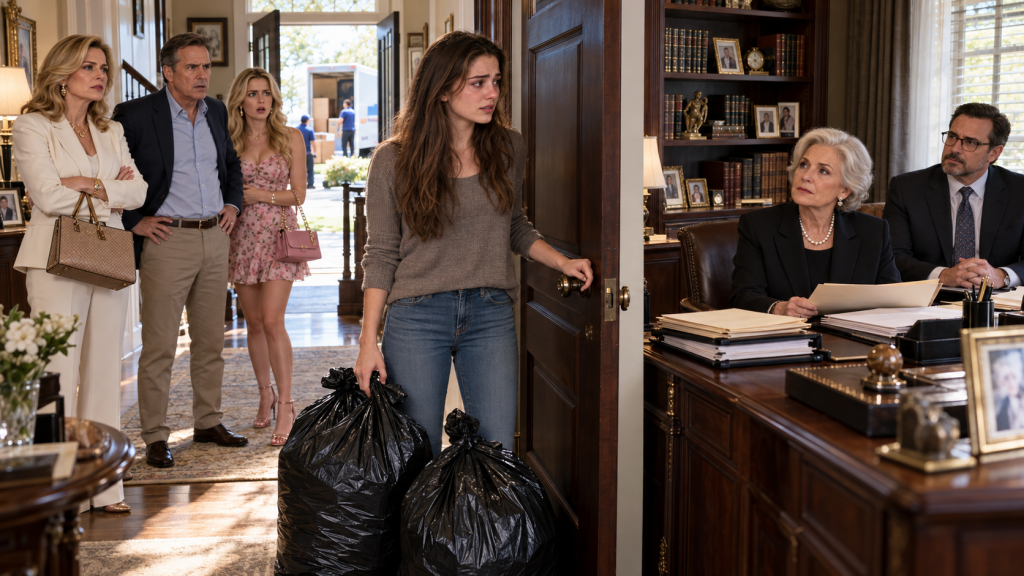
Dad reached for the computer again. Robert stood. “Mr. Sterling, step away from the desk.” “This is private family business.” Evelyn Vance rose beside him. “David, you’ve just walked into an estate meeting you weren’t invited to conduct. You have no authority to interfere with Arthur’s recorded instructions.” Dad pointed toward me. “She’s my daughter.”
The words hit me like an insult.
Seventeen years.
Seventeen birthdays.
Seventeen Christmas mornings.
Seventeen years of school concerts, college applications, heartbreaks, illnesses, and ordinary little moments that make someone a parent.
He had missed all of them.
Yet now he wanted to claim the title as though it were written on a piece of property.
I looked straight at him.
“Then act like you know me.”
His mouth opened.
Nothing came out.
I stepped closer to the computer.
“Please continue the recording, Robert.”
Evelyn gave a small nod.
Robert pressed play.
And Grandpa’s face filled the screen again.
He was sitting in the leather chair beside his study window.
The same chair where he’d read the newspaper every morning, usually with a cup of coffee balanced dangerously on one armrest.
He looked thin.
His gray sweater hung loosely around his shoulders.
But his eyes were gentle and clear.
“My little one,” he began, “I want you to remember something before you hear the rest.”
I swallowed.
“You were never abandoned because you were worth less than your sister.”
A sob escaped my throat.
Grandpa paused in the recording, as though he knew I might need time.
“You weren’t too difficult. You weren’t too expensive. You weren’t too much trouble.”
He took a breath.
“The adults around you made choices that belonged to them. Not to you.”
Behind me, Mom whispered, “This is ridiculous.”
Evelyn turned.
“Caroline, you may listen quietly or leave the room.”
Mom fell silent.
Grandpa continued.
“When you were four, your grandmother Clara passed away. She loved you deeply, Maya. She loved both her granddaughters.”
I remembered Grandma Clara only in fragments.
The smell of lavender soap.
A soft hand brushing hair away from my forehead.
A woman humming while she fastened the buttons on my winter coat.
Grandpa kept a photograph of her beside his bed.
He kissed the frame every night before turning off the light.
“She had put money aside for you,” Grandpa said. “Money she wanted you to use for your education and your future.”
Dad went absolutely still.
Grandpa looked down at some papers.
“Your father was responsible for managing that money when you were a child.”
Something cold moved through me.
“After Clara died, he and Caroline began taking money from the account. Not for your needs. For debts they had accumulated.”
I stared at the screen.
Grandpa’s voice trembled.
“When I discovered what was happening, I confronted them. They told me that if I continued asking questions, they’d move away and I would never see you again.”
I heard Chloe inhale sharply.
Grandpa continued.
“I told them I would seek help to protect you. There were lawyers. Meetings. Arguments. And a terrible afternoon when they brought you to my house and said they wanted me to raise you.”
My knees weakened.
I remembered that afternoon.
My yellow dress.
My little suitcase.
Mom telling me she’d return on Sunday.
Grandpa wiped his eyes on the recording.
“They signed documents concerning your care. But the money mentioned in those papers was not a payment I gave them to take you off their hands.”
He looked directly into the camera.
“It was money they had already taken from an account that belonged to you.”
The room went silent.
Then Grandpa whispered:
“Maya, the person who paid for their new life was you.”
I felt the words enter me without making sense.
Me?
I had paid them?
At five years old?
The little girl who waited beside the window had somehow financed the very life her family chose without her.
I turned toward Dad.
“What does he mean?”
Dad shook his head.
“Your grandfather never understood business.”
I looked at Mom.
Her face had gone pale beneath her makeup.
“Mom?”
She avoided my eyes.
Evelyn opened a file.
“Your grandmother established a custodial investment account for your benefit. Your father was the designated custodian. The account statements indicate that substantial amounts were withdrawn and transferred to accounts associated with David and Caroline.”
“How much?”
Nobody answered.
I looked at Evelyn again.
“How much money did they take?”
She glanced toward Robert.
Then gently turned a statement toward me.
The figures blurred through my tears.
I wiped my face.
Read them again.
And felt the floor disappear beneath me.
One hundred and eighty-six thousand dollars.
Chloe suddenly laughed.
Not because anything was funny.
It was the frightened, disbelieving laugh of someone who had just heard a stranger describe her family.
“That can’t be right.”
She looked toward Dad.
“You told me Grandpa wanted Maya to live here.”
Dad swallowed.
“He did.”
“And you said he paid you to cover her expenses.”
Mom stepped forward.
“Chloe, honey, this isn’t your concern.”
Chloe stared at her.
“Not my concern?”
Her voice rose.
“You told me Maya hated California. You said she didn’t want to come with us.”
I turned toward my sister.
“What?”
She looked at me.
For the first time since entering the house, her expression contained something other than entitlement.
Confusion.
Real confusion.
“Mom said Grandpa asked to keep you,” she whispered. “She said you cried whenever they mentioned taking you home.”
My chest tightened.
I shook my head.
“I waited for you.”
Chloe went still.
“Every Sunday at first,” I continued. “Then every birthday.”
Her lips parted.
“I thought you didn’t want me.”
I looked at Mom.
She was staring at the floor.
And something inside me began to break all over again.
Outside, a mover called from the driveway.
“Mr. Sterling? Are we taking the dining-room table or not?”
Dad flinched.
Robert walked to the window.
“Please stop all loading,” he called. “The property belongs to a trust, and this removal hasn’t been authorized.”
The mover hesitated.
Then nodded and called to his crew.
Evelyn looked at Dad.
“Your father’s estate planning does not give you possession of this house. Maya is the sole beneficiary of the trust holding it. Robert is assisting with the immediate administration, and the trust provides for Maya to assume responsibility as successor trustee under the transition provisions.”
Dad’s jaw tightened.
“You can’t disinherit your own son.”
Evelyn answered evenly.
“Your father was entitled to decide how to distribute his property, subject to applicable law. You cannot acquire it simply by arriving with a moving truck.”
Mom grabbed the garbage bags from the floor.
“This is absurd. We have rights.”
“Then you may pursue them through counsel,” Evelyn said. “You may not remove trust property.”
Grandpa’s recorded voice rose again.
“There is one more thing, Maya.”
We all turned.
He was looking into the camera with an expression I recognized.
It was the look he wore when something hurt him and he didn’t want me to see.
“I’ve saved the records because one day you may want answers. And because the people who took from you might someday return asking for more.”
His breathing grew unsteady.
“But I don’t want money to become the measure of your life.”
He smiled faintly.
“I didn’t raise you because you came with an inheritance.”
A tear slipped down his cheek.
“I raised you because you were mine to love.”
I covered my mouth.
Then Grandpa leaned closer to the camera.
“And sweetheart, when Evelyn shows you the red folder, don’t let anyone convince you that what happened next was your fault.”
The recording ended.
I turned toward Evelyn.
“What red folder?”
She opened the bottom drawer of Grandpa’s desk.
Inside lay a thick crimson file.
Across the front, in Grandpa’s familiar handwriting, were four words.
THE TRUTH ABOUT SUNDAY.
And beneath them, a date.
The date my parents abandoned me.
Evelyn placed the crimson folder on Grandpa’s desk.
I stared at it for several seconds before reaching forward.
The cardboard edges were worn.
One corner had been repaired with transparent tape.
Grandpa had written the date twice, as though he’d been afraid somebody might misread it.
I remembered that Sunday with such painful clarity.
The blue sky.
The sound of a lawn sprinkler.
My yellow dress scratching the backs of my knees.
A little suitcase waiting beside Grandpa’s front door.
I remembered being five years old and certain that if I sat perfectly still, my parents would come back.
Now I was twenty-two.
And I was about to learn what the adults had been doing while I waited.
Evelyn opened the folder.
Inside were copies of financial records, correspondence, and the documents from the guardianship proceedings that followed my parents’ departure.
She spread them across the desk.
“The agreement you saw earlier is not a document that legally sold a child,” she explained. “No such private agreement could replace a court’s responsibility to consider a child’s welfare.”
I nodded slowly.
“Then why did it say settlement?”
“Because your grandfather and your parents were also discussing the money that had been removed from your custodial account. Unfortunately, the papers were drafted in a way that combined references to your care with the financial dispute.”
She pointed to another document.
“Your grandfather later pursued legal guardianship through the court, supported by evidence that he was providing your actual day-to-day care.”
I swallowed.
“So he became my guardian?”
“Yes.”
“Legally?”
“Yes, Maya.”
I looked toward Dad.
“And they agreed?”
Evelyn paused.
“They did not meaningfully contest the arrangement at the time.”
My chest tightened.
Not meaningfully contest.
Such gentle words for something that had broken my childhood in two.
I turned another page.
There was a bank statement with several withdrawals highlighted in yellow.
Forty thousand dollars.
Thirty-five thousand.
Twenty-seven thousand.
Smaller withdrawals followed.
They had taken the money over a period of months.
Not in one desperate moment.
Not because of a single emergency.
Repeatedly.
Deliberately.
I looked at Mom.
“What did you buy?”
She folded her arms.
“Don’t make this ugly.”
I almost laughed.
“You arrived here with garbage bags to throw me out of my own home.”
Her eyes narrowed.
“You’ve become very disrespectful.”
I stared at her.
There was something almost astonishing about hearing that word.
Disrespectful.
Apparently, I was allowed to lose my grandfather, discover that my parents had taken money belonging to me, and be ordered out of my home.
But asking what happened was disrespectful.
I turned toward Evelyn.
“Please tell me.”
She took a breath.
“Some withdrawals appear connected to business debts. Others were transferred into the household accounts your parents used after moving to California.”
I looked down.
“What about Chloe?”
Nobody spoke.
Then Chloe said quietly:
“What about me?”
I stared at her.
She was standing beside Grandpa’s bookcase, still holding the book she’d been planning to throw away.
“I want to know whether any of my money was spent on you.”
She recoiled.
“Are you blaming me?”
“No.”
My voice shook.
“I’m asking what they did.”
Evelyn answered carefully.
“The records indicate that the transferred money entered accounts used for ordinary household expenses and larger expenditures. We cannot assign every purchase to a particular person based on these records alone.”
I nodded.
Chloe looked at Dad.
He looked away.
The next page was a letter.
It was written on the letterhead of a law firm I’d never heard of.
Dated seventeen years earlier.
Addressed to Grandpa.
Evelyn read part of it aloud.
David and Caroline were demanding that Arthur stop questioning certain transactions.
They claimed the money had been used for appropriate family purposes.
They also stated that continued allegations would make future contact with Maya difficult.
I stared at those words.
Then at Dad.
“You threatened to take me away?”
He looked exhausted.
“Maya, it was complicated.”
I shook my head.
“I was five.”
“I know.”
“No,” I whispered. “You don’t.”
I remembered Grandpa taking me to kindergarten.
Waiting outside the classroom because I cried whenever he tried to leave.
I remembered him kneeling beside me.
Promising he’d be there when school finished.
Every day.
He kept that promise so faithfully that eventually I stopped being afraid.
“You weren’t worried about me,” I said to Dad. “You were worried about the money.”
He opened his mouth.
Then closed it.
Mom stepped forward.
“You have no idea what we were dealing with.”
I looked at her.
“Then tell me.”
She hesitated.
I continued.
“Tell me why you couldn’t call on my sixth birthday.”
Silence.
“Tell me why you didn’t send a Christmas card.”
Nothing.
“Tell me why I spent years wondering whether I’d been such a bad little girl that you couldn’t bear to see me.”
Mom looked away.
And I finally understood that there might never be an explanation capable of making what she’d done bearable.
Chloe lowered herself into Grandpa’s chair.
For the first time since she arrived, she seemed to forget all about the master bedroom.
“I remember our old house,” she whispered.
Dad looked toward her.
“Chloe, not now.”
She ignored him.
“We moved after you left Maya here. Mom said Grandpa wanted you because you needed special attention.”
I stared.
“Special attention?”
Chloe nodded miserably.
“She said you were difficult. That you cried constantly and wouldn’t settle anywhere.”
My throat tightened.
“I cried because I missed you.”
Her eyes filled.
“I didn’t know.”
Mom snapped:
“Chloe, you were a child.”
Chloe turned toward her.
“So was Maya.”
Those four words seemed to change the air in the room.
Mom went silent.
Dad stared at the carpet.
I looked at my sister.
For seventeen years, I’d imagined her living a perfect life with the parents who didn’t want me.
I’d imagined Christmas trees, birthday cakes, vacations, family photographs.
Perhaps she had enjoyed all those things.
But now I was beginning to understand that my parents had also constructed a story for her.
A story in which I hadn’t been abandoned.
A story in which Grandpa had simply taken me away.
A story that allowed them to keep living without answering the most painful question.
Why did you leave Maya behind?
Robert cleared his throat.
“There’s another document, Maya.”
He opened a separate envelope.
It contained a letter from Grandpa.
Not the recorded farewell.
A much older letter.
Dated shortly after my sixth birthday.
Evelyn handed it to me.
I recognized Grandpa’s handwriting immediately.
Dear David and Caroline,
Maya asked whether you were coming to see her today.
I told her I had not heard from you.
She waited by the front window until the sun went down.
I will continue ensuring that she is loved and cared for, but I cannot continue reassuring her with promises you haven’t made.
If you want to establish meaningful contact, please speak with me and the appropriate professionals about a consistent plan that puts her needs first.
She deserves honesty.
Your father, Arthur.
Tears spilled down my face.
I pressed the letter against my chest.
Grandpa had seen me waiting.
He had known what every unanswered birthday was doing to me.
And he had tried to make them understand.
“Did they answer?” I whispered.
Evelyn slowly shook her head.
“Not that letter.”
I looked down.
Then another thought struck me.
“Did Grandpa write to them again?”
Robert nodded.
“Several times.”
I swallowed.
“And did they ever try to see me?”
Evelyn hesitated.
“There were communications. Some concerned money and the guardianship. Your grandfather preserved them, including one that may surprise you.”
She reached into the folder.
Removed a photograph.
And placed it in front of me.
It showed my parents standing outside Grandpa’s house.
I recognized the porch.
The front steps.
The old red mailbox that Arthur replaced when I was twelve.
But I didn’t recognize the scene.
I turned the photograph over.
The date was from nine years earlier.
When I was thirteen.
My chest tightened.
“They came here?”
Evelyn nodded.
“Yes.”
I stared at Dad.
“You came to this house when I was thirteen?”
His face drained.
I whispered:
“Why didn’t you come inside?”
For the first time since entering Grandpa’s study, Dad looked genuinely afraid to answer.
Then Chloe said something that made the silence even worse.
“That’s the summer Mom told me Maya had refused to meet us.”
I turned toward her.
“What?”
Her voice trembled.
“She said Grandpa asked whether you’d see us, and you said no.”
I shook my head.
“No one asked me.”
Mom suddenly moved toward the door.
“We’re leaving.”
But I was already looking at the next sheet.
A printed email.
And the subject line made my heart begin pounding.
RE: PROPERTY VALUATION AND GUARDIANSHIP REQUEST.
They hadn’t come to see me.
They had come to discuss Grandpa’s house.
I read the email three times.
Then a fourth.
The words remained the same.
We are prepared to discuss resuming Maya’s contact with her immediate family, provided Arthur is willing to address the outstanding financial concerns and the future disposition of the residence.
I stared at that sentence.
Provided Arthur is willing.
They had made seeing me conditional on Grandpa discussing money.
Again.
I looked toward Dad.
“You came when I was thirteen because you wanted something from Grandpa.”
He swallowed.
“It wasn’t that simple.”
“Then explain it.”
Dad looked toward Evelyn.
“Those emails were private.”
Evelyn answered calmly.
“They were preserved in Arthur’s records concerning Maya’s welfare and the related financial dispute. Maya is entitled to ask what happened.”
I turned back to him.
“Explain it.”
Dad rubbed his forehead.
“Our business was going through a difficult period.”
I waited.
“We thought your grandfather might be willing to help.”
“With what?”
He hesitated.
“A financing arrangement.”
I looked down at the email.
“You wanted him to use the house as security.”
Dad said nothing.
I looked up.
“Didn’t you?”
Finally, he nodded.
For a moment, I could only stare.
When I was thirteen, I had been growing my hair long because I thought Mom might like it.
I had secretly practiced making pancakes because I imagined cooking breakfast for my family if they ever visited.
I had written a letter to Chloe that I never sent because I was frightened she’d laugh at me.
And while I was doing all that, my parents had returned to Grandpa’s driveway seeking another financial favor.
“Did you ask about me?” I whispered.
Dad’s mouth tightened.
“Of course.”
I looked at Evelyn.
She opened another page.
Grandpa’s reply.
I will not place my home at risk to support your business. If your interest in Maya is genuine, we can discuss age-appropriate contact with appropriate guidance, independently of any financial request.
My eyes filled.
He had offered them a way to see me.
Without money.
Without bargaining.
Without conditions.
I looked at Dad.
“What did you say?”
He stared at the floor.
Evelyn answered.
“They didn’t pursue the contact arrangement.”
Something inside me went very quiet.
I had spent seventeen years wondering whether my parents had been unable to return.
Now I knew they had been able.
They had simply chosen not to come unless coming benefited them.
Chloe was crying.
Silently.
Almost angrily.
She looked toward Mom.
“You told me Grandpa wouldn’t let us see her.”
Mom shook her head.
“He was difficult. He made everything impossible.”
Chloe pointed toward the letter.
“He offered to arrange a visit.”
Mom’s eyes flashed.
“You don’t understand what it was like dealing with him.”
I looked at her.
“No,” I said.
“I understand exactly what it was like being loved by him.”
Dad suddenly reached for his phone.
“I’m calling my lawyer.”
Evelyn nodded.
“That would be sensible.”
He glared at her.
“You people are treating me like a criminal.”
“Nobody here is making a criminal finding,” Evelyn replied. “But your financial conduct and the documents need careful review.”
Dad’s expression hardened.
“Those withdrawals happened seventeen years ago.”
Robert looked at him.
“The age of a transaction doesn’t determine whether the underlying accounting questions disappear. Counsel will assess the applicable claims, deadlines, and remedies.”
Dad went silent.
For the first time, I realized his confidence had depended on everyone around him being too frightened, too trusting, or too uninformed to challenge him.
The movers called again.
Robert excused himself and went outside.
Through the study window, I watched him speak with the crew supervisor.
The men stopped moving furniture.
One gently lowered Grandpa’s dining-room chair onto the lawn.
The sight made my stomach twist.
That chair belonged inside.
At the table where he’d helped me with my homework.
At the place where he’d sat every birthday, pretending he didn’t know I’d made him another terrible homemade card.
I wanted to run outside and carry it back myself.
But Evelyn touched my arm.
“Let us handle the immediate property issues, Maya.”
I nodded.
Dad moved toward the doorway.
“We’re leaving.”
Mom followed him.
Then Chloe.
But at the threshold, my sister stopped.
She looked back at me.
Her makeup had run beneath her eyes.
For a moment, I thought she might apologize.
Instead, she whispered:
“Did Grandpa really tell you we never came because we didn’t want you?”
I stared at her.
“He told me you hadn’t come.”
She swallowed.
“And what did you think?”
My voice broke.
“I thought if I became better, you’d remember me.”
Chloe began crying again.
I watched her turn away.
And I realized there was no way to make that sentence hurt only one of us.
The moving company returned the chair and other furniture it had taken outside.
Robert and Evelyn documented what had been disturbed.
Nothing was allowed to leave without proper authorization.
Dad argued briefly with the supervisor.
Then, apparently realizing that the crew would not continue without proof of his authority, he paid the cancellation charge.
Mom stood beside the SUV, speaking rapidly into her phone.
Chloe remained near the porch.
Her arms were wrapped around herself.
When they finally drove away, I expected relief.
Instead, the house felt painfully empty.
I stood in the front hallway, looking at the two black garbage bags Mom had shoved into my arms less than an hour earlier.
They were still lying on the floor.
Empty.
Waiting for the clothes I had been ordered to pack.
I bent down.
Picked one up.
And suddenly began crying so hard that I couldn’t breathe.
Evelyn came toward me.
“Maya.”
I shook my head.
“I’m sorry.”
“You have nothing to apologize for.”
I tried to speak.
But all I could manage was:
“He knew.”
Evelyn knelt beside me.
“Who?”
“Grandpa.”
My voice shattered.
“He knew they might come back and do this.”
She nodded sadly.
“Yes.”
I pressed my hands over my face.
“And he was dying, and instead of worrying about himself, he was making sure I wouldn’t lose my home.”
Evelyn’s eyes filled.
“Arthur loved you very much.”
I laughed bitterly through tears.
“He worried about me until the last day.”
She reached for my hand.
“That’s true.”
I looked at her.
“Why didn’t he tell me about the money?”
She hesitated.
“Some of those decisions were his to explain. I can tell you that he often feared the records would make you feel as though your parents had assigned a price to your presence in their lives.”
I swallowed.
“He knew I already felt unwanted.”
“Yes.”
I stared toward the study.
The room he’d kept carefully organized.
The chair where he’d sat with his tea.
The bookshelf containing the same history books he’d read over and over.
He had lived with those documents.
Those ugly secrets.
All those years.
And he’d never once made me feel like a burden.
“Was he angry with them?” I asked.
Evelyn took a breath.
“Very.”
I nodded.
“Did he ever stop loving Dad?”
She looked toward the window.
“I don’t think so.”
I swallowed.
“But he stopped trusting him.”
“Yes.”
I sat quietly for a long time.
Then Robert returned.
He carried a clipboard and a small envelope.
“The house is secure,” he said. “The movers have left. I’ve also spoken with the estate’s insurance representative about documenting the attempted removal.”
I nodded.
“Thank you.”
He sat across from me.
“Maya, there’s another part of your grandfather’s arrangements we should discuss.”
My stomach tightened.
“More secrets?”
He smiled sadly.
“Not exactly.”
He opened a summary of the trust.
Grandpa had transferred the house into a revocable living trust while he was alive.
The documents contained detailed provisions for administration after his death.
I was the sole beneficiary of the trust assets designated to pass to me.
Robert had temporary administrative responsibilities to help complete the transition.
And Grandpa had named me to assume the trustee role once the required steps were completed.
I stared at the pages.
“Why did he involve Robert?”
“Your grandfather wanted an experienced person available immediately after his death,” Evelyn explained. “He was concerned that your parents might make claims before you had a chance to understand the documents.”
I nodded slowly.
“He told you they’d come.”
Evelyn met my eyes.
“He believed it was possible.”
Robert turned another page.
“There are also financial assets.”
I almost laughed.
“Grandpa barely bought himself new shoes.”
He smiled.
“He was careful with money.”
“That doesn’t mean he had any.”
Robert looked at Evelyn.
She nodded.
He placed a summary in front of me.
I stared at the figures.
The house.
A portfolio of investments accumulated over decades.
An interest in a small commercial property partnership Grandpa had held since the 1990s.
Several savings accounts.
And a reserve for anticipated taxes, expenses, and administration.
I looked up.
“Is this real?”
Evelyn nodded.
“Yes.”
My throat tightened.
“He never told me.”
Robert answered gently.
“He wasn’t hiding an extravagant life from you. Arthur preferred to live simply, and he took his responsibilities as a steward of these assets seriously.”
I stared.
Grandpa’s old sweaters.
His repaired furniture.
His tomatoes.
The way he saved rubber bands and reused grocery bags.
“Why would he leave all this to me?”
Evelyn’s expression softened.
“Because he wanted the person he loved and trusted to be protected.”
I looked down.
“And Dad gets nothing?”
“Arthur’s documents intentionally omit David as a beneficiary of these particular assets, subject to any valid legal claims. Your father may choose to contest the arrangements, but merely being Arthur’s son doesn’t entitle him to seize them.”
I sat back.
For a moment, I imagined how excited my parents must have been when they heard Grandpa had died.
They hadn’t come to his funeral.
Hadn’t asked what his final days were like.
Hadn’t even called to see whether I was managing.
They’d sent a text.
Then brought a moving truck.
They believed the old man who’d raised me had finally left them something valuable enough to claim.
I looked at Grandpa’s portrait.
And whispered:
“You were ready for them.”
Evelyn reached into her briefcase.
“One more thing, Maya.”
I looked up.
She handed me a small envelope.
On its front, Grandpa had written:
FOR THE DAY YOU THINK LOVE HAS TO BE EARNED.
My hands trembled.
I opened it.
Inside was a photograph of us when I was seven.
I was sitting on his shoulders, grinning beneath a crooked paper crown.
On the back, he’d written:
You never had to become perfect to deserve a home.
I began crying again.
And this time, I let myself.
For the next two days, I barely left Grandpa’s house.
I didn’t know what else to do.
His funeral flowers were beginning to wilt.
The casserole dishes neighbors had brought were stacked in the refrigerator.
His slippers remained beside the back door.
Every room was filled with him.
And every room now contained the memory of my parents trying to claim it.
On Monday morning, Evelyn called.
“Good morning, Maya.”
I sat at the kitchen table with a cup of tea.
“Morning.”
“How are you feeling?”
I looked toward Grandpa’s empty chair.
“Like somebody took the roof off my life and left me standing in the rain.”
She was quiet.
Then said:
“That’s a very understandable feeling.”
Evelyn explained that David had contacted an attorney.
He was questioning Grandpa’s estate plan and requesting additional documents.
I felt my stomach tighten.
“He’s going to try to take the house.”
“He may attempt a legal challenge.”
“Can he win?”
“Any challenge depends on its grounds and evidence. Your grandfather took care to document his intentions and obtain independent advice. We will respond through the proper process.”
I swallowed.
“Could they make me move while everything is being decided?”
“Don’t assume that. The property remains subject to the trust’s administration, and we’ll address any actual legal requests as they arise.”
I nodded.
Then whispered:
“Grandpa promised I’d always have somewhere to go.”
Evelyn’s voice softened.
“I know.”
The next morning, a letter arrived from my father’s attorney.
It questioned whether Grandpa had been mentally capable of making his final amendments.
I read the first page.
Then set it down.
My hands were shaking.
Grandpa had been forgetful near the end.
Sometimes he misplaced his glasses.
Sometimes he asked whether I’d eaten dinner when we’d just finished washing the dishes.
But he knew who I was.
He knew what belonged to him.
He knew why he wanted me protected.
Evelyn later showed me the records supporting his decisions.
The trust had been established years earlier.
Its principal provisions had been reviewed while he was well.
More recent documents had been executed with appropriate legal safeguards and documentation of his understanding.
Nothing depended entirely on a video recorded during his final illness.
The video was a personal message.
His legal arrangements stood on their own documents and supporting evidence.
That distinction mattered to me.
Because I didn’t want Grandpa’s last words turned into a contest about whether he had loved me enough.
He had already answered that question every day for seventeen years.
Then, on Wednesday evening, my phone rang.
An unfamiliar number.
I almost ignored it.
Something made me answer.
“Hello?”
A woman spoke.
“Maya?”
I recognized the voice immediately.
Chloe.
I sat very still.
“What do you want?”
She hesitated.
“I need to talk to you.”
I stared at the rain outside the kitchen window.
“You had plenty to say when you came here.”
“I know.”
My throat tightened.
“You were going to throw away Grandpa’s books.”
Her breathing changed.
“I know that too.”
For several seconds, neither of us spoke.
Then Chloe whispered:
“Mom says you’re trying to ruin our family.”
I closed my eyes.
“And what do you think?”
She hesitated.
“I don’t know what to think anymore.”
I swallowed.
“That’s more honest than anything she said.”
Chloe let out a shaky breath.
“I found something.”
My stomach tightened.
“What?”
“A box of letters.”
I stared toward the hallway.
“What letters?”
She hesitated.
“Mine.”
I frowned.
“What do you mean?”
“When I was little, I used to write to you.”
My chest tightened.
“You never wrote to me.”
“Yes, I did.”
I shook my head, though she couldn’t see me.
“No.”
“Maya, I wrote every year.”
The kitchen seemed to go very quiet.
Chloe continued.
“Birthdays. Christmas. Sometimes when I just missed you.”
I gripped the table.
“Grandpa would have given them to me.”
She swallowed.
“They never reached him.”
I closed my eyes.
“Why?”
“Mom told me she mailed them.”
My throat tightened.
“She said you didn’t answer because you were angry with us.”
I could barely breathe.
“I wasn’t angry when I was little,” I whispered.
Chloe began crying.
“I know that now.”
“I kept asking Grandpa whether you remembered me.”
Her voice broke.
“I did remember you.”
I looked toward the refrigerator.
A photograph of me at nine was held against the door with a tomato-shaped magnet.
Grandpa had taken it at a school picnic.
I was smiling.
But I remembered crying that morning because another girl had introduced her older sister to everyone.
“Why didn’t you call?” I asked.
Chloe sobbed quietly.
“I asked.”
I said nothing.
“Mom told me Grandpa didn’t want us upsetting you.”
My eyes filled.
“And you believed her.”
“I was eight when we left.”
I swallowed.
“Yes.”
She continued.
“But I got older. I could have looked for you myself.”
I closed my eyes.
“That part is true.”
Chloe was silent.
Then she whispered:
“I was angry at you because I thought you chose him over us.”
The words hurt.
But they also explained something.
The coldness.
The mocking smile.
The confidence with which she’d marched upstairs and announced she was taking Grandpa’s room.
She had been carrying a false story for seventeen years.
And she’d allowed that story to become an excuse for treating me cruelly.
“Chloe,” I said quietly, “you still came into my house the day after Grandpa’s funeral and tried to take his bedroom.”
She began crying harder.
“I know.”
“You didn’t ask whether I was okay.”
“No.”
“You didn’t even say you were sorry he died.”
Her voice cracked.
“No.”
I took a breath.
“Being lied to explains why you were angry. It doesn’t make what you did right.”
She was silent for a moment.
Then whispered:
“I understand.”
I looked at the rain.
“What do you want from me?”
Her answer came slowly.
“Nothing.”
I almost laughed.
“Really?”
“Yes.”
She swallowed.
“I just wanted you to know I didn’t forget you.”
My chest tightened.
“And there’s something else.”
I waited.
“Mom asked me to sign a statement yesterday.”
I sat up.
“What statement?”
“She wanted me to say Grandpa promised Dad the house.”
My stomach dropped.
“Did you sign it?”
“No.”
I closed my eyes.
“She said you’d stolen everything from him,” Chloe continued. “That Grandpa was confused and you had manipulated him.”
My throat tightened.
“And?”
Chloe’s voice became stronger.
“I told her I wasn’t there when the trust was made. I wasn’t going to swear to something I didn’t know.”
For a moment, I couldn’t speak.
Then I whispered:
“Thank you.”
She cried quietly.
“It’s the first time I’ve told her no about something this big.”
I stared toward the window.
“I know the feeling.”
We were silent for a long time.
Then Chloe said:
“Can I give you the letters?”
My throat tightened.
“Yes.”
“Could we meet somewhere?”
I thought about it.
Not at Grandpa’s house.
Not yet.
That house had to remain a place where I felt safe.
“There’s a café near the library,” I said. “Saturday afternoon.”
Chloe exhaled.
“Okay.”
“And Chloe?”
“Yes?”
“Come alone.”
A pause.
Then:
“I will.”
On Saturday, I arrived early.
I chose a table near the window.
My hands trembled as I unfolded a napkin.
I didn’t know whether I wanted to see her.
Part of me wanted to run.
Another part desperately wanted to meet the sister I’d imagined for seventeen years.
Chloe arrived carrying a shoebox.
She wore jeans and a plain sweater.
No expensive handbag.
No perfectly arranged sunglasses.
For a moment, she looked younger than twenty-six.
Then she saw me.
And stopped.
“Hi,” she whispered.
“Hi.”
She sat across from me.
Placed the shoebox between us.
Then pushed it toward me.
Inside were letters.
Dozens of them.
Some written in large childish handwriting.
Others on notebook paper.
A few decorated with glitter and stickers.
Most addressed simply:
TO MAYA.
I opened the first.
It was dated six months after I’d been left with Grandpa.
Dear Maya,
I miss you.
Mommy says you like living with Grandpa.
Do you still have the yellow dress?
I saved you a purple bracelet.
Please write back.
Love, Chloe.
I began crying.
Chloe covered her mouth.
I opened another.
Dear Maya,
I’m ten now.
I learned to do cartwheels.
I wish you could see.
Do you remember the song we used to sing?
A third.
Dear Maya,
Mom says I should stop writing because it makes me sad.
But I don’t want you to think I forgot you.
I looked up.
Chloe was crying openly.
“I thought you hated me.”
I shook my head.
“I thought you forgot me.”
She reached across the table.
Then stopped.
Waiting.
For permission.
I looked at her hand.
And after a moment, I placed mine beside it.
Not quite touching.
Not yet.
But close enough to mean something.
Then Chloe whispered:
“Maya, there’s a letter you need to read first.”
She reached into the bottom of the box.
Removed a sealed envelope.
And placed it in front of me.
It wasn’t addressed in childish handwriting.
It was written in Mom’s unmistakable script.
CHLOE — NEVER SEND THIS.
I stared.
Chloe swallowed.
“I found it with the others. Mom wrote it after we moved.”
I turned the envelope over.
The seal was already broken.
Inside was a single sheet of paper.
And at the top were three words that made my heart stop.
IF MAYA ASKS.
I unfolded the page.
The handwriting was neat.
Careful.
Exactly the way Mom used to write birthday cards for people she wanted to impress.
At the top, beneath IF MAYA ASKS, she had written several short sentences.
Tell her we made the best decision for everyone.
Tell her Arthur offered to take her because he had more time.
Tell her she was unhappy in California.
Tell her Chloe needed stability.
I stopped reading.
My hands were shaking.
Below those instructions was another line.
Never discuss the custodial money or the agreement with Arthur.
And beneath it:
If the girls ever speak again, they must hear the same story.
For a long time, neither of us moved.
Then Chloe whispered:
“She planned what to tell us.”
I looked up.
Her face was white.
“She knew we’d ask questions someday.”
I nodded.
“And she was ready with answers.”
Chloe began crying.
“I believed every word.”
I looked down at the letter again.
I felt anger.
A deep, bitter anger.
But beneath it was something even harder to bear.
Grief for the childhood we might have had.
Two sisters.
Living hundreds of miles apart.
Each convinced the other had rejected her.
I looked at Chloe.
“Do you remember when we used to build forts with couch cushions?”
She wiped her cheeks.
“Yes.”
“You always insisted on being the queen.”
A broken smile appeared.
“And you were my knight.”
I laughed through tears.
“You never let me have the crown.”
She shook her head.
“No.”
For a moment, we were little girls again.
Before the money.
Before the lies.
Before the endless Sundays.
Then Chloe looked at me.
“I wish I’d found you sooner.”
I swallowed.
“So do I.”
We sat at the café for nearly two hours.
I told her about Grandpa.
How he made waffles on Saturday mornings.
How he cried at my high-school graduation.
How he pretended he didn’t know I was sneaking out to meet my first boyfriend, then left the porch light on until I returned.
Chloe laughed.
Then cried.
She told me about California.
How Mom constantly compared her to other girls.
How Dad missed family events for business meetings.
How she’d grown up believing she had to be successful enough to justify every sacrifice her parents claimed they’d made for her.
It wasn’t the perfect childhood I’d imagined.
But it was a childhood in which she’d known her parents would be there in the morning.
And I couldn’t pretend those experiences were equal.
“Chloe,” I said quietly, “I need you to understand something.”
She nodded.
“I don’t know whether we’re going to become close.”
Her eyes filled.
“I know.”
“What happened doesn’t disappear because we’ve discovered the truth.”
She wiped her cheeks.
“I understand.”
I looked at the shoebox.
“But I’d like to try knowing you.”
Her face crumpled.
She nodded.
“Me too.”
I brought the letters home.
That evening, I sat in Grandpa’s study and read every one.
Some were only three sentences long.
Some were covered in little drawings.
In one, Chloe had included half a friendship bracelet.
She’d written:
I kept the other half. Maybe we can wear them when I see you.
I pressed the paper against my chest.
Then opened the desk drawer.
Inside was a small velvet pouch.
Grandpa had kept my childhood treasures there.
A tooth I’d lost at six.
A ribbon from my first spelling competition.
And a faded purple bracelet I’d made for a sister who never returned.
I held it beside the photograph of Chloe’s bracelet.
For seventeen years, both of us had been reaching toward someone we thought had turned away.
The following week, Evelyn reviewed Mom’s letter.
She explained that it could be relevant evidence of how my parents had described the separation and the financial arrangements.
Chloe agreed to preserve the original and provide an accurate account of where she’d found it.
Nobody assumed the letter alone proved every allegation.
But it helped establish a pattern.
A story carefully constructed.
Maintained for years.
And repeated whenever somebody came too close to asking what had really happened.
Meanwhile, my parents’ estate challenge continued.
Dad’s attorney sought records.
Evelyn supplied what was legally required.
Grandpa’s trust documents, independent advice, and supporting records were examined.
Dad’s initial claim that Grandpa had promised him the house wasn’t supported by a deed, trust amendment, or any other enforceable transfer.
Then another complication emerged.
Dad had already told a lender in California that he expected to inherit valuable real estate after Grandpa’s death.
He had included that anticipated inheritance in a financial presentation concerning the refinancing of his business debts.
When Evelyn learned of the statement, she notified the relevant parties that Dad had no authority to pledge trust property and that any claim to an inheritance was disputed.
I sat across from her, stunned.
“So he wasn’t just hoping to get the house.”
She shook her head.
“He was apparently counting on it.”
I swallowed.
“Before Grandpa was even buried.”
Evelyn’s expression softened.
“Yes.”
A terrible thought occurred to me.
“Is that why they came with the moving truck?”
“We can’t know everything they were thinking,” she replied. “But the financial records suggest they had strong incentives to obtain control of the property quickly.”
I nodded.
For seventeen years, I’d imagined my parents returning with explanations.
Maybe apologies.
Maybe gifts.
Maybe photographs showing all the years they’d missed.
Instead, they had come with movers because Grandpa’s death made the house look available.
Two weeks later, Dad called me.
I let it ring.
Then, after speaking with Evelyn about the ongoing dispute, I agreed to communicate through a documented channel.
His message was short.
Maya, we need to resolve this privately. There is no reason to destroy the family over old accounting issues.
I stared at the screen.
Old accounting issues.
He had found three words to describe the money taken from my childhood account.
Three words that left out the yellow dress.
The empty window.
The birthday candles.
The little girl who believed she had to become better to deserve being remembered.
I wrote back.
Please direct any legal or financial proposals to Evelyn.
Then I put the phone down.
A few days later, Mom sent a message of her own.
I hope you’ll eventually understand that parents have to make impossible decisions. We did what we thought was best.
I read it once.
Then turned off my phone.
Because I had spent too many years trying to understand why they left.
I no longer needed an explanation that made their choice sound noble.
I needed to decide what kind of life I wanted now.
That night, I opened Grandpa’s final personal letter.
There were only two pages.
He had written it slowly.
His handwriting leaned toward the right near the bottom.
I could picture him pausing to rest his hand.
Little one,
If you’ve discovered the financial records, I know you’re hurting.
I should have found a better way to tell you earlier.
I was afraid you’d grow up believing your childhood had been exchanged for money. I was afraid the truth would become another way they made you feel unwanted.
But I also know that keeping painful truths can become its own kind of mistake.
Tears filled my eyes.
Grandpa had never pretended he was perfect.
He apologized when he lost his temper.
When he forgot a school event.
When he misunderstood something I’d said.
He believed being older gave him experience.
Not permission to be unquestionable.
I can’t decide what you do about David and Caroline.
You may want accountability. You may want distance. You may someday want to hear them out.
Those choices belong to you.
But remember this: the money was yours because your grandmother loved you. The house is yours because I loved you. Neither gift was meant to purchase your affection or control your future.
I began sobbing.
Then read the final lines.
Spend your life with people who come back when they say they will.
And when you find someone standing at a window wondering whether they’re worth loving, remind them they never had to earn it.
Forever your Grandpa,
Arthur.
I folded the letter.
Pressed it against my heart.
And whispered:
“I’ll try.”
Summer arrived slowly.
The rain softened.
The backyard tomatoes began to ripen.
And Grandpa’s house, which had seemed unbearably quiet after his death, started to feel like somewhere I could breathe again.
I didn’t change his study immediately.
I kept the books where they belonged.
His old chair remained beside the window.
The wooden ruler he used as a bookmark stayed on the desk.
But I opened the curtains.
I brought in fresh flowers.
And I stopped treating the room like a place I wasn’t allowed to enter.
Robert continued helping with the trust administration while I learned what taking responsibility as trustee would involve.
There were accounts to understand.
Records to maintain.
Investment decisions to review with qualified professionals.
And legal responsibilities I couldn’t simply ignore because the money came from someone who loved me.
For a while, I felt overwhelmed.
One morning, I looked at a stack of financial papers and laughed.
“Grandpa, you could have warned me there’d be so much paperwork.”
Then I cried.
Because there was nobody sitting across from me to laugh back.
Evelyn helped me find the right advisers.
She also reminded me that being the beneficiary didn’t mean I needed to make every major decision immediately.
The house wasn’t going anywhere.
I didn’t have to sell the investments.
I didn’t have to transform my life overnight.
I could learn.
Ask questions.
Make thoughtful choices.
Gradually, I began to understand another lesson Grandpa had left me.
Money could provide security.
But security was not the same as love.
My parents had spent years confusing the two.
Grandpa never did.
The dispute over the old custodial account took longer than I expected.
The records confirmed significant withdrawals from money that had been set aside for me.
Determining precisely which expenditures were improper, what might still be recoverable, and which legal deadlines applied required careful work.
I learned that being wronged did not guarantee a quick court victory.
Evidence mattered.
Time mattered.
The law mattered.
And sometimes accountability came through imperfect choices rather than dramatic triumphs.
Eventually, after both sides had legal representation and the accounting was reviewed, Dad agreed to a financial settlement addressing a substantial portion of the disputed withdrawals.
It did not repay every dollar immediately.
His financial circumstances were too complicated for that.
The agreement required specific payments and financial disclosures, with remedies if he failed to meet its terms.
I accepted it after careful advice.
Not because I had forgotten.
Because I wanted a resolution grounded in what could actually be established and enforced.
His separate effort to obtain Grandpa’s house also came to an end.
After reviewing the trust documents and the evidence surrounding Grandpa’s decisions, Dad withdrew the challenge.
There was no sudden revelation that he had been the rightful heir all along.
No hidden deed.
No handwritten promise.
Only the arrangements Grandpa had deliberately made.
The house remained protected under the trust.
And I remained the person Grandpa had chosen to benefit from it.
Mom sent one more letter.
It arrived in a cream-colored envelope.
I recognized her handwriting before I opened it.
For a moment, I considered throwing it away.
Then I sat at the kitchen table and read it.
Maya,
I know things have become painful.
I hope you’ll remember that your father and I were young, frightened, and struggling financially.
We made decisions we believed were necessary.
Your grandfather was better positioned to care for you.
I never intended for you to feel abandoned.
I stopped.
There it was again.
A description of my childhood in which everyone had faced difficult circumstances and nobody had actually chosen to leave me.
I turned the page.
I would like us to put the past behind us. Your father has suffered enough, and Chloe is very upset.
I hope you’ll consider how much this has hurt the family.
I stared at the letter.
Then looked toward Grandpa’s photograph on the refrigerator.
The man who had sat beside my bed when I had nightmares.
Who had learned to braid my hair by watching instructional videos.
Who had attended every school concert even when the performances were dreadful.
Who’d worked extra hours to make sure I could go on a seventh-grade field trip.
I folded Mom’s letter.
Placed it in a drawer.
And didn’t reply.
I didn’t need to argue with her about whether she’d meant to hurt me.
The harm had happened.
I was allowed to acknowledge it without waiting for her to agree.
Chloe’s relationship with our parents changed too.
She moved into an apartment of her own.
Started handling her finances independently.
And stopped allowing Mom to speak for her.
When Dad tried to persuade her to support his version of Grandpa’s promises, she refused.
One evening, she called me.
“Maya?”
“Hi.”
“Can I ask you something?”
“Sure.”
She hesitated.
“Do you think people can change?”
I thought about Grandpa.
About his patience.
His stubbornness.
His willingness to apologize.
“Yes,” I answered.
“I do.”
Chloe was silent.
Then I added:
“But I think change has to show up in what they do, not just what they say.”
She exhaled.
“That’s what I’ve been thinking.”
Over time, she and I began speaking once a week.
At first, our conversations were awkward.
We didn’t share enough memories.
We didn’t know each other’s favorite foods.
Or what music we liked.
Or which jokes would make the other laugh.
We were sisters by birth.
But almost strangers by experience.
So we started small.
She told me about her work.
I told her about the books I’d been reading.
She confessed she’d never learned to cook anything besides scrambled eggs.
I admitted Grandpa had spoiled me so badly that I still couldn’t make a decent tomato sauce without consulting his recipe cards.
Sometimes we laughed.
Sometimes we cried.
Sometimes one of us needed a few days without talking.
We learned to respect that.
One Saturday in September, Chloe came to the house.
Not with a moving truck.
Not with bags to pack my belongings.
She arrived carrying a grocery sack and a potted lavender plant.
I opened the door.
She looked nervous.
“Hi.”
I smiled faintly.
“Hi.”
She held up the plant.
“I remembered Grandma Clara liked lavender.”
My eyes filled.
“Yes.”
She looked down.
“I thought maybe we could put it in the garden.”
For a moment, I didn’t speak.
Then I stepped aside.
“Come in.”
She entered slowly.
Almost reverently.
Her eyes moved over the hallway.
The photographs.
The wooden staircase.
The little table beside Grandpa’s study.
“I was awful the last time I came here,” she whispered.
I looked at her.
“Yes.”
She nodded.
“I know.”
We stood quietly.
Then she glanced upstairs.
“Can I tell you something?”
“Of course.”
“I don’t want the master bedroom.”
I laughed softly.
“I gathered that.”
Her eyes filled.
“I don’t want anything that belonged to Grandpa.”
I looked at her.
Then she continued.
“I just want to know what my sister was like when she was little.”
My throat tightened.
For a moment, I couldn’t speak.
Then I reached for an old photo album on the hallway shelf.
“I can show you.”
We spent the afternoon looking through photographs.
Me missing my two front teeth.
Me wearing an enormous sunhat in Grandpa’s garden.
Me holding a science-fair ribbon.
Me standing beside him at graduation, his face shining with pride.
Chloe laughed at the photographs.
Then cried.
At one picture, she stopped.
I was about eight.
Standing on the porch.
Holding a yellow balloon.
Grandpa’s arm rested around my shoulders.
“You look happy,” she whispered.
I nodded.
“I was.”
She swallowed.
“I spent years believing you had everything because Grandpa loved you more.”
I looked at her.
“Chloe, he didn’t take me in to win a competition.”
She nodded.
“I know that now.”
I touched the photograph.
“He was the person who stayed.”
After a moment, Chloe whispered:
“I wish I had known him better.”
My eyes filled.
“He would have liked to know you too.”
We planted the lavender near the back steps.
It wasn’t much.
Just a small plant in a patch of freshly turned soil.
But I watched Chloe press the earth gently around its roots.
And I thought about all the things that might still grow, even after years of neglect.
That evening, after she left, I opened Grandpa’s study.
There was one drawer I hadn’t fully explored.
The smallest one.
At the back of his desk.
Inside was a cassette tape in a paper sleeve.
The label was written in Grandma Clara’s handwriting.
FOR OUR GIRLS.
My heart tightened.
I stared at it for several seconds.
Then found Grandpa’s old cassette player on the bookshelf.
It took me three attempts to get the tape running.
There was a soft hiss.
A click.
Then a woman’s voice filled the room.
“Arthur, is it recording?”
I began crying before she said another word.
Grandma Clara.
Her voice was softer than I remembered.
Grandpa answered from somewhere nearby.
“Yes, sweetheart.”
A little laugh followed.
Then Grandma said:
“Well, hello, my beautiful girls.”
I covered my mouth.
“This is Grandma Clara,” she continued. “Your grandfather says one day you’ll both be grown women, and you won’t remember how silly we were when you were little.”
She laughed.
“I’m making this so you can hear me tell you that I love you.”
I sat in Grandpa’s chair.
Tears streaming down my face.
Grandma continued.
“Chloe, you are brave and full of questions.”
I smiled through tears.
“Maya, you give the best hugs in the whole world.”
Her voice faltered briefly.
Then she said:
“I hope you’ll always look after each other.”
A pause.
“Not because you’re required to.”
Another soft laugh.
“But because sisters can become wonderful friends when they take the time to know one another.”
Then I heard Grandpa in the background.
“Clara, tell them about the cookies.”
She laughed.
“Oh, Arthur, don’t encourage them.”
And suddenly they were both laughing.
Together.
Young enough that I could almost imagine them standing in the kitchen.
Before illness.
Before loss.
Before seventeen years of unanswered questions.
Grandma spoke again.
“Girls, when life gets difficult, remember that you don’t have to be perfect to be loved.”
I pressed my hands over my mouth.
The same words Grandpa had spoken to me beside the window when I was seven.
Then her voice softened.
“You simply have to remember that love is something people should show you in the way they treat you.”
The tape crackled.
Grandpa said quietly:
“That was beautiful, Clara.”
She laughed.
“Then stop recording, you sentimental old man.”
The tape clicked off.
I sat motionless.
For a long time, I couldn’t even breathe properly.
Then I picked up my phone.
Called Chloe.
And waited.
She answered.
“Maya?”
My voice trembled.
“I found something.”
“What?”
I looked toward the cassette player.
“Grandma left us a message.”
Chloe was silent.
Then whispered:
“Both of us?”
I smiled through tears.
“Yes.”
Her breath caught.
“Can I hear it?”
I looked around the study.
At Grandpa’s chair.
The books.
The photographs.
The house that had held me through every lonely year.
“Come over tomorrow,” I whispered.
“We’ll listen together.”
The following Sunday, Chloe arrived just before noon.
I made coffee.
She brought pastries.
And we sat side by side in Grandpa’s study while Grandma Clara’s voice filled the room.
When the recording ended, Chloe leaned against my shoulder.
I let her.
For the first time in seventeen years, I didn’t feel like the little sister waiting to be remembered.
I felt like a woman beginning to choose the people she wanted in her life.
Later that afternoon, we visited Grandpa’s grave.
Chloe stood beside me holding a bouquet of yellow flowers.
“I don’t know what to say,” she whispered.
I smiled sadly.
“He wasn’t very demanding.”
She laughed through tears.
Then knelt.
“Mr. Sterling,” she began, “I’m sorry I came to your house acting like everything you loved belonged to me.”
Her voice broke.
“And thank you for looking after Maya.”
I closed my eyes.
She placed the flowers beside the stone.
Then stood next to me.
For a while, we watched the breeze move through the cemetery trees.
I thought about the morning after Grandpa’s funeral.
The moving truck.
The garbage bags.
The way Mom told me to pack my belongings as though seventeen years of love could be thrown away before lunch.
They had believed Grandpa’s death meant I was alone.
They had believed the house would be theirs.
They had believed the little girl they once abandoned would still be too frightened to challenge them.
But Grandpa had known something they didn’t.
He had spent seventeen years teaching me what it meant to be loved without conditions.
And when the moment came to defend the life he’d built for us, I didn’t need to scream.
I didn’t need to beg.
I only needed to open his study.
I looked at the gravestone.
“Thank you,” I whispered.
“For coming back every single day.”
Chloe reached for my hand.
And this time, I took it.
We walked toward the parking lot together.
Not pretending the past had disappeared.
Not pretending our parents had suddenly become the people we wished they were.
But no longer allowing their choices to decide the rest of our lives.
When we returned home, I unlocked Grandpa’s front door.
The same door I’d opened that terrible morning.
The same door my parents had marched through, certain they were about to inherit everything.
I looked at Chloe.
“Would you like to stay for dinner?”
She smiled.
“I’d love to.”
We went inside.
And for the first time, I understood that Grandpa had left me far more than a house.
He had left me the freedom to decide who belonged in my life.
The courage to ask difficult questions.
And the knowledge that being loved was never something I needed to purchase with obedience, perfection, or silence.
My parents had taken money that was supposed to protect my future.
They had left me behind.
And seventeen years later, they returned expecting to take the roof over my head.
But the man they underestimated had spent those years building something they could neither steal nor inherit.
A daughter who knew her own worth.
They arrived with a moving truck because they thought Grandpa’s death had finally given them everything.
They left empty-handed because his love had already given me what I needed to stand my ground.
That night, after Chloe went home, I returned to the study one last time.
I sat in Grandpa’s chair.
Opened his favorite book.
And placed Grandma’s cassette beside his photograph.
Outside, the porch light glowed against the darkness.
For seventeen years, that light had meant one simple thing.
Grandpa was home.
Someone was waiting for me.
Someone would always open the door.
Now I was the one who kept it burning.
And if another lonely child ever stood at a window believing they had to become better to deserve somebody’s love, I hoped I would remember exactly what Grandpa taught me.
The right people don’t make you earn your place in their hearts.
They make room for you, and they stay.
THE END STORIES! THANK YOU FOR READING GOOD LUCK !❤️
Related Posts