Colonel Richard Coleman remained standing. For the first time that evening, the decorated Marine officer looked as though he wished he were somewhere else. His glass sat untouched beside his plate. The smug expression he’d worn while questioning my qualifications had vanished, leaving two bright patches of red along his cheeks.
“Admiral,” he said carefully, “I don’t believe this is the appropriate setting.” Admiral William Brooks looked up at him. “Interesting, Richard. You didn’t seem concerned about the setting when you accused my son’s girlfriend of lying about her military service.” A faint movement went around the table.
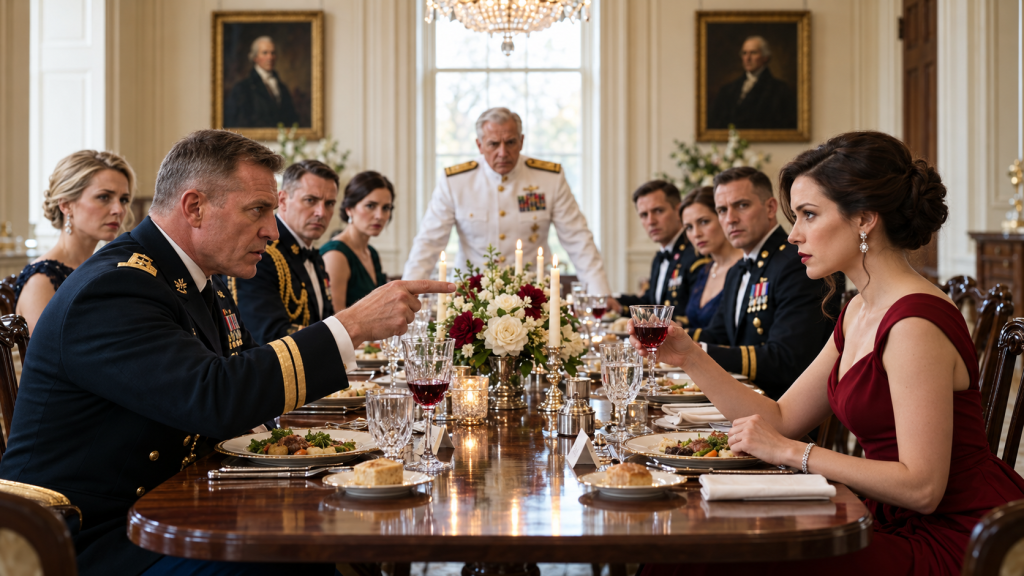
Somebody set down a fork. Ethan’s sister, Natalie, leaned forward. Coleman glanced at the other guests. “That was harmless conversation.” I felt my fingers tighten beneath the table. Harmless. He’d spent nearly fifteen minutes questioning my service, interrupting my answers, and inviting the other guests to laugh at the idea of a woman flying Navy aircraft.
He’d suggested I’d probably worn a flight suit for publicity photographs.
He’d asked whether I’d ever managed to land an aircraft without a man explaining the controls.
And when I’d declined to discuss operational assignments, he’d called me a fraud.
Now, with his own credibility threatened, he’d decided the conversation was inappropriate.
The admiral placed the sealed envelope on the table.
“Sit down, Richard.”
Coleman lowered himself into his chair.
William turned toward me.
“Commander Morgan, I owe you an apology.”
The formal address startled me.
Until then, everyone had simply called me Claire.
I looked at him.
“Sir?”
“I should have ended this interrogation when it began.”
I swallowed.
“It’s your birthday dinner, Admiral. I didn’t want to cause a scene.”
His eyes softened.
“You didn’t cause it.”
Then he looked toward Coleman.
“Someone else did.”
Ethan stared at me.
“Commander?”
I turned toward him.
He knew I was a Navy pilot.
He knew I’d spent years on deployments.
He knew there were aspects of my work I couldn’t discuss.
But I’d never insisted on being addressed by my rank in his home.
And he’d never treated my military career as something that needed a label before it deserved respect.
“Yes,” I said quietly.
His expression changed.
Not with doubt.
With the realization that an important part of my life had suddenly become the center of a confrontation I hadn’t wanted.
Coleman recovered enough to lean forward.
“Bill, let’s be careful. There are operational matters here that shouldn’t be discussed publicly.”
I looked at him.
For the first time that evening, I spoke without trying to soften my words.
“Then perhaps you shouldn’t have introduced them.”
His jaw tightened.
I continued.
“You asked whether I was genuinely a Navy aviator. I answered truthfully. You refused to accept it.”
“That’s not how I remember the exchange.”
“It’s how everyone else heard it.”
Natalie nodded.
“It is.”
The admiral touched the envelope.
“The materials I’ve brought are approved, unclassified portions of a completed review and a correction to an earlier administrative record. I’m not releasing operational recordings or classified information at dinner.”
I felt some of the tension leave my shoulders.
William understood the boundary.
Whatever he knew about that night, he wasn’t going to prove a point by exposing information that didn’t belong in a private dining room.
He removed a document.
On the first page was an official summary.
Cape Ardent Maritime Rescue — Supplemental Findings.
Below it was a date I remembered as sharply as my own birthday.
May 14.
Six years earlier.
My stomach tightened.
The room seemed to recede.
For a moment, I wasn’t sitting in a private restaurant in Washington.
I was back inside a helicopter cockpit.
Black water beneath me.
Rain striking the windshield.
An alarm sounding in my headset.
And a frightened voice calling across the radio.
Twelve personnel aboard. Taking water. Request immediate assistance.
“Claire?”
Ethan’s hand touched mine.
I blinked.
The dining room returned.
“Are you all right?”
I nodded.
“I’m fine.”
It was a familiar answer.
One I had given during medical checks, evaluation interviews, and sleepless nights after the mission.
I was fine.
Until something reminded me that I wasn’t entirely.
William watched me carefully.
“We can stop here.”
Coleman looked almost relieved.
But I shook my head.
“No, sir.”
I looked across the table.
“If Colonel Coleman is going to accuse me of falsifying my service, I would prefer he hear the correction.”
The admiral inclined his head.
“Very well.”
He turned to Coleman.
“Six years ago, you signed a statement saying Nightjar withdrew from the rescue area while Marine personnel remained in the water.”
Coleman stiffened.
“That statement reflected the information available to me.”
William opened the second page.
“It also stated that you had personally monitored the relevant communications throughout the incident.”
“I did.”
“Continuously?”
Coleman hesitated.
“Within the limitations of the equipment.”
The admiral studied him.
“That’s not what your signed declaration says.”
Across the table, a retired Navy captain named Helen Pierce leaned forward.
“What happened to the communications?”
William looked toward her.
“The supplemental review established that portions of the original reporting chain were interrupted, and that later summaries did not accurately reflect the sequence of the rescue.”
Coleman lifted his chin.
“Exactly. There were gaps.”
William nodded.
“Yes.”
Then he added:
“Gaps that your statement represented as certainty.”
I stared at the tablecloth.
For six years, I’d tried not to think about that statement.
It hadn’t ended my career.
The investigation had eventually cleared me of abandoning anyone.
But the allegation had followed me through assignments and performance discussions long after the facts should have settled it.
Some people knew the investigation had concluded in my favor.
Others only remembered there’d been one.
A rumor didn’t need to be true to leave a mark.
Coleman looked toward Ethan.
“Your father knows that combat decisions aren’t always simple.”
I felt my jaw tighten.
William’s voice remained calm.
“They aren’t.”
He glanced at me.
“Which is why we owe the people who make them an accurate record.”
Coleman pushed back his chair.
“I won’t sit here while six-year-old accusations are twisted into a personal attack.”
I looked at him.
“You’re the one who raised my qualifications.”
He turned toward me.
“You disobeyed an instruction to withdraw.”
“Yes,” I answered.
The room went silent.
I continued.
“That was examined.”
Coleman pointed toward me.
“There. She admits it.”
I didn’t raise my voice.
“I reported the decision myself. I explained it in the inquiry. I accepted that my judgment would be reviewed.”
His expression faltered.
Then I asked:
“Why didn’t your original statement mention that we returned with all twelve Marines alive?”
Nobody spoke.
Coleman’s lips parted.
No answer came.
William closed the folder.
“The conclusion of the supplemental review is that the original allegation of abandonment was unsupported. The rescue was completed, and the flight crew’s actions were documented.”
Coleman looked away.
“That’s not the whole story.”
I felt an old ache tighten behind my ribs.
“No,” I said.
“It isn’t.”
Ethan’s mother, Miriam, rose quietly.
She looked at her husband’s face.
Then at me.
“Perhaps we should give everyone a moment.”
William nodded.
Miriam asked the staff to hold dessert.
Several guests stepped into the adjoining lounge.
Natalie remained beside Ethan.
Coleman’s wife, Patricia, had gone very pale.
She touched her husband’s sleeve.
“Richard, what aren’t you telling us?”
He pulled away.
“This is a professional disagreement.”
Patricia’s expression changed.
“Then why did you spend dinner making it personal?”
I looked down.
Somewhere beyond the restaurant windows, traffic moved through the Washington streets.
Six years earlier, I’d wanted nothing more than to return from Cape Ardent, submit the reports, and continue flying.
Instead, I’d spent months answering questions about whether I had abandoned men I’d nearly killed myself trying to save.
Now the person whose statement had helped create those questions was sitting across from me, still insisting I was the problem.
William placed the documents back inside the envelope.
“Richard, the administrative record has been corrected. That is the matter I intended to address.”
Coleman stood again.
“You’ve humiliated me in front of my friends.”
The admiral met his eyes.
“You humiliated yourself when you decided Claire needed to prove she belonged in the profession she has served honorably.”
Coleman’s face darkened.
For a moment, I thought he might say something else.
Instead, he reached for his jacket.
Patricia rose beside him.
He moved toward the door.
Then stopped.
He looked directly at me.
“Commander, you’d better remember that not everyone sees that night the way you do.”
I held his gaze.
“I remember exactly what happened, Colonel.”
His eyes narrowed.
“And so do the people we brought home.”
He left without another word.
Patricia followed after a brief, embarrassed apology to Miriam.
The restaurant door closed.
And suddenly the room felt too quiet.
Ethan turned toward me.
“Claire, why didn’t you tell me?”
I looked at him.
“About Cape Ardent?”
He nodded.
I took a slow breath.
“Because I didn’t want the worst night of my career to become the first thing your family knew about me.”
His expression softened.
“I wouldn’t have treated it that way.”
“I know.”
Then I added:
“But I couldn’t know how everybody else would.”
William approached us.
“Commander Morgan.”
I stood instinctively.
He shook his head gently.
“We’re not on a parade ground.”
I gave a faint smile.
“Old habits, sir.”
He looked at me for a long moment.
Then said:
“There’s something I want you to understand.”
I waited.
“I didn’t know you were Ethan’s Claire until he mentioned your service and Pensacola. Then I recognized the timeline and requested confirmation through appropriate channels.”
I nodded.
“I suspected.”
He smiled sadly.
“I hoped you would tell me when you were comfortable.”
I glanced toward the door where Coleman had disappeared.
“Tonight wasn’t exactly how I imagined it.”
“No.”
His face grew serious.
“And I regret allowing Richard to push you into that position.”
I looked at the envelope.
“Sir, how recently was the supplemental review completed?”
William hesitated.
“Last month.”
My pulse quickened.
I’d received a notice that portions of the old case file were being updated.
But I hadn’t expected the corrected record to reach a retired admiral’s dinner table.
“Why was there another review?”
William looked toward the window.
“Additional testimony became available.”
I felt my stomach tighten.
“From whom?”
He studied me carefully.
“Someone who was aboard the aircraft that night.”
For a moment, I couldn’t speak.
Then I whispered:
“Chief Ortega?”
William nodded.
And everything inside me went still.
Chief Petty Officer Rafael Ortega had been my helicopter’s crew chief.
Rafe.
A man who could make a frightened sailor laugh while repairing equipment under impossible conditions.
A man who could identify trouble in an aircraft by listening to a sound everyone else ignored.
A man who’d spent twelve years flying before Cape Ardent ended his career in the air.
I hadn’t spoken to him in nearly a year.
Not because I didn’t care.
Because every conversation reminded me of the injury he’d sustained that night.
And of the responsibility I’d carried ever since.
“He submitted a new statement?” I asked.
William nodded.
“With supporting information from another member of the rescue team. The appropriate authorities reopened questions about the accuracy of the original reporting.”
I felt my throat close.
Rafe had already testified six years earlier.
He’d sat through interviews.
Recounted details nobody wanted to remember.
And endured the frustration of watching official summaries flatten one terrifying night into contradictory paragraphs.
What had changed?
Before I could ask, William spoke.
“Claire, whatever comes next, you shouldn’t have to handle it alone.”
I glanced toward Ethan.
He reached for my hand.
“I know,” he said softly.
I swallowed.
But I wasn’t sure either of them understood.
Because I knew Rafe.
And if he had decided to reopen a wound he’d spent years trying to close, he must have discovered something important.
Something none of us had known before.
My phone vibrated.
An unfamiliar number.
I almost ignored it.
Then a message appeared.
Nightjar, this is Ortega. I heard Coleman was at the dinner.
My heart began pounding.
A second message followed.
There’s something in the old rescue record they never showed you.
And then:
The withdrawal order wasn’t sent when they said it was.
I read Rafe’s message three times.
Then I walked out of the dining room.
Ethan followed me into the quiet hallway, but he stopped a few feet away when he saw my expression.
“Claire?”
I looked up.
“Chief Ortega says the withdrawal order was recorded at the wrong time.”
Ethan frowned.
“What does that mean?”
I stared at the screen.
For six years, the official account had centered on a simple question.
Had I knowingly entered the danger area after receiving a valid instruction to stand clear?
I’d never denied remaining after an order to withdraw was transmitted.
I’d explained that by then, the rescue was already underway and abandoning the men would have left them with almost no chance of surviving.
But the sequence mattered.
Enormously.
If the order had been issued before we approached the stricken vessel, as Coleman’s original report suggested, I had disregarded a restriction before the emergency developed around us.
If the order arrived later, after we’d begun lifting survivors from the water, the decision was entirely different.
Still dangerous.
Still subject to review.
But a decision made while twelve men were fighting to stay alive beneath my aircraft.
I called Rafe.
He answered immediately.
“Nightjar.”
I hadn’t heard his voice in nearly a year.
The sound brought a sudden pressure to my chest.
“Chief.”
He gave a small laugh.
“You still call me that.”
“You still call me Nightjar.”
“Some things are worth keeping.”
Then his voice grew serious.
“Are you somewhere private?”
I glanced at Ethan.
“Give me a minute?”
He nodded and moved toward the lounge.
I turned toward a quiet alcove near the windows.
“Go ahead, Rafe.”
“The new review team reexamined the synchronized maintenance records and communications logs,” he said. “There was an error in the way the original timeline had been presented.”
I closed my eyes.
“An error?”
“That’s the polite version.”
“Rafe.”
He exhaled.
“Coleman’s command log shows the withdrawal instruction being issued before we reached the vessel. But the independently preserved records establish that the actual transmission came after the first survivors were already being recovered.”
My pulse quickened.
“Are you certain?”
“The investigators have the original material and the technical analysis. I can’t send you restricted records, but I can tell you what the official correction says.”
I leaned against the wall.
For a moment, I couldn’t speak.
Six years earlier, every interview had seemed to return to the same accusation.
Why did you enter the area after being directed to remain clear?
I would answer:
We were already conducting a rescue when the withdrawal instruction came through.
Then someone would point toward the operations log.
A timestamp.
A tidy line on a printed page.
Apparently contradicting what I remembered.
I had begun to wonder whether the storm, exhaustion, and fear had distorted my sense of time.
I had not forgotten the men.
Not forgotten the water.
But after months of questioning, I’d found myself staring at the ceiling at night, wondering whether I had misunderstood the order.
“Claire?”
Rafe’s voice pulled me back.
“I’m here.”
He hesitated.
“You were right about when it came.”
I covered my mouth.
For six years, I’d needed to hear those words.
And suddenly I couldn’t make a sound.
Rafe continued.
“The new findings also raise questions about why Coleman’s signed account described a continuous communications picture when the operations desk had documented outages.”
I shut my eyes.
“That part I know.”
“There may be more.”
“What?”
He was quiet for a moment.
“There’s another witness. Someone who worked at the communications desk and recently came forward with records explaining how the original summary was prepared.”
I felt cold.
“Who?”
“Lieutenant Daniel Mercer. He was a junior officer then. He’s out of the service now.”
I frowned.
I remembered the name.
Mercer had been quiet during the inquiry.
Always seated near the back of the room.
He’d looked sick every time Coleman entered.
“Why now?”
Rafe sighed.
“He says he’s carried it for six years.”
I looked toward the dining room.
Laughter drifted faintly through the door as the guests tried to reclaim what remained of William’s birthday.
Somebody had begun serving dessert.
Life was continuing.
Meanwhile, the past was opening beneath my feet.
“Rafe,” I said softly, “why didn’t you tell me you were doing this?”
He was quiet.
Then he answered:
“Because I wanted the review team to finish checking it before I gave you another reason to hope.”
My eyes filled.
“I wish you hadn’t carried it alone.”
He laughed without humor.
“Coming from you, that’s rich.”
I smiled through tears.
Then asked the question I’d avoided for years.
“How’s your leg?”
A pause.
“Still attached.”
“Rafe.”
“Physical therapy’s helping. Some days are better than others.”
I swallowed.
The injury he’d suffered during the landing had damaged nerves in his left leg.
He could walk.
He could work.
He had built a good life teaching aviation safety.
But he couldn’t return to the job he’d loved.
And I’d spent six years feeling that my choice to remain over Cape Ardent had ended his flying career.
“You know you didn’t put me in that helicopter against my will,” he said quietly.
I closed my eyes.
“I was in command.”
“And I was your crew chief.”
He paused.
“I knew the risks. So did Maya. So did Tessa.”
I pressed my fingers against my forehead.
Then Rafe said:
“Claire, the men we rescued got to go home. Some of them had babies they hadn’t met yet. One had a wedding scheduled. Another had a mother who’d already lost two sons.”
My throat tightened.
He continued.
“I don’t regret helping bring them back.”
For a moment, I could barely breathe.
“Neither do I,” I whispered.
“Good.”
Then he added:
“Now stop letting Coleman’s paperwork tell you what happened inside our aircraft.”
When I ended the call, I remained in the hallway.
Ethan approached carefully.
“Everything okay?”
I looked up.
“No.”
His expression tightened.
Then I smiled through tears.
“Maybe for the first time in six years, it might be.”
He stepped closer.
I leaned into him.
He wrapped his arms around me without asking questions.
And suddenly, the memories I’d spent years holding at a distance came rushing back.
Cape Ardent had looked almost peaceful on the chart.
A stretch of coastline.
Dark water.
A scattering of islands.
A narrow shipping route beyond a region of heightened military tension.
On the night of the rescue, nothing about it was peaceful.
A storm had rolled across the coast after midnight.
Visibility dropped.
Waves struck the sides of ships hard enough to lift smaller vessels out of the water.
Our helicopter had launched from an amphibious assault ship several miles offshore.
I was the aircraft commander.
Lieutenant Maya Chen sat beside me.
Rafe worked in the cabin.
Petty Officer Tessa Ward was our rescue swimmer.
We’d trained together for months.
We trusted one another in ways that were difficult to explain to people who’d never depended on a crew inside a machine flying over open water.
We received the first distress report shortly after two in the morning.
A Marine transport vessel was taking on water after a serious mechanical failure.
Twelve Marines remained aboard.
The crew responsible for operating the vessel had already begun emergency procedures.
Conditions were worsening.
The closest rescue resources were being coordinated through multiple command channels.
We were cleared to proceed toward the reported location while the situation was assessed.
As we approached, Maya spotted a faint light beneath the clouds.
“Contact,” she said.
I turned.
Far below us, the vessel rocked violently.
Its stern was already low in the water.
Then we saw figures moving along the deck.
Twelve Marines.
Men trained to remain steady under pressure.
That night, they were holding on to railings while the ship came apart beneath them.
The radio crackled.
The voice was strained.
“We’re losing the aft compartment. We need evacuation.”
I remember looking toward Maya.
She looked at me.
Neither of us needed to speak.
We had a job to do.
We began coordinating recovery with the other rescue aircraft and supporting ships.
Tessa prepared to assist.
Rafe checked the hoist.
The wind was brutal.
Every time we settled into position, a gust tried to push us away from the vessel.
My hands tightened around the controls.
Maya monitored our position and instruments.
Rafe’s voice came through my headset.
“Ready when you are, Nightjar.”
I took a breath.
“Let’s bring them home.”
The first Marine came up through the spray so cold that his hands barely worked.
Then another.
A third had a deep cut across his forehead.
One survivor was pulled from the water after the vessel rolled unexpectedly.
We coordinated with a second helicopter to distribute the rescues and avoid overloading either aircraft.
Everything was moving too quickly.
The aircraft.
The sea.
The voices.
The minutes.
Then the withdrawal instruction came.
Not before the rescue.
Not while we were still approaching.
After we’d already begun recovering personnel.
The message warned of an evolving threat nearby and ordered aircraft to stand clear pending further direction.
It was not a meaningless instruction.
Our safety mattered.
The surrounding airspace had become more dangerous.
And every minute we stayed increased the risk to the crew.
But men remained in the water beneath us.
I could see their lights moving between the waves.
I requested permission to continue the immediate rescue.
The answer was delayed.
Communications were interrupted.
The vessel began sinking faster.
And one of the Marines disappeared beneath a wave.
“Claire,” Maya said, “we have to decide.”
I remember looking down.
Two heads near the wreck.
A light flashing.
Someone waving.
And the knowledge that if we left at that moment, there might be no one close enough to reach them before the sea took them.
I made the decision.
We remained long enough to recover the survivors and coordinate the final pickups.
I reported that choice.
I didn’t hide it.
And I knew it might cost me.
The final recovery nearly killed us.
A violent gust struck as Rafe was securing a survivor.
The aircraft shifted.
Maya called out an altitude warning.
I corrected.
Tessa caught the last Marine before he slipped away from the hoist.
Rafe helped drag him into the cabin.
Then the radio carried the words I’d been waiting to hear.
“All twelve accounted for.”
I should have felt relief.
Instead, I was exhausted.
Our remaining fuel margin was narrowing.
The weather was deteriorating.
And the ship that had carried those Marines was disappearing beneath the waves.
We turned toward our recovery ship.
The return flight felt endless.
During the deck approach, the aircraft was struck by another powerful gust.
We landed hard.
A piece of equipment shifted in the cabin despite having been secured earlier.
Rafe was injured.
The crew responded immediately.
Medical personnel met us.
The helicopter was damaged.
And I remember climbing out onto the deck with my legs shaking so badly that I couldn’t stand without holding the side of the aircraft.
Maya reached for me.
“You did it.”
I stared toward the ship’s medical bay, where our rescued Marines were being taken.
Then I whispered:
“We all did.”
That should have been the story.
A dangerous rescue.
Twelve lives saved.
A crew that did its duty under terrible conditions.
A command decision reviewed honestly.
Instead, three days later, I was informed that questions had been raised about my actions.
A report suggested I’d disregarded an order before beginning the rescue.
Another accused me of abandoning personnel in the water.
The second allegation was particularly absurd.
We had returned with the Marines.
Their names were recorded.
Their medical assessments were documented.
Yet the statement had been written in language that implied negligence and disregard for their safety.
I asked who had signed the report.
Colonel Richard Coleman.
The same officer who had coordinated part of the operations picture.
The same man who’d barely acknowledged me during the mission briefings.
And now the same man who had sat across from me at a birthday dinner and asked whether I was really a pilot.
“Claire.”
Ethan’s voice brought me back to the hallway.
I realized I was crying.
He held my face gently.
“You don’t have to tell me everything.”
I swallowed.
“I know.”
For a moment, I looked toward the private dining room.
Then back at him.
“But I think I need to tell you some of it.”
We left the birthday dinner shortly afterward.
William and Miriam understood.
Natalie hugged me before I left.
She looked embarrassed.
“I’m sorry about Coleman.”
I shook my head.
“You didn’t invite him to interrogate me.”
“No,” she said. “But I wish I’d spoken sooner.”
I gave her a tired smile.
“So do I.”
Outside, Washington was bright with streetlights.
Ethan and I walked toward his car.
He opened the door for me.
Then hesitated.
“Claire?”
I looked at him.
“Do you trust my father?”
The question startled me.
I thought about William.
His quiet observation.
The envelope.
The apology.
And the fact that he had known something about my past for months without forcing me to explain it.
“I think he wants to do the right thing,” I answered.
Ethan nodded.
Then his expression changed.
“But?”
I looked down.
“But I still don’t know what he knew six years ago.”
Ethan went still.
I continued.
“Your father was a senior commander when Cape Ardent happened. That report reached his level.”
He swallowed.
“You think he knew Coleman was wrong?”
“I don’t know.”
I looked toward the restaurant.
“And that’s what frightens me.”
Because there was one possibility I had never allowed myself to examine.
Coleman might not have acted alone.
Someone had accepted his timeline.
Someone had allowed the inaccurate allegations to remain attached to my record for months.
Someone had decided that the easiest way to handle the dispute was to let a woman pilot defend herself while more senior officers protected their own credibility.
And now the man who’d reviewed the evidence was also the father of the person I loved.
Ethan took my hand.
“Then we should ask him.”
I looked at him.
“You’d do that?”
He seemed almost offended.
“Claire, he’s my father.”
“I know.”
He squeezed my hand.
“But you’re the woman I love.”
My chest tightened.
Then he added:
“And those two things don’t require me to pretend either of you is incapable of making mistakes.”
When we reached the car, my phone vibrated again.
Rafe.
A new message.
One more thing. Mercer says Coleman didn’t just change the timing.
I stared at the screen.
Then read the next sentence.
He says the colonel knew the Marines were still aboard before he recommended delaying the rescue.
I didn’t sleep that night.
Ethan stayed with me, but even with his arm around my shoulders, I couldn’t quiet my thoughts.
I kept remembering the deck of the sinking transport.
The faces below us.
The voices over the radio.
And Coleman sitting comfortably at a desk while people fought to stay above water.
At four in the morning, I gave up trying to sleep.
I went into the kitchen and made coffee.
Ethan appeared a few minutes later.
He was wearing an old college sweatshirt, his hair disheveled.
“Did you sleep at all?”
I shook my head.
He sat opposite me.
“Then let’s talk.”
I looked at him.
“About your father?”
“About whatever you need.”
I stared into my cup.
“Six years ago, I thought the inquiry would establish the facts and everything would return to normal.”
Ethan waited.
“It did establish some of them. The abandonment allegation wasn’t sustained. Nobody could explain how a flight that recovered survivors had supposedly deserted them.”
I gave a tired laugh.
“But the uncertainty around the command sequence remained. I was cleared to continue serving, yet the rumor followed me.”
“What did it cost you?”
I looked up.
“An assignment I wanted. Months of scrutiny. And a lot of nights wondering whether I’d failed my crew.”
His face tightened.
“Why didn’t you challenge the report further?”
“I did.”
I pressed my hands around the coffee mug.
“Formal responses. Statements. Corrections. Meetings with lawyers. I did everything I was supposed to do.”
He nodded.
“But at some point, I wanted to fly again. I wanted to be more than the officer who kept arguing about Cape Ardent.”
Ethan reached across the table.
“I’m sorry.”
I swallowed.
He continued.
“I knew your work was important. I didn’t know how much you’d been carrying.”
I looked at him.
“I didn’t tell you.”
“No.”
He squeezed my hand.
“But you don’t have to earn the right to be believed by telling me everything.”
My eyes filled.
Later that morning, William called.
He didn’t ask whether I’d enjoyed dinner.
He didn’t pretend nothing unusual had happened.
“Claire,” he said, “I’d appreciate the chance to speak with you.”
I hesitated.
“About Coleman?”
“Yes.”
“And Cape Ardent?”
A pause.
“Yes.”
I looked toward Ethan.
He nodded.
I took a breath.
“Then I have questions, Admiral.”
William’s voice was quiet.
“I expect you do.”
We met at the Brooks family home the following afternoon.
Miriam greeted me at the door.
She hugged me gently.
“Claire, I owe you an apology too.”
I shook my head.
“You didn’t do anything.”
She looked toward the study.
“I’ve known Richard Coleman for years. I saw how he was speaking to you, and I hesitated because I didn’t want to embarrass him on Bill’s birthday.”
Her expression hardened.
“That was the wrong person to worry about embarrassing.”
I swallowed.
“Thank you.”
William was waiting in his study.
Photographs covered the walls.
Ships.
Squadrons.
Graduation ceremonies.
Generations of service.
He looked older than he had at dinner.
Not weaker.
Just tired.
He stood when I entered.
“Commander.”
“Admiral.”
Ethan sat beside me.
William remained standing for a moment.
Then said:
“Before we begin, I want you to know that I won’t ask you to discuss anything outside the appropriate security and professional boundaries.”
I nodded.
“Thank you, sir.”
He sat.
I asked the question immediately.
“What did you know about Coleman’s report six years ago?”
William took a slow breath.
“I knew that the initial statements conflicted.”
My stomach tightened.
“Did you know mine was being questioned?”
“Yes.”
I stared at him.
“Did you believe I’d abandoned Marines?”
“No.”
The answer came without hesitation.
I swallowed.
“Then why did that allegation remain attached to the case?”
William looked down.
“The inquiry proceeded through the authorized channels. The investigation eventually concluded there was insufficient support for that accusation.”
I waited.
He continued.
“But I accepted the correction as a matter of paperwork. I didn’t consider adequately how widely the original allegation had already traveled.”
I felt anger rise.
“That paperwork followed me for years.”
William nodded.
“I know.”
“You were a four-star admiral.”
“Yes.”
“People listened when you spoke.”
He met my eyes.
“And I should have been more attentive to what the final record actually meant for the people involved.”
For a moment, I didn’t know what to say.
I’d expected defensiveness.
An explanation about bureaucracy.
A reminder that I should be grateful the allegation hadn’t ended my career.
Instead, William was admitting something much harder.
That he had possessed authority.
And hadn’t used all of it to ensure the damage was corrected.
“Why didn’t you call me?” I asked.
He looked pained.
“By the time the inquiry concluded, I understood that you wanted to return to flying without further publicity. I told myself that respecting the formal process was enough.”
He paused.
“It wasn’t.”
I swallowed.
Ethan spoke.
“Dad, did you suspect Coleman had changed the timeline?”
William shook his head.
“Not then. The new review identified information that wasn’t properly reconciled in the original file.”
He looked at me.
“I won’t claim I knew something I didn’t. But I should have insisted the inconsistencies were resolved more thoroughly.”
I nodded slowly.
That mattered.
I didn’t need William to become a villain so my pain would make sense.
I needed him to understand that avoiding responsibility was not the same as acting honorably.
Then I asked:
“Why did you keep inviting Coleman into your home?”
William looked toward a photograph on the bookshelf.
A younger version of himself stood beside several officers, including Coleman.
“Because I had known him for decades. We served together on difficult assignments. I remembered the man I’d trusted.”
He turned back toward me.
“And I allowed that history to influence how critically I examined his behavior.”
I stared at him.
“He humiliated me because he believed you would support him.”
William’s face tightened.
“I think you’re right.”
For a moment, the study was quiet.
Then William said:
“Claire, I can’t undo the inquiry. I can’t give back the time you spent defending yourself. And I can’t make Coleman tell the truth merely by ordering him to.”
He leaned forward.
“But I can acknowledge my own failure. And I can support the proper review of the new evidence.”
I looked at him.
“Even if it damages a man you’ve called your friend for thirty years?”
William’s eyes hardened.
“Friendship does not make a false statement true.”
I sat back.
For the first time since the birthday dinner, I felt the ground beneath me steady slightly.
Not because a retired admiral had declared me worthy.
Because someone who’d once had power over the record was finally willing to admit that I hadn’t received the care the facts deserved.
Before we left, William handed me a small card.
On it was the name of a retired Marine sergeant.
Gabriel Reyes.
My heart stopped.
I remembered him.
He’d been the last man brought aboard our helicopter.
Hypothermic.
Barely conscious.
His hands had been so cold that Tessa struggled to remove his gloves.
He’d kept asking whether the others had survived.
“Reyes contacted the review team,” William said.
I stared at the card.
“Why?”
“He wants to speak with you, if you’re willing.”
I looked up.
“Is he all right?”
William smiled gently.
“He’s married. Has two children. Works with a veterans’ transition program.”
My eyes filled.
Then William added:
“He says there’s something he never had the opportunity to thank you for.”
I called Gabriel that evening.
He answered in a warm, steady voice.
“Commander Morgan?”
I swallowed.
“Sergeant Reyes?”
A laugh.
“Former sergeant. These days, I mostly answer to Dad.”
I smiled through tears.
“It’s good to hear your voice.”
“You too, ma’am.”
There was a pause.
Then he said:
“I’ve wanted to make this call for six years.”
My throat tightened.
“Why didn’t you?”
“Because I kept thinking you’d be tired of hearing about that night.”
I closed my eyes.
“I was.”
He chuckled softly.
“Fair enough.”
Then his voice grew serious.
“My daughter was born three months after the rescue.”
I pressed a hand against my mouth.
Gabriel continued.
“She turned six last week. Her name is Charlotte.”
My eyes filled.
“She sounds wonderful.”
“She is.”
He paused.
“On the night you came for us, I was thinking about my wife. She was pregnant, and I’d promised I’d be home for the birth.”
His voice cracked.
“I thought I’d broken that promise.”
I stared toward the window.
Then he said:
“Your crew gave me the chance to keep it.”
I couldn’t speak.
For years, I’d remembered Gabriel as the final survivor.
A man clinging to consciousness beneath a freezing wave.
I’d never imagined him at a kitchen table helping a little girl with homework.
Never imagined birthday cakes.
School photographs.
The small, ordinary moments we’d made possible.
“Gabriel,” I whispered, “we all worked to bring you home.”
“I know.”
He paused.
“That’s why I contacted the review team.”
My pulse quickened.
“What did you tell them?”
He took a breath.
“That Colonel Coleman’s statement didn’t match what happened.”
Gabriel explained that the rescue survivors had given accounts after receiving medical care.
Some statements were incomplete because the Marines were exhausted, injured, or still recovering.
Coleman’s summary treated certain gaps as proof that no extraction had been underway at the time of the withdrawal instruction.
But Gabriel remembered the order being discussed while his comrades were already being lifted.
He also remembered a Marine on the sinking vessel calling repeatedly for help before receiving any clear response.
“I was beside our radio operator,” Gabriel said.
“Did he survive?”
“Yes.”
My eyes filled.
Gabriel continued.
“He remembered speaking to the coordination desk before your aircraft arrived. He told the investigators he’d warned them we couldn’t wait much longer.”
I gripped my phone.
“And Coleman?”
Gabriel hesitated.
“The operator said the desk acknowledged the warning but told them to remain in place until the situation could be further assessed.”
I closed my eyes.
It wasn’t proof that every delay was malicious.
There had been genuine threats in the area.
Aircraft safety had mattered.
But it contradicted the tidy version in which Coleman claimed he’d had no reliable information about how rapidly the vessel was deteriorating.
“Why didn’t your statement settle it the first time?” I asked.
Gabriel sighed.
“We were interviewed separately. Different questions. Different records. We didn’t see the full timeline.”
He paused.
“And some of us were afraid that challenging a colonel’s account would create problems we weren’t equipped to handle.”
I felt cold.
I’d been an officer.
I’d had counsel.
I’d known how to request records.
Gabriel and his comrades had been exhausted Marines recovering from a disaster.
They had trusted the investigation to assemble their words accurately.
“I wish I’d known,” I whispered.
He answered gently.
“So do I.”
Then he said:
“But we know now.”
A few days later, I spoke with Rafe again.
This time, Maya Chen joined us.
She was still flying.
Still sharp.
Still possessed of the quiet humor that had carried us through deployments.
When she appeared on my screen, she smiled.
“Nightjar.”
I laughed.
“Chen.”
She raised an eyebrow.
“Still terrible at answering messages?”
“Still keeping score?”
“Always.”
Rafe sat beside her.
His left leg was extended slightly.
He looked older.
A few more gray hairs.
But his smile was the same.
For a moment, I couldn’t speak.
Then I whispered:
“I’ve missed you both.”
Maya’s expression softened.
“We’ve missed you too.”
We talked for nearly two hours.
Not only about Cape Ardent.
About Maya’s new assignment.
Rafe’s aviation safety work.
Tessa’s recent promotion.
About the absurd things that happened during ordinary deployments.
And then, gradually, about the night none of us had forgotten.
Rafe explained that he had been contacted during a routine review of older safety records.
An archived technical record had exposed the discrepancy between the time entered in the operations summary and the time the withdrawal transmission actually reached the aircraft.
He’d asked why the corrected sequence wasn’t reflected in the official narrative.
That question led to further examination.
The investigators located additional records.
Then Mercer came forward.
“Why did he wait so long?” Maya asked.
Rafe sighed.
“He says he was young, frightened, and convinced that nobody would believe him over Coleman.”
I looked down.
I understood that kind of fear.
But understanding it didn’t make the lost years disappear.
Rafe continued.
“Mercer says he was told to prepare a clean chronology after the incident. The original logs contained interruptions and conflicting reports.”
My stomach tightened.
“What did he do?”
“He used the times provided by the senior officer overseeing the summary.”
“Coleman.”
“Yes.”
I closed my eyes.
“Did he know they were wrong?” I asked.
Rafe hesitated.
“He says he suspected the entries didn’t match the original transmissions. Later, when he challenged the discrepancy, he was told the differences were administrative and would be reconciled.”
Maya’s expression hardened.
“And they weren’t.”
Rafe shook his head.
“No.”
I sat quietly.
Six years.
An altered chronology.
A junior officer too frightened to challenge it effectively.
A colonel who’d signed a declaration claiming certainty he apparently hadn’t possessed.
And a rescue crew whose decisions had been judged against the wrong sequence of events.
Then Maya said:
“Claire, there’s something else.”
I looked up.
“What?”
She glanced toward Rafe.
He nodded.
Maya continued.
“The review team has asked us to provide supplementary statements about the final recovery and the landing.”
My chest tightened.
“Why?”
“Because the record needs to distinguish the decision to remain from the injury that happened during our return.”
I looked toward Rafe’s leg.
He noticed.
And smiled gently.
“Nightjar, don’t start.”
My throat closed.
“You were injured because we stayed,” I whispered.
Rafe shook his head.
“I was injured during a difficult landing in terrible weather. That’s a fact.”
He leaned forward.
“The inquiry can examine every operational factor. But you don’t get to invent a simpler explanation just because guilt feels familiar.”
I began crying.
Maya looked directly at me.
“We made that rescue as a crew.”
I covered my mouth.
She continued.
“You listened to us. You told us the risks. And we agreed those Marines had almost no time left.”
My eyes filled.
“For six years, I’ve wondered whether I should have turned around.”
Rafe’s expression softened.
Then he asked:
“Would you tell another pilot to abandon twelve people she could still reach, without even considering whether continuing the rescue was possible?”
I shook my head.
“No.”
“Then stop judging yourself by a standard you wouldn’t apply to anyone else.”
The conversation ended with all three of us crying and laughing.
It was the first time I’d spoken openly about Cape Ardent without feeling that I was sitting across from investigators waiting to find a mistake.
That evening, Ethan came over.
He found me on the sofa with the old photographs from my deployment spread across the coffee table.
He sat beside me.
“Good day?”
I smiled through tears.
“A hard one.”
He looked at the pictures.
Then at me.
“Want company?”
I leaned against him.
“Yes.”
We stayed there for a long time.
Eventually, Ethan asked:
“Claire, did you ever consider leaving the Navy after the investigation?”
I stared at the photograph of our helicopter.
“Yes.”
His hand tightened around mine.
“Why didn’t you?”
I thought about it.
Then answered:
“Because Coleman didn’t get to decide whether I belonged in the sky.”
A week later, I received a formal notice.
The supplemental review had expanded.
Not because of the birthday dinner.
Not because William Brooks had asked a dramatic question.
Because additional evidence raised serious concerns about the accuracy of signed statements and the preparation of the original operational chronology.
The relevant authorities would examine the new material through established procedures.
Coleman would have an opportunity to respond.
Witnesses would be interviewed.
Documents would be verified.
The process would take time.
I read the notice twice.
Then placed it carefully on my desk.
For six years, I had wanted the world to understand what happened.
Now, for the first time, I felt something different.
I wanted the truth to be recorded correctly even if nobody outside the service ever learned my name.
That night, Natalie called.
She sounded nervous.
“Claire, have you seen what’s online?”
My stomach tightened.
“What?”
“Someone posted a short video from Dad’s birthday dinner.”
I closed my eyes.
“Of course they did.”
She continued.
“It’s been shared everywhere.”
I sat down.
“What does it show?”
Natalie hesitated.
“Coleman questioning you. Dad asking your call sign. The part where Coleman tries to leave.”
I covered my face.
Then Natalie said:
“Claire, somebody is claiming you lied about the rescue.”
My heart stopped.
“What?”
She swallowed.
“An anonymous account posted a document online. It says you disobeyed orders and abandoned Marines.”
For a moment, I couldn’t breathe.
The old accusation.
The same allegation the inquiry had not sustained.
The same narrative that had followed me for years.
Now it was spreading beyond military offices and whispered conversations.
I looked toward the photograph of our crew.
Then asked:
“Has the corrected record been included?”
Natalie was quiet.
“No.”
My phone began vibrating.
Messages.
Calls.
Notifications from people I hadn’t spoken to in years.
Someone had taken a private confrontation and turned it into an argument for strangers.
And I knew exactly who stood to benefit from that confusion.
Then another message arrived.
This one came from an address I didn’t recognize.
Commander Morgan, you should have let the past stay buried.
Attached was a photograph.
A page from the old investigation.
And at the bottom, underlined in red, was a sentence from Coleman’s original statement.
Nightjar withdrew despite knowledge of personnel remaining in the water.
I stared at the screen.
Then noticed something that made my pulse quicken.
The document had a handwritten notation in the corner.
Not an official marking.
Three words.
USE ORIGINAL VERSION.
I forwarded the message to the appropriate security and investigative contacts without replying.
Then I turned off the notifications.
For a moment, I sat in silence.
The temptation to defend myself publicly was overwhelming.
I wanted to post the corrected findings.
To tell every stranger repeating Coleman’s accusation exactly how wrong they were.
To describe the wind and the waves.
To explain how it felt to hold a helicopter steady while frightened men were being lifted from the water.
But that wasn’t how responsible service members handled restricted operational records.
And it wasn’t how I intended to regain my peace.
The next morning, my commanding officer asked to see me.
Captain Rebecca Sloan had known me for years.
She was direct, fair, and possessed of an extraordinary ability to look at a problem without becoming distracted by the surrounding noise.
I entered her office feeling like a junior lieutenant about to be reprimanded.
She looked up.
“Claire.”
“Ma’am.”
“Sit down.”
I obeyed.
She placed a printed copy of the online allegation on her desk.
“I assume you’ve seen this.”
“Yes, ma’am.”
“Did you release any documents?”
“No.”
“Did you discuss classified operational details at the dinner?”
“No. I confirmed my call sign. Admiral Brooks referred to an approved, unclassified correction.”
She nodded.
“We’ve reviewed the available information. Public affairs and the appropriate security personnel are addressing the release of the old document.”
I swallowed.
Then she looked directly at me.
“Commander, the allegation of abandonment was not sustained. That is part of the official record.”
My throat tightened.
“Yes, ma’am.”
Sloan leaned back.
“The internet is not a court of inquiry.”
I almost smiled.
“No, ma’am.”
“And you’re not required to relive a dangerous mission every time somebody wants an argument.”
My eyes filled.
She continued.
“Follow the investigative process. Preserve any relevant messages. Maintain your professional obligations.”
Then her expression softened.
“And take care of yourself.”
I nodded.
For the first time since the video appeared, I felt I could breathe.
A few days later, Daniel Mercer contacted the review team about the handwritten notation.
He explained that the words USE ORIGINAL VERSION had been written during a later administrative dispute about the case summary.
The phrase had been part of a routing instruction, not a conclusion that the original account was accurate.
The document circulating online had been removed from its proper context.
Investigators continued examining who had distributed it and whether any rules had been violated.
No one could reasonably identify the sender from the screenshot alone.
I refused to pretend otherwise.
But the incident had one unexpected effect.
Former personnel who’d been reluctant to revisit Cape Ardent began contacting the appropriate review offices.
Not strangers with opinions.
People who’d been there.
A former communications technician.
A medical officer who’d treated the rescued Marines.
A flight deck supervisor who remembered the timing of our return.
Their accounts didn’t all contain the same details.
Memories rarely do.
But the records and testimony provided more opportunities to check the chronology against evidence.
Coleman retained counsel and disputed the suggestion that he’d knowingly falsified his statement.
He argued that the operations picture had been confused and that his judgments reflected legitimate safety concerns.
Some of those concerns were real.
The weather had been dangerous.
The threat near the rescue area had mattered.
No serious investigator would dismiss those facts merely because I had succeeded in bringing people home.
But the central question remained.
Why had Coleman certified a sequence of events that the original communications records did not support?
And why had the resulting statement blamed a pilot for abandoning people who were demonstrably recovered?
The formal review proceeded over several months.
I provided a supplemental statement.
Maya did too.
Rafe and Tessa described the recovery sequence and the hard landing.
Mercer explained his role in assembling the original chronology.
Gabriel and other rescued Marines confirmed what they remembered about the calls for assistance.
Technical specialists examined the recorded times and the differences between the underlying materials and later summaries.
It wasn’t exciting work.
There were no dramatic speeches.
No pounding on tables.
Sometimes a single question occupied an entire interview.
What did a particular word mean in the original instruction?
Which communications system recorded the timestamp?
What could the flight crew reasonably have known at that moment?
Did an officer report a fact, an assumption, or information passed to him by someone else?
Those distinctions mattered.
They were the difference between a serious inquiry and a story invented to make people feel good.
The most painful part came when I reviewed my own decision again.
The moment I remained over the water after the withdrawal instruction.
I could feel the helicopter moving beneath me.
Hear Maya’s voice.
Remember Rafe reporting the final survivor.
I explained my judgment.
Then I acknowledged what I’d always acknowledged.
The choice carried risk.
If we’d lost the aircraft, twelve rescued Marines and four crew members might have died.
I didn’t pretend courage erased that possibility.
I didn’t need to.
The investigators were there to determine what had happened, what information was available, and whether the record fairly reflected the circumstances.
When the review concluded, its findings were more significant than I’d allowed myself to hope.
The corrected chronology confirmed that our rescue was already underway when the withdrawal instruction was transmitted.
The record also established that Coleman’s signed statement had presented disputed assumptions as verified observations.
His description of the flight withdrawing while Marines remained abandoned was not supported by the evidence.
And his claim to have monitored all relevant communications continuously was inconsistent with documented interruptions in the operations picture.
The reviewers did not say every decision made that night had been perfect.
They didn’t need to.
They concluded that the original account had materially misrepresented the sequence of events and had unfairly attributed conduct to my crew that the evidence did not establish.
The official record was amended accordingly.
The concerns about Coleman’s reporting were referred for appropriate administrative consideration.
He had the right to respond.
Any further consequences would follow established procedures.
Coleman’s reputation did not collapse in a single afternoon.
But his authority to present himself as the unquestioned expert on Cape Ardent was gone.
The veterans’ organization where he held an honorary advisory position suspended his participation while reviewing the matter.
He stopped appearing at public events to discuss the mission.
And the corrected record became the version that future official summaries were required to use.
For me, the most important document was only three pages long.
It didn’t call me a hero.
It didn’t contain a dramatic tribute to my courage.
It simply stated the facts.
My aircraft had not abandoned the Marines.
The sequence I’d described was supported by the corrected evidence.
The twelve personnel had been recovered through the coordinated actions of the rescue teams.
And the earlier allegations had not accurately represented our conduct.
I sat in my apartment with those pages in my lap.
Then I cried.
Not because someone had finally handed me a victory.
Because for six years, I’d carried the exhaustion of knowing the truth and wondering whether the record would ever reflect it.
Now it did.
Ethan found me sitting on the floor beside the sofa.
He crouched.
“Claire?”
I held up the document.
He read the first page.
Then looked at me.
“It’s done?”
I nodded.
“The correction is final.”
He wrapped his arms around me.
And I cried against his shoulder until I could barely breathe.
A week later, William invited me to lunch.
Just the two of us.
No decorated officers.
No audience.
No birthday speeches.
We met at a quiet restaurant near the river.
He stood when I arrived.
“Claire.”
“Admiral.”
He smiled faintly.
“William, please.”
I sat down.
For a few minutes, we talked about Ethan.
His work.
Natalie’s new apartment.
Miriam’s determination to renovate a kitchen that everyone else thought was perfectly fine.
Then William placed a small envelope on the table.
I looked at it.
“What is this?”
“A letter.”
I raised an eyebrow.
“Another one?”
He smiled sadly.
“This one is from me.”
I opened it.
The letter acknowledged that the original allegations had been allowed to damage my professional reputation beyond the formal conclusions of the first inquiry.
William described his regret that he hadn’t ensured the corrected information received the attention it deserved.
He also acknowledged that he’d remained socially close to Coleman despite knowing how the original dispute had affected the people involved.
I read the final paragraph twice.
Rank gives a person authority over certain decisions. It does not make that person immune to failing someone who deserved better.
I was proud of the rescue when I first learned of it.
I should have been more willing to defend the accuracy of its record afterward.
You deserved better from the senior leadership responsible for ensuring fairness.
William Brooks.
I folded the letter.
Then looked up.
“Thank you.”
He nodded.
“I don’t expect that to erase anything.”
“It doesn’t.”
His expression remained calm.
I continued.
“But it matters.”
We sat quietly for a moment.
Then William said:
“Claire, do you know why I asked your call sign at dinner?”
I smiled faintly.
“Because you recognized the name?”
“Partly.”
I waited.
He looked toward the river.
“When Richard started questioning your service, I realized he was doing the same thing I’d seen him do to junior officers for years.”
My expression tightened.
“He was turning rank into permission to humiliate someone.”
William nodded.
“I should have stopped him before he got that far.”
I looked down.
He continued.
“Then I remembered the name Nightjar in the rescue file.”
His eyes softened.
“I wanted him to understand that the woman he was mocking had already demonstrated something he was demanding she prove.”
I took a breath.
“And what was that?”
William looked directly at me.
“Judgment under pressure.”
I sat quietly.
Then answered:
“Admiral, I didn’t need him to respect me because I flew a famous mission.”
William nodded.
“I know.”
“I needed him to understand that he shouldn’t have humiliated someone merely because he didn’t believe a woman could have her job.”
He lowered his eyes.
“You’re right.”
I looked out the window.
Then added:
“There are women flying aircraft every day whose names will never appear in a rescue report. They still deserve respect.”
William smiled.
“They do.”
By the time we finished lunch, I felt something had shifted between us.
Not because he was an admiral.
Not because he was Ethan’s father.
Because he’d stopped using his rank as a shield against being wrong.
And because he’d listened.
The following month, our old rescue crew met for the first time in years.
Rafe had arranged it.
Maya flew in from her assignment.
Tessa came with her husband.
I arrived with Ethan.
We gathered at a modest restaurant near the water.
No formal uniforms.
No ceremony.
Just four people who’d once trusted their lives to one another and were finally sitting at the same table again.
Rafe rose when he saw me.
His limp was more pronounced than I remembered.
For a moment, guilt stabbed through me.
He noticed immediately.
“Nightjar.”
I stopped.
He pointed toward the chair.
“If you’re about to apologize for my leg, I’m charging you for dinner.”
Maya burst out laughing.
Tessa shook her head.
“Still the same man.”
I laughed through tears.
Then hugged Rafe.
Over dinner, we told stories we’d never included in official reports.
The time Maya accidentally packed six pairs of socks and no toothbrush for a deployment.
The day Tessa convinced Rafe that a maintenance manual contained a secret recipe for chili.
The afternoon I walked into a briefing with two different boots because I’d been awake for nearly thirty hours.
We laughed until my stomach hurt.
Then the conversation quieted.
Rafe lifted his glass.
“To Cape Ardent.”
Maya nodded.
“To the twelve.”
Tessa added:
“And everybody who got them home.”
I looked around the table.
My crew.
The people I’d carried in my memories for six years.
I raised my glass.
“To all of us.”
Rafe reached into his pocket.
“Claire, I have something for you.”
I stared.
He placed a small embroidered patch on the table.
It showed a dark bird flying above silver waves.
Beneath it were the words:
NIGHTJAR — TWELVE HOME.
My breath caught.
“Where did you get this?”
Rafe smiled.
“Had it made years ago.”
I looked at him.
“Why didn’t you give it to me?”
He shrugged.
“Didn’t seem like the right time.”
My eyes filled.
“And now?”
He looked at Maya and Tessa.
Then back at me.
“Now you’re finally willing to believe what we knew.”
I picked up the patch.
The stitching was slightly uneven.
The bird’s wings were wider than any real nightjar’s.
It was beautiful.
Tessa leaned toward me.
“Claire, do you remember what you said after the last Marine was aboard?”
I frowned.
“I probably said a dozen things.”
She smiled.
“You said, ‘Count them again.’”
I laughed softly.
“That sounds like me.”
“You made us count until everybody agreed.”
Rafe nodded.
“Twelve.”
Maya smiled.
“Every single one.”
I looked down at the patch.
For six years, Cape Ardent had been a memory surrounded by accusations.
That night, sitting with my crew, it finally became something else.
A story about people who’d worked together to bring others home.
Not a perfect story.
Not one without fear or consequences.
But one that deserved to be remembered accurately.
Six months later, Ethan invited me to another family dinner.
I looked at him suspiciously.
“Should I bring my flight log?”
He laughed.
“Absolutely not.”
“Pilot identification?”
“No.”
“A notarized statement confirming that I know which end of the aircraft points forward?”
He covered his face.
“Claire.”
I grinned.
“Just checking.”
We arrived at the Brooks house on a cool Saturday evening.
Miriam opened the door wearing an apron.
Natalie was already in the kitchen, arguing with Ethan about who’d forgotten dessert.
William stood near the fireplace.
He smiled when he saw me.
“Claire. Good to see you.”
“Good to see you too, William.”
There was no interrogation.
No challenge.
No demand to justify my place at the table.
For the first time, I felt comfortable enough to arrive simply as myself.
After dinner, Ethan asked me to walk into the garden.
The air smelled of roses and freshly cut grass.
He took my hand.
“Claire, can I ask you something?”
I smiled.
“Depends. Is it about aircraft?”
“No.”
“Classified operations?”
He laughed.
“No.”
I turned toward him.
“Then go ahead.”
His expression grew serious.
“When you first met my family, I thought the important thing was making sure everyone liked you.”
I listened.
He continued.
“But after that dinner, I realized I’d been asking you to feel comfortable in a room where someone was deliberately making you uncomfortable.”
I swallowed.
“Ethan—”
He shook his head gently.
“I should have spoken up sooner.”
My eyes filled.
“You did speak up.”
“Not soon enough.”
For a moment, we stood quietly beneath the garden lights.
Then he said:
“I don’t want you to have to fight for respect in a place that’s supposed to feel like home.”
I looked at the house.
Through the windows, I could see Miriam laughing with Natalie.
William was gathering plates.
Ordinary family moments.
Small gestures that had nothing to do with military rank.
I squeezed Ethan’s hand.
“That means more than you know.”
He smiled.
“Then there’s something else.”
I raised an eyebrow.
“Another question?”
He nodded.
“Would you consider building a future with me?”
I stared at him.
Then laughed softly through tears.
“We’re already doing that.”
His smile widened.
“I know. I just wanted to make sure you knew I was serious.”
I wrapped my arms around him.
“I do.”
We didn’t announce an engagement that night.
We didn’t need to.
We’d learned that the strongest promises weren’t necessarily the ones made in front of an audience.
Sometimes they were quiet.
A hand held during a difficult conversation.
A willingness to listen.
The courage to admit when you’d been wrong.
A few weeks later, I accepted a new aviation assignment focused on training, operational judgment, and flight safety.
It still allowed me to fly.
That mattered.
But it also gave me opportunities to teach younger aviators how to think clearly when circumstances became uncertain.
I didn’t tell them that courage meant ignoring orders.
It didn’t.
I taught them that aviation demanded discipline, sound judgment, crew coordination, and honest reporting.
That difficult decisions needed to be examined carefully.
And that no one should alter the facts afterward simply to protect a reputation.
During one training session, a young lieutenant approached me.
“Ma’am, can I ask something?”
“Of course.”
She hesitated.
“Have you ever felt like you had to prove you belonged more than everyone else?”
I looked at her.
She was capable.
Intelligent.
Clearly exhausted by having to explain her competence to people who’d already decided what they believed.
I thought about Coleman.
The bourbon glass.
The laughter.
The question that had finally changed the room.
Then I answered:
“Yes.”
Her eyes widened.
“What did you do?”
I smiled gently.
“I kept learning. Kept flying. Kept doing my job.”
She nodded.
I continued.
“And when somebody treated me unfairly, I learned I didn’t have to turn every conversation into a trial of my worth.”
Her expression softened.
“Thank you, ma’am.”
I watched her walk away.
And for a moment, I felt more proud than I had while receiving any commendation.
Later that evening, I placed Rafe’s patch beside the corrected review in my desk drawer.
I didn’t frame the documents.
I didn’t hang them where every visitor would see.
I knew what had happened.
My crew knew.
The rescued Marines knew.
And the official record finally reflected it.
That was enough.
Sometimes I still dreamed about Cape Ardent.
The black water.
The failing vessel.
The voices calling for help.
But the dreams had changed.
I no longer woke only to the sound of a withdrawal instruction.
Sometimes I remembered the end instead.
Rafe’s voice in my headset.
Maya confirming our course home.
Tessa reporting that the final survivor was secure.
And those three words:
All twelve accounted for.
Colonel Coleman had believed he could decide whether my service counted because I didn’t fit the picture in his mind.
He’d believed his rank gave him permission to humiliate me.
And he’d believed an old accusation would matter more than the truth.
But the records were corrected.
The people who’d been there spoke.
And the story no longer belonged to the man who had tried to rewrite it.
I still remember the exact moment William Brooks lowered his fork at his seventieth-birthday dinner.
The room falling silent.
Coleman’s confident smile fading.
And that simple question.
What’s your call sign?
I didn’t know then how much would follow.
The reopened memories.
The difficult conversations.
The corrected records.
The reunion with my crew.
Or the peace I’d eventually find.
But I know something now that I wish I’d understood when I was a younger officer.
My worth was never created by a four-star admiral recognizing my call sign.
And it was never diminished by a colonel refusing to believe I belonged in the cockpit.
The Navy wings I’d earned were real long before that birthday dinner.
The lives our crew helped save were real long before the supplemental review.
And the truth had never depended on whether Richard Coleman was willing to acknowledge it.
That night, he demanded that I prove I was a Navy pilot.
I chose not to perform my life for his entertainment.
Then an admiral asked one question, and the room discovered what Coleman had been determined not to see.
But my greatest victory wasn’t watching his smile disappear.
It was finally understanding that I didn’t have to spend the rest of my career answering to the judgment of a man who had never deserved that power over me.
My call sign was Nightjar.
Twelve Marines came home.
And after six years of carrying the weight of that night, so did I.
THE END STORIES! THANK YOU FOR READING GOOD LUCK !❤️
Related Posts