Jason stared at the bank statement as though the numbers might disappear if he refused to look at them. David remained standing beside the dining table, one hand resting on the back of a chair. “Tell your mother,” he repeated. My son’s eyes moved from his father to the uniformed officer standing near the kitchen doorway.
Then he looked at me. “Mom, don’t make this a bigger deal than it is.” I felt something turn cold inside my chest. Yesterday, he’d struck me hard enough to leave bruising across my cheek. Now he was looking at evidence of money missing from an account we’d established for his future, and his first concern was whether I would make a fuss.
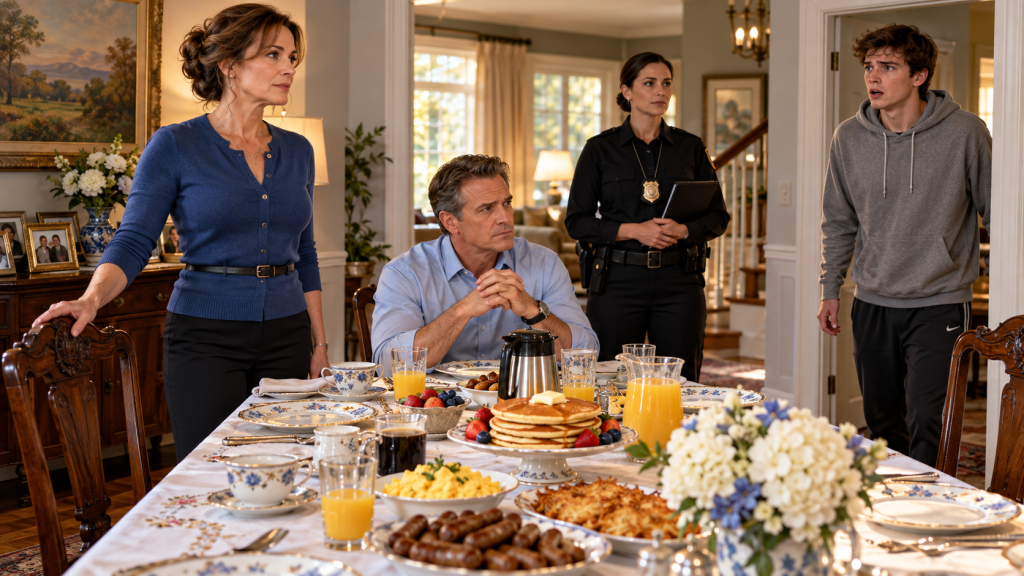
“Whose signature is it, Jason?” I asked. His mouth tightened. “You know whose.” I looked at the statement. The signature beneath the withdrawal authorization read: Sarah Bennett. My name. Written in blue ink. Except it wasn’t my handwriting.
I had a peculiar habit of making the last letter of my first name too large. My husband used to tease me that my signature looked as though it were climbing a hill.
This one was careful.
Neat.
Almost elegant.
It looked like someone had practiced it.
And I knew exactly where Jason could have found examples.
The bills I’d paid at the kitchen counter.
The birthday checks I’d signed for relatives.
The documents I’d kept in the filing cabinet beside my bedroom.
My son had lived in the same house as me long enough to study my handwriting.
“Jason,” I whispered, “did you forge my signature?”
He gave a short, ugly laugh.
“It’s my college fund.”
“That isn’t what I asked.”
“What’s the difference? The money was always supposed to be mine.”
David pulled out another statement.
“The account was established by your mother and me. We retained control of the funds until we agreed on their use. You were not authorized to withdraw them yourself.”
Jason rolled his eyes.
“So now you’re both lawyers?”
I looked at the transactions.
Five withdrawals.
Spread over ten months.
The total printed at the bottom was eighteen thousand, four hundred and fifty dollars.
My hands began shaking.
I’d been picking up extra shifts at the school library when colleagues needed help.
I’d stopped buying new clothes.
I’d postponed getting a leaking bathroom pipe repaired because Jason said he couldn’t afford his car insurance.
And all that time, he’d been taking money from an account his father and I had saved for him.
“Eighteen thousand dollars?” I whispered.
Jason looked away.
David answered quietly.
“Eighteen thousand four hundred and fifty.”
I swallowed.
“And you’ve been sending him eight hundred dollars every month?”
“For eleven months.”
I sat down slowly.
Nearly nine thousand dollars from his father.
More than eighteen thousand from the education account.
Over four thousand he’d borrowed directly from me.
And I’d spent the previous evening being told I was selfish because I wouldn’t give him another three hundred.
Jason folded his arms.
“You’re acting like I stole from strangers.”
I looked up.
“No, Jason.”
My voice sounded different.
Quieter.
“You stole from people who loved you.”
For a moment, his expression flickered.
Then he shrugged.
“You were going to give me the money eventually.”
I stared at him.
“That money was supposed to help you build a future.”
“I am trying to build a future.”
“With what?”
He said nothing.
“Your third attempt at a business? Another car? Another weekend you can’t explain?”
His jaw tightened.
“Don’t start.”
I glanced toward Officer Ramirez.
He had remained silent while we discussed the account.
Now he stepped forward.
“Jason, I’m here because your mother reported an assault. We also have information about possible unauthorized financial transactions. You’re not required to answer questions about either matter right now.”
Jason looked at him suspiciously.
“Am I under arrest?”
The officer answered carefully.
“I’m going to explain your situation and the next steps. Right now, I need everyone to remain calm.”
Jason turned toward me.
“You called the cops on your own son?”
I looked at the white tablecloth.
At the pancakes.
At the good china.
At the photographs of my bruised face.
Then I met his eyes.
“Yes.”
His face twisted.
“After everything I’ve been through?”
I felt my heart break.
Not because he was angry.
Because he still believed his suffering gave him permission to hurt me.
He pointed toward David.
“This is his fault.”
David stiffened.
“How?”
“You left.”
The words cracked across the dining room.
“You moved across the country. You got your new life. Mom stayed here dealing with everything.”
David lowered his eyes.
Jason continued.
“And now you show up pretending you’re some kind of hero?”
I watched my former husband absorb the accusation.
There was truth buried inside it.
David had moved away.
He’d called.
Sent gifts.
Visited when he could.
But he’d also allowed me to handle most of the practical difficulties of raising an angry teenager.
He’d chosen distance more often than conflict.
Still, none of that explained the bruising on my face.
David looked at our son.
“You have every right to tell me you’re hurt by how I handled things.”
Jason seemed startled.
“But you do not have the right to hit your mother.”
“Of course you’d take her side.”
“This isn’t about sides.”
David’s voice shook.
“It’s about your mother being safe.”
Jason laughed bitterly.
“Now you care about safety.”
I watched him move closer to the table.
Something in his posture changed.
His shoulders tightened.
His fists closed.
I recognized it.
That awful moment before he punched a door.
Before he kicked a chair.
Before he decided someone else was responsible for the anger building inside him.
For years, I’d tried to soothe him when I saw that expression.
I used to rush toward him.
Lower my voice.
Offer money.
Apologize for things I hadn’t done.
That morning, I stayed in my chair.
Officer Ramirez shifted slightly, maintaining space between us.
“Jason,” he said, “take a moment. Keep your hands visible.”
My son turned toward him.
“What, you think I’m going to hit someone?”
Nobody answered.
Then his eyes moved to the photograph of my cheek.
His expression changed.
For the briefest instant, I thought he might finally understand.
Instead, he said:
“She knows how to push my buttons.”
And there it was again.
The same excuse.
A different sentence carrying the same meaning.
See what you make me do.
Officer Ramirez asked Jason to step into the adjoining room so they could address the reported assault.
My son hesitated, glanced toward the front door, and then complied.
I heard a quiet exchange.
A second officer, who had been waiting outside as part of the response, entered.
The officers handled their investigation without putting David or me in charge of confronting Jason.
Eventually, they told us they had grounds to take him into custody in connection with the assault allegation.
Jason’s voice rose from the hallway.
“Mom, tell them this is ridiculous.”
I closed my eyes.
“Mom!”
David touched my shoulder.
I looked toward the doorway.
My son stood between the officers, his face flushed with anger and disbelief.
For twenty-three years, I’d answered when he called.
When he fell off his bicycle.
When he woke frightened by thunderstorms.
When he needed a ride home from soccer practice.
When his first girlfriend broke his heart.
And every time he’d created a problem he expected me to solve.
Now he was calling for me again.
But this time, rescuing him would mean abandoning myself.
I stood slowly.
“Jason.”
He looked at me.
I swallowed.
“I love you.”
His eyes filled for a second.
Then I continued.
“But I’m not going to say you didn’t hurt me.”
His mouth opened.
“You’re really doing this?”
Tears burned behind my eyes.
“No,” I whispered. “You did this. I’m finally refusing to hide it.”
When the front door closed behind him, the house became unbearably quiet.
The pancakes were still warm.
Coffee steamed in the pot.
The sausage had gone cold.
I stared at the breakfast I’d spent hours preparing.
Jason’s favorite meal.
Every dish chosen because I knew exactly what he liked.
And I realized I’d been trying to make the last morning of our old life look like every other morning.
My knees weakened.
David caught my arm.
“Sarah?”
I shook my head.
Then, for the first time since the assault, I began to cry.
He guided me into a chair.
I covered my face.
“I thought he’d be sorry.”
David sat beside me.
“I know.”
“I thought when he saw what he’d done—”
My voice broke.
“I thought he’d look at me and understand.”
David didn’t interrupt.
I pressed my fingers against my swollen cheek.
“He used to cry when birds got hurt.”
I looked up.
“Do you remember that little sparrow he brought home when he was seven?”
David’s eyes filled.
“The one in the shoebox?”
I nodded.
“He stayed beside it all night.”
“I remember.”
I began sobbing harder.
“What happened to our boy?”
David stared at the tablecloth.
Then whispered:
“I don’t know.”
Later that morning, Officer Ramirez returned to explain how I could supplement the report and access victim-support services.
He encouraged me to have my injuries medically assessed and to document any further threats.
He also explained that because Jason had been living in my house, there could be separate housing and occupancy questions requiring lawful procedures rather than simply putting his belongings outside.
I listened carefully.
The old version of me would have heard those details and become overwhelmed.
She would have said it was easier to let Jason stay.
She would have convinced herself that filing paperwork was cruel.
But the old version of me had spent two years being afraid to say no in her own kitchen.
I wasn’t willing to live that way again.
David accompanied me to urgent care.
The doctor examined my cheek, jaw, and hip.
She asked whether I’d experienced dizziness, nausea, or changes in hearing.
She documented the bruising and gave me instructions about symptoms that would require further assessment.
Then she asked a question that made my eyes fill.
“Do you feel safe returning home?”
I opened my mouth.
For a moment, no words came.
Then I answered:
“Not yet.”
The clinic connected me with a victim advocate named Monica Ellis.
She had a gentle voice, silver earrings, and a way of speaking that made difficult information feel manageable.
She explained options for immediate safety planning, protective orders where appropriate, and legal advice about Jason’s residence.
She didn’t tell me what I had to do.
She didn’t suggest my love for my son meant I should forgive the assault.
And she didn’t tell me that reporting him made me a bad mother.
Instead, she said:
“Sarah, you get to decide what contact feels safe. You also deserve help making those decisions.”
I stared at her.
For years, I’d made every decision by asking what would make Jason less angry.
Nobody had asked what would make me feel safe.
That evening, David stayed in the guest room.
Not because we were considering getting back together.
We weren’t.
Our marriage had ended for reasons that remained real.
But our son had harmed me, and David wanted to help with the immediate practical aftermath.
I allowed it.
After dinner, he brought me a glass of water and sat at the opposite end of the sofa.
For several minutes, neither of us spoke.
Then I asked:
“Why didn’t you tell me you were giving Jason money?”
David closed his eyes.
“I thought you knew.”
I stared at him.
“Eight hundred dollars a month?”
He nodded.
“He said you were charging rent and didn’t want to make it awkward between us.”
I gave a bitter laugh.
“Jason hasn’t paid me a dollar in nearly two years.”
David lowered his head.
“I know that now.”
“Did you ever ask me?”
“No.”
“Why?”
He rubbed his face.
“Because every time we spoke about Jason, we argued. I thought helping him directly was a way to avoid putting more pressure on you.”
I looked toward the kitchen.
“The pressure never went away, David. You just couldn’t see it.”
He nodded slowly.
“You’re right.”
I expected him to defend himself.
To say I hadn’t told him enough.
To explain how difficult it was to be a parent from another state.
Instead, he looked at me and said:
“I owe you an apology.”
My eyes filled.
“For what?”
“For leaving you alone to handle things that should have involved both of us.”
I swallowed.
“We were divorced.”
“Yes. But we were still his parents.”
He paused.
“And I let my guilt about moving away become another way for Jason to avoid responsibility.”
For a moment, I couldn’t speak.
Then David added:
“I thought sending money meant I was helping.”
I looked at the swollen bruise on my arm.
“So did I.”
That night, after David went upstairs, I sat alone at the dining table.
The white cloth was still in place.
I’d washed the breakfast dishes.
Put the good china away.
But I couldn’t bring myself to remove the tablecloth.
My mother had embroidered it more than thirty years earlier.
She used to say that special things should be brought out when life gave you a reason to remember.
I’d always thought she meant celebrations.
Birthdays.
Christmases.
Graduations.
Now I wondered whether she might have understood that some days become important for entirely different reasons.
I ran my fingers across the stitching.
Then looked toward the hallway.
For the first time in nearly two years, I wasn’t listening for Jason’s footsteps.
I wasn’t wondering what mood he’d be in.
I wasn’t rehearsing excuses for why I couldn’t afford his next request.
The silence frightened me.
But beneath the fear was something else.
Relief.
And that relief made me cry all over again.
The next morning, I woke to the sound of my phone vibrating.
For one terrifying second, I thought Jason was calling from upstairs.
My heart began racing before I was fully awake.
Then I remembered.
He wasn’t in the house.
The call came from an unfamiliar number.
I let it go to voicemail.
A minute later, another call arrived.
Then a text.
Mom, please answer. I didn’t mean for things to get this bad.
I stared at the screen.
The message had come from Jason’s number.
I didn’t respond.
Instead, I saved it and contacted Monica, who reminded me to preserve messages and let the relevant professionals know about any contact that might violate the conditions imposed after his arrest.
I placed the phone facedown.
My hands were shaking.
For years, Jason had been able to pull me back into an argument with a single message.
A plea.
An accusation.
A promise.
Sometimes all three within five minutes.
That morning, I made a cup of tea and let the silence remain.
At ten, David and I met with a representative from the bank where we’d established Jason’s education account.
Her name was Elaine Parker.
She looked sympathetic, but she didn’t try to minimize what had happened.
The account had originally been opened jointly by David and me when Jason was five.
We’d deposited birthday money, small monthly savings, and whatever extra we could manage.
After the divorce, we’d left it untouched while Jason considered whether to return to college or pursue vocational training.
Neither of us had authorized the disputed withdrawals.
Elaine reviewed the available records.
The signature forms.
The account-access history.
The address and contact information.
Then her expression tightened.
“There’s something else I need you to see.”
My stomach dropped.
She turned her computer screen slightly.
“A change was made to the account’s notification settings about eleven months ago.”
David leaned forward.
“What change?”
“The mailing address and electronic contact information associated with certain notices were updated.”
I stared at her.
“To what?”
She read out an email address.
I didn’t recognize it.
David shook his head.
“Neither of us uses that.”
Elaine nodded.
“Then we need to treat those changes as disputed as well.”
She explained that the bank would investigate how access had been obtained and whether its verification procedures had been followed.
The account was secured against further unauthorized activity.
We were advised to protect related credentials and review other accounts for suspicious changes.
The bank couldn’t immediately tell us who had made every entry.
But it could preserve records and investigate the transactions.
As Elaine spoke, I remembered Jason asking to borrow my laptop the previous spring.
He said his computer had crashed and he needed to complete a job application.
I’d given it to him.
Of course I had.
I’d even left my password written on a sticky note beside the keyboard because I was afraid he’d interrupt my work to ask for it.
I felt sick.
I’d spent years making access to everything easy for him.
My home.
My time.
My money.
My forgiveness.
I’d never imagined I’d need to protect myself from my own child.
Then David pointed toward the list of transfers.
“What is this account?”
Elaine followed his finger.
One transfer had gone to a financial account under a name that resembled mine.
S. Bennett Services.
I stared.
“I don’t own a business.”
Elaine looked at me.
“Then we’ll include that recipient information in the investigation.”
The account appeared repeatedly in the transaction history.
Money had moved there before being sent onward.
It was another layer of deception.
Not simply a son taking a little more than his parents intended to give.
Someone had taken steps to make unauthorized withdrawals look legitimate.
When we left the bank, I sat in David’s car without fastening my seat belt.
My former husband waited.
Finally, I whispered:
“I used to check on him every night when he was little.”
David looked toward me.
“What?”
“Even after he was old enough to sleep through the night. I’d stand in his doorway and make sure he was breathing.”
Tears filled my eyes.
“I worried about him falling out of bed. Getting sick. Being frightened.”
I looked down.
“And now I’m checking my doors because I’m afraid of him.”
David covered his eyes.
For the first time since arriving, he began crying.
That afternoon, I opened Jason’s old bedroom door.
I hadn’t gone inside since the police took him away.
The room smelled of stale takeout food and laundry that had been left too long in a basket.
Clothes covered the chair.
Dirty dishes crowded the desk.
A cracked television remote lay beside the bed.
And the hole he’d punched in the door six months earlier was still there.
I’d covered it with a poster.
I stared at the poster now.
A picture of a mountain range.
Peaceful.
Beautiful.
Hiding the shape of his fist.
I pulled it down.
Then sat on the edge of the bed and cried.
There were photographs on the dresser.
Jason at seven, holding a rescued sparrow in a shoebox.
Jason at twelve, grinning beside a trophy.
Jason at sixteen, standing between David and me at his school awards ceremony.
I picked up the last one.
He was smiling.
We were smiling.
But when I looked closely, I remembered that afternoon.
He’d been furious because David arrived late.
He’d refused to speak to him until the ceremony began.
Afterward, Jason told me I should have made his father come earlier.
I’d apologized.
As though I controlled David’s work schedule.
As though every disappointment my son experienced had somehow become mine to repair.
A knock sounded behind me.
David stood in the doorway.
“Sarah?”
I wiped my face.
He looked at the damaged door.
Then at me.
“How long has that been there?”
“Six months.”
His expression changed.
“Jason did that?”
I nodded.
David stared.
“Why didn’t you tell me?”
I gave a tired laugh.
“Would you have believed me?”
He looked hurt.
Then thoughtful.
“I would have wanted to.”
I studied his face.
“That isn’t the same thing.”
He lowered his head.
“No.”
That evening, Monica helped me make a practical safety plan.
I arranged to stay temporarily with my sister, Ruth, while the situation was assessed.
I asked a local attorney about the lawful steps for ending Jason’s occupancy and protecting my home.
Any restrictions arising from the criminal case would be handled separately.
I wasn’t going to throw his belongings onto the lawn or assume an arrest automatically ended every residential right he might have.
But I was going to use the procedures available to me.
For the first time, making a plan felt stronger than making another promise to endure.
Ruth came over after work.
She was three years younger than me, a high-school science teacher with a sharp sense of humor and very little patience for excuses.
When she saw my bruised cheek, she stopped in the doorway.
Her face changed completely.
“Sarah.”
I looked down.
“It’s not as bad as it looks.”
She stared at me.
Then said quietly:
“Don’t do that.”
I looked up.
“Do what?”
“Make it smaller so I won’t be upset.”
My eyes filled.
She stepped forward and hugged me.
I collapsed against her.
“I didn’t know it had gotten this bad,” she whispered.
“Neither did I.”
We stood together for a long time.
Then Ruth pulled back.
“You’re coming to stay with me tonight.”
I nodded.
She looked surprised.
Usually, I argued.
Usually, I insisted I was fine.
Usually, I explained why Jason needed me nearby.
That evening, I simply said:
“Okay.”
As we packed, my phone rang again.
This time, the caller was a woman named Maya Collins.
Jason’s former girlfriend.
I stared at the screen.
They’d broken up nine months earlier.
I hadn’t spoken to her since.
I answered cautiously.
“Hello?”
“Mrs. Bennett?”
Her voice shook.
“Maya?”
She took a breath.
“I heard what happened.”
My stomach tightened.
“How?”
“Jason called me.”
I closed my eyes.
“He told me you had him arrested because of an argument about money.”
I sat down.
“That’s not what happened.”
“I know,” she said.
The certainty in her voice startled me.
Then she whispered:
“Mrs. Bennett, there’s something I should have told you a long time ago.”
I felt cold.
“What?”
Maya hesitated.
“Jason took money from me too.”
I stared.
“How much?”
“Almost three thousand dollars.”
I pressed a hand against my forehead.
She continued.
“He said he needed it for a certification course. Then I found out he’d been spending money on online betting.”
I closed my eyes.
“So that’s where it went.”
“Some of it,” she answered.
Her voice broke.
“I don’t know about all of it.”
She told me Jason had borrowed money repeatedly while they were together.
At first, he’d paid it back.
Then the excuses began.
A problem with his paycheck.
An unexpected car repair.
A bank transfer that hadn’t cleared.
When she stopped giving him money, his temper changed.
He shouted.
Accused her of being disloyal.
Once, he smashed her phone against a wall.
She ended the relationship soon afterward.
“Maya,” I whispered, “why didn’t you tell me?”
She was silent.
Then she answered:
“Because when I tried explaining to you that Jason was frightening me, you told me he was going through a difficult time.”
I felt as though someone had struck me again.
I remembered the conversation.
Maya had come to my house crying.
She’d said Jason was becoming impossible to live with.
I’d told her that the divorce had affected him deeply.
That he was sensitive.
That he needed patience.
I’d thought I was defending my son.
Instead, I’d dismissed a young woman who was asking for help.
Tears spilled down my face.
“Maya, I’m so sorry.”
She began crying too.
“I know you loved him.”
“I did. I do.”
My voice broke.
“But I should have listened.”
There was a long silence.
Then she said:
“I didn’t call to hurt you.”
“I know.”
“I just don’t want you thinking this happened because you finally said no.”
I closed my eyes.
She continued softly.
“He did this because he thought he could keep making everyone else responsible for his choices.”
After we hung up, I sat on the edge of the bed holding my phone.
Ruth sat beside me.
I told her what Maya had said.
She listened.
Then asked:
“Are you blaming yourself?”
I looked down.
“Yes.”
She took my hand.
“Sarah, you can acknowledge the ways you excused his behavior without accepting responsibility for his decision to become violent.”
I swallowed.
“But I could have stopped it sooner.”
“Maybe you could have set limits sooner. Maybe David could have been more involved. Maybe other people could have intervened.”
She squeezed my fingers.
“But Jason is the one who hit you.”
My eyes filled.
“And he’s the one who has to decide whether he wants to change.”
I looked toward the hallway.
At the home I’d spent nineteen years paying for.
At the family photographs.
At the bedroom door with the hole in it.
Then I whispered:
“I don’t know how to be his mother anymore.”
Ruth rested her head against mine.
“Maybe you start by remembering that you’re still a person.”
That night, I went to Ruth’s house.
I slept in her guest room with the door locked.
The room was quiet.
The sheets smelled of lavender.
No one shouted from upstairs.
No one demanded money.
No one slammed doors.
Still, I woke at 2:17 a.m. with my heart racing.
For several seconds, I couldn’t remember where I was.
I reached for the lamp.
Then noticed a glass of water beside the bed.
Ruth had left it there.
Alongside a note.
You’re safe here. You don’t have to solve everything tonight.
I read it twice.
Then, for the first time in years, I let myself believe those words might be true.
Four days later, a letter arrived at my house.
David had gone back to Los Angeles to arrange leave from work and speak with an attorney about the financial account.
Ruth was with me when I collected the mail.
Most of it was ordinary.
A grocery advertisement.
My electric bill.
A reminder about my dental appointment.
Then I saw an envelope from a finance company I’d never heard of.
It was addressed to me.
I opened it at the kitchen counter.
The first sentence made my hands go numb.
Thank you for your recent application.
Below it was a reference number and a proposed loan amount.
$27,500.
I stared at the page.
“I didn’t apply for a loan.”
Ruth looked over my shoulder.
Her expression changed.
“Sarah, call the company.”
I did.
The representative confirmed that an application had been submitted listing me as a co-borrower.
The primary applicant was Jason.
The application described the loan as funding for a small business venture.
I stood in my kitchen staring at the account number.
“Has any money been released?”
“Not at this time,” the representative said.
Relief nearly brought me to my knees.
I explained that I hadn’t authorized the application and disputed the electronic acknowledgment attributed to me.
The company referred the matter for fraud review and advised me on the documentation needed to dispute it.
I immediately contacted my attorney and the investigating officer.
When the call ended, Ruth sat down.
“Twenty-seven thousand dollars,” she whispered.
I nodded.
My son had been trying to borrow another twenty-seven thousand dollars using my name.
After taking money from the education account.
After deceiving both parents about his finances.
After borrowing from Maya.
After demanding three hundred dollars from me.
I looked toward the wall where I’d marked his height every birthday when he was little.
Tiny pencil lines.
A name.
A date.
The evidence of a boy growing taller.
I wondered when growing older had stopped meaning growing more responsible.
The loan application contained a business name.
Northstar Digital Ventures.
I stared at it.
Jason had mentioned starting a media business several months earlier.
He said he wanted to build gaming channels, produce videos, and attract sponsors.
I’d encouraged him to write a business plan.
He’d become irritated.
“Why do you always make everything so complicated?”
I’d thought he was frustrated by my practical advice.
Now I realized he might have been looking for a large amount of money without wanting to explain how it would be used.
The next day, David returned.
He brought a folder containing information he’d obtained from Jason’s old messages and his own bank records.
He sat across from me at Ruth’s kitchen table.
“I think I know why Jason kept asking for money.”
I looked up.
David placed several statements on the table.
Some showed payments he’d sent to our son.
Others showed screenshots of messages Jason had sent him.
The requests became increasingly urgent over time.
Dad, I need help with the lease.
The bank messed up my account.
It’s just until Friday.
Mom doesn’t understand how expensive everything is.
Then one from three months earlier:
If I can’t get another $5,000, everything I’ve been working on is finished.
I stared at it.
“What was he working on?”
David swallowed.
“I thought it was the media business.”
I looked toward him.
“And now?”
He hesitated.
“I spoke with someone Jason used to work with. There was apparently a group of them betting on sports online. Jason had been losing money for quite a while.”
My stomach tightened.
“Maya told me.”
David nodded.
“He wasn’t just spending what he had. He was borrowing to try to replace what he’d lost.”
I sat back.
It explained the disappearing paychecks.
The frantic demands.
The unexplained weekends.
The promises that he would return every dollar soon.
But it didn’t explain everything.
People could develop destructive gambling habits without threatening their mothers.
They could struggle with debt without forging signatures.
And they could feel desperate without raising a hand against someone who refused to fund them.
I said as much.
David looked at me.
“I know.”
Then he whispered:
“I don’t want us to use this as another excuse.”
That afternoon, David made a decision he’d avoided for years.
He called the attorney handling Jason’s case.
He arranged for a letter to be passed on through the appropriate channel.
The letter explained that he would no longer send Jason unrestricted money.
He was willing to help pay directly for legitimate treatment or assessments if those services were arranged responsibly.
But he wouldn’t continue funding unexplained demands.
When he finished, David looked exhausted.
“I feel like I’ve abandoned him again,” he admitted.
I reached across the table.
“Sending money wasn’t keeping him safe.”
His eyes filled.
“I know.”
“And refusing to bankroll him isn’t the same as refusing to love him.”
David closed his eyes.
For years, those two ideas had become tangled in both of us.
Love and money.
Help and rescue.
Responsibility and guilt.
Now we were trying to separate them, one painful decision at a time.
The hearing concerning my safety took place several weeks later.
Monica accompanied me.
David was there too, though I had told him he didn’t need to come.
He said:
“You spent too many years handling the difficult parts alone.”
We sat in a waiting area outside the courtroom.
I held my folder so tightly that the edges bent.
Inside were medical records, photographs, messages, and the police report.
Jason arrived with his attorney.
He wore a white shirt I’d bought him for a job interview the previous year.
I recognized it immediately.
One cuff was slightly frayed.
He had always complained that it scratched his wrist.
Seeing him in that shirt hurt more than I’d expected.
For a moment, he looked like the boy I’d driven to his first college orientation.
Excited.
Nervous.
Certain the world was waiting for him.
Then he saw me.
His expression hardened.
And I remembered why we were there.
The court heard evidence relevant to my request for protection.
The attorneys addressed the assault allegation, the history of damaged property, the messages, and the safety concerns.
The judge asked questions.
I answered truthfully.
I didn’t exaggerate.
I didn’t minimize.
I described the moment Jason demanded money.
The blow.
My head striking sideways.
His words afterward.
See what you make me do?
When I repeated them, my voice shook.
But I didn’t stop.
Jason’s attorney questioned whether the argument had escalated in ways that made his client feel threatened.
I looked toward the judge.
Then answered:
“I was standing at my kitchen counter with an electric bill in my hand.”
My eyes filled.
“I told my son I couldn’t give him three hundred dollars.”
I swallowed.
“He hit me.”
The courtroom remained silent.
The judge issued protective conditions after considering the evidence and the applicable legal requirements.
The order restricted Jason’s contact and access to my home while the matter proceeded.
My attorney also addressed the separate housing arrangements through the appropriate process, so we weren’t relying on assumptions about his right to occupy the property.
His belongings were later collected through a scheduled, supervised arrangement.
I did not have to be present.
That detail mattered more than I expected.
For once, I didn’t have to stand beside someone who frightened me while pretending everything was normal.
Outside the courtroom, I sat on a bench.
My hands were shaking.
Monica sat beside me.
“You did well.”
I shook my head.
“I was terrified.”
She nodded.
“Being terrified doesn’t mean you failed.”
I looked toward the courthouse doors.
Then whispered:
“I kept expecting Jason to look at me and say he was sorry.”
Monica was quiet for a moment.
Then she asked:
“What would an apology need to look like for you to believe it?”
I stared at her.
I’d spent years accepting apologies because Jason looked upset.
Sometimes he brought flowers.
Sometimes he hugged me.
Sometimes he promised never to shout again.
But the behavior returned.
And each time, I found a reason to believe the next apology would be different.
“I don’t know,” I admitted.
Monica nodded.
“That’s all right.”
She waited.
Then said:
“An apology can be meaningful, but it isn’t a substitute for changed behavior. You don’t have to decide today whether you’ll ever trust him again.”
I closed my eyes.
For the first time, I understood that forgiveness didn’t have to be another decision made under pressure.
When we returned to the house, Ruth stood in the front hallway.
She’d arranged for a locksmith after the appropriate restrictions were confirmed.
The locks had been changed.
A security system had been installed.
The damaged bedroom door was being repaired.
And the kitchen chair Jason had broken had been taken to the garage.
I stood in the doorway looking around.
Everything was familiar.
Yet the house felt different.
I wasn’t certain whether I liked it.
Ruth approached.
“Do you want me to stay tonight?”
I considered the question.
Part of me wanted to say yes.
I was still frightened.
Still waking from nightmares.
Still wondering whether Jason might appear on the porch.
But I also wanted to begin reclaiming my home.
“I think I’ll try staying here,” I said.
She nodded.
“Then I’m ten minutes away.”
I smiled through tears.
“I know.”
That evening, I cooked dinner for one.
Just one.
Chicken.
Rice.
Green beans.
I used a small pan instead of the enormous skillet Jason preferred.
I seasoned the vegetables the way I liked them, without worrying that he’d complain.
I ate at the dining table.
And when I finished, I left the dishes in the sink for half an hour because I wanted to sit on the sofa and read.
Nobody criticized me.
Nobody demanded anything.
Nobody asked what I was going to do for them next.
The freedom felt strange.
Almost uncomfortable.
Later, I walked upstairs.
Jason’s bedroom door was open.
His belongings had been removed.
The walls were bare except for a few marks where posters had hung.
I stood in the doorway and remembered the day he first moved into that room.
He was four.
He’d insisted on choosing the blue paint.
Then he’d changed his mind halfway through and demanded green.
David and I had laughed.
We painted one wall green and the rest blue.
Jason declared it perfect.
I smiled at the memory.
Then began crying.
Because the empty room didn’t make me feel victorious.
It made me feel like a mother grieving a child who was still alive.
I sat on the floor.
For a long time, I let myself cry.
I cried for the boy who’d rescued birds.
For the teenager who’d felt abandoned after the divorce.
For the young man who’d learned to blame everyone else for his choices.
For the years I’d spent confusing endless forgiveness with love.
And for the frightening possibility that Jason might never become someone I could safely welcome home again.
When I finally stood, I noticed something on the windowsill.
A little wooden bird.
One wing was crooked.
Jason had carved it in middle school.
He’d given it to me for Mother’s Day.
I’d kept it on my bedroom dresser for years before moving it into his room.
I picked it up.
Turned it over.
On the underside, in uneven handwriting, he’d carved:
LOVE YOU, MOM.
My eyes filled.
I held the bird against my chest.
And for the first time, I allowed two truths to exist together.
I loved my son.
And I was afraid of him.
Neither truth erased the other.
The following week, I received another letter.
This one had been forwarded through Jason’s attorney.
It was handwritten.
Only one page.
I sat at the dining table and opened it.
Mom,
I know you’re angry.
I know I shouldn’t have hit you.
But you have no idea how trapped I’ve felt.
I stopped reading.
My stomach tightened.
I continued.
I’ve been trying to fix things. Dad abandoned me. You started treating me like a tenant. Everybody acts like I’m the only person who ever made mistakes.
I need you to understand why I lost control.
There was a final sentence.
If you really love me, you’ll help me get through this.
I put the letter down.
For a long time, I stared at it.
Then I folded it and placed it inside the folder with the other documents.
I didn’t answer.
Because for the first time in my life, I recognized an apology that was still asking me to take responsibility for the harm someone else had done.
Autumn arrived almost without my noticing.
At the elementary school, children returned with oversized backpacks, new sneakers, and stories about their summer vacations.
The library filled with noise again.
I had always loved the first week of school.
The smell of sharpened pencils.
The sound of little shoes squeaking across the floor.
The way kindergarteners looked at the bookshelves as though they’d discovered a room full of treasure.
But that year, I felt older.
Not in my body.
In the part of me that had spent twenty-three years believing every problem could be solved if I loved my son enough.
One morning, a little boy named Oliver approached my desk.
He held a picture book with a torn cover.
His eyes were full of worry.
“Mrs. Bennett?”
“Yes, sweetheart?”
“I broke it.”
I looked at the book.
One corner of the cover had separated.
Nothing serious.
He swallowed.
“Am I in trouble?”
I smiled gently.
“Accidents happen.”
His face relaxed.
Then I added:
“But when something gets damaged, we tell the truth and try to repair it.”
He nodded solemnly.
“Can we fix it?”
“I think so.”
I brought out the bookbinding tape.
Together, we repaired the cover.
Oliver watched carefully.
When we finished, he grinned.
“It looks better.”
I smiled.
“Yes.”
Then he asked:
“Is it exactly like before?”
I ran my finger along the visible repair.
“No,” I said softly. “But it can still be a good book.”
After he left, I sat behind my desk staring at the mended cover.
I knew it was only a children’s book.
But I couldn’t stop thinking about the question.
Is it exactly like before?
Some things could be repaired.
Others couldn’t.
And sometimes the damage remained visible even after the danger had passed.
By then, the financial investigations had produced a clearer account of Jason’s behavior.
The disputed education-account transactions had been traced through the receiving accounts.
The bank’s investigation identified failures in how certain changes and authorizations had been verified.
Some funds were recovered, and the bank resolved part of the disputed loss under its review procedures.
The remaining amount became part of the financial case and the restitution discussion.
There were still expenses and complications.
But the important fact was no longer in doubt.
David and I had not authorized the withdrawals.
Jason had used our information to access money he wasn’t entitled to take.
The proposed $27,500 loan had never been funded.
Its paperwork became additional evidence of how far he’d been willing to go to obtain money.
When investigators examined the records, they found that Jason had submitted false information about my consent.
He’d been planning to use my credit standing to obtain money I didn’t know he was seeking.
I remembered the moment he’d stood in my kitchen demanding three hundred dollars.
The absurdity almost made me laugh.
He’d already tried to borrow tens of thousands in my name.
But when I refused another three hundred in cash, he struck me.
It had never been about whether I could afford to help.
It was about whether I was allowed to say no.
Jason eventually retained an attorney and agreed to enter treatment while the criminal and financial matters proceeded.
David told me through our attorneys that Jason was receiving help for problematic gambling behavior and working with a counselor on anger, blame, and responsibility.
I was relieved.
I was also careful.
I’d heard promises before.
This time, I wasn’t going to judge change by what Jason said he planned to do.
I would watch what he actually did over time.
The legal proceedings moved slowly.
There were hearings.
Document reviews.
Discussions about restitution.
The assault case and the financial allegations were handled through the applicable process, with Jason represented by counsel.
Eventually, he entered guilty pleas to the assault and specified financial offenses.
At sentencing, the court considered the evidence, his lack of prior convictions, the nature of the harm, and the treatment he’d begun.
The resulting sentence included supervised conditions, restitution obligations, and requirements intended to address his conduct.
The protections surrounding my safety remained a separate matter that would not simply disappear because he said he was sorry.
I attended the sentencing hearing.
Not because I wanted to see my son humiliated.
Because I wanted to speak.
For the first time in years, I wanted to tell the truth without editing it to protect him.
When I stood, my hands shook.
Jason sat beside his attorney.
David was behind me.
Ruth sat on my other side.
I looked toward the judge.
Then began.
“I love my son.”
My voice trembled.
“I loved him when he was a baby and I walked the floor all night because he wouldn’t sleep.”
I swallowed.
“I loved him when he was a little boy bringing injured birds home and insisting I could save them.”
Jason lowered his head.
“I loved him when his father and I divorced, when he struggled at school, when he lost jobs, and when he moved back into my home.”
My eyes filled.
“But I also became afraid of him.”
I took a breath.
“I stopped saying no because I couldn’t predict what would happen afterward.”
The courtroom was silent.
“I convinced myself that if I kept helping, eventually he’d feel secure enough to change.”
A tear rolled down my cheek.
“Instead, the demands grew. The threats grew. And one night, after I refused to give him money, he hit me.”
I looked toward Jason.
His shoulders had begun shaking.
I continued.
“I am not here because I stopped loving him.”
My voice steadied.
“I’m here because I finally understood that loving him did not require me to let him hurt me.”
I turned back toward the judge.
“I hope he changes. I hope he builds a life he can be proud of. I hope someday we can have a relationship that doesn’t frighten either of us.”
I swallowed.
“But I cannot make that happen for him.”
When I finished, Ruth took my hand.
David wiped his eyes.
Jason remained looking at the table.
I didn’t know what he was thinking.
For once, I didn’t try to guess.
After the hearing, David and I walked outside together.
The sky was gray.
Leaves skittered across the courthouse steps.
He looked at me.
“Sarah, I’m proud of you.”
I gave a tired smile.
“I was shaking the entire time.”
“I know.”
He paused.
“But you said what needed to be said.”
I looked toward the parking lot.
“Do you think he’ll change?”
David was quiet.
Then he answered:
“I think he has the chance to.”
I nodded.
He added:
“And for once, we have to let the chance belong to him.”
That winter, I began seeing a counselor regularly.
At first, I spent most of our sessions talking about Jason.
His childhood.
The divorce.
His anger.
The money.
The assault.
One afternoon, my counselor interrupted gently.
“Sarah, tell me something about yourself that has nothing to do with being Jason’s mother.”
I stared at her.
My mind went blank.
She waited.
I gave a nervous laugh.
“I work in a library.”
“What do you enjoy outside work?”
I thought about it.
Then realized I hadn’t answered that question in years.
I used to paint.
Small watercolors.
Flowers.
Birds.
Landscapes.
I stopped because Jason complained about the smell of the supplies and said I spent too much time on hobbies while he was struggling.
I used to meet friends for lunch.
Then I began canceling because Jason needed my car, or money, or help with some new emergency.
I used to take long walks.
I stopped because I was always exhausted.
“I don’t know who I am anymore,” I whispered.
My counselor nodded.
“Then perhaps we can begin finding out.”
The following Saturday, Ruth arrived carrying a box.
Inside were watercolor paints.
Brushes.
Paper.
And a small wooden easel.
I looked at her.
“What’s all this?”
She grinned.
“Your sister is tired of hearing you say you used to paint.”
Tears filled my eyes.
“Ruth…”
She put the box on the table.
“Don’t make it dramatic. I found the easel on sale.”
I laughed.
Then hugged her.
I began painting again.
At first, my hands felt clumsy.
The colors ran.
The shapes looked wrong.
I ruined three sheets of paper trying to paint a rose.
Then I remembered something my mother used to tell me.
Watercolor isn’t supposed to be controlled every second. Sometimes you have to let the colors move.
I smiled.
And tried again.
By Christmas, my dining room had become a place I enjoyed entering.
I bought a new set of placemats.
Repaired the chair Jason had broken.
Hung one of my paintings beside the window.
I invited Ruth, David, and two friends from work for a small holiday dinner.
David came as Jason’s father and as someone with whom I’d rebuilt a respectful friendship, not as my husband.
That distinction felt comfortable.
We laughed.
Ate too much pie.
Played a ridiculous card game Ruth insisted she knew how to win.
And when everyone left, I stood in the kitchen and realized something remarkable.
I’d spent an entire evening without thinking about whether Jason was angry with me.
A few days after Christmas, I received another letter.
This one also came through the appropriate legal channel.
Jason’s handwriting was smaller than before.
Less hurried.
The letter began:
Mom, I read the first letter I sent you after the arrest. I understand now why you didn’t answer.
I stopped.
My hands began trembling.
Then I continued.
I said I was sorry, but I kept explaining why what I did was your fault.
It wasn’t.
I sat down.
I hit you because you told me no and I wanted to make you afraid to say it again.
Tears filled my eyes.
There it was.
The truth he’d spent years avoiding.
Not anger making him helpless.
Not my refusal making him violent.
A decision to frighten me into compliance.
I also stole money.
I used your name because I believed you would forgive me if I could make the problem disappear before you found out.
When you discovered it, I was angry at you for noticing.
I covered my mouth.
I’m not writing this to ask you to stop the case, send money, or let me move home.
I’m following the repayment plan and attending treatment. I have a job, and I’m learning how to handle money without hiding what I’m doing.
I know none of that erases what happened.
You don’t owe me a reply.
I hope someday I become someone you can feel safe around.
Love, Jason.
I read the letter three times.
Then I put it beside the first one.
The difference was almost unbearable.
The first had asked me to understand his suffering.
The second acknowledged mine.
The first had demanded another rescue.
The second asked for nothing.
I didn’t know whether the change would last.
But for the first time, I could see what actual responsibility might begin to look like.
I folded the letter carefully and placed it in a drawer.
Then I went into the kitchen.
Made myself a cup of coffee.
Sat beside the window.
And watched the snow begin falling across the backyard.
I didn’t call Jason.
I didn’t send money.
I didn’t promise forgiveness.
I simply let myself feel hope without turning it into another obligation.
Spring arrived quietly.
The bruising on my cheek had disappeared months earlier.
But I still sometimes flinched when someone raised their voice unexpectedly.
I still checked the front door twice before bed.
And some nights, I woke from dreams in which Jason stood in the kitchen demanding money.
Healing wasn’t as simple as waiting for the visible injuries to fade.
I was learning that.
Slowly.
Jason continued complying with the conditions of his sentence and treatment.
Through his attorney and, later, a counselor facilitating family communication, I received occasional updates.
He was working regular hours at a distribution warehouse.
He had arranged structured repayment of the money he owed.
Some months, the payments were small.
But he made them.
He no longer received unrestricted financial help from David.
And for the first time in years, the people around him weren’t expected to erase his problems before he faced them.
One afternoon, Monica asked whether I’d considered having a conversation with Jason.
I stared at her.
“Do I have to?”
“No.”
I looked relieved.
She smiled gently.
“This isn’t a requirement. It’s an option, if and when it’s safe and you want it.”
I thought about the letters.
The court.
The little wooden bird on my dresser.
Then I whispered:
“I think I’d like to see him.”
We arranged a meeting at a counseling office after the necessary contact restrictions had been reviewed and any permissions addressed.
I wasn’t going to invite Jason back into the house as a way of testing whether he’d changed.
I wasn’t going to place myself somewhere I couldn’t leave.
We met in a quiet room with a professional present.
Two chairs.
A small table.
A box of tissues.
And a window overlooking a courtyard.
It was nothing like the dining room where our old life had ended.
When Jason entered, my breath caught.
He looked thinner.
His hair was shorter.
He wore a plain blue shirt and clean jeans.
For a moment, he looked so familiar that I wanted to stand and hug him.
Then I remembered his hand striking my face.
I remained seated.
Jason stopped a few feet away.
“Hi, Mom.”
My eyes filled.
“Hello, Jason.”
He sat opposite me.
For a long time, neither of us spoke.
Then he looked down.
“I don’t know how to start.”
I took a slow breath.
“Tell the truth.”
He nodded.
“I was angry for years,” he said.
I listened.
“At Dad. At you. At myself. Every time something went wrong, I felt like somebody had done it to me.”
He rubbed his palms together.
“And then I started expecting people to fix it.”
I watched his face.
He continued.
“When I lost money, I thought another bet would get it back. When I couldn’t pay somebody, I borrowed from someone else. When that wasn’t enough, I lied.”
His voice broke.
“And when you finally stopped giving me money, I felt like you were taking away something I deserved.”
I swallowed.
Jason looked up.
“I know how awful that sounds.”
I nodded.
“It is awful.”
He lowered his eyes.
“I know.”
For several seconds, neither of us spoke.
Then he whispered:
“When I hit you, I wanted you to be scared.”
Tears filled my eyes.
He continued.
“I wanted you to give in.”
His voice cracked.
“And afterward, when I saw what I’d done, I blamed you because I couldn’t stand the thought that I was becoming someone who hurt his own mother.”
I stared at him.
“You didn’t just become that person, Jason.”
He looked up.
“You were making choices for a long time. Shouting. Breaking things. Threatening people.”
He nodded through tears.
“I know.”
I leaned forward.
“Do you understand how frightened I was?”
He covered his face.
“I think I’m beginning to.”
My voice trembled.
“I used to listen for your footsteps because I wanted to know whether you were home safely.”
He began crying.
“Then I started listening because I needed to know what mood you were in.”
He lowered his head.
I swallowed.
“I loved you the entire time.”
“I know, Mom.”
“But I was scared in my own house.”
He began sobbing.
For several minutes, neither of us spoke.
Then Jason wiped his face.
“I’m sorry.”
I looked at him.
He continued.
“Not because I got arrested.”
His voice shook.
“Not because I lost the house or the money.”
He swallowed.
“I’m sorry because I hurt you. And you didn’t deserve it.”
I closed my eyes.
For years, I’d wanted those words.
I’d imagined hearing them in the kitchen the morning after the assault.
I’d imagined Jason suddenly realizing what he’d done and becoming the sweet boy I remembered.
But healing hadn’t happened in one breakfast.
And it wasn’t going to be completed by one apology.
I opened my eyes.
“Thank you for saying that.”
Jason nodded.
Then he asked the question I’d been expecting.
“Do you think I can ever come home?”
My chest tightened.
I took a long breath.
“Not to live, Jason.”
His expression crumpled.
I continued.
“You’re building an adult life now. You need to keep doing that.”
He looked down.
“I know.”
“And whether you come to visit someday will depend on safety, time, and the trust you rebuild.”
He wiped his eyes.
“Okay.”
I studied his face.
For the first time, he hadn’t argued when I set a boundary.
He hadn’t raised his voice.
Hadn’t accused me of being selfish.
Hadn’t demanded that I prove I loved him.
He simply accepted the answer.
It was a small moment.
But it mattered.
Before the meeting ended, Jason reached into his pocket.
He placed a photograph on the table.
I recognized it immediately.
He was seven years old.
Standing in our garage.
Holding a shoebox containing an injured sparrow.
I smiled through tears.
“Where did you find that?”
“Dad sent it to me.”
He looked down.
“I remember that bird.”
“So do I.”
His voice softened.
“You stayed up all night helping me find somebody who knew how to care for it.”
I nodded.
“The wildlife rehabilitator came the next morning.”
Jason smiled sadly.
“You told me helping something doesn’t mean pretending you know how to fix everything.”
I stared at him.
I’d forgotten saying that.
He continued.
“You said sometimes helping means calling someone who knows what they’re doing.”
My eyes filled.
He looked at me.
“I think you finally did that for both of us.”
I began crying.
Not because everything was fixed.
Because, for the first time, my son seemed to understand the difference between love and rescue.
We ended the meeting without a dramatic embrace.
Jason asked whether he could hug me.
I considered it.
Then shook my head gently.
“Not today.”
He nodded.
“Okay, Mom.”
I smiled through tears.
“Maybe another time.”
He looked at me.
Then smiled faintly.
“I’d like that.”
A year after the morning I cooked Jason’s favorite breakfast, I took the embroidered white tablecloth out of the linen cabinet again.
It was a Saturday.
Sunlight filled the kitchen.
Birds were singing outside.
I spread the cloth across the dining table and smoothed the wrinkles with both hands.
Then I brought out the good china.
But this time, I wasn’t preparing a meal to disguise fear.
I was celebrating my own birthday.
Ruth arrived first, carrying flowers.
David came later with a chocolate cake and a joke about finally remembering what flavor I liked.
Two friends from work brought fruit and pastries.
We talked.
Laughed.
Ate breakfast at an unreasonable hour.
Nobody demanded money.
Nobody frightened me.
Nobody told me that saying no was an act of betrayal.
At one point, Ruth glanced at the tablecloth.
“Isn’t this the one from that morning?”
I nodded.
Her expression softened.
“Are you okay using it?”
I looked around the room.
At the people I’d invited.
At the sunlight.
At the breakfast I’d chosen.
Then I smiled.
“Yes.”
After everyone left, I stood beside the dining table.
The white cloth was stained with a little coffee.
There were crumbs on the plates.
Flowers leaned toward the window.
It looked like the aftermath of an ordinary celebration.
And I realized I’d once believed this tablecloth belonged only to the beautiful moments of my life.
Now it carried a different memory.
The morning I finally stopped letting fear decide how much I was allowed to protect myself.
My phone buzzed.
A message from Jason.
We had established limited, agreed contact after the counseling meeting.
He hadn’t asked for money.
Hadn’t demanded a visit.
Hadn’t tried to move back.
He was continuing his treatment, maintaining employment, and meeting his repayment obligations.
There were still difficult days.
There were still consequences.
And I still wasn’t ready to let him return to the house.
But we were beginning to speak honestly.
I opened his message.
Happy birthday, Mom.
I hope you have a good day.
You deserve one.
I read it twice.
Then typed:
Thank you, Jason. I hope you’re doing well.
He replied a few minutes later.
I’m trying.
I smiled sadly.
Then wrote:
Keep trying.
I placed the phone on the table.
For a long moment, I looked toward the stairs.
I could almost hear the boy he’d been.
The little feet running down the hallway.
The excited voice asking what was for breakfast.
The child who’d once believed I could save every injured bird in the world.
I would always love that boy.
And I loved the man he was trying to become.
But I finally understood something that had taken me twenty-three years to learn.
My love for my son did not give him the right to hurt me.
And being his mother did not mean sacrificing my safety to protect him from consequences.
The night he hit me, Jason believed my refusal was the problem.
The following morning, when he saw his favorite breakfast, he smiled and said:
“So you finally learned.”
He was right about one thing.
I had learned.
But not the lesson he wanted to teach me.
I learned that saying no could be an act of love.
That accountability was not cruelty.
That a mother’s forgiveness did not need to arrive before her child’s change.
And that even when someone you love is struggling, you are not required to let them destroy your peace.
That morning, Jason believed I’d finally learned to obey him.
Instead, I had finally learned to protect myself.
And for the first time in years, the home I’d spent my life building belonged to me again.
THE END STORIES! THANK YOU FOR READING GOOD LUCK !❤️
Related Posts