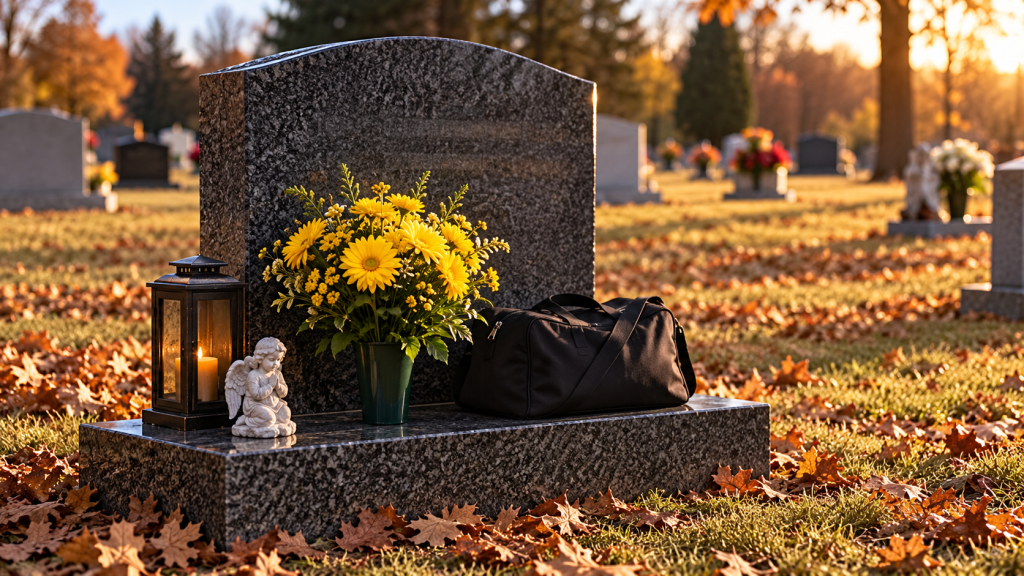
I stared at the message on my phone until the words began to blur. Leave that bag. Don’t listen to the woman. My sister had sent it less than a minute after Elena told me she’d been hiding the truth about Paul’s death. Five years. For five years, I’d visited this grave carrying yellow flowers, believing my husband had died alone in a highway accident.
I’d wondered whether he’d been frightened. Whether he’d called my name. Whether he’d known how much I loved him. And now a stranger was standing beside his headstone telling me he’d died saving her little girl. While my sister, Rachel, was warning me not to listen. My hands began shaking. I looked at Elena.
“How does Rachel know you’re here?” Elena’s eyes filled. “She knows I’ve been trying to reach you.” “That doesn’t answer my question.” “I told her yesterday that I was going to give you the bag myself.” My stomach tightened. “You contacted my sister?” Elena nodded miserably. “One last time. I told her I couldn’t keep this secret anymore.”
I stared at her.
“Why would you warn the person who was hiding it?”
She lowered her eyes.
“Because I was afraid.”
Those three words were barely audible.
Then she looked toward the little silver wedding ring resting in my palm.
“I’m tired of being afraid, Megan.”
The groundskeeper who had accompanied Elena stepped closer.
His name tag read LEON.
“Ma’am,” he said gently, “the cemetery office asked me to check whether everything was all right.”
I glanced toward the black bag.
My husband’s phone.
His wedding ring.
A child’s raincoat.
A photograph showing a little girl I’d never met.
Everything about it felt wrong.
And yet the little dent on the ring was unmistakable.
I remembered the afternoon Paul dropped it while fixing our porch railing.
He’d searched between the floorboards for nearly an hour.
When he found it, he held it up and laughed.
“Still married!”
I’d kissed him and told him he was an idiot.
He’d grinned.
“My favorite kind.”
Now I was holding that same ring beside his grave.
I looked at Leon.
“Could you please ask the cemetery office to preserve any security footage from this morning?”
He nodded.
“Of course.”
Then I turned to Elena.
“I need to know exactly how you got these things.”
Her face tightened.
“I’ll tell you everything.”
I swallowed.
“And I need you to understand something. If there’s evidence connected to Paul’s death, we need to give it to investigators. Not pass it around.”
Elena nodded quickly.
“I brought the originals because I didn’t know whether you’d believe me.”
I looked at the bag.
For a moment, I wanted to close it and walk away.
I wanted the world to return to the simple cruelty I already knew.
My husband had died.
There had been a highway accident.
Sometimes terrible things happened for no reason anyone could understand.
But then I looked at the picture of Paul kneeling beside Sophie.
He was smiling.
The familiar, slightly crooked smile that appeared whenever he tried to make a frightened child laugh.
And I knew I couldn’t leave.
We moved to a bench near the cemetery office.
Leon brought us water.
I called my sister.
Rachel answered immediately.
“Megan?”
Her voice was breathless.
“Where are you?”
“At Paul’s grave.”
Silence.
Then she said:
“Please tell me you haven’t taken anything from that woman.”
I looked at Elena.
“She says Paul saved her daughter’s life.”
Rachel exhaled sharply.
“Megan, you need to be careful.”
“Careful of what?”
“People who see a grieving widow and think they can get money.”
I stared at the phone.
“Money?”
“Paul had life insurance. You own the house. There are people who prey on that.”
For five years, Rachel had been the person I called when grief made the world feel unmanageable.
She’d stayed at my house after the funeral.
Helped me sort through condolence cards.
Taken me to the bank when I couldn’t bear to discuss death benefits.
I’d trusted her.
And now she was talking about money before asking how I was feeling.
“Rachel,” I whispered, “how did Elena get Paul’s wedding ring?”
She didn’t answer.
“Rachel?”
“Things disappear after accidents, Meg.”
“His ring wasn’t listed among the effects returned to me.”
She swallowed audibly.
“Then maybe somebody stole it.”
I closed my eyes.
“Elena says Sophie was there when Paul died.”
“That woman is lying.”
“Did you meet her five years ago?”
A long silence followed.
Then Rachel said:
“Don’t do this over the phone.”
My heart began pounding.
“Answer me.”
She took a shaky breath.
“Yes.”
The world seemed to fall silent.
“You met her?”
“Yes.”
“When?”
“After the funeral.”
My voice broke.
“And you never told me?”
“Megan, I was protecting you.”
I looked toward Paul’s grave.
Yellow flowers lay beside the stone.
For the first time in five years, the sight made me angry.
“You don’t get to decide what I can survive, Rachel.”
She began crying.
“Please come home. I’ll explain.”
I swallowed.
“No. I’m going to listen to Elena first.”
“Megan—”
I ended the call.
Elena sat beside me without speaking.
She looked to be in her late thirties, with tired brown eyes and dark hair twisted into a loose bun.
She held her handbag tightly in her lap.
I had so many questions that I couldn’t decide which one to ask first.
Finally, I looked at the photograph again.
“Tell me about Sophie.”
Elena’s expression softened.
“She’s eleven now.”
My throat tightened.
“She was six when Paul died?”
“Yes.”
“Where is she?”
“At my sister’s house. She knows I’m here.”
I studied her.
“Does she remember him?”
Elena began crying.
“Every day.”
I stared.
She wiped her cheeks.
“She calls him the man who stayed.”
My chest tightened.
“Why?”
Elena looked toward the gravel path.
“Because everyone else was trying to get away from the road, and your husband went back for her.”
I gripped the edge of the bench.
Elena began slowly.
Five years earlier, she’d been driving home with Sophie after visiting her mother.
They had stopped at a gas station along the highway.
Sophie was upset because she’d dropped her stuffed rabbit into a puddle.
Paul had been standing near the coffee machine.
He noticed her crying.
He asked the attendant for paper towels, helped Sophie dry the rabbit, and made a ridiculous joke about rabbits needing swimming lessons.
I smiled despite myself.
That sounded like Paul.
He’d never been able to pass a crying child without trying to help.
Elena showed me another photograph on her phone.
It was the original image from the gas station.
Paul crouched beside Sophie, holding the damp rabbit by one ear.
Sophie was laughing.
Elena explained that she’d taken the picture after Sophie insisted she wanted a photograph with the funny man.
I stared at his face.
He had been alive just hours before his death.
Smiling.
Making somebody else’s child laugh.
He looked so ordinary.
So completely himself.
“After we left,” Elena continued, “I had trouble with my car.”
“What kind of trouble?”
“A tire started losing pressure. I pulled over, but the shoulder was narrow and the road was dark.”
She swallowed.
“Sophie became frightened. Cars were passing close to us.”
I looked at her.
“What happened next?”
“Paul stopped.”
My eyes filled.
“He’d recognized our car from the gas station.”
She nodded.
“He pulled in ahead of us and came back with a flashlight. He said he’d call roadside assistance.”
I could almost hear Paul’s voice.
Let’s get you somewhere safe first.
He’d said things like that all the time.
If a neighbor was stranded.
If an elderly person needed help carrying groceries.
If someone dropped something in a parking lot.
Paul never assumed somebody else would handle it.
Elena’s voice began trembling.
“He told me to take Sophie away from the roadway while he checked the tire.”
I gripped the bench.
“Then?”
“Sophie had climbed back into the car for her rabbit. I turned around, and I couldn’t see her.”
Elena covered her mouth.
“I went toward the passenger door, but it was stuck against the guardrail.”
My stomach twisted.
“Paul reached her?”
She nodded through tears.
“He pulled her out through the other side.”
I could barely breathe.
“He was carrying her toward me when a pickup came around the bend.”
Her hands began shaking.
“It was moving too fast. It was close to the shoulder.”
I stared.
“Did Paul see it?”
“Yes.”
She began crying harder.
“He pushed Sophie toward me.”
I pressed a hand over my mouth.
“And then?”
Elena looked directly at me.
“The truck struck him.”
I bent forward.
For five years, I’d imagined Paul dying inside his own car.
I’d imagined the steering wheel.
The windshield.
The terrible silence afterward.
Now Elena was telling me he’d been on his feet, carrying a frightened little girl.
He’d seen the danger.
And he’d used the last seconds of his life to push her away from it.
I began sobbing.
Elena moved closer but didn’t touch me.
“I am so sorry, Megan.”
I shook my head.
“Did he say anything?”
Her face crumpled.
“Before the truck reached us, he told Sophie to run to her mommy.”
I covered my mouth.
“He said, ‘Go on, sweetheart. I’ve got you.’”
My whole body shook.
That was Paul.
Those were exactly the kind of words he would’ve said.
Then Elena whispered:
“And when the truck hit him, he was still reaching toward her.”
I cried until I couldn’t breathe properly.
Elena waited.
So did Leon, who remained a respectful distance away.
Finally, I lifted my head.
“What happened to the truck?”
Elena’s expression changed.
“It didn’t stop.”
I stared.
“It just drove away?”
She nodded.
“Someone got out briefly farther up the road. I heard shouting. Then it left.”
I swallowed.
“Did you see the driver?”
“Not clearly.”
My chest tightened.
“But you saw the truck.”
“Yes.”
“What did it look like?”
Elena hesitated.
Then answered:
“A dark blue pickup. A work truck. There was a company marking on the door.”
“What company?”
She looked down.
“Garrison Transport.”
My stomach dropped.
Garrison Transport.
My brother-in-law’s company.
Rachel’s husband, Graham, owned it.
I stared at Elena.
“No.”
She began crying.
“I recognized the name later. That’s how I found your sister.”
For a moment, the world seemed to tilt.
Rachel had told me Paul died in an accident.
She’d helped me fill out insurance forms.
She’d held me when I cried.
And all that time, her husband’s company name had been on the vehicle that struck him.
My phone buzzed.
Another message from Rachel.
Whatever Elena told you, please don’t involve the police until we’ve talked.
I stared at the words.
Then I looked up at Elena.
“Why didn’t the police report mention Sophie?”
She wiped her eyes.
“That’s the part I still don’t understand.”
I swallowed.
“Tell me.”
Elena took a breath.
“I gave a statement at the hospital. I told an officer about the truck. He said they’d follow up.”
“And?”
“A few days later, someone called and said the accident had been reconstructed as a single-vehicle crash.”
My heart pounded.
“What?”
“They said Paul’s car had left the roadway and that the other details couldn’t be verified.”
I stared.
Elena continued.
“I insisted he’d been outside his car. That Sophie had been there. But the officer said I was confused because of the trauma.”
I felt cold.
“Who was the officer?”
She reached into the bag and removed a copy of a business card.
SERGEANT MARK HARLAN.
The name meant nothing to me.
But then Elena added:
“He was a friend of Graham Garrison.”
I took a shaky breath.
“Why did you keep Paul’s phone?”
Elena looked at the black bag.
“He handed it to me when he stopped. He told me to call roadside assistance because his phone had a better signal.”
She swallowed.
“During the accident, it fell into my car. Later, when I found it, I tried to return it.”
I stared.
“To whom?”
“Your sister.”
My chest tightened.
Elena continued.
“Rachel said she would give it to you. But when I mentioned the recording, she became upset.”
“What recording?”
Elena looked at me.
“The one Paul made before he stopped to help us.”
My stomach tightened.
She opened the bag.
Carefully, she showed me the cracked phone.
“The recording was saved on it. I had the phone repaired enough to retrieve the files, but I kept the original.”
I stared.
“What did he say?”
Elena’s eyes filled.
“I think you need to hear it yourself.”
I wanted to listen immediately.
Every part of me wanted to hear Paul’s voice again.
But something stopped me.
The phone was evidence.
The recording might be important.
And I’d already handled more of the bag than I should have.
I looked at Elena.
“We need to take this to an investigator.”
She nodded.
“I know.”
“Not Rachel. Not Graham. Someone independent.”
She swallowed.
“Will you believe me?”
I looked at the photograph of Paul and Sophie.
Then at the wedding ring in my palm.
“I believe you’re telling me what you remember.”
My voice broke.
“And I intend to find out what happened.”
As we stood to leave, Elena touched my arm.
“Megan?”
I turned.
“There’s one more thing.”
My stomach tightened.
“What?”
“Paul wasn’t only worried about a truck following him.”
She looked toward the cemetery entrance.
“Earlier that day, he’d argued with someone on the phone.”
I swallowed.
“Who?”
Elena’s voice trembled.
“Your sister.”
I stared.
She continued.
“After the gas station, he told me he was supposed to meet Rachel that night. He said they’d been arguing about something involving her son.”
My heart stopped.
Rachel’s son.
My nephew.
Noah.
He’d been eighteen when Paul died.
A quiet boy who loved basketball and used to spend weekends helping his father at the transport yard.
A boy Paul had taught to change a tire.
I stared at Elena.
“Why would Paul be arguing about Noah?”
Her face crumpled.
“I don’t know.”
Then she added:
“But Megan, when the pickup stopped farther up the road, I heard someone shouting a name.”
My mouth went dry.
“What name?”
Elena closed her eyes.
And whispered:
“Noah.”
For a moment, I couldn’t feel my hands.
Noah.
The name hung between us in the morning air.
I had known my nephew since the day he was born.
I’d changed his diapers, attended his birthday parties, and watched Paul teach him to ride a bicycle.
When Noah turned sixteen, Paul helped him buy his first used car.
He’d spent an entire Saturday inspecting the engine and showing him how to check the brakes.
And now Elena was telling me she’d heard somebody shout his name at the scene of Paul’s death.
“Are you sure?” I whispered.
Elena shook her head slowly.
“I’m sure I heard the name. I can’t honestly tell you who shouted it.”
I swallowed.
“Did you tell the police?”
“Yes. I told Sergeant Harlan.”
I looked down at the wedding ring.
“Was it in your written statement?”
“I never received a copy of the statement I gave that night.”
My stomach tightened.
Then she added, “When I requested the final report months later, my name wasn’t included as a witness.”
I stared at her.
“Not even as Sophie’s mother?”
“No.”
I thought about the five years after Paul’s funeral.
Rachel had been there through nearly every important moment.
The first Christmas without him.
The day I finally packed away his shirts.
Our tenth wedding anniversary, when I stayed in bed until evening because I couldn’t face the empty space beside me.
Noah had visited too.
He’d carried groceries to my kitchen.
Fixed a broken porch light.
Taken my trash bins to the curb when it snowed.
I’d thought he was grieving the uncle who had always looked out for him.
Now I remembered the way he avoided talking about the accident.
The way he sometimes became pale when I mentioned the highway.
The way Rachel immediately changed the subject.
I’d assumed they were being considerate.
What if they’d been afraid?
Elena and I went to the local law enforcement office and asked how to submit material concerning an old fatal collision.
We were directed to investigators who could arrange an appropriate intake and determine whether the case should be reviewed by a separate unit.
Because the allegation involved a former investigating officer, I also requested that the concern about Sergeant Harlan be documented.
We didn’t play the recording on a random computer or forward the phone to friends.
The evidence needed to be preserved.
Elena provided the original phone, the bag, her photographs, and the notes she’d kept over the years.
I provided the messages from Rachel and explained how the ring had come into my possession.
A detective named Mara Castillo interviewed us separately.
She had a steady voice and a habit of waiting until people finished speaking.
When I told her what Elena remembered, she didn’t say the case was solved.
She said:
“We need to compare these accounts with the original collision file, medical evidence, dispatch records, and anything that can still be independently verified.”
I nodded.
“Will you look at it?”
“Yes,” she said. “I can’t promise what we’ll find. But these questions deserve a proper review.”
For the first time that morning, I felt something resembling relief.
The detective asked how I knew Rachel Garrison.
“She’s my sister.”
“And Graham Garrison?”
“Her husband.”
“Does Garrison Transport operate blue pickup trucks?”
I swallowed.
“Yes.”
“Did Noah Garrison have access to those vehicles five years ago?”
“I don’t know.”
Then I remembered something.
Paul and Noah had worked together at Graham’s transport yard a few times.
Paul had helped the business with occasional mechanical problems.
Graham liked saying his brother-in-law could repair anything.
I looked up.
“Noah sometimes helped with the company vehicles.”
Detective Castillo wrote that down.
“Thank you.”
Then she asked:
“Did Paul ever express concern about Noah’s driving?”
My throat tightened.
There had been an argument at our house a few weeks before Paul died.
Noah had arrived late one evening, laughing loudly and smelling faintly of alcohol.
Paul offered to drive him home.
Noah insisted he was fine.
I remembered Paul taking the car keys from his hand.
Rachel had arrived ten minutes later, furious.
“You’ve embarrassed him,” she’d told Paul.
Paul replied, “I’d rather embarrass him tonight than attend his funeral tomorrow.”
At the time, I thought it was an ordinary family disagreement.
Now I told Detective Castillo everything.
She didn’t react dramatically.
But she wrote for a long time.
That evening, I went home and sat on the bedroom floor.
I hadn’t changed much since Paul died.
His side of the dresser was mostly empty now.
But one drawer still held a few of his things.
A watch with a worn leather strap.
Two folded handkerchiefs.
A postcard from our honeymoon.
And a little notebook full of ridiculous reminders.
Buy coffee.
Fix garage light.
Ask Megan about Saturday.
On the last page, he’d written:
Yellow flowers.
I pressed the notebook against my chest.
“Paul,” I whispered, “what were you doing that night?”
For five years, I’d imagined his last hours as a sequence of ordinary decisions.
Work.
Dinner.
Driving home.
An accident.
Now every detail felt uncertain.
Why had he stopped at that gas station?
Had he been following Noah?
Had he been trying to prevent something terrible?
And if Rachel knew the truth, how had she managed to look at me all these years?
My phone rang.
Rachel.
I let it ring.
Then another call came.
Graham.
I didn’t answer that either.
A message appeared.
Meg, don’t let strangers tear our family apart.
I stared at it.
Then typed the first words I’d sent my sister since leaving the cemetery.
Did Noah drive the blue Garrison truck the night Paul died?
Three dots appeared.
Disappeared.
Appeared again.
Finally, she answered.
Please don’t do this by text.
I felt a cold anger settle inside me.
That wasn’t a denial.
The next morning, Rachel arrived at my house.
I saw her through the front window.
She stood on the porch holding a paper bag from my favorite bakery.
Cinnamon rolls.
The same ones she brought when I was sad.
For a moment, I remembered being children.
Rachel was three years older.
She’d taught me how to braid my hair.
Held my hand on the first day of school.
Stayed beside me when our father was in the hospital.
For most of my life, she was the person I trusted when things became frightening.
Now I was afraid of what she might say if I opened the door.
I called through it.
“Rachel, I don’t want to talk right now.”
Her voice broke.
“Megan, please.”
I stood still.
She continued.
“I know you’re angry.”
I almost laughed.
“Angry?”
Tears filled my eyes.
“Paul is dead.”
Rachel began crying.
“I know.”
“You sat beside me at his funeral.”
“I know.”
“You watched me cry for five years.”
She covered her face.
“Megan—”
“And all that time, you knew Elena existed.”
Silence.
I pressed my forehead against the door.
“Why didn’t you tell me?”
Rachel whispered:
“Because I thought knowing would destroy you.”
I lifted my head.
“Knowing what?”
She didn’t answer.
I waited.
Then she said:
“Graham handled everything after the accident.”
My pulse quickened.
“What did he handle?”
“Insurance. The truck. The police questions.”
I closed my eyes.
“Was Noah driving?”
Rachel began sobbing.
For a moment, I heard only her breathing.
Then she whispered:
“Yes.”
I gripped the wall.
The answer I’d feared was now coming from my own sister.
“Noah hit Paul?”
Rachel cried harder.
“Megan, it was an accident.”
I stared at the door.
“You knew?”
“Yes.”
“How long?”
She swallowed.
“Since that night.”
My legs nearly gave way.
Five years.
My sister had known since the night my husband died.
And she’d said nothing.
I stepped back.
“Leave.”
“Megan, please let me explain.”
“No.”
“He was only eighteen.”
My heart shattered.
“And Paul was thirty-four.”
Rachel sobbed.
“He was my son.”
I stared at the door.
“And Paul was my husband.”
Silence.
Then I whispered:
“You protected your child by letting me bury mine.”
Rachel made a broken sound.
“We didn’t have children, Meg.”
I closed my eyes.
I knew that.
Rachel knew that.
Paul and I had tried for two years before accepting that starting a family might not happen for us.
He’d held me through every disappointment.
He’d told me our marriage wasn’t less of a marriage because our house was quiet.
Rachel knew those things.
And in her panic, she’d just used them against me.
I stepped closer to the door.
“Paul was my family.”
She began crying harder.
“I’m sorry.”
“Leave, Rachel.”
After she walked away, I sank onto the hallway floor.
The cinnamon rolls remained on the porch.
I stared at the paper bag through the glass.
A familiar kindness.
Delivered by someone who had concealed the truth about my husband’s death.
For the first time, I understood that betrayal didn’t always come from people who had never loved you.
Sometimes it came from people who loved someone else more desperately than they loved the truth.
Several days later, Detective Castillo called.
“Megan, we’ve completed an initial review of the original collision file.”
My heart began pounding.
“What did you find?”
“Several discrepancies.”
I sat down.
She explained that the crash report identified Paul as the sole occupant of his vehicle.
That statement, by itself, wasn’t wrong.
He had been traveling alone.
But the report also treated the event as a single-vehicle collision, with no documented second vehicle and no mention of a woman or child present nearby.
The physical evidence listed in the file was incomplete.
Several photographs had been referenced but were not included in the final archive.
And the location noted for Paul’s body was inconsistent with the initial emergency dispatch information.
I stared at the wall.
“Does that mean someone changed the report?”
“It raises concerns we need to investigate. We won’t make that conclusion without examining the source records.”
She paused.
“There’s something else.”
I held my breath.
“The medical examiner’s findings are consistent with a severe vehicle impact, but the injuries don’t establish by themselves whether Paul was inside his car or standing outside it.”
I covered my mouth.
So even after five years, the evidence hadn’t disappeared completely.
Detective Castillo continued.
“We located an emergency dispatch entry documenting a woman and child at the scene.”
My eyes filled.
“Elena and Sophie?”
“It doesn’t identify them by name in the summary. But the time and location are consistent with their account.”
I took a shaky breath.
“Then why weren’t they in the report?”
“That is one of the questions being examined.”
There was a pause.
“Another agency is reviewing Sergeant Harlan’s handling of the file because of the potential conflict of interest.”
I closed my eyes.
For five years, I’d believed the official explanation because I thought it had been reached through a complete investigation.
Now I was learning how many questions had been left unanswered.
Three days later, the detective called again.
This time, she sounded different.
More careful.
“Megan, the forensic team recovered an audio memo from Paul’s phone.”
My hands began shaking.
“Can I hear it?”
“We’d like you to come in. There are things we want to explain about what the recording can and cannot establish.”
I swallowed.
“Is it his voice?”
“Yes.”
I began crying.
For five years, I’d listened to the same twelve-second voicemail on my birthday.
Hey, Meg. It’s me. Don’t forget we’re out of milk. Love you.
Now there was another recording.
Another chance to hear him speak.
And this time, his voice might explain why he never came home.
The next morning, I sat in a small interview room with Detective Castillo.
Elena was there.
A technical specialist had prepared an authenticated copy of the recovered audio for review.
The detective explained that the recording’s date and integrity had been assessed against the phone’s other data, though the recording alone could not prove every event it described.
Then she pressed play.
There was a faint rustle.
Traffic.
A car door shutting.
Then Paul’s voice.
“Okay, Meg. I’m recording this because I keep losing my nerve about calling you.”
My entire body went still.
He sounded tired.
But unmistakably alive.
“I had another argument with Rachel. Noah’s been taking Graham’s work truck out after drinking. I saw him earlier, and I told Rachel somebody needs to take those keys away.”
A pause.
Then Paul exhaled.
“She says I’m overreacting. Graham says Noah is a good driver. But being a good driver doesn’t help if you’re not thinking clearly.”
I covered my mouth.
The recording continued.
“I don’t want to start another family fight. But I’m going to tell Graham what I saw, whether Rachel likes it or not.”
There was another pause.
Then he said:
“I love you. I’ll explain when I get home.”
The recording ended.
I stared at the speaker.
I’ll explain when I get home.
I began sobbing.
He’d believed there would be time.
Time to sit beside me at our kitchen table.
Time to tell me he’d argued with my sister.
Time to complain about how stubborn Noah was being.
Time to laugh about the ridiculous rabbit at the gas station.
He’d assumed he was coming home.
Detective Castillo passed me a tissue.
I could barely speak.
“Was Noah following him?”
“We haven’t established that from this recording.”
I nodded.
She continued.
“But the phone’s other data, photographs, and location records are providing leads. We’re also reviewing the Garrison Transport vehicle records and the old repair and insurance files.”
I looked down.
“Please find out.”
Her expression softened.
“We will follow what the evidence supports.”
Then Elena spoke.
“There was something I never told you at the cemetery.”
I turned toward her.
Her face was pale.
“I didn’t see the driver’s face clearly that night. But I remember someone getting out farther up the road after the collision.”
I nodded.
She swallowed.
“The person stood beside the truck. I heard another voice shouting.”
My heart pounded.
“What did it say?”
Elena began crying.
“Someone shouted, ‘Noah, get back in. We have to go.’”
I stared.
Detective Castillo leaned forward.
“Are you certain that’s what you remember?”
Elena nodded.
“Yes.”
The detective made a note.
Then asked:
“Did you hear more than one person?”
“Yes. At least two voices.”
My stomach tightened.
Noah hadn’t necessarily been alone.
Someone else had been there.
Someone who told him to leave.
And suddenly, the question wasn’t only who struck Paul.
It was who had decided that saving Noah mattered more than stopping for the man lying beside the road.
The next month passed in fragments.
Some days I felt almost normal.
I went to work.
Bought groceries.
Answered emails.
Met a friend for lunch.
Then a song would play in a shop, or I’d see a man wearing the same blue jacket Paul used to wear, and grief would rise so suddenly that I couldn’t breathe.
Only now, anger came with it.
I wasn’t merely mourning the husband I’d lost.
I was mourning five years of truth that had been taken from me.
Detective Castillo kept me informed when she could.
The investigators located an old repair invoice from a private garage that had serviced Garrison Transport vehicles.
It described extensive repairs to the front passenger side of a blue company pickup less than a week after Paul’s death.
The invoice called the damage a collision with a loading barrier.
But an insurance photograph taken before the repair showed marks that investigators believed warranted comparison with evidence from Paul’s accident.
The garage owner had kept records.
The parts supplier had retained invoices.
And the vehicle’s identifying number matched the one in Garrison Transport’s fleet records.
I remember sitting at my kitchen table when the detective explained that.
The truck.
There had been a truck.
It hadn’t existed only in Elena’s memory.
Then the investigators found something else.
A former Garrison Transport employee named Victor Salazar had kept copies of dispatch logs from the month Paul died.
Victor had been fired after arguing with Graham about maintenance and safety procedures.
He’d preserved the records as part of an employment dispute.
Five years later, those copies mattered.
The truck’s official log claimed it had been parked at the transport yard on the night of Paul’s death.
But separate fuel purchases, access records, and messages contradicted that timeline.
The company vehicle had been used.
And someone had changed the records afterward.
I asked Detective Castillo whether that meant Noah had been driving.
She paused.
“We have evidence putting the vehicle on the road. We’re still working to establish the occupants and their actions.”
I swallowed.
“Rachel admitted Noah was involved.”
“I understand. Her statements need to be obtained and assessed through proper procedures.”
I nodded.
The answer frustrated me.
But I’d spent five years living with a conclusion that hadn’t been properly tested.
I didn’t want investigators to make the same mistake in the other direction.
One afternoon, Elena called.
“Sophie wants to meet you.”
I sat down.
“What?”
“She keeps asking about Paul.”
My throat tightened.
Elena continued.
“I told her I’d spoken to you. She wants to know whether you’re angry with her.”
My heart broke.
“Angry with Sophie?”
“She says if she hadn’t gone back for her rabbit, your husband might still be alive.”
I covered my mouth.
“Oh, Elena.”
Her voice trembled.
“I’ve told her a thousand times it wasn’t her fault.”
I stared toward Paul’s photograph.
Then whispered:
“Tell her it wasn’t. Tell her Paul made his own choice to help, and the person driving the truck was responsible for driving safely.”
Elena began crying.
“I do.”
I took a breath.
“I’d like to meet her, if she’s comfortable.”
We arranged to meet at a quiet public garden.
Elena spoke with Sophie’s counselor beforehand to make sure the meeting would be handled sensitively.
I didn’t want Sophie questioned about the collision.
She had already carried enough.
She deserved to be an eleven-year-old girl, not a witness rehearsing the worst night of her childhood for my comfort.
Sophie arrived wearing a yellow sweater.
She had long dark curls and serious brown eyes.
When she saw me, she stopped walking.
For a moment, neither of us spoke.
Then she whispered:
“Are you Paul’s wife?”
I nodded.
“Yes.”
She looked down.
“He was nice.”
Tears rose in my eyes.
“I know.”
She swallowed.
“He helped me dry Mr. Buttons.”
I smiled through tears.
“Your rabbit?”
She nodded.
“He said rabbits should take swimming lessons before jumping in puddles.”
I laughed.
That sounded exactly like Paul.
Sophie reached into her backpack.
She pulled out a folded piece of paper.
“I made this.”
I accepted it carefully.
It was a drawing.
A highway beneath a dark blue sky.
A little girl holding a white rabbit.
And a man kneeling beside her with a flashlight.
Above them, Sophie had written:
THE MAN WHO STAYED.
I stared at the page.
Then I began crying.
Sophie looked frightened.
“Did I make you sad?”
I shook my head quickly.
“No, sweetheart.”
I knelt so we were eye level.
“You made me remember something beautiful about my husband.”
Her eyes filled.
I continued.
“Paul loved helping people. He would have been glad to know you were safe.”
She swallowed.
“Mom says he saved me.”
I nodded.
“He helped you get to safety.”
Then I said something I wanted her to remember for the rest of her life.
“But what happened to him was not your fault.”
Sophie’s face crumpled.
“Even though I went back for Mr. Buttons?”
“Even then.”
She began crying.
I opened my arms slightly.
She stepped forward and hugged me.
I held her gently.
And for a moment, I felt as though the five years between the accident and this afternoon had narrowed into something I could finally understand.
Paul hadn’t left this world without kindness.
His last act had given someone else the chance to grow up.
We spent the rest of the afternoon walking through the garden.
Sophie told me about school.
Her favorite teacher.
Her love of drawing.
The books she was reading.
At one point, she asked what Paul did for work.
I smiled.
“He designed equipment for warehouses. Mostly the kind that keeps people safe.”
She considered that.
“Like safety signs?”
“Sometimes. And machines that help people lift heavy things without getting hurt.”
Sophie nodded.
“He was good at safety.”
My eyes filled.
“Yes,” I whispered.
“He tried to be.”
Before we left, Elena asked whether I wanted the drawing.
I looked at Sophie.
“May I keep it?”
She smiled shyly.
“Yes.”
I held it carefully.
Then asked whether Sophie would like to see a photograph of Paul when he was younger.
Her face brightened.
I showed her a picture from our honeymoon.
Paul standing beside the ocean with his shoes in one hand.
His hair was a mess.
He was laughing.
Sophie giggled.
“He looks silly.”
“He was.”
Then she pointed toward me.
“You look happy.”
I swallowed.
“I was.”
She studied the photograph.
Then whispered:
“I hope you’re happy again.”
I stared at her.
Such a small sentence.
Spoken by a child who’d survived something no child should have witnessed.
I smiled through tears.
“I’m working on it.”
That night, I placed Sophie’s drawing beside Paul’s photograph.
I sat looking at both until the room grew dark.
For years, I’d been afraid that learning more about his final moments would destroy me.
But hearing Sophie remember his kindness had given me something I didn’t expect.
It hadn’t made his death easier.
Nothing could.
But it had given me back part of the man he was.
The following week, Noah contacted me.
His message came from a number I didn’t recognize.
Megan, it’s Noah. I know you don’t owe me anything, but I need to tell you the truth. I’ve spoken with an attorney. I want to give a statement.
I stared at the screen.
Then another message appeared.
I’m sorry about Uncle Paul.
My hands began shaking.
For five years, Noah had called me Aunt Megan.
He’d visited my house.
Helped fix small things.
Watched me cry.
And now he was twenty-three, sending an apology for something he’d apparently done when he was eighteen.
I didn’t answer immediately.
Instead, I called Detective Castillo.
She advised me to let Noah’s attorney coordinate any formal interview.
I agreed.
I wasn’t going to let a private conversation become a substitute for an investigation.
A few days later, Noah gave a recorded statement with counsel present.
I wasn’t there.
But later, after portions of his account became part of the legal proceedings, I learned what he’d said.
He had taken one of Graham’s company trucks that night.
He’d consumed alcohol earlier.
He’d argued with Paul, who’d warned him not to drive.
Noah was angry.
Embarrassed.
Convinced his uncle was treating him like a child.
When he saw Paul’s car on the highway, he followed it.
He wanted Paul to stop.
He wanted to argue.
He wanted to prove he could handle himself.
At some point, Graham joined Noah in the pickup after receiving a call about the confrontation.
According to Noah’s account, his father told him to drive back toward the transport yard.
They argued inside the vehicle.
Noah was distracted.
He approached the narrow stretch of highway too quickly.
And when he saw Paul’s car stopped near Elena’s vehicle, he swerved.
He struck Paul.
I read the account with shaking hands.
Graham had been sitting beside him.
His father.
An adult.
The owner of the truck.
The man who should have stopped the situation long before it reached that road.
Noah said he tried to stop immediately.
Graham shouted at him to keep moving.
They pulled over farther ahead.
Noah got out.
He saw the damaged front of the truck.
He heard Elena screaming.
And he started back toward the accident.
Then Graham grabbed him.
According to Noah, his father said:
“If you go back, everything is over. You’ll go to prison. Your mother will lose you. Get in the truck.”
Noah froze.
He was eighteen.
Frightened.
And he obeyed.
I sat at my kitchen table reading those words.
For years, I’d imagined the driver as a faceless monster.
Someone who struck my husband and disappeared without caring.
Now I was discovering something more complicated and somehow more terrible.
A frightened young man had made a catastrophic decision.
His father had chosen to protect him rather than help the person he’d hit.
And my sister had helped keep the consequences away from her family.
Noah’s account did not excuse him.
He’d been old enough to understand that drinking and driving were dangerous.
Old enough to know he should stop after a collision.
Old enough to tell the truth afterward.
But he had spent five years carrying what happened.
And the adults who might have helped him take responsibility had instead taught him to hide.
The investigators continued checking his account against independent evidence.
They examined repair records, communications, location information, and the archived emergency dispatch materials.
The inquiry into Sergeant Harlan revealed unusual contact with Graham after the crash.
Financial records showed payments through a consulting arrangement that investigators believed had been used to conceal money connected to the cover-up.
There were also discrepancies between Harlan’s initial field notes and the final collision narrative.
The original notes referenced a possible second vehicle and civilian witnesses.
Those references had disappeared from the later report.
For five years, I’d thought the absence of evidence meant there was nothing else to know.
Now I understood something painful.
Sometimes evidence is absent because nobody looked carefully enough.
And sometimes someone makes sure it doesn’t reach the people who need it.
One afternoon, Rachel left a letter in my mailbox.
I nearly threw it away.
Then I saw her handwriting.
The same careful handwriting that appeared on birthday cards throughout my childhood.
I sat at the kitchen table and opened it.
Meg,
I don’t know whether you’ll ever forgive me.
I don’t know whether I deserve it.
But I need to stop pretending that what I did was protection.
When Graham told me Noah had been driving, I panicked.
I thought my son would go to prison. I thought our family would collapse.
Graham promised me he could fix everything.
I stopped reading.
Tears blurred my vision.
He said the police would treat it as an accident.
He said Elena’s story was confused.
He said nothing would bring Paul back, and exposing Noah would only destroy another life.
I wanted to believe him.
So I did.
My hands tightened around the paper.
When Elena contacted me after the funeral, she wanted to give you Paul’s ring and phone.
I told her you already knew about Sophie.
I told her you didn’t want contact.
That was a lie.
Then Graham warned her that continuing to speak could put her and her daughter through years of trouble.
I let him.
I covered my face.
Rachel continued.
I visited you afterward.
I held you while you cried.
I helped you sort Paul’s clothes.
Every time you asked whether he suffered, I wanted to tell you what I knew.
But I was afraid you’d never speak to me again.
The longer I stayed silent, the harder it became to stop.
I stared at the final paragraph.
I told myself I was saving my son.
But I was teaching him that his life mattered more than yours, Paul’s, or Sophie’s.
I’m sorry, Megan.
I don’t expect you to understand.
I only hope someday you will know that I have told investigators everything I remember.
Rachel.
I folded the letter.
Then I began crying.
I loved my sister.
I had loved her almost my entire life.
But she had stood beside me during the worst years of my life and withheld the one truth I needed most.
There was no explanation that could make those years disappear.
Not fear.
Not motherhood.
Not regret.
That evening, I took the letter to Paul’s photograph.
I placed it beside Sophie’s drawing.
Then I whispered:
“Paul, I don’t know what I’m supposed to do with all of this.”
The room remained quiet.
I looked at his smiling face.
Then at the little girl he’d saved.
For the first time, I wasn’t asking whether I could forgive Rachel.
I was asking whether I could build a future that didn’t require me to pretend the past had been different.
The investigation eventually became a criminal case.
Noah was charged in connection with the fatal collision and his failure to stop and render aid.
Graham faced charges relating to the cover-up, the alteration of company records, and his actions after the crash.
The investigation into former Sergeant Harlan resulted in separate proceedings concerning false reporting and corruption.
Rachel also had to answer for her participation in concealing evidence and misleading a witness.
I watched the developments from a distance.
Sometimes I read the court documents.
Other times, I couldn’t bear to look.
I had spent five years living with an unanswered question.
Now I was learning that answers could be painful in ways uncertainty never was.
Elena testified about the highway.
The broken-down car.
Sophie climbing back inside for her rabbit.
Paul helping her out.
The pickup.
The voices.
The terrible moment when the truck drove away.
Her voice shook, but she finished.
The court also heard evidence from the vehicle records, witnesses, forensic examiners, and investigators who had reconstructed the case.
The old medical and dispatch records helped correct the false narrative that Paul had died in a single-vehicle accident while driving alone.
He had been outside his vehicle.
He had been helping a frightened child.
And another vehicle had struck him.
Noah eventually accepted responsibility through a guilty plea to the applicable offenses.
The court considered his age at the time, his actions, the fatal consequences, his failure to stop, and his later cooperation.
He received a custodial sentence and additional obligations determined through the legal process.
Graham’s conduct was addressed separately.
His efforts to remove evidence and conceal his son’s involvement had prevented a timely investigation, prolonged my suffering, and denied Elena an honest account of the night she nearly lost Sophie.
He too faced serious penalties.
Harlan’s case exposed the damage caused when someone entrusted with recording the truth instead manipulates it.
The proceedings did not undo what happened.
But the false account of Paul’s death was no longer the official final word.
I attended Noah’s sentencing.
I wasn’t sure whether I should.
Then I remembered how many years he’d spent standing in my kitchen, pretending nothing was wrong.
I needed to see him acknowledge what he’d done.
He looked younger than twenty-three when he entered the courtroom.
His shoulders were hunched.
His face was pale.
When he spoke, his voice shook.
“I was angry at my uncle because he told me not to drive.”
He swallowed.
“I thought he was embarrassing me.”
He looked toward me.
“Uncle Paul was trying to keep me from hurting somebody.”
My eyes filled.
Noah continued.
“And I hurt him.”
He began crying.
“I saw him beside the road. I knew it was him. I wanted to go back.”
His voice broke.
“I let Dad tell me to leave.”
He covered his face.
“And afterward, every day I didn’t tell the truth made it harder to tell.”
I stared at him.
The little boy Paul had taught to ride a bicycle.
The teenager whose first car Paul had helped repair.
Now a young man facing the consequences of the choices he’d made.
Then Noah said something that broke me.
“I remember Uncle Paul telling me that being grown-up isn’t about proving nobody can stop you.”
He swallowed.
“He said being grown-up means knowing when to stop yourself.”
Tears streamed down my face.
“He was right.”
When it was my turn to speak, my hands were trembling.
I stood before the court with a photograph of Paul.
Not the one from the cemetery bag.
A picture from an ordinary Saturday morning.
Paul standing in our kitchen holding a frying pan.
He’d burned breakfast.
He was laughing.
I looked at Noah.
“Your uncle was thirty-four years old.”
My voice broke.
“He loved bad jokes. He loved yellow flowers because he said they made our kitchen look happier.”
I swallowed.
“He wanted to travel. He wanted to grow old. He wanted to spend more Sunday mornings making terrible pancakes.”
The courtroom was silent.
“For five years, I believed his death was something nobody could explain.”
I looked down at the photograph.
“Then I learned he died helping a little girl get away from danger.”
Tears slid down my cheeks.
“I will always be grateful that Sophie survived.”
I looked toward Noah again.
“But I will never be grateful for what you did.”
He lowered his head.
“I hope you become a better man,” I continued.
“Not because that will erase what happened. It won’t.”
My voice shook.
“But because your uncle spent years trying to teach you that your choices matter.”
After the hearing, Rachel waited near the courthouse exit.
She looked exhausted.
Graham’s legal troubles had changed her life.
Her marriage was unraveling.
Her business finances were under scrutiny.
The comfortable world she’d protected at such terrible cost had fallen apart anyway.
She approached slowly.
“Megan?”
I stopped.
For a moment, we simply looked at each other.
Then she whispered:
“I’m sorry.”
I nodded.
“I know.”
Her eyes filled.
“Do you think we’ll ever be sisters again?”
My throat tightened.
I looked at the woman who’d held my hand when we were children.
Who’d comforted me after our mother’s death.
Who’d made cinnamon rolls when I was sad.
And who had watched me grieve Paul for five years while hiding the truth about how he died.
“I don’t know,” I whispered.
Rachel began crying.
“I love you.”
Tears filled my eyes.
“I love you too.”
For a moment, hope crossed her face.
Then I continued.
“But loving you doesn’t mean I can trust you right now.”
She lowered her head.
“I understand.”
I took a breath.
“If we ever rebuild anything, it will have to begin with honesty. No more deciding what I should know. No more telling lies because the truth is uncomfortable.”
Rachel nodded through tears.
“I promise.”
I looked at her.
“Then keep that promise whether I forgive you or not.”
I walked away before either of us could say something we weren’t ready to mean.
The following October, I returned to Paul’s grave.
It was the sixth anniversary of his death.
For the first time, I didn’t go alone.
Elena came with Sophie.
We carried yellow flowers.
Sophie brought a small stuffed rabbit.
It wasn’t the original Mr. Buttons.
That one had become too worn to take outside.
This was a new rabbit with a yellow ribbon.
She placed it carefully beside Paul’s headstone.
Then she whispered:
“Thank you for staying.”
My eyes filled.
Elena put a hand on her daughter’s shoulder.
We stood together in the quiet cemetery.
Three people whose lives had been changed by one man’s final act of kindness.
After a while, Sophie looked at me.
“Megan?”
“Yes, sweetheart?”
“Do you think Paul was scared?”
The question made my heart ache.
I looked at his name carved into the stone.
Then back at her.
“I don’t know exactly what he felt.”
Sophie nodded.
I continued.
“But I know that even if he was frightened, he helped you.”
Her eyes filled.
“Does that mean he was brave?”
I smiled through tears.
“Yes.”
I took her hand.
“That’s exactly what it means.”
We sat on a bench beneath the trees.
Elena told me Sophie had started writing a school project about people who help others.
She wanted to include Paul.
Not as a famous person.
Not as a superhero.
As an ordinary man who saw someone in danger and stopped.
I smiled.
“He would have been embarrassed.”
Elena laughed softly.
“Really?”
“Oh, terribly.”
I looked at the photograph in my hand.
“He never liked being called a hero.”
Sophie tilted her head.
“Why?”
“Because he believed helping somebody was simply what people should do.”
She considered that.
Then said:
“I think that makes him a hero anyway.”
I began crying.
Because I thought so too.
Over the following year, Elena and I became friends.
It happened gradually.
Coffee after Sophie’s school events.
Lunch on quiet Saturdays.
Occasional messages about ordinary things.
Sophie sent me photographs of her drawings.
I showed her pictures of Paul making ridiculous faces during our vacations.
I told her how he’d once spent an entire afternoon trying to rescue a bird that had flown into our garage.
And how the bird eventually flew away while he was still building an elaborate cardboard trap.
Sophie laughed so hard she spilled her lemonade.
For the first time, sharing stories about Paul didn’t make me feel as though I was losing him all over again.
It made me feel that something of him was still moving through the world.
I also began visiting a grief support group again.
I’d attended one shortly after Paul’s death, then stopped because I thought I’d reached the point where I should be finished grieving.
Now I understood grief didn’t work that way.
Learning the truth had reopened parts of the wound.
But it had also allowed me to mourn the man Paul actually was in his final moments, rather than the uncertain story I’d been given.
One evening, the group facilitator asked what had helped me most.
I thought about it for a long time.
Then answered:
“Being allowed to ask questions.”
The room became quiet.
I continued.
“For years, everyone told me I should accept what happened and move on. But acceptance built on false information isn’t peace.”
I swallowed.
“Now I know more. Some of it is terrible. But at least the truth belongs to me.”
Rachel wrote occasionally.
At first, I kept her letters unopened.
Then I began reading them.
She didn’t ask me for money.
Didn’t demand forgiveness.
Didn’t try to explain away what she’d done.
She told me about counseling.
About the painful process of examining the decisions she’d made.
About how she’d confused protecting Noah with protecting him from responsibility.
I didn’t respond to every letter.
But eventually, I sent one of my own.
Rachel,
I miss the sister I believed I had.
I don’t know whether we can rebuild our relationship.
But I appreciate that you’ve stopped asking me to pretend the past didn’t happen.
If we ever find our way toward each other again, it will have to be slowly.
Love, Megan.
It wasn’t forgiveness.
Not yet.
It was a small door left unlocked.
And for now, that was enough.
Two years after I found the black bag, I made a decision I’d been considering for a long time.
I established a small community scholarship in Paul’s memory.
Nothing grand.
Nothing that required enormous wealth.
It would help students interested in mechanical engineering, roadside safety, or public service.
I called it the Paul Bennett Memorial Award.
On the application, I included one question.
Describe a time you chose to help someone when it would have been easier to walk away.
Paul would have liked that.
He’d never believed kindness needed an audience.
But I wanted young people to understand something he had shown through his life.
Sometimes the most important decisions happen when nobody expects us to be extraordinary.
At the first scholarship presentation, Sophie stood beside me.
She was thirteen now.
Tall.
Confident.
Still carrying her sketchbook everywhere.
She’d asked whether she could say a few words.
I agreed.
When she stepped to the microphone, she looked nervous.
Then she took a breath.
“Five years ago, a man named Paul helped save my life.”
Her voice trembled.
“I used to think that meant I owed him something impossible.”
I covered my mouth.
Sophie continued.
“But Megan told me I didn’t owe him my life. She said the best way to remember him was to be kind to people when I had the chance.”
Tears filled my eyes.
She smiled.
“So that’s what I try to do.”
After the ceremony, Sophie ran toward me.
“Was that okay?”
I pulled her into my arms.
“It was beautiful.”
She grinned.
“Do you think Paul would’ve liked it?”
I looked toward his photograph beside the podium.
Then smiled through tears.
“He would’ve said you were embarrassing him.”
Sophie laughed.
“And then?”
“And then he would’ve hugged you.”
She held on tighter.
That evening, I returned home and placed Paul’s wedding ring beside mine.
For years, I’d kept my own ring in a small jewelry box.
His had been missing.
Now the two bands rested together.
Mine still shone softly.
His carried that familiar little dent.
I looked at them for a long time.
Then I picked up the photograph Elena had given me.
Paul kneeling beside Sophie.
His smile.
Her little yellow raincoat.
The moment before everything changed.
I’d once been frightened of that photograph.
Now I was grateful for it.
It showed Paul alive.
Kind.
Completely himself.
I thought about the day I found the black bag.
How my knees had buckled.
How frightened I’d been to open it.
How the ring, the phone, and the photograph seemed to threaten everything I believed about my husband’s death.
I hadn’t known the truth would lead me through police reports, family betrayals, courtrooms, and years of grief I’d thought were behind me.
I hadn’t known it would expose the terrible choices of people I’d trusted.
And I certainly hadn’t known it would bring a little girl named Sophie into my life.
But now I understood something I hadn’t understood before.
Paul did not die because Sophie needed help.
He died because someone drove dangerously, struck him, and failed to stop.
His decision to help her was not the tragedy.
It was the last beautiful thing he did.
The tragedy was that other people chose fear, secrecy, and self-preservation over the truth.
I opened my phone and played the voicemail I’d saved for years.
“Hey, Meg. It’s me. Don’t forget we’re out of milk. Love you.”
I smiled through tears.
Then I played the recovered recording.
“I love you. I’ll explain when I get home.”
My heart tightened.
He never came home that night.
But after five years of lies, his voice finally reached me.
And I could remember him not only as the man I’d lost, but as the man who had stopped beside a dark highway because someone needed him.
I looked at his photograph.
“Paul,” I whispered, “I know now.”
The room was quiet.
I touched his ring.
“I know you weren’t alone.”
A tear slid down my cheek.
“And I know you didn’t leave this world without love.”
People still tell me that life goes on.
They’re right.
It does.
There are bills to pay.
Friends to meet.
Birthdays to celebrate.
Flowers to buy.
Some days, there is even laughter that arrives without warning.
And someday, perhaps, there will be another person beside me.
I no longer believe loving someone new would mean loving Paul less.
Love doesn’t work like that.
The heart can make room for a future without erasing its past.
Every October, I still bring yellow flowers to the cemetery.
Sometimes Elena and Sophie come with me.
Sometimes I go alone.
I sit beside Paul’s headstone and tell him about the year.
About Sophie’s drawings.
About the scholarship.
About the ordinary little things he would have laughed at.
And when I leave, I don’t spend the whole drive home wondering whether he was frightened or whether anyone cared.
I know what I can know.
I know he helped a child reach safety.
I know somebody finally told the truth.
And I know the last words he recorded for me.
“I love you. I’ll explain when I get home.”
He never got to explain.
But I found the answers.
And although those answers broke my heart, they also gave me something I thought I’d lost forever.
The truth about the man I loved.
THE END STORIES! THANK YOU FOR READING GOOD LUCK !❤️
Related Posts



