The door swung inward, and Mr. Varela stepped onto the rooftop. “I warned her not to leave witnesses.” He said it so quietly that, for one terrible second, I wondered whether I’d imagined it. Then he closed the door behind him. The sound of the latch sliding into place was louder than the traffic far below.
He wore a dark work jacket, gray trousers, and the same brown leather shoes I’d seen at Rebecca’s funeral. His silver hair was combed neatly backward. In his right hand was a ring of keys. In his left, a flashlight. He looked exactly as he’d looked every morning for the twenty-three years I’d lived in that building.
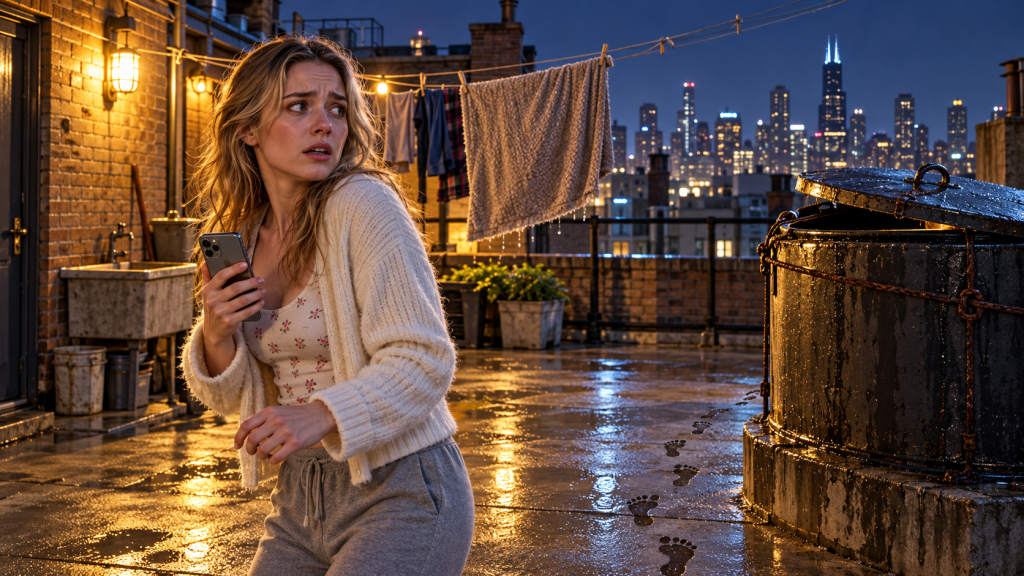
The man who collected rent. The man who complained when children played in the stairwell. The man who always seemed to know when somebody had visitors. Only now, in the yellow light above the rooftop door, his face had lost its familiar expression. There was no irritation. No impatience. Only a terrible calm. “Mr. Varela,” I whispered.
His eyes moved to the black water tank.
Then to the scrap of Rebecca’s gray robe clutched in my hand.
“Give me that.”
I stepped backward.
He took one step forward.
“Don’t make this difficult.”
Behind me, the tank gave three slow knocks.
Knock.
Knock.
Knock.
Varela stopped.
His gaze shifted toward the rusted lid.
For the first time, I saw something unexpected cross his face.
Fear.
“You opened it?” he asked.
I swallowed.
“No.”
His eyes narrowed.
“Then how did you get that?”
He pointed toward the porcelain doll’s hand, still protruding from the narrow space beneath the lid.
I couldn’t answer.
Because I didn’t know.
The hand was motionless now.
Its tiny white fingers looked almost delicate beneath the rooftop light.
But the wet footprints were still there.
Seven little prints.
Bare feet.
No larger than a six-year-old child’s.
And the last one ended beside my shoe.
Varela looked down.
His face drained of color.
“That’s impossible,” he whispered.
My heart began hammering.
“What happened to Emmett?”
His jaw tightened.
“Go downstairs.”
“Tell me what happened to him.”
His eyes snapped toward me.
“I said go downstairs.”
Then something scratched against the inside of the tank.
Slowly.
Deliberately.
Varela flinched.
And a child’s voice whispered from somewhere beneath the lid.
“He has the key.”
The landlord staggered backward.
For one second, I saw the frightened old man beneath the monster.
Then he looked at me.
“You didn’t hear that.”
I stared at him.
“Yes, I did.”
He took another step.
“You’ve been drinking?”
“No.”
“Taking something?”
“No.”
His voice sharpened.
“Then stop staring at that tank like a lunatic.”
I glanced toward the rooftop door.
He was standing directly between me and the stairs.
The parapet wall was too high to climb safely.
The neighboring building was separated by an alley four stories below.
There was nowhere to run.
My phone vibrated.
The screen illuminated in my shaking hand.
REBE 2A — VOICE MESSAGE
Varela saw the name.
His expression changed so violently that I nearly screamed.
“Where did you get her phone?”
I stared at him.
“It’s my phone.”
“That’s not what I asked.”
He lunged.
I barely had time to move.
His fingers caught my sleeve.
The fabric tore.
I stumbled backward into one of the old laundry basins.
Pain shot through my hip.
The flashlight fell from his hand and struck the concrete.
For a moment, the light spun across the rooftop.
Wall.
Laundry line.
Water tank.
And then something else.
A small boy standing beside the black tank.
Barefoot.
Wearing a blue T-shirt.
His dark hair was plastered against his forehead.
He was looking directly at me.
I blinked.
He vanished.
Varela made a strangled sound.
“You saw him.”
It wasn’t a question.
I backed away.
“Emmett?”
The landlord shook his head furiously.
“No. No, he isn’t here.”
The phone vibrated again.
This time, Rebecca’s voice came through the speaker without my touching anything.
“Neighbor, don’t let him close the lower door.”
Varela went completely still.
The keys trembled in his hand.
Then he shouted at the tank.
“SHUT UP!”
The sound echoed across the rooftops.
A window opened somewhere below.
“What’s going on up there?” a woman called.
I recognized Mrs. Salcedo from unit 1B.
For twenty years, she’d been our building’s unofficial watchwoman, baker, and keeper of spare batteries.
I drew the deepest breath of my life.
“CALL THE POLICE!”
Varela spun toward me.
I screamed again.
“HE’S TRYING TO HURT ME!”
He grabbed my arm.
But before he could pull me away, the tank lid slammed upward.
Not enough to open.
Just an inch.
Then it crashed down.
The rusted wire tightened around the rim.
A thin stream of dark water spilled over the side.
Varela released me.
He stumbled backward, staring at the tank.
And I heard something that froze me where I stood.
A little boy laughing.
Not happily.
Not cruelly.
The way a child laughs when he recognizes someone who once frightened him and realizes, suddenly, that the fear has changed sides.
Varela began fumbling through his keys.
I seized the moment.
I ran toward the rooftop door, grabbed the handle, and twisted.
Locked.
Of course.
Behind me, the landlord shouted.
“Get away from there!”
I grabbed an old metal laundry pole and swung it toward the door’s wired-glass window.
The first blow cracked the glass.
The second shattered it.
Pain flashed through my hand as I reached carefully through the broken opening and found the interior release.
The latch clicked.
I pulled the door open.
Then I ran.
I took the stairwell two steps at a time.
Behind me, Varela shouted my name.
I didn’t turn around.
On the third floor, a light came on.
On the second, somebody opened a door.
By the time I reached the first floor, Mrs. Salcedo was standing in the hallway with her phone pressed against her ear.
She wore a purple nightgown and pink slippers.
Her white hair stuck out in every direction.
But her voice was steady.
“Yes, officer. The building at the corner of Halsted and Mercer. A woman is screaming. The landlord has locked her on the roof.”
She saw me.
Then she grabbed my wrist and pulled me into her apartment.
The door slammed.
Three locks clicked.
For a moment, I couldn’t breathe.
Mrs. Salcedo pushed me into a chair.
“Look at me.”
I tried.
“Are you hurt?”
I shook my head.
Then noticed blood running down my fingers.
“Just my hand.”
She fetched a clean towel.
Outside, footsteps thundered down the staircase.
Someone tried the front entrance.
Then Varela shouted, “Open this door!”
Mrs. Salcedo didn’t move.
“Go away, Esteban.”
“She’s confused!”
“She sounds perfectly clear to me.”
“Open the door!”
“No.”
There was a long silence.
Then Varela spoke in a voice so soft I barely heard it.
“Carmen, you know what happens to people who interfere.”
Mrs. Salcedo’s face changed.
Not with surprise.
With recognition.
She took a slow breath.
Then shouted, “And you know what happens when people stop being afraid of you.”
The footsteps retreated.
A car engine started outside.
Then came the distant sound of sirens.
Mrs. Salcedo looked at me.
“What did you find?”
I stared at her.
She seemed almost prepared for the answer.
I swallowed.
“Rebecca sent me messages.”
Her expression tightened.
“Tonight?”
I nodded.
“From her phone.”
Mrs. Salcedo crossed herself.
Then she whispered, “After all these years.”
A cold shiver moved through me.
“You knew something?”
She looked toward the ceiling.
For several seconds, she said nothing.
Then she answered.
“I knew the tank was never empty.”
The police arrived eight minutes later.
I remember because I stared at Mrs. Salcedo’s kitchen clock while we waited, willing the hands to move faster.
Two officers came upstairs first.
They examined my injured hand, listened to my account, and requested additional help to check the rooftop.
I gave them Varela’s name.
I told them exactly what he’d said.
And I played Rebecca’s first voice message.
Static crackled from the speaker.
Then her voice emerged.
Neighbor…
One officer raised his eyebrows.
If you hear them scratching at the tank… don’t uncover it.
He looked at his partner.
“Who’s Rebecca?”
I swallowed.
“My neighbor. She died yesterday.”
The room went silent.
Mrs. Salcedo sat beside me.
The officer listened again.
Then he asked, “Could somebody have sent a recording from her account?”
“I don’t know.”
“Did anyone else have access to her phone?”
“I don’t know.”
It sounded terrible.
Every answer made me sound less convincing.
I showed him the other messages.
Some played normally.
Others had turned into files that contained only static.
One showed a timestamp of 2:17 a.m.
Another had no timestamp at all.
The officer examined the torn sleeve of my sweatshirt.
Then the blood on my hand.
At least those were real.
I told him about the landlord grabbing me and blocking the exit.
I told him about the keys.
The footprints.
The doll’s hand.
And the child’s voice.
His expression became more guarded.
When I mentioned Emmett, he asked me to repeat the name.
“Emmett Moreno,” I said. “Rebecca’s son. He disappeared four years ago.”
The officer exchanged a glance with his partner.
Then he reached for his radio.
They searched the building.
Mr. Varela was gone.
His apartment on the ground floor was locked.
His car was missing.
On the rooftop, the officers found the broken door window, the fallen flashlight, and the old black tank.
But the footprints were gone.
The concrete was completely dry.
The porcelain hand had vanished.
Only a narrow strip of gray fabric remained caught beneath the wire around the lid.
I watched an officer photograph it.
“That’s Rebecca’s robe,” I whispered.
He didn’t argue.
He simply placed the information in his notes.
Additional responders examined the tank.
The lid was held by a rusted cable and padlock.
The tank appeared disconnected from the building’s current drinking-water supply.
An initial inspection found no obvious way for a living child to have entered.
And when a firefighter shone a light through the narrow gap beneath the lid, he saw only black water several feet below.
Nothing moved.
Nothing scratched.
One officer looked at me gently.
“Ma’am, it’s been a frightening night.”
I knew what he meant.
He thought grief and fear had made me imagine things.
I couldn’t entirely blame him.
I’d seen a boy disappear in front of my eyes.
I’d heard a dead woman speak through my phone.
I’d watched footprints appear on dry concrete.
If someone had told me that story the previous week, I might have suggested they get some sleep.
But I knew what I’d seen.
And more importantly, I knew what Varela had said.
I warned her not to leave witnesses.
The police documented the threats and the attempted assault. They advised me to preserve the messages, photograph my injuries, and avoid confronting Varela.
An officer also arranged for the report to be referred to investigators because of the possible connection to Emmett’s unresolved disappearance.
It wasn’t the dramatic rescue I’d hoped for.
No one lifted the tank lid.
No secret door opened.
No missing child emerged.
By four-thirty in the morning, the rooftop was quiet again.
Mrs. Salcedo made me tea.
Then she sat across from me at her small kitchen table.
Her hands were wrapped around a chipped ceramic mug.
“Carmen,” I whispered, “what did you mean when you said the tank was never empty?”
She stared into her tea.
For a long time, she didn’t answer.
Then she looked up.
“Do you remember the little girl who lived in 3C before you moved here?”
I frowned.
“No.”
“Her name was Lucía.”
My skin prickled.
“She was seven.”
Mrs. Salcedo looked toward the window.
“One winter, she disappeared.”
I stared at her.
“What?”
“The family moved out a week later. Varela told everyone they’d gone to stay with relatives.”
Her voice trembled.
“But the mother came back alone three times. Every time, she went to the roof.”
I swallowed.
“What happened to the little girl?”
Mrs. Salcedo looked at me.
“Nobody ever told us.”
A terrible silence settled between us.
Then she leaned forward.
“And there was one more thing.”
“What?”
“Every night after that family left, at exactly two-seventeen, I could hear knocking through my kitchen pipes.”
My heart stopped.
She nodded toward the ceiling.
“Three knocks. Then silence.”
I stared at her.
“Why didn’t you tell anyone?”
She looked suddenly very old.
“Because I did.”
A tear slid down her cheek.
“And the next morning, Varela told me he knew where my daughter worked.”
I sat motionless.
Mrs. Salcedo wiped her face.
“I spent twenty years pretending I couldn’t hear what happened in this building.”
Then she looked directly at me.
“But tonight, when you screamed for help, I realized I couldn’t spend another night doing it.”
Outside, the sky was beginning to turn gray.
The city was waking.
Cars passed along the wet street.
Someone opened the corner bakery.
A garbage truck rattled down the alley.
And above us, hidden beneath a rusted lid, something struck the black water tank three times.
Knock.
Knock.
Knock.
Mrs. Salcedo and I stared at each other.
Neither of us spoke.
Then my phone lit up.
REBE 2A
One new message.
This time, there was no recording.
Only six words.
FIND WHAT HE BUILT BENEATH THE WATER.
I stared at the message until the letters blurred.
Find what he built beneath the water.
Mrs. Salcedo leaned forward.
“What does it say?”
I showed her.
She read the words once.
Then again.
A long silence passed.
Finally, she stood and walked toward a wooden cabinet beside her refrigerator.
She opened the bottom drawer.
For several seconds, she searched through a stack of old envelopes, yellowed newspaper clippings, and photographs.
Then she removed a folded sheet of paper.
“I kept this,” she whispered.
She spread it across the kitchen table.
It was a faded diagram of our building.
Across the top were the words:
MERCER STREET TENEMENT — PLUMBING AND SERVICE ALTERATIONS, 1968.
I leaned closer.
The drawing showed the stairwell, rooftop, water pipes, and original basement.
But behind the boiler room was a section I’d never seen.
A narrow rectangular space labeled Former Coal Storage and Service Access.
I pointed at it.
“What’s that?”
Mrs. Salcedo adjusted her glasses.
“When I first moved here, the basement was larger. There was a hallway behind the old boiler.”
My heart quickened.
“What happened to it?”
“Varela’s father sealed it when the building was renovated.”
She traced a line with her finger.
“After Esteban inherited the property, he said the old service area was dangerous and nobody was allowed inside.”
I studied the diagram.
A vertical shaft ran from the forgotten basement space toward the rooftop.
Directly beneath the water tank.
I felt cold.
“Carmen.”
She looked at me.
“There’s a passage.”
She nodded slowly.
“There used to be.”
I remembered the child’s whisper.
Don’t let him see you looking at the bottom.
Perhaps Emmett hadn’t meant the bottom of the tank itself.
Perhaps he meant what lay below it.
I reached for my phone to call the police again.
Then Mrs. Salcedo stopped me.
“There’s someone else you should talk to first.”
“Who?”
“Rebecca’s sister.”
I frowned.
“Marisol?”
She nodded.
I remembered her at the funeral.
She’d stood near the grave in a black coat, barely speaking.
When Rebecca’s coffin was lowered, she’d cried briefly, then walked away before the last prayer.
I’d thought her grief seemed distant.
Now I wondered whether I’d misunderstood.
“Do you have her number?”
Mrs. Salcedo nodded.
“She gave it to me before the funeral. Said to call if anything unusual happened at the building.”
My heart quickened.
“Why would she say that?”
Mrs. Salcedo’s expression darkened.
“Perhaps because she knew more than she could say in front of Varela.”
She dialed.
The call rang four times.
Then a tired woman’s voice answered.
“Hello?”
“Marisol? It’s Carmen Salcedo from Rebecca’s building.”
Silence.
Then, “Is something wrong?”
Mrs. Salcedo looked at me.
“We need to speak with you about your sister.”
Marisol didn’t hesitate.
“Did the messages start?”
My blood ran cold.
I leaned toward the phone.
“You knew?”
The woman on the other end began crying.
Then she whispered, “Oh, Rebecca. You really did it.”
Marisol arrived shortly after eight that morning.
She was smaller than Rebecca, with dark curls threaded with gray and deep lines around her mouth.
She wore the same black coat she’d worn at the cemetery.
But there was nothing detached about her grief now.
Her eyes were red.
Her hands trembled.
And when she saw me, she gripped my shoulders.
“Did you hear his voice?”
I stared at her.
“Whose?”
“Emmett’s.”
My stomach tightened.
I nodded.
Marisol covered her mouth.
For a moment, she looked ready to collapse.
Mrs. Salcedo guided her to a chair.
We sat around the kitchen table, the faded building diagram between us.
Marisol stared at it.
Then she began speaking.
“Rebecca called me six days before she died.”
My heart pounded.
“She sounded frightened,” Marisol continued. “But not the way she usually did.”
I waited.
“For four years, she’d called me whenever she thought she’d heard Emmett in the pipes. Sometimes she’d insist he was alive. Sometimes she’d say he’d died and was trying to find his way home.”
Marisol wiped her eyes.
“I didn’t know what to believe.”
I remembered Rebecca’s nightly visits to the rooftop.
The empty bucket.
The way she’d stood in front of the tank without moving.
“She kept telling you he was there?”
Marisol nodded.
“At first, I thought grief had made her imagine things. I begged her to see a doctor. To move away from the building.”
Her voice broke.
“But she kept saying that if she left, Emmett wouldn’t know where to find her.”
I felt tears rise.
Marisol continued.
“Last week, she called me and said she’d finally found something.”
“What?”
“She wouldn’t tell me over the phone. She said somebody was listening.”
Mrs. Salcedo crossed herself.
“Varela.”
Marisol nodded.
“She told me that if anything happened to her, I was to come to the building and look for a notebook.”
I leaned forward.
“Where?”
Marisol reached into her handbag.
Then she placed a brass key on the table.
“Unit 2A.”
For a moment, nobody spoke.
Rebecca’s apartment had remained locked since her death.
Varela had told the tenants that her sister would collect the belongings later.
Now I wondered whether he’d been waiting for an opportunity to search it himself.
Marisol looked at us.
“Rebecca said the notebook would explain everything.”
My heart quickened.
“Then let’s find it.”
Mrs. Salcedo shook her head.
“Not alone.”
She pointed toward my phone.
“Call the detective handling Emmett’s case. Tell him Marisol wants to provide access to her sister’s belongings.”
I nodded.
For once, we weren’t going to give Varela the advantage of finding us unprepared.
I called the number the officers had provided.
Detective Rosa Medina answered an hour later.
She had been assigned to review the new information connected to Emmett’s disappearance.
Her voice was low and precise.
She listened as I explained the messages, the rooftop confrontation, the building diagram, and Rebecca’s instruction to find a notebook.
Then she asked to meet us at the tenement.
By ten-thirty, we were standing outside unit 2A.
Marisol held the key.
Detective Medina stood beside her, accompanied by another investigator.
Mrs. Salcedo remained near the stairwell.
I tried to breathe normally.
The hallway smelled of bleach, old wood, and damp plaster.
Exactly as it always had.
But something about the silence outside Rebecca’s door frightened me more than the scratching on the roof.
Perhaps it was the thought of entering an apartment whose owner was never coming home.
Perhaps it was the knowledge that Rebecca had spent four years living beside a secret that might have destroyed her.
Marisol inserted the key.
The lock turned.
And the door opened.
Rebecca’s apartment was almost unbearably neat.
The curtains were closed.
Her slippers stood beside the bed.
A small bowl rested on the kitchen counter.
There was a calendar hanging above the stove.
Every page was marked with the same handwritten time.
2:17.
I stared at it.
The numbers appeared again and again.
Every day.
Every month.
Four years.
Beside the calendar was a photograph of Emmett.
He was six years old.
Smiling.
Missing one front tooth.
Holding a paper airplane.
My throat tightened.
Marisol saw me looking.
“That was the last picture taken before he disappeared.”
I stepped closer.
The blue T-shirt.
The dark hair.
The little gap in his smile.
I’d seen that boy on the rooftop.
Standing beside the water tank.
I felt tears fill my eyes.
Detective Medina examined the calendar.
“Did Rebecca always write the same time?”
Marisol nodded.
“She said that’s when she heard him.”
The detective asked, “Heard him where?”
“In the pipes.”
A long silence followed.
Then the other investigator pointed toward a small bookcase.
“Is that her notebook?”
There were several notebooks.
Shopping lists.
Church notes.
Old recipes.
Then Marisol found a black composition book wrapped in a faded blue scarf.
Her hands began shaking.
“This is it.”
Detective Medina opened the cover.
The first page contained a single sentence.
If you find this, please don’t let them say I imagined him.
My chest tightened.
Below it was a date.
Four years earlier.
The night Emmett disappeared.
Marisol began crying.
Detective Medina turned the page.
And Rebecca’s story began unfolding.
She had written about the rain.
About Emmett refusing to sleep because he’d heard voices near the roof.
About footsteps in the service passage.
And about a man arguing with someone behind the old laundry basins.
She’d gone upstairs after Emmett.
She’d found him beside the water tank.
He had been crying.
He told her he’d seen Mr. Varela carrying something wrapped in a sheet toward a door behind the tank.
Rebecca wrote that Emmett had heard someone begging to be let out.
A child’s voice.
The detective stopped reading.
For a moment, nobody spoke.
Then she turned another page.
Rebecca had written that Varela appeared on the rooftop carrying a flashlight.
He accused her of spying.
He grabbed Emmett’s arm.
Rebecca struggled with him.
In the confusion, she pushed her son toward a narrow service opening behind the water tank.
She told him to hide.
To stay quiet.
To wait until she came back.
I covered my mouth.
I left the boy in there.
The words from the voice message struck me all over again.
Rebecca hadn’t meant she’d abandoned him.
She’d hidden him from a man she believed was dangerous.
And something had gone terribly wrong.
Detective Medina continued reading.
Rebecca wrote that Varela dragged her downstairs.
He locked her inside her apartment.
By the time she escaped and returned to the roof, the opening behind the tank had been sealed.
Emmett was gone.
She screamed.
The police came.
The neighbors searched.
And Varela told everyone the child had probably wandered into the street.
Later, rumors spread that Emmett’s father had taken him.
But Rebecca had never believed them.
I stared at the notebook.
“Why didn’t she tell the police about the opening?”
Marisol wiped her cheeks.
“She did.”
Detective Medina looked up.
“What happened?”
Marisol swallowed.
“She told them she’d hidden Emmett behind the tank, but Varela said there was no such passage. They inspected the rooftop and found nothing.”
She looked at the faded diagram.
“No one knew the old service shaft had been altered.”
I felt sick.
Rebecca had known where she’d last seen her son.
But the passage she’d used had disappeared.
And the man who controlled the building had controlled access to the place she needed searched.
Marisol continued.
“After the police left, Varela started telling Rebecca she’d get blamed if she kept saying she’d hidden the boy.”
I closed my eyes.
“He frightened her.”
“Yes.”
Marisol’s voice broke.
“He said the authorities might believe she’d locked Emmett inside and caused his death.”
The notebook contained pages of agonized questions.
What if I waited too long?
What if he was trying to call me?
What if he’s still there?
I wiped my eyes.
Four years.
For four years, Rebecca had been living with the possibility that the last thing she’d told her son was to hide.
And every night, at two-seventeen, she’d returned to the tank to listen.
Detective Medina turned toward the final pages.
The handwriting changed there.
It became cramped.
Urgent.
Rebecca had drawn a rough map of the basement.
Beneath it, she’d written:
The water is not the bottom.
Another page contained a list of names.
Emmett Moreno — 4 years.
Lucía Alvarez — 23 years.
Then three more names I didn’t recognize.
Beside each was a date.
Marisol pressed a hand to her mouth.
Mrs. Salcedo began crying quietly.
The detective studied the list.
“Do you recognize these people?”
Mrs. Salcedo nodded.
“Some were children who lived here. Some were from nearby buildings.”
My stomach turned.
Rebecca hadn’t simply been searching for Emmett.
She had begun investigating disappearances connected to the building.
And she believed they all led to the same place.
Detective Medina closed the notebook carefully.
Then she looked at the other investigator.
“We need the original building records, and we need to examine that basement.”
He nodded.
I felt a strange mixture of fear and relief.
Finally, someone was taking the hidden passage seriously.
Then Marisol noticed something inside the scarf.
A small envelope.
She opened it.
Inside was a photograph of Rebecca’s bedroom wall.
One section of wallpaper had been lifted.
Behind it was a narrow cavity.
And written on the back of the photograph were the words:
He hears through the walls. Don’t speak near the radiator.
I stared toward the old cast-iron radiator beside Rebecca’s bed.
For a moment, nobody moved.
Then Detective Medina approached it.
She leaned closer.
Behind the radiator, partly concealed by a strip of loose plaster, was a tiny circular opening.
Not part of the heating system.
A drilled hole.
Something dark rested inside.
The detective’s expression changed.
“Everybody step back.”
Her colleague examined the area.
Then he carefully documented what appeared to be a small electronic listening device concealed behind the wall.
My stomach dropped.
Rebecca hadn’t been imagining that someone was listening.
Someone had been.
I turned toward Marisol.
Her face was white.
And suddenly, another terrible possibility occurred to me.
“Marisol, how did Rebecca die?”
My question hung in the air.
Marisol swallowed.
“The doctor said her heart stopped.”
I stared at her.
“But why?”
“She was found on the floor of her apartment. Varela called the ambulance.”
A chill ran through me.
“He found her?”
Marisol nodded.
“He said she’d complained of feeling sick.”
I looked toward the hidden listening device.
Then toward the notebook describing the basement.
Rebecca had discovered something.
She’d begun collecting evidence.
And only days later, the man she feared had been the one to find her dead.
Detective Medina’s expression tightened.
She spoke quietly to her colleague.
Then she turned toward us.
“We need to preserve this room and review the circumstances of Rebecca’s death as well.”
Marisol began crying.
I put my arms around her.
And as I held Rebecca’s sister, I understood something that made my blood run cold.
Perhaps the messages hadn’t begun because Rebecca wanted to frighten me.
Perhaps they had begun because, even after death, she was trying to finish what she’d started.
To lead someone to the place where Emmett had been waiting for her.
But the notebook’s final page contained one more warning.
Written in heavy black ink were seven words.
HE KNOWS WHEN YOU FIND THE LOWER DOOR.
At that exact moment, the lights went out.
And somewhere beneath our feet, something heavy began dragging across the basement floor.
For one terrible second, nobody moved.
The lights had gone out so suddenly that Rebecca’s apartment seemed to swallow us.
Then came another sound.
Metal scraping against concrete.
Somewhere below the first floor.
Detective Medina switched on her flashlight.
“Everyone stay where you are.”
Her colleague was already speaking into his radio.
Mrs. Salcedo gripped my arm.
“That sound,” she whispered.
I turned toward her.
“What?”
“The old drainage pump.”
My heart began pounding.
“What pump?”
She looked toward the floor.
“There used to be one beneath the boiler room. It drained water from the old service shaft.”
The scraping came again.
Then a dull mechanical thud.
Mrs. Salcedo’s face drained of color.
“Someone’s running it.”
Detective Medina looked at the building diagram.
“Is there another entrance to the basement?”
Mrs. Salcedo nodded.
“From the alley. Behind the boiler room.”
The detective spoke into her radio again, requesting officers at both entrances and additional assistance from the fire department.
Then she turned toward us.
“I need everyone to leave this building. We’ll handle the basement.”
I nodded.
But as I moved toward the hallway, my phone vibrated.
Rebecca.
One new voice message.
I didn’t want to play it.
Not after everything I’d heard.
But my thumb moved almost without permission.
Static crackled.
Then her voice emerged.
“Neighbor… he’s trying to wash the room away.”
My blood went cold.
The recording continued.
“Don’t go through the water. The door is beside the red pipe.”
Then, very faintly, another voice.
A child.
“I’m here.”
I looked at Detective Medina.
She had heard it too.
For the first time, her professional expression faltered.
Only briefly.
Then she took a breath.
“Save that recording.”
I nodded.
She turned toward her colleague.
“Let’s move.”
The next few minutes blurred together.
Doors opened along the hallway.
Neighbors emerged holding phones, blankets, and frightened children.
Someone shouted that the power was out.
Someone else said water was rising in the basement.
I helped Mrs. Salcedo down the stairs while an officer directed tenants toward the street.
Outside, the morning air was cold.
Fire engines arrived.
Their lights flashed against the damp brick walls.
Police officers cordoned off the building’s entrances.
And I stood on the sidewalk, staring up at the black rooftop tank.
For four years, Rebecca had climbed those stairs carrying an empty bucket.
For four years, she’d looked toward that tank, hoping to hear her son’s voice.
Now I wondered whether he’d been trying to lead her somewhere all along.
A firefighter approached Detective Medina carrying the old building diagram.
They spoke quietly.
Then I saw him point toward a narrow space behind the boiler room.
The detective nodded.
A small team entered through the alley.
Another officer came to speak with the tenants.
“Please remain outside the building until we’re finished.”
Mrs. Salcedo sat beside me on a folding chair someone had brought from the corner shop.
Marisol stood nearby, holding Rebecca’s notebook against her chest.
We waited.
Ten minutes.
Twenty.
Thirty.
Then a sound rose from beneath the pavement.
A deep metallic groan.
The ground seemed to tremble.
A plume of rusty water burst from an old drain near the alley.
People shouted.
Firefighters rushed toward it.
Then a voice crackled through an officer’s radio.
“We’ve located a concealed service entrance.”
My breath caught.
A pause.
Then another voice.
“There’s a locked chamber below the former coal room.”
Marisol grabbed my hand.
I could barely feel my fingers.
The radio crackled again.
“We need additional lighting and a safe-entry assessment. There appears to be a second reservoir.”
I stared toward the building.
The water is not the bottom.
Rebecca had been right.
Beneath the old rooftop tank was another structure.
A hidden space nobody had properly examined when Emmett disappeared.
And someone had been trying desperately to keep it sealed.
Then, from the alley, came a shout.
“POLICE! STOP!”
A crash.
Footsteps.
A man screaming.
I stood so quickly the chair tipped backward.
Varela emerged from the basement access passage.
His clothes were soaked.
Rusty water streamed from his jacket.
A heavy ring of keys hung from his belt.
In one hand, he held an iron bar.
Two officers followed.
“Drop it!”
Varela stumbled toward the alley fence.
Then he saw me.
Our eyes met.
His face twisted.
“You.”
He began running in my direction.
An officer shouted again.
Varela didn’t stop.
I backed away.
For a moment, I was back on the rooftop.
The locked door.
The water tank.
The sound of tiny fingernails scratching plastic.
Varela lunged.
Then something appeared between us.
A small wet footprint.
On the dry concrete.
Varela looked down.
Another footprint appeared.
Then another.
They crossed the alley in a line, stopping directly in front of him.
He froze.
“No,” he whispered.
A child’s voice came from somewhere I couldn’t see.
“You locked it.”
Varela stumbled backward.
“Stay away from me!”
The iron bar slipped from his fingers.
It struck the pavement with a loud clang.
An officer seized his arm.
Another moved in to help.
Within seconds, Varela was on the ground, being handcuffed.
He twisted his head toward the old building.
His expression was no longer angry.
It was terrified.
“You don’t understand,” he shouted.
Detective Medina emerged from the basement entrance.
Her face was grim.
“Then explain it, Mr. Varela.”
He looked at her.
Then toward the roof.
And whispered something I could barely hear.
“They weren’t supposed to remember.”
The hidden chamber was discovered that morning.
I wasn’t permitted to enter it.
Nobody outside the response team was.
The old structure was unstable, and firefighters had to make sure the space could be examined safely.
Investigators remained inside the building for hours.
Then days.
The service entrance behind the boiler room led into a narrow passage sealed during renovations decades earlier.
Beyond it was a concealed room built around an abandoned water reservoir.
The rooftop tank was connected to the old system through a large maintenance shaft and a series of drainage pipes.
The tank itself was not empty.
But the room beneath it had been hidden behind masonry and a locked metal door.
Varela had retained the only known working key.
Inside, investigators found belongings associated with people who had disappeared over the years.
Clothing.
Photographs.
Small personal objects.
Old records.
And evidence of deaths the building had kept concealed for decades.
Eventually, specialists recovered human remains.
The identifications took time.
Families were contacted privately.
Records were reviewed.
Forensic testing was completed.
It was not a quick process, and not every question could be answered.
But the terrible pattern began to emerge.
Emmett had not been taken by his father.
He had not run away.
He had not wandered into the street.
He had died on the night he disappeared.
And his remains had been concealed in the old service chamber.
When Detective Medina told Marisol and me, we were sitting together in a quiet office.
She spoke gently.
She didn’t describe details we hadn’t asked to hear.
She explained what the evidence supported and what investigators were still working to establish.
Marisol bowed her head.
Then she began crying.
I sat motionless.
For four years, we’d imagined a hundred possible endings to Emmett’s disappearance.
Some hopeful.
Some terrible.
But none prepared me for the knowledge that he had been so close.
Only a few floors away.
While Rebecca climbed the stairs every night searching for him.
While neighbors washed dishes.
While children ran along the hallway.
While Varela collected the rent.
The little boy we’d searched for across Chicago had never left our building.
I covered my face.
And cried.
Later, investigators told us more about what they had reconstructed.
On the night Emmett disappeared, he had witnessed something near the rooftop service entrance.
Rebecca had tried to hide him from Varela.
She’d pushed him into the narrow opening and told him to remain quiet.
Varela had then gained control of the access point and prevented Rebecca from reaching her son.
The evidence supported that the child had been trapped in the concealed service area, where dangerous conditions led to his death.
The exact sequence of every minute could never be known.
But the central truth was unmistakable.
Rebecca had tried to protect him.
And Varela had prevented her from saving him.
For years, he’d concealed the evidence while encouraging the story that Emmett’s father had taken him.
He’d also used fear and threats to keep Rebecca isolated.
And when she began uncovering records connected to other disappearances, he’d taken steps to silence her.
Detective Medina explained that investigators were also examining Varela’s connection to several older cases.
Some went back decades.
The building’s concealed chamber had been used to hide evidence of crimes.
The names in Rebecca’s notebook gave investigators a starting point.
And Mrs. Salcedo’s memories, along with old municipal records, helped them identify people whose disappearances had never been fully resolved.
One name haunted me most.
Lucía Alvarez.
Seven years old.
Missing before I moved into the building.
Her family had spent decades wondering what happened.
Eventually, evidence recovered from the hidden chamber led investigators to confirm that Lucía, too, had died.
Her relatives were notified.
Her mother was still alive.
She had grown old waiting for news of a daughter who’d never come home.
When I learned that, I sat alone in my apartment for nearly an hour.
I thought about the little wet footprints on the rooftop.
The child’s voice.
The porcelain doll’s hand.
And the strange sweetness beneath the smell of rust and old water.
Perhaps I’d heard Emmett.
Perhaps I’d seen something my frightened mind couldn’t fully understand.
But I knew the truth now.
Those children had been there.
And for far too long, nobody had known where to look.
The investigation into Rebecca’s death took longer.
At first, there seemed to be no connection beyond the timing.
She’d been found unconscious in her apartment.
The preliminary determination had not suggested a violent death.
But the discovery of the listening device, her notebook, and the concealed chamber changed the questions investigators were asking.
They reviewed the circumstances under which she’d been found.
They examined maintenance records and the apartment’s heating system.
They spoke with medical experts.
And they pursued additional forensic testing through the appropriate legal process.
Eventually, investigators established that Rebecca had been exposed to dangerous conditions in her apartment after a deliberate alteration to the building’s ventilation system.
Evidence connected Varela to that tampering.
He had known she was searching for the concealed chamber.
He’d learned that she was collecting information.
And he had sought to stop her before she could reveal what she’d found.
The man who claimed to have discovered her body had helped cause her death.
When Marisol heard that, she didn’t scream.
She didn’t collapse.
She stared at the detective.
Then whispered, “She knew.”
I looked at her.
“Who?”
“Rebecca.”
Her voice broke.
“She knew something was going to happen to her.”
Marisol reached into her handbag.
From a small compartment, she removed a folded piece of paper.
“I didn’t understand this when she gave it to me.”
She unfolded it.
It was a handwritten note.
Rebecca’s writing.
Marisol, if I die before I find him, please don’t let them bury my boy’s name with mine.
Below it was another sentence.
If somebody hears him, believe them.
Tears filled my eyes.
For four years, Rebecca had been told she was imagining things.
That grief had made her irrational.
That the sounds in the pipes were only old plumbing.
That Emmett was gone and she needed to move on.
But she’d kept listening.
And eventually, she’d found enough to understand that her son had never been far away.
I took Marisol’s hand.
“Your sister didn’t stop trying.”
She began crying.
“No.”
I looked at Rebecca’s note.
“She never stopped.”
Varela’s trial began the following year.
By then, the building had been emptied for extensive inspection and repair.
Most tenants had been relocated.
The concealed chamber had been secured and documented.
The rooftop tank was eventually removed as part of the work required to make the property safe.
I moved into a small apartment several blocks away.
It had bright windows.
A proper laundry room.
And no strange sounds coming from the pipes.
But some nights, I still woke at exactly 2:17.
My heart would race.
I’d reach for my phone.
And for a few seconds, I would swear I could hear water dripping onto concrete.
The voice messages had stopped.
Not immediately.
There had been one final recording after the hidden chamber was found.
I received it at 2:17 the following morning.
At first, I heard static.
Then a faint rushing sound.
Like waves inside a pipe.
Rebecca whispered my name.
“Thank you.”
I sat upright in bed.
Her voice continued.
“He isn’t alone anymore.”
Then the recording ended.
I saved it.
But when I tried to play it for Detective Medina several days later, there was only silence.
Not static.
Not breathing.
Nothing.
The file still existed.
The timestamp remained.
But Rebecca’s voice was gone.
I never found an ordinary explanation.
Perhaps someone had used her account to send recordings she’d made before she died.
Perhaps the phone had behaved strangely.
Perhaps grief and terror had made me hear things that technology couldn’t preserve.
I couldn’t prove otherwise.
But I know what I heard.
And I know that after those final words, the scratching stopped.
At trial, prosecutors presented the evidence gathered from the building, the forensic examinations, witness accounts, maintenance records, and recovered documents.
Varela’s defense challenged the government’s case.
But the physical evidence and corroborating records were overwhelming.
He was ultimately convicted of multiple serious offenses connected to the deaths and concealment of evidence, including the crimes against Emmett and Rebecca.
The court imposed a sentence that meant he would spend the remainder of his life in prison.
When the verdict was read, Varela didn’t look at the judge.
He looked toward the back of the courtroom.
At the empty space beside the door.
His face turned pale.
Then he whispered something.
I was sitting near the aisle.
I heard it.
“Stop looking at me.”
I turned.
There was nobody there.
Only a narrow strip of sunlight on the floor.
But for a moment, I thought I saw a small wet footprint.
Then it was gone.
I didn’t tell anyone.
Some things no longer needed explaining.
The important facts had been proved.
The families finally knew where their missing loved ones had been.
And Varela could no longer hurt anyone from our building.
That was enough.
Emmett was finally laid to rest beside his mother.
The funeral was held on a cold Saturday morning.
Not far from the cemetery where we’d buried Rebecca.
This time, people came.
Dozens of neighbors.
Former tenants.
Teachers who remembered Emmett from first grade.
The woman who used to sell fruit at the corner market.
The old man who repaired bicycles outside his shop.
And Mrs. Salcedo, wearing her best dark blue coat.
Marisol stood beside the small casket.
She held a photograph of Emmett smiling with his missing front tooth.
For a moment, nobody spoke.
Then she stepped forward.
“My sister spent four years being told to stop looking,” she said.
Her voice trembled.
“People said she needed to accept that Emmett was gone. They said she was making herself sick with grief.”
Marisol looked toward the casket.
“But a mother knew her son had not simply vanished.”
Tears rolled down her cheeks.
“She couldn’t save him that night. And she blamed herself for the rest of her life.”
She paused.
“But today, I want everyone to remember that Rebecca did not abandon her little boy.”
I covered my mouth.
“She loved him. She searched for him. And when she found the truth, she tried to make sure somebody else would hear it.”
The cemetery was silent.
Then Mrs. Salcedo began to cry.
I put my arm around her.
Marisol continued.
“Emmett should have grown up. He should have learned to ride a bicycle, finished school, and had birthdays with people who loved him.”
Her voice broke.
“We can’t give him those years back.”
She looked at the people gathered around her.
“But we can finally give him his name, his story, and a place beside his mother.”
When the ceremony ended, I placed a small paper airplane beside Emmett’s flowers.
I’d folded it from a sheet of blue paper.
He used to love paper airplanes.
Once, when he was five, he’d stood in the hallway outside my apartment trying to make one fly all the way down the stairs.
Rebecca had called him to dinner three times.
He’d ignored her every time.
Finally, she’d come outside, smiling despite herself.
“Emmett, come eat before your soup gets cold.”
He’d looked at me.
Then whispered, “One more flight.”
I could still hear his little laugh.
Standing beside his grave, I whispered, “You can fly now, sweetheart.”
The wind moved gently through the trees.
For a moment, the blue paper airplane shifted beneath the flowers.
Then it was still.
Two years passed.
Chicago kept moving.
The corner bakery changed owners.
The streetlights were replaced.
The old tenement was repaired and eventually reopened under new management, after the necessary inspections and safety work.
Many former residents chose not to return.
I understood.
Some places hold too much pain.
But Mrs. Salcedo insisted on visiting the rooftop once the building was safe.
And one spring afternoon, she invited me to accompany her.
I hesitated.
Then agreed.
The rooftop looked nothing like the place where I’d nearly lost my life.
The old black water tank was gone.
The laundry basins had been removed.
The concrete had been resurfaced.
And along one wall, there were wooden planters filled with flowers.
Marisol had worked with several former tenants to create a small memorial garden.
Not an elaborate monument.
Just a quiet place where people could remember those who’d been forgotten.
A plaque stood beside the flowers.
It contained Emmett’s name.
Lucía’s.
And the names of the others whose disappearances had been connected to the building.
Beneath them were the words:
THEY WERE HERE. THEY WERE LOVED. THEY WERE NEVER FORGOTTEN.
I stood in front of the plaque.
For a long time, I couldn’t speak.
Mrs. Salcedo came beside me.
She leaned on a new aluminum cane.
“Well,” she said softly, “it’s better than that horrible old tank.”
I laughed through my tears.
“Much better.”
We walked toward the back wall.
From there, we could see the Chicago skyline.
The rooftops.
The distant traffic.
The trains moving between buildings.
For a moment, I remembered standing in that exact place with a wet blanket dripping onto my feet.
The scratching.
The messages.
The tiny footprints.
The breath against my neck.
I shivered.
Mrs. Salcedo noticed.
“You’re thinking about that night.”
I nodded.
She looked toward the planters.
“Do you still get the messages?”
“No.”
She smiled faintly.
“Good.”
We stood quietly.
Then she asked, “Do you think it was really Rebecca?”
I looked at the memorial.
I thought about the voice I’d heard.
The boy beside the tank.
The footprints.
The little porcelain hand.
And the message that had led us to the lower door.
“I don’t know,” I answered.
Mrs. Salcedo nodded.
For a moment, neither of us spoke.
Then she said, “I think sometimes people leave more behind than we can see.”
I looked at her.
She smiled sadly.
“Love, for one thing.”
My throat tightened.
“Yes.”
She pointed toward the plaque.
“And unfinished promises.”
I looked down.
A small white flower had fallen beside Emmett’s name.
I bent to pick it up.
As I straightened, I noticed something on the freshly cleaned concrete.
A footprint.
Very small.
Barefoot.
Wet.
My breath stopped.
I looked around.
The rooftop was empty except for Mrs. Salcedo and me.
The planters had been watered earlier, but there was no trail leading from them.
Only one little footprint.
Right beside the memorial.
Mrs. Salcedo followed my gaze.
Her eyes widened.
For a moment, we stood perfectly still.
Then a warm breeze moved across the rooftop.
The footprint slowly faded.
And I heard something.
Not through my phone.
Not from the old water pipes.
A small, distant laugh.
A boy’s laugh.
Free of fear.
I closed my eyes.
And for the first time, the sound didn’t frighten me.
“Goodbye, Emmett,” I whispered.
Mrs. Salcedo took my hand.
Together, we walked toward the stairs.
But before leaving, I looked back one last time.
The flowers swayed gently.
The city shimmered beyond the rooftops.
And the space where the black tank had stood was filled with afternoon sunlight.
I thought about Rebecca.
The woman in the gray robe.
The mother who walked upstairs every night carrying an empty bucket.
For years, we’d mistaken her silence for madness.
We’d watched her pass in the hallway without asking the questions she desperately needed someone to ask.
And when she tried to tell people her son was still there, too many of us decided grief had made her impossible to believe.
I couldn’t change that.
I couldn’t return Emmett’s childhood.
I couldn’t give Rebecca the chance to hold her son again.
But I could remember what happened.
I could tell the truth when people wanted a more comfortable story.
I could listen when somebody said something was wrong.
And I could refuse to let fear turn another person’s suffering into silence.
Because that was what Varela had counted on.
Not only locked doors.
Not only hidden rooms.
Not only the thick black water beneath an old tank.
He had counted on people being too frightened, too tired, or too certain that somebody else would help.
For years, he’d been right.
Until the night a dead woman’s voice reached my phone.
Until the night a little boy’s footprints appeared on dry concrete.
Until the night somebody finally listened.
As I followed Mrs. Salcedo down the stairs, my phone vibrated once.
I stopped.
My heart gave a painful leap.
For one breath, I expected to see Rebecca’s name.
But it was only Marisol.
She had sent a photograph of the memorial garden, taken earlier that morning.
Beneath it was a message.
Rebecca would have loved the flowers. Thank you for helping us bring Emmett home.
I stared at the screen.
Then I typed:
She brought us to him. We just had to listen.
I put the phone away.
And continued down the stairs.
Outside, the afternoon sun warmed my face.
Children were playing on the sidewalk.
Somewhere, a dog barked.
A train rumbled through the distance.
Life went on.
Not because the past had disappeared.
But because the truth had finally given the living permission to move forward.
I never heard scratching from the water tank again.
I never received another message from Rebecca.
And I never saw Emmett’s footprints after that afternoon.
But sometimes, when rain tapped against my bedroom window at night, I remembered his voice whispering my name.
And instead of being afraid, I thought of a six-year-old boy who’d waited far too long for somebody to find him.
Some secrets are buried beneath concrete, water, and years of silence. But love has a way of finding the smallest opening, and truth has a way of rising, even from the darkest places.
Rebecca had died before she could finish searching.
Yet somehow, her final warning led us to the door that had remained closed for decades.
And the little boy everyone thought had vanished without a trace finally came home.
THE END STORIES! THANK YOU FOR READING GOOD LUCK !❤️
Related Posts



