“Sarah, your son deserves to know who really bought it.” The woman’s voice stopped me in the doorway. For a moment, I forgot about the police officers standing behind us, the mysterious wheelchair seller, and the frightened expression on Julian’s face. I could only stare at her. Eleven years. That was how long it had been since I’d heard that voice in person.
Her hair was almost completely gray now. There were deep lines beside her eyes, and her hands looked thinner than I remembered. But I would have recognized her anywhere. “Mom?” The word escaped before I could stop it. Julian turned toward me. “Mom?” The woman took a hesitant step forward.
“Hello, Sarah.” I felt as though the floor had disappeared beneath my feet. My mother, Nora Ellis, stood inside the rehabilitation center’s storage room, beside the guitar my son had sold. She was holding its scratched black case as though it contained something precious. And she was looking at Julian with tears in her eyes.
My son glanced between us.
“Wait,” he whispered. “That’s Grandma Nora?”
Nobody answered.
He had seen photographs of her.
He knew she existed.
But he’d been only two years old the last time she’d held him.
For eleven years, I’d kept my distance from the woman who had once broken my trust so completely that I could barely bear to speak her name.
And now she was standing in front of my thirteen-year-old son, holding the one possession he’d loved enough to sell for someone else.
Officer Daniels cleared his throat.
“Mrs. Vance, perhaps we should all sit down.”
I shook my head.
“No.”
My voice came out sharper than intended.
I wasn’t angry at the officer.
I was trying to keep myself from falling apart.
I looked at my mother.
“What are you doing here?”
Nora swallowed.
“I work with the equipment assistance program at this center.”
I stared at her.
“You work here?”
“Part-time. And I volunteer with the foundation that helps families obtain mobility equipment.”
I looked toward the wheelchair beside Maya.
Then toward the guitar.
My mind struggled to connect the pieces.
Maya’s father, Daniel Moreno, stepped forward.
“Sarah, perhaps I should explain.”
I turned toward him.
He looked exhausted.
There were dark circles beneath his eyes, and his hands trembled slightly as he folded them together.
“Last night,” he began, “a man came to our home claiming the payment for Maya’s wheelchair hadn’t cleared.”
I nodded.
Officer Cooper had already told us that much.
Daniel continued.
“He said he could take the chair back immediately or we could pay him another fourteen hundred dollars.”
My stomach twisted.
“Another fourteen hundred?”
Daniel nodded.
“He knew Maya needed it. He kept saying we wouldn’t want her to wake up and find it gone.”
I looked at the girl beside him.
Maya had been smiling only minutes earlier.
Now she stared at the floor, her hands gripping the wheels.
My heart ached.
No child should have to wonder whether the equipment that allowed her to move comfortably through school would disappear because an adult wanted money.
Daniel continued.
“I asked him to show me the payment records. He became angry.”
“What happened?”
“He threatened to call the police and report that your son had paid with stolen funds.”
Julian made a small sound beside me.
“Dad, I didn’t.”
Daniel knelt in front of him.
“I know you didn’t, Julian.”
My son’s eyes filled.
“I sold my guitar. The money was mine.”
“I know.”
Daniel placed a hand over his heart.
“And I am grateful for what you tried to do for my daughter.”
Then he looked at Officer Daniels.
“The man wouldn’t leave until I called the police.”
Officer Daniels nodded.
“When we checked the seller’s details, we discovered the wheelchair’s serial number had been flagged in a separate investigation.”
I felt cold.
“Flagged?”
Nora stepped closer.
“The chair was part of a batch of equipment intended for families through our assistance program.”
I stared at her.
“You mean it was stolen?”
“The records suggest it was diverted without authorization. The investigators are still determining how that happened.”
She looked toward Maya.
“But the most important thing is that Maya wasn’t responsible for any of it. Neither was Julian.”
Maya looked up.
“Do I have to give it back?”
Her voice was barely audible.
The room went quiet.
Then Nora knelt so they were eye level.
“Sweetheart, we’re arranging for you to receive equipment through the proper program. We won’t make you responsible for sorting out what that man did.”
Maya’s eyes filled.
“But I like this chair.”
Nora smiled gently.
“Then we’ll have the specialists check whether it fits you safely. Your comfort matters.”
Maya nodded.
It was such a simple exchange.
But watching my mother speak to her, I felt a confusing ache in my chest.
I remembered that gentle voice.
The way she’d spoken to me when I was little.
The way she used to sit on the edge of my bed and tell me stories until I fell asleep.
For a moment, the woman I’d loved as a child stood directly in front of me.
Then I remembered the woman who had lied to me when I needed her most.
And the ache turned sharp again.
I looked toward the guitar.
“What does this have to do with Julian’s Fender?”
Nora rose slowly.
Then she said something that made my throat close.
“I bought it back.”
Julian stared at her.
“You did?”
She nodded.
“When I saw your name on the wheelchair paperwork, I recognized it.”
My son looked confused.
“But how did you know about the guitar?”
“Mr. Moreno told me how you’d raised the money. He said you’d sold an instrument you loved.”
Daniel nodded.
“I mentioned it when she came to help us after the police arrived.”
Nora continued.
“I made some calls to the music shops nearby. The second one remembered buying a custom Fender from a boy who said he was helping a classmate.”
Julian’s eyes widened.
“Mr. Russo’s shop?”
“Yes.”
“He bought it from me yesterday.”
Nora smiled sadly.
“He hadn’t sold it to anyone else yet. I paid him to hold it, then arranged to collect it.”
I stared at her.
“Why?”
She looked directly at me.
“Because a boy shouldn’t have to lose something he treasures just to help his friend receive what she needs.”
My eyes filled unexpectedly.
Then she added, “And because I remember what it feels like to lose an instrument you love.”
The words struck like a blow.
I looked away.
She knew exactly what she was referring to.
And so did I.
Eleven years earlier, she’d sold something precious that had belonged to me.
Something I’d never forgiven her for taking.
Julian stepped toward the guitar.
“Can I touch it?”
I swallowed.
“Of course, sweetheart.”
He knelt beside the case.
His fingers brushed the worn handle.
Then he opened it.
Inside lay his blue custom Fender Stratocaster.
The finish was scratched near the lower edge, but the instrument was intact.
For a moment, he simply stared.
Then he looked up at my mother.
“You bought it for me?”
She nodded.
“Yes.”
His voice trembled.
“But you don’t even know me.”
Nora’s face crumpled.
“No,” she whispered. “Not the way I wish I did.”
Tears rolled down her cheeks.
“But I know what you did for Maya.”
Julian looked toward his classmate.
She smiled at him.
Then he turned back to Nora.
“Thank you.”
My mother covered her mouth.
And just like that, the careful walls I’d built around eleven years of hurt began trembling.
I wasn’t ready to let them fall.
Not yet.
But for the first time, I wondered whether the past had more to it than I’d allowed myself to consider.
A doctor entered the room and asked whether Maya was ready for her seating assessment.
Her parents exchanged a relieved glance.
“Yes,” her mother, Ana, answered from the doorway.
I hadn’t noticed her arrive.
She was still wearing a hospital cafeteria uniform and carrying a large tote bag.
She looked as though she’d come straight from work.
Maya rolled toward her.
“Mom, look.”
Ana knelt and examined the chair.
“Oh, sweetheart.”
She touched the padded armrest.
Then looked at Julian.
Daniel had apparently told her what happened.
Her eyes filled.
“You bought this for Maya?”
Julian shifted nervously.
“I tried.”
Ana hugged him.
He went rigid for a second, then hugged her back.
“Thank you,” she whispered.
I watched my son blush bright red.
He had always been uncomfortable with attention.
When he did something kind, he usually hoped nobody would make a fuss.
But there was something important about watching Maya’s family speak to him directly.
Not as a hero from a newspaper.
Not as the subject of a social media post.
As a friend who had noticed a problem and cared enough to act.
Maya looked at him.
“Julian?”
“Yeah?”
“I’m really glad you helped me.”
He smiled.
“I’m glad too.”
Then she added, “But next time, maybe ask the adults before selling all your stuff.”
The room erupted in unexpected laughter.
Julian grinned sheepishly.
“Yeah. My mom mentioned that.”
I shook my head.
“Only about fifty times.”
He gave me a hopeful look.
“Does this mean I’m not grounded?”
I raised an eyebrow.
“Nice try.”
Everyone laughed again.
And for a brief moment, the fear of the morning loosened its hold on us.
But I still had questions.
A great many questions.
I looked at Officer Daniels.
“What’s going to happen to the man who sold Julian the chair?”
The officer became serious.
“Investigators are examining allegations involving the resale of equipment that wasn’t his to sell, as well as demands for additional payments from families.”
“Is Julian in any danger?”
“We have no indication that your son was involved in wrongdoing. We do want to preserve his purchase records and hear exactly what the seller told him.”
I nodded.
“Of course.”
Julian suddenly stiffened.
Then he reached into his backpack.
“Mom, there’s something I didn’t tell you.”
My heart tightened.
“What?”
He pulled out a folded piece of paper.
A handwritten receipt.
Across the top were the words PIKE FAMILY MOBILITY SERVICES.
Underneath was the price.
$1,400.
But what caught my attention wasn’t the amount.
It was the handwritten note at the bottom.
Additional delivery and processing fees may apply.
I looked at Julian.
“Did you read this before you paid?”
His face turned red.
“No.”
I closed my eyes.
The officer accepted a copy of the receipt.
Then asked, “Julian, how did you contact Mr. Pike?”
My son swallowed.
“He posted an advertisement online. It said he helped families find affordable wheelchairs.”
“Did you meet him by yourself?”
Julian nodded.
My stomach dropped.
“Julian.”
He looked at me miserably.
“I’m sorry.”
I knelt beside him.
“Sweetheart, you met an adult stranger to buy expensive equipment, and you didn’t tell us?”
He nodded again.
I took a slow breath.
I wanted to lecture him.
To explain every terrible thing that could have happened.
To tell him how frightened I was by the thought of him meeting a dishonest stranger alone.
But the look on his face stopped me.
He was already beginning to understand.
I put my hands on his shoulders.
“Julian, wanting to help Maya was kind. But being kind doesn’t mean you should ignore your own safety.”
His eyes filled.
“I just thought if I waited, she would keep getting stuck at school.”
“I know.”
I pulled him close.
“And next time, we’ll figure out how to help without putting you at risk.”
He nodded against my shoulder.
Then whispered, “Am I still in trouble?”
I kissed his forehead.
“We’re definitely having a longer conversation at home.”
He sighed.
“Okay.”
I smiled sadly.
“But I’m very glad you’re safe.”
He hugged me tighter.
For a moment, I forgot everyone else in the room.
Then my mother spoke quietly.
“Sarah?”
I turned.
She stood beside the guitar case.
There were tears in her eyes.
“Could we talk privately?”
My chest tightened.
Eleven years of silence stood between us.
Eleven years of unanswered letters.
Birthdays missed.
Holidays passed.
And a violin I’d never seen again.
I looked at Julian.
He was carefully closing his guitar case.
Then I looked at Nora.
“All right,” I whispered.
“But only for a few minutes.”
She nodded.
“That’s more than I expected.”
We sat in a small consultation room down the hall.
There was a round table, two chairs, and a window overlooking the parking lot.
It reminded me of the waiting room at the hospital where Julian had been born.
And suddenly, I was remembering another morning.
Eleven years earlier.
Julian was two.
David had just returned to work after a difficult stretch of unemployment.
Money was tight.
We were saving every dollar.
And my mother had asked to borrow something precious.
Not money.
My violin.
It had belonged to me since I was fourteen.
My father, Thomas Ellis, had bought it shortly before he died of a heart attack.
We hadn’t been wealthy.
He’d saved for months.
When he gave me the instrument, he told me music was something nobody could take away.
I practiced every day.
Played in my school orchestra.
And later kept the violin carefully stored even when life became too busy for regular lessons.
After Dad died, that instrument became one of the few things that still felt connected to him.
Then my mother developed a gambling problem.
At first, it was occasional trips to the casino.
Then online games.
Then loans.
Bills she hid.
Promises she couldn’t keep.
One afternoon, while David and I were at work, she entered our home with a spare key.
She took my father’s violin.
And sold it.
When I discovered the empty case, she told me someone must have stolen it.
I believed her.
Until I found the pawn ticket inside her coat.
That was the day our relationship broke.
I confronted her.
She cried.
Promised she’d repay me.
Begged for another chance.
But by then, she’d already lied about missing money and unpaid bills.
The violin was the final betrayal.
I told her to leave.
She did.
Over the following months, she sent letters.
Then fewer letters.
Then, eventually, none.
For eleven years, I had told myself the silence was proof that cutting her off had been the right decision.
Now she was sitting across from me.
Older.
Quieter.
Looking at me with the same eyes I’d inherited.
“I know what you’re thinking,” she said.
I stared at her.
“Do you?”
She nodded.
“You think I bought Julian’s guitar because I’m trying to make up for what I stole.”
I looked down.
“Isn’t that what you’re doing?”
Her eyes filled.
“In part.”
I swallowed.
At least she wasn’t pretending otherwise.
She continued.
“But that’s not the whole reason.”
I folded my arms.
“Then tell me.”
Nora took a breath.
“Eight months after you asked me to leave, I finally admitted I couldn’t stop gambling on my own.”
I said nothing.
“I entered treatment. I found a recovery group. I started working with a financial counselor.”
She stared at her hands.
“It wasn’t quick.”
I remembered the letters I’d returned unopened.
The phone calls I’d refused.
The years I’d spent telling myself she had probably gone back to gambling.
Nora continued.
“I slipped once during the first year. Then I started again. And this time, I stayed with it.”
Her voice trembled.
“I’ve been in recovery for nine years.”
I looked at her.
For a moment, I didn’t know what to say.
She smiled sadly.
“I know that doesn’t erase what I did.”
“No,” I whispered. “It doesn’t.”
“I don’t expect it to.”
A tear rolled down her cheek.
Then she said, “I started volunteering at the rehabilitation center because I needed to do something useful that didn’t revolve around my own problems.”
I listened.
“Eventually, they hired me part-time to coordinate donated equipment.”
She gave a small smile.
“Most days, I answer phones, check records, or help families find the right person to speak with. Nothing glamorous.”
I looked toward the window.
“But when Daniel mentioned Julian’s name, I knew.”
She swallowed.
“I knew he was my grandson.”
My throat tightened.
“Then why didn’t you call me?”
Nora’s eyes filled.
“Because you asked me not to.”
I looked at her.
She continued.
“I wanted to come running to your house. I wanted to tell you how proud I was of him.”
Her voice broke.
“But I remembered the last thing you said to me.”
I closed my eyes.
Don’t ever use my son to get back into my life.
I’d said it in anger.
Eleven years ago.
And she’d remembered.
“I didn’t want to make Julian’s kindness into a way of forcing you to see me.”
Nora wiped her eyes.
“So I bought back the guitar. I brought it here. I told the officers they could contact you.”
I looked at her.
“And you expected nothing?”
She shook her head.
“I hoped you might let me give it to him.”
A tear slid down my cheek.
“That was all.”
We sat quietly.
Then Nora reached into her bag.
She removed an envelope.
I recognized my name on the front.
Written in her handwriting.
“I’ve carried this for years,” she said.
I stared at it.
“What is it?”
“An apology.”
I almost laughed.
“You’ve written me letters before.”
“I know.”
“Why should this one be different?”
She looked at me.
“Because it doesn’t ask you to forgive me.”
I went still.
Nora placed the envelope on the table.
“It explains what I did, what it cost you, and what I’ve done since. You can read it. Or you can throw it away.”
Her voice trembled.
“I won’t argue with your decision.”
For a long moment, I stared at the envelope.
Then I reached for it.
Not because the past was forgiven.
Not because I was ready to welcome her into my life.
But because, for the first time, my mother was offering me the truth without demanding something in return.
And I wanted to know what it said.
I didn’t open the envelope at the rehabilitation center.
I slipped it into my purse.
Then I looked at my mother.
“Julian doesn’t know why we stopped speaking.”
Nora nodded.
“I assumed he didn’t.”
“He knows we had a serious disagreement. That’s all.”
Her eyes filled.
“Sarah, I won’t tell him anything you aren’t comfortable having him hear.”
I took a breath.
“But if he asks me, I’m not going to lie.”
She nodded immediately.
“You shouldn’t.”
Something about her answer surprised me.
The mother I remembered would have tried to defend herself.
Explained that she’d been desperate.
Asked me to consider her circumstances.
But this woman sat quietly, accepting that the truth might make her grandson think less of her.
I didn’t know what to do with that.
Finally, I stood.
“We should go back.”
Nora rose.
“Of course.”
At the doorway, I stopped.
“Mom?”
She looked at me.
“Yes?”
“Thank you for buying back Julian’s guitar.”
Her face crumpled.
She pressed her lips together.
Then whispered, “You’re welcome.”
It was the first kind thing I’d said to her in eleven years.
And it was all I could manage.
For now, it was enough.
When we returned to the rehabilitation room, Maya was practicing turning her wheelchair through a narrow doorway with a mobility specialist.
She moved forward, adjusted her angle, and tried again.
This time, she cleared the doorway smoothly.
Her face lit up.
“Dad, did you see?”
Daniel smiled.
“I saw.”
Maya laughed.
“That’s going to make school so much easier.”
Julian watched her with a grin.
Then he looked at the guitar case.
For a second, his smile faded.
“Mom?”
“Yes?”
“Can I still help pay for Maya’s chair?”
I stared at him.
“Sweetheart, you’ve already done so much.”
He looked toward Maya.
“But the money went to that man. What if she still needs another one?”
Nora stepped beside us.
“Julian, the foundation has a process for helping families obtain safe equipment. We have specialists and donors who can help. You don’t need to carry the whole cost.”
He frowned.
“But I wanted to do something.”
Maya rolled toward him.
“You did.”
She stopped directly in front of him.
“You noticed when I was having trouble.”
Julian looked down.
“Anybody could have noticed.”
Maya shook her head.
“Lots of people noticed. You were the one who asked me if I wanted help.”
He looked up.
She smiled.
“And then you listened when I told you what was wrong.”
For a moment, I couldn’t speak.
I had been so focused on the extraordinary sacrifice of Julian selling his guitar that I had almost missed something even more important.
He had listened.
He had taken Maya seriously.
Not treated her as helpless.
Not decided what she needed without asking.
He had simply believed her when she explained that her old chair was uncomfortable and difficult to maneuver.
His mistake had been trying to solve an expensive, complicated problem alone.
But his first instinct had been kindness joined with respect.
Maya looked toward me.
“Mrs. Vance?”
“Yes, honey?”
“Can I keep hanging out with Julian?”
I blinked.
“Of course.”
She grinned.
“Good. Because he still owes me help with our science project.”
Julian groaned.
“Maya.”
She laughed.
“You promised.”
He looked toward me.
“See? I can’t even be generous without getting homework.”
We all laughed.
And the sound felt beautiful.
The morning had begun with two police officers at my door.
Now my son was laughing with his friend in a rehabilitation center.
His beloved guitar had been returned.
And the grandmother he’d never known was standing only a few feet away.
I couldn’t possibly understand everything that had happened.
But for the first time since opening the door at seven that morning, I could breathe.
Then Officer Daniels approached.
“Mrs. Vance, there’s one more matter we’d like to discuss.”
My stomach tightened.
“What is it?”
He glanced at Julian.
“We believe Mr. Pike may have obtained money from several families through similar transactions.”
I nodded.
“The wheelchair scheme?”
“Yes. We want to make sure Julian’s account is properly documented, because his receipt and the messages he exchanged with the seller may help establish what happened.”
I swallowed.
“Of course.”
Then the officer looked toward Nora.
“Ms. Ellis has also identified discrepancies involving several pieces of donated equipment.”
My mother nodded.
“We started finding missing inventory months ago.”
I looked at her.
“Why didn’t anyone stop him?”
Her face darkened.
“We reported the discrepancies. But at first, we thought they were clerical errors. Different warehouses had different records, and some equipment was moved between programs.”
She looked toward Daniel.
“Then families began complaining that they were being charged unexpected fees for chairs they thought were being provided through legitimate assistance arrangements.”
My stomach turned.
“So Mr. Pike was taking donated wheelchairs and selling them?”
“That’s one of the things investigators are examining,” Officer Daniels answered.
Nora continued.
“And there’s something important about Maya’s chair.”
I looked at her.
“What?”
She hesitated.
“It wasn’t selected at random.”
Maya frowned.
“What do you mean?”
Nora knelt beside her.
“The serial number corresponds to equipment our program had reserved during an earlier review of your family’s request.”
Daniel went completely still.
“What?”
Ana pressed a hand against her chest.
“You mean this chair was supposed to be considered for Maya?”
Nora nodded.
“The matching equipment was listed as missing before the final distribution approval. We hadn’t understood where it went.”
For a moment, nobody spoke.
Then Maya whispered, “So it was supposed to help me anyway?”
My heart broke.
The chair had not simply been stolen from an anonymous warehouse.
It had been diverted from a program already trying to assist Maya.
She had waited while her old wheelchair continued causing problems.
Her parents had saved every spare dollar.
Julian had sold his favorite possessions.
And somewhere in the middle of it all, a dishonest adult had attempted to profit from a child’s need.
Daniel covered his face.
Ana began crying.
Julian stared at the floor.
Then he said very quietly, “That’s not fair.”
Nobody disagreed.
Maya looked at him.
“No,” she said. “It isn’t.”
She took a breath.
“But it’s not your fault.”
Julian’s eyes filled.
He nodded.
Then Maya looked toward the officers.
“Are you going to make sure he doesn’t do this to another kid?”
Officer Daniels crouched slightly so he could speak to her without towering over her.
“We’re working with the people responsible for investigating what happened. Your family’s information can help.”
Maya nodded.
“Good.”
Then she turned her chair toward the therapist.
“Can we finish checking the brakes now?”
I smiled through tears.
Because even in the middle of a terrible discovery, Maya knew what mattered to her.
She wanted equipment that worked.
She wanted to get through school comfortably.
And she wanted to get on with her day.
For the first time, I stopped thinking of her as the girl my son had rescued.
She was a smart, determined young person who had been dealing with an unfair situation long before Julian became involved.
And now she was ready to help change it.
David came home early that afternoon.
My husband worked as a maintenance supervisor at a manufacturing plant, and he’d been handling an emergency equipment shutdown when the officers arrived at our door.
I’d called him as soon as things settled enough to explain what was happening.
He’d spent the next few hours trying to get away from work.
When he finally walked through the front door, Julian was sitting on the living room rug with his guitar case open.
David stopped.
He looked at the instrument.
Then at our son.
“Julian?”
Our boy stood.
“Dad.”
For a moment, I saw the fear return to his face.
He knew his father had worked extra shifts to help pay for that guitar.
He knew how much it had cost.
And he knew selling it without permission had been a serious decision.
David stepped forward.
Then pulled him into a hug.
I watched Julian’s shoulders begin shaking.
“Dad, I’m sorry.”
David held him tightly.
“I’m glad you’re safe, buddy.”
Julian began crying.
“I didn’t think the man was bad.”
“I know.”
“I checked the wheelchair online. It looked real.”
David pulled back.
“Some dishonest people make things look trustworthy on purpose.”
Julian wiped his face.
“I should’ve told you.”
“Yes,” David answered gently. “You should have.”
My heart swelled.
He wasn’t pretending Julian had done nothing wrong.
But he wasn’t crushing the kindness that had led him to act.
David looked toward the guitar.
“Did you get it back?”
Julian nodded.
“Grandma Nora bought it.”
My husband’s expression changed.
Slowly, he turned toward me.
“Nora?”
I nodded.
David was quiet for several seconds.
Then he looked at Julian.
“Buddy, why don’t you go wash up? Your mom and I need to talk.”
Julian hesitated.
“Am I in trouble?”
David smiled faintly.
“We’re going to talk about some rules, yes.”
Our son sighed.
“Okay.”
Then David added, “But we’re also going to talk about what you did right.”
Julian looked up.
His face brightened slightly.
“Really?”
“Really.”
He disappeared upstairs.
David waited until we heard his bedroom door close.
Then he turned toward me.
“Sarah.”
I sat down.
“I know.”
“You saw your mother?”
I nodded.
For a moment, he looked stunned.
Then he sat beside me.
“How are you?”
The question almost undid me.
All morning, people had asked about the wheelchair.
The guitar.
Julian.
Maya.
The police.
The seller.
But David was the first person to look at me and ask how I was feeling about seeing Nora after eleven years.
I began crying.
He put his arms around me.
“I don’t know,” I whispered.
He held me.
“I think I’m angry. And relieved. And sad.”
He kissed my forehead.
“That makes sense.”
I pulled back.
“She bought Julian’s guitar.”
“I heard.”
“She works at the rehabilitation center.”
David nodded slowly.
“Good for her.”
I stared at him.
“You’re not surprised she’s doing something useful?”
He considered his answer.
“I’m surprised we’re hearing about it now. But I’m glad she found something steady.”
I looked down.
“I still remember that violin.”
David took my hand.
“So do I.”
He had been there the day I found the pawn ticket.
He had watched me shake with anger.
Watched me confront Nora.
Watched me cry for hours afterward.
He knew the violin wasn’t simply an instrument.
It was the last birthday gift my father had ever given me.
David squeezed my hand.
“Sarah, you don’t have to decide anything about your mother today.”
I nodded.
“And you don’t have to keep her away forever just because that’s the decision you made eleven years ago.”
I looked at him.
He continued.
“You’re allowed to change your mind if you want to.”
Then he smiled sadly.
“And you’re allowed not to.”
Tears rolled down my cheeks.
I leaned against his shoulder.
For a moment, I felt grateful for the quiet steadiness of our marriage.
We weren’t perfect.
We argued about money and chores.
We sometimes worked too much.
But David had never made me feel that I owed him a particular emotion.
He loved me.
And he respected the fact that some decisions belonged to me.
After a while, I reached into my purse.
I removed Nora’s envelope.
David looked at it.
“What’s that?”
“A letter.”
“From her?”
I nodded.
“Do you want to read it?”
He shook his head.
“Only if you want me to.”
I stared at the handwriting.
Then slowly opened the envelope.
The letter was four pages long.
At the top, Nora had written the date.
Not that morning.
Not that week.
Seven years earlier.
I stared at it.
Then began reading.
My dearest Sarah,
I have written you so many letters that I no longer know which words you have already heard.
This one is different because I am not asking you to answer.
My throat tightened.
When I took your violin, I knew exactly what it meant to you.
I knew your father had bought it for your fourteenth birthday.
I knew you kept it because you could still hear his voice when you played.
And I took it anyway.
A sob escaped me.
David squeezed my hand.
I continued.
I told myself I was desperate.
I told myself I would buy it back before you noticed.
I told myself a hundred stories because I was ashamed to admit the simplest truth: I valued my gambling more than your trust.
Tears blurred the page.
When you found out, you were right to be angry.
You were right to protect your family.
I made choices that hurt you. And I cannot repair them merely by saying I am sorry.
I paused to wipe my face.
Then continued.
I have spent years learning that recovery is not a speech. It is what I choose every day.
I no longer gamble. I have learned to manage money without hiding it. I have paid my debts. I have apologized to people I hurt.
But I know the person I most want to apologize to may never wish to hear it.
My chest tightened.
I love you, Sarah.
I loved you when you were little.
I loved you when you told me to leave.
And I love you now, even though I understand that love does not give me the right to walk back into your life.
I covered my mouth.
The final paragraph was written more carefully.
If Julian ever asks about me, please tell him the truth in whatever way you think is right.
Tell him I made serious mistakes.
Tell him people can work to change.
And tell him he never has to earn love by fixing what adults have broken.
At the bottom, Nora had written:
Your mother, with no excuses left to offer.
I lowered the pages.
For a long time, I couldn’t speak.
David sat beside me.
Then he asked quietly, “What are you thinking?”
I looked toward the staircase.
“I’ve spent eleven years telling myself Mom didn’t care enough to change.”
My voice broke.
“And she did change. At least, she’s been trying.”
David nodded.
“That doesn’t erase what happened.”
“I know.”
I stared at the letter.
“But maybe I’ve been carrying a picture of her that stopped changing when I closed the door.”
David put his arm around me.
I began crying again.
Not because I was ready to forgive everything.
But because the past was no longer as simple as I’d wanted it to be.
And perhaps, after eleven years, I was ready to learn what came next.
The next week brought news that frightened me all over again.
Julian was sitting at the kitchen counter doing homework when his phone vibrated.
He glanced at the screen.
Then his expression changed.
I noticed immediately.
“Julian?”
He quickly turned the phone facedown.
My stomach tightened.
“Sweetheart, what is it?”
“Nothing.”
I put down the dish towel.
“Look at me.”
He hesitated.
Then slowly raised his eyes.
They were filled with fear.
“Mom, I think it’s that man.”
I felt cold.
“What man?”
“The wheelchair seller.”
I stepped closer.
“Show me.”
Julian turned over the phone.
A message from an unfamiliar number filled the screen.
You and your family caused a lot of trouble.
Below it was another.
Tell your mother to stop talking to the police.
Then a third.
You won’t be able to protect that girl forever.
My heart seemed to stop.
For one moment, every instinct in my body told me to grab my son and run.
Then I forced myself to breathe.
“Julian, when did these arrive?”
“Just now.”
“Have you replied?”
He shook his head.
I pulled him into my arms.
“Good. Don’t answer.”
He began crying.
“Mom, is Maya in danger?”
I swallowed.
“We’re going to make sure the police know about this immediately.”
He clung to me.
“I’m sorry.”
I held him tighter.
“Sweetheart, this isn’t something you caused by telling the truth.”
His shoulders shook.
“He said we’d be safe if I just paid him.”
I went still.
“What?”
Julian pulled back.
Tears streamed down his face.
“He sent another message yesterday. I deleted it.”
My stomach tightened.
“Why didn’t you tell me?”
“Because I didn’t want you to worry.”
I closed my eyes.
There it was again.
My child, only thirteen, believing that loving someone meant keeping frightening things to himself.
I took his hands.
“Julian, listen to me carefully.”
He looked up.
“You are never responsible for protecting me from the truth.”
His lips trembled.
“Not even when you think I’ll be upset?”
“Especially then.”
I wiped his cheeks.
“We face difficult things together. That’s what families do.”
He nodded.
Then whispered, “Okay.”
I called David.
Then Officer Daniels, using the number we’d been given for follow-up.
We preserved the messages and provided the information to investigators.
Officer Daniels reassured us that Julian had done the right thing by telling us and that the threatening messages would be examined.
He also advised us about practical safety measures while the matter was being investigated.
That evening, David sat beside Julian on the living room sofa.
For a long time, neither spoke.
Then my husband picked up the guitar.
“Remember when we bought this?”
Julian nodded.
“You made me play the same song for three hours.”
David smiled.
“You wanted to show us you could play it perfectly.”
“I still can’t.”
“Neither can I.”
They laughed softly.
Then David set down the instrument.
“Buddy, I want you to know something.”
Julian looked at him.
“I am proud of your kindness.”
Our son’s eyes filled.
“But I’m also proud that you told us when you were frightened.”
Julian looked down.
“I thought being brave meant I had to handle it myself.”
David shook his head.
“Sometimes bravery means asking for help before you’re in trouble.”
I stood in the doorway listening.
And I realized that the most important lesson Julian might learn from this experience wasn’t how much he could give away.
It was that he didn’t have to carry everybody else’s suffering alone.
The investigation revealed that Mr. Pike had been exploiting families seeking affordable mobility equipment for more than a year.
He advertised supposedly discounted wheelchairs and other devices through online listings.
Some equipment had been obtained through legitimate resale arrangements.
Other items were linked to missing charity inventory.
In several cases, families paid substantial deposits and received nothing.
In others, equipment was delivered before additional fees were demanded.
The threats against Julian and the Morenos became part of the investigation.
But there was another discovery.
Someone inside the equipment distribution network had been helping Pike gain access to donated devices.
The person was Alan Keene, a warehouse coordinator responsible for tracking shipments and transfers.
Investigators found discrepancies in inventory records and communications linking him to unauthorized removals.
He had helped create the appearance that some devices were being transferred for repair or reassignment.
Meanwhile, equipment that should have been available through assistance programs was diverted into private sales.
It wasn’t merely a case of one dishonest seller taking money.
It was a system of two men exploiting gaps in oversight while families waited for equipment they needed.
When the news reached Maya’s parents, Ana cried.
“We kept thinking we hadn’t saved enough,” she told me.
Her voice shook.
“We blamed ourselves.”
Daniel stood beside her.
“And all this time, somebody was taking chairs that could have helped families like ours.”
I looked at them.
For a moment, I didn’t know what to say.
Then Maya spoke from beside the kitchen table.
“I don’t want anybody else waiting because someone hid the equipment.”
Her mother knelt beside her.
“Neither do I, sweetheart.”
Maya looked at Julian.
“Maybe we can do something.”
He brightened.
“A fundraiser?”
She tilted her head.
“Maybe. But not just money.”
Julian frowned.
“What do you mean?”
Maya thought for a moment.
“People always assume the answer is money. Sometimes it is. But I also want people to stop putting boxes in the accessible hallways and acting like it’s no big deal.”
I smiled.
She continued.
“And I want somebody to fix that heavy door near the science wing.”
Julian nodded eagerly.
“That door is awful.”
Maya raised an eyebrow.
“You only noticed after I complained about it.”
He grinned.
“That’s true.”
Then she looked at me.
“Mrs. Vance, do you think we could ask the principal for a meeting?”
I smiled.
“I think that’s an excellent idea.”
Julian looked between us.
“Can we bring a list?”
Maya laughed.
“I already have one.”
For the first time, my son understood that helping his friend didn’t have to mean solving her entire life.
Sometimes it meant listening while she explained what needed to change.
And then standing beside her while the right people took responsibility.
Several weeks later, Maya and Julian stood before the school’s accessibility committee.
They were nervous.
Both had prepared notes.
Julian wore his best blue shirt.
Maya had a folder filled with photographs of blocked doorways, crowded corridors, and the difficult route between the science classroom and the cafeteria.
The principal, Ms. Harper, listened carefully.
So did a representative from the school district.
Maya spoke first.
“I don’t want people to think I hate school.”
She looked around the room.
“I like my teachers. I like my friends. I want to participate in everything everybody else does.”
Her voice trembled slightly.
“But sometimes I spend so much time dealing with doors and narrow spaces that I miss the beginning of class.”
She opened her folder.
“This is the hallway outside the library.”
A photograph showed boxes stacked beside a narrow passage.
“This is what happens when the maintenance cart is parked near the elevator.”
Another photograph.
“And this is the door I can’t open easily by myself.”
The principal leaned forward.
“Thank you for documenting these problems, Maya.”
Maya nodded.
Then continued.
“I know not everything can be fixed in one day. But I want people to know these are real problems, not just me being late.”
I watched from the back of the room.
My eyes filled.
Julian stood beside her.
He didn’t interrupt.
Didn’t speak for her.
When she finished, he stepped forward.
“I just want to say that Maya shouldn’t have to miss lunch because a door doesn’t work properly.”
He looked toward the principal.
“And nobody should make fun of the sounds a wheelchair makes when it needs repairs.”
Ms. Harper nodded.
“Agreed.”
She then described the steps the school would take to review the routes Maya had identified, address obstructions and door access, and work with the district on appropriate accessibility arrangements.
Maya listened carefully.
Then asked whether they could set dates for the follow-up review.
I almost laughed.
That girl was going to be running a company someday.
The principal smiled.
“Yes, Maya. We can.”
When the meeting ended, Julian looked at his friend.
“You were amazing.”
She grinned.
“So were you.”
Then she added, “Next time, don’t sell your guitar before asking what I need.”
Julian laughed.
“Deal.”
They bumped fists.
And I felt something warm settle inside me.
My son had begun this journey believing that helping required sacrificing everything he loved.
Now he was learning that real kindness also meant listening, planning, and supporting someone else’s independence.
That lesson would stay with him long after the wheelchair was no longer new.
By the end of the school year, Maya had a properly fitted wheelchair through the assistance program.
The original chair had been carefully examined, its history documented, and its suitability reviewed by the appropriate professionals.
The foundation worked with her family to arrange equipment that met her needs through a legitimate process.
No one asked Julian to pay for it.
No one demanded another mysterious fee.
And nobody threatened to take it away because a dishonest seller wanted more money.
The day Maya arrived at school with her updated chair, Julian met her near the entrance.
She rolled toward him with a huge smile.
“Race you to science?”
He grinned.
“You know you’re going to win.”
“Then hurry up.”
She took off down the corridor.
Julian ran beside her, laughing.
I watched from the car.
For a moment, I remembered the little boy standing in our hallway with an empty guitar stand behind him.
He had sold almost everything he treasured because he couldn’t stand watching his friend struggle.
I was proud of his heart.
But I was even prouder of the boy he was becoming.
He’d learned that kindness needed care, honesty, and boundaries.
He’d learned to ask for help.
And he’d learned that his friend was not somebody to rescue, but somebody worth standing beside.
The case against Graham Pike and Alan Keene eventually reached court.
Investigators had gathered financial records, communications, inventory discrepancies, and statements from affected families.
Both men faced serious consequences for their roles in the fraudulent equipment transactions.
Some families received refunds through restitution and recovery efforts.
Others had to wait longer while claims were resolved.
The foundation reviewed its procedures, strengthened inventory controls, and worked to make its assistance process clearer to families.
It wasn’t a perfect ending.
Money had been lost.
Trust had been damaged.
And people had spent months waiting for equipment they needed.
But the scheme was exposed.
Other families were warned.
And Maya no longer had to depend on a frightened thirteen-year-old boy selling his belongings to address a problem adults and institutions should have helped resolve.
One afternoon, Officer Daniels stopped by our home after contacting us in advance.
He was out of uniform.
Julian opened the door.
“Officer Daniels?”
The officer smiled.
“Hello, Julian.”
My son looked nervous.
“Did I do something?”
Daniels laughed softly.
“No. Actually, I came to bring you something.”
He handed Julian an envelope.
Inside was a letter from several families affected by the case.
They thanked him for speaking honestly about what happened.
For preserving his receipt.
For answering questions.
And for helping investigators understand how Pike had approached young buyers and families.
Julian read the letter twice.
Then looked up.
“I didn’t know I helped that much.”
Officer Daniels smiled.
“You did something important.”
Julian looked down.
“I just wanted Maya to have a wheelchair.”
“I know.”
The officer paused.
“And that’s a good reason to help someone. But remember that you deserve to be safe too.”
Julian nodded.
“I remember.”
After Daniels left, my son pinned the letter above his desk.
Right beside the guitar stand.
I stood in the doorway watching him.
“Mom?”
“Yes?”
“Do you think Grandpa Thomas would’ve liked Maya?”
I smiled.
My father had died long before Maya was born.
But I could imagine him sitting at the kitchen table, listening while she explained everything that needed fixing at her school.
“Oh, sweetheart.”
I laughed softly.
“He would have loved her.”
Julian smiled.
“Yeah. I think so too.”
Then he picked up his guitar.
And began playing.
My mother and I started with coffee.
Not family dinners.
Not birthday celebrations.
Not invitations to every holiday.
Just coffee.
Once every few weeks, we met at a little café near the rehabilitation center.
At first, the conversations were awkward.
We talked about the weather.
My job.
Julian’s school.
Nora’s volunteer work.
Sometimes silence settled between us.
And sometimes the past rose so sharply that I had to put down my cup.
One afternoon, I asked her a question I’d carried for eleven years.
“Mom, why did you lie about the violin?”
She stared at her hands.
Then answered quietly.
“Because I was ashamed.”
My throat tightened.
“I would have been angry if you’d told me the truth.”
“I know.”
“But you let me think somebody had broken into my home.”
Nora’s eyes filled.
“Yes.”
I looked at her.
“You made me afraid in my own house.”
She began crying.
“I know, Sarah.”
For a moment, the old anger returned.
Sharp and hot.
I wanted her to understand what that lie had done.
How I’d checked every window.
Changed the locks.
Feared that someone might return while Julian was sleeping.
All because she couldn’t bear to admit she’d taken the instrument herself.
I swallowed.
“I can’t pretend that didn’t happen.”
Nora shook her head.
“I don’t want you to.”
We sat quietly.
Then she said, “I spent years wishing I could take back that day.”
I looked at her.
“But wishing isn’t enough.”
“No,” she whispered.
“It isn’t.”
For the first time, I could speak about the hurt without feeling that I had to end the conversation.
And for the first time, my mother listened without trying to make the story easier on herself.
That became the beginning of something.
Not the restoration of the relationship we’d had when I was little.
Something new.
Something slower.
Built through consistency rather than promises.
Eventually, Julian asked whether Nora could come to one of his school performances.
I hesitated.
Then talked with David.
We agreed that our son could get to know her gradually, with clear expectations and our involvement.
Nora came.
She sat near the back of the auditorium.
When Julian played his guitar, she cried quietly.
Afterward, she waited until he’d finished talking with his friends.
Then approached.
“Julian, that was wonderful.”
He blushed.
“Thanks, Grandma Nora.”
My mother’s eyes filled.
I watched her struggle to answer.
Then she whispered, “I’m very proud of you.”
Julian grinned.
“Mom says Grandpa Thomas used to play music too.”
Nora smiled through tears.
“He did.”
Then she looked at me.
There was something in her expression I couldn’t understand.
A kind of sadness mixed with anticipation.
I didn’t ask about it.
Not then.
But three weeks later, I finally learned why.
It happened on a quiet Sunday afternoon.
Nora arrived at our house carrying a long, narrow case.
The moment I saw it, my heart began pounding.
“Mom?”
She looked nervous.
“Sarah, may I come in?”
I stepped aside.
She carried the case into the living room and placed it on the coffee table.
For a moment, neither of us spoke.
Then she looked at me.
“I’ve wanted to give you this for years.”
My throat tightened.
I stared at the case.
The dark leather.
The worn handle.
The small brass clasp.
I knew it.
I would have recognized it anywhere.
My hands began shaking.
“Where did you get that?”
Nora’s eyes filled.
“Three years after I sold your violin, I finally found it.”
I covered my mouth.
She continued.
“The pawn shop had sold it to a collector. I contacted him, explained what I’d done, and asked whether he would consider selling it back.”
My breath caught.
“He still had it?”
She nodded.
“He did.”
Tears rolled down her cheeks.
“I saved until I could afford the price.”
I stared at her.
“Mom.”
She looked down.
“I had it inspected and repaired where it needed care. I wanted to send it to you, but every letter I wrote came back unopened.”
My eyes filled.
“And I knew you’d asked me not to contact you.”
She swallowed.
“So I kept it safe.”
I couldn’t move.
Nora reached toward the case.
Then stopped.
“Would you like to open it?”
My hands trembled as I knelt beside the table.
I released the brass clasps.
Slowly, I lifted the lid.
And there it was.
My father’s violin.
The warm brown wood.
The delicate curves.
The small mark near the bridge where I’d accidentally scratched it as a teenager.
And inside the lid, beneath the faded velvet lining, the little handwritten note my father had placed there.
To Sarah,
Keep making music, even when life gets loud.
Love, Dad.
A sob escaped me.
I touched the instrument.
For eleven years, I’d believed it was gone forever.
I’d pictured it in the hands of strangers.
Forgotten.
Damaged.
Lost.
Now it was resting in front of me.
The final birthday gift my father had given me.
I picked it up carefully.
The familiar weight settled against my palm.
And I began crying so hard that I couldn’t see.
Nora knelt beside me.
“I’m sorry, Sarah.”
Her voice broke.
“I am so terribly sorry.”
I looked at her through my tears.
For years, I’d imagined what I would say if I ever saw that violin again.
I’d imagined anger.
Relief.
Questions.
But sitting there, holding the instrument my father had once placed in my hands, I felt something deeper.
Grief for the years we’d lost.
And gratitude that something precious had found its way home.
I reached toward Nora.
She hesitated.
Then I hugged her.
We cried together.
I didn’t tell her everything was forgotten.
It wasn’t.
I didn’t tell her one good deed erased eleven years of pain.
It couldn’t.
But I whispered something I’d thought I might never say again.
“I love you, Mom.”
She began crying harder.
“I love you too, Sarah.”
And for the first time in eleven years, those words didn’t feel like a demand.
They felt like a beginning.
The following spring, Julian and Maya helped organize a community music evening.
It began as a small school project.
Maya wanted to raise awareness about accessible school spaces and the legitimate resources available to families seeking mobility equipment.
Julian suggested inviting student musicians.
The school agreed to help coordinate an event with the foundation and local community groups.
What started as a few songs in the school auditorium grew into an evening of music, student presentations, and information for families.
There was a table where parents could learn how to contact reputable equipment providers.
Another explained the district’s accessibility procedures.
The foundation shared information about its assistance process and the safeguards it had introduced.
And Maya stood before the audience to explain why listening to disabled students mattered.
She spoke clearly.
Confidently.
With her parents sitting in the front row.
“I don’t want people to think kindness only means giving somebody money,” she said.
I watched her from beside David.
“Sometimes kindness means asking what someone needs, believing the answer, and helping the right people make changes.”
She smiled toward Julian.
“My friend wanted to help me so badly that he sold his favorite guitar.”
The audience laughed softly.
Julian turned bright red.
Maya continued.
“That was incredibly kind. It was also a little ridiculous.”
More laughter.
Julian covered his face.
Then Maya’s expression grew serious.
“But he noticed something was wrong. And he cared enough to ask.”
Her voice softened.
“I hope people remember that part.”
The applause was warm and sincere.
Maya rolled away from the microphone.
Then Julian walked onto the stage.
He was holding his blue Fender Stratocaster.
The scratches on the body were still visible.
We’d had the instrument inspected and made sure it was safe to play, but Julian had insisted that we leave the cosmetic marks.
“Why?” I’d asked.
He smiled.
“Because they’re part of its story.”
Now, standing beneath the stage lights, he adjusted the strap over his shoulder.
Then he looked toward the front row.
“I’m going to play something with my mom.”
I froze.
David grinned beside me.
I stared at him.
“You knew?”
He smiled.
“Maybe.”
From the side of the stage, Nora appeared.
She was carrying my violin case.
My eyes filled.
Julian leaned toward the microphone.
“Mom, Grandpa Thomas gave you your instrument. You and Dad gave me mine.”
He swallowed.
“And Maya reminded me that music isn’t the only thing worth caring about.”
My throat tightened.
Then he smiled.
“So I thought maybe we could play together.”
The room blurred.
I stood.
David squeezed my hand.
“Go on.”
I walked onto the stage.
Nora handed me the violin.
For one brief moment, our eyes met.
She smiled through tears.
Then stepped back.
I took my place beside Julian.
He looked at me.
“Ready, Mom?”
I laughed softly.
“Not even a little.”
He grinned.
“Me neither.”
Then he began to play.
A gentle melody filled the auditorium.
I lifted the violin beneath my chin.
My fingers found the strings.
And for the first time in more than a decade, I played the instrument my father had given me.
The first notes trembled.
Then steadied.
Julian glanced at me.
I smiled.
And we continued.
Guitar and violin.
Mother and son.
Two instruments that had both been sold, both returned, and both carried stories far larger than the music they made.
When the final note faded, the audience rose to its feet.
I looked toward David.
He was crying openly.
Beside him, Nora held a tissue against her face.
Maya was clapping and laughing.
And Julian stood beside me, smiling so broadly that I thought his face might split.
I pulled him into my arms.
“You were wonderful.”
He hugged me.
“So were you.”
I kissed his forehead.
Then whispered, “I’m proud of you.”
He smiled.
“I know, Mom.”
I laughed.
Then he added, “I’m proud of you too.”
And that was the moment I realized how much we’d all changed.
Julian had learned that generosity didn’t require sacrificing his safety.
Maya had learned that speaking up could help change the environment around her.
Nora had learned that rebuilding trust required patience and accountability.
And I had learned that protecting my son didn’t mean sheltering him from every difficult truth.
Sometimes it meant showing him how to face one.
Together.
That night, after the concert, we returned home.
Julian carried his guitar upstairs.
David put the leftover refreshments away.
And I stood in the hallway looking toward my son’s bedroom.
The guitar stand was no longer empty.
The instrument rested exactly where it belonged.
But beside it was something new.
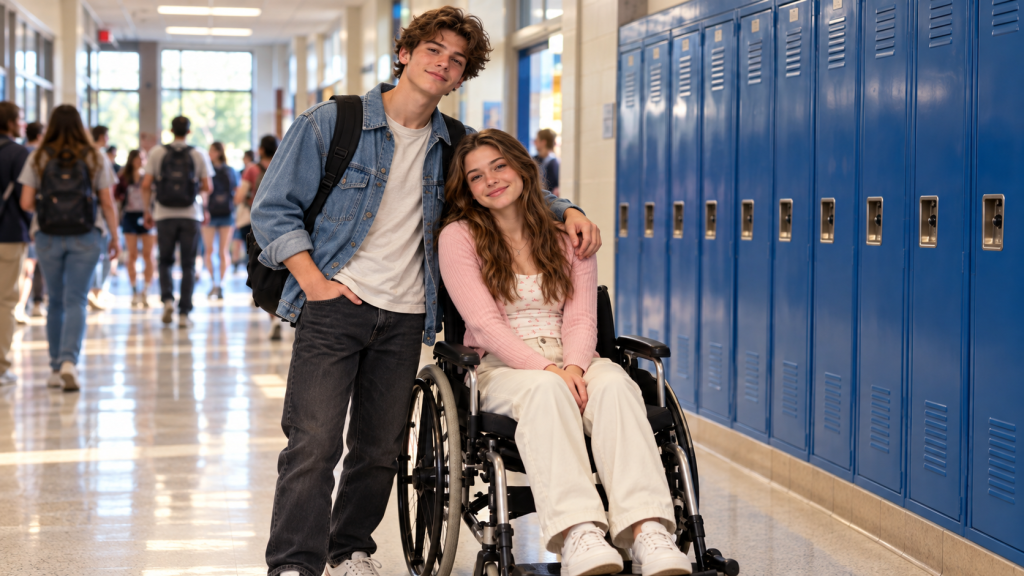
A photograph.
Julian and Maya.
Standing and sitting beside each other at the rehabilitation center, smiling toward the camera.
Below it, my son had written:
FRIENDSHIP IS ABOUT SHOWING UP.
I smiled.
Then noticed a smaller piece of paper tucked beneath the frame.
It was a note from Nora.
Dear Julian,
Thank you for reminding an old woman that kindness can begin a new chapter.
Keep playing.
Love, Grandma Nora.
My eyes filled.
I looked toward the living room.
On the mantel stood a photograph of my father holding his violin.
Beside it was a newer picture.
Nora, David, Julian, and me after the school concert.
We weren’t a perfect family.
We still had difficult conversations.
There were years we couldn’t recover.
Apologies that needed to be supported by continued actions.
And memories that would probably always hurt a little.
But we were trying.
And for the first time in a very long while, trying felt possible.
David came beside me.
He slipped his arm around my shoulders.
“You okay?”
I nodded.
Then smiled through tears.
“I’m more than okay.”
He kissed my forehead.
For a moment, we stood listening to Julian playing softly upstairs.
The same melody from the concert.
Slow.
Careful.
Beautiful.
I thought back to the morning two police officers appeared on our doorstep.
I had been terrified.
I’d thought my son was in trouble.
I’d thought the missing guitar might be evidence of something terrible.
And in a way, it had led us toward something terrible: adults profiting from families who needed help.
But it had also led us toward unexpected kindness.
Toward accountability.
Toward a grandmother’s attempt to make amends.
And toward a boy who discovered that helping others didn’t mean he had to give up everything he loved.
I closed my eyes.
Then whispered, “Thank you, Julian.”
Upstairs, the music continued.
And I realized that my son hadn’t just helped a girl receive a safer wheelchair.
He had reminded our family what kindness could look like when it was guided by honesty, respect, and the courage to ask for help.
His guitar had found its way home.
So had my father’s violin.
And slowly, carefully, so had a part of our family.
Because the greatest gifts aren’t always the expensive things we sacrifice.
Sometimes they’re the moments when we listen.
The mistakes we finally admit.
The trust we patiently rebuild.
And the love we choose to express through our actions, long after words alone have stopped being enough.
I looked toward the staircase one last time.
Then smiled.
Our house was full of music again.
And this time, every note sounded like hope.
THE END STORIES! THANK YOU FOR READING GOOD LUCK !❤️
Related Posts