The signature was almost perfect. That was what frightened me most. Every loop, every slant, every little flourish looked as though it belonged to me. Even the way the final letter curved beneath the line was familiar.
But I had never signed that document. I had never agreed to give away my baby. And for twenty-three years, I had visited a grave believing my little boy was buried beneath it. I looked up at the stranger sitting across from me. “Tell me he’s alive.” My voice came out so quietly that I barely recognized it.
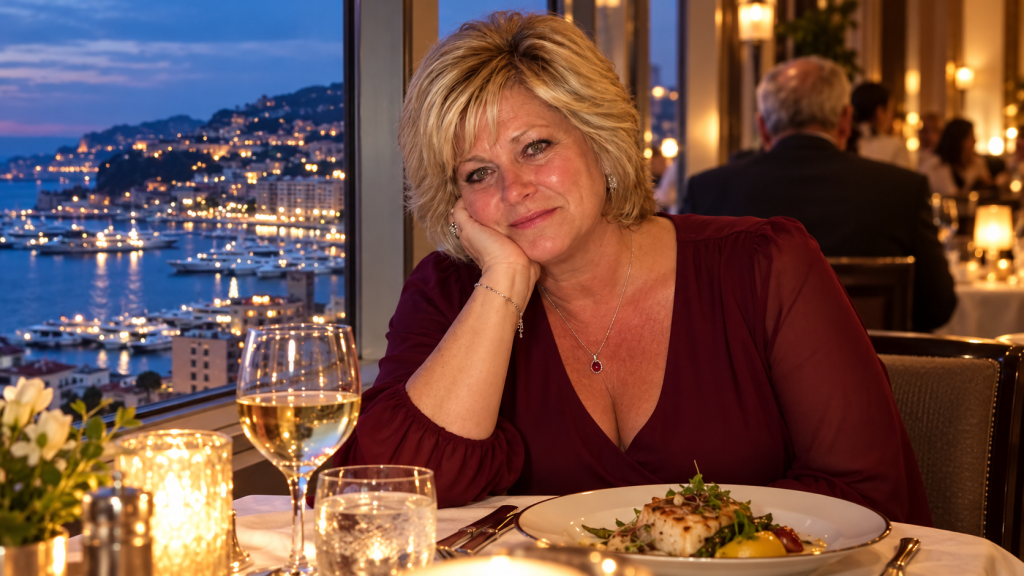
Daniel Mercer didn’t answer immediately. The lights of the cruise ship glittered above us. Somewhere behind my chair, a waiter laughed with another passenger. Silverware clinked against plates. People were enjoying dinner. Ordering dessert. Talking about tomorrow’s excursions.
And my entire life was falling apart.
“Daniel,” I whispered, “please.”
He folded his hands on the table.
“I have evidence that Noah survived the night you were told he died.”
My heart lurched.
“But I haven’t yet confirmed every part of what happened afterward.”
I gripped the edge of the table.
“What does that mean?”
“It means I won’t promise you something I can’t prove.”
I looked down at the tiny silver sailboat.
Its little mast was crooked, exactly as I remembered.
I had bought it from a seaside gift shop during my pregnancy.
Noah’s father, Andrew, and I had taken a weekend trip to the coast before the baby was born. We were young, tired, and saving every dollar.
Andrew wanted to buy a fancy stroller.
I wanted to sit on the beach and watch the boats.
That afternoon, I found the little silver ornament and joked that our son would become a sailor.
When the hospital told us Noah had died, I carried that sailboat to the funeral home.
I placed it inside the tiny coffin myself.
My fingers trembled as I picked it up now.
“How did you get this?”
Daniel looked toward the dark ocean.
“Your husband gave it to me.”
I stared at him.
“What?”
“Six weeks ago. When I confronted him about the hospital records, he took this from a locked drawer in his office.”
My throat tightened.
“Andrew had it?”
Daniel nodded.
“For twenty-three years.”
A memory rose so violently that I almost became physically sick.
The funeral home.
The white satin lining.
The tiny coffin already closed except for the moment the funeral director allowed me to place my keepsake inside.
Andrew standing behind me, one hand against my shoulder.
Let him rest now, sweetheart.
I’d believed he was trying to protect me.
Now I wondered whether he’d been making sure I didn’t look too closely.
“Why would he take it out?”
Daniel’s voice softened.
“He said he couldn’t stand the thought of something you loved being buried in an empty coffin.”
I stopped breathing.
“Empty?”
Daniel closed his eyes.
“I’m sorry.”
I stared at him.
Then I whispered, “There was no baby inside?”
“He told me there wasn’t.”
The ocean outside the window seemed impossibly black.
I had spent twenty-three years bringing flowers to that grave.
Twenty-three Christmases.
Twenty-three birthdays.
Every December, I lit a candle and whispered goodnight to a child I thought I’d lost.
I’d stood beside that headstone through storms and bitter cold, imagining my son alone beneath the earth.
And Andrew had known.
Every single year.
He’d stood beside me, holding an umbrella, allowing me to cry over a coffin he knew was empty.
I pushed my chair backward.
“I need air.”
Daniel stood immediately.
“Of course.”
He didn’t touch me.
He didn’t try to stop me.
He simply gathered the documents and followed at a respectful distance while I walked out of the dining room.
I reached the promenade deck before my knees finally weakened.
I lowered myself onto a bench.
Wind whipped my hair across my face.
The sea stretched endlessly into the darkness.
For a long time, I couldn’t speak.
Then I asked the question that had been burning inside me.
“Why are you here?”
Daniel sat at the far end of the bench.
“I contacted your sister, Leah, after your husband refused to tell you the truth.”
I turned toward him.
“My sister?”
“She told me you were going on this cruise. She offered to help arrange a conversation when you returned, but I was afraid another delay would give people time to destroy records.”
I stared at him.
“So you booked a cabin?”
He nodded, looking ashamed.
“I did. I should have let you decide whether you wanted to meet. I’m sorry.”
I looked away.
Leah was the person who had sent me here to recover from my divorce.
Now I understood why she’d seemed unusually anxious when she said goodbye.
Had she known?
Had she arranged another revelation behind my back?
I felt a fresh wave of anger.
Then Daniel said, “Your sister knew only that I had serious concerns about your son’s medical records. She didn’t know what I was going to show you tonight.”
I pressed the silver boat into my palm.
“Everybody seems to know something about my life except me.”
Daniel lowered his head.
“You’re right.”
That simple acknowledgment almost made me cry.
For twenty-three years, Andrew had explained everything.
Why I shouldn’t request records.
Why discussing Noah was too painful.
Why I needed to stop asking whether the doctors had done everything possible.
He had answers for every question.
And I had mistaken his certainty for love.
Now the stranger beside me was the first person who seemed willing to say what he didn’t know.
I took a breath.
“Start at the beginning.”
Daniel opened the folder.
And began.
Noah had been born early, just after midnight on December fourteenth.
I remembered the pain.
The terrible urgency.
The medical team moving around me.
I remembered hearing one sharp, angry little cry before a nurse carried him away.
Then I began bleeding.
There were rushed voices and an emergency procedure.
By the time I woke properly, Andrew was sitting beside my bed.
His eyes were red.
He told me our baby had died.
I remembered grabbing his shirt.
Begging him to let me see Noah.
Andrew said the doctors had advised against it because the baby was so fragile.
I had been weak, medicated, and almost incoherent with grief.
Eventually, I believed him.
Daniel opened a yellowed hospital record.
“Noah was admitted to neonatal care at twelve forty-seven in the morning.”
I stared at the page.
“That’s after he was born.”
“Yes.”
He turned it toward me.
“His condition was serious, but he responded to treatment. By five thirty that morning, he was breathing with assistance and showing improvement.”
I covered my mouth.
“Then why was I told he died?”
Daniel’s jaw tightened.
“That is the question I’ve spent months trying to answer.”
He showed me another record.
A transfer authorization.
Noah had been moved to a specialist facility two counties away.
The transfer took place at eleven eighteen that morning.
Five hours before Andrew told me our son had died.
I stared at the timestamp.
My husband had entered my hospital room carrying the most devastating news of my life while our baby was apparently still alive.
“Was Andrew there when they transferred him?”
Daniel nodded slowly.
“His signature appears on the release.”
I looked at the forged signature beneath it.
Mine.
I had supposedly signed a consent form while recovering from an emergency procedure, at a time when my own medical notes described me as heavily sedated and unable to participate in lengthy decisions.
“Who signed my name?”
“I don’t know yet.”
He hesitated.
“But the hospital’s former administrator, Patricia Vale, approved the documents.”
The name struck me.
I remembered Patricia.
A neat woman with dark hair and a pearl necklace.
She had visited my room after Noah’s supposed death.
She’d brought me a white envelope containing a memorial card.
She had told me that sometimes the kindest thing a mother could do was accept that certain questions would never have answers.
I looked at Daniel.
“She knew.”
“She appears to have been involved.”
My eyes filled with tears.
“Where is she now?”
“Retired. Living in Arizona.”
He paused.
“And I have reason to believe the facility that received Noah was connected to an adoption organization she helped oversee.”
I stared at him.
The word seemed impossible.
Adoption.
My son hadn’t been unwanted.
He hadn’t been abandoned.
I’d been waiting for him with a nursery painted pale blue.
A crib Andrew assembled three weeks before the birth.
A drawer filled with tiny clothes that smelled of laundry soap.
I whispered, “They gave my baby away.”
Daniel’s eyes filled.
“It appears someone arranged for him to be placed with another family.”
I covered my face.
Then a terrible thought came.
I looked up.
“Did those people know?”
“There’s no evidence yet that the receiving family knew you hadn’t consented.”
I nodded shakily.
I didn’t want to hate strangers who might have loved my son.
Not until I understood what had happened.
But I wanted answers.
For Noah.
For the woman I’d been twenty-three years earlier.
And for every night I’d fallen asleep clutching a photograph of an empty hospital blanket.
Daniel opened the folder one final time.
“There’s one more thing.”
He removed a photocopied card.
It was dated eleven days after Noah’s birth.
At the top were two words.
PLACEMENT CONFIRMED.
Underneath was a new name.
ELI BENNETT.
I stared at it.
“Who is Eli Bennett?”
Daniel’s expression softened.
He touched the line where my son’s birth date appeared.
“Elaine, I believe that’s the name your baby was given.”
My heart stopped.
Because for the first time in twenty-three years, I wasn’t looking at a death certificate.
I was looking at evidence of a life.
I repeated the name silently.
Eli Bennett.
It didn’t sound like my baby’s name.
But somewhere in the world, a little boy might have grown up hearing it called across playgrounds and classrooms.
Someone might have shouted it from a kitchen when dinner was ready.
Someone might have whispered it over birthday candles.
All the ordinary moments I’d grieved had perhaps happened after all.
Just without me.
“Do you have a photograph?” I asked.
Daniel looked at me carefully.
“I have one that may help identify him, but I don’t want you mistaking an unverified connection for certainty.”
“Please.”
He took a photograph from the folder.
It showed a young man standing beside a wooden fishing boat.
He had brown hair, a broad smile, and one hand resting against a freshly painted hull.
He wore a faded gray sweatshirt.
For a moment, I simply stared.
Then my vision blurred.
The young man’s eyes looked astonishingly like Andrew’s.
But his smile—
His smile was mine.
I recognized the way one corner of his mouth lifted slightly higher than the other.
My mother used to tease me about it when I was a girl.
I pressed the photograph against my chest.
“Oh, Noah.”
Daniel didn’t correct me.
He waited while I cried.
Eventually, he said, “His name is Eli. He’s twenty-three. He grew up in a small coastal town with a couple named Beth and Paul Bennett.”
I looked up.
“Are they good people?”
Daniel nodded.
“Everything I’ve learned suggests they cared for him deeply. His adoptive father taught him carpentry. His mother worked in a public library.”
I laughed through tears.
“My son worked with boats?”
“From what I’ve found, yes.”
I looked down at the tiny silver sailboat.
The coincidence was almost unbearable.
“Does he know about me?”
Daniel hesitated.
“I believe he knows he’s adopted. But I haven’t spoken directly with him, and I don’t know what he was told about his birth family.”
I nodded.
A strange fear entered my heart.
What if he didn’t want me?
What if finding me would disturb a happy life?
What if he’d already made peace with his past and I arrived carrying twenty-three years of grief?
Daniel seemed to sense my thoughts.
“You don’t have to decide anything tonight.”
I looked at the photograph.
“That’s the first thing anyone has said to me about Noah in twenty-three years that actually feels kind.”
He lowered his eyes.
“I’m sorry I didn’t speak sooner.”
I studied him.
“Why didn’t you?”
Daniel sat quietly before answering.
“At the time, I was a young resident. Patricia Vale controlled the administrative records. She assured me the transfer and placement were lawful.”
He swallowed.
“Later, when I noticed discrepancies, I asked questions. She told me I was misunderstanding the paperwork.”
“And you believed her?”
“I wanted to.”
His voice carried a terrible weariness.
“Eventually I left that hospital. The records were inaccessible to me, and I told myself I couldn’t accuse people without evidence.”
I looked away.
“Twenty-three years.”
“I know.”
“Twenty-three years I thought he was dead.”
Daniel nodded.
“I’ve carried my part in that for a long time.”
I wanted to be furious with him.
Part of me was.
But he was sitting beside me now because he’d finally done what so many others had refused to do.
He’d opened the records.
He’d asked the questions.
He’d looked for the truth.
“Why now?” I asked.
“Two years ago, the old hospital merged its archives into a regional records system. I was contacted about incomplete neonatal documentation during a review. Your son’s file contained contradictory entries.”
He paused.
“I remembered him.”
My throat tightened.
“You remembered Noah?”
Daniel nodded.
“A very small baby with an impressive set of lungs.”
I began crying again.
“He cried?”
“He did.”
I covered my face.
For years, the only sound I’d allowed myself to remember was that single cry in the delivery room.
Now someone was telling me my son had cried again.
And again.
After the moment I’d believed his life had ended.
Daniel continued.
“I started asking questions. Eventually I found records connecting the transfer to the adoption organization. Then I contacted your husband, believing he could help clarify your consent.”
My stomach tightened.
“What did Andrew say?”
“At first, he told me to stop digging.”
I closed my eyes.
“Then?”
“He offered to pay for my legal expenses if I agreed not to pursue the matter.”
I stared at him.
“He tried to pay you?”
Daniel nodded.
“When I refused, he told me there were things you’d never forgive him for.”
I looked toward the sea.
Suddenly, the divorce made sense.
Andrew hadn’t left because we’d grown apart.
He’d left because the lie that had held our marriage together was finally beginning to crack.
And he had chosen to run rather than stand beside me when it broke.
I called Leah from my cabin that night.
She answered on the first ring.
“Elaine?”
Her voice was strained.
I didn’t bother with pleasantries.
“Did you know?”
There was a long silence.
Then she whispered, “Daniel found you.”
I began crying.
“Leah.”
“I’m sorry.”
“Did you know Noah was alive?”
“No. I swear to you, I didn’t know that.”
I sat on the edge of the bed.
“Then what did you know?”
She took a shaky breath.
“A few days before I booked the cruise, Daniel contacted me. He said he’d uncovered irregularities in Noah’s hospital records. He wanted help reaching you.”
“Why didn’t you tell me?”
“Because you were barely sleeping. You’d stopped eating properly. And I was terrified of bringing you another possible tragedy without understanding what he had.”
My eyes filled.
“So you sent me away?”
“I booked the cruise because you needed rest. Daniel told me later that he wanted to be on the same sailing. I gave him the information.”
I stared at the carpet.
“You had no right to arrange that without telling me.”
“I know.”
Her voice broke.
“I should’ve asked what you wanted.”
I cried quietly.
Then asked, “Why didn’t you stop him?”
“Because when I asked whether he thought Noah might have survived, he wouldn’t tell me no.”
Those words silenced me.
Leah continued.
“I remembered you in the hospital. How they wouldn’t let you hold him. How quickly Andrew arranged the funeral.”
I closed my eyes.
“I thought we were all just trying to get through it.”
“So did I.”
We sat in silence.
Then she whispered, “Elaine, what did Daniel find?”
I looked at the photograph resting beside the silver sailboat.
“He found a name.”
Leah inhaled sharply.
“What name?”
My voice trembled.
“Eli Bennett.”
For several seconds, she didn’t speak.
Then she began sobbing.
My sister, who had spent twenty-three years reminding me that I was still allowed to be happy, was crying as though the grief had finally found a door through which it could escape.
“Is he alive?” she whispered.
“I think so.”
“Oh, Elaine.”
I stared at the ocean beyond my cabin window.
“I don’t know what I’m supposed to feel.”
“You don’t have to know tonight.”
I began crying harder.
Because for the first time since Andrew left, I wasn’t grieving the end of a marriage.
I was beginning to grieve the years someone had stolen from me.
And beneath that grief was something terrifying.
Hope.
The following morning, I called my daughter.
Grace was twenty years old and studying architecture three states away.
She had taken the divorce badly.
She adored her father, and his refusal to explain why he’d left had hurt her almost as much as it hurt me.
When she answered, she sounded cheerful.
“Hey, Mom! How’s the ship?”
I closed my eyes.
“Grace, honey, I need to tell you something.”
Her voice changed instantly.
“What’s wrong?”
“Are you somewhere private?”
“Yes. I’m in my room.”
I took a breath.
“Do you remember what I told you about your older brother?”
She was quiet.
Then said, “Noah?”
“Yes.”
I could hear her moving.
“Mom, what’s going on?”
I looked at the photograph.
“I’ve learned that the hospital records may not have told the truth about what happened when he was born.”
Silence.
Then she whispered, “What does that mean?”
My voice broke.
“It means he may have survived.”
Grace gasped.
For a moment, all I heard was her breathing.
Then she said, “Mom. Are you telling me I might have a brother who’s alive?”
I pressed my hand against my mouth.
“Yes.”
“Does Dad know?”
I closed my eyes.
“I believe he does.”
Grace made a sound I had never heard from her before.
Not quite a sob.
Not quite anger.
Something between the two.
“He told me Noah was in heaven.”
I began crying.
“I know, sweetheart.”
“He used to take me to the cemetery on his birthday.”
I remembered.
Grace carrying little white flowers.
Andrew kneeling beside the stone.
The three of us standing in the cold.
My daughter whispered, “Why would Dad do that?”
I had no answer.
And for once, I refused to invent one.
“I don’t know everything yet.”
She was quiet for a long time.
Then she asked, “Can I see his picture?”
I looked down at the photograph.
My heart ached.
“Yes.”
“But Mom?”
“Yes, honey?”
“Before we tell ourselves he’s our family, we have to find out whether he wants us.”
I closed my eyes.
Twenty years old.
And already wiser than I had been at forty.
“You’re right,” I whispered.
Grace began crying.
Then she said, “Whatever happens, you’re not doing this alone.”
I held the phone against my cheek.
And for the first time in weeks, I believed her.
For the remaining days of the cruise, I hardly slept.
Yet strangely, I didn’t want to go home.
On the ship, I was surrounded by strangers who knew nothing about my past. I could walk along the deck without anyone looking at me as the woman whose husband had inexplicably abandoned her.
I could sit beside the water with Eli’s photograph in my lap and imagine the life he’d lived.
Did he have a favorite food?
Had he broken his arm climbing a tree?
Did somebody teach him to ride a bicycle?
Had he ever wondered whether his birth mother thought about him?
That final question haunted me.
Because I had thought about him every day.
Every single day.
On the last evening, Daniel found me sitting near the observation lounge.
He approached carefully.
“May I sit?”
I nodded.
He placed a small envelope beside me.
“These are copies of the records I can share. I want you to have them before we leave the ship.”
I looked at him.
“Are you afraid someone will take them?”
“I’m concerned records could disappear. I’ve retained copies with my attorney.”
I nodded.
Daniel studied me.
“Elaine, I want to tell you something.”
I waited.
“When I first became a doctor, I thought being good at my job meant always having the answers.”
He looked out at the water.
“Then I learned that knowing when something is wrong matters just as much.”
His voice grew quiet.
“I failed to keep asking questions when I should have.”
I stared at him.
“Why did you come back to this after so many years?”
He hesitated.
“Because I have a daughter.”
I looked toward him.
“She’s twenty-four. Last year, she became a mother.”
His eyes filled.
“I watched her hold that baby, and I remembered you.”
I lowered my head.
Daniel continued.
“I remembered a young woman in a hospital bed asking to see her son. And I remembered an administrator insisting everything had been handled appropriately.”
He swallowed.
“I couldn’t keep living with that memory without knowing whether we’d told you the truth.”
I watched the dark water move beyond the glass.
“Daniel, I don’t know if I’ll ever be able to thank you.”
He shook his head.
“You don’t owe me gratitude.”
Then he said something that stayed with me.
“You were the mother. You were the one entitled to know what happened.”
I looked down at the records.
For twenty-three years, I’d felt foolish for questioning doctors and funeral arrangements.
As though grief had made me irrational.
Now I understood that my questions had been the most reasonable thing in the world.
I was a mother who wanted to know where her baby had gone.
Leah was waiting when I returned to port.
She stood near the passenger terminal wearing sunglasses, though her red eyes were visible beneath them.
When she saw me, she hurried forward.
I stepped into her arms.
We held each other for a long time.
Neither of us spoke.
Then she whispered, “I’m sorry.”
I nodded against her shoulder.
“I know.”
She pulled back.
“Are you angry with me?”
“Yes.”
Her face crumpled.
I squeezed her hand.
“But I’m glad you’re here.”
She nodded.
“That’s fair.”
We drove home quietly.
The familiar roads looked strange.
I passed the grocery store where Andrew and I had shopped every Sunday.
The coffee shop where we’d celebrated our anniversaries.
The park where Grace learned to ride her bicycle.
Everything looked exactly the same.
Yet the story I’d attached to those places had changed.
At home, I found a message from Andrew.
We need to talk before you do something you’ll regret.
I stared at the screen.
Then called my attorney.
Her name was Caroline Price, and she’d been helping me review the divorce paperwork.
When I explained what Daniel had discovered, she listened in stunned silence.
Then she said, “Elaine, don’t sign anything else. Preserve every message and document.”
I nodded.
She arranged for me to consult attorneys experienced in adoption records and potential misconduct involving medical and identity documents.
I knew there would be no simple answer.
The records were old.
Some of the people involved had retired.
And proving exactly who forged what would require more than my memories.
But I was no longer willing to let another person decide that the questions were too painful to investigate.
Two days later, Andrew agreed to meet me at Caroline’s office.
He arrived wearing the same charcoal jacket he’d worn the night he asked for a divorce.
For a moment, I remembered the man who used to hold my hand during thunderstorms.
The man who made terrible pancakes every Mother’s Day.
The man who cried when Grace graduated from high school.
I loved that man for twenty-two years.
But I didn’t know whether he’d ever been the person I thought he was.
He sat opposite me.
“Elaine.”
I placed the silver sailboat on the table.
His face went white.
“Where did you get that?”
“Daniel.”
Andrew closed his eyes.
I leaned forward.
“Was our son alive when you told me he was dead?”
He didn’t answer.
“Andrew.”
Tears appeared in his eyes.
“Yes.”
The word was barely audible.
But it seemed to shake the entire room.
I pressed my hands together beneath the table.
“Did you know they were taking him to another facility?”
He nodded.
“Yes.”
I stared at him.
“Did you sign the transfer?”
“Yes.”
“And did you agree to the adoption?”
Andrew began crying.
“I was told he needed expensive treatment. We had debts. Your medical bills were going to be enormous.”
I felt sick.
“What debts?”
He stared at the floor.
“The business investment I made before we were married. It was failing. I hadn’t told you.”
I remembered the small business Andrew had briefly started with a friend.
He’d said it never made much money.
He hadn’t told me it left us financially exposed.
“How much?” I asked.
“Almost seventy thousand.”
I stared at him.
He continued.
“Patricia Vale knew. She said there was a couple who could give Noah everything we couldn’t.”
My breath caught.
“She offered you money?”
Andrew covered his face.
“She said the placement organization would settle the debt and cover the remaining hospital costs.”
I felt a terrible coldness spread through me.
“How much did you receive?”
He whispered, “Seventy-five thousand.”
I looked at Caroline.
She remained composed, but her expression was grim.
I turned back toward Andrew.
“You accepted money in exchange for our baby?”
“No!”
His voice cracked.
“I thought I was saving him!”
I stared at him.
“Then why did you tell me he died?”
He began sobbing.
“Because I knew you’d never agree.”
For a moment, I couldn’t breathe.
There it was.
Not confusion.
Not an unfortunate misunderstanding.
He knew I would refuse.
So he’d made the decision for me.
He’d taken away my child and then taken away my right to grieve the truth.
I looked at him.
“Who signed my name?”
Andrew wiped his eyes.
“Patricia’s office prepared the documents.”
“Did you know the signature wasn’t mine?”
He nodded.
I began trembling.
“And the coffin?”
His shoulders shook.
“They arranged a memorial service. They said it would be easier if everyone believed Noah had died.”
I closed my eyes.
“Easier for whom?”
He couldn’t answer.
I pointed toward the sailboat.
“You took this out?”
Andrew nodded.
“After you left the funeral home. I couldn’t bear knowing you’d placed something you loved beside an empty blanket.”
I stared at him.
“You couldn’t bear it?”
My voice rose.
“You stood beside me while I begged God to let me hold our son one more time.”
He covered his face.
“You brought flowers to his grave.”
“I know.”
“You watched me cry on every birthday.”
“I know.”
“And you never told me.”
He sobbed.
“I’m sorry.”
I stood so suddenly my chair scraped the floor.
“Don’t.”
He looked up.
“Elaine—”
“Don’t apologize as though you forgot an anniversary or missed an appointment.”
My voice broke.
“You stole twenty-three years of my son’s life from me.”
Caroline stood beside me.
I pressed a hand against the table to steady myself.
Then I asked one final question.
“Why did you divorce me?”
Andrew wiped his face.
“Daniel came to see me. He said he was investigating the records. He told me you might learn the truth.”
I stared at him.
“So you left?”
“I couldn’t bear the thought of you looking at me once you knew.”
A bitter laugh escaped me.
“You left me wondering what was wrong with me.”
His face crumpled.
“I thought it would be kinder.”
“To whom?”
He said nothing.
I looked down at the silver boat.
Then at the man who had once promised to stand beside me through everything.
“I spent three weeks blaming myself for the end of our marriage,” I whispered.
My eyes filled.
“And now I know the truth.”
Andrew raised his head hopefully.
But I continued.
“You didn’t leave because we grew apart. You left because you were afraid I’d finally discover who you really were.”
I picked up the sailboat.
Then walked out.
That evening, Grace came home.
She dropped her suitcase in the hallway and ran into my arms.
We cried together until neither of us could speak.
Later, sitting at the kitchen table, I told her what Andrew had admitted.
She listened without interrupting.
When I finished, she stared at the wall.
“Seventy-five thousand dollars?”
I nodded.
Her eyes filled.
“He gave away my brother because he owed money?”
I swallowed.
“That’s what he’s admitted.”
Grace began crying.
Then she asked, “Did Dad ever try to find him?”
I hesitated.
Because there was one more thing Andrew had told Caroline after I left the room.
Something I hadn’t yet managed to say aloud.
“Grace,” I whispered, “your father knew where Eli was living.”
She stared at me.
“What?”
“He received updates through the placement organization.”
She shook her head.
“No.”
“And when Eli became an adult, he tried to contact us.”
Grace covered her mouth.
I continued.
“He sent a letter four years ago.”
Her eyes filled.
“What happened?”
My voice broke.
“Andrew intercepted it.”
For a moment, the only sound in the kitchen was the refrigerator humming.
Then Grace whispered, “Dad told us Noah was dead while his son was trying to find us?”
I nodded.
She began crying harder.
And I held her.
Because now I understood that Andrew hadn’t simply hidden the past.
He had continued choosing the lie, even when our son finally came looking for the truth.
Three weeks later, I received a letter.
Not from Andrew.
From Eli.
Caroline had helped arrange contact through an intermediary so that neither of us would feel pressured into a meeting before we were ready.
Eli had been told there was evidence his adoption might have been arranged without his birth mother’s knowledge.
He’d agreed to exchange medical information and undergo an independent DNA test.
When the results came back, there was no uncertainty left.
The young man in the photograph was my son.
My Noah.
My Eli.
I held the letter for almost an hour before opening it.
Then I unfolded the single page.
Dear Elaine,
I’m not sure how to begin this. I’ve imagined writing to you many times, but I never imagined the circumstances would be anything like this.
I want you to know I had a happy childhood. My parents loved me. They still do. I don’t want discovering you to erase what they gave me.
But I also want you to know I tried to find you.
When I was nineteen, I wrote to the address listed in some old paperwork. I received a response saying you knew where I was and preferred not to reopen the past.
I believed it.
It hurt, but I tried to respect it.
Now I’m learning that you may never have received my letter.
If that’s true, I don’t know what to say except that I’m sorry for the years we both lost.
I don’t know if I’m ready for everything this might mean. But I would like to meet you.
Maybe we could have coffee.
Eli.
I read it three times.
Then I pressed it against my heart and cried.
Not because he called me Mom.
He didn’t.
Not because he promised we’d become a family overnight.
He hadn’t.
I cried because he had asked to meet me.
After twenty-three years, my son was offering me a beginning.
We met on a Saturday afternoon at a small café overlooking the harbor.
Grace came with me but waited at a bookstore nearby. She wanted to meet her brother too, but understood that our first conversation might be difficult enough without another person joining us.
I arrived twenty minutes early.
My hands shook so badly that I spilled half my water.
Every time the door opened, my heart jumped.
Then a young man stepped inside.
Brown hair.
Gray jacket.
A familiar, slightly crooked smile.
For one terrible, beautiful moment, I saw the baby I’d never been allowed to hold and the man he’d become standing in the same place.
He looked around.
Our eyes met.
And he stopped.
I stood slowly.
“Eli?”
He nodded.
“Elaine?”
I smiled through tears.
“Yes.”
He walked toward me.
For a moment, neither of us knew what to do.
Then he opened his arms slightly.
“Would a hug be okay?”
I began crying.
“Very much.”
He stepped forward.
I wrapped my arms around him.
And after twenty-three years, I held my son.
He was taller than me.
His shoulders were broad.
He smelled faintly of soap and cedarwood.
Nothing about him resembled the tiny baby I’d imagined all those years.
And yet, standing there, I felt a part of my heart recognize something I couldn’t explain.
He held me carefully.
Then whispered, “I’m here.”
I cried harder.
“I know.”
We stood like that until he gently stepped back.
His eyes were wet.
“I’m sorry,” he said with a nervous laugh. “I promised myself I wouldn’t cry.”
I laughed through my tears.
“So did I.”
We sat down.
For a few moments, we simply looked at each other.
Then he smiled.
“You have my smile.”
I laughed.
“I was going to say you have mine.”
He grinned.
And for one brief moment, the years between us seemed almost bearable.
We talked for three hours.
I learned he loved woodworking, hated olives, and had once broken his wrist falling off a bicycle.
I learned his adoptive father, Paul, had taught him to repair boats.
His adoptive mother, Beth, had read him adventure stories every night until he was old enough to read them himself.
He’d grown up near the ocean.
Spent summers fishing.
And once dreamed of becoming a marine biologist before discovering he preferred building things with his hands.
I listened greedily.
Every small detail felt precious.
Eventually, he asked about the night he was born.
I took a breath.
Then told him what I remembered.
The emergency delivery.
The little cry.
The nursery I’d prepared.
The sailboat.
And the twenty-three years I’d believed he was dead.
Eli sat perfectly still.
When I finished, he wiped his eyes.
“I thought you gave me away.”
My heart broke.
“I know.”
He looked down.
“I wasn’t angry all the time. My parents loved me. But sometimes I wondered what was wrong with me.”
I reached across the table.
“Nothing was wrong with you.”
His face crumpled.
I continued.
“There was never a moment when I didn’t want you.”
Tears rolled down his cheeks.
For a long time, he couldn’t speak.
Then he whispered, “I needed to hear that.”
I squeezed his hand.
He looked toward the window.
“Beth told me when I was eight that being adopted meant I had two stories. The story of where I came from, and the story of where I grew up.”
I smiled through tears.
“She sounds wonderful.”
“She is.”
He looked back at me.
“She didn’t know any of this. Neither did Dad. They believed the documents were legitimate.”
“I believe you.”
Eli breathed out shakily.
“She was afraid meeting you would make me think she’d done something wrong.”
I shook my head.
“She raised you with love. I would never want to take that away from her.”
He began crying again.
Then he reached into his bag.
“I brought something.”
He placed a small wooden sailboat on the table.
It was beautifully carved, with a white sail and a dark polished hull.
“I made it when I was seventeen.”
I stared at it.
He smiled.
“Dad taught me.”
My hands trembled as I reached into my purse.
Then I placed the tiny silver sailboat beside the wooden one.
Eli stared.
“What’s that?”
I told him.
About the gift shop.
The funeral.
The coffin.
How I’d believed the silver boat was buried with him.
He touched it carefully.
For a moment, neither of us spoke.
Then he whispered, “All those years, you thought I was gone.”
I nodded.
“And all those years,” he said, “I thought you didn’t want me.”
We looked at each other.
There was no sentence powerful enough to repair what had happened.
No embrace long enough to return the birthdays.
No apology capable of giving us back his first steps, his first words, or the afternoons when he came home from school needing comfort.
But there were years ahead of us.
And for the first time, we both knew the truth.
The legal investigation continued.
Andrew’s admissions, the financial records, the forged documents, and the surviving hospital files were all examined.
The authorities began reviewing the conduct of the people involved, including Patricia Vale and the organization that had arranged the adoption.
Some records were incomplete.
Some questions remained difficult to prove after so many years.
Caroline warned me that criminal proceedings and civil claims could be affected by the age of the evidence, the applicable laws, and the responsibility established for each person.
I understood.
But the essential facts were no longer hidden.
Noah had survived.
I had not consented to his adoption.
And Andrew had admitted participating in the deception that separated us.
He lost my trust forever.
The divorce remained final, and I did not return to him.
When he later wrote asking whether I could someday forgive him, I did not answer immediately.
Eventually, I sent a short letter.
Andrew, I hope you take responsibility for what you did. But forgiveness cannot return twenty-three years to our son, and I will not pretend our marriage was destroyed by something as simple as growing apart.
I am choosing to spend the years I have left telling the truth.
That was all.
I didn’t need him to understand.
I needed to stop arranging my life around his excuses.
Six months after the cruise, Grace finally met her brother.
We invited Eli and his parents to a small dinner at Leah’s house.
I was nervous.
So was everyone else.
Beth Bennett arrived carrying homemade bread. She was a gentle woman with silver hair and a warm smile.
When she saw me, her eyes filled.
“I wish I’d known,” she whispered.
I took her hand.
“So do I.”
She began crying.
“I would never have wanted to hurt you.”
“I believe you.”
We stood holding hands for a long moment.
Two mothers.
One who had raised a little boy.
One who had spent twenty-three years believing she’d buried him.
Neither of us could change the past.
But we didn’t have to become enemies because other people had lied.
Grace and Eli spent most of the evening talking about music, movies, and their childhoods.
At one point, Grace laughed so loudly that everyone turned toward her.
Eli had apparently told her a ridiculous story about falling into the harbor while trying to impress a girl.
“You’re definitely my brother,” Grace declared.
He grinned.
“Is that a compliment?”
“Unfortunately, yes.”
Everyone laughed.
I stood near the kitchen doorway, watching them.
And suddenly I remembered something Andrew used to say when Grace was little.
I wish she’d had a sibling to grow up with.
He had said those words while knowing exactly where her brother was.
For a moment, the old anger returned.
Sharp.
Terrible.
Then Eli looked toward me.
“Elaine, come sit with us.”
I smiled.
And the anger loosened just enough for me to walk back into the room.
I couldn’t change the childhoods my children had lost together.
But I could be present for the relationship they were beginning now.
A year after that cruise, I returned to the ocean.
Not because I wanted to escape my life.
Because I finally wanted to enjoy it.
Grace came with me.
Eli joined us for the first weekend, taking time away from his boat workshop.
One afternoon, the three of us stood on a quiet beach while the sun lowered toward the horizon.
The wind was warm.
The waves rolled gently over the sand.
And for the first time in decades, I looked toward the water without feeling that something precious had been buried beyond my reach.
Eli stood beside me.
“Can I ask you something?”
I smiled.
“Anything.”
He hesitated.
“Would it be okay if I called you Mom sometimes?”
For a moment, I couldn’t speak.
Then I began crying.
“Of course.”
He smiled nervously.
“I still call Beth Mom.”
I reached for his hand.
“You should.”
He looked at me.
“That doesn’t bother you?”
I shook my head.
“She gave you a beautiful life. I will always be grateful for that.”
His eyes filled.
Then he wrapped an arm around my shoulders.
“Thanks, Mom.”
Two ordinary words.
Words I’d imagined hearing for twenty-three years.
And somehow they were even more beautiful than I’d dreamed.
Grace came over and slipped her arm around my other side.
“Are we having a family moment without me?”
Eli laughed.
“Apparently.”
She grinned.
“Unacceptable.”
We stood there together, watching the sun disappear.
A mother.
A daughter.
A son.
Not a perfect family.
Not a family untouched by sorrow.
But a family finally allowed to know its own story.
Sometimes, I still think about that fourth night on the cruise.
The dark water beyond the dining room window.
The stranger sitting across from me.
The tiny silver sailboat on the white tablecloth.
I remember believing my marriage was the greatest thing I’d lost.
Then Daniel opened his jacket, and I discovered that my grief had been built around a lie much older than my divorce.
I had been robbed of birthdays, bedtime stories, school photographs, and twenty-three years of ordinary memories.
Nothing could give those years back.
And I would never pretend that finding my son erased the damage.
There were still difficult conversations.
Still moments when Eli needed space.
Still evenings when I cried over photographs of a little boy I never got to raise.
But there were also new photographs.
New birthdays.
Phone calls on Sunday afternoons.
Grace teasing her brother.
Beth inviting me to dinner.
And a young man who sometimes ended our conversations by saying, “Love you, Mom.”
I kept the silver sailboat on the windowsill beside Eli’s wooden one.
Two little boats.
One carried twenty-three years of mourning.
The other carried the possibility of something new.
For most of my life, I believed that love meant holding on to the person who had promised never to leave.
Now I understood that love also meant telling the truth, even when it changed everything.
Andrew had given me a divorce because he feared losing me when I discovered what he’d done.
What he never imagined was that losing him would become the least important part of my story.
I boarded that cruise believing I was a woman whose husband no longer loved her.
I came home knowing I was a mother whose son had been alive all along.
And although I could never reclaim the twenty-three years we’d lost, I would spend every year ahead making sure he never had to wonder whether he was wanted.
Because the answer had always been yes.
Even when nobody allowed me to say it.
THE END STORIES! THANK YOU FOR READING GOOD LUCK !❤️
Related Posts