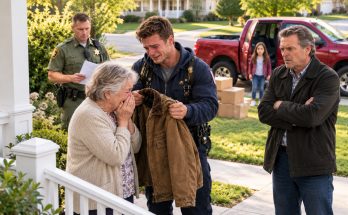
The man standing beside Marla’s car was Vincent Sloane. I knew his name because it was written on almost every letter we’d received from the hospital during the final months of Tom’s illness. He was the director of patient financial services at St. Andrew’s Medical Center. He was also the man who had sat across from my dying husband and told us that the treatment Tom desperately wanted would require a nineteen-thousand-dollar deposit before the hospital could schedule it.
I remembered begging him to give us more time. I remembered Tom reaching across the desk and taking my hand. And I remembered Sloane saying, in a voice so polished it almost sounded sympathetic, “Unfortunately, Mrs. Bennett, compassion doesn’t change hospital policy.” Now he was standing in my driveway holding a black briefcase.
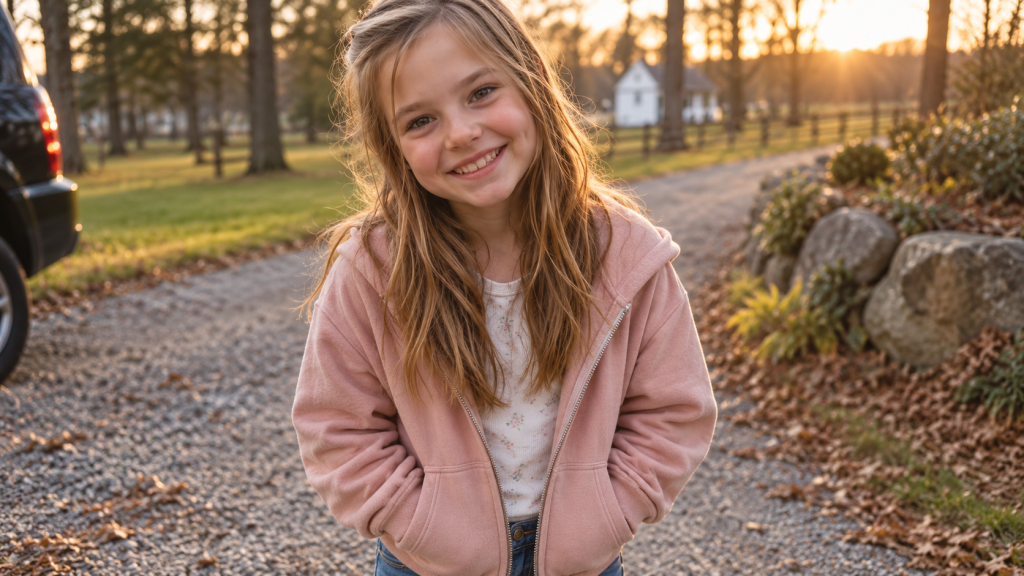
Beside him, my sister looked as though she might faint. “Mom?” Abby whispered. I turned. She was still wearing the jacket. The sleeves hung slightly past her wrists, and her cheeks were streaked with frightened tears. “Sweetheart, take the jacket off and put it on the chair.” She shook her head.
“Did I do something bad?”
My heart twisted.
“No, baby. You haven’t done anything wrong.”
“But Aunt Marla said—”
“I know what she said.”
I knelt in front of her.
“Listen carefully. I need you to go into the living room, sit beside the window away from the front door, and call Mrs. Collins next door. Tell her I need her to come over.”
Abby swallowed.
“Are we in trouble?”
I kissed her forehead.
“No. We’re going to make sure we’re safe.”
She nodded and hurried away.
Then I locked the front door.
Three sharp knocks followed almost immediately.
“Jen!” Marla shouted. “Open up!”
I looked through the peephole.
Sloane stood a few steps behind her.
His expression was calm.
That frightened me more than if he’d been angry.
“Marla,” I called through the door, “why is Mr. Sloane here?”
My sister glanced toward him.
“He wants to clear up a misunderstanding.”
“What misunderstanding?”
“The jacket. The things inside it.”
I gripped my phone.
Sloane stepped forward.
“Mrs. Bennett, I’m sorry to disturb you. Your sister says you may have come into possession of confidential hospital material.”
I stared at him through the peephole.
Confidential hospital material.
That was what he was calling the flash drive hidden inside a child’s winter coat.
“What material?” I asked.
“Documents belonging to St. Andrew’s. There may be patient financial records on a storage device.”
“How would you know what’s in a storage device you haven’t seen?”
For the first time, his expression shifted.
Marla touched his sleeve.
“Vincent, maybe we should—”
“Marla, please.”
He returned his attention to the door.
“Mrs. Bennett, I can assure you that returning the device voluntarily is in everyone’s best interest.”
I glanced toward the little silver drive on the kitchen counter.
For months, I’d wondered whether Tom had been hiding something during his last weeks.
He’d stayed up late.
Made phone calls in the garage.
Asked questions about the fundraiser that I thought were simply expressions of his growing frustration.
Once, I’d found him sitting at the kitchen table staring at a bank statement.
He’d quickly folded it and told me not to worry.
Now I wondered what he’d known.
“What happens if I don’t give it to you?” I asked.
Sloane straightened.
“Then the hospital may have to consider legal action.”
I almost laughed.
The man who’d watched me cry over my husband’s medical bills was now threatening me over something I’d found in my daughter’s coat.
“I think you should leave.”
Marla began pounding on the door.
“Jen, please! You don’t understand!”
I looked toward the living room.
Abby was speaking quietly on the phone.
I took a breath.
“Then explain it from outside.”
Marla pressed her forehead against the door.
“That drive could ruin everything.”
My blood ran cold.
“What everything?”
She didn’t answer.
Sloane stepped closer.
“Mrs. Bennett, this conversation is becoming unnecessarily emotional.”
I remembered him using almost exactly those words when I’d asked why Tom’s financial assistance application had been denied.
Back then, I’d swallowed my anger because my husband’s treatment depended on people like him.
Not this time.
“I’ve asked you to leave. I’m contacting the police to report your visit and the disputed documents.”
Sloane’s expression hardened.
“You’re making a mistake.”
“No,” I said. “I’m finally asking questions.”
I ended the conversation and called the nonemergency police number to explain that two people were demanding property from my home and refusing to leave after I’d asked them to.
As I spoke, Marla’s car finally backed out of the driveway.
But before she left, my phone buzzed.
A message from an unfamiliar number appeared.
It’s Kayla. I’m using Grandma’s phone. Please don’t give him the silver thing.
My heart began pounding.
Another message followed.
I put it in my jacket because Mom said she was going to throw away Uncle Tom’s papers.
Then a third.
Mr. Sloane told Mom if anyone found out, she’d lose me.
I stared at the screen.
Kayla.
My thirteen-year-old niece.
The girl who had grown up calling Tom her favorite uncle.
The girl who used to sit beside his hospital bed drawing pictures of butterflies because she believed they brought good luck.
She’d been frightened enough to hide evidence inside her old coat.
And her own mother had sold that coat to me for the last eighty dollars I possessed.
A knock sounded again.
I flinched.
But this time, it was our neighbor, Mrs. Collins.
“Jen? Honey, it’s me.”
I opened the door.
The seventy-year-old woman took one look at my face and pulled me into her arms.
“Oh, sweetheart. What’s happened?”
I held on to her.
For the first time since Tom died, I allowed myself to say the words I was most afraid of.
“I think somebody stole the money people donated to save my husband.”
Mrs. Collins tightened her embrace.
Behind me, Abby began to cry.
And the three of us stood in the hallway, clinging to one another while the winter wind rattled the front windows.
The officer who arrived twenty minutes later was a woman named Teresa Alvarez.
She didn’t promise to arrest anyone.
She didn’t tell me my suspicions were correct.
She listened while I explained what Abby had found, why Marla had demanded the jacket back, and what Sloane had said outside my door.
Then she looked at the messages from Kayla.
“Is the child safe?” she asked.
“She’s at her grandmother’s house, as far as I know.”
“Are you able to contact her guardian?”
I nodded.
Kayla’s paternal grandmother, Ruth, had always been kind to me. She’d helped with meals during Tom’s treatments and sometimes picked Abby up from school when I couldn’t leave the hospital.
I called her.
She answered immediately.
“Jen, honey. Is everything all right?”
“Is Kayla with you?”
“Yes.”
I felt a wave of relief.
“Please don’t let Marla or anyone from the hospital pressure her about what she found. An officer is here, and we need to make sure Kayla can speak safely with the appropriate people.”
Ruth went quiet.
Then said, “Oh, Jen. I was afraid something like this would happen.”
My stomach tightened.
“What do you mean?”
“Kayla’s been having nightmares. She keeps saying her mother did something terrible to Uncle Tom.”
I closed my eyes.
The officer gently asked to speak with Ruth.
While they arranged a proper follow-up, Mrs. Collins sat beside Abby on the couch.
My daughter was holding the jacket against her chest.
I hadn’t realized how tightly she’d become attached to it.
“Mommy,” she whispered, “is Aunt Marla going to take this away?”
I sat beside her.
“No, sweetheart. You can keep it.”
“Even if she wants her money back?”
I swallowed.
“Even then.”
Abby looked down at the faded embroidered butterfly near the pocket.
“Kayla said this jacket was lucky.”
I brushed a strand of hair from her face.
“Did she?”
Abby nodded.
“She said Uncle Tom helped her pick it out.”
My breath caught.
“What?”
“She told me he bought it when she got her first award at school. He said every girl deserves to feel warm when she’s doing brave things.”
I turned away before Abby could see my tears.
Tom.
My quiet, exhausted husband.
The man who apologized whenever he needed another treatment.
The man who’d once driven across town to bring Abby a forgotten school project, even though he could barely stay awake afterward.
He’d bought this coat for Kayla.
And now it had returned to our home carrying a secret.
I looked toward the butterfly stitched near the pocket.
For the first time, I wondered whether Kayla had chosen that hiding place because of the memory attached to it.
Not because the jacket was unimportant.
Because it was something her uncle had given her.
Something she thought he would have wanted her to protect.
The next morning, Mrs. Collins brought over a folder.
She stood in my kitchen wearing her old brown cardigan, with snow melting on the shoulders.
“Before you look at that little drive,” she said, “there’s something I think you should see.”
She opened the folder.
Inside were printed donation receipts, fundraiser flyers, and a handwritten list of names.
I recognized the flyer immediately.
HELP TOM BENNETT FIGHT CANCER.
Beneath the words was a photograph of Tom holding Abby at her eighth birthday party.
I remembered when that picture had been taken.
He’d already begun losing weight, but he still had enough strength to lift her onto his shoulders.
Mrs. Collins pointed to a column of figures.
“I helped organize the church collection.”
I nodded.
“I remember.”
“What you may not remember is that we counted the donations before giving the records to Marla.”
My hands began trembling.
“How much?”
“From the church alone, eleven thousand six hundred and forty dollars.”
I stared at her.
“Marla told me the church had raised twenty-eight hundred.”
Mrs. Collins nodded grimly.
“That’s why I kept the records.”
She turned another page.
“The school fundraiser brought in seven thousand two hundred. And the community auction raised more than nine thousand.”
My chest tightened.
I remembered the auction.
Neighbors had donated furniture, handmade quilts, restaurant certificates, and even a weekend at a lakeside cabin.
I’d been too exhausted from Tom’s hospital visits to manage it.
Marla had offered to take over.
I’d been grateful.
Terribly grateful.
Mrs. Collins continued.
“There were online contributions too. I didn’t manage those, so I can’t confirm the final figure. But I know several donors sent substantial amounts.”
I gripped the table.
“Marla told us most people never followed through.”
Mrs. Collins looked at me sadly.
“Jen, people gave because they loved Tom.”
I began crying.
For months, I’d carried the shame of believing our community had wanted to help but couldn’t.
I’d understood.
Everyone had bills.
Everyone struggled.
I’d never blamed anybody.
But now I was learning that the help had been there.
And somewhere between the people who gave it and the family who needed it, the money had disappeared.
Mrs. Collins squeezed my hand.
“There’s something else.”
I looked up.
“Three weeks before Tom died, he came to see me.”
My heart stopped.
“What?”
“He asked whether I had copies of the fundraiser records. I gave him everything.”
I stared at her.
“Why didn’t you tell me?”
“He asked me not to until he’d checked something with the hospital. He didn’t want to raise your hopes if it turned out to be an accounting mistake.”
She wiped her eyes.
“I should have told you after he passed. But I thought you had enough grief.”
I looked toward the photograph on the flyer.
Tom had known.
Or at least suspected.
While I sat beside his bed counting the money we didn’t have, he’d been trying to understand why donations had vanished.
I whispered, “He was trying to protect me.”
Mrs. Collins shook her head gently.
“Perhaps. But he also left you carrying too much alone.”
I nodded.
She was right.
And for the first time, I realized that uncovering the truth wasn’t going to make every painful memory simple.
Tom could have loved me deeply and still made choices that left me without important information.
Marla could have been my sister and still betrayed me.
A person could be frightened, ashamed, or desperate.
None of those feelings automatically made their actions harmless.
I closed the folder.
Then I reached for my phone.
There was one person I needed to call.
A woman named Naomi Finch.
She’d helped another family challenge a disputed medical bill several years earlier, and Mrs. Collins had kept her contact information.
I didn’t know whether Naomi could uncover what happened.
But I knew I wasn’t handing the flash drive to Vincent Sloane.
And I wasn’t going to investigate its contents without making sure the evidence was protected.
Naomi Finch’s office was above a bakery on Main Street.
The building was old, with narrow wooden stairs and windows that rattled whenever a truck passed outside.
I arrived carrying the silver flash drive, Tom’s photograph, and Mrs. Collins’s folder in a grocery bag.
It was the only bag I had that wasn’t torn.
I felt embarrassed when I placed everything on Naomi’s desk.
Then she looked at me and said, “Jen, evidence doesn’t become less important because it arrives in a grocery bag.”
I nearly cried.
Naomi was in her forties, with short dark hair and an expression that suggested she had very little patience for people who tried to intimidate others with expensive stationery.
She examined the photograph and read the notes.
Then she asked permission to arrange for a qualified examiner to make a documented copy of the drive before we reviewed its contents.
“Whatever is on there,” she said, “we want to preserve the original.”
I nodded.
“Do you think it’s real?”
“I think your husband’s photograph, your niece’s messages, and the fundraiser records justify taking this seriously. But we need to verify what the documents actually show.”
She spoke without making promises.
I appreciated that.
For so long, my life had been controlled by people who sounded certain about things they hadn’t bothered to understand.
Naomi wasn’t one of them.
Two days later, I returned to her office.
She had arranged the verified copies of the files into folders on a computer.
“Are you ready?” she asked.
I wasn’t.
But I nodded.
The first folder contained spreadsheets.
Dozens of them.
Dates, amounts, donor names, transfer references, and bank account numbers.
At the top of one was the title:
TOM BENNETT COMMUNITY TREATMENT FUND — RECONCILIATION.
I stared at the figures.
The total donations recorded across the fundraiser were forty-three thousand eight hundred and twenty dollars.
I whispered the amount aloud.
“$43,820.”
Naomi nodded.
“That is the figure reflected in these records. We’re going to compare it with independent donor confirmations and bank documents.”
I leaned forward.
Another column showed distributions.
Three thousand nine hundred dollars had reached our household to help with basic expenses.
I remembered those payments.
Marla had brought the envelopes to our kitchen and told me how lucky we were that anyone had contributed at all.
The rest of the money had been routed through an organization called the Community Patient Support Initiative.
I frowned.
“That’s the hospital’s assistance program.”
Naomi opened another file.
“According to this correspondence, your sister was authorized to coordinate transfers from the fundraiser to that program.”
I felt sick.
“She told me the money was still being collected.”
Naomi nodded.
“That statement doesn’t match the records we have.”
The next page contained invoices.
Some were labeled as administrative charges.
Others referred to patient support services.
Several had been approved by Vincent Sloane.
The combined amounts were substantial.
I stared at the signatures.
“So they took it?”
Naomi spoke carefully.
“The documents suggest significant funds were diverted. We need the source records to establish who received the money and whether the charges were legitimate.”
Then she opened a PDF bearing the hospital’s letterhead.
At the top was Tom’s name.
Below it was a treatment assistance request.
My heart began pounding.
“This is the application.”
I remembered filling it out.
The mountain of forms.
The questions about income and insurance.
The bank statements I’d copied at the public library because our printer had broken.
I’d written a personal statement explaining why the treatment mattered to us.
I’d begged.
I could barely look at it now.
Naomi pointed toward the bottom.
“The program approved assistance up to seventeen thousand five hundred dollars.”
I stared.
“What?”
She turned the screen toward me.
There it was.
APPROVED.
A date.
An authorization reference.
The initials of a review committee member.
I shook my head.
“No.”
Naomi waited.
“Sloane told us we were denied.”
She opened another document.
It was the denial letter we’d received.
I recognized every word.
Unfortunately, funding has been exhausted for the current treatment cycle.
I had read that letter sitting on our bedroom floor while Tom slept.
I’d cried so hard I could barely breathe.
We’d sold his tools.
I’d pawned my grandmother’s necklace.
We’d borrowed from friends who could hardly afford to help.
And still we’d come up short.
Naomi placed the two documents side by side.
The approval carried an earlier date.
The denial followed three days later.
“These records conflict,” she said quietly.
I stared at the screen.
Then whispered, “Was the treatment already paid for?”
“We need to establish whether the approval was valid and whether funds were available when the treatment was supposed to be scheduled.”
I felt tears running down my face.
“But they told us there was nothing.”
Naomi reached for a tissue.
“I know.”
I looked toward Tom’s photograph on her desk.
He’d grown so thin during his final months.
Sometimes, after the doctors left the room, he’d squeeze my hand and say, “Don’t worry about the money, Jen. We’ll find a way.”
He’d said it to comfort me.
Perhaps he’d known there was money somewhere.
Perhaps he’d begun to suspect that the problem wasn’t our inability to raise enough.
It was someone preventing that money from reaching us.
Naomi waited until I could breathe again.
Then she said, “There’s one more folder.”
I looked up.
“It’s labeled for you.”
The file was named:
JEN — IF I DON’T GET THE CHANCE.
My hands began trembling.
Naomi turned the computer toward me.
Inside was an audio recording.
And when she pressed play, my husband’s voice filled the room.
“Hey, beautiful.”
I covered my mouth.
It was Tom.
Not the weak voice he’d had near the end.
Not the whisper I’d heard when he was too tired to speak.
His familiar voice.
Warm.
A little rough.
The voice that used to call me from the grocery store because he’d forgotten which kind of milk Abby liked.
“If you’re hearing this, I guess I didn’t manage to explain things the way I wanted.”
I started crying.
“First, I’m sorry. I know you’re tired of hearing me say that.”
A small laugh escaped him.
“Second, none of this is your fault.”
I closed my eyes.
Then his tone changed.
“Somebody has been taking money people donated to help us. Marla knows more than she’s told you. And the hospital says the program rejected us, but I found paperwork suggesting otherwise.”
I gripped the edge of the desk.
“I don’t know yet whether they broke the law. I don’t know how much of the money is missing. But I know you’ve been blaming yourself for not raising enough.”
His voice softened.
“Please stop.”
I began sobbing.
“You did everything you could, Jen.”
Naomi silently slid the tissues closer.
Tom continued.
“And if the treatment doesn’t happen, don’t spend the rest of your life wondering whether you failed me.”
He paused.
“Whatever happens, I want you to have a life after this. A real one. Not just a long, sad apology for being the one who stayed.”
There was a rustling sound.
Then his voice returned.
“I love you. I love our girl. And I’m going to keep asking questions for as long as I can.”
The recording ended.
I bowed my head onto Naomi’s desk.
For months, I’d carried a terrible private thought.
That if I’d worked more hours, borrowed more money, or sold something else, Tom might still be alive.
I knew medicine couldn’t promise that.
His cancer had been advanced.
The treatment he’d wanted might not have worked.
But the belief that I hadn’t done enough had followed me into every quiet moment.
Now my husband was telling me, in his own voice, to stop punishing myself.
I cried until my whole body ached.
And when I finally looked up, Naomi was crying too.
Marla came to see me four days later.
She didn’t arrive with Vincent Sloane.
She didn’t demand the jacket.
Instead, she stood outside my front door holding a paper grocery bag, her face pale and her eyes red.
I opened the door but didn’t invite her inside.
“Jen.”
I looked at her.
“What do you want?”
She swallowed.
“I came to tell you the truth.”
I folded my arms.
“You had plenty of chances.”
“I know.”
She looked down at the grocery bag.
“Kayla’s staying with Ruth. She doesn’t want to come home until I’ve explained what happened.”
My chest tightened.
“She’s a child, Marla. She never should’ve been frightened into hiding something like this.”
Tears rolled down my sister’s cheeks.
“I know.”
I stared at her.
“You sold me her jacket for eighty dollars. You knew Abby needed a coat. You knew I was saving that money for groceries.”
Marla covered her mouth.
“I thought the jacket was empty.”
I went still.
“What?”
“Kayla hadn’t worn it for months. I checked the pockets when I cleaned out her closet. There was nothing inside.”
I looked toward the hallway where the jacket hung.
“Then why did you call me the next morning?”
“Kayla heard me telling Ruth I’d sold it.”
Marla began crying.
“She panicked. She said I’d sold the thing she’d promised Uncle Tom she’d keep safe.”
My heart tightened.
“What promise?”
Marla looked at me.
“The week before Tom died, Kayla visited him with me. He gave her a little envelope and told her it contained something important.”
I stared.
“He gave evidence to a thirteen-year-old?”
“He gave her a note and a photograph. The drive was already tucked into the envelope. He told her to give it to you if he couldn’t.”
Marla wiped her eyes.
“He didn’t ask her to confront anyone. He thought she’d hand it to you after he was gone.”
I closed my eyes.
“Then why didn’t she?”
“Because she heard me arguing with him.”
I looked up.
Marla began shaking.
“She heard me say I couldn’t afford to tell the truth.”
The words hung between us.
Then I asked quietly, “How much did you take?”
My sister stared at the ground.
“Six thousand.”
I felt sick.
“Six thousand dollars?”
She nodded.
“I borrowed it when I fell behind on the mortgage. Kayla needed dental work, my car broke down, and I was terrified we’d lose the house.”
I looked at her.
“You could’ve asked me.”
She laughed bitterly.
“Jen, you were already selling your belongings to pay for Tom’s treatment.”
I felt anger rising.
“So instead you took money people gave him?”
She lowered her head.
“Yes.”
For a moment, I couldn’t speak.
Then I asked, “What about the rest?”
Marla looked toward the street.
“Vincent.”
I waited.
“He helped set up the donation accounts. He told me transferring funds through the patient support program would let the hospital claim matching contributions.”
I remembered the fundraiser emails.
The official-looking forms.
How grateful I’d been when Marla told me the hospital would manage everything properly.
Marla continued.
“When I took the first six thousand, Vincent noticed. He told me he’d report me unless I helped him process some other transfers.”
My stomach turned.
“So you kept helping?”
“I was scared.”
“Tom was dying, Marla.”
Her face crumpled.
“I know.”
I stepped closer.
“He was your brother-in-law. He fixed your porch steps when you couldn’t afford a carpenter. He stayed with Kayla when she was sick. He never let you pay him back for anything.”
Marla began sobbing.
“And you watched us beg for money while you helped somebody steal it.”
She couldn’t answer.
Finally, I asked the question I’d been dreading.
“Did Tom know?”
Marla nodded.
“He confronted me at the treatment center.”
I thought of the photograph.
Tom standing beside her.
The envelope in his hand.
“What did he say?”
Marla wiped her face.
“He said, ‘Jen’s going to find out. You need to be the one who tells her.'”
I closed my eyes.
“And?”
“I begged him for two weeks.”
“Why?”
“Vincent said he’d report the entire thing as my theft. He said I’d lose Kayla, and you would hate me forever.”
I stared at her.
“He used Kayla to frighten you.”
She nodded.
“And you let him frighten her too.”
Marla looked as though I’d struck her.
“Yes.”
For several seconds, the only sound was a car passing slowly down the street.
Then she held out the grocery bag.
Inside were two envelopes.
One contained eighty dollars.
The other contained a written account of every transfer she could remember, along with copies of messages from Sloane.
“I’ve spoken with a lawyer,” Marla said. “I’m going to give this to the investigators.”
I took the written account.
But I left the money in her hand.
“Keep it for now.”
She looked confused.
“Jen—”
“You don’t get to fix what you did by handing me the same eighty dollars you took while insulting me.”
Her eyes filled.
“The money matters. Abby needs food and clothes. But the truth matters too.”
Marla nodded.
I stepped back.
“Tell the investigators everything. Don’t make Kayla carry this anymore.”
My sister began crying again.
“Will you ever forgive me?”
I looked at her.
I thought of Tom.
Of the sleepless nights.
Of the fundraiser.
Of the expensive jacket she’d snatched from my hands while telling me that my daughter could freeze.
“I don’t know.”
Marla lowered her head.
“And I won’t promise forgiveness just to make you feel better.”
I closed the door gently.
Then I leaned against it, exhausted.
For years, I’d believed that being sisters meant we would always find our way back to each other.
Now I understood that blood could create a connection.
But only honesty could make that connection safe.
The investigation eventually reached far beyond our family.
Naomi submitted the relevant records to the appropriate authorities, and several donors agreed to provide statements and proof of their contributions.
Mrs. Collins gave investigators her careful handwritten records.
The hospital commissioned an independent financial review after questions about the patient support program could no longer be ignored.
And Marla, true to her word, provided her own messages, account information, and an explanation of how she had helped Vincent Sloane process the transfers.
What emerged was uglier than anything I’d imagined.
The Community Patient Support Initiative had been presented to donors as a way to help families facing overwhelming medical expenses.
Some assistance had reached patients.
But auditors found that significant sums had been diverted through misleading administrative invoices and accounts controlled by people connected to Sloane.
Our fundraiser wasn’t the only one affected.
There were other families.
Other hospital rooms.
Other parents counting coins at kitchen tables while believing the money promised to them had never arrived.
I thought about how small our world had become while Tom was sick.
Everything was measured in appointments, medications, test results, and the distance between one hospital chair and the next.
We hadn’t had the strength to question every piece of paperwork.
We’d trusted people because we needed to.
Sloane had counted on that.
The investigation also confirmed something important about Tom’s assistance application.
An internal committee had approved financial support, and the approval had not been properly communicated to us. The denial Sloane sent didn’t accurately reflect the program’s records.
I asked Tom’s former oncologist the question that had been haunting me.
“If the treatment had gone ahead, would he still be alive?”
Dr. Bennett’s expression softened.
“Jen, I can’t tell you that.”
I lowered my eyes.
“His disease was advanced. The treatment was an option worth discussing, but it wasn’t a guarantee. We can’t know whether it would have changed the outcome.”
I cried.
Not because the answer surprised me.
Because some part of me had still hoped there would be a simple explanation that could undo losing him.
The doctor waited.
Then said, “What happened with the funding was wrong. But you mustn’t turn that wrongdoing into proof that you failed Tom.”
I thought of his voice on the recording.
Please stop blaming yourself.
For the first time, I tried.
Months later, Sloane faced criminal charges arising from the diversion of charitable funds and the false financial records used to conceal the transactions.
Marla also faced consequences for the money she’d taken and her role in processing the transfers. Her cooperation was considered, but it didn’t erase her choices.
The legal proceedings took time.
Money was traced, assets were pursued, and arrangements were made to compensate affected patients and donors where possible.
The hospital changed how charitable assistance applications were reviewed and required stronger independent oversight of the accounts.
I didn’t mistake those changes for justice being complete.
Tom was still gone.
Other families had still endured fear they shouldn’t have had to carry.
No financial settlement could return the mornings I’d spent sitting beside my husband’s bed, terrified that I hadn’t done enough to save him.
But the truth was no longer buried.
And the people responsible could no longer dismiss our questions as confusion or grief.
Kayla came to see me that summer.
Ruth brought her.
She stood on our doorstep clutching a little canvas bag, looking painfully nervous.
“Hi, Aunt Jen.”
I smiled.
“Hi, sweetheart.”
Her eyes filled.
“Are you mad at me?”
I felt my heart break.
I knelt in front of her.
“No, Kayla.”
She swallowed.
“I should’ve given you the drive sooner.”
I took her hands.
“You were a child trying to understand something frightening. None of this should have been your responsibility.”
She began crying.
“Mom said everything would get worse if I told.”
I hugged her.
“It was the grown-ups’ job to do the right thing. Not yours.”
She held on tightly.
Then she reached into her bag.
Inside was a drawing of Tom.
He was sitting beneath a tree with two little girls beside him.
Abby and Kayla.
Above their heads, she’d written:
UNCLE TOM ALWAYS MADE ROOM FOR BOTH OF US.
I stared at it through my tears.
“He did,” I whispered.
Kayla wiped her cheeks.
“Can I still come see Abby?”
I looked at her.
“Of course.”
She smiled.
Then Abby appeared behind me.
And the two girls ran into each other’s arms.
Watching them, I understood that Marla’s betrayal didn’t have to destroy the love between our daughters.
They hadn’t created the lies.
They didn’t have to inherit them.
That September, I found a job at the elementary school Abby attended.
It wasn’t glamorous.
I worked in the administrative office, helping with attendance records, lunch accounts, and the endless paperwork that somehow follows every child through school.
The salary was modest.
But the hours allowed me to be home when Abby finished her classes.
And for the first time since Tom’s illness, I began to imagine a future that wasn’t entirely shaped by medical bills and grief.
We were still careful with money.
We still bought most of our clothes secondhand.
There were evenings when dinner was soup and toast because that was what we could afford.
But the difference was enormous.
I no longer felt ashamed of what we had.
I knew how hard I’d worked to keep us going.
And I was beginning to understand that being poor wasn’t a moral failure.
Nor did it give anyone the right to humiliate me.
Mrs. Collins continued bringing over extra vegetables from her garden.
Sometimes she claimed she had grown too many.
Sometimes she said she’d made a casserole large enough to feed an army.
We both knew what she was doing.
But she never made me feel small.
That was the difference between kindness and control.
Kindness offered help without demanding gratitude as payment.
Marla wrote me a letter that winter.
Not asking for forgiveness.
Not explaining why she’d been frightened.
Not reminding me that we were sisters.
She simply acknowledged what she’d done.
She described taking the first donation money, lying about the fundraiser totals, and allowing Sloane to use her fear as leverage.
She apologized for the way she’d treated me when I asked for the jacket.
And she wrote something that stayed with me.
I knew you were struggling, Jen. I made you feel ashamed of needing help because I couldn’t bear facing how much I had already taken from you.
I read that sentence several times.
Then I folded the letter and placed it in my desk.
I didn’t call her.
I didn’t invite her over.
But I stopped pretending I felt nothing when I heard her name.
Sometimes I missed my sister.
Not the woman who had demanded eighty dollars while my daughter shivered.
The sister who once built blanket forts with me.
Who held my hand when we visited our father’s grave.
Who danced with Tom at our wedding and cried when he promised to love me forever.
Those memories mattered.
But they couldn’t cancel what she’d done.
I decided that if we ever found our way back to each other, it would have to begin with the truth, not with the expectation that I should forget it.
And that was enough of a decision for now.
The following February, Abby came home from school with red cheeks and snow clinging to her boots.
She was wearing Kayla’s old jacket.
It had survived another winter.
I’d patched a small tear near the lining and replaced one missing button.
The coat still looked beautiful to Abby.
She didn’t care that it had belonged to somebody else.
She cared that it kept her warm.
I was chopping vegetables when she entered the kitchen.
“Mom?”
“Yes, sweetheart?”
“Can I ask you something about Daddy?”
I set down the knife.
“Of course.”
She took off her gloves.
“Did he know we were going to be okay?”
My chest tightened.
I looked at her.
“What makes you ask that?”
Abby shrugged.
“Sometimes I think he worried about us all the time.”
I remembered Tom lying awake at night, calculating expenses on the back of envelopes.
The way he’d apologized because I had to sell our old television.
The way he’d smiled whenever Abby came into his hospital room and then turned his face toward the window after she left.
He had worried.
More than she’d ever known.
I pulled out a chair.
“Come sit with me.”
Abby climbed onto the seat.
I took her hands.
“Your daddy was frightened about a lot of things when he was sick.”
She nodded.
“But he loved you more than anything.”
Her eyes filled.
“Did he say that?”
I smiled through tears.
“Every chance he got.”
Then I opened the laptop and played a little part of his recording.
I love you. I love our girl.
Abby sat perfectly still.
When she heard his voice, tears slid down her cheeks.
I held her until the recording ended.
Then she whispered, “I miss him.”
I kissed her hair.
“Me too.”
She looked at the jacket hanging beside the kitchen door.
“Kayla says he bought it for her because he wanted her to be warm.”
I nodded.
“He did.”
Abby thought about that.
“Then I think Daddy helped me get warm too.”
I looked at her.
“Even though he’s gone.”
I couldn’t speak.
She smiled sadly.
“Maybe that’s what love does.”
I wrapped my arms around her.
And for a moment, the kitchen was full of everything we’d lost and everything we still had.
That spring, our community held a small gathering in Tom’s memory.
Mrs. Collins helped organize it.
The church opened its hall.
Several families who had been affected by the hospital’s fundraising misconduct came.
There were photographs, homemade food, and a table where people could learn about the independent patient assistance programs created in response to what had happened.
The organizers made certain that donations were tracked transparently and that families received clear information about how assistance would be administered.
I didn’t give a long speech.
I simply stood beside Tom’s photograph and thanked the people who had cared about him.
Then I said something I’d been carrying for a long time.
“When Tom was sick, I thought we were alone because we couldn’t find the money we needed.”
My voice shook.
“But the truth is, people were helping us. Their generosity was real, even when we never received what they gave.”
I looked around the room.
“I don’t know whether a different treatment would have given Tom more time. I’ll never know that.”
Tears filled my eyes.
“But I do know his life mattered. And I know what happened to our family should never happen to anyone else.”
Mrs. Collins began crying.
I smiled through my own tears.
“Thank you for remembering him.”
When I stepped away from the microphone, Abby came running toward me.
She wrapped her arms around my waist.
“Good job, Mommy.”
I laughed.
“Thank you, baby.”
Then she pointed toward Tom’s photograph.
“Do you think Daddy heard?”
I looked at his smiling face.
“I like to think he’d be proud of us.”
Abby nodded confidently.
“He would.”
For the first time, I believed it without needing anyone to convince me.
I still keep the little silver flash drive in a secure place, along with copies of Tom’s letters and the photograph found in the coat.
Not because I want to spend my life reliving the betrayal.
Because I want Abby to know the complete story when she’s old enough.
I want her to understand that her father loved her.
That her cousin Kayla found the courage to protect something important.
That generosity sometimes comes from people who have very little.
And that being related to someone does not give them permission to treat you cruelly.
I also want her to know that accepting help is not shameful.
What Marla did was wrong because she lied, stole, and took advantage of people who were vulnerable.
Not because she was frightened of losing her home.
Not because she needed money.
People can struggle and still choose honesty.
I learned that from Mrs. Collins.
From the donors who gave what they could.
From Kayla, who tried to protect the truth even when she was scared.
And from Tom, who used some of his final strength to make sure I would one day know that I hadn’t failed him.
On cold mornings, I still watch Abby pull on that jacket before school.
The fabric has softened with age.
The sleeves finally fit her properly.
And the little butterfly near the pocket remains slightly crooked.
Sometimes she slips her hands inside and smiles.
“Warm enough?” I ask.
She grins.
“Perfect.”
I watch her run toward the school bus, her boots crunching across the frosted sidewalk.
Then I close the door and stand in our little hallway.
I remember the day I gave Marla my last eighty dollars.
I remember how ashamed she made me feel for being unable to afford something new.
I remember thinking that the jacket was simply another reminder of how much our lives had changed after Tom died.
But what Abby found inside its pocket changed everything.
My sister thought she was selling me a used coat. Instead, she handed me the truth my husband had fought to uncover.
The eighty dollars hurt.
The betrayal hurt more.
And nothing we discovered could bring Tom home.
But the evidence helped us expose what had happened, protect other families, and begin rebuilding a life that grief and dishonesty had nearly destroyed.
I had spent so long believing I was failing because I couldn’t give Abby everything she deserved.
Now I understood what mattered most.
She had warmth.
She had love.
She had people who would stand beside her without asking what they could take.
And she had a mother who would never again confuse cruelty with family loyalty.
That old jacket didn’t just help my daughter survive another winter. It carried the truth that finally allowed us to begin living again.
THE END STORIES! THANK YOU FOR READING GOOD LUCK !❤️
Related Posts