Theo held the final page so tightly that the paper began to shake. Nobody in the chapel moved. I could hear the low hum of the air conditioner, the occasional muffled sob, and my husband’s breathing beside me. A few minutes earlier, Daniel had been ready to drag Theo outside for wearing a red dress to our son’s funeral.
Now he sat perfectly still, his fingers wrapped around mine, waiting to hear what our boy had asked of us before he died. Theo lowered his eyes. Then he began reading. “Mom. Dad. If you’re hearing this, it means Theo kept his promise. And if Dad hasn’t chased him out of the church yet, that’s already better than I expected.”
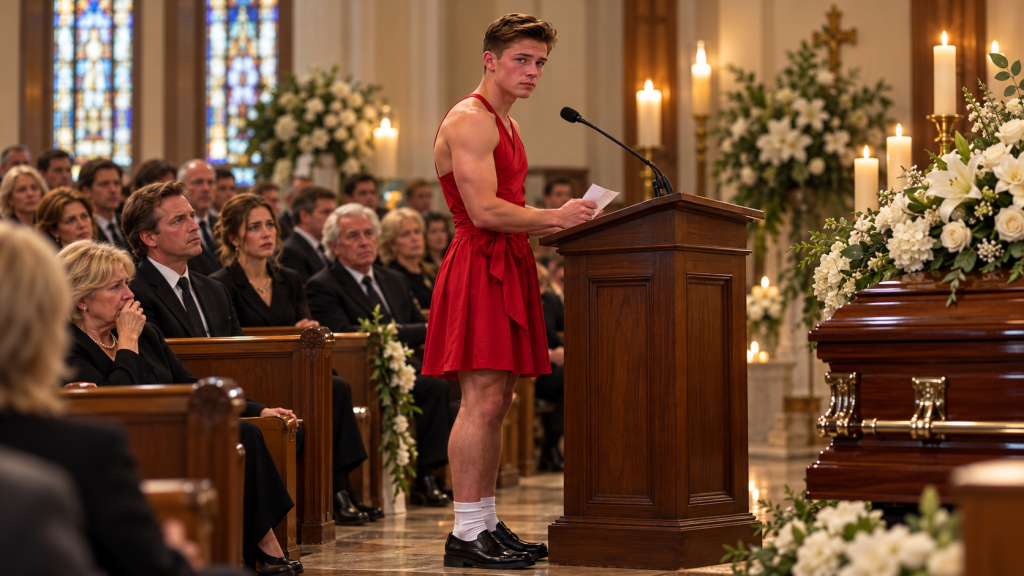
A fragile ripple of laughter passed through the congregation. Daniel covered his mouth. Theo tried to smile. “Seriously, Dad. I know you think funerals should be quiet and respectful. I know you polished your shoes for Grandpa’s funeral even though nobody was going to look at them. And I know you probably think Theo’s dress is ridiculous.” My husband bent forward.
I felt tears run down my cheeks.
“But Dad, there’s something I never figured out how to tell you while I was alive.
“Theo was there on the days when I wasn’t brave.
“Everyone kept telling me how strong I was. The nurses said it. My teachers said it. You and Mom said it because you wanted me to believe it.
“But sometimes I wasn’t strong at all.
“Sometimes I was angry. Sometimes I was scared. Sometimes I hated everything, including myself for being sick.
“Theo was the only person who never made me feel guilty for those days.
“He didn’t tell me to be positive.
“He didn’t tell me miracles happen.
“He just sat beside me and let me be miserable until I wasn’t miserable anymore.
“And when I couldn’t remember what happiness felt like, he put on his sister’s red dress and reminded me.”
Theo stopped.
He pressed the paper against his chest.
His shoulders shook.
I wanted to run to him.
Instead, I held Daniel’s hand because I knew that if I moved, he might fall apart completely.
After a moment, Theo continued.
“There’s one thing I need you to promise me.
“When I’m gone, please don’t let Theo become a stranger.
“He’s going to tell you he’s fine. He’ll say he’s busy. He’ll make jokes and pretend he doesn’t mind spending Christmas somewhere else.
“But I know him.
“He’ll think the only reason he had a place in our house was because I was there.
“He’ll think my bedroom stopped being his the moment I stopped breathing.
“Please don’t let him believe that.
“You always told us family wasn’t only about blood.
“Now I need you to prove you meant it.
“Save him a place at the table.
“Ask him about school.
“Go to his graduation.
“And Dad, please teach him how to change a tire properly, because your last lesson was mostly yelling at us for losing the wrench.
“Love him when I’m not there to remind you.
“Not because he’s replacing me.
“Nobody replaces anybody.
“Just because he’s Theo.
“And because I love him.”
By the final sentence, Theo could barely speak.
He folded the letter carefully.
Then he looked toward my son’s coffin.
“Jack,” he whispered, “I don’t know how to do this without you.”
Something inside me broke.
I stood.
I didn’t think about the guests or the service or what anyone might say.
I simply walked toward the boy who had spent half his childhood at my kitchen table.
When I reached him, he looked frightened.
“I’m sorry,” he whispered.
I shook my head.
“Oh, sweetheart.”
Then I wrapped my arms around him.
He collapsed against me.
For fourteen months, I had watched him be strong for Jack.
He had learned which hospital doors opened automatically and which ones needed a security badge.
He knew how to adjust the pillows behind my son’s back.
He knew the difference between Jack’s real laugh and the polite smile he gave visitors when he was exhausted.
And through all of it, Theo had rarely let himself cry in front of us.
Now, in the middle of the chapel, he wept like a child who had been carrying something too heavy for far too long.
“I’m sorry,” he kept saying.
“I promised him. I promised I would do it.”
I held him tighter.
“You did, sweetheart. You kept your promise.”
Behind us, I heard footsteps.
Daniel.
I turned.
My husband stood a few feet away, his face streaked with tears.
For one terrible second, Theo stiffened.
He had seen Daniel’s anger when he entered the chapel.
He knew my husband had nearly confronted him.
Daniel looked at the red dress.
Then at Theo.
His voice broke.
“Son, can you forgive me?”
Theo stared at him.
Daniel took another step.
“I saw what you were wearing, and I thought you were making fun of Jack.”
He wiped his face.
“I didn’t ask why. I didn’t give you a chance. I was so angry about losing my boy that I nearly hurt another boy who loved him.”
Theo began shaking his head.
“Mr. Harris, you didn’t—”
“Yes,” Daniel whispered. “I did.”
He looked toward Jack’s coffin.
Then back at Theo.
“And Jack knew I might.”
A tear slid down his cheek.
“Even at the end, he understood me better than I understood myself.”
Daniel opened his arms.
Theo hesitated only a moment.
Then he stepped forward.
My husband held him with both arms, pressing one hand against the back of his head.
They stood there together, a grieving father and a grieving boy in a bright red dress, while the entire chapel watched.
And suddenly, the dress no longer seemed unusual.
It seemed like the most honest thing in the room.
Because everyone else had come dressed to show respect for death.
Theo had come dressed to honor the life my son had fought so hard to keep.
After the service, people approached us with stories about Jack.
Some were familiar.
Others were surprises.
A teacher told me Jack had insisted on sending homework to a classmate who’d been absent for weeks, even during his own treatment.
A neighbor remembered him helping carry groceries before he became ill.
One of his friends described a terrible joke Jack had told during a video call from the hospital.
Each memory hurt.
Each memory also gave me something back.
When a child dies, parents are left with the unbearable feeling that their child’s entire future has vanished.
I had spent fourteen months watching Jack’s world shrink.
First he stopped playing basketball.
Then he stopped attending school regularly.
Then even walking from his bedroom to the kitchen became difficult.
I thought illness had stolen nearly everything from him.
But listening to those stories, I began to understand that Jack had been leaving pieces of himself everywhere.
In classrooms.
In friendships.
In the ordinary kindnesses people remembered long after the moment had passed.
Theo stayed close to us throughout the afternoon.
He spoke politely when relatives approached, though I could see how exhausted he was.
Some guests apologized for staring at his dress.
Others thanked him for explaining it.
One elderly woman took his hands and said, “That was the bravest eulogy I’ve ever heard.”
Theo lowered his head.
“I’m not very brave.”
She smiled gently.
“Courage doesn’t always feel like courage while you’re doing it.”
I watched him consider those words.
Then he nodded.
But something continued to trouble me.
Every time someone mentioned Jack’s room, Theo’s expression changed.
He would look away.
Or suddenly remember something he needed to do.
Or ask whether we wanted another glass of water.
I recognized the behavior.
He had been doing it since childhood.
Whenever he felt unwanted, Theo became useful.
He washed dishes nobody had asked him to wash.
Carried bags nobody needed carried.
Offered to go home before anyone could suggest it.
For years, I’d thought of that habit as politeness.
Now I wondered how often it had been fear.
By late afternoon, most guests had left the reception.
Daniel was speaking with the funeral director.
I found Theo in the kitchen, quietly stacking plates.
He had taken off his borrowed dress shoes and was standing in his socks.
“Theo?”
He turned.
“Yes, Mrs. Harris?”
I looked at the pile of plates.
“You don’t have to do that.”
He gave me a small smile.
“It’s okay. Somebody should.”
I moved closer.
“Sit with me.”
He hesitated.
Then pulled out a chair at the kitchen table.
It was the same chair where he’d sat as a little boy with scraped knees, eating peanut-butter sandwiches and arguing with Jack about video games.
I sat opposite him.
For a moment, neither of us spoke.
Then I asked, “Where are you sleeping tonight?”
His eyes dropped.
“At home, probably.”
“Probably?”
He rubbed his palms against his knees.
“My mom says I should start getting used to being there again.”
I swallowed.
“Have you talked to her?”
He nodded.
“She thinks I’ve spent too much time here. She says you and Mr. Harris need space.”
I looked at him.
“And what do you think?”
He stared at the table.
“I don’t want to bother you.”
Those words hurt more than I expected.
“Theo, you’ve never bothered us.”
He gave a sad little laugh.
“Mrs. Harris, Jack’s gone.”
I felt the air leave my lungs.
He continued softly.
“That changes things.”
I looked toward the staircase.
Up there was the room where Jack had spent his final months.
Across the hall was the bedroom we’d called Theo’s since he was seven.
For fourteen years, two boys had filled our home with noise.
Now one bedroom was painfully quiet.
And the boy who remained seemed convinced that his place had disappeared too.
I reached across the table.
“Theo, Jack didn’t create your place in this family.”
His eyes filled.
“He helped us recognize it.”
He pressed his lips together.
“But I don’t want you looking at me and thinking about him every day.”
I smiled sadly.
“Sweetheart, we’re going to think about Jack every day anyway.”
A tear rolled down his cheek.
I squeezed his hand.
“And I’d rather remember him with someone who loved him.”
Theo bent forward.
For a long time, he cried without making a sound.
Then he whispered something that frightened me.
“There’s something else Jack asked me not to tell you until after the funeral.”
I stared at him.
“What is it?”
He looked toward the stairs.
“It’s in his room.”
I followed Theo upstairs.
Each step felt heavier than the last.
For fourteen months, I had climbed those stairs carrying medicine, clean sheets, bowls of soup, and hope.
Sometimes hope had been the heaviest thing of all.
At the top of the landing, Theo stopped outside Jack’s bedroom.
His hand hovered over the doorknob.
“Are you sure?” he asked.
I nodded.
“Yes.”
He opened the door.
The room smelled faintly of laundry detergent and the cedarwood soap Jack had liked.
His basketball shoes were still beside the closet.
A half-finished model airplane rested on the desk.
The curtains were open.
Sunlight fell across the blue blanket where my son had spent so many afternoons.
I stood in the doorway.
For a moment, I could almost hear him.
Mom, don’t come in without knocking.
I smiled through tears.
Then Theo walked toward the dresser.
He opened the bottom drawer and lifted out a small wooden box.
I recognized it.
Charles—Daniel’s father—had made that box for Jack when he was little.
The lid was carved with a crooked star.
Inside, Jack had kept treasures nobody else would have considered valuable.
A beach pebble.
An old movie ticket.
His first school medal.
A photograph of him and Theo grinning with ice cream smeared across their faces.
Theo carried the box to the bed.
“He told me this was for you and Mr. Harris.”
He opened it.
Inside were several envelopes, a small flash drive, and a notebook with a bright yellow cover.
On the front, in Jack’s handwriting, were the words:
DAYS WORTH KEEPING.
I sat down.
“What is this?”
Theo’s eyes filled.
“About eight months ago, Jack got upset because everybody kept talking about what he couldn’t do anymore.”
He smiled sadly.
“He said he was tired of being remembered as the kid in the hospital bed.”
I touched the notebook.
“So we started writing down good things,” Theo continued.
“Not big things. Just anything that made a day worth remembering.”
I opened the first page.
The date was written in Jack’s neat handwriting.
Tuesday. Mom burned the toast and blamed the toaster. Theo laughed so hard he spilled orange juice. Dad pretended not to notice. Best breakfast all week.
I laughed.
Then cried.
The next page read:
Thursday. Rain on the windows. Theo and I watched a terrible movie. We argued about the ending for forty minutes. Excellent waste of time.
Farther down:
Saturday. Dad fell asleep during the football game. He woke up cheering for the wrong team. Mom nearly fell off the sofa laughing.
I pressed a hand to my mouth.
There were pages and pages.
Ordinary moments.
Tiny victories.
Small jokes.
The things I had barely noticed because I was so frightened of what tomorrow might bring.
Theo sat beside me.
“Sometimes he couldn’t write, so I did.”
I turned another page.
The handwriting changed.
Monday. Jack ate half a grilled cheese sandwich. Said it tasted like victory. I told him victory usually has better seasoning.
Beneath it, Jack had added:
Theo remains unqualified to review food.
I laughed again.
And for the first time since my son died, laughter did not feel like betrayal.
It felt like recognition.
I knew that boy.
I knew his humor.
His impatience.
His stubborn determination to make somebody smile.
I turned toward Theo.
“Why didn’t you tell us?”
He stared at his hands.
“Jack wanted to give it to you himself.”
My heart tightened.
Theo continued.
“Then things got worse. He said if he couldn’t finish it, I should wait until after the funeral.”
“Why?”
“He didn’t want it to become another goodbye.”
I looked down at the notebook.
“He wanted you to read it when you were ready to remember the good days.”
I closed my eyes.
How extraordinary that my dying son had worried about how his parents would remember him.
Then Theo pointed toward the flash drive.
“There’s something on there too.”
I looked at it.
“A video?”
He nodded.
“Several.”
My hands began trembling.
“Did Jack make them?”
“Some of them.”
Theo hesitated.
“The last one is for his dad.”
Daniel found us sitting on Jack’s bedroom floor.
I had opened the laptop we used to keep downstairs.
Theo had connected the flash drive.
On the screen were six video files.
Their names were simple.
Kitchen.
Rainy Tuesday.
The Dress.
Graduation Practice.
Mom.
Dad.
Daniel stopped in the doorway.
“What are you doing?”
I looked up.
“Theo brought us something Jack left.”
My husband’s face tightened.
He looked toward the laptop.
Then at the yellow notebook in my lap.
“What is it?”
“Memories.”
Daniel slowly lowered himself onto the bed.
Theo glanced at me.
“Should I play the first one?”
I nodded.
The screen flickered.
And suddenly, Jack was there.
Alive.
Sitting in his bedroom.
His hair was already gone, and his face looked thinner than I remembered.
But his smile was unmistakable.
“Okay,” he said, looking toward the camera. “This is probably the dumbest documentary in history.”
Theo’s voice came from behind the phone.
“That’s because the subject is boring.”
Jack threw a pillow toward the camera.
The image shook.
Daniel made a sound beside me.
It was half laugh, half sob.
On the screen, Jack said, “The purpose of this film is to prove that people can have really terrible days and still experience moments of excellent stupidity.”
He lifted a cookie.
“Exhibit A. Mom told me not to eat this before dinner.”
Theo asked, “Are you going to?”
Jack took an enormous bite.
“Obviously.”
The video ended.
I laughed while tears ran down my face.
Another began.
Jack sat by the bedroom window while rain fell outside.
Theo was reading aloud from a comic book.
Jack interrupted him every few seconds to criticize the characters.
It was nothing remarkable.
And it was everything.
Then Theo clicked the file labeled The Dress.
I held my breath.
The screen showed Jack sitting upright on his bed.
His face was pale.
His hands were resting on his knees.
Theo stood beside the dresser, wearing the same red dress he’d worn to the funeral.
It hung awkwardly from his shoulders.
He had mismatched socks and an expression of exaggerated seriousness.
“Ladies and gentlemen,” Theo announced, “welcome to tonight’s extremely exclusive fashion show.”
Jack stared at him.
Then began laughing.
Not politely.
Not carefully.
He laughed until he bent forward, clutching his stomach.
Theo struck a dramatic pose.
“Do you think red is my color?”
Jack wheezed.
“No. I think bad decisions are your color.”
Theo pretended to be offended.
“I’ll have you know this dress belonged to a woman with excellent taste.”
Jack’s laughter softened.
He looked at Theo.
“Emma?”
Theo nodded.
For several seconds, neither boy spoke.
Then Jack said quietly, “Tell me about her graduation.”
Theo sat on the edge of the bed.
And the video changed.
It stopped being a joke.
Theo told Jack about Emma standing in their kitchen before her graduation ceremony, twirling in the dress while their father complained that everybody would notice her.
“That was the point,” Theo said on the recording. “She told him she’d worked too hard to disappear into a crowd.”
Jack smiled.
“She sounds awesome.”
“She was.”
Theo looked down at the fabric.
“I haven’t worn anything of hers since she died. I haven’t even opened her closet much.”
Jack reached for his hand.
“Does wearing it make you miss her more?”
Theo nodded.
“Yeah.”
Jack waited.
Then asked, “Does it help you remember her too?”
Theo looked at him.
After a moment, he nodded again.
Jack smiled.
“Then maybe that’s okay.”
The recording continued.
Theo told stories about his sister.
The time she’d gotten detention for defending a younger student.
The homemade birthday cake she’d dropped on the kitchen floor.
The way she sang loudly in the car, always choosing the wrong key.
And Jack listened.
At the end, my son looked directly into the camera.
“Important scientific discovery,” he announced. “Red dresses are excellent for remembering people you love.”
Theo laughed.
“That’s not scientific.”
“Neither is your fashion sense.”
They both began laughing again.
Daniel bent forward and covered his face.
I wrapped an arm around him.
We sat together, listening to our son laugh.
The sound filled the bedroom.
For months, our memories of Jack had been dominated by pain.
Now here he was, laughing about bad fashion and eating forbidden cookies.
Still our boy.
Still himself.
I turned toward Theo.
He was crying quietly.
“Thank you,” I whispered.
He shook his head.
“Jack made me promise not to delete anything.”
I looked at the screen.
“Thank goodness he did.”
The next video was labeled Graduation Practice.
Jack sat at his desk wearing a crooked paper cap.
Theo had drawn a diploma on notebook paper.
“Congratulations,” Theo announced solemnly. “You have successfully graduated from the School of Being Extremely Annoying.”
Jack bowed.
“Thank you. I’d like to thank my parents for making this possible.”
He held up the fake diploma.
Then his expression changed.
“Theo?”
“Yeah?”
“If I’m not at graduation, you still have to go.”
Theo was quiet.
Jack continued.
“Don’t skip it because you think I should be there.”
Theo looked away.
“I don’t want to do it without you.”
Jack swallowed.
“I know.”
Then he gave his friend a small smile.
“But I’m going to be furious if you waste all that homework.”
Daniel laughed through tears.
On the screen, Theo shook his head.
“You’re impossible.”
“Yes,” Jack replied. “And you’re going to graduate.”
He pointed toward the camera.
“Mom and Dad are going to clap so loudly they’ll embarrass you.”
I felt Daniel’s arm tighten around my shoulders.
Jack smiled.
“And you’ll pretend you hate it.”
The video ended.
We sat in silence.
Then Daniel whispered, “We will.”
Theo looked at him.
My husband wiped his face.
“When you graduate, son, we’re going to be there.”
Theo began crying.
Daniel reached for his hand.
“And I promise we’ll be embarrassingly loud.”
I thought the videos had already given us more than we could bear.
Then Theo opened the final file.
Dad.
Jack appeared on the screen alone.
He was lying against his pillows, holding the camera with both hands.
For several seconds, he simply stared into the lens.
Then he smiled.
“Hi, Dad.”
Daniel went completely still.
Jack swallowed.
“I don’t know when you’ll watch this. Theo says making these videos is cheesy, but he also cried during a dog food commercial last week, so I’m not taking criticism from him.”
A faint laugh escaped Daniel’s throat.
On the screen, Jack’s smile faded.
“Dad, there’s something I need you to know.”
He looked down.
“When I got sick, you started trying to fix everything.”
I watched my husband close his eyes.
“You researched doctors. You learned all the medicine names. You kept asking whether there was another hospital, another treatment, another thing we could try.”
Jack took a breath.
“I know why.”
His voice softened.
“You’ve always fixed things. When my bike broke, you fixed it. When I failed math, you helped me study. When I was little and thought monsters lived in my closet, you checked it every night.”
Daniel began trembling.
“But this wasn’t something you could fix.”
Jack paused.
“And I know you think that means you failed.”
My husband’s face crumpled.
“I heard you crying in the garage that night after the doctor told us the treatment wasn’t working.”
I stared at Daniel.
He had never told me that.
On the screen, Jack continued.
“I wanted to come downstairs, but I couldn’t.”
His eyes filled.
“So I just listened.”
Then my son looked directly into the camera.
“Dad, you didn’t fail me.”
Daniel made a sound I will never forget.
It seemed to come from somewhere deep inside him.
Jack continued.
“You gave me a good life. Even when it got really hard, you kept showing up.”
A tear slid down his cheek.
“And when I couldn’t be brave, you were scared with me. That’s not failing.”
He smiled faintly.
“That’s being my dad.”
Daniel began sobbing.
I held him.
Jack looked down at his hands.
“And one more thing.”
He paused.
“Please don’t spend the rest of your life being angry because I died.”
His voice trembled.
“I don’t want that to be what happens to our family.”
He swallowed.
“Take Mom somewhere nice. Tell bad jokes. Make pancakes on Sundays even though you always burn the first one.”
A small smile crossed his face.
“And please keep Theo around.”
He glanced toward the bedroom door.
“He’s going to need you.”
Then Jack whispered, “I love you, Dad.”
The screen went black.
Daniel buried his face in his hands.
For a long time, he couldn’t speak.
When he finally looked up, his voice was barely audible.
“I thought if I kept looking, I’d find something.”
I took his hand.
“I know.”
“Another doctor. Another treatment. Something I missed.”
My own tears fell.
“Daniel—”
He shook his head.
“I couldn’t save him.”
I wrapped my arms around him.
“No,” I whispered. “We couldn’t.”
For a moment, that truth felt unbearable.
Then I looked toward the dark screen.
“But we loved him.”
Daniel stared at it.
And finally, after fourteen months of fighting and three weeks of silence, he let himself grieve without trying to turn grief into another problem he could solve.
We watched the video for Mom the following morning.
Daniel had wanted to see it with me, but I asked for a little time alone.
He understood.
I carried the laptop downstairs, made a cup of tea, and sat at the kitchen table where I’d served Jack thousands of breakfasts.
Then I pressed play.
Jack appeared with a blanket around his shoulders.
“Hi, Mom.”
I immediately began crying.
He smiled.
“You’re crying already, aren’t you?”
I laughed helplessly.
“Probably.”
On the screen, Jack looked toward the window.
“I don’t really know how to say this, so I’m just going to say it.”
He took a breath.
“Thank you for never making me feel like being sick was the only thing about me.”
I pressed my hand against my mouth.
“Thank you for arguing with me when I left my clothes on the floor. Thank you for making me do homework even when I complained. Thank you for getting mad when I stayed up too late playing games with Theo.”
He smiled.
“I know sometimes you worried you were too hard on me.”
My chest tightened.
“I wasn’t.”
He looked down.
“When everyone started treating me like I was made of glass, you still remembered I was a teenage boy who could be incredibly annoying.”
A laugh escaped through my tears.
“You made me feel normal.”
He paused.
“And Mom, there’s something I need you to promise.”
I leaned closer.
“Don’t stop doing things you love because I’m not there.”
His eyes filled.
“Go dancing with Dad. Plant those ridiculous flowers that never grow. Go to the beach even when it’s cold.”
He smiled.
“And please, please, don’t feel guilty when you’re happy.”
I began sobbing.
My son had known.
Somehow, in the middle of everything he was enduring, he’d understood that I would be frightened of happiness after he was gone.
Jack swallowed.
“Being my mom was only part of who you were.”
His voice softened.
“It was my favorite part.”
Then he smiled.
“But there’s more to you than losing me.”
He lifted a hand toward the camera.
“I love you.”
The video ended.
I sat at the kitchen table for a very long time.
Then I picked up my phone.
I called Daniel.
“Could we go to the beach this weekend?”
He was quiet.
Then he asked, “The one Jack liked?”
“Yes.”
I heard him take a shaky breath.
“Let’s go.”
Two weeks after the funeral, Theo’s mother came to our house.
Her name was Claire.
I’d known her for years, though we had never become especially close.
Life had been difficult for her.
Her marriage had ended badly.
Then Emma had died in a car accident, and grief seemed to settle over their household like a winter that never ended.
Theo had spent more time with us after that.
I had never asked whether Claire resented it.
Now, sitting across from her at my kitchen table, I realized how many things all of us had left unsaid.
She held a photograph of Emma in the red dress.
The young woman was standing on a porch, smiling broadly, her graduation flowers tucked beneath one arm.
“She insisted on wearing red,” Claire whispered.
I looked at the photograph.
“She was beautiful.”
Claire smiled through tears.
“She hated being ordinary.”
Then she looked toward the staircase.
“When Theo asked whether he could borrow the dress, I thought he’d finally lost his mind.”
My stomach tightened.
“You knew?”
She nodded.
“He told me about Jack’s promise.”
Her voice broke.
“I helped him fasten the zipper.”
I stared at her.
Claire wiped her eyes.
“I almost asked him not to do it. I was afraid people would laugh.”
She looked toward the photograph.
“Then I remembered Emma standing in that dress, telling me she didn’t care whether everyone stared.”
A small smile appeared.
“She said sometimes the best things in life happen when you’re brave enough to look different.”
I reached for Claire’s hand.
“She sounds wonderful.”
“She was.”
For a while, we sat quietly.
Then Claire looked at me.
“There’s something I need to apologize for.”
I waited.
“I told Theo he should stop staying here so much after Jack died.”
My chest tightened.
She continued.
“I thought I was protecting you and Daniel.”
“From what?”
“From having to look at him and remember Jack.”
I glanced toward the staircase.
“Claire, we remember Jack whether Theo is here or not.”
She nodded.
“I know that now.”
Then she began crying.
“And I think part of me was afraid.”
“Of what?”
She looked down.
“That Theo needed your family more than he needed me.”
My heart softened.
For years, I’d believed Claire was simply grateful that we welcomed her son.
I hadn’t considered how it might feel to watch him find comfort in another household while she was struggling with her own grief.
I squeezed her hand.
“Claire, love isn’t a competition.”
She looked at me.
“Theo can love you and still have a place here.”
Her eyes filled.
“And he can love Jack without losing you.”
She began crying harder.
I moved beside her.
We held each other for a long time.
Two mothers.
Both grieving.
Both trying to understand how to keep loving children when death had changed the shape of our families.
When Theo came downstairs, he stopped in the doorway.
He looked from his mother to me.
“What happened?”
Claire wiped her eyes.
“Nothing bad, sweetheart.”
She held out her arms.
Theo hesitated.
Then crossed the kitchen.
She hugged him tightly.
“I’m proud of you,” she whispered.
He began crying.
“For the funeral?”
“For loving your friend.”
She kissed his forehead.
“And for helping us remember your sister.”
Watching them, I understood something Jack had grasped before any of us.
The red dress hadn’t only belonged to Emma.
And it hadn’t only been part of a joke.
It had become a bridge between two families who were learning how to grieve without disappearing from each other’s lives.
The following months were difficult.
Some mornings, I could barely get out of bed.
Other days, Daniel grew angry over something small and then spent hours apologizing.
Sometimes Theo avoided our house because the silence inside Jack’s bedroom frightened him.
We didn’t always know how to help one another.
But we began talking.
Really talking.
Daniel joined a bereavement support group.
I started meeting with a counselor who helped me understand that grief wasn’t something I needed to complete successfully.
Theo spent time with his mother and visited us whenever he wanted.
We made no grand promises about replacing Jack.
We simply kept a place for Theo at the table.
Some evenings, he came over and watched a movie with Daniel.
Other evenings, he helped me cook.
And sometimes, we said very little.
That was all right too.
We didn’t need every visit to become a ceremony of remembrance.
Jack had asked us to keep living.
So we tried.
Graduation arrived in June.
The school auditorium was crowded with proud families.
I wore a blue dress Jack had helped me choose for a wedding the previous summer.
Daniel wore the tie Jack once told him made him look like a disappointed geography teacher.
We sat beside Claire.
There was an empty chair at the end of our row.
Nobody had reserved it for Jack.
It simply remained empty because one guest hadn’t arrived.
Yet when I looked at it, I thought of my son.
Of all the things he should have been doing that morning.
Adjusting his graduation cap.
Laughing with Theo.
Complaining that the ceremony would last forever.
For a moment, the grief nearly overwhelmed me.
Daniel reached for my hand.
“You okay?”
I nodded.
“No.”
He squeezed my fingers.
“Me neither.”
Then we sat together.
When Theo’s name was announced, he stepped onto the stage wearing a navy suit.
Tucked into his jacket pocket was a small red handkerchief.
Claire had chosen it for him.
Not cut from Emma’s dress, which remained carefully preserved, but made from a piece of fabric she’d kept in her sewing basket.
Theo had wanted a way to remember his sister and Jack without turning the ceremony into another goodbye.
He crossed the stage.
Accepted his diploma.
Then looked toward us.
Daniel stood first.
He began clapping so loudly that several people turned around.
I stood beside him.
Claire was laughing through tears.
“That’s our boy!” Daniel shouted.
Theo’s face turned bright red.
He shook his head.
Then smiled.
Exactly as Jack had predicted.
That evening, we had dinner together.
Nothing elaborate.
Pizza.
Salad.
A homemade chocolate cake.
Daniel gave Theo a small toolbox.
Theo opened it and laughed.
“Seriously?”
Daniel smiled.
“Jack specifically requested that I teach you how to change a tire properly.”
Theo looked down at the tools.
His eyes filled.
Daniel placed a hand on his shoulder.
“And this time, I’ll try not to yell about the wrench.”
We all laughed.
For a moment, I could almost hear Jack laughing with us.
Not because I believed he was somehow sitting invisibly at the table.
But because his humor had become part of ours.
And the love he left behind was still teaching us how to be a family.
On the first anniversary of Jack’s death, we went to the beach.
Daniel carried a thermos of coffee.
Claire brought sandwiches.
Theo arrived with a little wooden box containing two photographs.
One showed Jack and Theo at seven years old, standing in our backyard with muddy knees.
The other showed them in Jack’s bedroom.
Theo was wearing Emma’s red dress.
Jack was laughing so hard his eyes were closed.
I held the photographs carefully.
“They look happy,” I whispered.
Theo nodded.
“They were.”
He stared toward the water.
“Sometimes I feel guilty for laughing about that day.”
Daniel put an arm around his shoulders.
“Why?”
“Because Jack was so sick.”
My husband was quiet for a moment.
Then he answered.
“That’s exactly why the laughter mattered.”
Theo looked up.
Daniel smiled sadly.
“I spent so much time thinking about what Jack was losing that I forgot he was still finding things worth enjoying.”
He looked toward the photograph.
“You gave him one of those things.”
Theo began crying.
Daniel held him.
And I watched the two of them standing at the shoreline, with the wind moving through their hair.
A father who had lost his son.
A young man who had lost his best friend and his sister.
Neither one could bring back the people they loved.
But they could still stand beside each other.
And sometimes, that was enough.
Later, as we walked back toward the parking lot, Theo caught my hand.
“Mrs. Harris?”
I smiled.
“Yes, sweetheart?”
“Is it still okay if I come over on Sundays?”
I stopped.
Even after everything, he was asking.
Even after the funeral, the videos, graduation, and all those evenings at our kitchen table, some part of him still worried that love could expire.
I turned toward him.
“Theo, you don’t need a special reason to visit.”
His eyes filled.
“Really?”
I nodded.
“You’re family.”
He hugged me.
And this time, when he cried, he didn’t apologize.
That Christmas, Theo helped decorate our tree.
Daniel complained about the tangled lights.
Claire brought cookies.
And I placed a small photograph near the top of the mantel.
In it, Jack was laughing at Theo in the red dress.
I had once feared that seeing my son smile in photographs would hurt too much to bear.
Now I understood that I could miss him desperately and still be grateful for every moment captured.
During dinner, Daniel raised his glass.
“To Jack.”
We all lifted ours.
Then Theo smiled.
“And to Emma.”
Claire wiped her eyes.
“To Emma.”
For a moment, we sat quietly.
Then Daniel looked at Theo.
“One more thing.”
Theo raised an eyebrow.
“What?”
My husband smiled.
“Thank you for wearing that dress.”
Theo laughed.
“You almost threw me out.”
“I know.”
Daniel’s smile faded into something gentler.
“And I nearly missed the most important thing my son wanted to tell me.”
He reached across the table.
“That love doesn’t always look the way we expect.”
Theo took his hand.
I looked around the room.
At my husband.
At Claire.
At the young man who had once appeared on our doorstep carrying a schoolbag, hoping someone would let him stay for dinner.
And at the photograph of the boy whose absence would always hurt.
Jack had been right.
Nobody could replace him.
We had learned that the hard way.
But losing him did not mean the love he’d given us had to disappear.
My husband had wanted to throw Theo out of our son’s funeral because he thought the bright red dress was disrespectful.
Instead, that dress revealed a promise between two boys, carried the memory of a beloved sister, and reminded a grieving family that joy could exist beside unbearable sorrow.
And perhaps the most beautiful part was this:
Jack had known he might not live long enough to see his best friend graduate, travel, fall in love, or build a life.
But he’d wanted Theo to have those things anyway.
He’d wanted his parents to keep loving.
He’d wanted laughter to return to the house.
And he’d wanted us to remember him as more than the illness that took him.
So whenever I think of my son’s funeral now, I don’t remember the whispers.
I don’t remember the disapproving faces.
I remember a young man standing at a microphone in a bright red dress, trembling as he kept the hardest promise of his life.
I remember my husband’s arms opening instead of pushing him away.
And I remember the words Jack left us.
“Nobody replaces anybody. Just keep loving each other.”
Those words became the gift our son left behind.
Because grief had taught us how much death could take.
But Jack, with the help of his best friend and one unforgettable red dress, taught us how much love could still give.
THE END STORIES! THANK YOU FOR READING GOOD LUCK !❤️
Related Posts