I read the message three times before the words finally made sense. The agent says we can list the house next week. If I get her to agree before she realizes what’s happening, we can close quickly. Helen needs to be out first. The basement situation should convince her she can’t stay.
Beneath it was another message. Once the sale goes through, I can put my share into the business. We can’t keep waiting for her mother to finish treatment. I slowly lifted my eyes. Gabriel was standing across the dining table, his face drained of color. His brother, Marcus, had stopped eating.
Ruth sat perfectly still, one hand resting on my mother’s shoulder. And Mom looked at me with the kind of frightened expression I hadn’t seen since the day her oncologist first explained that she needed chemotherapy. “Gabriel,” I said quietly, “what business?” He rubbed his forehead.
“You’re misunderstanding the conversation.”
I looked at the printout again.
“Then explain it.”
He glanced at his mother.
“Mom, why would you bring this here?”
Ruth’s expression didn’t change.
“Because I asked you three times whether your wife knew you were planning to sell the house.”
Gabriel’s jaw tightened.
“And I told you it was complicated.”
“No,” she answered. “You told me you were handling it.”
I placed the paper on the table.
“Are you selling our home?”
He gave a short, impatient laugh.
“Nobody is selling anything yet.”
“Yet?”
He looked away.
I felt an unfamiliar calm settle over me.
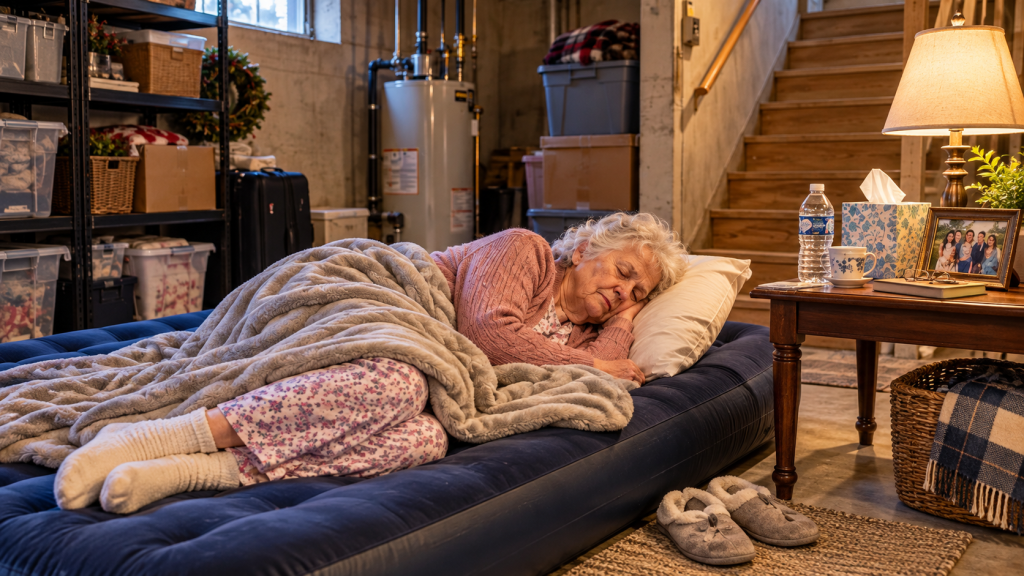
It was the same calm I’d experienced that morning when I found my seventy-year-old mother lying on an air mattress in the basement.
A feeling so cold and clear that even anger seemed unnecessary.
“Gabriel, whose name is on the deed?”
He sighed.
“Both of ours.”
“And whose money paid the down payment?”
He stared at me.
“Why are we doing this?”
“Answer me.”
“We both contributed.”
“Yes. We did.”
I leaned forward.
“We bought this house together. We pay the mortgage together. I cover the insurance and most of the utilities. You don’t get to decide it’s yours because you’re a man.”
Marcus shifted in his chair.
Gabriel turned toward him.
“Are you seriously going to sit there and let them gang up on me?”
His brother swallowed.
Then said something nobody expected.
“Gabe, you told me she knew.”
I looked at Marcus.
“What?”
He stared at the table.
“The business. The house. Everything.”
Gabriel’s face hardened.
“Shut up, Marcus.”
But his brother finally looked at me.
“He said you two had agreed to downsize. He said your mom was going back home after treatment, and you were excited about investing in our sports lounge.”
I felt my chest tighten.
Sports lounge.
For months, Gabriel and Marcus had talked about opening a bar with televisions, pool tables, and weekend events.
I had thought it was one of their usual ideas.
The kind they discussed enthusiastically over beer and forgot about when actual numbers entered the conversation.
Apparently, Gabriel had decided the idea was worth risking our home.
“How much money?” I asked.
Marcus didn’t answer.
“Marcus.”
He looked at Gabriel.
Then whispered, “About a hundred and twenty thousand.”
My mother made a small sound.
Ruth closed her eyes.
I stared at my husband.
“You intended to sell our house so you could invest a hundred and twenty thousand dollars in a bar?”
Gabriel threw his hands up.
“It’s not just a bar. It’s a legitimate business opportunity.”
I almost laughed.
“With whose money?”
“Our equity.”
I repeated the word.
“Our.”
He didn’t seem to hear the difference.
“We’ve spent years building value in this property,” he continued. “What’s the point if we never do anything with it?”
I looked toward my mother.
She was sitting upright, but her hands were trembling.
She had barely touched her dinner.
The effort of getting dressed and coming upstairs had exhausted her.
And the man I’d married was discussing how inconvenient her cancer treatment had become for his business plans.
“Mom,” I said gently, “would you like to go lie down?”
She shook her head.
“No, sweetheart.”
Her voice was weak.
But her eyes were steady.
“I want to hear this.”
Gabriel looked toward the ceiling.
“Great. Now we’re turning a private financial discussion into a family tribunal.”
Ruth stood.
“No, Gabriel.”
He looked at her.
“This is what happens when you treat people like obstacles instead of family.”
He laughed bitterly.
“Don’t start lecturing me.”
But Ruth didn’t raise her voice.
She simply reached into her handbag and placed another folded paper on the table.
I recognized the letterhead immediately.
It belonged to a local real estate brokerage.
Attached was a preliminary property valuation.
Our address appeared at the top.
Beneath it was a proposed listing price.
Then, in the notes section, a sentence that made my stomach turn.
Seller indicates spouse is temporarily away and anticipates consent once relocation arrangements are finalized.
I looked at Gabriel.
“Relocation arrangements?”
He said nothing.
Ruth answered for him.
“He told the agent you were planning to move your mother into long-term residential care.”
The room went silent.
I could hear the refrigerator running.
Somewhere down the street, a dog barked.
My mother placed both hands flat against the table.
Then she whispered, “You were trying to make me leave.”
Gabriel looked at her.
“Helen, this isn’t personal.”
My mother’s face crumpled.
For seventy years, she’d weathered hardships without asking for much.
She had raised children, cared for my father during his final illness, and spent decades helping other people before herself.
Now she was facing chemotherapy.
And my husband had decided that making her uncomfortable was a reasonable way to clear a bedroom.
“It was personal to me,” she answered.
Her voice was barely audible.
But every person at that table heard it.
Gabriel tried to turn the conversation back toward money.
He told us the sports lounge could generate steady income.
That Marcus had found a promising location.
That the neighborhood was growing.
That other investors were interested.
He talked about projected revenue and commercial leases as though a collection of optimistic numbers could explain why he’d put my sick mother on a basement floor.
I listened until he ran out of breath.
Then I asked one question.
“Why didn’t you tell me?”
He stared.
“I knew how you’d react.”
I nodded.
“Because you knew I’d say no.”
He looked away.
“Because you always put your mother first.”
I felt anger rise.
“Gabriel, my mother has cancer.”
“I know.”
“She’s staying here temporarily while she’s receiving chemotherapy.”
“I know.”
“She needs a bed close to a bathroom, and you’ve moved her into a basement where she can barely manage the stairs.”
He spread his hands.
“She was only down there for two nights.”
I looked at him.
“Two nights?”
He blinked.
I’d been gone four days.
“Gabriel, how long was she down there?”
He didn’t answer.
I turned toward Mom.
She lowered her eyes.
“Three nights,” she whispered.
My heart stopped.
“Mom.”
She swallowed.
“He moved me after you left on the first morning.”
I stared at Gabriel.
“You told me his brother came to watch football.”
Mom nodded faintly.
“That was the reason he gave.”
I looked at Marcus.
He seemed genuinely shaken.
“I didn’t know she’d been down there since the first day,” he said. “I only came over yesterday.”
Gabriel snapped, “It doesn’t matter whether it was two nights or three!”
Ruth’s chair scraped against the floor.
“Yes, it does.”
Her voice was so sharp that Gabriel stopped speaking.
She pointed toward Helen.
“Your mother-in-law is undergoing chemotherapy. She is exhausted. She needs a safe place to recover. You put her on an air mattress because you wanted control over a room.”
Gabriel looked away.
Ruth continued.
“When I was going through treatment, do you remember how frightened you were?”
He said nothing.
“You were eleven. You used to sit beside my bed and bring me water because you thought that if you kept watching, nothing bad would happen.”
A tear rolled down her cheek.
“I taught you that people who are sick deserve patience. I taught you to help people who can’t help themselves.”
Gabriel shifted.
“Mom, please.”
She shook her head.
“And somehow you grew into a man who looks at a seventy-year-old woman fighting cancer and sees an inconvenience.”
My husband lowered his eyes.
For the first time that evening, he seemed to have no prepared answer.
I stood.
“Gabriel, I want you to stay somewhere else tonight.”
He stared.
“Excuse me?”
“I need space. Mom needs rest. And I am not going to spend tonight arguing while she’s exhausted.”
His face hardened.
“This is my house.”
I nodded.
“Legally, it’s our house. I’m not pretending otherwise. I’m asking you to leave voluntarily tonight so we can work out what happens next without more conflict.”
He folded his arms.
“And if I refuse?”
I looked at him.
“Then I will take Mom somewhere safe and speak with an attorney about our options tomorrow.”
Ruth picked up her car keys.
“Gabriel, you can stay at my place.”
He stared at her.
“You’re taking her side?”
Ruth looked toward Helen.
“I’m taking the side of basic human decency.”
Marcus stood awkwardly.
“I’ll go too.”
Gabriel looked around the table.
Nobody spoke for him.
At last, he grabbed his jacket.
At the doorway, he turned back.
“You’re going to regret turning this into a bigger problem than it needs to be.”
I looked directly at him.
“Gabriel, you moved my sick mother onto a basement floor and started planning to sell our home without telling me.”
My voice remained steady.
“You made this problem. I’m simply refusing to hide it.”
He left.
A few seconds later, Ruth followed him.
But before she stepped outside, she turned toward me.
“I’m sorry,” she whispered.
I shook my head.
“Ruth, you didn’t do this.”
Her eyes filled.
“I know. But I raised him. And tonight I am terribly ashamed of the man he’s become.”
I walked over and hugged her.
She held me tightly.
Then she left.
When the door finally closed, my mother began to cry.
And I realized that the most important conversation of the evening hadn’t happened yet.
Mom waited until the sound of Gabriel’s car had disappeared.
Then she covered her face with both hands.
“I’m so sorry, sweetheart.”
I knelt beside her chair.
“Mom, what are you apologizing for?”
She shook her head.
“For causing trouble in your marriage.”
I stared at her.
For several seconds, I couldn’t speak.
My mother was seventy years old.
She’d been through months of blood tests, consultations, medications, and chemotherapy appointments.
Her body was exhausted.
Some days, even the smell of toast made her nauseated.
And somehow, after being forced to sleep on a cold basement floor, she believed she’d done something wrong by needing help.
I gently took her hands.
“Mom, look at me.”
She raised her eyes.
“You didn’t cause trouble in my marriage. Gabriel did.”
She began crying harder.
“I should have told you.”
My chest tightened.
“Told me what?”
She hesitated.
Then whispered, “I tried to come upstairs yesterday.”
I felt a chill.
“What happened?”
She looked down.
“I got dizzy halfway up.”
My heart began pounding.
“Mom.”
“I sat on the stairs until it passed.”
“How long?”
She shook her head.
“I’m not sure.”
I took a slow breath.
“Did Gabriel know?”
“He heard me calling.”
I felt something terrible settle inside me.
“What did he do?”
Mom wiped her face.
“He told me to rest until I felt steady enough to continue.”
I closed my eyes.
Three nights in the basement.
A woman undergoing chemotherapy.
An air mattress on the floor.
And a husband who had heard her calling from the stairs and decided she could manage on her own.
“Why didn’t you call me?”
She looked ashamed.
“Because you were working. You sounded so happy when you called from the hotel.”
I began crying.
“Oh, Mom.”
“I didn’t want you worrying.”
I moved closer and put my arms around her.
For a long time, I held her.
Then I said something I wished I’d told her more often.
“You don’t have to make your suffering smaller so the people who love you can feel comfortable.”
She buried her face against my shoulder.
“I didn’t want to be a burden.”
I closed my eyes.
“You aren’t a burden.”
I pulled back enough to look at her.
“You’re my mother. You took care of me when I was sick. You stayed up through fevers, drove me to school, and worked extra shifts so I could go to college.”
Tears ran down her cheeks.
“You never called me a burden when I needed you.”
She tried to smile.
“Well, you were quite demanding when you had chickenpox.”
I laughed through tears.
“Exactly. And you still loved me.”
She nodded.
“Of course.”
“Then let me love you too.”
Her expression softened.
I helped her to the guest room and settled her into the bed.
Before she closed her eyes, she reached for my hand.
“Sweetheart?”
“Yes?”
“Don’t destroy your marriage for me.”
I swallowed.
“Mom, I won’t make decisions about my marriage because you ask me to stay or leave.”
She watched me.
“I’ll make them because of what Gabriel has shown me about the kind of partner he is.”
She nodded slowly.
Then whispered, “I just want you to be happy.”
I kissed her forehead.
“So do I.”
The next morning, I called Mom’s oncology team and explained what had happened on the basement stairs.
They took my concerns seriously.
Because dizziness and weakness during chemotherapy can have several causes, including dehydration, anemia, medication effects, or infection, they arranged for her to be assessed.
Sarah, one of the clinic nurses, had known Mom for months.
When we arrived, she knelt beside her wheelchair.
“Helen, I hear you’ve had a difficult few days.”
Mom attempted a smile.
“I’m apparently not as sturdy as I used to be.”
Sarah smiled gently.
“Being sturdy doesn’t mean you have to do everything alone.”
They checked her vital signs, reviewed her symptoms and medications, and arranged the testing her care team considered necessary.
She needed additional support with hydration and rest, and they reviewed warning signs that would require immediate medical attention.
Thankfully, there was no evidence of a serious injury from the episode on the stairs.
But the nurse’s expression became firm when I described the basement.
“She needs a safe environment,” Sarah told me. “We should also assess her fall risk and whether additional help or equipment would make recovery easier.”
I nodded.
“I understand.”
Mom looked embarrassed.
“I don’t want my daughter turning her house into a hospital.”
Sarah shook her head.
“Helen, nobody’s suggesting that. We’re talking about making ordinary life safer while you recover.”
I reached for Mom’s hand.
“And I want to do that.”
She squeezed my fingers.
On the drive home, she was quiet for several minutes.
Then she said, “I liked Ruth.”
I smiled.
“She likes you.”
Mom looked out the window.
“It’s funny, isn’t it? We both went through chemotherapy. We both raised children. And somehow, we ended up having to remind a grown man how to be kind.”
I laughed softly.
“You’re allowed to be angry with him.”
She nodded.
“I am.”
Then she looked at me.
“But I don’t want that anger to be the only thing we talk about while I’m staying with you.”
I thought about the previous evening.
The real estate letter.
The business plans.
The humiliation of watching Gabriel defend what he’d done.
Mom was right.
Her time with me couldn’t become nothing but a record of his cruelty.
I reached for the radio.
“All right. What would you rather talk about?”
She smiled.
“Did I tell you that your cousin Emily is apparently getting married to the man she met at the hardware store?”
I laughed.
“No.”
Mom settled back into her seat.
“Well, you’re going to love this.”
And for the rest of the drive, we talked about family gossip, terrible first dates, and the extraordinary number of people who somehow found romance while buying paint.
It felt wonderful.
Not because everything was fine.
Because for twenty minutes, my mother was simply my mother again.
That afternoon, I met with a family-law attorney named Caroline Wells.
She came recommended by a colleague who knew how carefully I preferred to handle complicated situations.
Caroline listened without interrupting as I explained everything.
The house.
The chemotherapy.
The basement.
The sports lounge.
The messages.
And the proposed sale.
When I finished, she asked for copies of the real estate correspondence and our property documents.
“We’ll verify the title and any financial obligations,” she said. “But from what you’ve described, the house is jointly owned. Gabriel cannot simply transfer your ownership interest without the required legal authorization.”
I exhaled.
“So he can’t sell it behind my back?”
“He shouldn’t be able to complete a legitimate sale of both owners’ interests without proper participation and signatures. We’ll confirm there hasn’t been any unauthorized filing or attempted use of your identity.”
I nodded.
“And the agent?”
“Contact the brokerage directly, in writing, to make clear that you have not agreed to list or sell the property. We can help with that.”
I looked at my hands.
“What about the money for the business?”
Caroline studied me.
“Have you checked your joint accounts recently?”
I hesitated.
“Not since before my trip.”
“Then let’s review them.”
I opened my banking app.
Our emergency savings account appeared on the screen.
For years, we’d kept approximately thirty-five thousand dollars there.
Enough to cover household emergencies, job changes, and unexpected medical expenses.
The balance was now sixteen thousand four hundred dollars.
I stared.
My chest tightened.
“That can’t be right.”
Caroline waited.
I opened the transaction history.
There it was.
A transfer dated six days earlier.
$18,600 — M. & G. HOSPITALITY VENTURES.
I closed my eyes.
The company name meant nothing to me.
But the initials did.
Marcus and Gabriel.
I turned the screen toward Caroline.
“I never approved this.”
She nodded carefully.
“Because it’s a joint account, the bank’s authorization rules and your rights may be different from those involving an account held solely in your name. We need to review the account agreement, trace the payment, and determine what remedies are available.”
I swallowed.
“I thought we were saving that money in case something happened.”
She looked at me.
“Unfortunately, something has.”
I leaned back in my chair.
The man who told me he was the man of the house had apparently been quietly draining the money we kept to protect that same household.
And he’d done it while I was traveling for work and my mother was undergoing chemotherapy.
For a moment, I wanted to scream.
Instead, I asked Caroline for a legal pad.
Then I began writing questions.
Because I had spent too many years solving problems at work to forget how to do it now.
And this time, the problem was my own marriage.
Caroline helped me organize the next steps.
I contacted the bank to review the account and prevent further unauthorized or disputed use where possible.
I redirected my future pay into an individual account while making sure essential household bills could still be paid.
We preserved the messages and documents.
We confirmed the mortgage remained current.
We also contacted the real estate brokerage.
The managing broker returned our call that evening.
His name was Patrick Monroe.
He sounded deeply uncomfortable.
“Mrs. — I’m sorry, may I call you by your first name?”
“That’s fine.”
He cleared his throat.
“Your husband contacted one of our agents requesting a valuation and information about listing the property.”
“Did he tell your agent I had agreed?”
“He represented that you were both considering a sale.”
I looked toward Caroline.
“And did anyone verify that?”
“Not yet. Our office records show preliminary discussions and a draft listing packet, but no fully executed listing agreement from both owners.”
I exhaled slowly.
“Then I want it noted that I do not consent to a sale or listing.”
“Understood.”
Patrick hesitated.
“There’s something else.”
I sat straighter.
“What?”
“He asked our agent whether a cash buyer might be willing to proceed quickly if one spouse was away for medical family reasons.”
My stomach turned.
“What did the agent tell him?”
“That ownership and signing requirements would need to be satisfied and any transaction would go through our normal verification process.”
I closed my eyes.
“Thank you.”
Patrick continued.
“We’re reviewing the communications. I can send your attorney copies of the records we’re permitted to disclose.”
Caroline nodded.
“We’ll follow up formally.”
When the call ended, I sat very still.
Gabriel hadn’t merely fantasized about selling.
He had begun testing the boundaries.
Trying to discover how far he could get without asking me.
That distinction mattered.
It explained why he’d wanted Mom out of the guest room.
Why he’d been so desperate to reclaim control of the house.
And why he’d grown angry the moment I returned unexpectedly.
He hadn’t simply been inconvenienced by my mother’s illness.
He’d been inconvenienced by the fact that our lives weren’t following the schedule he’d constructed in secret.
Three days later, Marcus asked to meet me.
He didn’t want Gabriel present.
We sat in a small coffee shop near my office.
Marcus looked exhausted.
There were dark circles beneath his eyes, and for the first time since I’d known him, he seemed to have lost his usual easy confidence.
He placed a folder on the table.
“I should’ve spoken up that night.”
I looked at him.
“Yes.”
He nodded.
“I let Gabe tell me that you were happy about the business because I wanted to believe him.”
I waited.
Marcus opened the folder.
Inside was a preliminary operating budget for the sports lounge.
The numbers were far less attractive than Gabriel had suggested.
Construction estimates had increased.
The landlord wanted a larger security deposit.
And the projected revenue depended on attendance figures that seemed wildly optimistic.
I had managed business projects long enough to recognize the warning signs.
“Marcus, this isn’t a finished business plan.”
“I know.”
“Then why were you asking for a hundred and twenty thousand dollars?”
He rubbed his forehead.
“Gabriel convinced me we could make it work.”
I looked at the papers.
“And the eighteen thousand six hundred?”
Marcus swallowed.
“It was paid toward the initial commercial lease and setup expenses.”
I stared at him.
“That was our household emergency money.”
His eyes filled.
“I didn’t know he hadn’t discussed it with you.”
I wanted to believe him.
But I had learned not to confuse a convincing apology with evidence.
“Then help my attorney account for where it went.”
Marcus nodded.
“I will.”
He pushed another document toward me.
It was an email chain between him and Gabriel.
Near the bottom was a message dated seven weeks earlier.
Don’t worry about my work situation. Once the property is sold, everything will be fine.
I frowned.
“What work situation?”
Marcus closed his eyes.
Then whispered, “He didn’t tell you?”
My stomach sank.
“Tell me what?”
He looked down.
“Gabriel lost his job.”
For a moment, I couldn’t speak.
“What?”
“His position was eliminated almost two months ago. He got a severance payment.”
I stared at Marcus.
Every weekday, Gabriel had been leaving the house in the morning.
He came home carrying his laptop.
He complained about deadlines.
He talked about difficult clients.
And all the while, he’d been unemployed.
“Where was he going?”
Marcus looked miserable.
“Sometimes to my apartment. Sometimes to meetings about the lounge.”
I slowly leaned back.
It explained so much.
The sudden obsession with appearing important.
The long discussions about being respected.
The way Gabriel had become irritated whenever I mentioned work.
And his increasingly aggressive insistence that he was the man of the house.
He had lost control over one part of his life.
Instead of telling me, he’d tried to seize control over another.
Our home.
My mother.
Our savings.
I looked at Marcus.
“Did you know he was treating Mom like this?”
He shook his head.
“Not until I saw her at dinner.”
Then his eyes filled.
“I used to think Gabe was the strong one. He always made the decisions when we were kids.”
I watched him.
Marcus whispered, “I think I confused being loud with being strong.”
I closed the folder.
“So did he.”
I met Gabriel the following week in Caroline’s office.
By then, he’d been staying with Ruth and had agreed not to come to the house without arranging it first.
Caroline had explained that temporary living arrangements and longer-term property rights were different matters, so we were documenting everything properly.
Gabriel entered wearing a dark jacket and the expression of a man who had barely slept.
He looked at Caroline.
Then at me.
“Do we really need a lawyer for this?”
I nodded.
“Yes.”
He sat down.
For a moment, nobody spoke.
Then he said, “I’m sorry about Helen.”
I waited.
“I shouldn’t have moved her downstairs.”
“No,” I answered. “You shouldn’t have.”
He looked at me.
“But you have to understand how much pressure I’ve been under.”
I stared.
“Gabriel, you lost your job.”
His face changed.
“Marcus told you.”
“Yes.”
He looked away.
“I was going to tell you.”
“When?”
He didn’t answer.
I continued.
“After the house sold? After you’d spent the money? After you opened the lounge?”
His eyes filled.
“I thought I could fix everything.”
I took a breath.
“By lying to me?”
“I didn’t want you thinking I was a failure.”
For a moment, I felt sadness.
Real sadness.
I had loved this man.
I’d married him because I believed we could face difficulties together.
If he’d come home after losing his job and said he was frightened, I would have helped him.
We could have reviewed our budget.
Reduced expenses.
Made a plan.
But he’d chosen something else.
“Gabriel,” I said quietly, “being unemployed wouldn’t have made me lose respect for you.”
He looked up.
“Putting my mother on a basement floor did.”
Tears ran down his face.
I continued.
“Trying to sell our house without asking me did. Spending our emergency savings without discussing it did.”
He covered his face.
I waited until he looked up again.
Then I asked, “Why did you tell Ruth you needed to make Mom uncomfortable enough to leave?”
He swallowed.
“I thought if Helen went back to her own place, you’d be more open to downsizing.”
“She was here because she couldn’t manage safely on her own during chemotherapy.”
“I know.”
“And you used that vulnerability against her.”
He lowered his head.
“Yes.”
For the first time, he didn’t try to explain it away.
I looked at him.
“That is the part I can’t get past.”
He began sobbing.
“Please don’t leave me.”
My throat tightened.
I remembered our wedding.
Our first apartment.
All the silly jokes.
The mornings when he brought me coffee.
The evenings when we stayed up talking about plans for the future.
They had been real.
But so was the basement.
I took a breath.
“I didn’t want our marriage to end.”
He reached for my hand.
I gently moved mine away.
“But I can’t remain married to someone who believes he has the right to punish vulnerable people when they interfere with his plans.”
He began crying harder.
I let myself cry too.
Then I said the words I’d been carrying for days.
“I want a divorce.”
The legal process took months.
It wasn’t dramatic.
It was paperwork, financial disclosures, property valuations, and difficult negotiations.
The business expenses had to be accounted for.
Our assets and debts had to be reviewed.
The proposed property sale was abandoned.
And the money Gabriel had transferred into the lounge venture became part of the financial issues our attorneys worked to resolve.
Some funds were recoverable under the arrangements reached with the business.
Other costs were not.
I didn’t get every dollar back.
I also didn’t pretend that a divorce automatically erased the obligations connected to a jointly owned home.
Caroline helped me understand my options.
We considered selling.
We considered a buyout.
And we considered what I could realistically afford without placing myself under unreasonable financial pressure.
Eventually, after negotiations and lender approval, I was able to refinance the house into my name alone as part of a documented property settlement.
It required adjustments to our other assets and a careful new budget.
There was no surprise inheritance.
No secret millionaire arriving to rescue me.
Just a difficult, lawful process that finally gave me control over the home I had helped purchase.
Gabriel moved into a small apartment.
He found another job.
Marcus abandoned the original lounge project after realizing the finances didn’t support the promises they’d made.
And Ruth remained a part of my life.
That surprised people.
Several friends assumed that divorcing Gabriel would mean losing his mother too.
But Ruth had never treated kindness as something that depended on whose side of the family a person belonged to.
She visited Helen regularly.
Sometimes she brought soup.
Sometimes she brought old photographs from her nursing days.
And once, when Mom felt strong enough, the two women spent an entire afternoon laughing about the ridiculous things people had said to them during treatment.
I listened from the kitchen.
Their laughter floated down the hallway.
And I realized that my marriage might have ended, but not every relationship connected to it had to disappear.
By the time winter arrived, Mom had completed her planned course of chemotherapy.
Her doctors continued monitoring her recovery and arranging follow-up appointments. There were still days when fatigue caught her unexpectedly, and I knew that completing treatment didn’t mean every worry had vanished.
But she was eating better.
Walking farther.
And laughing more often.
One Sunday morning, I found her sitting in the first-floor guest room, folding a small stack of blankets.
“Mom, what are you doing?”
She smiled.
“Thinking.”
“That sounds dangerous.”
She laughed.
Then patted the bed beside her.
“Sit down, sweetheart.”
I sat.
She looked around the room.
The sunlight fell across the quilt she’d brought from her own home. A little vase of yellow flowers stood on the dresser.
“This room saved me,” she said quietly.
My throat tightened.
“Mom—”
“No. Listen.”
She took my hand.
“When I was downstairs on that mattress, I started believing I didn’t belong anywhere.”
My eyes filled.
“I know.”
She shook her head.
“I’ve lived seventy years. I’ve raised a family. I’ve taken care of people I loved. And still, one man’s cruelty made me feel ashamed for needing help.”
I squeezed her hand.
She smiled sadly.
“Then you came home.”
I closed my eyes.
“And you reminded me that growing older doesn’t mean becoming disposable.”
Tears ran down my face.
Mom continued.
“I don’t want you remembering these months only because your marriage ended.”
I looked at her.
“I want you to remember that you brought me somewhere I could rest. You helped me through treatment. You let me be frightened without making me feel weak.”
She touched my cheek.
“And when someone tried to make me feel small, you refused to let him.”
I hugged her.
For a long time, we sat together in the quiet bedroom.
Then Mom whispered, “I think I’ll be ready to go back to my own house soon, once we make sure everything is safe.”
I pulled back.
“Are you certain?”
She smiled.
“Not tomorrow. And not without discussing it with my care team.”
Then she laughed softly.
“But sweetheart, I still like having my own kitchen.”
I laughed through tears.
“I know.”
“And my own television remote.”
“Of course.”
She squeezed my hand.
“But I’d like to keep visiting.”
I smiled.
“Mom, this room will always be yours whenever you need it.”
Her eyes filled.
Then she said something I’ll never forget.
“Just promise me one thing.”
“Anything.”
“Don’t spend the rest of your life believing you lost something by standing up for me.”
I swallowed.
She took both my hands.
“You didn’t lose yourself. You finally stood up for yourself too.”
Gabriel wrote me a letter after our divorce became final.
It arrived in a plain envelope, without flowers or gifts.
I almost put it away unopened.
Then I decided that reading it didn’t mean I had to respond.
He wrote that losing his job had made him ashamed.
That he’d confused financial success with personal worth.
That he’d begun treating our home as proof of his authority because he felt he had failed everywhere else.
He admitted that none of those feelings justified what he’d done.
Then he wrote:
I keep remembering my mother during chemotherapy. How frightened I was. How desperately I wanted somebody to help her.
And I keep remembering Helen lying downstairs while I sat watching football.
I don’t know how I became the person who thought those things belonged in the same life.
You weren’t disrespecting me by caring for your mother. I was disrespecting both of you by treating compassion as a challenge to my authority.
I’m sorry. I know that doesn’t give me the right to ask you to come back.
I folded the letter.
Then I placed it in my desk.
I hoped Gabriel continued learning.
I hoped he became more honest.
I hoped he eventually understood that being respected was not the same as being obeyed.
But I no longer needed to remain beside him while he figured those things out.
The following Christmas, Ruth joined Mom and me for dinner.
There were no elaborate decorations.
No expensive gifts.
Just roast chicken, warm bread, mashed potatoes, and a little chocolate cake.
Mom was feeling well enough to help prepare the vegetables.
Ruth insisted on washing the dishes afterward.
And I sat at the kitchen table, listening to the two women argue cheerfully about whether the potatoes needed more butter.
At one point, Mom glanced around the dining room.
“Funny,” she said.
“What is?” I asked.
She smiled.
“Last year, I was afraid to ask for a glass of water.”
I felt tears rising.
She reached for her water glass.
“This year, I’m afraid Ruth will try to make me eat a third helping.”
Ruth laughed.
“You’re getting that third helping whether you like it or not.”
We all burst out laughing.
And I realized that the house felt different now.
It wasn’t because the furniture had changed.
Or because Gabriel was gone.
It was because nobody inside it had to earn the right to be treated with kindness.
For years, I’d believed marriage meant facing every hardship together.
I still believed that.
But I’d learned that togetherness was impossible when one person believed he had the authority to decide whose dignity mattered.
My husband had called himself the man of the house while putting my seventy-year-old mother on an air mattress during chemotherapy.
He thought that being the man meant having the final word about every room, every dollar, and every person beneath our roof.
But a home isn’t made safe by the person who speaks the loudest.
It’s made safe by the people who notice when someone is struggling.
The people who bring water.
Who move a chair closer to the bathroom.
Who sit beside someone who’s frightened and say, You don’t have to go through this alone.
That was what my mother had taught me all my life.
And it was what I finally learned to demand in return.
That night, after Ruth left, I walked past the guest room.
Mom was sitting comfortably in bed, reading a mystery novel.
She looked up.
“Everything okay, sweetheart?”
I smiled.
“Everything’s okay.”
She held out her hand.
I crossed the room and took it.
And as I looked around that warm, peaceful bedroom, I understood that the lesson Gabriel would never forget wasn’t that I had taken his house away.
It was that the woman he expected to obey him had discovered she could build a life without him—and that the mother he’d treated as disposable had always deserved a place where she was loved.
I turned off the hallway light.
And for the first time in a long time, every person sleeping beneath my roof could rest without wondering whether they were welcome.
THE END STORIES! THANK YOU FOR READING GOOD LUCK !❤️
Related Posts