For a moment, the only sound in the courtyard was the wind moving through the olive trees. My son stood beneath the golden afternoon sunlight, holding a document that apparently carried his signature. Except he had never signed it. And the account number printed beneath his name belonged to the savings he had spent twelve years building for his first home.
His bride, Elena, stood beside him in her beautiful white dress. Her father, Vittorio Bellini, looked furious. Her brother, Marco, was still clutching the microphone he’d tried to take from my hands. And I, Margaret Toland, a sixty-eight-year-old retired schoolteacher who had spent an entire year secretly learning Italian, was about to discover that the false wedding speech was only the beginning.
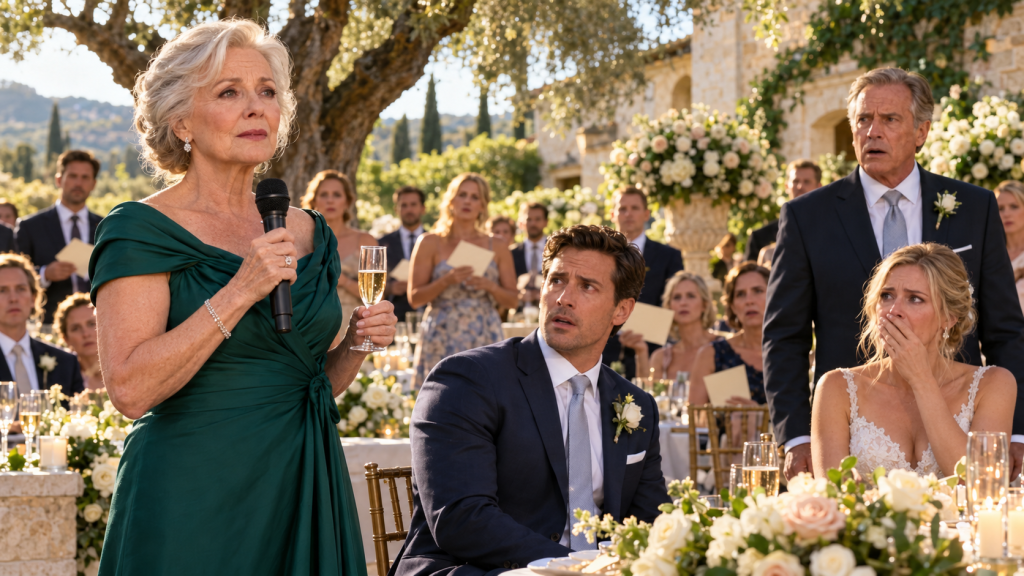
“Elena,” my son said, “look at me.” She didn’t. “Please.” Her eyes moved toward her father. That single glance told me more than any confession could have. Daniel noticed it too. His face changed. “Why are you looking at him?” Elena’s lips trembled. “Daniel, I can explain.”
“Then explain why my signature is on this document.”
Vittorio stepped forward.
“Enough. This is not appropriate for a wedding.”
Daniel turned toward him.
“Is forging someone’s signature appropriate?”
A murmur moved through the guests.
Vittorio’s expression hardened.
“No one has forged anything. These are preliminary papers for a family business arrangement.”
“Then why does the document identify me as a personal guarantor for four hundred and twenty thousand euros?”
My stomach tightened.
Four hundred and twenty thousand euros.
My son had never mentioned a financial commitment remotely close to that amount.
Vittorio spread his hands.
“Daniel, you’re marrying into our family. Naturally, there are responsibilities.”
Daniel stared at him.
“Responsibilities I never agreed to?”
Elena stepped between them.
“Darling, please. Let us talk privately.”
I watched my son’s eyes fill with tears.
For thirty-eight years, I had known almost every expression his face could make.
I’d seen him frightened, furious, excited, embarrassed, and proud.
But I’d never seen him look so completely lost.
He glanced down at the document again.
“Elena, did you know about this?”
She remained silent.
He asked again.
“Did you know?”
Finally, she whispered, “I knew Papa was preparing something.”
Daniel closed his eyes.
“And you didn’t tell me.”
“I thought he was only gathering information.”
Sofia, the former hotel bookkeeper, shook her head.
“That isn’t true.”
Everyone turned toward her.
She opened her leather folder.
“Elena attended the meeting with the financial consultant. She provided Daniel’s business information herself.”
Elena went pale.
Marco lunged toward Sofia.
“Shut your mouth!”
A tall guest stepped between them.
“That’s enough, Marco.”
The man introduced himself as Vittorio’s cousin, Paolo.
He was broad-shouldered, gray-haired, and looked deeply ashamed.
“Let her speak,” Paolo said.
Vittorio pointed angrily at Sofia.
“She was dismissed from our hotel. She’s trying to destroy us.”
Sofia straightened.
“I was dismissed because I refused to sign financial statements I knew were misleading.”
She looked directly at Daniel.
“I tried contacting you three times.”
My son stared.
“What?”
“Two emails and one telephone message. I warned you that the hotel’s debt was much larger than your fiancée’s family had disclosed.”
Daniel looked toward Elena.
She began crying.
Sofia continued.
“Your fiancée told me you were too busy preparing for the wedding and that all communication should go through her.”
I felt a coldness spread through my chest.
It wasn’t simply that Elena’s family wanted my son’s money.
They had carefully controlled what he was allowed to know.
And when I began asking questions, they’d prepared a public humiliation to make certain my warnings would never be taken seriously.
I raised the microphone.
“Before anyone makes another accusation,” I said in Italian, “I would like every guest to keep the printed card they received.”
Marco turned sharply.
“Why?”
“Because it carries my name.”
I held up my original speech.
“And because I have the email in which you promised to translate these words accurately.”
His expression changed.
I continued.
“I taught high school students for thirty-four years. When someone handed in another person’s words and claimed them as their own, we called it dishonesty.”
Several guests nodded.
I looked toward Vittorio.
“When someone deliberately changes another person’s words to harm their reputation, the consequences can be considerably worse.”
Vittorio’s face reddened.
“You come into my country and insult my family?”
I answered in his own language.
“No, Signor Bellini. I came into your country hoping to become part of your family.”
My voice trembled.
“You are the one who decided that kindness was a weakness to exploit.”
For the first time, he had no answer.
Then an elderly woman rose from the front table.
Elena’s grandmother, Lucia.
She wore a navy dress, a small pearl brooch, and an expression of profound disappointment.
“Vittorio,” she said quietly, “sit down.”
He turned.
“Mamma, please.”
“Sit.”
Something in her voice silenced him.
Lucia walked slowly toward me.
She took my hand.
“I heard your real toast,” she said.
My eyes filled.
“You thanked the people of our village. You remembered your son’s father. And you wished our family peace.”
I nodded.
“Every word came from my heart.”
She looked toward the printed cards.
“Then whoever wrote these lies beneath your name has disgraced us.”
Vittorio stared at the ground.
Lucia turned toward her son.
“And you will not use my hotel to justify dishonesty.”
I looked up.
My hotel?
I hadn’t realized those two words would become the next turning point in a wedding already falling apart.
The reception ended without another toast.
No one formally announced it.
The musicians simply stopped playing.
The waiters began clearing untouched glasses.
Groups of guests moved toward the parking area, speaking in hushed voices.
What had begun as a celebration beneath centuries-old olive trees had become a room without walls, full of uncomfortable truths.
Daniel remained beside the wedding table.
His shoulders were hunched.
The ceremony had ended less than an hour earlier.
And already he was staring at his new wife as though she were a stranger.
I approached him.
“Daniel.”
He looked at me.
“Mom, did you know?”
I swallowed.
“I knew they were planning to embarrass me. I knew they wanted money from you. I didn’t know about the document Sofia brought.”
His face tightened.
“Why didn’t you tell me everything?”
The question hurt because he deserved to ask it.
“I tried to warn you about the money.”
“That’s not what I asked.”
I lowered my eyes.
He was right.
I’d been waiting for the perfect moment to expose people who believed I couldn’t understand them.
But in doing so, I’d allowed my son to stand at the altar without knowing everything I knew.
I took a breath.
“Because I was afraid you’d believe I was trying to ruin your happiness.”
He looked away.
“I might have.”
“I know.”
Tears filled my eyes.
“But I should have told you anyway.”
For a moment, he said nothing.
Then he whispered, “I wish you had.”
I nodded.
“So do I.”
It would have been easy to defend myself.
To remind him that he’d dismissed my concerns.
To insist I had no choice.
But love is not strengthened by winning every argument.
Sometimes love requires acknowledging that even when our intentions are good, our decisions can still wound the people we’re trying to protect.
Daniel took my hand.
“I’m not angry that you learned Italian.”
I gave a tearful laugh.
“I hope not.”
He looked at me.
“You studied for a whole year?”
“Two lessons every week. Two hours of practice most nights.”
His eyes filled again.
“For me?”
“Of course.”
He embraced me.
I held him tightly.
He smelled of expensive cologne and the flowers pinned to his wedding jacket.
For a moment, I remembered his father, George, holding him when he was small.
The same broad shoulders.
The same warm, slightly crooked smile.
Then Daniel whispered into my hair, “I miss Dad.”
My throat closed.
“So do I, sweetheart.”
He stepped back.
“Can we leave?”
I nodded.
“Whenever you’re ready.”
Before we reached the courtyard gate, Sofia approached.
“Daniel, there are things you need to see.”
He looked exhausted.
“More?”
She nodded.
“I’m afraid so.”
I watched him take a breath.
Then he said, “Tomorrow morning. Somewhere private.”
Sofia agreed.
Lucia approached us next.
She looked at Daniel with tears in her eyes.
“I am sorry, young man.”
He shook his head.
“You haven’t done anything.”
Her expression grew sad.
“Sometimes standing quietly while someone does wrong is its own mistake.”
Then she pressed a folded piece of paper into my hand.
“My telephone number,” she said.
I nodded.
“Thank you.”
She squeezed my fingers.
“Please don’t judge all of us by what happened today.”
I looked around the courtyard.
At the guests who had tried to stop Marco.
At the elderly aunt who’d read the false speech aloud.
At the waiters whose faces showed embarrassment rather than amusement.
And at Sofia, who had risked her job to expose the truth.
“I won’t,” I promised.
That night, Daniel and I sat in the dining room of our small hotel.
I’d insisted we stay somewhere independent of Elena’s family when we’d first arrived.
Daniel had thought it unnecessary.
Now he called it the wisest decision I’d made.
He still wore his wedding suit, although his tie hung loose around his neck.
A plate of pasta sat untouched before him.
Finally, he said, “Mom, I need to tell you something.”
I put down my fork.
“What is it?”
He stared at his hands.
“I already transferred seventy-five thousand dollars to the hotel.”
My stomach dropped.
“When?”
“Three weeks ago.”
“From your house savings?”
He nodded.
I closed my eyes.
Twelve years.
That was how long he’d been saving.
After George died, Daniel had become determined to build something of his own.
He’d started his commercial supply business in a rented warehouse, sleeping on a secondhand sofa when he worked too late to drive home.
He’d driven an old truck with a broken radio.
Saved nearly every spare dollar.
Declined vacations.
Turned down expensive cars.
Not because he hated spending money, but because he wanted a future he could afford.
And now he’d handed over seventy-five thousand dollars without telling me.
“Why?” I asked gently.
He looked embarrassed.
“Elena said the hotel needed a temporary deposit to satisfy its lender. She promised it would be returned after the refinancing.”
“Did you receive a written loan agreement?”
He shook his head.
“Just a payment confirmation.”
I swallowed.
“Daniel—”
“I know.”
His voice broke.
“I know how it sounds.”
I reached across the table.
“Did Elena tell you the hotel owed four hundred and twenty thousand euros?”
“No. She said their debts were manageable.”
He began crying.
“I thought I was helping my future wife protect something that mattered to her.”
I nodded.
“I understand.”
He covered his face.
“I feel like an idiot.”
“Don’t.”
“Mom, I run a business. I check contracts every day. I insist on purchase orders and written agreements. And I sent seventy-five thousand dollars because a woman I loved told me to trust her.”
I held his hand.
“Being good at business doesn’t make you immune to betrayal.”
He looked at me.
“But I ignored you.”
“Yes,” I said softly.
He flinched.
I squeezed his hand.
“And I wish you’d listened. But you don’t have to spend the rest of your life punishing yourself for that.”
His eyes filled.
For several minutes, we sat quietly.
Then he asked, “What happens to the marriage?”
I stared at him.
The wedding had happened.
The vows had been exchanged.
The rings had been placed.
But whether the ceremony created a legally recognized marriage, and what remedies might be available if deception influenced his consent, were questions for qualified attorneys in the relevant jurisdictions.
“I don’t know,” I admitted.
“But we need independent legal advice before you make decisions about money, property, or paperwork.”
He nodded.
Then he whispered, “What if she really loved me?”
I felt my heart break a little more.
“Then she’ll have to explain why she allowed people to hurt you.”
He looked toward the window.
“And if she didn’t?”
I was silent for a moment.
“Then you’ll grieve the future you believed you had.”
His shoulders shook.
I moved to his side and put my arms around him.
“And eventually, sweetheart, you’ll build another one.”
The next morning, Sofia met us at a little café near the town square.
She arrived carrying the same leather folder.
This time, a younger woman accompanied her.
“This is Giulia Conti,” Sofia explained. “She’s an attorney who works independently of the Bellini family. I asked her to come because some of these documents may require legal attention.”
Giulia shook our hands.
She was calm, precise, and spoke excellent English.
I understood her Italian perfectly, but I was grateful Daniel wouldn’t have to struggle through technical explanations in a language he barely spoke.
We moved to a quiet table.
Giulia looked at him.
“Before we begin, have you signed any authorization allowing the Bellini family to pledge your assets or guarantee their debt?”
“No.”
“Have you given anyone permission to sign on your behalf?”
“Absolutely not.”
She nodded.
“Then the document Sofia obtained presents a serious problem. But I want to be clear: a document in an application file does not necessarily mean a loan has been approved or a valid guarantee has been created.”
Daniel leaned forward.
“So they haven’t taken the money from my savings account?”
“Not based on this document alone. We need confirmation from the lender.”
I watched his shoulders loosen slightly.
Giulia continued.
“You should contact your bank immediately, preserve the application materials, and dispute any unauthorized instruction. We should also notify the prospective lender that the signature is not yours.”
He nodded.
Then Sofia opened her folder.
“There is something else.”
I looked at her.
“About the seventy-five thousand dollars?”
She nodded.
Daniel went still.
Sofia placed a transaction record between us.
“The payment was not received by the hotel’s operating company.”
My son frowned.
“Elena gave me the account details.”
“Yes,” Sofia said. “But the beneficiary was Bellini Hospitality Consulting, not the hotel.”
Daniel stared.
“What’s the difference?”
Sofia turned another page.
“The hotel is owned by a family company. Bellini Hospitality Consulting is a separate business controlled by Marco.”
I looked up.
“Elena’s brother?”
“Yes.”
The silence that followed was terrible.
Daniel looked toward the window.
“So the money didn’t even go to the hotel?”
“Not directly,” Sofia answered.
She hesitated.
“Some payments were subsequently made to hotel suppliers. Others went to accounts that need further investigation.”
Giulia raised a hand.
“We shouldn’t assume where every euro went until we’ve verified the records.”
Sofia nodded.
“But the arrangement was concealed from the hotel’s bookkeeper.”
I watched Daniel absorb the news.
I could almost see him searching his memories for warning signs.
The dinner conversations.
The affectionate promises.
The way Marco always offered to handle paperwork.
The way Vittorio insisted that important financial decisions had to be made quickly.
Finally, Daniel spoke.
“How long have they been planning this?”
Sofia looked at Giulia.
Then she said, “At least five months.”
My son stared.
“Five months?”
She opened her folder again.
Inside was a printed email exchange.
The first message came from Vittorio.
Its subject line was:
American Investment Opportunity.
My heart began pounding.
Sofia read aloud.
“Daniel’s personal resources appear substantial. Elena believes he will be comfortable contributing once the marriage is finalized.”
Daniel closed his eyes.
The next message was from Marco.
His mother may interfere. She asks too many questions about the hotel.
My fingers tightened around my cup.
Then came a reply from Vittorio.
She must be discouraged from involving herself in our arrangements.
I stared.
They hadn’t simply decided to embarrass me after hearing about my wedding toast.
They’d identified me as a problem months before I arrived.
Sofia hesitated.
“There’s one more message.”
She slid the page toward me.
It was from Elena.
Margaret has offered a large wedding gift. Please don’t pressure Daniel until after the ceremony. I can speak to him once we’re married.
I felt suddenly cold.
The cashier’s check.
The substantial envelope in my handbag.
They had known about it.
Somehow, they had known I intended to give Daniel and Elena money toward their first home.
I looked at my son.
He was staring at the email.
His face had gone completely white.
“Elena told them.”
Sofia nodded.
“I believe so.”
Daniel whispered, “I trusted her with everything.”
No one spoke.
He looked at me.
“Mom, I mentioned your gift to her.”
I remembered telling Daniel I wanted to help them start their marriage.
I hadn’t given him the exact amount.
But I’d told him I was saving something special.
He must have shared that happy news with the woman he loved.
And she’d treated it as another opportunity.
I reached for his hand.
“Sharing good news with your fiancée wasn’t wrong.”
His eyes filled.
“She turned it into a financial plan.”
I nodded sadly.
“Yes.”
Giulia spent the next two hours helping Daniel organize the practical steps.
He contacted his bank to report the suspected misuse of his personal information.
He asked that any unusual transfer instructions or changes to his accounts receive additional verification.
He notified the prospective lender in writing that he disputed the signature and had never authorized a guarantee.
He preserved Elena’s messages and the payment confirmation.
And, with Giulia’s guidance, he arranged for independent legal advice concerning the transfer to Marco’s company.
Nothing was instantly solved.
The seventy-five thousand dollars did not magically reappear.
The bank didn’t simply reverse a transfer Daniel had knowingly initiated weeks earlier, even though the purpose of the payment may have been misrepresented.
Giulia explained that recovering the money could require legal proceedings or a negotiated repayment agreement.
Daniel listened carefully.
Then he said something that surprised me.
“I want to report the false signature even if Elena was involved.”
Giulia nodded.
“That is your decision, and we can discuss the appropriate process.”
He looked at the documents.
“If someone had done this to one of my employees, I’d tell them to protect themselves.”
His voice trembled.
“I need to stop pretending it matters less because I love her.”
I reached across the table.
“Your father would have been proud to hear you say that.”
Daniel looked at me.
Then a tear rolled down his cheek.
That afternoon, Elena came to our hotel.
She wore a simple blue dress instead of her wedding gown.
Her hair was tied back.
There were dark circles beneath her eyes.
When the receptionist called my room, I went downstairs with Daniel.
Elena stood near the entrance clutching her handbag.
“Daniel.”
He stopped several feet away.
“What do you want?”
Her face crumpled.
“To explain.”
He looked at me.
“Mom, would you mind giving us some privacy?”
I hesitated.
Then nodded.
“Of course.”
I moved to a nearby table, far enough away that they could speak without me hearing everything, but close enough that Daniel could find me if he wanted.
I watched them through the glass doors leading to the hotel garden.
Elena began talking.
Her hands moved nervously.
At first, Daniel simply listened.
Then his expression tightened.
He shook his head.
Elena began crying.
After several minutes, Daniel returned.
“Mom, she wants you to hear this too.”
I followed him outside.
Elena looked at me.
“Margaret, I’m sorry.”
I studied her.
“For what?”
She blinked.
Then whispered, “For the speech.”
“And?”
Her eyes filled.
“For the things my father said.”
“And?”
She lowered her head.
“For not telling Daniel about the financial documents.”
I waited.
Then asked, “Did you know Marco intended to print a false translation beneath my name?”
Her silence was answer enough.
Finally, she whispered, “Yes.”
I felt my chest tighten.
“Why?”
She wiped her cheeks.
“Papa said you would never approve of Daniel helping the hotel. He thought if the guests believed you’d insulted us, Daniel would be embarrassed and more determined to prove his loyalty to my family.”
I looked at her.
“Did you believe that was acceptable?”
She began crying harder.
“No.”
“Then why didn’t you stop it?”
Elena stared at the ground.
“Because my father said the hotel would close if we couldn’t find the money.”
For a moment, her expression reminded me of a frightened child.
Then she continued.
“Forty-two people work there, Margaret. Some of them have been with us for decades. Papa said we’d lose everything, and all those families would lose their jobs.”
I considered her words.
They explained why she might have been frightened.
But they didn’t explain why she’d allowed innocent people to be harmed.
“Elena,” I said gently, “there is a difference between trying to save employees and lying to obtain another person’s savings.”
She nodded.
“I know.”
Daniel looked at her.
“Did you love me?”
She lifted her head.
“Yes.”
He stared.
“Then how could you do this?”
Tears streamed down her face.
“Because I was afraid you’d leave if you knew how much trouble my family was in.”
Daniel’s voice broke.
“So you made sure I couldn’t decide for myself.”
She covered her mouth.
He continued.
“I would have helped you find an honest solution.”
“I know.”
“No,” he said.
His voice trembled.
“I don’t think you did.”
For a long moment, nobody spoke.
Then Daniel asked, “Who put my signature on that application?”
Elena closed her eyes.
And when she answered, I felt something inside me go still.
“Marco prepared the document.”
Daniel stared.
“How did he get my signature?”
She began trembling.
“He used a scan from the paperwork you showed me when we were looking at houses.”
My son stepped backward.
He had shared those documents with her because they were planning a life together.
He’d been proud to show her how much he’d saved.
She had given her brother access to the very papers that represented his dreams.
Daniel’s eyes filled.
“Did you know he was going to use it?”
Elena swallowed.
“I knew he wanted the information. I didn’t know he’d insert the signature into the application until afterward.”
“Did you tell him to withdraw it?”
She didn’t answer.
Daniel nodded slowly.
“That’s what I thought.”
Elena reached for his hand.
He stepped away.
“I need time.”
She began crying.
“Daniel, please. We’re married.”
He looked at the wedding ring on his finger.
For a moment, I thought he might throw it away.
Instead, he removed it carefully and placed it in his pocket.
“I don’t know what our marriage is going to become,” he said.
His voice was quiet.
“But it cannot become anything honest while you’re still hiding things from me.”
Elena covered her face.
And my son walked back inside.
I wanted to follow him immediately.
But Elena looked at me.
“Margaret?”
I turned.
She whispered, “Do you hate me?”
I studied the young woman I’d once hoped to welcome as a daughter.
“No,” I answered.
She looked surprised.
“I am angry with you. I am deeply disappointed. And I don’t trust you.”
Her eyes filled.
“But hatred would only give you another place in my life that you haven’t earned.”
Then I left her standing in the garden.
The following morning, Lucia Bellini invited us to the family hotel.
Daniel didn’t want to go.
“Mom, I’ve seen enough of that place.”
I understood.
But Lucia had specifically asked him to come, and something about her voice on the telephone made me believe she had information we needed.
“Just one conversation,” I suggested. “After that, we can leave.”
He agreed.
The hotel stood on a hillside above vineyards and olive groves.
It was a beautiful old building with honey-colored stone walls, blue shutters, and balconies overflowing with flowers.
The sort of place where people traveled to celebrate anniversaries and forget how quickly the world was moving.
I could understand why Elena loved it.
I could understand why its employees wanted it to survive.
And I could understand how frightened people might become at the thought of losing such a place.
But fear could not transform deceit into kindness.
Lucia met us in the courtyard.
She had arranged a small table beneath a climbing rose.
Sofia sat beside her.
So did Paolo, Vittorio’s cousin.
Lucia looked at Daniel.
“Thank you for coming.”
He nodded politely.
She gestured toward the chairs.
“Please sit.”
Once we were settled, she placed a photograph on the table.
It showed a younger Lucia beside a handsome man in a white shirt.
Behind them stood the hotel, its walls newly painted.
“My husband and I opened this place fifty-three years ago,” she said.
I studied the photograph.
“You built it together?”
She nodded.
“He worked in the kitchen. I handled reservations, accounts, and cleaning.”
She smiled faintly.
“Some nights, after our guests went to bed, we washed every dish ourselves.”
I thought of the proud, elderly woman standing up during the wedding reception.
And suddenly I understood why she had looked so wounded.
For her, the hotel wasn’t simply an asset.
It was a lifetime of work.
Lucia’s expression grew serious.
“When my husband died, I allowed Vittorio to take over daily management.”
She looked down.
“I thought I was giving my son responsibility.”
Paolo shifted in his chair.
“He gradually stopped providing complete financial reports.”
Lucia nodded.
“Whenever I asked questions, Vittorio said I was too old to understand modern business.”
I felt a familiar anger.
I’d heard variations of those words all week.
The old woman doesn’t understand.
Some people seemed to believe age meant ignorance.
They never considered how much an older person might have learned simply by surviving long enough to recognize a familiar deception.
Lucia continued.
“Three months ago, Sofia told me the numbers were wrong.”
Sofia opened her folder.
“The hotel had financial problems,” she explained. “But the records also showed payments to related businesses and expenses that didn’t appear to benefit hotel operations.”
Daniel leaned forward.
“Marco’s company?”
Sofia nodded.
“Among others.”
Lucia looked toward the building.
“Vittorio told the family we needed a wealthy investor immediately or every employee would lose their job.”
Paolo spoke.
“An independent review may show other options for keeping the hotel operating. We have already begun arranging one.”
I frowned.
“Does Vittorio control the entire company?”
Lucia shook her head.
“No. I still own a substantial interest. Other family members have shares too.”
She straightened.
“And we are not without rights.”
Paolo explained that they were seeking legal advice about suspending Vittorio’s management authority, obtaining complete records, and protecting the property from transactions that had not been properly authorized.
Nothing would happen with the snap of a finger.
There would be meetings, legal reviews, and difficult decisions.
But the hotel might have a future that did not depend on taking money from an unsuspecting son-in-law.
Daniel listened quietly.
Then asked Sofia, “Why did you keep trying to warn me?”
She looked at him.
“Because I once watched my father lose his business after someone persuaded him to guarantee another man’s debt.”
Her voice softened.
“He was honest. He worked hard. But he trusted the wrong person, and that one signature followed him for years.”
She glanced toward Lucia.
“When I saw your name on the application, I remembered how helpless he felt.”
Daniel lowered his eyes.
“Thank you.”
Sofia nodded.
Then Lucia said something that made us all turn.
“I have another reason for asking you here.”
She reached into her handbag and removed a small cream-colored envelope.
My pulse quickened.
It looked almost identical to the one containing my wedding gift.
Lucia placed it before me.
“Margaret, Vittorio came to my home before the wedding and told me you had promised a large contribution to the hotel’s future.”
I stared at her.
“What?”
She nodded sadly.
“He said you intended to make a generous donation during the reception and that the family should thank you publicly afterward.”
My hands went cold.
I hadn’t promised the hotel a penny.
The cashier’s check in my purse was meant for Daniel and Elena to purchase a home.
It was not a business investment.
It was not a guarantee.
And it certainly wasn’t money Vittorio had any right to claim.
Lucia continued.
“He even asked me to prepare a speech thanking you for saving the hotel.”
I looked toward Daniel.
He stared at the table.
Suddenly, the entire plan became clear.
They intended to humiliate me before the guests.
Turn my own words into insults.
Make Daniel ashamed of his mother.
Then present the financial contribution as an opportunity to repair the damage and demonstrate his loyalty to his new family.
If I had been frightened enough to apologize, they might have encouraged me to surrender the cashier’s check as well.
And if Daniel had still wanted the marriage, he might have felt pressured to sign whatever documents Vittorio placed before him.
All of it had been designed to make honesty seem cruel and compliance seem loving.
I stared at the envelope.
Then I began to laugh.
Not because anything was amusing.
Because I was remembering my years in the classroom.
The student who changed a failing grade on a report card.
The teenager who insisted another boy had broken a window.
The children who believed that if they told a lie confidently enough, reality itself would eventually become embarrassed and agree with them.
Vittorio was no different.
He simply had nicer clothes.
More expensive wine.
And considerably more practice.
Lucia looked at me.
“Margaret?”
I wiped my eyes.
“I’m sorry.”
I took a breath.
“It’s just that I’ve spent my life teaching young people that honesty matters.”
I glanced toward the hotel.
“And I’ve traveled thousands of miles to discover that some adults never learned the lesson.”
Lucia smiled sadly.
“Perhaps they still can.”
I nodded.
“Perhaps.”
But I had stopped believing it was my responsibility to teach them.
Over the following weeks, the truth continued to emerge.
Daniel returned home and worked with his American bank and independent legal advisers to protect his accounts and pursue recovery of the money he’d transferred.
Giulia helped coordinate the relevant records and communications abroad.
An examination of the proposed guarantee established that Daniel had not properly authorized the signature used in the application.
The lender confirmed it would not rely on the disputed document and that the proposed financing had not been completed on that basis.
The suspected falsification was reported for investigation.
The seventy-five thousand dollars proved more difficult.
Some of the money had already been spent.
Some had passed through Marco’s consulting company into other accounts.
Daniel couldn’t recover everything simply because he’d been deceived.
But the records gave his advisers a foundation to pursue the people and entities responsible.
Eventually, after months of negotiations and legal pressure, Marco’s company agreed to a structured repayment arrangement for the funds that could be substantiated and recovered.
The payments took time.
Daniel recovered a substantial portion over the following year, while other claims remained unresolved.
It wasn’t a perfect ending.
But it was a real one.
I was relieved.
Not because my son needed his savings more than he needed peace.
But because I wanted him to learn that justice was often patient, complicated work rather than a dramatic moment at a microphone.
As for the hotel, Lucia and the other concerned owners brought in independent management while the disputed transactions were reviewed.
Vittorio lost his authority to make major financial commitments on the company’s behalf during that process.
Marco’s consulting arrangements were examined.
Sofia was invited to return to help rebuild reliable financial reporting.
And the staff, many of whom had spent years quietly worrying about their wages, finally received more honest information about the hotel’s condition.
There were sacrifices.
Some planned renovations were canceled.
The hotel negotiated with creditors.
Its owners had to accept that pride was not a substitute for sound accounting.
But it stayed open.
And gradually, the place began recovering without turning an unsuspecting family member into collateral.
When Lucia wrote to tell me the news, I cried.
I hadn’t wanted the hotel destroyed.
I’d wanted the people running it to stop destroying others in order to save themselves.
Those were very different things.
Elena wrote to Daniel several times.
At first, her letters were filled with explanations.
Her father’s expectations.
The fear of losing the hotel.
The pressure of keeping the family together.
Daniel read them.
But he didn’t answer.
Then, one afternoon, a different letter arrived.
It was much shorter.
Daniel,
I knew my family was hiding things from you.
I knew the wedding speech was a lie.
I knew your generosity was being treated as an opportunity instead of a gift.
And I chose silence because telling the truth might have cost me the marriage I wanted.
I loved you. But I didn’t love you honestly.
I’m sorry.
Daniel read it at my kitchen table.
He sat quietly for a long time.
Then he folded it.
“Mom?”
“Yes?”
“Do you think she means it?”
I considered the question.
“I think she may.”
He looked up.
“Then why does it still hurt so much?”
I reached for his hand.
“Because an apology can acknowledge a wound without healing it.”
His eyes filled.
He looked toward the photograph of his father on my mantel.
For a moment, I could almost see George sitting beside us.
I knew what he would have said.
Take your time, son. The heart isn’t a business contract.
Daniel eventually decided not to continue the marriage.
With independent legal guidance, he began the appropriate process for ending it and resolving the questions arising from the ceremony abroad.
It was painful.
There were conversations, documents, and difficult moments when he doubted himself.
But he never again allowed guilt to make his financial decisions.
And although Elena’s apology mattered to him, it did not restore the trust their marriage would have needed.
I watched him grieve.
Not only for Elena.
For the children he’d imagined.
The home they’d discussed.
The ordinary mornings he’d expected to share with her.
There is a particular sadness in losing a future that never had the chance to exist.
I couldn’t take it away.
So I did what mothers have done for generations.
I made tea.
I listened.
I sat beside him when he didn’t feel like talking.
And I reminded him that a broken dream did not mean he was incapable of building another.
Fourteen months after the wedding, an envelope arrived from Italy.
Inside was a photograph.
Lucia stood outside the hotel beside Sofia and several employees.
Fresh flowers surrounded the entrance.
The shutters had been repainted.
Everyone was smiling.
On the back, Lucia had written:
The doors are still open, Margaret. This time, we are keeping them open with honest hands.
I smiled.
Then I found a second letter.
Lucia was inviting me back for the hotel’s anniversary celebration.
She wanted me to give a toast.
A real one.
I laughed aloud.
After everything that had happened, the idea of standing beneath those olive trees again seemed almost unbelievable.
I called Daniel.
“Guess what?”
He laughed.
“Mom, after Italy, those words frighten me.”
I told him about the invitation.
There was a pause.
Then he asked, “Are you going?”
“I haven’t decided.”
Another silence.
Then he said, “I think you should.”
I looked toward the window.
“What about you?”
He took a breath.
“I’d like to go with you.”
My eyes filled.
“Are you sure?”
“Yes.”
Then he laughed softly.
“But this time, Mom, I’m checking every piece of paperwork myself.”
I laughed through tears.
“That’s my boy.”
We returned to Italy the following spring.
The hotel was still beautiful.
The olive trees still spread their branches across the courtyard.
The air smelled of rosemary and warm bread.
But something felt different.
There was no false friendliness.
No whispered mockery.
No carefully staged attempt to make me feel foolish.
Lucia welcomed us at the entrance.
She embraced Daniel first.
Then me.
“Margaret,” she said in Italian, “you look wonderful.”
I smiled.
“So do you.”
She stepped back.
“I hear your Italian is even better.”
I laughed.
“I’ve kept studying.”
And I had.
What began as a secret wedding surprise had become something I genuinely loved.
I’d joined a conversation group.
Read Italian novels.
Made friends through the language.
And discovered that at sixty-eight, sixty-nine, and every age afterward, there were still beautiful things left to learn.
That evening, I stood beneath the same olive trees where my son’s wedding reception had fallen apart.
Lucia handed me a microphone.
For a moment, I remembered Marco reaching for it.
Vittorio’s vanishing smile.
The cream-colored cards covered with words I hadn’t written.
Then I looked toward Daniel.
He was sitting beside Sofia and Paolo, listening to a conversation about the hotel’s restoration.
He looked peaceful.
Not because everything had been restored to the way it was before.
It hadn’t.
But because he had survived the loss of the future he’d expected.
And he’d stopped believing that love required him to surrender his judgment.
I raised my glass.
This time, no one offered to translate.
No one handed out a false speech.
No one told me what I was supposed to say.
I spoke in the language I had worked so hard to learn.
“Last year, I came to this beautiful village believing I was bringing a gift.”
The guests grew quiet.
“I thought my gift was the ability to speak your language.”
I smiled.
“But I learned that understanding words and understanding people are very different things.”
Lucia wiped her eyes.
I continued.
“Words can be used to welcome strangers. They can also be used to deceive them.”
I looked toward the hotel.
“A family’s history can become a source of pride. But pride without honesty can destroy the very things it claims to protect.”
Daniel was watching me now.
His eyes shone.
I raised my glass higher.
“So tonight, I propose a toast not to wealth, not to appearances, and not to the perfection of any family.”
I paused.
“To the courage of people who tell the truth, even when telling it costs them something.”
Sofia began crying.
“To those who protect others without asking what they can gain.”
Lucia pressed her hand against her heart.
“And to the beautiful possibility that after something breaks, we may still build a future worthy of our trust.”
The applause began slowly.
Then filled the courtyard.
Daniel stood.
His eyes were wet.
And when I stepped away from the microphone, my son came toward me.
He embraced me tightly.
“I’m proud of you, Mom.”
I closed my eyes.
For so many years, I’d wondered whether becoming older meant becoming less important.
Less capable.
Less visible.
That wedding had taught me otherwise.
The people who underestimated me had mistaken gentleness for weakness and silence for ignorance.
But I had never been powerless.
I had simply been waiting for the moment when speaking the truth mattered more than keeping everyone comfortable.
As Daniel and I walked toward the hotel entrance, he squeezed my hand.
“Mom?”
“Yes, sweetheart?”
“I’m glad you learned Italian.”
I smiled.
“So am I.”
Then he added, “But I’m even more glad you taught me something Dad always wanted me to understand.”
I looked at him.
“What’s that?”
He smiled through tears.
“Never confuse someone needing your money with someone loving your heart.”
I pressed his hand.
And together, we stepped into the warm evening light.
I had traveled across an ocean to deliver a wedding toast.
Instead, I discovered something far more valuable than the perfect speech.
You are never too old to learn, never too old to stand up for yourself, and never obligated to remain silent simply because someone assumes you cannot understand.
And sometimes, the most powerful words you’ll ever speak are the ones dishonest people never expected you to know.
THE END STORIES! THANK YOU FOR READING GOOD LUCK !❤️
Related Posts