For twenty years, I had imagined what it would feel like to see my mother’s face again. I imagined wrinkles around her eyes. Silver strands in her hair. The familiar smile I remembered from childhood, before the accident stole the world of colors and faces from me.
But I never imagined that the first time I saw her after two decades of darkness, she would be standing in a hospital doorway, begging my husband to keep another secret. “Please, Nigel,” she whispered. “Don’t show her the page with my signature.” Her voice trembled. The man beside my hospital bed went rigid.
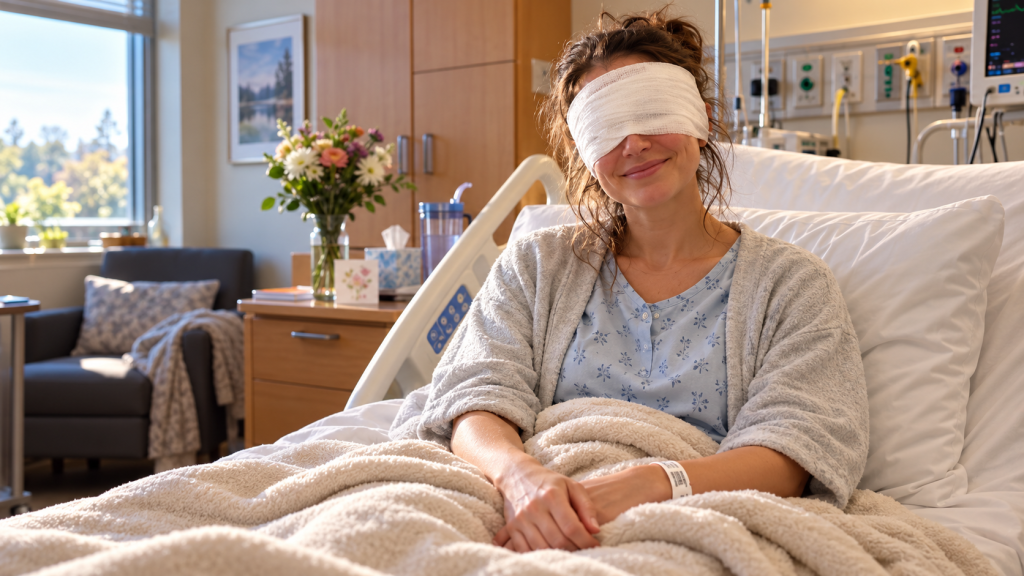
I looked from him to the woman standing near the door. Everything was still strangely bright. The ceiling lights surrounded objects with pale halos, and my eyes struggled to focus whenever I moved them too quickly. But I could see. I could see the hospital curtains.
The blue blanket covering my legs.
The trembling hands of the man I’d married.
And the crescent-shaped scar above his left eyebrow.
A scar I’d seen for the last time when I was a little girl lying beneath a playground swing.
“Ethan,” I whispered.
He closed his eyes.
My mother made a small, wounded sound.
For a moment, nobody spoke.
Then I looked directly at her.
“Mom, what page?”
She gripped the doorframe.
“Sweetheart, you’ve just had surgery. You’re not supposed to upset yourself.”
I stared at her.
Even after twenty years, I recognized that tone.
The gentle, careful voice she used whenever there was something unpleasant she didn’t want me to know.
I had heard it when my father left.
When my grandparents died.
When doctors told me another operation had failed.
But now I could see the fear behind it.
“What page?” I repeated.
Nigel reached for the yellowed hospital file.
My mother stepped forward.
“Nigel, don’t.”
He stopped.
For years, I had trusted those two people more than anyone else in the world.
My mother had guided me through the first terrifying months of blindness.
Nigel had taught me that I could be loved without being pitied.
Together, they had helped me build a life filled with music, books, laughter, and two beautiful children.
And suddenly, both of them looked as though they were waiting for me to discover a crime.
“Someone tell me the truth,” I said.
My voice cracked.
“Because I have spent twenty years imagining this moment, and I refuse to spend my first hour of sight being lied to.”
Nigel lowered his head.
Then he placed the file on my lap.
“Her name is on the settlement agreement,” he said.
I stared.
“What settlement?”
My mother’s eyes filled with tears.
Nigel opened the file to a page near the back.
At the top were the words:
Confidential Resolution of Medical Claim.
Beneath them was a date.
A date from eighteen years earlier.
Two years after I lost my sight.
My stomach tightened.
I leaned forward, struggling to bring the letters into focus.
Nigel immediately said, “Don’t strain your eyes. I can read it to you.”
I almost laughed.
For years, I’d depended on his voice to understand the world.
Now I desperately wanted him to stop explaining things and let me see them for myself.
“No,” I whispered. “Let me try.”
The letters swam.
I blinked.
Then gradually, the words became clearer.
The agreement referred to complications following my second eye operation.
It acknowledged disputed concerns regarding the timing of treatment, the completeness of my medical records, and the management of inflammation that had spread after my original injury.
The hospital and surgeon denied admitting legal liability.
In exchange for a financial settlement, my mother, acting as my legal guardian, had agreed to resolve the claim.
Then I reached the signature page.
There it was.
My mother’s name.
Written in the handwriting I had learned to recognize by touch, tracing her letters on birthday cards long after I could no longer see them.
Margaret Ellis.
My hands went cold.
“You knew something went wrong?”
She began crying.
“Anna, please understand—”
“You knew?”
She nodded.
I looked at Nigel.
“And the surgeon?”
His eyes filled.
“My biological father.”
I stared at him.
The boy who had pushed me from the swing had grown into the man who became my husband.
And the surgeon responsible for my second operation had been that boy’s father.
I looked toward the window.
I could see a patch of blue sky.
An actual blue sky.
For twenty years, I’d listened to people describe the color of the world.
Now I could see it.
But everything I thought I understood about my life was falling apart.
“Get out,” I whispered.
Nigel flinched.
“Anna—”
“Both of you.”
My mother began sobbing.
“Sweetheart, let me explain.”
I looked at her.
“Twenty years.”
My voice trembled.
“Twenty years, Mom.”
She reached for me.
I pulled away.
“You watched me learn how to use a cane. You watched me cry because I couldn’t see my children’s faces. And you never told me there was another story behind what happened?”
She covered her mouth.
Nigel stepped toward the bed.
“Anna, your eyes are still healing. Please don’t—”
I turned sharply.
“Don’t tell me what to do with my eyes.”
He stopped.
I stared at him.
“Not you.”
His face crumpled.
For a moment, I could see the man I loved beneath the secrets he had kept.
Then I remembered his words before removing the bandages.
Don’t hate me.
He had known.
He had always known.
And he’d waited until the moment I could see his face to admit it.
“Please,” I whispered. “I need you to leave.”
He nodded slowly.
Then he guided my mother toward the door.
Before stepping outside, he looked back.
“I love you, Anna.”
My eyes filled.
I looked down at the hospital file.
“That’s what makes this hurt so much.”
The door closed.
And for the first time in twenty years, I was alone with a world I could see but no longer understood.
I didn’t cry immediately.
That surprised me.
I stared at my hands instead.
My fingers.
My wedding ring.
The tiny white scar across my thumb from the day I’d accidentally broken a glass while learning to cook without sight.
They were ordinary hands.
Hands that had raised children.
Written college papers on a Braille display.
Prepared hundreds of meals.
Held the face of a husband I had believed was a stranger when we met.
I had imagined seeing my hands again for so long that I thought the experience would fill me with joy.
Instead, I felt as though I were looking at evidence.
Evidence that I had lived a whole life while other people decided which truths I was allowed to know.
A nurse entered quietly.
She was a woman with warm brown eyes and a badge that read Caroline.
“Anna?”
I looked up.
For a moment, I was fascinated by the movement of her lips.
Her expression.
The kindness in her eyes.
“How are you feeling?”
I almost said fine.
It was the answer I’d given strangers for two decades.
Fine.
Managing.
Doing well.
Grateful.
But I couldn’t force the word out.
“I don’t know,” I admitted.
Caroline pulled up a chair.
“That’s all right.”
I looked at her.
“Is the surgery really successful?”
Her expression softened.
“The early examination is encouraging. You have useful vision, although your eyes will need time to heal and your brain will need practice interpreting all the visual information it’s receiving.”
I nodded.
“Can something go wrong?”
“There are still risks, and you’ll need careful follow-up. Your ophthalmology team will explain the findings and the next stages of rehabilitation.”
I took a breath.
Then asked, “Can I have another doctor?”
She looked surprised.
“Another doctor?”
“Someone who wasn’t involved in my marriage.”
For a moment, she simply studied me.
Then she nodded.
“We can request an independent specialist to oversee your recovery.”
My throat tightened.
“Thank you.”
She stood.
But before she reached the door, I called her back.
“Caroline?”
“Yes?”
I swallowed.
“Can you help me see my children?”
She smiled gently.
“Of course.”
And suddenly, for the first time since the bandages came off, I felt something other than terror.
I was going to see Oliver and June.
Whatever my husband had done, whatever my mother had hidden, my children were waiting.
And I had spent years dreaming of the moment I would finally recognize their faces.
Oliver came through the door first.
He was nine years old, wearing a green dinosaur T-shirt and carrying a paper bag.
June followed behind him.
She was six, with two dark braids and a pink cardigan.
I had known these children in ways that many sighted mothers never needed to think about.
I knew Oliver’s footsteps by their rhythm.
I knew when he was nervous because he rubbed the seam of his sleeve between his fingers.
I knew June was smiling before she spoke because her breathing changed whenever she was about to laugh.
But until that afternoon, I’d never seen their faces.
“Mommy?” Oliver said.
His voice trembled.
I covered my mouth.
My son had Nigel’s dark hair.
My eyes.
And a little spray of freckles across his nose.
June had enormous brown eyes and cheeks flushed with excitement.
She looked exactly like the child I’d imagined from tracing her features with my fingertips.
Except she was more beautiful.
So much more beautiful.
“Are you looking at us?” she whispered.
I nodded.
Tears streamed down my face.
“Yes, sweetheart.”
June clasped her hands together.
“Really?”
“Really.”
She stepped closer.
“Then what color is my sweater?”
I laughed through my tears.
“Pink.”
Her mouth fell open.
“Oliver! She knows!”
My son smiled.
But I noticed something else.
His eyes were wet.
He stood near the door as though he didn’t know whether he was allowed to come closer.
“Oliver?”
“Yeah, Mom?”
“Would you come here?”
He crossed the room.
I reached for his face.
For years, I’d traced his cheeks, his forehead, the curve of his nose.
Now I could match those familiar shapes to the boy standing before me.
“You’re so handsome,” I whispered.
He started crying.
I pulled him into my arms.
June immediately climbed beside us.
For a few precious minutes, the world contained only my children.
Their warmth.
Their laughter.
Their astonished questions.
June wanted me to identify every color in the room.
Oliver held up three fingers, then five, then seven, testing me until Caroline gently reminded him that my eyes needed rest.
I laughed.
I cried.
I watched the way their faces changed when they smiled.
And something inside me that had been waiting for twenty years finally opened.
Then June asked the question I had been dreading.
“Mommy, why isn’t Daddy happy?”
I went still.
Oliver looked toward the door.
“Dad was crying in the hallway.”
My heart tightened.
I considered what to say.
Their father had hurt me in ways I didn’t yet understand.
But he was still the man who made their breakfasts, read bedtime stories, and carried June upstairs when she fell asleep on the sofa.
I wasn’t going to make them responsible for the truth before they were old enough to understand it.
“Daddy and I learned something difficult today,” I said carefully.
Oliver frowned.
“About the operation?”
“About something that happened a long time ago.”
June’s eyes widened.
“Are you still going to be our mommy?”
The question broke my heart.
I pulled her close.
“Always.”
“And Daddy?”
I kissed her forehead.
“He will always be your daddy.”
Oliver studied me.
“Even if you’re angry with him?”
I looked at my son.
“Even then.”
His shoulders relaxed.
I held them both until Caroline gently suggested we pause the visit.
After they left, I lay back against my pillows and stared at the ceiling.
For the first time that day, my tears were not entirely sorrow.
I had seen my children.
Nothing could take that moment away.
Not Nigel.
Not my mother.
Not the past.
And I realized, with surprising clarity, that whatever happened to my marriage, I would never regret choosing the operation.
The following morning, an independent ophthalmologist came to examine me.
Her name was Dr. Saira Shah.
She was in her fifties, with short black hair and an expression that conveyed calm without pretending certainty.
She checked my vision, examined the surgical site, and asked how I was adjusting to light and movement.
I told her that objects sometimes seemed to shift strangely when I looked from one place to another.
She nodded.
“Your eyes have been through significant treatment. And your brain has spent many years relying primarily on information from your other senses.”
“Will everything eventually look normal?”
She smiled gently.
“We hope your vision will continue improving, but nobody should promise perfection. Visual rehabilitation, careful follow-up, and patience will all matter.”
I looked down.
She continued.
“The important thing is that your early results are encouraging.”
I swallowed.
“Can I ask you something about my childhood?”
“Of course.”
I told her about the accident.
The operations.
The records Nigel had shown me.
And the claim that my blindness might have been preventable.
Dr. Shah listened carefully.
Then said, “It would be irresponsible for me to reach a conclusion without reviewing the original records and having an appropriate specialist assess them.”
I nodded.
“But could something like that happen?”
She took a breath.
“Medical complications can arise even when care is appropriate. They can also arise because something was missed or managed incorrectly. Determining which occurred in your case requires evidence.”
I looked at her.
“There’s evidence my records were changed.”
“Then that deserves serious examination.”
I swallowed.
She hesitated.
“Anna, there’s another matter I think we should discuss.”
I felt my chest tighten.
“What?”
“Your husband was directly involved in your treatment while also being your spouse. Even when someone is an exceptionally qualified surgeon, treating a close family member in a major procedure raises important questions about professional boundaries and independent judgment.”
I looked toward the door.
“He was the only person I trusted.”
Dr. Shah’s expression softened.
“I understand.”
She paused.
“But patients deserve medical decisions that are free from personal pressure or hidden conflicts.”
My eyes filled.
Nigel had spent years telling me that one day he would help me see.
I had believed his determination was proof of love.
Perhaps some of it was.
But I was beginning to understand that love didn’t excuse everything.
“Will you take over my care?” I asked.
She nodded.
“With the appropriate transfer of records and your consent, my team can oversee your follow-up and coordinate rehabilitation.”
For the first time since the surgery, I felt some control returning.
I took a breath.
“Then I’d like that.”
My mother came to see me that evening.
I hadn’t invited her.
But she had called the hospital and asked whether I would agree to speak with her.
Part of me wanted to refuse.
Another part needed answers so badly that silence felt unbearable.
I asked Caroline to remain nearby.
Then I allowed my mother into the room.
She stood just inside the door.
She looked older than I expected.
Her hair was nearly white.
Fine lines framed her mouth.
There were small age spots across her hands.
I stared at her.
My last visual memory of my mother was a woman in her thirties, kneeling beside a playground stretcher, telling me to hold on.
Now she was standing before me, decades older, carrying a grief I couldn’t understand.
“Anna,” she whispered.
I nodded toward the chair.
“Sit down.”
She obeyed.
For a long time, neither of us spoke.
Then I asked, “Why did you sign that agreement?”
She folded her hands.
“Because I was frightened.”
“Of what?”
“That we’d lose everything.”
I stared.
She began crying.
“After the second operation, the bills kept coming. We had consultations, rehabilitation appointments, travel expenses. I took time off work. Your father had already left us, and I didn’t have enough savings.”
I remembered those years.
The arguments over money.
The way my mother quietly stopped buying herself new clothes.
The nights I heard her crying in the kitchen because she thought I was asleep.
She continued.
“A nurse raised concerns about your treatment. She told me there had been a delay in recognizing complications.”
My heart pounded.
“What kind of complications?”
“Inflammation after your injury. Problems that affected both eyes. She believed more urgent specialist intervention should have been considered.”
My fingers tightened around the blanket.
“Did the surgeon know?”
My mother nodded slowly.
“He knew there had been questions about the timing of the treatment. The hospital insisted the outcome was uncertain.”
I stared at her.
“Then how did the settlement happen?”
She wiped her eyes.
“A lawyer contacted me. He said the hospital was willing to resolve the dispute privately.”
“How much?”
My mother closed her eyes.
“Two hundred and forty thousand dollars.”
I went still.
I had never known.
She continued quickly.
“The money paid for rehabilitation, your education, mobility training, equipment, and years of additional care. I kept records. I didn’t spend it on myself.”
I swallowed.
“Then why hide it?”
My mother stared at me through tears.
“Because I thought if you knew someone might have made a mistake, you’d spend your life wondering whether you could have seen.”
I laughed bitterly.
“Instead, I spent my life wondering why God had let it happen.”
She covered her face.
“I know.”
“No, Mom. You don’t.”
My voice shook.
“You had information about my life that belonged to me.”
She nodded.
“I was wrong.”
I leaned forward.
“Did you know the surgeon changed the records?”
Her eyes widened.
“No.”
I watched her closely.
She shook her head.
“I knew there were disagreements about the treatment. I knew the settlement was confidential. But I didn’t know the report itself had been altered.”
For a moment, I wanted to believe her.
Then another question came to me.
“Did you know Nigel was Ethan?”
My mother stopped breathing.
Her silence told me everything.
I closed my eyes.
“When?”
She began crying.
“Before your wedding.”
I stared at her.
“Before my wedding?”
She nodded.
“He came to see me. He told me who he had been.”
The room seemed to grow colder.
I whispered, “And you never told me.”
My mother covered her face.
“He begged me not to.”
“That was eight years ago.”
She nodded.
“You watched me marry him.”
Tears ran down her cheeks.
“Yes.”
I looked toward the window.
For twenty years, my mother had concealed information about my childhood treatment.
For eight years, she had known that my husband was the boy who pushed me.
And she had allowed me to believe neither of them had any connection to my past.
“Mom,” I whispered, “I trusted you to tell me the truth when I couldn’t see what was happening around me.”
Her face crumpled.
I continued.
“But you weren’t protecting me from the world.”
My voice broke.
“You were protecting your secrets from me.”
She began sobbing.
I turned away.
I couldn’t bear to watch her cry.
Not yet.
Maybe not for a long time.
Nigel came the next afternoon.
I had asked him to bring the complete file, not just the pages he’d chosen to show me.
When he entered, I noticed things I’d never known about the man I’d slept beside for eight years.
He was taller than I’d imagined.
His hair was dark with a little gray near the temples.
He had a nervous habit of pressing his thumb against the side of his wedding ring.
I recognized that gesture immediately because I had heard the faint scrape of metal against his skin whenever he was worried.
And above his left eyebrow was the scar.
The mark that had unlocked twenty years of memory.
He stood near the door.
“Anna.”
I looked at him.
“Sit down.”
He obeyed.
For a moment, we simply studied each other.
I had dreamed of seeing my husband’s face.
I thought I would know him instantly.
Instead, I was looking at a stranger whose voice I loved.
“Tell me everything,” I said.
He swallowed.
“Where do you want me to start?”
“At the playground.”
His face changed.
He looked down.
“I was twelve.”
I nodded.
“I remember.”
He took a shaking breath.
“There were three boys with me. We’d been teasing some younger children. One of them dared me to push you off the swing.”
I stared at him.
“I told you to stop.”
He nodded.
“You did.”
A tear slid down his cheek.
“I wanted the other boys to think I was brave. So I pushed harder.”
I remembered the terrible sensation of leaving the swing.
The air rushing past my face.
The sharp impact.
Then pain so fierce that I couldn’t understand where my body ended.
“I saw you fall,” Nigel whispered. “I heard you scream.”
I closed my eyes.
He continued.
“I ran away.”
Those words hurt more than I expected.
“You ran?”
He nodded.
“I was scared.”
I stared at him.
“I was scared too.”
His face crumpled.
He covered his eyes.
“I know.”
For several seconds, he couldn’t speak.
Then he continued.
“My father was an ophthalmic surgeon. When he learned what had happened, he told me I could be blamed for ruining your life.”
My fingers tightened.
“He was right that you’d hurt me.”
Nigel nodded.
“But instead of helping me take responsibility, he told me to keep quiet.”
I swallowed.
“He operated on me afterward.”
“Yes.”
I looked at him.
“And you knew?”
Nigel nodded.
“He told my mother he was helping the family. He said he would make sure you received the best treatment available.”
I stared.
“Why did you change your name?”
He took a breath.
“My parents divorced when I was thirteen. My mother remarried, and my stepfather adopted me. I took his surname, and I began using Nigel, which had been my middle name.”
I looked down.
“So Ethan disappeared.”
He shook his head.
“No.”
His voice broke.
“I tried to make him disappear.”
For a moment, I almost felt sorry for him.
Then I remembered the woman I’d been at our wedding.
Standing in a white dress.
Listening to Nigel promise honesty and faithfulness.
Never imagining that he had already hidden a part of our story from me.
“Why did you become an eye surgeon?” I asked.
His eyes filled.
“Because of you.”
I looked away.
He continued.
“When I was older, I learned more about what your injury had done. I kept thinking about the girl on the swing. I wondered whether there was any way someone could help her.”
He swallowed.
“At first, I thought studying medicine would make me feel less guilty.”
I remained silent.
“Then I discovered I was good at it. I became fascinated by reconstructive treatments and the possibility of restoring useful sight after severe injury.”
He looked at me.
“By the time I met you again, I’d already built my career around that work.”
I stared.
“The first time we spoke at the hospital, you recognized me?”
He nodded.
“Your name. Your medical history. Your voice.”
I felt tears rising.
“And when I asked whether we knew each other?”
His eyes filled.
“I lied.”
I swallowed.
“Why didn’t you tell me later?”
He looked down.
“Every week I planned to. Then we became friends. Then I fell in love with you.”
I shook my head.
“That isn’t an answer.”
He covered his face.
“I was afraid.”
I stared.
“Of losing me?”
“Yes.”
“But you didn’t give me a choice.”
He lowered his hands.
“No.”
I leaned forward.
“Nigel, you didn’t trust me with the truth about my own life.”
His voice trembled.
“I know.”
“You let me marry you without knowing who you had been.”
He nodded.
“You let me tell our children that we met by chance at the hospital.”
Tears ran down his face.
“Yes.”
I sat back.
Then asked, “And your father?”
Nigel’s expression changed.
“He died six weeks ago.”
I stared.
“My father and I had barely spoken in years. After his death, an attorney contacted me about his papers.”
He opened the file.
“Among them were copies of your original treatment records, correspondence from the hospital, and notes he hadn’t included in the official chart.”
I felt my heart pounding.
“What did you find?”
Nigel turned several pages.
“There was an internal clinical review. It raised concerns that a referral for additional specialist treatment had been delayed and that my father’s account of the sequence of events didn’t match other records.”
I stared.
“Did he change the report?”
Nigel nodded.
“The surviving records strongly suggest he altered parts of the operative documentation after questions were raised.”
My breath caught.
“And that’s why you said I might not have needed to remain blind?”
He looked devastated.
“There was an opportunity for treatment that should have been evaluated sooner. I don’t know whether it would have preserved your sight, Anna. I should never have spoken as though that outcome were certain.”
I looked down.
He continued.
“But I do know you deserved honest records and an independent assessment.”
I wiped a tear.
“So you found the evidence last month.”
“Yes.”
“And instead of telling me, you begged me not to have surgery.”
He closed his eyes.
“I was afraid you’d recognize me.”
I stared.
He whispered, “And I was afraid you’d discover who my father was.”
My voice broke.
“You were willing to let me remain blind rather than risk losing your marriage?”
His head snapped up.
“No. I never intended to deny you treatment permanently.”
“But you tried to delay it for your own reasons.”
He was silent.
I nodded.
“That’s what I thought.”
He began crying.
“Anna, I hate what I did.”
I looked at him.
“I believe you.”
Hope flickered across his face.
But I continued.
“Your shame isn’t the same thing as my forgiveness.”
His expression collapsed.
I took a breath.
“If you’d told me when we first met, I might have hated you. I might have walked away. Or I might have eventually understood that a frightened twelve-year-old boy could grow into a different man.”
I swallowed.
“But you made sure I never got to decide.”
He lowered his head.
I looked at the scar above his eye.
For years, I’d thought the greatest gift Nigel could give me was sight.
Now I understood that what I’d needed from him was something much simpler.
The truth.
I was discharged several days later.
Dr. Shah’s team arranged follow-up appointments, visual rehabilitation, and guidance for adjusting to a world that sometimes overwhelmed me with movement and light.
I had imagined returning home and immediately recognizing everything.
Instead, I discovered that seeing was a skill I had to relearn.
The kitchen was too bright in the mornings.
Patterns on the wallpaper sometimes confused me.
Faces were difficult to recognize until I learned to match them with voices.
And the stairs seemed strangely steep when I looked down at them.
I still used many of the techniques that had helped me live independently while blind.
My cane remained beside the door.
My phone continued reading messages aloud when I preferred.
I hadn’t suddenly become a different person.
I was Anna.
The same woman who loved poetry, played piano, and could tell when June was sneaking into the kitchen for a cookie.
Only now, I could see the chocolate on her cheek.
That particular discovery made her laugh so hard that she nearly fell off her chair.
But home wasn’t as simple as I’d dreamed.
Nigel had moved into a small apartment nearby.
It was my decision.
He cried when I told him.
So did I.
But I needed time to understand whether our marriage could survive what he’d concealed.
He continued seeing the children regularly.
We worked out schedules carefully.
I never asked them to stop loving him.
And I never pretended that their father’s love for them erased what he had done to me.
One evening, after Oliver and June went to bed, I stood before the mirror in our bedroom.
My own face looked almost unfamiliar.
There were fine lines near my eyes.
A small scar beside my temple.
Silver strands beginning to appear in my hair.
I touched the glass.
For years, people had told me I was beautiful.
Nigel said it often.
My mother said I looked like her when she was young.
Friends described my smile.
But now I could see myself.
And the sight made me cry.
Not because I disliked what I saw.
Because I suddenly understood how much time had passed.
I had lost my sight as a child.
I had regained it as a woman with children of her own.
Between those two moments lay an entire life that I couldn’t go back and see.
I sat on the bed.
Then I cried for the girl I’d been.
For the colors I’d missed.
For the faces I had known only through touch.
For every moment when someone else had decided what information I needed.
Eventually, I looked toward the mirror again.
And I whispered, “You’re still here.”
It wasn’t a dramatic declaration.
But it was the first time I truly felt that my future belonged to me.
Three months after the operation, an independent review of my childhood medical records began.
I had hired an attorney with experience in medical negligence and patient rights.
She didn’t promise that every wrong could be remedied after so many years.
There were questions about the age of the evidence, legal time limits, the old settlement, and what could still be established.
But she assured me that I had a right to obtain my records and ask how my treatment had been documented.
Nigel provided the papers he’d found among his father’s belongings.
The hospital reviewed the discrepancies in its archived files.
And the information concerning the altered report was referred to the appropriate professional authorities.
Nigel also disclosed his personal involvement in my treatment and the history he’d concealed.
His decision to perform major surgery on his own wife received scrutiny.
He stepped back completely from directing my medical care and cooperated with the review.
I couldn’t tell whether those decisions would change how I felt about him.
But I recognized that he was finally accepting responsibility without trying to decide the outcome for me.
The records eventually confirmed several troubling facts.
A specialist referral had been considered during my childhood treatment.
The documentation surrounding that decision was incomplete and inconsistent.
An internal report questioning aspects of my care had not appeared in the records later supplied to our family.
And there was evidence that Nigel’s father had modified the operative narrative after the concerns were raised.
No honest expert could tell me with certainty that an earlier intervention would have saved my sight.
That answer had been lost among medical uncertainties and the passage of time.
But something else was no longer uncertain.
My mother and I had deserved an accurate account of what happened.
And I had deserved to know about the settlement when I was old enough to understand it.
Those truths mattered, even if no court could restore the years I’d lost.
My mother wrote me a letter that autumn.
I’d asked her not to visit until I felt ready.
For the first time, she respected that request.
The letter arrived in a plain white envelope.
I sat at the kitchen table and read it slowly.
It was one of the first personal letters I’d read with my own eyes in twenty years.
My darling Anna,
I have spent most of my life believing that protecting you meant keeping painful things away from you.
When you were little, I decided what you needed to know.
When you were grown, I kept doing it.
I told myself you had suffered enough.
But the truth is that I was frightened of what you would think of me if you knew what I’d signed.
I was frightened you would hate the surgeon. I was frightened you would hate yourself for the accident. And later, when Nigel told me who he had been, I was frightened you would lose the happiness you’d finally found.
I made every decision out of fear, then called those decisions love.
I stopped reading.
Tears blurred the page.
I wiped my eyes and continued.
The settlement money paid for the support you needed, but I should have told you about it. I should have shown you the records when you became an adult. And when Nigel told me the truth before your wedding, I should have told you immediately.
You might have chosen to marry him anyway.
You might have chosen something else.
That choice belonged to you.
I’m sorry I didn’t respect it.
The final paragraph was short.
I love you, Anna. I know love does not undo what I’ve done. I will not ask you to comfort me. If you ever want to speak, I will listen.
I sat with the letter for a long time.
For years, my mother’s voice had meant safety.
Now I was learning that safety required more than affection.
It required honesty.
I eventually called her.
When she answered, she began crying.
“Anna?”
“Hi, Mom.”
“Oh, sweetheart.”
I swallowed.
“I read your letter.”
She was silent.
Then whispered, “Thank you.”
I stared out the window.
The maple tree in our backyard had turned deep red.
I had never seen autumn leaves like that before.
“I love you,” I said.
My mother began sobbing.
“But I’m still angry.”
“I know.”
“And I need more time.”
“I understand.”
I took a breath.
“Maybe one day we can have coffee and talk without pretending everything is all right.”
Her voice shook.
“I would like that.”
I looked toward the crimson leaves.
“So would I.”
Then I ended the call.
It wasn’t forgiveness.
But it was the beginning of a relationship in which the truth finally had a place.
Nigel and I attended counseling separately before we considered speaking together.
I needed someone who wasn’t connected to his family, my mother, or the hospital.
Someone who would listen without telling me that I should be grateful to the man who’d restored my sight.
Because I was grateful for the outcome of my surgery.
Deeply grateful.
But gratitude didn’t mean I owed Nigel silence.
The procedure had changed my life.
His deception had also changed it.
Both things were true.
During one session, my counselor asked, “Anna, what do you want from your husband now?”
I stared at my hands.
For years, I’d known the answer to nearly every question about Nigel.
What he liked for breakfast.
Which books he reread.
How he sounded when he was worried.
Where he placed his keys.
But I no longer knew what I wanted from him.
Finally, I whispered, “I want to know whether he loves me as I am, or whether he loved the chance to repair something he’d broken.”
The counselor waited.
I began crying.
“Because if I was always a way for him to make up for his childhood, then I don’t know what our marriage was.”
She handed me a tissue.
“Have you asked him?”
I shook my head.
“Not yet.”
“Perhaps that’s the conversation you need before you decide anything else.”
She was right.
Nigel came to the house on a cold November afternoon.
The children were spending the day with his sister.
We sat at the kitchen table.
He looked tired.
His face was thinner than it had been after my surgery.
For once, I didn’t have to imagine how worried he was.
I could see it.
“Anna,” he said, “thank you for agreeing to talk.”
I nodded.
Then I asked him the question I’d rehearsed for weeks.
“Did you marry me because you loved me, or because you wanted to make up for what happened?”
His face crumpled.
For several seconds, he didn’t answer.
Then he whispered, “At first, I wanted to help you because of what I’d done.”
I looked down.
He continued.
“When we met again, I thought if I could help restore your sight, perhaps I could become someone better than the boy I had been.”
I swallowed.
“And then?”
His voice broke.
“Then I got to know you.”
He looked at me.
“You argued with me about books. You laughed at my terrible jokes. You refused to let anyone describe your life as tragic.”
A tear slipped down his face.
“You were strong, impatient, funny, stubborn, and kinder than I deserved.”
I closed my eyes.
He continued.
“I fell in love with you. But I never stopped being afraid that telling you the truth would mean losing you.”
I looked at him.
“So you chose to keep me.”
He lowered his head.
“Yes.”
“Without letting me decide.”
“Yes.”
I took a shaky breath.
“Nigel, I believe you love me.”
His eyes filled.
“But love without honesty doesn’t give the other person freedom.”
He nodded.
“I know that now.”
I looked toward my wedding ring.
For months, I’d wondered whether I should take it off.
Some days, I wanted to.
Other days, the thought made me cry.
“What happens if I can’t trust you again?” I asked.
Nigel swallowed.
“Then I’ll have to accept that.”
I stared.
He continued.
“I’ll still be the children’s father. I’ll still honor the responsibilities I have. And I’ll tell the truth about what I’ve done.”
His voice broke.
“But I won’t ask you to stay because I helped restore your sight.”
Tears filled my eyes.
For the first time, he wasn’t asking me to protect him from the consequences of his decisions.
He was allowing me the right to choose.
I looked at him for a long moment.
Then whispered, “I don’t know whether our marriage will survive.”
He nodded.
“I understand.”
“But I’m willing to keep talking.”
His eyes filled.
He reached across the table.
Then stopped, waiting.
For the first time in a long while, I appreciated that he was asking without words.
I considered his hand.
Then placed mine over it.
Not as a promise.
Not as forgiveness.
But as a small acknowledgment that truth, however late, had finally entered the room.
A year after my surgery, Oliver asked me whether I wanted to go back to the playground where everything had started.
We were walking home from the library.
The sky was bright, and the sidewalks were scattered with fallen leaves.
He pointed toward a little park across the street.
“Mom, wasn’t that where you got hurt?”
I stopped.
The playground had changed.
The old metal swings were gone.
In their place stood a wooden climbing structure and bright yellow slides.
Children were laughing.
Parents sat on benches, watching them.
For twenty years, that place had existed in my memory only through sound and pain.
Now I could see it.
“Yes,” I whispered.
Oliver looked up at me.
“Are you scared?”
I considered the question.
“A little.”
He took my hand.
“We don’t have to go.”
I looked toward the swings.
Then I smiled.
“I think I’d like to.”
We crossed the street together.
June ran ahead, her braids bouncing behind her.
She climbed onto a swing and called, “Mommy, watch me!”
I laughed.
“I’m watching!”
She pushed herself higher.
Oliver settled onto the swing beside her.
For a moment, I stood very still.
The chains creaked.
The children laughed.
Leaves danced across the playground.
And somewhere inside me, a frightened little girl seemed to loosen her grip on a memory she’d carried for twenty years.
I sat on a bench and watched my children play.
Not because I needed to prove I’d conquered the past.
Not because everything had become perfect.
But because that place no longer belonged only to the accident.
It also belonged to the laughter happening there now.
My relationship with Nigel continued changing.
We didn’t immediately move back together.
We continued counseling.
We made decisions about our children openly.
He never again asked me to let him control my medical treatment.
And when difficult questions arose, he answered them, even when the truth was uncomfortable.
There were still days when I looked at the scar above his eyebrow and felt betrayed all over again.
There were nights when I remembered our wedding and wondered what I would have chosen if I’d known.
But there were also moments when I watched him help Oliver with homework or braid June’s hair and remembered that the love he’d given our children had been real.
I couldn’t pretend the lies hadn’t happened.
I also couldn’t pretend that those years had contained nothing beautiful.
I learned to hold both truths without forcing myself to make a permanent decision before I was ready.
My mother and I began meeting for coffee.
At first, the conversations were awkward.
We spoke about books.
The weather.
The children.
Then gradually, we began discussing the past.
She didn’t ask me to forget.
I didn’t promise that I could.
But every honest conversation gave us something we hadn’t possessed before.
A relationship in which I was allowed to know the truth and decide what to do with it.
That was worth building, even slowly.
On the second anniversary of my surgery, June gave me a painting.
It showed a woman standing beneath a rainbow.
Two children held her hands.
Above them, in uneven purple letters, she’d written:
MOMMY CAN SEE US.
I began crying.
June looked worried.
“Don’t you like it?”
I pulled her close.
“I love it.”
Oliver came into the room.
He examined the painting.
“You forgot Dad,” he said.
June frowned.
“I didn’t have room.”
I laughed.
Then I looked toward the window.
Nigel was outside in the garden, helping Oliver’s little bicycle stand upright after the wind had knocked it over.
He looked up and saw me watching.
For a moment, our eyes met.
He smiled.
I smiled back.
It wasn’t a promise that everything would return to the way it had been.
It was something quieter.
A recognition that the future remained unwritten.
And for once, nobody else was going to write it for me.
I looked down at June’s painting.
For twenty years, I’d believed that seeing again would be the greatest miracle of my life.
And it was extraordinary.
The colors.
The faces.
The sunlight.
The sight of my children laughing across a room.
But I had learned something I never expected.
My blindness had never made me helpless. And regaining my sight did not make the people who lied to me innocent.
I had built a meaningful life without vision.
I had earned my education.
Raised my children.
Made friends.
Loved deeply.
Learned how to move through the world with courage.
Those achievements didn’t disappear when the bandages came off.
They were still mine.
And now I had something else.
The freedom to see the truth about the people I loved.
Not merely their faces.
Their choices.
Their fears.
Their mistakes.
And the courage they might or might not have to take responsibility for them.
I placed June’s painting on the mantel.
Then I stepped outside.
The evening sky was filled with soft pink clouds.
Oliver was laughing.
June ran toward her father.
And I stood quietly beneath the fading sunlight, looking at the family I loved without pretending our story was simple.
Nigel approached.
“Anna?”
I turned.
“Yes?”
He hesitated.
“Are you happy?”
I looked toward the children.
Then toward the sky.
For years, I’d believed happiness was something I would finally achieve when I could see again.
Now I understood that happiness couldn’t be reduced to a successful operation, a perfect marriage, or the absence of pain.
Sometimes it was simply the ability to stand in the truth without losing yourself.
“I’m learning to be,” I answered.
He nodded.
And for once, he didn’t try to improve my answer.
I looked at the little crescent-shaped scar above his eyebrow.
Once, it had been the first thing I recognized.
Now I could see the rest of his face too.
Whether I would ever fully trust him again was a question time and his actions would answer.
But I no longer needed to solve that question tonight.
I had children to love.
A life to live.
A world to explore.
And twenty years of colors waiting to become memories.
I stepped into the garden.
June held out her hand.
“Mommy, come see the flowers!”
I smiled.
“I’m coming, sweetheart.”
And as I followed her into the warm evening light, I realized that the greatest thing I’d reclaimed wasn’t merely my eyesight.
It was the right to look at my own life, recognize the truth, and decide for myself what came next.
THE END STORIES! THANK YOU FOR READING GOOD LUCK !❤️
Related Posts