The letter was waiting for Daniel and Renee at the very house they believed they had lost. And I was the one who had written it. My son was still speaking excitedly into the telephone. “Mom, are you listening? The new owner left a letter with our names on it. Our agent says it’s unusual.”
I stood beside the window of my hotel suite, looking toward the distant mountains. The Arizona afternoon was clear and bright. Somewhere below, people were going about their ordinary lives, unaware that a seventy-one-year-old widow had just purchased a beautiful house for cash. A house her son had spent months dreaming about.
A house he couldn’t afford. And a house he now wanted to persuade its new owner to surrender. “I’m listening, Daniel,” I said. “Do you think they’re interested in selling?” “I suppose you’ll have to read the letter.” He hesitated. “Renee thinks maybe they want to negotiate with us privately.” I closed my eyes.
Of course she did.
For months, Renee had treated every closed door as something she could open if she applied enough pressure.
My kitchen had become her kitchen.
My time had become her time.
My availability had become an obligation.
Now she seemed to imagine that a stranger’s real estate purchase was simply another situation waiting to be rearranged in her favor.
“What does the letter say?” I asked.
Daniel rustled the paper.
Then he began reading.
“Dear Daniel and Renee, I understand that Willow Creek Lane holds special meaning for your family. The property has been purchased by Yellow Rose Holdings and is not currently offered for sale.”
There was a pause.
I could hear Daniel breathing.
Then he continued.
“If you wish to understand the new owner’s plans, you are invited to visit the property this Saturday at eleven in the morning. This invitation is for a conversation, not a promise to sell or transfer ownership. You may bring Lily and Noah if they wish to come.”
He stopped reading.
“That’s strange, isn’t it?”
“Why?”
“Why would they invite us if they don’t want to sell?”
I looked down at the photograph on my telephone.
It showed the old yellow kitchen in the Tucson house Harold and I had once shared.
Above the window was a wooden plaque he had painted himself.
YELLOW ROSE.
He’d made it for our twenty-fifth wedding anniversary.
Daniel had grown up seeing those words every morning while eating breakfast.
But apparently, they had never meant enough for him to remember them.
“Perhaps the owner has something to tell you,” I said.
Daniel laughed.
“Well, I’m definitely going.”
“Then go.”
“Do you think we should bring the kids?”
“They loved that house.”
“I know.”
His voice softened.
For a moment, he sounded like the son I remembered.
“Mom, Lily keeps asking where you are.”
My heart tightened.
“Does she?”
“Yeah. Noah too. They miss you.”
I pressed my lips together.
I missed them so much that some mornings I woke reaching for the school-lunch routine I’d followed for nearly two years.
“Tell them I love them.”
“I will.”
He hesitated.
“Where are you staying, anyway?”
The question should have comforted me.
Instead, it reminded me that he’d waited almost a week to ask.
“I’m somewhere safe, Daniel.”
“Some retirement place?”
“No.”
“An apartment?”
I looked toward the mountains.
“I’ve made arrangements.”
He seemed satisfied.
“Okay. Well, I’ll call you after Saturday.”
I closed my eyes.
“All right.”
Then he added, almost casually, “Mom, if this owner agrees to sell, maybe you could help us with the deposit. We still haven’t recovered from losing the first offer.”
I stood very still.
Six days earlier, my son had asked me to leave his house.
Now he was asking for money toward another one.
I thought of the years I’d spent making sure he had everything he needed.
And the years I’d spent confusing being needed with being loved.
“I think you should discuss what you can afford with your financial adviser,” I answered.
He sounded disappointed.
“Right. Okay.”
We ended the call.
I placed the phone on the table.
Then I sat down and cried.
Not because I regretted purchasing the house.
Not because I wanted to punish Daniel.
But because even after everything, he still hadn’t asked the question I desperately wanted to hear.
Mom, are you happy?
Saturday arrived with a brilliant blue sky.
I drove to Willow Creek Lane at nine-thirty.
The house stood beneath two enormous mesquite trees, its broad porch casting a cool shadow over the stone pathway.
It was even more beautiful than I remembered.
The exterior was cream-colored, with dark green shutters and a wide front door.
The windows were tall.
A climbing rose grew near the porch steps.
And the back garden contained a little stone bench beneath an olive tree.
When Daniel and Renee first showed me the property, I’d understood immediately why they’d fallen in love with it.
But I’d noticed things they hadn’t.
The first-floor bedroom with its own bathroom.
The wide hallway.
The covered porch where someone could sit in the afternoon without worrying about the sun.
The large kitchen window looking out toward the garden.
It reminded me of the Tucson house where Harold and I had spent nearly four decades.
Not because it was identical.
Because it felt like somewhere a person could breathe.
When my attorney, Evelyn Price, asked why I wanted that particular house, I had answered honestly.
“Because I can imagine growing old there without feeling like a burden.”
Evelyn had looked at me for a long moment.
Then she’d said, “Margaret, you are allowed to choose a house simply because you love it.”
The words had stayed with me.
For years, I’d organized my choices around other people’s comfort.
Now I had the money and the opportunity to ask myself what I actually wanted.
And the answer was surprisingly simple.
A garden.
A kitchen.
Somewhere peaceful.
And a door that belonged to me.
At ten-forty-five, I stood in the living room looking at the empty walls.
I’d brought only one thing.
The wooden Yellow Rose plaque from Harold’s kitchen.
It rested on the mantel.
I ran my fingers over the worn lettering.
“Well, Harold,” I whispered, “I hope you like the place.”
Outside, a car approached.
My heart began pounding.
Daniel and Renee had arrived.
I watched from the front window as their car pulled into the driveway.
Lily climbed out first.
She was nine, with dark curls and the same bright eyes Daniel had possessed as a child.
Noah followed.
He was seven, serious and thoughtful, with a habit of studying everything before deciding what to say.
Renee stepped out wearing a cream blouse and expensive sunglasses.
Daniel looked nervous.
I took a slow breath.
Then opened the front door.
Lily stopped halfway up the path.
Her mouth fell open.
“Grandma?”
Before I could answer, she began running.
“Grandma!”
I bent down just in time to catch her.
She threw her arms around my neck.
“Oh, Grandma, where have you been?”
My eyes filled.
“Hello, my sweet girl.”
She held me tightly.
“I thought you went away forever.”
My heart broke.
“No, sweetheart.”
I kissed her forehead.
“I would never stop loving you.”
Noah approached more slowly.
He stood beside me holding the straps of his backpack.
“Grandma?”
I opened my other arm.
He stepped into it.
And for a moment, I was surrounded by the two people I had missed most.
Then Daniel spoke.
“Mom?”
I looked up.
He was standing beside Renee, staring at me.
“What are you doing here?”
I straightened.
“Welcome to Willow Creek Lane.”
Renee removed her sunglasses.
Her eyes moved toward the doorway.
Then toward the house.
Then back to me.
“Margaret,” she said slowly, “are you working for the owner?”
I almost smiled.
“No.”
Daniel frowned.
“Then why are you here?”
I stepped aside.
“Come in.”
He hesitated.
Renee looked suspicious.
But the children were already pulling me toward the living room.
“Grandma, look!” Lily exclaimed. “It’s the house we wanted!”
I nodded.
“I know.”
She looked up at me.
“Do you live here now?”
For a moment, nobody spoke.
Then I smiled.
“Yes, sweetheart.”
Daniel stared.
“What?”
I looked directly at him.
“I bought the house.”
The silence that followed was so complete that I could hear the hum of the refrigerator in the kitchen.
Renee laughed once.
It wasn’t a happy laugh.
“That’s not funny, Margaret.”
“I’m not joking.”
Daniel shook his head.
“Mom, this house sold for more than we could afford. How could you possibly buy it?”
I took a breath.
“Through a company I established. Yellow Rose Holdings.”
His face changed.
“Yellow Rose?”
I nodded.
He looked toward the mantel.
His eyes found the wooden plaque.
For several seconds, he stared.
Then whispered, “Dad’s sign.”
“Yes.”
He looked back at me.
“That’s where the name came from?”
I nodded.
Renee stepped forward.
“Margaret, I don’t understand. Are you saying you own this entire property?”
“Yes.”
Her expression tightened.
“And you bought it after we told you how much we wanted it?”
I looked at her calmly.
“Yes.”
Daniel’s face flushed.
“Mom, why would you do that?”
I waited.
He continued.
“You knew we loved this place.”
“I did.”
“You knew we’d been trying to buy it.”
“Yes.”
His voice rose.
“Then why didn’t you help us?”
Lily looked from her father to me.
Noah stepped closer to my side.
I took a breath.
“Daniel, you asked me to leave your home because you wanted more space. I needed somewhere to live.”
He stared.
I continued.
“This house was available. It suited my needs. And I bought it.”
Renee folded her arms.
“So you stole our dream house.”
I looked at her.
“No, Renee. I purchased a house from someone who was willing to sell it.”
She opened her mouth.
Then closed it.
I glanced toward the children.
“Why don’t you two explore the back garden? I left some lemonade and biscuits on the patio table.”
Lily looked worried.
“Are you going to argue?”
I knelt beside her.
“Your parents and I need to have an adult conversation.”
She studied my face.
“Are you angry?”
I smiled gently.
“I’m sad about some things. But I’m very happy to see you.”
Noah took her hand.
“Come on, Lily.”
They walked toward the garden.
When the patio door closed behind them, I turned back to Daniel and Renee.
And for the first time in my life, I prepared to tell my son something without softening it to protect his feelings.
Daniel stood in the middle of the living room with his hands hanging helplessly at his sides.
Renee looked around as though searching for evidence of some elaborate deception.
Neither seemed able to understand how the woman who had spent the previous two years making their children’s sandwiches could now own the house they wanted.
Finally, Daniel spoke.
“Mom, where did you get the money?”
I looked toward the mantel.
The yellow wooden plaque rested beneath a tall window.
Harold had painted the letters himself because he knew how much I loved yellow roses.
He used to say they were a reminder that love could survive difficult seasons.
“I won the lottery,” I answered.
Daniel blinked.
“What?”
“Three months ago. I bought a ticket after a medical appointment.”
Renee stared at me.
“How much?”
I hesitated.
My financial advisers had encouraged discretion, and I still intended to protect my privacy.
But I had decided before inviting Daniel and Renee that I would not build the next chapter of our relationship around another secret.
“The announced prize was eighty-nine million dollars.”
Daniel stumbled backward until the sofa caught him.
Renee gripped the edge of the kitchen counter.
For several seconds, nobody spoke.
Then my son whispered, “Eighty-nine million?”
I nodded.
“That’s the advertised prize amount. The actual money available after the payment election, taxes, professional arrangements, and other obligations is different. Most of what I received is protected and invested.”
He shook his head.
“You’ve been a millionaire this whole time?”
“Yes.”
“While living in our guest bedroom?”
“Yes.”
Renee’s face turned red.
“While we were paying for your food?”
I felt a familiar sting.
Even now.
Even after I’d explained that I owned the house, her first instinct was to calculate what she’d spent on me.
I looked at her steadily.
“Renee, when you invited me to live with you, you didn’t ask me to pay rent. I understood the arrangement was temporary while I recovered from Harold’s death.”
She crossed her arms.
“And you never thought to contribute?”
“I contributed every day.”
Her lips tightened.
I continued.
“I cooked. Cleaned. Did laundry. Watched the children. Drove them to activities. Stayed home when you traveled.”
Daniel looked down.
“I know you helped, Mom.”
“Did you?”
He said nothing.
I took a breath.
“Because when you asked me to move out, neither of you mentioned any of those things.”
Renee looked toward the patio.
“We never forced you to do them.”
“That’s true.”
She seemed surprised by my answer.
I continued.
“But you came to depend on me doing them. When I stopped volunteering for one chore, someone asked why it wasn’t finished. When I wanted an afternoon to myself, I was told the children needed me.”
Daniel rubbed his forehead.
“Mom, this isn’t about chores.”
“No,” I said quietly. “It’s about being treated as though I had no life beyond what I could do for your household.”
He stared at me.
Then asked, “Why didn’t you tell us about the money?”
I looked at him for a long moment.
“Because I wanted time to decide what to do with it.”
His expression darkened.
“So you were testing us?”
“No.”
I shook my head.
“I wasn’t trying to trap anyone. I was grieving, and then something extraordinary happened. I needed legal advice, time, and privacy.”
I paused.
“And I wanted to know what my own life could look like before anyone else began deciding for me.”
Renee laughed bitterly.
“Well, now you can afford any life you want.”
I nodded.
“Yes.”
The simplicity of the answer seemed to anger her.
She looked toward the windows.
“Then this shouldn’t be difficult.”
I waited.
She continued.
“We can buy the house from you. You’ve already paid cash. We could make monthly payments.”
Daniel looked up.
Hope flooded his face.
“Mom, that might work.”
I shook my head gently.
“No.”
Both of them stared.
Renee’s voice sharpened.
“Why not?”
“Because I bought this house to live in.”
Daniel frowned.
“Mom, it’s four bedrooms.”
“I know.”
“It’s much bigger than you need.”
“Perhaps.”
He looked bewildered.
“Then why wouldn’t you let us have it?”
I felt tears gathering.
“Daniel, three months ago you believed I should move somewhere else because your house was becoming crowded.”
He lowered his eyes.
“Yes.”
“Now you’re telling me my new house is too large and I should give it to you.”
He didn’t answer.
I took a breath.
“I need you to understand something. My home does not become available for your use simply because you want it.”
Renee turned away.
Daniel sat down.
For the first time, he seemed to be searching for an argument that didn’t begin with what he believed I owed him.
I offered them coffee.
Renee refused.
Daniel accepted.
He sat at the kitchen island while I filled two mugs.
The kitchen was bright, with cream cabinets and a long window overlooking the garden.
A patch of yellow sunlight rested across the countertop.
For a moment, I imagined Harold sitting there beside me.
He would have loved the room.
He would have loved the garden.
And he would have known exactly why I’d chosen this place.
I placed the coffee in front of Daniel.
He stared at it.
“Mom, did Dad know you wanted a house like this?”
I smiled sadly.
“He knew I liked houses with big porches.”
Daniel nodded.
“Yeah.”
A pause.
Then he whispered, “I guess I forgot.”
I sat across from him.
“Your father used to tell me he wanted us to grow old somewhere we could watch the sunset without hearing traffic.”
Daniel looked toward the window.
“He always liked quiet.”
“Yes.”
I smiled.
“Which was funny, considering how much noise you made growing up.”
For a moment, Daniel laughed.
A real laugh.
Then his face changed.
“Mom, I didn’t mean for things to get so bad.”
I looked at him.
“Which things?”
He swallowed.
“You living with us.”
I waited.
He continued.
“At first, we were glad you came. I was worried about you being alone after Dad died.”
“I know.”
“Then you started helping with the kids, and everything became easier.”
He stared into his coffee.
“I didn’t realize how much we relied on you.”
I nodded.
“I don’t think you did.”
His eyes filled.
“When Renee and I talked about needing more space, it didn’t feel cruel. We thought you’d want your independence.”
I looked at him.
“I did want independence, Daniel.”
He looked up.
“But you didn’t ask me what I wanted. You discussed my departure as though it was already decided.”
He swallowed.
“You could’ve told us you were unhappy.”
I nodded.
“That’s fair. I should have spoken sooner about how the responsibilities were accumulating.”
He seemed surprised.
I continued.
“I let too many things become habits because I didn’t want to make your life harder.”
My voice trembled.
“But once I understood I was expected to provide all that help, I became afraid that saying no would make me unwelcome.”
Daniel covered his face.
I watched him quietly.
Then he whispered, “You shouldn’t have felt that way.”
“No,” I answered. “I shouldn’t.”
He looked toward the patio.
Lily and Noah were sitting beneath the olive tree.
Lily was telling her brother something animatedly.
Noah was laughing.
Daniel watched them.
Then asked, “Are you going to let them visit?”
My heart tightened.
“Of course.”
His shoulders relaxed.
I continued.
“But not as a way of replacing the childcare you used to receive.”
He looked down.
I spoke gently.
“I love being their grandmother. I want to bake with them, read stories, attend school events, and sometimes have them for sleepovers.”
I paused.
“But I don’t want to be the person you assume is available every afternoon because it’s convenient.”
Daniel nodded slowly.
“I understand.”
I wasn’t certain he did yet.
But for the first time, he seemed willing to try.
Renee returned from the garden a few minutes later.
She’d been speaking on her phone.
Her face was tense.
“Daniel, we need to go.”
He frowned.
“Why?”
“Because this is ridiculous.”
She turned toward me.
“You have eighty-nine million dollars, Margaret. More money than you could ever spend. And you’re refusing to help your own son buy a family home.”
I took a breath.
“Renee, I haven’t said I will never help Daniel or the children.”
“Then help us.”
“I will make decisions about gifts carefully, with professional advice and without being pressured.”
She shook her head.
“That sounds like an excuse.”
I looked at her.
“You’re entitled to feel disappointed.”
Her expression hardened.
“Disappointed?”
She gestured toward the kitchen.
“You’re sitting in the house we wanted. You’re telling us you’ve become wealthy beyond imagination. And you expect us to smile?”
“No.”
My voice remained quiet.
“I expect us to speak respectfully.”
Renee stared at me.
Then she said something I never forgot.
“If we’d known you had that much money, we’d never have asked you to leave.”
The sentence settled between us.
Daniel closed his eyes.
And I felt something inside me grow very still.
I looked at my daughter-in-law.
“Thank you for telling me.”
She blinked.
“For what?”
“The truth.”
Renee frowned.
I continued.
“You’ve just told me my welcome in your house depended on what you believed I could provide.”
Her expression changed.
“That’s not what I meant.”
“Perhaps not.”
I took a breath.
“But that’s what I heard.”
Daniel stood.
“Renee, let’s go.”
She stared at him.
“You’re just going to leave?”
He looked exhausted.
“Yes.”
Renee opened her mouth, then closed it.
For a moment, I thought she might continue arguing.
Instead, she walked toward the patio and called the children.
Lily hurried inside.
“Grandma, can we come back tomorrow?”
I knelt.
“We’ll arrange a visit soon, sweetheart.”
She threw her arms around me.
“I love your house.”
I smiled through tears.
“Me too.”
Noah approached with something in his hand.
It was a small drawing.
Three people stood beneath an enormous yellow sun.
I recognized the picture immediately.
It was the one he’d slipped into my suitcase when I left.
He’d apparently made another.
He held it toward me.
“I made this one for your new house.”
I took it.
“Thank you, sweetheart.”
He looked at me seriously.
“Grandma, does this mean you won’t have to leave again?”
The question broke my heart.
I pulled him into my arms.
“No, Noah.”
I kissed his forehead.
“This is my home.”
He smiled.
“Good.”
When they left, I stood on the porch watching their car disappear.
Then I went inside.
I placed Noah’s drawing on the refrigerator.
And cried for a long time.
Because my grandchildren had understood something the adults still struggled to accept.
I hadn’t bought Willow Creek Lane to take something away from anyone.
I had bought it because, after two years of living in someone else’s spare bedroom, I wanted somewhere I could finally stay.
The first weeks at Willow Creek Lane were lonelier than I expected.
People imagine that sudden wealth transforms every ordinary moment.
They picture beautiful clothes, enormous rooms, and extravagant dinners.
But money doesn’t sit beside you when you miss someone.
It doesn’t ask how you slept.
And it doesn’t fill the silence left by a husband who once knew exactly how you liked your tea.
My new house was lovely.
The morning sunlight moved across the kitchen floor.
Birds gathered beneath the trees.
The porch was wide enough for two rocking chairs.
Yet some evenings, I sat alone in the living room and wondered whether I’d made an enormous mistake.
Not by buying the house.
By believing that financial independence would make emotional independence easy.
I’d spent two years surrounded by Daniel’s family.
There had been noise.
School bags.
Children arguing about breakfast.
Renee discussing appointments.
Daniel coming home late and asking what was for dinner.
I’d resented being taken for granted.
But I’d also loved the sound of life moving around me.
Now I had peace.
And I had to learn what to do with it.
One Sunday morning, I took out Harold’s old wooden plaque and hung it above the kitchen window.
The letters were faded.
A little corner had chipped away.
The paint wasn’t particularly neat.
But it was the most beautiful object in the house.
I stepped back.
Then whispered, “There you are.”
For the first time since moving in, the kitchen felt like mine.
Three weeks later, Lily called.
“Grandma, can I come over?”
I smiled.
“Hello, sweetheart.”
“Mom says I have to ask properly.”
“Then you’ve asked very nicely.”
She giggled.
“Can Noah come too?”
“Of course, if your parents agree and we arrange a time.”
She became quiet.
Then whispered, “Do you still make pancakes?”
I felt tears gathering.
“Yes, Lily.”
“The ones with little apple pieces?”
I laughed.
“Those too.”
Her voice brightened.
“Good. Because Daddy burned ours.”
I covered my mouth to stop myself laughing.
“Did he?”
“Really badly.”
I imagined Daniel standing over the stove, bewildered by a pan of blackened pancakes.
For years, he’d left breakfast to me.
Now he was learning.
We arranged a Saturday visit.
Daniel brought the children at ten.
He arrived carrying a bag of groceries.
I looked at it.
“What’s that?”
He seemed embarrassed.
“Breakfast ingredients. Lily said you were making pancakes, and I didn’t want you to have to buy everything.”
I stared.
It was such a small gesture.
Milk.
Eggs.
Apples.
Flour.
Nothing extravagant.
But after years of providing without being asked whether I needed help, I nearly cried over that grocery bag.
“Thank you, Daniel.”
He nodded.
Then he looked toward the kitchen.
“Mom, I’ve started cooking breakfast on weekdays.”
I smiled.
“How’s that going?”
He laughed.
“Badly.”
I laughed too.
“But we’re getting better.”
He hesitated.
“Renee and I didn’t realize how much you handled.”
I looked at him.
He continued.
“We’ve hired someone to help with the kids after school twice a week. And I’ve changed my work schedule so I can pick them up the other days.”
I nodded.
“That sounds sensible.”
He looked down.
“It’s expensive.”
“I know.”
He swallowed.
“I think I finally understand that your time had value, even when nobody sent us an invoice.”
My eyes filled.
I touched his arm.
“Thank you for saying that.”
Then Lily came running into the room.
“Grandma! Noah says we can put chocolate chips in the pancakes!”
I laughed.
“Does he?”
She nodded enthusiastically.
I looked at Daniel.
He smiled.
“Your kitchen. Your rules.”
For a moment, I couldn’t speak.
Then I smiled back.
“Exactly.”
The children stayed until late afternoon.
We made pancakes.
Played cards.
Walked through the garden.
And planted three yellow rosebushes beside the porch.
Lily wanted one for herself.
Noah wanted one for Grandpa Harold.
I chose the third.
“Who’s yours for, Grandma?” Lily asked.
I considered.
Then smiled.
“For tomorrow.”
She frowned.
“Tomorrow?”
“Yes.”
I pressed the soil gently around the roots.
“Because I think tomorrow deserves something beautiful too.”
Noah looked toward the porch.
“Will the roses be here when we’re grown up?”
“I hope so.”
He considered that.
Then said, “Maybe we can bring our children here.”
My throat tightened.
“Maybe.”
He smiled.
And returned to digging.
When Daniel arrived to collect them, he stood beside the flower bed.
For a moment, he looked at the three small plants without speaking.
Then he whispered, “Dad would’ve loved these.”
I nodded.
“Yes.”
He looked toward the wooden plaque above the kitchen window.
“I remember him making that.”
I smiled sadly.
“You were twelve.”
He nodded.
“He got yellow paint on his good shoes.”
I laughed.
“He certainly did.”
Daniel’s eyes filled.
Then he said, “Mom, I think I forgot that you lost him too.”
I looked at him.
He continued.
“After Dad died, you were always so busy taking care of me. I don’t think I ever stopped to ask what it was like for you.”
I swallowed.
“You were only seven when he died, sweetheart.”
“I know.”
He looked down.
“But I’m not seven anymore.”
The words settled between us.
Not as an apology that solved everything.
As something more important.
The beginning of understanding.
In August, an old friend named Judith came to visit.
We’d worked together at the transportation company for almost twenty years.
She’d retired a few months before me and possessed the remarkable ability to tell when I was pretending to be fine.
She walked through the house, admired the garden, and then sat across from me on the porch.
“Margaret,” she said, “what are you going to do with the rest of your life?”
I laughed.
“That’s an enormous question.”
“Well, you have an enormous amount of time to think about it.”
I looked toward the roses.
“I’ve been wondering.”
She studied me.
“You didn’t spend thirty years managing transportation operations so you could sit in a beautiful house waiting for your son to call.”
I smiled.
“Judith, you have such a delicate way with words.”
She laughed.
Then her expression softened.
“Seriously. What matters to you now?”
I thought about Harold.
The kitchen in Tucson.
The day Daniel asked me to leave.
The hotel room where I’d spent my first evening alone.
And the quiet fear I’d felt when I realized I no longer had a home of my own.
“Older people who have nowhere safe to go,” I answered.
Judith looked at me.
“What do you mean?”
I took a breath.
“I had savings. I had legal help. Then I won more money than I ever imagined.”
I paused.
“But when Daniel asked me to leave, I still felt frightened.”
Judith nodded.
“I can imagine.”
“What happens to someone who doesn’t have those resources?”
She looked toward the garden.
I continued.
“Someone who’s been living with adult children because they can’t afford anything else. Someone who provides childcare or household help and then suddenly becomes inconvenient.”
Judith was quiet.
Then she said, “That’s something worth doing something about.”
Over the following months, I worked with advisers and local nonprofit organizations to develop a plan.
I didn’t simply write a large check and announce that every problem had been solved.
We spoke with housing specialists.
Social workers.
Organizations supporting older adults.
And families struggling to balance employment, caregiving, and housing costs.
Eventually, Yellow Rose Holdings helped establish a separate charitable initiative with appropriate oversight.
We called it the Yellow Rose Project.
Its purpose was to support practical programs that helped older adults maintain independence, access reliable information, and obtain short-term housing assistance when family arrangements became unsafe or unstable.
The first grants were modest compared with the lottery prize.
But they were carefully planned.
I wanted the work to last.
And for the first time in years, I woke each morning with something to look forward to that had nothing to do with whether Daniel needed me.
I had work that mattered.
People who valued my judgment.
And a future I was choosing for myself.
Renee came to see me in October.
She called ahead.
Asked whether I had time.
And arrived without Daniel or the children.
That alone surprised me.
I invited her onto the porch.
She sat in one of the rocking chairs, holding her handbag tightly.
For several minutes, she stared at the garden.
Then she spoke.
“Margaret, I’ve been thinking about what I said when we came here.”
I waited.
She swallowed.
“That if we’d known you were wealthy, we wouldn’t have asked you to move out.”
I nodded.
Her eyes filled.
“I know how terrible that sounded.”
“It hurt,” I answered.
She looked down.
“I’ve been afraid of having too many people depending on us. My own mother spent years caring for relatives, and I watched her become exhausted and resentful.”
I listened.
“Then when you moved in, everything was wonderful at first. You helped us so much. But eventually, I felt like we had no privacy.”
I nodded.
“That’s something we could have discussed.”
“I know.”
She wiped her cheeks.
“Instead, I complained about money because I was too embarrassed to admit that I wanted my home to feel like mine again.”
I looked toward the roses.
Then said quietly, “Renee, I understand wanting privacy. I wanted it too.”
She looked up.
“I wasn’t entitled to stay in your house forever.”
Her eyes widened.
I continued.
“But I deserved an honest conversation. And after nearly two years of helping your family, I deserved enough respect to be asked what I needed.”
She began crying.
“You’re right.”
For a long moment, neither of us spoke.
Then she whispered, “I’m sorry.”
I looked at her.
Not at the expensive clothes or the carefully maintained appearance.
At a tired woman who had made hurtful choices and was finally beginning to acknowledge them.
“Thank you,” I said.
She swallowed.
“Can we start again?”
I considered.
“Slowly.”
She nodded.
“And without money being part of the conversation.”
Her eyes filled.
“Agreed.”
Then, for the first time since we’d met, Renee asked me something that had nothing to do with childcare, expenses, or obligations.
“Margaret, are you happy here?”
I looked toward the garden.
Three small rosebushes were growing beside the porch.
The afternoon sunlight turned their leaves golden.
I smiled.
“Yes, Renee.”
And I realized I meant it.
At Christmas, I hosted dinner at Willow Creek Lane.
Not because anybody expected me to cook.
Not because I felt responsible for making everyone’s holiday perfect.
Because I wanted to.
Daniel brought a casserole.
Renee prepared dessert.
Lily helped arrange the table.
Noah insisted on placing a photograph of Harold beside the centerpiece.
“Grandpa should be here too,” he said.
I smiled through tears.
“That’s a lovely idea.”
When everyone sat down, Daniel raised his glass.
“To Mom.”
I laughed.
“Oh, Daniel, don’t start.”
He smiled.
“No, I mean it.”
He looked around the table.
“Mom, you’ve spent your whole life making sure everybody else had somewhere to belong.”
His voice trembled.
“And I forgot that you needed that too.”
I covered my mouth.
He continued.
“I’m sorry it took losing your help to understand how much of yourself you were giving us.”
Renee reached for his hand.
Daniel looked at me.
“Thank you for teaching me that being your son doesn’t mean being entitled to everything you have.”
I felt tears slipping down my cheeks.
Then Lily stood up.
“Can I say something?”
Everyone smiled.
“Of course,” I answered.
She looked around the table seriously.
“I’m glad Grandma lives here.”
Noah nodded.
“Me too.”
Lily continued.
“Because now when we come over, we get to play with her instead of asking her to do all the chores.”
Everyone became quiet.
Then Daniel began laughing through tears.
“You’re right, sweetheart.”
Lily smiled proudly.
And something inside me finally settled.
My grandchildren didn’t care that I had won eighty-nine million dollars.
They cared that I had time to play cards.
To listen to their stories.
To make pancakes on Saturday mornings.
And to watch the roses grow.
Later that evening, after everyone had gone home, I stood in the kitchen beneath Harold’s old wooden plaque.
The house was quiet.
But it wasn’t lonely.
I had spent the day with people I loved.
And when the dishes were finished, I was free to sit down, read a book, or go to bed without anybody expecting me to prepare tomorrow’s lunches.
My phone vibrated.
A message from Daniel appeared.
Mom, thanks for having us. The kids loved it. We’d like to take you to dinner next weekend, if you’re free. Our treat.
I smiled.
Then typed:
I’d love that.
I placed the phone down.
And looked toward the photograph of Harold on the mantel.
“Well, darling,” I whispered, “I think I’m finally getting the hang of this.”
I remembered the evening Daniel asked me to leave.
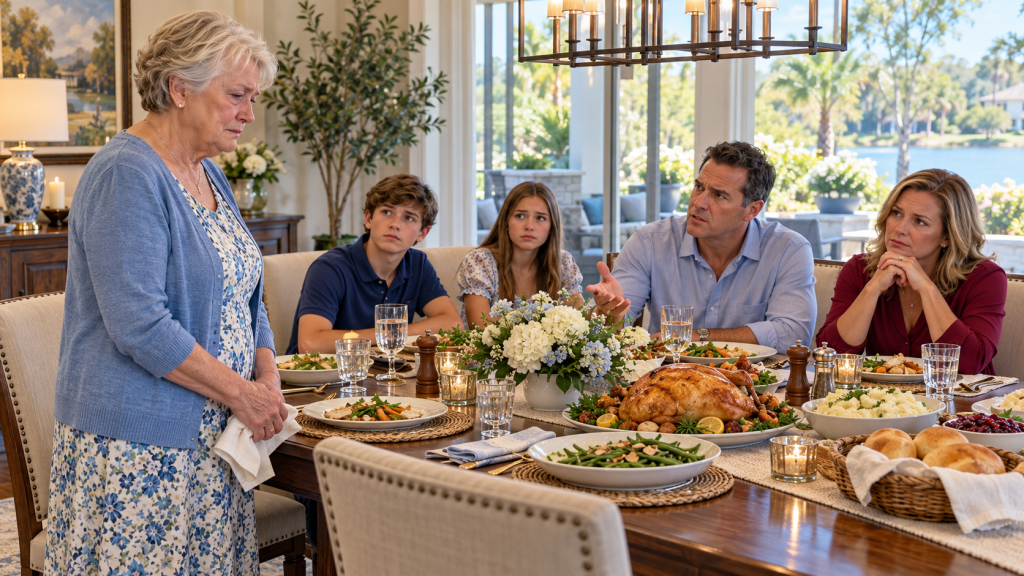
The silence around the dinner table.
The way my grandchildren avoided looking at me.
The suitcase I packed.
The hotel room.
The loneliness.
And the strange, frightening freedom of realizing I could choose what happened next.
For a while, I’d believed buying Willow Creek Lane would be my revenge.
That watching Daniel discover I owned his dream house would somehow erase the pain of being asked to leave.
But revenge hadn’t healed me.
Money hadn’t healed me either.
What healed me was something slower.
Learning that my value didn’t depend on how useful I was.
Learning that my son could be disappointed without my rushing to solve his problems.
Learning that I could love my grandchildren without becoming their unpaid nanny.
And learning that being wealthy didn’t require me to rescue everyone who wanted something from me.
The biggest surprise of my life wasn’t the lottery ticket.
It wasn’t the eighty-nine-million-dollar prize.
It wasn’t even the day I bought the house Daniel dreamed of owning.
It was discovering that, at seventy-one, I still had an entire life waiting to be lived.
I walked to the kitchen window.
Outside, the yellow rosebushes moved gently in the evening breeze.
Harold had planted the first yellow roses in our Tucson garden nearly forty years earlier.
He used to say they were his favorite because they reminded him that sunshine could return after a difficult season.
I touched the old wooden plaque.
Then smiled.
Because for the first time since my husband died, I was no longer living in someone else’s spare room, waiting to discover whether I was still welcome.
I had a front door.
A garden.
A home.
A future.
And people learning to love me without calculating what I could give them.
My son had asked when I was finally going to find somewhere else to live.
I had found somewhere.
But more importantly, I had finally found my way back to myself.
THE END STORIES! THANK YOU FOR READING GOOD LUCK !❤️
Related Posts