For several seconds, nobody moved. The ocean wind swept across the porch, stirring the white tablecloths Laurelai had arranged for what was supposed to be her daughter’s triumphant homecoming celebration. Thirty-four invited guests stood around my driveway, their champagne glasses suspended awkwardly in their hands.
My son Cullen stared at his father-in-law. Blythe had stepped away from him. And I, at seventy-one years old, stood holding a document that I had once intended to make my son’s future easier. “Cullen,” Miles repeated, his voice dangerously quiet, “why did the bank contact me about an application bearing your mother’s name?”
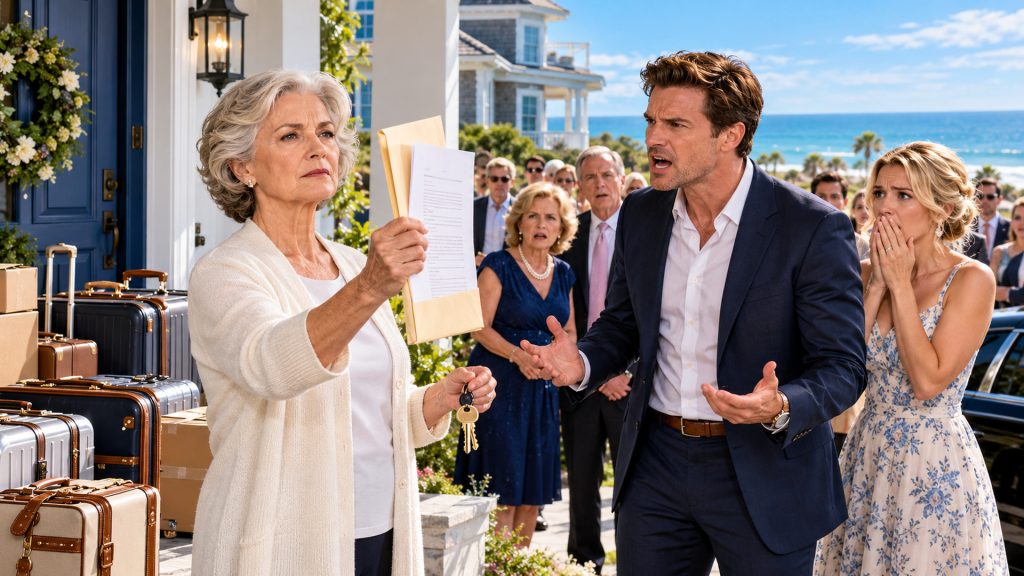
My son opened his mouth. Then closed it. He looked toward me. “Mom, this isn’t what it sounds like.” I felt an old, familiar pain spread through my chest. For forty-two years, I’d known that expression. The nervous smile he wore when he broke something expensive as a child.
The confident explanation he offered when he missed a school deadline.
The charming way he could turn an uncomfortable question into a story about someone else’s misunderstanding.
When Cullen was little, I used to find that expression endearing.
Now, watching it appear on the face of a grown man who had secretly married, lied about my health, and attempted to claim my home, I felt something inside me grow terribly still.
“Then explain it,” I said.
He swallowed.
“It’s just preliminary paperwork.”
Miles stared at him.
“Preliminary paperwork requiring your mother’s authorization?”
Laurelai stepped forward.
“Can we please stop humiliating the children?”
I turned toward her.
“Your daughter is thirty-eight, Laurelai. My son is forty-two. They’re not children.”
Her face reddened.
“This is a private family matter.”
I looked around at the guests she’d invited to witness me surrender the keys to my own home.
“You arranged chairs for an audience.”
A few people lowered their eyes.
I continued calmly.
“Now that the conversation isn’t going the way you planned, you want privacy.”
Laurelai looked away.
Cullen stepped closer.
“Mom, please. We can work this out.”
I studied him.
There was a time when those words would have softened me immediately.
I would have offered him coffee.
Asked whether he was under stress.
Found some way to help before he had even explained what had happened.
But that afternoon, standing before the house Nile and I had rebuilt with our own hands, I finally understood something.
Helping my son and protecting him from the consequences of his choices were not necessarily the same thing.
“Cullen,” I said, “did you sign my name to anything?”
His face drained of color.
“Mom—”
“Did you?”
The silence stretched.
Then he whispered, “I thought you’d approve.”
My heart sank.
“That wasn’t my question.”
He looked down.
And in that moment, I knew.
Whatever had been submitted to the bank, my son had crossed a line that no amount of family loyalty could excuse.
Miles stepped away to call the bank.
I could hear only fragments of the conversation.
“Unauthorized application.”
“Property owner.”
“Written confirmation.”
Then he turned toward us.
“The bank representative says no loan has been approved or funded. They’re reviewing the application and will contact the property owner through their formal process.”
I released a breath I hadn’t realized I was holding.
The house was still mine.
But the relief lasted only a moment.
Because now I had to face something more painful than the possibility of losing property.
My own son had apparently been willing to use my identity without permission.
I looked at him.
“Why?”
Cullen rubbed his forehead.
“Because we needed financing.”
“For what?”
He hesitated.
Blythe answered.
“The wedding.”
Everyone fell silent.
I stared at her.
“The wedding?”
She looked at Cullen.
“You told me the money was coming from your investments.”
Cullen’s jaw tightened.
“It was supposed to.”
Miles returned.
“What investments?”
My son looked trapped.
Then he said, “The company deal fell through.”
I frowned.
“What company deal?”
For years, Cullen had worked in commercial real estate development.
He dressed beautifully, drove expensive cars, and spoke constantly about investment opportunities.
Whenever I asked how business was going, he assured me everything was wonderful.
Apparently, it wasn’t.
“The development project,” he muttered. “The one in Charleston.”
Miles’s face changed.
“You told me you sold your interest in that project.”
“I was going to.”
Blythe stared at him.
“Cullen, what are you talking about?”
He looked around the driveway.
“Can everyone stop interrogating me?”
I studied his face.
Then I said quietly, “You stood in front of these people and demanded my house.”
He looked at me.
“You told them it belonged to you.”
His expression hardened.
“Because it was always supposed to be mine!”
I took a slow breath.
“No, Cullen.”
I looked toward the blue front door Nile had painted.
“This house was supposed to be part of your inheritance someday.”
My voice trembled.
“That’s very different from belonging to you while I’m still alive.”
He opened his mouth.
I continued.
“And it is certainly different from using it as security for a debt I never agreed to.”
For the first time, my son had no answer.
I turned toward the guests.
“I’m sorry your afternoon has become uncomfortable.”
Nobody spoke.
“But there will be no transfer of keys today.”
I held the cream-colored envelope against my chest.
“The house remains mine. Any questions about the property will be handled through my attorney.”
A woman near the front nodded.
Another guest quietly collected her handbag.
Within minutes, the gathering began dissolving.
People walked toward their cars without making eye contact.
The champagne remained unopened.
The folding chairs stood in neat rows facing my front door, as though waiting for a ceremony that would never happen.
Laurelai watched her carefully planned celebration fall apart.
Then she turned toward me.
“You’ve made your point.”
I looked at her.
“I wasn’t trying to make a point.”
Her expression hardened.
“Then what were you trying to do?”
I glanced toward Nile’s photograph through the living room window.
“Protect my home.”
She scoffed.
“It’s just a house.”
For a moment, I couldn’t speak.
Then I smiled sadly.
“No, Laurelai.”
I looked toward the weathered porch rail.
“The front steps were rebuilt by my husband after a storm destroyed half the foundation.”
I gestured toward the windows.
“He installed those himself.”
My voice softened.
“And that blue door? He painted it the summer before his cancer diagnosis.”
I looked directly at her.
“You see a two-million-dollar property.”
My throat tightened.
“I see thirty-six years of marriage.”
Laurelai’s expression changed.
But I wasn’t finished.
“And even if it were only an investment, it would still belong to me.”
She lowered her eyes.
I turned back toward Cullen.
“Your belongings are on the porch. Please arrange to collect them.”
He stared at me.
“Where are we supposed to stay?”
I looked at the man I’d raised.
The little boy who once slept with a stuffed dinosaur.
The teenager who called me whenever he needed advice.
The grown man who had decided his mother’s existence was inconvenient to the life he wanted to display.
“I hope,” I said quietly, “you find somewhere honest to begin again.”
That evening, after everyone left, I sat alone on the porch.
The sun was setting over the ocean.
The waves moved steadily toward the sand, just as they had during the summers Nile and I spent rebuilding the house.
I was exhausted.
Not physically.
Emotionally.
For years, I’d imagined that growing older would bring a certain peace.
I’d raised my son.
I’d worked hard.
I’d cared for my husband through illness.
I’d buried him.
And I’d finally reached a time when I could enjoy the life we’d spent decades building.
Instead, I was sitting in my own home wondering whether my only child had tried to use my identity to borrow money.
I heard Nile’s voice in my memory.
Don’t confuse being needed with being loved.
He used to say that whenever I became worried about Cullen’s financial problems.
I had always dismissed it.
“That’s our son,” I’d tell him.
And Nile would smile gently.
“I know.”
Then he’d add, “That’s why we have to teach him that love doesn’t remove responsibility.”
I closed my eyes.
I missed that man with an ache that reached into my bones.
He would have known what to say.
Or perhaps he wouldn’t.
Perhaps he’d have been just as heartbroken.
I looked toward the ocean.
“Nile,” I whispered, “I wish you were here.”
The wind moved through the porch railings.
Of course, nobody answered.
But I remembered the note he had left.
The one attached to the proposed property transfer.
I went inside, opened the cream-colored envelope, and unfolded his handwritten message.
My love,
If we ever give Cullen the house, let it be because he understands what it means to care for something.
Not because he believes being our son entitles him to it.
I read the words slowly.
Then I noticed something I’d overlooked before.
There was another paragraph.
And if the day comes when our generosity is treated as an obligation, remember that refusing to give away something precious is not the same as refusing to love our child.
Tears filled my eyes.
For the first time in days, I allowed myself to cry.
Not because I’d lost the house.
I hadn’t.
But because I was beginning to understand that the relationship I’d imagined having with Cullen was not the one we actually had.
And that realization hurt far more than the price of any property.
The following morning, I called my attorney.
Her name was Rebecca Shaw.
She had handled our family’s legal affairs for nearly twenty years.
She knew the house.
She knew Nile.
And she had prepared the unsigned transfer documents I’d considered giving Cullen as a wedding gift.
When I explained what had happened, she listened without interrupting.
Then she asked one question.
“Did you authorize any mortgage application?”
“No.”
“Did you sign a loan agreement or guarantee?”
“No.”
“Did you give Cullen permission to represent himself as the owner?”
“Absolutely not.”
She paused.
“Then we need to obtain the bank’s records and determine exactly what was submitted.”
My hands trembled.
“Could I lose the house?”
Rebecca answered carefully.
“Based on what you’ve told me, ownership remains in your name and no financing has been completed. But we should verify the title records and take appropriate steps to protect you.”
I nodded.
She continued.
“We should also document the property access issue. Changing locks doesn’t necessarily resolve every legal question if someone has established occupancy rights, so let’s make sure any belongings and access disputes are handled properly.”
I appreciated her calmness.
For years, I’d been the person everyone expected to solve problems.
Now someone was helping me without demanding that I make myself smaller to deserve it.
“What about Cullen?” I whispered.
Rebecca’s voice softened.
“That depends on the evidence and what actions you’re prepared to take.”
I closed my eyes.
“He’s my only son.”
“I know.”
She paused.
“But protecting yourself isn’t an act of cruelty toward him.”
Those words stayed with me long after the call ended.
Two days later, Rebecca met me at the beach house.
We sat at the kitchen table while she reviewed the documents.
The proposed deed had never been executed.
There was no completed transfer.
The home remained legally mine.
The bank confirmed that a mortgage inquiry had been initiated using information that appeared to identify me as a participant in the transaction.
Additional supporting documents required investigation.
But no mortgage had been approved.
No funds had been released.
And the bank had flagged the application for further review.
Rebecca looked up.
“That’s good news.”
I nodded.
But relief felt strangely incomplete.
“Did Cullen submit the paperwork?”
“The bank’s records indicate he was involved in initiating the application. We’re still determining what representations were made and which documents were submitted.”
I stared at the table.
Then I asked, “What if my son committed fraud?”
Rebecca was quiet.
“If evidence establishes misconduct, there may be legal consequences.”
I closed my eyes.
“I don’t want to destroy his life.”
She leaned forward.
“You are not responsible for concealing wrongdoing to protect someone from the consequences of their own actions.”
My throat tightened.
“But he’s my child.”
She nodded.
“And you can love him while refusing to allow unauthorized use of your identity or property.”
I looked toward the ocean.
For years, I’d believed motherhood meant finding a way to soften every fall.
Now I was being asked to accept that some falls were necessary for a person to learn where the ground truly was.
That afternoon, I received a message from Blythe.
Could we talk privately? Without Cullen or my parents?
I stared at the screen.
I didn’t know what to think of my new daughter-in-law.
Until recently, I’d believed she simply came from a wealthy family with a taste for expensive things.
She had been polite during our limited meetings.
Beautifully dressed.
Carefully spoken.
But distant.
She rarely asked about Nile.
Never seemed interested in the beach house except as a place to entertain guests.
And apparently, she’d accepted a wedding in which the groom’s mother was excluded because she lacked “status.”
I considered ignoring her message.
Then I remembered her expression when Miles mentioned the mortgage application.
She had looked genuinely shocked.
I replied.
Tomorrow. Two o’clock. At Rebecca’s office.
Blythe agreed immediately.
She arrived wearing a simple blue dress.
No elaborate jewelry.
No designer handbag.
For the first time, she looked younger than the polished woman I’d seen in the wedding photographs.
Rebecca offered her a chair.
Blythe sat down carefully.
Then she began crying.
“I’m sorry.”
I remained quiet.
She wiped her face.
“I know that doesn’t fix anything.”
“No,” I said softly. “It doesn’t.”
She nodded.
Then she looked at me.
“I need you to know I didn’t understand what Cullen was doing with the house.”
I studied her.
“You believed I had transferred it?”
“Yes.”
“Why?”
“Because he showed me a document.”
My stomach tightened.
“What document?”
She reached into her handbag.
Then placed a printed copy on the table.
Rebecca picked it up.
It was the proposed transfer prepared months earlier.
The same document Cullen had apparently seen inside my private envelope.
Except this copy included a page I had never authorized.
A typed cover sheet.
It stated that the owner intended to complete the transfer before the newlyweds returned from their honeymoon.
Beneath the statement was a typed version of my name.
I stared.
“That’s not my signature.”
Rebecca nodded.
“I can see that this isn’t a handwritten signature. We’ll need to determine who created the page and how it was represented.”
Blythe covered her face.
“Cullen told me it was already arranged.”
I looked at her.
“And you never thought to ask me?”
She lowered her head.
“I should have.”
I waited.
Then asked the question that had been hurting me most.
“Why wasn’t I invited to your wedding?”
Blythe began crying harder.
For several seconds, she couldn’t speak.
Then she whispered, “Because Cullen told me you were embarrassed by his marriage.”
I stared.
“What?”
“He said you didn’t approve of me or my family.”
My chest tightened.
“He told me you thought I was marrying him for money.”
I looked at Rebecca.
Then back at Blythe.
“I barely knew you.”
She nodded miserably.
“I know.”
She wiped her cheeks.
“He said you were difficult about social events. He said you didn’t want to be around my parents because you thought they looked down on you.”
My mouth went dry.
“That wasn’t true.”
“I understand that now.”
I shook my head.
“He told me it was just easier to keep the wedding small and tell people you were unwell.”
I closed my eyes.
Cullen had lied to everyone.
To me.
To Blythe.
To her parents.
To the wedding guests.
And perhaps most painfully, he’d used my supposed illness to explain my absence from the most important day of his adult life.
I took a long breath.
“Did you believe I was sick?”
Blythe looked ashamed.
“He told me you were recovering from a condition you didn’t want discussed.”
I stared at her.
“And you didn’t call?”
She began crying.
“No.”
For a moment, I felt anger rising.
Then I remembered something.
Cullen had also told me the wedding was only for people with status.
He had positioned us as enemies before we’d ever had a chance to become family.
I looked at Blythe.
“You were still responsible for not asking me directly.”
She nodded.
“I know.”
“But it sounds as though we were both being told different stories.”
Blythe covered her mouth.
“Yes.”
Rebecca asked several questions about the paperwork.
Blythe explained that Cullen had repeatedly claimed the beach house was part of his inheritance and that its transfer had already been approved.
He had described the property as a wedding gift.
He’d also told her parents that he owned substantial investments.
Now, after the mortgage application surfaced, she had begun checking his claims.
And the more she investigated, the more concerned she became.
“There are credit cards I didn’t know about,” she whispered.
Rebecca took notes.
“Joint accounts?”
“Some are in Cullen’s name. Others are business accounts.”
Blythe’s voice trembled.
“He told me the wedding was paid for.”
I looked at her.
“Was it?”
She shook her head.
“There are unpaid vendor balances.”
I closed my eyes.
“Of course.”
She continued.
“My parents contributed a substantial amount because Cullen said he was using the beach house as part of a larger investment arrangement.”
I stared.
“So the whole wedding was built around the promise of a house that didn’t belong to him.”
Blythe lowered her head.
“I think so.”
For a long moment, nobody spoke.
Then she whispered, “Mrs. Bennett, I don’t know who I married.”
I studied her.
There was genuine fear in her voice.
Not fear of losing a luxury home.
Fear of discovering that the person she’d trusted had constructed their future on lies.
I remembered how I felt when I discovered Nile’s photograph shoved into a drawer.
How deeply it hurt to realize someone I’d loved believed my memories were obstacles to his plans.
For the first time, I saw Blythe not only as the woman who’d excluded me from her wedding, but also as someone facing a painful truth about Cullen.
I reached for a tissue and placed it beside her.
“You’ll have to decide what to do with what you’ve learned.”
She nodded.
“And I need you to understand something.”
She looked up.
“My house is not available to solve this problem.”
Her eyes filled.
“I understand.”
I studied her.
Then said, “But if you want to build an honest relationship with me someday, we can start with the truth.”
She began crying.
“I’d like that.”
That evening, Cullen called.
His voice was furious.
“Mom, did you meet with Blythe?”
“Yes.”
“Without telling me?”
“Yes.”
He exhaled sharply.
“You had no right.”
I almost laughed.
“No right to speak with my daughter-in-law?”
“She told you private things.”
I remained quiet.
Then said, “Cullen, did you tell her I disapproved of your marriage?”
He hesitated.
“Mom—”
“Did you?”
“You never made much effort with her.”
I closed my eyes.
“We met three times before the wedding.”
“You were cold.”
I stared at the wall.
“I invited both of you to Christmas dinner.”
He said nothing.
“I sent her flowers when she got her promotion.”
Silence.
“And I offered to host an engagement dinner.”
His voice tightened.
“That would’ve been awkward.”
“Why?”
“Because your house isn’t exactly the kind of place her parents are used to.”
The words landed heavily.
I looked around my kitchen.
The counters Nile had installed.
The cabinets we’d refinished.
The table where Cullen used to do his homework.
Our home wasn’t grand.
It wasn’t designed to impress.
But it had been filled with love.
I took a breath.
“Cullen, are you ashamed of me?”
He remained silent.
I waited.
Then he said, “You don’t understand how things work in certain circles.”
My heart sank.
“Maybe not.”
He sighed.
“Mom, please don’t make this about yourself.”
I closed my eyes.
“My son married without inviting me.”
I paused.
“Then tried to claim my house.”
My voice trembled.
“And now you’re telling me not to make any of it about myself.”
He said nothing.
I took a slow breath.
“Cullen, I think you need to speak with Rebecca.”
His voice sharpened.
“I’m not going to be intimidated by your lawyer.”
“Then perhaps you should get your own.”
He went silent.
Then whispered, “You’re really going to do this?”
I looked toward Nile’s photograph.
“Yes.”
For the first time in forty-two years, I ended a conversation with my son without offering him a way to escape the consequences of what he’d done.
The following week, Miles requested a meeting.
I expected another attempt to pressure me.
Instead, he arrived at Rebecca’s office looking exhausted.
His expensive suit was wrinkled.
His normally confident expression was strained.
He sat down and placed a folder on the table.
“Mrs. Bennett,” he began, “I owe you an apology.”
I looked at him.
“For what?”
“For believing what Cullen told me without speaking to you.”
I remained quiet.
Miles continued.
“He presented the property transfer as a completed family arrangement.”
I nodded.
“And you never thought to verify it?”
He lowered his head.
“I should have.”
He opened the folder.
“I’ve also had an independent accountant review the wedding expenses and the financial information Cullen provided.”
Rebecca leaned forward.
“What did you find?”
Miles took a breath.
“Several of Cullen’s claimed assets couldn’t be substantiated.”
My stomach tightened.
“He also appears to have overstated the value of his business interests.”
I looked at him.
“By how much?”
Miles hesitated.
“Substantially.”
For a moment, I couldn’t speak.
My son had built an entire image around wealth he might not possess.
He had surrounded himself with expensive clothes, cars, and people who valued status.
And now I was discovering that much of it may have been supported by debt, exaggeration, and promises of money he expected to inherit.
I looked at Miles.
“Did you know about the mortgage application?”
He shook his head.
“No. I received the call because Cullen had listed me as a financial reference.”
Rebecca made a note.
Miles continued.
“When the bank asked me to confirm certain information, I realized something was wrong.”
I studied him.
“Why did you say at the gathering that Cullen had submitted it using my identity?”
“Because the bank indicated the application identified you as a participant. I was shocked.”
Rebecca nodded.
“We’re verifying the exact documents independently.”
Miles looked at me.
“Mrs. Bennett, I’m sorry.”
His voice trembled.
“I thought I was helping my daughter begin a secure marriage.”
I nodded slowly.
“And now?”
He looked down.
“Now I’m afraid I’ve helped her begin one built on false promises.”
For the first time, I saw him as a frightened father rather than an arrogant man.
It didn’t erase his participation in the pressure campaign.
But I understood it.
We had both loved our children.
And both, in different ways, had been too willing to believe what they told us.
The investigation into the bank application took several months.
Rebecca kept me informed.
The lender confirmed that no mortgage had been issued.
The title to the beach house remained entirely in my name.
The disputed application was closed while questions about the submitted information were referred for further review.
The bank also provided documentation showing that Cullen had initiated the transaction and supplied materials he was not authorized to represent as final.
An attorney representing Cullen eventually contacted Rebecca.
They disputed some of the conclusions and sought to resolve the matter without further escalation.
I did not pretend to understand every legal detail.
That was why I’d hired professionals.
I wanted the truth established carefully.
I wanted my property protected.
And I wanted any consequences to arise from actual evidence, not my anger.
The process was slow.
There was no dramatic courtroom scene.
No sudden confession before a judge.
No moment when everything became simple.
Instead, there were documents, explanations, consultations, and difficult decisions.
One afternoon, Rebecca asked whether I wanted to pursue further civil remedies.
I stared at her.
“What would that accomplish?”
She explained the options.
I listened.
Then took several days to consider them.
I didn’t want revenge.
But I didn’t want to teach Cullen that he could use my name without permission and expect me to make the problem disappear.
Eventually, I authorized the steps Rebecca recommended to protect my interests and address the unauthorized representations.
Whatever other consequences followed would be handled through the appropriate processes.
It was the hardest decision I’d made since Nile died.
And perhaps the most necessary.
While all of that unfolded, I did something unexpected.
I began spending more time at the beach house.
Not because I feared someone would take it.
Not because I wanted to guard it.
But because I’d spent too many years treating it as an investment rather than the home Nile and I had loved.
One morning, I opened every window.
The ocean breeze moved through the rooms.
I took down the expensive curtains Blythe had installed without asking and rehung the simple white ones I’d chosen years earlier.
I returned my robe to the master bedroom.
I placed Nile’s photograph on the fireplace mantel.
Then I stood back and looked at the room.
For the first time in weeks, it felt like mine again.
I walked onto the porch.
The blue door was beginning to fade.
Nile had painted it himself fourteen years earlier.
He’d chosen the color after spending half an afternoon arguing with me about shades of blue.
I’d wanted something darker.
He insisted this color matched the sky after a storm.
I smiled at the memory.
Then I went to the hardware store.
Bought paint.
And spent the afternoon restoring the door.
My hands weren’t as steady as they used to be.
The first coat looked terrible.
Paint dripped along the edge.
I laughed.
Nile would have teased me mercilessly.
But I kept working.
By sunset, the door looked beautiful.
I stood on the porch with paint on my fingers and tears in my eyes.
“Nile,” I whispered, “I think we still make a good team.”
Of course, he didn’t answer.
But I could almost hear him laughing.
That summer, I invited several old friends to stay for a weekend.
Women I’d known for decades.
Some widowed.
Some divorced.
Some simply eager to escape their routines.
We cooked.
Played cards.
Walked along the beach.
And laughed until our stomachs hurt.
One evening, my friend Patricia looked around the living room.
“Do you know what I love most about this place?”
I smiled.
“The ocean?”
She shook her head.
“The stories.”
I looked at her.
She gestured toward the photographs.
“The wedding picture. The old furniture. That ridiculous wooden fish your husband carved.”
I laughed.
“Nile insisted it was a dolphin.”
Patricia grinned.
“It definitely isn’t.”
Everyone laughed.
Then she grew serious.
“This place feels lived in.”
My throat tightened.
I looked around the room.
For months, I’d been so focused on what Cullen wanted to take that I’d almost forgotten what the house still offered.
Peace.
Memory.
Friendship.
A place to gather people I loved.
I smiled through tears.
“Thank you.”
That night, after everyone went to bed, I sat on the porch.
The moonlight stretched across the water.
I thought about all the years Nile and I spent rebuilding this place.
We hadn’t done it to impress wealthy guests.
We hadn’t done it because we expected Cullen to appreciate its value.
We did it because we loved working side by side.
Because we wanted somewhere our family could gather.
Because after surviving a hurricane, we’d learned not to postpone every dream.
And I realized something important.
The house had never been valuable because of its price.
It was valuable because of the life we’d lived inside it.
In early autumn, I received a letter from Cullen.
It arrived through Rebecca’s office.
I recognized his handwriting immediately.
For several minutes, I left it unopened.
Then I sat at the kitchen table and carefully unfolded the paper.
Mom,
I don’t know how to begin.
I’ve spent months telling myself you overreacted.
I blamed you for embarrassing me in front of Blythe’s family.
I blamed you for refusing to give us the house.
And I blamed everyone else for the financial problems I created.
I stopped reading.
My throat tightened.
Then I continued.
But the truth is, I lied.
I lied to Blythe about my finances.
I lied to her parents about the property.
I lied to the wedding guests about your health.
And I used paperwork I had no right to use.
My eyes filled.
I told myself I was only borrowing against something that would eventually belong to me.
I understand now that it was never mine to promise.
I covered my mouth.
There it was.
The truth I’d waited months to hear.
Not a legal conclusion.
Not an excuse.
An acknowledgment.
The letter continued.
I don’t expect you to forgive me.
Blythe and I are living separately while we decide what happens to our marriage.
I’ve started working with a financial counselor and an attorney to deal with my debts and the consequences of my decisions.
I also started seeing a therapist.
I paused.
That surprised me.
Cullen had always dismissed therapy as something other people needed.
He had been proud of his independence.
Perhaps too proud.
I’ve spent most of my adult life terrified that people would discover I’m not as successful as I pretend to be.
I was ashamed of my debts.
Ashamed of my failed investments.
And eventually, ashamed of the ordinary life I came from.
Tears slipped down my cheeks.
I thought if I married into a wealthy family and lived in the beach house, I’d finally become the man I wanted everyone to think I was.
But I was wrong.
I wasn’t building a life.
I was building an image.
I stared at those words.
Then continued.
Mom, the cruelest thing I did wasn’t trying to take the house.
My breath caught.
It was deciding you weren’t important enough to stand beside me at my wedding.
I began crying.
You and Dad gave me everything that mattered.
You taught me how to work.
You showed up to every school event.
You supported me when I failed.
And I treated you like someone who would embarrass me.
His handwriting became less steady.
I’m sorry.
Not because I lost access to the house.
Not because my marriage is struggling.
But because I finally understand that I hurt the person who loved me before I had anything worth showing off.
I folded the letter.
For a long time, I couldn’t move.
I wanted to believe him.
I wanted to call immediately.
To hear his voice.
To tell him I loved him.
But I remembered Nile’s words.
Refusing to give away something precious is not the same as refusing to love our child.
I placed the letter beside my coffee cup.
Then whispered, “Oh, Cullen.”
And cried.
I didn’t respond immediately.
I took the letter to the beach house.
I read it again on the porch.
Then I placed it beside Nile’s photograph.
For three days, I thought about what to say.
I knew an apology couldn’t undo everything.
It couldn’t return the wedding I’d missed.
It couldn’t erase the humiliation of standing before strangers while my son demanded my house.
It couldn’t resolve the legal questions.
But it could be the beginning of something different.
Eventually, I wrote a reply.
Cullen,
I love you.
That has never changed.
But loving you doesn’t mean I can pretend what happened was acceptable.
You lied to me, to Blythe, and to her family.
You treated my home as though it already belonged to you.
And you used information connected to my property without my permission.
Those choices damaged my trust.
I paused.
Then continued.
Your father and I never wanted you to become wealthy to make us proud.
We wanted you to become honest.
Kind.
Responsible.
Someone who understood that other people’s dignity mattered as much as his own.
Tears filled my eyes.
I’m glad you’re beginning to face your mistakes.
But rebuilding trust will take time and consistent actions.
I won’t transfer the beach house.
I won’t take responsibility for your debts.
And I won’t ask Rebecca to conceal or ignore the matters that need to be resolved.
I took a breath.
But if you’re willing to build a relationship that isn’t based on what I can give you, I am willing to try.
Love, Mom.
I sealed the letter.
Then sat quietly.
I hadn’t forgiven everything.
I wasn’t sure when I would.
But I had left a door open.
Not the blue door of the beach house.
A different one.
The possibility of having a son again.
The following month, Cullen asked whether we could meet.
I suggested a quiet café.
Not my house.
Not the beach property.
Somewhere neutral.
He agreed.
When I arrived, he was already seated.
I almost didn’t recognize him.
His expensive watch was gone.
He wore a simple gray sweater.
His hair looked slightly longer than usual.
And for the first time in years, he seemed tired in a way no expensive vacation could hide.
He stood when he saw me.
“Mom.”
I stopped.
For a moment, I saw the boy who used to wait at the front window for Nile to come home from work.
Then I saw the man who had wounded me so deeply.
Both were my son.
Neither erased the other.
“Hello, Cullen.”
He pulled out a chair.
I sat.
For several minutes, we spoke about ordinary things.
The weather.
The drive.
The café.
Then Cullen placed his hands on the table.
“Mom, I want to apologize in person.”
I nodded.
He swallowed.
“I don’t expect you to believe everything I wrote.”
I remained quiet.
“But I meant it.”
His eyes filled.
“I was ashamed of you.”
The words hurt even though I already knew.
He looked down.
“Not because you did anything wrong.”
He took a breath.
“But because I was ashamed of where I came from.”
I stared at him.
He continued.
“When I started working with wealthy developers, I felt like I didn’t belong.”
I nodded slowly.
“They talked about family estates and investment portfolios and vacation homes.”
He gave a bitter laugh.
“I started pretending I had the same things.”
My heart tightened.
“And when Blythe’s parents asked about my family, I told them about the beach house.”
He looked up.
“Then I let them believe it was mine.”
I took a slow breath.
“Why not tell the truth?”
He shook his head.
“Because every lie made the next one necessary.”
I looked at him.
“And eventually, you believed your own story.”
He nodded.
“Yes.”
Tears filled his eyes.
“I thought if I could just get the house, everything would work out.”
I stared at him.
“My son,” I whispered, “you were willing to lose me to keep pretending.”
He began crying.
“I know.”
For a long time, neither of us spoke.
Then he whispered, “I’m sorry, Mom.”
I looked down.
The apology sounded real.
But real apologies don’t automatically erase damage.
I reached for my coffee.
Then said, “I hear you.”
He nodded.
“And I hope you’re prepared to prove through your actions that you’ve changed.”
His eyes filled.
“I am.”
I looked at him.
“Then start by continuing to tell the truth, even when it costs you something.”
Cullen and Blythe eventually made a decision about their marriage.
They separated for several months.
During that time, Blythe moved into an apartment near her work.
Cullen began rebuilding his finances under professional guidance.
He sold his luxury car.
Closed unnecessary accounts.
And accepted a position with a smaller development company.
It wasn’t glamorous.
It didn’t come with a corner office.
But it was honest work.
One afternoon, he called me.
“Mom, I got paid today.”
I smiled.
“That’s good.”
He laughed softly.
“It’s not much compared with what I used to make.”
I waited.
Then he added, “But I actually know where every dollar came from.”
My throat tightened.
I smiled.
“That matters.”
He was quiet.
Then whispered, “I think Dad would have liked that.”
I looked toward Nile’s photograph.
“Yes.”
My eyes filled.
“I think he would.”
The biggest surprise came the following spring.
Blythe called me.
“Mrs. Bennett, would you like to have lunch?”
I smiled.
“I’d like that.”
We met at a small restaurant overlooking the harbor.
She looked different.
Less carefully polished.
More relaxed.
She wore a simple dress and little jewelry.
She smiled when she saw me.
“Thank you for coming.”
I sat.
“How are you?”
She considered.
“Better.”
I nodded.
“And Cullen?”
Her expression softened.
“We’re working on things.”
I waited.
“We started counseling together.”
I looked at her.
“Is it helping?”
She smiled faintly.
“I think so.”
Then she took a breath.
“He’s learning to tell me when something is wrong instead of pretending everything is fine.”
My throat tightened.
“And you’re learning to ask questions?”
She laughed softly.
“Exactly.”
We ate lunch.
Talked about work.
About travel.
About ordinary things.
Then Blythe grew serious.
“There’s something I want to tell you.”
I looked up.
“My parents were wrong.”
I remained quiet.
“They treated you as though your home was something to be transferred because it suited our plans.”
She swallowed.
“And I allowed it.”
I nodded.
“Yes.”
Her eyes filled.
“I was embarrassed when the wedding guests found out you weren’t sick.”
She looked down.
“But I should have been embarrassed long before that.”
I studied her.
“Why?”
“Because I was willing to accept a beautiful house and a convenient story without asking whether the woman who owned it wanted any of it.”
My throat tightened.
She wiped her eyes.
“I’m sorry.”
I reached for her hand.
“Thank you.”
She smiled through tears.
Then she said something that surprised me.
“I don’t want to be invited into your life because I’m married to Cullen.”
I looked at her.
“I want to know you.”
My eyes filled.
For years, I’d imagined that gaining a daughter-in-law might mean gaining another person to share holidays and family memories with.
Instead, our relationship began with exclusion and conflict.
But perhaps it didn’t have to end there.
I smiled.
“I’d like that too.”
That summer, Cullen asked whether he could visit the beach house.
Not stay there.
Not move in.
Just visit.
I considered.
Then said yes.
On one condition.
He had to come alone.
No guests.
No celebration.
No discussion of property.
Just a mother and son.
He agreed.
When he arrived, I was standing on the porch.
He stepped out of a modest sedan.
For a moment, he stared at the house.
Then he smiled sadly.
“The door looks good.”
I laughed softly.
“Thank you.”
He approached.
“Did you repaint it?”
I nodded.
“Last summer.”
His eyes filled.
“Dad would’ve liked that.”
I looked at the blue door.
“He chose the color.”
Cullen nodded.
“I remember.”
We stood quietly.
Then I stepped aside.
“Come in.”
He entered slowly.
For the first time in years, he looked around the rooms as though he were seeing them rather than evaluating them.
He stopped beside the fireplace.
Nile’s photograph stood on the mantel.
Cullen approached it.
His expression changed.
“Mom.”
I looked at him.
“I’m sorry I moved this.”
My throat tightened.
I nodded.
He touched the frame gently.
“I didn’t think about what it meant to you.”
I took a slow breath.
“No.”
He lowered his eyes.
“I was so focused on making this place look expensive that I forgot why it mattered.”
I looked toward the windows.
“Your father and I rebuilt this house after a hurricane.”
Cullen nodded.
“I know.”
“Do you remember the summer you helped us paint the porch?”
He smiled faintly.
“I was sixteen.”
“You complained the entire time.”
He laughed.
“I remember.”
I smiled through tears.
“Your father gave you five dollars an hour.”
Cullen chuckled.
“And I thought he was being cheap.”
We both laughed.
Then the laughter faded.
He looked around the room.
“I wish I’d appreciated it.”
I reached for his hand.
“You can appreciate it now.”
His eyes filled.
For a moment, he looked like the boy I remembered.
Not the confident man from the wedding photographs.
Not the son demanding keys.
Just Cullen.
My child.
Trying to find his way back.
We spent the afternoon walking along the beach.
He told me about his job.
His therapy.
His financial arrangements.
The difficult conversations he’d been having with Blythe.
I listened.
I didn’t solve his problems.
Didn’t offer money.
Didn’t suggest he quit his job or move into the beach house.
I simply listened.
At one point, he stopped beside the water.
“Mom, can I ask you something?”
“Of course.”
“Do you still want to leave me the house someday?”
I felt my chest tighten.
There it was.
The question I’d been waiting for.
I looked at him.
“Cullen, I don’t know what my estate plans will look like years from now.”
His expression changed.
I continued.
“I’ve updated my documents to protect my wishes and ensure that the property is managed responsibly.”
He nodded slowly.
“And I haven’t promised the house to anyone.”
He looked down.
“I understand.”
I studied him.
“Does that upset you?”
He took a breath.
“A little.”
I appreciated his honesty.
Then he looked at me.
“But I think I understand why.”
I nodded.
“Good.”
He stared toward the ocean.
Then whispered, “I don’t want to be the kind of man who only visits his mother because he expects something.”
My throat tightened.
I reached for his hand.
“Then don’t be.”
He smiled sadly.
For a long time, we stood beside the water.
And for the first time, I felt that perhaps we were beginning to build something honest.
Months passed.
Cullen continued working.
Blythe and he eventually decided to remain married, but they chose to live in a modest apartment they could afford.
They paid their bills.
Made compromises.
And slowly learned that a marriage built on appearances was a fragile thing.
Laurelai and Miles also changed.
Not dramatically.
Not overnight.
But they became more careful about making assumptions.
Miles called me one afternoon to apologize again for the welcome-home gathering.
“I thought I was celebrating my daughter’s future,” he said.
I nodded.
“And I thought I was being pressured to surrender mine.”
He sighed.
“You were.”
I appreciated his honesty.
Then he added, “I’ve learned that money can make people terribly careless about other people’s boundaries.”
I smiled faintly.
“Yes.”
We spoke for a while.
Then he said something unexpected.
“I’d like to visit your beach house someday. Not as someone expecting keys.”
I laughed.
“As a guest?”
He chuckled.
“Exactly.”
I considered.
“Perhaps someday.”
And for once, the possibility didn’t feel threatening.
Because I knew I could say yes or no.
And either answer would be respected.
A year after the disastrous homecoming celebration, I hosted a small gathering at the beach house.
Not for wealthy guests.
Not for people with status.
Just family and close friends.
Patricia came.
Rebecca stopped by briefly.
Cullen and Blythe arrived carrying dessert.
Laurelai and Miles brought flowers.
We sat on the porch as the sun lowered toward the ocean.
The folding chairs were ordinary.
The food was homemade.
The tablecloths didn’t match.
And nobody cared.
At one point, Cullen stood.
“I’d like to say something.”
The conversation quieted.
I looked at him nervously.
He smiled.
“Don’t worry, Mom. I’m not asking for the house.”
Everyone laughed.
Then his expression became serious.
“One year ago, I stood on this porch and demanded something that didn’t belong to me.”
My throat tightened.
He looked around.
“I thought success meant having the biggest house, the nicest car, and the most impressive people at my wedding.”
He paused.
“I thought if I could make everyone believe I was wealthy, I’d finally feel important.”
His voice trembled.
“But I learned something.”
He looked directly at me.
“I already had something far more valuable.”
My eyes filled.
“I had parents who loved me.”
He swallowed.
“And I treated that love like a resource I could spend.”
The porch fell silent.
Cullen continued.
“I can’t undo what I did.”
He looked toward Nile’s photograph through the window.
“I can’t give my dad another year.”
His voice broke.
“And I can’t give my mother back the wedding I kept her from.”
Tears streamed down my cheeks.
“But I can stop lying.”
He took a breath.
“I can stop pretending.”
“And I can become someone who understands that love is not measured by what people give you.”
He looked at Blythe.
She smiled through tears.
Then he turned toward me.
“Mom, thank you for teaching me that.”
I covered my mouth.
For a long moment, nobody spoke.
Then I stood.
I walked toward him.
And embraced my son.
Not because every wound had disappeared.
Not because the past no longer mattered.
But because the man standing before me had begun to understand something I’d spent forty-two years hoping to teach him.
Responsibility.
Humility.
And the simple truth that a person’s worth cannot be measured by the price of the things they own.
Later that evening, after the guests left, Cullen stayed behind to help clean up.
He carried plates into the kitchen.
Blythe washed glasses.
I dried them.
For a while, the three of us worked quietly.
Then Cullen looked at me.
“Mom?”
“Yes?”
“I’ve been thinking about Dad.”
My throat tightened.
“What about him?”
He smiled sadly.
“Do you remember the first time we came here after the hurricane?”
I nodded.
“The roof was gone.”
He laughed.
“And there was sand in every room.”
“Every single room.”
He looked toward the windows.
“Dad told me something that day.”
I waited.
“He said, ‘A house isn’t what you inherit. It’s what you take care of.’”
My eyes filled.
I remembered.
Nile had said those words while handing Cullen a paintbrush.
At the time, my son had rolled his eyes.
Now he stood in the kitchen, years later, finally understanding.
Cullen looked at me.
“I thought Dad was talking about property.”
I smiled through tears.
“And now?”
He swallowed.
“I think he was talking about everything.”
I reached for his hand.
“Yes, sweetheart.”
He nodded.
“Everything.”
That night, after Cullen and Blythe drove away, I sat alone on the porch.
The ocean stretched dark and endless beneath the moonlight.
The blue door stood behind me.
Nile’s photograph rested on the mantel.
And for the first time in a long time, I felt at peace.
I thought about the woman I’d been the morning Cullen called from the airport.
Seventy-one years old.
Holding a cup of coffee.
Listening to her only son explain that she’d been excluded from his wedding because the guests were people with status.
I remembered the pain.
The disbelief.
The terrible realization that my son’s future plans included my home but not my presence.
I remembered driving to the beach house.
Finding Blythe’s bathrobe in my bedroom.
Finding Nile’s photograph face down in a drawer.
Changing the locks.
Placing the suitcases on the porch.
And discovering that the house I’d intended to give away had already been promised to strangers.
At the time, I’d thought the story was about protecting property.
But now I understood.
It was about protecting something much more important.
My dignity.
My memories.
My right to decide how I would live the years I had left.
And my right to love my son without financing every mistake he made.
I still don’t know exactly what will happen to the beach house after I’m gone.
Perhaps Cullen will inherit it.
Perhaps I’ll arrange for it to remain in the family under carefully defined terms.
Perhaps I’ll sell it someday and use the money to travel, support causes Nile cared about, or enjoy the life we worked so hard to build.
The important thing is that those choices belong to me.
Not to Cullen.
Not to Blythe.
Not to her parents.
And certainly not to people who measure a person’s importance by the number printed on a bank statement.
I spent too many years believing motherhood meant giving everything.
Every spare dollar.
Every hour.
Every opportunity.
Every piece of myself.
But age has taught me something.
Love is not ownership.
And generosity is not an obligation.
A child may inherit our name, our features, our memories, and perhaps someday our property.
But they are not entitled to inherit control over our lives while we’re still living them.
I wish Cullen had understood that sooner.
I wish I’d taught it more clearly.
And I wish Nile had lived long enough to see our son beginning to change.
But I cannot rewrite the past.
I can only decide what happens next.
On what would have been Nile’s seventy-fifth birthday, I returned to the beach house alone.
I brought his favorite flowers.
Blue hydrangeas.
I placed them beside his photograph.
Then I took out the handwritten note he’d left.
The same note that had once accompanied the proposed transfer documents.
I read it again.
Our son may inherit this home someday, but only if he remembers it was built with love, not entitlement.
I smiled through tears.
“Nile,” I whispered, “I think he’s beginning to understand.”
The house was quiet.
Outside, the waves moved steadily toward the shore.
I looked around the room.
At the worn wooden floors.
The furniture we’d repaired.
The photographs.
The blue front door.
For years, I’d been afraid that selling or giving away this house would mean losing the last physical piece of our marriage.
Now I understood something.
Nile wasn’t contained in the walls.
He wasn’t trapped in the porch railings or the fireplace mantel.
He lived in the memories.
The lessons.
The laughter.
The love.
And the courage he had helped me find.
The house was precious.
But it wasn’t the source of that love.
It was one of the places where we’d lived it.
I folded the note.
Then whispered, “Thank you for reminding me.”
A few weeks later, Cullen called.
“Mom?”
“Yes, sweetheart?”
“Blythe and I wanted to ask you something.”
I smiled.
“What?”
“Would you like to have dinner with us on Sunday?”
I paused.
“At your apartment?”
He laughed.
“Yes.”
I smiled.
“What’s the occasion?”
“No occasion.”
His voice softened.
“We just want to see you.”
For a moment, I couldn’t speak.
For years, Cullen had called when he needed money.
When he needed advice.
When he wanted something fixed.
When he was in trouble.
Now he was inviting me to dinner simply because he wanted my company.
Tears filled my eyes.
“I’d love that.”
He sounded relieved.
“Great.”
Then he added, “And Mom?”
“Yes?”
“You don’t have to bring anything.”
I laughed through tears.
“Are you sure?”
“Positive.”
He paused.
“Just yourself.”
I closed my eyes.
For the first time in a long while, I felt like my presence was enough.
Not my house.
Not my savings.
Not my ability to solve problems.
Just me.
And perhaps that was the greatest gift my son had ever given me.
Sunday evening, I arrived at Cullen and Blythe’s apartment.
It wasn’t large.
The furniture was simple.
The kitchen was small.
And the dining table was covered with a slightly wrinkled tablecloth.
But the place felt warm.
Lived in.
Honest.
Blythe opened the door.
“Come in!”
She smiled.
“We’re so glad you’re here.”
Cullen appeared from the kitchen wearing an apron.
I stared.
“Are you cooking?”
He grinned.
“Trying.”
I laughed.
“Should I be concerned?”
“Only a little.”
He stepped forward and hugged me.
A real hug.
Not rushed.
Not distracted.
Not given while looking over my shoulder for someone more important.
Then he whispered, “I’m glad you came, Mom.”
I held him tightly.
“Me too.”
Dinner was imperfect.
The chicken was slightly dry.
The potatoes needed more salt.
And Cullen accidentally burned the rolls.
But we laughed.
Talked.
Shared stories about Nile.
And for the first time in years, my son wasn’t trying to impress anyone.
He was simply being himself.
After dinner, Blythe brought out a small dessert.
Lemon cake.
I smiled.
“Where did you get this?”
Cullen looked embarrassed.
“Dad’s recipe box.”
My heart tightened.
“Nile’s?”
He nodded.
“I found a copy of the recipe you gave me years ago.”
His eyes filled.
“I remembered he used to make it for your birthday.”
I covered my mouth.
“He did.”
Cullen smiled sadly.
“I thought maybe we could have it tonight.”
Tears streamed down my cheeks.
And in that small apartment, surrounded by inexpensive furniture and ordinary laughter, I finally understood something.
This was the kind of wealth Nile had wanted our son to inherit.
Not the beach house.
Not the bank accounts.
Not the value of our investments.
But the ability to create a home where people felt welcome simply because they were loved.
As I drove back that evening, I thought about everything that had happened.
The secret wedding.
The lies.
The mortgage application.
The public confrontation.
The months of legal and financial consequences.
The difficult apologies.
The slow rebuilding of trust.
I didn’t feel triumphant.
I didn’t feel as though I’d won a battle.
I felt grateful that something good had begun emerging from something painful.
I knew our relationship would never return to what it had been before.
And perhaps that was all right.
The old relationship had been built partly on my willingness to give and Cullen’s assumption that I always would.
The new one was different.
It required honesty.
Boundaries.
Mutual respect.
And the understanding that love could survive the word no.
That was something I hadn’t known how to teach when Cullen was a child.
But perhaps neither of us was too old to learn.
Today, when people ask why I changed the locks on my beach house, I usually smile.
Some expect a story about revenge.
They want to hear how I humiliated my wealthy daughter-in-law.
How I exposed my son.
How I took everything away from him.
But that’s not what happened.
I didn’t take anything that belonged to Cullen.
I simply stopped allowing him to claim what belonged to me.
And the real victory wasn’t watching him stand embarrassed before a crowd of people.
It was watching him begin to understand that his worth didn’t depend on impressing them.
I still love my son.
I always will.
But I no longer confuse love with surrender.
And I no longer believe that getting older means giving younger people permission to decide when my life should become smaller.
My home is still mine.
My memories are still mine.
My future is still mine.
And the relationships I choose to maintain must have room for my dignity as well as theirs.
I have learned that the people who truly love us don’t need to own what we’ve built.
They simply want to share our lives while we’re still here.
One quiet morning, I stood on the porch of the beach house with a cup of coffee.
The ocean was calm.
A few seabirds circled above the water.
The blue front door gleamed in the sunlight.
I looked toward the wooden railing where Nile used to rest his elbows while telling me about his dreams.
Then I smiled.
“Nile,” I whispered, “I think we’re going to be okay.”
A gentle breeze moved across the porch.
I took another sip of coffee.
And for the first time in years, I wasn’t afraid of what might happen next.
Because I’d finally learned that I could be a loving mother without becoming a silent one.
I could help my son without rescuing him from every consequence.
I could forgive without forgetting.
And I could protect my home without apologizing for the life my husband and I had built.
The house would always hold our memories.
But it was no longer a place I feared losing.
It was a place I had chosen to keep.
And that choice reminded me of something important.
The greatest inheritance we can give our children is not the wealth we leave behind, but the wisdom to understand that love, respect, and dignity can never be demanded as property.
That afternoon, Cullen called.
“Mom, what are you doing?”
I smiled.
“Enjoying the ocean.”
He laughed.
“Sounds nice.”
“It is.”
He hesitated.
“Can I come visit next weekend?”
I looked around the porch.
At the flowers.
The windows.
The blue door.
And the house Nile and I had built with so much love.
Then I smiled.
“Of course, sweetheart.”
His voice brightened.
“Really?”
“Yes.”
I took a breath.
“But call before you come.”
He laughed.
“I will.”
“And Cullen?”
“Yes, Mom?”
“Bring your own suitcase.”
For a moment, he was silent.
Then he burst out laughing.
A real laugh.
The kind I remembered from his childhood.
“Deal, Mom.”
I laughed too.
And when the call ended, I stood there smiling toward the sea.
Because the house was still mine.
My dignity was still intact.
And my son was finally learning that the greatest privilege wasn’t inheriting a beautiful home.
It was being welcomed inside one.
THE END STORIES! THANK YOU FOR READING GOOD LUCK !❤️
Related Posts