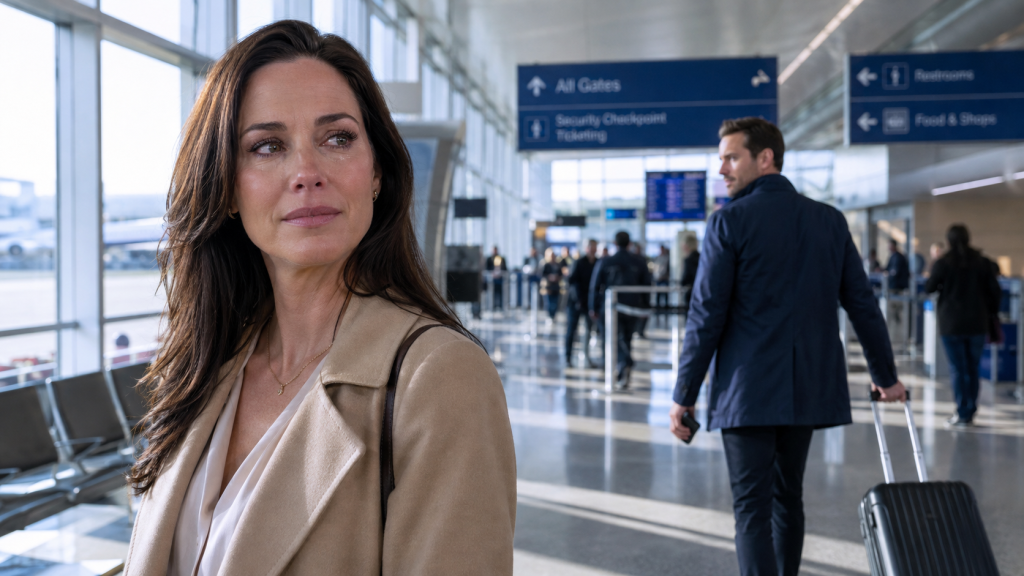
For a moment, I forgot how to breathe. I sat in my study, staring at the divorce petition on my desk while my husband’s voice crackled through the phone. Outside, rain was beginning to fall against the windows.
The same windows my grandmother had helped me pay to replace eight years earlier. The same house where Daniel had held me after three miscarriages, promising that no matter what happened, we would always have each other.
Now he was in Miami with another woman. And somehow, he was bringing my dead grandmother into his lies. “What did you just say?” I whispered. Daniel exhaled sharply. “Emma, listen carefully. Olivia has information about your grandmother’s estate.”
My fingers tightened around the phone.
“What information?”
“Something that could complicate the inheritance.”
I looked toward the framed photograph on my bookshelf.
Grandma Rose.
She was standing in her garden, wearing a faded blue cardigan, holding a basket of tomatoes and smiling as though the world had never given her a reason not to.
She had raised me after my parents died in a car accident when I was fourteen.
She had been my comfort.
My safe place.
The one person who never made me feel like loving me was difficult.
And now my husband was using her memory as a threat.
“Daniel,” I said quietly, “what exactly does Olivia know?”
He hesitated.
Then lowered his voice.
“There’s a letter.”
My stomach tightened.
“What letter?”
“Something Rose wrote before she died.”
I stared at the photograph.
“My grandmother died six years ago.”
“I know.”
“Then why would Olivia have something she wrote?”
Silence.
I could hear faint music in the background.
A door closing.
Then Daniel whispered, “Because Olivia wasn’t always a stranger to your family.”
The room seemed to tilt.
“What?”
He sighed.
“Emma, I don’t want to discuss this over the phone.”
I almost laughed.
“You’re pretending to work in Canada while living in Miami with your pregnant mistress, and now you’re suddenly concerned about having an honest conversation?”
“Keep your voice down.”
My eyes narrowed.
“Why? Is Olivia listening?”
He didn’t answer.
Then he said, “Look, if you put the money back where it belongs, we can discuss everything calmly.”
There it was.
The same demand.
The same money.
Seven hundred and twenty thousand dollars.
He hadn’t called because he was worried about my grandmother.
He’d called because his carefully planned escape was collapsing.
I took a slow breath.
“Daniel, if Olivia has something belonging to my grandmother, she can send it to my attorney.”
His voice hardened.
“You’re making a mistake.”
“No,” I whispered.
“I made my mistake twelve years ago when I married you.”
Then I ended the call.
I sat motionless for several minutes.
My heart was racing.
Part of me wanted to call him back and demand every answer immediately.
Another part wanted to drive to Miami and confront them both.
But I remembered Rebecca’s warning.
Don’t react to a threat before you understand what someone actually has.
I picked up my phone and called her.
She answered on the second ring.
“Emma?”
“Daniel just told me Olivia has information about my grandmother’s estate.”
Rebecca was quiet.
“What kind of information?”
“He claims there’s a letter.”
“Do you know whether it exists?”
“No.”
“Did he describe its contents?”
“No. He just demanded that I return the money.”
Rebecca exhaled.
“Then we treat it as an unverified claim.”
I leaned back.
“But why mention Grandma Rose?”
“Because he knows she matters to you.”
The words hurt.
Rebecca continued.
“He may be trying to frighten you into releasing funds before we’ve completed the financial review.”
I looked toward the desk.
“Could he challenge my inheritance?”
“Anyone can make an allegation. That doesn’t mean it’s valid. We need to examine the estate documents, the account history, and the evidence.”
I nodded.
Rebecca’s voice softened.
“Emma, you did the right thing by contacting me.”
My eyes filled.
“I feel like I’m losing my mind.”
“You’ve discovered a serious betrayal. That doesn’t mean you’re incapable of thinking clearly.”
I closed my eyes.
Then asked the question I was most afraid to say aloud.
“What if he’s been lying to me for years?”
Rebecca paused.
“Then we’re going to uncover the truth carefully.”
The next morning, I went to my grandmother’s old house.
I had inherited it after she died, but I’d never been able to sell it.
It was a small brick home on a quiet street in Queens.
Nothing luxurious.
Nothing impressive.
But its narrow porch and yellow kitchen had held nearly every happy memory of my childhood.
I still visited occasionally.
Sometimes to sort through belongings.
Sometimes simply because I missed her.
When I unlocked the front door, the familiar smell of old wood and lavender greeted me.
I stood in the hallway for a long moment.
“Grandma,” I whispered, “I wish you were here.”
Then I went upstairs.
Her bedroom remained mostly as she’d left it.
A wooden dresser.
A floral quilt.
Stacks of books.
And a little writing desk beside the window.
I opened the desk drawer.
Inside were old birthday cards, receipts, letters, and photographs.
I began sorting.
Hours passed.
Then I found something tucked beneath a stack of utility bills.
A cream-colored envelope.
My name was written across the front.
For Emma, when she is ready.
My hands began shaking.
I recognized the handwriting immediately.
Grandma Rose.
For a moment, I couldn’t open it.
Then I noticed something strange.
The envelope had already been unsealed.
The paper inside was folded neatly, but the edge was creased in a way that suggested someone had handled it recently.
My pulse quickened.
I unfolded the letter.
My darling Emma,
There are things I should have told you while I was still strong enough to sit beside you and explain them.
I swallowed.
I’ve spent years protecting you from pain, but I worry that sometimes protection can become another kind of silence.
My chest tightened.
I continued.
Your parents left you more than memories.
I froze.
My parents?
I read the sentence again.
There were financial matters after their deaths that I handled on your behalf.
My hands trembled.
When you are ready, I want you to understand where everything came from and why I made certain choices.
Then came a line that made my breath catch.
If anyone ever tells you that you owe them your inheritance, ask to see the original documents.
I pressed a hand against my mouth.
The letter ended with a simple sentence.
Money can be replaced, sweetheart. Your freedom cannot.
I stared at the page.
Then turned it over.
There was no second page.
But at the bottom, Grandma had written:
The blue box in the attic.
I went upstairs so quickly I nearly tripped.
The attic was dusty.
Old Christmas decorations lined one wall.
A broken rocking chair leaned beside several cardboard boxes.
And beneath a faded blanket stood a blue metal document case.
I recognized it.
Grandma used to keep important papers inside.
When I was a child, she called it her “boring box.”
“Nothing exciting in there, Emma,” she’d tell me. “Just the paperwork that keeps life from becoming unnecessarily dramatic.”
I almost smiled at the memory.
Now, standing alone in that attic, I wished desperately that she’d been right.
The box was locked.
I searched the nearby shelves until I found a small envelope taped beneath the lid.
Inside was a key.
My hands shook as I turned it.
The lock clicked.
I opened the box.
And discovered a part of my family’s history I’d never known existed.
There were insurance records from my parents’ deaths.
Documents concerning investments Grandma had managed for me while I was a minor.
Bank statements.
Copies of old wills.
And a notebook filled with her careful handwriting.
At the top of the first page, she’d written:
Emma’s future. Never mix this with anyone else’s promises.
I sat down on the attic floor.
My grandmother had spent years carefully documenting the money she’d protected for me.
Not because she was wealthy.
But because she’d understood how vulnerable a young woman could become when she didn’t know where her financial security came from.
I turned another page.
There was an entry from the year Daniel and I married.
Emma is in love. I pray he treats her gently.
My eyes filled.
The next entry was dated six months later.
Daniel asked whether the inheritance could be placed into a joint investment structure. I advised Emma to wait.
I stopped breathing.
I remembered that conversation.
Daniel had suggested combining our savings into one account because, according to him, married people shouldn’t keep financial secrets.
Grandma had quietly asked me to think carefully.
I’d accused her of distrusting my husband.
She hadn’t argued.
She’d simply hugged me.
Now I understood why.
I turned the page.
And found another entry.
Daniel came to see me alone.
My stomach dropped.
I sat frozen.
The attic seemed suddenly too small.
I read the words again.
Daniel came to see me alone.
Grandma’s handwriting continued.
He asked whether Emma would eventually receive the remainder of my estate.
My heart pounded.
I told him my plans were private and that Emma’s inheritance belonged to Emma.
There was a long line beneath the sentence, as though Grandma had paused before continuing.
He became unpleasant.
My hands began shaking.
He said marriage made him entitled to understand our finances.
I covered my mouth.
I told him marriage should make him responsible for his wife’s happiness, not curious about the size of her accounts.
Tears filled my eyes.
I could almost hear Grandma saying it.
Calmly.
Firmly.
Without raising her voice.
Then came the final sentence.
I hope I am wrong about him.
I pressed the notebook against my chest.
“Oh, Grandma.”
I had spent years believing Daniel and my grandmother simply didn’t understand each other.
He’d complained that she was controlling.
She’d said very little.
Whenever I tried to arrange family dinners, Daniel always had a reason to leave early.
I’d thought they were ordinary personality differences.
Now I wondered whether Grandma had seen something in him long before I did.
I looked down at the documents.
Then a more troubling thought occurred to me.
Someone had opened the envelope downstairs.
Someone might have searched the house.
I hadn’t been there in several weeks.
Daniel still had an old key.
My pulse quickened.
I called Rebecca immediately.
“Rebecca,” I whispered, “I think Daniel has been inside my grandmother’s house.”
Within hours, Rebecca helped me arrange to secure the property and preserve the documents.
I photographed the letter, the notebook, and the contents of the blue box.
I didn’t confront Daniel.
I didn’t call Olivia.
Instead, I brought everything to Rebecca’s office.
She reviewed the papers carefully.
Then looked at me.
“Emma, these may be important.”
I swallowed.
“Do they prove the inheritance was mine?”
“They support the history of the funds, but we’ll need to trace the actual account transactions and review the estate records.”
I nodded.
She continued.
“The fact that your grandmother kept organized records is helpful.”
I looked down.
“Daniel always said Grandma was paranoid about money.”
Rebecca’s expression softened.
“Sometimes people call boundaries paranoia when those boundaries prevent them from getting what they want.”
My eyes filled.
She opened another folder.
“There’s something else.”
I looked up.
“We’ve obtained preliminary information about Daniel’s financial activity.”
My heart tightened.
“What did you find?”
Rebecca took a slow breath.
“Several transfers from your joint account were initiated during the months before he left.”
I stared at her.
“But the balance was still seven hundred and twenty thousand.”
“Yes. There were incoming deposits and outgoing transfers. The account’s balance alone doesn’t show the full history.”
She slid a statement toward me.
I saw unfamiliar names.
An investment platform.
A consulting company.
Payments to a property management firm in Florida.
My stomach dropped.
“Miami?”
Rebecca nodded.
“We’re reviewing whether these payments were authorized and how they were described.”
I felt sick.
For months, Daniel had been telling me we needed to cut back.
He’d complained about grocery bills.
Suggested postponing repairs.
Told me we shouldn’t take a vacation because the market was uncertain.
Meanwhile, money had apparently been moving toward the life he was building with another woman.
I looked at Rebecca.
“How long has this been happening?”
She met my eyes.
“We’re still tracing it.”
I closed my eyes.
Then whispered, “I thought we were saving for our future.”
Rebecca was quiet.
I looked at the statement again.
“He was saving for his.”
Three days later, Olivia emailed me.
This time, her tone was different.
Emma, I need to talk to you. Please.
I stared at the message.
Below it was another sentence.
Daniel has been lying to both of us.
I sat back.
Then forwarded it to Rebecca.
She advised me to keep communications documented and avoid making promises or accusations.
So I replied carefully.
You may send any information you want me to consider to my attorney.
Olivia responded within minutes.
I don’t want to hurt you anymore. But there’s something you need to see.
Attached was a photograph.
It showed a document lying on a white marble countertop.
At the top were the words:
Private Investment Agreement.
Below them was my grandmother’s name.
Rose Eleanor Whitman.
My breath caught.
Grandma had never used that document title in any of her records.
I enlarged the photograph.
Near the bottom was a signature.
It looked like hers.
But something was wrong.
Grandma always formed the letter R with a distinctive curl.
This signature lacked it.
I stared.
Then noticed the date.
The agreement had supposedly been signed six months after Grandma’s death.
I felt the blood drain from my face.
I called Rebecca.
“Look at the date.”
She was quiet for several seconds.
Then said, “Emma, preserve that image.”
My hands trembled.
“What does it mean?”
“It raises serious questions about the document’s authenticity.”
I closed my eyes.
Then whispered, “Daniel has been using my dead grandmother’s name.”
Rebecca arranged for Olivia’s information to be reviewed through counsel.
Olivia agreed to provide copies of what she had.
She also agreed to speak with us at Rebecca’s office during a scheduled visit to New York.
When she arrived, I almost didn’t recognize the woman I’d imagined for months.
She was twenty-nine.
Pregnant.
Nervous.
And far less confident than her earlier messages had suggested.
She sat across from me with both hands resting over her stomach.
“Emma,” she whispered, “I’m sorry.”
I looked at her.
There were a thousand things I wanted to say.
A thousand questions.
Did you know he was married?
Did you enjoy watching me suffer?
Did you laugh while he lied to me?
But when I opened my mouth, only one question came out.
“Did you know about me?”
Olivia began crying.
“Yes.”
The honesty hurt.
I looked away.
She continued.
“He told me your marriage was over.”
I closed my eyes.
“He said you were living separately and only pretending to stay together for financial reasons.”
My throat tightened.
“That wasn’t true.”
She nodded.
“I know that now.”
I stared at her.
“Then why did you send me that cruel email?”
Olivia covered her face.
“Because he told me you were trying to ruin his life.”
I felt anger rise.
She continued.
“He said you were refusing to release money that belonged to him.”
I leaned forward.
“Olivia, that money came from my grandmother’s estate and my work.”
Her eyes filled.
“I believe you.”
I studied her.
“Why?”
She opened her handbag.
Then placed a folder on the table.
“Because I found this in his condo.”
Inside were copies of documents.
Investment agreements.
Account summaries.
Emails.
And the suspicious paper bearing Grandma’s name.
Olivia’s voice trembled.
“He told me your grandmother had promised him money before she died.”
I stared at her.
“He said she’d invested in one of his businesses and that the estate owed him repayment.”
Rebecca leaned forward.
“Did he show you original agreements?”
Olivia shook her head.
“Only copies.”
She swallowed.
“When I saw the dates, I asked questions.”
I looked at her.
“What did he say?”
Her face crumpled.
“He told me I was too stupid to understand.”
The room fell silent.
Then Olivia whispered, “That was when I started wondering what else he’d lied about.”
She told us Daniel had met her nearly two years earlier.
Not six months.
Not recently.
Two years.
He had introduced himself as a successful consultant whose marriage was ending.
He claimed I had moved on emotionally.
That we barely spoke.
That he was waiting for certain financial matters to settle before filing for divorce.
Olivia believed him.
At least, she wanted to.
When she became pregnant, Daniel promised they would move to Miami and begin again.
He told her he had substantial savings.
He showed her photographs of luxury properties.
He said the condo lease was temporary because he expected a large distribution from an investment connected to his wife’s family.
I stared at her.
“And you believed all of it?”
She looked down.
“Yes.”
I took a breath.
“Even after you knew I was still married to him?”
Her eyes filled.
“I told myself the marriage was over in every way that mattered.”
I looked away.
The words hurt.
Because they were the kind of convenient explanation people use when truth threatens something they want.
Olivia began crying.
“I know that doesn’t excuse what I did.”
I remained quiet.
Then she said something that surprised me.
“I don’t expect you to forgive me.”
I looked back.
“I just don’t want you to lose everything because I was afraid to admit I was wrong.”
Rebecca reviewed the documents.
Then asked Olivia several questions about where she’d found them, what Daniel had said, and whether she’d altered anything.
Olivia answered carefully.
When the meeting ended, she stood.
Her eyes were red.
“Emma, I really am sorry.”
I studied her.
For a moment, I thought about the baby she was carrying.
A child who had no responsibility for the choices surrounding his birth.
Then I looked at Olivia.
“I hope you protect your child from the kind of lies that brought us here.”
She began crying.
“I will.”
I nodded.
And let her leave.
That evening, I returned to Grandma’s house.
I sat at her old kitchen table with a cup of tea.
The room was quiet.
The refrigerator hummed softly.
Rain tapped against the window.
I looked toward the empty chair where she used to sit.
“Grandma,” I whispered, “you tried to warn me.”
My eyes filled.
I remembered the first time Daniel met her.
He’d brought flowers.
A beautiful bouquet of white lilies.
Grandma had thanked him politely.
After dinner, while he helped carry dishes into the kitchen, she’d watched him carefully.
Later, she asked me one question.
“Emma, does he make you feel safe enough to disagree with him?”
I had laughed.
“What kind of question is that?”
She’d smiled gently.
“An important one.”
I told her Daniel was wonderful.
That he was ambitious.
Charming.
Devoted.
That he wanted to build a beautiful life with me.
Grandma had listened.
Then she’d said, “Ambition isn’t a problem, sweetheart. But make sure he wants to build a life with you, not simply around you.”
At the time, I thought she was being cautious.
Now I understood.
Daniel liked being admired.
He liked people believing he was successful.
He liked the idea of wealth.
And slowly, over the years, I’d begun measuring my own worth by how well I supported his dreams.
I postponed vacations.
I stopped buying things I wanted.
I worked late.
I forgave missed anniversaries.
I excused his impatience.
And after the miscarriages, when my grief became inconvenient to him, I apologized for being sad.
I pressed my hands against my face.
How had I become someone who apologized for needing comfort?
The answer wasn’t simple.
There had been good years.
Real laughter.
Happy memories.
Quiet mornings when Daniel brought me coffee.
Trips where we walked along the beach holding hands.
Days when he made me feel loved.
I refused to pretend those moments hadn’t happened.
That would have been another kind of dishonesty.
But I was beginning to understand something painful.
Good memories don’t cancel betrayal.
And the fact that someone once loved you doesn’t give them permission to keep hurting you.
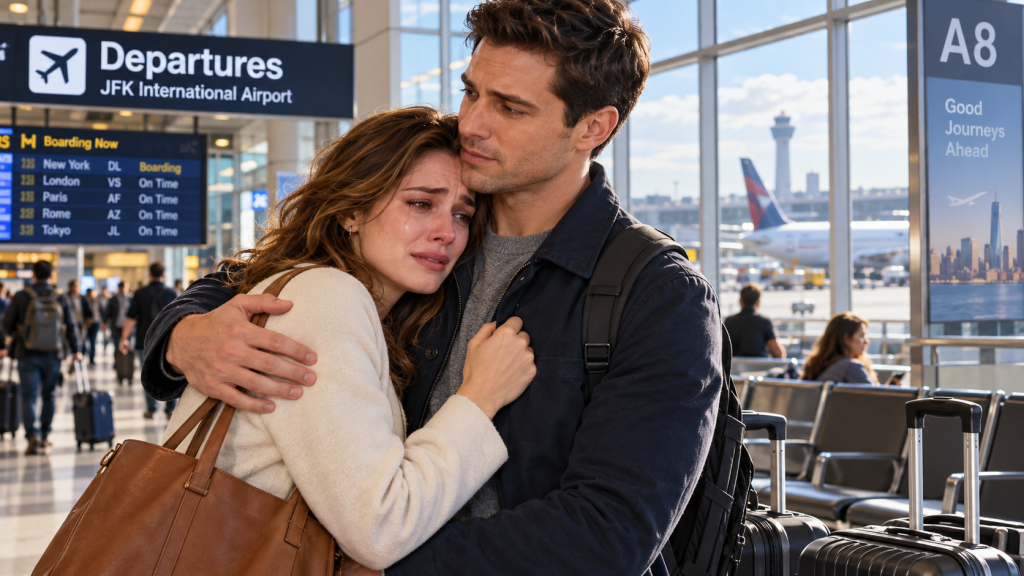
I thought about the airport.
The way Daniel held me.
The tenderness in his voice.
The kiss on my forehead.
It’s for us.
He had looked directly into my eyes and lied.
Not once.
Not impulsively.
But as part of a carefully prepared plan.
He had arranged a condo.
Scheduled transfers.
Constructed a story about working in Canada.
And expected me to wait faithfully while he built another life.
I looked toward Grandma’s empty chair.
Then whispered, “I won’t wait anymore.”
The divorce proceedings became more complicated than I expected.
Daniel hired an attorney.
His initial response disputed my characterization of the funds and sought an accounting of the money I’d moved from the joint account.
Rebecca had anticipated that.
We had preserved the transaction records.
The money remained untouched in an account where it could be traced while ownership and any marital claims were reviewed.
I wasn’t going to spend it recklessly.
I wasn’t going to hide it.
And I wasn’t going to pretend that transferring funds out of a joint account automatically settled every legal question.
I wanted the matter resolved properly.
Daniel also challenged the source of certain deposits.
He claimed some represented business income and marital savings.
Rebecca and a forensic accountant examined the statements.
They traced deposits from Grandma’s estate.
Reviewed the original inheritance paperwork.
Reconstructed transfers between accounts.
And separated what could be documented from what remained disputed.
It was exhausting.
Some days, I spent hours reading statements.
Other days, I wanted to throw every folder across the room.
But I kept going.
Not because I wanted revenge.
Because I wanted my life back.
One afternoon, Rebecca called.
“Emma, we found something.”
My heart tightened.
“What?”
“The company listed on those private investment agreements.”
I sat down.
“What about it?”
“It appears Daniel had an ownership interest in it.”
I closed my eyes.
“Of course.”
She continued.
“The company received funds from accounts connected to your household finances.”
My stomach dropped.
“How much?”
“We’re still calculating the amounts and checking the authorization history.”
I pressed a hand against my forehead.
Rebecca paused.
“Emma, there’s more.”
I swallowed.
“The agreement that supposedly bears your grandmother’s signature is dated after her death. We have confirmation of that.”
I stared at the wall.
“And Daniel submitted it?”
“We have evidence that the document was circulated in connection with financial representations he made. We’re examining its origin and use.”
My hands trembled.
“What happens now?”
“Your attorney team will address the document in the civil proceedings, and we’ll discuss whether it should be referred for further investigation.”
I closed my eyes.
For months, Daniel had treated me as though I was too trusting to notice.
Now every document he’d created was becoming another piece of the story.
And the story wasn’t one he could control simply by speaking more confidently than everyone else.
The most painful discovery arrived in a small folder.
Rebecca had asked me to review some older correspondence.
Among the documents was an email Daniel had sent to a financial adviser four years earlier.
The subject line read:
Future inheritance planning.
I opened it.
My stomach tightened.
Daniel had written that I was the primary beneficiary of my grandmother’s estate and that he expected access to those funds as part of our marital financial arrangements.
He described me as cautious.
Emotionally attached to the money.
Difficult to persuade.
Then came a sentence that made my vision blur.
Once Emma feels secure enough, I expect she’ll agree to consolidate everything.
I stared at the screen.
Four years ago.
Four years before Miami.
Four years before Olivia’s pregnancy.
Four years before the airport goodbye.
He had already been discussing how to gain access to money he knew mattered deeply to me.
I remembered the arguments.
The subtle pressure.
His insistence that separate finances meant a lack of trust.
The way he’d accused me of treating him like an outsider whenever I hesitated.
My hands shook.
I closed the email.
Then opened Grandma’s notebook again.
Emma’s future. Never mix this with anyone else’s promises.
I began crying.
Not because I’d lost the money.
But because I finally understood how many times my instincts had tried to warn me.
And how often I’d silenced them to keep the peace.
Around that time, Daniel began sending messages.
At first, they were angry.
You’re ruining my reputation.
You’ve turned Olivia against me.
You don’t understand what you’ve done.
Then they became sentimental.
Remember our honeymoon?
Remember when we bought the house?
We were happy once, Emma.
I didn’t answer.
Rebecca advised me to keep communications through appropriate channels while the proceedings continued.
Then one evening, another message arrived.
I miss you.
I stared at it for a long time.
The words hurt more than the accusations.
Because part of me still remembered loving him.
Part of me still remembered the man who held my hand when the doctor told us our first pregnancy had ended.
The man who brought me soup when I was sick.
The man who once danced with me in our kitchen because my favorite song came on the radio.
I closed my eyes.
Then I remembered the luxury condo lease.
Olivia’s ultrasound.
The emails.
The false stories.
The airport.
I placed the phone facedown.
Missing someone isn’t the same as trusting them.
And loving the person you thought someone was doesn’t mean you must remain with the person they’ve shown themselves to be.
One Saturday morning, I visited a small bakery near Grandma’s house.
I hadn’t been there in years.
When I was little, Grandma used to take me after school.
She’d buy a cinnamon roll and insist we share it.
Even though she always let me eat most of it.
The bakery had changed owners.
But the smell was the same.
Warm butter.
Sugar.
Fresh bread.
I ordered coffee and a cinnamon roll.
Then sat by the window.
For the first time in months, I wasn’t thinking about legal documents.
I wasn’t wondering where Daniel was.
I wasn’t checking my phone.
I was simply sitting quietly.
Enjoying something small.
I took a bite.
And began crying.
The woman behind the counter approached gently.
“Are you all right?”
I wiped my cheeks.
“Yes.”
I laughed softly.
“It’s just been a difficult year.”
She smiled.
“Would you like another napkin?”
I nodded.
“Thank you.”
She returned with a small stack.
Then said, “Take your time.”
Those three words nearly broke me.
For years, I’d lived according to Daniel’s schedule.
His plans.
His ambitions.
His expectations.
Now a stranger was telling me I didn’t have to hurry.
I sat there until my coffee grew cold.
And when I finally stood, I felt something unfamiliar.
Not happiness exactly.
But possibility.
A few weeks later, Olivia contacted Rebecca again.
She had moved out of the Miami condo.
Daniel was no longer living with her.
She had decided to stay temporarily with her sister while preparing for the baby’s arrival.
She also provided additional documents relating to the condo lease and expenses Daniel had represented as business costs.
I didn’t celebrate their separation.
I didn’t feel victorious.
Another relationship had collapsed under the weight of the same dishonesty that destroyed mine.
And an unborn child was now facing uncertainty before he had even entered the world.
I thought about my three miscarriages.
For years, I’d imagined what it would be like to hold a baby of my own.
To hear a tiny laugh.
To read bedtime stories.
To watch a child grow.
Those dreams had become painful enough that I rarely spoke about them.
Now Olivia was preparing to give birth to Daniel’s son.
I expected to feel jealousy.
Sometimes I did.
But more than anything, I felt sorrow.
Not because her child existed.
But because Daniel had used the promise of family as another excuse to lie.
I realized that the baby wasn’t responsible for any of it.
He deserved stability.
Honesty.
And adults willing to take responsibility for their choices.
I hoped Olivia would give him that.
And I hoped Daniel would eventually understand that fatherhood couldn’t be performed through expensive gifts and grand promises.
It required showing up.
Truthfully.
Consistently.
Without demanding that someone else pay for the life you wanted.
The following month, Rebecca arranged a settlement conference.
Daniel attended with his attorney.
I hadn’t seen him in person since the airport.
When he entered the room, my breath caught.
He looked older.
His face was thinner.
His expensive suit hung slightly loose across his shoulders.
But his eyes were the same.
For a moment, he smiled.
“Emma.”
I nodded.
“Daniel.”
He looked as though he wanted to say something more.
Rebecca gently directed everyone to their seats.
The conversation began with financial disclosures.
Account histories.
Property.
The suspicious investment documents.
The transfers connected to Florida.
It was slow, technical, and emotionally draining.
But eventually, the discussion turned toward the marriage itself.
Daniel looked at me.
“Emma, I never wanted things to end like this.”
I stared.
Then whispered, “How did you want them to end?”
He looked down.
“I don’t know.”
I took a breath.
“You told me you were moving to Canada for work.”
He nodded.
“You promised to call every day.”
His eyes filled.
“You kissed me goodbye while another woman was waiting for you in Miami.”
He closed his eyes.
I continued.
“And you planned to use money I believed we were protecting for our future.”
His shoulders dropped.
For a moment, nobody spoke.
Then he whispered, “I was afraid.”
I stared.
“Afraid of what?”
“That I’d failed.”
I looked at him.
He continued.
“My business was struggling. I had debts. I felt like every decision I’d made was wrong.”
I remained quiet.
“Then Olivia became pregnant.”
He swallowed.
“And I thought if I could start over somewhere else, I could escape everything.”
I closed my eyes.
“You couldn’t escape yourself.”
He looked at me.
“No.”
For the first time, he seemed to understand.
But understanding didn’t undo what he’d done.
I took a slow breath.
“Daniel, you could have told me you were struggling.”
His eyes filled.
“You could have told me you wanted a divorce.”
I swallowed.
“You could have told me you loved someone else.”
Tears rolled down my cheeks.
“It would have hurt.”
My voice broke.
“But at least I would have been standing in the truth.”
He covered his face.
“I’m sorry.”
I nodded slowly.
“I hear you.”
Then I added, “But I’m not coming back.”
The settlement process continued.
There were disagreements.
Questions about disputed documents.
And matters that required further review.
But eventually, with legal guidance and financial tracing, we reached an agreement addressing the divorce and division of assets.
A substantial portion of the funds was recognized as traceable to my grandmother’s estate and handled accordingly under the applicable legal framework.
Other amounts were resolved through negotiated terms.
I didn’t receive every dollar I’d initially hoped to protect.
And Daniel didn’t receive the access he’d expected.
It wasn’t a dramatic victory.
It was a carefully documented resolution to a painful situation.
The disputed investment documents were separately addressed through the appropriate review process.
I learned that the law rarely delivers emotional closure.
It determines rights, obligations, and consequences.
Closure, if it comes, has to be built elsewhere.
When the divorce was finalized, Rebecca called.
“Emma, it’s done.”
I sat silently.
For several seconds, I couldn’t speak.
Then I whispered, “I’m divorced.”
“Yes.”
I closed my eyes.
The word felt enormous.
Divorced.
I had imagined spending the rest of my life with Daniel.
Growing old beside him.
Taking trips.
Arguing about dinner.
Laughing over memories.
Instead, I was alone in the house where we’d built a life together.
And yet, beneath the sadness, I felt something unexpected.
Relief.
Not because divorce was easy.
But because the uncertainty had ended.
The lies no longer controlled my future.
I took a breath.
Then whispered, “Thank you, Rebecca.”
She smiled through the phone.
“You’re welcome.”
That evening, I went to Grandma’s house.
I carried a small bouquet of white lilies.
I placed them beside her photograph.
Then sat at the kitchen table.
For a long time, I looked at the room.
The yellow cabinets.
The old curtains.
The wooden chairs.
The chipped ceramic bowl she always used for fruit.
I thought about everything she’d done for me.
After my parents died, she could have allowed grief to swallow her.
Instead, she brought me home.
She made breakfast.
Helped with homework.
Attended school events.
Held me while I cried.
And slowly taught me that surviving loss didn’t mean forgetting the people we’d loved.
Then, when I became an adult, she protected my financial future as carefully as she’d protected my childhood.
Even after her death, her records and advice helped me recognize a deception I had been too frightened to face.
I touched her photograph.
“Grandma,” I whispered, “I did it.”
My eyes filled.
“I finally chose myself.”
I sat quietly.
Then laughed through tears.
“You would’ve told me to eat something.”
I stood.
Opened the kitchen cupboard.
And found a box of tea I’d left there during my last visit.
I brewed a cup.
Sat back down.
And for the first time in a long while, I didn’t feel like the woman Daniel had abandoned.
I felt like Emma.
Grandma Rose’s girl.
The one she’d taught to stand up after falling.
Over the following months, I began rebuilding my life.
Not through dramatic transformations.
Not by buying a sports car or taking a luxurious vacation to prove I was happy.
I started with ordinary things.
I repainted my bedroom.
Changed the bedding.
Moved furniture.
Took down photographs that made the house feel trapped in a past I no longer wanted to inhabit.
I kept some memories.
Others I placed in boxes.
I didn’t burn wedding pictures.
I didn’t pretend the marriage had never happened.
Twelve years of my life were real.
But I no longer wanted every room to remind me of promises Daniel had broken.
I began taking evening walks.
Cooking meals I liked.
Listening to music without wondering whether it annoyed anyone.
I started seeing a therapist.
At first, I struggled to explain why I needed help.
I wasn’t in physical danger.
I had a home.
A job.
Friends.
Financial stability.
But the betrayal had left me questioning my judgment.
I worried that I couldn’t trust myself.
My therapist helped me understand that being deceived didn’t mean I was foolish.
It meant someone had chosen deception.
And rebuilding trust in myself would take time.
I worked through the grief of my marriage.
The lingering sorrow of my miscarriages.
The complicated feelings I had about Olivia’s baby.
And the fear that I’d wasted the best years of my life.
Some sessions left me exhausted.
Others gave me clarity.
And slowly, I began to feel like I was returning to myself.
One afternoon, I received a letter from Olivia.
It arrived through Rebecca’s office.
Inside was a photograph of a newborn baby.
A little boy.
Wrapped in a pale blue blanket.
His tiny hands rested beside his face.
I stared at the picture.
For a moment, I couldn’t move.
Then I unfolded the letter.
Emma,
My son was born last week.
His name is Noah.
I know you may not want to hear from me.
I understand if you never respond.
But I wanted to tell you that you were right.
Children deserve honesty.
I have been working to build a stable life for him.
Daniel and I are addressing his responsibilities through the appropriate channels.
I also wanted to apologize again.
I allowed myself to believe a story that made someone else’s pain seem unimportant.
I won’t do that again.
I hope one day you find the happiness you deserve.
Olivia.
I stared at the photograph.
Noah.
An innocent child.
His life was beginning just as mine was taking an entirely different direction.
I cried.
Not because I wanted him to suffer.
Not because I wished he’d never been born.
But because his existence touched a part of my heart that had never fully healed.
I thought about the babies I’d lost.
The nursery I’d imagined.
The tiny clothes I’d bought and later packed away.
The way Daniel had sometimes grown impatient with my grief.
I placed the photograph beside the letter.
Then sat quietly.
Eventually, I wrote a brief reply.
Olivia,
Thank you for letting me know Noah arrived safely.
I hope he grows up surrounded by honesty, stability, and love.
I wish him well.
Emma.
I didn’t send gifts.
I didn’t ask for updates.
I didn’t become involved in their family.
That wasn’t my role.
But I could wish an innocent child a good life without reopening the wounds his father’s choices had caused.
And that felt like progress.
A year after the airport goodbye, I took a trip.
Not to Toronto.
Not to Miami.
I went to a quiet coastal town in Maine.
Grandma Rose had always wanted to visit.
She loved the idea of rocky shores, lighthouses, and little bookstores overlooking the water.
We’d planned a trip once, but her health declined before we could go.
So I went for both of us.
I rented a small cottage.
Walked along the beach.
Collected smooth stones.
And visited a bookstore where the owner recommended novels I would never have chosen myself.
One evening, I sat on a wooden bench overlooking the ocean.
The sky was streaked with gold and pink.
Seagulls circled overhead.
I thought about the woman I’d been a year earlier.
Standing at JFK.
Crying into Daniel’s chest.
Pretending to believe his promises.
Then driving home with a plan to protect myself.
At the time, I’d imagined that moving the money and filing for divorce would make me feel powerful.
But the months afterward had taught me something.
Real strength wasn’t in surprising Daniel.
It wasn’t in watching him panic.
And it wasn’t in proving I could survive without him.
Real strength was continuing to live honestly after discovering how much dishonesty had shaped my marriage.
It was facing painful facts.
Accepting help.
Protecting my boundaries.
And refusing to allow betrayal to become the center of the rest of my life.
I looked toward the horizon.
Then whispered, “Grandma, you would’ve loved this.”
The waves moved gently toward the shore.
I smiled.
And for the first time in years, I felt free.
When I returned home, I made another decision.
I wanted Grandma’s house to become something more than a place filled with memories.
For years, I’d kept it unchanged because I was afraid that altering anything would make me feel as though I was losing her all over again.
But the house was too full of warmth to remain empty.
I began restoring it.
Not extravagantly.
Just carefully.
I repaired the porch.
Painted the kitchen.
Replaced worn fixtures.
And created a small room filled with books.
Then I contacted a local organization that supported young adults transitioning out of unstable family situations.
I wanted to explore whether the house could be used, through an appropriate arrangement, to provide temporary housing and practical support.
The planning took time.
There were inspections.
Insurance questions.
Legal details.
And many conversations.
But eventually, I found a responsible way to make the property useful while protecting it.
The first young woman who stayed there was named Maya.
She was nineteen.
Quiet.
Determined.
And trying to finish community college while working part-time.
When she first entered the house, she looked around nervously.
“It’s beautiful.”
I smiled.
“Thank you.”
She touched the back of a kitchen chair.
“Are you sure I can stay here?”
My throat tightened.
“Yes.”
Her eyes filled.
“For how long?”
I explained the agreed terms and support arrangement.
She nodded.
Then whispered, “I’ve never had somewhere this peaceful.”
I looked toward Grandma’s photograph on the mantel.
And for a moment, I felt as though the woman who had raised me was still reaching out to someone who needed a safe place to begin again.
Over the next year, Maya worked hard.
She continued her studies.
Saved money.
And gradually built confidence in herself.
Sometimes we had coffee together.
Sometimes we discussed practical things.
Budgeting.
Job applications.
The importance of keeping copies of important documents.
One afternoon, she asked why I was so careful about finances.
I smiled sadly.
“Because someone once used my trust against me.”
She looked concerned.
“What happened?”
I told her a little.
Not every painful detail.
Just enough.
She listened carefully.
Then said, “That must’ve been terrible.”
I nodded.
“It was.”
She hesitated.
“Did you ever stop trusting people?”
I considered.
“For a while, I wanted to.”
She looked at me.
“And now?”
I smiled gently.
“Now I try to trust slowly.”
She nodded.
I continued.
“And I remember that someone who respects you won’t demand that you ignore your own questions.”
Maya thought about that.
Then smiled.
“I’ll remember.”
I looked toward Grandma’s photograph.
So would she.
I was certain of it.
Two years after the divorce, I received an unexpected phone call.
It was Daniel.
I almost didn’t answer.
But when I saw his name, I realized I no longer felt the same rush of fear or anger.
I considered.
Then answered.
“Hello?”
“Emma.”
His voice sounded different.
Older.
Quieter.
“Daniel.”
He hesitated.
“I hope I’m not bothering you.”
I looked toward the garden.
“What do you need?”
There was a long pause.
Then he said, “I wanted to apologize.”
I closed my eyes.
“You’ve already apologized.”
“I know.”
He took a breath.
“But I don’t think I ever told you the whole truth.”
I remained quiet.
He continued.
“I was jealous of you.”
The words startled me.
“What?”
“Your grandmother loved you.”
I frowned.
“Of course she did.”
“You had something I never felt I had.”
I looked down.
“A family that made you feel safe.”
His voice trembled.
“And money that gave you choices.”
I was quiet.
He continued.
“I told myself I was ambitious.”
He laughed bitterly.
“But a lot of it was resentment.”
I looked toward the window.
“I resented that you didn’t need me financially.”
My chest tightened.
“And when my business started failing, I couldn’t stand the thought of admitting it.”
I closed my eyes.
He whispered, “So I lied.”
I said nothing.
“I lied about the money.”
“I lied about Olivia.”
“I lied about Canada.”
His voice broke.
“And I tried to make you feel guilty for protecting yourself.”
I took a slow breath.
“Daniel, I know.”
He was quiet.
Then whispered, “I don’t expect forgiveness.”
I looked at the trees outside.
For a moment, I considered everything we’d been through.
The love.
The grief.
The betrayal.
The divorce.
The years I’d spent recovering.
Then I said, “I hope you continue taking responsibility for your choices.”
He nodded, though I couldn’t see him.
“I am.”
I took a breath.
“And I hope you become the kind of father Noah deserves.”
His voice broke.
“I’m trying.”
I closed my eyes.
“Then keep trying.”
There was a long silence.
Then he whispered, “Goodbye, Emma.”
I looked toward Grandma’s photograph.
“Goodbye, Daniel.”
I ended the call.
And felt no need to call back.
That evening, I sat in the garden with a cup of tea.
The sun was lowering behind the trees.
A gentle breeze moved through the flowers.
I thought about what Daniel had said.
His jealousy.
His shame.
His fear of failure.
For years, I might have taken those feelings as an invitation to comfort him.
To reassure him.
To explain why he wasn’t a bad person.
To soften the consequences.
But I had learned something.
Understanding why someone hurt you doesn’t mean you must become responsible for healing them.
Daniel had his life.
His child.
His choices.
And the responsibility to face them.
I had mine.
And for the first time, I wasn’t afraid of the difference.
As the years passed, my life became quieter.
Not empty.
Quiet.
There were mornings when I drank coffee without checking anyone else’s schedule.
Evenings when I read until midnight.
Weekends spent gardening.
Visits with friends.
Trips I’d once postponed because Daniel insisted we should save money for his next investment.
I still missed Grandma.
I still carried sadness from the pregnancies I’d lost.
And sometimes, when I heard a song from my wedding, I felt a brief ache.
But those memories no longer controlled me.
I stopped measuring my life by what hadn’t happened.
The children I hadn’t raised.
The marriage that hadn’t lasted.
The future Daniel and I hadn’t built.
Instead, I began noticing what remained.
My health.
My work.
My home.
My friendships.
My freedom to choose.
And the possibility of discovering new things about myself.
I took a pottery class.
I was terrible at it.
My first bowl looked like a collapsed flowerpot.
I laughed so hard the instructor came over to make sure I was all right.
Then I signed up for another class.
Because for once, I didn’t need to be impressive.
I only needed to enjoy being alive.
One winter afternoon, Maya came to visit.
She had completed her studies and found a stable job.
She was preparing to move into an apartment of her own.
When she arrived, she carried a small wrapped package.
“Emma, I brought you something.”
I smiled.
“You didn’t have to.”
“I wanted to.”
Inside was a framed photograph.
It showed Grandma’s old house.
The porch.
The yellow kitchen window.
The little garden I’d restored.
Beneath the photograph, Maya had written:
Thank you for giving me a place to begin again.
My eyes filled.
“Oh, Maya.”
She smiled through tears.
“You always said your grandmother made this house feel safe.”
I nodded.
“She did.”
Maya took my hand.
“Well, you made it feel safe for me.”
I began crying.
She hugged me.
And in that moment, I realized something.
The money Grandma left me had mattered.
It helped me remain secure.
It gave me choices.
It protected me when my marriage fell apart.
But her greatest gift wasn’t the inheritance itself.
It was the example she’d given me.
How to love without controlling.
How to help without demanding.
How to protect someone’s dignity while allowing them to build their own life.
I looked toward her photograph.
And whispered, “You did good, Grandma.”
On the fifth anniversary of the day I drove Daniel to the airport, I returned to JFK.
Not because I wanted to relive the pain.
I was flying to visit an old friend in California.
As I walked through the departures terminal, I recognized the place where Daniel had held me.
The same wide windows.
The same polished floors.
The same endless announcements.
For a moment, I stopped.
I remembered his arms around me.
His soft voice.
His promise to call every day.
And my own tears.
Then I remembered walking away.
The sudden stillness.
The determination.
The drive home.
The bank account.
The divorce petition.
The long months of discovering truths I hadn’t wanted to believe.
I stood there for a moment.
Then smiled.
Because the woman who had once walked through that terminal pretending to believe a lie was no longer the woman standing there now.
I’d lost a marriage.
I’d faced painful truths.
I’d learned things about myself I wish I hadn’t needed to learn.
But I had also found something precious.
The ability to trust my own judgment again.
I pulled my suitcase toward security.
Then my phone rang.
It was Maya.
“Emma! Did you get to the airport okay?”
I laughed.
“Yes.”
“Did you remember your passport?”
“I’m flying to California, sweetheart.”
She burst out laughing.
“Oh. Right.”
I smiled.
“Still appreciate the reminder.”
She paused.
Then said, “Have fun.”
I looked around the terminal.
For years, those words would’ve sounded strange.
Fun.
Without Daniel.
Without a shared plan.
Without asking whether someone else approved.
Now they felt beautiful.
“I will,” I said.
And I meant it.
I still think about Grandma Rose often.
Especially when I make difficult decisions.
She had a way of asking simple questions that revealed complicated truths.
Does this person respect your no?
Do you feel safe telling them the truth?
Are you making this choice because you want to, or because you’re afraid of disappointing someone?
For years, I’d ignored those questions.
I believed love meant trust without hesitation.
Sharing everything.
Never asking too many questions.
Never keeping anything separate.
But Grandma understood something I’d had to learn the hard way.
Trust isn’t the absence of boundaries.
It’s the confidence that your boundaries will be respected.
A person who truly loves you doesn’t need to control your money.
They don’t need to isolate you from your family.
They don’t need to make you feel foolish for asking reasonable questions.
And they certainly don’t need to lie about moving to another country while secretly building a new life with someone else.
I don’t regret loving Daniel.
Not entirely.
There were years when I believed we were happy.
Those memories are part of my life.
But I no longer regret leaving.
Because staying would have required me to abandon the very person Grandma had spent so many years teaching me to protect.
Myself.
Today, the seven hundred and twenty thousand dollars is no longer just a number that reminds me of betrayal.
The legal and financial process determined how the disputed funds were handled, and I made careful plans for what remained under my control.
Some supports my future.
Some is invested responsibly.
Some helps maintain Grandma’s house and the work being done there.
And some simply gives me the freedom to make decisions without fear.
I no longer look at money as proof that someone loves me.
Or as something I must surrender to prove I love them.
I see it for what it is.
A resource.
A responsibility.
A way to create security.
But never a substitute for honesty.
Grandma spent years protecting my future.
Daniel tried to use that future to finance his escape.
And I learned that the most important thing I could do was stop allowing someone else’s lies to determine what happened to my life.
One evening, I returned to Grandma’s house after the young woman currently staying there had left for work.
The kitchen was quiet.
The yellow cabinets gleamed softly in the afternoon light.
I made a cup of tea.
Then sat at the table with Grandma’s old notebook.
I opened it to the first page.
Emma’s future. Never mix this with anyone else’s promises.
I smiled.
Then turned to the entry about Daniel.
I hope I am wrong about him.
My eyes filled.
For years, I’d felt guilty that Grandma hadn’t lived long enough to see me happy.
Now I understood that happiness wasn’t something another person could give me and take away at will.
It was something I had to build.
Carefully.
Honestly.
Sometimes painfully.
I closed the notebook.
Then whispered, “Grandma, I think I’m finally doing it.”
Outside, the garden moved gently in the breeze.
I looked toward her photograph.
And for the first time, I didn’t feel like a woman whose marriage had failed.
I felt like a woman whose life was still unfolding.
People sometimes ask whether I regret not confronting Daniel at the airport.
Whether I wish I’d shown him the condo lease.
Whether I wish I’d shouted about Olivia in front of everyone.
Whether I wish I’d watched his face when he realized I knew.
I always shake my head.
“No.”
Because that morning wasn’t about humiliating him.
It was about choosing what I would do next.
He’d already made his choices.
He’d chosen deception.
He’d chosen secrecy.
He’d chosen another woman.
And he’d chosen to treat money connected to my future as though it were available to finance his new life.
I didn’t need to scream to prove I understood.
I needed to protect myself.
Seek help.
Preserve the evidence.
And begin the difficult work of ending a marriage that no longer had room for truth.
The tears I cried at the airport were real.
They weren’t only part of a performance.
I was mourning the man I’d believed I married.
I was mourning the future I’d imagined.
And I was mourning the trust I hadn’t realized was already gone.
But after he disappeared around the corner, I understood that grief didn’t have to make the decision for me.
I could be heartbroken.
And still act.
I could be afraid.
And still tell the truth.
I could love the memory of someone.
And still refuse to follow the person he’d become.
The greatest lesson came from Grandma Rose.
She once told me, when I was sixteen and terrified of failing an exam, “Emma, courage isn’t the absence of fear.”
I remember rolling my eyes.
“Then what is it?”
She smiled.
“Doing the thing that protects your future even when your hands are shaking.”
For years, I thought she meant school.
Work.
Ordinary challenges.
I didn’t know she was teaching me how to survive something much bigger.
That morning at JFK, my hands shook.
That afternoon, while preserving the bank records, my hands shook.
When I sat across from Daniel during the divorce proceedings, my hands shook.
And when I finally signed the papers ending our marriage, my hands shook.
But I did what needed to be done.
Not perfectly.
Not without mistakes.
Not without tears.
I kept going.
And slowly, the shaking stopped.
I still have the photograph of Grandma standing in her garden.
It sits on my desk beside a small ceramic bowl I made in pottery class.
The bowl is crooked.
The glaze is uneven.
And the bottom isn’t perfectly flat.
But I love it.
Because I made it with my own hands.
I didn’t ask anyone whether it was good enough.
I didn’t apologize for the imperfections.
I simply created something.
And whenever I look at it, I think about the life I’ve built since the airport.
Not perfect.
Not the life I expected.
But mine.
A life with boundaries.
Friendship.
Purpose.
And enough peace to enjoy ordinary mornings.
Sometimes I wonder what Daniel would think if he saw me now.
Then I remember that his opinion no longer determines how I see myself.
And the thought makes me smile.
Last spring, I planted a rosebush outside Grandma’s kitchen window.
It was a pale pink variety.
The kind she loved.
I spent an entire afternoon digging, watering, and carefully arranging the soil.
When I finished, I stood back.
The little plant looked fragile.
Its branches were thin.
Its leaves trembled in the breeze.
For a moment, I worried it wouldn’t survive.
Then I remembered something Grandma once told me while teaching me to garden.
“Roots don’t become strong because the weather is always gentle.”
I’d been nine at the time.
She’d been showing me how to protect young plants during a storm.
“Roots become strong because they learn how to hold.”
I smiled at the memory.
Then knelt beside the rosebush.
“Hold on,” I whispered.
And as I stood, I realized I was smiling through tears.
Because for years, I’d believed the storms in my life had taken everything.
My parents.
My grandmother.
My pregnancies.
My marriage.
But they hadn’t taken my ability to grow.
That was still mine.
If I could speak to the woman I was at the airport, I’d tell her something.
I’d tell her that the next few months would hurt.
That she would discover lies she hadn’t imagined.
That she’d question herself.
Cry.
Lose sleep.
And grieve a future that had never truly existed the way she believed.
But I’d also tell her this:
One day, she would wake up without wondering where Daniel was.
One day, she’d make coffee and enjoy the quiet.
One day, she’d laugh without immediately feeling guilty.
One day, she’d look at the money Grandma left her and see security rather than betrayal.
And one day, she’d stand in an airport again, not watching someone leave her behind, but walking toward a journey she’d chosen for herself.
I’d tell her that happiness would return.
Not all at once.
Not through revenge.
But through the ordinary, extraordinary work of learning to trust herself again.
And if there’s one thing I hope anyone hearing my story understands, it’s this:
You do not have to surrender your dignity, your financial security, or your future to prove that your love was real.
Someone else’s betrayal does not make your loyalty foolish.
Someone else’s lies do not make you incapable of seeing the truth.
And someone else’s decision to leave does not mean your life has lost its value.
I spent years believing love meant holding on.
Now I understand that sometimes love for yourself means letting go.
Not because you have stopped caring.
But because you have finally decided that your own life deserves honesty too.
The last time I visited Grandma’s grave, I brought pale pink roses.
I knelt beside the stone.
The afternoon sunlight fell gently across her name.
I placed the flowers carefully.
Then sat on the grass.
“Grandma,” I whispered, “you were right.”
My eyes filled.
“About Daniel.”
I laughed softly.
“About money.”
Then I looked toward the sky.
“And about me.”
For a long moment, I sat quietly.
I thought about every difficult step.
Every painful discovery.
Every moment I nearly gave up.
Then I smiled.
“I still have my future.”
A breeze moved through the trees.
And for the first time in years, those words didn’t feel like something I was trying to convince myself to believe.
They felt true.
I stood.
Brushed the grass from my coat.
And walked toward my car.
My phone buzzed with a message from Maya.
Coffee tomorrow? I have exciting news!
I smiled.
Then typed back.
Absolutely. My treat.
I started the car.
The road ahead was clear.
And for once, I wasn’t wondering whether someone else would approve of where I was going.
I was simply going.
Toward friendship.
Toward purpose.
Toward the life I’d chosen.
Because the day I stopped crying at the airport wasn’t the day my marriage ended.
It was the day I began remembering that my life belonged to me.
And that was a promise I would never break again.
THE END STORIES! THANK YOU FOR READING GOOD LUCK !❤️
Related Posts