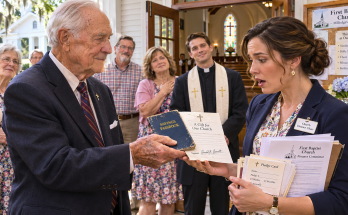
I stared at the hospital document in my trembling hands. Beneath Corinne’s signature, she had written an instruction that seemed impossible to misunderstand. If I cannot speak for myself, contact Thomas. And directly beside those words, in Daniel’s unmistakable handwriting, someone had added:
Do not contact him. The wind stirred the trees outside the church. Only an hour earlier, I had stood beside Corinne’s grave, saying goodbye to the woman I’d loved when I was seventeen and married when I was sixty-two.
Now her forty-four-year-old son stood before me, looking as though the secrets he’d carried were finally crushing him. “Daniel,” I whispered, “why would you write that?” He lowered his head. “Because I was afraid.” “Of me?”
He nodded.
I looked at the letter again.
My son.
For forty-five years, I hadn’t known I had a son.
I had prayed for children throughout my marriage to Margaret. We’d endured appointments, disappointments, and years of accepting that parenthood might never happen for us.
And now, at sixty-two, I was learning that a child of mine had been alive all along.
A child who had grown into a man.
A man who apparently had wanted to keep me away from his dying mother.
I steadied myself against the church railing.
“What are you afraid to tell me?”
Daniel looked toward the cemetery.
Then he whispered, “Mom wasn’t the only person who spent years trying to find you.”
My heart began pounding.
“What do you mean?”
He wiped his eyes.
“I found you eleven years ago.”
For a moment, the world seemed to stand still.
Eleven years.
Not six months.
Not last Christmas.
Eleven years.
“You knew who I was?”
He nodded.
“And you never told me?”
His face crumpled.
“No.”
I stared at him.
Then he reached into his jacket and withdrew a small photograph.
It showed a little girl standing beside a church Christmas tree.
She wore a red coat and held a paper angel.
I recognized her immediately.
“Emily?”
Daniel began crying.
“Yes.”
My knees weakened.
Because the little girl in that photograph had been attending my church for almost ten years.
And every Christmas Eve, she had been the one who insisted on placing the final angel at the top of the children’s tree.
Daniel looked into my eyes.
“Tom, Emily is my daughter.”
His voice broke.
“And she’s your granddaughter.”
For a long time, I couldn’t speak.
The cemetery bells rang somewhere behind us.
Cars moved along the road.
People leaving the funeral stopped to embrace one another.
Life continued around me while everything I thought I knew was being rearranged.
I looked at the photograph.
Emily.
The little girl with the crooked smile.
The child who used to call me Pastor Tommy because she couldn’t pronounce Thomas when she was younger.
The girl who brought homemade bookmarks to church and always made an extra one for me.
My granddaughter.
For nearly a decade, she had been standing a few feet away from me every Sunday.
And I had never known.
“Daniel,” I whispered, “how is that possible?”
He covered his face.
“I brought her to church because she needed somewhere safe.”
I stared at him.
“Safe from what?”
He took a trembling breath.
“From everything that happened after her mother died.”
My heart tightened.
“Emily’s mother is dead?”
He nodded.
“Her name was Rebecca. She died when Emily was three.”
I closed my eyes.
Another life I’d known nothing about.
Another grief my family had endured without me.
Daniel continued.
“Mom helped me raise her. But there were days when she was working, and I was barely managing.”
He looked toward the church.
“One Sunday, I brought Emily here.”
I swallowed.
“And you knew I was her grandfather?”
“Not then.”
He shook his head.
“I only knew you were a pastor who seemed kind to children.”
I stared at him.
“Then when did you find out?”
His expression changed.
“Four months later.”
He sat down on the stone bench beside the church entrance.
I lowered myself beside him.
For the first time, we sat together not as strangers connected by a funeral, but as a father and son facing the enormous space between their lives.
Daniel looked at his hands.
“When I was thirty-three, I started looking into Mom’s past. I wanted to understand why she never spoke about my father.”
I listened.
“She told me she’d loved someone before I was born, but that he’d gone away to college and eventually married somebody else.”
My throat tightened.
“She never said my name?”
“Not until last Christmas. But I found an old photograph in her attic.”
He reached into his pocket.
Another photograph.
This one was faded and yellow around the edges.
Corinne and me.
Seventeen years old.
Standing beneath the paper decorations at our senior prom.
I remembered that night perfectly.
Her blue dress.
The gardenias in her hair.
The way she’d laughed when the school band played our favorite song too slowly.
Daniel pointed toward the back of the photograph.
There, in Corinne’s handwriting, were six words.
Tommy, my first and forever love.
My eyes filled.
“I remember that picture.”
Daniel nodded.
“I searched the name of your high school. Then I found an old reunion notice mentioning a Thomas who’d become a pastor.”
I swallowed.
“And then?”
“I found your church.”
He looked toward me.
“I came here on a Sunday.”
My chest tightened.
“And you saw me?”
“Yes.”
“Did we speak?”
He nodded.
I stared at him.
“You asked whether we had a children’s program.”
A memory stirred.
A tired young father standing near the entrance.
A little girl holding his hand.
He’d asked about Sunday school.
I’d shown him the classroom.
And told him everyone was welcome.
Daniel wiped his cheeks.
“You shook my hand and said, ‘We’re glad you’re here.’”
My eyes filled.
“I remember.”
His face crumpled.
“I wanted to tell you everything.”
I swallowed.
“Why didn’t you?”
He looked down.
“Because Mom had spent so long believing you had chosen another life. And you had a wife. I didn’t know whether telling you would destroy your marriage.”
For a moment, I couldn’t speak.
Then I thought of Margaret.
My wife for thirty-six years.
My companion through grief, illness, and the ordinary disappointments of life.
She’d died seven years earlier after a long struggle with heart disease.
Daniel had begun attending our church four years before her death.
She must have known him.
And Emily.
I turned toward him.
“Margaret met your daughter.”
He nodded.
“Yes.”
My throat tightened.
“She helped Emily make a Christmas angel.”
Daniel began crying.
“I know.”
I remembered Margaret sitting at the Sunday school table, helping a little girl attach cotton wings to a paper figure.
Emily had accidentally spilled glitter across Margaret’s sweater.
Margaret had laughed.
Then she helped clean it up.
My heart broke.
All those years we’d prayed for children.
And a granddaughter had sat on Margaret’s lap without either of us knowing.
I covered my mouth.
Daniel reached toward me, then stopped.
“I know this is cruel.”
I shook my head.
“I don’t even know what to call it.”
He lowered his eyes.
“I’m sorry.”
I stared toward the cemetery.
Corinne was buried beside a maple tree.
Margaret was buried in another cemetery across town.
Two women I’d loved.
Two lives that had shaped mine.
And between them stood forty-five years of unanswered questions.
I looked at Daniel.
“Does Emily know?”
He shook his head.
“She knows you’re someone important to our family. Mom told her a few weeks ago that you were an old friend.”
I swallowed.
“Does she know I’m her grandfather?”
“No.”
I looked down.
“And you?”
He studied me.
“What about me?”
I took a breath.
“Do you believe I’m your father?”
Daniel’s eyes filled.
“Mom always believed it.”
I nodded.
“But you deserve certainty too.”
He wiped his cheeks.
“I’d like that.”
There was something unexpectedly painful about those words.
For forty-five years, Daniel had lived without knowing his father’s name.
For eleven years, he’d known where I was but couldn’t bring himself to speak.
And now, after Corinne’s death, we were sitting outside a church discussing whether to confirm a connection that should have been part of our lives from the beginning.
I reached for his hand.
“Daniel, whatever we discover, I want you to know something.”
He looked up.
“I didn’t know about you.”
His lower lip trembled.
“If I had known…”
My voice broke.
“I would have wanted to meet my son.”
Daniel began crying.
And for the first time, he let me hold him.
We stayed on that bench until the sun moved behind the church roof.
Finally, Daniel sat upright.
“There’s still something I haven’t told you.”
I looked at him.
“The hospital document?”
He nodded.
I took a breath.
“Then tell me.”
He explained that six months earlier, Corinne’s condition had deteriorated.
She had begun experiencing episodes of confusion related to her illness and treatment.
During discussions about her care preferences, she repeatedly mentioned a man named Thomas.
At first, Daniel thought she meant a cousin.
Then she provided the name of my church.
He recognized it immediately.
The hospital asked for reliable contact information, and Corinne expressed a wish that I be contacted if she couldn’t speak for herself.
Daniel looked ashamed.
“I panicked.”
I watched him.
He continued.
“I knew you were the pastor. I knew you had known Emily for years. But Mom didn’t know any of that.”
My heart tightened.
“She didn’t know we’d met?”
“No.”
“Why not?”
He swallowed.
“Because I was afraid she’d feel betrayed.”
I looked down.
“She had been waiting for forty-five years to see you again. And I’d been coming to your church without telling her.”
He wiped his face.
“So when I saw your name on the form, I wrote that instruction in the margin.”
I stared at him.
“Did anyone authorize you to change her wishes?”
“No.”
His voice broke.
“I shouldn’t have done it.”
He explained that the notation had been placed on a copy of a hospital document while staff were reviewing family contact information.
It had no authority to override Corinne’s own wishes.
The medical team continued following the applicable consent and decision-making procedures.
But Daniel’s objection delayed a nonurgent attempt to locate me through the contact details available.
“Did your mother know?”
He shook his head.
“No.”
“And what happened afterward?”
Daniel looked toward the cemetery.
“She got worse for a while. Then she improved enough to tell the staff she wanted to see a pastor.”
My chest tightened.
“She asked for me?”
“She asked for someone from your church. I don’t know whether she understood you’d be the one who came.”
I closed my eyes.
The day I first walked into her hospital room returned with astonishing clarity.
The smell of antiseptic.
The quiet medical equipment.
The woman lying beneath the white blanket.
The moment she lifted her head and laughed.
Tommy? Is that really you?
Daniel’s voice broke.
“When she told me you’d visited, I thought she was confused.”
I looked at him.
He continued.
“Then she showed me a photograph you took together.”
I remembered that picture.
Corinne sitting upright in bed.
Me beside her.
Both of us smiling like teenagers.
Daniel began crying.
“She said she’d never been happier.”
I swallowed.
“And you still didn’t tell her?”
He shook his head.
“No.”
“Why?”
He looked at me.
“Because for the first time in months, she wasn’t talking about dying.”
I sat quietly.
Daniel continued.
“She was talking about her prom dress. About the songs you used to sing. About how you bought her flowers because you couldn’t afford jewelry.”
He smiled through tears.
“She looked like my mother again.”
My eyes filled.
“She told me you asked her to marry you.”
I nodded.
Daniel’s voice trembled.
“She said she couldn’t believe you agreed.”
I laughed softly.
“Neither could I.”
He stared at his hands.
“I wanted her to have that happiness. Just for a little while.”
I looked at him.
“But you were afraid the truth would ruin it.”
He nodded.
“Yes.”
For a long time, neither of us spoke.
Then I said quietly, “Daniel, she deserved to choose what to do with the truth.”
He closed his eyes.
“I know.”
I continued.
“And so did I.”
He began crying.
“I know.”
I looked toward Corinne’s grave.
Her final wish had been to marry me.
I’d thought it was a charming, bittersweet request from a dying woman who wanted to reclaim a little happiness from her youth.
Now I knew it was connected to an entire history she’d spent decades carrying alone.
But I also knew she had not been simply a woman waiting for me.
She’d raised a son.
Worked.
Loved.
Laughed.
Survived difficult years.
And built a life in which I hadn’t been present.
I needed to remember all of that.
I looked at Daniel.
“Your mother loved you very much.”
He nodded.
“I know.”
“And she was frightened.”
His eyes filled.
“Yes.”
I took a breath.
“But she wasn’t wrong to want joy at the end of her life.”
Daniel looked up.
“No.”
I squeezed his hand.
“We’re going to have to tell each other the truth from now on.”
He nodded.
“I’d like that.”
The following week, Daniel and I arranged to speak with an independent counselor.
Neither of us knew how to begin becoming family.
He was forty-four.
I was sixty-two.
We weren’t going to recover the childhood he’d lived without me.
There would be no memories of teaching him to ride a bicycle.
No photographs of his first day at school.
No evenings spent helping him with homework.
And no chance to tell him, as a child, that his grandmother’s judgment had nothing to do with his worth.
But we could decide what came next.
The counselor, Dr. Miriam Ellis, listened patiently as we explained our history.
When we finished, she asked Daniel a question.
“What are you hoping for from Thomas?”
Daniel looked uncomfortable.
“I don’t know.”
She nodded.
“That’s a reasonable answer.”
He glanced toward me.
“I suppose I want to know what it feels like to have a father.”
My throat tightened.
Then he gave a sad smile.
“But I’m not exactly a child anymore.”
Dr. Ellis leaned forward.
“Needing connection doesn’t have an age limit.”
Daniel looked down.
She continued.
“And becoming family doesn’t mean pretending the lost years didn’t happen.”
Then she turned toward me.
“Thomas, what do you hope for?”
I thought carefully.
“I want to know him.”
Daniel looked up.
I continued.
“I want to learn who he is, not who I imagine he might have been.”
My eyes filled.
“And I want to understand why Corinne kept everything hidden.”
Dr. Ellis nodded.
“Those are different questions. You may not receive complete answers to all of them.”
I swallowed.
“I know.”
That afternoon, I discovered something about Daniel that made me smile.
He was a carpenter.
A very good one.
He built cabinets, restored old furniture, and helped renovate historic houses.
When I asked why he’d chosen that work, he laughed.
“Because wood makes more sense to me than people.”
I laughed.
“Sometimes I feel the same way.”
He smiled.
Then hesitated.
“Mom said you were good at fixing things.”
I shook my head.
“Not particularly.”
“She said you repaired her bicycle when you were seventeen.”
I stared at him.
Then burst out laughing.
“Daniel, I made that bicycle worse.”
His eyes widened.
“What?”
“The chain kept falling off. I spent three hours trying to fix it.”
He laughed.
“Mom said you were very determined.”
I smiled.
“That part is true.”
We talked for nearly two hours.
About carpentry.
Church.
Music.
Food.
And the ordinary details that somehow made our relationship feel less impossible.
Before leaving, Daniel looked at me.
“Can I ask something?”
“Of course.”
“Did you ever have other children?”
I shook my head.
“No.”
He swallowed.
“Did you want them?”
My throat tightened.
“Very much.”
I told him about Margaret.
About the years we’d hoped for a child.
The medical appointments.
The disappointments.
And the grief we’d eventually learned to carry together.
Daniel listened quietly.
Then whispered, “I’m sorry.”
I shook my head.
“You don’t need to apologize.”
He looked down.
“If I’d told you eleven years ago…”
I took a breath.
“We can’t know how things would’ve changed.”
His eyes filled.
“But Margaret might have known.”
I nodded.
“Yes.”
For a moment, the room grew quiet.
Then I told him something I’d never said aloud.
“Margaret would have loved you.”
Daniel began crying.
I continued.
“She had a wonderful heart. She wasn’t perfect, but she was generous and steady.”
My voice broke.
“And she would have been delighted to know Emily was her family too.”
Daniel covered his face.
I sat beside him until he could speak again.
Two weeks later, we completed a voluntary DNA test through an accredited laboratory.
Daniel wanted certainty.
So did I.
I didn’t need a test to decide whether to treat him with kindness.
But we both understood why establishing biological parentage mattered.
When the results arrived, Daniel asked whether we could open them together.
We sat in my kitchen.
The same kitchen where Margaret used to bake bread on Sunday afternoons.
I placed the sealed envelope between us.
Daniel looked nervous.
“Ready?”
I smiled faintly.
“As ready as I’ll ever be.”
He opened it.
Read the results.
Then looked up.
His eyes filled.
“It’s confirmed.”
I swallowed.
He turned the page toward me.
The laboratory report supported a father-son relationship with extremely high probability.
I stared at the words.
Then at Daniel.
“My son,” I whispered.
His face crumpled.
“Dad?”
The word struck me with a force I hadn’t expected.
For sixty-two years, nobody had ever called me that.
Not once.
I covered my mouth.
Daniel looked suddenly frightened.
“I’m sorry. I shouldn’t have—”
“No.”
My voice broke.
I reached for him.
“Please don’t apologize.”
He stood.
I stood.
And we embraced.
I don’t know how long we remained there.
I only know that when he finally stepped back, we were both crying.
For forty-five years, I’d been his father without knowing it.
Now, for the first time, I had the privilege of hearing him say the word.
That evening, I visited Corinne’s grave.
The cemetery was quiet.
The late-afternoon sun filtered through the maple leaves.
I knelt beside her stone.
“Corinne,” I whispered, “we got the results.”
The wind moved gently through the grass.
I smiled through tears.
“He’s our son.”
For a while, I simply sat there.
Then I took a breath.
“I wish you had told me.”
My voice trembled.
“I wish we’d been brave enough to find each other sooner.”
I looked toward the distant church.
“But I’m going to know him now.”
And for the first time since her funeral, I felt something besides grief.
I felt the fragile beginning of hope.
The next challenge was Emily.
Daniel wanted to tell her the truth.
But we agreed not to overwhelm her with information she wasn’t ready to understand.
She was fourteen now.
Thoughtful.
Curious.
And still grieving the grandmother who had helped raise her.
With guidance from the counselor, Daniel began talking with her about family history.
He explained that Corinne had known me as a teenager.
That we’d loved each other.
And that he’d recently discovered something important about his own father.
Emily listened.
Then asked the question only a child could ask so directly.
“Is Pastor Tommy my grandpa?”
Daniel told me later that his heart nearly stopped.
He nodded.
“Yes.”
Emily was quiet for a moment.
Then she smiled.
“I thought so.”
Daniel stared at her.
“What?”
She shrugged.
“Grandma always looked happy when he was at church.”
I laughed when he told me.
Children notice so much.
Sometimes they simply don’t know what the details mean.
Emily asked whether she could tell me something in person.
I agreed.
We met at the church garden on a Saturday afternoon.
Daniel stayed nearby.
When Emily saw me, she waved.
“Pastor Tommy!”
I smiled.
“Hello, Emily.”
She approached slowly.
Then looked at me with those familiar brown eyes.
Eyes that reminded me of Corinne.
“Dad told me,” she said.
I nodded.
“Yes.”
She studied my face.
“So you’re my grandfather?”
My throat tightened.
“Yes.”
She thought about that.
Then asked, “Does that mean I can call you Grandpa Tommy?”
I began crying.
She looked alarmed.
“Oh no. Was that bad?”
I shook my head quickly.
“Not at all.”
I smiled through tears.
“I’d love that.”
She grinned.
“Good.”
Then she hugged me.
I held her gently.
For years, I’d known Emily as a bright, kind child in our church community.
Now I knew she was family.
But I also knew that our relationship needed to grow naturally.
She didn’t suddenly owe me closeness.
I didn’t automatically become a replacement for the grandparents or other adults who had loved her.
We had to discover what being grandfather and granddaughter meant to us.
And we began with something simple.
Ice cream.
We walked to the little shop near the church.
Emily ordered strawberry.
Daniel chose chocolate.
I ordered vanilla.
She stared at me.
“Grandpa Tommy, that’s boring.”
I laughed.
“It’s a classic.”
She shook her head.
“That’s what old people say.”
Daniel burst out laughing.
I looked at him.
“Is she always like this?”
He grinned.
“Unfortunately, yes.”
For the first time, I heard the sound of three generations laughing together.
And I knew I would remember it for the rest of my life.
But our story wasn’t finished revealing its secrets.
One afternoon, while Daniel was sorting through Corinne’s belongings, he found a small wooden chest beneath her bed.
Inside were photographs, jewelry, and old letters.
He called me immediately.
“Dad?”
I smiled at the word.
“Yes?”
“I found something.”
My heart tightened.
“What?”
“Letters from you.”
I went to his house that evening.
Daniel had arranged the letters on his dining table.
Some were still folded inside envelopes.
Others had been opened years earlier.
I recognized the handwriting.
Mine.
Young.
Careful.
Sometimes awkward.
The earliest letter was dated shortly after I left for college.
Dear Corinne,
I miss you more than I expected.
Every time I hear our song, I think about prom night.
I know we’re at different schools, but I hope we can keep writing.
Love, Tommy.
I covered my mouth.
I remembered writing it.
I’d sent several letters that first year.
Some had received replies.
Then the replies became less frequent.
Eventually, they stopped.
I looked at Daniel.
“Where did these come from?”
He swallowed.
“Mom kept them.”
I opened another letter.
This one was dated almost a year later.
I’d written after learning that Corinne had stopped attending college.
I remembered being worried.
I asked whether she was all right.
Whether something had happened.
Whether she wanted to talk.
At the bottom, I’d written:
Whatever is happening, you can tell me.
My eyes filled.
I had asked.
But she never told me about the baby.
Daniel watched me.
“There’s something strange.”
I looked up.
“What?”
He pointed toward the envelopes.
“Some have postal markings. Others don’t.”
I frowned.
He continued.
“The ones Mom sent to you were marked return to sender, but the markings don’t look like the ones on these.”
I studied them.
Then felt my stomach tighten.
The returned envelopes Corinne had saved carried a stamped phrase.
RETURN TO SENDER.
But several lacked ordinary postal cancellation marks.
Daniel looked at me.
“Do you think Grandpa did it himself?”
I swallowed.
“I don’t know.”
We arranged for the documents to be examined by someone with experience in historical correspondence.
The available evidence suggested that at least some of the returned envelopes had never entered the postal system.
The markings appeared to have been applied privately.
I sat quietly when we received that assessment.
Corinne’s father had not simply failed to forward her letters.
He appeared to have created the impression that she’d tried to reach me and been rejected.
Daniel stared at the findings.
“Mom thought you sent them back.”
My throat tightened.
“She wrote that he never mailed them.”
He nodded.
“She learned that years later. But she spent a long time believing you’d refused her letters.”
I closed my eyes.
I imagined Corinne at eighteen.
Pregnant.
Frightened.
Living under her father’s roof.
Holding envelopes that seemed to prove the boy she loved wanted nothing to do with her.
My heart broke for her.
Then Daniel opened another letter.
This one was written in Corinne’s handwriting.
The date was several years after Daniel’s birth.
Dear Tommy,
I don’t know whether I will ever send this.
There are things I should have told you when we were young.
I thought I was protecting your future.
Perhaps I was only protecting myself from another rejection.
I have a son.
His name is Daniel.
He’s beautiful and stubborn and laughs when I sing.
Sometimes he looks at me with your eyes.
I wish you could meet him.
I couldn’t read any further.
Tears fell onto the page.
Daniel moved beside me.
“Dad?”
I shook my head.
“Just give me a moment.”
He waited.
Finally, I whispered, “She wanted us to meet.”
Daniel nodded.
“Yes.”
I looked at him.
“And then she waited.”
His eyes filled.
“For years.”
We sat quietly.
Then Daniel asked something that surprised me.
“Are you angry with her?”
I thought carefully.
“Yes.”
He looked startled.
I continued.
“I’m angry that she didn’t tell me.”
My voice trembled.
“And I’m heartbroken that she believed she couldn’t.”
Daniel nodded slowly.
I took a breath.
“But I also know she was young, frightened, and under pressure from people she depended on.”
He looked down.
“She made choices that hurt us.”
“Yes.”
I swallowed.
“And she also loved us.”
For a long time, neither of us spoke.
Then I said quietly, “Those things can both be true.”
Over the following months, Daniel and I continued learning how to be family.
There were awkward moments.
Sometimes he called me Tom.
Sometimes Dad.
Sometimes he began one word and switched to the other halfway through.
I didn’t mind.
Our relationship wasn’t going to be built by forcing him to use a particular name.
We began having dinner every Thursday.
At first, the conversations were careful.
We talked about work.
The weather.
Church.
Emily’s school projects.
Gradually, we started discussing harder things.
His childhood.
Corinne’s illness.
Rebecca’s death.
The loneliness he’d carried after becoming a single father.
One evening, he told me about the day Emily was born.
He described holding her for the first time.
How frightened he’d been.
How certain he was that he would do everything differently from the father he believed had abandoned him.
I listened quietly.
Then he said something that made my chest tighten.
“I spent years being angry with you.”
I nodded.
“I understand.”
He looked down.
“I thought you knew about me.”
My eyes filled.
“I didn’t.”
“I know that now.”
He took a breath.
“But I still feel angry sometimes.”
I looked at him.
“That makes sense.”
He seemed surprised.
“Really?”
I nodded.
“Knowing the truth doesn’t automatically erase what you felt growing up.”
He stared at me.
Then whispered, “Thank you.”
I smiled gently.
“We can be honest about it.”
That became the foundation of our relationship.
Not pretending that forty-five years had disappeared.
But allowing the past to be spoken about without turning every conversation into a trial.
Sometimes we laughed.
Sometimes we cried.
And sometimes we simply sat together, two men learning how to share a life neither had expected.
Emily adapted more easily.
She began visiting me after school once a week.
We baked cookies.
Worked in the church garden.
And argued affectionately about whether strawberry ice cream was superior to vanilla.
One afternoon, she found Margaret’s photograph on my mantel.
She studied it.
“Grandpa Tommy?”
“Yes?”
“Who’s that?”
I smiled softly.
“That’s Margaret. She was my wife for many years.”
Emily looked at the photograph.
“She looks nice.”
“She was.”
Emily thought for a moment.
“Did she know Grandma Corinne?”
I shook my head.
“No.”
“Would they have liked each other?”
My throat tightened.
“I hope so.”
She studied my face.
Then asked, “Do you miss both of them?”
I smiled through tears.
“Yes.”
Emily nodded.
“That must be hard.”
I laughed softly.
“Sometimes.”
Then she said something I’ll never forget.
“Maybe love is like having different flowers in a garden.”
I looked at her.
She continued.
“They don’t have to be the same flower to be beautiful.”
I began crying.
Emily looked worried.
“Was that weird?”
I shook my head.
“No, sweetheart.”
I smiled.
“That was wonderful.”
For the first time, I understood that loving Corinne at the end of her life did not diminish the marriage I’d shared with Margaret.
And honoring Margaret didn’t mean I had to hide the love that had survived between Corinne and me.
Both women mattered.
Both relationships had shaped me.
And neither needed to erase the other.
One year after Corinne’s death, Daniel and I visited her grave together.
Emily came with us.
She carried a small bunch of pink flowers.
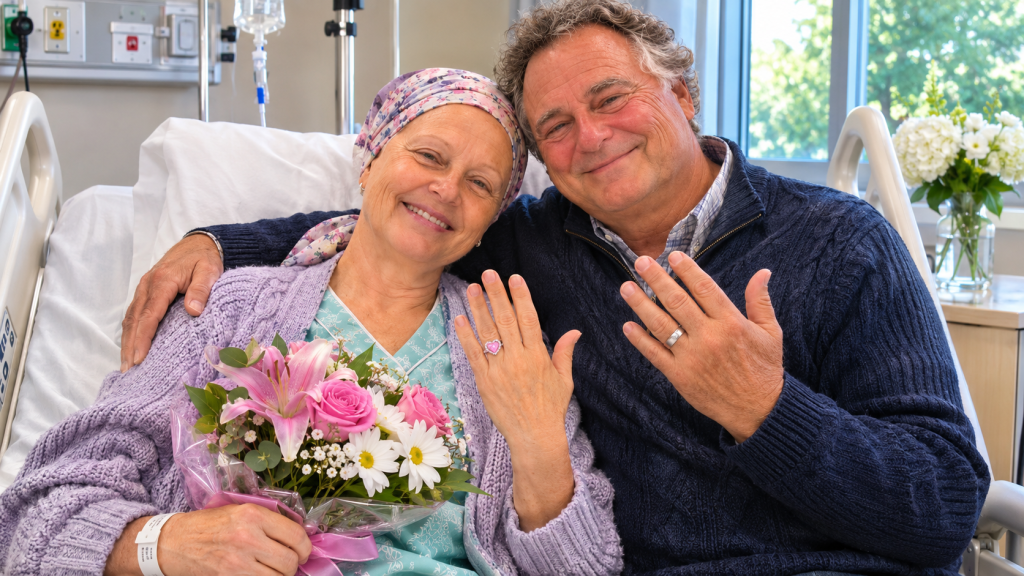
I brought a photograph of Corinne from our hospital wedding.
Daniel carried the wooden chest containing her letters.
We stood beneath the maple tree.
The morning sunlight filtered through the branches.
Emily placed the flowers beside the stone.
“Hi, Grandma.”
Her voice trembled.
“I miss you.”
Daniel put his arm around her.
“Me too.”
I knelt beside the grave.
The little pink-flower wedding ring rested in a small box in my coat pocket.
After Corinne died, Daniel had given it back to me.
I had kept it beside my bed.
Sometimes I opened the box just to remember how she’d laughed when I slipped it onto her finger.
I touched the stone.
“Corinne,” I whispered, “you gave me five days as your husband.”
My eyes filled.
“And you left me something I never imagined.”
I looked toward Daniel.
Then Emily.
“A family.”
For a long time, we stood quietly.
Then Daniel knelt beside me.
“Mom,” he whispered, “I wish you’d told us sooner.”
His voice broke.
“But we’re together now.”
Emily reached for our hands.
We stood there, three generations connected by a love that had survived silence, distance, and loss.
Then Daniel took a breath.
“Dad?”
I turned.
“Yes?”
He smiled through tears.
“I found something else in Mom’s chest.”
I raised an eyebrow.
“Another secret?”
He laughed softly.
“Not exactly.”
He handed me a small envelope.
Inside was a photograph of our hospital wedding.
Corinne was smiling.
I stood beside her wearing my old church suit.
Our inexpensive rings were visible.
On the back, she’d written:
I waited forty-five years for five beautiful days. I hope Tommy remembers that I was happy.
My eyes filled.
Daniel continued.
“She wrote it the day after the wedding.”
I looked at the photograph.
Corinne’s smile.
Her tired eyes.
The pink flower on her ring.
I closed my eyes.
For months, I’d struggled with the thought that we’d lost so much time.
Forty-five years.
A son’s childhood.
The chance to know my granddaughter as a baby.
Countless ordinary moments.
But now I understood that Corinne had not wanted the final days of her life to be defined only by regret.
She wanted to laugh.
To remember.
To be loved.
And to leave behind something more enduring than sorrow.
I looked toward her grave.
“I remember,” I whispered.
We stayed until the sun rose higher.
Then Emily tugged my sleeve.
“Grandpa Tommy?”
“Yes?”
“Can we get ice cream?”
Daniel burst out laughing.
I looked at her.
“At a cemetery?”
She shrugged.
“Grandma liked ice cream.”
I smiled.
“She certainly did.”
And so we went.
We sat at a little outdoor table near the park.
Emily ordered strawberry.
Daniel chose chocolate.
And I ordered vanilla.
She shook her head.
“Still boring.”
I laughed.
“Still classic.”
Daniel smiled.
Then leaned back in his chair.
For a moment, I watched him.
My son.
A grown man with gray beginning to appear at his temples.
A carpenter.
A father.
A person who had suffered losses I hadn’t been there to help him carry.
I couldn’t return to his childhood.
But I could show up now.
And I intended to.
As the years passed, our relationship grew.
Not perfectly.
There were misunderstandings.
Missed calls.
Occasional disagreements.
And moments when the old pain resurfaced unexpectedly.
But we kept talking.
Daniel sometimes asked questions about my younger years.
I told him stories about college.
My first job.
Why I became a pastor.
And how Margaret encouraged me when I doubted whether I was suited for ministry.
He told me about building his first wooden shelf.
How Rebecca laughed when he proposed marriage.
How frightened he’d been when Emily was born.
And how Corinne used to sing while washing dishes.
Sometimes he would stop in the middle of a story.
Look at me.
And smile.
As though he were still getting used to the idea that the person listening was his father.
I understood.
I was still getting used to it too.
One afternoon, I attended Emily’s school concert.
She was playing the violin.
Daniel sat beside me.
The auditorium was crowded with parents and grandparents.
I looked around.
Then realized something.
For most of my life, I’d watched families gather for school performances and wondered what it would feel like to be part of one.
Now I was sitting beside my son, waiting for my granddaughter to take the stage.
Daniel noticed my expression.
“You okay, Dad?”
I smiled.
“Better than okay.”
The curtain opened.
Emily walked onto the stage.
She spotted us.
Grinned.
And waved.
I waved back.
Tears filled my eyes.
For forty-five years, I hadn’t known this life was possible.
And now it was happening.
Not as a replacement for the years we’d lost.
But as a gift within the time we still had.
After the concert, Emily ran toward us.
“Grandpa!”
I opened my arms.
She hugged me tightly.
“Did you like it?”
I smiled.
“You were wonderful.”
She laughed.
“I missed a note.”
I shook my head.
“I didn’t notice.”
Daniel grinned.
“I did.”
Emily gasped.
“Dad!”
We all burst out laughing.
As we walked toward the parking lot, Emily took my hand.
Then Daniel’s.
And for a moment, I felt the simple warmth of belonging.
That evening, after they went home, I sat alone in my kitchen.
The house was quiet.
Margaret’s photograph stood on the mantel.
Corinne’s wedding picture rested beside it.
Emily’s latest school photograph was nearby.
And Daniel had given me a wooden picture frame he’d made himself.
Inside it was a photograph of the three of us.
Taken at the park.
Smiling.
Laughing.
Together.
Beneath the photograph, Daniel had carved three words.
TIME STILL MATTERS.
I stared at those words for a long time.
Because they captured something I’d been struggling to explain.
For years, I believed the greatest tragedy of my life was that Margaret and I never had children.
Then I learned I’d had a son all along.
And grief took a different shape.
I mourned the childhood I’d missed.
The birthdays I hadn’t celebrated.
The tears I hadn’t wiped away.
The advice I hadn’t given.
But Daniel helped me understand something.
The time we’d lost mattered.
And so did the time we still had.
I couldn’t change the past.
I couldn’t force Corinne to explain every decision.
I couldn’t undo the fear that had kept Daniel silent.
And I couldn’t bring Margaret back to meet the family she’d unknowingly loved from a distance.
But I could choose what happened next.
I could answer Daniel’s calls.
Attend Emily’s concerts.
Celebrate birthdays.
Ask questions.
Listen.
And be present.
Sometimes the most meaningful part of love isn’t making a promise.
It’s keeping the ordinary ones.
Showing up.
Remembering.
Staying.
One Sunday, I shared a story with my congregation.
I didn’t disclose private details about Daniel or Emily.
Those belonged to them.
But I spoke about time.
About regret.
About how easily we postpone important conversations because we fear their consequences.
I stood behind the pulpit.
Looked toward the congregation.
And said:
“Sometimes we imagine that love means protecting people from painful truths.”
The room grew quiet.
“But when we hide the truth, we may also take away their opportunity to choose.”
I paused.
“Honesty doesn’t guarantee that a relationship will survive.”
My voice trembled.
“But secrecy can prevent a relationship from ever having a chance.”
I looked toward the back row.
Daniel sat beside Emily.
He smiled faintly.
I continued.
“If there’s someone you need to speak to, don’t assume time will always be available.”
The words settled over the congregation.
And I thought of Corinne.
Seventeen years old.
Standing beneath prom decorations.
Laughing when I promised we’d marry someday.
Neither of us imagined we’d have to wait forty-five years.
After the service, Daniel approached me.
“Dad?”
I smiled.
“Yes?”
He looked toward the empty church.
“That was beautiful.”
My eyes filled.
“Thank you.”
He hesitated.
Then whispered, “I’m sorry I waited so long.”
I took his hand.
“I wish we’d had more years.”
He nodded.
“Me too.”
I smiled gently.
“But I’m grateful for the ones we have.”
Daniel began crying.
Then hugged me.
For a long time, we stood there.
A father and son who had spent decades as strangers.
Finally learning that love could grow even in the places where time had left scars.
Today, when I think about Corinne, I don’t remember only the hospital bed.
Or the medical equipment.
Or the week we were told would be her last.
I remember the girl in the blue prom dress.
The woman who laughed at my terrible jokes.
The bride who declared a cheap ring with a pink plastic flower the most beautiful ring in the world.
I remember the way she squeezed my hand.
And the way she smiled when she asked me to marry her.
But most of all, I remember what she left behind.
Not money.
Not property.
Not a grand inheritance.
A son.
A granddaughter.
And the opportunity to become part of a family I’d never known existed.
There are days when the lost years still hurt.
I wonder what Daniel looked like when he was five.
Whether he was afraid on his first day of school.
Whether Corinne ever told him stories about our prom.
I wonder what Margaret would have said if she’d known.
Whether she’d have baked bread for Daniel.
Whether she’d have helped Emily with homework.
Whether she’d have smiled at me and said, “Tommy, look what life has given us.”
Those questions may never have answers.
And I’ve learned to live with that.
Because grief isn’t always about losing someone.
Sometimes it’s about discovering how much life happened while you were looking in another direction.
But I’ve also learned that love can begin again without pretending the past never existed.
One evening, Emily asked me whether I was sad that Corinne had died.
I told her the truth.
“Yes.”
She looked down.
“Me too.”
Then she asked, “But aren’t you happy you found Dad?”
I smiled through tears.
“Very.”
She considered that.
Then whispered, “So you can be happy and sad at the same time?”
I nodded.
“Yes, sweetheart.”
She smiled.
“Good.”
I laughed softly.
“Why good?”
She looked toward the framed photographs on my mantel.
“Because that’s how I feel too.”
I held her close.
And realized that perhaps healing wasn’t about choosing between grief and gratitude.
Perhaps it was learning to let them exist together.
Corinne’s death broke my heart.
But her final wish opened a door I hadn’t known was there.
Her son brought me an envelope.
And inside it was a truth that changed everything I believed about my life.
I had spent forty-five years thinking the girl I loved had become a beautiful memory.
Instead, part of that love had been living in the world all along.
Growing.
Learning.
Becoming a man.
Raising a daughter.
And waiting, in his own frightened way, to understand where he came from.
Now, when Daniel calls me Dad, I still feel a small miracle in that ordinary word.
When Emily runs toward me shouting Grandpa Tommy, I still have to blink back tears.
And when I visit Corinne’s grave, I no longer speak only about the past.
I tell her about Daniel’s work.
Emily’s school.
The family dinners.
The laughter.
The little moments that would have made her smile.
Sometimes I bring flowers.
Sometimes I bring photographs.
And sometimes I simply sit beneath the maple tree and remember.
The last time I visited, I placed a small pink flower beside her stone.
Then I whispered:
“Corinne, you were right.”
The wind moved through the branches.
I smiled.
“We should have married when we were seventeen.”
Then I laughed through tears.
“But I’m glad we finally did.”
I touched the little wedding band on my finger.
The inexpensive ring I’d purchased at a flea market.
It wasn’t valuable.
It wasn’t elegant.
And it certainly wasn’t the kind of ring anyone would expect a sixty-two-year-old groom to choose.
But Corinne had loved it.
And so did I.
Because its worth had never been measured in money.
It was measured in five days.
Five days of laughter.
Five days of holding hands.
Five days in which a dying woman felt loved.
And in the truth she left behind.
I don’t know how many years I have left.
None of us do.
But I know how I want to spend them.
Being present.
Speaking honestly.
Loving the people who are here.
And refusing to let fear steal the conversations that matter most.
If there’s one thing Corinne taught me, it’s that life doesn’t always give us the ending we imagined.
Sometimes it gives us something more complicated.
More painful.
And unexpectedly beautiful.
I lost the woman I loved twice.
Once when we were young and life carried us apart.
And once when I held her hand as she took her final breath.
But the second time, she left me something I never expected.
A chance to be a father.
A chance to be a grandfather.
And a reason to believe that even after enormous loss, life can still offer love.
I married my high school sweetheart forty-five years after we first fell in love.
I thought I was granting her final wish.
But after she died, I discovered she had given me something far greater.
She had left me a family.
And every time my son calls me Dad, I remember that the most beautiful gifts are not always the ones we know to ask for.
Sometimes they’re the ones we discover when we finally find the courage to open the truth.