Elias Vance stared at the brass key resting in his palm. For seventeen years, he had believed his younger brother was dead. Seventeen winters of waking in an empty cabin. Seventeen summers of wondering whether he could have done something differently. Seventeen years of remembering the flames that consumed the old chapel and the last words Jonah had spoken before disappearing into the smoke.
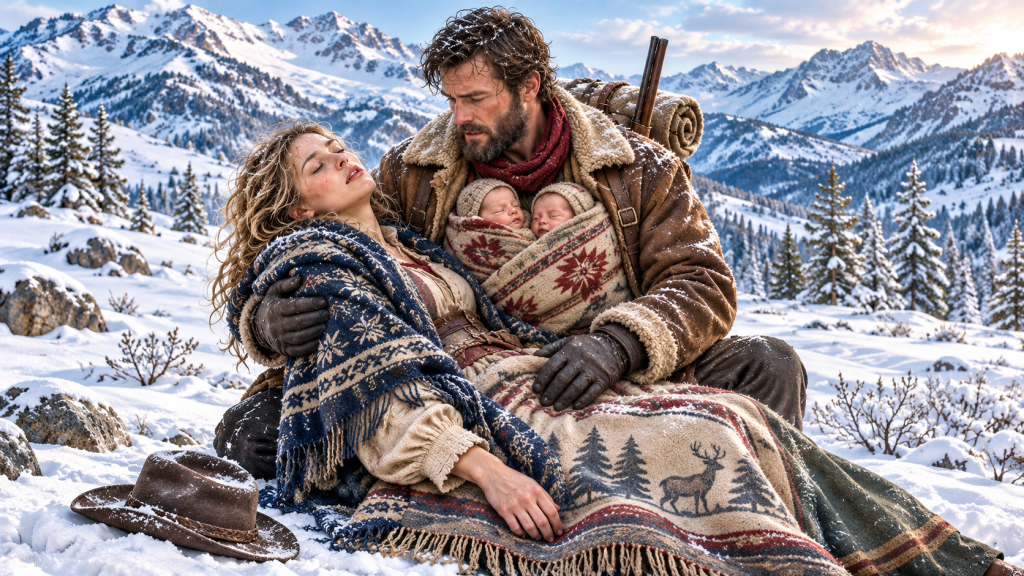
And now a half-starved woman, nearly beaten to death and abandoned in the snow with her newborn daughters, was telling him that Jonah was alive. Outside, three armed riders waited beneath the pines. Inside, two babies slept beside the fire. And Elias suddenly felt as though the world he’d buried beneath years of silence was rising from its grave.
“What did you say?” he whispered. Miriam’s lips trembled. “Your brother. Jonah Vance. He helped me escape.” Elias gripped the key. “Where is he?” She shook her head weakly. “I don’t know.” His jaw tightened. 2“Don’t lie to me.” Tears filled her eyes. “I’m not lying.” Before she could explain, Sheriff Harlan shouted from outside.
“Vance! You’ve got ten seconds to open that door!”
Elias turned toward the window.
Three horses stood in the snow.
The sheriff.
A black-coated preacher.
And a third man Elias recognized immediately.
Caleb Rusk.
Miriam’s husband.
The man who had allowed his wife and newborn daughters to be left for dead.
Elias slowly set the key on the mantel.
Then he picked up his rifle.
“Stay away from the windows,” he told Miriam.
She grabbed his sleeve.
“Please. Don’t let them take my girls.”
He looked at her trembling hands.
Then at the babies.
Hope and Grace.
Two tiny lives that had barely begun.
His voice was low, but steady.
“They’re not taking anybody.”
Sheriff Harlan called again.
“Elias, don’t make this difficult.”
Elias stepped toward the door.
He opened it just enough to stand in the doorway, keeping the warm air from pouring outside.
Snow swept across the porch.
Harlan sat on his horse, his gray beard stiff with frost.
Beside him, Reverend Silas Crowe rested a gloved hand on his saddle.
Caleb Rusk looked impatient.
“Where’s my wife?” Caleb demanded.
Elias said nothing.
Rusk leaned forward.
“I know she’s in there.”
“And?”
“She belongs home.”
Elias stared at him.
“Funny thing about home.”
Caleb frowned.
“What?”
“It’s usually where people are kept alive.”
The preacher’s expression hardened.
“Mind your tongue, Vance.”
Elias looked toward him.
“Mind your own business, Crowe.”
Harlan sighed.
“We’ve got a legal matter to settle. Mrs. Rusk has caused trouble in town. Her husband has come to collect her.”
Elias glanced at Caleb.
“Did he come to collect her before or after someone tied her to a whipping post?”
Caleb’s face changed.
The sheriff shifted in his saddle.
“Careful what you accuse people of.”
Elias stared at him.
“I found her nearly frozen to death. Her back was torn open. Her babies were turning blue.”
Reverend Crowe lifted his chin.
“The woman was disciplined for defying her husband and bringing disgrace upon a respectable household.”
The words settled in the air.
For a moment, Elias simply stared.
Then he said quietly, “You call that respectable?”
Crowe’s eyes narrowed.
“The Lord commands order.”
Elias stepped forward.
“Don’t drag the Lord into something men did with a whip.”
Caleb reached toward the pistol at his belt.
Elias raised his rifle, keeping the barrel pointed toward the snow.
“Leave your hand where it is.”
The sheriff stiffened.
“You threatening a lawman?”
“No.”
Elias looked him directly in the eyes.
“I’m telling three men they’re not coming inside my house.”
Harlan considered him.
Then smiled without warmth.
“You always were stubborn, just like your brother.”
Elias felt his stomach tighten.
Jonah.
The sheriff had spoken his name as though the wound was still fresh.
Elias forced his expression to remain calm.
“Then you remember what happened when people pushed him too far.”
Harlan looked away.
A strange movement.
Small.
Almost meaningless.
But Elias noticed.
Reverend Crowe spoke again.
“There’s property missing from the chapel records. We have reason to believe Mrs. Rusk took it.”
Miriam’s key seemed to burn against Elias’s thoughts.
“What property?”
Crowe stared at him.
“Church documents.”
Elias laughed.
“You ride through a mountain storm with armed men because a sick woman borrowed some papers?”
Caleb’s jaw tightened.
“Those documents don’t concern you.”
“Then neither does my cabin.”
Elias stepped backward.
The preacher leaned forward.
“Vance, you have no idea what you’re protecting.”
Elias looked toward the babies sleeping near the fire.
Then back at the men outside.
“I know exactly what I’m protecting.”
He closed the door.
A gunshot cracked through the trees.
The bullet struck the wooden frame beside Elias’s shoulder.
Miriam screamed.
Hope began crying.
Elias dropped behind the heavy table and pulled it toward the window.
Outside, Harlan shouted angrily.
“Rusk! Put that thing away!”
Another voice followed.
Caleb’s.
“He’s hiding my wife!”
Elias heard horses moving.
Then the sheriff called again.
“Vance! This isn’t finished!”
The hoofbeats faded into the woods.
For several moments, Elias didn’t move.
Only when the silence returned did he set down his rifle.
Miriam was clutching the babies.
Her face had turned white.
“They’ll come back,” she whispered.
Elias knelt beside her.
“Probably.”
Her eyes filled.
“I’ve brought danger to your home.”
He looked at her.
“No.”
She shook her head.
“You don’t understand.”
“I understand enough.”
He glanced toward the hole in his doorframe.
“Danger came here on horseback.”
Miriam began crying.
Not loudly.
There was hardly enough strength left in her for that.
But her shoulders trembled as she held her daughters.
Elias took a blanket and settled it around them.
Then he knelt beside the fire.
For a long time, neither spoke.
Finally, he asked the question that had been tearing at him since she’d mentioned Jonah.
“Tell me about my brother.”
Miriam looked up.
“Are you sure?”
Elias stared into the flames.
“I’ve been waiting seventeen years for someone to tell me anything.”
She took a trembling breath.
“Jonah came to our house three months ago.”
Elias turned.
“He called himself Samuel Reed. Said he was a traveling surveyor.”
Elias swallowed.
Jonah had always loved maps.
As boys, they’d spent hours drawing the mountain passes from memory.
Their father used to say Jonah could find his way through darkness by listening to the wind.
Miriam continued.
“He was looking for old property boundaries. Caleb allowed him to stay in the stable.”
“Why?”
“Because Jonah offered money for information about the abandoned chapel.”
Elias went still.
“The chapel?”
She nodded.
“He said certain records had been hidden beneath it before the fire.”
Elias stared at her.
“What records?”
Miriam looked toward the brass key.
“Proof that Reverend Crowe and Sheriff Harlan stole land from families who couldn’t defend themselves.”
Elias sat back.
The old chapel had burned seventeen years earlier.
Back then, Crowe had been a young minister with a powerful voice and an even more powerful appetite for influence.
Harlan had been newly elected sheriff.
They had arrived in the valley together, promising prosperity and order.
Within a few years, struggling families began losing their property.
Widows.
Immigrant homesteaders.
Miners injured in accidents.
People who couldn’t read the legal notices nailed to their own doors.
The church offered assistance.
Then debts appeared.
Mortgages.
Unpaid fees.
Claims nobody understood.
Soon, land changed hands.
And Crowe’s congregation grew richer while the people who’d built the valley disappeared.
Jonah had noticed.
He’d begun asking questions.
Then came the chapel fire.
And Jonah vanished.
Elias looked at Miriam.
“My brother found evidence?”
She nodded.
“He believed the original land records survived the fire.”
“Where?”
“Beneath the chapel.”
Elias stared at the brass key.
“And this opens the hiding place?”
“Yes.”
He picked it up.
The key was old.
Its teeth uneven.
A small star had been scratched near the handle.
Elias’s throat tightened.
Jonah used to carve stars into everything.
His knife handles.
His saddle.
The wooden fishing box they’d shared as children.
He said stars were reminders that even lost men had something to follow.
Elias traced the tiny mark.
Then whispered, “It’s his.”
Miriam watched him.
“I didn’t know he was your brother until he told me about you.”
Elias looked up.
“He spoke about me?”
She nodded.
“All the time.”
His chest tightened.
“What did he say?”
Her eyes filled.
“That you were the strongest man he’d ever known.”
Elias laughed bitterly.
“He was wrong.”
Miriam shook her head.
“He said you’d think that.”
The words struck him harder than any blow.
For seventeen years, he’d carried the belief that he’d failed Jonah.
On the night of the fire, he’d been away repairing a bridge.
By the time he reached the village, the chapel was burning.
He’d tried to enter.
Harlan stopped him.
Said nobody could survive inside.
Afterward, a body was found in the ashes.
Badly burned.
Unrecognizable.
A silver watch found nearby belonged to Jonah.
Everyone accepted the conclusion.
Jonah was dead.
Elias had buried him beneath the aspen trees.
Then, unable to bear the valley’s whispers, he’d retreated into the mountains.
He looked at Miriam.
“Why didn’t Jonah come home?”
She lowered her eyes.
“He said someone had threatened you.”
Elias went still.
“What?”
She swallowed.
“He said if he returned, the men who wanted him dead would come after the one person he couldn’t bear to lose.”
Elias stared at the floor.
Then whispered, “Me.”
Miriam nodded.
“He stayed away because he thought it would keep you safe.”
For a long moment, Elias couldn’t speak.
Then he stood abruptly.
He walked toward the window.
Outside, the snow stretched toward the dark pines.
Seventeen years.
Seventeen years of grief.
Seventeen years of believing his brother had abandoned the world.
And Jonah had been alive.
Somewhere beyond those mountains.
Carrying the truth.
Carrying fear.
Carrying the burden of protecting a brother who’d thought him dead.
Elias pressed his hand against the wall.
“Fool,” he whispered.
But his voice broke.
“Stubborn, foolish boy.”
Behind him, Miriam spoke softly.
“He wanted to come back.”
Elias closed his eyes.
“Then why didn’t he?”
She took a breath.
“Because he said he needed proof strong enough that Harlan and Crowe couldn’t destroy it.”
Elias looked toward the brass key.
“And now?”
Miriam’s eyes filled.
“Now I think they found him.”
The cabin fell silent.
Elias turned slowly.
“What happened?”
Miriam swallowed.
“Three nights before the twins were born, Jonah came to our house after dark. He was wounded.”
Elias felt cold.
“How badly?”
“He had blood on his coat. He could barely stand.”
“Where did he go?”
“I don’t know.”
She shook her head.
“He gave me the key and told me to keep it hidden.”
Elias gripped the table.
“Did he say anything else?”
“Yes.”
Her voice trembled.
“He said if they came for me, I should find Elias Vance.”
Elias stared at her.
Then looked toward the girls.
The babies Jonah had helped protect.
The woman whose life had become tangled in the same evil that had destroyed their family seventeen years earlier.
He sat beside the fire.
And made a decision.
They were not going to die in that cabin.
Not Miriam.
Not Hope.
Not Grace.
And not the truth Jonah had spent seventeen years trying to bring into the light.
But first, he needed help.
Miriam’s fever had lessened, yet she remained dangerously weak.
The twins needed more care than his rough hands and mountain instincts could provide.
He could keep a fire burning.
Build a shelter.
Track an elk through deep snow.
But newborn babies were not wounded animals, and Miriam’s injuries needed proper treatment.
Elias had sent an urgent message earlier through a passing trapper, asking for the valley’s midwife.
Now he could only hope she’d received it.
Shortly before dusk, the sound of sleigh bells broke the silence.
Elias reached for his rifle.
Then heard a familiar voice.
“Elias Vance! If you point that thing at me, I’ll make you regret being born!”
He nearly smiled.
Mrs. Abigail Finch.
Seventy years old.
A widow.
A midwife.
And the only person in the valley who’d ever managed to frighten Sheriff Harlan without carrying a weapon.
Elias opened the door.
Abigail stood outside wrapped in a thick wool cloak.
Beside her was a younger woman carrying a medical bag.
“My granddaughter, Clara,” Abigail announced. “She’s trained as a nurse.”
Elias stepped aside.
“Thank God.”
Abigail snorted.
“Thank Him after we’ve seen the patients.”
The women went directly to Miriam.
Clara examined her carefully.
Abigail tended to the babies.
Their hands moved with practiced confidence.
Warmth.
Clean linens.
Food.
Fresh water.
Careful attention to the injuries.
After an hour, Clara approached Elias.
“Miriam needs rest, nourishment, and continued treatment. The wounds are serious, and infection remains a concern.”
Elias nodded.
“And the babies?”
Clara glanced toward the hearth.
“They were dangerously cold when you found them. They’re stronger now, but we need to keep monitoring them and make sure they’re feeding adequately.”
Elias swallowed.
“Will they live?”
Clara’s expression softened.
“I can’t promise that.”
She placed a hand on his arm.
“But they’ve survived this far. That’s something.”
Elias looked toward the twins.
Hope was sleeping with one tiny hand curled beside her cheek.
Grace made a soft sound and turned toward her sister.
He’d seen newborn lambs.
Foals.
Bear cubs.
But never anything so small that seemed to demand so much courage from the world around it.
Abigail watched him.
Then smiled faintly.
“Don’t look so frightened, mountain man.”
Elias frowned.
“I’m not frightened.”
She raised an eyebrow.
“You look like a man asked to carry a thunderstorm in a teacup.”
Clara laughed softly.
For the first time in days, the cabin held a sound other than crying and pain.
Then Abigail noticed Miriam’s back.
Her expression changed.
The humor vanished.
She stared at the wounds.
And whispered, “Those monsters.”
Miriam lowered her eyes.
“I’m sorry.”
Abigail looked at her sharply.
“For what?”
Miriam’s lips trembled.
“For bringing shame.”
Abigail knelt beside her.
“Child, shame belongs to the hands that hurt you.”
Miriam began crying.
Abigail took her hand.
“And don’t you forget it.”
That night, while Clara cared for the twins, Abigail asked Miriam to tell her what had happened.
Slowly, Miriam began.
She’d married Caleb Rusk two years earlier.
He was a wealthy cattle buyer.
Respected by the church.
Praised by Reverend Crowe for his generosity.
At first, he’d been charming.
He brought flowers.
Promised her a fine home.
Called her beautiful.
But after the wedding, everything changed.
He decided whom she could visit.
What she could wear.
How much money she could spend.
And whether she was permitted to speak during gatherings.
When Miriam became pregnant, Caleb insisted they would have a son.
An heir.
Someone to inherit his cattle business and the land he expected to acquire.
He spoke about the child as though the baby were a possession not yet delivered.
But Miriam gave birth to twins.
Girls.
Hope and Grace.
And Caleb’s pride turned to fury.
“He said I’d humiliated him,” Miriam whispered.
Abigail’s expression darkened.
“He said God had punished him for marrying a woman who couldn’t give him sons.”
Miriam looked toward the babies.
“I told him they were beautiful.”
Her voice broke.
“He said beauty wasn’t worth anything.”
Elias stood beside the window, listening.
Every word tightened something inside his chest.
Miriam continued.
“Then he found the key.”
She looked toward Elias.
“I’d hidden it in my sewing basket.”
Caleb demanded to know what it opened.
Miriam refused to tell him.
He accused her of conspiring with Jonah.
Then he called Reverend Crowe.
The next morning, Miriam was dragged to the center of town.
Crowe declared that she had betrayed her husband and dishonored the community.
Harlan stood beside the whipping post.
People gathered.
Some looked away.
Others watched.
Nobody stopped it.
Miriam began trembling.
“They said my daughters would be placed with a respectable family.”
She covered her face.
“I told them they couldn’t take my babies.”
Her voice cracked.
“So they beat me.”
Abigail’s hands shook with anger.
Clara looked away, fighting tears.
Elias stared at the fire.
He imagined Miriam standing before the town.
Weak from childbirth.
Holding two newborn daughters.
Surrounded by people who’d confused cruelty with righteousness.
Then Miriam whispered something that silenced everyone.
“Reverend Crowe wasn’t angry because the babies were girls.”
Elias turned.
“What?”
She looked at him.
“He was angry because I refused to give him the key.”
The room became still.
Miriam continued.
“Caleb said if I surrendered it, they’d call the matter a misunderstanding.”
She swallowed.
“But when I wouldn’t tell them where it was, Crowe ordered the punishment.”
Elias looked toward the brass key.
So that was it.
The girls were the excuse.
The public shame was the weapon.
And the real purpose had been to frighten Miriam into revealing Jonah’s evidence.
Abigail rose slowly.
“We need to get this woman somewhere safe.”
Elias nodded.
“I know.”
“Not the town,” Clara said.
Elias looked toward her.
She continued.
“Not while Harlan controls the jail and Crowe controls the church committee.”
Abigail thought for a moment.
Then said, “There’s a territorial marshal stationed at Fort Mercer. He’s not under Harlan’s authority.”
Elias looked up.
“Marshal Thomas Reed?”
Abigail nodded.
“You know him?”
“By reputation.”
“He’s honest.”
Elias almost laughed.
“That’s a rare quality around here.”
Abigail gave him a sharp look.
“Then let’s not waste it.”
They developed a plan.
Clara would remain with Miriam and the babies.
Abigail would return to the valley and contact trusted families who’d lost land under Crowe’s influence.
Elias would send word to Marshal Reed, explaining that Miriam needed protection and that evidence of serious crimes might be hidden beneath the old chapel.
But before anyone could leave, a new sound rose outside.
A horse.
Moving slowly.
Not the frantic approach of an armed rider.
The stumbling steps of an exhausted animal.
Elias took his rifle and opened the door.
A dark horse stood near the woodpile.
Its saddle was empty.
Blood marked the leather.
Elias froze.
He knew that saddle.
Even after seventeen years.
The stitching along its edge formed a tiny star.
“Jonah,” he whispered.
He approached carefully.
The horse lowered its head.
A leather satchel hung from the saddle.
Inside was a folded map.
Several pages of notes.
And a small photograph.
Two boys stood beside a river.
One older.
One younger.
Elias and Jonah.
Taken the summer before their father died.
Elias stared at it.
Then unfolded the map.
The old chapel was marked in red.
A narrow passage ran beneath the building toward a dry creek bed.
At the bottom, Jonah had written:
If I fail to return, the truth is beneath the third foundation stone.
Elias swallowed.
Then noticed another sentence.
Forgive me, brother. I never stopped trying to come home.
His knees nearly gave way.
For a long time, he stood beside the horse, holding the page.
Then he pressed it against his chest.
Clara appeared behind him.
“Elias?”
He turned.
His eyes were filled with tears.
“It’s Jonah’s horse.”
She looked at the bloodstained saddle.
Then whispered, “Is he alive?”
Elias stared into the dark trees.
“I don’t know.”
But he intended to find out.
At dawn, Marshal Reed arrived with two deputies.
He was a broad-shouldered man with a weathered face and a quiet manner.
He listened as Elias explained what had happened.
Then examined the map, the key, and the documents Jonah had left.
Reed looked toward Miriam.
“Mrs. Rusk, are you willing to provide a statement?”
She hesitated.
Elias watched her.
For years, she’d lived under the authority of men who treated her words as worthless.
Now an officer was asking whether she wanted to speak.
Miriam took a trembling breath.
“Yes.”
Reed nodded.
“Then we’ll arrange for you to do so safely.”
He turned toward Elias.
“We need to preserve these items and establish what they mean. I won’t pretend a key and a map alone prove every allegation.”
Elias nodded.
“But the injuries and reported threats require investigation. And the old chapel may hold evidence.”
Abigail stepped forward.
“There’s more.”
Reed looked at her.
She produced a small leather-bound notebook.
“Names of families whose land was taken.”
Elias stared.
Abigail continued.
“I’ve kept records for years. People came to me when they were desperate. Some had medical debts. Others had mortgages they didn’t understand.”
She looked toward the marshal.
“I couldn’t prove what was happening. But I wrote down what they told me.”
Reed accepted the notebook carefully.
“Thank you.”
Abigail straightened.
“Don’t thank me yet.”
Her eyes hardened.
“Find the men who did this.”
The marshal nodded.
“We’ll follow the evidence.”
That afternoon, Elias guided the marshal and his deputies toward the old chapel.
The building stood near the edge of town.
Only blackened stone walls remained.
Snow had gathered inside the ruins.
A few charred beams rose like broken fingers toward the sky.
Elias stopped at the entrance.
For seventeen years, he’d avoided this place.
He’d buried Jonah beneath the aspens because of what happened here.
Now he stood among the ruins, holding a map his brother had drawn.
Reed examined the foundation.
“Third stone?”
Elias nodded.
“According to the notes.”
They worked carefully.
The stone was heavy.
Frozen earth held it firmly in place.
Eventually, they uncovered an iron compartment beneath the foundation.
Inside sat a metal strongbox.
Elias stared.
The brass key fitted its lock.
He turned it.
The box opened.
Inside were bundles of papers wrapped in oilcloth.
Property deeds.
Payment records.
Signed agreements.
Letters.
And a ledger containing names, dates, and sums of money.
Reed examined the first pages.
His expression darkened.
“These may be important.”
Elias swallowed.
“Can you prove what they did?”
“Not by reading a few pages here.”
The marshal carefully replaced the papers.
“But we can secure them and compare them against official records and witnesses.”
Then Elias noticed something beneath the ledger.
A pocket watch.
Silver.
Scratched.
He picked it up.
On the back were two initials.
J.V.
His breath caught.
The same watch supposedly found in the chapel ashes seventeen years earlier.
But this one had a different mark.
A small engraving their father had added years before.
Elias looked toward Reed.
“This was my brother’s.”
The marshal studied it.
“Are you certain?”
Elias nodded.
“Our father gave it to him.”
He opened the watch.
Inside was a tiny folded photograph.
Their mother.
Smiling.
Young.
Elias began crying.
The watch buried with Jonah seventeen years earlier had been a substitute.
Someone had staged his death.
Then a voice spoke from the shadows.
“Elias?”
He froze.
The sound was weak.
Almost swallowed by the wind.
But Elias knew it.
He had heard that voice as a child.
He’d heard it laughing beside rivers.
Calling across mountain trails.
Whispering secrets beneath blankets when thunderstorms shook their childhood home.
He turned slowly.
A man stood near the collapsed wall.
Thin.
Bearded.
His left arm wrapped in a bloodstained bandage.
His face marked by old scars.
But his eyes were unmistakable.
“Jonah?”
The man smiled faintly.
“Hello, big brother.”
Elias dropped the watch.
For a moment, he couldn’t move.
Seventeen years.
Seventeen years of mourning.
Seventeen years of speaking to a grave that held another man’s remains.
Then he crossed the ruined chapel.
And embraced his brother.
Jonah cried out in pain.
Elias pulled back.
“Sorry.”
Jonah laughed weakly.
“Still don’t know your own strength.”
Elias stared at him.
Touched his shoulders.
His face.
His hair.
As though afraid the man would vanish if he looked away.
“You’re alive.”
Jonah nodded.
“Barely.”
Elias began crying.
He didn’t care that the marshal watched.
Didn’t care that the deputies stood nearby.
For seventeen years, he’d believed himself alone in the world.
Now his brother stood before him.
Alive.
Real.
Warm beneath his hands.
“You fool,” Elias whispered.
Jonah smiled through tears.
“I know.”
Elias shook his head.
“Seventeen years.”
Jonah looked down.
“I wanted to come home.”
“Then why didn’t you?”
Jonah’s voice broke.
“Because they told me they’d kill you.”
The words settled between them.
Elias stared.
Jonah continued.
“Crowe and Harlan found out I’d been copying the land records. They caught me beneath the chapel.”
He swallowed.
“They burned the building to destroy the evidence. I escaped through the tunnel, but they thought I knew enough to ruin them.”
Elias looked toward the strongbox.
“Then whose body did we bury?”
Jonah’s eyes filled.
“A man named Peter Ellis. He worked as a caretaker.”
Elias went still.
“He died in the fire?”
Jonah nodded.
“Crowe locked him inside after Peter discovered the hidden records.”
The horror of it settled over Elias.
For seventeen years, he’d mourned his brother while another man’s family had been denied the truth about his death.
Jonah continued.
“I tried to report what happened. Harlan intercepted my letters. Then they sent men after me.”
Elias swallowed.
“So you ran.”
“I survived.”
Jonah looked toward the ruined walls.
“And I kept gathering evidence.”
He explained that he’d spent years traveling through the territory under different names.
Surveying land.
Working for railway companies.
Comparing old deeds.
Finding families who’d been displaced.
He’d returned three months earlier because Crowe had begun using the same scheme to claim a valuable stretch of valley land.
Land connected to Miriam’s family.
Elias frowned.
“Miriam?”
Jonah nodded.
“Her mother inherited a tract near the river.”
Elias stared.
“Caleb wanted it?”
“He wanted the land title transferred through Miriam’s marriage.”
Jonah’s expression hardened.
“When she refused to sign away her rights, Crowe invented a debt against her family’s property.”
Elias felt cold.
“And the twins?”
Jonah looked down.
“Caleb hoped for a son he could use to strengthen his claim to the family estate. When Miriam gave birth to girls, he became furious.”
He swallowed.
“But the girls were never the real problem.”
Elias understood.
“The key.”
Jonah nodded.
“Miriam had evidence I needed Crowe to believe was lost.”
Then Jonah’s face changed.
“Where is she?”
Elias looked at him.
“Safe. At my cabin.”
Jonah closed his eyes.
“And the babies?”
“Alive.”
His brother began crying.
“Thank God.”
Elias placed a hand on his shoulder.
“You helped her?”
Jonah nodded.
“I couldn’t leave her there.”
Elias looked at him for a long moment.
Then whispered, “Neither could I.”
The marshal stepped forward.
“Mr. Vance, we need to get you medical care and take a statement.”
Jonah nodded weakly.
“I’ll tell you everything.”
Then he looked toward Elias.
“But there’s something you need to know first.”
Elias frowned.
“What?”
Jonah swallowed.
“Crowe isn’t the only one who profited from those land seizures.”
He looked toward the strongbox.
“There are men in the county court involved too.”
For the first time, Marshal Reed looked genuinely troubled.
Jonah continued.
“The documents include payments to officials who approved fraudulent transfers.”
Elias stared.
“How many?”
Jonah shook his head.
“Enough that Crowe thought he’d never be challenged.”
Reed closed the strongbox.
“Then this investigation will go beyond the valley.”
The following days changed everything.
Marshal Reed arranged medical treatment for Jonah and protection for Miriam and the girls.
The records recovered beneath the chapel were secured.
Witnesses were interviewed.
And formal investigations began into the land transactions, the fire, the assault on Miriam, and the actions of the officials involved.
Crowe denied everything.
Harlan claimed the records were fabricated.
Caleb insisted Miriam was unstable and that he’d only been trying to protect his household.
But their stories began unraveling.
The ledger matched bank entries.
The disputed land transfers contained irregular signatures.
Some witnesses described being threatened into signing documents they couldn’t read.
Others recalled money changing hands before property hearings.
Abigail Finch testified about injured families she’d treated and conversations she’d recorded over the years.
Miriam gave a detailed account of her marriage, the threats, the public punishment, and the attempt to take her daughters.
Jonah provided evidence of the hidden documents and explained his years of investigating the scheme.
The truth was not established in a single dramatic afternoon.
It took months.
Records.
Witnesses.
Hearings.
And people brave enough to speak despite years of intimidation.
But the silence surrounding the valley began to break.
One afternoon, Reverend Crowe was taken into custody on charges arising from the investigation.
Sheriff Harlan was removed from his position pending proceedings and later faced charges relating to corruption and violence.
Caleb Rusk was also charged in connection with the assault and threats against Miriam.
The cases proceeded through the courts.
Some defendants disputed the allegations.
Others eventually admitted parts of their conduct.
The investigation also led to renewed examination of land transactions involving numerous families.
Some claims resulted in restoration of property rights.
Others required compensation or separate legal proceedings.
The damage could not all be undone.
Families had died.
Homes had been lost.
Children had grown up far from the places their parents once owned.
But for the first time in seventeen years, the valley’s powerful men could no longer dictate the truth simply by speaking louder than everyone else.
And Miriam was no longer alone.
By spring, she had regained much of her strength.
Her wounds healed slowly.
Some scars remained.
But she could stand without trembling.
Walk beside the cabin.
And carry both daughters for short distances, one in each arm.
Hope was the quieter twin.
She loved being held close.
Grace cried loudly whenever she was hungry, tired, or offended by the weather.
Elias found the difference astonishing.
He’d once believed babies were simply small creatures who slept and cried.
Now he knew Hope liked the sound of the rocking chair.
Grace preferred being carried while someone walked.
Hope settled when Miriam sang.
Grace seemed fascinated by the deep rumble of Elias’s voice.
One evening, Miriam laughed as he held Grace near the fire.
“She likes you.”
Elias frowned.
“She likes my beard.”
Grace had wrapped her tiny fingers around it.
Miriam laughed harder.
“Perhaps.”
Elias carefully freed himself.
Then looked at the baby.
“You’re a troublesome little creature.”
Grace smiled.
It was her first clear smile.
Elias froze.
Miriam gasped.
“She smiled!”
He stared.
Grace smiled again.
For a moment, Elias looked utterly bewildered.
Then the stern mountain man’s face softened into something Miriam had never seen before.
A smile.
Wide.
Unprotected.
Almost boyish.
Miriam watched him.
And felt something warm stir inside her chest.
She had been frightened of him when she first woke in the cabin.
His broad shoulders.
Scarred hands.
Quiet manner.
The rifle always nearby.
But she’d learned that strength could be gentle.
That a man could speak softly without being weak.
That he could protect someone without claiming ownership over them.
And most importantly, she had learned that kindness did not require obedience.
One afternoon, she found Elias repairing the porch railing.
The snow had melted from the lower slopes.
Green grass pushed through the earth.
Birds sang in the pines.
Miriam stood beside him.
“Elias?”
He looked up.
“Yes?”
“I’ve been thinking.”
He set down his hammer.
“About what?”
She took a breath.
“The cabin.”
He waited.
“I’ve been here for months.”
He nodded.
“You have.”
She looked toward the doorway.
Hope and Grace were sleeping inside under Clara’s watchful eye.
“I don’t want to become a burden.”
Elias frowned.
“You aren’t.”
Miriam lowered her eyes.
“But I don’t know what comes next.”
For a moment, he said nothing.
Then he looked toward the mountains.
“Neither do I.”
She smiled sadly.
“I suppose that makes two of us.”
Elias considered her.
Then said quietly, “You could stay.”
Miriam looked up.
“What?”
He swallowed.
“I mean, if you want.”
Her eyes filled.
“Elias…”
He continued awkwardly.
“The cabin’s big enough. Mostly.”
A small smile crossed his face.
“And Jonah says I ought to stop pretending I enjoy talking to the walls.”
Miriam laughed softly.
Then Elias’s expression grew serious.
“But I don’t want you thinking you have to stay because I helped you.”
She stared at him.
He continued.
“You don’t owe me your life.”
Tears filled her eyes.
For years, Caleb had told her every meal, every dress, every roof beam represented a debt she owed him.
Now Elias stood before her offering shelter without demanding anything in return.
She whispered, “You really mean that?”
He nodded.
“Yes.”
Miriam looked down.
Then said quietly, “I want to stay.”
Elias smiled faintly.
“Good.”
But she wasn’t finished.
“I want to work too.”
He raised an eyebrow.
“Work?”
“Yes.”
She took a breath.
“Before I married Caleb, I taught children to read.”
Elias nodded.
“I remember you mentioning it.”
“I’d like to do that again.”
He studied her.
“Then you should.”
She smiled.
“I thought perhaps we could use the old storehouse near the creek.”
Elias considered.
“The roof needs repair.”
“I know.”
“The windows are cracked.”
“I know.”
He smiled.
“And you think that’s a school?”
Miriam lifted her chin.
“I think it’s a beginning.”
Elias laughed.
Then picked up his hammer.
“Well, we’d better get that roof fixed.”
By summer, the valley had a small schoolhouse.
It wasn’t grand.
The desks were mismatched.
The windows rattled in strong wind.
And the stove smoked whenever the weather changed.
But children came.
Some walked miles through the fields.
Others arrived on horseback.
A few were the sons and daughters of families who’d once lost land to Crowe’s schemes.
Miriam taught them reading.
Writing.
Arithmetic.
And the importance of asking questions when someone claimed authority.
One afternoon, a little girl named Eliza raised her hand.
“Mrs. Rusk?”
Miriam smiled.
“Yes?”
Eliza hesitated.
“Can girls own land?”
The classroom fell silent.
Miriam took a breath.
“Yes, Eliza. Property rights depend on the law and circumstances, but being a girl does not make someone less deserving of a home or a future.”
Eliza smiled.
“My father says girls should learn to keep house.”
Miriam nodded.
“Learning to care for a home is useful.”
She paused.
“But so is learning to read a contract before someone asks you to sign it.”
Elias, who was repairing a window outside, heard the words.
He smiled to himself.
That evening, he told Miriam what he’d overheard.
She blushed.
“Was I too bold?”
Elias looked at her.
“No.”
He smiled.
“You were exactly bold enough.”
Months passed.
The girls grew stronger.
Jonah recovered from his injuries and began rebuilding his life in the valley.
He remained close to Elias.
Sometimes the brothers sat outside the cabin long after sunset, sharing stories about the years they’d lost.
One evening, Jonah looked toward the stars.
“I used to imagine coming home.”
Elias nodded.
“What did you imagine?”
Jonah smiled sadly.
“You standing in the doorway, furious with me.”
Elias laughed.
“That part was accurate.”
Jonah looked down.
“I thought you’d never forgive me.”
Elias was quiet.
Then he said, “I was angry.”
Jonah nodded.
“I know.”
“I still am sometimes.”
His brother swallowed.
“But I understand why you stayed away.”
Jonah stared at him.
Elias continued.
“I wish you’d trusted me enough to tell me the truth.”
His voice broke.
“But I’m glad you’re here now.”
Jonah began crying.
Elias reached for his shoulder.
And for the first time in seventeen years, the brothers sat beneath the stars without a grave standing between them.
Autumn arrived.
The aspens turned gold.
The mornings grew colder.
And Elias found himself thinking about Miriam differently.
At first, he’d seen her as someone who needed rescue.
Then as someone who needed safety.
But now he saw the woman who rose before dawn to prepare lessons.
Who laughed when Grace threw mashed potatoes across the table.
Who comforted Hope during thunderstorms.
Who stood before a classroom and taught children they had the right to understand the world.
She was brave.
Not because she had never been frightened.
But because she’d lived through cruelty and refused to let it make her cruel.
One evening, they stood beside the creek.
The girls were asleep in a wagon nearby.
The sky glowed orange behind the mountains.
Miriam looked toward Elias.
“Can I ask you something?”
He nodded.
“Anything.”
She hesitated.
“Why did you live alone for so long?”
Elias looked toward the trees.
For a moment, he said nothing.
Then he answered.
“Because I thought loving people only meant losing them.”
Miriam’s eyes filled.
He continued.
“After Jonah disappeared, I couldn’t bear being near anyone.”
She nodded.
“I understand.”
Elias looked at her.
“Then you came.”
She smiled faintly.
“Half frozen and causing trouble.”
He laughed softly.
“Something like that.”
For a moment, they stood quietly.
Then he continued.
“And suddenly, the cabin wasn’t empty.”
Miriam looked down.
He took a breath.
“I started looking forward to hearing the girls cry.”
She laughed.
“That’s a strange thing to say.”
“I know.”
He smiled.
“Then I started looking forward to hearing you laugh.”
Miriam grew still.
The creek moved gently over the stones.
Somewhere in the distance, a bird called.
She whispered, “Elias…”
He shook his head.
“You don’t have to say anything.”
He took a slow breath.
“I just wanted you to know.”
Miriam looked at him.
Then reached for his hand.
Her fingers were warm.
Steady.
“I look forward to coming home too,” she whispered.
For a moment, Elias simply stared at their joined hands.
Then he smiled.
And the mountains around them seemed less lonely than they ever had before.
Winter returned.
The first snow fell softly across the valley.
But this time, the cabin was warm.
Not simply from the fire.
From the sound of laughter.
From small feet beginning to explore the floor.
From Miriam singing while she cooked.
From Jonah arriving with fresh bread and stories that always grew more ridiculous each time he told them.
Hope and Grace celebrated their first birthday.
Abigail baked a cake.
Clara brought ribbons.
Jonah carved two wooden horses.
And Elias built a small cradle large enough for two dolls, though the twins seemed more interested in climbing into it themselves.
The cabin filled with friends.
People who’d once been afraid to challenge the powerful men of the valley.
People who’d helped expose the wrongdoing.
People who understood that rebuilding a community meant more than punishing those who’d harmed it.
When the candles were lit, Miriam looked around.
Her eyes filled.
A year earlier, she’d been lying in the snow, certain her daughters would die beside her.
Now they were surrounded by people who loved them.
Abigail noticed her tears.
“What’s wrong, child?”
Miriam shook her head.
“Nothing.”
She smiled through tears.
“Everything is right.”
After the guests left, Elias stood beside the fireplace.
Hope slept against his shoulder.
Grace rested in Miriam’s arms.
He looked at the little girls.
Then at their mother.
“Miriam?”
She smiled.
“Yes?”
He took a breath.
“I’ve been thinking about something.”
She raised an eyebrow.
“That sounds dangerous.”
He laughed.
Then his expression grew serious.
“I want to ask you something.”
Miriam watched him.
Elias glanced toward the babies.
Then back at her.
“I don’t want you to ever feel trapped again.”
Her smile softened.
He continued.
“I don’t want you to believe you owe me anything because I found you in the snow.”
Her eyes filled.
“I know.”
He swallowed.
“But if you ever wanted to build a life with me…”
He stopped.
For the first time in his life, Elias Vance seemed unable to find the words.
Miriam waited.
Finally, he whispered, “I’d be honored.”
Tears spilled down her cheeks.
She looked at the man standing before her.
The rugged mountain man who’d carried her from the snow.
The man who’d kept her daughters warm against his chest.
The man who’d never asked her to surrender herself in exchange for safety.
She smiled.
“Elias, you already are part of our life.”
He stared.
She continued.
“But yes.”
Her voice trembled.
“I would like to build one with you.”
Elias closed his eyes.
Then laughed softly.
A sound filled with disbelief.
Relief.
And something like joy.
He stepped closer.
Carefully, mindful of the sleeping children, he kissed her forehead.
It was not a promise of ownership.
It was a promise of partnership.
They married the following spring.
Not because Miriam needed a husband to survive.
She had already proven she could stand on her own.
Not because Elias needed someone to fill the silence.
He had learned that love was more than company.
They married because they chose each other.
Freely.
Without fear.
The ceremony took place beneath a flowering apple tree beside the cabin.
Jonah stood beside Elias.
Abigail held Hope.
Clara held Grace.
The girls wore matching white dresses and kept trying to grab the ribbons in their hair.
When the officiant asked whether Elias would love and honor Miriam, he looked directly into her eyes.
“I will.”
When Miriam made her vows, her voice trembled.
But not from fear.
She looked at Elias.
And smiled.
Afterward, the twins began crying at exactly the same moment.
Everyone laughed.
Elias scooped them both into his arms.
Then looked at Miriam.
“Well,” he said, “I suppose that means they approve.”
She burst out laughing.
The years that followed were not perfect.
There were hard winters.
Failed crops.
Illnesses.
Long days.
And nights when the past returned in dreams.
Miriam sometimes woke remembering the whipping post.
Elias sometimes dreamed of the chapel fire.
Jonah carried memories of years spent hiding from men who wanted him silenced.
But they learned to speak about those memories.
To ask for help.
To sit beside one another when the darkness felt close.
And slowly, the past loosened its grip.
Hope grew into a thoughtful child who loved books.
Grace became fearless, climbing trees and racing horses before Elias could convince her to slow down.
Both girls grew up knowing the truth about their beginning.
Not every painful detail while they were small.
But enough to understand that their mother had fought for them.
That people had tried to shame her for giving birth to daughters.
And that those people had been wrong.
One afternoon, when the twins were seven, Hope asked Miriam a question.
“Mother?”
Miriam looked up from her sewing.
“Yes, sweetheart?”
“Why did those men think girls were bad?”
Miriam paused.
Then set down her needle.
“Because they had learned to value power more than people.”
Hope frowned.
“But girls are people.”
Miriam smiled.
“Yes.”
Grace, sitting beside the window, looked up.
“Then they were foolish.”
Elias laughed from the doorway.
“Very.”
Miriam looked toward him.
Their eyes met.
And for a moment, both remembered the snow.
The cold.
The little bundles hidden beneath a dying woman’s arms.
Miriam smiled through tears.
“Yes, Grace.”
She looked at her daughters.
“They were very foolish.”
One autumn afternoon, the family visited the old chapel ruins.
The site had been preserved as a memorial.
The land records recovered there had helped expose years of theft and corruption.
A simple stone marker now stood beside the foundation.
It honored Peter Ellis, the caretaker who died in the fire, and the families harmed by the crimes uncovered afterward.
Jonah stood beside Elias.
For a long time, neither spoke.
Then Jonah looked at the marker.
“Sometimes I wonder whether I should have come back sooner.”
Elias nodded.
“Me too.”
Jonah lowered his head.
“I lost seventeen years.”
Elias looked toward the girls playing nearby.
“Yes.”
Then he smiled sadly.
“But we have today.”
Jonah’s eyes filled.
Elias placed a hand on his shoulder.
“And tomorrow, if we’re fortunate.”
They stood together beneath the mountain sky.
Two brothers who’d lost too much time.
But who had finally found their way home.
That evening, Miriam stood outside the cabin while Elias carried firewood inside.
The twins were laughing near the fence.
Jonah sat on the porch carving another wooden horse.
The smell of supper drifted through the open window.
Miriam looked toward the distant plains.
She could still remember the place where she’d been abandoned.
The snow.
The blood.
The terrible silence.
The fear that her daughters would take their last breaths against her body.
For years, she’d wondered why she’d survived.
Why Elias had found her.
Why the storm hadn’t taken all three of them.
Now she understood that surviving was only the beginning.
Life afterward had required courage too.
The courage to speak.
To trust.
To rebuild.
To believe she deserved happiness after being told she deserved shame.
Elias stepped beside her.
“What are you thinking about?”
She smiled faintly.
“The day you found us.”
His expression softened.
“You remember much?”
“Enough.”
She looked toward the girls.
“I remember thinking I had failed them.”
Elias shook his head.
“You kept them alive.”
Tears filled her eyes.
“I was so afraid.”
“I know.”
She turned toward him.
“And then you carried us home.”
Elias looked down.
“I only did what needed doing.”
Miriam smiled.
“That is what made it extraordinary.”
He slipped his arm gently around her shoulders.
They stood together, watching their daughters laugh beneath the gold evening light.
Then Miriam whispered, “Do you remember what you told me?”
Elias frowned.
“When?”
“The first morning I was awake enough to understand where I was.”
He thought for a moment.
She smiled.
“You told me the girls would keep their names.”
Elias nodded.
“I remember.”
Her eyes filled.
“You didn’t tell me what I had to become.”
She leaned against him.
“You simply made sure we had the chance to live.”
Elias looked toward Hope and Grace.
The girls were chasing each other through the grass.
Their laughter carried across the valley.
He smiled.
“That’s all anyone should have wanted for them.”
Miriam closed her eyes.
And for a moment, the wind smelled not of winter and fear, but of pine trees, warm earth, and home.
Years later, when people told the story of Elias Vance, they often called him a hero.
They spoke of the storm.
The wounded woman.
The newborn twins.
The armed riders.
The evidence hidden beneath the burned chapel.
Some described him as a fearless mountain man who stood against an entire town.
Others remembered him as the brother who helped reveal seventeen years of corruption.
But Elias never liked those stories very much.
Whenever someone praised him, he shook his head.
“I’m no hero.”
One afternoon, a traveler asked him why he’d risked his life for three strangers.
Elias looked toward the garden.
Miriam was teaching Hope and Grace how to plant seeds.
Jonah was repairing the fence.
The cabin stood warm and sturdy beneath the mountains.
Elias smiled.
“Because they were alive.”
The traveler frowned.
“That’s all?”
Elias nodded.
“That’s enough.”
Then he returned to his work.
As for Miriam, she taught generations of children in the little schoolhouse near the creek.
Girls.
Boys.
Children from wealthy families.
Children whose parents had lost everything.
She taught them that knowledge belonged to everyone.
That cruelty did not become righteousness because powerful people approved of it.
And that no child’s worth depended on whether they were born a son or daughter.
She also taught them to read contracts.
To ask questions.
To recognize when someone was using shame to silence them.
And whenever a little girl doubted herself, Miriam reminded her:
“You were not born to apologize for existing.”
Hope and Grace grew up believing those words.
They became strong.
Curious.
Compassionate.
And unafraid to imagine lives beyond the valley.
One became a teacher.
The other learned medicine.
Both returned often to the cabin where they’d been given a second chance at life.
And every winter, when the first heavy snow covered the plains, Elias stood for a moment beside the window.
He remembered the day he’d found them.
The small shapes beneath the snow.
The terrifying silence.
The thin cries that told him life remained.
Then he looked toward the fire.
Toward the family gathered around it.
And thanked heaven that he’d taken one more step into the storm.
Because seventeen years earlier, he’d buried his brother and believed the mountains had taken everything from him.
But on the coldest day of his life, he discovered that the world was not finished offering him reasons to live.
He found a woman who refused to surrender her daughters.
Two little girls whose lives others had declared worthless.
And a truth that brought his brother home.
He hadn’t set out looking for love.
He hadn’t expected redemption.
He hadn’t imagined a family filling the silence of his cabin.
He’d only seen three people dying in the snow.
And decided they deserved to live.
Sometimes the greatest changes begin with a choice so simple that it hardly seems extraordinary.
A hand extended.
A door opened.
A fire kept burning.
A refusal to look away.
Elias Vance understood that better than most.
One winter evening, long after the girls had grown, Miriam sat beside him on the porch.
Snow fell gently beyond the railing.
The mountains stood dark against the stars.
She leaned her head against his shoulder.
“Elias?”
“Yes, my love?”
“Do you ever wonder what would’ve happened if you hadn’t found us?”
He looked toward the falling snow.
For a long moment, he said nothing.
Then he took her hand.
“I try not to.”
Miriam nodded.
Elias turned toward her.
“But I know what happened because I did.”
She smiled.
“What?”
He looked toward the warm light spilling from their home.
Toward the photographs on the mantel.
Toward the little wooden horses Jonah had carved for the twins.
Toward the life they’d built from what once seemed impossible.
Then he whispered:
“I found my way home.”
Miriam began crying.
She took his face gently between her hands.
And kissed him.
Outside, the snow continued falling.
But inside, the fire burned.
And the cabin that had once held only silence was filled with memories, laughter, and the enduring warmth of a family that had chosen one another.
They had abandoned Miriam and her twin daughters because they believed the girls were worthless.
They had hidden the truth because they believed fear would keep everyone silent.
And they had underestimated a lonely mountain man whose heart was far stronger than his reputation.
But the mountain didn’t bury them.
The storm didn’t silence them.
And the men who tried to destroy them did not get to write the ending.
Because one man refused to walk past three lives that still had breath.
One woman refused to surrender her daughters.
And one brother refused to let the truth remain hidden forever.
In the end, the greatest treasure beneath the old chapel wasn’t the stolen land or the ledger of crimes.
It was the truth that returned a family to itself.
And the greatest miracle inside Elias Vance’s cabin wasn’t that three strangers survived a winter storm.
It was that, after years of loss and cruelty, they found a place where love did not demand obedience, kindness did not carry a price, and two little girls were welcomed into the world exactly as they were.
Hope and Grace.
Two names given by a mother who had nothing left but love.
Two lives saved by a man who had nearly forgotten how to hope.
And a reminder that sometimes the bravest thing a person can do is look at someone the world has cast aside and say:
“You are safe here. You matter. And you deserve a future.”