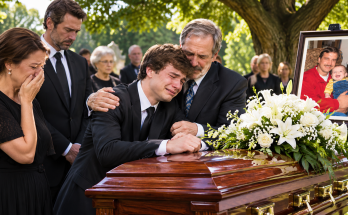
➡️ PART 4 — THE FINAL PART ➡️
For fifty-one years, my husband Harlis had been the one person who could make me feel safe without saying a word.
He wasn’t a wealthy man.
He drove a propane truck through the hills of northern Arkansas, worked hard, and saved whatever money we didn’t need for groceries and bills.
But he kept his promises.
And he always told me that the things we built together belonged to both of us.
Now, just weeks after we buried him, I was sitting in our attorney’s office, staring at a recorded deed that supposedly transferred our rental house to our son and daughter-in-law.
The signature at the bottom was mine.
Except I had never signed it.
And the date made my stomach turn.
The document had been recorded the day after Harlis’s funeral.
I stared at Ruth Talley.
“Somebody signed my name.”
Ruth nodded carefully.
“That’s what we need to establish through the proper process.”
I looked at the paper again.
The address was familiar.
4112 Highway 62.
The little brick house Harlis and I bought in 2003.
The house where Brandon and Courtney had lived for six years, paying nine hundred dollars a month while we covered most of the operating expenses.
The house my son now claimed his father had given him.
My fingers trembled.
“Ruth, I was home that day.”
“I know.”
“I spent the whole afternoon sorting funeral flowers.”
Her expression softened.
“Jeanie, we have documentation that may help establish where you were and what occurred.”
I swallowed.
Then whispered, “My own boy.”
For a moment, I couldn’t say anything else.
Ruth reached across the desk.
“Jeanie, we need to proceed carefully.”
I nodded.
“Tell me what to do.”
“First, we’ll obtain the complete recording information and any available original documents.”
She continued.
“We’ll also examine the notary acknowledgment and determine who appeared before the notary.”
I stared at her.
“And the house?”
“We can pursue appropriate legal action to challenge the deed and protect your ownership interest.”
I exhaled slowly.
Ruth looked directly at me.
“But I need you to understand something. A document being recorded doesn’t automatically mean it’s legally valid.”
I nodded.
For the first time that morning, I felt a little less frightened.
“Good.”
Then I took a breath.
“Because I don’t intend to lose the house Harlis and I worked for.”
That afternoon, I drove home through the hills outside Yellville.
The sky was pale blue.
The trees moved gently in the wind.
I passed the little church where Harlis and I had worshiped together for decades.
For a moment, I almost turned into the parking lot.
I wanted to sit in the quiet sanctuary and ask God why grief couldn’t come without another burden.
Instead, I drove home.
Harlis’s old pickup sat beneath the carport.
I hadn’t been able to sell it.
His feed caps still hung beside the kitchen door.
And the recliner where his heart stopped was sitting exactly where he’d left it.
I lowered myself into my chair.
Then cried.
Not because of the house.
Not because of the money.
But because I finally understood that the son I’d raised might have been willing to take something from me while I was still trying to survive the loss of his father.
Willadean arrived around suppertime.
She brought cornbread.
A dish of green beans.
And the birthday card Harlis had signed shortly before his death.
I showed her the deed.
She examined it.
Then sat down slowly.
“Lord have mercy.”
I wiped my eyes.
“That’s what I said.”
She pointed toward the signature.
“Jeanie, that doesn’t look like yours.”
I nodded.
“It isn’t.”
Willadean studied me.
“What are you fixing to do?”
I looked toward Harlis’s desk.
“Whatever Ruth says we can legally do.”
She smiled faintly.
“Good.”
Then she reached for my hand.
“And you’re going to eat something before you make yourself sick.”
I almost laughed.
“Willadean, you’re bossier than Harlis ever was.”
She patted my arm.
“Somebody’s got to be.”
Three days later, Ruth called with the first important discovery.
The notary listed on the deed was a woman named Denise Pritchard.
She worked for a small document-processing business in the next county.
Ruth had requested the relevant records through appropriate channels.
The notary’s journal and associated paperwork would need examination.
But an initial review raised concerns.
The deed purported to bear my signature on a day when I hadn’t left my home.
And the identification information associated with the acknowledgment did not match the current identification I carried.
I sat quietly.
Then asked, “Could somebody have used an old copy of my driver’s license?”
Ruth answered carefully.
“That’s one possibility. We’re not going to assume how it happened until we’ve examined the evidence.”
I nodded.
“Alright.”
Then she said something that made my chest tighten.
“Jeanie, there’s another issue.”
“What?”
“The document was submitted for recording through a service that had previously handled paperwork for Courtney.”
For several seconds, I couldn’t speak.
I looked toward the kitchen window.
I remembered Courtney standing beside Brandon at Harlis’s funeral.
Her black dress.
Her pearl earrings.
The little smile when Brandon told me he was ending my allowance.
I had thought she was simply pleased to stop sending nine hundred dollars.
Now I wondered whether she’d already believed the house belonged to them.
I swallowed.
“Does Brandon know?”
Ruth paused.
“We don’t know what he knew about the document’s preparation.”
I closed my eyes.
I wanted to believe he didn’t know.
I wanted to believe Courtney had acted alone.
But I’d spent too many years protecting my son from uncomfortable truths.
This time, I wasn’t going to decide what happened before the evidence came in.
A week later, Brandon appeared at my door.
He wasn’t shouting.
He looked exhausted.
His shoulders sagged beneath his work jacket.
“Mom?”
I opened the screen door.
“Hello, honey.”
He looked toward the driveway.
“Can we talk?”
I hesitated.
Then stepped aside.
He entered the kitchen.
For a moment, his eyes settled on Harlis’s empty chair.
He swallowed.
“I keep expecting Daddy to be sitting there.”
My throat tightened.
“So do I.”
He sat down.
For several seconds, neither spoke.
Then he whispered, “Courtney says you’ve hired a lawyer to take our house.”
I looked directly at him.
“Brandon, that house was never yours.”
His expression tightened.
“Daddy promised—”
I raised my hand.
“Your daddy promised you a place to live while you rebuilt your life. He didn’t promise you ownership.”
Brandon looked down.
I took the recorded deed from the folder Ruth had given me.
Then placed it on the table.
“Have you seen this?”
He glanced at the paper.
His face changed.
“Where’d you get that?”
My stomach tightened.
“From the county records.”
He swallowed.
For several seconds, he stared at it.
Then whispered, “Courtney said it was taken care of.”
The words struck me like a slap.
I sat very still.
“Taken care of?”
Brandon closed his eyes.
“Mom—”
I leaned forward.
“Did you know somebody was filing paperwork to put that house in your names?”
He looked down.
“She said Daddy had signed something before he died.”
My chest tightened.
“And my signature?”
He didn’t answer.
“Brandon.”
His eyes filled.
“I didn’t ask.”
For a long moment, the room was silent.
Then I whispered, “That’s the problem, son.”
Brandon began crying.
He told me Courtney had been worried about their finances.
Kaden’s travel baseball expenses had increased.
Their credit cards were carrying balances.
And they’d begun planning renovations on the assumption that the Highway 62 house would eventually belong to them.
I listened.
Then asked, “Did you ever check with your father?”
He wiped his face.
“He said the house would stay in the family.”
I nodded.
“It will, honey. But that doesn’t mean you get to decide what happens to it.”
He looked down.
I continued.
“Your father and I owned that house. He wanted me to have financial security if he went first.”
Brandon’s voice broke.
“I didn’t think you’d need the money.”
I stared at him.
“That wasn’t your decision to make.”
For the first time, Brandon looked at me without anger.
He looked ashamed.
Then whispered, “Are you going to have Courtney arrested?”
I took a breath.
“I’m going to cooperate with the investigation.”
His face tightened.
“Mom, we have Kaden.”
“I know.”
I swallowed.
“And I love that boy with everything in me.”
My eyes filled.
“But loving my grandson doesn’t mean I can pretend someone didn’t sign my name to a document I never approved.”
Brandon covered his face.
For several minutes, he cried.
I wanted to go around the table and hold him.
But I stayed where I was.
Because I was finally learning that loving my son didn’t require me to erase his responsibility.
The legal proceedings continued.
Ruth pursued a civil action challenging the deed.
The matter was also referred for investigation because of the questions surrounding the signatures and acknowledgment.
The recorded document didn’t disappear overnight.
Evidence had to be collected.
The relevant parties had opportunities to respond.
And the court needed to determine whether the purported transfer was valid.
But the records began telling a clear story.
Harlis had repeatedly documented his intention that the property remain part of our financial security.
His ledger recorded Brandon’s payments as rent.
His correspondence with Ruth showed that he’d rejected proposals to transfer the property.
And I had never knowingly executed a deed giving away my ownership.
Then investigators obtained additional information concerning the notary acknowledgment.
The journal entry associated with the deed lacked information that should have been present.
The signature attributed to me was inconsistent with known examples.
And the supporting records did not establish that I had personally appeared before the notary.
Denise Pritchard was questioned about the circumstances.
The investigation examined whether the notarial process had been improperly handled and who had supplied the document.
I didn’t attend every meeting.
Ruth kept me informed.
But one afternoon, she called with news that made my hands tremble.
“Jeanie, Courtney has retained separate counsel.”
I sat down.
“Why separate?”
“Because her interests may differ from Brandon’s.”
I looked toward Harlis’s desk.
For years, I’d believed the two of them made every decision together.
Now, for the first time, I wondered how much my son had allowed himself not to know.
Two weeks later, Courtney requested a meeting.
Ruth arranged it through the attorneys.
I agreed.
We sat in a conference room in Harrison.
Courtney looked different.
No expensive jewelry.
No perfectly styled hair.
Her hands trembled around a paper cup of water.
For several seconds, she said nothing.
Then whispered, “Jeanie, I’m sorry.”
I looked at her.
“For what?”
Her eyes filled.
“For how I treated you after Harlis died.”
I nodded.
She continued.
“And for telling people you were confused.”
My throat tightened.
I remembered those words.
You’re grieving, Jeanie. You’re confused.
As though being a widow meant I could no longer understand a deed.
I swallowed.
“Why did you say that?”
Courtney lowered her head.
“Because I wanted Brandon to believe you were wrong.”
The admission hurt.
But I appreciated that she’d finally stopped pretending.
I looked directly at her.
“Did you arrange the deed?”
Her attorney advised caution about discussing the pending matter.
Courtney looked down.
Then quietly said she would address those questions through the formal process.
I nodded.
For once, I didn’t demand an answer at the kitchen table.
The truth needed to be established properly.
But I did ask one question.
“Courtney, did you ever think about what would happen to me if that house was taken?”
She began crying.
“I thought you’d be alright.”
I stared at her.
“Because I still had my own house?”
She nodded.
I took a breath.
“Courtney, a person doesn’t stop needing security because they’re old.”
Her face crumpled.
I continued.
“Harlis and I saved for years so we wouldn’t become a burden to anybody.”
My voice broke.
“And you stood beside my son at his father’s funeral and told me I’d have to manage without your help.”
Courtney couldn’t look at me.
The civil case eventually reached a resolution.
The disputed deed was set aside through the legal process after the relevant evidence and positions were addressed.
The property records were corrected to reflect that no valid transfer to Brandon and Courtney had occurred.
The questions involving the preparation and acknowledgment of the document were handled separately by the appropriate authorities.
There were consequences for the misconduct established through those proceedings.
I didn’t celebrate.
I didn’t stand outside the courthouse smiling.
I simply sat beside Ruth and cried.
Because something Harlis and I had worked for had been protected.
And because protecting it had required me to question the honesty of people I’d once trusted with a key to my home.
Afterward, Ruth asked what I wanted to do about Brandon’s tenancy.
I considered the question carefully.
The existing arrangement could no longer continue indefinitely without clear terms.
But I didn’t want to make decisions in anger.
We reviewed the lease and applicable requirements.
Then I instructed Ruth to communicate that Brandon and Courtney would need to enter an appropriate written arrangement or make plans to move when legally required.
There would be no sudden lock changes.
No threats.
No dramatic confrontation on the front lawn.
Harlis had taught me that doing something properly mattered most when you were angry enough to do it badly.
Brandon and Courtney eventually decided to move.
Their new house was smaller.
Three bedrooms.
No plans for an expensive deck.
No large backyard for entertaining.
But it was clean.
Affordable.
And close to Kaden’s school.
On moving day, Brandon called me.
“Mom, would you come by?”
I hesitated.
Then said yes.
When I arrived, he was standing in the driveway.
The moving truck was nearly full.
He looked toward the brick house.
“I grew up believing this place was ours.”
I nodded.
“I know.”
He swallowed.
“Daddy helped us when we had nowhere else to go.”
My eyes filled.
“He did.”
Then Brandon whispered, “And I turned that into something I thought I was owed.”
For several seconds, neither of us spoke.
He looked toward me.
“Mom, I’m sorry.”
I took a breath.
“For what, honey?”
His eyes filled.
“For what I said at the funeral.”
My throat tightened.
He continued.
“For making you feel like a burden.”
I nodded.
“And for not asking questions when Courtney said the property paperwork was handled.”
I swallowed.
“Brandon, that hurt more than you know.”
He began crying.
“I know.”
I looked toward the empty house.
“No, honey. I don’t think you do yet.”
I paused.
“But I hope someday you will.”
We stood in silence.
Then Brandon reached into his pocket.
He removed a folded piece of paper.
It was a copy of the last check he’d given me.
Nine hundred dollars.
The one he’d handed me after Harlis’s funeral.
“I found this in my desk,” he whispered.
I stared at it.
He continued.
“I remember thinking I was finally done supporting you.”
His face crumpled.
“And now I know Daddy and you were the ones supporting us.”
My throat tightened.
He looked toward me.
“How did I get so selfish?”
I considered the question.
Then answered honestly.
“Because we made it too easy for you not to think about what things cost.”
His eyes filled.
I continued.
“Your daddy and I made mistakes too, Brandon.”
He shook his head.
“No, Mom—”
“Yes, honey.”
I took his hand.
“We thought helping you meant making sure you never struggled.”
My voice softened.
“But sometimes people need to carry their own responsibilities to understand their weight.”
That evening, I drove home alone.
The sun was setting behind the hills.
A thin ribbon of smoke rose from a farmhouse chimney.
I passed the churchyard where Harlis was buried.
For a moment, I considered stopping.
But I kept driving.
I wanted to sit in his chair.
Look at the photographs on the mantel.
And tell him what had happened.
When I got home, I made myself a cup of tea.
Then opened his green ledger.
The pages smelled faintly of dust and old paper.
Every number was written in his careful hand.
Every expense.
Every repair.
Every payment from Brandon.
I turned to the note he’d left near the back.
If I go first, don’t let our boy mistake your kindness for helplessness.
I traced the words with my finger.
Then whispered, “I didn’t, Harlis.”
My eyes filled.
“I finally listened.”
The months that followed were quiet.
Not easy.
But quiet.
I began spending more time with Willadean.
We attended church together.
Went to the farmers’ market.
And occasionally drove to Harrison for lunch.
I started tending the little flower garden Harlis had planted beside the porch.
He loved marigolds.
Said they were stubborn enough to survive anything.
I laughed every time I remembered that.
Some mornings, I still reached across the bed expecting to find him.
Some evenings, I set two plates on the table before remembering I needed only one.
Grief didn’t disappear because the legal troubles ended.
But it became something I could carry without feeling completely crushed by it.
One Sunday, Brandon came to church alone.
He sat beside me.
For a while, neither of us spoke.
Then he reached for the hymnal.
I noticed his hands trembling.
After the service, he asked whether I’d like to have lunch.
I looked at him.
“Just us?”
He nodded.
“Just us.”
We went to a little diner off the square.
Harlis used to order chicken-fried steak there every Friday.
Brandon ordered coffee.
I ordered vegetable soup.
For the first time in years, we talked without money entering the conversation.
He asked about my garden.
I asked about Kaden.
We discussed the weather.
The church roof repairs.
And an old fishing trip he’d taken with his father.
When he laughed, I saw Harlis in his face.
It made my heart ache.
But it also made me smile.
Before we left, Brandon looked toward me.
“Mom, can I ask you something?”
“Of course.”
He swallowed.
“Do you still trust me?”
I sat quietly.
Then answered.
“Not the way I used to.”
His expression fell.
I reached across the table.
“But trust can be rebuilt, honey.”
His eyes filled.
“How?”
I squeezed his hand.
“With truth. With time. And with actions that match your words.”
He nodded slowly.
For the first time, he didn’t ask me to forgive everything immediately.
He simply listened.
That summer, Kaden came to spend a weekend with me.
He was growing taller.
His voice was changing.
And he still loved baseball more than almost anything.
We sat on the porch shelling peas.
He looked toward me.
“Grandma, are you mad at Mom and Dad?”
I considered my answer carefully.
“Sometimes grown-ups make mistakes that hurt other people.”
He nodded.
“Like what?”
I smiled gently.
“That’s something your parents will need to explain to you when the time is right.”
He looked down.
“Are you mad at me?”
My heart nearly broke.
“Oh, sweetheart.”
I pulled him close.
“Never.”
His eyes filled.
I continued.
“You didn’t do anything wrong.”
He rested his head against my shoulder.
Then whispered, “I miss Grandpa.”
Tears filled my eyes.
“Me too, baby.”
That evening, Kaden asked if he could look through Harlis’s old fishing photographs.
We sat at the kitchen table.
He laughed at pictures of his grandfather holding enormous catfish.
I told him about the time Harlis fell into the creek because he’d refused to admit a rock was slippery.
Kaden laughed so hard he nearly fell from his chair.
For a moment, the kitchen felt alive again.
I could almost hear Harlis chuckling.
And I realized something important.
The house hadn’t mattered only because it represented money.
It mattered because Harlis and I had spent our lives building security, memories, and opportunities for the people we loved.
But those things couldn’t survive if the people receiving them forgot to respect the hands that provided them.
On the first anniversary of Harlis’s death, I visited his grave.
I brought yellow marigolds from our garden.
The sky was clear.
Birds sang in the trees.
I knelt carefully beside the stone.
“Well, old man,” I whispered, “you left me quite a mess.”
I laughed through tears.
Then brushed a leaf away from his name.
“Brandon’s learning.”
I paused.
“Slowly.”
My eyes filled.
“And I’m learning too.”
I looked toward the hills.
“For fifty-one years, I leaned on you whenever things got hard.”
My voice broke.
“I didn’t know how I’d manage without you.”
I placed my hand against the gravestone.
“But I’m doing alright.”
I stayed there for a long time.
Remembering the young man who’d asked me to dance at a church picnic.
The husband who worked long hours so we could pay off our first home.
The father who taught Brandon how to ride a bicycle.
And the old man who still reached for my hand whenever we crossed a parking lot.
Then I whispered, “Thank you for leaving me the truth.”
The wind moved gently through the grass.
And for a moment, I felt as though Harlis was still beside me.
I used to believe being a good mother meant giving my son whatever I could.
A home.
Money.
Help whenever his business struggled.
And protection from the consequences of decisions he made.
For years, Harlis and I convinced ourselves that generosity would teach Brandon gratitude.
But somewhere along the way, he began mistaking our help for something he was entitled to receive.
The nine hundred dollars he paid each month became an allowance in his mind.
The house became his.
And our quiet sacrifices disappeared beneath the story he told himself about supporting his parents.
Then Harlis died.
And the truth could no longer remain hidden.
My son once stood beside his father’s grave and told me I’d have to survive on my own.
He believed ending those nine-hundred-dollar payments would leave me helpless.
But what he didn’t understand was that I had spent fifty-one years helping build the very security he was taking for granted.
I wasn’t helpless.
I was grieving.
And there is a difference.
I didn’t fight to keep the house because I wanted to hurt Brandon.
I fought because Harlis and I had worked too hard to allow our decisions to be rewritten after he was gone.
I fought because being seventy-three didn’t mean I had stopped understanding my own finances.
And I fought because love shouldn’t require a mother to surrender everything she owns just to keep her son speaking to her.
Today, Brandon and I are rebuilding our relationship.
Slowly.
Carefully.
With boundaries neither of us understood before.
I still love him.
I always will.
But I no longer confuse love with unlimited sacrifice.
I no longer believe saying no makes me a bad mother.
And I no longer feel obligated to protect someone from the consequences of choices they knowingly made.
Sometimes, late in the evening, I sit at the kitchen table with Harlis’s green ledger beside me.
I read his careful handwriting.
The ordinary numbers.
The little notes.
The dates.
And I remember the man who believed every dollar deserved accounting, but every person deserved kindness.
Then I close the book.
Look toward his empty chair.
And whisper, “You were right, honey.”
Because the greatest thing Harlis left me wasn’t the rental house.
It wasn’t the property records.
Or the savings we’d accumulated over a lifetime.
It was the reminder that kindness doesn’t make a person weak.
Generosity doesn’t erase ownership.
And being a mother doesn’t mean giving up the right to protect your own future.
The day we buried Harlis, Brandon handed me a nine-hundred-dollar check and told me it was the last one.
He thought he was ending my financial security.
Instead, he began a lesson neither of us would ever forget.
One about truth.
Responsibility.
And the difference between helping someone and allowing them to take advantage of your love.
And now, whenever I drive past the little brick house on Highway 62, I don’t think about the arguments anymore.
I think about Harlis.
The years we worked.
The sacrifices we made.
And the life we built together.
Then I smile.
Because at seventy-three years old, I finally understand something my husband knew all along.
I can love my family with my whole heart without handing them the keys to everything I own.
And that, after fifty-one years of marriage and a lifetime of giving, is a lesson worth keeping.