➡️ PART 3 ➡️
For five years, Richard had imagined his return home as a celebration. He pictured his mother waiting beside the window, his father smiling from his favorite armchair, and his wife Joanne standing in the kitchen, ready to welcome him back into the life he’d left behind.
But the home he entered that afternoon contained none of those things. His father was dead. His marriage had ended four years earlier. And the woman he’d expected to spend five years caring for his parents had quietly rebuilt her life without him. Now, standing before his trembling mother, Richard held a letter written by Arthur shortly before his death.
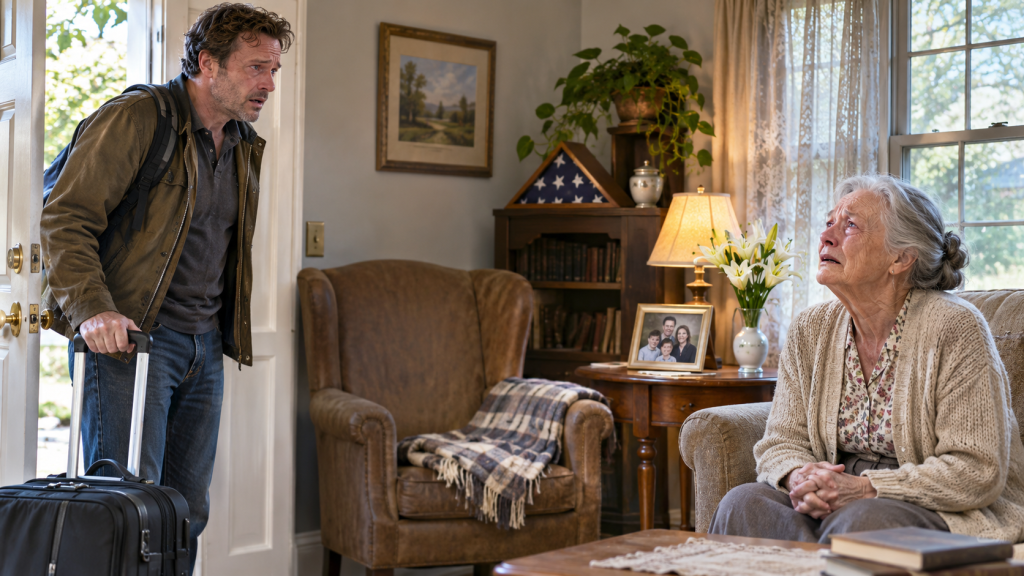
The final sentence seemed to burn through the paper. “Richard, I know why you really went to Germany.” His throat tightened. “Mom, what does Dad mean?” Dorothy looked toward the empty armchair beside the fireplace. For a moment, she seemed unable to speak.
Then she whispered, “Your father found the documents.” Richard swallowed. “What documents?” “The ones showing that your European transfer wasn’t what you told us.” His face went pale. “Mom, I worked in Frankfurt.” Dorothy nodded. “Yes, you did.” Then she looked directly at him. “But your company didn’t send you there.” Richard stared at her. “That’s ridiculous.” Dorothy reached toward the table.
Her arthritic fingers struggled to lift a second envelope.
She pushed it toward him.
“Arthur asked a lawyer to help him understand what happened.”
Richard hesitated before opening it.
Inside was a letter from his former employer’s human resources department.
The document confirmed that Richard had voluntarily applied for an overseas assignment through an affiliated business.
It also stated that his original position in the United States had not required relocation.
Richard read the paragraph twice.
Then folded the paper.
“That doesn’t change anything.”
Dorothy’s expression hardened.
“Doesn’t it?”
“An overseas opportunity came up. I accepted.”
“You told Joanne you had no choice.”
Richard looked away.
Dorothy continued.
“You told us your employer ordered you to leave.”
His mother’s voice cracked.
“And you made your wife believe she had to surrender her career to care for your parents.”
Richard rubbed his forehead.
“Mom, I was trying to secure our future.”
Dorothy gave a sad laugh.
“Whose future, Richard?”
He didn’t answer.
“Your father and I were frightened of becoming dependent. Joanne understood that.”
Tears filled her eyes.
“She spent weeks researching home modifications, medical transportation, and visiting nurses before we moved in.”
Richard stared at the floor.
“She agreed to help.”
“She agreed to help with you.”
Dorothy leaned forward.
“Not instead of you.”
Richard looked toward the staircase.
“Where is she living?”
Dorothy’s expression changed.
“That’s what you ask?”
He frowned.
“What?”
“You’ve learned your father died eighteen months ago, and your first concern is where Joanne lives.”
Richard lowered his eyes.
For a moment, he looked like the little boy Dorothy remembered.
The child who’d once brought her wildflowers and promised to build her a castle when he grew up.
But that little boy had become a man who could disappear for five years and call it responsibility.
“Mom,” he whispered, “I sent money.”
Dorothy nodded.
“Some.”
His head lifted.
“What do you mean?”
“You promised five thousand euros every month.”
“I transferred money regularly.”
“Not to us.”
Richard frowned.
Dorothy reached for another folder.
“The statements Arthur kept.”
She opened it carefully.
“Your father checked when the care bills began arriving.”
Richard’s face tightened.
Dorothy continued.
“Three transfers reached the household expense account during the first six months.”
He swallowed.
“And the others?”
“We never received them.”
Richard stared at her.
“That’s impossible.”
Dorothy pointed toward the documents.
“Then explain the account numbers.”
Richard sat down heavily.
He’d promised his family five thousand euros a month.
He’d told Joanne that money would cover professional assistance, medication, groceries, and whatever else his parents needed.
But after arriving in Frankfurt, he’d opened a separate account for his overseas expenses.
As months passed, the promised transfers became irregular.
Then stopped.
He’d convinced himself that Joanne could manage temporarily.
She’d always managed everything.
That was what made her dependable.
That was what made leaving so easy.
Now his mother was showing him the consequences.
“Your father paid for his own rehabilitation,” Dorothy said.
Richard stared at her.
“He used his savings?”
“Yes.”
“And the care fund?”
“That covered part of it.”
Dorothy’s eyes filled.
“Joanne helped us arrange a budget and hire caregivers we could actually afford.”
Richard looked down.
“She didn’t have to do that.”
His mother’s expression hardened.
“No, Richard.”
She paused.
“She didn’t.”
For several seconds, silence filled the room.
Then Dorothy said something that made Richard lift his head.
“Joanne came back the day after you flew out.”
He frowned.
“What?”
“She sat with your father and me at this very table.”
Dorothy looked toward the kitchen.
“She was crying.”
Richard swallowed.
“She was angry.”
“She was devastated.”
Dorothy took a slow breath.
“She told us she couldn’t become our full-time caregiver while keeping her own job and health.”
Richard stared at her.
“Then she abandoned you.”
Dorothy shook her head.
“No.”
Her voice became firm.
“She helped us contact a care coordinator. She arranged temporary support while we worked out a proper plan.”
Tears slipped down her cheeks.
“Then she left because she understood something your father and I were too ashamed to admit.”
Richard looked toward her.
“What?”
“We had allowed our son to turn his wife’s kindness into an obligation.”
Richard fell silent.
Dorothy continued.
“Joanne didn’t stop caring about us.”
She looked toward the empty armchair.
“She stopped allowing you to decide how much she owed us.”
Richard swallowed.
For the first time since walking through the front door, he seemed to understand that his mother’s disappointment wasn’t directed at Joanne.
It was directed at him.
Meanwhile, across town, Joanne was sitting in the office of a small nonprofit organization she’d helped establish two years earlier.
The sign outside read:
The Arthur and Dorothy Family Care Resource Center.
She was forty-eight now.
Her dark hair had begun showing a few silver strands.
But her eyes were clearer than they’d been in years.
She sat across from a woman named Linda, who was caring for her husband after a serious stroke.
Linda clutched a folder of medical bills.
“I don’t know how I’m supposed to keep working,” she whispered.
Joanne leaned forward.
“You shouldn’t have to solve everything alone.”
Linda’s eyes filled.
“My daughter says I need to be stronger.”
Joanne smiled sadly.
“Sometimes strength means asking for help before you’re completely exhausted.”
Then she handed Linda a list of local support services.
“Let’s start with what assistance you may qualify for.”
Five years earlier, Joanne had believed her marriage was built on partnership.
She’d worked as a project manager for a healthcare technology company.
She’d taken pride in her career.
She loved Richard.
And she genuinely cared about his parents.
When Arthur fell and Dorothy’s arthritis worsened, she’d agreed to rearrange their household.
But she had insisted that Richard share the responsibility.
He’d promised.
Then he’d left.
And in that moment, Joanne realized she’d been offered a life in which everyone else’s needs mattered more than her own.
She remembered the drive home from the airport.
Her hands trembling against the steering wheel.
The tears blurring the highway signs.
The way Richard had patted her shoulder before disappearing through security.
Four years will fly by.
He’d spoken as though time meant nothing.
As though four years of bathing, lifting, feeding, scheduling, and worrying could simply be placed on his wife’s shoulders.
By the time Joanne reached the parking lot of a roadside café, she’d made a decision.
She called her attorney.
Then her employer.
Then a local eldercare service.
She didn’t stop paying expenses because she wanted Arthur and Dorothy to suffer.
She stopped allowing Richard to use her money as an excuse to abandon his own responsibilities.
That first evening, she sat with her in-laws.
Dorothy cried.
Arthur looked ashamed.
“We never wanted this,” he whispered.
Joanne reached for his hand.
“I know.”
Dorothy looked frightened.
“Where will we go?”
Joanne took a breath.
“You have options.”
She opened a folder.
“We can arrange home assistance, review your benefits, and find somewhere that’s safe for both of you.”
Arthur’s eyes filled.
“And Richard?”
Joanne looked toward the window.
“Richard made his choice.”
Then she whispered.
“Now I have to make mine.”
The divorce wasn’t immediate.
Richard initially ignored the communications.
When Joanne’s attorney obtained confirmation that the papers had reached him, the legal process continued.
Richard sent angry messages.
You’re overreacting.
You promised to help my parents.
You can’t destroy our marriage over one career opportunity.
Joanne saved the messages.
But she didn’t argue.
She had spent years explaining her needs to a man who listened only when agreeing benefited him.
Now she let the legal process speak.
The first year was difficult.
Joanne moved into a smaller apartment.
She worked full-time.
And every Sunday afternoon, she visited Arthur and Dorothy.
Not because Richard expected it.
Not because anyone had the right to demand it.
But because she cared about them.
Sometimes she brought groceries.
Sometimes she helped Dorothy organize paperwork.
Sometimes she simply sat beside Arthur while he talked about his childhood.
Their relationship slowly changed.
Without Richard’s expectations hanging over them, their visits became something freely chosen.
One Sunday, Arthur looked toward Joanne.
“You know, I owe you an apology.”
She frowned.
“For what?”
“For raising a son who believed your time belonged to him.”
Joanne’s eyes filled.
“Arthur, you aren’t responsible for every choice Richard makes.”
He nodded.
“That’s true.”
Then he whispered.
“But I should have spoken up when he tried to make you carry everything.”
Joanne reached for his hand.
“You did eventually.”
Arthur smiled sadly.
“Too late.”
She shook her head.
“Not too late to matter.”
As the months passed, Arthur’s health continued declining.
His mobility worsened.
He needed more support.
Dorothy’s arthritis made daily tasks increasingly difficult.
But with professional assistance and careful financial planning, they maintained a measure of independence.
Joanne helped them navigate complicated paperwork.
She never became their unpaid full-time caregiver.
And Arthur respected that.
One afternoon, he told her something she’d remember forever.
“Joanne, the greatest gift you’ve given us isn’t the help.”
She smiled.
“What is it?”
He looked toward Dorothy.
“You taught us that needing care doesn’t give us the right to control someone else’s life.”
Eighteen months before Richard returned, Arthur died peacefully following a period of declining health.
Joanne was there.
Dorothy sat beside his bed.
A nurse had adjusted his pillows.
The room was quiet.
Arthur looked toward Joanne.
His voice was weak.
“Promise me something.”
She leaned closer.
“Anything I can.”
He swallowed.
“Don’t let Richard convince you that leaving was wrong.”
Tears rolled down her cheeks.
“Arthur…”
He smiled faintly.
“You deserve a life that belongs to you.”
Then he closed his eyes.
Those were among the last words he spoke to her.
The funeral was small.
Dorothy wore a navy dress.
Joanne sat beside her.
Several neighbors attended.
Richard didn’t come.
He’d received messages about his father’s worsening condition.
He’d also been informed after Arthur’s death.
But his assistant sent flowers.
A white arrangement with a card.
With love, Richard.
Dorothy stared at the flowers.
Then quietly asked Joanne to place them at the back of the room.
Now, five years after leaving, Richard sat in his childhood home, holding the letter Arthur had written.
His mother watched him.
“Why didn’t you come home when Dad was dying?”
Richard swallowed.
“I was busy.”
Dorothy nodded.
“So was Joanne.”
His face tightened.
“Mom…”
She interrupted.
“She was working, Richard. She had responsibilities.”
Tears filled her eyes.
“But she made time.”
Richard lowered his head.
For several moments, he couldn’t speak.
Finally, he whispered.
“Can I see Dad’s grave?”
Dorothy nodded.
“Of course.”
He wiped his face.
“And Joanne?”
His mother looked toward him.
“That isn’t my decision.”
The following morning, Richard visited the cemetery.
He stood before Arthur’s headstone.
A cool breeze moved through the trees.
He read the inscription.
Arthur Bennett — Beloved Husband, Father, and Friend.
Richard placed a small bouquet beside the stone.
Then began crying.
He’d missed the final eighteen months of his father’s life.
The hospital visits.
The difficult nights.
The last conversations.
The funeral.
All because he’d convinced himself that earning money overseas mattered more than being present.
He knelt beside the grave.
“Dad, I’m sorry.”
The wind moved through the grass.
There was no answer.
And Richard understood that some apologies arrive too late to be heard by the person who deserves them.
Three days later, Richard contacted Joanne.
She was sitting at her desk when his name appeared on the phone.
For several seconds, she stared at it.
Then answered.
“Hello, Richard.”
Her voice was calm.
He swallowed.
“Joanne.”
A long silence followed.
Then he whispered.
“I’m home.”
“I know.”
His throat tightened.
“Mom told me everything.”
Joanne looked toward the window.
“Did she?”
He sighed.
“About Dad. The divorce. The care arrangements.”
She remained silent.
Then Richard asked something that made her close her eyes.
“Why didn’t you tell me you were leaving?”
Joanne took a slow breath.
“I did, Richard.”
She opened her email archive.
The messages were still there.
Her attorney’s correspondence.
The notice of divorce proceedings.
The records confirming delivery to his Frankfurt address.
She remembered waiting for a meaningful response.
Instead, Richard had written:
You’ll calm down when you realize how difficult life is without my income.
Joanne had read those words while sitting in a small apartment surrounded by unpacked boxes.
She’d cried that night.
Not because she doubted herself.
But because she’d finally accepted that the man she loved didn’t believe she could choose a future without him.
“Richard,” she said quietly, “you knew.”
He went silent.
“You signed for the documents.”
His voice trembled.
“I thought you’d change your mind.”
Joanne closed her eyes.
“That’s the problem.”
“What?”
“You never believed my decisions mattered unless you agreed with them.”
Richard began crying.
“Joanne, can we meet?”
She hesitated.
Then answered.
“We can speak in a public place.”
His voice softened.
“Thank you.”
Joanne looked toward the framed photograph of Arthur on her desk.
She’d promised him she wouldn’t allow guilt to pull her back into a life she’d worked so hard to escape.
And she intended to keep that promise.
They met at a quiet café the following afternoon.
Richard arrived early.
For the first time in years, he looked nervous.
Joanne walked in wearing a simple green blouse and dark trousers.
She looked confident.
Peaceful.
Different.
Richard stood.
“Joanne.”
She smiled politely.
“Hello.”
He stared at her.
“You look wonderful.”
“Thank you.”
They sat.
For several moments, neither spoke.
Then Richard whispered.
“I’m sorry.”
Joanne looked toward him.
“For what?”
His eyes filled.
“For leaving you with Mom and Dad.”
She nodded.
“And?”
He swallowed.
“For lying about the transfer.”
She waited.
Richard lowered his head.
“For making promises I didn’t intend to keep.”
Joanne took a slow breath.
“Richard, you didn’t just leave me with responsibilities.”
He looked up.
“You tried to take away my choices.”
His eyes filled.
“You expected me to reduce my career, spend my savings, and become a full-time caregiver because it made your life easier.”
Richard began crying.
“I know.”
Joanne shook her head gently.
“I’m not sure you do.”
He reached across the table.
She didn’t take his hand.
“I want another chance,” he whispered.
Joanne looked at him.
For a moment, she remembered the man she’d married.
The man who used to make her laugh.
Who brought her coffee on rainy mornings.
Who once promised they’d grow old together.
She felt a familiar sadness.
But she didn’t feel the desire to return.
“Richard,” she said softly, “we’ve been divorced for four years.”
His face crumpled.
“I know.”
“I built a life.”
He nodded.
“I understand.”
She smiled sadly.
“Then please don’t ask me to abandon it to make you feel better.”
Richard stared down at his coffee.
For several minutes, neither spoke.
Then he whispered.
“Mom said you started a care center.”
Joanne nodded.
“A resource center.”
He looked surprised.
“Named after my parents?”
“Yes.”
His eyes filled.
“Why?”
Joanne smiled gently.
“Because Arthur and Dorothy helped me understand how many families struggle with caregiving.”
She paused.
“And because your father believed no one should have to sacrifice their entire life to prove they love someone.”
Richard covered his face.
Then Joanne said something he hadn’t expected.
“Richard, there’s one more thing you should know.”
He looked up.
“What?”
“Arthur helped establish the center before he died.”
Richard stared at her.
“Dad?”
She nodded.
“He contributed part of his savings after arranging for his and Dorothy’s care.”
Richard swallowed.
“I didn’t know.”
Joanne looked toward him.
“He was proud of it.”
Tears filled Richard’s eyes.
Then he whispered.
“Why didn’t anyone tell me?”
Joanne’s expression softened.
“Because you weren’t there to hear it.”
Richard sat motionless.
The café hummed around them.
Coffee machines hissed.
People laughed at nearby tables.
Life continued.
And for the first time, Richard seemed to understand how many important moments he’d missed.
Not because someone had excluded him.
But because he’d spent five years making himself unavailable.
When Joanne stood to leave, Richard reached into his briefcase.
“Wait.”
She paused.
He removed a document.
“I found this among Dad’s papers.”
Joanne looked down.
It was a copy of a financial statement.
Her eyes narrowed.
“What’s that?”
Richard swallowed.
“Mom said Dad was worried about the money I promised to send.”
Joanne nodded.
“He had reason to be.”
Richard opened another page.
“I checked my European accounts.”
Her stomach tightened.
“And?”
His voice trembled.
“Some of the transfers were made.”
Joanne frowned.
“To whom?”
Richard looked frightened.
“That’s what I don’t understand.”
He placed the statement before her.
The payments weren’t going to Arthur and Dorothy’s care account.
They were going to a business account.
A company named Bennett International Advisory.
Joanne stared at the name.
“Richard, that’s your company.”
He nodded.
“Yes.”
She looked toward him.
“Then why are you surprised?”
Richard swallowed.
“Because someone transferred money out of it.”
Her heart tightened.
“Who?”
He hesitated.
Then whispered.
“Someone with access to my Frankfurt accounts.”
Joanne leaned back.
For a moment, she felt the old instinct to help.
To open a spreadsheet.
To investigate.
To solve Richard’s problems before he had to face them.
Then she remembered Arthur’s final words.
You deserve a life that belongs to you.
She took a slow breath.
“Richard, you need a forensic accountant and an attorney.”
He looked toward her.
“Joanne, you used to manage all our finances.”
She nodded.
“I did.”
His eyes filled.
“Can you help me?”
She shook her head gently.
“No, Richard.”
For several seconds, he stared at her.
Then he whispered.
“Why?”
Joanne stood.
“Because helping you doesn’t mean taking responsibility for your choices.”
She picked up her handbag.
“You have professionals who can investigate your accounts.”
Richard looked devastated.
“And Mom?”
“She needs a son who shows up.”
Joanne smiled sadly.
“Not another promise that someone else will do the work.”
She turned toward the door.
Then Richard spoke again.
“Joanne.”
She stopped.
His voice trembled.
“Do you think Dad ever forgave me?”
For several seconds, she remained silent.
Then she turned back.
“Arthur loved you until the end.”
Richard began crying.
Joanne continued.
“But I can’t tell you what forgiveness meant to him.”
She paused.
“That’s a conversation you needed to have while he was alive.”
Joanne stepped outside.
The afternoon sunlight warmed her face.
She inhaled deeply.
For five years, she’d carried the memory of Richard leaving her at the airport.
The way he’d smiled.
The way he’d promised time would pass quickly.
The way he’d assumed she’d wait.
Now she’d finally spoken to him as a woman who no longer needed his permission to live.
And for the first time, that memory no longer hurt quite so much.
That evening, Dorothy called her.
“Joanne, sweetheart?”
Joanne smiled.
“Hello, Dorothy.”
Her former mother-in-law hesitated.
“Richard told me you met.”
“Yes.”
“Was it difficult?”
Joanne looked toward the window.
“A little.”
Dorothy’s voice softened.
“I’m sorry.”
Joanne shook her head.
“You don’t have anything to apologize for.”
A long silence followed.
Then Dorothy whispered.
“Joanne, there’s something I haven’t told Richard.”
Joanne’s stomach tightened.
“What?”
Dorothy took a slow breath.
“Arthur left another letter.”
Joanne frowned.
“For Richard?”
“No.”
The older woman’s voice trembled.
“For you.”
Joanne sat down.
“Dorothy, why didn’t you give it to me?”
“Because Arthur asked me to wait.”
Her heart pounded.
“Until when?”
Dorothy hesitated.
Then answered.
“Until Richard finally came home and learned what his choices had cost him.”
For several seconds, Joanne couldn’t speak.
Then Dorothy continued.
“There’s also a document attached.”
Joanne frowned.
“What kind of document?”
Her former mother-in-law swallowed.
“Something Arthur arranged before he died.”
Joanne looked toward the photograph on her desk.
The kind old man who’d apologized for his son’s behavior.
Who’d encouraged her to protect her independence.
Who’d helped create the resource center.
She whispered.
“What did he arrange?”
Dorothy’s voice broke.
“Joanne, Arthur made a change to his estate.”
Joanne sat motionless.
“Dorothy, you and Arthur needed your savings for care.”
“I know, sweetheart.”
“Then why would he change anything?”
Dorothy took a shaky breath.
“Because he discovered something about Richard’s overseas arrangement.”
Joanne’s heart began pounding.
“What?”
Her former mother-in-law hesitated.
Then whispered.
“Richard didn’t just leave because he wanted a career in Europe.”
Joanne closed her eyes.
She’d suspected that for years.
But Dorothy wasn’t finished.
“Arthur learned that your husband had been preparing the move long before he asked us to live with you.”
Joanne swallowed.
“How long?”
Dorothy’s voice trembled.
“Almost eighteen months.”
Joanne stared toward the window.
Eighteen months.
Richard had spent a year and a half preparing to move abroad.
Then waited until the day after his parents moved in to tell her.
The betrayal suddenly seemed even more calculated.
But Dorothy continued.
“There’s another thing.”
Joanne gripped the telephone.
“What?”
Her former mother-in-law lowered her voice.
“Arthur discovered that Richard had listed you as an unpaid director of his European company.”
For several seconds, Joanne couldn’t breathe.
“What?”
Dorothy swallowed.
“Your name appeared on documents connected to Bennett International Advisory.”
Joanne stared at the wall.
“I never agreed to that.”
“I know.”
Her heart pounded.
“Did Arthur know?”
“He found out before he died.”
Joanne closed her eyes.
Then Dorothy whispered something that made the room seem to tilt.
“And he believed Richard had used your identity to support financial arrangements you knew nothing about.”
Joanne sat motionless.
For five years, she’d believed the worst thing Richard had done was abandon her with responsibilities that weren’t hers to carry.
Now she was learning that his overseas plans might have involved her name long after their marriage ended.
She looked toward the framed photograph of Arthur.
Then whispered.
“Dorothy, where is the letter?”
Her former mother-in-law took a shaky breath.
“It’s in the envelope Arthur left with me.”
Joanne closed her eyes.
For years, she’d worked to rebuild her independence.
She’d protected her career.
Created a nonprofit.
Helped families navigate the difficult world of caregiving.
And learned to say no without apologizing.
But now a new question threatened to pull her back toward a past she’d fought so hard to escape.
Had Richard merely abandoned his wife to pursue a better life—or had he used her identity to build that life without her consent?