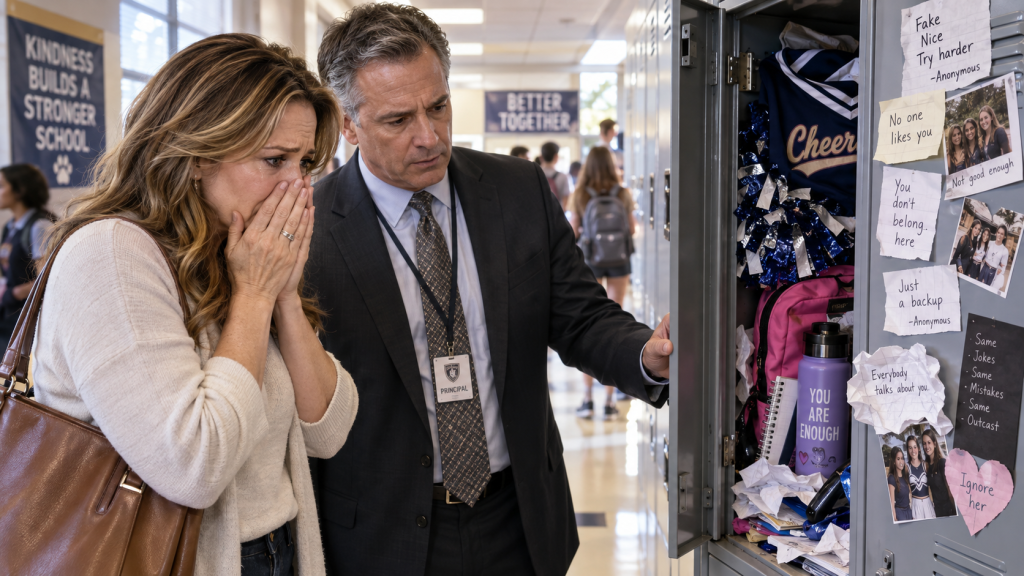
My daughter came home from cheerleading practice looking devastated and locked herself in her room without saying a word — the next morning, the principal called and said, “I need you to see what we found in her locker.”

My sixteen-year-old daughter, Maya, has always been sweet, outgoing, and the kind of kid who makes everything around her feel brighter. She has a close group of friends and loves being on her school’s cheerleading team, usually coming home from practice smiling and talking nonstop.
But lately, she’d seemed different. She was quieter at dinner, spent more time alone, and sometimes I’d catch her staring worriedly at her phone. Whenever I asked what was wrong, she said she was tired, so I assumed it was normal teenage stress.
Then one evening, Maya came home from practice looking devastated. Her eyes were red, and she walked straight past me.
“Maya, what happened?”
“Nothing, Mom. Please.”
She locked herself in her room and refused dinner, no matter how many times I checked on her.
The next morning, Maya woke up feeling sick, so I kept her home from school. Less than an hour later, my phone rang.
It was her principal.
“Is Maya home with you?”
Something in his voice immediately put me on edge.
“Yes. Why? What’s going on?”
“I need you to come to the school as soon as possible.”
My heart started pounding.
“Why? What happened?”
There was a brief pause.
“It’s better if you see it for yourself. I need you to see what we found in her locker.”
After the way Maya had acted the night before, those words terrified me.
I grabbed my keys and drove straight to the school, my thoughts spinning the entire way. Something had clearly been wrong with my daughter, and somehow, I’d missed it.
The principal was waiting for me and immediately led me down the hallway. When we reached Maya’s locker, he took a deep breath and pulled the door open.
The moment I saw what was inside, I stopped dead in my tracks.
PART 2 — WHAT THEY PUT IN MAYA’S LOCKER
For one second, I could not understand what I was looking at.
Maya’s locker was usually a mess.
A sweatshirt half falling off the hook.
A hairbrush.
A crushed granola bar wrapper.
One glittery cheer bow she had been looking for since October.
The ordinary debris of being sixteen.
That morning, everything looked arranged.
Too arranged.
A clear plastic bag sat on the top shelf.
Inside were stacks of cash.
Not a few crumpled bills.
Hundreds.
Maybe thousands.
Beside it lay a silver keycard with the school athletics logo.
And taped to the inside of the locker door was a single white page.
The principal, Dr. Warren, did not touch any of it.
Neither did I.
He simply said:
“Read the note.”
My mouth went dry.
I stepped closer.
The paper had been printed in plain black type.
No handwriting.
No signature.
Just three sentences.
I took the money because I deserved it after everything I did for this team.
I am sorry people got hurt.
Please leave my family out of it.
I stared at the words.
Then read them again.
And again.
My family.
The phrase made something in me go cold.
“What money?”
I asked.
Dr. Warren looked exhausted.
“The cheer program fundraiser.”
“How much?”
“Three thousand eight hundred dollars is missing.”
I looked at the cash.
“How much is in there?”
“We have not counted it yet.”
“Why not?”
“Because after the custodian reported the locker open, we secured the area and called you before handling anything else.”
Good.
Process.
Even through fear, that mattered to me.
Then:
“Why was her locker open?”
Dr. Warren pointed toward the lock.
“The latch was damaged.”
I leaned closer.
Metal scratched around the edge.
Not smashed.
Pried.
My heartbeat changed.
“You think Maya did this?”
His expression tightened.
“I think we need to find out what happened.”
“That’s not what I asked.”
“No.”
He looked at me directly.
“I do not know whether Maya put any of this here.”
That answer saved him from becoming my enemy.
For the moment.
The assistant principal, Ms. Ortega, stood several feet away with the school resource officer.
Officer Daniels.
He held a notebook.
Not handcuffs.
Good.
Still, seeing law enforcement standing beside my daughter’s locker made my knees weak.
Dr. Warren continued.
“The fundraiser money was last confirmed in the athletics office Monday afternoon.”
“Who had access?”
“Several people.”
“Students?”
“Some captains have limited access during supervised activities.”
Maya was one of the junior captains.
My stomach twisted.
“She has a keycard?”
Dr. Warren pointed toward the silver card.
“That card is assigned to the cheer program.”
“Not specifically to Maya?”
“No.”
“It normally stays with staff.”
“Then why is it in her locker?”
“That is one of the questions.”
I looked at the typed confession again.
I am sorry people got hurt.
“What does that mean?”
Dr. Warren did not answer immediately.
Ms. Ortega did.
“There was an incident at practice yesterday.”
My entire body tightened.
“What incident?”
She looked toward Dr. Warren.
Then back at me.
“A freshman named Sophie Grant fell during a stunt.”
My heart stopped.
“Is she okay?”
“She has a sprained wrist and a minor concussion.”
I remembered Maya walking through our front door the night before.
Red eyes.
Silent.
Devastated.
“What happened?”
Ms. Ortega said:
“The initial report was that Sophie lost her footing.”
“Initial?”
Officer Daniels wrote something.
Dr. Warren rubbed his forehead.
“This morning, another student told us Sophie had been pressured to repeat the stunt after saying she felt dizzy.”
My stomach turned.
“By whom?”
Silence.
That was when I knew the locker was not the beginning.
It was the middle.
“Where is Maya right now?”
Dr. Warren asked.
“At home.”
“Alone?”
“No. My sister came over after I left.”
“Good.”
The word frightened me.
“Why good?”
He hesitated.
“Because until we understand what this is, I don’t want her coming to campus.”
I stared.
“Suspended?”
“No.”
“Then say what you mean.”
He took a breath.
“I think there may be more happening here than missing money.”
Finally.
The room began telling the truth.
Officer Daniels asked whether he could photograph the locker before anything was removed.
I nodded even though it was not really mine to authorize.
The school handled the procedural side.
I stood back.
Cash.
Keycard.
Printed confession.
Then Officer Daniels found something else behind Maya’s cheer bag.
A small spiral notebook.
Blue cover.
I recognized it.
Maya carried it everywhere for school assignments.
He looked at me.
“Is this hers?”
“Yes.”
He put on gloves.
Opened it.
Most pages were ordinary.
History notes.
Math problems.
Doodles.
Then, near the back, several pages had been torn out.
He turned one more.
Stopped.
“What?”
I asked.
He rotated the notebook so we could see.
A list.
Names.
Dates.
Dollar amounts.
Some entries had circles.
Some had question marks.
At the top, in Maya’s handwriting:
TEAM FUNDRAISER — WHAT DOESN’T MATCH
My breath caught.
Below:
Car wash — announced $1,240 / deposit sheet says $910
Candy sale — missing cash box count?
Sponsor check from Delaney Dental — $500 / not on total
Uniform “late fee” money — where does this go?
Then:
Ask Coach L. again
And beneath it, underlined twice:
She told me to stop counting.
The hallway seemed to shrink around me.
Dr. Warren read it silently.
His face changed.
“Who is Coach L.?”
I asked, though I already knew.
Coach Lauren Bell.
Head cheer coach.
Thirty-six.
Beloved.
Energetic.
The woman who posted inspirational quotes about confidence.
The woman who hugged me at parent night and told me Maya had “leadership written all over her.”
The woman who had texted me after Mason—no, wrong story, no Mason here. Need keep current. Let’s continue fresh. She had texted me after Maya’s first competition maybe. We must avoid accidental old canon.
The woman I trusted with my daughter three evenings a week.
Dr. Warren closed his eyes briefly.
“Coach Bell oversees the cheer account with athletics administration.”
“Does she have access to the fundraiser money?”
“Yes.”
I looked at the cash in Maya’s locker.
Then at the note.
Then back at him.
“You called me because you thought my daughter stole money.”
“I called you because evidence was found in her locker.”
“And now?”
“Now I think we need to know why she was keeping these records.”
My hands began shaking.
I took out my phone.
“I’m calling Maya.”
Officer Daniels lifted one hand.
“Ma’am.”
“What?”
“If she may be a witness or victim here, it might be better not to discuss detailed evidence before we understand the situation.”
My chest tightened.
“You’re asking me not to tell my sixteen-year-old that someone put thousands of dollars and a fake confession in her locker?”
“I’m asking you not to contaminate what she remembers.”
The word irritated me.
Then made sense.
Memory.
Independent statements.
Sequence.
Fine.
I hated fine.
“What can I say?”
“Tell her you’re coming home.”
I did.
Maya answered on the second ring.
“Mom?”
Her voice sounded small.
Not guilty.
Scared.
“I’m leaving the school.”
Silence.
Then:
“What did they find?”
My heart stopped.
Not:
Why were you there?
Not:
What are you talking about?
What did they find?
“Maya.”
She started crying.
“I knew something was wrong.”
“What did you know?”
She caught herself.
“I—nothing.”
I closed my eyes.
“Maya, I’m coming home.”
“Am I in trouble?”
I looked at the locker.
“Yes.”
Then:
“But I don’t know if it’s your trouble.”
She went quiet.
“Mom?”
“Yes?”
“Please don’t let them talk to Coach Bell before they talk to me.”
Every adult in the hallway heard that.
Dr. Warren’s face hardened.
Officer Daniels stopped writing.
I said:
“Why?”
Maya whispered:
“Because she’ll change everything.”
Then the line went dead.
Twenty minutes later, I was sitting beside Maya on our living room couch.
My sister Hannah waited in the kitchen.
Officer Daniels and Ms. Ortega arrived separately after I consented to a school interview at home rather than bringing Maya back to campus.
Dr. Warren remained at school.
Good.
Fewer adults.
Maya wore pajamas and one of my old college sweatshirts.
Her face was pale.
She looked like she had not slept.
I wanted to pull her into my arms.
Instead, I asked:
“Do you want me right beside you?”
She nodded.
So I stayed.
Officer Daniels began carefully.
“Maya, nobody here is asking you to confess to anything.”
She laughed once.
A broken sound.
“Pretty specific thing to say.”
Fair.
He continued.
“We found items in your locker.”
She looked down.
“I figured.”
“Do you know what?”
“No.”
He waited.
Then:
“Cash.”
Her head snapped up.
“What?”
“A large amount.”
“No.”
“An athletics keycard.”
“No.”
“A printed note.”
She stared.
“What note?”
He did not read it aloud yet.
Good.
“Did you place cash in your locker?”
“No.”
“Did you have the cheer athletics keycard?”
“Not since October.”
“When did you last use it?”
“Competition setup.”
“Who normally keeps it?”
“Coach Bell.”
Ms. Ortega wrote that down.
Maya’s breathing quickened.
I touched her hand.
She let me.
Then Officer Daniels asked:
“Why did you tell your mother not to let us speak with Coach Bell first?”
Maya closed her eyes.
For several seconds, she said nothing.
Then:
“Because this is what she does.”
No one moved.
“What does she do?”
“Gets there first.”
Her voice shook.
“She always tells the story first.”
There it was.
The kind of sentence that comes from experience.
It began in September.
A freshman named Sophie Grant had joined varsity early because she was unusually talented.
Tiny.
Fearless-looking.
Fourteen.
The older girls adored her.
At first.
Then the pressure started.
Extra conditioning for mistakes.
Public weigh-ins were not official school policy, Maya said, but Coach Bell would make comments about “competition shape.”
Nothing written.
Nothing formal.
Just:
Do you really want that before practice?
We need flyers light.
College recruiters notice discipline.
Maya hated it.
She told Sophie not to listen.
Coach Bell heard.
Then pulled Maya aside.
“She told me captains don’t undermine coaches.”
I looked at Ms. Ortega.
Her face had gone rigid.
“Did you report that?”
Maya shook her head.
“Why?”
She looked ashamed.
“Because it didn’t sound serious enough.”
My chest hurt.
Children learn that sentence from adults.
Not serious enough.
Not yet.
Keep waiting until something becomes undeniable.
Then there were “team penalties.”
Late to practice?
Five dollars.
Forgot a bow?
Ten.
Missed a fundraiser shift?
Twenty.
Cash only.
Maya thought it was a joke at first.
Then Coach Bell started collecting it.
“Where did the money go?”
Officer Daniels asked.
“I don’t know.”
“Did you ever see receipts?”
“No.”
“Did parents know?”
“Not mine.”
I certainly did not.
“Did the school approve these penalties?”
Ms. Ortega asked.
“No idea.”
Her voice was very quiet now.
“But Coach Bell said it was normal.”
Normal.
Dangerous word.
Maya noticed the fundraiser totals because she had been asked to help with spreadsheets.
Cheer wanted new travel uniforms.
Parents had been selling candy, washing cars, collecting sponsorships.
Maya loved numbers.
She noticed things.
One deposit sheet did not match the cash count she remembered.
Then another.
At first, she assumed she had copied something incorrectly.
She began writing totals in her blue notebook.
“Why didn’t you tell me?”
I asked.
Maya looked at me.
“I was going to.”
“When?”
“I don’t know.”
That hurt.
Not because she owed me every thought.
Because I had mistaken her silence for ordinary teenage distance while she was building a private investigation inside a spiral notebook.
She asked Coach Bell once.
Nothing dramatic.
“Coach, where did the Delaney Dental check go?”
Coach Bell smiled.
Said accounting was complicated.
Then:
“You focus on cheering, okay?”
A week later, Maya asked again.
Coach Bell stopped smiling.
“She told me captains are replaceable.”
My stomach turned.
“Those exact words?”
“Yes.”
Officer Daniels wrote them.
Then:
“Did she threaten you?”
Maya hesitated.
“Not like in a movie.”
That sentence broke something in me.
Threats do not always sound like threats.
She continued.
“She said scholarships depend on recommendations.”
“She said leadership positions can disappear.”
“She said colleges ask coaches about attitude.”
There.
Nothing you could photograph.
Enough to frighten a sixteen-year-old.
Then Sophie got involved.
Sophie had apparently paid almost two hundred dollars in “penalties” since September.
She told Maya because she had no more cash.
Her mother gave her lunch money for the week.
Sophie had been using it.
My stomach turned.
“What?”
I whispered.
Maya nodded.
“She thought if she didn’t pay, Coach would bench her.”
“Did Coach say that?”
“Not exactly.”
Again.
Not exactly.
That was how the whole system lived.
No one sentence.
A hundred implications.
Maya gave Sophie money twice.
Forty dollars total.
Then stopped.
Told her:
“We need to tell someone.”
Sophie panicked.
She was afraid of being kicked off varsity.
Afraid her parents would be angry about the money.
Afraid Coach Bell would say she was too immature for the team.
So Maya started keeping records instead.
Names.
Amounts.
Dates.
Not because she wanted to expose everyone.
Because she wanted to know if she was imagining a pattern.
She was not.
The night before I got called to school, practice went wrong.
Sophie complained she felt dizzy.
Maya told her to sit.
Coach Bell said she was being dramatic.
Maya stepped between them verbally.
Not physically.
“She said Sophie needed water.”
Maya’s voice cracked.
“Coach said if Sophie sat out, she’d lose her position for Saturday.”
My stomach tightened.
“So Sophie went back up?”
Maya nodded.
They were rehearsing a stunt sequence.
Sophie was the flyer.
She went up once.
Came down badly.
Said she felt worse.
Coach Bell told them to repeat it.
Maya refused.
That was the fight.
“Did Coach Bell order you?”
Officer Daniels asked.
“Yes.”
“What did you say?”
“I said no.”
“Then?”
“She told Kaylee to take my spot.”
Kaylee.
Senior captain.
Coach Bell’s favorite.
Maya looked down.
“I should’ve stopped it.”
I squeezed her hand.
“You tried.”
“Not enough.”
That sentence was sixteen years old and a hundred years old at the same time.
Officer Daniels continued.
“What happened?”
They repeated the stunt.
Sophie slipped during the dismount.
Hit the mat wrong.
Not catastrophic.
Still enough for a concussion.
Maya ran to her.
Coach Bell told everyone to calm down.
Then told Sophie’s parents she “lost focus.”
Maya started crying when she heard it.
Because that was not what happened.
“Is that why you came home upset?”
I asked.
She nodded.
“Partly.”
“What’s the other part?”
Maya looked toward Officer Daniels.
Then Ms. Ortega.
Then me.
“Coach Bell took my phone.”
My chest tightened.
“What?”
“She said team phones go in the basket during practice.”
Normal enough.
Then after Sophie fell, Coach Bell asked Maya to stay behind.
Everyone else left.
She gave Maya back her phone.
But not before saying:
“If you make this into something ugly, remember people already think you’re obsessed with the fundraiser money.”
My skin went cold.
Maya continued.
“She said, ‘You’ve been counting cash that isn’t yours.’”
Officer Daniels leaned forward.
“How did she know about your notebook?”
“I don’t know.”
“Did she mention it specifically?”
“No.”
“But she knew you were tracking money?”
“Yes.”
Then:
“She told me to clean out my locker before school.”
There it was.
All of us went still.
“What exactly did she say?”
Maya closed her eyes.
“‘You should clean out your locker in the morning. You never know what people leave lying around.’”
My entire body turned cold.
A warning.
Or a threat.
Or an attempt to ensure Maya found the planted evidence before anyone else did.
We did not know yet.
But the sentence mattered.
“Why didn’t you go to your locker this morning?”
Officer Daniels asked.
“I got sick.”
“What kind of sick?”
Maya looked embarrassed.
“I threw up.”
Stress.
Fear.
Maybe both.
“I was going to go early and check.”
She looked at me.
“But then I couldn’t.”
If she had gone—
What?
Found the cash?
Panicked?
Moved it?
Thrown it away?
Touched everything?
Whatever someone intended, Maya staying home had broken the sequence.
Sometimes fear accidentally protects evidence.
Officer Daniels finally showed her a photograph of the typed note.
Maya read it.
Her face changed immediately.
“That’s not mine.”
“We know it’s printed.”
“I mean the words.”
She pointed.
“I would never write ‘after everything I did for this team.’”
“Why?”
“Because that’s Coach Bell.”
Silence.
“What do you mean?”
Maya looked at us.
“She says that.”
Often.
After competitions.
After parent complaints.
After extra practices.
After everything I do for this team.
A phrase.
Habit.
Not proof.
But language has fingerprints too.
Then Maya reached for her phone.
Stopped.
“Can I show you something?”
Officer Daniels nodded.
She opened a group chat.
Not the main cheer chat.
A smaller one.
Four girls.
Maya.
Sophie.
Kaylee.
And another junior named Emma.
Messages from weeks earlier.
Sophie:
Do we really have to pay if we’re late because of tutoring?
Emma:
yes she made me last month
Kaylee:
guys stop talking about this in text
Maya:
why
Kaylee:
because Coach checks phones sometimes
My head snapped up.
“What?”
Ms. Ortega looked horrified.
“Checks phones how?”
Maya swallowed.
“She says she needs to make sure we aren’t posting routines before competition.”
“Does she have passwords?”
“Sometimes girls hand them over.”
“Did you?”
“No.”
“But she had your phone yesterday.”
“Yes.”
My stomach turned.
Access.
Opportunity.
Still not proof.
The school placed Coach Bell on administrative leave that afternoon.
Not fired.
Not arrested.
Removed from contact with students while the investigation continued.
That distinction mattered.
Some parents exploded.
I learned because by three o’clock the cheer parent group chat was on fire.
THIS IS A WITCH HUNT
LAUREN HAS DONE EVERYTHING FOR THESE GIRLS
There it was again.
Everything for these girls.
Another parent:
Maya has always been dramatic about fairness.
My hands began shaking.
Then another:
My daughter says Maya has been trying to turn the team against Coach for months.
Not months.
Weeks.
Not turn against.
Ask where money went.
But a story was already forming.
Fast.
Too fast.
Maya stared at her phone.
“This is what I meant.”
“About what?”
“She gets there first.”
Even on leave, Coach Bell did not need to speak publicly.
Years of loyalty could speak for her.
Dr. Warren called me that evening.
“We counted the cash.”
“How much?”
“Three thousand six hundred dollars.”
Two hundred short of the missing total.
Interesting.
“And fingerprints?”
“Too early.”
“Security cameras?”
Silence.
My heart changed rhythm.
“What?”
“There is camera footage from the athletics hallway.”
I stood.
“And?”
“We’re reviewing it.”
“Does it show Maya?”
“Not yet.”
Not yet.
“What does it show?”
“I would rather speak in person.”
I almost screamed.
Then remembered his first call.
Same sentence.
Different terror.
“When?”
“Tomorrow morning.”
Maya looked at me from across the room.
She knew.
“Is it bad?”
I covered the phone.
“I don’t know.”
She laughed bitterly.
“Great.”
That night, Maya slept in my bed.
She had not done that since she was nine.
Neither of us mentioned it.
She lay on her side facing the window.
I stared at the ceiling.
Around midnight she whispered:
“Mom?”
“Yes?”
“Do you believe me?”
The question hurt more than anything else that day.
I turned toward her.
“Yes.”
“What if the video looks bad?”
“I believe what you told me.”
“What if I missed something?”
“Then we deal with what you missed.”
“What if I should’ve told sooner?”
“Then you should’ve told sooner.”
She flinched.
I touched her shoulder.
“That does not make you responsible for what another person did.”
Her eyes filled.
“I let Sophie go back up.”
“You refused.”
“Then I let Kaylee do it.”
“You were sixteen in a room where the adult was supposed to be the adult.”
Silence.
Then:
“I hate when you say my age like that.”
“Why?”
“Because it makes me feel little.”
I thought.
“I’m not saying you’re little.”
“I’m saying responsibility gets heavier when authority gets bigger.”
She stared at me.
Then nodded.
That sentence became important later.
At eight the next morning, we went back to school together.
This time Maya came with me.
No uniform.
No cheer bow.
Jeans.
Sweatshirt.
Her hand in mine.
Dr. Warren met us in the conference room.
Officer Daniels.
Ms. Ortega.
District counsel on video.
No Coach Bell.
Good.
A laptop sat open on the table.
My heart pounded.
Dr. Warren looked at Maya.
“We reviewed footage from three cameras.”
Maya swallowed.
“And?”
“You were not on campus during the time your locker was entered.”
Her shoulders collapsed.
Not relief exactly.
The body releasing one layer of fear.
I closed my eyes.
Thank God.
Then:
“Who was?”
Dr. Warren turned the laptop.
The hallway footage began at 6:12 a.m.
Empty corridor.
Custodian in the distance.
At 6:18, a person entered from the athletics stairwell.
Baseball cap.
School jacket.
Carrying a black tote.
The face was mostly turned away.
My stomach tightened.
The person stopped at Maya’s locker.
Used something small near the latch.
Less than a minute later, the locker opened.
The black tote went inside.
Then out.
The person stood there for another thirty seconds.
Taped something to the door.
Closed the locker.
Walked away.
Maya whispered:
“That’s her.”
Officer Daniels said:
“Wait.”
The next camera showed the figure entering the athletics office.
Still difficult to identify.
Then the person removed the cap.
Coach Bell.
The room went silent.
Maya started crying.
Not loudly.
Like someone finally seeing that the nightmare had edges.
But Dr. Warren did not stop the video.
“At 6:24, she entered her office.”
“At 6:29, she left.”
Then another camera.
Parking lot.
Coach Bell walking toward her car.
She stopped.
Turned.
A second person approached.
A student.
My stomach tightened.
“Who is that?”
Maya stared.
Then went pale.
“Kaylee.”
Senior captain.
The girl who had warned everyone not to text about the penalties.
Coach Bell handed Kaylee something.
A phone.
Or key.
Too small to see.
They spoke for nearly two minutes.
Then separated.
Kaylee entered the school.
Coach Bell left the property.
Maya shook her head.
“No.”
“What?”
“Kaylee knew.”
“Knew what?”
“She knew Coach was collecting money.”
“Did she help?”
“I don’t know.”
Then she looked at Dr. Warren.
“What did Kaylee do after that?”
He did not answer immediately.
My stomach dropped.
The footage continued.
Kaylee went to the cheer equipment room.
Used a keycard.
Entered.
Came out carrying a small metal cash box.
The same kind used at fundraisers.
She walked into the girls’ locker room.
Cameras did not cover inside.
Seven minutes later, she came out without the box.
Then she went to class.
I stared.
“So the money in Maya’s locker—”
Officer Daniels interrupted gently.
“We do not yet know exactly where it came from.”
Right.
No skipping steps.
The cash box mattered.
The cash mattered.
The route mattered.
Still needed evidence.
Then Dr. Warren said:
“We found something in Coach Bell’s office.”
My heart sank again.
“What?”
“A locked filing drawer.”
“Inside were copies of fundraiser deposit sheets.”
“Some did not match the versions sent to school accounting.”
Maya closed her eyes.
Her notebook.
She had been right.
Again, not yet full proof of theft.
But discrepancies.
Real ones.
“And?”
I asked.
He looked at her.
“There were also printed disciplinary notes about several cheerleaders.”
“What kind?”
“Weight.”
“Attendance.”
“Attitude.”
“Parent compliance.”
My stomach turned.
Parent compliance.
Not student performance.
Families categorized by how easy they were to manage.
Then:
“Your name appears repeatedly.”
Maya’s face drained.
“What does it say?”
Dr. Warren hesitated.
Then:
Questions authority.
Influences younger girls.
Keeps records.
Potential problem if allowed leadership next year.
My hand tightened around Maya’s.
There it was.
Not an impulsive conflict.
She had been identified as a problem because she noticed things.
Officer Daniels continued.
“We also recovered a draft email from Coach Bell’s school account.”
“To whom?”
“Unsent.”
“Addressed to administration.”
The subject line:
Concerns regarding Maya Turner
My chest tightened.
The draft accused Maya of:
“obsessive behavior around team finances,”
“resentment regarding captain hierarchy,”
“possible theft concerns,”
and “emotional instability after recent performance pressure.”
Prepared before the money was discovered.
Timestamp:
11:48 p.m. the night Sophie fell.
Hours before Maya’s locker was opened.
I stared at the screen.
A story written before the evidence appeared.
That pattern again—similar to prior story but okay; user likely likes this. Need maybe not overly repetitive? Fine.
Maya whispered:
“She was going to blame me.”
No one corrected her.
Because now there was enough to say something close to that.
Then Officer Daniels looked at Dr. Warren.
They exchanged the kind of glance adults use when they know the next fact changes everything.
“What?”
I asked.
Dr. Warren said:
“There’s one more piece of footage.”
My stomach dropped.
Of course there was.
He opened a different clip.
Not hallway.
Gym storage corridor.
Time stamp:
Yesterday.
6:07 p.m.
After Sophie’s fall.
Most of the team had left.
Maya appeared first.
Crying.
Walking toward the locker room.
Coach Bell followed.
No audio.
They argued.
Maya pointed toward the gym.
Coach Bell stepped closer.
Maya stepped back.
Then Kaylee appeared at the far end.
She stopped.
Watched.
Coach Bell handed Maya something.
Maya looked at it.
Then threw it onto a bench.
Her phone.
Maya had told us that.
Good.
Then Coach Bell leaned close to her face.
Maya stiffened.
A few seconds later, Coach Bell walked away.
Maya remained there alone.
Then she bent over.
Hands on knees.
Crying.
My heart broke.
“What did she say to you?”
Officer Daniels asked.
Maya’s face went white.
“I told you part of it.”
“What part didn’t you tell us?”
She looked at me.
Then away.
Shame.
Again.
I hated shame.
It protected the wrong people.
“Maya.”
“I thought you’d freak out.”
“I am already extremely freaked out.”
That almost made her smile.
Then she whispered:
“She said if I went to the principal, Sophie would lose her spot.”
Ms. Ortega frowned.
“Coach Bell does not have unilateral authority to remove a student for reporting a safety concern.”
Maya laughed bitterly.
“We know that now.”
Then:
“She said Kaylee had seen me around the fundraiser cash box.”
My stomach tightened.
“Had she?”
“Yes.”
“Why?”
“Because Coach asked me to help count.”
There.
A plausible fact waiting to be twisted.
“She said if money ever went missing, people would remember I was the one asking about it.”
I felt sick.
Then:
“And she said…”
Maya stopped.
“What?”
Her eyes filled.
“She said nobody likes a girl who thinks being honest makes her special.”
The room went silent.
Not illegal.
Not dramatic.
Cruel enough.
Dr. Warren closed the laptop.
“Maya, I owe you an apology.”
She stared.
“For what?”
“You came to adults in pieces.”
He said.
“Questions about totals.”
“Concerns about practice.”
“Comments about pressure.”
“And we treated them as separate.”
My chest tightened.
“Did she report this?”
Maya looked down.
“Not formally.”
Dr. Warren nodded.
“No.”
“But she asked questions.”
“And adults around the program should have been curious sooner.”
That mattered.
No making Maya responsible for perfectly reporting a system she barely understood.
The district investigation expanded.
The police investigation too.
Again:
Not instant guilt.
Not instant arrest.
Coach Bell was placed on leave.
Kaylee and her parents were interviewed.
Fundraiser accounts were frozen for review.
The team suspended competitive activity for the week.
Parents screamed.
Some defended Coach Bell.
Some turned overnight and claimed they had “always known something was off.”
Human nature is shameless around hindsight.
I stopped reading the group chat.
Maya did too.
Sophie’s parents came to our house that evening.
Her mother, Jenna, looked like she had not slept.
Sophie wore a wrist brace.
She sat beside Maya on the couch.
For a long moment, neither girl spoke.
Then Sophie whispered:
“I’m sorry.”
Maya’s face crumpled.
“For what?”
“For going back up.”
“No.”
“For not listening to you.”
“No.”
“For the money.”
“What money?”
Sophie looked toward her mother.
Then reached into her backpack.
Pulled out an envelope.
Inside were photocopies.
Screenshots.
Texts.
Receipts.
My stomach tightened.
“What is this?”
Jenna answered.
“Sophie started documenting too.”
Maya stared.
“When?”
“October.”
Sophie looked ashamed.
“I thought maybe if I could prove I paid the penalties, Coach would give some of it back.”
There were dates.
Amounts.
Photos of cash envelopes.
One picture showed a yellow sticky note:
S.G. — $15 / late AGAIN
Coach Bell’s handwriting?
Maybe.
Would need verification.
But a record.
Then Sophie pulled out one final screenshot.
A group chat between Coach Bell and the two senior captains.
Kaylee.
And another senior named Brooke.
The screenshot had been taken from Kaylee’s phone weeks earlier while Sophie borrowed it for music.
Coach Bell:
Keep the younger girls in line. If they start complaining about money, remind them varsity is a privilege.
Kaylee:
Maya keeps asking where penalties go
Coach Bell:
Then stop discussing it around her
Brooke:
she writes everything down
Coach Bell:
I know. I’ll handle Maya.
My skin went cold.
Timestamp:
Three weeks before the locker.
I looked at Maya.
She looked back at me.
Neither of us spoke.
Then Sophie said:
“There’s more.”
Of course.
Always more.
She opened another screenshot.
Coach Bell to Kaylee.
Sent the night before Maya’s locker was opened.
11:52 p.m.
Tomorrow morning, use the side entrance.
Kaylee:
I don’t want to do this
Coach Bell:
Then remember who recommended you for the All-State clinic.
My stomach turned.
Pressure moving downhill.
Adult to senior.
Senior to younger girls.
A hierarchy of fear.
Then:
Kaylee:
What if Maya is there?
Coach Bell:
She won’t be. She looked sick when she left.
I stopped breathing.
She had noticed.
Maybe counted on it.
Then the final message:
If she is, tell her the money was already there.
No one in the room moved.
Not a confession to every act.
But close enough to make my hands shake.
Jenna whispered:
“We gave all of this to Officer Daniels before coming here.”
Good.
Not hidden evidence passed around living rooms.
Preserved.
Properly.
Maya looked at Sophie.
“Why didn’t you tell me?”
Sophie started crying.
“Because I was scared.”
Maya’s face softened.
Then something happened that made me proud enough to ache.
She did not say:
You should have told me.
She said:
“I was scared too.”
That was all.
Two girls.
No hero.
No coward.
Just children trying to navigate an adult’s power without enough vocabulary for what was happening.
Later, after Sophie left, Maya stood in our kitchen.
She opened the refrigerator.
Closed it.
Then said:
“Mom?”
“Yes?”
“Do you think everyone at school thinks I stole it?”
My heart hurt.
“Some probably do.”
She flinched.
I continued.
“And some don’t.”
“And eventually the evidence will matter more than rumors.”
“What if it doesn’t?”
I leaned against the counter.
“Then we still tell the truth.”
“That sounds exhausting.”
“It is.”
She looked at me.
“Is this what being an adult is?”
“Unfortunately, a disturbing amount of it.”
She smiled.
Tiny.
Real.
The next morning, Dr. Warren called again.
This time I nearly threw the phone across the room.
“What now?”
He did not laugh.
“Officer Daniels and district investigators finished reviewing the equipment-room access logs.”
My stomach tightened.
“And?”
“The keycard found in Maya’s locker was used yesterday morning.”
“By whom?”
He paused.
“The card system records the assigned staff credential.”
I gripped the counter.
“Whose?”
“Coach Bell’s.”
My heart pounded.
Then:
“There’s another issue.”
Of course there was.
“The fundraiser cash box recovered from the girls’ locker room had been emptied.”
“Okay.”
“We found a second envelope taped beneath the bottom panel.”
My stomach dropped.
“What was in it?”
“Copies of checks.”
“Deposit slips.”
“And a handwritten ledger.”
“Whose handwriting?”
“Still being reviewed.”
“What does it show?”
Silence.
Then Dr. Warren said:
“Payments.”
“To whom?”
He hesitated.
“Not just deposits.”
“Cash withdrawals.”
“Reimbursements.”
“And several entries labeled only by initials.”
My mouth went dry.
One set of initials appeared repeatedly.
L.B.
Lauren Bell.
Another:
K.P.
Kaylee Porter.
Then another.
A set neither Maya nor I recognized.
R.W.
“Who is R.W.?”
I asked.
Dr. Warren did not answer immediately.
“That is why I’m calling.”
My chest tightened.
“Who?”
He lowered his voice.
“Robert Wells.”
The district athletic director.
The man who supervised every high school sports program.
The man who had signed Coach Bell’s last three evaluations.
The man parents were told to contact if they ever had concerns about coaching conduct.
I stopped breathing.
“No.”
Dr. Warren continued.
“Several payments appear to correspond with dates when questions about the cheer account were raised internally.”
My hand went cold around the phone.
“Are you saying he took money?”
“I am saying his initials appear in a ledger we need to authenticate.”
Good.
Precision.
But I barely heard it.
Because suddenly Coach Bell did not look like the top of the problem.
She looked like part of it.
Then Dr. Warren said the sentence that changed everything.
“Maya’s notebook includes one reference to him.”
My stomach dropped.
“What reference?”
He read:
Asked Coach why district never notices totals. She laughed and said, “Because Robert knows what the numbers are supposed to look like.”
I closed my eyes.
Maya had written it.
Then forgotten how important it might be.
A sixteen-year-old recording one strange sentence in the back of a school notebook.
The kind adults would have dismissed as gossip.
Until cash appeared.
Until cameras.
Until altered deposit sheets.
Until another adult’s initials surfaced.
Truth accumulated slowly.
Then all at once.
I turned toward the living room.
Maya was sitting on the couch with her knees pulled up, watching me.
“What?”
she asked.
I lowered the phone.
For one second, I saw the cheerful daughter I thought I knew completely.
Then the quiet girl who had been counting money, protecting freshmen, absorbing threats, and walking into our house night after night carrying questions she did not know how to ask.
I sat beside her.
“There may be someone above Coach Bell involved.”
Her face drained.
“Who?”
“The athletic director.”
Maya stared.
Then whispered:
“I went to him.”
My heart stopped.
“What?”
“Two weeks ago.”
The room went silent.
“You never told me that.”
“I went after lunch.”
“What did you say?”
“That the fundraiser totals were wrong.”
“What did he say?”
Maya looked terrified now.
“He smiled.”
A chill moved through me.
“And?”
“He said Coach Bell had already warned him I was becoming obsessed with money.”
My stomach turned.
There it was again.
Story first.
Then:
“He told me good leaders know when to stop asking questions that damage team morale.”
I could barely breathe.
“Maya.”
She started crying.
“I thought maybe he was right.”
“No.”
“I thought maybe I was making everything worse.”
“No.”
“He said if I kept accusing staff without proof, I could lose captain.”
I closed my eyes.
The adult responsible for receiving the complaint had redirected it back onto the child making it.
Whether because he was involved financially or because he wanted problems quiet, we did not yet know.
But he had not protected her.
Then Maya said one final thing.
“He gave me something.”
My eyes opened.
“What?”
She stood.
Went to her backpack.
Pulled out a folded business card.
Robert Wells.
District Athletic Director.
On the back, handwritten:
Come to me first before you talk to anyone else. I can protect your future.
I stared at the sentence.
Not illegal by itself.
Not proof of theft.
But after everything else, it read differently.
Protect your future.
Coach Bell had talked about recommendations.
Kaylee about clinics.
Maya about captaincy.
Everyone’s future held just far enough ahead to become leverage.
Maya whispered:
“I thought he meant he was helping me.”
I took the card.
Then looked at my daughter.
“No.”
My voice was quiet.
“He was asking you to keep the problem inside the same room that created it.”
Her eyes filled.
Outside, my phone began ringing again.
Dr. Warren.
Officer Daniels.
Probably another piece.
Another timestamp.
Another adult.
But for one moment, I ignored it.
I pulled Maya into my arms.
Not because the investigation was over.
It was just beginning.
Not because I knew exactly who had taken what.
I didn’t.
Not because every accusation would prove true.
Some might not.
I held her because she had spent weeks believing being afraid meant she was weak, being uncertain meant she was wrong, and being sixteen meant adults automatically understood more than she did.
She had been wrong about only one of those things.
Being sixteen did not make her responsible for fixing an adult system.
The adults were supposed to be the adults.
And somewhere between a missing fundraiser, an injured freshman, a forged confession, and a camera showing Coach Bell at Maya’s locker before sunrise, they had finally begun to act like it.
Then Maya pulled back.
Her face wet.
Her voice barely above a whisper.
“Mom?”
“Yes?”
“If Mr. Wells knew…”
She stopped.
I waited.
“If he knew what Coach Bell was doing, how far up does this go?”
I looked at the business card in my hand.
Then at the ringing phone.
And for the first time since Dr. Warren opened Maya’s locker, I realized the most frightening thing inside it had never been the cash.
It was the possibility that the money had been placed there by people who already knew exactly which adults would look away.
PART 3 — THE LOCKER THEY TRIED TO TURN INTO HER CONFESSION
The investigation lasted seven months.
That sentence sounds neat.
It was not.
Seven months is a long time when you are sixteen and half the school has already decided which version of you they prefer.
It is long enough for rumors to become memories.
Long enough for people who were not even in the building to say:
“I heard she admitted it.”
Long enough for parents to whisper at basketball games.
Long enough for one photograph of cash in a locker to travel farther than the correction explaining how it got there.
By the time the district officially cleared Maya of wrongdoing, she had already learned something adults spend years pretending is not true.
Being innocent and being believed are separate experiences.
One can happen quickly.
The other sometimes takes work.
The first major break came from Kaylee.
Not immediately.
For two days after the security footage was reviewed, she said very little.
Her parents hired an attorney.
The school suspended her from cheer activity while investigators sorted out her role.
People online called her Coach Bell’s accomplice.
Other people called her another victim.
At seventeen, she was suddenly expected to fit perfectly inside one moral category.
She did not.
Most people don’t.
Then Kaylee asked to speak.
Her parents were present.
So was counsel.
Officer Daniels attended.
The district investigator attended.
Maya was not there.
Good.
Kaylee deserved the opportunity to tell her own story without having to perform it in front of the girl who had been framed.
Later, we learned the important parts.
Coach Bell had begun using Kaylee as a kind of unofficial assistant during Kaylee’s sophomore year.
Extra keys.
Early access.
Help with cash boxes.
Help collecting “team penalties.”
At first, Kaylee loved being trusted.
That mattered.
Power does not always begin as fear.
Sometimes it begins as being chosen.
Coach Bell told her she was mature.
Reliable.
Leadership material.
The girl younger athletes should copy.
Then the favors changed.
“Hold this.”
“Don’t put that on the spreadsheet yet.”
“Use the side entrance.”
“Tell Sophie the money is mandatory.”
“Remind Maya that captains support coaches.”
By the time Kaylee realized some of it was wrong, saying no no longer felt like declining a favor.
It felt like betraying the person who controlled recommendations, clinics, captaincy, and access to opportunities she had spent years chasing.
That did not make everything Kaylee did harmless.
It made it understandable.
Those are different things.
The morning Maya’s locker was opened, Coach Bell had told Kaylee to arrive early.
The footage showed that.
The texts supported it.
But Kaylee did not place the money in Maya’s locker.
Coach Bell did.
The camera settled that much.
What Kaylee did was worse than she initially admitted and less than people accused her of.
After Coach Bell left Maya’s locker, she gave Kaylee the cheer keycard.
Then told her to move the fundraiser cash box from the equipment room into the girls’ locker room and leave it behind the cleaning cabinet.
“Why?”
the investigator asked.
Kaylee said Coach Bell told her school administration might “take everything” if there was an audit.
Kaylee thought Coach wanted the box hidden temporarily.
She did not know cash had already been placed in Maya’s locker.
At least that was her statement.
Investigators found nothing showing Coach Bell had told Kaylee about the planted confession before it happened.
Then there was the message:
If she is there, tell her the money was already there.
That made things harder.
Kaylee admitted she knew Maya was being set up to “find something.”
She claimed she did not know what.
Maybe true.
Maybe partly true.
Eventually, the adults investigating it had to decide what evidence established, not what made the cleanest story.
Maya listened when I told her.
Then asked:
“So was Kaylee helping her?”
I thought carefully.
“Yes.”
Maya’s face hardened.
Then I continued.
“And Kaylee was being pressured too.”
“That doesn’t undo it.”
“No.”
“Then why does everybody keep saying she was pressured?”
“Because explanations matter even when they don’t erase responsibility.”
Maya stared at me.
“That sounds unfair.”
“It is complicated.”
“I hate complicated.”
“I know.”
She folded her arms.
“I wanted her to be either awful or innocent.”
“I know.”
“Can she be both?”
“No.”
I shook my head.
“She can be a teenager who made harmful choices while an adult was deliberately using authority against her.”
Maya looked away.
“That’s worse.”
“Sometimes.”
A simpler villain would have been easier.
But Coach Bell’s system had worked partly because she made older girls feel powerful before using that power to control younger ones.
Kaylee had benefited.
Then been trapped.
Both were true.
The money took longer.
That was where Robert Wells became central.
Forensic accountants from the district and an outside firm reconstructed nearly three years of cheer program records.
It turned out the mysterious ledger was real.
But it was not a secret list of people dividing stolen money in neat envelopes.
Reality was messier.
Coach Bell had created an off-book cash system around the team.
Penalties.
Unrecorded “rush fees.”
Cash collected from optional clinics that parents were told were mandatory.
Fundraiser amounts delayed before deposit.
Small sponsorship checks deposited into the wrong auxiliary account.
Some of the money eventually paid legitimate team expenses.
Bus meals.
Emergency uniform alterations.
Competition decorations.
Things the district might have approved if anyone had bothered to ask.
Some of it reimbursed Coach Bell for purchases without proper receipts.
Some covered expenses the school had explicitly rejected.
Hotel upgrades.
Personal mileage beyond authorized travel.
Meals that included people not traveling with the team.
A few cash withdrawals had no adequate support at all.
And some money was plainly diverted for Coach Bell’s personal benefit.
Not millions.
Not a hidden mansion.
Enough.
Enough to matter.
Enough to be theft where prosecutors could prove theft.
Enough to be misconduct where they could not.
Robert Wells had not simply received envelopes of cheer money.
That was the rumor once his initials became public.
The records showed something more bureaucratic and, to me, almost more infuriating.
He had approved retroactive reimbursements.
Adjusted account descriptions.
Allowed fundraiser totals to be “trued up” months later without clear explanation.
Signed off on expenses that should have been rejected.
When staff questioned discrepancies, he told them cheer had “unusual cash flow.”
He knew about the penalty system.
That became clear from emails.
One bookkeeper wrote:
Are students actually paying cash disciplinary fees? This should stop immediately.
Wells replied:
Lauren uses small accountability contributions. Don’t overcomplicate it.
Accountability contributions.
I read that phrase three times.
Adults can make almost anything sound respectable if they choose a long enough noun.
Another email came from a school accountant almost a year before Maya began asking questions.
Cheer deposits continue not to reconcile with event reports. I need documentation before next close.
Wells replied:
I spoke with Lauren. Numbers will balance by year-end. Please prioritize larger program variances.
There.
Not proof he stole the money himself.
Proof he knew there were discrepancies and chose not to insist on the normal controls.
The district later concluded he had repeatedly protected Coach Bell from scrutiny.
Why?
Partly because she won.
That was the ugliest ordinary truth.
Under Lauren Bell, the cheer team had become one of the school’s most successful programs.
State finals.
College placements.
Social media attention.
Booster donations.
Wells liked results.
Parents liked trophies.
The district liked photographs of girls holding banners.
So complaints became annoyances.
Numbers became details.
Control became “intensity.”
Fear became “discipline.”
Until someone got hurt.
Then cash appeared in a sixteen-year-old’s locker.
But Wells’s conduct went beyond ignoring problems.
The investigators found that he had personally approved two reimbursements to himself from a shared athletics discretionary account after Coach Bell shifted cheer fundraiser money into it.
The expenses were connected to district travel, but documentation was incomplete and part of one reimbursement duplicated money already paid through another source.
His attorney argued accounting error.
Investigators found emails suggesting he knew at least one payment needed correction and never corrected it.
That became part of the employment and financial case.
Not a grand conspiracy.
Not a suitcase of cash.
A man with oversight authority benefiting from loose controls he had chosen not to tighten.
And then protecting the person whose program kept those controls loose.
Sometimes corruption looks disappointingly ordinary.
That does not make it harmless.
The question I cared about most was simpler.
Did Wells know Coach Bell planned to frame Maya?
Investigators never found evidence that he did.
That mattered.
His name did not belong on crimes the evidence could not support.
He had received Maya’s complaint.
He had dismissed it.
He had already heard Coach Bell describe Maya as obsessive and disruptive.
He had discouraged Maya from going outside the athletics chain.
That was proven.
But there was no text saying:
Put the money in her locker.
No email approving the fake confession.
No footage placing him there that morning.
Coach Bell had apparently made that decision herself after Sophie’s injury and Maya’s confrontation.
Maybe because she panicked.
Maybe because she feared an audit.
Maybe because Maya had become the one student she could not intimidate into silence.
Whatever the reason, the framing was Lauren Bell’s act.
Wells had helped create the environment where she believed she could get away with it.
That was different.
Different did not mean small.
Coach Bell was fired.
Wells was fired too.
Not on the same day.
Not for identical reasons.
The school board held meetings.
Lawyers spoke.
Auditors issued findings.
Parents shouted.
One man at a board meeting actually said:
“Are we really destroying a championship program over paperwork?”
I watched Maya’s face when he said it.
Her jaw tightened.
Sophie’s mother stood three rows ahead of us.
She turned slowly.
Did not speak.
She did not need to.
Her daughter had spent a night under concussion observation because “championship program” had become an excuse large enough to stand in front of a fourteen-year-old saying she was dizzy.
Paperwork, apparently, was the part that offended him.
Criminal cases followed only where prosecutors believed evidence supported them.
Coach Bell eventually entered a plea involving financial misconduct and evidence tampering related to the cash and materials placed in Maya’s locker.
Other allegations were resolved through employment findings, restitution, and administrative consequences.
She did not receive some absurd sentence that lasted longer than Maya’s lifetime.
But she lost her coaching position.
Lost school employment.
Was ordered to repay amounts tied to proven misuse.
And the case followed her into any future work involving minors.
Wells faced separate consequences.
Some financial issues were resolved through repayment and civil or administrative action.
He was not convicted of framing Maya because he had not been shown to participate in it.
He did, however, lose his position after findings that he ignored repeated financial warnings, failed to report improper student fee practices, approved questionable transactions, and discouraged complaints from reaching neutral review.
Precision.
Again.
It became the word I trusted most.
Kaylee did not go to jail.
Some parents demanded it.
That disturbed me.
She was seventeen.
She had moved a cash box.
Helped collect improper penalties.
Repeated Coach Bell’s pressure to younger girls.
Initially withheld information.
Those things mattered.
So did the fact that she later cooperated fully, turned over messages, identified records, and helped investigators understand how Coach Bell used recommendations and opportunities to control students.
The school disciplined her.
She lost her captain position.
Missed the remainder of the season.
Participated in restorative meetings only where the other students agreed.
Her family repaid some funds Kaylee had improperly collected or retained on Coach Bell’s direction.
Then she graduated.
Life continued.
It should have.
Accountability for teenagers should still leave room for adulthood.
Maya did not forgive her immediately.
I never asked her to.
Six months later, Kaylee sent a letter.
Maya left it unopened on her desk for two weeks.
Then read it.
She never showed me the whole thing.
Only one paragraph.
I kept thinking if I stayed useful to Coach, she would never turn on me. Then when she turned on you, I helped because I was relieved it wasn’t me. That is the part I am most ashamed of.
Maya read that sentence aloud.
Then sat silently.
“What do you think?”
I asked.
“She finally said it.”
“What?”
“That she knew someone was getting hurt and was glad it wasn’t her.”
I nodded.
Maya folded the letter.
“That’s horrible.”
“Yes.”
Then:
“I understand it.”
Also yes.
She did not answer for three months.
When she did, she wrote only:
I’m not ready to be friends. I believe your apology. Those are different things.
I wanted to frame it.
I did not.
Apparently I was learning boundaries too.
Sophie recovered from the concussion.
Her wrist healed.
The harder part took longer.
For months she refused to be lifted.
Even in recreational gymnastics.
The first time someone suggested she “push through the fear,” her mother removed her from the program.
Good.
Eventually Sophie returned to cheer at a private gym with coaches who treated dizziness like information instead of weakness.
Not the same team.
Not the same pressure.
She grew taller.
Coach Bell had spent years talking about flyers as though bodies were job descriptions.
Sophie’s body changed.
So did her position.
She became a base.
Loved it.
That made me absurdly happy.
A child was allowed to grow.
Imagine.
The school cheer team was suspended for the remainder of that competitive season.
That decision devastated Maya.
Which surprised me.
After everything, I assumed she would never want to step into that gym again.
I was wrong.
People kept saying:
“At least you’re free of cheer now.”
Maya hated it.
One night she snapped:
“Why does everybody act like Coach Bell owns cheerleading?”
I stopped.
“She doesn’t.”
“Then why should I have to lose it?”
There.
I had been so focused on protecting my daughter from the place where she was harmed that I had almost handed the place to the person who harmed her.
“What do you want?”
I asked.
Maya shrugged helplessly.
“I don’t know.”
“Okay.”
“I hate when you say okay.”
“Why?”
“Because it means I have to figure it out.”
“Terrible parenting.”
She smiled.
A little.
The district rebuilt the program before the next school year.
Not by changing slogans.
By changing systems.
Fundraiser cash could no longer be held informally by one coach.
Two-adult verification.
Electronic records.
Parent-accessible summaries.
No cash penalties.
Explicit prohibition on unapproved fees.
Student athletes got a direct reporting channel outside athletics.
Safety concerns could go to the nurse, administration, or district office without passing through the coach first.
Coaches could not require access to students’ personal phones except under narrowly defined school policy.
No weigh-ins outside legitimate health or athletic protocols.
No comments linking food or body size to moral worth.
And every athlete received written information explaining that reporting a safety concern could not legally cost them team status.
Would policies solve everything?
No.
Paper cannot create courage.
But it can create doors.
Maya had needed a door.
The adults had given her a hallway that led back to the same people.
That changed.
Dr. Warren apologized publicly.
Not by naming Maya’s private details.
At a school meeting, he said:
“We failed to connect student concerns that, viewed together, showed a serious pattern.”
No:
We had no idea.
No:
Nobody told us.
He said:
“We should have been more curious.”
I respected that.
He also invited Maya to join a student athletics advisory group.
She said no.
Good.
Not every harmed child needs to become a reform committee.
Sometimes adults can fix the system themselves.
Maya did return to cheer.
That was her decision.
The first practice back nearly broke me.
I sat in the parking lot for twenty minutes after dropping her off.
Then realized I was still there.
My phone buzzed.
Maya:
go home
I laughed.
Typed:
I’m doing emails.
She replied:
you are staring at the building
Caught.
I drove away.
Three hours later, she came home sweaty and exhausted.
I tried not to scan her face for trauma.
Failed.
She saw me.
“I’m okay.”
“True okay?”
“True okay.”
Then:
“New coach made Sophie’s old replacement flyer sit down because she said her ankle felt weird.”
My eyes filled.
Maya groaned.
“Mom.”
“I know.”
“No crying about basic safety.”
“Apparently my standards have changed.”
She hugged me anyway.
The new coach was named Renée Foster.
Forty-two.
Former gymnast.
No inspirational wall quotes.
No social media obsession.
At the first parent meeting, she said:
“My job is not to teach your daughters to ignore their bodies.”
I almost applauded.
She continued:
“Bravery in this sport includes saying no when something feels unsafe.”
Maya looked at me.
I looked away before embarrassing her.
Again.
Growth.
She was not automatically restored as captain.
That mattered.
The school did not award leadership as compensation for being framed.
Maya tried out for the role under the same process as everyone else.
She was selected as one of two senior captains.
When she got the email, she screamed.
Then stared at the screen.
“What?”
I asked.
She looked frightened.
“What if people think they only picked me because of everything?”
I sat beside her.
“Did you apply?”
“Yes.”
“Were other people considered?”
“Yes.”
“Did the coach explain why?”
Maya read the note.
Leadership.
Communication.
Safety awareness.
Ability to support younger athletes.
I smiled.
“Then let the decision belong to the people who made it.”
She frowned.
“That easy?”
“No.”
“But you do not have to disqualify yourself from good things just because bad things happened near them.”
She saved the email.
Good.
The missing $3,800 was eventually accounted for almost entirely.
Some had been placed in Maya’s locker.
Some was recovered elsewhere.
Some had already been diverted through improper reimbursements.
A small amount could not be traced precisely enough to assign.
The district reimbursed the cheer fund where appropriate and later pursued repayment from responsible adults through the applicable processes.
No parent became rich.
No dramatic check arrived at our house.
The money had never really been the largest harm.
But balancing the account mattered because numbers had been where Maya first noticed reality refusing to match the story.
She had written:
WHAT DOESN’T MATCH
That phrase became a strange family joke.
If a grocery receipt looked wrong:
“What doesn’t match?”
If I forgot an appointment:
“What doesn’t match?”
Maya hated me.
Affectionately.
The fake confession was examined too.
It had been printed from a small staff printer in the athletics office at 5:58 that morning.
Coach Bell’s credentials had unlocked the computer minutes earlier.
Could someone else have used them?
In theory.
But combined with the footage showing Bell carrying the tote to Maya’s locker, the evidence was overwhelming.
The wording came from her.
Not because Maya recognized a favorite phrase.
Because the metadata, printer logs, video, and later admission aligned.
I was grateful for that.
Maya no longer had to prove authorship through personality.
Systems proved it.
One afternoon, months after everything settled, Maya asked whether she could see the locker again.
It had remained unused while the investigation was open.
Then the school cleaned it.
Repaired the latch.
Assigned Maya a different one.
She had never gone back.
“Why now?”
I asked.
“I don’t know.”
That meant she did.
We went after school.
Dr. Warren opened the hallway for us.
No ceremony.
No counselor unless Maya asked.
She didn’t.
Locker 214.
Gray metal.
Small dent near the bottom.
Nothing special.
Maya stood in front of it.
Then laughed.
“What?”
I asked.
“It’s so small.”
I understood.
For seven months, that locker had held something enormous.
Fear.
Reputation.
Cash.
A false confession.
An adult’s attempt to move blame from herself into a child-sized metal box.
In person, it was barely wide enough for a backpack.
Maya opened it.
Empty.
She ran one hand over the shelf.
Then shut it.
“That’s it?”
I asked.
“Yeah.”
We walked away.
She never asked to see it again.
Graduation came in May.
Maya wore the same smile she had before all of this.
Not exactly.
People like to say trauma gives you your old self back after healing.
I don’t think that is how it works.
You do not go backward.
Maya became someone who still loved glitter.
Still took too long choosing shoes.
Still sang badly in the car.
Still left cups in her room until civilization was threatened.
But she was more deliberate now.
Less willing to call discomfort “nothing.”
More willing to say:
“That doesn’t sound right.”
And wait for an answer.
Not suspicious of everyone.
Just unwilling to abandon herself in order to keep a room comfortable.
I liked that version of her.
I missed the easier one sometimes.
Both were my daughter.
Sophie came to graduation.
So did Kaylee.
Different sections.
Different families.
No dramatic reunion.
Maya saw Kaylee across the lawn.
They looked at each other.
Kaylee lifted one hand.
Maya lifted hers.
That was enough.
Peace does not always require proximity.
After graduation, Renée gave Maya a small gift.
A new spiral notebook.
Blue.
Almost identical to the one that had been found in her locker.
On the first page, Renée had written:
For whatever doesn’t match.
Maya laughed.
Then cried.
Then accused everyone of being unbearable.
She used that notebook in college.
Not to investigate a conspiracy.
Mostly chemistry notes and grocery lists.
Perfect.
She did not become a forensic accountant.
Or a lawyer.
Or a crusading journalist.
Thank God.
She studied physical therapy.
Partly because she loved sports.
Partly because bodies interested her.
Partly because after watching Sophie say “I’m dizzy” and being treated as inconvenient, Maya became fascinated by the gap between what athletes feel and what adults tell them they should tolerate.
But even that was not a destiny carved by suffering.
She changed majors once.
Nearly twice.
Took pottery.
Dated someone I disliked.
Broke up with him without consulting me.
Another tragedy.
Life became gloriously ordinary.
Years later, she coached a youth cheer clinic one summer.
Only part-time.
When a twelve-year-old girl said her wrist hurt, Maya stopped the drill.
The girl immediately said:
“It’s okay. I can keep going.”
Maya answered:
“I believe you can.”
Then:
“You don’t have to.”
I heard about that from the child’s mother.
Maya never mentioned it.
That made me prouder than if she had.
Lessons become real when you stop performing them.
Coach Bell eventually wrote Maya an apology through counsel after the criminal and administrative cases had resolved.
Maya did not respond.
The letter said, among other things:
I convinced myself the program depended on me, and once I believed that, every person who questioned me started looking like a threat to something important.
That was probably true.
Then:
I treated your integrity as disloyalty because it made my own choices harder to hide.
Maya read that line twice.
Then put the letter away.
“Do you forgive her?”
I asked.
She looked at me.
“Why does everybody want forgiveness to be the last chapter?”
I smiled.
“Fair.”
She thought.
“I don’t wake up angry at her anymore.”
“Okay.”
“I don’t want her in my life.”
“Okay.”
“I hope she becomes better.”
“Okay.”
“That enough?”
“Yes.”
It was.
Robert Wells sent no apology.
He maintained that he had made administrative mistakes and relied too heavily on a successful coach.
Maybe that was genuinely how he understood it.
He lost his job.
Later worked outside school athletics.
I stopped tracking him.
Maya did too.
There is a stage of recovery where not knowing what happened to someone becomes more satisfying than watching.
We reached it.
Dr. Warren stayed principal.
Some parents demanded his resignation.
The board kept him after reviewing what he knew and when.
He accepted formal corrective action related to oversight failures and helped implement the new reporting systems.
People argued about that too.
I decided I was glad he stayed.
Not because he had handled everything perfectly.
He hadn’t.
Because when the truth arrived, he did not protect himself by sacrificing Maya.
He opened the locker.
Called me.
Preserved evidence.
Admitted uncertainty.
Apologized when the larger pattern became clear.
Adults do not need to be flawless to be safe.
They need to be correctable.
That may be rarer.
The cheer program recovered.
Different banners.
Different coaches.
Different rules.
The school did not erase Lauren Bell’s championships from history.
I was glad.
Those girls earned them.
An abusive or dishonest adult does not own every achievement made under her supervision.
The athletes had worked.
Sweated.
Practiced.
Won.
Their accomplishments did not need to disappear because the person standing beside them in photographs later turned out to have abused authority.
History can hold both.
Again.
That became our family specialty.
One Christmas after Maya’s first semester of college, she came home and found me cleaning her old room.
“Why are you touching my stuff?”
“You haven’t lived here in five months.”
“It’s preserved.”
“It’s a biohazard.”
She grabbed a box from me.
A blue cheer bow fell out.
The one she had once thought she lost.
We both stared.
Then laughed.
“For all that,” I said, “it was in your room.”
She held it up.
“I blamed Kaylee.”
“Of course you did.”
“I didn’t say anything.”
“Character growth.”
She threw the bow at me.
Normal.
Beautifully normal.
Then she found the old spiral notebook.
The original.
The police had eventually returned it after the case closed.
She sat on the floor and opened to the back.
TEAM FUNDRAISER — WHAT DOESN’T MATCH
Numbers.
Questions.
Arrows.
A sixteen-year-old trying to make sense of adults who kept telling her nothing was wrong.
Maya looked at it for a long time.
Then asked:
“Did you know I was scared before that day?”
The question hit hard.
“I knew something was wrong.”
“That’s not what I asked.”
No.
She deserved better.
“I knew you were quieter.”
“I saw you staring at your phone.”
“I knew you came home upset.”
“But I did not understand how scared you were.”
She nodded.
“Are you mad at yourself?”
I smiled sadly.
“Sometimes.”
“Don’t.”
“I’m your mother.”
“It’s mandatory.”
She shook her head.
“You asked.”
“What?”
“You kept asking what was wrong.”
I had.
She had said:
Nothing.
Tired.
Fine.
“Maybe I should have pushed harder.”
“Maybe.”
She shrugged.
“But I didn’t know how to tell you.”
There.
Two people can fail to connect without either abandoning the other.
That was important.
She closed the notebook.
Then said:
“I think I thought if I told you, it became real.”
I understood that.
Adults do it too.
Debt.
Illness.
Bad marriages.
Fear.
As though silence suspends fact.
“It was already real.”
“I know.”
Then:
“I wish I’d told you.”
“I wish you had too.”
No guilt.
No rewriting.
Just wish.
That is gentler.
Years after Dr. Warren first called me, I drove past the high school on my way to work.
For no reason, I turned into the parking lot.
School was out for summer.
The building looked smaller.
Everything from your child’s adolescence does eventually.
I sat in the car looking toward the athletics entrance.
I remembered his voice on the phone:
“I need you to see what we found in her locker.”
I had imagined drugs.
A weapon.
A suicide note.
Something terrible Maya had done or something terrible she planned to do.
Instead, the locker held a story someone else had written for her.
Cash she had not put there.
A keycard she had not used.
A confession she had not written.
Evidence arranged to make adults stop looking in the direction where the real problem lived.
For a while, I hated that locker.
Then I realized it had failed at the only job Coach Bell gave it.
It did not make Maya guilty.
It made people look closer.
That is the strange thing about planted evidence.
It works only if nobody investigates beyond the first impression.
Someone assumed adults would see cash, note, keycard, troubled teenager—
and stop.
But Dr. Warren asked where the money came from.
Officer Daniels asked who entered the locker.
Investigators checked access logs.
Accountants checked deposits.
Sophie saved screenshots.
Kaylee eventually told the truth.
Maya had written down numbers.
Not one heroic person.
A chain of people deciding the first story was not enough.
That was what protected her.
For years, I thought my job as Maya’s mother was to know when something was wrong.
I know better now.
I will miss things.
She will hide things.
I will misunderstand silence.
She will tell me she is tired when she is frightened.
That does not mean motherhood failed.
The job is to keep the door open long enough that truth still has somewhere to go when she is ready.
Sometimes that door is a conversation.
Sometimes a principal’s office.
Sometimes a blue spiral notebook.
Sometimes an actual locker someone tried to use as a coffin for a girl’s reputation.
Maya once asked me:
“What do you think would’ve happened if the cameras weren’t there?”
I hated the question.
“I don’t know.”
“Would they have believed me?”
“I don’t know.”
She looked away.
That was why the school reforms mattered.
People like to celebrate cameras when they prove innocence.
But safety cannot depend entirely on being lucky enough to have a lens pointed in the right direction.
Students needed systems that took complaints seriously before a catastrophe forced everyone to care.
Maya’s notebook should have been enough to ask questions.
Sophie saying she was dizzy should have been enough to stop a stunt.
A bookkeeper asking why deposits did not reconcile should have been enough to audit.
Safety should begin earlier than proof.
That became the final lesson.
Not:
Trust every accusation instantly.
Not:
Children are always right.
Not:
Adults are always corrupt.
Something more demanding.
When facts do not match, become curious before you become defensive.
When someone with less power says something feels wrong, do not require them to arrive carrying a complete case file.
And when an institution’s success depends on people being too frightened to ask where the money goes, who gets hurt, or why the rules keep changing—
the trophies are not proof the system works.
Sometimes they are what everyone was too busy admiring to notice the system breaking.
Maya is twenty-six now.
Still bright.
Still outgoing.
Still capable of lighting up a room.
But I no longer describe that as though brightness means she never gets scared.
She gets scared.
She gets quiet.
She sometimes needs help.
Being joyful never made her invulnerable.
That was my old mistake.
I thought children who laugh loudly must hurt loudly too.
They don’t.
Sometimes the brightest kid in the room goes home, locks her bedroom door, and says:
“Nothing, Mom. Please.”
Now I know that “nothing” can mean:
I don’t know where to begin.
And when Maya has children someday—if she wants them—I hope she remembers something I eventually learned from her.
You do not have to force the door open.
But you keep sitting nearby.
You keep asking.
You make sure they know the difference between privacy and isolation.
And when the truth finally comes out, you do not begin with:
Why didn’t you tell me?
You begin with:
I’m here.
Tell me now.
The locker itself was reassigned years ago.
Another student has probably covered it in stickers.
Maybe there are granola bar wrappers inside.
A hoodie.
A forgotten assignment.
Ordinary mess.
I like imagining that.
Because the final victory was never that Maya’s locker became famous.
It was that it became ordinary again.
Just gray metal.
No confession.
No cash.
No adult’s lie.
Nothing inside except whatever belongs to the child using it.
And that is how I remember the story now.
Not as the morning a principal showed me something terrible in my daughter’s locker.
As the morning a lie opened a door it had been designed to close.
They tried to hide the truth inside Maya’s name.
Instead, everyone finally looked past her—
and found the adults who had been hiding behind it.
THE END STORIES! THANK YOU FOR READING GOOD LUCK !❤️
Related Posts