For the first time in our twelve-year marriage, my husband looked at me as though I were someone he had never met. His name was Eric Brooks. He was forty-five years old, a pipeline supervisor who had spent most of our marriage telling me he understood the world better than I did.
He knew how to negotiate contracts. How to buy equipment. How to make money work. And, according to him, I knew how to work twelve-hour shifts at a hospital and worry about things that didn’t matter. But that morning, sitting in a courtroom while a woman in a lavender blouse admitted to withdrawing sixty-one thousand dollars from our savings account, Eric looked utterly lost.
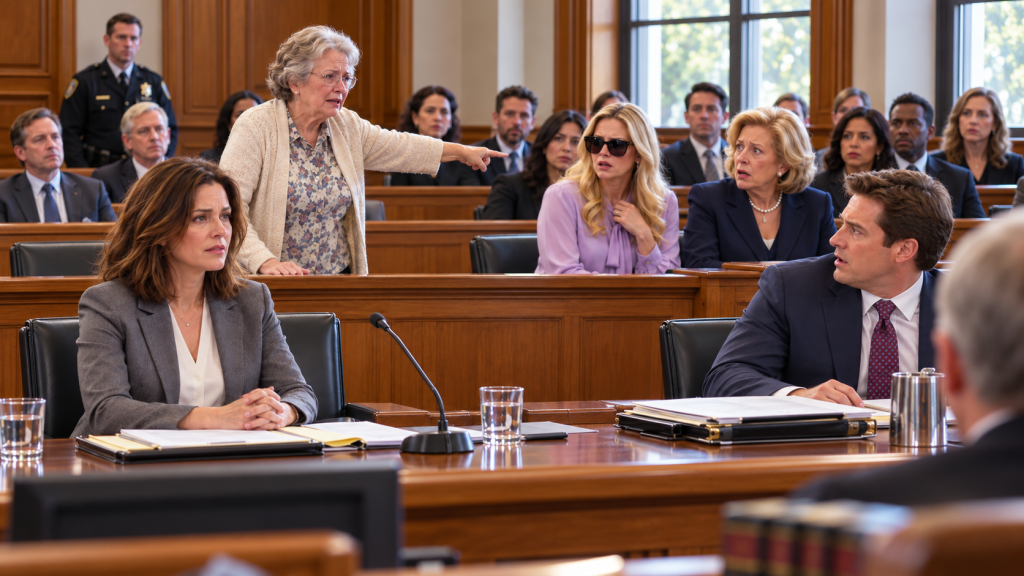
The judge leaned forward. “Mrs. Marsh, I need you to remain where you are.” Celia Marsh stopped moving. My grandmother’s emerald ring glittered on her left hand. I couldn’t stop looking at it. My grandmother had worn that ring for forty-three years. She’d worn it while making Sunday dinner, while tending her roses, and while sitting beside my grandfather during the final months of his life.
Before she died, she slipped it from her finger and placed it in my palm.
“Angela,” she’d whispered, “don’t save your beautiful things for a life you haven’t lived yet.”
I’d worn it on my wedding day.
And now a stranger was standing in court wearing it like a decoration.
Eric’s attorney rose.
“Your Honor, these allegations are extraordinary. This woman was not scheduled to testify, and my client has had no opportunity to examine these claims.”
The judge nodded.
“You’re correct. We will not decide their truth based on an unsworn statement from the gallery.”
Then she looked toward the court officer.
“Please have the witness remain available. Counsel will meet with the court before we proceed.”
Eric’s mother, Marjorie, stood abruptly.
“This is ridiculous!”
The judge looked directly at her.
“Mrs. Brooks, sit down.”
Marjorie’s face turned crimson.
“That woman is lying.”
Celia began crying.
“You paid me, Marjorie.”
The courtroom erupted into whispers.
The judge called for order.
I sat perfectly still.
For six months, people had told me I was mistaken.
That I had forgotten spending the money.
That working too many shifts had affected my memory.
That the stress of divorce was making me see conspiracies where none existed.
And now the woman who had impersonated me was standing ten feet away.
Wearing the ring I’d been accused of losing.
My attorney, Rachel Monroe, leaned toward me.
“Angela, don’t say anything yet.”
I nodded.
My throat felt too tight for words.
Then Eric turned.
“Mom, what is she talking about?”
Marjorie looked at him.
“Eric, don’t.”
He stared at her.
“What did you do?”
For one brief moment, I thought he was genuinely surprised.
Then I remembered the bass boat.
The missing savings.
The way he’d smiled when the withdrawal slips were presented.
And the secret house in Fargo.
He might not have known Celia’s name.
But that didn’t mean he hadn’t known what was happening to our money.
I looked at my husband.
And I realized that the question wasn’t whether he had lied.
It was how many lies were still waiting to be uncovered.
The judge called a recess and directed the attorneys to address the newly disclosed evidence through the appropriate procedures.
The disputed withdrawals, cashier’s checks, and Celia’s statements would need to be examined and authenticated.
The court also made clear that potential criminal conduct was a separate matter for the relevant authorities.
Nothing was magically settled that afternoon.
But something important had changed.
For six months, Eric’s attorney had treated the withdrawal slips as proof that I was dishonest.
Now those same slips had become the foundation of a much more serious investigation.
Rachel guided me into a small conference room.
The moment the door closed, my legs began shaking.
She pulled out a chair.
“Sit down, Angela.”
I did.
Then I started crying.
Not gracefully.
Not quietly.
I cried until my chest hurt.
Rachel sat beside me and waited.
When I could finally speak, I whispered, “I thought I was losing my mind.”
Her expression softened.
“I know.”
“I kept checking my calendar. I kept reading my bank statements. I even looked through old receipts because I thought maybe I’d somehow forgotten.”
I wiped my cheeks.
“Four withdrawals, Rachel. Four different days. I was working on three of them.”
She nodded.
“And now we have someone admitting another person used your identification.”
I looked at her.
“Will they believe me?”
Rachel took my hand.
“We have a credible witness, a possible impersonator, the disputed ring, and financial records we can seek to trace. That’s substantial information. It still has to be tested, but you’re no longer relying solely on your denial.”
I began crying again.
Then I whispered, “Who’s the other woman?”
Rachel hesitated.
“We need to establish that from the deed and other records.”
I nodded.
But my mind was already racing.
Eric had been working in North Dakota for nearly two years.
He told me he stayed in company housing.
He complained about the cold, the long hours, and how lonely the job was.
Sometimes he didn’t answer the phone for days.
He said cell service was unreliable near the pipeline.
I’d believed him.
I’d packed little care packages.
Sent homemade cookies.
Bought him thermal socks.
And now I was learning there might be a house in Fargo with his name on the deed.
A house purchased partly with money I’d earned working doubles.
The room began spinning.
Rachel handed me water.
“Angela, listen to me.”
I looked up.
“We’re going to obtain the deed.”
I swallowed.
“And if he’s living there with someone?”
Her expression softened.
“Then we’ll deal with the truth when we have it.”
I nodded.
But something in me already knew.
I had spent nine years saving for the house Eric and I promised each other.
He hadn’t stopped dreaming about a house.
He had simply decided to build that dream with someone else.
Joyce Wilkes came to see me after the hearing.
She stood in the courthouse hallway holding a brown handbag with both hands.
She looked frightened.
“Mrs. Brooks?”
I turned.
“Joyce.”
Her eyes immediately filled.
“I’m so sorry.”
I shook my head.
“You don’t have to apologize.”
“Yes, honey. I do.”
She took a trembling breath.
“I processed those withdrawals.”
I looked at her.
She continued.
“I saw the driver’s license. I compared the photograph. The woman had the right name, the right information, and she looked close enough that I convinced myself there wasn’t a problem.”
Tears ran down her cheeks.
“But I remember thinking something felt wrong.”
I listened.
“She was nervous,” Joyce whispered. “She kept looking behind her. The second time she came, she asked if I remembered her from the previous visit.”
I frowned.
“Why would she ask that?”
Joyce looked ashamed.
“I think she was checking whether I recognized her as the account holder.”
She wiped her eyes.
“The third time, I noticed the ring.”
My stomach tightened.
“Grandma’s ring.”
Joyce nodded.
“She had it on the counter while she filled out the paperwork. I told her it was beautiful.”
Her voice broke.
“And she said it had belonged to her grandmother.”
I closed my eyes.
“Then when I read about your divorce hearing, something clicked. The photograph in the paper looked different from the woman I’d served.”
I looked at her.
“So you found me.”
She nodded.
“I tried reaching the bank first. They told me to speak with their fraud department, and I did. But I couldn’t stop thinking about you.”
She paused.
“Your attorney arranged for me to appear because I wanted to tell the court what I remembered.”
I studied her face.
“Why?”
She looked surprised.
“Why what, honey?”
“Why get involved? You were already retired.”
Joyce took my hand.
“Because I spent twenty-two years behind that counter, and every time somebody trusted me with their savings, it meant something.”
Her voice trembled.
“I made a mistake. I won’t make it worse by pretending I didn’t.”
I began crying.
Then she added something I will never forget.
“Angela, being fooled doesn’t make you foolish. But once you learn the truth, you have a responsibility to do something with it.”
I hugged her.
And for the first time in six months, I felt something stronger than humiliation.
I felt believed.
Three days later, Rachel called while I was finishing a twelve-hour shift at St. Luke’s.
I’d spent the afternoon caring for a woman recovering from heart surgery.
She was seventy-eight, frightened, and convinced that every noise from the monitor meant something terrible was happening.
I had sat beside her bed and explained the sounds until her breathing slowed.
Then I went into the staff room, checked my phone, and found six missed calls from Rachel.
My stomach tightened.
I called immediately.
“Angela, we received the Fargo property records.”
I sat down.
“Okay.”
There was a pause.
“The other owner is a woman named Tessa Rowan.”
I closed my eyes.
“How old?”
“Thirty-four.”
“Is she married?”
“According to the available records, she isn’t married to Eric.”
I took a shaky breath.
“Does she know about me?”
“We don’t know yet.”
Rachel continued.
“The property was purchased last spring. Eric and Tessa are named as owners. The down payment included a twenty-five-thousand-dollar cashier’s check purchased using funds from your joint savings account.”
I stared at the lockers across from me.
“Twenty-five thousand.”
“Yes.”
“And the rest?”
“The other three withdrawals total thirty-six thousand dollars. The cashier’s checks went to North Star Marine.”
I began crying.
Eric’s bass boat had cost approximately thirty-six thousand dollars.
He told me he’d bought it with money from a pipeline completion bonus.
I remembered standing in our driveway when he brought it home.
The shiny hull.
The polished seats.
His proud smile.
He had told me not to touch anything because the finish scratched easily.
Then he’d said, “One day, when you stop worrying about every dollar, you’ll understand why a man needs something that’s just his.”
I had stood there holding a grocery bag, wondering why my dream of a house with a garden was selfish while his dream of a boat was necessary.
Now I knew.
He had bought his dream with my money.
And used the remainder to help buy a home for another woman.
“Angela?” Rachel asked.
“I’m here.”
Her voice softened.
“We can arrange to speak with Tessa through her attorney or another appropriate channel. You don’t have to contact her yourself.”
I looked down at my wedding ring.
I’d stopped wearing it three months earlier.
But there was still a faint pale line around my finger.
“I need to know what she thinks is happening.”
Rachel paused.
“Then we’ll approach it carefully.”
I nodded.
Then I asked the question that had been burning inside me.
“Did Eric ever actually work in North Dakota?”
“Yes. His employer confirmed the pipeline assignments.”
I closed my eyes.
“So that part was true.”
“His work was real. His account of what he did outside work may not have been.”
I leaned back against the wall.
That was the cruelty of it.
Eric hadn’t fabricated an entire life.
He had mixed enough truth into his lies that I stopped knowing where one ended and the other began.
Tessa agreed to speak with Rachel first.
Then, a week later, she agreed to meet me.
We chose a quiet café on a Sunday afternoon.
I arrived early and sat near the window.
My hands trembled around my coffee cup.
When the door opened, I recognized her from a photograph Rachel had obtained with her permission.
Tessa was tall, with shoulder-length brown hair and a tired expression.
She was carrying a diaper bag.
Beside her was a little girl with dark curls, holding a stuffed rabbit.
The child couldn’t have been more than two.
My heart stopped.
Tessa approached.
“Angela?”
I nodded.
She sat across from me.
The little girl climbed onto her lap.
“This is Lucy.”
I stared at the child.
“Hello, Lucy.”
Lucy hid her face in her mother’s shoulder.
For a few moments, neither of us spoke.
Then Tessa said quietly, “She’s Eric’s daughter.”
The world seemed to tilt.
I looked at her.
“How old?”
“Twenty months.”
I closed my eyes.
Twenty months.
Eric and I had still been discussing our future twenty months earlier.
He had told me he was working extra shifts because he wanted us to be financially secure.
He had promised we’d finally start looking for the larger house I’d wanted.
And all along, another woman had been raising his daughter.
Tessa wiped her eyes.
“I didn’t know he was still married.”
I looked up.
She continued.
“He told me he and his wife had separated years ago. He said the divorce was taking longer than expected because there were complicated property issues.”
I stared at her.
“Did he tell you I stole our savings?”
Her expression changed.
“Yes.”
I felt something break inside me.
“He said you’d emptied the accounts and were trying to blame him.”
Tessa looked down.
“I’m sorry. I believed him.”
I took a breath.
“How did he explain the money for the house?”
“He said he’d received a work bonus and had savings from before the marriage.”
I laughed once.
It was a terrible sound.
“Of course he did.”
Tessa’s eyes filled.
“I had money saved too. I put nearly everything I had into that house because I thought we were building a home for our daughter.”
I looked at Lucy.
She was playing quietly with the zipper on her mother’s jacket.
Completely unaware of the adults’ devastation.
Then Tessa reached into her bag.
“I brought something.”
She took out a folded document.
It was a copy of a letter Eric had shown her the previous autumn.
According to the letter, I had demanded an unfair financial settlement and was refusing to cooperate with the divorce.
The letter carried what appeared to be my signature.
I stared at it.
“I’ve never seen this.”
Tessa covered her mouth.
“Oh, God.”
I looked at her.
“He forged that too.”
She began crying.
For a moment, I felt a sharp flash of anger toward her.
She was sitting across from me with the daughter my husband had fathered while married to me.
She lived in the house purchased partly with my savings.
She had enjoyed the life I had spent years trying to build.
But then I looked at her face.
She wasn’t triumphant.
She was frightened.
And I realized that Eric had sold us both different versions of the same lie.
I reached across the table.
“Tessa, I’m not here to blame Lucy.”
She began crying harder.
“Thank you.”
“But I do need the truth about the money.”
She nodded immediately.
“Whatever documents I have, I’ll give them to your lawyer.”
I swallowed.
“And what are you going to do?”
She looked down at her daughter.
“I don’t know.”
Then she said something that stayed with me.
“I thought the worst thing that could happen was finding out the man I loved was still married.”
Her voice trembled.
“Now I’m wondering whether any part of the life he described to me was real.”
I understood that feeling.
More deeply than I wanted to.
The next twist came from the woman I’d almost hated when I first saw her in court.
Celia Marsh.
Rachel called one evening to say Celia had retained an attorney and was cooperating with investigators.
She had admitted her role in the impersonation.
But she also claimed to have evidence explaining how Marjorie had recruited her.
And why she’d appeared in the courtroom wearing my grandmother’s ring.
Rachel arranged for the information to be provided through the proper legal channels.
When I learned what Celia had said, I sat in silence.
She had been working at a small cleaning company when she met Marjorie.
Celia had fallen behind on rent after her husband died.
Marjorie knew she was struggling.
She offered her money for what she described as “help with some family banking.”
At first, Celia believed the withdrawals had been authorized.
But when she was asked to wear a wig, imitate my signature, and present identification bearing my name, she understood she was participating in something dishonest.
She went ahead anyway.
Marjorie paid her eighteen hundred dollars.
And gave her my grandmother’s ring.
I stared at Rachel.
“She gave away Grandma’s ring?”
Rachel nodded.
“According to Celia, Marjorie called it part of her payment.”
For a moment, I couldn’t speak.
Then Rachel continued.
“Marjorie allegedly told Celia the ring had belonged to an ungrateful daughter-in-law who didn’t deserve it.”
My hands began shaking.
So that was what my grandmother’s legacy had become.
A payment for helping someone steal from me.
I thought of the afternoon my ring disappeared.
I’d searched every drawer.
Checked my laundry.
Called the hospital laundry department.
Even taken apart the drain beneath the bathroom sink.
Eric stood in the doorway watching me.
He’d sighed and said, “Ang, you probably lost it while washing your hands. Stop turning the house upside down.”
His mother had agreed.
Nurses are always taking their rings off, dear.
Now I wondered whether they’d rehearsed those words.
Rachel spoke again.
“Celia says Marjorie brought her to the courthouse because she wanted her available in case the bank records were challenged.”
I frowned.
“Why would she do that?”
“Marjorie apparently thought Celia would repeat the false story that she’d been acting at your request. Celia had initially agreed because she was frightened of being prosecuted.”
I closed my eyes.
“But she changed her mind.”
“Yes.”
Rachel paused.
“She told investigators that when she saw Joyce Wilkes stand up, she knew the deception was about to be exposed. She decided to tell the truth.”
I stared at the wall.
“And the ring?”
“She wore it because she wanted Joyce to recognize her without any doubt. She also agreed to surrender it as evidence.”
My throat tightened.
I didn’t know whether Celia was driven by guilt, fear, or the hope that cooperation would reduce the consequences she faced.
Perhaps all three.
She had made choices that harmed me.
Her confession didn’t erase that.
But I was grateful she’d finally told the truth.
And I was grateful for Joyce Wilkes.
The retired teller who had spent six months remembering a woman’s voice and a beautiful old ring.
Without her, I might never have known what happened.
When the financial records finally came together, they revealed something even more painful than I’d expected.
Marjorie had organized the impersonation.
Celia had made the withdrawals.
But Eric had known where the money came from.
Investigators obtained messages and emails exchanged between Eric and his mother during the weeks surrounding the transactions.
One message from Marjorie said:
The first two checks are ready. Make sure the boat dealer accepts them.
Eric replied:
He will. Just don’t let Angela see anything.
Another message, sent several days later, was even worse.
The Fargo payment needs to go through before she starts asking questions.
Eric’s answer was short.
Then get it done.
I read those words in Rachel’s office.
My husband had told me I must have emptied our savings and forgotten.
He’d watched me search bank records.
He’d watched me cry.
He’d seen me question my own memory.
And all along, he knew exactly where the money had gone.
I looked up.
“Rachel, he wasn’t confused.”
She shook her head.
“No.”
“He wasn’t trying to protect his mother.”
“That may have been part of his conduct, but the records indicate he was participating in the transactions.”
I stared at the messages again.
“He wanted me to believe I’d done it.”
Rachel didn’t answer immediately.
Then she said, “The evidence strongly supports that he knew the accusation against you was false.”
I covered my mouth.
For months, I’d wondered whether I was losing my ability to think clearly.
Sometimes I misplaced things after a double shift.
Sometimes I forgot whether I’d paid a bill.
Sometimes I walked into a room and couldn’t remember why.
I was tired.
Eric used that exhaustion against me.
He told me I worked too much.
That my memory couldn’t be trusted.
That the simplest explanation was that I’d spent the money and blocked it out.
And then he walked into court smiling because he believed the bank records would destroy my credibility.
I thought of all the patients I’d cared for over the years.
The people who trusted me to monitor their medications, recognize changes in their condition, and notice when something wasn’t right.
I had never doubted my ability to do my job.
But at home, the man who was supposed to know me best had slowly made me question whether I could trust my own mind.
I looked at Rachel.
“Why did he want the court to think I stole it?”
She turned toward another document.
“His proposed settlement would have assigned you responsibility for the missing funds when dividing the marital assets.”
I stared.
“And the house?”
“He was seeking a larger share of the equity in your current home, based partly on that accusation.”
I closed my eyes.
So it wasn’t enough to steal sixty-one thousand dollars.
He wanted to make me pay for the theft a second time through the divorce.
And the little house we’d purchased after years of renting—the first property I’d ever been able to call ours—was part of the calculation.
I began crying.
Rachel handed me a tissue.
Then she said quietly, “Angela, we can challenge those claims.”
I nodded.
She continued.
“The court can examine the actual transactions, not merely what Eric says happened. And we’re pursuing recovery through the appropriate civil and financial processes as well.”
I looked toward the window.
For the first time, I realized the danger wasn’t just the money I’d lost.
It was the future he had almost convinced me I didn’t deserve.
Marjorie requested to speak with me before the next hearing.
I refused.
Then she sent a letter.
It was handwritten on pale blue stationery, the kind she used for thank-you notes after church gatherings.
Angela,
I never wanted this situation to become so unpleasant.
I stared at that sentence.
Unpleasant.
As though she’d accidentally served dinner late.
As though she hadn’t arranged for a stranger to impersonate me four times at a bank.
As though she hadn’t helped take my grandmother’s ring.
I kept reading.
Eric was under tremendous pressure, and I was trying to help my son. You have always been independent, and sometimes you failed to understand that a husband’s responsibilities are different from a wife’s.
My face grew hot.
You should have trusted him to manage the money.
I almost laughed.
Then came the sentence that explained more about Marjorie than anything she’d said in court.
And perhaps if you had made more time for your marriage instead of spending every waking hour at that hospital, Eric wouldn’t have felt so alone.
I stopped.
For nine years, I’d worked double shifts at St. Luke’s.
Sometimes because we needed the money.
Sometimes because the hospital was short-staffed.
And sometimes because I believed that if I kept saving, one day Eric and I would have the house with the big yard we dreamed about.
He told me to work more when he wanted something expensive.
Then he criticized me for working when he wanted someone to blame.
Marjorie had watched that happen.
And now she was suggesting that my labor had somehow caused her son’s deception.
I folded the letter.
Then I put it into the evidence folder Rachel had given me.
I didn’t reply.
There was nothing I could say that would make Marjorie understand what she’d refused to see for years.
That her son’s comfort was not worth another person’s destruction.
That being a mother didn’t entitle her to steal for him.
And that blaming a woman for her husband’s choices did not turn those choices into something respectable.
The next hearing was very different from the first.
The court had received additional authenticated bank records, transaction documents, and evidence relating to the disputed signatures.
Joyce testified formally about the customer she’d served.
Celia gave evidence concerning her participation, subject to questioning by the attorneys.
The court also reviewed records tracing the cashier’s checks.
Eric’s attorney tried to explain some of the discrepancies as misunderstandings between family members.
But the financial trail was difficult to dismiss.
Three cashier’s checks had financed the bass boat.
The fourth had helped purchase the Fargo house.
The relevant communications showed that Eric knew the money had been moved without my authorization.
And the woman who had visited the bank had admitted she wasn’t me.
At one point, Eric’s attorney questioned Joyce about why she hadn’t challenged Celia’s identification at the time.
Joyce looked down.
“I made an error.”
The attorney leaned forward.
“And you expect the court to rely on your memory months later?”
Joyce raised her head.
“I expect the court to consider my testimony along with the records and the other evidence.”
Her voice trembled.
“That’s all I’m asking.”
I felt tears gathering.
She wasn’t pretending to be perfect.
She was doing something much more difficult.
She was admitting a mistake while telling the truth about what she remembered.
When my turn came to testify, Rachel asked me about the savings.
I explained how I made deposits from my nursing paychecks.
How I checked the balances.
How I had never entered that branch to withdraw the money.
Then she asked, “Mrs. Brooks, what were you saving for?”
I looked toward the judge.
“A house.”
My voice shook.
“Not a mansion. Just a place with a big yard.”
I smiled sadly.
“I wanted a tree in the backyard, a porch where I could drink coffee after night shifts, and somewhere I could grow roses like my grandmother.”
Rachel paused.
“And what happened when you learned the account was empty?”
I took a breath.
“My husband told me I’d spent it.”
I looked at Eric.
“He said I’d forgotten.”
My voice broke.
“For a while, I believed that maybe something was wrong with me.”
The courtroom was silent.
I continued.
“But I know now that I didn’t take that money.”
I looked toward the judge.
“I earned it. I saved it. And somebody else decided it was theirs to spend.”
I paused.
“Then they tried to make me ashamed for asking where it went.”
My hands trembled.
“But I am not ashamed anymore.”
When I finished, Eric stared at the table.
For once, he had nothing to whisper.
And for once, I didn’t need him to agree with me.
The divorce was finalized several months later.
By then, the financial investigation had established that I had not authorized the withdrawals.
The court rejected Eric’s attempt to assign the missing sixty-one thousand dollars to me when dividing our marital assets.
His share of our remaining property was adjusted in light of the evidence and the applicable financial findings.
The bank also conducted its own investigation into the identification and verification failures that had allowed the impersonation to occur.
The dispute was eventually resolved through a combination of financial recovery, settlement arrangements, and court-ordered obligations.
Not every dollar appeared in my account overnight.
Some recovery depended on the sale of Eric’s boat.
Other amounts were tied to his interest in the Fargo property.
Tessa’s own financial contributions had to be considered separately.
I didn’t want to leave her and little Lucy without a home merely to punish Eric.
They hadn’t stolen my savings.
Eric and the people who helped him had.
The criminal investigation proceeded on its own timetable.
Celia faced consequences for her participation, although her cooperation became part of the legal process.
Marjorie could no longer dismiss her involvement as a misunderstanding.
And Eric’s professional reputation suffered as the evidence surrounding the transactions became known.
For years, he’d told me that my nursing job was a hobby while his work involved real risks.
Now he was discovering that the greatest risk he’d ever taken was assuming I would never be believed.
My grandmother’s ring was returned after it was no longer needed as evidence.
Rachel called me one Friday afternoon.
“Angela, I have something for you.”
When I arrived at her office, she handed me a small velvet pouch.
Inside was the emerald ring.
I lifted it carefully.
The green stone caught the light.
The two tiny diamonds still sparkled beside it.
For a moment, I couldn’t breathe.
I remembered Grandma’s hands.
The smell of the lavender soap she kept beside her kitchen sink.
The way she used to stir sugar into her tea and tell me that the best things in life were rarely the most expensive.
I slipped the ring onto my finger.
It fit perfectly.
And I began crying.
Rachel waited.
Then she said softly, “It’s back where it belongs.”
I nodded.
But I was thinking about something more than jewelry.
For six months, I’d been told that I couldn’t trust my memory.
That I’d stolen money.
That I’d lost the ring through carelessness.
That I was dishonest.
Now I was holding the very object that helped expose the truth.
My grandmother had been gone for years.
But somehow, the ring she’d left me had become the reason a retired bank teller remembered a woman who wasn’t me.
I looked at Rachel.
“Could you help me send Joyce some flowers?”
She smiled.
“I think she’d love that.”
Joyce and I met for lunch a few weeks later.
She arrived wearing a little green cardigan.
The moment she saw the emerald ring on my finger, her eyes filled.
“Oh, honey.”
I smiled.
“It’s home.”
She reached across the table.
“That’s a beautiful sight.”
I held her hand.
“Joyce, you gave me something back that I thought I’d lost forever.”
She looked down.
“Your ring?”
I shook my head.
“My name.”
Her face crumpled.
I continued.
“For months, I thought I’d spend the rest of my life explaining something nobody believed.”
I swallowed.
“Then you called.”
Joyce began crying.
She squeezed my hand.
“Angela, you did the hard part.”
I smiled sadly.
“We both did something hard.”
For a while, we sat quietly.
Then Joyce laughed.
“Well, if I ever forget why I loved working at that bank, I’ll remember this lunch.”
I laughed through my tears.
And we ordered dessert.
Two slices of lemon cake.
Neither of us cared that it was only eleven thirty in the morning.
The following autumn, I sold the modest house Eric and I had purchased together.
I could have kept it under the divorce arrangements.
But every room reminded me of arguments I’d spent years pretending were ordinary.
The kitchen where Eric told me I must have emptied the savings.
The bedroom where I searched for Grandma’s ring.
The driveway where he polished his bass boat while I carried groceries inside.
I wanted a home that didn’t require me to keep making peace with painful memories.
So I found a small bungalow on the edge of town.
It wasn’t fancy.
The porch needed painting.
The kitchen cabinets were old.
And the backyard was mostly weeds.
But there was a maple tree near the fence.
A wide patch of sunlight behind the house.
And enough space for a rose garden.
The first time I walked through the property, the real estate agent pointed out everything that needed repairing.
I listened carefully.
Asked questions.
Took notes.
Then stepped into the backyard.
The grass moved gently in the breeze.
I could hear birds in the tree.
And for the first time in years, I imagined coming home after a long hospital shift and feeling peaceful.
I made an offer I could responsibly afford.
A few weeks later, the house was mine.
Not because I had worked myself to exhaustion to earn someone else’s approval.
Not because a husband had promised that someday we would make a better life together.
Because I had made a plan.
Protected my finances.
And chosen a home that suited the life I wanted.
On moving day, my friend Denise from St. Luke’s arrived carrying a toolbox.
She stood in the backyard, looked around, and smiled.
“Well, Ang.”
I laughed.
“What?”
“You finally got your big yard.”
My eyes filled.
I looked toward the maple tree.
“Yes,” I whispered.
“I did.”
Denise put her arm around my shoulders.
Then she said, “And this time, nobody gets to tell you what you can plant in it.”
I laughed so hard I started crying.
The first thing I planted was a rosebush.
Pink roses.
Just like Grandma used to grow.
I knelt beside the garden bed with my old gardening gloves and carefully pressed the soil around the roots.
My emerald ring was safely inside the house.
I no longer wore it when doing rough work.
Not because I was afraid to live in it.
But because I’d learned that taking care of something beautiful was different from being too frightened to enjoy it.
As I worked, I thought about the woman I’d been at forty.
Standing in a rented house.
Working double shifts.
Saving for a future she believed she had to earn through sacrifice.
I wished I could go back and tell her that her dreams weren’t foolish.
That wanting a home wasn’t selfish.
That being a nurse was not a hobby.
And that trusting someone did not make her responsible for the lies he chose to tell.
I wished I could tell her that one day she would stand in a courtroom and hear a woman confess to wearing her stolen ring.
That a stranger named Joyce Wilkes would find the courage to speak.
That the truth would be painful.
But that it would also set her free from a story she had been forced to live inside.
I pressed the last handful of soil into place.
Then sat back on my heels.
The rosebush was small.
Its branches were bare.
There were no flowers yet.
But its roots were safely planted.
And I knew that, given time and care, it would grow.
A year after the hearing, I was sitting on my porch with a cup of coffee when my phone rang.
It was Denise.
“Angela, you coming in tonight?”
I smiled.
“Seven o’clock.”
She laughed.
“Good. We’re short one nurse, and I told them you were the best person to ask.”
I looked out at the garden.
The roses were blooming.
The maple tree cast long shadows across the lawn.
And my grandmother’s ring rested on my finger, catching the afternoon sunlight.
For nine years, Eric had told me my job was something I did because I didn’t understand real work.
But that job had taught me more about strength than he ever understood.
I’d watched people endure pain with dignity.
I’d seen families sit beside hospital beds holding hands through the longest nights of their lives.
I’d watched frightened patients become determined survivors.
And I’d learned that a person’s worth was never measured by how much money they earned, how impressive their possessions looked, or how confidently they spoke.
Sometimes the strongest person in the room was the one whose hands were shaking.
Like Joyce Wilkes.
Standing in the second row of a courtroom.
Telling the truth even though it might expose her own mistake.
I looked toward the little rosebush.
Then at the ring Grandma had given me.
For months, I believed the worst thing Eric stole was sixty-one thousand dollars.
But the money wasn’t the deepest wound.
He had tried to steal my confidence.
My reputation.
My ability to trust my own memory.
And my belief that the life I had spent years building belonged to me.
He almost succeeded.
Almost.
Because he hadn’t counted on a retired teller with a conscience.
He hadn’t counted on the truth traveling through cashier’s checks, signatures, and a ring with two little diamonds.
And he certainly hadn’t counted on the woman he’d spent years belittling finally learning to stand up for herself.
I took a sip of coffee.
Somewhere in the backyard, a bird began singing.
The air smelled of fresh grass and roses.
My new house was quiet.
There was no bass boat in the driveway.
No husband telling me to stop worrying about money.
No mother-in-law reminding me that I should be grateful to have been chosen.
Just my home.
My garden.
My work.
And the life I was finally free to live.
I looked down at Grandma’s ring and remembered her words.
Don’t save your beautiful things for a life you haven’t lived yet.
I smiled.
Then whispered, “I’m living it now, Grandma.”
And for the first time in a very long while, I believed every word.
THE END STORIES! THANK YOU FOR READING GOOD LUCK !❤️
Related Posts