➡️ PART 3 — THE DAY MY DAUGHTER PUT DOWN THE SHIELD
The flight attendant found another passenger willing to switch seats with the woman.
It happened quietly.
No applause.
No triumphant looks.
No one stood up and told her she had been cruel.
She simply gathered her handbag, avoided my eyes, and moved several rows toward the back.
Louise watched her go.
Then looked at me.
For a second, she seemed older than eight.
Too much older.
That frightened me more than the woman’s shouting had.
I held my son against my chest and whispered:
“Come sit with me.”
Louise climbed into the empty seat.
The passenger who had switched with the woman took Louise’s original seat behind us.
No one complained.
No one asked questions.
The plane settled back into the strange intimacy of strangers pretending not to hear one another breathe.
My baby had fallen asleep.
His cheek rested against me.
Louise leaned against my shoulder.
For several minutes, neither of us spoke.
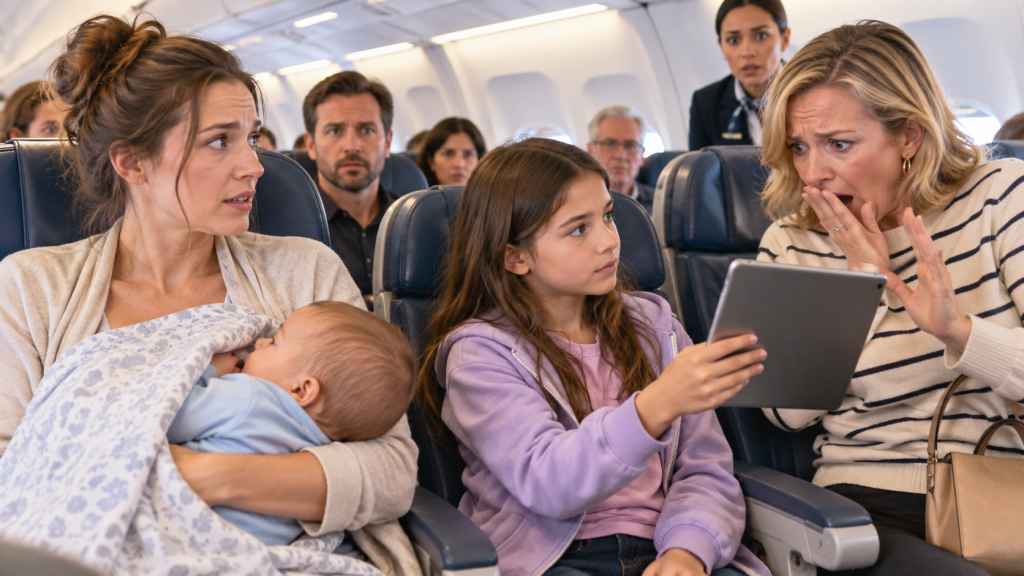
Then I looked down at her tablet.
The photograph of her father was still on the screen.
He was holding our son in the hospital.
His face was pale.
His smile was enormous.
I reached over and turned off the display.
Louise stiffened.
“Why did you do that?”
“Because you don’t have to show strangers our pain so they’ll be kind to us.”
She looked confused.
“She was being mean to you.”
“I know.”
“She needed to know.”
“Maybe.”
Louise looked toward the back of the plane.
Then at me.
“She stopped.”
“Yes.”
“So it worked.”
I could not argue with that.
Children often see morality in results.
Do the thing.
Problem stops.
Therefore the thing was right.
Adults know it is rarely that simple.
I brushed hair from her forehead.
“Louise, listen to me.”
She waited.
“What you did was brave.”
Her eyes brightened.
“But?”
Of course she heard the but coming.
“But it is not your job to protect me.”
Her face changed.
“I wasn’t.”
“You were.”
“I just wanted her to stop.”
“I know.”
“Dad would have done it.”
There it was.
The sentence I had been afraid of.
I swallowed.
“Maybe.”
Louise looked wounded.
“What do you mean, maybe?”
“Your dad would have wanted someone to treat me kindly.”
“Yes.”
“He would also have wanted you to be eight.”
She stared at me.
I smiled sadly.
“And eight-year-olds should not have to defend their mothers from grown women on airplanes.”
Louise looked down at her hands.
“I didn’t mind.”
I knew.
That was the problem.
Children can become good at carrying burdens before anyone realizes they are heavy.
For the next hour, she barely spoke.
I wondered if I had taken something away from her.
Not courage.
I hoped not.
Maybe purpose.
Since her father died, Louise had been searching constantly for things to do.
Bring me tissues.
Warm the baby’s bottle.
Check whether I ate.
Remind me of appointments.
Carry diaper bags she could barely lift.
Stand beside me when relatives hugged me too long.
Once, at the funeral, she had pulled my aunt’s hands away from my shoulders and said:
“Mom needs air.”
Everyone laughed softly.
I had kissed her forehead and called her my little helper.
Now, sitting thirty thousand feet above the ground, I wondered whether I had accidentally given grief a job description.
The flight attendant returned.
She was a woman in her forties with kind eyes and the exhausted calm of someone who had already solved fourteen problems before lunch.
She crouched beside our row.
“Everything all right here?”
“Yes.”
I answered.
Then:
“Thank you.”
She smiled.
“Of course.”
Louise asked:
“Is that lady okay?”
The flight attendant glanced toward the back.
“She’s fine.”
“Is she mad?”
“Probably embarrassed.”
Louise seemed to think about that.
Then whispered:
“Good.”
I almost corrected her.
Then didn’t.
She was eight.
She had earned some imperfect feelings.
The flight attendant stood.
Before leaving, she looked at me.
“You did nothing wrong, by the way.”
I knew what she meant.
Feeding my child.
Existing in public.
Taking up one seat while my baby took up part of me.
My throat tightened unexpectedly.
“Thank you.”
Sometimes the smallest kindness finds the exact crack where grief has been leaking.
Two hours later, while Louise watched a movie with headphones, I saw the woman approach.
My whole body tensed.
Not fear exactly.
Exhaustion.
I did not have the strength for another scene.
She stopped at the edge of our row.
Her face looked different.
Not because it had changed.
Because anger was no longer arranging it.
“I’m not here to argue.”
she said quietly.
I waited.
She looked at Louise.
Then at the sleeping baby.
Then at me.
“I owe you an apology.”
I said nothing.
Apologies should be allowed to arrive without us rushing to make them easier.
She swallowed.
“What I said was cruel.”
Still nothing.
“I was irritated before I even got on the plane.”
She shook her head.
“That is not an excuse.”
Good.
“I don’t like flying.”
“I hadn’t slept.”
“My connection was delayed.”
“I was angry before your son made a sound.”
She looked toward Louise.
“And then I decided to make my bad day your problem.”
That was honest enough to surprise me.
“I did not know about your husband.”
she continued.
I looked down.
“You shouldn’t have needed to.”
She stopped.
I heard my own voice strengthen.
“You shouldn’t need to know someone buried a husband before deciding not to humiliate her.”
Her eyes filled.
“No.”
she whispered.
“You’re right.”
I looked at her.
“I could have been having the happiest month of my life.”
“Yes.”
“And I still would have deserved to feed my baby without being told to hide in a bathroom.”
“Yes.”
There was no defense.
That helped.
She looked at Louise again.
“Your daughter was right.”
I shook my head.
“She should never have needed to be.”
The woman’s mouth trembled.
“No.”
Then:
“I’m sorry, sweetheart.”
Louise removed one headphone.
“For yelling at my mom?”
“Yes.”
“And saying babies should stay home?”
“Yes.”
“And saying she should feed him in the bathroom?”
The woman’s face reddened.
“Yes.”
Louise considered.
Then said:
“That was really rude.”
The woman almost smiled.
“It was.”
Louise put the headphone back on.
Apparently the hearing was adjourned.
The woman turned to leave.
I surprised myself.
“Wait.”
She stopped.
“I accept your apology.”
Her shoulders lowered.
Not forgiveness as erasure.
Not friendship.
Just closure enough for a six-hour flight.
“Thank you.”
she whispered.
Then she returned to her seat.
I thought that would be the most difficult part of the day.
I was wrong.
Grief rarely respects scheduling.
My mother was waiting at baggage claim.
The moment I saw her, I stopped walking.
She had become smaller since the funeral.
Or maybe grief had changed scale.
She stood beside a luggage cart wearing the green cardigan she always wore when traveling, scanning every face coming down the corridor.
Then she saw us.
Her hand flew to her mouth.
Louise ran first.
“Grandma!”
Mom bent just in time.
Louise hit her with enough force to nearly knock her backward.
My mother wrapped both arms around her.
Then looked over Louise’s shoulder at me.
That was when both of us began crying.
No words.
None needed.
I walked into her arms with my son between us.
For a moment, all four of us held on to whatever we could reach.
Mom had prepared the guest room.
Fresh sheets.
Blackout curtains.
A bassinet borrowed from a neighbor.
A stack of diapers.
Baby soap.
Crackers beside the bed because she remembered I forgot to eat when I was tired.
She had also put a framed photograph of my husband on the dresser.
I stopped when I saw it.
He was standing at the beach with Louise on his shoulders.
Before cancer.
Before hospitals.
Before our son.
Sunburned.
Laughing.
Alive in the careless way healthy people are alive.
Mom saw my face.
“I can move it.”
“No.”
“You sure?”
“No.”
I laughed through tears.
“But leave it.”
She nodded.
Grief teaches families strange grammar.
No can mean yes.
I don’t know can mean please stay.
I’m fine can mean sit beside me without asking questions.
The first week at Mom’s house, I slept.
Not well.
Just often.
My body seemed to understand that someone else was available.
Someone would hear the baby.
Someone would make breakfast.
Someone would remember groceries.
Someone would check the locks.
I had spent the month after my husband died functioning through necessity.
Funeral arrangements.
Death certificates.
Insurance calls.
Medical bills.
Thank-you notes.
A baby who still needed feeding every few hours.
An eight-year-old who asked questions like:
“Does Dad know he’s dead?”
“What happens to his phone number?”
“Will I forget his voice?”
“What if the baby doesn’t remember him?”
There had been no space to collapse.
At Mom’s house, space appeared.
So I did.
One morning, I woke at eleven.
Sunlight had crossed half the room.
Panic hit immediately.
The baby.
I sat up.
The bassinet was empty.
My heart stopped.
Then I heard laughter from downstairs.
Louise.
Mom.
A baby squeal.
I pressed both hands to my face.
Safe.
They were safe.
I was safe.
Still, I cried for twenty minutes.
Because for one second, waking without responsibility felt like losing something else.
When I went downstairs, Louise was feeding her brother mashed banana from the tip of a spoon while Mom supervised.
Most of it was on his face.
“You’re awake.”
Louise said.
“Yes.”
“I told Grandma not to wake you.”
Mom looked at me over the coffee machine.
“She was very firm.”
Louise nodded proudly.
“You needed sleep.”
There it was again.
My little manager.
I sat beside her.
“Louise.”
“What?”
“Come here.”
She climbed into my lap despite being far too big.
I wrapped my arms around her.
“You don’t have to take care of me.”
She groaned.
“We already talked about this.”
“Apparently not enough.”
She leaned back.
“I’m not taking care of you.”
“You told Grandma not to wake me.”
“Because you were tired.”
“You keep checking if I eat.”
“Because sometimes you don’t.”
“You bring me water.”
“Because breastfeeding makes you thirsty.”
Mom turned away from the coffee machine.
I could see she was trying not to interfere.
Louise continued.
“I’m just helping.”
I looked at her.
“What happens if you don’t?”
She froze.
That was the question.
“Nothing.”
she said too quickly.
“Louise.”
She looked down.
Then whispered:
“You might get worse.”
My chest tightened.
“Worse how?”
She shrugged.
“Sad.”
“I am sad.”
“I know.”
“What do you think happens if I get really sad?”
She would not answer.
Mom put down the coffee mug.
“Sweetheart?”
Louise’s lip trembled.
Then the truth came out.
“You might die too.”
The room disappeared.
I pulled her against me.
“Oh, baby.”
She started crying.
Not polite tears.
Not the controlled little crying she had done at the funeral when adults were watching.
She collapsed.
“I don’t want you to die.”
“I’m not planning to.”
“Dad didn’t plan to!”
There are arguments children win because reality has betrayed the adults first.
I held her tighter.
“You’re right.”
She sobbed.
“He was just sick and then he got more sick and then everyone kept saying he might get better and then he didn’t.”
“I know.”
“And you cry all the time.”
“I know.”
“And sometimes you don’t eat.”
“I know.”
“And the baby needs you.”
“I know.”
Her voice rose.
“So I have to help!”
There it was.
The job grief had given her.
I looked at Mom.
She was crying silently.
I returned my attention to Louise.
“No.”
Louise pushed away.
“Yes!”
“No.”
“Who’s going to do it?”
“The adults.”
“What adults?”
“Me.”
“You’re sad.”
“Grandma.”
“She doesn’t live with us.”
“Aunt Sarah.”
“She has work.”
“Our friends.”
“They have their own families.”
Each answer came instantly.
She had evaluated our entire support system.
Eight years old.
I felt ashamed.
Then stopped.
Shame would only make her comfort me.
Not today.
“Louise, listen.”
She wiped her nose.
“Your job is not to keep me alive.”
“But—”
“No.”
I kept my voice soft.
“My job is to keep myself healthy.”
“My job is to ask for help.”
“Grandma’s job is to help when she can.”
“Doctors help.”
“Friends help.”
“Family helps.”
“You can help with little things because families help each other.”
“But you do not have to monitor me.”
She frowned at the word.
“Monitor?”
“Watch me all the time to make sure I’m okay.”
She looked away.
Then she whispered:
“Dad told me to take care of you.”
My breath stopped.
“When?”
“At the hospital.”
I searched my memory.
So many hospital visits.
So many last conversations.
Which one?
“The last time I saw him awake.”
My eyes filled.
Louise continued.
“You went downstairs to get coffee.”
“I stayed.”
“He said I was his big girl.”
My heart broke before she finished.
“He said, ‘Take care of your mom and your brother for me.’”
I closed my eyes.
Of course he had.
Not as an assignment.
Not as a transfer of responsibility.
A dying father trying to say love in a sentence.
But children take language literally when death makes everything else uncertain.
“Oh, Louise.”
“He told me.”
“I know.”
“So I promised.”
My daughter had been carrying a promise to a dead man.
No wonder she had stood up on the plane.
No wonder she checked my food.
No wonder she watched doors.
I touched her cheeks.
“Your dad made one mistake when he said that.”
Her eyes widened.
“Dad didn’t make mistakes.”
I almost laughed through tears.
“Oh, your father made plenty.”
Mom laughed quietly.
Louise looked offended.
I smiled.
“He left socks everywhere.”
“That doesn’t count.”
“He forgot my birthday reservation once.”
“You still had dinner.”
“At a gas station.”
Louise almost smiled.
Then her face became serious again.
“What mistake?”
“He asked you to do an adult job.”
She looked hurt.
“He trusted me.”
“Yes.”
“He trusted how much you loved us.”
“But I know your dad.”
I swallowed.
“And if he understood that you were staying awake worrying I might die because you thought you had to protect me, he would take those words back.”
Louise shook her head.
“You don’t know.”
“I do.”
“How?”
“Because he loved you too much to make you responsible for me.”
She stared.
Then whispered:
“So I can break the promise?”
I pulled her into my arms.
“No.”
She went stiff.
Then I said:
“I’m releasing you from it.”
Her body softened.
“You can love us.”
“You can help sometimes.”
“You can hug your brother.”
“You can tell me if you’re worried.”
“But you do not have to take care of the family in Dad’s place.”
“There is no Dad’s place for you to fill.”
She cried into my shoulder.
For the first time since the funeral, she cried like a child whose father had died.
Not like a child assigned to replace him.
That afternoon, Mom found me on the back porch.
The baby was asleep.
Louise was inside watching a movie and eating popcorn before dinner.
Something I normally would have stopped.
Not that day.
Mom sat beside me.
“You okay?”
“No.”
“Good.”
I looked at her.
She smiled faintly.
“I mean, good that you’re not pretending.”
I laughed.
Then cried again.
Grief is exhausting.
It repeats itself because it has nowhere else to go.
“I didn’t see what she was doing.”
I said.
“I did.”
I looked at Mom.
“Why didn’t you say something?”
“I tried.”
“When?”
“After the funeral.”
She reminded me.
Mom had said:
“Louise is watching you too closely.”
I had snapped:
“She just lost her father. Of course she is.”
Mom had dropped it.
Now I remembered.
“I’m sorry.”
“No.”
she said.
“You were surviving.”
That word.
Surviving.
Everyone kept using it as though it were noble.
Most of the time, survival was ugly.
Forgetful.
Impatient.
Unwashed hair.
Unanswered messages.
Frozen dinners.
Crying in the shower so children would not hear.
Nothing heroic about it.
Still necessary.
“I think we need therapy.”
I said.
Mom nodded.
“For Louise?”
“For all of us.”
“Good.”
“I don’t want her growing up thinking love means becoming useful when someone is hurting.”
Mom was quiet.
Then:
“You do that too.”
I looked at her.
“Excuse me?”
“You heard me.”
Apparently grief had made my mother reckless.
She continued.
“When your husband got sick, you became the organizer.”
“That was necessary.”
“Some of it.”
“I handled appointments.”
“Yes.”
“Medication.”
“Yes.”
“Insurance.”
“Yes.”
“Louise.”
“Yes.”
“The baby.”
“Yes.”
“What was I supposed to do?”
“Ask for more help.”
I stared.
Mom softened.
“Honey, you taught Louise what she’s doing.”
That hurt because it was true.
“You love by carrying.”
she said.
“You always have.”
“And you married a man who loved you enough to let you forget how heavy things were sometimes.”
My throat tightened.
That was true too.
My husband had been the one who took bags from my hands.
Made me sit down.
Brought coffee.
Said:
“Stop doing everyone’s job.”
Then he got sick.
And there was no one left to say it.
So I kept carrying.
Louise watched.
Children learn love from posture before language.
Therapy began the following week.
Not dramatic.
A small office.
Soft rug.
A shelf full of toys despite Louise insisting she was “too old for baby stuff.”
Our therapist was named Dr. Patel.
Louise disliked her for exactly twelve minutes.
Then discovered a basket of miniature animals and spent the next half hour arranging them by species while insisting she was not playing.
Dr. Patel did not challenge her.
Smart woman.
She met with Louise separately later.
Then with me.
One afternoon she said:
“Your daughter is worried that if she stops being useful, she will become another thing you have to manage.”
That sentence sat inside me for days.
Another thing you have to manage.
My child had turned herself into low-maintenance grief.
So I started making deliberate mistakes around her.
Small ones.
I forgot the grocery list.
On purpose at first.
Then naturally.
I let laundry stay unfolded.
I asked Mom to hold the baby even when I technically could.
I cried in front of Louise sometimes without saying:
“I’m fine.”
Instead:
“I’m sad today.”
Then:
“But I can handle being sad.”
The first time, she stood near me uncertainly.
“Do you need anything?”
“A hug.”
She gave one.
Then I released her.
No water.
No tissues.
No assignment.
The next time, she asked:
“Do you want company or space?”
I nearly cried harder.
“Company.”
She sat beside me and colored.
That was enough.
We stayed with Mom for six weeks.
Longer than planned.
I felt guilty.
Mom ignored the guilt.
She gave Louise chores.
Important.
But ordinary ones.
Set the table.
Feed the dog.
Put shoes away.
Nothing related to my survival.
The baby gained weight.
Started laughing when Mom sneezed.
Louise made a game of inducing fake sneezes until he squealed.
I began sleeping five-hour stretches.
Sometimes six.
Grief did not lift.
But my body stopped believing every day was an emergency.
The woman from the plane entered my life one more time.
Not physically.
A letter arrived at Mom’s house.
Forwarded through the airline after she asked customer service whether they could pass it along without revealing our information.
I hesitated before opening it.
Inside was one page.
No name.
Just:
To the mother and the little girl on Flight 614,
She wrote that she had thought about us for weeks.
She apologized again.
Then:
Your daughter showed me a photograph because she thought your grief was the reason I should be kind. I have not been able to stop thinking about what you said afterward—that you should not have needed tragedy to deserve dignity.
I kept reading.
I realized I have often treated inconvenience as though it were injury. A crying child. Someone moving slowly. A person taking up more space than I want them to. I have been impatient because I assume my comfort matters more than what I cannot see.
Then:
I am trying to change that.
No explanation.
No request.
Good.
The final line:
Please tell your daughter I remember what she said about making a hurting person’s day heavier. I hope I do not forget it.
I folded the letter.
Louise was at the table.
“Who’s that from?”
“The lady from the plane.”
Her eyes widened.
“Is she mad?”
“No.”
I handed her the letter.
She read slowly.
Then said:
“Huh.”
That was all.
Children do not always provide satisfying literary conclusions.
I smiled.
“What?”
“She learned.”
“Maybe.”
“Good.”
Then Louise went back to drawing.
The woman had stopped being an enemy in her mind.
That was healthier than triumph.
Before we flew home, I panicked.
Same airline.
Same route.
Different flight.
I almost changed to driving.
Mom noticed.
“You don’t want to fly.”
“I’m fine.”
She raised one eyebrow.
Apparently I had learned nothing.
“I don’t want another scene.”
“Do you expect one?”
“No.”
“Then what are you afraid of?”
I looked toward Louise.
She was packing.
The tablet sat on the bed.
Same tablet.
Same photograph inside.
“I don’t want her having to defend me again.”
Mom smiled.
“Then don’t make her.”
Simple.
Infuriating.
Correct.
On the flight home, I booked seats together.
More expensive.
Worth it.
Louise by the window.
Me in the middle.
Baby in my arms.
An elderly man took the aisle.
The moment he saw the baby, I tensed.
He smiled.
“How old?”
“Six months.”
“My youngest is forty-three.”
I laughed.
He showed us pictures of grandchildren before takeoff.
Human beings can surprise you in better directions too.
Halfway through the flight, my baby cried.
Loudly.
Nothing worked.
Pacifier.
Rocking.
Toy.
Louise looked at me.
I knew what she was thinking.
I whispered:
“He’s hungry.”
She glanced at the elderly man.
He was wearing headphones.
I adjusted the nursing cover.
My hands shook slightly.
Louise noticed.
“You okay?”
“Yes.”
Then corrected myself.
“Nervous.”
She nodded.
“Do you need me to do anything?”
There it was.
The new question.
Not:
What should I fix?
Do you need me?
I smiled.
“No.”
“Okay.”
She returned to her movie.
My son ate.
No one shouted.
No one stared.
The plane did not stop flying.
Ordinary.
I had never appreciated ordinary so much.
We returned home.
The house felt wrong.
My husband’s shoes still stood by the garage door.
I had not moved them before leaving.
His jacket hung behind mine.
His favorite mug sat upside down in the cupboard.
For six weeks, grief had been portable.
Suddenly it became architectural again.
He belonged to every room.
Louise stood in the hallway.
“Are you okay?”
I almost lied.
Then:
“This is hard.”
She waited.
“Do you need anything?”
I looked at her.
“I need Grandma to help us decide what to do with Dad’s clothes next weekend.”
Louise nodded.
Adult problem.
Adult help.
Good.
“What do you need?”
I asked.
She thought.
“Can Dad’s blue hoodie stay?”
“Yes.”
“And the beach shirt.”
“The ugly orange one?”
“It’s not ugly.”
“It is terrible.”
“Dad loved it.”
“He was wrong.”
Louise laughed.
The house softened by one degree.
We did not clear everything.
I had read articles saying grief required letting go.
Other articles said keep things as long as needed.
Everyone apparently had rules for dead people’s shirts.
I stopped reading.
We kept what mattered.
Donated what did not.
Boxed some things without deciding.
His shoes stayed by the garage another four months.
Then one morning I moved them.
No ceremony.
I needed the space.
That is how grief changes.
Something sacred on Tuesday becomes an obstacle by Friday.
Not disrespect.
Life.
Louise began sleeping in her own room again.
After her father died, she had often crawled into mine.
I never stopped her.
Then, slowly, she stopped coming.
The first night she slept straight through alone, I was proud.
Then lonely.
Motherhood is ridiculous.
You spend years teaching children independence, then mourn every successful lesson.
Therapy continued.
For both of us.
I learned things about grief I wish no one needed to know.
That anger can appear when the person you miss did nothing wrong.
That I could be furious at my husband for dying.
That this did not mean I loved him less.
That widows sometimes resent couples holding hands in grocery stores.
That I could be grateful for my children and still hate how much responsibility I carried alone.
That exhaustion can look like depression.
That depression can look like exhaustion.
That asking for help before collapse is a skill.
I was bad at it.
Then slightly less bad.
Louise learned different things.
She learned she did not have to become her father.
That remembering him did not require copying his responsibilities.
That she could be mad at him too.
That shocked her.
One day she came out of therapy crying.
“I’m mad at Dad.”
I sat beside her in the car.
“Okay.”
“You’re not mad at me?”
“No.”
“He promised he’d come to my school play.”
My heart broke.
“He meant to.”
“But he didn’t.”
“I know.”
“He died.”
“Yes.”
“That’s a bad excuse.”
I laughed before I could stop myself.
Then she laughed too.
Then cried harder.
“I hate cancer.”
“Me too.”
Good.
Let the anger go where it belonged.
Not at herself.
Not at me.
Not at a random woman on a plane.
At the impossible thing.
My son grew.
First tooth.
First crawl.
First word.
Not Dad.
Thank God.
It was “ball.”
Louise insisted it was “Lou.”
It was not.
We let her believe it for two days.
He would never remember his father.
That grief arrived slowly.
Pictures would become borrowed memory.
Stories.
Video clips.
A voice recording.
He would know a man through what other people preserved.
I hated that.
So I started writing.
Not a perfect memory book.
Just fragments.
Your dad hated olives.
He sang terribly.
He cried when you were born.
He always checked every door twice before bed.
He could not wrap gifts.
He loved thunderstorms.
He said your sister was the bravest person he knew and then worried she would believe him too much.
That last line I added later.
On the first anniversary of his death, people expected me to do something meaningful.
We did not.
We ordered pizza.
Louise wore his blue hoodie.
The baby—now seventeen months old—threw pepperoni on the floor.
At seven that evening, I lit a candle.
Louise asked:
“Do we have to say something?”
“No.”
“Good.”
We sat.
Then she said:
“I miss his hands.”
I looked at her.
“What?”
“His hands.”
She held her own up.
“They were big.”
“Yes.”
“When he picked me up, he could hold my whole back.”
My eyes filled.
“I miss that too.”
We had spent a year talking about his laugh.
Smile.
Voice.
No one had mentioned hands.
Grief stores strange details.
“Mom?”
“Yes?”
“Are you happy?”
The question caught me.
“Sometimes.”
“Are you still sad?”
“Yes.”
“How can both?”
I thought.
“Have you ever eaten something sweet and salty at the same time?”
She stared.
“That’s your example?”
“I’m tired.”
She laughed.
Then I tried again.
“Because feelings don’t wait for other feelings to leave.”
“I can miss Dad and enjoy pizza.”
“I can cry in the morning and laugh at your brother after lunch.”
“Being happy again doesn’t mean I stopped loving him.”
She looked relieved.
That was when I realized she had been watching for betrayal.
If I healed, would it mean Dad mattered less?
No.
Healing is not disloyalty.
I told her.
Then told myself.
Two years after the plane, I started working again.
Part-time.
My husband and I had planned that I would return after the baby turned one.
Cancer destroyed schedules.
I delayed.
Then slowly went back.
The first morning, Louise stood in the kitchen while I packed lunch.
“Do you have everything?”
I looked at her.
She froze.
Then laughed.
“Sorry.”
I smiled.
“What’s your job this morning?”
“Eat cereal.”
“Excellent.”
“And get on the bus.”
“Ambitious.”
She rolled her eyes.
I kissed her forehead.
Progress does not always look profound.
Sometimes it is an eight-year-old turned ten eating cereal instead of checking her mother’s keys.
I began volunteering once a month with a bereavement group at the hospital where my husband had been treated.
Not because grief made me wise.
It didn’t.
Mostly it made me familiar.
I could sit beside someone who said:
“I hate everyone who tells me he’s in a better place.”
And answer:
“Yeah.”
No correction.
Sometimes that was enough.
One young widow brought a newborn to the group.
He cried.
She immediately stood.
“I’m sorry.”
Every muscle in my body remembered the plane.
I said:
“Sit.”
She looked embarrassed.
“He’s loud.”
“He’s a baby.”
People smiled.
She fed him under a cover.
No one complained.
Afterward, she whispered:
“Thank you.”
I thought of the woman on the plane.
Louise’s tablet.
My husband’s photograph.
How easy it is to make a hard day heavier.
How equally possible it is not to.
Years passed.
Louise became thirteen.
Then sixteen.
Grief became less visible but not smaller.
It changed residence.
Her father was no longer in every daily conversation.
Then suddenly she would smell his aftershave in a department store and disappear into a bathroom crying.
Or a teacher would ask about family medical history.
Or a father-daughter dance would be announced at school.
Grief ambushes teenagers differently.
I learned not to say:
I thought you were doing better.
There is no better enough to prevent missing a father.
At sixteen, Louise found the old tablet in a drawer.
The screen was cracked now.
Battery almost dead.
She plugged it in.
I found her on the couch looking at the photograph she had shown the woman years before.
Her father holding the baby.
She smiled.
“Remember the plane?”
“Yes.”
“I was savage.”
I laughed.
“You were eight.”
“Still.”
Then she became quiet.
“I shouldn’t have done that.”
“Why?”
“I used Dad to shame her.”
Interesting.
Teenage morality replacing childhood justice.
I sat beside her.
“You were trying to protect me.”
“I know.”
“She deserved to be called out.”
“Maybe.”
Louise looked at me.
“What do you think?”
“I think you were a grieving eight-year-old who wanted an adult to stop humiliating her mom.”
“That does not make you manipulative.”
“It makes you eight.”
She looked at the photo again.
“Did you mean it when you said I didn’t have to protect you?”
“Yes.”
“Was I really doing that a lot?”
“Yes.”
She winced.
“Sorry.”
I stared.
Then laughed.
“No.”
“What?”
“You are not apologizing for being a traumatized second grader.”
“I was third grade.”
“Fine.”
“A deeply burdened third grader.”
She smiled.
Then handed me the tablet.
“I don’t need this anymore.”
“What should we do with it?”
“Keep the photos.”
“And the tablet?”
“Recycle it.”
Same answer another child might give another story.
Sometimes objects finish their work.
We saved everything to a drive.
Including the image from the plane.
I almost deleted it.
Louise stopped me.
“Why?”
“That picture doesn’t belong to the rude lady.”
She was right.
It belonged to us.
A father holding his son.
Before it became evidence of grief.
Before it became a lesson.
It was just love.
We kept it.
At eighteen, Louise graduated high school.
My mother came.
Aunt Sarah.
Friends.
My son, now ten, complained about the heat.
We took a thousand photographs.
After the ceremony, Louise stood in her cap and gown holding one framed photo.
Her father.
Not the hospital one.
The beach.
Orange shirt.
Still ugly.
She carried it for one family picture.
Then put it down.
That mattered.
She did not spend the whole day holding him up.
She included him.
Then lived the rest.
That evening, after everyone left, she found me washing dishes.
“Mom?”
“Yeah?”
“Do you think Dad would be proud?”
My eyes filled.
“Yes.”
“Even though I’m going to school across the country?”
“He’d complain about tuition.”
She laughed.
“Seriously.”
“Seriously.”
I dried my hands.
“He would be proud that you became yourself.”
Her expression softened.
Then:
“Do you think he’d be proud of you?”
I was not prepared.
I looked away.
“Why?”
“Because you did everything.”
“No.”
I said quickly.
That old idea again.
“I did not do everything.”
“Grandma helped.”
“Aunt Sarah.”
“Therapists.”
“Friends.”
“Teachers.”
“You.”
Louise smiled.
“You just said I didn’t have to.”
“You didn’t.”
“That doesn’t mean you weren’t part of us surviving.”
She was right.
Different from responsibility.
Contribution freely given.
Love without assignment.
Then she said:
“I think Dad would be happy you let me stop taking care of you.”
That sentence ended something inside me.
A task completed.
A promise properly returned.
Years after that first flight, the three of us—Louise, her brother, and I—flew to visit Mom again.
Louise was twenty-one.
My son thirteen.
I was older.
Different face.
Same tendency to overpack.
Across the aisle sat a young mother with a baby.
The baby cried before takeoff.
Loud.
The mother turned red.
“I’m so sorry.”
I looked at her.
“You don’t have to apologize.”
She smiled weakly.
“He hates planes.”
“He has excellent judgment.”
Louise laughed.
The mother relaxed.
An hour later, the baby cried again.
Hungry.
The mother looked around nervously.
Then adjusted her shirt and began feeding him.
Across the aisle, an older passenger glanced over.
For one instant, my body remembered.
Louise remembered too.
I saw her sit straighter.
The old shield rising.
Then she looked at me.
I smiled.
She relaxed back into her seat.
No battle.
No photograph.
No dead father needed as proof.
The older passenger looked away.
That was all.
A few minutes later, the young mother caught my eye.
“Thank you.”
“For what?”
“For not making me feel weird.”
My throat tightened.
“Of course.”
She looked down at her baby.
“I always worry people are judging.”
I thought about the woman years earlier.
Then about the letter.
Then Louise.
“We’re all carrying enough already.”
I said.
“Most of the time, there’s no reason to add more.”
Louise turned toward the window.
I saw her smile in the reflection.
Her father’s sentence.
Changed slightly.
Living on.
Not as an order.
As a choice.
My husband has been gone sixteen years now.
That sentence still looks impossible.
My son is old enough to drive.
Louise is finishing graduate school.
Mom’s hair is white.
Mine has started.
Time kept going despite every day I once believed I could not survive.
That still amazes me.
I used to think grief meant holding tightly.
Photographs.
Shirts.
Voicemails.
Promises.
Pain.
If I loosened my grip, something would disappear.
Then I watched Louise.
She taught me differently.
She loved her father fiercely.
Then slowly put down the job she thought he had given her.
The love stayed.
That was the proof I needed.
You can put down responsibility without putting down love.
You can heal without abandoning memory.
You can laugh without betraying the dead.
You can allow strangers to remain strangers instead of teaching every one of them why you deserve kindness.
And sometimes, the strongest thing you can teach a child is that she does not have to become strong every minute.
The photograph from the airplane still exists.
It sits in a digital folder among thousands of others.
Sometimes I find it accidentally.
My husband.
Hospital gown.
Our son in his arms.
Louise leaning into the corner of the frame.
Three people.
One future none of them understood yet.
When I see it now, I no longer think first about the rude woman.
I no longer think about the plane.
I think about his hands.
Louise was right.
They were big.
One hand beneath our son’s head.
The other wrapped around his tiny body.
Protective.
Gentle.
And I finally understand something about protection that took me years to learn.
Protection is not always standing between someone you love and every difficult thing.
Sometimes it is creating enough safety that they no longer believe they have to stand between you and the world.
That is what I eventually gave Louise.
Not perfectly.
Not immediately.
But enough.
On the last night of that later visit with Mom, Louise and I sat on the porch after everyone went to bed.
Same porch where years earlier I had cried because I discovered my eight-year-old thought she had to keep me alive.
Louise had a glass of wine now.
I hated that detail.
She found it hilarious.
“You know I’m twenty-one.”
“I know.”
“You’re staring at my glass.”
“I’m not.”
“You absolutely are.”
I looked away.
She laughed.
Then the night grew quiet.
“Mom?”
“Yes?”
“Do you remember exactly what Dad said?”
“When?”
“Before he died.”
I knew.
The promise.
“Take care of your mom and your brother.”
She nodded.
“I used to be angry at him for that.”
“I know.”
“Then I felt guilty for being angry.”
“I know.”
“Now I think he was just scared.”
My eyes filled.
“Yes.”
“He was dying.”
“Yes.”
“He probably thought he was saying something loving.”
“He was.”
Louise looked toward the dark yard.
“I wish he had said something else.”
“What?”
She thought.
Then smiled.
“Go be a kid.”
I laughed softly.
“Me too.”
Then:
“But maybe we can forgive him for not knowing.”
She looked at me.
“We can.”
Louise reached over and took my hand.
Not because she was checking whether I was okay.
Not because I needed help standing.
Not because she had promised anyone.
Just because she wanted to.
That difference contained sixteen years.
“Mom?”
“What?”
“Are you okay now?”
The question had changed.
When she was eight, it meant:
Are you going to die?
At twenty-one, it meant something ordinary.
A daughter asking her mother about life.
I thought carefully.
My husband was still dead.
There were days I missed him so badly the absence became physical.
I had built a career again.
Raised two children.
Loved people.
Lost people.
Made mistakes.
Laughed.
Cried.
Fed babies on airplanes.
Argued with teenagers.
Watched my daughter grow into a woman who no longer confused love with vigilance.
Was I okay?
“Yes.”
I said.
Then smiled.
“Actually, yes.”
Louise squeezed my hand.
“Good.”
No tears.
No rescue.
No assignment.
Just good.
Years ago, a stranger on a plane told me to be ashamed because my baby was hungry.
My eight-year-old daughter answered her with our grief because grief was the strongest weapon she had.
The woman moved seats.
People stared.
For a little while, I thought that was the story.
A rude stranger.
A brave child.
A lesson delivered.
It wasn’t.
The real lesson came afterward.
My daughter did not need to become my defender because her father died.
I did not need to display my wounds before strangers were required to treat me decently.
The woman did not need to become permanently evil because she behaved cruelly in one terrible moment.
And my husband’s memory did not need to become a set of responsibilities we carried until they crushed us.
Love could be lighter than that.
Eventually, it was.
If I could return to that plane, I would still let Louise show the photograph.
I would not rewrite the child she was.
She did what she knew to do.
But afterward, I would kneel beside her exactly as I eventually did and say:
“You were brave.”
“And now you can sit down.”
“You don’t have to guard me.”
“You don’t have to replace him.”
“You don’t have to earn your place in this family by being useful.”
“You are allowed to be tired.”
“You are allowed to be angry.”
“You are allowed to need me.”
“You are allowed to be eight.”
Because the greatest thing a grieving child can be given is not praise for becoming strong too soon.
It is permission to put the strength down.
My husband once told Louise that when someone was already hurting, we should not make their day heavier.
For years, she thought that meant she needed to carry the weight instead.
Now we know better.
Kindness does not require one hurting person to become another person’s shield.
Sometimes kindness is simply refusing to add weight.
Sometimes it is taking some when you are able.
Sometimes it is asking before you lift anything at all.
And sometimes love sounds like this:
“You don’t have to carry me.”
“I’m still here.”
That was what I finally taught my daughter.
And somehow, in teaching her, I learned it too.
THE END STORIES! THANK YOU FOR READING GOOD LUCK !❤️
Related Posts