PART 3 — THE HOUSE THEY THOUGHT WAS ALREADY THEIRS
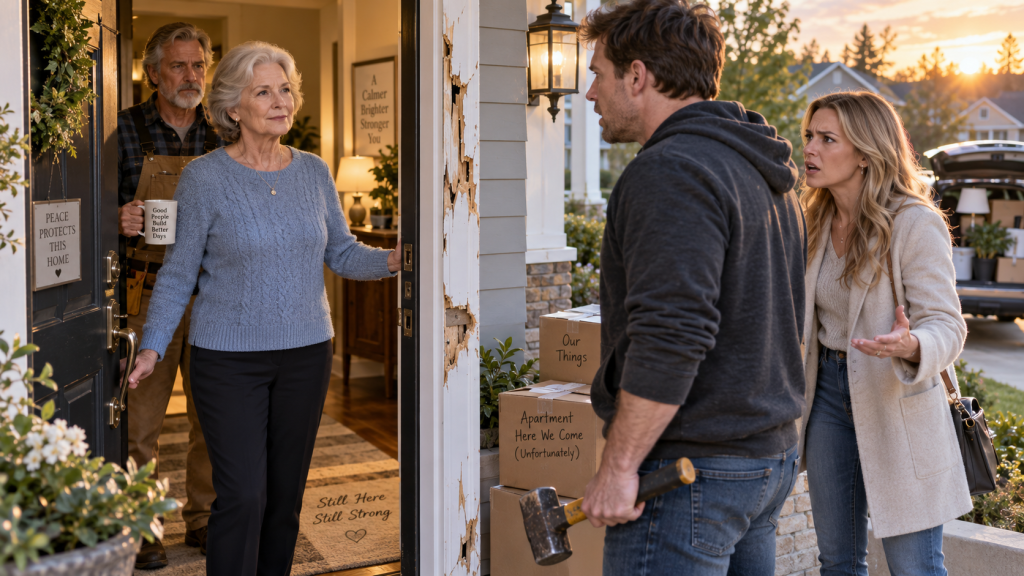
The police officer looked at the sledgehammer in my son’s hands.
Then at the splintered trim beside my front door.
Then at me.
“Ma’am,” he said carefully, “are you the homeowner?”
“Yes.”
David opened his mouth.
I raised one hand.
For the first time in his life, my son actually stopped speaking because I asked him to.
The officer looked at him.
“And you are?”
“Her son.”
“That isn’t what I asked.”
David’s face changed.
Arthur made a sound behind me that might have been a cough.
I knew better.
David swallowed.
“David Miller.”
“And do you currently reside at this address?”
David looked at me.
Sarah answered for him.
“Yes.”
I looked at her.
“No.”
The officer’s eyes moved between us.
Sarah threw both hands up.
“We’ve lived here for three months.”
“And you were given written notice to leave?”
The officer asked me.
“Yes.”
Sarah snapped:
“She sent some ridiculous letter.”
David turned toward her.
“You said there was no letter.”
Her face tightened.
“I said it wasn’t valid.”
“That isn’t what you said.”
“David, not now.”
“No.”
My son stared at his wife.
“You told me there was nothing to worry about.”
Sarah looked away.
That was the second crack.
The officer held up a hand.
“We can sort out residency questions separately. What I need to understand right now is why someone was using a sledgehammer on the door.”
David finally looked down at the tool.
It seemed heavier in his hands now.
“I thought something had happened to my mother.”
I almost admired the speed of the lie.
Not because it was good.
Because it revealed how frightened he was.
I folded my arms.
“You were shouting because your key didn’t work.”
“Mom—”
“You never called my phone.”
Silence.
“You never called an ambulance.”
He looked at me.
“You never yelled, ‘Are you okay?’”
The officer’s expression sharpened.
Sarah cut in.
“She’s twisting everything.”
I looked at the security camera above the porch.
“No.”
Then back at her.
“The camera can explain it.”
That shut her up.
The officer noticed.
“Do you have footage?”
“Yes.”
“Audio?”
“Yes.”
David closed his eyes.
The sledgehammer lowered another inch.
I felt no triumph.
That surprised me.
All weekend, I had imagined this confrontation.
I thought I would feel powerful.
Vindicated.
Maybe even a little cruel.
Instead, I felt deeply, terribly sad.
Because this was my son.
The boy who used to sleep with one foot outside the blanket.
The child who once cried for forty minutes because he stepped on an ant.
The teenager who carried groceries for elderly neighbors without being asked.
The man now standing in my driveway with a tool meant for demolition because a door I owned refused to open for him.
How had we gotten here?
Not in one morning.
That was the answer.
Families rarely collapse in one morning.
They erode.
A favor here.
An assumption there.
A swallowed insult.
A silence mistaken for agreement.
A mother who keeps saying yes because she thinks love requires endurance.
A son who slowly stops hearing yes as generosity and starts hearing it as normal.
And then one morning, the key stops turning.
—
The officer asked David to put the sledgehammer down.
He did.
Very carefully.
That image stayed with me.
Not the hammer hitting the door.
My son setting it down.
Because sometimes that is the first real sign a person understands the rules have changed.
Sarah did not understand yet.
She crossed her arms.
“This is ridiculous. She is not well.”
The officer looked at her.
“What makes you say that?”
I almost smiled.
Sarah did not realize the trap was entirely her own.
“She’s paranoid.”
“Sarah,” David warned.
“She locks her bedroom.”
I waited.
“She canceled the internet because David upgraded it.”
The officer blinked.
Sarah kept going.
“She hides things.”
“What things?”
“I don’t know. Financial papers. House documents. She refuses help.”
The officer glanced at me.
I said nothing.
“And lately she’s been acting irrationally.”
“How?”
“Changing locks.”
I looked at the new locks.
Then the sledgehammer.
The officer did too.
Sarah saw it a second later.
Her face flushed.
“That’s not what I mean.”
Behind me, Arthur stepped closer.
“Officer, I installed the locks yesterday at Mrs. Miller’s request.”
The officer nodded.
“And you are?”
“Arthur Bell.”
“Relationship?”
“Family friend. Retired contractor.”
Arthur pointed toward the damaged trim.
“I also installed that reinforced strike plate.”
He looked at David.
“Good thing I did.”
David stared at him.
There was something almost boyish in my son’s expression.
Betrayal.
As if Arthur had taken my side in a schoolyard dispute.
Not realizing there should never have been sides.
Sarah looked at me.
“You planned this.”
“Yes.”
Her mouth fell open.
At least that accusation was true.
“You set us up.”
“No.”
“I heard you.”
“I changed my locks.”
My voice remained calm.
“You brought a sledgehammer.”
The officer almost sighed.
I could practically hear him thinking:
Please stop helping the homeowner’s case.
Then a second patrol car arrived.
That was when Sarah finally became quiet.
—
No one went to jail that morning.
I know some people would prefer that.
A dramatic arrest.
Handcuffs.
Neighbors watching.
Sarah screaming.
David finally humiliated.
Real life is often less satisfying.
And better for it.
The officers reviewed the footage.
They photographed the damage.
They took statements.
David admitted he had struck the door.
He insisted he thought he still had a right to enter.
The officers explained that a disputed residency did not grant him the right to break through a reinforced front door while the homeowner stood inside refusing entry.
They advised everyone to let attorneys handle the rest.
There would be a report.
Potential property-damage issues.
Possible charges depending on what I wanted to pursue and what the prosecutor considered.
When one officer asked whether I wanted David arrested immediately for the damage, I hesitated.
Sarah noticed.
Of course she did.
She whispered:
“See? She knows this is family.”
I turned toward her.
That sentence decided it.
Not an arrest.
Something harder.
“No.”
I looked at the officer.
“I don’t want him arrested this morning.”
David exhaled.
Relief.
Then I added:
“But I do want the report completed.”
His face changed.
“I want the damage documented.”
Silence.
“And I want it made clear that neither of them has permission to enter the house.”
The officer nodded.
David stared at me.
“Mom.”
I met his eyes.
“You wanted documentation.”
His face fell.
I repeated the words from the doorway.
“So did I.”
—
They left at 7:12.
Not inside.
Away.
That distinction mattered.
David put the sledgehammer in the trunk.
Sarah climbed into the passenger seat without looking at me.
For one second, I thought my son would follow her.
Instead, he stood beside the car.
Hands in his pockets.
Shoulders slumped.
He looked at the front door.
The splintered trim.
The new deadbolt.
Then at me.
“Where are we supposed to go?”
I almost answered automatically.
A hotel.
Your cousin.
A rental.
Arthur’s cabin.
My mind started solving his problem before I could stop it.
Forty years of motherhood does not disappear because of one terrible morning.
Then I remembered the porch conversation.
A nice assisted living facility.
We’d have the house.
Why wait ten years?
I tightened my robe around myself.
“You’re forty-one years old.”
He flinched.
“You’ll figure it out.”
That sentence hurt both of us.
Maybe it needed to.
He nodded once.
Got into the car.
They drove away.
Arthur stood beside me.
Neither of us spoke until the car disappeared.
Then he looked at the damage.
“Door held.”
I laughed.
Suddenly.
Completely inappropriately.
I laughed so hard I had to hold the porch railing.
Arthur smiled.
“Told you.”
“You built a tank.”
“You asked for secure.”
“I asked for a door.”
“Details.”
I laughed again.
Then, without warning, I started crying.
Arthur’s smile disappeared.
He did not touch me immediately.
That is one of the reasons I trusted him.
He waited.
I covered my face.
“I don’t know who he is anymore.”
Arthur looked down the street where David’s car had vanished.
“Yes, you do.”
I stared at him.
“What?”
“He’s your son.”
“That’s supposed to make this better?”
“No.”
Arthur’s voice was quiet.
“It makes it harder.”
That was true.
Strangers are easier to hate.
Family comes with memories.
—
Arthur repaired the trim before lunch.
I watched from the kitchen.
Every time the drill sounded, I flinched.
He noticed.
“Go upstairs.”
“No.”
“Lisa.”
“This is my house.”
He nodded.
“Exactly.”
So I stayed.
That mattered.
I had spent months retreating to my bedroom whenever tension filled the rooms.
Now I remained downstairs while the damage was repaired.
Not because I needed to supervise Arthur.
Because I needed my body to learn the hallway belonged to me again.
At noon, he finished.
The door looked almost normal.
Almost.
One section of wood near the frame remained slightly lighter where he replaced the trim.
“I can stain it darker.”
“No.”
He looked at me.
“Leave it.”
“You sure?”
“Yes.”
I touched the wood.
“I want to remember.”
Arthur frowned.
“Why?”
“Because I’m very talented at forgiving things too quickly.”
He gave me a long look.
Then nodded.
“Leave it.”
—
Monday morning, my attorney called.
Her name was Caroline Webb.
Fifty-eight.
Silver bob.
The kind of woman who made you sit straighter even over the phone.
She had handled the trust documents two days earlier after I told her what I overheard.
I had expected disbelief.
Instead, she said:
“Good. You heard them before signing anything.”
That sentence frightened me.
Because there had been papers.
David had already mentioned them twice.
“Tax planning.”
“Estate simplification.”
“Making things easier if you ever get sick.”
I had almost signed.
Almost.
The word haunted me.
Caroline had arranged an independent medical evaluation with my longtime doctor.
Then a separate cognitive assessment.
Not because I doubted myself.
Because if David and Sarah ever tried to claim I was confused, I wanted a record created before they knew I had heard them.
The results were boring.
That was the point.
Normal cognition.
Independent decision-making capacity.
No indication of impairment.
I had never been happier to be medically uninteresting.
Caroline also amended my power-of-attorney documents.
David’s name was removed.
My niece Rebecca became primary financial agent if I ever lost capacity.
Arthur was listed as backup for limited property matters.
My health-care directive named my sister.
The house went into a revocable trust structured so David could not simply take control through a power of attorney.
I had not disinherited him.
Not then.
I wanted protection, not revenge.
Caroline respected that.
Now she said:
“The police report helps.”
I stared out the kitchen window.
“That’s an ugly sentence.”
“Legal protection often is.”
“What happens next?”
“We continue the removal process properly.”
“They’re already gone.”
“Their bodies are gone. Their legal status may still need resolving.”
I groaned.
She laughed lightly.
“You wanted clean.”
“I did.”
“Clean takes paperwork.”
That became another lesson.
Drama is fast.
Protection is paperwork.
—
The certified notice Sarah had hidden became important.
Very important.
Caroline had sent it to both David’s workplace and the house three weeks before their trip.
Not an eviction notice exactly.
A formal notice ending permission to occupy the property after the legally required period.
David never saw the copy sent home.
Sarah signed for it.
Then apparently put it in her car.
The workplace letter reached David’s office assistant while he was traveling for meetings.
She forwarded an image to his email.
He never opened it.
When Caroline showed me delivery records, I felt something shift.
Not because David had intentionally ignored me.
Because he had become so confident in my compliance that formal correspondence from my attorney did not even register as urgent.
That was entitlement in its purest form.
Not cruelty.
Certainty.
He was certain I would bend.
—
They rented an extended-stay suite.
I learned from my sister.
Not because David called.
He did not speak to me for eleven days.
Eleven days.
The longest silence between us since he was born.
When he was in college, he once went five days without calling.
I phoned campus security.
He was mortified.
Now I looked at my phone every morning.
Nothing.
Part of me felt relieved.
The rest was a mother.
On day six, I typed:
I love you. I am not changing my decision.
I stared at the message.
Then deleted it.
Not because it was untrue.
Because I realized I wanted to send it to soothe myself.
To force contact.
To make the rupture smaller.
He knew I loved him.
Maybe for once, he needed to sit with the other sentence without me cushioning it.
I am not changing my decision.
So I said nothing.
—
On day twelve, David showed up at noon.
No sledgehammer.
No Sarah.
He rang the bell.
I saw him through the camera.
He looked tired.
I opened the door.
Not fully.
The security chain remained on.
His eyes dropped to it.
That hurt him.
I saw it.
Good.
Not because I wanted pain.
Because trust should have weight.
“Can I talk to you?”
I studied him.
“Are you alone?”
“Yes.”
“Where is Sarah?”
“At the hotel.”
I closed the door.
Removed the chain.
Opened it again.
He noticed.
Another small thing.
“Come in.”
He stepped into the hallway.
Stopped near the oak console table.
The one Sarah had put on the curb.
He touched the edge.
Not quite.
His hand hovered.
Then dropped.
“You kept it.”
“Of course.”
He nodded.
We went to the kitchen.
He sat at the island.
The same place I had sat drinking coffee while he tried to break in.
Neither of us mentioned that.
Yet.
I poured water.
Not coffee.
I was not ready to perform hospitality.
He noticed.
He deserved to.
“Mom.”
“Yes?”
“I’m sorry about the door.”
I stared.
“That’s where you’re starting?”
He looked down.
“I don’t know where to start.”
Fair.
I sat across from him.
“Start with what you and Sarah were planning.”
He closed his eyes.
“Mom…”
“No.”
My voice stayed calm.
“You do not get to apologize for the hammer before we discuss why you thought you needed the house.”
He rubbed both hands over his face.
“We weren’t going to hurt you.”
I laughed once.
He flinched.
“You planned to get me declared incompetent.”
“No.”
“I heard you.”
“We talked about options.”
“David.”
He became quiet.
I leaned forward.
“Do not turn planning into brainstorming because the plan failed.”
That landed.
He looked at me.
“I wasn’t going to force you.”
“You were going to lie about tax documents.”
His face changed.
“I said maybe.”
“You said you needed your name on the deed first.”
Silence.
“You discussed power of attorney.”
His eyes filled.
“You talked about putting me in assisted living.”
“Sarah did.”
“And you answered her.”
“I was trying to calm her down.”
“No.”
I shook my head.
“You were calculating.”
He stared at the island.
“I’m sorry.”
Not enough.
“What was the plan?”
His breathing changed.
“There wasn’t a full plan.”
“Then tell me the half.”
He swallowed.
They had money problems.
That was where it began.
Not poverty.
Debt.
A difference.
Their apartment lease ended because they chose not to renew.
Not because the new place was delayed.
There was no new place.
That lie struck me almost physically.
“You invented the apartment?”
David looked ashamed.
“Yes.”
“Why?”
“Because Sarah didn’t want to tell you we couldn’t qualify.”
“For what?”
“A house.”
“What house?”
He gave me the address.
I knew the neighborhood.
Expensive.
Much more than they needed.
“You applied for a mortgage?”
“Yes.”
“And were denied.”
He nodded.
“Debt?”
“Yes.”
“How much?”
He gave me the number.
I stared.
Credit cards.
Car loans.
Travel.
Student debt.
A failed investment David had never mentioned.
Nearly two hundred thousand dollars excluding car financing.
My son had been drowning under a roof I owned while telling me the Wi-Fi needed upgrading.
I sat back.
“Why didn’t you tell me?”
He laughed bitterly.
“What would you have done?”
I knew.
Paid.
At least part.
He knew too.
“That’s why,” he said.
I stared.
“You didn’t tell me because you knew I’d help?”
“No.”
He looked at me.
“Because I knew I’d ask you to.”
That was different.
More honest.
“And I was ashamed.”
I waited.
“Then moving in here fixed everything for a while.”
No rent.
No premium internet bill until I canceled it.
No utilities.
Lower food costs.
They started saving.
Then spent again.
Sarah began looking at my house differently.
Not as mine.
As equity.
As an answer.
“At first, I told her no.”
My throat tightened.
“To what?”
“Selling.”
“Selling my house?”
“Eventually.”
“While I was alive?”
He winced.
“Yes.”
I stood.
My body needed distance.
“You discussed selling my house.”
“We were talking.”
“Stop using that word as disinfectant.”
He became quiet.
“When did assisted living come into it?”
“A month ago.”
I turned.
“Why?”
“Sarah’s grandmother moved into one and loved it.”
I almost laughed.
How convenient.
“So she decided I would too.”
“She said maybe you were lonely.”
“I was not.”
“I know.”
“Do you?”
He looked toward the hallway.
“You stayed upstairs all the time.”
“Because my daughter-in-law criticized everything I did downstairs.”
That hit him.
He knew.
“I should’ve stopped that.”
“Yes.”
“She said you were withdrawing.”
“I was retreating.”
Difference.
A huge one.
“She started talking about signs of decline.”
“What signs?”
He looked embarrassed.
“You lost your keys.”
“Once.”
“You repeated a story.”
“I am sixty-eight, not a recording device.”
He almost smiled.
I did not.
“You bought the same groceries twice.”
“I like tomatoes.”
That nearly broke him.
He laughed once.
Then cried.
“God.”
“Yes.”
He covered his face.
“What was I doing?”
I stared.
“That is the question.”
He cried.
Not dramatically.
Quietly.
My son had cried in this kitchen before.
Broken arm.
Divorce from his college girlfriend.
His father’s funeral.
This was different.
Shame has a particular sound.
Eventually he said:
“I think once we needed the house, everything started looking like evidence.”
I went still.
That sentence mattered.
They wanted an outcome.
Then reality rearranged itself to support it.
My locking my bedroom door became paranoia.
My refusal to do laundry became inability.
My canceled internet became confusion.
My attachment to old furniture became rigidity.
My boundaries became symptoms.
That frightened me more than greed.
Because humans can justify almost anything once they decide the conclusion first.
“You were building a case.”
“Yes.”
The word almost disappeared.
“And the doctor?”
“We hadn’t contacted one.”
“Yet.”
“No.”
“Power of attorney?”
“I downloaded forms.”
My stomach turned.
“Did you fill them out?”
“Some.”
“Did you sign anything for me?”
“No.”
“Did Sarah?”
“No.”
He hesitated.
I saw it.
“What?”
“There’s something you need to know.”
My body went cold.
“Tell me.”
“Sarah contacted a senior-care consultant.”
I stopped breathing.
“When?”
“Two weeks before the trip.”
“Using my name?”
“Yes.”
“What did she say?”
“That we were exploring options.”
I gripped the counter.
“Did she give them medical information?”
“I don’t know.”
“David.”
“I don’t know.”
I believed him.
That did not help.
He looked sick.
“I told her it was too far.”
“Then why didn’t you stop it?”
He whispered:
“Because part of me still wanted the house.”
There.
The ugliest truth.
Clean.
Undecorated.
I sat down.
“Thank you.”
He looked shocked.
“For what?”
“For finally saying something I can believe.”
—
I did not forgive him that day.
I wish stories were faster.
They aren’t.
I told David to leave after two hours.
Before he went, he stood near the door.
“Do you hate me?”
I looked at him.
“No.”
His face collapsed with relief.
I continued.
“I don’t trust you.”
The relief disappeared.
“That hurts more.”
“It should.”
He nodded.
“I don’t know how to fix it.”
“You don’t.”
“What?”
“You don’t fix trust.”
I opened the door.
“You behave differently long enough that maybe it grows back.”
He swallowed.
“How long?”
I stared at him.
“That question is exactly why you’re not ready.”
He understood.
I think.
He left.
—
Sarah did not apologize.
Not then.
She hired an attorney.
Not because I was pursuing criminal charges over the care plan.
There was no crime in talking.
No forged deed.
No signed power of attorney.
But Caroline sent formal notices demanding that any materials containing my medical or financial information be destroyed or returned.
The senior-care consultant confirmed Sarah had submitted an online inquiry.
She described me as:
Widowed female, late 60s, increasing confusion, resistance to assistance, possible unsafe isolation.
I read that description twice.
Then a third time.
It was me.
And not me.
A version of me constructed entirely from behaviors that became inconvenient to them.
I saved a copy.
Not because I wanted to torture myself.
Because I needed to remember how language can become a weapon when ordinary autonomy is redefined as dysfunction.
The consultant had recommended an evaluation before any placement.
Good.
They had done nothing wrong.
Sarah had.
Maybe not legally.
Morally.
Definitely.
Caroline sent a preservation letter.
Every email.
Text.
Form.
File.
I wanted a record.
Not revenge.
A record.
Once people discuss taking your capacity, you stop trusting memory alone.
—
Arthur came by every morning that week.
Sometimes with tools.
Sometimes no excuse.
One day he brought donuts.
I looked at the box.
“I’m going to gain ten pounds.”
“You’ll survive.”
“You’re a bad influence.”
“I’ve been told.”
We sat on the porch.
The lighter strip of replacement wood still visible beside the door.
Arthur looked at it.
“You sure you don’t want stain?”
“No.”
He nodded.
“Coffee?”
“Yes.”
We drank.
After a while, I said:
“Did my husband ever worry about David?”
Arthur looked at me.
My husband, Michael, had been dead eleven years.
Arthur had known him since they were sixteen.
Fishing.
Construction jobs.
Bad motorcycles.
Worse haircuts.
“Worry how?”
“Entitled.”
Arthur thought.
“Not exactly.”
“What then?”
“He worried you would make David soft.”
I stared.
“What?”
Arthur smiled slightly.
“Michael said you rescued too fast.”
I felt defensive immediately.
“David was a child.”
“I know.”
“He needed help.”
“I know.”
“Michael helped him too.”
“I know.”
I glared.
Arthur laughed.
“You asked.”
“What did he say exactly?”
Arthur looked toward the yard.
“After David dropped out of that first college program.”
I remembered.
Nineteen.
Lost.
I paid the next semester somewhere else.
Michael wanted him to work first.
We fought.
“He said, ‘Lisa loves that boy so hard she keeps getting between him and the lesson.’”
My eyes filled.
That sounded like Michael.
Annoying.
Accurate.
“He never told me that.”
“He did.”
“We fought.”
“You won.”
I laughed through tears.
“Apparently not.”
Arthur became serious.
“Don’t do that.”
“What?”
“Turn this into evidence you ruined your son.”
I looked down.
“You didn’t.”
“But I helped.”
“Maybe.”
Again.
That word.
“David’s forty-one.”
Arthur’s voice hardened slightly.
“He has had twenty years to correct anything you taught him badly.”
I looked at him.
“So has Sarah.”
“Yes.”
Responsibility again.
It returned like a bell.
—
I changed more than locks.
Passwords.
Bank accounts.
Credit freezes.
Mail delivery.
Security settings.
Health portal access.
Emergency contacts.
I removed David from every place where convenience had quietly become authority.
That was painful.
At the pharmacy.
The hospital.
My brokerage account.
Even the veterinarian, though I no longer had a dog.
Michael and I used to list David everywhere.
Our son.
Of course.
That was the default.
Now every form asked:
Emergency contact?
And I had to decide whether love and trust still occupied the same line.
Sometimes they did not.
My sister became first contact.
David second.
I kept him there.
Not everything had to become exile.
—
Three weeks later, Sarah filed for divorce.
David told me.
He called at eight in the evening.
I almost didn’t answer.
Then did.
“Mom?”
“Yes.”
“She left.”
I closed my eyes.
There was no satisfaction.
I had disliked what Sarah did.
I did not want my son destroyed.
“What happened?”
“She says I turned against her.”
“Did you?”
“I told her I was done trying to get the house.”
I waited.
“She said I chose you.”
I laughed softly.
“What?”
“You make it sound like there was supposed to be a contest.”
“I know.”
His voice broke.
“I told her that.”
“Then?”
“She said we needed assets, not feelings.”
That sentence told me more about Sarah than three months under my roof had.
Not because she was incapable of love.
But fear had apparently converted security into ownership for her too.
“Did you know she had contacted the senior-care place?”
“Not until after.”
I believed him.
“Are you safe?”
He sounded surprised.
“Yes.”
“Is she?”
“Yes.”
“Good.”
Then he cried.
My son.
Forty-one.
Homeless a month earlier.
Marriage ending now.
My maternal instinct rose so fast it almost knocked me over.
Come home.
The words reached my tongue.
I swallowed them.
Not because I wanted to punish him.
Because I understood something at last.
Coming home was exactly what he did whenever life became difficult.
And I had always opened the door before he learned what standing on his own felt like.
“I’m sorry,” I said.
Not:
Come here.
Not:
I’ll fix it.
Just:
“I’m sorry.”
He cried harder.
“Can I see you tomorrow?”
“Yes.”
That was help without rescue.
I was learning.
—
David rented a one-bedroom apartment.
Small.
No guest room.
No granite island.
No garage.
When I visited, he apologized for the folding chairs.
I sat.
“They’re chairs.”
“I used to have better.”
“You used to use mine.”
He laughed.
Good.
He made coffee.
Too weak.
I drank it anyway.
There were boxes everywhere.
His gaming system sat on the floor.
Sarah had taken most furniture that belonged to her.
They were negotiating the rest through attorneys.
I looked around.
“This is yours.”
He frowned.
“Unfortunately.”
“No.”
I touched the mug.
“This is yours.”
Rent.
Electricity.
Internet.
Groceries.
All his.
His face changed.
“I know.”
“Feels different?”
“Yes.”
He smiled sadly.
“More expensive.”
I laughed.
Then he handed me an envelope.
My stomach tightened.
“What’s this?”
“Read it later.”
“No.”
I handed it back.
“If it matters, tell me.”
He looked surprised.
Then embarrassed.
“Therapy assignment.”
I waited.
“Write down what I was expecting you to provide.”
Oh.
He unfolded the page.
Not money.
Not exactly.
Security.
Fallback.
Housing.
Emergency cash.
Inheritance.
Approval.
Childcare if he ever had children.
Emotional rescue.
Decision-making.
“Dad died and I think I decided you had to become both parents forever.”
My throat tightened.
“I’m sorry.”
He continued.
“I never asked what you wanted after Dad died.”
That hurt.
Because it was true.
Eleven years.
David had been thirty.
He mourned his father.
I disappeared into widowhood.
He called every day at first.
Then less.
Eventually, when he called, it was often about problems.
I was grateful.
Problems made me useful.
Useful made me less lonely.
There it was.
My side.
“I liked being needed.”
David looked up.
“I know.”
I blinked.
“You do?”
“Yes.”
He smiled sadly.
“You always sound happiest when you’re solving something.”
That was uncomfortable.
“I thought I was helping.”
“You were.”
Both.
Again.
Always.
“You helped so fast I stopped asking whether I could do it myself.”
I looked at him.
There is a strange grief in hearing your grown child describe the exact way your love failed to prepare him.
Not because the love was wrong.
Because its form became unsustainable.
“I’m sorry.”
David shook his head.
“No.”
His eyes filled.
“I’m not giving you my part.”
That sentence made me cry.
He had learned something.
Already.
“I’m responsible for what I did.”
He folded the paper.
“And I’m responsible for what I do next.”
I reached across the folding table.
Took his hand.
Not rescue.
Connection.
There is a difference.
—
Sarah and David did not divorce immediately.
They separated.
Six months.
Counseling.
Fights.
More counseling.
Then they reconciled.
I know.
I was surprised too.
Sarah asked to meet me before moving back in with David.
Not my house.
His apartment.
That detail mattered.
We met at a café.
Public.
Her idea.
She arrived early.
Simple clothes.
No sharp tone.
I was suspicious.
Good.
Suspicion had become healthy in measured doses.
“Thank you for coming.”
I nodded.
She clasped both hands around her cup.
“I owe you an apology.”
“Yes.”
She looked up.
Not expecting ease.
Good again.
“I don’t know where to start.”
“Start with what you meant to do.”
Her eyes filled.
She nodded.
“I wanted your house.”
Clean.
No excuses.
“I thought it should be David’s eventually.”
“Yes.”
“I thought you had more space than you needed.”
I felt anger rise.
Then settle.
“I told myself assisted living would be good for you.”
“Did you believe that?”
She shook her head.
“Not at first.”
Important.
“When did you start?”
“After I started researching.”
She laughed bitterly.
“You can find an article online to justify anything if you already want the answer.”
Exactly.
“I started seeing your behavior differently.”
“Because you needed me impaired.”
Her face collapsed.
“Yes.”
There it was.
No euphemism.
“I’m sorry.”
“Why the deed?”
“Security.”
“For you.”
“For us.”
I stared.
“You understand I was alive?”
Tears fell.
“Yes.”
“Did that matter?”
“Yes.”
“Enough?”
“No.”
Honest.
Painfully.
“I grew up moving constantly.”
That was new.
Sarah had mentioned childhood instability vaguely.
Not details.
“Rentals. Evictions. My mom lost a house when I was fourteen.”
She swallowed.
“I became obsessed with owning.”
I listened.
“That isn’t your fault.”
“I know.”
Good.
“I turned your home into a symbol.”
I nodded.
“And symbols are dangerous when actual people live inside them.”
She cried.
“I’m sorry.”
I believed she was sorry.
That did not restore trust.
“I accept the apology.”
She looked relieved.
Then I added:
“You will never have a key to my house again.”
Pain flashed.
She nodded.
“I understand.”
“You will not be involved in my medical care.”
“Yes.”
“Financial documents.”
“Yes.”
“Estate planning.”
“Yes.”
“If David ever inherits something from me, that will be his relationship with my estate. Not yours.”
She looked down.
“Yes.”
I leaned forward.
“And if you ever describe my boundaries as cognitive decline again, I will not meet you for coffee.”
Her face crumpled.
“I won’t.”
“Good.”
That was our new beginning.
Not warmth.
Clarity.
Sometimes clarity is the kinder beginning.
—
I did not change my estate plan back.
Not completely.
David remained a beneficiary.
But the house?
That changed.
Years earlier, Michael and I assumed David would inherit it.
Simple.
One child.
One house.
Now I did something different.
My trust directed that the house be sold after my death unless David purchased it at fair market value through a defined process.
Proceeds would be divided.
Some to David.
Some to my granddaughter’s education fund.
Some to a housing nonprofit for widows facing displacement.
When Caroline read the clause, she looked at me.
“Purposeful.”
“Yes.”
“Punitive?”
I thought.
“No.”
And I meant it.
I did not want David spending the rest of my life waiting for keys.
If he wanted the house someday, he could buy it.
If not, it would become money distributed according to my wishes.
That freed both of us.
A home should shelter the living.
Not manipulate them from the future.
—
The police case over the door eventually resolved with property-damage charges handled without jail.
David paid for repairs.
Every dollar.
I almost refused.
Then remembered what Arthur said about lessons.
I accepted the check.
Deposited it.
The next week, I gave the same amount to a local domestic-violence shelter.
Not because David was abusive in that sense.
Because reinforced doors matter.
I knew that now.
Arthur installed locks there sometimes as a volunteer.
When I told him about the donation, he stared.
“What?”
“Nothing.”
“You’re judging.”
“No.”
“You’re absolutely judging.”
“I’m thinking Michael would be proud.”
My eyes filled.
Arthur’s did too.
Then he looked away because men of his generation often treat visible emotion like an electrical fire.
“Coffee?”
“Yes.”
We never discussed it further.
—
The first Christmas after everything was terrible.
I will not romanticize it.
David and Sarah came for two hours.
I almost canceled.
Then decided avoidance was giving one holiday too much power.
My sister came.
Arthur too.
Small dinner.
No overnight guests.
No spare keys.
Sarah brought dessert.
She asked before placing it in my refrigerator.
That tiny question nearly broke me.
“Can I put this here?”
Months earlier, she rearranged my kitchen without asking.
Now she asked about pie.
“Yes.”
Her eyes filled.
Mine too.
We pretended they didn’t.
Dinner was polite.
Too polite.
Everyone avoided assisted living jokes.
Obviously.
At one point, David looked at the espresso machine.
Still on the counter.
He smiled.
“I remember the blender.”
Sarah covered her face.
“Please don’t.”
Arthur asked:
“What blender?”
I pointed at him.
“No.”
He grinned.
“Now I need to know.”
We laughed.
Barely.
But enough.
The evening ended without an explosion.
Sometimes that is success.
—
A year later, Sarah apologized for the console table.
Not verbally.
She restored it.
I came home one afternoon and found a package on my porch.
Inside was a small brass plaque.
Not attached.
Just wrapped.
RESTORED BY MICHAEL MILLER, 1989
My husband’s name.
I called Sarah.
“What is this?”
She sounded nervous.
“I found the photo album.”
“What album?”
“The one with Michael working on the table.”
I sat down.
She continued.
“I realized it wasn’t just furniture.”
My throat tightened.
“No.”
“I had a plaque made.”
“Why?”
“Because I treated your memories like clutter.”
I closed my eyes.
“I’m sorry.”
I touched the brass letters.
Michael.
His hands.
Sawdust in his hair.
I cried.
“Thank you.”
The plaque now sits underneath the table.
Not visible unless you bend.
I like that.
Some meaning does not need to be displayed to be real.
—
David grew.
Slowly.
Annoyingly.
Not in a cinematic montage.
He paid rent.
Built savings.
Sold the expensive car.
Bought a used Honda.
The first time he drove it to my house, I laughed.
He looked offended.
“It’s reliable.”
“I said nothing.”
“You’re laughing.”
“I’m proud.”
“That’s worse.”
He learned to cook more than eggs.
Called less often for help.
More often just to talk.
Sometimes he asked advice.
I gave it.
Sometimes he ignored it.
That was healthy.
The first time he solved a major problem without telling me until after, I felt hurt.
Then proud.
Then embarrassed by the hurt.
Motherhood is full of contradictions nobody warns you about.
You raise them to need you less.
Then they succeed.
And you have to find out who you are when they do.
—
I discovered who I was.
Not immediately.
For months after they left, my house felt too quiet again.
The loneliness I had avoided returned.
But this time, I did not solve it by inviting someone to move in.
I joined a walking group.
Hated it.
Stayed.
Took pottery.
Worse than watercolor.
Made one bowl that leaned so severely Arthur called it “architecturally emotional.”
I kept it.
Volunteered at the botanical garden.
Travelled with my sister.
Learned how to make espresso without Michael saying mine was too strong.
I changed the guest room into a reading room.
Not because guests were banned.
Because I stopped preserving half my house for hypothetical people.
That was freeing.
—
Arthur remained.
People asked.
Of course they did.
Widow.
Widower.
Old friends.
Coffee every morning.
Gossip loves an empty category.
“Are you two together?”
My sister asked.
“No.”
“Do you want to be?”
“I don’t know.”
Arthur knew I was thinking about it before I did.
One evening, after fixing a cabinet hinge that did not need fixing, he said:
“Michael would haunt me.”
I stared.
“For what?”
“If I dated you.”
I laughed so hard I spilled tea.
“He’d haunt you for using his drill wrong.”
“That too.”
We did not date.
Not then.
Two years later, we did.
Slowly.
Awkwardly.
At seventy, romance is less about butterflies and more about whether someone annoys you pleasantly.
Arthur did.
Our first official date was dinner.
He wore a jacket.
I laughed.
“You own that?”
“Apparently.”
We talked about Michael.
That mattered.
No pretending.
No erasing.
Arthur loved his friend.
I loved my husband.
Love after loss does not have to evict memory to make room.
Eventually Arthur kissed me.
Then apologized.
I kissed him again.
That solved it.
David struggled at first.
Of course.
He said:
“Dad’s best friend?”
I answered:
“Would you prefer a stranger?”
He did not.
Sarah, unexpectedly, supported me.
“She deserves happiness.”
I almost said:
Be careful. That sounds healthy.
I didn’t.
Growth deserves dignity too.
—
Three years after the sledgehammer morning, David asked for a key.
Not demand.
Asked.
We were sitting on the porch.
He said:
“I know the answer may be no.”
Good opening.
“Why do you want one?”
“Emergency.”
“What emergency?”
He thought.
“If you fall.”
“I have a medical alert system.”
He nodded.
“If there’s a fire.”
“Then you should call firefighters.”
He laughed.
“Mom.”
“I’m serious.”
“I know.”
He looked at the door.
“I think I want it because not having one reminds me.”
There.
Truth.
“Of what?”
“That you stopped trusting me.”
I looked at him.
“Yes.”
He swallowed.
“Do you now?”
“More.”
“Enough?”
I thought.
Then reached into my pocket.
Not because I had planned it.
There was no key.
I laughed.
“Apparently not enough to carry one around.”
He laughed too.
A week later, I gave him a key.
One.
Not the garage code.
Not documents.
Not unlimited authority.
A key.
With rules.
Emergencies.
Invited visits.
Never copy.
He took it like something sacred.
“Thank you.”
I looked at him.
“This key opens a door.”
“Yes.”
“It does not open my finances, my medical decisions, or my future.”
He smiled.
“I know.”
Good.
That was why he got it.
—
Sarah never got one.
She never asked.
That may have been her greatest act of respect.
—
At seventy-three, I fell.
Not dramatically.
Garden hose.
Pride.
Human body meets concrete.
I fractured my wrist.
David arrived at the emergency room before Arthur.
He sat beside me.
Did not take over.
That mattered.
The doctor asked:
“Who is your medical decision-maker?”
“My sister.”
David did not react.
Not visibly.
Later, while driving me home, he said:
“I used to think that should be me.”
I looked out the window.
“And now?”
“I think it should be whoever you trust with it.”
My eyes filled.
“Yes.”
He continued.
“If that changes someday, you’ll tell me.”
“Yes.”
No resentment.
No entitlement.
Trust had grown.
Not all the way back to where it began.
Somewhere better.
More conscious.
—
My sister died when I was seventy-six.
Stroke.
Quick.
Devastating.
Her death forced another estate update.
Caroline, now mostly retired, laughed when I arrived.
“You again.”
“Apparently I refuse to die in a legally convenient way.”
We reviewed documents.
Medical agent.
Financial.
Trust.
This time, I named David as health-care backup behind Arthur.
Not first.
He did not know.
Then Arthur died two years later.
Heart.
Sudden.
He was seventy-nine.
I thought losing Michael had taught me grief.
It had.
But grief does not become easier through expertise.
Only more recognizable.
Arthur’s death felt different.
Michael was my life.
Arthur had been my second chapter.
Losing him felt like someone closing a book I had not expected to own.
David came to my house that night.
Used his key.
But called first.
That mattered even after years.
“Mom?”
“Yes.”
“I’m outside.”
“Come in.”
He did.
No assumption.
At midnight, I told him:
“You’re my medical agent now.”
He stared.
“What?”
“Arthur was first.”
His eyes filled.
“And now?”
“You.”
He cried.
I held up one finger.
“Do not make me regret it.”
He laughed through tears.
“Never.”
“Never is a dangerous word.”
“Then I’ll try.”
Better.
—
Sarah and David stayed married.
Not perfectly.
Nobody is.
They had no children.
By choice.
Sarah once told me:
“I don’t think I’d survive teenage entitlement.”
I stared.
She laughed.
Fair.
She became a project manager for a design firm.
Very successful.
Good at control when control belonged in a job description.
She even helped me redesign my downstairs bathroom when I needed grab bars later.
She asked before moving everything.
Every single item.
“Can I move this?”
“Yes.”
“This?”
“Yes.”
“This hideous vase?”
“No.”
She smiled.
“Worth trying.”
We developed a relationship.
Not mother-daughter.
Something else.
Adult women who knew exactly how badly they could hurt each other and chose not to.
That is a strange intimacy.
—
At eighty, I decided to move.
Not because anyone suggested it.
That mattered enormously.
The house had stairs.
Maintenance.
A yard I no longer enjoyed managing.
I found a one-story townhouse near the botanical garden.
Beautiful.
Smaller.
Safe.
I told David over dinner.
He froze.
“You’re selling?”
“Yes.”
He looked around.
His childhood.
Michael.
The console table.
Everything.
For one second, I saw the old hunger.
Or maybe I feared it.
Then he said:
“Do you want help?”
That was all.
I nearly cried.
“Yes.”
He smiled.
“Okay.”
No:
But this house is mine someday.
No:
Why not give it to us?
No:
You’re too old to decide.
Just:
Do you want help?
That question contained fifteen years of change.
—
The sale went smoothly.
David helped pack.
Sarah labeled boxes.
I supervised too much.
Some things never change.
When we reached his old bedroom, he found a baseball glove from age twelve.
He sat on the floor.
“Dad bought this.”
“Yes.”
He held it.
“I forgot.”
I sat beside him.
The room looked small.
He had once wanted to inherit an entire house.
Now he cried over a glove.
Perspective is expensive.
Eventually, he asked:
“Do you forgive me?”
I knew what he meant.
Not the door.
Everything.
I thought.
“Yes.”
His face crumpled.
“But I don’t erase it.”
“I know.”
“Do you?”
He looked at the glove.
“No.”
Good.
Forgiveness without memory is only amnesia.
We needed better.
—
Before leaving the house for the final time, I stood at the front door.
The lighter strip of wood beside the frame was still there.
Arthur had never stained it.
I touched it.
David stood behind me.
“Do you want me to fix that for the buyers?”
“No.”
He stared.
“They’ll probably think it looks weird.”
“Then they can stain it.”
I smiled.
“It’s not my scar anymore.”
I closed the door.
Locked it.
Handed the keys to the realtor.
And walked away.
Not forced.
Not declared incompetent.
Not removed.
I left when I chose.
That mattered more than I can explain.
—
My new townhouse had no spare keys hanging beside the back door.
Old habit broken.
One key with me.
One secure lockbox for emergency services.
One with David.
That was enough.
The first morning, I made espresso.
Sat by the window.
Silence.
Years earlier, silence frightened me.
Now it felt earned.
I thought about the assisted-living conversation.
Their plan.
The house.
The power of attorney.
All because they assumed aging meant my choices mattered less.
That idea angered me more than anything else.
Old age does not turn a person into communal property.
Needing help does not cancel agency.
Slowness is not stupidity.
Caution is not confusion.
Keeping old furniture is not cognitive decline.
And saying no is not evidence you no longer understand what is best for you.
Sometimes saying no is the clearest evidence that you do.
—
At eighty-three, I did eventually move into assisted living.
Yes.
Life appreciates irony.
I chose it.
That is the entire difference.
My townhouse became too much after a hip replacement.
I toured four communities.
Rejected three.
Selected one with a garden, excellent coffee, and a library large enough to get lost in.
David came with me only after I invited him.
Sarah asked questions about design.
Of course.
At the fourth place, the director said:
“We encourage family involvement.”
I looked at David.
He smiled.
“Only if invited.”
The director looked confused.
Sarah laughed.
Long story.
When I signed the papers, David sat beside me.
Not over me.
I read every line.
Asked questions.
Changed one clause.
The administrator looked surprised.
I enjoyed that.
Afterward, David said:
“Mom?”
“Yes?”
“I’m proud of you.”
“For moving?”
“For making it yours.”
My eyes filled.
That was it.
Years earlier, he wanted to place me somewhere so he could have my house.
Now he helped me move somewhere I chose because I no longer wanted one.
Same action.
Completely different meaning.
Consent changes everything.
—
The old sledgehammer ended up in David’s garage.
I discovered that accidentally.
At eighty-four, I visited his house.
Yes.
His house.
He bought one eventually.
Not mine.
Not inherited.
Saved.
Qualified.
Paid mortgage.
I was absurdly proud.
I walked into the garage and saw the hammer hanging on the wall.
I stopped.
“What is that?”
David looked embarrassed.
“I kept it.”
“Why?”
He shrugged.
“Reminder.”
“Of what?”
“Not to solve door problems with demolition equipment.”
I laughed.
Then he became serious.
“Of the worst morning of my life.”
I touched the handle.
“It wasn’t mine.”
He looked at me.
“No?”
“No.”
The worst morning would have been if I had not heard you on the porch.
He became still.
“What?”
I looked at my son.
“If I hadn’t heard you and Sarah talking, I might have signed something.”
His face drained.
“You wouldn’t.”
“I almost did.”
“When?”
“The week before.”
He sat.
I had never told him.
“You said it was tax planning.”
He covered his face.
“God.”
“I had the pen in my hand.”
Tears slipped through his fingers.
“Mom…”
“I didn’t sign because Arthur called and interrupted.”
That was true.
Michael’s best friend had saved me before he even knew I needed saving.
Later that evening, I mentioned the forms to Arthur.
He asked to see them.
That suspicion eventually helped me listen harder.
David cried.
“I almost…”
“Yes.”
He could not finish.
“You almost did something you would have regretted for the rest of your life.”
I looked at him.
“But you didn’t.”
“Because you heard us.”
“Yes.”
He shook his head.
“That’s not enough.”
“No.”
I touched his shoulder.
“But what came after counts too.”
He looked up.
Years.
Rent.
Therapy.
Apologies.
Changed behavior.
Respect.
That counted.
People sometimes act as if the worst thing someone almost did permanently defines them.
Sometimes it should change how we see them.
Always.
But if there is no room for growth afterward, accountability becomes a prison instead of a teacher.
I did not want my son imprisoned forever inside that porch conversation.
I wanted him to understand it.
He did.
—
Sarah died before David.
Cancer.
Sixty-eight.
Too young.
Her illness changed all of us.
By then, whatever anger I once carried had become history.
When she entered hospice, I visited.
She looked small in the bed.
Not the sharp woman with the blender.
Not the voice at the cracked kitchen window.
Just Sarah.
She smiled when she saw me.
“Lisa.”
“Hello, trouble.”
She laughed weakly.
“Still mad about the espresso machine?”
“Absolutely.”
“Good.”
I sat beside her.
After a while, she said:
“I’m sorry.”
I almost groaned.
“Sarah.”
“No.”
She touched my hand.
“I know we settled this.”
“Then stop.”
“I need to say one thing.”
I waited.
“I was afraid of being poor again.”
Her eyes filled.
“I let fear make you into an obstacle.”
My throat tightened.
“I know.”
“I’m ashamed.”
“I know.”
“Did you forgive me?”
“Yes.”
“When?”
I thought.
“Before you did.”
She cried.
I smiled.
“That annoyed me.”
She laughed through tears.
Then whispered:
“Thank you for not making David choose me or you.”
That surprised me.
“I wanted to.”
“I know.”
“You were terrible.”
“So were you sometimes.”
“Excuse me?”
She smiled.
There she was.
Sarah.
Even dying.
I squeezed her hand.
“You became family eventually.”
Her face broke.
Not daughter.
Family.
The right word.
She died three weeks later.
At her funeral, David leaned into me like a boy.
I held him.
No house.
No money.
No lesson.
Just grief.
There are moments when boundaries step aside because love has nothing to defend against.
—
David never remarried.
Not because Sarah was perfect.
Because some loves remain enough after they end.
He visited me every Sunday.
Not at 5:58.
Usually ten.
He knocked.
Even when he had a key card.
Always.
I teased him.
“You know you can come in.”
“I know.”
“Then why knock?”
He smiled.
“Practice.”
That answer never stopped moving me.
—
I am eighty-seven now.
David is sixty.
I live in the assisted-living community Sarah once imagined as a way to remove me.
I chose the room.
The curtains.
The furniture.
My espresso machine is on the counter.
Yes.
That machine survived everything.
The staff hates it because I make coffee strong enough to restart the dead.
I keep the brass plaque from Michael’s console table on my bookshelf.
The table itself belongs to David now.
He asked before taking it.
Of course.
The lighter strip of wood from my old front door?
I kept a small piece when the buyers replaced the frame.
Arthur cut it for me years ago.
It sits in a drawer.
Not because I remain angry.
Because memory is useful when it no longer controls you.
—
Last Sunday, David visited.
He brought pastries.
Bad ones.
I told him so.
“You sound like Sarah.”
He froze.
Then laughed.
“I miss her.”
“I know.”
We drank coffee.
He looked around my apartment.
“Do you like it here?”
“Yes.”
“Really?”
“Yes.”
“Still?”
I smiled.
“Are you checking my cognition?”
His face went pale.
I laughed so hard I nearly spilled my coffee.
“Mom.”
“Too soon?”
“It has been twenty years.”
“Still too soon?”
He laughed.
Then reached for my hand.
“Never again.”
I squeezed his fingers.
“I know.”
That was trust.
Not believing someone never made a terrible mistake.
Knowing what they learned from it.
—
Before he left, David stood by the door.
He paused.
“Mom?”
“Yes?”
“I’ve been meaning to ask something.”
“What?”
“Why did you open the door that morning?”
I stared.
“What do you mean?”
“You knew I had the sledgehammer.”
“Yes.”
“Arthur said to let me try.”
“Yes.”
“Why open it?”
I had never considered the question.
Not deeply.
I thought back.
My hand on the deadbolt.
David outside.
Hammer raised.
Sarah shouting.
Arthur behind me.
The whole life before and after balanced in that hallway.
Finally, I knew.
“Because I wanted you to see me.”
His eyes filled.
“What?”
“You were talking about me like I was an obstacle.”
I looked at my son.
“A confused old woman. A house. A deed. A problem to solve.”
My voice softened.
“I opened the door because I needed you to see your mother standing there.”
David cried.
So did I.
“Did it work?”
I thought.
“Yes.”
“Immediately?”
“No.”
We laughed.
“Nothing with you was immediate.”
“That sounds genetic.”
“Probably.”
He kissed my forehead.
Then left.
He knocked once on the outside of the door after closing it.
Our old joke.
I smiled.
—
People often tell this story as though the lock change was the dramatic part.
It wasn’t.
The most important lock was the one inside me.
The one I had placed around the word no.
For years, I treated no as dangerous.
No might disappoint my son.
No might make Sarah angry.
No might leave me alone.
No might make me seem difficult.
Then I discovered what yes had cost.
My kitchen.
My routines.
My privacy.
My money.
My authority.
Eventually, almost my home.
So I unlocked no.
And once I did, everything changed.
Not because no is magic.
Because it reveals who can love you without controlling you.
David learned.
Sarah eventually learned.
I learned too.
—
I do not regret letting them move in.
People find that surprising.
I regret what I tolerated.
Different thing.
If they had never moved in, perhaps I would never have seen how much my son still expected me to carry.
Perhaps he would never have seen it either.
Maybe he would have waited until I actually became frail before entitlement turned into something harder to resist.
Instead, everything surfaced while I was strong enough to change the locks myself.
That feels like grace.
Messy grace.
But grace.
—
I also do not regret keeping David in my life.
Some people would have cut him off forever.
I understand.
What he contemplated was serious.
A violation.
I never minimized it.
Neither did he after that first year.
That is why we survived.
He did not demand forgiveness as evidence of motherhood.
He earned closeness slowly.
And I did not use his worst choice to control him forever.
That mattered too.
Boundaries should protect life.
Not become another form of domination.
I wanted a son.
Not a defendant serving a permanent sentence.
So over time, we built something new.
Not the relationship we had before.
That relationship had too much rescue in it.
The new one had doors.
Questions.
Permission.
Honesty.
Strangely, it was warmer.
—
The assisted-living staff calls David my “very attentive son.”
I smile every time.
They have no idea.
Maybe one day someone will ask why he always knocks.
Maybe I’ll tell them.
Maybe not.
Some stories do not need to become explanations for everything.
Sometimes a knock is simply a knock.
But I hear what is underneath it.
May I come in?
Not:
This will be mine eventually.
Not:
You need me to decide.
Not:
You are getting old, therefore I know better.
Just:
May I come in?
And I answer.
Sometimes yes.
Sometimes:
Give me five minutes.
He waits.
That is love now.
—
The first morning of this story began at 5:58 with a key that stopped turning.
I used to think that locked door saved my house.
It didn’t.
The house was wood.
Brick.
Mortgage records.
Furniture.
I eventually sold it willingly.
What that door saved was something more important.
My right to decide when it opened.
My right to decide who entered.
My right to decide when I left.
My right to age without surrendering authorship of my own life.
That is what David and Sarah almost took.
Not property.
Agency.
And that is what I fought hardest to keep.
—
I still think about the moment the first sledgehammer blow landed.
CRACK.
At the time, it sounded like violence.
Now, in memory, it sounds like something breaking open.
An arrangement.
A lie.
A family pattern.
The belief that motherhood meant endless access.
The belief that aging meant reduced authority.
The belief that inheritance begins before death.
All of it cracked.
Loudly.
Painfully.
Necessary.
—
If I could speak to the woman sitting at the kitchen island that morning, hands around black coffee while her son pounded on the door, I would tell her:
Do not feel guilty.
Not yet.
Guilt will come anyway.
Let it pass through.
Do not let it drive.
You are not cruel for protecting yourself.
You are not abandoning your son by making him house himself.
You are not paranoid because you secure documents someone discussed taking.
You are not selfish because you want your own kitchen arranged the way you like it.
Your memories are not clutter because someone younger prefers minimalism.
Your furniture is not outdated if it still holds love.
Your age is not an argument.
And when people describe your independence as a symptom, pay attention.
That is often the moment they have stopped seeing you as a person and started seeing you as a problem.
Then I would tell her something harder.
Do not make David only the villain.
He is responsible.
Completely.
But he is still becoming.
So are you.
Leave one door inside yourself unlocked.
Not the front door.
Not yet.
A smaller one.
For the possibility that accountability may change him.
It will.
Slowly.
But it will.
—
Michael would have laughed at all of this.
Not the dangerous part.
The espresso machine.
The deadbolt.
Arthur dating me.
David driving a used Honda.
Sarah returning the plaque.
He would have had opinions.
Too many.
Sometimes I talk to him anyway.
There is a photograph beside my bed here.
Young Michael.
Sawdust in his hair.
He is standing beside the console table.
Smiling.
I tell him:
“Your son finally learned to knock.”
Then I imagine Michael saying:
“About damn time.”
Maybe.
Or maybe he would remind me:
“He learned because you finally stopped opening before he knocked.”
That sounds more like him.
Annoying even from memory.
—
The last time David visited, he brought me a new keychain.
Silver.
Simple.
Engraved with one word.
ASK.
I stared.
He looked embarrassed.
“Too much?”
“Yes.”
“I can return it.”
“No.”
I clipped my room key to it.
Then handed him his own.
His says:
KNOCK.
Sarah would have called them cheesy.
She would have been right.
We love them.
—
So yes.
My son once came to my house before sunrise holding a sledgehammer.
His wife once planned to turn my age into an argument against my independence.
They discussed assisted living like a real-estate strategy.
They wanted a deed.
A power of attorney.
A house they thought would be theirs eventually.
And I changed the locks.
But that is not where the story ends.
The lock was only the first boundary.
After that came years.
Painful conversations.
Therapy.
Legal documents.
Apartments.
Bills.
Apologies.
Distance.
Keys returned.
Keys earned.
A marriage nearly lost.
A marriage repaired.
Deaths.
New homes.
An assisted-living room I chose myself.
A son who learned that love does not equal ownership.
A mother who learned that help offered too quickly can become a cage for both people.
And eventually, forgiveness.
Not forgetfulness.
Never that.
Forgiveness with memory.
The kind that knows exactly where the scar is and stops touching it every morning to make sure it still hurts.
—
I do not own the old house anymore.
Someone else wakes in my bedroom.
Someone else uses the kitchen.
Maybe they changed the cabinets.
I hope not.
Maybe they removed the console table’s old spot completely.
Doesn’t matter.
Homes are temporary.
Even the ones we spend forty years defending.
What remains is the way we learned to live inside ourselves.
Mine finally has locks.
Windows.
A door.
And people I love know what to do now.
They knock.
I choose.
Then, when I want them there, I open.
That was the lesson hidden inside that Sunday morning.
Not how to keep family out.
How to let them back in without giving yourself away.
And in the end, that mattered far more than the house they once thought was already theirs.
THE END STORIES! THANK YOU FOR READING GOOD LUCK !❤️
Related Posts