PART 3 — WHAT THEY THOUGHT I WOULD KEEP PAYING FOR
The bank manager’s voice was so careful that my hand tightened around the phone before he even finished his sentence.
“Beth, I think you need to come in. We found something in the boutique account that Sarah definitely didn’t want you to see.”
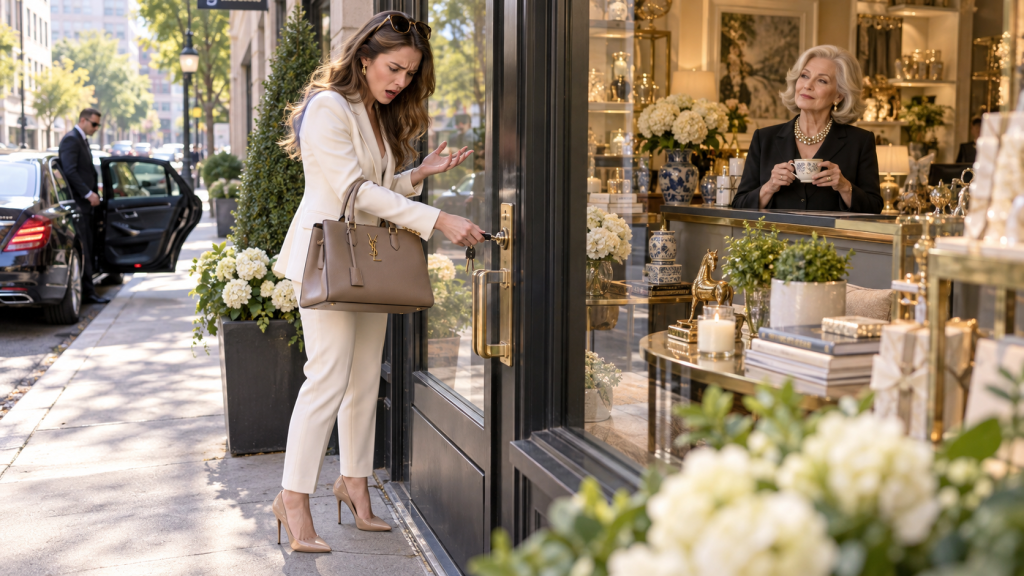
I looked through the front windows of my store.
Sarah was still standing outside.
Greg was beside her now, one hand on his hip, the other pointing toward the door as though anger might somehow turn the new lock back into the old one.
Pedestrians slowed as they passed.
Sarah’s mouth moved rapidly.
Greg’s face had that expression I knew too well.
The one that said everyone else was being unreasonable.
For years, I had seen that face and softened.
Not that morning.
“What did you find?” I asked.
The bank manager hesitated.
“I would rather show you.”
My stomach tightened.
“How serious?”
Another pause.
“Serious enough that I don’t think you should discuss it with Sarah before we speak.”
I looked through the glass again.
Sarah noticed me watching.
She pointed at the door.
Then at herself.
Then mouthed:
OPEN IT.
I turned away.
“I’ll be there in twenty minutes.”
“Bring identification.”
“I will.”
“And Beth?”
“Yes?”
“Bring copies of anything showing who is authorized on the business accounts.”
My pulse changed.
Not faster.
Colder.
“I have them here.”
“Good.”
He ended the call.
For several seconds, I stood behind my counter with the phone still pressed to my ear.
The boutique smelled the way it always did in the morning.
Cedar shelves.
Vanilla candles.
Fresh coffee from the café next door.
For decades, that smell had meant work.
Pride.
Routine.
My life.
Now suddenly it smelled like evidence.
Sarah pounded against the glass again.
I closed my eyes.
Then I walked toward the door.
Not to unlock it.
I stood close enough for her to hear me through the glass.
“I’m leaving for a while.”
Her eyebrows shot upward.
“You’re what?”
“Tom will stay until the opening manager arrives.”
“What opening manager?”
“Marisol.”
Sarah laughed.
“Marisol is a sales associate.”
“She was.”
Her expression changed.
I had promoted Marisol thirty minutes earlier.
Temporary acting manager.
Not because I wanted to make a theatrical statement.
Because when I looked honestly at the last two years, Marisol had been doing half of Sarah’s work anyway.
She knew the customers.
The vendors.
The inventory system.
The junior staff trusted her.
And unlike Sarah, Marisol had never once charged a seventy-four-dollar lunch to the business because she claimed she had “discussed displays” while eating it.
“You can’t just replace me with her.”
“I just did.”
Greg stepped closer.
“Mom, enough.”
I looked at him.
He still believed that word carried authority here.
My son.
My only child.
The boy I had once carried half asleep from the car after Little League games.
The teenager who called me from college because he did not know how to wash a wool sweater.
The man now standing beside his wife demanding access to a business he had never helped build.
“Greg,” I said, “go home.”
He looked stunned.
“This is our home too.”
“No.”
I kept my voice level.
“It is the place I allowed you to live temporarily.”
His jaw tightened.
“For three years?”
“Yes.”
“That’s not temporary.”
“You’re right.”
I nodded.
“That is one of the mistakes I’m correcting.”
Sarah folded her arms.
“This is insane.”
I looked at her.
“No.”
Then I smiled.
“This is accounting.”
I turned away.
For once, I left them standing outside.
—
The bank was six blocks from the boutique.
I walked.
I could have called a car.
I didn’t.
Cold air cleared my head.
Downtown traffic moved around me.
People carried briefcases and coffee cups.
A delivery man pushed boxes into a pharmacy.
A woman in a red coat argued with someone through earbuds.
Ordinary morning.
That offended me slightly.
Something was coming apart inside my life, and the city had the nerve to continue ordering breakfast.
At the corner, my phone vibrated.
Greg.
I ignored it.
Again.
Ignored.
Then a text.
You are taking this too far.
Another.
Sarah is your employee. You can’t humiliate her like this.
I stopped walking.
Read that sentence twice.
Humiliate her.
The woman who had mocked me at my own table.
Who had laughed about my taste.
Who had spent years behaving as though my business were a slightly embarrassing inheritance she had graciously agreed to modernize.
And now I was humiliating her because a key no longer worked.
I typed:
Go home. We will discuss move-out arrangements tonight.
He replied instantly.
No. We are discussing this now.
I put the phone back in my coat pocket.
The wonderful thing about text messages is that someone can demand immediate obedience while you continue walking.
—
The manager was waiting for me.
His name was David Chen.
He had handled my business accounts for seven years.
David was younger than Greg by perhaps five years, meticulous, polite, and almost irritatingly calm.
That morning, he did not look calm.
He led me into a private office and closed the door.
“Sit down.”
I sat.
He placed several printed statements between us.
“Before we start, I need to ask something.”
“All right.”
“Did you authorize a vendor called S.G. Lifestyle Consulting?”
The name meant nothing.
“No.”
He watched my face.
“You’re sure?”
“I have never heard of it.”
He turned a page.
“Did you authorize monthly consulting payments to this vendor?”
“No.”
“How much?”
He rotated the statement.
My stomach dropped.
$2,750.
Another month.
$3,100.
Then $2,950.
Again.
Again.
Again.
“What is this?”
David folded his hands.
“We found eighteen payments over approximately fourteen months.”
My mouth went dry.
“How much total?”
He did not answer immediately.
“David.”
“$47,860.”
The room seemed to shift.
Almost forty-eight thousand dollars.
For several seconds, all I could hear was the hum of the heating vent.
“No.”
“I’m sorry.”
“No.”
I stared at the paper.
“That can’t be right.”
He slid another page toward me.
Different payments.
Smaller.
Expense reimbursements.
$384.
$612.
$1,147.
$925.
“What are those?”
“Reimbursements submitted through your business expense platform.”
I looked closer.
Initials.
S.P.
Sarah’s maiden name began with P.
My skin went cold.
“How much?”
“Another $16,430.”
I stared.
Together.
More than sixty-four thousand dollars.
Not counting lunches.
Not counting the SUV.
Not counting rent-free living.
Not counting groceries, utilities, insurance.
I placed one hand on the desk.
“I don’t understand.”
David’s voice softened.
“I think that’s why we needed you here.”
He pulled up an account profile.
The vendor address was partially masked on his screen.
Then he clicked.
Full address.
I knew it.
Not Sarah and Greg’s legal mailing address.
Because legally they still used my house.
This was a private mailbox at a shipping center three miles away.
David continued.
“S.G. Lifestyle Consulting was added as a vendor sixteen months ago.”
“Who added it?”
“The user credentials were Sarah’s.”
I closed my eyes.
“And I didn’t approve it?”
“That’s what I needed to verify.”
“No.”
My voice shook.
“No, I did not.”
“There’s more.”
Of course there was.
There is always more after that sentence.
David produced an electronic authorization form.
It bore my name.
Bethany Collins.
My typed signature.
Below it, a checkbox:
OWNER APPROVAL CONFIRMED.
I stared.
“I never signed this.”
“We can review login records.”
“I never signed it.”
“I believe you.”
He said it quickly.
“But we need to document that.”
My hands began trembling.
For three years, I had tolerated disrespect because I loved my son.
For sixteen months, his wife may have been stealing from me.
And because I had been afraid of family conflict, I had not looked closely enough to see it.
That realization hurt almost as much as the money.
I heard my own voice in my head.
Keep the peace.
It isn’t worth an argument.
They’ll move out soon.
Sarah is still learning.
Every excuse had become cover.
Not intentionally.
But effectively.
David opened another document.
“This is what concerned us most.”
A business credit application.
My boutique.
My company information.
My annual revenue.
A requested line of credit for $75,000.
My heart stopped.
“Was that approved?”
“No.”
I breathed again.
“Why?”
“Because part of the verification failed.”
“What verification?”
“The phone confirmation went to the owner number on file.”
“My number?”
“Yes.”
“I never got a call.”
“It was blocked before completion because the application also attempted to modify your contact information.”
I stared.
“To what?”
David turned the screen.
Sarah’s phone number.
For several seconds, I did not feel anything.
Then everything arrived at once.
Anger.
Fear.
Humiliation.
Grief.
The bizarre urge to laugh.
Sarah had not merely behaved as if the boutique belonged to her.
She had started building paperwork around the fantasy.
I looked at David.
“When?”
“Three weeks ago.”
Three weeks.
Before Sunday dinner.
Before Greg slammed his hand against my table.
Before I changed the locks.
Sarah had already attempted to extend business credit under my company.
“Did Greg know?”
“I can’t answer that.”
“Was his name anywhere?”
David hesitated.
Then slid another page forward.
Emergency contact.
Secondary business contact.
Gregory Collins.
My son.
My breath stopped.
“That doesn’t prove he knew.”
“No.”
David was careful.
“It does not.”
I nodded.
I appreciated that.
Because suddenly, I wanted proof for everything.
I had spent too long allowing assumption to replace knowledge.
“I need copies.”
“You’ll have them.”
“I need account access frozen for Sarah.”
“We already restricted her user pending your confirmation.”
“Remove her.”
“Yes.”
“Every card.”
“Yes.”
“Every platform.”
“Yes.”
“And please tell me what I need to do legally.”
“You need an attorney and probably a forensic accountant.”
Probably.
I laughed.
“Nothing says successful small business like needing the word forensic.”
David gave me a sympathetic smile.
Then his expression became serious.
“Beth.”
“Yes?”
“Do not confront her alone.”
I looked at him.
“She lives in my house.”
“I know.”
That sentence suddenly sounded absurd.
The woman whose login credentials were attached to unauthorized payments still had clothes in my closet downstairs.
Shoes by my back door.
A toothbrush in my guest bathroom.
Her favorite yogurt in my refrigerator.
“Not for much longer.”
—
I called my attorney from the bank parking lot.
Not a business attorney.
Not yet.
My estate attorney, Helen Morris, had known me for twenty years.
She answered:
“Beth?”
“I need a referral.”
“What happened?”
I told her.
Not every detail.
Enough.
Her tone changed immediately.
“I’m sending you two names. Call Martin Hale first.”
“Should I call the police?”
“Talk to Martin.”
“Helen.”
“Yes?”
“I feel stupid.”
There was a pause.
Then:
“You trusted family.”
My eyes filled.
“That is not stupidity.”
“It feels like it.”
“I know.”
“Everyone around me is going to say I should have known.”
“Then everyone around you can enjoy the privilege of hindsight.”
I laughed through tears.
That was Helen.
“Beth, listen to me.”
I listened.
“Do not destroy records. Do not move money except under bank or legal guidance. Do not threaten Sarah. Do not accuse Greg of anything you cannot prove. And do not let guilt make you soften decisions you have already made for good reason.”
That last one went directly through me.
“Fine.”
She laughed.
“Given what happened last time you said fine, maybe choose another word.”
I smiled.
“Understood.”
“Better.”
—
By noon, Sarah had gone home.
I knew because my security camera showed her arriving.
Greg was already there.
They disappeared inside.
For the first time in three years, I felt strange knowing they were in my house while I was not.
Not unsafe.
Invaded.
That distinction mattered.
The house had once been quiet after my husband died.
Painfully quiet.
I had filled that quiet with family.
Then I had allowed family to fill every corner until there was barely room for me.
Sarah’s candles on my mantel.
Sarah’s throw pillows.
Sarah’s vitamins in my kitchen.
Greg’s gym bags.
Shoes.
Packages.
Their streaming services.
Their food.
Their schedules.
Somewhere in the process, my own home became a place where I asked before making noise.
I sat in my car outside the lawyer’s office and thought:
How did I let that happen?
The answer was not weakness.
It was loneliness.
That mattered.
I had not invited Greg and Sarah in because I lacked boundaries.
I invited them because grief made the house unbearable.
I wanted footsteps.
Voices.
People at breakfast.
I thought company would heal absence.
Instead, fear of losing the company made me tolerate disrespect.
Loneliness is expensive when the wrong people discover what you are willing to pay to avoid it.
—
Martin Hale was a compact man in his late fifties with silver hair and reading glasses that hung from a black cord around his neck.
He listened without interrupting.
When I finished, he said:
“I’m going to separate three issues because emotionally they are tied together and legally they are not.”
“Good.”
“First: employment.”
I nodded.
“Second: possible financial misconduct involving the boutique.”
My stomach tightened.
“Third: residency at your home.”
“All right.”
He leaned forward.
“Do not use one issue to retaliate for another.”
“I’m not trying to retaliate.”
“I believe you.”
He held up one hand.
“But Sarah will probably claim you are.”
Of course she would.
“Your documentation regarding employment needs to stand on its own.”
“It can.”
“Good.”
“The vehicle?”
He asked.
“My name is on the title and financing.”
“Where is it?”
“Clara’s barn.”
His eyebrows rose.
“Barn?”
“It seemed private.”
He looked like he wanted to laugh but decided professionalism was safer.
“Did you take it using your own key?”
“Yes.”
“Was there any written agreement transferring ownership?”
“No.”
“Payments?”
“I made them.”
“Every one?”
“Yes.”
He nodded.
“We’ll verify. Do not sell it yet.”
“Fine.”
He stared.
“Sorry.”
“Understood.”
I smiled.
Martin continued.
“For the house, we need to examine whether Greg and Sarah have any tenancy rights based on the duration of their residency and local law.”
I felt irritation immediately.
“They don’t pay rent.”
“That does not always mean they have no legal protections.”
I exhaled.
“All right.”
“We’ll do this correctly.”
That sentence became my anchor.
Correctly.
Not dramatically.
Not angrily.
Not even satisfyingly.
Correctly.
Then Martin looked at the bank documents.
His entire expression changed.
“You said Sarah had management access?”
“Yes.”
“Did that include authority to establish vendors?”
“Operationally, yes, but owner approval was required for recurring contracts over one thousand dollars.”
“And this approval is not yours?”
“No.”
He studied the signature.
“Did she have access to your electronic signature?”
I thought.
My stomach turned.
“She had access to my office.”
“Computer?”
“Yes.”
“Password?”
“Not intentionally.”
“What does that mean?”
“I wrote passwords in a notebook.”
Martin closed his eyes for one second.
I felt like a child being scolded.
“I know.”
“No, Beth.”
He looked at me.
“I am not blaming you.”
“I should have been more careful.”
“Yes.”
Then:
“Her alleged misuse of access would still be her responsibility.”
That word again.
Responsibility.
It felt almost unfamiliar after years of carrying everyone else’s.
—
At three that afternoon, Martin advised me to make a police report regarding the suspected unauthorized payments and attempted credit application.
I did.
The detective who took the report was younger than my boutique.
That bothered me irrationally.
He was kind.
Professional.
He asked careful questions.
I answered.
When he said the words “possible employee embezzlement,” I nearly corrected him.
Sarah is my daughter-in-law.
Then I realized that was precisely the problem.
I had spent three years changing nouns to soften verbs.
Not disrespect.
Family tension.
Not misuse.
Misunderstanding.
Not theft.
Help.
Not entitlement.
Need.
The language had protected them from consequences and me from admitting what was happening.
The detective did not have that luxury.
Neither did I anymore.
—
I returned home at six with Martin.
Not because I was afraid of Greg.
Because I wanted a witness.
Clara came too.
She sat in her car across the street, ready if needed.
When I unlocked my front door, the first thing I noticed was the sound.
Nothing.
No television.
No music.
No laughter.
The house was tense enough to hear itself.
Greg stood in the living room.
Sarah sat on the sofa.
Her arms were crossed.
On the coffee table lay the thirty-day notice Martin had arranged earlier.
Greg looked at him.
“Who is this?”
“My attorney.”
His face changed.
“You brought a lawyer into our family?”
That sentence almost made me laugh.
“No, Greg.”
I closed the door.
“Your wife brought my business accounts into our family.”
Sarah stood.
“I don’t know what you’re talking about.”
I looked at her.
And there it was.
No confusion.
Too quick.
Immediate denial before hearing the accusation.
My heart sank.
“Sit down.”
“I’m not sitting.”
“Then stand.”
Greg looked between us.
“What happened?”
I studied him.
For the first time since the bank, I truly believed he might not know.
That was somehow worse.
Because if Sarah had hidden this from him too, the explosion coming belonged to all of us.
I placed copies of the statements on the table.
“S.G. Lifestyle Consulting.”
Sarah’s face went pale.
Greg frowned.
“What’s that?”
Sarah said nothing.
I looked at my son.
“You don’t know?”
“No.”
He turned to her.
“Sarah?”
Her jaw tightened.
“It’s consulting work.”
“For whom?”
I asked.
“The store.”
“You were already paid a salary.”
“That was management.”
“And this?”
“Brand strategy.”
I almost admired the confidence.
“What strategy?”
“You wouldn’t understand.”
The sentence landed softly.
More insulting than if she had screamed.
I looked around my living room.
My house.
My furniture.
My son.
The woman standing in front of me using my age as an explanation for why I should not question where forty-eight thousand dollars went.
“Try me.”
She laughed.
“I did vendor research. Digital branding. Product curation.”
“Where are the invoices?”
Silence.
“Deliverables?”
She looked at Martin.
“This is harassment.”
He spoke calmly.
“Sarah, I represent Beth and the boutique. You are not required to answer questions from me.”
She looked relieved.
Then he added:
“You should consider obtaining your own counsel.”
Greg stared at him.
“Counsel?”
Then at me.
“What did you do?”
I kept my eyes on Sarah.
“I reported the transactions.”
Greg’s face drained.
“To who?”
“The bank. My lawyer. The police.”
Sarah actually stumbled backward.
“You called the police?”
“Yes.”
“You psycho.”
Greg turned toward her.
“Why are the police involved?”
I handed him the summary.
He read.
Slowly.
I watched my son’s face change line by line.
He reached the total.
Looked at Sarah.
“Sixty-four thousand?”
She shook her head.
“It isn’t like that.”
“What is it like?”
“It was compensation.”
“For what?”
“I just told her.”
“Tell me.”
Her face hardened.
“You know how much I did at that store.”
“I know you worked there.”
“I practically ran it.”
I almost corrected her.
Didn’t.
Greg continued reading.
Then he saw the attempted credit line.
“What the hell is this?”
Sarah said nothing.
He looked at me.
“Is this real?”
“Yes.”
“Seventy-five thousand?”
“It wasn’t approved.”
He turned back to his wife.
“You applied for a loan?”
“A line.”
“That is not better.”
“It was for expansion.”
“What expansion?”
“My expansion plan.”
Greg’s voice rose.
“Your?”
Sarah flinched.
Then recovered.
“The business needs to grow.”
My stomach turned.
My business.
Needs to grow.
As if thirty-two successful years were merely a waiting room for her ideas.
Greg looked at the secondary contact field.
His name.
His face went blank.
“Why am I on this?”
Sarah’s mouth opened.
Nothing.
“Why is my name here?”
“I needed a secondary contact.”
“You used my name?”
“It wasn’t a big deal.”
My son laughed.
Not humor.
Shock.
“You put my name on a credit application for Mom’s business and didn’t tell me?”
Sarah crossed her arms.
“You would have said no.”
There it was.
A complete moral system in six words.
You would have said no.
Therefore I did not ask.
I watched Greg absorb it.
For the first time since Sunday dinner, I felt no satisfaction.
Only sadness.
Because entitlement is easiest to recognize when it turns toward you.
Greg had tolerated Sarah’s treatment of me because it benefited him.
Now the same logic was standing in front of him.
“You knew about the consulting company?” he asked.
“No.”
My voice was quiet.
“I didn’t know.”
Sarah turned on me.
“You told me to modernize the store.”
“I hired you to manage it.”
“You underpaid me.”
“You made seventy-two thousand dollars a year.”
“You know what managers make downtown?”
“Yes.”
“I brought you younger customers.”
“Some.”
“You’re impossible.”
Greg held up the statement.
“Sarah.”
She ignored him.
“You were going to die in that store doing the same tired displays forever.”
The words hit harder than I expected.
Not because I believed them.
Because I suddenly remembered the first day I opened.
Thirty-two years earlier.
Fresh paint.
Secondhand shelves.
Seven customers.
I sold three candles and a ceramic bowl.
At closing, my husband brought champagne in paper cups.
He told me:
“One day this place will be too small for you.”
He had been right.
I expanded twice.
Survived recessions.
A pandemic.
Big-box competitors.
Online shopping.
My boutique was not perfect.
But it was alive because I adapted.
Sarah had mistaken age for stagnation because disrespect made her blind.
I looked at her.
“You may have had good ideas.”
She blinked.
That was not what she expected.
“You did.”
I continued.
“Some of your displays worked. Your social media campaigns helped. You brought in customers I might not have reached.”
Greg looked at me.
Sarah’s shoulders lowered slightly.
Then:
“And none of that gave you permission to take money I did not agree to pay.”
Her face hardened again.
“You owed me.”
“No.”
“I increased revenue.”
“That is what salary and performance bonuses are for.”
“You never gave me enough credit.”
“Then you ask.”
My voice shook now.
“You negotiate.”
“You resign.”
“You open your own business.”
I pointed at the statements.
“You do not create your own compensation system inside mine.”
Silence.
Sarah looked at Greg.
“You know she was going to leave you everything anyway.”
My entire body went cold.
Greg froze.
“What?”
Sarah’s eyes widened slightly.
Too late.
I stared at her.
“What did you say?”
She looked away.
Nothing.
“Sarah.”
She sighed.
“I said it didn’t matter in the long run.”
The room became very still.
My son looked sick.
“Why wouldn’t it matter?”
Sarah’s voice became impatient.
“Because the boutique will eventually be yours.”
I looked at Greg.
He would not look at me.
There.
The deeper wound.
Not that he necessarily knew about the money.
But somewhere in their marriage, my life had been converted into future assets.
House.
Store.
Accounts.
A mother turned into a waiting period.
I sat down.
Not because I was weak.
Because my knees suddenly were.
Greg whispered:
“Mom…”
I looked at him.
“Did you tell her that?”
“No.”
Too fast.
Then:
“I mean…”
He rubbed his forehead.
“We talked about the future.”
“What future?”
“Estate stuff.”
“When?”
“I don’t know.”
“Greg.”
“A couple times.”
My chest tightened.
“Did you tell her the boutique would be yours?”
“I assumed.”
That word.
Assumed.
How much damage had been done in my life by things people assumed I would give?
I looked around the room.
“You assumed.”
He sat across from me.
“You always said you wanted it to stay in the family.”
“I did.”
“You said one day I’d have to decide whether to keep it or sell it.”
“Yes.”
“So…”
“So what?”
I leaned forward.
“You thought that meant it belonged to you now?”
“No.”
His voice broke.
“No, Mom.”
Sarah scoffed.
“Oh please.”
Greg turned.
“Stop.”
She stared at him.
“You talked about it all the time.”
“I talked about what might happen someday.”
“You said the house would be paid off.”
“Stop.”
“You said your mother had plenty.”
“Sarah.”
“You said once she retired—”
“STOP.”
My son shouted so loudly the windows seemed to shake.
The house fell silent.
Sarah stared at him.
For a second, I saw Sunday dinner again.
His palm striking the table.
His red face.
His demand that I not correct his wife.
Except this time, his anger was facing the other direction.
It did not comfort me.
It was too late for comfort.
Greg stood there breathing hard.
Then slowly sat.
He covered his face.
“I’m sorry.”
I had wanted that sentence for years.
Now it felt small.
I looked at Martin.
He understood.
He stood.
“Sarah, the thirty-day occupancy notice remains in effect subject to applicable law. Communication about the business should go through counsel.”
Sarah laughed in disbelief.
“You’re actually evicting us?”
“I am ending your residency.”
I said it calmly.
“You’ll have time to arrange somewhere else.”
“And the car?”
“Will remain stored until my attorney confirms what I can legally do.”
“My belongings?”
“You can collect your personal property from the boutique through an arranged appointment.”
She looked around.
Then at Greg.
“Say something.”
He did.
“I think we should leave tonight.”
Her face changed.
“What?”
“Hotel.”
“No.”
“We are not staying here tonight.”
She stared at him.
“This is your mother manipulating you.”
Greg looked at me.
Then at Sarah.
“No.”
His voice was quiet.
“This is us finally having to pay for things ourselves.”
—
They left at 8:17.
One suitcase each.
Not everything.
Just enough for several nights.
I stood behind the curtain and watched their rideshare disappear.
Martin had left earlier.
Clara came in through the back door with soup.
Of course.
Women our age respond to catastrophe with soup.
I sat at the kitchen table.
Same table.
Same room.
Three nights after Greg slammed his palm against the wood.
Clara placed a bowl in front of me.
“Eat.”
“I’m not hungry.”
“Then resent it while eating.”
I laughed.
First time all day.
Then I cried.
Clara sat beside me.
No speeches.
No judgment.
After several minutes, I whispered:
“What if I caused this?”
She looked at me.
“By what? Feeding them?”
“I made it too easy.”
“Yes.”
Her answer surprised me.
I stared.
Clara shrugged.
“You did.”
I almost became angry.
Then she squeezed my hand.
“That doesn’t make what they did your fault.”
I looked down.
“You can be generous badly.”
The sentence sounded strange.
She continued.
“You can give so much that people stop seeing the gift.”
My tears came harder.
“You can rescue grown adults until they forget they know how to swim.”
I laughed through tears.
“Was that in a greeting card?”
“No. I’m brilliant after nine.”
I smiled.
Then she became serious.
“You should have set boundaries years ago.”
“Yes.”
“Greg should have respected you anyway.”
“Yes.”
“Sarah should not have taken money.”
“Yes.”
“All can be true.”
I leaned against her.
For years, I thought accountability meant choosing one guilty person.
I was beginning to understand it could be distributed without being diluted.
—
The forensic review took seven weeks.
Seven miserable, clarifying weeks.
Sarah had created S.G. Lifestyle Consulting.
The initials were hers.
Not Sarah Greg, as I first suspected.
Sarah Grace.
Her middle name.
She had invoiced my boutique for vague services.
Brand consulting.
Trend analysis.
Digital positioning.
Some work existed.
Most did not justify the payments.
She had also reimbursed herself for personal purchases coded as business expenses.
Hotel stays.
Meals.
Clothing.
A handbag listed as “visual merchandising sample.”
I laughed when I saw that.
A very expensive sample.
The attempted line of credit was the worst.
Not because she succeeded.
Because she was preparing to use borrowed money to renovate the boutique without my approval.
New fixtures.
New branding.
A website overhaul.
She had even contacted an architect.
There was a rendering.
My store name removed.
Replaced with:
SARAH & CO.
I stared at that image for a long time.
The front window.
My windows.
My building.
My thirty-two years.
My name gone.
That hurt more than the stolen money.
Money can be repaid.
Erasure is different.
Greg saw the rendering two months later.
He cried.
Not dramatic tears.
Quiet.
Ashamed.
We were sitting in my attorney’s conference room.
Sarah had retained counsel.
The criminal investigation continued.
Greg was not charged.
There was no evidence he had participated in the transfers or loan application.
He had benefited from the household arrangement.
He had made assumptions about inheritance.
He had failed me.
But he had not stolen from the business.
That distinction mattered.
I refused to punish him for crimes he did not commit simply because I was angry about things he had.
He stared at the rendering.
“She was going to rename it?”
“Yes.”
“Did she tell you?”
“No.”
He closed his eyes.
Then whispered:
“I didn’t know her.”
I looked at him.
A month earlier, I might have said:
Now you know how I feel.
I didn’t.
Pain is not improved by symmetry.
Instead:
“You knew parts.”
He looked up.
“So did I.”
That was true.
Sarah was not a monster hiding perfectly for three years.
She was ambitious.
Capable.
Funny sometimes.
Wonderful with my granddaughter.
Good at merchandising.
Impatient.
Image-conscious.
Entitled.
Increasingly convinced she deserved ownership she had never earned.
People do not become one thing when we discover the worst thing they did.
That is what makes betrayal so difficult.
If villains were always villains, nobody would invite them to Sunday dinner.
—
Greg and Sarah moved into an apartment by the end of the month.
Not luxurious.
Perfectly decent.
Two bedrooms.
Twenty minutes away.
Greg complained once about the rent.
I stared at him.
He stopped.
Good.
They took their furniture.
Clothes.
Electronics.
Boxes.
Sarah attempted to take a console table from my hallway.
I reminded her it belonged to me.
She rolled her eyes.
Then left it.
Small victories should not matter.
That one did.
After the final box went out, I stood in the guest suite.
Their room.
For three years.
The carpet was indented where their bed had been.
Closet empty.
Bathroom drawers bare.
The room looked larger.
I expected relief.
Instead, I cried.
Because I had wanted them there once.
That deserves honesty.
I did not invite them into my home intending to become resentful.
I wanted breakfasts.
Company.
A family under one roof.
After my husband died, I woke some mornings and forgot for two seconds.
Then the empty side of the bed reminded me.
Greg moving in softened that.
Sarah’s footsteps downstairs.
Coffee.
Television.
My son laughing.
Those were real gifts before expectation poisoned them.
I sat on the bare floor.
Allowed myself to mourn both things.
What happened.
And what I had hoped would happen.
They were not the same.
—
The SUV was sold.
Legally.
Carefully.
After the attorneys confirmed the title and financing arrangements, I paid off the remaining balance and sold it.
I did not keep the profit.
There wasn’t much after payoff.
Still, the money that remained went into an employee emergency fund at the boutique.
Marisol suggested the idea.
“You don’t have to do that,” she said.
“I know.”
“Then why?”
I thought about it.
“Because I spent years paying for someone who did not appreciate it.”
I smiled.
“I’d like to help people who do.”
The first employee who used the fund was nineteen-year-old Ava.
Her transmission failed.
She had been taking two buses to work.
The fund paid part of the repair.
Ava cried in my office.
I almost cried too.
That money felt cleaner.
Not because Sarah was bad.
Because generosity worked differently when it was not expected.
—
Sarah eventually pleaded guilty to financial charges.
The legal details were complicated.
Restitution.
Probation.
Community service.
Employment restrictions involving financial access for a period of time.
There was no dramatic courtroom victory.
No handcuffs.
No satisfying collapse.
I was glad.
Not because she deserved no consequences.
Because by then I understood I did not need spectacle.
I wanted my money back where possible.
My business protected.
My records corrected.
My life quiet.
The prosecutor asked whether I wanted to make a victim-impact statement.
I almost said no.
Then I wrote one.
Not about money.
About trust.
I stood in court and looked at Sarah.
She looked smaller.
No designer bag.
No perfect makeup.
Just a woman facing the consequences of choices she once believed would remain hidden behind family.
I read:
“For three years, I treated Sarah as family first and employee second. That was my mistake as a business owner, but it was not permission to take from me. The deepest damage was not financial. It was learning that my generosity had been interpreted as weakness and that my future death had been discussed as if it were a business transition plan.”
Sarah looked down.
I continued.
“I do not want revenge.”
My voice shook.
“I want accountability.”
I breathed.
“And I want Sarah to understand that building something takes longer than wanting it.”
That was all.
Outside court, Greg waited for her.
He did not look at me.
I did not force it.
Some bridges are repaired from both sides or not at all.
—
Greg stayed married to Sarah.
That surprised everyone.
Especially my sister.
“After all that?”
She was horrified.
I shrugged.
“It’s his marriage.”
“You’re okay with it?”
“No.”
That made her blink.
“I’m also not married to her.”
My sister stared.
“Beth.”
“What?”
“You’re impossible now.”
I smiled.
“No. Just retired from managing adults.”
Greg came to see me alone two weeks after Sarah’s sentencing.
He stood on the porch.
Not using his old key.
He no longer had one.
He rang the bell.
That mattered.
I opened the door.
“Hi.”
“Hi.”
He looked nervous.
“Can I come in?”
I considered.
“Yes.”
He stepped inside.
Looked around.
I had changed the living room.
Not because of them.
Because after they moved, I realized I hated the gray furniture Sarah selected.
I brought my old floral chair back from storage.
Put books on the shelves.
My husband’s photograph on the mantel.
The vintage plates Sarah had not thrown away were displayed in the dining room.
Color returned.
Greg noticed.
“Looks like you.”
That sentence touched me.
“Thank you.”
We sat.
He twisted his hands together.
“I’m staying with Sarah.”
“I know.”
“Mom…”
“I’m not going to argue.”
He looked surprised.
“I thought you’d—”
“What?”
“Tell me I’m making a mistake.”
“Would it change your mind?”
“No.”
“Then why waste both our time?”
He almost smiled.
Then his face became serious.
“She’s in therapy.”
“Good.”
“So am I.”
That surprised me.
“Good.”
He swallowed.
“We’ve been talking about why I let things get this far.”
I stayed quiet.
“I liked it.”
I frowned.
“What?”
“Living here.”
Of course.
But he meant more.
“I liked not worrying.”
He looked ashamed.
“No rent. No car payment. Groceries. Utilities.”
His eyes filled.
“I told myself we were saving.”
“Were you?”
“Some.”
“How much?”
He gave a number.
I almost laughed.
Three years.
They had saved less than I assumed.
“Where did the rest go?”
“Trips. Clothes. Eating out.”
At least he was honest.
“I knew you were paying too much.”
My throat tightened.
“Did you?”
“Yes.”
“Then why didn’t you stop it?”
He cried.
That made the room harder.
“Because it was easier not to.”
There.
No grand excuse.
No manipulation by Sarah.
No childhood wound.
Convenience.
Sometimes the truth is embarrassingly ordinary.
“I let you carry us.”
He wiped his face.
“And when you complained, I acted like you were nagging because if I admitted you were right, I’d have to change.”
My eyes filled.
“That Sunday…”
He looked down.
“I wasn’t defending Sarah because I thought she was right.”
I stared.
“I was defending our arrangement.”
The sentence hurt.
But I respected it.
“I knew if you started setting boundaries with her, they might reach me.”
I leaned back.
There it was.
The deepest apology he could offer.
Not:
I’m sorry you were hurt.
Not:
Sarah made me.
I knew.
And I benefited.
“I’m sorry.”
He cried harder.
“I was a terrible son.”
“No.”
He looked up.
“You were selfish.”
I kept my voice gentle.
“There’s a difference.”
He blinked.
“You were also grieving Dad.”
His face broke.
We rarely said my husband’s name anymore.
Not because it was forbidden.
Because grief had settled into furniture.
“You moved in because I was lonely.”
I continued.
“And maybe because you were too.”
Greg nodded.
“I missed him.”
“I know.”
“I didn’t want you alone.”
“I believe that.”
That mattered.
Good intentions can become bad arrangements.
It does not mean they were fake at the beginning.
“You stayed too long.”
“Yes.”
“You stopped being grateful.”
“Yes.”
“You let your wife disrespect me.”
His face tightened.
“Yes.”
“And when I corrected her, you tried to silence me.”
“Yes.”
I waited.
He looked at me.
“I’m sorry.”
This time, I accepted it.
Not erased.
Accepted.
“Thank you.”
He exhaled as though he had been holding that breath for months.
Then he looked around.
“Can I ask something?”
“Yes.”
“Am I still in your will?”
I stared at him.
He turned red immediately.
“God. That sounded awful.”
I almost laughed.
“It did.”
“I don’t mean how it sounded.”
“What do you mean?”
He looked down.
“I want to know what we are.”
My heart softened slightly.
“Your inheritance is not our relationship.”
“I know.”
“Do you?”
“I’m trying.”
I studied him.
Then answered honestly.
“My estate plan changed.”
His face fell.
“I’m not discussing details.”
He nodded.
“That’s fair.”
“You may inherit something.”
“Okay.”
“You may not inherit what you expected.”
“Okay.”
I waited.
No argument.
No calculation.
That mattered.
Then I said:
“You are still my son.”
Greg’s face collapsed.
He covered his eyes.
I moved beside him.
Not to erase the past.
Because he was my child.
Both truths.
I put one arm around him.
He leaned into me.
And for a few minutes, neither of us spoke.
—
Sarah did not come to my house for almost a year.
I was fine with that.
Then one afternoon, she called.
I nearly let it go to voicemail.
Then answered.
“Hello?”
“Beth.”
Her voice was unfamiliar.
No confidence.
No performance.
“Hello, Sarah.”
“Can I ask you something?”
“Yes.”
“Would you meet me?”
My first instinct was no.
My second was why.
The second won.
“For what?”
“I owe you an apology.”
“You can apologize by phone.”
“I know.”
She paused.
“I think I need to look at you.”
That sentence stayed with me.
We met at a café.
Public.
Neutral.
Sarah arrived early.
No makeup.
Simple coat.
She looked tired.
She stood when I approached.
I sat.
She sat.
For several seconds, neither of us spoke.
Then:
“I was jealous of you.”
That was not what I expected.
I stared.
“Of me?”
“Yes.”
She laughed softly.
“I know.”
“No, I genuinely don’t understand.”
“You had everything.”
I almost became angry.
“My husband died.”
“I know.”
Her eyes filled.
“I don’t mean everything like that.”
She rubbed her hands.
“You built something.”
The boutique.
“You walked in and people knew you.”
Customers.
Employees.
Vendors.
“You knew who you were.”
I almost laughed.
After widowhood, I had rarely known anything less.
Sarah continued.
“I didn’t.”
She looked embarrassed.
“I bounced from job to job. Marketing. Events. Retail. I always felt like everyone else had a career and I had… outfits.”
Despite myself, I smiled.
She did too.
“When you hired me, I felt important.”
I listened.
“At first, I was grateful.”
That hurt.
Because I remembered.
She was.
The first six months, she worked hard.
Brought ideas.
Stayed late.
Sent me messages at midnight about displays.
Something changed.
“When?”
She knew what I meant.
“When did grateful become owed?”
Sarah looked down.
“I don’t know.”
I believed her.
“Maybe when people started complimenting the changes.”
She shrugged.
“Maybe when Greg kept saying the store would be ours one day.”
My jaw tightened.
“He should not have said that.”
“No.”
“But I liked hearing it.”
She swallowed.
“I started thinking of everything I did as an investment in my own future.”
There it was.
Not theft in her mind.
Prepayment.
Entitlement with spreadsheets.
“I thought you were old-fashioned.”
She laughed bitterly.
“I thought if you disagreed with me, it meant you didn’t understand.”
“And the money?”
Her eyes filled.
“I told myself you underpaid me.”
“You didn’t believe that at first.”
“No.”
She shook her head.
“I taught myself to believe it.”
That was a powerful sentence.
People teach themselves stories that make bad behavior survivable.
“I knew the consulting invoices were wrong.”
Good.
“I knew the credit application was worse.”
Her voice broke.
“I knew.”
I waited.
“I’m sorry.”
The café noise continued around us.
Cups.
Milk steaming.
People talking.
No dramatic music.
Just an apology finally arriving without excuses.
“I accept that you are sorry.”
Sarah looked at me.
Not the same as forgiveness.
Not yet.
She understood.
“I don’t expect you to trust me.”
“Good.”
“I don’t expect a job.”
“Very good.”
She almost smiled.
“I don’t expect money.”
“That would be ambitious.”
She laughed once.
Then cried.
I let her.
After a while, she asked:
“Do you hate me?”
I thought.
“No.”
Her eyes lifted.
“I hated what you did.”
I folded my hands.
“I disliked who I became around you.”
“What do you mean?”
“Quiet.”
She looked down.
“I let you make me feel old inside my own business.”
Her face crumpled.
“I’m sorry.”
“I know.”
“And I let you rearrange my home until I was living around your preferences.”
“I know.”
“I should have stopped you much earlier.”
Sarah shook her head.
“You shouldn’t have had to.”
“No.”
I smiled sadly.
“But adults often should not have to do things they still need to do.”
Boundaries again.
Always.
Before we left, Sarah said:
“I kept one of your vintage plates.”
I stared.
“What?”
Her eyes widened.
“Not stolen.”
I almost laughed.
“When we were packing, I found one in a cabinet. The blue floral one.”
I knew exactly which.
My mother’s.
“You threw most of those away.”
“I know.”
She looked ashamed.
“I found one you’d hidden in the pantry.”
I had.
“I took it when we moved.”
I stared.
Then she reached into her bag.
Wrapped carefully in paper.
The plate.
Blue flowers.
A tiny chip near the edge.
I had eaten birthday cake from that plate when I was eight.
My mother served toast on it.
I thought it was gone.
“I should have returned it sooner.”
My eyes filled.
I touched the rim.
“Thank you.”
Sarah cried.
So did I.
Not because a plate fixed anything.
Because sometimes restitution begins with the smallest object someone finally admits was never theirs.
—
I never rehired Sarah.
That deserves to be clear.
Forgiveness is not reinstatement.
A relationship can recover in one form and remain permanently closed in another.
She eventually found work with a design company.
No financial authority.
At first.
She worked her way up.
Years later, she sent me a message after a promotion.
I asked for the raise this time.
I laughed.
Replied:
Much cheaper than a lawyer. Congratulations.
She responded with a heart.
That was enough.
—
The boutique changed too.
Sarah had been wrong about many things.
Not everything.
That mattered.
I hired a consultant.
A real one.
Paid openly.
We updated the website.
Improved social media.
Reworked displays.
Introduced contemporary lines beside the artisan products I loved.
Marisol became permanent general manager.
She was excellent.
I reduced my hours.
At first, that terrified me.
If I was not at the boutique every day, who was I?
For decades, I had criticized Greg and Sarah for treating the business like my entire identity while secretly doing the same thing myself.
My husband’s death had made that worse.
The boutique gave me somewhere to go.
Purpose.
Noise.
People.
Then Sarah’s betrayal made me grip it harder.
Eventually, I understood that reclaiming something does not require clinging to it forever.
I began taking Tuesdays off.
Then Fridays too.
I joined Clara for watercolor classes.
I was terrible.
My first painting looked like a barn melting in rain.
Clara framed it.
Traitor.
I traveled.
Not extravagantly.
Enough.
I learned to eat dinner alone at restaurants without bringing a book as camouflage.
That took courage.
Widowhood teaches strange skills.
The first time I sat alone with nothing between me and the room, I expected pity.
Nobody cared.
Wonderful.
I ordered dessert.
—
The house changed.
After Greg and Sarah moved out, I closed the guest suite for six months.
Then one morning I opened the curtains.
Sunlight came in.
Dust everywhere.
I stood there thinking:
This room does not have to remain evidence.
So I turned it into a studio.
Sewing.
Painting.
Books.
The vintage plates on the wall.
My husband’s old reading chair in the corner.
One shelf for photographs.
Greg as a child.
Greg’s wedding.
My husband laughing on our last beach trip.
Even Sarah in one.
Yes.
I kept it.
A Thanksgiving before everything went bad.
Sarah holding a pie.
Me laughing beside her.
Some people told me to remove it.
Why?
That day happened.
Healing does not require destroying evidence that someone once made you happy.
It requires accepting the full timeline.
—
Three years after the dining-table fight, I hosted Sunday dinner again.
I had avoided it.
Too much memory.
Then my sister said:
“Beth, are you really going to let one bad dinner steal roast chicken forever?”
She had a point.
So I invited family.
Smaller group.
My sister.
Two cousins.
Greg.
Sarah.
Their daughter.
Yes, Sarah came.
I thought about it for a week.
Then decided my home could include someone without financing them.
That distinction felt important.
When Sarah arrived, she held flowers.
Not expensive.
Simple tulips.
She stopped at the door.
“Can I come in?”
Not assumed.
Asked.
I looked at her.
“Yes.”
Greg carried wine.
Their daughter ran past everyone toward the kitchen.
Some things do not change.
Dinner was awkward for perhaps fifteen minutes.
Then my cousin told a story.
Someone laughed.
My sister spilled water.
Normality arrived cautiously.
Sarah complimented the food.
I raised an eyebrow.
She laughed.
“I mean it.”
“You’d better.”
Greg nearly choked.
Everyone laughed.
Even me.
At dessert, my granddaughter asked:
“Grandma, can I have the boutique one day?”
The entire table froze.
I stared at her.
Then burst out laughing.
Greg covered his face.
Sarah went pale.
My granddaughter looked confused.
“What?”
I wiped tears from my eyes.
“Sweetheart.”
“Yes?”
“You can apply for a job.”
Everyone laughed harder.
Even Sarah.
Especially Sarah.
That mattered.
—
Later, after everyone left, Greg stayed behind.
He helped carry plates to the kitchen.
No announcement.
No expectation of praise.
Just helped.
He wiped the table.
The same table.
His palm had struck it three years earlier.
The mark was invisible.
I still knew exactly where.
He touched the surface.
“Do you remember?”
“Yes.”
“I think about it.”
“So do I.”
He looked ashamed.
“I wish I could take it back.”
“I know.”
“I scared you.”
I considered.
“Not physically.”
“What then?”
I put down the plate.
“You showed me that my own son was willing to publicly silence me to protect the comfort he got from my generosity.”
He closed his eyes.
“That is a very specific kind of hurt.”
“I’m sorry.”
“I know.”
He nodded.
Then:
“Do you trust me again?”
I appreciated the question.
“More.”
His face softened.
“Not completely?”
“No.”
He nodded.
“That’s fair.”
Trust does not return because someone becomes impatient with the wait.
It returns one ordinary act at a time.
Rent paid somewhere else.
A phone call that does not ask for money.
A visit that ends before overstaying.
A birthday gift purchased with their own account.
An apology that does not demand absolution.
Greg had been doing those things.
I noticed.
I did not announce each one.
But I noticed.
“Mom?”
“Yes?”
“Can I ask one thing about the will?”
I stared.
He smiled nervously.
“Not what’s in it.”
“All right.”
“Just…”
He leaned against the counter.
“Did you change it because you were angry?”
“Yes.”
His face fell.
Then I added:
“And then I changed it again when I wasn’t.”
He looked up.
“What does that mean?”
“It means I don’t make permanent decisions while furious if I can avoid it.”
He waited.
“My estate now reflects what I actually want.”
“Which is?”
“None of your business while I’m alive.”
He laughed.
“Fair.”
Then I told him one thing.
“The boutique is not automatically yours.”
He nodded.
“I know.”
“If Marisol wants to buy into it when I retire, she will have the opportunity.”
He blinked.
Then nodded again.
“That makes sense.”
No argument.
No:
But I’m your son.
That mattered.
“You will inherit personal things.”
I continued.
“Some money.”
His eyes filled.
“But the biggest gift I intend to leave you is not a business you never built.”
He looked at me.
“It is the freedom to build your own life without waiting for mine to end.”
He cried.
I did too.
There are inheritances worth more than property.
Not everyone recognizes them quickly.
—
I retired from full-time ownership at seventy-two.
Not fully.
People like me rarely retire elegantly.
I kept a minority stake.
Advisory role.
Still visited.
Still rearranged things when Marisol wasn’t looking.
She noticed.
Always.
The day we signed the transition agreement, she cried.
“I can’t do this without you.”
I smiled.
“Yes, you can.”
“How do you know?”
“Because I hired you.”
She laughed.
I handed her a key.
Not the old one.
A new one.
Symbolic maybe.
I did not plan that.
But when she took it, I remembered Sarah standing outside the glass door twisting a key that no longer worked.
For years, I thought that morning represented power.
I had taken access away.
Now, handing access to someone who had earned trust felt more powerful.
Boundaries are not only about closing doors.
They make safe opening possible.
—
My granddaughter eventually worked at the boutique for one summer.
Age seventeen.
She lasted nine weeks.
Then announced retail was “emotionally exhausting.”
I laughed so hard she became offended.
She did not want the business.
Thank God.
She wanted to study marine biology.
Greg worried.
“No money in that.”
I stared.
He stopped.
“Sorry.”
Growth.
She went to college.
Sarah cried at move-in.
Greg cried harder.
I pretended not to.
Failed.
Families continue.
That is their most irritating and miraculous quality.
One terrible chapter rarely becomes the final one unless everyone insists on rereading it forever.
—
Clara died when I was seventy-five.
That loss was different from my husband.
Friendship leaves different rooms empty.
She had known me before marriage.
Before the boutique.
Before widowhood.
Before Greg’s Sunday dinner.
Before the barn with the SUV.
At her memorial, her daughter handed me a small envelope.
“Mom wanted you to have this.”
Inside was a photograph.
My white luxury SUV parked inside Clara’s barn at dawn.
I stared.
Then laughed aloud during a memorial service.
Several people turned.
On the back, Clara had written:
The morning Beth finally remembered the word NO.
I cried so hard I had to sit down.
Later, I framed the photo.
Not because taking the SUV was my proudest moment.
It wasn’t.
Looking back, I would probably handle parts more calmly.
But that morning mattered.
It was the first action after years of endurance.
Messy boundaries are sometimes what people build before they learn elegant ones.
I forgive that version of myself.
She was exhausted.
She did what she could.
—
Sarah and I never became close.
I think that is important too.
Stories often demand extremes.
Enemies or best friends.
Estranged forever or hugging over Christmas cookies.
Real life contains polite middle ground.
We became civil.
Then respectful.
Eventually, occasionally warm.
She sent flowers when Clara died.
I attended her father’s funeral.
She called when she received a professional certification.
I congratulated her.
Sometimes she came for Sunday dinner.
Sometimes she did not.
I stopped measuring.
Greg loved her.
That was his choice.
She became better.
That was hers.
I did not need either fact to become my responsibility.
—
At seventy-eight, I sold the house.
Not because anyone told me to.
That distinction pleased me.
Greg objected.
“Mom, are you sure?”
“Yes.”
“It’s a lot of house.”
“Exactly.”
He stopped.
I smiled.
“That argument works when I use it.”
He laughed.
I moved into a smaller home near the park.
One floor.
Big windows.
Enough space for a dining table.
I kept the mahogany one.
Of course.
Greg offered to buy me something smaller.
“No.”
“Why?”
“History.”
He looked at the table.
Then smiled sadly.
“Bad history.”
“Not only.”
That was true.
Birthdays.
My husband carving turkey.
Homework.
Christmas morning cinnamon rolls.
Clara drinking wine.
Apologies.
One slammed palm does not get ownership over thirty years of wood.
I kept it.
—
The boutique eventually changed names.
Not to Sarah & Co.
That would have been funny.
Marisol bought majority ownership with another longtime employee.
They renamed it slightly to reflect the next generation while preserving mine.
A small brass plaque near the entrance reads:
Founded by Beth Collins. Built one customer at a time.
The first time I saw it, I cried.
Sarah happened to be there.
She touched my arm.
“You deserve that.”
I looked at her.
Years earlier, I might have wondered whether she meant it.
Now I did not need to.
“Thank you.”
She looked at the plaque.
Then said:
“I thought changing everything was the same as improving it.”
I smiled.
“Most young people do.”
She gave me a look.
“Still correcting me?”
“You’re not my daughter.”
For one second, her face went blank.
Then she burst out laughing.
So did I.
Greg, standing nearby, groaned.
“Are we really joking about that?”
“Yes.”
I smiled.
“We survived it.”
Humor is strange.
It can be cruel too early.
Healing later.
Timing is everything.
—
Years after the court case, Sarah repaid the final restitution payment.
She sent me a copy of the confirmation.
No message.
Just the receipt.
I stared at the number.
Zero balance.
Financially, the debt was finished.
Emotionally, it had been finished earlier.
Not erased.
Finished.
There is a difference.
I wrote:
Received. Thank you.
She replied:
I’m sorry it took so long.
I thought.
Then:
Some things are supposed to take time.
Trust.
Repayment.
Growing up.
Forgiveness.
All of it.
—
When Greg turned sixty, we had dinner at my smaller house.
He had gray hair.
That offended me personally.
My child was not allowed to have gray hair.
He sat across from me at the old table.
Sarah beside him.
Their daughter home from a research project.
After cake, Greg handed me a box.
“My birthday,” I said.
He smiled.
“I know.”
“Then why am I getting something?”
“Open it.”
Inside was a small wooden plaque.
I read:
SHE’S NOT YOUR DAUGHTER.
I stared.
Then beneath it:
THANK GOD. ONE GREG WAS ENOUGH.
I laughed so hard my stomach hurt.
Sarah buried her face.
“You approved this?”
“No.”
Greg grinned.
“I made it.”
“You have too much free time.”
Then he became serious.
“There’s something on the back.”
I turned it.
A longer inscription.
Mom, the worst thing I ever said to you became the thing that finally forced me to grow up. I wish I had learned another way. I’m grateful you loved me enough not to keep paying for my mistakes.
My laughter disappeared.
I read it again.
My eyes filled.
Greg looked nervous.
“I know it’s corny.”
“No.”
My voice broke.
“It’s honest.”
He nodded.
“I thought love meant you’d always catch me.”
My throat tightened.
“I know.”
“Now I think sometimes love is letting someone feel the ground.”
That was Clara’s lesson too.
Adults need to discover their own weight.
I reached across the table.
Greg took my hand.
“I’m proud of you.”
He cried immediately.
So did Sarah.
Our granddaughter rolled her eyes and cried too.
Families.
—
I am eighty-two now.
The boutique no longer belongs to me.
The SUV is long gone.
The big house belongs to another family.
My husband has been gone more than two decades.
Clara too.
Greg has grandchildren.
Which means I am a great-grandmother.
An offensive title for a woman who still believes she is fifty-four until she stands up too quickly.
Sarah brings dessert to Sunday dinners now.
Sometimes it is excellent.
Sometimes not.
I correct her cooking.
She threatens to report me.
We laugh.
That sounds impossibly gentle compared with where we started.
Do not misunderstand it.
Time did not prove what she did was unimportant.
Time proved consequences and humanity can coexist.
Sarah paid.
Legally.
Financially.
Emotionally.
Greg changed.
Slowly.
I changed too.
That part matters most.
I learned not to confuse forgiveness with renewed access.
Not to confuse family with entitlement.
Not to confuse generosity with obligation.
And perhaps hardest of all:
Not to confuse silence with peace.
For years, my home was quiet because I swallowed words.
That was not peace.
Peace has truth in it.
Sometimes uncomfortable truth.
Sometimes a closed door.
Sometimes a bill people have to pay themselves.
Sometimes a child hearing no.
Sometimes a daughter-in-law being fired.
Sometimes a mother admitting she helped create the pattern that hurt her.
Real peace is sturdier than politeness.
—
I still have Clara’s photograph of the SUV in the barn.
It sits beside the wooden plaque Greg gave me.
Visitors ask about them.
I usually say:
“Long story.”
It is.
But the story is not really about a car.
Or a boutique.
Or forged approvals.
Or an entitled daughter-in-law.
Those are only the loud parts.
The story is about the moment I understood that every yes teaches people something.
So does every no.
For years, my yes had taught Greg and Sarah:
Beth will cover it.
Beth will pay.
Beth will forgive.
Beth will stay quiet.
Beth would rather be hurt than make dinner uncomfortable.
I cannot blame them entirely for learning the lesson I kept repeating.
But once I changed the lesson, they had a choice.
Adapt.
Or lose access.
Eventually, they adapted.
So did I.
—
People sometimes hear the first part and cheer when I tell them I took the SUV.
They love that moment.
The locked boutique.
Sarah staring through the glass.
The keys that no longer worked.
It feels satisfying.
I understand.
There is something emotionally neat about consequences arriving before breakfast.
But that is not my favorite part anymore.
My favorite part came years later.
One ordinary Sunday.
Sarah was washing dishes in my smaller kitchen.
Greg was outside with his granddaughter.
I came in carrying a plate.
Sarah turned.
“Leave it. I’ve got it.”
Old me might have felt useful.
New me felt grateful.
“Thank you.”
Then she said:
“Beth?”
“Yes?”
“I like your plates.”
I stared.
The blue floral pattern.
Old-fashioned.
The kind she once threw away.
I smiled.
“They’re outdated.”
She laughed.
“No.”
She dried one carefully.
“They’re yours.”
That was all.
But something inside me settled.
Not because she finally approved of my taste.
Because neither of us needed the other to disappear for the room to feel comfortable anymore.
That was peace.
—
If I could speak to the version of myself sitting upstairs after that Sunday dinner, I would not tell her to take revenge.
I would tell her to breathe.
Open the accounts.
Read everything.
Protect the business.
Call a lawyer.
Ask for help.
Document.
Do not threaten.
Do not destroy.
Do not let anger make permanent decisions without information.
And Beth—
stop thinking that because people need you, they value you.
Sometimes they do.
Sometimes they value access.
You need to know the difference.
I would tell her:
You are allowed to change the terms of your generosity.
You are allowed to notice when helping becomes carrying.
You are allowed to tell adults the cost of their choices belongs to them.
And when your own child says something cruel, you are allowed to love him without protecting him from what the cruelty reveals.
That last part is hard.
Mothers are trained to rescue.
But grown children sometimes need consequences more than comfort.
Greg did.
I did too.
—
The mahogany table still sits in my dining room.
It is too large for the space.
I do not care.
There is a tiny indentation where Greg’s wedding ring struck the wood the night he slammed his palm.
You have to know where to look.
I never repaired it.
Not as punishment.
As memory.
Every family table collects marks.
Hot dishes.
Dropped forks.
Children carving letters underneath.
Wine stains.
Arguments.
Apologies.
The mark means less now.
That is how healing often works.
The scar does not vanish.
The life around it becomes bigger.
Last Christmas, my great-granddaughter sat in Greg’s old seat.
She banged both hands against the table because someone took her dinner roll.
Every adult froze.
Then Greg said:
“Oh no.”
I laughed until I cried.
Sarah pointed at him.
“Your genetics.”
Greg looked at me.
“I’m sorry again.”
“Too late.”
Everyone laughed.
My great-granddaughter stole the roll anyway.
History repeats.
Sometimes more adorably.
—
I once believed the strongest thing I did was taking the SUV before sunrise.
It wasn’t.
I once believed it was changing the boutique locks.
It wasn’t.
I thought perhaps it was reporting the missing money.
Necessary.
Still not the strongest.
The strongest thing I did came much later.
I allowed people to change without pretending they had never hurt me.
That requires more strength than anger.
Anger is immediate.
Forgiveness with boundaries is patient.
It asks you to remember accurately without worshipping the wound.
To say:
Yes, you did this.
Yes, it mattered.
No, you do not get the same access as before.
And yes, if your behavior changes consistently, perhaps something new can grow.
Not the old relationship.
Something more honest.
That is what I have with Greg now.
With Sarah too.
New.
Not restored.
Restoration sounds like returning something to original condition.
I did not want the original condition anymore.
The original condition had too much silence.
—
The morning after Greg slammed his hand on my table, I thought I was finally taking back my money.
I was wrong.
Money was only the easiest thing to count.
What I actually took back was authority.
Over my home.
My business.
My time.
My decisions.
My voice.
And once I had those, the money became simple.
Bills go to the person who owns them.
Cars go to the person responsible for them.
Jobs go to the people who earn them.
Keys go to the people you trust.
Love?
Love is different.
Love can remain even when all those things change.
That was the lesson none of us understood at first.
Greg thought if I loved him, I would pay.
Sarah thought if I accepted her as family, I would overlook.
I thought if I loved them, I should keep giving until resentment proved I had gone too far.
We were all wrong.
Love is not free housing.
It is not a company card.
It is not a vehicle.
It is not automatic employment.
It is not inheritance.
Those are arrangements.
Love is whether the relationship survives once the arrangements become fair.
Ours nearly didn’t.
Then it did.
That is how I know what remained was real.
—
A few months ago, Greg asked me one final question.
We were drinking coffee.
He said:
“Mom, when you die, do you want me to keep the table?”
I looked at him.
“You’re planning ahead again?”
His face turned red.
I laughed.
Then answered.
“Yes.”
“Really?”
“Yes.”
“Why me?”
I touched the little mark in the wood.
“Because you know what it cost.”
He stared.
Then smiled.
“I’ll keep it.”
“Don’t let Sarah paint it.”
From the kitchen, Sarah yelled:
“I HEARD THAT.”
Greg laughed.
I smiled.
My house felt warm.
Not crowded.
Warm.
There is a difference.
—
So when I think back to Sarah standing outside my boutique that Monday morning, twisting a key that no longer worked, I no longer see the beginning of her punishment.
I see the beginning of all of us learning the difference between access and love.
The old key failed because I had finally changed the lock.
But locks were never the real problem.
The real problem was that I had spent years leaving every door open because I was afraid closing one would make people leave.
Some did leave for a while.
Then the people who truly cared learned how to knock.
Greg did.
Sarah did.
And I learned that opening the door after someone knocks feels entirely different from living in a house where everyone assumes they can walk in.
That difference changed my life.
—
My son once told me:
“She’s not your daughter. Don’t correct her.”
He was right about one thing.
Sarah was not my daughter.
She was an adult woman responsible for her own choices.
And Greg was not a little boy anymore.
He was an adult man responsible for his.
The mistake I had made was continuing to love them as though responsibility could still be transferred to me.
It couldn’t.
So I stopped.
I stopped paying the car.
Stopped funding lunches.
Stopped covering bills.
Stopped excusing disrespect.
Stopped confusing rescue with motherhood.
Stopped allowing my home to become someone else’s waiting room for inheritance.
And after all of that stopped, something I did not expect began.
Greg learned to stand on his own.
Sarah learned to ask instead of take.
I learned to give without disappearing.
That is why, all these years later, I do not regret saying fine.
They thought fine meant surrender.
It didn’t.
It meant:
Fine.
You are adults.
Be adults.
Fine.
You do not want correction.
Then you will have consequences.
Fine.
My money will no longer translate your choices into comfort.
Fine.
I will survive your anger.
That last one was the most important.
For years, I had avoided boundaries because I feared the anger that would follow.
Then anger came.
And I survived.
Once you learn that, control becomes much harder for anyone else to hold over you.
—
I am Beth Collins.
I built a business.
Raised a son.
Loved a husband.
Buried him.
Made mistakes.
Gave too much.
Spoke too little.
Then changed.
People like to believe change belongs to the young.
It doesn’t.
You can learn boundaries at sixty.
Seventy.
Eighty.
You can change a lock.
Rewrite a will.
Sell a car.
Apologize.
Forgive.
Start painting badly.
Eat alone.
Move houses.
Promote someone who earned it.
Let your grown child struggle.
Let your daughter-in-law become better without making yourself her judge forever.
There is still life after the role everyone assigned you.
I wish I had understood that sooner.
But sooner is not always available.
Eventually is still powerful.
—
Last Sunday, everyone came for dinner.
I made roast chicken.
Mashed potatoes.
Green beans.
Almost the same meal as the night everything changed.
Sarah brought pie.
Greg opened wine.
My sister sat beside me in the same seat she occupied years ago.
At one point, Sarah took a bite of chicken.
She looked at me.
I raised an eyebrow.
“Well?”
The whole table went quiet dramatically.
She swallowed.
Then said:
“Honestly…”
Greg groaned.
“Sarah.”
She held up one hand.
“The food is excellent.”
Everyone laughed.
I laughed hardest.
Then she added:
“And the plates are beautiful.”
My sister nearly fell out of her chair.
I pointed my fork at Sarah.
“Careful. I might put you back in the will.”
Greg choked.
Sarah covered her face.
My granddaughter yelled:
“Grandma!”
The room filled with laughter.
And I sat there looking at them.
Not perfect.
Not innocent.
Not what I once imagined family should be.
Better.
Real.
Nobody owed me obedience.
I owed nobody endless rescue.
We were simply people choosing to return to the same table.
That is enough.
More than enough.
After dinner, Greg helped clear the dishes.
Sarah wrapped leftovers.
My great-granddaughter fell asleep on the sofa.
Before leaving, Greg kissed my forehead.
“Love you, Mom.”
No request afterward.
No bill.
No favor.
Just the words.
“I love you too.”
The front door closed.
The house grew quiet.
But this time, the quiet did not hurt.
I walked back into the dining room.
Ran my fingers over the old mahogany table.
Found the tiny mark where Greg’s hand once struck it.
I smiled.
That night had once felt like the moment my family broke.
It wasn’t.
It was the moment the old arrangement broke.
The family had to decide what remained after entitlement left the room.
Years later, I finally knew.
Love remained.
Not the kind that pays every bill.
Not the kind that stays silent.
The kind that can survive a locked door, a hard truth, an apology, and the long walk back to the table.
And that, in the end, was worth far more than anything they once expected to inherit.
THE END STORIES! THANK YOU FOR READING GOOD LUCK !❤️
Related Posts