PART 3 — THE GIRL WHO CAME BACK WITH ANOTHER NAME
“Nora,” I whispered again.
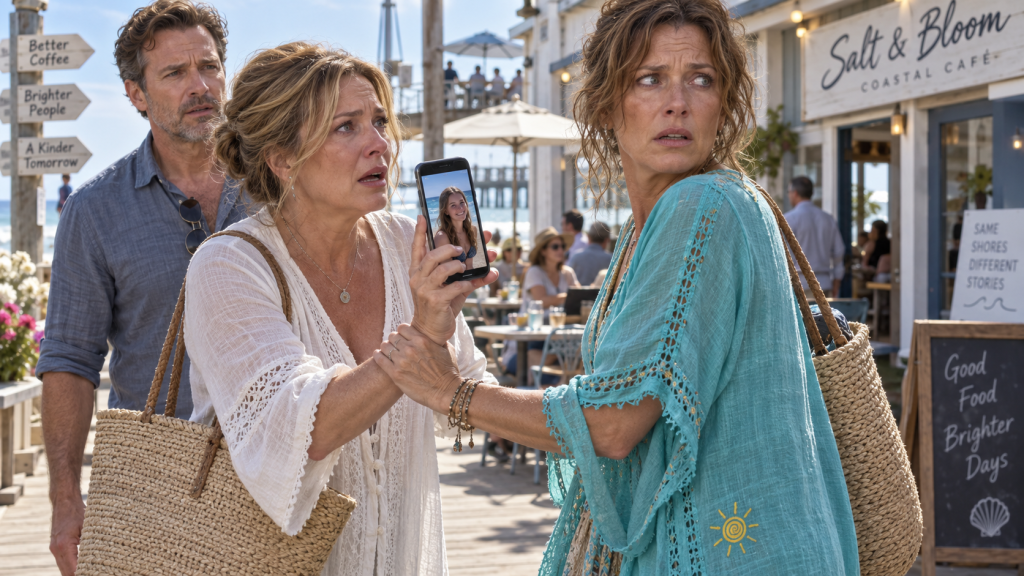
The woman holding the little girl’s hand flinched as though I had thrown something at her.
“Don’t call me that.”
Her voice was quiet.
Not angry.
Afraid.
That frightened me more.
Eight years.
Eight years of imagining every possible version of my daughter’s life.
Alive somewhere.
Dead somewhere.
Trapped.
Free.
Remembering us.
Hating us.
Waiting for us.
I had imagined finding her in airports, grocery stores, parking lots, hotel lobbies.
In none of those fantasies did she look directly at me and ask why someone from her nightmares knew her name.
Michael stood beside me.
His hand hovered near my back but did not touch me.
He knew better than to move suddenly.
The little girl had pressed herself against Nora’s leg.
She had dark curls and enormous brown eyes.
She looked from me to Michael, then up at Nora.
“Mom?”
That word nearly dropped me to my knees.
Mom.
Nora had a child.
My missing sixteen-year-old daughter was standing six hundred miles from the beach where she disappeared, twenty-four years old now, holding the hand of a little girl who had just called her Mom.
Eight entire years existed between us.
A life.
A pregnancy.
A birth.
First words.
Birthdays.
Fevers.
Bedtime stories.
Everything.
I had missed all of it.
“Nora,” Michael said, and his voice broke on the second syllable.
She backed away.
“I said that isn’t my name.”
Marjorie stepped between us slightly.
“Elise.”
Nora looked at her.
“Who are they?”
Marjorie’s face collapsed.
“I think you should listen to them.”
“No.”
Nora pulled the little girl closer.
“You said those people were from years ago.”
“I didn’t know who they were.”
“You said they weren’t real.”
“I said I didn’t know.”
Nora’s eyes snapped toward me.
I took one step backward.
Not forward.
Backward.
“I won’t touch you.”
She stared.
“I promise.”
Her breathing was fast now.
Too fast.
The little girl began to cry.
Nora immediately crouched.
“Maisie.”
So that was her name.
“Baby, look at me.”
The tenderness in Nora’s voice hurt almost as much as the fear.
“You’re okay.”
She kissed Maisie’s forehead.
“Mommy’s okay.”
I covered my mouth.
Nora looked up.
Saw me crying.
Something moved across her face.
Recognition?
No.
Pain.
As though my tears themselves were familiar.
“I know you.”
My heart stopped.
Michael inhaled sharply.
Nora stood slowly.
“No.”
She shook her head.
“I don’t know you.”
“You just said—”
“I’ve seen you.”
Her voice trembled.
“When I sleep.”
I could barely stand.
“What do you see?”
Marjorie whispered:
“Don’t push her.”
She was right.
I stopped.
Nora looked toward the street.
Like she might run.
Then she pulled out her phone.
“I’m calling Miriam.”
Marjorie’s expression changed.
“No.”
Nora stared at her.
“Why?”
“Call the police instead.”
The air seemed to leave Nora’s body.
“What?”
Michael spoke before I could.
“Yes.”
Nora turned toward him.
His eyes were wet.
“Call them.”
He held both hands where she could see them.
“Tell them there are two strangers claiming to be your parents.”
My heart twisted at the word strangers.
“But call.”
Nora stared at him.
Michael continued.
“You don’t have to believe us.”
His voice cracked.
“You don’t have to come near us.”
“Call the police.”
Nora looked at Marjorie.
Then at me.
Then at the photograph still glowing on my phone.
Sixteen-year-old Nora squinting into sunlight.
Turquoise cover-up.
Crooked yellow sun.
For the first time, the fear in her face was joined by something else.
Doubt.
She dialed.
—
The officers arrived eleven minutes later.
I know because I watched every second.
Nora stood near the café wall with Maisie pressed against her.
Michael and I stayed across the terrace.
Marjorie stood between.
Nobody touched anybody.
When the first officer approached, Nora began talking immediately.
“These people say they’re my parents.”
The officer looked at us.
“We are.”
I handed over my identification.
Then the old missing-person case information I still carried in my wallet.
Yes.
After eight years.
I still carried it.
A folded card with Nora’s case number.
The detective’s old contact information.
A photograph.
You do strange things when your child is missing.
You turn hope into paperwork because paperwork can fit inside a purse.
The officer read the card.
Then looked at Nora.
His expression changed.
“Ma’am, what is your full name?”
“Elise Catherine Harlan.”
My stomach clenched.
Not Nora.
Elise.
Harlan.
The officer typed something into his computer.
“What’s your date of birth?”
She told him.
Wrong year.
By eleven months.
Michael looked at me.
I shook my head.
Do not react.
Not yet.
The officer asked for identification.
Nora handed him a driver’s license.
He examined it.
Then called someone.
A second officer spoke with us separately.
I told the story.
The beach.
The cover-up.
The yellow sun.
The photograph.
Eight years.
When I finished, he looked at me for several seconds.
“Mrs. Vale—”
That was my name.
Anna Vale.
My daughter had once been Nora Vale.
“Do you have any unique identifying information about your daughter that would not have been public?”
Dozens.
A crescent-shaped scar behind her left knee from falling off a bicycle at nine.
A tiny birthmark beneath her right shoulder blade shaped vaguely like a comma.
A chipped lower tooth from seventh-grade basketball.
A surgical scar near her appendix from when she was twelve.
I told him.
Across the terrace, another officer quietly asked Nora whether she had those marks.
Her face changed.
I saw it from twenty feet away.
She touched the back of her knee.
Then looked at me.
Not recognition.
Shock.
The officer continued asking questions.
Nora answered.
Then he asked:
“Do you know the name Anna Vale?”
She shook her head.
“Michael Vale?”
Her face tightened.
“No.”
“Have you ever heard the name Nora Vale?”
She looked toward me.
Then whispered:
“In dreams.”
I nearly broke.
—
The police asked us all to come to the station.
Nora refused at first.
“I need to call my mother.”
I heard it.
My mother.
Not me.
Someone else.
“Miriam?”
the officer asked.
Nora nodded.
“What’s her number?”
She hesitated.
Then gave it.
The officer stepped away.
Five minutes later, he returned with another expression entirely.
“Ms. Harlan, Miriam isn’t answering.”
“She might be driving.”
“Do you live with her?”
“No.”
“Where does she live?”
Nora gave an address.
Two streets from the café.
Exactly where Marjorie had said.
The officer wrote it down.
Then:
“Who is Paul Harlan?”
“My father.”
I felt Michael beside me become rigid.
The officer’s eyes flicked toward us.
“Biological father?”
Nora frowned.
“I don’t know why you’re asking that.”
“Do you have a birth certificate?”
“Yes.”
“Where were you born?”
She named a hospital in South Carolina.
My knees weakened.
Nora had been born in Ohio.
I remembered every hour of that day.
Twenty-one hours of labor.
Michael asleep in a chair for exactly seven minutes before I threw a wet washcloth at him.
I remembered the nurse.
The rain.
The vending-machine coffee.
My daughter’s first cry.
There are truths nobody can counterfeit inside a mother’s body.
The officer nodded slowly.
“Would you come with us voluntarily so we can sort this out?”
Nora looked at Maisie.
“I have my daughter.”
“She can come.”
“I don’t want them there.”
She meant us.
It hurt.
Still.
Michael answered first.
“We can go separately.”
I looked at him.
His face was wrecked.
But he was right.
Anything for Nora.
Even distance.
Especially distance.
—
At the station, they placed us in different rooms.
Mine had beige walls.
A table bolted to the floor.
Paper cup of water.
I had spent eight years begging police to find my daughter.
Now she was one hallway away, and I was not allowed to see her.
I understood why.
Understanding did not make breathing easier.
Michael sat beside me.
He stared at the floor.
“She has a daughter.”
I began crying again.
“Yes.”
“We’re grandparents.”
“Yes.”
He covered his face.
“Anna.”
“I know.”
“No.”
His voice cracked.
“You don’t.”
He looked at me.
“I used to imagine walking Nora down the aisle.”
Tears fell.
“I used to think that was the thing I’d missed.”
I reached for his hand.
He squeezed until it hurt.
We sat that way.
Two parents grieving a child who was alive down the hall.
Nobody teaches you how to do that.
—
A detective came in nearly an hour later.
Her name was Detective Sloane.
Mid-forties.
Calm.
She carried a file.
She sat across from us.
“I spoke to the department handling Nora’s original case.”
My heart jumped at the use of her name.
Nora.
Not Elise.
“They’ve confirmed the case remains active.”
Of course.
“We’ve also sent them current photographs.”
I nodded.
“Is she our daughter?”
Michael asked.
The detective paused.
“We need formal confirmation.”
My heart sank.
Then:
“But there are several indicators strongly suggesting she is.”
I closed my eyes.
The scar.
The birthmark.
The cover-up.
The face.
My body already knew.
Sloane continued.
“The identification she provided under the name Elise Catherine Harlan appears problematic.”
“What does that mean?”
“Some information attached to that identity predates the woman we’re speaking with.”
I stared.
“I don’t understand.”
“We’re still working through it.”
She folded her hands.
“Mrs. Vale, did you ever hear the name Elise Harlan before today?”
“No.”
“Paul Harlan?”
“No.”
“Miriam Harlan?”
“No.”
Michael shook his head too.
Sloane nodded.
Then asked:
“Do you remember any reports in the original investigation about a gray minivan?”
My stomach tightened.
“No.”
Michael looked up.
“There were thousands of vehicle tips.”
“Yes.”
Sloane nodded.
“Your original case file includes a witness who recalled a gray van leaving a beach-access road approximately forty minutes after Nora was last seen.”
I stopped breathing.
“Why didn’t they—”
“The plate was incomplete.”
She spoke gently.
“It was one of many unconfirmed leads.”
Michael gripped my hand harder.
Sloane continued.
“A vehicle matching that description was registered at the time to Paul Harlan.”
Silence.
The room disappeared.
Twenty-four-year-old Nora.
Sixteen-year-old Nora.
Gray van.
Beach.
Elise.
All of it moved closer together.
Michael whispered:
“Where are they?”
“Miriam and Paul?”
“Yes.”
“We’re trying to locate them.”
“Are they gone?”
“We don’t know.”
Then she asked something strange.
“Did Nora ever resemble anyone else in the missing-person coverage?”
I frowned.
“What?”
“Another missing child?”
“No.”
“A deceased teenager?”
I stared.
“No.”
Why?
Sloane looked down at the file.
“Paul and Miriam Harlan had a daughter.”
My stomach dropped.
“Had?”
“She died three years before Nora disappeared.”
Michael went pale.
“What was her name?”
I already knew.
Still.
Sloane said it.
“Elise.”
—
I do not remember the next few minutes clearly.
Michael stood.
Sat again.
I asked Sloane to repeat herself.
She did.
Elise Catherine Harlan.
Born eleven months before Nora.
Died at fifteen after complications from a congenital heart condition.
Nora disappeared three years later.
The license in Nora’s wallet carried the dead girl’s identity.
My daughter had not simply been given another name.
She had been placed inside a dead child’s life.
I felt sick.
“Did they take her because she looked like her?”
Sloane held up one hand.
“We don’t know motive yet.”
“Do you have a photograph?”
She hesitated.
Then opened the folder.
A school photograph.
Elise Harlan at fourteen.
Dark blond hair.
Long face.
Green-gray eyes.
Not Nora’s twin.
But enough.
Enough that from a distance, with hair changed, you could imagine a grieving parent making something monstrous out of resemblance.
Michael looked away.
I could not.
“She doesn’t look that much like Nora.”
“No.”
Sloane closed the file.
“Grief does not always operate rationally.”
Neither does obsession.
Neither does crime.
I understood that later.
At the time, I understood only this:
A woman had lost her daughter.
Then I lost mine.
And somehow those facts were connected.
—
DNA confirmed it two days later.
Forty-eight hours.
Longest two days of my life.
Nora stayed in temporary accommodation arranged through victim services because she refused to return to Miriam and Paul’s house.
That mattered.
She still did not trust us.
But she no longer fully trusted them either.
Police located the Harlans the first evening at a motel seventy miles inland.
They were detained for questioning.
Then the case widened.
Federal investigators became involved because state lines had been crossed and identity documents appeared to have been falsified.
I learned more legal terms in one week than I wanted to know in a lifetime.
But none mattered as much as the phone call from Detective Sloane.
“Mrs. Vale?”
“Yes.”
“The DNA is a parent-child match.”
I sat down on the kitchen floor of our rental.
Michael saw my face.
Dropped the cup he was holding.
It shattered.
Neither of us cared.
Sloane continued.
“The probability confirms that the woman you met is your biological daughter.”
I made a sound that still embarrasses me when I remember it.
Not a scream.
Not exactly.
Something ancient.
Michael collapsed beside me.
We held each other.
Eight years.
Eight years of missing posters.
Eight birthdays.
Eight Christmas mornings.
Eight times I woke on the anniversary and wondered whether my daughter was cold, hungry, frightened, alive.
Alive.
She had been alive.
Not safe.
Not free in the way I wanted.
But alive.
I pressed my forehead to the floor.
“Thank you.”
I do not know who I was speaking to.
Sloane.
God.
Nora.
The universe.
Everybody.
Nobody.
Thank you.
—
Then came the part nobody imagines when they think about finding a missing child.
You do not get them back all at once.
There is no running across a room.
No immediate embrace.
No music.
No promise that love recognizes itself faster than trauma.
Nora agreed to meet us three days after the DNA results.
With a therapist present.
Maisie stayed with Marjorie.
That told me something.
Nora trusted Marjorie.
I was grateful.
The meeting happened in a private room at a counseling center.
Two sofas.
A box of tissues placed so deliberately in the middle that I almost hated it.
Michael and I arrived first.
When the door opened, Nora stood there.
Jeans.
Gray sweater.
Hair clipped back.
No turquoise.
She looked older than sixteen.
Of course.
Yet when she hesitated in the doorway, I saw my child.
The way her left foot turned slightly inward when she was nervous.
She had done that during piano recitals.
Parent-teacher conferences.
Her first school dance.
I bit the inside of my cheek so hard I tasted blood.
Do not overwhelm her.
Do not run.
Do not touch.
Nora sat across from us.
The therapist introduced herself.
Dr. Mercer.
Then:
“Nora has asked that we use the name Elise today.”
My heart clenched.
I nodded.
“Of course.”
Nora looked surprised.
Maybe she expected me to fight even that.
Not today.
Identity can be a bridge.
I would not burn it just because it led somewhere painful.
She stared at me.
“You’re really my mother.”
“Yes.”
“And he’s my father.”
Michael nodded.
“Yes.”
She looked at him.
“You were in the nightmares too.”
His face broke.
“I’m sorry.”
Dr. Mercer gently said:
“You don’t need to apologize for appearing in dreams, Michael.”
He laughed once through tears.
“I know.”
Then looked at Nora.
“I’m sorry you were afraid of us.”
Nora stared down.
“I don’t know why.”
Silence.
Then:
“I remember your face.”
She looked at me.
“But when I try to remember before Miriam, things turn into pieces.”
My hands shook.
“What pieces?”
Dr. Mercer looked at Nora.
Nora nodded.
Permission.
I listened.
“A yellow kitchen.”
Ours.
It had been yellow.
“A dog.”
My heart cracked.
“Buddy.”
Nora’s eyes lifted.
“What?”
“Our dog.”
I swallowed.
“Buddy.”
“He died when you were thirteen.”
Nora closed her eyes.
Tears appeared.
“I remember fur.”
Michael covered his mouth.
“What else?”
I asked softly.
“Someone singing badly.”
Michael began crying.
“That was me.”
Nora almost smiled.
A tiny movement.
“You do look like someone who sings badly.”
I laughed.
So did Michael.
The first laugh between us.
Small.
Fragile.
Perfect.
Then Nora’s smile disappeared.
“I remember the beach.”
My entire body went rigid.
Dr. Mercer leaned forward.
“What part?”
Nora looked at the floor.
“Sun.”
“People.”
“My feet were burning.”
“Yes.”
I whispered.
The sand had been scorching.
“She was mad I didn’t wear sandals,” Nora said.
She looked at me.
“Were you?”
Tears poured down my face.
“Yes.”
I laughed.
“You kept taking them off.”
Nora cried too.
Then:
“I remember a woman.”
The room changed.
Michael stopped breathing.
“What woman?”
Dr. Mercer asked.
“Red hat.”
Nora touched her temple.
“She said something about a boy.”
I waited.
“I don’t know.”
She squeezed her eyes shut.
“Someone needed help.”
Then she started shaking.
Dr. Mercer intervened immediately.
“That’s enough.”
Nora nodded quickly.
I wanted more.
God, I wanted more.
But finding my daughter did not give me ownership of her memories.
I sat back.
“Okay.”
She looked at me.
Again, surprised.
“Okay?”
“Yes.”
“You don’t have to remember anything for me.”
Her mouth trembled.
“But you need to know.”
“No.”
I shook my head.
“I needed to know you were alive.”
My voice broke.
“Everything after that belongs at your pace.”
Nora covered her face.
And cried.
That was the first time I thought maybe, someday, she might believe I was safe.
—
The truth came in pieces over the next year.
Not one confession.
Not one recovered-memory miracle.
Pieces.
Some from Nora.
Some from police.
Some from documents found in the Harlans’ home.
Some from Miriam herself after charges were filed.
The woman in the red hat had been Miriam.
She approached Nora near the far end of the beach.
According to Nora’s fragmented memory and later evidence, Miriam told her a child had been hurt near the access road and asked for help.
Nora followed.
Not because she was foolish.
Because she was sixteen.
Because an older woman appeared frightened.
Because kindness is exploitable when someone is willing to exploit it.
Paul was waiting near the vehicle.
What happened after remained incomplete.
Nora remembered struggling.
A door.
A sharp blow near the back of her head.
Then nausea.
Darkness.
A motel ceiling.
The investigation later found medical records under a false name showing that Miriam had taken a teenage girl to a small urgent-care clinic two days after Nora disappeared for vomiting and dizziness.
She claimed the girl was her niece who had fallen.
The clinic had not connected her to a national missing-person case.
Why would they?
Different name.
Different state.
Hair cut shorter.
People imagine missing children glow somehow.
They do not.
They look like children standing beside adults who speak confidently.
That fact haunted me.
—
Nora had suffered a concussion.
Not enough to erase sixteen years of life like a blackboard.
Real memory does not work so neatly.
The specialists explained that trauma, fear, head injury, isolation, suggestion, and years of repeated false narratives can distort access to autobiographical memory.
She had retained fragments.
Feelings.
Images.
Dreams.
But Miriam and Paul gave those fragments explanations before Nora could build her own.
They told her she had run away.
That her parents were dangerous.
That there had been a fight.
That she had begged not to go home.
When Nora asked why she could not remember, Miriam said she had suffered a breakdown.
When Nora cried for me, Miriam told her I had rejected her.
When she asked why nobody came, Paul said:
“They stopped looking.”
That lie almost killed me when I heard it.
Stopped looking.
For eight years, Michael and I had done nothing but look.
We refinanced the house to pay private investigators.
I left my job for seven months.
Michael drove to three states following tips that went nowhere.
My mother died four years after Nora vanished with a copy of Nora’s missing poster folded in her Bible.
Stopped looking.
No.
We had nearly stopped living.
Never looking.
—
Police found evidence that Miriam had kept newspaper coverage from Nora.
Boxes.
Clippings.
Missing-person flyers.
Printed news articles.
Our faces.
Nora’s face.
All hidden inside a locked trunk in the Harlans’ attic.
The turquoise cover-up should have been there too.
It wasn’t.
That turned out to be because Nora herself had taken it.
About a year after the disappearance, Miriam gave Nora a box containing what she claimed were belongings from “before the breakdown.”
The cover-up was inside.
Nora said touching it gave her panic attacks.
Not memories exactly.
Sensations.
Heat.
Sand.
Someone screaming.
A woman’s face.
Mine.
Miriam told her the garment came from “the bad time.”
Nora believed her.
At a neighborhood yard sale, seventeen-year-old Nora sold it to Marjorie for three dollars.
Three dollars.
For seven years, one of the most important pieces of my daughter’s old life hung in another woman’s closet.
Marjorie wore it as a beach cover-up.
Washed it.
Folded it.
Never knew that crooked yellow sun had been stitched by a grandmother who died believing she would never see her granddaughter again.
That is how chance works.
Cruel.
Ridiculous.
Sacred.
All at once.
—
I asked Marjorie once why she had said:
“She can’t know you’re here.”
We were sitting at the same café months later.
I finally had the courage to return.
She stirred tea.
“Because Elise—Nora—used to have episodes.”
“What kind?”
“She’d see someone in town who looked like you.”
My throat tightened.
“And?”
“She would panic.”
“Why?”
“Because Miriam told her you were dangerous.”
I looked away.
Marjorie continued.
“She said her birth family had hurt her.”
I closed my eyes.
“Did you believe it?”
“At first.”
“Then?”
“She never had details.”
Marjorie sighed.
“She had feelings.”
“Nightmares.”
“But no story that stayed the same.”
“And Miriam answered for her constantly.”
I stared.
“You suspected something?”
“Not kidnapping.”
“No.”
She shook her head.
“I thought maybe abuse.”
“Cult.”
“Family estrangement.”
“Something.”
Then she looked at me.
“The day I saw your photograph, I knew the story I’d been told wasn’t the whole story.”
“Why?”
“The way you looked at her.”
Tears came.
“What way?”
“Like you had been dying for eight years.”
I cried.
Marjorie reached across the table.
I let her hold my hand.
—
Maisie was Nora’s daughter.
Biologically.
Her father was a young man named Ethan Cole.
Not part of the kidnapping.
That mattered.
Nora met him when she was eighteen and working part-time at a bakery.
The Harlans had gradually allowed her more independence by then because they believed the false identity was established and her original memories had become unreliable.
Ethan was nineteen.
They dated.
Nora became pregnant.
He stayed through Maisie’s first year.
Then they separated.
Not dramatically.
Young.
Overwhelmed.
He moved to another state for work and remained inconsistently involved.
The Harlans helped Nora raise Maisie.
That complicated everything.
Because monsters rarely spend eight years behaving monstrously every minute.
Miriam rocked Maisie to sleep.
Paul built her a wooden toy chest.
They paid for diapers.
Took Nora to prenatal appointments.
Celebrated birthdays.
Nora loved them.
That was the cruelty no headline could explain.
The people who stole her adolescence had also become the people she depended on to survive adulthood.
When they were arrested, Nora grieved them.
She hated herself for grieving.
Dr. Mercer told her:
“Attachment is not evidence that what happened was acceptable.”
That sentence helped all of us.
Nora had been manipulated.
Also loved in certain ways.
Exploited.
Also cared for at times.
Deceived profoundly.
Also dependent.
Human bonds do not sort themselves according to criminal charges.
That made healing slow.
And real.
—
Miriam eventually pleaded guilty.
Paul too.
There were kidnapping charges.
Identity-related offenses.
Document fraud.
Other charges tied to keeping Nora hidden across state lines.
I attended sentencing.
Nora did not.
She could not.
I almost didn’t either.
Then decided I needed to see Miriam once.
Not from a beach crowd.
Not from a photograph.
The woman who had lived inside the worst day of my life.
Miriam looked smaller than I expected.
Gray hair.
Thin shoulders.
Ordinary.
That offended me.
I wanted evil to have a visible face.
It rarely does.
She looked toward me before the hearing began.
I held her gaze.
She cried.
I did not.
During her statement, she spoke about Elise.
Her real daughter.
The one she lost.
She said grief “broke something.”
She said when she saw Nora at the beach, she thought for one irrational moment that God had “given her another chance.”
My hands became fists.
Another chance.
At my daughter.
She admitted that once they drove away, there was a point when they could have stopped.
Could have brought Nora back.
Could have called police.
Could have done one decent thing.
They didn’t.
Because returning her meant losing her.
That sentence exposed everything.
Not love.
Possession.
Miriam said:
“I told myself she needed us.”
I whispered:
“No.”
Patrice—no, wrong story. Here no Patrice. Need maintain. Let’s correct internally. There was no attorney named here yet. Continue.
The prosecutor paused.
Miriam looked directly at me.
“I know now that I needed her.”
My throat burned.
Then she said:
“I am sorry.”
I believed she was sorry.
It changed nothing.
That was one of the hardest lessons I learned.
Remorse can be real and still arrive too late to reduce what happened.
I did not forgive her that day.
I do not know whether I ever fully did.
I stopped wanting revenge.
That is not identical.
—
Paul never apologized to me.
He apologized to Nora.
Once.
In a letter.
She showed me years later.
He wrote:
We told ourselves we were saving you from pain when what we were really saving was our own fantasy.
Then:
I knew your mother was looking. I saw her on television. I turned it off before you came into the room.
When Nora read that line the first time, she threw up.
I understood.
I had appeared on television dozens of times.
Holding Nora’s photograph.
Begging.
If you have her, please let her come home.
He saw me.
He knew.
And turned off the television.
Some betrayals have no metaphor large enough.
—
Our first year with Nora back was not a reunion.
It was a negotiation.
That word sounds cold.
It wasn’t.
It was necessary.
How often could I call?
At first, once every three days.
Not every day.
Could I text?
Yes.
But no multiple follow-ups if she did not answer.
Could I send childhood photographs?
Only when she asked.
Could I call her Nora?
Sometimes.
At first she preferred Elise.
Then Nora-Elise.
Then one day, seven months after we found her, she texted:
Can you call me Nora today?
I stared at my phone for ten minutes.
Then replied:
Yes.
Nothing else.
No hearts.
No paragraph.
No:
I’ve waited eight years.
Just yes.
Because my joy was not her responsibility to manage.
That night, Michael and I went into the kitchen and cried over the sink where she could not see.
—
Michael had a harder time showing restraint.
Not because he loved her more.
Because he carried guilt differently.
He had been the one who said:
“Let her go get ice cream. She’s sixteen.”
I had almost told Nora to take her phone.
Michael said:
“She’s twenty yards away.”
For eight years, he blamed himself.
When Nora returned, his instinct was to make up every lost year immediately.
He bought Maisie too many toys.
Asked Nora to dinner constantly.
Sent childhood videos.
Nora withdrew.
I finally told him:
“You are trying to love her at a speed she cannot survive.”
He broke down.
“I missed eight years.”
“I know.”
“What am I supposed to do with that?”
“Carry it.”
He stared.
“That’s it?”
“Yes.”
My voice softened.
“She cannot carry it for you.”
That hurt him.
It also changed him.
Michael began therapy separately.
Eventually, his relationship with Nora became quieter.
Better.
He fixed her broken cabinet door without turning it into a father-daughter milestone.
He babysat Maisie when asked.
Not volunteered every day.
He stopped trying to force memories.
One afternoon, Nora called him because her car would not start.
He drove forty minutes.
Jumped the battery.
Left.
No emotional speech.
She called me afterward.
“Dad came.”
My heart stopped at the word.
Dad.
She continued.
“He didn’t make it weird.”
I laughed.
“Progress.”
She did too.
That was the first time she called him Dad without correcting herself.
He cried for an hour when I told him.
Then made me promise not to tell Nora.
I didn’t.
Some joy needs privacy too.
—
My mother was gone.
That became one of the hardest truths to tell Nora.
She remembered Grandma in fragments.
Hands.
Thread.
The smell of face powder.
Not the death.
Not the funeral.
Nothing.
When Nora asked who had sewn the turquoise cover-up, I could not answer at first.
Then:
“Your grandmother.”
She stared.
“Is she alive?”
I looked down.
“No.”
Nora went very still.
“When?”
“Four years ago.”
Her face changed.
“I missed it.”
I cried.
“Yes.”
“She thought I was dead?”
“No.”
That answer came fast.
“She never believed that.”
I told Nora about the Bible.
The folded missing poster.
How Grandma renewed the search fund every birthday.
How she stitched yellow suns onto three blankets during Nora’s first year missing because she said she needed to keep her hands busy.
Nora cried so hard that afternoon we stopped talking.
A month later, she asked for one of the blankets.
I brought it.
Not all three.
One.
She unfolded it carefully.
A crooked yellow sun in the corner.
Not the same as the cover-up.
Similar.
Nora touched the stitching.
Then whispered:
“I know this.”
My breath stopped.
“What?”
“The shape.”
She closed her eyes.
“Her fingers.”
I said nothing.
She pressed the blanket to her face.
And cried.
Memory did not return like a movie.
It returned like weather.
Smell.
Texture.
A phrase.
A song.
A yellow sun.
Enough.
—
Maisie called me Anna for the first six months.
Not Grandma.
That was fine.
She had a grandmother already in Miriam.
Complicated.
Painful.
Still.
One afternoon, Maisie was coloring at our table.
She looked up.
“Are you Mommy’s old mom?”
I nearly choked.
Michael left the room because he was about to cry.
Coward.
I stayed.
“What do you mean?”
“Miriam was her mom.”
I chose every word.
“Miriam took care of your mommy for a long time.”
“Are you her real mom?”
Children have no respect for nuance.
“I’m the mother who gave birth to her.”
Maisie frowned.
“Did you lose her?”
My eyes filled.
“Yes.”
“How?”
“A bad person took her away.”
Nora had approved that language for Maisie’s age.
Maisie thought.
“Was Miriam bad?”
There it was.
I looked toward Nora, who stood in the doorway.
She nodded.
Answer.
“Miriam did something very bad.”
I said.
“Can a person do bad and good?”
Maisie asked.
My throat tightened.
“Yes.”
I looked at Nora.
“Yes, they can.”
Maisie accepted this faster than adults did.
Then went back to drawing.
Five minutes later:
“Can I call you Grandma Anna?”
I broke.
Completely.
I turned my face away.
Nora started laughing through tears.
Maisie looked offended.
“What?”
“Nothing.”
I knelt beside her.
“Yes.”
My voice shook.
“You can call me Grandma Anna.”
She did.
Not every time at first.
Enough.
—
Nora eventually changed her legal name.
Not back exactly.
That surprised us.
She became Nora Elise Vale.
She kept Elise.
When she told me, I had to work not to react badly.
She saw it anyway.
“You hate it.”
“No.”
“You do.”
“I hate what they did with it.”
“That isn’t the same as the name.”
I became quiet.
She continued.
“Elise was me too.”
My eyes filled.
“The woman who raised Maisie.”
“The woman who survived them.”
“The woman who worked at the bakery.”
“I don’t want to erase her because she was built from a lie.”
That was wise.
Painfully wise.
I nodded.
“Nora Elise.”
She smiled.
“Too much?”
“No.”
“It’s beautiful.”
And it was.
Names can be stolen.
They can also be reclaimed, rearranged, chosen.
That mattered.
—
Two years after we found her, Nora asked to visit the beach.
The beach.
I nearly said no.
My body did.
My mouth almost followed.
Then I remembered.
Her life.
Her pace.
Her choice.
“When?”
“October.”
Fewer people.
Cooler.
Michael came.
Maisie too.
We stayed in a hotel near the same stretch of coast.
The morning we walked onto the sand, Nora stopped.
Could not move.
I stood beside her.
Not touching.
Waves.
Wind.
Gulls.
The same sounds that had haunted me for eight years.
Nora’s breathing changed.
“Do you remember?”
Michael asked.
I shot him a look.
He immediately said:
“Sorry.”
Good.
Nora smiled faintly.
“Some.”
We walked.
Slowly.
Past where our towels had been.
Past the old lifeguard tower.
The ice cream stand had been replaced with a smoothie kiosk.
Of course.
Time is rude.
We reached the far end.
Nora stopped near the access path.
Her face went white.
I moved closer.
“Want to go back?”
“No.”
She stared.
Then:
“Red hat.”
I held my breath.
“She was here.”
“Yes.”
Nora started crying.
“I followed her.”
“Yes.”
“I left you.”
“No.”
She turned sharply.
“I did.”
“You walked twenty yards.”
My voice shook.
“You did not leave me.”
“You were taken.”
She covered her face.
“I should have—”
“No.”
I said it harder.
“You were sixteen.”
Tears poured down my face.
“You helped someone who asked for help.”
She cried.
“You did not create what happened next.”
For eight years, I had blamed myself.
Then Michael.
The police.
The crowd.
The ice cream stand.
Now I watched Nora try to pick up the same blame.
I refused.
Not hers.
Never hers.
Maisie ran up carrying a shell.
“Mom!”
Nora wiped her face.
Maisie held it out.
“Look.”
A tiny white shell with a yellowish streak.
Nora laughed.
Then hugged her daughter.
Standing on the beach where she had vanished.
Not sixteen anymore.
Not alone.
For the first time in ten years, I heard the ocean without hating it.
Not loving.
Not yet.
But not hating.
That was enough.
—
The original missing-person poster was officially removed from the national database after Nora’s identification was confirmed.
I had expected that to feel triumphant.
Instead, I cried.
For eight years, her face had existed in a category:
MISSING.
Then one day it didn’t.
The poster stayed on my phone for months.
I could not delete it.
Eventually, Nora found it while looking through pictures.
“Mom.”
She had been calling me Mom consistently by then.
Mostly.
I looked up.
“Why is this still here?”
I stared.
“I don’t know.”
She touched the screen.
Sixteen-year-old Nora.
Then looked at me.
“Delete it.”
My chest tightened.
“What if—”
I stopped.
What if what?
She was here.
Nora understood.
“I’m not missing anymore.”
I cried.
Then deleted it.
Not the photograph.
Never.
The poster.
The word.
MISSING.
Gone.
—
There was no clean moment when she “remembered everything.”
She never did.
Some memories returned.
Some remained lost.
A neurologist once told us:
“Recovery is not always restoration.”
I hated that sentence.
Later, I understood.
Nora did not need to become exactly the girl she had been at sixteen.
That girl was gone in the ordinary way every sixteen-year-old eventually disappears.
Even without kidnapping.
People grow.
Change.
Forget.
Become.
My job was not to excavate an old daughter from beneath the new one.
My job was to know the woman standing in front of me.
Nora Elise.
Mother.
Baker.
Later, owner of a small café.
Terrible parallel parker.
Still hated raisins.
That survived.
Thank God.
Loved mystery novels.
Could not stand carnations.
Used too much vanilla in pancakes.
Laughed exactly like my mother.
Some things returned without anyone asking.
—
Michael and I nearly broke apart after Nora came home.
Nobody tells you finding a missing child can expose every crack grief forced a marriage to plaster over.
For eight years, we survived by moving in the same direction.
Search.
Call.
Print.
Drive.
Hope.
Collapse.
Repeat.
When Nora returned, the mission ended.
And underneath it sat two exhausted people who had forgotten how to talk about anything else.
Michael wanted closeness.
I wanted silence.
He wanted to celebrate.
I felt guilty celebrating when Nora was traumatized.
I wanted to analyze every new detail.
He wanted the past to stop.
We fought.
At one point he said:
“She’s home. Why are you still acting like she’s gone?”
I slapped the countertop so hard a glass fell.
“Because eight years are still gone.”
Silence.
Then both of us cried.
Therapy again.
Apparently my life became one long advertisement for therapy.
Worth it.
We learned that reunion creates a new kind of grief.
You get the person.
You do not get the lost time.
No one can refund birthdays.
You cannot hug backward.
Once we understood that, we stopped asking the other to be grateful in the same way.
We became better.
Different.
—
Miriam wrote Nora letters from prison.
At first Nora refused them.
Then kept them unopened.
Then one day, three years later, read one.
I was there.
Not by plan.
She called.
“Can you come over?”
I did.
The letter was six pages.
Miriam apologized.
Explained.
Remembered.
Too much.
Nora read silently.
Then tore the letter in half.
Then stopped.
Smoothed it.
Cried.
“I hate her.”
I sat beside her.
“I know.”
“I miss her.”
“I know.”
“That’s sick.”
“No.”
She looked at me.
“She stole me from you.”
“Yes.”
“And I still miss her soup.”
I laughed through tears.
“That is very specific.”
Nora laughed too.
Then sobbed.
I held her.
For the first time in our reunion, she let me hold her while she grieved Miriam.
That was one of the strangest gifts she ever gave me.
Trusting me enough to love someone who hurt us both.
I did not demand loyalty.
Pain is not healed by creating new loyalty tests.
—
Paul died in prison five years after sentencing.
Heart attack.
Nora did not attend anything.
There was no funeral she was invited to.
Miriam lived longer.
Nora eventually sent one letter.
Not forgiveness.
Truth.
She wrote:
I remember my mother now.
Then:
You told me she stopped looking. She didn’t.
And:
I will never understand why your grief was allowed to become my mother’s grief.
Nora did not show me the rest.
She didn’t need to.
Miriam replied.
Nora never opened it.
Her choice.
—
Marjorie became family.
Unexpectedly.
Not because she found Nora.
Chance did.
But because once the truth exploded, Marjorie did not disappear.
She helped with Maisie.
Drove Nora to appointments when seeing us felt too hard.
Sat with her through police interviews.
She became the bridge before we were safe enough to cross directly.
On the anniversary of the day we saw the cover-up, I sent her flowers.
The card said:
Thank you for wearing turquoise.
She called me laughing.
“Ugliest thing I owned.”
I gasped.
“My mother made that.”
“I’m sure she was lovely.”
“Take it back.”
“No.”
We laughed.
The cover-up itself went into evidence for a while.
Eventually, it was returned.
The crooked yellow sun still visible.
Faded.
Stretched.
I asked Nora what she wanted to do with it.
“Not keep it.”
“Okay.”
“Not throw it out either.”
So we donated it to the missing-children advocacy center that had supported us.
They placed it in a small private training display about identifying unique personal items.
Not public spectacle.
Purpose.
My mother’s crooked yellow sun kept helping.
She would have liked that.
Probably complained that the stitching was uneven.
—
Nora became an advocate eventually.
Not immediately.
For years, she wanted nothing to do with cameras.
Understandable.
Her face had been public property at sixteen.
Then, at twenty-nine, she agreed to speak at a closed conference for law enforcement and victim-support professionals.
I did not attend.
She asked me not to.
Later, she told me what she said.
“People think kidnapped children spend every day screaming ‘I’m kidnapped.’”
She looked at me.
“I told them sometimes you stop knowing which story is yours.”
My heart hurt.
“And I told them adults who speak confidently are dangerous when children are disoriented.”
“Yes.”
“And that recovered victims should not be expected to perform gratitude.”
That one was for us too.
I nodded.
“I’m glad.”
She smiled.
“I also told them to look at hems.”
I laughed.
“The sun?”
“The sun.”
—
Maisie grew up knowing two versions of family.
The people who raised her mother during captivity.
And us.
We never made her choose language before she was ready.
Miriam was “Miriam.”
I was Grandma Anna.
Michael was Grandpa Mike.
Simple.
At ten, Maisie asked:
“Did Miriam love Mom?”
We were baking cookies.
I froze.
Then:
“I think Miriam felt love.”
Maisie frowned.
“That sounds weird.”
“It is.”
“Can you love someone and steal them?”
I put down the spoon.
“You can feel attachment and still do something terribly wrong.”
“So love doesn’t make it okay.”
“No.”
“Then what does?”
“Nothing makes stealing a child okay.”
She nodded.
Then:
“Mom says Miriam loved selfishly.”
I looked toward Nora.
She stood in the doorway.
“That’s a good way to say it.”
Nora shrugged.
“Therapy.”
Again.
Worth every dollar.
—
At thirty, Nora married.
Ethan was not the groom.
They remained civil co-parents.
The man Nora married was named Julian.
He taught middle school science.
Quiet.
Kind.
The first time he met us, he did not ask Nora anything about the disappearance.
I noticed.
Later, I asked why.
He said:
“She’ll tell me what belongs to me when it belongs to me.”
I loved him immediately.
Michael cried through the entire wedding.
Nora did not let him walk her down the aisle alone.
She chose me too.
One on each side.
When she told us, I said:
“You don’t have to make up for anything.”
She smiled.
“I know.”
“I want both.”
So we walked.
Halfway down, Nora squeezed my hand.
I looked at her.
Sixteen.
Twenty-four.
Thirty.
All of them.
None of them.
My daughter.
At the front, before we let go, she whispered:
“You found me.”
I almost fell apart.
I whispered back:
“You were never ours to lose.”
She looked confused.
Then smiled.
I meant it.
Children belong to themselves first.
That was another lesson kidnapping taught me brutally.
Love does not mean ownership.
Not Miriam’s.
Not mine.
—
Years later, Nora finally remembered the exact last words she said to me before walking toward the ice cream stand.
We had always thought it was:
“I’ll be right back.”
That was what I told police.
What Michael remembered.
Then one summer afternoon, Nora called.
Her voice sounded strange.
“Mom?”
“Yes?”
“I remembered something.”
My body still reacted.
Even after all those years.
“What?”
“At the beach.”
I sat down.
“What?”
“You were putting sunscreen on your shoulders.”
I closed my eyes.
Yes.
“I told you I was getting ice cream.”
“Yes.”
“You said to take my sandals.”
I started crying already.
“I remember.”
“I said…”
She laughed through tears.
“I said, ‘Stop mothering me. I’m practically an adult.’”
A sob escaped me.
That sounded exactly like Nora.
Completely.
Painfully.
Then she said:
“You laughed.”
“Yes.”
“And you said, ‘You’ll always be my baby.’”
My hand covered my mouth.
I had forgotten.
She had remembered.
For eight years, I thought my final words to her were something boring.
Now I had them.
Not because I needed a perfect goodbye.
Because memory had decided to give one small thing back.
Nora cried.
“I used to think the woman in my dreams saying ‘my baby’ was Miriam.”
I closed my eyes.
“No.”
“It was you.”
“Yes.”
We cried together over the phone.
Then Nora said:
“I hate that phrase.”
I laughed.
“Too bad.”
“Mom.”
“You’re still my baby.”
“I’m thirty-two.”
“Tragic.”
She laughed.
Memory became joy for once.
—
Michael died when Nora was thirty-six.
Cancer.
Quick.
Unfair.
He had twelve years with her after she came back.
Not enough.
Everything feels not enough after losing eight.
But twelve years.
He saw her marry.
Saw Maisie graduate high school.
Held Nora’s second child.
Fixed too many appliances.
Sang badly at Christmas.
Near the end, Nora sat beside him.
I left them alone.
Later, she told me what he said.
“I’m sorry I told your mother to let you walk to the ice cream stand.”
Nora had laughed.
“Dad.”
“I mean it.”
“You didn’t make someone kidnap me.”
“I know.”
“Then stop carrying that.”
Apparently Michael cried.
Then Nora said:
“I don’t remember you letting me go.”
“I remember you finding me.”
When she told me, I had to sit down.
Michael died three days later.
Peacefully.
His hand in mine.
Nora on the other side.
We had lost her once.
He did not lose her at the end.
That mattered.
—
I am seventy-one now.
Nora is forty.
Maisie is twenty-two.
There are grandchildren.
Imagine.
More generations than I once believed I would see.
My phone no longer holds the missing-person poster.
It holds a group chat that never stops.
Nora complains about work.
Maisie sends pictures of food.
Julian sends terrible science jokes.
Life.
Boring.
Glorious.
Life.
—
Sometimes strangers still recognize Nora from old news coverage.
Rarely now.
A woman once stopped her in a grocery store.
“Oh my God, you’re that missing girl.”
Nora came home furious.
“I’m not missing.”
I understood.
The missing girl existed publicly for eight years.
The found woman had to fight to become more interesting than her own disappearance.
That took time.
Now, if people ask, Nora sometimes says:
“That happened to me. It is not my job title.”
I love that.
—
I kept the photograph from the beach.
Of course.
Nora at sixteen.
Turquoise cover-up.
Hand raised.
Stop taking pictures.
For years, it was evidence.
Then grief.
Then proof.
Now it is simply a photograph of my daughter being annoyed at her mother.
I like it best that way.
One day, Maisie looked at it.
“Mom had attitude.”
“Oh, enormous.”
Nora shouted from the kitchen:
“I can hear you.”
“Good.”
Maisie pointed to the yellow sun.
“That’s the famous stitch?”
“Yes.”
“Great-Grandma did that?”
“Yes.”
“It’s crooked.”
I laughed.
“So was she sometimes.”
Nora walked in.
“Grandma said it made it unique.”
My throat tightened.
She remembered.
Not because I told her recently.
She remembered.
I looked at her.
Nora noticed.
“What?”
“Nothing.”
She knew.
Tears filled her eyes.
Then she rolled them.
“Don’t.”
“Fine.”
We both cried anyway.
—
People ask whether finding the cover-up was fate.
I do not know.
Maybe Marjorie simply kept an old garment for seven years.
Maybe Michael happened to convince me to travel.
Maybe we chose the right street at the right hour.
Maybe wind lifted the hem.
Maybe a yellow thread refused to disappear.
You can call that fate.
Chance.
God.
Probability.
Grief desperate for meaning.
I no longer care what word people choose.
I saw the sun.
That is enough.
—
If I could return to that café terrace, I would tell myself something before turning around.
Not:
She’s alive.
I already knew that somehow.
I would say:
Finding is only the beginning.
Do not grab her.
Do not demand recognition.
Do not make her prove she remembers you.
Do not ask a traumatized woman to heal your eight years in one afternoon.
Let her be afraid.
Let her be angry.
Let her keep the name Elise until she decides what it means.
Let her grieve people you hate.
Let her love her daughter first.
Let her decide how often to call.
How much to know.
How much to remember.
You searched for a child.
You are going to meet a woman.
Love the woman.
Not only the child you lost.
That will be harder.
And better.
—
I used to believe motherhood meant knowing your child better than anyone.
Then I lost mine for eight years.
When she returned, other people knew what coffee she drank.
What music she liked.
How she took her eggs.
Which side of the bed she slept on.
I did not.
At first, that felt like theft too.
Then I learned.
Motherhood is not ownership of information.
It is willingness to keep knowing someone as they change.
I learned Nora again.
She learned me too.
Because eight years changed me.
I was not the mother she lost either.
We met somewhere in the middle.
That is where we built the family we have now.
Not restored.
Built.
Important difference.
—
Miriam once told Nora:
“They stopped looking.”
That was the lie everything rested on.
Maybe that is why the sight of the cover-up mattered so much.
Because the truth had been looking too.
In police files.
In old photographs.
In my wallet.
In my mother’s Bible.
In Michael’s late-night drives following impossible tips.
In a crooked yellow sun surviving wash after wash.
Truth does not always arrive quickly.
Sometimes it takes eight years and six hundred miles.
But when it finally lifts in the wind, you have to be willing to see it.
I did.
Marjorie did.
Nora eventually did too.
—
Last summer, our whole family went to the beach.
Not the same one.
Nora chose another.
Wide sand.
Quiet dunes.
Maisie came.
Julian.
Their children.
I sat under an umbrella.
At one point, Nora walked toward an ice cream stand with her youngest daughter.
My entire body tensed before I could stop it.
Forty years old.
Safe beach.
Family everywhere.
Still.
The nervous system keeps its own calendar.
Nora looked back.
Saw my face.
For a second, I was ashamed.
Then she smiled.
Held up her phone.
Waved it dramatically.
“I have my phone!”
I started laughing.
She shouted:
“And my sandals!”
Everyone looked.
I laughed harder.
Then she called:
“I’ll be right back!”
My chest tightened.
The old sentence.
Maybe not exact.
Still.
Nora saw.
Her smile softened.
Then she added:
“Mom, I’m forty. Stop mothering me.”
I cried while laughing.
People around us must have thought I was insane.
Maybe I was.
She walked away.
This time, I let her.
Not because fear vanished.
Because fear no longer got to write the ending.
Ten minutes later, Nora came back carrying three ice creams.
She handed me one.
Chocolate.
My favorite.
“You okay?”
“Yes.”
“Liar.”
“Mostly.”
She sat beside me.
Her daughter ran toward the water.
Julian followed.
Nora leaned her head against my shoulder.
The same child.
The same woman.
Both.
We watched waves.
After a while, she said:
“I’m glad you took that trip.”
“So am I.”
“Do you ever think about how weird it was?”
“Every day.”
“A cover-up.”
“Yes.”
“Marjorie could have thrown it away.”
“Yes.”
“You could’ve looked somewhere else.”
“Yes.”
“The wind could’ve stayed still.”
I smiled.
“But it didn’t.”
Nora took a bite of ice cream.
Then said:
“Grandma would say the sun was supposed to be crooked.”
I laughed.
“She absolutely would.”
We sat there.
No police.
No flyers.
No nightmares deciding the meaning of our faces.
Just a mother and daughter under an umbrella, older than the versions of ourselves frozen in a missing-person photograph.
I looked at Nora.
She caught me.
“What?”
“Nothing.”
“You’re doing it again.”
“What?”
“Memorizing me.”
My throat tightened.
Maybe I was.
For eight years, I had survived on one photograph.
Now I wanted every detail.
Lines near her eyes.
Salt in her hair.
Chocolate on her thumb.
Alive.
Here.
Annoyed.
Mine to love.
Never mine to own.
I smiled.
“Can you blame me?”
Nora considered.
Then:
“No.”
She leaned against me again.
I put my arm around her.
This time, she did not flinch.
—
Eight years after my daughter disappeared, I found a stranger wearing her clothes.
That is how people tell the story.
They are not wrong.
But it is not how I tell it anymore.
I found a crooked yellow sun.
Then I found a frightened woman named Elise.
Then DNA found Nora.
Then memories found fragments.
Then trust found us slowly.
Then my daughter found a way to belong to herself again.
And somewhere along the way, we found each other.
Not exactly where we had left off.
You cannot go back to a beach afternoon and pick up a life like a towel.
We began somewhere new.
That was the real miracle.
Not that Nora came back.
That after everything done to her, she still believed relationships could be built from truth.
That after everything taken from us, we stopped trying to recover time and started living the time we still had.
—
The turquoise cover-up is gone now.
The crooked yellow sun is not.
Nora has it tattooed inside her left wrist.
Tiny.
Uneven.
Exactly like my mother’s stitch.
When she showed me, I cried.
Of course.
She said:
“It isn’t for the kidnapping.”
I looked at her.
“What is it for?”
“Grandma.”
Then:
“And me.”
I waited.
Nora touched the small yellow sun.
“She repaired something that tore.”
My chest tightened.
“And she didn’t hide the repair.”
I could barely breathe.
“She made it part of the design.”
I took my daughter’s hand.
There it was.
The story.
Not returning to what existed before the tear.
Not pretending the fabric had never caught.
Repair visible.
Crooked.
Permanent.
Still beautiful.
Nora smiled.
“I think I like it better this way.”
The same words.
Her sixteen-year-old voice.
My mother’s laughter.
Eight missing years.
Forty-year-old Nora.
All inside one sentence.
I cried.
She did too.
Then she rolled her eyes because apparently some things survive everything.
“Mom.”
“I know.”
“You cry a lot.”
“I lost eight years. I have credits.”
She laughed.
And that laugh—
that laugh was never missing.
Not really.
It had simply been somewhere I could not hear it.
Now I can.
That is enough.
More than enough.
THE END STORIES! THANK YOU FOR READING GOOD LUCK !❤️
Related Posts