PART 3 — THE MOTHER HE THOUGHT WOULD SIGN ANYTHING
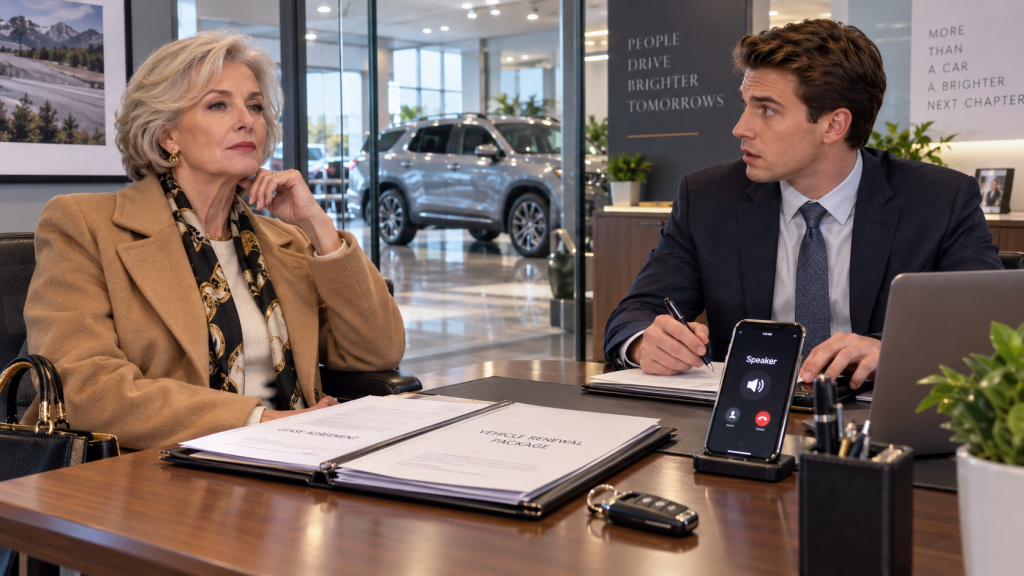
Corbin stared at his computer screen.
Then at me.
Then back at the screen.
“Mrs. Whitlow, someone submitted a payoff request on this vehicle yesterday using your Social Security number.”
For thirty-seven years, I worked around property records, assessments, deeds, exemptions, transfers, appeals, and people who thought putting a different name on paper could magically turn a lie into ownership.
I had learned something early.
People become very quiet when numbers finally stop cooperating with the story they have been telling.
I became quiet too.
“Was the request completed?”
“No, ma’am.”
“Money transferred?”
“No.”
“Good.”
Corbin looked relieved.
I wasn’t.
“Who submitted it?”
He hesitated.
“It came through First National Community.”
“That isn’t my bank.”
“No, ma’am.”
“What amount?”
He clicked.
“Twenty-eight thousand four hundred and change. Enough to buy out the vehicle, fees included.”
My son was still on speaker.
Nobody on the other end said anything.
Not Grady.
Not Kelsey.
Not Nathan.
I leaned closer to the phone.
“Grady?”
“Mom.”
His voice had changed.
Gone was the irritation.
Gone was the man who had told me three days earlier that maybe I would be welcome at holidays.
This was the voice he used when he was fourteen and had backed his father’s pickup into the mailbox.
“Did you use my Social Security number?”
“No.”
Too fast.
I looked at Corbin.
He looked at me.
Then Grady said:
“I mean, not like that.”
I nearly smiled.
There are lies.
Then there are sentences people use when a lie has already failed.
“What does ‘not like that’ mean?”
“I had your information because of the lease.”
“You had some of my information.”
“I thought the financing people needed it.”
“For a loan in my name?”
“It wasn’t supposed to stay in your name.”
I closed my eyes.
“What?”
“The plan was to buy the SUV out and then transfer it.”
“To you.”
“Yes.”
“With a loan opened using my identity.”
“No.”
His voice rose.
“Jesus, Mom, you’re making it sound criminal.”
Nathan spoke in the background.
“It is criminal.”
Silence.
Then Grady snapped:
“Stay out of it.”
Nathan answered:
“I tried.”
A chair scraped somewhere.
Kelsey said:
“What do you mean, you tried?”
Grady muttered something I couldn’t hear.
Then Kelsey’s voice became sharper.
“Grady, what did you submit?”
“Nothing happened.”
“That isn’t what I asked.”
Corbin stared at his desk.
I almost felt sorry for him.
A young man in a dealership office had apparently come to work expecting to discuss residual value and tire wear.
Instead, he had been seated front row at the collapse of my family.
I asked:
“Nathan, what did you mean when you said I should find out before the bank tells me?”
There was a pause.
Then the man whose name had appeared mysteriously on page four of my lease answered.
“Karen, I found paperwork in Grady’s office last night.”
My skin prickled hearing my first name from a stranger who was supposedly related to my dead ex-husband.
“What paperwork?”
“A loan application.”
“How much?”
Grady said:
“Nathan.”
Nathan ignored him.
“Forty-five thousand dollars.”
My fingers went cold.
Corbin looked up sharply.
“What was the stated purpose?”
I asked.
Nathan hesitated.
“Debt consolidation.”
Kelsey said:
“What debt?”
No one answered.
I did.
“Apparently we’re all about to find out.”
—
I asked Corbin to end the call.
Grady immediately protested.
“Mom, wait.”
“No.”
“We can fix this.”
“You don’t even know what ‘this’ is yet.”
“I do.”
“That makes one of us.”
“Please.”
There was desperation now.
For most of my life, that sound from my son had functioned like a key.
Mom, please.
Twenty dollars.
Then fifty.
Then rent.
Then a deposit.
Then dental work that wasn’t even his mouth.
Then six hundred twelve dollars a month because:
“It’s just until we get stable.”
Thirty-five months of temporary.
I looked at the phone.
“No.”
The room became still.
Grady had heard me say no before.
To drugs.
Motorcycles at sixteen.
Skipping school.
He had not heard it much as an adult.
That was partly my fault.
Not the fraud.
Never the fraud.
But I had made rescue predictable.
There is a difference between generosity and teaching someone there will always be a cushion under every fall.
I had confused those things for years.
“Return the SUV by five.”
“Mom—”
“Five.”
“Kelsey has appointments.”
“Kelsey has a driver’s license.”
“We need the car.”
“So do lots of people.”
His breathing changed.
“You’re doing this because we asked for space?”
“No.”
My voice stayed calm.
“I’m doing this because I own the lease.”
“And because someone just used my Social Security number.”
“That isn’t about privacy anymore.”
He was silent.
Then:
“What if I don’t bring it?”
Corbin’s face tightened.
I looked at him.
“What happens?”
He cleared his throat.
“The vehicle is due for contractual return. If it isn’t returned, there are procedures.”
I looked back at the phone.
“You heard him.”
Grady exhaled.
“Unbelievable.”
That word almost made me laugh.
Yes.
Apparently the unbelievable thing was not identity fraud.
It was his mother declining to finance him afterward.
“Five o’clock.”
I said.
Then Corbin ended the call.
The silence that followed was beautiful.
Not happy.
Clean.
—
I did not leave the dealership immediately.
Corbin brought in his manager.
Then someone from finance.
They printed the account history.
I read everything.
Every page.
That habit had paid my mortgage.
It was going to protect me now.
The additional-driver authorization bearing Nathan Cole’s name had been added electronically six weeks earlier.
My authorization appeared beside it.
I had never authorized anything.
The signature was typed.
Not handwritten.
A checkbox beneath it stated:
I certify that I am the primary lessee and approve the above driver.
I had never seen it.
“Who submitted this?”
I asked.
Corbin’s manager looked uncomfortable.
“It was completed through the customer portal.”
“My portal?”
“Yes.”
“I have never logged into your customer portal.”
That got everyone’s attention.
“How do you receive statements?”
“Paper.”
The manager stared.
“I’m sixty-three, not Amish.”
Corbin almost smiled.
Good.
I needed one normal human moment.
The manager said:
“We’ll preserve the activity logs.”
“Please do.”
“Mrs. Whitlow, you may also want to change your password.”
“I don’t have one.”
“You do now.”
Of course I did.
Apparently Grady had created it.
I changed everything before leaving.
Email.
Password.
Security questions.
Phone number verification.
Then I called First National Community from the parking lot.
Fraud department.
Forty-seven minutes.
Three transfers.
Identity verification.
The woman finally said:
“Yes, Mrs. Whitlow, we have a pending personal-loan application.”
“Forty-five thousand?”
“Yes.”
“Submitted when?”
“Yesterday morning.”
“Status?”
“Pending verification.”
“Whose phone number is on it?”
She read the last four digits.
Grady’s.
“Email?”
Also his.
“Address?”
My address.
That was clever.
He had mixed enough truth with enough theft to look legitimate.
“Employment?”
The woman hesitated.
“Retired.”
At least he knew that much.
“Income?”
She read a number.
Too high.
“What assets are listed?”
“Primary residence, estimated at three hundred eighty thousand.”
I almost laughed.
County assessor for thirty-seven years.
My son had chosen the one person on earth who would immediately know how stupidly wrong that value was.
My house was worth closer to three hundred twenty-two.
“If someone is going to steal my identity,” I said, “I wish they’d at least assess the property correctly.”
The fraud officer did not laugh.
Probably training.
I told her the application was unauthorized.
She froze it.
Then she said:
“There is another inquiry you should know about.”
My stomach sank.
“What?”
“A credit-card issuer pulled your report approximately four months ago.”
I gripped the steering wheel.
“Which issuer?”
She gave me the name.
I wrote it down.
“Anything else?”
“I can’t see your full credit history from here.”
Of course.
That came next.
—
I spent Friday afternoon doing things I had once helped confused taxpayers do.
Document.
Verify.
Freeze.
Call.
Write down names.
Times.
Reference numbers.
I pulled my credit report.
There it was.
A credit card I did not recognize.
Opened four months earlier.
Limit:
$18,000.
Balance:
$13,462.
My name.
My Social Security number.
My address.
Paperless statements.
Email I did not own.
Phone number I knew.
Grady’s.
I stared at that number until my eyes blurred.
Thirteen thousand four hundred sixty-two dollars.
My son had crossed from entitlement into theft months before I knew I was unwelcome at his house.
I called the issuer.
Fraud department.
More questions.
More passwords.
More verification.
Then the woman read recent charges.
A furniture store.
Electronics.
Two hotel stays.
Several restaurants.
A veterinary hospital.
That one made me laugh.
The dog.
Of course.
Kelsey had texted me six months earlier after the dog ate a sock.
Don’t worry, Mom, Grady handled it.
No.
Karen handled it.
Karen just didn’t know.
Then a charge near the hospital where Nathan worked.
I paused.
“What date?”
She told me.
Six weeks earlier.
Around the time Nathan’s name appeared on my SUV lease.
My first instinct was suspicion.
Then I stopped.
Do not decide before facts.
A lesson I had spent my career teaching angry property owners who wanted to accuse neighbors of moving boundary markers because a fence looked strange.
Facts.
First.
By four-thirty, my credit was frozen.
The disputed accounts flagged.
A fraud report started.
My good coat had become too warm.
I took it off and folded it across the passenger seat.
At 4:52, Grady’s SUV turned into the dealership.
I watched from my car.
Kelsey was in the passenger seat.
Nathan followed in the white sedan.
Hospital parking tag swinging from the mirror.
There was my mystery.
Not an affair.
Not yet, anyway.
A family secret on four wheels.
Grady parked the SUV.
Got out.
Slammed the door.
Kelsey climbed out more slowly.
Nathan parked several spaces away.
I stayed in my car for another moment.
Not fear.
Preparation.
Then I got out.
Grady saw me.
“Happy?”
“No.”
That answer surprised him.
Maybe he expected triumph.
I did not want his SUV.
I wanted my son to be someone who had not stolen my identity.
Very different wish.
Kelsey crossed her arms.
“Karen, we need to talk.”
“Eventually.”
“Now.”
“No.”
Her face flushed.
“You cannot just take our car.”
“Watch me.”
“It’s our only vehicle.”
Nathan spoke from behind them.
“Kelsey.”
She turned.
“Don’t.”
Then looked at me again.
“I didn’t know it was in your name.”
I believed that.
Mostly because her humiliation looked genuine.
“But you knew I paid for it.”
She opened her mouth.
Closed it.
Good.
“That is different.”
“No, Karen.”
Her voice softened.
“Grady told me the payment came from an account he had set up.”
I looked at Grady.
He looked away.
Kelsey’s face changed when she saw mine.
“Wait.”
“You really paid every month?”
“Thirty-five.”
Her eyes widened.
“How much?”
“Six hundred twelve.”
She looked at Grady.
“What?”
He rubbed his face.
“I was going to take over.”
“When?”
“Now.”
“By taking out a loan in her name?”
“That was temporary.”
Kelsey laughed.
One stunned, disgusted sound.
“Everything with you is temporary until someone else pays for it.”
Interesting.
Apparently I was not the only person beginning to see a pattern.
Grady looked at me.
“This is exactly why I didn’t want you involved.”
I stared.
“Because involvement creates witnesses?”
His face hardened.
“Because you make everything dramatic.”
Nathan said:
“She found a thirteen-thousand-dollar card.”
Grady whipped around.
“How do you know that?”
I looked at Nathan.
So he knew.
Not the exact balance perhaps.
But something.
“How do you know?”
Nathan’s face tightened.
“I saw a statement.”
“Where?”
“At the townhouse.”
Kelsey stared at him.
“What statement?”
Nathan reached into his jacket.
Then stopped.
“I gave the original to Grady last night.”
Kelsey slowly turned toward her husband.
“What statement?”
Grady snapped:
“Everybody stop.”
Nobody did.
Good.
Nathan looked at me.
“Karen, I need to tell you why I’m here.”
I glanced at the dealership doors.
“Not in this parking lot.”
Then at Grady.
“Go turn in the car.”
He stared.
“Mom.”
“Five o’clock.”
He looked at his watch.
4:58.
“Congratulations.”
I said.
“For once, you’re early.”
—
Corbin met us inside.
He looked relieved when he saw the SUV.
Then increasingly uncomfortable when he realized the entire family had arrived.
The inspection took forty minutes.
One scraped wheel.
Small ding near the rear passenger door.
Nothing catastrophic.
Mileage acceptable.
Grady stood with his hands in his pockets as though attending the funeral of a king.
Kelsey sat across from me.
Nathan stood near the coffee machine.
Nobody spoke much.
When Corbin handed me the return paperwork, I read every line.
Grady muttered:
“You never used to read things this long.”
I looked up.
“Apparently I had too much confidence in my son.”
He flinched.
Good.
Not because I wanted pain.
Because truth should land somewhere.
I signed.
My name.
My signature.
My choice.
The SUV ceased being my problem.
Corbin handed me copies.
“Anything else?”
“No.”
I stood.
Kelsey looked at Grady.
“How are we getting home?”
He glanced at Nathan.
Nathan shook his head.
“I’m not driving him.”
Kelsey blinked.
“What?”
“I’ll drive you.”
Nathan said.
“Not Grady.”
My son laughed bitterly.
“This is ridiculous.”
Nathan met his eyes.
“You used her identity.”
“You knew she paid for half our lives.”
“That does not mean I knew you were committing fraud.”
Nathan’s voice hardened.
“And don’t put me in that sentence.”
There was history there.
Six months of it.
Maybe more.
Grady looked at me.
“You’re really leaving me at a dealership.”
I picked up my purse.
“You’re forty.”
“Thirty-nine.”
“Then this is an excellent year to learn Uber.”
I walked out.
For once, nobody followed.
—
Nathan called me Saturday morning.
I almost did not answer.
Then curiosity won.
“Hello?”
“Karen?”
“Yes.”
“It’s Nathan Cole.”
“I know.”
“I’d like to explain.”
“So would everybody.”
He paused.
Fair.
“I’m not asking you to trust me.”
“Good.”
“I can meet anywhere you choose.”
I looked at the clock.
“Diner on Fifth.”
“When?”
“Ten.”
“I’ll be there.”
“And Nathan?”
“Yes?”
“Bring documentation.”
Another pause.
Then:
“I figured you’d say that.”
Maybe he did share blood with my ex-husband.
—
Nathan was already seated when I arrived.
White sedan outside.
Hospital tag.
He stood when he saw me.
Tall.
Dark hair beginning to gray at the temples.
Grady looked like his father around the mouth.
Nathan had his eyes.
My late ex-husband, Paul Whitlow, had been dead twelve years.
Heart attack at fifty-nine.
We had divorced six years before that.
Not because of infidelity.
As far as I knew.
Because Paul could make promises faster than he could keep them.
Money.
Jobs.
Drinking.
Women?
Apparently.
Nathan placed a folder on the table.
“Before anything else.”
He pushed it toward me.
Inside was a DNA report.
An ancestry service.
Grady listed as a close-family match.
Half sibling probability extremely high.
Then a second report from a private lab.
Nathan Cole and Grady Whitlow.
Biological half brothers.
I stared.
“My husband.”
“Your ex-husband.”
“Yes.”
Nathan looked ashamed.
As though he had done something wrong by existing.
I hated that immediately.
“Your mother?”
“Diane Cole.”
I knew the name.
Not personally.
A receptionist at a medical supply company Paul worked with in the early nineties.
I remembered seeing it on a Christmas card once.
My hand tightened around the paper.
“How old are you?”
“Thirty-seven.”
My stomach turned.
Grady was thirty-nine.
Paul and I had been married.
Very married.
Mortgage.
Toddler.
Family photographs.
The whole thing.
“Did your mother know about us?”
Nathan looked down.
“Yes.”
That hurt.
“Did you?”
“No.”
“Not until when?”
“Last year.”
He folded his hands.
“My mother died eighteen months ago.”
“I’m sorry.”
“Thank you.”
“She left me a letter.”
He swallowed.
“Said my father was Paul Whitlow.”
“I thought she might be wrong.”
“Then I tested.”
“And found Grady.”
“Yes.”
“When did you contact him?”
“Seven months ago.”
“Did you ask for money?”
“No.”
“Property?”
“No.”
“Anything from Paul’s estate?”
“No.”
“Why contact him?”
Nathan looked at me.
“Because I had a brother.”
Simple.
That answer softened something despite myself.
Then:
“And because I needed family medical history.”
“You’re a doctor.”
“Cardiologist.”
Of course.
“Paul died of a heart attack.”
“Yes.”
“I knew that once Grady told me.”
Nathan gave a sad smile.
“Useful information in my line of work.”
I almost smiled.
Then remembered why we were there.
“Why hide this from me?”
Nathan looked uncomfortable.
“Grady asked me to.”
“Why?”
“He said finding out about the affair would destroy your memory of his father.”
I laughed.
“Paul’s memory was doing fine destroying itself before death.”
Nathan looked down.
“He said you were fragile since retirement.”
That offended me more than it should have.
“Fragile?”
“I know.”
“I retired from tax appeals.”
“Yes.”
“I spent thirty-seven years having grown men scream at me over sheds.”
Nathan almost laughed.
“Exactly.”
“So you believed him?”
“At first.”
“Why?”
“Because he was my brother.”
There it was.
The same flaw repeated across generations.
Believe family because family says so.
Nathan continued.
“He told Kelsey you knew.”
I stared.
“Kelsey knew you were Paul’s son?”
“Yes.”
“And thought I knew?”
“Yes.”
“So she invited you into her house.”
“Yes.”
“But asked me to stop coming.”
Nathan’s face tightened.
“I didn’t know that until Tuesday.”
My chest hurt in a quiet way.
Kelsey had welcomed the secret son of my dead ex-husband under her roof while deciding his ex-wife needed to stay outside for privacy.
The universe has a nasty sense of irony.
“Why are you staying there?”
“I transferred to the hospital here two months ago.”
“My apartment renovation was delayed.”
“Grady offered the guest room.”
“Kelsey said yes.”
“For how long?”
“Supposed to be two weeks.”
“You’ve been there six.”
“Yes.”
“And your sedan?”
“Mine.”
“Nothing romantic between you and Kelsey?”
Nathan almost spit out his coffee.
“No.”
Good.
At least one cliché could die peacefully.
“Why were you added to my SUV?”
Nathan rubbed his forehead.
“My car was in the shop for four days.”
“Grady told me the SUV was his.”
“He added me to the insurance.”
“Or I thought he did.”
“I drove it twice.”
“You had no idea the lease was mine?”
“None.”
That part I believed.
“When did you find out?”
“Wednesday.”
“How?”
“The dealership called Kelsey because Grady had given them her number.”
“She asked me what ‘primary lessee’ meant because the dealership said Karen Whitlow had to authorize something.”
“So?”
“I asked Grady.”
Nathan’s mouth tightened.
“He told me you had financed the car originally but it was basically his.”
Basically.
That word again.
“And then?”
“Thursday I found a bank application on the printer in his office.”
“He had been scanning documents.”
“I saw your name.”
“Your Social Security number.”
“Your income.”
“The loan amount.”
“I confronted him.”
“What did he say?”
“That you always sign.”
The diner noise blurred.
Coffee cups.
Silverware.
A child laughing two tables away.
She’ll sign whatever.
Corbin’s words.
Grady’s words.
My son’s entire philosophy reduced to three words.
“He said you’d been paying for him since college.”
Nathan continued.
“He said you liked it.”
My eyes filled unexpectedly.
Liked it.
Maybe part of me had.
Not the money leaving.
The being needed.
After Paul died, after retirement approached, after Grady married and built a life where my role became smaller, paying kept me useful.
I hated admitting that.
Nathan said softly:
“He also said if you hesitated, he’d tell you Kelsey would be upset and you wouldn’t see them as much.”
I looked at him.
The diner disappeared.
“Did he say that?”
“Yes.”
I stared at the napkin dispenser.
There it was.
Not just entitlement.
Leverage.
He knew.
He knew I tolerated the casserole dish at the door.
The nameless wedding introduction.
The holiday uncertainty.
Because I was afraid pushing back would cost access to my son.
And he had learned access had a price.
One I kept paying.
“I’m sorry.”
Nathan said.
I wiped one eye.
“You didn’t do it.”
“No.”
He looked down.
“But I knew for two days before I told you.”
“Two days is not four months.”
He looked at me.
“I’m trying not to become my brother.”
That sentence mattered.
—
I asked Nathan one more question.
“Why did Grady tell me Kelsey could not know I saw your car?”
Nathan sighed.
“Because Kelsey thought you knew I existed.”
I frowned.
“Explain.”
“When the dealership called, she realized the lease was yours.”
“She asked Grady whether you knew I had driven it.”
“He said yes.”
“Then you drove past and apparently saw my car.”
“If Kelsey realized you didn’t know who I was, she’d realize Grady had lied to her too.”
I sat back.
There it was.
No affair.
No second romance.
Just another wall in Grady’s house made of different lies told to different women.
He told me Kelsey needed privacy.
He told Kelsey I knew Nathan.
He told Nathan I liked paying.
He told the dealership I would sign.
He told the bank my identity was his to borrow.
One man.
Four stories.
All designed so he never had to hear no.
I closed the folder.
“Thank you.”
Nathan nodded.
Then:
“What happens now?”
“With what?”
“Us.”
That surprised me.
“There is no us.”
His face fell slightly.
I continued.
“Not yet.”
He nodded.
Fair.
“You are not responsible for how you were born.”
Nathan looked at me.
“You are also not my son.”
“I know.”
“But you are Grady’s brother.”
“Yes.”
“What you do with that is between the two of you.”
He laughed bitterly.
“I’m currently not doing much.”
Understandable.
I stood.
Then paused.
“Nathan.”
“Yes?”
“Your mother?”
“What about her?”
“Whatever she did with Paul belongs to them.”
His face tightened.
“I spent a long time being angry at her.”
“So did I, and I met her only in a DNA report.”
That made him laugh.
Good.
Then I said the thing I wished someone had said to children born from affairs more often.
“You are not the betrayal.”
His eyes filled.
“You’re the person who had to live after it.”
He looked down.
“Thank you.”
I left before either of us could make the moment larger than it needed to be.
—
Kelsey came to my house Sunday afternoon.
Alone.
She stood on the porch holding my casserole dish.
Of course.
The same blue stoneware dish she had once handed me at her doorway without inviting me in.
Life does not understand subtlety.
I opened the door.
She held it out.
“I realized this was still ours.”
“Mine.”
She looked embarrassed.
“Right.”
I took it.
Did not invite her inside.
The irony was not lost on either of us.
“Can we talk?”
I thought.
Then stepped onto the porch and closed the door behind me.
Not punishment.
Boundary.
“What do you need?”
She looked exhausted.
“I left Grady.”
I blinked.
“When?”
“Last night.”
“Where are you staying?”
“My sister’s.”
I nodded.
She looked toward the street.
“I didn’t know.”
“Which part?”
“All of it.”
“That’s unlikely.”
She flinched.
Good.
I did not want cruelty.
I did want precision.
“You knew I paid the townhouse deposit.”
“Yes.”
“You knew I paid your dental bill.”
She looked away.
“Yes.”
“You knew I covered the vet.”
“Yes.”
“You knew I brought groceries sometimes.”
“Yes.”
“You knew you accepted help from me while asking my son to tell me not to visit.”
Her eyes filled.
“Yes.”
“That is not nothing.”
“No.”
She swallowed.
“I told myself the money was Grady’s relationship with you.”
Interesting.
“As if that made you uninvolved.”
“Yes.”
She cried.
“I wanted the help without feeling obligated to have you in my space.”
There it was.
Not malicious.
Selfish.
Human.
“I thought you came over too much.”
“I probably did sometimes.”
Kelsey looked surprised.
I continued.
“You could have told me.”
“I tried.”
“No.”
I shook my head.
“You complained to Grady.”
“You let him convert your discomfort into exile.”
She wiped her face.
“That’s true.”
“And I let fear of losing him make me tolerate things I should have addressed.”
We both stood with our own portion.
Different sizes.
Still ours.
Then Kelsey said:
“I thought the SUV was his.”
“I know.”
“I thought he paid the lease from an account you had helped him set up years ago.”
“I believe you.”
“He told me the credit card was a business card.”
My stomach tightened.
“You used it?”
Her face went white.
“Yes.”
“How much?”
“I don’t know.”
“Furniture.”
“Dog.”
“Two hotels.”
She stared.
“Those were anniversary trips.”
Of course.
My identity had apparently gone on vacation without me.
Kelsey covered her mouth.
“Oh my God.”
I felt anger.
Not at her entirely.
Enough.
“Did you ever look at the name on the card?”
“He kept it in his wallet.”
“Convenient.”
She cried.
“I’m sorry.”
I believed she was.
That did not make us close.
She continued.
“Nathan showed me the application last night.”
“He took a photo before giving it to Grady.”
Smart man.
“Grady admitted he opened the card.”
My stomach dropped.
“He admitted it?”
“Yes.”
“What did he say?”
Kelsey looked sick.
“That you would have given him the money anyway.”
There it was.
The sentence beneath every violation.
You would have said yes, so my no did not matter.
I looked at her.
“Where is he now?”
“At the townhouse.”
“Is Nathan there?”
“No.”
“Where’d he go?”
“Hotel.”
Good.
Kelsey took a shaky breath.
“Grady wants me to tell you not to report him.”
I laughed.
Not because it was funny.
“Of course.”
“He says if you make it official, he could lose his job.”
“What job?”
Her face changed.
That answer was wrong.
“What?”
I asked.
Kelsey whispered:
“He was laid off three months ago.”
I stared.
Another wall collapsed.
“He told me he was still working.”
“He told me too.”
“I thought he was working from home more.”
She laughed bitterly.
“He was pretending to.”
“Where did the money come from?”
She looked at me.
“Your credit card.”
My son had financed the illusion of employment with his mother’s identity.
Then told his wife his mother was too intrusive.
For the first time since Friday, I felt something close to grief.
Not anger.
Grief.
The child I had raised had become someone I would have warned another woman about.
That is a hard thing for a mother to admit.
Kelsey whispered:
“I’m filing for separation.”
I nodded.
“That’s your business.”
“I know.”
Then:
“I am sorry about the way I treated you.”
I looked at the casserole dish in my hands.
“I believe that too.”
“Can we—”
“No.”
She stopped.
I softened slightly.
“We do not need to decide what relationship we have today.”
Her eyes filled.
“Okay.”
“Take care of yourself.”
“You too.”
She turned.
Then stopped.
“Karen?”
“Yes?”
“You were right.”
“About what?”
“The car.”
I almost smiled.
“Specifics?”
“It was never ours.”
I looked at her.
“The car was the least important thing that wasn’t yours.”
She understood.
Then left.
—
Monday morning, I met with an attorney.
Not a family-law attorney.
An elder financial-abuse and identity-fraud attorney recommended by a former coworker.
Her name was Denise Harper.
She listened.
Then said:
“You need to decide one thing.”
“What?”
“Whether protecting your son from consequences is more important than protecting yourself from his conduct.”
I stared.
“That is a terrible way to phrase it.”
“It is.”
She did not apologize.
Good.
“What if reporting him destroys his life?”
“What if not reporting him teaches him your identity is still available?”
I looked away.
Denise continued.
“Account disputes often require formal documentation.”
“You need a record.”
“I know.”
“Do you?”
Yes.
I did.
Still hurt.
I filed the report.
Not because I wanted Grady arrested.
Not because I wanted revenge.
Because my name was mine.
My credit.
My Social Security number.
My retirement.
My house.
My future.
Motherhood did not turn identity theft into borrowing.
Love did not transform forgery into family business.
I wrote the facts.
Signed my name.
Read everything.
Then went home and vomited.
Both things can be true.
You can do the right thing and hate every second.
—
Grady came to my house that night.
I did not let him in.
He stood on the porch.
Same place Kelsey had.
His eyes were red.
“You reported me.”
“Yes.”
“I’m your son.”
“I know.”
“How could you do that?”
I stared at him.
Amazing.
Truly amazing.
“I used to ask the same thing when people were angry the county recorded tax liens.”
He blinked.
“What?”
“Never mind.”
I stepped closer to the closed screen door.
“You used my Social Security number.”
“I was going to pay it.”
“With what job?”
His face changed.
Kelsey told you.
“Eventually.”
“What happened to your job?”
“Downsizing.”
“Three months ago.”
“Yes.”
“Why didn’t you tell me?”
He laughed bitterly.
“Because you would have done this.”
“What?”
“Taken over.”
My mouth fell open.
“I have spent fifteen years taking over because you asked.”
“That’s different.”
“How?”
“Because when I ask, it’s my choice.”
There.
Something almost intelligent in the wreckage.
“Yes.”
I nodded.
“That is different.”
He looked confused.
“When you ask, I get to say yes or no.”
“When you steal my identity, you remove the question.”
Grady looked away.
“I knew you’d say yes.”
My eyes filled.
“That sentence is your entire problem.”
He stared at me.
“I thought you would sign.”
“Did you ask?”
“No.”
“Then you didn’t know.”
He rubbed both hands over his face.
“I panicked.”
“So you opened a credit card four months ago?”
Silence.
“That was before you lost your job.”
He stopped.
Caught.
“Why?”
He leaned against the railing.
“We were behind.”
“On what?”
“Everything.”
“How?”
“Kelsey wanted furniture.”
“I wanted things.”
“Trips.”
“Car insurance.”
“Rent went up.”
My jaw tightened.
“You had my six hundred twelve dollars every month.”
“I know.”
“You had my deposit.”
“I know.”
“Your father left you twenty-two thousand dollars when he died.”
“Gone.”
I stared.
“How?”
He laughed bitterly.
“Life.”
“No.”
I shook my head.
“Life is groceries.”
“Insurance.”
“A broken furnace.”
“Where did twenty-two thousand go?”
He said nothing.
“Say it.”
“Crypto.”
Of course.
I actually closed my eyes.
“How much?”
“Most.”
“Most?”
“Seventeen.”
I started laughing.
Could not help it.
My son looked offended.
“You lost seventeen thousand dollars gambling on cryptocurrency and then stole my identity to maintain a lifestyle your wife thought you could afford?”
“When you say it like that—”
“How else should I say it?”
He had no answer.
Then:
“I was going to fix it.”
Everybody thinks they will fix it before anyone notices.
Fraud survives on future tense.
“I believe you wanted to.”
His face softened.
Then I continued.
“That does not mean I will absorb it.”
He looked at me.
“You’re really going to let me get charged.”
“I am going to tell the truth about what happened.”
“Same thing.”
“No.”
“It isn’t.”
He stared through the screen.
Then his voice broke.
“Mom.”
That key again.
Older now.
Worn.
Still fit something in me.
I loved him.
God help me, I loved him.
I opened the screen door.
Not the front door.
One barrier remained.
“Grady.”
He looked up.
“I will help you find a lawyer.”
Hope flashed.
“I will not pay the lawyer.”
Hope dimmed.
“I will give you copies of whatever records you are entitled to.”
“I will not lie.”
“I will not tell the bank I authorized anything.”
His face hardened.
“So that’s it.”
“No.”
My voice shook.
“That is what love looks like now.”
He laughed.
“Love?”
“Yes.”
“I kept rescuing you because it made me feel useful.”
He stopped.
That admission was mine.
“I paid because I was afraid if I stopped, I would matter less.”
My eyes filled.
“I let you learn that access to you was something I could finance.”
Grady’s face changed.
“I never—”
“You did.”
I shook my head.
“Maybe not at first.”
“But eventually.”
“I kept buying a place at your table.”
“And you learned to charge admission.”
Silence.
He began crying.
So did I.
That was the ugliest, truest conversation we ever had.
“I’m sorry.”
He whispered.
“I know.”
“Can you forgive me?”
“Not tonight.”
His face crumpled.
That was honest too.
“Go home.”
“Kelsey left.”
“Then go to your house.”
“I can’t afford it.”
I almost said:
I’ll help.
The sentence rose automatically.
Years of reflex.
I swallowed it.
“You’ll figure it out.”
He stared.
Then nodded.
For the first time, I watched my son leave my porch carrying a problem I had not picked up for him.
I cried for an hour afterward.
Growth is often miserable while it is happening.
—
The fraud investigation did not send Grady to prison for years.
Real life was less theatrical than people imagine.
There were charges.
Negotiations.
Restitution.
Probation.
Financial counseling.
The unauthorized credit card was closed.
The balance became part of restitution he owed.
The loan never funded.
That helped.
The forged vehicle authorization became evidence too.
He lost his job prospects for a while.
Not forever.
Kelsey filed for divorce six months later.
They had no children.
Thank God.
That made the legal ending simpler than the emotional one.
The townhouse lease ended.
Grady moved into a one-bedroom apartment above a laundromat.
For nine months, he took the bus.
He hated it.
Good.
Not because buses are punishment.
Because inconvenience had always been someone else’s job to remove.
He needed to learn discomfort was survivable.
Eventually, he bought a twelve-year-old sedan.
Cash.
His cash.
I did not contribute one dollar.
He sent me a photograph.
No caption.
I stared at it.
Then replied:
Looks reliable.
He sent:
It’s ugly.
I replied:
Character building.
He sent a laughing emoji.
That was our first light exchange in almost a year.
—
Nathan moved into his apartment.
We saw each other occasionally.
At first, deliberately.
Coffee.
Lunch.
Never at my house.
I needed separation between Paul’s betrayal and Nathan’s existence.
He respected that.
One afternoon, Nathan brought medical records.
Paul’s.
Old copies Grady had found.
Family history.
Heart disease.
High blood pressure.
Nothing emotionally dramatic.
Just biology.
Nathan said:
“I thought you might want these back.”
I looked through them.
Paul’s handwriting.
His signature.
The name of the cardiologist I begged him to see six months before he died.
I sighed.
“He was stubborn.”
“So I’ve heard.”
Nathan smiled.
“Grady says I got that.”
“I wouldn’t brag.”
He laughed.
Then:
“Do you hate him?”
“Paul?”
“Yes.”
I thought.
“No.”
“Did you?”
“Oh, repeatedly.”
Nathan smiled.
I continued.
“I’m angry he cheated.”
“That doesn’t require hating thirty years of memories.”
Nathan looked down.
“My mother loved him.”
“I’m sure she did.”
“That bother you?”
“Yes.”
Honesty.
“Does your existence bother me?”
His face tightened.
“No.”
I leaned forward.
“That distinction matters.”
Nathan nodded.
Then:
“I wish I’d known him.”
I looked at the file.
“Sometimes knowing more does not improve the view.”
He laughed softly.
“But I understand.”
Nathan became part of the family slowly.
Not my son.
Never some replacement relationship.
Something stranger.
My ex-husband’s son.
My son’s brother.
A man I liked.
That was enough.
Years later, he called me Karen without hesitation and I called him when my blood pressure medication confused me.
Life builds categories language did not plan for.
—
Kelsey apologized again after the divorce.
This time in a letter.
I almost did not read it.
Then I did.
She wrote:
I treated your generosity like a subscription service and your presence like an inconvenience.
That was surprisingly good.
Then:
I thought boundaries meant I could take what Grady said you wanted to give while never asking whether you actually wanted to give it.
Better.
She admitted she had encouraged Grady to reduce visits.
Not because I had done anything unforgivable.
Because she wanted the house to feel like hers.
Reasonable need.
Badly handled.
She wrote:
I should have talked to you like an adult instead of making him do it.
Yes.
And:
I did not know he was committing fraud, but I enjoyed a lifestyle I never asked enough questions about. That part is mine.
I respected that.
I wrote back:
Thank you for saying this. I hope your next chapter is honest and peaceful.
No friendship.
No monthly lunch.
No sentimental reconciliation.
Some apologies need only acknowledgement.
Not renewed access.
I had learned.
—
Grady and I spent almost two years rebuilding something.
Not the old relationship.
That one had depended too much on money.
The first birthday after everything happened, he called.
“Do you want to have dinner?”
I waited.
“Are you asking me or expecting me to pay?”
Silence.
Then he laughed.
“Ouch.”
“Answer.”
“I’m asking.”
“Good.”
“Also, I’m paying.”
“Better.”
We met at a small Italian restaurant.
Not expensive.
He looked healthier.
Less polished.
More real.
We talked about work.
He had taken a position in warehouse logistics.
Not glamorous.
Steady.
He was good at it.
No company card.
No fancy title.
He said:
“I didn’t realize how much energy I spent pretending I was doing better than I was.”
I nodded.
“Pretending is expensive.”
“Apparently.”
He smiled.
Then became serious.
“I used to think you liked paying.”
“I did sometimes.”
He looked surprised.
“I liked helping.”
I said.
“I did not like being used.”
“Difference.”
He nodded.
“I understand now.”
“Good.”
Then:
“I thought if you were paying, you’d always stay.”
My throat tightened.
“What?”
He looked down.
“When Dad died, you went into fix-everything mode.”
“Bills.”
“College.”
“Emergency money.”
“You became the person who always solved stuff.”
He swallowed.
“I think somewhere along the way I got scared that if I stopped needing things, you’d stop showing up.”
I stared.
That was not an excuse.
It was a wound.
I could see the child inside the man without letting the child erase the man’s choices.
“I would have shown up for free.”
His eyes filled.
“I know that now.”
I started crying.
“So would I.”
That was part of my grief too.
I had taught him money was one of my primary love languages because I was uncomfortable needing anyone emotionally.
Pay the bill.
Bring the casserole.
Cover the deposit.
Fix the practical thing.
It was easier than saying:
I miss you.
Can I come over?
Do I still matter now that you’re married?
Maybe both of us had hidden feelings under transactions until neither could tell the difference.
Again:
Not my fault he committed fraud.
Still something worth changing.
—
Grady finished restitution three years after sentencing.
The final payment was not to me directly.
It went through the formal arrangement.
He still called afterward.
“Done.”
I knew what he meant.
“How does it feel?”
“Expensive.”
I laughed.
Then he said:
“Good.”
That mattered.
“Mom?”
“Yes?”
“I’m sorry.”
Not the first time.
Maybe the most complete.
“I know.”
“Do you forgive me?”
Years earlier, I had said not tonight.
This time, I thought.
“Yes.”
Silence.
“Really?”
“Yes.”
Then:
“That doesn’t mean I’m co-signing anything.”
He laughed.
“Never asking.”
“Good.”
Forgiveness felt different than I expected.
No light.
No music.
Just the absence of needing him to suffer more.
That was enough.
—
Nathan and Grady repaired their relationship separately.
Slowly.
At first, Grady resented him.
Called him a snitch.
Nathan responded:
“You used your mother’s identity.”
Not much room for argument.
Eventually, Grady apologized.
They became brothers in the ordinary annoying way.
Football.
Arguments.
Group texts.
Nathan corrected everyone’s medical misinformation.
Grady sent him videos designed to irritate cardiologists.
I watched from the edge.
A strange thing happened.
Paul’s affair stopped being the center of Nathan’s existence.
Good.
Nobody should have to remain evidence forever.
He became Uncle Nathan to no one because there were no children.
Just Nathan.
Family.
Adjacent.
Complicated.
Real.
—
I retired properly the second time.
The first year after leaving the assessor’s office, I had replaced work with worrying about Grady.
His bills.
His house.
His dog.
His marriage.
His car.
Once I stopped doing that, I discovered retirement contained hours.
So many hours.
At first, terrifying.
Then useful.
I joined a local property-tax assistance clinic once a week.
Mostly older homeowners confused about exemptions and reassessments.
I loved it.
One afternoon, a seventy-year-old woman came in carrying a stack of letters.
Her daughter had been “helping” with finances.
There were credit accounts the woman did not recognize.
My body went still.
I did not tell her my story.
Not then.
I helped her organize.
Call.
Freeze credit.
Ask questions.
At the end, she whispered:
“I feel so stupid.”
I looked at her.
“No.”
She waited.
“Trusting your child is not stupidity.”
My throat tightened.
“But now that you know there is a problem, you protect yourself.”
She began crying.
So did I.
Sometimes the lesson you paid for becomes useful to someone else.
That does not make the price fair.
Still.
Useful.
—
I put the six hundred twelve dollars a month somewhere else.
At first, savings.
Then I realized I had saved my whole life.
I booked a trip.
Savannah.
Then Charleston.
Then New Orleans with two retired coworkers who complained about every hotel mattress.
I bought myself a better coat.
Not because the old one was bad.
Because I wanted it.
That was difficult.
I had spent so many years turning discretionary money outward that buying something unnecessary for myself felt irresponsible.
I practiced.
Lunch.
Shoes.
A pottery class I was terrible at.
Six hundred twelve dollars used to keep my son inside an SUV he told his wife was his.
Now it bought things that did not require anyone’s gratitude.
Freedom can be embarrassingly practical.
—
Five years after the dealership, Grady called me on a Tuesday.
I almost laughed when I saw the day.
Tuesday.
The day he once told me to stop coming over.
“Hey, Mom.”
“Hey.”
“Are you busy Sunday?”
“Why?”
“I’m moving.”
“Congratulations?”
“Different apartment.”
“Better?”
“Much.”
Then:
“I want help.”
My old reflex rose.
“How much?”
Silence.
Then Grady laughed.
“No money.”
I smiled.
“What then?”
“I need someone who knows whether this landlord is charging me nonsense fees.”
There it was.
Expertise.
Not rescue.
“Send me the lease.”
“I already read it.”
My heart almost burst.
“You did?”
“Twice.”
“Who are you and what have you done with my son?”
He laughed.
“Still want you to look.”
“I will.”
Then he said:
“And after, I’m making dinner.”
“Dangerous.”
“You taught me.”
“I taught you nothing edible.”
True.
We agreed.
When I hung up, I sat quietly for a moment.
A lease.
His name.
His money.
His signature.
He wanted advice, not ownership transferred to me.
That was growth.
Small.
Boring.
Beautiful.
—
On Sunday, Grady handed me the lease.
I put on my reading glasses.
Page one.
Rent.
Deposit.
Utilities.
Page four.
Authorized occupants.
I paused.
He noticed.
“What?”
“Nothing.”
He leaned over.
Then saw where I was looking.
Page four.
Additional names.
He smiled.
“You okay?”
I looked at him.
“Yes.”
He sat back.
“Read everything.”
“I raised you better than I thought.”
He laughed.
“Eventually.”
We signed nothing together.
He signed.
I watched.
Not because he needed permission.
Because he asked me to be there.
That difference contained an entire repaired relationship.
—
Later, while he cooked pasta badly, he handed me a blue casserole dish.
Mine.
The same one Kelsey had returned to my porch years before.
“How do you still have this?”
“Kelsey gave it back.”
“I thought she gave it to me.”
“She did.”
“I borrowed it from your cabinet last month.”
“You’ve been in my cabinets?”
“You invited me.”
Fair.
The casserole dish was filled with baked ziti.
Too much cheese.
Not enough sauce.
I ate two servings.
“Good?”
Grady asked.
“No.”
He laughed.
“Liar.”
“Yes.”
It was wonderful.
Not the food.
The table.
No bill.
No lease payment.
No hidden transaction.
Just dinner.
I had spent years believing generosity was love’s most useful shape.
That night reminded me presence can be cheaper.
And worth more.
—
People sometimes ask why I reported my own son.
Usually people who have never had their name stolen by someone they gave birth to.
I no longer defend the decision.
I say:
Because he used my identity without permission.
Then I stop.
Motherhood is not a legal waiver.
Love is not blanket consent.
Helping someone yesterday does not authorize them to take tomorrow.
That sounds obvious.
It took me sixty-three years to understand it fully.
—
I also stopped pretending Kelsey was the villain.
She was unkind to me.
Dismissive.
Entitled in ways.
True.
But I had initially wanted her to be the explanation for everything.
Easier.
Daughter-in-law pushes mother away.
Son controlled by wife.
Classic.
Comforting.
Wrong.
Grady made his choices.
Grady told the lies.
Grady used my information.
Kelsey benefited without asking enough questions.
Nathan kept one secret too long.
I funded more than I should have.
Everyone owned their part.
That was the only version of the story that allowed anyone to change.
—
Paul’s affair remained another truth I had to absorb.
Twelve years dead and still capable of making me angry.
Impressive.
I went to his grave once after meeting Nathan.
Stood there.
“Really?”
No answer.
Of course.
“You had to leave paperwork too?”
Still nothing.
I laughed.
Then:
“He’s a good man.”
Wind moved through the cemetery.
Nathan.
“He deserved better than being a secret.”
That sentence surprised me.
Maybe Paul’s betrayal had harmed more than me.
Diane.
Nathan.
Even Grady, who learned adulthood could contain a brother he never knew.
Secrets create debts paid by people who never agreed to borrow.
I left without forgiving Paul exactly.
Dead people can live with ambiguity.
—
At sixty-nine, I sold my house.
Too much yard.
Too many stairs.
I bought a smaller place near the park.
Grady came to closing.
Nathan too.
Not because I needed them.
Because they insisted.
At the title office, a stack of papers sat before me.
The closing agent slid over a pen.
“You can sign here.”
I picked up the document.
Started reading.
Grady groaned.
Nathan laughed.
“She’ll read all of it.”
The closing agent smiled politely.
“I encourage that.”
I looked at my son.
“You hear that?”
“Yes, Mom.”
“Professionals encourage reading.”
“I’ve learned.”
I signed after every page made sense.
My own condo.
My own money.
My own signature.
No one borrowed it.
That should not feel revolutionary.
It did.
—
Grady never became wealthy.
That mattered less than he once thought.
He became stable.
Different.
He stayed with the logistics company.
Got promoted.
Saved.
Paid cash when he could.
Used credit carefully.
When something broke, he did not call asking how much I could send.
Sometimes he called asking whether I knew a reliable repair person.
That was fine.
Advice is not ownership.
Help is not rescue.
We learned vocabulary late.
Still learned it.
—
One Christmas, years after everything, Nathan brought a framed photograph.
Three men.
Paul.
Grady at maybe five.
And a baby I did not recognize.
Nathan.
I stared.
“Where did you get this?”
“My mother’s things.”
Paul was holding Nathan.
Not hiding him in that moment.
Just smiling down at his baby.
Grady stared.
“I’ve never seen Dad look like that.”
I had.
When he held Grady.
Same expression.
Love repeating in a dishonest man.
Complicated.
Nathan looked nervous.
“I almost didn’t bring it.”
I touched the frame.
“I’m glad you did.”
Grady looked at me.
“You okay?”
“Yes.”
And I was.
Not because betrayal became harmless.
Because Nathan had stopped feeling like proof of what Paul did to me.
He was proof that another life happened too.
A life he deserved to know.
I handed the frame back.
“Keep it.”
Nathan’s eyes filled.
“Sure?”
“Yes.”
“That’s your father.”
I told him.
“Whatever else he was.”
That was enough.
—
Kelsey remarried.
I heard through mutual friends.
No drama.
I hoped she was happy.
She sent a Christmas card once.
Her new husband.
Two stepchildren.
A dog that appeared smart enough not to eat socks.
I smiled.
Then put the card with the others.
No pain.
No resentment.
Some people leave your life after teaching what they came to teach.
Not mystical.
Just true.
—
The dealership mailed me an advertisement seven years after the turn-in.
Karen, time for your next vehicle?
I laughed so hard I had to sit down.
I took a photograph and sent it to Grady.
They miss us.
He replied:
BLOCK THEM.
Then:
Actually I’m buying a car Saturday.
I froze.
Then smiled.
Need me?
Three dots.
Then:
Want you there. Not need.
I stared at that distinction.
Good boy.
No.
Good man.
Different.
Saturday, we went together.
He chose a modest crossover.
Used.
One owner.
Good maintenance history.
The finance manager started talking monthly payment.
I interrupted.
“Total price.”
Grady laughed.
“She does this.”
“I know what I’m doing.”
“Then do it.”
He negotiated.
Read.
Asked questions.
When the paperwork came, the salesperson pointed to the signature line.
Grady paused.
Looked at me.
Then signed.
His name.
Not mine.
The title.
His.
Loan.
His.
Responsibility.
His.
When they handed him the keys, he smiled like a teenager.
“First decent car I’ve bought without you.”
“Bit late.”
“Character building.”
He threw my phrase back at me.
I laughed.
Outside, he stood beside the car.
“Picture?”
I took one.
He looked proud.
Not because the car was expensive.
Because he could afford it honestly.
That matters more when you have once confused possession with entitlement.
Before I left, he hugged me.
“Thanks.”
“For what?”
“Coming.”
Not:
Paying.
Not:
Signing.
Coming.
I held him tighter.
“You’re welcome.”
—
That night, I found the old SUV renewal packet in a file box.
The one I never signed.
I had kept it without realizing.
Page one.
My name.
Page four.
Nathan’s.
The paper had become almost funny now.
Almost.
I sat at my kitchen table and read the whole thing once more.
Then put it through the shredder.
Not ceremony.
Not revenge.
Administrative housekeeping.
Very county assessor of me.
The machine swallowed the page where my forged authorization appeared.
Then the renewal signature line.
Blank.
Still blank.
I smiled.
That unsigned line had once terrified my son.
He thought the disaster was losing a car.
Neither of us understood yet that the car was only the first thing returning to its rightful owner.
My money.
My identity.
My time.
My choices.
My relationship with him, eventually, on terms neither of us could purchase.
I emptied the shredder.
Made tea.
Went to bed.
—
When Grady told me to stop coming to his house because Kelsey needed privacy, I thought the insult was the story.
It wasn’t.
The deeper story was how quickly I almost accepted exile while continuing to finance the people excluding me.
I had spent years believing generosity guaranteed belonging.
It doesn’t.
If you have to keep paying to remain welcome, you are not being loved.
You are being billed.
That lesson hurt.
It also freed me.
Because once I stopped paying, I discovered something important.
The people who truly wanted me did not disappear when the money did.
Nathan stayed.
My friends stayed.
Eventually, Grady came back differently.
Not because I bought the road.
Because he walked it himself.
—
If I could speak to the woman I was on that Tuesday afternoon, phone still warm in her hand after her son said:
“Maybe holidays. We’ll see.”
I would tell her:
Do not beg.
Do not threaten.
Do not list everything you have paid for.
Put the lease in the drawer.
Exactly as you did.
Then ask yourself why your first instinct is to keep writing checks to prove you are still his mother.
You were his mother before the SUV.
You will be his mother after it.
His gratitude is not a receipt you need.
His access is not something you should purchase.
And when you discover what he did next, do not protect him from the truth just because you protected him from consequences too many times before.
Let him meet his own life.
If he becomes better, good.
If he doesn’t, you still get yours back.
—
Grady is forty-six now.
I am seventy.
He comes over most Sundays.
Not every.
Good.
People need their own lives.
Sometimes he brings groceries.
The first time, I said:
“What do I owe you?”
He looked offended.
“Nothing.”
I smiled.
“Just checking.”
Sometimes I cook.
Sometimes he does.
Nathan joins us when his hospital schedule allows.
The family tree remains absurd.
My dead ex-husband’s secret son arguing with my son over football at my table while I tell both of them to move their elbows.
Life has a sense of humor after all.
—
Last Sunday, Grady arrived carrying the blue casserole dish.
Again.
“Why does this keep traveling?”
“Tradition.”
“What’s in it?”
“Lasagna.”
“Better than last time?”
“No promises.”
He set it on my counter.
Then kissed my cheek.
No hidden papers.
No request.
No emergency.
Just:
“Hey, Mom.”
“Hey.”
Nathan came twenty minutes later.
We ate.
Grady complained about interest rates.
Nathan complained about hospital administrators.
I complained that both of them were too loud.
At one point, Grady looked around my kitchen.
“You know, I really thought that SUV was mine.”
I laughed.
“We know.”
“No.”
He smiled.
“I mean it.”
“I genuinely thought paying for gas meant it was basically mine.”
I shook my head.
“You were very committed to the word basically.”
Nathan laughed.
Grady continued.
“I thought everything would eventually become mine because you always fixed it.”
The room quieted.
Then he looked at me.
“I’m glad you stopped.”
My eyes filled.
“That makes one of us at the time.”
He smiled.
“I hated you for about six months.”
“I know.”
“You knew?”
“You were unsubtle.”
Nathan laughed.
Grady looked down.
“Thank you anyway.”
I reached across the table.
Not money.
Not keys.
My hand.
He took it.
That was all.
Enough.
—
The SUV disappeared from our lives years ago.
I do not remember the exact model anymore.
Funny.
At the time, it felt like the center of everything.
It wasn’t.
Cars depreciate.
People can too, if they refuse to change.
Or they can repair what is still repairable.
Slowly.
Expensively.
Honestly.
The most valuable thing I got back was never the vehicle.
It was the word no.
I had treated it like rejection for years.
Now I understand.
No is sometimes how love stops becoming exploitation.
No is how consent remains real.
No is how help stays a gift instead of turning into an expectation.
No is how a mother can love an adult son without becoming his emergency fund, his signature, his credit score, or his excuse.
And sometimes no is the first honest thing in a family that has been saying yes for all the wrong reasons.
—
My son once thought I would sign anything.
For a while, he was probably right.
That is difficult to admit.
I would have signed another lease.
Covered another emergency.
Paid another bill.
Swallowed another slight.
All because I thought losing usefulness meant losing him.
Then he told me to stay away.
And without intending to, he taught me the one lesson all my years studying ownership records had somehow missed.
You can pay for something without owning it.
A car.
A deposit.
A dinner.
A relationship.
Love is not a deed.
Generosity is not title.
And a person does not belong to you because you have invested in them.
Not a son.
Not a mother.
Not anyone.
All we can do is choose whether to keep showing up.
Freely.
Honestly.
Without hidden charges.
Grady finally learned that.
So did I.
And now, when he comes through my front door on Sunday carrying food he bought with his own money and asks whether I need help with anything, I no longer hear the boy who thought everything I had was eventually his.
I hear the man who learned that love means asking.
And respecting the answer.
Even when the answer is no.
Especially then.
THE END STORIES! THANK YOU FOR READING GOOD LUCK !❤️
Related Posts