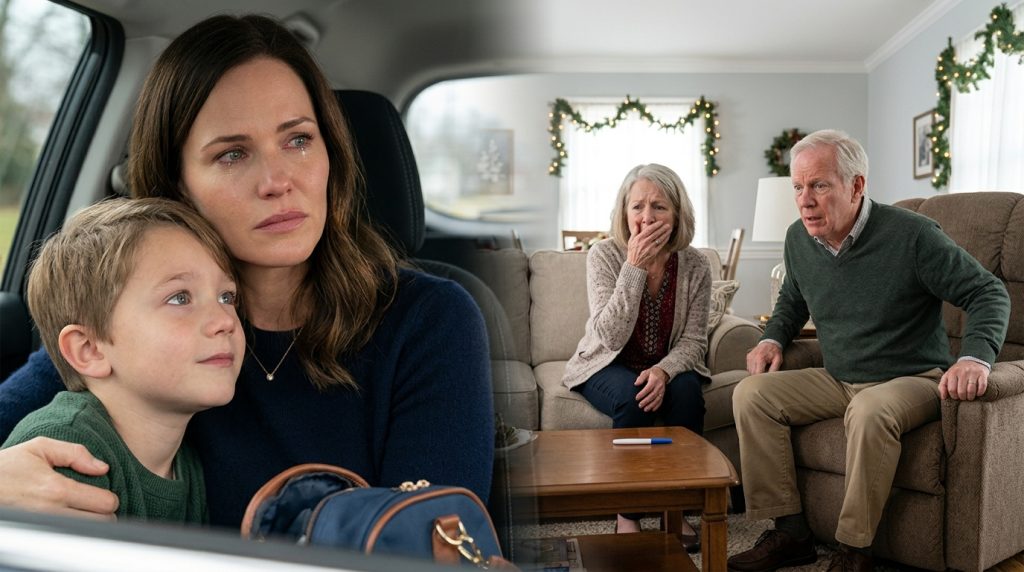
➡️ PART 3 ENDING PART➡️
My father’s knees nearly gave way.
He caught himself against the doorframe with one hand while the DNA report trembled in the other.
My mother screamed Raymond’s name once.
Not loudly.
It came out small.
Broken.
Like the name itself had cut her on the way out.
Leo tightened his fingers around mine.
“Mom?”
I looked down at him.
He was ten years old.
Ten.
Old enough to know something terrible had entered the room.
Too young to be made responsible for understanding all of it.
My father looked at the highlighted line again.
Then at Leo.
Then at me.
“No.”
His voice shook.
“No.”
I had imagined this moment for almost a decade.
In some versions, Dad shouted.
In others, Mom fainted.
Sometimes they begged forgiveness before I even finished speaking.
Sometimes they called me a liar all over again.
The truth was quieter.
My father simply kept saying no as if repetition could push ten years backward.
“No.”
He looked at the report.
“This is wrong.”
“It isn’t.”
“How do you know?”
“Because I had it verified.”
“DNA companies make mistakes.”
“This wasn’t one test.”
My father stared at me.
I continued.
“When Leo started asking more questions last year, I finally decided I needed certainty.”
My voice stayed steady.
“I used a genealogy service first.”
“Raymond had submitted his DNA years ago.”
“The relationship showed up immediately.”
My mother sat down on the little bench beside the entry table.
Her face had gone gray.
Dad whispered:
“He’s my brother.”
“I know.”
My mother covered her mouth.
Leo looked from them to me.
“Who’s Raymond?”
Everything stopped.
There are truths adults can spend years rehearsing and still discover they are impossible to explain to a child.
I crouched in front of my son.
“Raymond is someone in Grandpa’s family.”
Leo frowned.
“Like an uncle?”
I swallowed.
“Yes.”
“Your uncle?”
I nodded.
He looked at the paper in Grandpa’s hand.
Then at me.
“He’s my dad?”
The word struck every person on that porch differently.
My father looked physically ill.
My mother started crying.
And I felt the old fear rise from somewhere I had buried it at nineteen.
But Leo deserved something better than panic.
I took both of his hands.
“He is your biological father.”
Leo stared at me.
“Have I met him?”
“No.”
“Does he know about me?”
I hesitated.
“I don’t know how much he knows.”
That was technically true.
Then Leo asked the question I had feared most.
“Why didn’t you tell me?”
My throat closed.
“Because the story about how you were conceived belongs to something painful that happened to me.”
His forehead wrinkled.
He looked ten again.
Small.
Confused.
I continued carefully.
“And I wanted to wait until you were old enough to hear the truth in a way that would never make you think any part of it was your fault.”
His eyes filled.
“What did he do?”
My father made a strangled sound.
I looked at Leo.
“You do not need all of that today.”
“Why?”
“Because being honest with you does not mean giving you every painful detail before you’re ready.”
I touched his cheek.
“The important thing is this: he hurt me.”
Leo’s expression changed.
Not understanding everything.
Understanding enough.
“Like…”
He stopped.
I nodded slowly.
“He hurt me in a way no one had the right to.”
Leo looked at the floor.
Then whispered:
“And then I happened?”
My heart broke cleanly in half.
I pulled him against me.
“No.”
He stiffened.
I held him tighter.
“You did not happen like a punishment.”
“You were not something bad that came out of something bad.”
“You were my baby.”
“My choice was what came after.”
“I chose to keep you because whatever he did belonged to him.”
“You belonged to yourself.”
Leo started crying against my shoulder.
I did too.
Behind us, my mother sobbed.
My father said nothing.
For once, no adult tried to interrupt the child who needed the room most.
We did not remain on the porch.
That surprised me.
I had imagined delivering the truth and leaving.
A perfect scene.
A door closing.
My parents collapsing behind it.
But Leo’s hands were cold.
We had driven eight hours.
He had asked to meet his grandparents.
And trauma did not erase ordinary human needs like water, bathrooms, and somewhere to sit.
Dad stepped aside.
“Please.”
His voice barely worked.
“Come in.”
I looked at Leo.
“Do you want to?”
He thought.
Then nodded.
We entered the house I had not seen in ten years.
Nothing and everything had changed.
The wallpaper was gone.
The old brown carpet had become hardwood.
Mom had replaced the sofa.
Dad’s recliner was still there.
Same corner.
Same angle.
That chair stopped me harder than anything else.
Ten years earlier, Dad had stood from it and ordered me out.
I looked away.
Leo noticed.
Of course he did.
My son noticed everything.
Mom brought water.
Her hands shook so badly the glasses clicked against the tray.
Leo sat beside me.
Dad remained standing.
Finally he said:
“Tell me.”
I looked at him.
He had the report folded in his hand.
“Not in front of Leo.”
Dad immediately nodded.
“Of course.”
Mom looked toward my son.
“We have a guest room.”
Leo looked at me.
“No.”
That answer came fast.
He grabbed my sleeve.
I understood.
“I’m not sending you away.”
I said.
“We can take a break.”
Dad whispered:
“Whatever you need.”
There was something terrible about hearing those words ten years late.
Whatever you need.
When I was nineteen, I had needed one night.
One room.
One parent to say:
Sit down.
Start again.
You’re safe.
Instead, I got sixty minutes to pack.
I swallowed.
“Is there somewhere Leo can watch television where I can still see him?”
Dad pointed toward the den.
Open doorway.
Ten feet away.
Leo settled on the couch with headphones and a movie on my tablet.
I could see him.
He could see me.
Then I sat at the dining table with my parents.
The same table where I had done high-school homework.
Mom clasped her hands.
Dad placed the DNA report between us.
And I told them.
I did not give them every detail.
They were not entitled to every detail.
That was something I had learned in therapy years earlier.
Telling the truth does not mean surrendering ownership of the story.
I told them about Aunt Claire’s anniversary party.
Raymond had been there.
Of course.
Dad’s younger brother.
The funny uncle.
The one who brought expensive bottles of wine and made everyone laugh.
The one Dad defended whenever Grandma complained he was irresponsible.
Raymond was thirty-five then.
I was nineteen.
That night, I went upstairs because I had spilled wine on my sleeve.
The guest bathroom was occupied.
I went toward the bedroom where coats had been piled.
Raymond followed.
I told him to leave.
He laughed.
I told him again.
He did not.
I stopped there.
Dad’s face had become unrecognizable.
Mom whispered:
“Oh my God.”
I looked at her.
“You asked me the next morning why I was so quiet.”
Her eyes widened.
“I remember.”
“You told me I looked awful.”
Her hand flew to her mouth.
“I said I hadn’t slept.”
Mom started crying harder.
“You remember?”
“Yes.”
“Did I tell you?”
“No.”
“Do you remember what you said next?”
She shook her head.
I did.
Every word.
“You told me to stop staying up late because I had work.”
Mom bowed her head.
I continued.
“I didn’t know I was pregnant then.”
“I found out three weeks later.”
Dad stared at the table.
“What did Raymond say afterward?”
My whole body tightened.
Ten years gone.
Still I could hear him.
Nobody is going to believe you.
Your dad worships me.
You’ve always been dramatic.
Say anything and you’ll tear the family apart.
I told them.
Dad got up.
Walked three steps.
Then slammed his fist into the wall.
Leo looked up from the den.
I stood instantly.
“Dad.”
He turned.
His face was red.
“Do not.”
My voice cut through him.
He stared.
“You don’t get to scare Leo because you are angry about what happened to me.”
Dad looked toward the den.
His face collapsed.
He lowered his hand.
“I’m sorry.”
Leo watched him.
Dad whispered:
“I’m sorry, buddy.”
Leo slowly put his headphones back on.
I sat again.
My hands were shaking.
Dad sat too.
“Did you tell anyone?”
he asked.
“Not then.”
“Why?”
I almost laughed.
“You threw me out before I could figure out how.”
His face broke.
I continued.
“I came home already scared.”
“I had spent three weeks barely eating.”
“Barely sleeping.”
“Wondering if I was imagining everything.”
“Then the test was positive.”
“I knew who the father had to be.”
“I also knew what Raymond had said.”
Mom whispered:
“But when you told us…”
“I tried.”
Dad looked up.
“You said you couldn’t tell us who the father was.”
“Yes.”
“Why didn’t you say he hurt you?”
My anger finally rose.
Not explosive.
Hotter.
Cleaner.
“Because I was nineteen.”
Dad flinched.
“I was nineteen, terrified, pregnant, and standing in front of the two people who were supposed to make the room safe enough for the truth.”
My voice broke.
“You gave me less than a minute.”
Dad’s eyes filled.
I continued.
“You asked for a name.”
“I couldn’t give it.”
“You issued an ultimatum.”
“I tried to say one day you would understand.”
“You told me to get out.”
Mom sobbed.
Dad whispered:
“I didn’t know.”
“No.”
“You didn’t.”
I looked at him.
“You also didn’t ask.”
That was the sentence.
Ten years.
Reduced to four words.
You didn’t ask.
Dad covered his face.
Mom looked at me through tears.
“I should have stopped him.”
“Yes.”
The answer hurt her.
It was supposed to be true, not gentle.
She nodded.
“Yes.”
“I should have.”
Then she whispered:
“I was afraid of him.”
I stared.
“Dad?”
She nodded.
“Not that he would hurt me.”
“That he would leave.”
“Your father was furious.”
“Humiliated.”
“He kept saying people would talk.”
My stomach tightened.
“There.”
I said.
“Right there.”
Mom looked confused.
“You were worried people would talk.”
“I was worried my uncle had assaulted me.”
She closed her eyes.
“I know.”
“Now.”
“Yes.”
She cried.
“I know now.”
Dad suddenly stood.
“I’m calling Raymond.”
“No.”
He stopped.
“I need to—”
“No.”
“He needs to explain.”
“No.”
“Emma, he—”
I stood too.
“Do not make another decision about this for me.”
Dad froze.
I could hear my pulse.
“For ten years I have carried what he did.”
“I have lived with the pregnancy.”
“The birth.”
“The fear.”
“The questions.”
“The DNA test.”
“The nightmares.”
“The therapy.”
“The shame that never belonged to me.”
I stepped closer.
“You do not get to discover the truth for fifteen minutes and become the person in charge of what happens next.”
Dad’s face drained.
I continued.
“If Raymond is contacted, it happens because I decide how.”
“If a report is made, I decide how.”
“If Leo is told more, I decide when, with his therapist and with him.”
“You do not call.”
“You do not drive to his house.”
“You do not hit anyone.”
Dad swallowed.
Then, slowly, he nodded.
“Okay.”
I almost cried from the simplicity of it.
Okay.
One word I had needed at nineteen.
Mom looked at Leo.
“Does he have a therapist?”
“Yes.”
I said.
“I started seeing one again when he began asking about his father.”
Mom nodded.
“What did you tell her?”
“Enough.”
“She helped me plan how I would eventually tell him.”
“You didn’t plan this today?”
“No.”
My voice softened.
“Leo asked to meet you.”
“I thought maybe I could let him have grandparents without opening everything yet.”
Mom covered her mouth.
“We ruined that too.”
I looked at her.
“No.”
She blinked.
“You do not get to take this entire visit and turn it into proof that everything is ruined.”
I surprised myself.
Maybe therapy works.
“Leo came because he wanted to know you.”
“What happens from here depends on what you do next.”
Mom looked at me.
“Do we get a next?”
I thought.
Not:
Of course.
Not:
Never.
The truth.
“I don’t know.”
Her face crumpled.
“I can live with that.”
she whispered.
Good.
She would need to.
We stayed at a hotel that night.
My parents begged us to stay at the house.
I said no.
Not punishment.
I needed a door I controlled.
Leo lay on the second bed wearing hotel pajamas while I sat beside him.
He had barely spoken during the drive.
I hated that silence.
“Talk to me.”
He stared at the ceiling.
“Is Raymond really my dad?”
“Yes.”
“Like biologically.”
“Yes.”
He swallowed.
“Do I look like him?”
There are questions that seem small until you realize what is underneath.
“Some features may come from him.”
Leo turned toward me.
“Which?”
“I don’t know.”
“Mom.”
I thought.
“Your eyebrows, maybe.”
He touched them immediately.
My heart broke.
I grabbed his hand.
“No.”
“What?”
“Do not do that.”
His eyes filled.
“I don’t want his eyebrows.”
I pulled him into my arms.
“Sweetheart.”
“You have my eyes.”
“Grandpa’s chin.”
“Your own smile.”
“You are not assembled morally out of body parts.”
“You can have someone’s nose and none of his choices.”
Leo cried.
“What if I’m like him?”
There it was.
The fear.
I held his face.
“You are not born guilty.”
“You are not born cruel.”
“You are not born responsible for what your biological father did.”
“But what if it’s in me?”
“Kindness is in you too.”
“Patience.”
“Curiosity.”
“Your terrible habit of leaving socks everywhere.”
He laughed through tears.
“That’s probably genetic.”
“Unfortunately.”
I smiled.
Then became serious.
“What Raymond did was a choice.”
“Who you become will be made of thousands of your own.”
Leo nodded.
Then:
“Did you want me?”
I started crying before he finished.
“Yes.”
“How can you know?”
“Because I remember.”
I pressed my forehead against his.
“I remember being terrified.”
“I remember being broke.”
“I remember not knowing where we would live.”
“And I remember going to the clinic and hearing your heartbeat later.”
“I remember thinking…”
I stopped.
He waited.
“What?”
“That everything about how you came into my life had been taken from me.”
“But loving you was something I could choose.”
His tears fell.
“So I chose.”
“Again the next day.”
“And the day after that.”
“And every day since.”
He hugged me.
“Okay.”
It was not the last time he would ask.
Children revisit truth as they grow large enough to carry different parts of it.
I knew that.
That night, okay was enough.
The next morning, my father called.
He had not contacted Raymond.
I confirmed.
Good.
Then Dad said:
“There’s something else.”
My stomach tightened.
“What?”
“I looked through old emails.”
“Why?”
“Because I needed to understand.”
I almost told him not to investigate.
Then he said:
“Raymond emailed me two days after Claire’s party.”
My whole body went cold.
“What did he say?”
Dad’s voice shook.
“He said you had been drinking too much.”
I stopped breathing.
“He what?”
“He wrote that you seemed unstable.”
“That you had been flirting with people.”
My stomach turned.
“I was not.”
“I know.”
Dad started crying.
“He was preparing me.”
There it was.
Raymond had not only threatened me.
He had built his defense before I spoke.
Dad continued.
“He said I should keep an eye on you because you were going through a reckless phase.”
I sat on the hotel bed.
Leo was showering.
“He knew.”
I whispered.
“He knew exactly what he was doing.”
“Yes.”
Dad’s voice broke.
“And I remember thinking he was being a good uncle.”
I closed my eyes.
That was how predators survive families.
Not always because nobody sees anything.
Because they make sure people see the version that protects them first.
Dad said:
“I saved the email.”
“Don’t forward it to anyone except my attorney.”
“You have one?”
“I’m getting one.”
“Okay.”
Another pause.
Then:
“Emma?”
“Yes?”
“I’m sorry I believed him before you ever had the chance to speak.”
My eyes filled.
“You didn’t know what you were believing.”
“No.”
He said.
“But I chose the version of events that required the least from me.”
That was different.
Better.
He was beginning to understand.
Back home, I contacted a trauma-informed attorney.
Not because I had decided to prosecute Raymond.
Because I wanted to understand my choices.
That mattered.
Choices.
At nineteen, people had taken them from every direction.
Raymond.
My parents.
Fear.
Poverty.
I wanted no more decisions made under pressure.
My attorney’s name was Elise Parker.
She had silver hair, quiet eyes, and zero interest in dramatic speeches.
I loved her immediately.
I brought everything.
DNA report.
The email Dad had found.
An old notebook I had kept after leaving Ohio.
Medical records from a clinic I visited days after the assault.
I had told the nurse I had been forced into sexual contact but refused to identify who.
I had forgotten those exact words existed in writing.
Seeing them made me cry.
Nineteen-year-old Emma had tried to leave breadcrumbs for a future version of herself.
She just didn’t know that was what she was doing.
Elise read quietly.
Then said:
“You have options.”
Not:
Here’s what you should do.
Options.
Beautiful word.
We discussed them.
The age of the case.
Evidence.
The fact that DNA could establish paternity but not by itself establish non-consent.
The contemporaneous clinic record.
Raymond’s email.
My own written notes.
Potential witnesses from the party.
My parents’ testimony about my condition afterward.
None guaranteed anything.
That honesty helped.
Elise also referred me to an advocate who could accompany me if I chose to report.
I went home.
Slept badly.
Then decided.
I would report.
Not for revenge.
Not because I believed prison would give me back nineteen.
Because Raymond had built his silence partly from my fear that speaking would destroy the family.
The family had already been destroyed by silence once.
I would not protect him from the truth anymore.
My parents drove to my city two weeks later.
They stayed in a hotel.
Their choice.
Good.
Mom asked if they could see Leo.
I asked him.
He said yes.
We met at a diner.
Neutral.
No old living room.
No door loaded with history.
Dad brought nothing.
Mom almost brought a gift but apparently Dad stopped her.
Excellent.
Leo ordered pancakes at four in the afternoon.
My father said:
“Perfect.”
They talked.
Awkwardly.
School.
Baseball.
Books.
My mother asked too many questions.
Then caught herself.
Dad told one terrible joke.
Leo laughed anyway.
At one point he asked:
“Why didn’t you come find us?”
The whole table froze.
My father stared at me.
I did not rescue him.
Dad looked at Leo.
“I should have.”
“Why didn’t you?”
My mother started crying.
Dad answered.
“Pride.”
Leo frowned.
“What does that mean?”
Dad breathed.
“I told myself your mother had chosen to leave.”
“But I had told her to.”
“I knew that.”
“I think part of me was waiting for her to come back and apologize.”
My heart tightened.
Leo asked:
“For being pregnant?”
Dad closed his eyes.
“Yes.”
Leo stared.
“That’s dumb.”
I nearly choked on my coffee.
Dad laughed once through tears.
“It was.”
Leo continued eating pancakes.
Children can deliver judgment and syrup in the same breath.
Then Mom whispered:
“I wanted to call.”
I looked at her.
“You had my email.”
“I know.”
“Why didn’t you?”
She cried.
“Your father said you needed time.”
Dad flinched.
Mom continued.
“And I let that become ten years.”
Leo looked at her.
“Did you miss Mom?”
“Yes.”
“Then why didn’t you tell her?”
Mom wiped her face.
“Because grown-ups can be cowards too.”
Leo accepted that.
Maybe because it was the first explanation honest enough to fit.
Raymond denied everything at first.
Of course.
Through an attorney.
He acknowledged knowing me.
Acknowledged the party.
Acknowledged that Leo’s DNA might establish biological paternity.
But claimed the encounter had been consensual.
I expected that.
It still destroyed me for three days.
Not because I doubted myself.
Because there is a special violence in watching someone translate your worst night into mutual agreement.
My mother called.
I did not answer.
Dad texted:
No need to respond. We love you. We believe you.
That helped.
He did not demand access to my grief.
He just stood near it.
Better.
Investigators spoke to people from the old party.
Most remembered nothing useful.
Ten years is long.
Aunt Claire remembered I left early.
One cousin remembered Raymond disappeared upstairs for a while.
A friend named Natalie remembered seeing me outside crying.
She had asked what was wrong.
I told her I felt sick.
She had driven me home.
I had forgotten that.
When she called me after speaking to investigators, she cried.
“Emma, I wish I had asked more.”
I told her:
“You asked.”
“I lied.”
Not maliciously.
I wasn’t ready.
She whispered:
“I’m sorry.”
“You don’t owe me an apology.”
Maybe that was true.
Maybe all of us wanted to rewrite the moments before we understood their importance.
We could not.
The most important evidence came from Raymond himself.
Not a confession.
Not immediately.
An old voicemail.
My father found it on an ancient phone he kept in a desk drawer.
Technology has a strange way of preserving things people assume time has erased.
The voicemail was from four weeks after my pregnancy announcement.
Raymond’s voice.
Calm.
He said:
Don’t let Emma drag you into whatever story she’s creating. She was emotional that night and she needs consequences, not attention.
My father had saved it because he once thought it proved Raymond cared about the family.
He handed the phone to investigators with shaking hands.
It did not prove everything.
But it proved Raymond had been managing the narrative before anyone had accused him publicly of anything.
Combined with the clinic record, the DNA match, witnesses, and his own shifting statements, the case stopped looking like a ten-year-old family misunderstanding.
It looked like what it was.
The legal process took more than a year.
I will not turn it into entertainment.
There were interviews.
Delays.
Motions.
Days when I regretted reporting.
Days when I felt strong.
Days when I felt nineteen again and wanted to hide under blankets until the world forgot my name.
Leo knew only what his therapist and I agreed was appropriate.
There was an investigation.
A man had hurt me.
The adults were handling it.
He was safe.
That last sentence mattered most.
You are safe.
I said it until he believed me.
My parents attended every proceeding I allowed them to.
Not every one.
Sometimes I said no.
They respected it.
That was part of their apology.
Not speeches.
Obedience to boundaries they did not like.
Dad once drove four hours to sit in a courthouse hallway because I had told him I did not want him inside the room.
He sat there for six hours.
When I came out, he stood.
Did not ask what happened.
Just handed me coffee.
I cried in the car afterward.
That was the father I had needed at nineteen.
I was furious it took ten years.
Grateful he arrived at all.
Both.
Raymond eventually changed his plea.
Not because justice suddenly became clean.
Because the evidence and legal risk had narrowed his choices.
He admitted in court that the sexual contact had not been consensual.
That sentence nearly made me collapse.
Not because I needed him to tell me what happened.
I knew.
But there is something disorienting about hearing the person who spent years hiding behind denial finally put the truth into official language.
He was sentenced.
There were legal consequences.
Restrictions.
Years taken from his freedom.
Not enough for some people.
Too much according to others.
I stopped measuring healing against the number.
No sentence could return the porch.
My pregnancy.
My college plans.
The years with no parents.
The nights Leo asked about his father.
Justice was not a time machine.
It was a boundary society drew around what happened and said:
This was wrong.
That mattered.
It was not everything.
Raymond asked to speak to me before sentencing.
Through attorneys.
I said no.
He asked to send a letter.
I almost refused.
Then agreed to receive it through Elise.
She read it first.
Good attorney.
Then asked:
“Do you want it?”
“Yes.”
I took it home.
Did not open it for three months.
When I finally did, the first line made me angry.
Emma, there is no apology large enough.
Correct.
He did not ask forgiveness.
That helped.
He wrote that he had spent ten years telling himself I had been confused.
That I had regretted the encounter.
That he had not understood my silence.
Lies.
He admitted he knew they were lies.
He had invented them because the truth made him a person he could not bear to be.
Then:
When I saw Leo’s picture in the DNA notification, I understood there was a child carrying consequences I had refused to face.
I stopped reading.
Not because I was moved.
Because I hated the phrase.
Consequences.
Leo was not a consequence.
I kept reading later.
Raymond wrote:
I am not asking to know him. I do not believe biology gives me that right. If he ever wants information about medical history, I will provide it through whatever channel you choose. Nothing more.
That was the only paragraph I kept.
Not the apology.
Not the remorse.
Medical history.
Practical.
Something Leo might need.
I gave it to Elise to store.
The rest of the letter went into a box.
Not burned.
Not treasured.
Paper.
Leo turned twelve during the legal process.
That birthday was difficult.
He had become quieter.
Older.
One night he asked:
“Does everybody know who my dad is now?”
I knew what he meant.
Not everybody in the world.
Family.
Town.
People who talked.
“Some people know.”
“Are they going to think I’m weird?”
My heart tightened.
“Some people think ridiculous things about everything.”
“That doesn’t answer me.”
Teenage tendencies beginning early.
I smiled sadly.
“No.”
“I don’t think most people will.”
“And if someone does, that tells us something about them.”
Leo looked at me.
Then:
“Can I change my last name?”
My stomach dropped.
“You have my last name.”
“I know.”
“Mitchell.”
“Yes.”
He laughed.
“I forgot.”
We both laughed.
Then I realized what he was asking.
He had never carried Raymond’s name.
Still, he wanted something symbolic.
“What do you want to change?”
“Nothing.”
He looked embarrassed.
“I just wanted to know if I could.”
I touched his hand.
“You can decide what name fits you when you’re older.”
He nodded.
“Can I keep yours?”
I cried.
“Please do.”
My parents did not ask Leo to call them Grandma and Grandpa.
Not at first.
My mother signed birthday cards:
Love, Diane
My father:
Love, Frank
It felt ridiculous.
Painful.
Respectful.
Leo eventually changed it himself.
At thirteen, he wrote Grandpa on Dad’s Father’s Day card.
Dad cried for twenty minutes.
Leo was mortified.
“Why is he crying?”
I smiled.
“Because some words take a long time to earn.”
Leo thought.
“Did he earn it?”
“That’s your call.”
“He did.”
Then that was that.
Mom became Grandma several months later.
Not at a ceremony.
Leo called from the kitchen:
“Grandma, where are the napkins?”
My mother froze.
We all heard.
Leo didn’t notice.
Mom looked at me.
I shook my head.
Don’t make it a thing.
She didn’t.
She handed him napkins.
Then went into the bathroom and cried privately.
Progress.
I had to learn something too.
I liked being the parent who never abandoned Leo.
That identity had saved me.
It had also become dangerous.
When he was fourteen, he wanted to go to a week-long science camp.
I said no immediately.
Too far.
What if something happened?
He stared.
“Mom.”
“No.”
“You didn’t even look at it.”
“I don’t need to.”
He walked away furious.
My therapist later asked:
“What are you protecting him from?”
I answered:
“Being alone.”
She said:
“Or are you protecting yourself from him being somewhere you cannot rescue him?”
I hated therapists.
He went to camp.
Called once.
Had a wonderful time.
Came back taller.
Probably not actually taller.
Felt like it.
I learned that staying did not mean holding.
My relationship with my parents became real only when we stopped pretending reconciliation should look like the old family restored.
The old family had failed me.
I did not want it back.
We built something else.
Dad asked before visiting.
Mom did not comment on my parenting unless I asked.
At first, she nearly exploded from the effort.
I enjoyed that more than I should have.
We spent holidays together.
Not every holiday.
That mattered.
Sometimes Leo and I went somewhere else.
No guilt.
No:
After all these years.
No:
Family should be together.
Choice made closeness feel safer.
One Christmas, three years after our return to Ohio, Dad gave me a small box.
Inside was the old front-door key.
The one from the house where I grew up.
I stared.
“What is this?”
He looked nervous.
“I changed the locks years ago.”
“So this doesn’t open anything.”
“No.”
“Then why?”
He swallowed.
“Because I found it in my desk.”
“And I realized the night I threw you out, I kept acting like a house key was proof of who belonged.”
My throat tightened.
Dad continued.
“I want you to know you never needed that key to be my daughter.”
I looked at him.
“Dad.”
He started crying.
“I know.”
“I learned very late.”
I closed my hand around the useless brass key.
Then:
“I don’t want to move back.”
He laughed through tears.
“Thank God.”
I laughed too.
Then hugged him.
That key sits in my jewelry box now.
Not because I need access.
Because it opens nothing.
That is why it matters.
Mom’s apology took a different shape.
She asked to go with me to the clinic where I had been seen at nineteen.
The building had changed owners.
Different paint.
Different sign.
We did not go inside.
We sat in the parking lot.
She cried.
“I keep thinking about you driving here alone.”
“I took a bus.”
Mom sobbed harder.
I had not meant to make it worse.
“I should have been here.”
“Yes.”
She stared through the windshield.
“Do you hate me?”
I thought.
“No.”
“Did you?”
“Yes.”
Her face crumpled.
I let the truth stay.
Then:
“I hated you because loving you hurt more.”
She nodded.
“I understand.”
“Do you?”
“I’m trying.”
Good.
That was all I needed.
Leo eventually asked to know more about Raymond.
He was sixteen.
Old enough that hiding would have become disrespect.
We planned the conversation with his therapist.
I told him the truth.
No graphic details.
Enough.
Raymond had assaulted me.
I became pregnant.
He threatened me.
I was afraid.
My parents reacted without knowing.
They made a terrible decision.
I left.
I chose to raise Leo.
Then years later, DNA revealed the biological connection.
Leo sat with his hands locked together.
When I finished, he was quiet for a long time.
Then:
“Is that incest?”
The word landed hard.
I answered carefully.
“Biologically, yes.”
“Raymond was my uncle.”
“Your great-uncle.”
He looked sick.
I moved closer.
“Leo.”
“Does that mean something is wrong with me?”
“No.”
“Could there be?”
There were medical questions.
Real ones.
I had already spoken with a genetic counselor when he was younger.
Not because I believed something was wrong.
Because information is better than fear.
I explained.
His doctor knew his biological history.
If there were ever health concerns, we would address them.
He was healthy.
He was not contaminated.
Not cursed.
Not a family secret shaped like a person.
He was Leo.
He cried.
Then asked:
“Do Grandpa and Grandma feel weird when they look at me?”
My heart broke.
“No.”
“How do you know?”
“Because I asked them.”
He looked surprised.
I had.
Months earlier.
Dad cried before answering.
Mom too.
They told me they saw their grandson.
Not Raymond.
Not proof.
Leo.
I told him.
He nodded.
Then:
“Do you?”
“What?”
“See him.”
I reached for my son.
“No.”
Immediate.
“I see you.”
At seventeen, Leo asked if he could read Raymond’s letter.
I gave him the medical-history paragraph first.
He wanted the rest.
I hesitated.
Then remembered something I had spent years teaching myself.
His story belonged partly to him now.
I let him read it.
He finished.
Sat silently.
Then said:
“He talks about himself a lot.”
I laughed.
Hard.
“Accurate.”
Leo looked at the letter again.
“I thought I’d feel something.”
“What?”
“I don’t know.”
“Anger.”
“Curiosity.”
“Anything.”
He shrugged.
“He’s just a man who did something terrible.”
My eyes filled.
“That is allowed.”
“What?”
“For him not to become important just because he’s biological.”
Leo folded the letter.
“Can I throw it away?”
“Your copy?”
“Yes.”
“Of course.”
He tore it once.
Then stopped.
“No.”
He handed it back.
“Keep it.”
“Why?”
“In case I care later.”
I smiled.
“Good plan.”
Leo graduated high school at eighteen.
I sat between Mom and Dad.
That sentence still amazes me.
Dad wore a suit too warm for June.
Mom cried before Leo’s name was called.
I brought tissues.
Prepared.
When Leo crossed the stage, I remembered every night I had studied beside him as a baby.
Community-college textbooks.
A bottle warming beside my notes.
Two jobs.
Cheap apartments.
One winter with a heater that barely worked.
The day he learned to read.
The day he asked why we never visited Ohio.
The day he stood on my parents’ porch and unknowingly carried the truth in his own face.
He took his diploma.
Smiled.
That was all.
No dramatic revelation.
No public speech.
Thank God.
Afterward, Dad hugged him.
“Proud of you.”
Leo smiled.
“Thanks, Grandpa.”
Dad cried.
Again.
Leo chose a university three hours away.
I survived.
Barely.
He wanted to study environmental engineering.
No idea where he got that.
Certainly not from me.
At move-in, I reorganized his desk twice.
He said:
“Mom.”
I stopped.
“Sorry.”
“You can go.”
Rude child.
I hugged him.
Then lingered.
He laughed.
“I’ll call.”
“You better.”
“I love you.”
Those words.
Easy for him.
Once impossible for me to trust.
“I love you too.”
I drove home alone.
Pulled into a rest stop halfway.
Cried for twenty minutes.
Not because he was leaving.
Because I had raised a child who could leave without making departure mean abandonment.
That was one of the greatest things I ever accomplished.
My parents grew older.
So did I.
The story of what happened when I was nineteen did not become the only story our family told.
That mattered.
Dad developed arthritis.
Mom took up watercolor and painted terrible trees.
Leo brought girlfriends home.
One lasted two months.
One lasted two years.
Mom tried to ask too many questions.
I kicked her under the table.
She learned.
We laughed.
Normal.
Pain does not vanish when normal life returns.
It simply stops taking every chair.
Raymond served his sentence and eventually returned to society.
That fact frightened me at first.
Then I remembered something.
His freedom did not create access to me.
Those are different things.
There were legal protections.
No contact.
No direct messages.
No showing up.
He complied.
Years later, through Elise, he updated family medical information after a cardiac diagnosis.
Nothing else.
That was the only role he had in Leo’s life.
Data.
Not father.
Not family.
Data.
Harsh?
Maybe.
Appropriate.
Yes.
When Leo was twenty-three, he surprised me.
“Mom.”
“Yes?”
“I think I want to meet Raymond.”
Every muscle in my body tightened.
He saw.
“I don’t have to.”
I forced myself to breathe.
“No.”
“You do not make this decision based on my face.”
He smiled nervously.
“I want to know what he looks like in person.”
“Why?”
“I don’t know.”
Good answer.
“Curiosity.”
“Maybe I want to see that he’s just a person.”
I understood that.
A monster in imagination can grow larger than a man in a chair.
Still:
“There are risks.”
“I know.”
We talked with a therapist.
Elise confirmed legal boundaries.
Eventually, Leo arranged one meeting through an intermediary.
Public setting.
Support person nearby.
I did not go.
That was one of the hardest things I have ever done.
My grown son meeting the man who assaulted me.
Choice is beautiful until it belongs to someone you love and you hate the choice.
Then choice becomes discipline.
I let him go.
Leo returned three hours later.
He came to my house.
Sat at the kitchen table.
I did not ask immediately.
He poured water.
Drank.
Then said:
“He looks like Grandpa around the eyes.”
I swallowed.
“Okay.”
“He cried.”
I said nothing.
“He apologized.”
“To you?”
“For what he did to you.”
My body went cold.
Leo saw.
“He didn’t ask me to tell you.”
“Good.”
“He said he knew he had no right.”
Good.
Then Leo laughed once.
“What?”
I asked.
“I thought I’d look at him and understand something about myself.”
My throat tightened.
“Did you?”
“No.”
He smiled sadly.
“I understood something about him.”
“What?”
“He’s small.”
I frowned.
“Physically?”
“No.”
Leo struggled.
“Not pathetic.”
“Just…”
He searched.
“I spent years imagining him as this giant thing in our family.”
“Then he was sitting there.”
“Old.”
“Nervous.”
“Trying to answer questions.”
“He didn’t feel like the source of me.”
My eyes filled.
“What did?”
Leo looked at me.
“You.”
I cried.
Obviously.
He smiled.
“I know biology matters.”
“But he’s not where I come from in the way people mean when they ask.”
My entire life softened around that sentence.
Then Leo said:
“I don’t need to see him again.”
“Are you sure?”
“For now.”
I nodded.
For now.
Always enough.
My father died when Leo was twenty-six.
A stroke.
Sudden enough to be cruel.
Slow enough for goodbye.
At the hospital, Dad squeezed my hand.
His speech was weak.
He whispered:
“I’m sorry.”
I knew immediately what he meant.
Not the hospital.
Not leaving.
The porch.
Nineteen.
Everything.
I bent closer.
“Dad.”
He struggled.
“I sent…”
Breath.
“…my girl…”
Another breath.
“…away.”
My heart broke.
I touched his cheek.
“Yes.”
He cried.
Then I said:
“But you came back.”
His eyes met mine.
That did not erase it.
I was not trying to erase it.
I continued.
“You came back differently.”
“You believed me.”
“You stood beside me.”
“You earned Leo.”
Dad cried harder.
I smiled through tears.
“You were late.”
His mouth twitched.
A smile.
“Very.”
“Very.”
He squeezed my hand.
“I love you.”
“I love you too.”
He died the next morning.
I grieved the father who failed me.
And the father who changed.
Both were him.
Love became easier when I stopped requiring people to be only one thing.
Mom lived with me for three months after Dad died.
Terrible idea.
Wonderful.
She reorganized my spices.
I threatened eviction.
She cried at breakfast.
I cried in the laundry room.
We told stories.
Some from before everything broke.
That mattered.
A family can have happy memories without using them to deny the terrible ones.
One night Mom said:
“I used to think if I admitted what we did to you was unforgivable, it meant you could never love us again.”
I looked at her.
“And?”
“I learned forgiveness is not pretending something was forgivable.”
That was good.
I smiled.
“Therapy?”
“Expensive therapy.”
“Worth it.”
“Probably.”
Then Mom said:
“Do you know what I regret most?”
I expected:
Letting Dad throw you out.
Not stopping him.
Not believing you.
Instead she said:
“I regret that when you were nineteen, you thought telling us the truth would destroy us.”
My throat tightened.
She continued.
“Children should not have to protect their parents from truth.”
I looked at her.
“I wasn’t a child.”
Mom shook her head.
“You were mine.”
I cried.
So did she.
Leo eventually married.
A woman named Nora.
Kind.
Sharp.
Doctor.
The first time he told her the whole family history, he called me afterward.
“She knows.”
“How did it go?”
“She cried.”
“People do that.”
“She asked if I was okay.”
“What did you say?”
“I said yes.”
“Are you?”
He thought.
“Mostly.”
Good.
Nora never treated him as fragile.
Never treated the circumstances of his conception like a dark secret she had to tiptoe around.
When they discussed children, they met with doctors.
Asked appropriate questions.
Information.
No shame.
They had a daughter.
Then a son.
The first time I held my granddaughter, I thought about nineteen-year-old me.
Not the assault.
Not Raymond.
The bus ride from the clinic.
The duffel bag.
The fear.
I wished I could send her one message through time.
Not:
Everything will be okay.
That would be a lie.
Some things would never be okay.
I wanted to tell her:
You will not always feel like this moment owns your entire life.
That would have been true.
My mother became Great-Grandma Diane.
She was unbearable about it.
Photos everywhere.
Leo teased her.
“You didn’t want Mom to have me.”
The first time he said it, the room went quiet.
Mom looked at him.
Then answered:
“You’re right.”
No excuses.
Leo nodded.
Then:
“Good thing she didn’t listen.”
Mom smiled sadly.
“The best thing that ever happened to me was your mother refusing.”
I stepped in.
“No.”
They both looked at me.
I continued.
“The best thing was Leo.”
“Refusing you was just paperwork.”
Leo laughed.
Mom did too.
Good.
We had reached the point where truth could share a room with humor.
That took decades.
When Mom died, I found an envelope in her dresser.
My name.
Of course.
Parents discover letters when speaking becomes difficult.
Inside she had written:
Emma,
I used to think the worst thing I did was let your father put you out.
I was wrong.
I stopped reading.
Then continued.
The worst thing I did was decide my fear was more important than your fear.
My eyes filled.
You came to us terrified. I saw only what your pregnancy would do to the family. I did not ask what had already been done to you.
I pressed the page against my chest.
I cannot fix nineteen.
Thank you for letting me know you at thirty, forty, and beyond.
Then:
Please never tell yourself you owed me that chance. You gave it. There is a difference.
I cried until Leo found me sitting on the floor.
He read the letter.
Then said:
“She finally got it.”
“Yes.”
“She took forever.”
“Yes.”
He hugged me.
“Family tradition.”
I laughed through tears.
Maybe.
The house in Ohio eventually sold after Mom died.
The same house.
Same porch.
Different paint.
I went back one last time with Leo.
He was thirty-one.
I was fifty.
The living room was empty.
Dad’s recliner gone.
Walls bare.
Our voices echoed.
I walked toward the front door.
Stopped.
There.
That spot.
Nineteen.
Duffel bag.
Mother behind screen.
Father’s voice.
Get out.
Leo stood beside me.
“You okay?”
“Yes.”
Then:
“No.”
He waited.
Good son.
I touched the doorframe.
“For years I thought this was the place my family ended.”
Leo looked around.
“Wasn’t it?”
I thought.
“No.”
“It was the place one version ended.”
“That sounds like therapy.”
“Very expensive therapy.”
He laughed.
Then:
“Do you wish you never came back?”
I looked at him.
Ten-year-old Leo on this porch.
My parents shaking.
DNA report.
Truth.
Tears.
Years of repair.
“No.”
I said.
“I wish I had never been thrown out.”
“That’s different.”
He nodded.
Then:
“Ready?”
I took one last look.
“Yes.”
We walked out.
I did not keep the key.
No need.
People sometimes ask whether keeping the pregnancy saved me.
I dislike that question.
Leo should never have to carry the job of making something terrible worthwhile.
He did not redeem what Raymond did.
He did not justify my suffering.
A child is not compensation.
What happened to me was wrong.
Period.
Leo’s existence is good.
Period.
Those truths live beside each other without needing to cancel anything.
It took me years to learn that.
I also stopped saying:
“I kept him despite everything.”
It made Leo sound like an obstacle.
I say:
“I kept my pregnancy because that was the choice I could live with.”
Another woman could have made another choice.
Her life would belong to her.
My parents’ worst mistake was not having feelings about my pregnancy.
They were frightened.
So was I.
Their mistake was treating their fear like authority over my body and then turning me out when I refused.
That is what I taught Leo.
Choices belong to the person living inside them.
Family can advise.
Love.
Worry.
Disagree.
But love without respect becomes another kind of force.
We learned that the hardest possible way.
Years after Raymond’s case ended, I received a notification that he had died.
I was sixty-one.
Leo was forty-two.
Cancer.
Short illness.
I stared at the message.
Nothing happened inside me.
Then everything.
Anger.
Relief.
Sadness.
Not for him exactly.
For nineteen.
For the whole impossible chain.
I called Leo.
“Raymond died.”
Silence.
Then:
“Okay.”
I laughed softly.
Same word.
Always.
“Do you want to do anything?”
“No.”
“Are you sure?”
“Yes.”
Then he asked:
“Do you?”
I thought.
“No.”
And that was it.
No funeral.
No grave.
No dramatic closure.
Death does not always create closure.
Sometimes it simply removes the possibility of another chapter.
I was fine with that.
That night, I dreamed about the porch.
In the dream, I was nineteen.
Pregnant.
Holding the duffel bag.
Dad opened the door.
But before he could speak, fifty-year-old me walked up the steps.
Dream logic.
She stood beside nineteen-year-old me.
My father looked at both of us.
Then the older me said:
“She stays.”
I woke crying.
Not because the dream fixed anything.
Because for the first time, when I imagined that girl on the porch, she was no longer alone.
I had finally become the person I had needed.
That may be the deepest healing I ever found.
Leo has children now.
They know me as Grandma Emma.
They know Grandpa Frank and Grandma Diane through photographs.
They know there was another man in the family history, but not details they do not need yet.
One day they will ask.
Families should not build themselves on secrets.
But truth can have timing.
I learned that too.
When they ask, we will tell them enough.
No shame.
No mythology.
No pretending one person’s violence contaminates generations.
It doesn’t.
Patterns can travel.
So can healing.
So can boundaries.
So can truth.
On Leo’s fortieth birthday, he gave me a gift.
Ridiculous.
Parents are supposed to give children gifts.
He handed me a small wooden box.
Inside was the old pregnancy test.
Not the actual one.
Thank God.
A tiny carved replica.
I stared at him.
“What is wrong with you?”
He laughed.
Then handed me a note.
Mom,
You once told me the moment you saw two lines, you thought your life was over.
My eyes filled.
I know now how much you were carrying before I ever existed as anything more than a possibility.
Thank you for never making me responsible for healing what happened to you.
I covered my mouth.
Thank you for telling me the truth slowly enough that I could grow around it instead of being crushed under it.
I cried.
Of course.
Then:
And thank you for taking me back to Ohio when I asked, even though it meant reopening the worst door of your life.
I looked at him.
He smiled.
The final line said:
You didn’t give me grandparents that weekend. You gave all of us a chance to become honest.
I could not speak.
Leo hugged me.
Then whispered:
“You did good, Mom.”
I laughed through tears.
“So did you.”
I think about the first question my father asked when I told him I was pregnant.
Who’s the father?
For years, I hated that question.
Now I understand why.
It made the man the center before anyone asked what had happened to the woman.
No one asked:
Are you safe?
Were you hurt?
What do you want?
How can we help?
So if I could rewrite that living room, I would not begin with a name.
I would begin with:
“Emma, are you okay?”
Maybe I would have told them.
Maybe not immediately.
But the door would have remained open.
Sometimes that is everything.
The hidden truth that made my parents tremble was not simply that Raymond was Leo’s biological father.
It was what that truth forced them to see about themselves.
Dad saw that the brother he had trusted used that trust as a weapon.
Mom saw that silence was not neutrality.
Both saw that they had made a frightened nineteen-year-old choose between her pregnancy and her home before asking why she was afraid.
And I saw something too.
For ten years, I had believed telling them would give them power over the story again.
It didn’t.
By the time I returned, I had survived without their permission.
The truth no longer belonged to the terrified girl asking to be believed.
It belonged to a woman who already believed herself.
That changed everything.
I did not return to Ohio to punish my parents.
I returned because Leo asked for grandparents.
I left knowing something better.
Children deserve family.
But not at any price.
And adults do not deserve access to children simply because they share blood.
My parents earned their way back through years of changed behavior.
Raymond did not.
Both outcomes were possible.
That is what boundaries are for.
Not to decide who is good forever.
To decide what behavior receives access now.
Sometimes I still hold the old brass key Dad gave me.
The one that opens nothing.
It is scratched.
Ordinary.
Useless.
Perfect.
At nineteen, being thrown out convinced me belonging was something another person could revoke.
Now I know better.
A lock can deny you entry to a house.
It cannot decide where you belong.
My parents learned that late.
So did I.
And Leo?
He never became Raymond.
That question feels almost insulting now.
He became himself.
He became an engineer.
A husband.
A father.
A terrible cook.
A patient man with ridiculous eyebrows I eventually admitted might look a little like Raymond’s.
We laugh about that now.
Genes can pass along eyebrows.
They do not pass down guilt.
That belongs to choices.
So does goodness.
The last time Leo and I drove through my old neighborhood, the house had new owners.
Children’s bicycles lay in the yard.
A basketball hoop stood above the garage.
Someone had painted the front door blue.
Leo slowed the car.
“That’s it?”
“Yes.”
He looked.
“Smaller than I remember.”
“You were ten.”
“No.”
He smiled.
“I mean smaller than the story.”
I looked at him.
That sentence stayed with me.
The house had become smaller than the story.
Then eventually the story became smaller than our lives.
That is healing, I think.
Not forgetting.
Not forgiving everything.
Not pretending trauma made you stronger.
Simply building enough life around the wound that it is no longer the largest thing you can see.
At nineteen, I thought one terrible night had ruined my future.
Then I thought my parents throwing me out had.
Then I believed poverty had.
Then fear.
Then silence.
But my life kept becoming larger than each thing that tried to define it.
Community college became a degree.
Two jobs became one career.
A cheap apartment became a home.
A frightened pregnant girl became a mother.
A lonely child became a man surrounded by people who chose him.
My parents became family again.
Not because blood demanded it.
Because accountability made it possible.
And the man who hurt me became exactly what he should have been all along:
Responsible for his own actions.
Not responsible for my identity.
Not responsible for Leo’s.
If I could stand beside my nineteen-year-old self on that porch now, I would take the duffel bag from her hand.
I would tell her:
“You are going to be terrified for a while.”
“You are going to count dollars in grocery aisles.”
“You are going to cry in bathrooms because they are the only rooms where nobody asks you for anything.”
“You are going to miss your mother even while hating her.”
“You are going to look at your baby and sometimes feel love and fear so tangled you cannot tell which one is making you cry.”
“But listen.”
“The door closing behind you is not the end of your family.”
“It is not even the end of your relationship with the people inside.”
“It is the beginning of learning that home cannot be somewhere you are allowed to stay only if you surrender yourself.”
Then I would place her hand over her stomach.
Not because the baby would save her.
He wouldn’t.
She would save herself again and again.
But one day that baby would become a ten-year-old boy standing beside her on the same porch.
And when the old door opened, she would finally understand something she could not possibly know at nineteen:
She had not come back begging to be let in.
She had come back carrying the truth.
And this time, everyone else had to decide whether they were strong enough to make room for it.
They were.
Eventually.
So was she.
So was I.
THE END STORIES! THANK YOU FOR READING GOOD LUCK !❤️
Related Posts