PART 3 — THE SON WHO THOUGHT I WOULD ALWAYS SIGN
“You’re going to ruin everything.”
My son’s voice came through the dealership speaker thin and frightened.
For thirty-nine years, Grady had known exactly which words could turn me back into his mother before I had time to remain myself.
Mom, please.
I need you.
It’s temporary.
You know I’ll make it right.
And, apparently now:
You’re going to ruin everything.
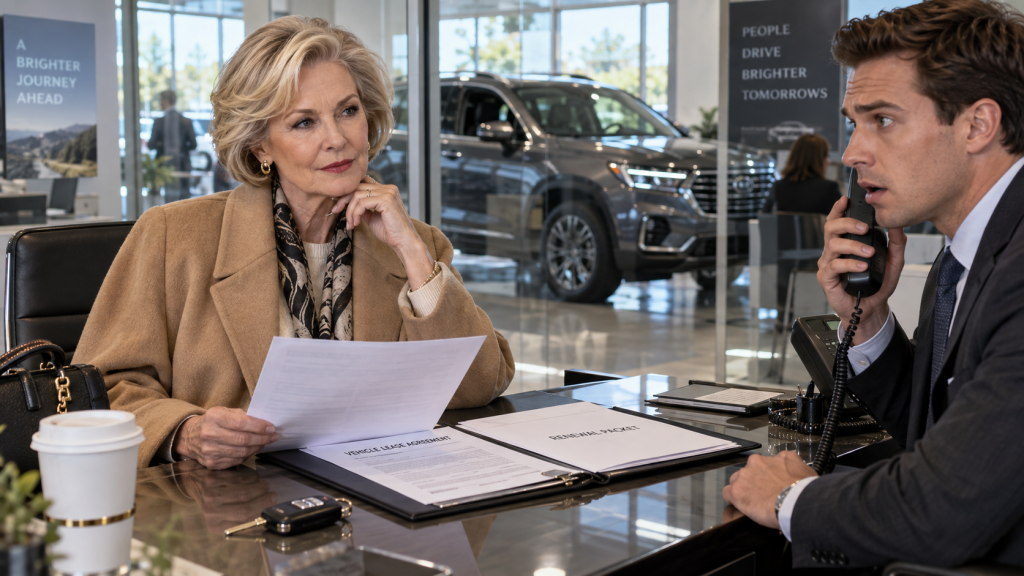
I stood beside Corbin’s desk with my coat buttoned and my purse under one arm.
“No, Grady.”
My voice surprised me with its calm.
“I think I’m finally going to find out what I’ve been paying for.”
Then I reached forward and ended the call.
Corbin looked at me.
For perhaps the sixth time that morning, he said:
“Ma’am?”
“Yes?”
“Are you all right?”
“No.”
I picked up the printed payoff request.
“But I intend to become all right.”
There are moments when being sixty-three is useful.
Not because age makes you wise automatically.
It doesn’t.
I have known seventy-year-olds with the emotional judgment of wet cardboard.
But sixty-three years had taught me something about panic.
Panic wants movement.
Truth usually wants documentation.
So I did what I had spent thirty-seven years watching angry property owners fail to do at the assessor’s office.
I slowed down.
“Corbin, I need copies.”
“Of what?”
“Everything.”
He hesitated.
“Everything related to the lease?”
“Everything related to my account.”
“Portal changes.”
“Phone calls.”
“Driver additions.”
“The payoff inquiry.”
“Any notes showing who claimed to be me or claimed to have my authorization.”
He sat straighter.
“I’ll need my manager.”
“Please get him.”
Corbin stood.
Then turned back.
“Do you want us to call your son again?”
“No.”
“Do you want us to release the vehicle to him for purchase if he comes in with financing?”
“Not through my account.”
He nodded.
“Understood.”
“And the renewal?”
“Declined.”
“Good.”
That one word hurt.
Not because I wanted the SUV.
Because for thirty-five months, six hundred twelve dollars had left my account automatically.
Thirty-five months.
Twenty-one thousand four hundred twenty dollars.
Before insurance help.
Before maintenance.
Before registration fees I had occasionally covered because Grady said:
“Mom, it’s just easier if you handle it.”
I had thought I was paying for transportation.
I was beginning to suspect I had been financing a personality.
The successful son.
The husband who provided.
The man whose wife posted photographs of “my baby” in a driveway attached to a townhouse whose deposit I had paid.
I sat back down.
My hands started shaking.
Corbin saw.
He slid a bottle of water toward me without saying anything.
Good boy.
I drank.
—
The dealership manager was named Steve Morales.
Fifty-something.
Wedding ring.
Reading glasses hanging from his collar.
He sat beside Corbin and read the screen.
His expression changed by degrees.
Concern.
Confusion.
Then the careful face businesses use when something has moved from customer-service inconvenience toward legal trouble.
“Mrs. Whitlow, I want to make sure I understand.”
“So do I.”
“The online customer portal was activated approximately eight months ago.”
“I did not activate it.”
Steve glanced at Corbin.
“Email address?”
He read it.
Not mine.
It contained my first initial, last name, and the number 63.
Clever enough.
“Phone?”
Grady’s.
“Security verification?”
He stopped.
“What?”
Steve frowned.
“The account used the last four digits of your Social Security number and your date of birth.”
I stared.
“Grady knows both.”
Steve nodded slowly.
Then:
“Dr. Nathan Cole was added as an authorized driver six weeks ago.”
“Using that portal?”
“Yes.”
“Who approved it?”
“The request indicates primary-lessee authentication.”
I laughed once.
Not because anything was funny.
“Meaning the computer believed the person logged in was me.”
“Yes.”
“And no human called me.”
“Apparently not.”
He looked uncomfortable.
Good.
He should.
Not guilty.
But uncomfortable.
Systems deserve discomfort when they make impersonation convenient.
“What about the payoff request?”
“Submitted yesterday through a partnered lender inquiry.”
“Using my Social Security number?”
“Yes.”
“Whose requested title?”
Steve read.
“Grady Whitlow and Kelsey Whitlow.”
My stomach turned.
No Nathan.
Interesting.
“Who was applying for financing?”
“Preliminary borrower profile lists you as primary, Mr. Whitlow as co-borrower.”
I went cold.
“What?”
Corbin looked at Steve.
Steve looked at me.
I repeated:
“What?”
He turned the screen.
My name.
Karen Elaine Whitlow.
My address.
My date of birth.
My Social Security number.
Then Grady.
Then requested vehicle title after payoff:
Grady and Kelsey.
I stared until the letters stopped being words.
“They wanted the loan in my name.”
Steve spoke carefully.
“That appears to be how the initial request was structured.”
“And the car in theirs.”
“Potentially, yes, depending on the final documentation.”
I leaned back.
My son had asked me to “clear up” a dealership misunderstanding.
Apparently the misunderstanding was that I still existed.
—
I left the dealership with a thick envelope.
At 10:47 a.m., I called my bank.
At 11:26, I froze my credit with all three bureaus.
At 12:04, I pulled my credit reports.
At 12:11, my stomach dropped.
There was an account I did not recognize.
Credit card.
Opened four months earlier.
Limit:
$18,000.
Current balance:
$13,462.
My name.
My Social Security number.
Mailing address:
mine.
Electronic statements:
an email I did not own.
Phone:
Grady’s.
I sat at my kitchen table.
The same table where I had paid his college application fees.
The same table where, years earlier, he sat at seventeen and told me he had wrecked his father’s old truck.
The same table where I once loaned him twelve hundred dollars for an apartment deposit and told him not to worry about paying me quickly.
I stared at the account.
There is something uniquely violating about identity theft by a stranger.
I imagine it makes the world feel unsafe.
Identity theft by your child does something different.
It makes your memories feel unsafe.
Every birthday.
Every emergency.
Every moment you handed over information because family needed forms completed.
You begin searching backward.
When did trust become inventory?
I called the card issuer.
The fraud representative verified me.
Then asked whether I recognized recent transactions.
Furniture store.
Electronics retailer.
Veterinary hospital.
Restaurants.
Two hotel stays.
A medical supply store.
Gas.
Groceries.
One expensive dinner.
I knew the restaurant.
Kelsey had posted anniversary photographs there.
Champagne.
Candles.
Caption:
My man spoils me.
Apparently my man had spoiled her with my credit score.
I pressed my fingers against my forehead.
“Ma’am?”
“I’m here.”
“Do you recognize the transactions?”
“I recognize some of what they bought.”
“That isn’t the same thing.”
“No.”
I swallowed.
“I did not authorize the account.”
She froze it.
Started a fraud case.
Asked whether I knew the likely individual responsible.
“Yes.”
The word hurt.
“Relationship?”
“My son.”
Silence.
Just half a second.
Professionals learn not to react.
Still.
I heard it.
“I’m sorry.”
“Thank you.”
Then she gave me a case number.
I wrote it neatly.
Thirty-seven years in government offices will teach you that when your life collapses, get a reference number.
—
My phone had 19 missed calls.
Grady.
Kelsey.
Grady.
Grady.
Kelsey.
A number I did not recognize.
Then a text.
Mom, do NOT report anything until we talk.
Another:
This is fixable.
Another:
You are making assumptions.
Then:
Nathan has nothing to do with this.
Interesting that he needed to say that.
Then the unknown number called again.
I answered.
“Hello?”
“Karen?”
Male voice.
Calm.
Careful.
“Who is this?”
“Nathan Cole.”
I went still.
“My alleged dead husband’s alleged son.”
He exhaled.
“That’s unfortunately accurate.”
“You have two minutes.”
“Fair.”
He paused.
“Grady told me he was going to the dealership.”
“Yes.”
“I told him to return the SUV.”
“Why?”
“Because I found out yesterday that it wasn’t his.”
I almost laughed.
“That puts you one day ahead of Kelsey.”
Another pause.
“I think Kelsey found out this morning.”
“Where are you?”
“Hospital.”
“The white sedan is yours.”
“Yes.”
“You’re a doctor.”
“Cardiologist.”
Of course.
My late ex-husband died of a heart attack.
The universe does enjoy a theme.
Nathan continued:
“I need to tell you something about Grady.”
“That sentence has become very popular.”
“I found paperwork in his office.”
My fingers tightened.
“What paperwork?”
“A personal-loan application.”
“How much?”
“Forty-five thousand dollars.”
I closed my eyes.
“Whose name?”
“Yours.”
Of course.
“Status?”
“I don’t know.”
“Lender?”
He told me.
I wrote it down.
“Why were you in his office?”
“I was using the printer.”
“Convenient.”
“I understand why you don’t trust me.”
“You understand very little about me.”
“Also fair.”
He went quiet.
Then:
“Karen, I’m not asking you to trust me.”
“I’m asking you to check.”
That sentence mattered.
Check.
Not believe.
Good.
“What is the loan for?”
“Debt consolidation, according to the form.”
“Whose debt?”
He hesitated.
“Grady’s, I think.”
“You think?”
“I only saw two pages before he took it.”
“Did you photograph them?”
“Yes.”
Smart man.
“Send them.”
“I will.”
“And Nathan?”
“Yes?”
“Do not tell Grady I’m checking.”
“He already knows I saw it.”
“Then don’t tell him what I’m doing.”
A pause.
“Okay.”
“Do you have somewhere else to stay tonight?”
“Yes.”
“Use it.”
He understood.
“I will.”
—
The personal loan existed.
Pending.
Forty-five thousand dollars.
My identity.
My address.
My inflated retirement income.
My home listed as an asset with an estimated value thirty percent too high.
That offended me professionally.
If you are going to steal a retired assessor’s identity, at least respect the market comparables.
I flagged it.
By two o’clock, I had three fraud case numbers.
Vehicle.
Credit card.
Personal loan.
I had eaten nothing.
I made toast.
Burned it.
Ate it anyway.
Then the doorbell rang.
I froze.
Not Grady.
Kelsey.
Alone.
She stood on my porch with red eyes and my blue casserole dish in her hands.
The same casserole dish she once returned at her door without letting me step inside.
For one irrational moment, I wanted to laugh.
Instead, I opened the outer screen but kept the main threshold between us.
“Kelsey.”
She held out the dish.
“I realized this is yours.”
“It was always mine.”
Her face flushed.
“Yes.”
I took it.
Did not invite her in.
She noticed.
So did I.
Sometimes life gives symmetry with no subtlety whatsoever.
“Can we talk?”
“What about?”
“Everything.”
“That’s a broad category.”
She began crying.
Not theatrical.
Messy.
“I didn’t know the car was yours.”
I watched her.
“I didn’t.”
“Grady told me he qualified for it himself.”
“Did you know I made the payments?”
“No.”
That surprised me.
“He said they came out of an old business account.”
“What business?”
“I never asked.”
There it was.
One of the quieter forms of complicity.
Not knowing because knowing might inconvenience the life you like.
She continued:
“I knew you helped sometimes.”
“Sometimes?”
She looked down.
“The townhouse deposit.”
“My dental work.”
“The vet.”
“Some utilities when things were tight.”
I folded my arms.
“You knew enough.”
“Yes.”
Her voice cracked.
“I did.”
That honesty bought her another minute.
“What else didn’t you know?”
She wiped her face.
“The credit card.”
I said nothing.
Her head snapped up.
“You found it.”
“Yes.”
“Oh God.”
“You used it?”
Her face collapsed.
“I didn’t know it was yours.”
“What did Grady tell you?”
“Business card.”
“Whose business?”
“He said he had consulting work.”
I stared.
“My son does not consult.”
“I know that now.”
“How much did you spend?”
“I don’t know.”
“Furniture?”
She nodded.
“Dog?”
“Yes.”
“Hotels?”
“Anniversary.”
Her voice broke.
“I thought he paid.”
I looked at the woman who had spent years treating me like an intrusive older relative while eating dinners financed by a credit account in my name.
Anger came.
Sharp.
Useful.
But not all of it belonged to her.
“Why are you here?”
Kelsey looked toward the street.
“Because I left him.”
I blinked.
“When?”
“This morning.”
“Where are you staying?”
“My sister’s.”
“Why?”
She laughed bitterly.
“Pick a reason.”
Then:
“He lost his job three months ago.”
I stopped breathing.
“What?”
“He didn’t tell you?”
“No.”
“He didn’t tell me either.”
I stared.
Kelsey continued.
“He got laid off.”
“He kept leaving the house at eight-thirty.”
“Laptop bag.”
“Coffee.”
“Everything.”
“He’d work from cafés or Nathan’s hospital lobby sometimes.”
“Come home after five.”
“He pretended.”
My stomach turned.
“What did you think was paying the bills?”
“His severance.”
“Consulting.”
“Credit.”
“I don’t know.”
She covered her face.
“I sound so stupid.”
“Careless.”
I corrected.
She looked up.
“Not stupid.”
“Careless.”
Her eyes filled.
“That’s fair.”
“What happened to his severance?”
“No idea.”
“His savings?”
“Gone.”
“Why?”
Kelsey hesitated.
“Crypto.”
Of course.
“How much?”
“He told me seventeen thousand.”
I almost laughed.
“From where?”
“Part of the money his dad left him.”
Paul.
My ex-husband.
Dead twelve years.
Still somehow funding bad decisions.
“What about Nathan?”
Kelsey stiffened.
“He really is Grady’s brother.”
“You believe that?”
“I’ve seen the DNA test.”
“And you thought I knew?”
“Yes.”
Her answer was immediate.
“Grady told me you knew years ago.”
My mouth fell open.
“Years?”
“He said you found out after Paul died and wanted nothing to do with Nathan.”
I laughed.
Then couldn’t stop.
Not because it was funny.
Because my son had built entire alternate versions of me for different audiences.
To Kelsey, I was the bitter ex-wife who rejected Paul’s secret child.
To Nathan, apparently I was—
“What did Grady tell Nathan about me?”
Kelsey looked uncomfortable.
“That you were fragile.”
I stopped laughing.
“Fragile?”
“After retirement.”
“He said you had trouble letting go.”
“And that paying for things made you feel needed.”
That one landed.
Because it contained truth.
Not enough to excuse what he did.
Enough to hurt.
Kelsey continued.
“He said if he didn’t let you help financially, you’d feel rejected.”
I stared at her.
That bastard.
Not because it was completely false.
Because he had taken my vulnerability and converted it into consent.
I had liked helping.
I liked being useful.
I hated the possibility that once Grady married, there would be less room for me.
So yes.
Sometimes I offered money too quickly.
Sometimes I brought food because knocking with something in my hands felt easier than saying:
I miss you.
Can I come in?
But wanting to help is not authorization to steal.
Generosity is not a password.
“You asked him to tell me not to come over.”
Kelsey closed her eyes.
“Yes.”
“Why?”
“Because you came by without asking.”
“Twice.”
“Yes.”
“And?”
She looked ashamed.
“Because I felt like the townhouse never became mine.”
I stared.
“You came over with groceries.”
“Casseroles.”
“You’d rearrange things.”
“I moved one chair.”
“It was my chair.”
Fair.
I almost smiled despite myself.
Kelsey continued.
“I wanted boundaries.”
“Then why didn’t you talk to me?”
“I complained to my husband.”
“And he converted that into exile.”
She nodded.
“Yes.”
Then:
“And I let him.”
Good.
She was not running.
“I’m sorry.”
I looked at the casserole dish in my hands.
“I believe you are.”
She waited.
“But I’m not ready to comfort you.”
Her eyes filled.
“That’s fair.”
“Do you know about the personal loan?”
“No.”
“Forty-five thousand.”
Her face went white.
“In my name.”
“Oh my God.”
“And a vehicle payoff request.”
She covered her mouth.
“Karen…”
“No.”
I stopped her.
“Go take care of yourself.”
“What are you going to do?”
“What I should have done the first time money stopped matching the story.”
“Look.”
She nodded.
Then turned to leave.
“Kelsey.”
She looked back.
“Did Nathan have anything to do with the fraud?”
“I don’t think so.”
“Why?”
“Because he is the one who showed me the loan application.”
That mattered.
Then she said:
“And Karen?”
“Yes?”
“The hospital car?”
“Nathan’s.”
“No affair.”
Despite everything, I laughed.
“Thank God.”
Kelsey actually smiled.
“Low bar.”
“Very.”
She walked away.
I stood on my porch holding a casserole dish.
For the first time, I understood that the biggest problem in my son’s house was not his wife.
That disappointed a part of me.
Blaming daughters-in-law is convenient.
The truth was less flattering.
Grady was my son.
He had learned some of his worst habits somewhere.
And I intended to understand which ones I had accidentally taught.
—
Nathan met me the next morning at a diner.
Public.
Ten o’clock.
He brought a folder.
I liked him slightly more for that alone.
Tall.
Dark hair touched with gray.
Paul’s eyes.
That was difficult.
My ex-husband, Paul Whitlow, had been dead twelve years.
We had divorced six years before that.
Not because of another woman.
At least not officially.
We fought about money.
Drinking.
His endless promises to become someone next month.
Nathan sat across from me.
He looked nervous.
“You look like him.”
I said.
His face tightened.
“I’ve been told.”
“How old are you?”
“Thirty-seven.”
Grady was thirty-nine.
My stomach turned.
Paul and I had been married.
Not separated.
Not struggling vaguely.
Married.
Toddler.
Mortgage.
Family portraits.
All of it.
“Your mother?”
“Diane Cole.”
I knew the name.
Receptionist at a medical-supply company Paul once serviced.
Christmas cards.
Company picnic.
A brunette who wore red lipstick.
Memory is cruel when given new information.
“Did she know about me?”
Nathan looked down.
“Yes.”
Good.
At least no comforting lie.
“How long were they involved?”
“I don’t know exactly.”
“Months?”
“I think about a year.”
My hands tightened around the coffee cup.
“And you?”
“Did not know his name until after my mother died.”
“When?”
“Eighteen months ago.”
“She told you?”
“Letter.”
He slid a photocopy toward me.
I did not read it.
Not yet.
“I did ancestry testing.”
Nathan continued.
“Grady matched.”
“As a half brother.”
“Yes.”
“Then private DNA?”
“Yes.”
He handed me the result.
Probability overwhelming.
No ambiguity.
Paul’s son.
Grady’s brother.
My life acquiring another branch after sixty-three.
“Why contact Grady?”
Nathan looked genuinely puzzled.
“Because I had a brother.”
Simple.
Human.
That softened something.
Then:
“And medical history.”
“You’re a cardiologist.”
“Yes.”
“Paul died of a heart attack.”
“Yes.”
Nathan smiled sadly.
“Useful family information in my profession.”
I almost smiled.
Almost.
“When did you contact Grady?”
“Seven months ago.”
“What did he tell you about me?”
Nathan exhaled.
“That you knew.”
“False.”
“I know.”
“That you never wanted to meet me because you blamed my existence for your divorce.”
“Also false.”
“I know.”
“That you were emotionally fragile after retirement.”
I rolled my eyes.
Nathan almost laughed.
“He said you had spent years helping him financially because you needed to feel needed.”
“That part is complicated.”
He nodded.
“Most true things are.”
Interesting man.
“Why stay at his house?”
“I transferred to St. Vincent’s six weeks ago.”
“My apartment renovation is delayed.”
“Grady offered the guest room.”
“Kelsey knew who you were?”
“Yes.”
“But thought I knew.”
“Yes.”
“Why were you added to my SUV?”
Nathan rubbed his forehead.
“My car went into the shop.”
“Transmission issue.”
“Grady said his SUV insurance required adding me if I drove it.”
“He logged into something on his laptop.”
“I assumed it was his.”
“You drove it?”
“Twice.”
I stared.
“Congratulations.”
“You have driven Karen Whitlow’s vehicle more recently than Karen Whitlow.”
He laughed once.
“I’m sorry.”
“You didn’t know.”
“No.”
“How did you learn?”
“The dealership called Kelsey Thursday.”
“She asked Grady why his mother was the primary lessee.”
“He told her it was an old technicality.”
“I asked him later.”
“He got angry.”
“Then I found the loan paperwork.”
“Forty-five thousand.”
“Yes.”
“Did he tell you what it was for?”
Nathan looked uncomfortable.
“Debt.”
“What debt?”
“He has several cards.”
“Personal loan.”
“Possibly back taxes.”
“And?”
Nathan hesitated.
“Gambling?”
I stared.
“What kind?”
“Sports apps.”
My son.
Paul had liked casinos.
Victor from prior story irrelevant.
Genetics is not destiny.
Still, patterns enjoy echoes.
“How much?”
“I don’t know.”
“Enough that he was panicking.”
Nathan continued.
“He said the SUV buyout would help.”
“How?”
“He believed owning it would let him refinance or sell later.”
“With my credit.”
“Yes.”
Then:
“He said you would sign eventually.”
There it was.
Again.
I leaned back.
“Exact words?”
Nathan hesitated.
“Mostly.”
“Exact enough.”
“He said: ‘Mom always signs when family needs something.’”
The waitress arrived.
Asked whether we wanted anything else.
I nearly said a different son.
Instead:
“No, thank you.”
When she left, Nathan said:
“I’m sorry.”
“You’re apologizing often for someone who did not do this.”
“I knew for two days.”
“Two days is not thirty-five months.”
He looked down.
Then:
“I also knew he was lying to Kelsey about his job.”
That mattered.
“How long?”
“About three weeks.”
“Why didn’t you tell her?”
“He said he was going to.”
“You believed him?”
“No.”
Nathan’s face tightened.
“I told myself it wasn’t my marriage.”
Convenient.
Human.
“Fair.”
He looked surprised.
“Not good.”
I clarified.
“Fair.”
“I’m trying to distinguish.”
He nodded.
Then:
“I’m moving into a hotel today.”
“Good.”
“What happens with us?”
That caught me.
“There is no us.”
He looked hurt.
Not offended.
Just hurt.
I continued:
“Not yet.”
He nodded slowly.
“You are Paul’s son.”
“Yes.”
“You are Grady’s brother.”
“Yes.”
“You are not responsible for how you were born.”
His eyes filled.
That was when I realized how much shame he carried for someone else’s affair.
I hated Paul a little more.
Then hated myself for aiming anger through a dead man at a living son.
“Your mother made choices.”
I said.
“Paul made choices.”
“You did not.”
Nathan swallowed.
“Thank you.”
“Do not thank me for basic biology.”
He smiled.
Then I added:
“You are also not my son.”
“I know.”
“But I don’t hate you.”
He looked down.
“That’s more than I expected.”
I understood.
Secrets train people to expect punishment.
—
The police report was harder than the bank calls.
Fraud department.
Identity theft.
Unauthorized account.
I provided documents.
Texts.
Dealer records.
The personal loan application.
I did not ask them to “go easy.”
I did not ask them to “throw the book.”
I told the truth.
That became my rule.
Grady came to my house the same evening.
I saw his car pull up.
Not the SUV.
An Uber.
Interesting.
The dealership had received the vehicle back that afternoon.
Kelsey drove it there.
Grady apparently refused at first.
Then discovered refusal did not manufacture ownership.
He rang my bell.
I opened the door but kept the screen locked.
He looked terrible.
Unshaven.
Eyes red.
“Mom.”
That word.
Always.
“Hi, Grady.”
“Can I come in?”
“No.”
He stared.
“You’re serious?”
“Yes.”
“This is my childhood home.”
“No.”
I said.
“It’s my house.”
He flinched.
Good distinction.
“What do you want?”
“I need to talk.”
“Talk.”
“Not through a screen.”
“Then stand on the porch.”
He laughed bitterly.
“Jesus.”
I waited.
He put both hands on his hips.
“You reported me.”
“Yes.”
“I’m your son.”
“Yes.”
“You could destroy my life.”
I looked at him.
“Did you open a credit card in my name?”
Silence.
“Did you?”
“Yes.”
There.
“Did you apply for a forty-five-thousand-dollar personal loan using my identity?”
He looked away.
“It wasn’t funded.”
“That is not an answer.”
“Yes.”
“Did you use my Social Security number on the vehicle payoff?”
“Yes.”
“Did you add Nathan to my lease through a portal created under my identity?”
He swallowed.
“Yes.”
I nodded.
“Then I did not create the facts I reported.”
He laughed bitterly.
“You’ve been talking to Kelsey.”
“Yes.”
“She left.”
“I know.”
“She’s acting like she’s innocent.”
“She isn’t.”
That surprised him.
“I’m not choosing Kelsey.”
“I’m choosing facts.”
He looked exhausted.
“Mom, I was going to pay it.”
“With what job?”
His face changed.
There.
Kelsey had told me.
“You lost your job three months ago.”
He looked away.
“Downsizing.”
“Why hide it?”
“Because everyone already thinks I’m a failure.”
I stared.
“Who is everyone?”
“Kelsey.”
“You.”
“Nathan shows up as a cardiologist.”
“Dad’s secret son.”
“My wife thinks I have my life together.”
“My mother thinks I need rescuing.”
His voice cracked.
“I didn’t know how to be the one who lost everything.”
There was my boy inside the thief.
That is the terrible thing about parenthood.
Even when the adult child does something unforgivable, you can often still see the eight-year-old face under it.
I almost opened the door.
Almost.
Then remembered the account.
My Social Security number.
The anniversary dinner.
“No.”
I whispered.
Grady stared.
“What?”
“You did know how to be the one who lost things.”
“You just decided I should lose them for you.”
His face broke.
“Mom.”
“No.”
My eyes filled.
“I will listen.”
“I will even help you find information for an attorney if you need it.”
“I will not pay the attorney.”
“I will not lie to the bank.”
“I will not say I authorized anything.”
“I will not repay your debts.”
“I will not save your marriage.”
“I will not renew the car.”
His breathing sharpened.
“So that’s it?”
“No.”
I cried.
“That is what love looks like now.”
He laughed angrily.
“That’s not love.”
I looked through the screen at the man I raised.
“What do you think love is?”
He opened his mouth.
Nothing.
I continued.
“Money?”
“Signing?”
“Paying?”
“Fixing?”
“Because if that is how you learned love from me, then I helped create this.”
His face changed.
I had surprised him.
Maybe myself too.
“I paid because it made me feel useful.”
I said.
“After your father died, after you married, after I retired—every time your life moved farther from mine, there was another thing I could help with.”
“Car.”
“Deposit.”
“Vet.”
“Dental work.”
“Bills.”
“I told myself I was generous.”
“And I was.”
Tears ran down my face.
“But I was also afraid.”
“Afraid of what?”
“That if you stopped needing me, you’d stop wanting me.”
Grady stared.
I laughed softly.
“Turns out I financed that fear very efficiently.”
His eyes filled.
“Mom…”
“And you learned it.”
My voice broke.
“You learned that access to you could be priced.”
“Maybe not consciously.”
“But you knew if I kept paying, I would tolerate being treated like an inconvenience.”
The casserole dish.
The blocked social media.
Maybe holidays.
We’ll see.
I wiped my face.
“You asked me to stay away from your house while expecting me to keep paying for the vehicle parked in front of it.”
Grady began crying.
Actually crying.
Not persuasion.
Pain.
“I’m sorry.”
“I know.”
“Can you forgive me?”
“Not tonight.”
He flinched.
That answer hurt us both.
Honesty often does.
He stood there another minute.
Then:
“Where am I supposed to go?”
“Kelsey left.”
“Townhouse rent is due.”
“I don’t have the SUV.”
Old reflex.
I felt it rise.
How much?
What do you need?
I swallowed.
“You’ll figure it out.”
He stared.
Then nodded.
For the first time in his adult life, my son left my house carrying a problem I did not pick up.
I shut the door.
Then slid down against it and sobbed.
Boundaries are sometimes described like victory.
They are often grief with better posture.
—
The legal outcome took months.
Nothing cinematic.
No handcuffs in my driveway.
No judge pounding a gavel while I delivered a speech.
Real life preferred paperwork.
The unfunded personal loan helped.
So did the frozen vehicle transaction.
The credit-card balance was real financial loss, but much of it was eventually assigned to Grady through fraud resolution and restitution arrangements.
He faced criminal charges related to identity misuse and fraudulent applications.
He accepted a plea.
Probation.
Restitution.
Financial counseling.
Restrictions.
Community service.
No prison epic.
No destroyed life.
Consequences.
Enough to make his choices official.
That mattered.
When his attorney asked whether I wanted to write a victim-impact statement, I did.
Three pages.
Then deleted two.
The final version said:
I do not want my son destroyed. I also do not want what he did renamed as borrowing simply because we are related. I gave him money many times willingly. The accounts at issue were different because he removed my ability to choose. That distinction is the harm.
I read it once.
Submitted it.
No dramatic adjectives.
No revenge.
Choice.
That became the center of everything.
—
Kelsey filed for divorce.
She and I spoke twice during the process.
The first time, she apologized again.
Not for Grady.
For herself.
“I treated your generosity like it was his success.”
She said.
“I let him take credit because the version where my husband provided everything felt better.”
I nodded.
“That makes sense.”
She looked surprised.
“It doesn’t make it right.”
“No.”
She smiled sadly.
“Right.”
Then:
“I’m sorry I made you feel unwelcome.”
I thought about the casserole dish.
“My visiting without notice bothered you.”
“Yes.”
“You were allowed to be bothered.”
Her eyes filled.
“I could have talked to you.”
“Yes.”
“I asked Grady to create the boundary because I didn’t want to feel like the bad guy.”
“Yes.”
“And when he made it harsher, part of me liked it.”
There.
Honest.
“I’m sorry.”
“I believe you.”
That was enough.
We did not become friends.
People sometimes think every apology should restore a relationship.
No.
Some apologies are simply the last clean stone placed at the end of a road.
Kelsey remarried years later.
I heard through her sister.
I hoped she was happy.
No sarcasm.
I did.
—
The question of Nathan lasted longer.
He moved into his apartment.
We met for coffee occasionally.
At first, because I had questions about Paul.
Then because I discovered Nathan was interesting even when my dead ex-husband was not being discussed.
That mattered.
He had grown up believing his father abandoned him intentionally.
Diane never contacted Paul after Nathan turned three.
Why?
Shame.
Fear.
Another relationship.
Nathan’s letter from his mother revealed Paul had sent money privately for several years.
Not consistently.
Not honorably.
But he knew Nathan existed.
That hurt.
I went to Paul’s grave after learning that.
Stood there in a coat too thin for November.
“You really were an idiot.”
I said.
No answer.
Typical.
“You let me divorce you thinking money and drinking were the worst things.”
Nothing.
“I would have liked the full list.”
Wind.
Dead men are terrible at accountability.
Then I whispered:
“Nathan is good.”
That surprised me.
He was.
Paul’s betrayal produced a person.
That person was not the betrayal.
I learned to separate those.
Slowly.
One afternoon, Nathan asked:
“Do you wish I hadn’t contacted Grady?”
I thought.
“If you hadn’t, I might still be paying for the SUV.”
He laughed.
Then:
“That bad?”
“No.”
I looked at him.
“I wish Paul had told the truth.”
“That is different.”
He nodded.
We understood each other.
Nathan never called me Mom.
Thank God.
I was not his mother.
But he came to Thanksgiving eventually.
Sat beside Grady once their relationship recovered enough.
That dinner was strange.
Paul’s two sons arguing over football while I served potatoes.
Life has no respect for tidy family trees.
—
Grady’s relationship with Nathan broke before it improved.
At first, Grady called him a traitor.
“You went to my mother.”
Nathan answered:
“You stole her identity.”
Difficult to debate.
They did not speak for eight months.
Then Grady called Nathan after a panic attack.
Nathan drove him to urgent care.
Brothers.
Apparently blood sometimes survives truth better once it stops depending on secrecy.
Their relationship became ordinary after that.
Not perfect.
Better.
They disagreed.
Texted.
Watched games.
Nathan refused to lend him money.
That delighted me.
Healthy family.
—
Grady’s financial life became much smaller.
Good.
He moved into a one-bedroom apartment above a laundromat.
No luxury SUV.
No townhouse.
No anniversary restaurants on stolen credit.
He took a warehouse logistics job.
Lower status than his previous position.
Steady.
He rode the bus for nine months.
The first time he complained, I almost said:
I’ll help you buy something.
The sentence reached my teeth.
Stopped.
“Buses are annoying.”
I said instead.
He stared at me.
“You’re enjoying this.”
“No.”
“Maybe three percent.”
He laughed despite himself.
That was progress.
Eventually he bought a twelve-year-old sedan.
Cash.
His money.
He sent me a photograph.
First car I’ve actually owned.
I stared at the message.
Then typed:
Looks reliable.
He replied:
It’s ugly.
I wrote:
Character building.
For the first time in nearly a year, he sent a laughing emoji.
I cried afterward.
Not because of the car.
Because the conversation contained no request.
—
Restitution took three years.
Grady paid monthly.
Sometimes late.
Then caught up.
I did not monitor every payment obsessively.
The system did.
Another important distinction.
At the final payment, he called.
“Done.”
I knew what he meant.
“How does it feel?”
“Expensive.”
I laughed.
Then he said:
“Good.”
I went quiet.
“Good?”
“Yeah.”
He sighed.
“For a long time, I thought the punishment was that I had to pay you back.”
“What changed?”
“I realized the punishment was knowing why I owed it.”
That was growth.
Ugly.
Earned.
Then:
“I’m sorry.”
Not the first apology.
Different.
“I know.”
“Do you forgive me?”
Years earlier:
Not tonight.
Now I thought.
Forgiveness is a dangerous word when people mistake it for reinstating privileges.
But we had already rebuilt boundaries.
No shared debt.
No borrowed credit.
No automatic rescue.
No hidden accounts.
Forgiveness had nowhere dangerous to go.
“Yes.”
Silence.
“Really?”
“Yes.”
Then:
“But I’m still never co-signing.”
He laughed.
“I would rather walk.”
“Excellent.”
That was enough.
—
I redirected the six hundred twelve dollars.
At first, into savings.
Every month.
Same date the SUV payment used to leave.
I watched the balance grow.
It felt ridiculous.
Then liberating.
After six months, I booked Savannah with two retired coworkers.
After Savannah, Charleston.
Then a train trip through New England.
I bought a coat that cost more than I usually allowed myself.
Not absurd.
Nice.
When the saleswoman asked:
“Gift?”
I said:
“Yes.”
“For who?”
I smiled.
“Me.”
That was harder than expected.
For decades, discretionary money moved outward.
Grady.
Family.
House.
Emergency.
Retirement taught me something unpleasant.
If you spend a lifetime proving love through usefulness, leisure can feel immoral.
So I practiced.
Lunch alone.
Museum membership.
Pottery class.
I was terrible.
Absolutely terrible.
My first bowl looked like something excavated from a collapsed civilization.
I kept it.
Progress.
—
I also volunteered once a week at a community financial-assistance clinic.
Property tax.
Credit disputes.
Senior benefits.
The kind of bureaucracy I understood.
One afternoon, a seventy-one-year-old woman named Teresa came in with a stack of credit-card notices.
Her daughter had been “helping with finances.”
There were accounts Teresa did not recognize.
Her hands shook.
“I feel stupid.”
That sentence hit me.
“No.”
She looked up.
“You trusted your child.”
I said.
“That is not stupidity.”
Tears came.
“But now that you know something is wrong, we deal with what is true.”
We froze her credit.
Made calls.
Created a list.
Before she left, she hugged me.
I drove home and sat in my car for ten minutes.
Sometimes the thing that nearly breaks you becomes useful later.
That does not make the breaking worthwhile.
Still.
Useful.
—
Five years after the dealership, Grady called me on a Tuesday.
I noticed the day immediately.
Tuesday.
Of course.
“Mom.”
“Hi.”
“You busy Sunday?”
“Why?”
“I’m moving.”
“To where?”
“Better apartment.”
“Congratulations.”
“I need help.”
Old electricity.
My shoulders tightened.
“How much?”
Silence.
Then Grady laughed.
“No money.”
I exhaled.
He heard.
“Wow.”
“Sorry.”
“No.”
He sounded amused.
“Fair.”
“What do you need?”
“Lease review.”
I smiled.
“You read it?”
“Twice.”
I nearly fell off the chair.
“Who are you?”
“Probation made me literate.”
“Dark.”
“Accurate.”
He emailed the lease.
I reviewed it.
Sunday, I went over.
Invitation.
Specific time.
Imagine that.
He made pasta.
Poorly.
On the table sat my blue casserole dish.
I stared.
“How did you get that?”
“You left it here last month.”
“I did not.”
“You brought brownies.”
“Then that means you borrowed it.”
He smiled.
“May I return it after dinner?”
I pointed at him.
“Look at you.”
“What?”
“Consent.”
He groaned.
“Please stop making fraud educational.”
“No.”
We ate.
No invoice.
No money conversation.
Just dinner.
At one point, Grady said:
“I really thought the SUV was mine.”
“I know.”
“No.”
He smiled sheepishly.
“I mean genuinely.”
“I paid for gas.”
“Insurance sometimes.”
“I washed it.”
“I had the keys.”
“I thought those things meant ownership.”
I leaned back.
“People confuse possession with ownership every day.”
“Assessor lecture?”
“Free of charge.”
He laughed.
Then grew serious.
“I think I did that with you too.”
My chest tightened.
“What do you mean?”
“You were always there.”
“So I thought your money was always there.”
“Your signature.”
“Your help.”
“Like access was ownership.”
I stared.
That was better insight than anything I had hoped for.
Then:
“And when Kelsey asked for privacy, I treated your presence like something we could turn off but keep the benefits running.”
My eyes filled.
“Yes.”
“I’m sorry.”
“I know.”
He reached across the table.
Not for money.
My hand.
I gave it.
—
Kelsey once wrote me a letter years after the divorce.
One line stayed.
I wanted your help without wanting your presence, and I let Grady convince me those things could be separated without hurting you.
True.
I wrote back:
Thank you for understanding that now. I hope your life is peaceful.
Nothing else.
No reopening.
Peace does not require reentry.
—
Nathan became the strangest gift left behind by Paul’s worst secret.
I would never say that to him.
Too sentimental.
But it was true.
When my blood pressure medication changed, Nathan explained the side effects.
When I needed a cardiology consult, he refused to treat me himself but found someone excellent.
When Grady relapsed briefly into online sports betting two years after probation, Nathan was the one who noticed and confronted him before I even knew.
Grady enrolled in a support program.
Did not ask me for money.
That mattered more than relapse itself.
One evening, Nathan and I sat on my porch.
He said:
“Do you ever hate my mother?”
I thought.
“Sometimes.”
He laughed.
“Thanks.”
“I never met her enough to know her.”
“I hate what she did with Paul.”
“That’s different.”
He nodded.
Then:
“Do you hate him?”
“Paul?”
“Yes.”
I thought about a man dead nearly twenty years.
A bad husband in some ways.
Good father to Grady in others.
Absent father to Nathan.
Funny.
Weak.
Generous in bursts.
Dishonest in others.
“No.”
I said.
“I ran out of energy.”
Nathan smiled.
“That sounds healthier than forgiveness.”
“Do not quote me.”
He laughed.
Family, adjacent.
Complicated.
Real.
—
When I turned sixty-nine, I sold my house.
Too much yard.
Too many stairs.
Too many memories stored in closets like receipts.
I bought a smaller condo near a park.
At closing, Grady and Nathan came.
Not because I needed them.
Because they asked.
The closing agent slid a stack of paperwork toward me.
“Sign here.”
I picked up page one.
Started reading.
Grady groaned.
Nathan laughed.
“She will read everything.”
The agent smiled.
“I encourage it.”
I looked over my glasses at Grady.
“You hear that?”
“Yes, Mom.”
“Professionals encourage reading.”
“I committed one financial felony and now every document becomes a lecture.”
“Correct.”
Nathan said:
“Could be worse.”
Grady looked at him.
“Whose side are you on?”
“Karen’s.”
“Traitor.”
“Historically, yes.”
We laughed.
I read every page.
Then signed.
My name.
My choice.
No one else typed it.
No one else assumed.
You cannot understand how satisfying an ordinary signature can become until somebody once treated yours as communal property.
—
Years later, I found the original SUV renewal packet in a file box.
I had forgotten it.
Page one.
My name.
Page four.
Dr. Nathan Cole.
The blank renewal signature line.
Still blank.
I sat at the kitchen counter.
For a moment, I was sixty-three again.
Good coat.
Dealership.
Corbin saying ma’am.
My son’s voice on speaker.
That car is basically mine.
I smiled.
Then put the packet through the shredder.
Not ceremony.
Housekeeping.
Very assessor of me.
The machine chewed Nathan’s unauthorized driver listing.
Then the renewal line.
Then the terms.
Paper strips fell into the bin.
I made tea.
Nothing exploded.
Some endings are gloriously administrative.
—
Grady eventually remarried.
Years later.
Her name was Elise.
She knew everything.
He told her before their engagement.
Not because I demanded it.
Because secrecy had cost him enough.
The first time she met me, she said:
“I’ve heard about the SUV.”
I closed my eyes.
“Of course you have.”
She smiled.
“He calls it the most expensive car he never owned.”
I liked her immediately.
Not because she flattered me.
Because she teased him without cruelty.
When they married, I paid for nothing except my own dress and a gift.
Grady never asked.
That felt strange.
Good strange.
At the reception, he danced with me.
Halfway through, he whispered:
“You know I used to think if you weren’t paying for something, you were mad.”
My throat tightened.
“Why?”
“Because money was how we talked.”
That hurt because it was true.
“What do we talk with now?”
He smiled.
“Mostly complaints about my back.”
“Genetics.”
“Paul?”
“Probably.”
He laughed.
Then:
“I’m glad you stopped.”
I looked at him.
“At the time, I hated you.”
“I know.”
“I thought you abandoned me.”
“I know.”
He swallowed.
“But you were the first person who stopped making it easy for me to keep lying.”
My eyes filled.
“That isn’t a mother’s favorite achievement.”
“No.”
He smiled.
“But it might be one of your best.”
We finished the dance.
No money changed hands.
—
I am seventy-one now.
Grady is forty-seven.
Nathan forty-five.
Elise makes excellent lemon cake.
Grady still drives used cars.
Nathan still drives the white sedan sometimes, because apparently cardiologists hate replacing vehicles until the wheels fall off.
My blue casserole dish continues migrating through the family without permission, which proves none of us learned everything.
On Sundays, people come over.
By invitation.
Sometimes Grady.
Sometimes Nathan.
Sometimes both.
Sometimes nobody.
And that is important too.
Silence no longer means rejection.
A quiet house is not evidence I have become useless.
It is a quiet house.
I wish I had known that at sixty-three.
I might have saved myself twenty-one thousand dollars and several casseroles.
—
Last month, Grady arrived carrying groceries.
He put them on my counter.
“What do I owe you?”
I asked automatically.
He stared.
“Nothing.”
I smiled.
“Just checking.”
“You are never letting this go.”
“No.”
“Fair.”
He unloaded coffee.
Bread.
Fruit.
Then a little package of yogurt.
Same brand I used to buy him when he was a child.
I held it up.
“What is this?”
“You like it.”
“I do.”
“Then eat it.”
No invoice.
No leverage.
No unspoken debt.
Just yogurt.
It nearly made me cry.
Age is ridiculous.
—
People ask whether reporting Grady was the hardest thing I ever did.
No.
The hardest thing was allowing him to experience the consequences after the report.
A report is one decision.
Not rescuing someone is a thousand.
When his rent was due.
When Kelsey left.
When he took the bus.
When he complained about his legal fees.
When he could not afford the newest phone.
When he said:
“I’m scared.”
I had to learn to answer:
“I know.”
Instead of:
“How much?”
That was harder.
Because money had been my way of converting helpless love into action.
Action feels better.
Sitting beside someone while they solve their own problem feels passive.
It isn’t.
Sometimes it is the most disciplined form of love available.
—
I also had to forgive myself.
Not for what Grady did.
That belongs to him.
For what I taught accidentally.
I taught him that Mom could always bridge the gap.
A hundred dollars.
A thousand.
A deposit.
A lease.
A dental bill.
A vet.
I rarely asked:
What happens if I don’t?
I thought asking would make generosity ugly.
Instead, never asking made entitlement invisible.
I know better now.
If I give, I know why.
If I lend, we write it down.
If I cannot afford to lose it, I do not call it a gift.
If somebody becomes angry because I ask for clarity, that is information.
Retirement taught me more about valuation than thirty-seven years at the assessor’s office.
Some things cost money.
Others cost self-respect.
Do not confuse the cheaper one.
—
Nathan once asked me if I regretted knowing.
About Paul.
About him.
About all of it.
We were at lunch.
I thought for a long time.
“No.”
“Even the affair?”
“I regret Paul did it.”
“I don’t regret knowing.”
“Why?”
“Because truth does not become kinder because it arrives late.”
Nathan nodded.
Then:
“Grady says finding me ruined everything.”
I smiled.
“Grady used to say a lot of things.”
“Now?”
“Now I think finding you exposed what was already weak.”
Nathan looked down.
“I’m sorry.”
“Stop apologizing for existing.”
He smiled.
“You’ve said that before.”
“Apparently repetition is necessary in this family.”
—
The white sedan eventually died.
Transmission.
Finally.
Nathan called.
“Karen, I need advice.”
I froze theatrically.
“How much?”
He laughed.
“Not money.”
Good family joke now.
“What?”
“Car.”
“I’m buying one.”
“Should I lease?”
I nearly hung up.
“Absolutely not.”
He laughed for thirty seconds.
Then bought a used Volvo.
In his own name.
I checked.
Of course I checked.
—
Sometimes I think about the exact sentence Grady said at the dealership.
Mom always signs when family needs something.
For years, that sentence made me furious.
Now it mostly makes me sad.
Because he was not inventing the pattern.
He was abusing it.
Different.
I had signed.
Again and again.
Permission slips.
Loans.
Lease documents.
Checks.
Emergency transfers.
Every signature came from love.
But a pattern of yes can never replace an individual yes.
That is what Grady forgot.
That is what I forgot too.
Consent does not accumulate.
Yesterday’s yes is not tomorrow’s authorization.
Not in money.
Not in access.
Not in relationships.
You ask again.
That is respect.
—
My son once told me:
“Maybe holidays. We’ll see.”
At the time, those words broke something.
I heard:
You matter when convenient.
Perhaps that was what he meant.
Perhaps he was trying to appease Kelsey and chose cruelty because it required less courage than an honest boundary conversation.
Either way, I stopped buying an invitation.
That changed everything.
Not immediately.
First, it made things worse.
Usually, when a system depends on your compliance, withdrawing compliance feels like an attack.
Grady panicked.
Kelsey panicked.
I panicked.
Then the truth had room.
The car was mine.
The credit was mine.
The debts were his.
The choices were theirs.
The relationship could finally become something other than a payment arrangement.
Eventually.
—
If I could go back to that Tuesday afternoon, I would still say:
“I understand.”
I would still hang up.
I would still put the lease renewal in the drawer.
Unsigned.
But I would tell that sixty-three-year-old woman one thing before she spent Thursday driving past a townhouse wondering why she was not welcome.
Karen, you are allowed to be hurt before you are useful.
You do not need to turn pain immediately into another payment.
You do not have to prove generosity to earn a chair in your son’s home.
And when Friday comes and you learn that the lease, the credit card, the personal loan, and the truth are all more complicated than you imagined, do not confuse consequences with revenge.
You are not taking his life away.
You are giving his choices back to him.
He may hate the weight at first.
Let him carry it.
Adults become adults partly by discovering their own problems do not disappear simply because their mothers love them.
—
The SUV was never really the story.
Cars depreciate.
Leases end.
Paint scratches.
Tires wear.
That part was simple.
The real story was ownership.
Who owned the debt?
Who owned the consequences?
Who owned my time?
Who owned my signature?
Who owned the right to decide where my money went?
For too long, the answer inside my family had quietly become:
Everyone, as long as they needed something.
No.
My son could ask.
My daughter-in-law could ask.
Nathan could ask.
Friends could ask.
I could say yes.
Or no.
The answer had to belong to me before the generosity meant anything.
That was what I finally reclaimed.
Not an SUV.
Choice.
—
Last Sunday, Grady arrived late.
Eight minutes.
I pointed at the clock.
“Terrible.”
“Traffic.”
“Excuses.”
He kissed my cheek.
Then handed me the blue casserole dish.
Again.
“What now?”
“Baked ziti.”
“Yours is terrible.”
“Elise made it.”
“Excellent.”
He rolled his eyes.
Nathan came twenty minutes later carrying salad.
We ate.
They argued about football.
I told them both they were loud.
At one point, Grady leaned back and looked around my condo.
“Mom?”
“Yes?”
“Do you remember that dealership?”
I laughed.
“Unfortunately.”
“Sometimes I think about what would have happened if you had just signed.”
The room became quieter.
Nathan looked at me.
I thought.
“I would have renewed the car.”
Grady nodded.
“You probably would have asked me for help with the credit card later.”
“Yeah.”
“Then the loan.”
He looked down.
“Probably.”
“And I would have kept thinking being needed meant being close.”
Grady swallowed.
“Yeah.”
I looked at him.
“We would have loved each other.”
“I think.”
“But badly.”
His eyes filled.
“That’s exactly it.”
I reached across the table.
He took my hand.
No one needed a speech.
We already had dinner.
We already had years.
We already had the thing I had tried to buy with every payment.
Presence.
Freely given.
—
When my son told me to stop coming to his house, I thought the punishment was losing access to him.
It wasn’t.
It was discovering I had been paying for access that was never guaranteed.
The strange gift came later.
Once the money stopped, I learned which parts of our relationship could survive without it.
Some did.
Some deserved to die.
The entitlement.
The lies.
The automatic rescue.
The idea that my signature was family property.
Those had to end before anything better could begin.
The car went back.
The fraudulent accounts closed.
The restitution ended.
Kelsey moved on.
Nathan found a place in a family nobody had planned for.
Grady grew up late.
I did too.
There is no age limit on that.
And now, when my son needs something, he asks.
Sometimes I help.
Sometimes I don’t.
Sometimes he comes over with groceries and needs nothing at all.
Those are my favorite visits.
Because I finally know the difference between being useful and being loved.
Useful is what someone values when you solve a problem.
Loved is what remains when you stop solving them.
It took a lease renewal, a white sedan, three fraud investigations, a hidden brother, one ruined marriage, and years of rebuilding for us to learn that.
Expensive lesson.
Worth keeping.
The next time Grady jokes that the old SUV was “basically his,” I smile and tell him the same thing I told him at the dealership all those years ago.
“No, sweetheart.”
“It was exactly not yours.”
Then he laughs.
And because he finally understands, so do I.
THE END STORIES! THANK YOU FOR READING GOOD LUCK !❤️
Related Posts