➡️ PART 3 ENDING PART ➡️
For several seconds, I couldn’t move.
Behind us, nearly two hundred people were sitting inside a church waiting for me to marry a man I suddenly realized I did not know.
My sister, Julia, stood beneath the stone archway clutching Bunny’s tiny recorder in one hand.
Emma held mine with both of hers.
“What did he say?”
My voice barely sounded like mine.
Julia glanced at Emma.
“Maybe she shouldn’t hear this.”
That was enough.
Whatever was on that recording was not something my five-year-old needed to carry.
I crouched beside Emma.
“Sweetheart, remember Aunt Julia’s car?”
She nodded.
“I want you to sit with Grandma for a few minutes.”
Immediately, fear flashed across her face.
“Are you going back to Matthew?”
“No.”
I answered so quickly she blinked.
“No, Emma. I’m not marrying Matthew.”
“Promise?”
My throat tightened.
“I promise.”
She stared at me as though testing whether promises still meant something.
Then she wrapped both arms around my neck.
“Okay.”
I kissed her temple.
My mother had already come running from the church after noticing the confusion.
She was wearing the blue dress Emma had helped her choose.
“What happened?”
“Mom, take Emma to Julia’s car.”
“Claire—”
“Please.”
She looked at my face.
Then at the recorder.
She stopped asking questions.
“Come on, sweetheart.”
Emma hesitated.
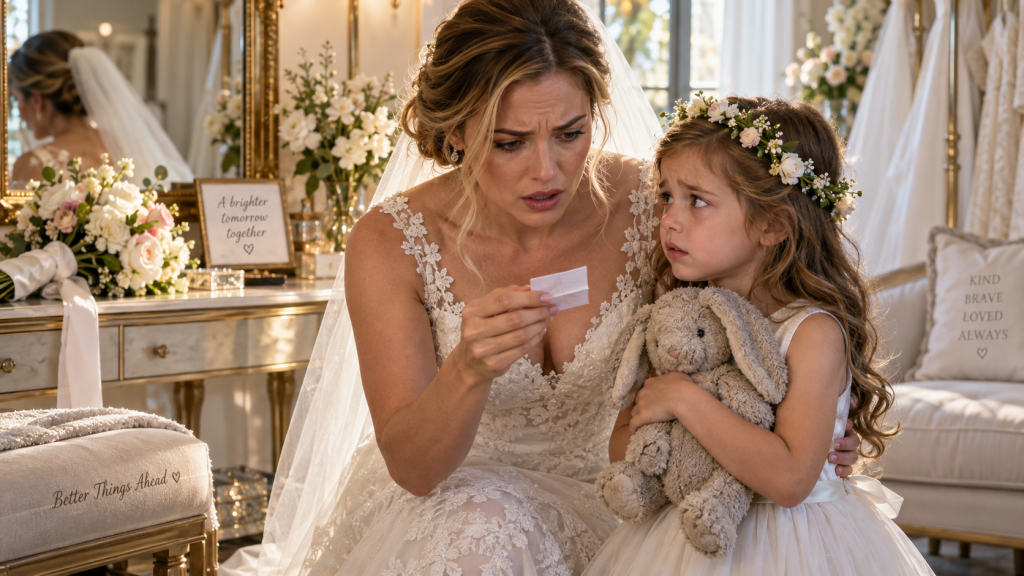
I placed Bunny back into her arms.
“Take care of him for me.”
“He’s a boy.”
“Sorry.”
That earned the tiniest smile.
Then she went with my mother.
I waited until they were out of earshot.
“Play it.”
Julia swallowed.
“Claire—”
“Play it.”
She pressed the button.
The recording resumed.
For a few seconds, there was only movement.
A door closing.
Matthew muttering something too quiet to understand.
Then a phone dialing.
A man’s voice answered.
“Yeah?”
Matthew spoke.
“She told her mother again.”
A pause.
The other man laughed.
“The kid?”
“Yes.”
My stomach tightened.
Matthew continued.
“She’s becoming a problem.”
Julia looked at me.
I felt the blood drain from my face.
The man on the phone asked:
“Does Claire believe her?”
“Not really.”
My heart broke.
Not because he was right.
Because he had been right.
I had listened to Emma.
I had asked questions.
Then Matthew had smiled, spoken gently, and I had accepted the explanation I wanted to hear.
Not really.
Those two words would follow me for years.
Matthew continued.
“Claire wants this wedding too much. She’s convinced herself Emma is just jealous.”
I covered my mouth.
He knew.
He had watched me choose hope over instinct.
And he had counted on it.
The other man asked:
“So what’s the problem?”
“The problem is after we’re married.”
“What about it?”
Matthew lowered his voice.
“Claire still hasn’t changed the beneficiary structure.”
I frowned.
Julia did too.
The other man said:
“I thought marriage handled that.”
“Not automatically.”
“What about the trust?”
My knees almost gave way.
The trust.
My father.
When Emma was born, my father had created a trust for her.
He wasn’t wealthy in the way people imagine wealth.
He owned land.
A small manufacturing business.
Several rental properties accumulated over forty years.
When he died, part of his estate went to me.
A larger portion was placed in trust for Emma.
Not because he loved me less.
Because he adored his granddaughter and wanted her future protected.
College.
A first home.
Medical needs.
Whatever life brought.
I was trustee until Emma reached a specified age, with a professional co-trustee overseeing larger distributions.
Matthew knew my father had left us comfortable.
He did not know the details.
Or at least I thought he didn’t.
On the recorder, Matthew said:
“Once we’re married, I’ll have time to straighten everything out.”
“How much?”
“I don’t know exactly.”
“Then why are you so sure it’s worth this?”
Matthew laughed.
That laugh.
I had heard it a thousand times.
Across dinner tables.
During movies.
In bed.
I would never hear it the same way again.
“Because Claire doesn’t work full-time anymore, she owns the house outright, and her father didn’t spend forty years building a company just to leave her nothing.”
My skin crawled.
The other man said:
“And the kid?”
A pause.
Matthew answered:
“That’s the complication.”
Julia whispered:
“Oh my God.”
The recording continued.
“If Claire dies before Emma is grown, most of it stays protected for Emma.”
I stopped breathing.
The man on the phone went silent.
Then:
“Matthew.”
“What?”
“You need to be careful how you talk.”
“Relax.”
“No. I’m serious.”
Matthew laughed again.
“I’m not talking about killing anybody.”
I almost collapsed from relief.
Then he continued.
“I’m saying Claire is sentimental. Once we’re married, I can convince her to change things.”
The relief died.
“She trusts me.”
He said it proudly.
The other man asked:
“And if she doesn’t change it?”
“She will.”
“You sound confident.”
“I’ve spent two years making myself indispensable.”
I closed my eyes.
Two years.
Every flat tire he changed.
Every dinner he cooked.
Every time he picked up groceries.
Every time he told me I deserved to be cared for.
Was all of it false?
I didn’t know.
That hurt in a different way.
The worst betrayals do not always erase every good moment.
Sometimes they poison your ability to know which moments were real.
Matthew continued.
“The only person who can mess this up is Emma.”
My hand tightened around Julia’s.
“She’s attached to Claire like a shadow.”
The other man laughed.
“She is five.”
“Exactly. Which means if she keeps acting out, eventually Claire will need help managing her.”
“What kind of help?”
“School counseling. Maybe time with her grandparents.”
My heart stopped.
Then:
“Once Claire and I have a child together, things will change anyway.”
Julia looked sick.
Matthew continued.
“Claire wants a family. A real family.”
I made a sound.
Not a sob.
Something lower.
Something wounded.
A real family.
Emma and I had already been one.
For five years.
Before Matthew.
Before the ring.
Before the church.
Before two hundred guests.
We were not waiting to become real.
We were real.
He had never understood that.
Or worse—
he had understood and intended to dismantle it.
The other man asked:
“You actually think Claire would send Emma away?”
“Not permanently.”
Matthew sounded irritated.
“I just need the kid to stop controlling every decision.”
Controlling.
My five-year-old.
The child who still asked permission to take the last cookie.
The child who apologized when she sneezed too loudly.
The child who slept with a stuffed rabbit because thunderstorms frightened her.
Controlling.
Then the man on the phone said:
“You’re marrying her tomorrow. Maybe stop talking like this until after the papers are signed.”
Matthew replied:
“That’s the plan.”
The recording ended.
For a long time, Julia and I stood beneath the church archway without speaking.
Cars passed on the street.
Wind moved the edge of my veil.
Somewhere inside the church, people were whispering.
My wedding was collapsing behind a wall.
My life was changing in a parking lot.
“Who was he talking to?”
I finally asked.
“I don’t know.”
“Can we identify the number?”
“Maybe.”
Julia looked at the recorder.
“We should preserve this.”
“Yes.”
My mind had begun moving again.
Not as a bride.
As a mother.
First:
Emma was safe.
Second:
Do not confront Matthew alone.
Third:
Preserve the recording.
Fourth:
Protect financial documents.
Fifth:
Get out.
I pulled off my veil.
Julia stared.
“What are you doing?”
“I can’t think with this thing on.”
I handed it to her.
Then I removed the engagement ring.
That was harder.
Not because I wanted it.
Because my finger had grown accustomed to its weight.
I stared at it.
Two years condensed into a diamond.
Then I slipped it into my purse.
“Claire?”
“Yes?”
“What are you going to do?”
“Leave.”
“And Matthew?”
“He can explain to the church why the bride isn’t coming.”
Julia stared.
“You’re not going to confront him?”
“No.”
“Why?”
I looked toward the parking lot where Emma sat with my mother.
“Because my daughter has already been brave enough for one day.”
That was the first correct decision I made after hearing the recording.
Not revenge.
Not humiliation.
Safety.
We left.
I did not march down the aisle and expose Matthew in front of two hundred guests.
I know people later wished I had.
It would have made a better story.
Bride enters.
Stops music.
Plays recording.
Groom turns pale.
Guests gasp.
Perhaps somebody throws cake.
Real life does not owe us theatrical satisfaction.
I had a frightened five-year-old in the back seat.
So I chose boring.
Boring is underrated when someone you love is scared.
I climbed into Julia’s car still wearing my wedding dress.
Emma sat beside me.
“Are we going home?”
“No.”
Her face tightened.
“Why?”
Because Matthew had a key.
Because his clothes were in my closet.
Because I no longer knew how far his entitlement extended.
I smiled gently.
“We’re going to Grandma’s.”
“Is Matthew coming?”
“No.”
“Ever?”
I looked at her.
“No.”
Her entire body changed.
Her shoulders dropped.
Her fingers loosened around Bunny.
Then she whispered:
“Good.”
One word.
Good.
I turned my face toward the window so she wouldn’t see me cry.
How long had my daughter been waiting for me to say no to him?
We drove away while my phone vibrated continuously inside my purse.
Matthew.
Then my wedding coordinator.
Then Matthew.
Then his mother.
Then Matthew.
Then friends.
Then Matthew again.
I turned the phone off.
At my mother’s house, I changed out of the wedding dress.
I couldn’t unzip it myself.
Julia helped.
Neither of us spoke.
When the dress fell away, I looked at it pooled on the bedroom floor.
Eight months of planning.
Thousands of dollars.
Alterations.
Flowers.
Menus.
Seating charts.
Gone.
I felt grief.
That surprised me.
How could I grieve a wedding to a man I had just discovered was manipulating me?
Because grief does not ask whether something deserved to survive.
It mourns what you believed it was.
I wasn’t mourning Matthew.
Not yet.
I was mourning the future I had imagined.
Christmas mornings.
Family vacations.
Someone beside me at school plays.
A father figure for Emma.
Another child, maybe.
Growing old with someone.
I sat on my mother’s bed wearing an old sweatshirt over bridal lingerie and began sobbing.
Julia sat beside me.
“I’m sorry.”
I shook my head.
“No.”
“What?”
“I should have listened to her.”
“Claire—”
“She told me.”
“You did listen.”
“No.”
I wiped my face.
“I heard her words.”
Then:
“I didn’t believe what they meant.”
That distinction mattered.
Emma had told me:
Please don’t leave me alone with Matthew.
I had protected her physically afterward.
That was something.
But I had still planned to marry him.
What message had that sent?
That I believed he was unsafe alone with her but safe enough to become her stepfather?
The contradiction horrified me.
“I wanted the wedding.”
I whispered.
“I wanted him.”
Julia took my hand.
“You wanted the man you thought he was.”
“Yes.”
“And Emma couldn’t explain everything.”
“No.”
“She is five.”
“I know.”
Julia squeezed my hand.
“You made a mistake.”
I looked at her.
“She came to you today.”
That mattered.
“She still trusted you enough to bring Bunny.”
I began crying harder.
Yes.
Despite my failure to understand earlier, Emma had tried again.
Children sometimes give us second chances before adults think we’ve earned them.
I would spend the rest of my life trying to deserve hers.
That afternoon, I called an attorney.
Not because marriage would have automatically given Matthew control of Emma’s trust.
It would not.
That fact mattered.
The recording showed what Matthew hoped to influence, not some magical legal transfer waiting at the altar.
My father’s trust had safeguards.
The professional co-trustee mattered.
My estate plan mattered.
The house being in my name mattered.
Matthew had overestimated what marrying me would accomplish automatically.
But he had not been counting on automatic rights alone.
He had been counting on me.
My trust.
My signature.
My willingness to change documents later.
That frightened me more.
He did not need a law to hand him everything.
He thought love would.
My attorney, Rachel Kim, listened without interrupting.
When I finished, she said:
“First, don’t alter the recording.”
“I won’t.”
“Keep the original device secure.”
“Yes.”
“Make copies through appropriate means.”
“Yes.”
“Do you believe Emma is in immediate danger?”
“I don’t know.”
“That means we behave cautiously.”
Good.
No drama.
Caution.
She explained that emotional intimidation of a child mattered, but exactly what legal remedies were available would depend on evidence, conduct, and jurisdiction.
She did not promise arrests.
She did not tell me Matthew would be dragged away in handcuffs because he said terrible things.
Real law is less cinematic.
She told me to document.
Preserve messages.
Change access codes.
Notify the trust administrator that no changes should be accepted without direct verification.
Review my estate plan.
Secure my home.
And most importantly:
Do not question Emma repeatedly.
“Why?”
“Because she’s five.”
Rachel’s voice softened.
“If there are concerns about what happened when you weren’t present, let a qualified professional handle that carefully.”
I felt sick.
“You think there might be more?”
“I think you shouldn’t assume either way.”
That became our rule.
No assumptions.
Not even terrible ones.
Especially terrible ones.
We contacted the appropriate professionals.
Emma spoke with a child specialist.
I was not in the room for everything.
That nearly killed me.
But the specialist later told me enough.
There was no disclosure of physical or sexual abuse.
I need to say that clearly.
Matthew had frightened her.
Belittled her.
Told her she was spoiled.
Told her I would become tired of her.
Threatened that she might be sent away.
Once, he had thrown Bunny into a hallway closet after Emma refused to stop asking when I would return.
That was how Bunny’s seam had torn.
Emma later discovered the opening.
Weeks afterward, she got the tiny recorder from Julia’s old keychain set.
Julia had given it to her as a silly “spy toy,” not realizing Emma would use it for something real.
My five-year-old had hidden it inside Bunny because adults kept changing when she tried to describe what happened.
That realization hurt more than almost anything.
She had created evidence because words had failed her.
No child should need evidence to be believed by her mother.
I told her that.
Not once.
Many times.
“Emma, you never have to prove being scared to me.”
She would nod.
Then one day she asked:
“But what if I’m wrong?”
“What do you mean?”
“What if somebody isn’t mean and I think they are?”
I knelt beside her.
“Then you still tell me.”
“Will you be mad?”
“No.”
“What if it’s Grandma?”
“Tell me.”
“Aunt Julia?”
“Tell me.”
“A teacher?”
“Tell me.”
“You?”
That one stopped me.
“Yes.”
She looked surprised.
“If I do something that scares you or hurts you, you can tell me too.”
“Even if you’re Mommy?”
“Especially then.”
That became one of the most important promises of our family.
No one becomes unquestionable because they are loved.
Not mothers.
Not fathers.
Not spouses.
Not grandparents.
Love is not immunity from accountability.
Matthew did not accept the canceled wedding quietly.
At first, he begged.
Messages poured in.
Claire, please answer.
You misunderstood.
That recording is out of context.
I was venting.
I would never hurt Emma.
Then:
We can fix this.
Then:
Think about what you’re doing.
Then:
Two hundred people watched you humiliate me.
There.
Not:
Emma is okay?
Not:
I terrified a child?
Humiliation.
His.
Then:
Your daughter has manipulated you from the beginning.
I blocked the new number.
He emailed.
She wanted me gone and she got what she wanted.
I forwarded everything to Rachel.
No reply.
Then his mother called my mother.
Apparently, I had “destroyed Matthew’s reputation.”
My mother said:
“No. Matthew recorded his own reputation.”
I had never loved her more.
Matthew came to my house once.
I was not there.
The new security camera captured him standing on the porch.
He rang the bell.
Waited.
Walked around the side.
Tried the gate.
Then returned to the porch.
He left a box.
Inside were photographs.
Cards.
The little ceramic dish Emma had made him for Father’s Day at preschool.
That one hurt.
On the bottom, in purple paint, she had written:
TO MATHEW LOVE EMA
Misspelled.
Beautiful.
He had displayed it on his desk.
Had that affection been real?
Maybe.
That was another difficult truth.
People who behave badly are not necessarily pretending every second.
Matthew may have cared for Emma sometimes.
He may have enjoyed helping her with puzzles.
He may have meant it when he cheered at her swimming lesson.
Then, when she became inconvenient to the future he wanted, he treated her feelings as obstacles.
That was enough.
Love that disappears when someone becomes inconvenient is not safety.
I packed his remaining belongings through arrangements made with counsel.
He collected them without seeing us.
The wedding gifts were returned.
That took weeks.
Every box felt like dismantling an imaginary house.
Blender.
Returned.
Crystal glasses.
Returned.
Sheets.
Returned.
Coffee maker.
Returned.
One card read:
May your new family be blessed with a lifetime of happiness.
I sat on the floor and cried.
Emma found me.
“Mommy?”
I quickly wiped my face.
Bad instinct.
Old instinct.
Pretend.
Then I stopped.
“I’m sad.”
She looked worried.
“Because of Matthew?”
“Yes.”
Her face fell.
“Do you want him back?”
“No.”
Immediate.
Certain.
“But I can still be sad.”
She climbed into my lap.
“I don’t miss him.”
“You don’t have to.”
“Do you?”
I thought.
“I miss who I thought he was.”
She considered that with the seriousness only a five-year-old can give an adult sentence.
“Was he pretend?”
“I don’t know.”
“Like a costume?”
“Maybe parts of him.”
She leaned against me.
Then:
“I like you without him.”
My heart cracked.
“I like us too.”
We sat among returned wedding gifts.
Not broken.
Just rearranging.
The mysterious man on the recording was identified eventually.
His name was Daniel Mercer.
An old college friend of Matthew’s.
He was not a criminal mastermind.
He wasn’t secretly controlling the trust.
He wasn’t planning to steal millions.
The truth was more ordinary and, in some ways, uglier.
He was the friend Matthew called when he wanted validation.
Daniel had heard Matthew complain for months about my financial arrangements.
He knew Matthew was frustrated that I insisted on keeping premarital assets separate.
He knew Matthew thought Emma’s trust represented “money Claire couldn’t touch properly.”
Daniel had encouraged him to get a prenuptial agreement favorable to himself or persuade me to restructure finances after marriage.
Not illegal by itself.
But the recording revealed the way Matthew thought.
My daughter was not a child to him in that conversation.
She was a complication.
My trust was not security for Emma.
It was money he could not influence.
My caution was not responsibility.
It was resistance.
Daniel eventually gave a statement confirming the conversation.
He claimed he had repeatedly told Matthew to “be careful.”
That was true on the recording.
But he had also laughed.
People often want credit for the moment they warned someone after months of encouraging the attitude that created the problem.
I had no interest in Daniel beyond the facts.
He disappeared from my life.
Good.
The financial review uncovered something else.
Not theft.
Not yet.
Matthew had researched my father’s trust far more extensively than he ever admitted.
Search history on a shared computer showed questions about spousal inheritance, trustees, beneficiary changes, marital property, guardianship, and whether a stepparent could gain authority over a child’s assets.
Some searches had innocent explanations individually.
Together, after the recording, they formed a disturbing picture.
He had been planning.
Not necessarily a crime.
A strategy.
My attorney said:
“Intentions are not always legally actionable.”
I answered:
“They’re actionable to me.”
She smiled.
“Yes.”
That was enough to cancel a wedding.
Enough to end access.
Enough to protect my child.
I did not need a jury to validate leaving.
That lesson became important.
Women are often taught to wait for proof severe enough to justify departure to everyone else.
Bruises.
Police reports.
Bank theft.
Something undeniable.
But relationships are not criminal trials.
I did not need to prove Matthew guilty beyond a reasonable doubt to decide he would never again share a home with my daughter.
I needed enough information to know we were not safe emotionally or financially.
I had it.
Emma began therapy.
So did I.
My therapist was named Dr. Lena Morris.
On our third session, she asked:
“What are you most angry about?”
“Matthew.”
“Only Matthew?”
I hated her immediately.
“No.”
“Who else?”
“Myself.”
There.
“Why?”
“Because Emma told me.”
“What did she tell you?”
“That he was mean when I wasn’t there.”
“And what did you do?”
“I confronted him.”
“What else?”
“I stopped leaving her alone with him.”
“What else?”
I stared.
“I still planned the wedding.”
“Yes.”
“I failed her.”
Dr. Morris waited.
I hated waiting therapists.
They make silence do unpaid labor.
Finally, she asked:
“What would failure have looked like on the wedding day?”
I frowned.
“What?”
“She brought you Bunny.”
“Yes.”
“You listened.”
“Yes.”
“You left.”
“Yes.”
“You ended the wedding.”
“Yes.”
“You protected her.”
“Yes.”
“So the story contains a mistake.”
She paused.
“And a correction.”
I began crying.
“I should have corrected it sooner.”
“Yes.”
That surprised me.
She didn’t rescue me from responsibility.
Good.
“But Claire, if your standard for being a good mother is never misunderstanding your child, you will fail every week.”
I laughed through tears.
“That’s comforting.”
“Your responsibility is not omniscience.”
Then:
“It’s responsiveness.”
That word stayed.
Responsive.
When Emma showed me more, I changed course.
Immediately.
Not perfectly.
But decisively.
I could live with that.
Eventually.
For months, Emma asked whether I was going to marry someone.
“No.”
“Tomorrow?”
“No.”
“Next week?”
“No.”
“Ever?”
That one was harder.
“I don’t know.”
She would frown.
“Can it just be us?”
“For now, yes.”
She liked that.
So did I.
I did not date for four years.
Not because I swore off men.
Because I needed to understand why I had wanted Matthew’s version of family badly enough to explain away my daughter’s fear.
The answer was painful.
I had been lonely.
Not just romantically.
Socially.
I was tired of being the only parent at school events.
Tired of forms with blank spaces where “father” should be.
Tired of people saying:
“You’re so strong.”
Strength is sometimes just what people call you when nobody is coming to help.
Matthew came.
He fixed things.
Remembered appointments.
Carried groceries.
Took Emma to the zoo with me.
Made pancakes.
When he proposed, I thought:
Finally.
Not:
I love this man.
I did love him.
But underneath love was relief.
Finally, someone chose us.
That made me ignore the possibility that he wanted me more than he wanted us.
There is a difference.
A person who loves a parent does not automatically know how to love the child who comes with them.
And a child is not luggage attached to a relationship.
Emma was not part of the package.
She was the center of my responsibility.
I learned that more deeply than I ever wanted to.
The church refunded almost nothing.
I didn’t care.
For a while, the unused wedding dress hung in the back of my closet.
I couldn’t look at it.
Julia suggested selling it.
I said no.
Then yes.
Then no.
Finally, two years later, Emma found it.
She was seven.
“Mommy!”
I hurried upstairs.
She stood inside the garment bag like she’d discovered buried treasure.
“Your princess dress!”
My stomach tightened.
“Yes.”
“Can I see?”
I hesitated.
Then unzipped the bag.
White fabric fell forward.
Still beautiful.
That surprised me.
I expected betrayal to make it ugly.
It didn’t.
Objects are innocent.
“Put it on.”
Emma said.
“No.”
“Please?”
“Absolutely not.”
Twenty minutes later, I was wearing it.
Because children are relentless.
It still fit badly enough to be uncomfortable.
Emma put on the crooked flower crown we had somehow kept.
She danced around me.
“You look pretty.”
I looked into the mirror.
For years, that dress had represented the worst mistake I almost made.
Now I saw something else.
The woman who wore it had left.
Before the vows.
Before the signatures.
Before Matthew became legally and emotionally more embedded in our lives.
She had listened in time.
Not early enough to avoid pain.
In time to prevent more.
I smiled at my reflection.
“You know what?”
“What?”
“You can have it someday for dress-up.”
Emma’s eyes widened.
“Really?”
“Yes.”
She destroyed the hem within three months.
Best use that dress ever had.
By eight, she had cut a piece from the train to make Bunny a cape.
When I saw it, I laughed until I cried.
A dress meant for a wedding that never happened became clothing for the stuffed rabbit that saved us.
There are worse endings.
Bunny survived too.
Barely.
Years of love are hard on stuffed animals.
One ear flattened.
The fur turned gray.
The ribbon disappeared.
The hidden seam remained.
I offered to sew it properly.
Emma refused.
“Why?”
“That’s where the recorder went.”
She wanted the opening.
A scar.
Not repaired away.
At ten, she stopped sleeping with Bunny every night.
At twelve, he moved to a shelf.
At thirteen, she shoved him into a closet because friends were coming over.
At fourteen, I found him back on her bed after a terrible day at school.
I said nothing.
At fifteen, Emma asked me:
“Did Matthew go to jail?”
“No.”
She looked confused.
“Why not?”
“Because being cruel and manipulative isn’t automatically a crime.”
“But he scared me.”
“Yes.”
“He wanted your money.”
“He wanted influence over money and our financial decisions. Wanting something isn’t necessarily criminal either.”
She frowned.
“So he got away with it?”
That question mattered.
“No.”
“How?”
“He lost us.”
Emma rolled her eyes.
“Mom, that’s cheesy.”
“It is.”
I smiled.
“But consequences aren’t only prison.”
I explained that some professional consequences had followed after people learned enough about his behavior, though I had never launched a public campaign against him.
He lost friends.
The wedding ended.
Our relationship ended.
Access to our home ended.
Any future he imagined with my property ended.
But I had not dedicated my life to destroying him.
“Why?”
Emma asked.
“Because then he would still be controlling my time.”
She thought about that.
“So you just stopped caring?”
“No.”
“I cared for a long time.”
Then:
“I stopped organizing my life around the caring.”
She liked that answer better.
Matthew wrote to me once after six years.
A real letter.
Paper.
No demands.
By then, Emma was eleven.
I opened it alone.
Claire,
I have started this letter more times than I can count.
I know an apology now cannot change what I did.
For years I told myself the recording made me sound worse than I was.
That was another lie.
It made me sound like who I was when I believed no one important was listening.
I stopped.
That sentence was honest.
He continued.
I resented Emma.
Writing that makes me ashamed.
She was five.
I was competing with a five-year-old for your attention and telling myself she was the problem.
I told myself I wanted to be her father.
What I really wanted was the authority of being her father without earning the trust first.
I looked toward Bunny on Emma’s shelf.
Matthew wrote:
I also became obsessed with your financial security.
At first, I told myself I wanted to understand our future.
Then I began imagining your property and your father’s trust as resources that should eventually become part of “our” family.
When you kept boundaries around them, I took it personally.
I started thinking of those boundaries as rejection.
They weren’t.
They were responsible.
My throat tightened.
Then:
The ugliest thing I said was that Emma was the complication.
She wasn’t.
I was.
I put the letter down.
Walked around the kitchen.
Came back.
He apologized for telling Emma I might become tired of her.
For threatening that she could be sent away.
For throwing Bunny into the closet.
For using my desire for family against me.
Then:
I don’t ask you to reply.
I especially do not ask Emma to forgive me.
If she remembers me at all, I hope eventually I become small enough in her memory that remembering doesn’t hurt.
Matthew.
I folded the letter.
For two days, I didn’t tell Emma.
Then I reconsidered.
The apology involved her.
But she was eleven.
So I asked her therapist first.
We decided to give Emma a choice.
“Matthew wrote a letter.”
She stared at me.
“Why?”
“To apologize.”
“Do I have to read it?”
“No.”
“Do I have to forgive him?”
“No.”
“Do you want to?”
“I don’t know.”
She thought.
Then:
“Can you keep it?”
“Yes.”
“Maybe later.”
Later came at seventeen.
She read it.
Her face barely changed.
When she finished, she said:
“He finally sounds like an adult.”
I almost laughed.
“How do you feel?”
“Sad.”
“For him?”
“For me.”
That answer stopped me.
“Why?”
“Because I was five.”
She looked at the letter.
“I thought I was doing something wrong.”
I sat beside her.
“You weren’t.”
“I know now.”
Then:
“I wish I knew then.”
I hugged her.
“Me too.”
She let me hold her for almost a minute, which at seventeen was equivalent to a three-hour embrace.
Then she pulled away.
“I’m keeping Bunny forever.”
“Obviously.”
At eighteen, Emma left for college.
The night before she moved into her dorm, I couldn’t sleep.
I stood in her doorway.
Boxes everywhere.
Bunny on top of one.
Emma woke.
“Mom?”
“Sorry.”
“What are you doing?”
“Nothing.”
“You’re being creepy.”
“I gave birth to you.”
“Not a defense.”
I laughed.
Then started crying.
“Oh my God.”
she groaned.
“Don’t.”
“I’m not.”
“You are.”
“I have allergies.”
“In August?”
“Seasonal.”
She sat up.
“Come here.”
I sat beside her.
“I’m scared.”
I admitted.
“Of what?”
“Everything.”
She smiled.
“I’ll be fine.”
“I know.”
“You taught me what to do.”
“What?”
“If somebody scares me, tell.”
My throat tightened.
“If someone tells me I’m imagining things, check.”
“Yes.”
“If someone says love means I owe them something, leave.”
“Yes.”
“If I feel weird about someone, I don’t have to wait until I can prove they’re evil.”
I laughed through tears.
“Correct.”
“And always hide recording devices in rabbits.”
“No.”
She grinned.
“Kidding.”
I hugged her.
Then she said:
“Mom?”
“Yes?”
“I never thought you chose Matthew over me.”
I became still.
“What?”
“I know you think that.”
“How?”
“You make a face whenever his name comes up.”
“What face?”
“The guilt face.”
I looked away.
Emma touched my hand.
“I was scared you might choose him.”
My heart broke.
“But then I showed you Bunny.”
“Yes.”
“And you left.”
I cried.
“So when I remember the wedding, that’s what I remember.”
“What?”
“You left.”
She smiled.
“You were wearing that giant dress and you looked completely insane, and we ran out the side door.”
I laughed.
“You remember that?”
“Bits.”
She leaned against me.
“I remember you believed me.”
I closed my eyes.
For years, I had centered the mistake.
Emma remembered the correction.
Maybe Dr. Morris had been right.
Responsive.
Not omniscient.
Emma went to college.
Studied psychology for one semester.
Hated it.
Switched to architecture.
Apparently my daughter preferred buildings to feelings.
I supported this enthusiastically.
At twenty-two, she graduated.
Bunny attended.
Hidden inside my handbag.
Emma found out and accused me of embarrassing her.
Then took a graduation photograph holding him.
At twenty-four, she fell in love.
His name was Noah.
The first time I met him, I terrified him.
Not intentionally.
Mostly.
“What do you do?”
“Urban planning.”
“Family?”
“Mom.”
“Financial debt?”
“Mom!”
Noah looked at Emma.
“Is this an interrogation?”
Emma sighed.
“You have no idea.”
I apologized.
Eventually.
Noah was gentle.
But gentleness no longer impressed me by itself.
Matthew had been gentle when people were watching.
So I watched something else.
How Noah handled no.
That was the test.
Emma changed dinner plans.
“No problem.”
Emma disagreed with him.
He argued, sometimes badly, but did not punish her with silence.
Emma wanted a weekend alone.
He went hiking with friends.
Emma kept separate savings.
He kept his.
When they moved in together, they discussed expenses.
Not romantic.
Excellent.
Love is revealed less by how someone responds to yes than by how they respond to no.
I wish I had learned that earlier.
When Noah proposed, Emma called me.
“Mom.”
Her voice was strange.
“What happened?”
“He proposed.”
My stomach dropped.
Not because I disliked him.
Because memory is irrational.
Church.
Dress.
Bunny.
Recorder.
“Are you okay?”
Emma asked.
I laughed.
“You’re asking me?”
“You got quiet.”
“I’m happy.”
“Sure?”
“Yes.”
Then:
“Are you?”
She laughed.
“Yes.”
“Then I’m happy.”
She paused.
“Mom?”
“Yes?”
“If I find anything inside Bunny before the wedding, I’m blaming you.”
I laughed until I cried.
They married in a garden.
Small ceremony.
Forty-three people.
No church.
No grand aisle.
Not because Emma feared weddings.
She simply hated crowds.
Bunny sat in the bridal room.
On purpose.
Before the ceremony, Emma handed him to me.
“Check.”
I stared.
“You’re horrible.”
“Check him.”
I squeezed Bunny dramatically.
“Nothing.”
“Good.”
Then she became serious.
“Keep him during the ceremony.”
“Why?”
“Because he belongs with you too.”
That almost ended me.
I sat in the front row holding a twenty-year-old stuffed rabbit beneath my shawl while my daughter married a man who looked at her as though being chosen by her was a privilege, not an acquisition.
When the officiant asked Emma if she took Noah, she said:
“I do.”
Her voice was clear.
Not frightened.
Not coerced.
Chosen.
I cried.
Afterward, Noah hugged me.
“Thank you for trusting me.”
I pulled back.
“No.”
He looked confused.
“Don’t thank me for that.”
“Why?”
“Emma trusts you.”
I smiled.
“That’s the one that matters.”
He nodded.
Good answer.
Years passed.
I never remarried.
Not because Matthew ruined love for me.
He didn’t get that much power.
I dated.
Had relationships.
One lasted almost four years.
His name was David.
Kind man.
Widower.
He never tried to become Emma’s father.
That was part of why she liked him.
One evening, years into our relationship, David asked:
“Do you want to get married?”
I thought.
Then said:
“No.”
He nodded.
“Okay.”
That was it.
No punishment.
No sulking.
No accusation that I feared commitment.
He poured more tea.
After a minute, I asked:
“That’s all?”
“What else would there be?”
“I said no.”
“I heard you.”
I began crying.
Poor David looked terrified.
“Did I do something?”
“No.”
I laughed.
“You did something right.”
We stayed together another two years.
Eventually our lives moved in different directions.
We separated kindly.
I learned another lesson.
A relationship can end without anyone becoming a villain.
That felt revolutionary.
Emma had her first child when she was thirty.
A girl.
Sophie.
When I held Sophie for the first time, I thought about Emma at five.
Crooked flower crown.
Bunny.
Please look now.
I cried.
Emma noticed.
“You okay?”
“Yes.”
“Thinking about the wedding?”
“How do you always know?”
“Guilt face.”
“I’m seventy.”
“Same face.”
I kissed Sophie’s forehead.
“You were so little.”
Emma understood.
“I was.”
“I should have—”
“Mom.”
I stopped.
She had interrupted this sentence many times over the years.
She knew how it ended.
Should have listened sooner.
Should have known.
Should have seen.
Emma sighed.
“You did listen.”
“Eventually.”
“In time.”
There it was.
Again.
In time.
I looked at my granddaughter.
“I hope she never has to be brave like you were.”
Emma smiled.
“Me too.”
That became our new philosophy.
People love praising brave children.
Sometimes too much.
A child should not need extraordinary courage to make adults protect them.
Bravery is wonderful.
Safety is better.
Sophie grew up knowing that.
When she said someone made her uncomfortable, Emma listened.
Not panicked.
Not accused.
Listened.
Asked appropriate questions.
Set boundaries.
Got more information.
She did not teach Sophie that every uncomfortable feeling proved danger.
She taught her that discomfort was information worth sharing.
That nuance mattered.
Fear should be heard without being turned into certainty before facts are known.
Emma became very good at that.
Better than I had been.
That made me proud.
One afternoon, when Sophie was six, I found Emma sewing Bunny.
I nearly fainted.
“You’re repairing the sacred opening?”
“No.”
She smiled.
“Reinforcing around it.”
The seam remained visible.
Sophie watched.
“Why is Bunny broken there?”
Emma looked at me.
I looked at her.
Her choice.
“When I was little, I hid something inside him because I needed Grandma to listen.”
“What?”
“A tiny recorder.”
Sophie gasped.
“Were you a spy?”
Emma laughed.
“Sort of.”
“What did Grandma do?”
Emma looked at me.
“She listened.”
That was the version she gave her daughter.
Not:
Grandma ignored me at first.
Not:
A man frightened me.
Not:
My mother almost married him.
She listened.
I had spent half my life fearing my mistake would become the defining story of my motherhood.
My daughter had chosen the moment I corrected it.
Grace sometimes arrives from the people we failed.
That does not erase the failure.
It gives us responsibility to honor the grace.
I tried.
When I was seventy-two, I received an email.
Matthew.
I almost deleted it.
Then opened it.
He was married.
Had been for years.
He had a son.
He wrote:
Claire,
My son turned five last week.
I have thought about Emma every day since.
That age changes what I understand.
I looked at my own child and tried to imagine an adult telling him his mother would get tired of him.
I couldn’t.
I don’t know how I did that to Emma.
I stopped reading.
Walked outside.
Came back later.
Matthew continued.
I used to think becoming a father would prove I wasn’t the person on that recording.
Instead, it showed me more clearly who I had been.
I hope Emma is well.
I will not contact her.
I don’t expect an answer.
I only wanted to say that I am sorry again.
I forwarded the email to Emma.
She called.
“Wow.”
“Yes.”
“How do you feel?”
“Old.”
“Mom.”
“I don’t know.”
Emma became quiet.
Then:
“I hope he’s a good dad.”
“Me too.”
That surprised me.
“Really?”
“Yes.”
She laughed softly.
“What am I supposed to hope? That another five-year-old has a terrible father so the universe balances?”
No.
Of course not.
“I hope he learned.”
Emma said.
That was all.
We did not reply.
Matthew’s growth, if real, belonged to his life.
We did not need to supervise it.
That was freedom too.
By seventy-five, I had become the grandmother who carried snacks in every purse.
Emma mocked me.
Sophie loved me.
Noah stole the snacks.
Bunny lived in a glass-front cabinet at Emma’s house.
Not as a shrine.
Protection from the dog.
One day Sophie asked:
“Grandma, did Bunny save Mommy?”
I smiled.
“No.”
“Mommy said he did.”
“Bunny helped.”
“Who saved her?”
I thought carefully.
“Your mom helped save herself.”
Sophie frowned.
“She was five.”
“Yes.”
“Can five-year-olds save themselves?”
“Not alone.”
I looked at Emma across the room.
“They shouldn’t have to.”
Then:
“She told me something was wrong.”
I touched Sophie’s nose.
“And I finally understood.”
“Then you saved her.”
“No.”
I shook my head.
“We left together.”
That was how I preferred to remember it.
Not mother rescuing child.
Not child rescuing mother.
Two people leaving something harmful together.
Emma had shown me the truth.
I had opened the door.
Both mattered.
At seventy-eight, I sold the house Matthew had once hoped to influence.
That surprised Emma.
“You love that house.”
“I did.”
“Why sell?”
“Stairs.”
She laughed.
Practical.
I moved into a smaller place near her family.
While packing, we found old documents from my father’s trust.
Emma sat on the floor.
“Is this what Matthew wanted?”
“In part.”
She flipped through pages.
“It’s boring.”
“Most money is.”
“I imagined a treasure map.”
“Sorry.”
She laughed.
By then, the trust had long since served its purpose.
Education.
Investments.
Security.
Emma had made responsible choices.
My father would have been proud.
The money had never been the treasure.
The protection was.
He had built safeguards because he knew love and money can become dangerous when mixed carelessly.
I understood him better in old age.
When Sophie turned five, I had a difficult week.
Same age.
Emma noticed.
“You keep staring at her.”
“She’s tiny.”
“Yes.”
“You were this tiny.”
“Yes.”
“How could he—”
“Mom.”
“I know.”
She sat beside me.
“You don’t have to keep prosecuting the past.”
I looked at her.
“Since when are you the wise one?”
“Since approximately Bunny.”
Fair.
“I still get angry.”
I admitted.
“So do I.”
“You do?”
“Sometimes.”
She shrugged.
“Then I make lunch.”
I laughed.
“What?”
“Life continues.”
She smiled.
“Anger isn’t a full-time job.”
That may have been the best thing she ever taught me.
Anger can protect.
It can clarify.
It can move your feet toward an exit.
But if you make it your permanent occupation, the person who hurt you remains your employer.
I resigned.
So did Emma.
Not all at once.
Slowly.
Ordinarily.
One day at a time.
When I was eighty, Emma brought Bunny to my birthday dinner.
The poor rabbit was almost bald.
“You’re abusing an elderly animal.”
I said.
“He wanted cake.”
“He doesn’t have a digestive system.”
“Don’t discriminate.”
Sophie rolled her eyes.
Family.
Warm.
Annoying.
Safe.
After dinner, Emma and I sat outside.
She placed Bunny between us.
“Do you remember exactly what you found?”
“The recorder?”
“Yes.”
“Of course.”
“What did you think first?”
I considered.
“Honestly?”
“Yes.”
“I thought the wedding was over.”
She laughed.
“Not ‘my daughter’s in danger’?”
“That came almost simultaneously.”
“Almost?”
“Don’t ruin my heroic image.”
She smiled.
Then became serious.
“I thought you’d be mad at me.”
“I know.”
“That’s the part I remember most.”
My chest tightened.
“Why?”
“Because when you said you believed me…”
She looked down.
“I felt like I could breathe again.”
I touched her hand.
“I’m sorry you ever thought I wouldn’t.”
“I know.”
Then:
“But Mom?”
“Yes?”
“I learned something good from it too.”
“What?”
“That if I have to choose between disappointing people and protecting myself, I can disappoint people.”
I smiled.
“Two hundred of them, apparently.”
She laughed.
“Exactly.”
That became a family joke.
Whenever someone worried too much about appearances, Emma would say:
“Remember, Grandma once ghosted two hundred wedding guests.”
I objected.
“I didn’t ghost them. Julia made an announcement.”
“Same energy.”
Even painful memories can eventually become jokes without becoming meaningless.
That is one of time’s gentler miracles.
At eighty-two, I attended Sophie’s wedding.
Yes.
Another wedding.
By then, Emma was forty-seven.
Bunny did not attend.
We had standards.
Before the ceremony, Sophie came to me.
“Grandma?”
“Yes?”
“Mom told me the story.”
“Which one?”
“Bunny.”
I sighed.
“Of course.”
“She said you left your own wedding for her.”
“Yes.”
Sophie hugged me.
“That’s romantic.”
I laughed.
“It was the least romantic day of my life.”
“You know what I mean.”
I did.
She pulled back.
“Were you embarrassed?”
“Very.”
“Two hundred people?”
“Approximately.”
“And you just left?”
“Yes.”
“Weren’t you worried what everyone would think?”
I smiled.
“For about thirty seconds.”
“Then?”
“I looked at your mother.”
That was enough.
Sophie nodded.
Then went to marry the person she had chosen.
I sat beside Emma.
During the vows, she reached for my hand.
No fear.
Just memory.
Afterward, she whispered:
“Better wedding.”
“Much.”
“Food’s worse.”
“Definitely.”
We laughed.
Bunny outlived almost everyone.
Not literally.
Stuffed rabbits do not die unless dogs get involved.
But he remained.
When I moved into assisted living in my late eighties, Emma asked what I wanted from the house.
“Photographs.”
“What else?”
“My blue blanket.”
“Okay.”
“The good kettle.”
“You aren’t allowed kettles there.”
“Oppression.”
She laughed.
“What else?”
I thought.
“Bunny.”
She stared.
“No.”
“What?”
“He’s mine.”
“I bought him.”
“For me.”
“I funded him.”
“Not how gifts work.”
We argued for ten minutes.
Finally, she brought him on visiting days.
Compromise.
By then, my memory had begun playing tricks.
Names arrived late.
Rooms became confusing.
But some things remained sharp.
Emma at five.
Crooked flower crown.
Bunny.
Please look now.
I worried that would be my final memory of her.
Fear.
I didn’t want that.
So I deliberately practiced others.
Emma graduating.
Emma laughing at her wedding.
Emma holding Sophie.
Emma at forty, barefoot in my kitchen stealing strawberries.
Emma at fifty, complaining about her knees.
Emma bringing me coffee.
A life cannot be reduced to its worst day.
Neither can a person.
I wanted my memory to know that.
One afternoon, Emma sat beside my bed.
She was in her fifties.
I looked at her and suddenly saw the child inside the woman.
“Bunny?”
I asked.
She smiled.
“In the car.”
“Get him.”
“Seriously?”
“Yes.”
She returned carrying him.
Ancient.
Flattened.
Loved nearly beyond recognition.
I touched the opening beneath his neck.
Still there.
“You never fixed it.”
“No.”
“Why?”
“You know why.”
I did.
“It was where the truth was.”
Emma smiled.
“Yes.”
I looked at her.
“I almost married him.”
“But you didn’t.”
“I almost didn’t understand.”
“But you did.”
“I should have listened sooner.”
She sighed.
“Mom.”
I laughed.
“Guilt face?”
“Massive guilt face.”
She took my hand.
“You want to know what I remember?”
“Yes.”
“The door.”
“What door?”
“The side door of the church.”
I frowned.
“You pushed it open.”
She continued.
“It was really bright outside.”
I remembered.
Cold sunlight across my wedding dress.
“You held my hand.”
Her eyes filled.
“And we walked through.”
Not the recorder.
Not Matthew.
Not fear.
The door.
Of course.
Children remember exits too.
“I thought weddings were supposed to end with people walking out together.”
Emma said.
I laughed.
“They usually do.”
“Ours did.”
That sentence stayed with me.
Our wedding.
Not mine and Matthew’s.
Mine and Emma’s strange ceremony of choosing each other again.
We had walked out together.
No vows.
But perhaps there had been one.
I believe you.
There isn’t a choice.
You matter.
I’m leaving with you.
Those were vows.
Better ones than anything printed in my wedding program.
When Emma left that evening, Bunny remained beside me.
She had forgotten him.
Or perhaps not.
I held him.
Felt the old seam.
And thought about how strange life is.
A tiny recorder.
A stuffed rabbit.
A frightened child.
A wedding dress.
Four things collided in one room and changed decades.
People often imagine turning points as grand decisions.
Sometimes they are five-year-old hands tugging silk.
Mommy, please look.
And the entire future depends on whether we kneel down.
Whether we listen.
Whether we are willing to let the music stop.
That is the part I would tell any parent now.
Your child may not have the perfect words.
Fear rarely speaks in paragraphs.
It says:
I don’t like him.
Don’t leave me.
She’s mean.
My stomach hurts.
Can I stay home?
Look inside Bunny.
Those sentences are not proof.
But they are invitations to pay attention.
Listen without forcing.
Protect without panicking.
Ask for appropriate help.
Do not make children carry investigations themselves.
And never make your desire for an adult relationship more important than their ability to feel safe enough to speak.
I learned that almost too late.
Almost.
That word matters.
Because almost is not always tragedy.
Sometimes almost is escape.
I almost married Matthew.
I didn’t.
I almost dismissed Emma’s fear completely.
I didn’t.
I almost walked down the aisle.
Instead, I walked out a side door.
Almost became the distance between one life and another.
Years later, I stopped hating that woman in the wedding dress.
For a long time, I thought she was foolish.
Lonely.
Desperate.
Blind.
Now I see her differently.
She made mistakes.
Then, when truth arrived at the worst possible moment, she did not ask truth to wait until after the photographs.
She did not say:
We’ve spent too much money.
Guests are waiting.
Maybe we’ll discuss it tomorrow.
Maybe Matthew can explain.
Maybe Emma misunderstood.
She left.
That mattered.
A good decision does not erase earlier mistakes.
But earlier mistakes do not invalidate a good decision either.
We are allowed to correct course.
Even at the church door.
Even after invitations.
Even after deposits.
Even while wearing white.
Especially then.
My father used to say:
“Money lost can be earned again. Time lost cannot.”
I understood that differently after Matthew.
The wedding money disappeared.
Fine.
The trust remained protected.
Fine.
But the most important thing I saved that day was time.
Years Emma might have spent inside a home where she felt unwanted.
Years I might have spent being slowly persuaded that her discomfort was manipulation.
Years Matthew might have spent weakening financial boundaries while calling it marriage.
Years of my daughter wondering why I chose him.
We did not live those years.
That is worth every lost deposit.
Every embarrassed guest.
Every returned blender.
Every whispered rumor.
People did talk.
Of course they did.
Some thought I overreacted.
They had not heard everything.
Some said:
“All couples say terrible things privately.”
Maybe.
Some said:
“Children can be jealous.”
True.
Some said:
“You could have postponed instead of ending it.”
No.
I knew enough.
I did not need unanimous approval.
That was another freedom.
My life was not a courtroom.
Neither was Emma’s safety.
Years later, one of my former bridesmaids admitted she had initially thought I was being dramatic.
“I’m sorry.”
she said.
“I didn’t understand.”
I smiled.
“You didn’t need to.”
“What?”
“I did.”
That was enough.
Matthew had once counted on my need for other people’s approval.
He thought two hundred guests would make leaving harder.
He was right.
For several minutes.
Then Emma looked at me.
The crowd disappeared.
That may be motherhood at its purest.
Not perfection.
Priority.
When I reached ninety, Sophie visited with her own five-year-old son.
His name was Caleb.
He found Bunny.
Naturally.
Children can detect stuffed animals from impossible distances.
“Can I play with him?”
Emma nearly shouted:
“No!”
We all stared.
She laughed.
“Sorry.”
Caleb looked terrified.
Emma crouched.
“He’s very old.”
“So is Great-Grandma.”
I gasped.
Everyone laughed.
Caleb carried Bunny carefully.
Then asked:
“Why does he have a hole?”
I looked at Emma.
She looked at me.
Then she said:
“Because a long time ago, something important had to fit inside.”
Caleb nodded.
Satisfied.
Children don’t always demand the whole story.
He tucked a toy car into the opening.
Emma and I stared.
Then laughed.
The place that once held evidence now held a red toy car.
I loved that.
Not every scar has to remain sacred forever.
Sometimes children turn it back into play.
That afternoon, I watched Caleb push Bunny around in an imaginary race car.
Emma sat beside me.
“Should I stop him?”
“No.”
“He’ll stretch the seam.”
“Let him.”
She looked surprised.
I smiled.
“Bunny’s retired.”
“So are you.”
“Watch your tone.”
She laughed.
Then rested her head against mine.
“Mom?”
“Yes?”
“Thank you.”
“For what?”
She looked toward Bunny.
“You know.”
I did.
But I answered anyway.
“You don’t owe me thanks for protecting you.”
“No.”
She smiled.
“But I can still give it.”
Fair.
“Then you’re welcome.”
I squeezed her hand.
“And thank you.”
“For what?”
“For trying again when I didn’t understand the first time.”
Emma’s eyes filled.
“I was five.”
“I know.”
“I didn’t have anywhere else to go.”
“I know.”
That sentence hurt.
Then she added:
“But I knew you’d listen eventually.”
I looked at her.
“How?”
She shrugged.
“Because you were my mom.”
That faith humbled me more than any accusation could have.
A child had trusted me before I fully deserved it.
I spent the rest of my life trying to make that trust a safe place to live.
And when I think of that wedding now, I no longer hear the organ.
I don’t see the flowers.
I don’t remember the cake.
I barely remember the faces of the guests.
I remember Emma’s hand.
Tiny fingers wrapped around mine.
The side door.
Cold sunlight.
My dress brushing the pavement.
My phone vibrating with Matthew’s calls.
And my daughter asking:
“Are we going home?”
At the time, I said no.
We were going to Grandma’s.
But I understand the question differently now.
Were we going home?
Yes.
We were.
Not to a building.
To each other.
Matthew had spent two years trying to convince me that family was something he could give us.
A husband.
A father figure.
A second child someday.
A larger table.
A different last name.
But family had been standing beside me all along in a crooked flower crown, clutching a battered stuffed rabbit.
Emma and I were already a family.
Matthew’s greatest mistake was believing he was the person who made us complete.
He wasn’t.
No one was.
Years later, Emma once asked whether I regretted meeting him.
I thought carefully.
“Yes.”
She looked surprised.
People expect poetic answers.
No regrets.
Everything happens for a reason.
I don’t believe that.
Some things happen because people make bad choices.
I would prefer Emma had never been frightened.
I would prefer I had never doubted myself.
I would prefer Matthew had either loved us properly or stayed away.
Pain does not become good merely because we learn from it.
So yes.
I regret that it happened.
But regret is not the same as wishing away the people we became afterward.
We learned.
We repaired.
We grew.
Not because Matthew gave us a gift.
Because after he caused harm, we did something meaningful with what remained.
That distinction matters.
I do not thank storms for teaching me to rebuild the roof.
I simply become grateful for the roof.
Emma eventually stopped asking whether I would choose her.
She knew.
Not because I told her endlessly.
Because years accumulated.
I showed up.
School plays.
Fevers.
Heartbreak.
College.
Marriage.
Childbirth.
Ordinary Tuesdays.
Trust is rarely repaired by one dramatic promise.
It is repaired through repetition.
I said I would be there.
Then I was.
Again.
Again.
Again.
And Emma did the same for me when age reversed our roles.
Doctor appointments.
Groceries.
Medication.
Lost glasses.
Repeated stories.
The daughter I once held by the hand eventually held mine.
Not because she owed me for leaving the wedding.
Love is not a ledger.
She did it because we had built a life where care moved both directions without becoming debt.
That was the family I had wanted.
I just hadn’t recognized it when it was only two people.
So this is how our story ends.
Not with Matthew punished.
Not with a courtroom.
Not with a ruined groom standing alone at an altar.
Not with two hundred guests discovering some spectacular secret.
Those things belong to the beginning.
The ending is quieter.
An old woman.
Her grown daughter.
A nearly bald stuffed rabbit.
A child playing with a toy car.
A family laughing in a warm room.
No one afraid to speak.
No one threatened with being sent away.
No one competing for a mother’s love.
No one treating money as ownership.
No one mistaking control for care.
Just people.
Imperfect.
Safe enough to be honest.
And Bunny.
Still there.
Still carrying the little opening beneath his neck.
For decades, I thought that opening represented the worst day of my life.
Eventually, I understood it represented something else.
A place where truth could hide until someone was ready to hear it.
Emma brought me that truth.
I opened my hand.
Then I opened the door.
And together, before the music could begin, we walked away from the life someone else had planned for us.
Toward our own.
If I could speak to the woman I was in that bridal room one last time, I would not tell her:
Don’t marry Matthew.
She already learned that.
I would kneel beside her, straighten Emma’s crooked flower crown, place Bunny back into those tiny arms, and say:
Look at your daughter.
She is frightened.
But she still came to you.
That means the bridge between you is still standing.
Walk across it.
Now.
And when she does—
when that mother takes her daughter’s hand and runs through the side door while nearly two hundred people wait for a ceremony that will never happen—
I would tell her one more thing:
Do not be ashamed.
You are not running away from your wedding.
You are running toward your child.
There is a difference.
One is fear.
The other is love.
And love, when it is healthy, does not demand that a five-year-old surrender her safety so an adult can have the future she imagined.
It changes the future.
So change it.
Let the flowers wilt.
Let the food go uneaten.
Let people whisper.
Let the groom wait.
Let the dress drag through the parking lot.
Take the little hand reaching for yours.
Open the door.
Walk into the cold sunlight.
And don’t look back.
Because one day that five-year-old will become a woman.
One day she will stand beside you with silver beginning in her own hair.
One day she will hold the battered rabbit between you and laugh about the wedding you never had.
And when you apologize for the thousandth time because you did not understand soon enough, she will squeeze your hand and remind you of the only part she chose to carry forward:
“But you listened, Mom.”
Yes.
Eventually, I did.
And sometimes one moment of truly listening is enough to change every moment that comes after it.
That was what Bunny carried inside him.
Not merely a recorder.
Not merely Matthew’s voice.
Not merely evidence.
A door.
And when my daughter asked me to open it—
I did.
Then we walked through together.
THE END STORIES! THANK YOU FOR READING GOOD LUCK !❤️
Related Posts