➡️ PART 3 ENDING PART ➡️
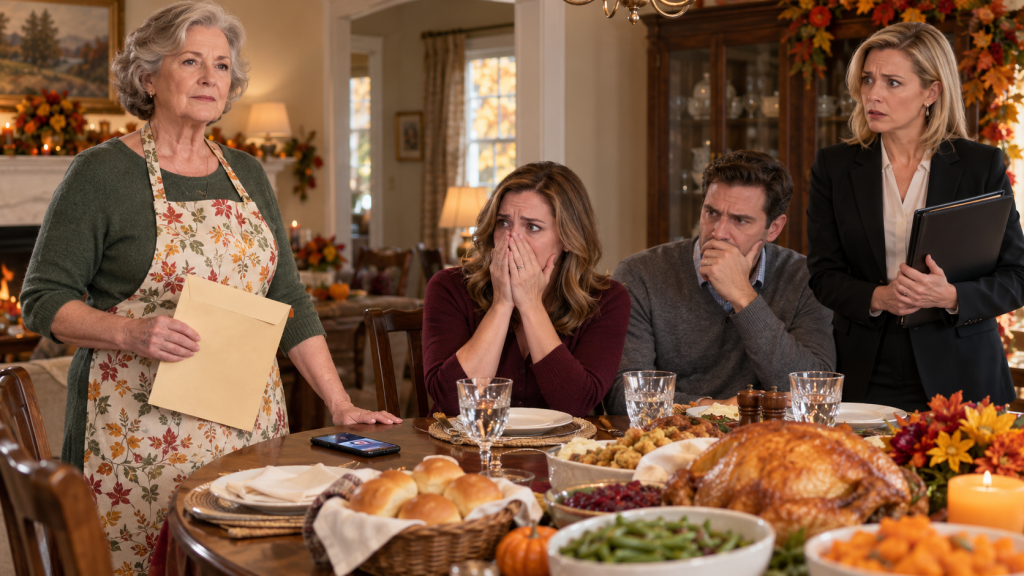
For several seconds, nobody moved.
The turkey was getting cold.
The good rolls sat beneath the linen towel I had embroidered twenty-three years earlier.
From the den came the muffled sound of an animated movie and the occasional laughter of my grandchildren, who had no idea that ten feet away their family was cracking open along lines that had apparently existed for years.
Daniel stood at the end of my dining-room table with my late husband’s old leather briefcase open in front of him.
And in his hand was an envelope.
Melissa’s name was written across it.
Not typed.
Not printed by a lawyer.
Written by her father.
Thomas had always formed his capital M strangely, with the middle point lower than the outer lines.
I knew that handwriting better than my own.
Melissa did too.
“That’s Dad’s.”
Her voice sounded small.
Daniel nodded.
“Yes.”
Kevin stood.
“We’re leaving.”
Melissa did not move.
“Sit down, Kevin.”
He looked at her.
“Mel.”
“I said sit down.”
It was the first time all afternoon I had heard my daughter speak to her husband the way she usually spoke to me.
He sat.
Daniel placed the envelope in front of Melissa.
She did not touch it.
Instead she looked at me.
“You knew about this?”
“No.”
That surprised her.
I looked at Daniel.
“I knew Thomas gave Daniel some papers before he died. I didn’t know what they were.”
Daniel nodded.
“He made me promise.”
“Promise what?”
Melissa asked.
“That I wouldn’t give this to you unless something specific happened.”
“What?”
Daniel looked at me.
Then back at her.
“Unless you tried to take control of your mother’s house or finances while she was still capable of making her own decisions.”
Melissa stared at him.
Kevin laughed.
Not because anything was funny.
Because some men laugh when the room stops obeying them.
“This is insane.”
Daniel ignored him.
Melissa finally touched the envelope.
Her fingers traced her father’s handwriting.
“Why would Dad think I’d do that?”
Daniel’s expression changed.
“Read it.”
“I asked you a question.”
“And your father answered it nine years ago.”
Melissa’s eyes filled.
“Nine?”
“Yes.”
Thomas had died seven years earlier.
That meant he had written the letter two years before his death.
Not from a hospital bed in some morphine-heavy haze.
Not in the last confused hours of a dying man.
He had thought about this.
Prepared for it.
Waited.
My stomach tightened.
“Daniel.”
He looked at me.
“You said three days before he died.”
“He gave it to me three days before he died.”
Daniel touched the envelope.
“He wrote it earlier.”
“How much earlier?”
“Almost two years.”
I sat down.
Suddenly, I was the one who needed a chair.
Melissa whispered:
“Why?”
Daniel exhaled.
“Because this didn’t start with the voicemail.”
Kevin stood again.
“Enough.”
Daniel looked at him.
“You seem nervous.”
“I’m not nervous.”
“You’ve tried to leave twice.”
“Because my children are in the next room while you people are staging some kind of family ambush.”
I pointed toward the chair.
“Sit.”
Kevin looked at me.
For years, he had treated my quietness like weakness.
People make that mistake about quiet women.
They think because we don’t raise our voices, we don’t have one.
Kevin sat.
Melissa opened the envelope.
Inside were five pages.
She unfolded them carefully.
I watched her face as she began reading.
At first, nothing.
Then her mouth tightened.
Then her eyes stopped moving.
“What?”
I asked.
She shook her head.
“Melissa?”
“Nothing.”
Daniel said:
“Read it aloud.”
“No.”
“Your mother deserves to hear it.”
“I said no.”
I looked at her.
“Then give it to me.”
She clutched the pages.
“No.”
“Why?”
“Because it’s from Dad to me.”
That was true.
And I respected it.
Even angry.
Even betrayed.
Some boundaries still mattered.
“All right.”
I said.
“Then you don’t have to read it aloud.”
Kevin exhaled as though he’d won something.
I continued:
“But Daniel can tell me what Thomas told him.”
Kevin’s relief vanished.
Daniel pulled out a chair.
“Thomas came to my house one Saturday morning almost nine years ago.”
Melissa lowered the letter.
“He was furious.”
I tried to remember.
Nine years earlier.
Thomas had still been working part-time at the hardware store because retirement bored him.
Melissa and Kevin had been married six years.
Their oldest child had just been born.
“What happened?”
I asked.
Daniel looked at Melissa.
“Do you want to tell her?”
She said nothing.
Daniel continued.
“Kevin approached Thomas about taking out a home-equity loan against this house.”
I turned toward Kevin.
He immediately shook his head.
“That is not what happened.”
Daniel ignored him.
“He wanted Thomas and Rosemary to borrow against the property and put the money into a business.”
I remembered.
A restaurant.
No.
A sports bar.
Kevin and a friend had wanted to buy into a sports bar in Naperville.
Thomas told me it was a bad idea.
I had forgotten the rest.
“You asked Thomas for money.”
I said.
Kevin spread his hands.
“It was an investment opportunity.”
“You asked him to borrow against our house?”
“I discussed possibilities.”
Daniel gave a humorless smile.
“That’s a very elegant way of saying yes.”
Melissa interrupted.
“Dad said no.”
“Yes.”
Daniel replied.
“And three weeks later, Thomas discovered you’d contacted a mortgage broker anyway.”
My stomach dropped.
I looked at Melissa.
She looked at the table.
“Did you?”
“It wasn’t an application.”
“What was it?”
“An inquiry.”
“Using information about my house?”
“Mom—”
“Using information about my house?”
“Yes.”
I stared at her.
Nine years.
Thomas had known.
And never told me.
Another man protecting me with silence.
I was getting tired of being protected by people who apparently believed truth was too heavy for women.
“Why didn’t Thomas tell me?”
Daniel answered quietly.
“Because Melissa was pregnant.”
My eyes closed.
Of course.
Our grandson.
Thomas would have swallowed fire to keep peace around that baby.
“He made me promise not to tell you unless they tried something again.”
Daniel continued.
“He said he’d handled it.”
“How?”
“He told Kevin that if he ever used your property information again without permission, he would report it.”
Kevin laughed.
“Report what? Asking a mortgage broker a question?”
Daniel looked at him.
“Thomas was not concerned with whether you could explain it away. He was concerned with the fact that you looked at his home and saw capital you were entitled to deploy.”
Those words sounded painfully familiar.
The asset.
My house.
Not for long.
Melissa looked down at the letter.
“Dad forgave us.”
Daniel shook his head.
“Your father loved you.”
“That isn’t what I said.”
“No.”
Daniel’s voice softened.
“He loved you.”
Melissa began crying.
That was when one of my grandchildren appeared in the doorway.
My grandson, Ethan.
Ten years old.
“Mom?”
Every adult in the room changed instantly.
That is what children do.
They remind you that whatever ugliness you are carrying, you still have a responsibility not to hand it to them.
Melissa wiped her face.
“Hey, honey.”
“Movie’s over.”
“Put another one on.”
“Can we eat?”
I looked at the turkey.
Thanksgiving.
Of course.
Children still get hungry during betrayal.
“Yes.”
I stood.
“We’re going to eat.”
Kevin stared at me.
“Rosemary—”
“We are not doing this in front of them.”
I looked toward Ethan.
“Go get your sister. Wash your hands.”
He smiled.
“Can we have rolls?”
“You can have two.”
“Three?”
“Don’t exploit a family crisis.”
He had no idea what I meant.
Good.
He ran away.
Daniel began closing the briefcase.
I stopped him.
“Stay.”
Melissa looked at me.
“Mom.”
“He stays.”
“He wasn’t invited.”
“Neither was the realtor.”
That ended that.
We ate Thanksgiving dinner.
It was the strangest meal of my life.
My grandchildren talked about school.
Ethan had apparently learned to play something called Minecraft.
His sister Lucy had lost a tooth.
Daniel complimented my stuffing.
Kevin barely ate.
Melissa kept Dad’s letter folded in her lap beneath the table.
And I passed gravy.
There are moments when dignity looks less like a speech and more like refusing to let adults destroy a child’s holiday.
I did not want Ethan and Lucy to remember Thanksgiving as the day Grandma screamed at their parents.
So we talked about pie.
After dinner, I sent them outside with Daniel to rake leaves into piles they would immediately destroy by jumping into them.
He understood.
He took them.
That left Melissa, Kevin, and me.
Suzanne was long gone.
The house became quiet.
Kevin spoke first.
“I want a copy of that recording.”
“No.”
“You can’t use something like that against us and refuse to provide it.”
“I can do whatever my attorney advises.”
“You’re acting like we’re criminals.”
I looked at him.
“You discussed obtaining a false medical opinion to have me declared incompetent.”
“That was a joke.”
Melissa looked at him.
I saw something change in her face.
“A joke?”
Kevin turned.
“Come on, Mel.”
“You said your cousin would sign anything.”
“We were frustrated.”
“You asked me how much was in Mom’s account.”
“You told me.”
“You asked.”
“Because we’re married.”
“No.”
Melissa shook her head.
“You asked because you wanted to know how much we’d get.”
Kevin stared.
“We.”
“Don’t.”
Her voice sharpened.
“Don’t make me plural right now.”
I had never heard her say anything like that to him.
He looked at me.
“This is what you wanted.”
“No.”
I said.
“I wanted to keep my house.”
“You wanted to turn her against me.”
“Kevin, I did not put words in your mouth.”
He opened his mouth.
I raised one finger.
“You called my phone.”
Silence.
“You spoke for eleven minutes.”
Silence.
“You called my home an asset.”
Silence.
“You discussed my money.”
Silence.
“You discussed moving me ‘wherever.’”
His jaw tightened.
“And you discussed using a doctor to take away my right to make decisions for myself.”
I leaned forward.
“If hearing your own plan makes you look bad, the problem is not the speaker.”
Melissa started crying again.
I wanted to comfort her.
That instinct nearly defeated me.
She was my daughter.
Forty-one years old, and I still saw the child who came home from kindergarten with a scraped knee.
Motherhood is cruel that way.
Your child can become an adult capable of hurting you, and some part of your body will still want to reach for a Band-Aid.
I kept my hands folded.
“Mom.”
“Yes?”
“We weren’t going to put you in a nursing home.”
“What does ‘wherever’ mean?”
She looked at Kevin.
I waited.
“Melissa.”
“An apartment.”
“Where?”
“We hadn’t decided.”
“Near you?”
Silence.
“Near me?”
She shook her head.
“Then where?”
“Kevin found a senior community in Indiana.”
I stared.
Indiana.
I lived outside Chicago.
My doctors were here.
My church.
My friends.
My husband’s grave.
Thirty-eight years of neighbors.
My life.
“You were going to move me to Indiana?”
“It was affordable.”
There are sentences so cruel they arrive wearing sensible shoes.
It was affordable.
“To whom?”
“What?”
“Affordable to whom?”
She couldn’t answer.
Kevin did.
“You’d save money.”
“I have money.”
“That isn’t the point.”
I almost smiled.
Finally, we agreed.
Money wasn’t the point.
Control was.
I looked at Melissa.
“What would happen to this house?”
“We would sell it.”
“And the proceeds?”
“Mom, obviously they’d be yours.”
“Then why did you say half now, half when she goes wherever?”
Melissa froze.
Kevin looked at her.
There.
The sentence.
The one they had hoped I hadn’t understood.
I had understood every word.
“What was half?”
I asked.
“Nothing.”
“Melissa.”
“It was just an idea.”
“What idea?”
She covered her face.
Kevin stood.
“We don’t have to sit here and be interrogated.”
Melissa shouted:
“Sit down!”
He stopped.
Even I jumped.
She looked at him.
“What was half?”
He stared at her.
“You know.”
“I want you to say it.”
“Mel.”
“Say it.”
His face hardened.
“Our share.”
My chest went cold.
Melissa looked sick.
“Our?”
“You agreed.”
“I agreed we’d help Mom move and she might give us some money.”
“You agreed we could use part of the proceeds to clear the debt.”
“What debt?”
I asked.
Neither answered.
“What debt?”
Melissa whispered:
“Kevin’s business.”
Of course.
There is always a hole somewhere when people begin measuring someone else’s house.
“How much?”
“Mom—”
“How much?”
Kevin said:
“About a hundred and eighty.”
I thought he meant eighteen thousand.
Then I saw his face.
“One hundred eighty thousand dollars?”
Nobody answered.
I sat back.
The refrigerator hummed.
Outside, Lucy screamed with laughter as she jumped into leaves.
I looked at my daughter.
“You were going to sell my house to pay your husband’s debt.”
“No.”
Melissa shook her head violently.
“No, that wasn’t how it started.”
“How did it start?”
She began talking too fast.
“Kevin’s company lost two contracts. Then there were taxes, and the line of credit, and we refinanced our house, and we thought if you moved somewhere smaller you’d be safer anyway, and the house is too much for one person, and the stairs—”
“The stairs are stairs.”
She cried harder.
“I know.”
“No. You know now because I said it in front of Suzanne.”
“Mom.”
“When did concern become entitlement?”
She stared.
I wasn’t sure whether I was asking her or myself.
“When did you look at the house where you grew up and start calculating what it could pay?”
“I don’t know.”
That was the first answer I believed.
She truly didn’t.
Greed rarely announces itself.
It learns the language of practicality.
Concern.
Efficiency.
Safety.
Downsizing.
Estate planning.
Then one day, a daughter hears herself say:
It’s not like she needs it.
I looked at her.
“Read your father’s letter.”
She shook her head.
“Please.”
“Mom.”
“I won’t make you read it aloud.”
I softened.
“But read it.”
She unfolded the pages.
Kevin moved toward her.
She pulled them away.
“Don’t.”
He stopped.
Melissa read silently.
I watched my husband’s words move through our daughter.
Halfway down the second page, she began crying.
At the third, she put one hand over her mouth.
At the fourth, she stood and walked to the window.
When she finished, she remained there.
I waited.
Finally, she turned.
“Dad knew.”
“Yes.”
“He thought I’d do this.”
Daniel had come back inside unnoticed.
He stood near the doorway.
“No.”
Melissa looked at him.
“He thought you might forget yourself.”
“What does that mean?”
Daniel glanced at me.
Then quoted Thomas.
“Sometimes decent people start calling greed responsibility because responsibility sounds better at the dinner table.”
My husband.
That sounded exactly like him.
Melissa collapsed into a chair.
“What else did he say?”
Daniel looked toward me.
I nodded.
“Tell us.”
Daniel sat.
“Thomas didn’t think Melissa was a bad person.”
He looked at her.
“He thought you were vulnerable to Kevin’s pressure.”
Kevin scoffed.
“Of course.”
Daniel turned.
“He also thought you were charming, hardworking, impulsive, financially reckless, and incapable of hearing the word no without treating it as the beginning of negotiations.”
I nearly laughed.
Thomas definitely said that.
Kevin went red.
Daniel continued.
“Thomas told me that if this day ever came, I was supposed to remind Melissa of the summer she was nineteen.”
My daughter froze.
“What?”
“The red Honda.”
I remembered.
Melissa had wanted a red Honda Civic.
She had saved maybe twelve hundred dollars.
The car cost six thousand.
Thomas refused to pay the difference.
She didn’t speak to him for three days.
Then she got a second summer job.
By September, Thomas quietly matched what she’d saved.
She bought the car.
Daniel said:
“Your father told me you came home after your first twelve-hour shift at the restaurant with blisters on both feet and said, ‘I hate you.’”
Melissa laughed through tears.
“I did.”
“He said, ‘Good. Hate me while you’re saving.’”
That was Thomas.
Daniel smiled.
“He said by September you had enough money because somebody loved you enough not to rescue you in June.”
Melissa cried.
“He wrote about that.”
Daniel nodded.
“He was afraid Kevin’s debts would someday make you forget the difference between being helped and being entitled.”
Kevin stood.
“I’m done listening to a dead man insult me.”
Daniel’s expression hardened.
“Then leave.”
“This isn’t your house.”
“No.”
I said.
“It is mine.”
Kevin looked at me.
I pointed toward the hallway.
“If you want to leave, leave.”
Melissa looked up.
“Kevin.”
“What?”
“Go home.”
He stared at her.
“You’re coming.”
“No.”
His face changed.
“What?”
“I said I’m staying.”
“We came together.”
“And you’re leaving alone.”
“Melissa.”
“Please.”
She wasn’t angry now.
She looked exhausted.
“Just go.”
Kevin grabbed his coat.
At the door, he turned toward me.
“This is exactly what you wanted.”
I almost answered.
Then decided he didn’t deserve one.
The door closed.
Melissa cried at my dining-room table.
I sat across from her.
Not beside her.
Not yet.
After a while, she whispered:
“I don’t know who I am right now.”
I looked at her.
“You’re my daughter.”
She shook her head.
“I heard myself on that recording.”
“Yes.”
“I sound horrible.”
“Yes.”
She flinched.
I could have softened it.
I didn’t.
“You sound like someone talking about my life as if I weren’t a person.”
“I know.”
“You sound like someone who had already decided my answer didn’t matter.”
“I know.”
“You sound like someone willing to use a false medical opinion if I said no.”
Her face crumpled.
“I know.”
Then I softened.
“But eleven minutes is not forty-one years.”
She looked at me.
That was the first mercy I offered.
Not absolution.
Perspective.
“You did something terrible.”
I said.
“You planned something terrible.”
She cried.
“But I am not going to pretend the little girl who used to sleep beside me during thunderstorms never existed.”
“Mom.”
“I am furious with you.”
“I know.”
“I don’t trust you.”
That hurt her more.
Good.
It needed to.
“And I love you.”
She lowered her head.
“All three things are true.”
We sat with them.
Fury.
Distrust.
Love.
Families would be healthier if people understood that love does not cancel the other two.
Eventually, Melissa asked:
“Who is the successor trustee really?”
“Daniel.”
“No backup?”
“There is.”
“Who?”
“My attorney’s firm.”
She nodded.
“And me?”
“No.”
Her mouth trembled.
“Ever?”
“I don’t know.”
Honest.
“Can I earn it back?”
“That isn’t the goal.”
She looked confused.
“My trust is not a prize for good behavior.”
I said.
“You need to repair yourself because you don’t want to become the person on that recording. Not because you’re trying to get your name back onto my documents.”
She cried again.
“I don’t want your money.”
I raised an eyebrow.
“Okay.”
She almost smiled.
“Right.”
“Try again.”
“I don’t want to want your money.”
That was better.
“I believe that.”
Outside, the children laughed again.
Melissa wiped her face.
“What do I tell them?”
“Nothing today.”
“About Kevin?”
“That’s your marriage.”
She stared at the table.
“I don’t know if I can go home.”
My heart moved before my judgment did.
“You and the children can stay here tonight.”
She looked up.
“But Kevin cannot.”
She nodded.
“Okay.”
Then:
“Thank you.”
That Thanksgiving ended with my grandchildren sleeping in the room their mother once shared with a poster of Bon Jovi and a telephone shaped like a hamburger.
Melissa slept on my couch.
Daniel went home at nine.
Before leaving, he hugged me.
“You okay?”
“No.”
“Good answer.”
“I’m safe.”
“Better answer.”
At midnight, I walked downstairs.
Melissa was awake.
“Mom?”
“Yes?”
“Did Dad hate Kevin?”
I sat in the armchair.
“No.”
“How do you know?”
“Because your father wasn’t good at hiding hatred.”
She smiled weakly.
“He thought Kevin was reckless.”
“Yes.”
“He was right.”
“Yes.”
She stared at the ceiling.
“Why didn’t you tell me?”
“I didn’t know most of it.”
“Would you have?”
I thought.
“Yes.”
“Even if I hated you?”
“Yes.”
She closed her eyes.
“Dad should’ve told you.”
“Yes.”
We both knew what we meant.
The secret had protected nobody.
Thomas thought he was preserving our family.
Instead, he had buried a warning until after he was gone.
Love can be misguided even when it is sincere.
The next morning, Melissa took the children home.
Not to Kevin.
To her friend Rebecca’s house.
She told him she needed space.
I did not celebrate.
A marriage collapsing is not entertainment simply because one spouse has behaved badly.
My grandchildren loved their father.
Melissa had loved him for seventeen years.
Whatever happened next would hurt people I loved.
So I stayed out of the center.
That was difficult.
Very difficult.
I had opinions.
Many.
I wrote some down rather than saying them.
This may have saved several relationships.
Kevin called me three days later.
I did not answer.
He left a message.
“Rosemary, I want to apologize.”
I saved that voicemail too.
For different reasons.
He said:
“What we discussed was wrong. I was scared about the business and convinced myself that because the house would eventually go to Melissa, using some of that value early wasn’t really taking anything from you. I understand how ugly that sounds.”
A decent beginning.
Then:
“But Daniel has always hated me, and I think he is using this situation—”
Delete.
Not the voicemail.
My patience.
I sent the recording to Mr. Sadler.
His response:
“Do not engage.”
Excellent legal advice.
Excellent life advice.
The doctor cousin became a problem.
His name was Dr. Andrew Keller.
He was not actually Kevin’s cousin.
He was Kevin’s second cousin by marriage, which somehow made the whole thing more pathetic.
Mr. Sadler insisted we take that part seriously.
We did not accuse him of something he had not done.
That mattered.
Planning is not completion.
Words are evidence of intention, but they are not proof that Dr. Keller had agreed.
So Mr. Sadler sent a formal notice through appropriate channels making clear that I had never been evaluated by Dr. Keller, had not authorized him to provide any opinion concerning my capacity, and would challenge any representation otherwise.
Dr. Keller called his own attorney immediately.
Within days, we learned something interesting.
Kevin had lied.
Dr. Keller had never agreed to “sign anything.”
Kevin had once joked to Melissa that Andrew was “family” and could “probably help” if they needed a doctor.
That became, in their private conversation:
Kevin’s cousin will sign anything.
Dr. Keller was furious.
As he should have been.
I was relieved.
Not because it made Kevin innocent.
Because I did not want another person corrupted merely to make my story more dramatic.
Reality was enough.
Mr. Sadler also corrected something he had said in anger during our first meeting.
He told me:
“I called the plan a felony in the planning. That was imprecise.”
I appreciated that.
“What is it?”
“A deeply concerning conversation that could become evidence of fraud, coercion, exploitation, or other wrongdoing if acted upon. But we don’t invent crimes before conduct occurs.”
That was why I trusted him.
He cared more about accuracy than revenge.
“So nobody’s going to jail?”
“Rosemary, is that what you want?”
I thought.
“No.”
“What do you want?”
“My house.”
“You have it.”
“My decisions.”
“You have them.”
“My daughter back.”
He took off his glasses.
“That one isn’t a legal service.”
“I figured.”
The trust stayed.
The account stayed.
Two hundred forty thousand dollars.
Thomas’s life insurance.
For seven years, I had barely touched it.
Melissa was right about that.
She was wrong about what it meant.
Money does not become available to other people merely because you are not spending it quickly enough for their taste.
I had plans.
Not exciting ones.
A new roof.
Future medical care.
Maybe travel.
Security.
The ability to hire help if I needed it.
The freedom not to become dependent on my children.
That money was doing something while sitting in the account.
It was giving me choices.
People who have never feared running out of money sometimes mistake untouched savings for unused money.
It is not unused.
Sometimes its job is simply to let you sleep.
I slept better once the trust was complete.
Melissa and Kevin separated.
For six months.
They attended counseling.
Individually and together.
I stayed out of it as much as possible.
Melissa came every Sunday.
At first, she apologized constantly.
“Mom, I’m sorry.”
“I know.”
“I’m so sorry.”
“I know.”
“I don’t know how you can look at me.”
“Melissa.”
“What?”
“Apologies are starting to become another way you’re asking me to take care of your feelings.”
She stopped.
That was hard.
But necessary.
“I don’t need you to suffer in front of me.”
I said.
“I need you to change.”
She nodded.
After that, she apologized less.
And changed more.
She found a job.
She had stopped working full-time when Lucy was born.
That decision had made sense for their family then.
But over the years, Kevin had taken control of almost every financial decision.
Melissa had access to accounts.
Technically.
But she didn’t understand them.
That frightened her.
So she learned.
She sat with a financial counselor.
Pulled credit reports.
Listed debts.
Discovered Kevin’s business owed more than he had told her.
Much more.
The one hundred eighty thousand was only the business debt.
There were credit cards.
Tax arrears.
A loan she thought had been paid.
And a personal guarantee bearing her signature.
That one became complicated.
Melissa claimed she did not remember signing it.
Unlike Kevin, we did not immediately shout forgery.
She hired counsel.
The document was examined.
Eventually, it turned out she had signed it electronically in a bundle of refinancing paperwork without understanding what it was.
That was painful.
But important.
Not every terrible outcome comes from a secret crime.
Sometimes it comes from not reading.
From trust.
From fatigue.
From clicking “sign” because your spouse says:
It’s routine.
Melissa learned that too.
She called me one evening.
“I feel so stupid.”
“No.”
“Mom, I signed a personal guarantee for ninety thousand dollars without reading it.”
“That was foolish.”
“Thank you.”
“You said stupid.”
“Difference?”
“Yes.”
I had learned this from Thomas.
“A foolish decision is something you did. Stupid becomes something you are.”
She became quiet.
“Dad used to say things like that.”
“I know.”
“I miss him.”
“Me too.”
Then she asked:
“Do you think he’d be ashamed of me?”
I looked at his photograph.
“Yes.”
She inhaled.
I continued.
“And he’d love you.”
She cried.
Both.
Again.
Life is full of both.
Kevin eventually admitted the full truth.
Not to me.
To Melissa.
She later told me what she wanted me to know.
His business was failing.
He had hidden the severity because he was ashamed.
He convinced himself my house was the solution.
He began talking about downsizing.
Melissa resisted at first.
Then he reframed it as concern.
The stairs.
Maintenance.
Me being alone.
Emergency response times.
Property taxes.
All real considerations.
That is what made the manipulation effective.
Good lies often borrow furniture from truth.
My house did have stairs.
I did live alone.
The yard was work.
Taxes were high.
Someday I might choose to move.
But someday I might choose to move is not the same as my daughter gets to arrange my departure because her husband needs money.
Melissa gradually began repeating his language.
The house became “too much.”
Then “wasted space.”
Then “the asset.”
My savings became “sitting there.”
My independence became “stubbornness.”
And my future became a problem they could solve.
By the time the purse called me, they had crossed a line neither of them could pretend not to see.
Melissa told me:
“The worst part is I remember saying ‘doctor thing,’ and I remember knowing it was wrong while I said it.”
I looked at her.
“Then why did you?”
“I wanted the conversation to keep moving toward the answer we needed.”
There.
That was one of the most honest things she ever said.
People sometimes participate in wrongdoing not because they believe it is right, but because admitting it is wrong would force them to abandon the outcome they want.
The house.
The money.
Debt gone.
Problem solved.
I asked:
“What would have happened if I had agreed to sell?”
She cried.
“We probably would’ve told ourselves you wanted it.”
That haunted me.
Not because it happened.
Because it almost could have.
Consent can be manufactured from exhaustion.
Ask enough.
Pressure enough.
Frame resistance as confusion.
Eventually, someone says yes just to stop the conversation.
Then everyone points to the yes.
I became much more careful with that word.
A year after the voicemail, Melissa and Kevin divorced.
I did not tell her to.
She made the decision.
Kevin did not become a monster in the divorce.
That surprised some people.
He was angry.
Defensive.
At times unfair.
But he loved his children.
He eventually accepted a structured repayment plan for his debts, closed the business, and returned to salaried work.
The marriage ended because Melissa said she could no longer tell where partnership stopped and pressure began.
Kevin said she was blaming him for choices she had made too.
He was partly right.
She admitted that.
That mattered.
“I said those things.”
she told me.
“He didn’t make my mouth move.”
Good.
Accountability without accuracy becomes another form of escape.
Kevin influenced her.
He did not possess her.
She had choices.
She made bad ones.
She owned them.
Their divorce was painful but not apocalyptic.
They developed a custody arrangement.
The children remained close to both parents.
I never played the voicemail for Ethan or Lucy.
Not when they were ten and seven.
Not when they were teenagers.
Their parents’ worst private conversation did not belong in their childhood.
Melissa agreed.
Kevin did too.
For that, I was grateful.
Years later, when Ethan was an adult, he learned a simplified version.
By then, he had noticed that his mother and I had gone through a difficult period.
Families leave shadows even when children don’t know what cast them.
He asked me:
“Was Dad trying to steal your house?”
I said:
“Your father and mother were under financial pressure and made plans involving my property without my consent.”
He frowned.
“That’s a lawyer answer.”
“Mr. Sadler trained me well.”
“Grandma.”
I smiled.
“Yes. They were trying to push me into selling.”
“Did you hate Dad?”
“No.”
That surprised him.
“I was furious with him.”
“Same thing.”
“No.”
I looked at him.
“Do not confuse anger with hatred. Anger can end. Hatred likes permanent housing.”
He laughed.
“That’s very Grandma.”
“Good.”
Then I told him something I wanted him to carry.
“Your father did something wrong. Your mother did too. They also loved you. You are not required to choose which fact is true.”
He sat quietly.
“Both?”
“Yes.”
Both.
Always both.
Daniel remained successor trustee.
Melissa never asked again to be named.
That was one of the ways I knew she had changed.
Three years after Thanksgiving, I updated the trust.
Mr. Sadler had finally retired for real.
He claimed.
He still answered the phone.
My new attorney asked whether I wanted to reconsider the successor.
I thought about Melissa.
Then said:
“No.”
Not punishment.
Structure.
Daniel was younger than I was by four years, healthy, financially stable, and painfully honest.
Melissa understood.
When I told her, she said:
“Good.”
I studied her.
“Good?”
“Yes.”
“You’re not upset?”
She smiled sadly.
“I don’t want you wondering whether I’m being nice because I want my name back.”
That nearly broke me.
I hugged her.
The first real hug since Thanksgiving.
She held on.
“Mom?”
“Yes?”
“Thank you for not giving up on me.”
I pulled back.
“I came close.”
She laughed through tears.
“I deserved that.”
“No.”
I shook my head.
“You deserved consequences.”
Then:
“Giving up is different.”
She nodded.
I learned to separate those too.
Boundaries are not abandonment.
Consequences are not revenge.
Forgiveness is not restored access.
Love is not a financial instrument.
Those sentences became important in our family.
My house remained mine.
I stayed another eleven years.
The stairs continued being stairs.
Then, at seventy-six, one of them became something else.
I slipped.
Broke my wrist.
Nothing dramatic.
No secret plot.
No ominous diagnosis.
I simply missed a step while carrying laundry.
At the hospital, Melissa sat beside me.
The doctor said:
“You might consider reducing fall risks at home.”
I looked at my daughter.
She looked straight ahead.
Did not say a word.
I almost laughed.
On the drive home, I asked:
“Nothing?”
“What?”
“No downsizing speech?”
She gripped the steering wheel.
“Absolutely not.”
“Not even one?”
“No.”
“The stairs tried to kill me.”
“They are still stairs.”
I laughed so hard my wrist hurt.
Three months later, I told her:
“I think I’m going to sell.”
She nearly drove onto the shoulder.
“What?”
“The house.”
“No.”
I stared.
She stared.
Then we both started laughing.
“Now you don’t want me to sell?”
“I don’t know the rules anymore.”
“The rule is I decide.”
Her face softened.
“Right.”
That was the entire lesson.
Not never sell.
Not never accept help.
Not stay in a house until it becomes unsafe to prove independence.
I decide.
Autonomy is not stubbornly refusing every change.
It is having a meaningful voice in the changes that happen to your life.
I sold the house the following spring.
On my terms.
With my realtor.
Not Suzanne.
Though I did call her.
She laughed.
“I wondered if I’d ever hear from you again.”
“You did nothing wrong.”
“I still felt awful.”
“Want the listing?”
“Are you serious?”
“Yes.”
Suzanne sold my house.
There was something satisfying about that.
The woman who had once unknowingly carried a folder into an attempted family ambush became the professional I deliberately chose eleven years later.
She asked what I wanted.
List price.
Timing.
Showings.
Closing.
Every decision.
She never once said:
Your daughter thinks.
Good woman.
The house sold for more than I expected.
I cried on closing day.
Of course.
Thirty-eight years had become forty-nine.
Thomas had painted the kitchen twice.
Badly both times.
Melissa learned to walk in that hallway.
She came home from prom through that front door.
Ethan took his first steps across the living-room rug.
Lucy once drew a purple horse on the basement wall and blamed the dog.
The dog was dead.
She was three.
I never painted over the horse.
The buyers found it during inspection.
“Would you like us to cover that?”
the painter asked.
“No.”
Let the next family discover a purple horse.
Not everything needs to be erased.
Melissa helped me pack.
She asked before touching anything.
Every box.
“Keep?”
“Yes.”
“Donate?”
“Yes.”
“Trash?”
“No! That’s your father’s.”
“Mom, it’s a broken flashlight.”
“Your father’s broken flashlight.”
She sighed.
“Keep.”
Growth can be very boring.
Sometimes it looks like a forty-something daughter asking permission before throwing away a flashlight.
I loved every second.
I moved into a condominium ten minutes from Melissa.
Not because she chose it.
Because I did.
One level.
Two bedrooms.
Balcony.
Elevator.
A ridiculous amount of sunlight.
The first night, I sat among boxes and cried.
Then the doorbell rang.
Melissa stood there with the grandchildren and a tray of lasagna.
“Can we come in?”
Can we.
Not:
We’re here.
Not:
Move over.
Not:
You need us.
Can we come in?
“Yes.”
I said.
They entered.
That was home too.
The trust continued.
The money grew because apparently leaving money alone can occasionally be useful.
I spent some.
Finally.
At seventy-eight, I went to Italy.
Thomas and I had always planned to.
We never made it.
For years after he died, I thought going without him would be betrayal.
Then Daniel said:
“Thomas is dead, Rosemary. He’s not going to be offended.”
Daniel has never had a poetic bone in his body.
Useful man.
I went with Melissa.
That surprised both of us.
Rome.
Florence.
Venice.
We fought in Venice because she wanted to use GPS and I insisted I knew where we were going.
I did not.
We got lost.
Ate the best pasta of my life in a restaurant we never would have found otherwise.
At dinner, Melissa raised her glass.
“To getting lost.”
I raised mine.
“To not declaring me incompetent because I can’t read an Italian street sign.”
She nearly choked.
We could joke about it by then.
That took years.
Humor is sometimes scar tissue becoming flexible.
Not forgetting.
Movement.
On our final night, we sat beside the canal.
Melissa said:
“Can I ask you something?”
“Yes.”
“Why did you choose Uncle Daniel?”
I smiled.
“Took you thirteen years.”
“I know.”
“You really want to know?”
“Yes.”
“Because he knew how to say no to me.”
She frowned.
“What?”
“When your father died, I wanted to give you children almost everything.”
“Why?”
“Grief.”
I looked at the water.
“I wanted to give away the insurance money.”
Melissa stared.
“To us?”
“You and Daniel.”
“Uncle Daniel isn’t your child.”
“I know. I wasn’t thinking clearly.”
“What did he say?”
“He told me to stop making permanent decisions because I was lonely.”
She smiled.
“Sounds like him.”
“He made me put the money into an account and wait a year.”
“So you trusted him because he stopped you from giving him money?”
“Exactly.”
She looked toward the canal.
Then whispered:
“I get it.”
That was why.
Trustworthy people do not prove themselves by how much they can obtain from you.
Sometimes they prove themselves by what they refuse to take.
Daniel died when I was eighty-one.
Heart attack.
Sudden.
I hated him for it.
At the funeral, I stood beside his wife and told him silently he was inconsiderate.
Then I had to choose another successor trustee.
This time, I chose a professional fiduciary.
Melissa came with me to the attorney’s office.
The attorney asked:
“Would you prefer your daughter?”
Before I could answer, Melissa said:
“No.”
We both looked at her.
She smiled.
“Mom should never have to wonder whether family affection and financial authority are getting tangled again.”
I cried.
In a law office.
Very undignified.
Afterward, I told her:
“That was the moment.”
“What moment?”
“I trust you again.”
She stopped walking.
“Mom.”
“Not with the trust.”
She laughed through tears.
“Of course.”
“But with me.”
She hugged me in the parking lot.
Thirteen years.
Trust can break in eleven minutes.
Repair can take thirteen years.
That is not unfair.
That is proportion.
A vase takes one second to drop and hours to piece together.
Nobody blames the glue.
Kevin rebuilt his life too.
I saw him at graduations.
Birthdays.
Eventually weddings.
We were civil.
Then cordial.
Never close.
He remarried.
His second wife, Hannah, was a school librarian.
At Ethan’s college graduation, Kevin approached me.
“Rosemary.”
“Kevin.”
He looked older.
So did I.
“I owe you something.”
“Money?”
He laughed.
“Still terrifying.”
“What?”
“An apology without a but.”
I waited.
He said:
“I tried to use your age as leverage against you because I was in financial trouble and wanted access to something that wasn’t mine.”
No explanation.
Good.
“I encouraged Melissa to see your independence as a problem because your independence prevented us from controlling the outcome.”
Better.
“I am sorry.”
I looked at him.
“Thank you.”
“That all?”
“What were you expecting?”
“I don’t know.”
“Confetti?”
He laughed.
Then became serious.
“I’ve wanted to say that for years.”
“Why didn’t you?”
“Pride.”
“Expensive hobby.”
“Yes.”
We stood quietly.
Then I said:
“I forgive you.”
His eyes filled.
That surprised both of us.
“But.”
He smiled.
“There it is.”
“But forgiveness doesn’t rewrite history.”
“I know.”
“And it doesn’t mean what you did was smaller than it was.”
“I know.”
“Good.”
Then we went to watch our grandson graduate.
That was enough.
Kevin never became family to me again in the old way.
But he became someone whose existence no longer tightened my chest.
That was useful.
Melissa never remarried.
Not because Kevin ruined marriage.
She dated.
Had a long relationship with a man named Charles.
They kept separate houses.
At sixty, she told me:
“I think this is perfect.”
“What?”
“He goes home.”
I laughed.
“Romance.”
“Highly underrated.”
She became a grandmother before I died.
That was strange.
My daughter, the grandmother.
Ethan had a little boy named Thomas.
After my husband.
When Melissa told me, I cried for an hour.
The first Thanksgiving after baby Thomas was born, everyone came to my condo.
Too many people.
Not enough chairs.
Exactly how Thanksgiving should be.
Melissa made the rolls.
They were terrible.
I told her.
She said:
“Dad would’ve eaten them.”
“Your father ate anything with butter.”
We laughed.
After dinner, Ethan brought baby Thomas to me.
“Great-Grandma?”
“Yes?”
“Hold him.”
I took him.
Tiny.
Warm.
Oblivious to trusts and houses and voicemails and adults who sometimes confuse fear with entitlement.
I looked around the room.
Melissa.
Kevin and Hannah.
Ethan.
Lucy.
Charles.
Children.
Grandchildren.
People whose relationships had changed shape without disappearing entirely.
I thought about that Thanksgiving decades earlier.
The speaker.
The realtor.
The envelope.
My daughter going white.
For years, I thought that was the day our family nearly broke.
Eventually, I understood it differently.
It was the day pretending broke.
The family survived.
Pretending did not.
Good.
Families should not survive by requiring one person to stay quiet about what everyone else is doing.
That is not peace.
It is silence with table settings.
I had been very good at silence.
Remember what Melissa said?
Mom won’t fight it. She hates confrontation.
She had misunderstood me because I had taught her to.
That was another truth I had to face.
For decades, I avoided conflict.
When Thomas irritated me, I often swallowed it.
When Melissa became demanding as an adult, I gave in because arguing felt exhausting.
When Kevin made comments about my house, I pretended not to hear.
When they pushed downsizing, I smiled.
I thought I was keeping peace.
What I was sometimes doing was teaching people that my boundaries were soft enough to lean on.
That does not excuse what they planned.
Their choices belonged to them.
But my future choices belonged to me.
So I changed too.
I learned to say:
“No.”
Without paragraphs afterward.
No.
A complete sentence.
At eighty-four, a doctor suggested I stop driving at night.
I asked why.
He explained.
My vision.
Reaction time.
Medication.
I listened.
Then agreed.
Not because I had become obedient.
Because autonomy includes making sensible decisions with good information.
At eighty-six, I stopped driving entirely.
My choice.
After two minor scares.
Melissa never took my keys.
I handed them to her.
She cried.
“Why are you crying?”
“Because I remember Indiana.”
So did I.
I placed the keys in her palm.
“This is different.”
“I know.”
“Say why.”
She laughed through tears.
“Because you decided.”
Exactly.
At eighty-eight, I needed more help.
Not because someone invented incompetence.
Because bodies age.
Mine included.
I had arthritis.
Heart trouble.
A hip that behaved like it had a personal grievance.
Melissa asked:
“What do you want?”
That question.
What do you want?
I had waited decades to hear it from her without an agenda hiding behind it.
“I want to stay here as long as I reasonably can.”
“Okay.”
We hired help.
With my money.
The money that had once been “just sitting.”
It paid for a home health aide three mornings a week.
Then five.
Then evenings.
It paid for safety bars.
Medication management.
Physical therapy.
Transportation.
Choice.
That is what the two-forty had been for.
Not necessarily these exact things.
But the ability to decide.
One afternoon, Melissa sat beside me on the balcony.
She was sixty-four.
Almost the age I had been when the purse called.
That realization made me laugh.
“What?”
she asked.
“You’re almost sixty-five.”
“Rude.”
“You know what happens at sixty-five?”
“What?”
“Your children sell your house.”
She stared.
Then threw a cushion at me.
I laughed until I coughed.
When we calmed down, she said:
“Mom?”
“Yes?”
“I finally understand how young sixty-five is.”
I looked at her.
There it was.
“Do you?”
“I thought you were old.”
“I was.”
“No.”
She shook her head.
“You were older than me. That’s not the same thing.”
I smiled.
She continued.
“I thought Dad dying had made you fragile.”
“It did.”
“For a while.”
“Yes.”
“I mistook grief for incapacity.”
That sentence was important.
“And because I was scared about money, I let myself believe your age gave me permission to manage you.”
“Yes.”
“I hate that.”
“Good.”
She laughed.
“You’re supposed to say I shouldn’t hate myself.”
“I didn’t say hate yourself.”
I touched her hand.
“Hate the thinking. Then don’t repeat it.”
She nodded.
That became important sooner than either of us expected.
At sixty-seven, Melissa developed a tremor.
Nothing catastrophic.
A neurological condition that could be managed but required adjustments.
Ethan became concerned.
Very concerned.
One day, I heard him say:
“Mom, maybe you shouldn’t live alone.”
Melissa’s face changed.
I recognized it.
The face of someone hearing concern begin to sound like a decision.
Ethan continued:
“We could find somewhere closer.”
I cleared my throat.
He looked at me.
“Grandma?”
“The stairs are stairs.”
Melissa burst out laughing.
Ethan looked confused.
“What’s that supposed to mean?”
“Ask your mother.”
She did.
She told him.
Not the whole eleven-minute recording.
Enough.
She told her adult son:
“When concern stops asking questions and starts announcing answers, be careful.”
I nearly applauded.
Ethan listened.
He changed his approach.
“What do you want, Mom?”
There.
The inheritance I was proudest of.
Not money.
A question.
What do you want?
Generational wealth is nice.
Generational respect is better.
I did eventually need assisted living.
At ninety.
My choice became narrower by then.
That is another truth people dislike.
Aging sometimes reduces options.
Autonomy does not mean reality disappears.
I could no longer safely remain alone, even with extensive help.
My doctors explained.
My aide agreed.
I knew.
Melissa sat beside me.
“What do you want?”
“Somewhere with decent coffee.”
She laughed.
“Serious.”
“Close to you.”
Her eyes filled.
“And a window.”
“Okay.”
“No beige.”
“What?”
“Old-person places love beige.”
“Mom.”
“I’ve had enough beige.”
We found one.
Ten minutes from Melissa.
Large windows.
Garden.
Terrible coffee.
You cannot win everything.
The day I moved in, Melissa stood in the doorway.
“Are you okay?”
“No.”
“Want me to stay?”
“Yes.”
She stayed.
That night, I woke at two.
For a moment, I didn’t know where I was.
That frightened me.
Not because confusion at two in the morning in a new room proves anything.
Because the old recording lived somewhere deep inside me.
The doctor thing.
Competency.
Wherever.
I pressed the call button.
Then stopped.
Melissa was asleep in the chair.
I watched her.
She woke.
“Mom?”
“Where am I?”
She sat up.
“Maple Grove.”
“Oh.”
“You moved in today.”
“Yes.”
“Want water?”
“Yes.”
No panic.
No triumphant:
See, you’re confused.
No grabbing documents.
Just water.
That was healing too.
By morning, I knew exactly where I was.
I complained about the coffee.
Clearly competent.
At ninety-two, I decided to revise my estate plan one final time.
The house was long gone.
The trust held investments and remaining savings.
I divided most of it between Melissa and the grandchildren.
That surprises people.
Why leave money to the daughter who once planned to take it?
Because inheritance is not a morality trophy.
And because she had spent nearly thirty years becoming someone I trusted again.
I did not restore her as trustee.
Different role.
Different risk.
But I left her something else.
Thomas’s letter.
The original.
And the phone.
Yes.
I still had the phone.
Ancient thing.
Wouldn’t hold a charge.
The voicemail had been preserved elsewhere.
But I kept the device.
Melissa laughed when she saw it in my drawer.
“You still have that?”
“Yes.”
“Why?”
“Historical artifact.”
“Destroy it.”
“No.”
“Mom.”
“I like knowing it exists.”
She groaned.
I eventually gave instructions that after my death, the recording was to be deleted once Melissa had the opportunity to decide whether she wanted a copy for herself.
Not published.
Not played at funerals.
Not handed to grandchildren.
It had served its purpose.
Evidence should not automatically become inheritance.
Some family wounds deserve an ending.
When I told Melissa, she cried.
“Why give me the choice?”
“Because it’s your voice too.”
She looked at me.
“I don’t want it.”
“Then delete it.”
“Will you be mad?”
“I’ll be dead.”
She laughed through tears.
“Mom.”
“Practical.”
Then I told her:
“The recording saved me.”
She shook her head.
“You saved yourself.”
I thought.
“Both.”
She smiled.
Both.
Again.
When I was ninety-three, we had Thanksgiving at Melissa’s house.
She had finally learned to make rolls.
Almost.
Ethan carved the turkey.
Lucy brought sweet potatoes.
Kevin stopped by briefly because the grandchildren wanted him there.
Life had become complicated enough to be peaceful.
After dinner, Melissa disappeared.
She returned holding an envelope.
“What is that?”
“You’ll see.”
She handed it to me.
My name was written across the front.
I opened it.
Inside was a letter.
Mom,
I have spent almost thirty years trying to find a sentence big enough to apologize for eleven minutes.
There isn’t one.
My throat tightened.
She continued.
For a long time I wanted you to forget the recording because I wanted to stop being the woman on it.
You taught me that forgetting isn’t the same as changing.
I had to listen to what I had become before I could become someone else.
I looked up.
Melissa was crying.
I kept reading.
I used to think the worst thing I said was “the doctor thing.”
It wasn’t.
The worst thing was:
“It’s not like she needs it.”
Because in that sentence, I stopped seeing your money as the result of your life and started seeing it as unused property waiting for me.
I am ashamed of that.
But I no longer believe shame is enough.
So here is what I learned.
Your house was not my inheritance while you were alive.
Your money was not mine because I could imagine needing it more.
Your age did not reduce your authority over yourself.
Your quietness was not permission.
Your love for me was not a power of attorney.
I stopped.
Could not see.
Melissa sat beside me.
I continued.
When you eventually sold the house, I understood what I should have understood from the beginning.
The problem was never selling.
The problem was who got to decide.
You did.
That was all you were asking us to respect.
I am sorry we made something so basic feel like a battle.
I love you.
Not for what you leave me.
Not for what you forgave.
Not because you gave me another chance.
I love you because you are my mother.
And if there is anything good I can pass to my children from what I did wrong, I hope it is this:
Ask before helping.
Listen before deciding.
And never confuse someone’s vulnerability with an invitation to take their choices away.
Love,
Melissa.
I folded the letter.
Then slapped her lightly on the arm.
“Ow.”
“Why did you make me cry before pie?”
She laughed.
I pulled her against me.
We stayed like that.
Mother and daughter.
Not trustee and beneficiary.
Not homeowner and future heir.
Not victim and offender.
Not forever.
Just mother and daughter.
Later, after everyone went home, I sat near the window.
Snow had started.
I thought about Thomas.
He would have liked the evening.
He would have complained that the turkey was dry.
It wasn’t.
Thomas always complained about turkey.
I imagined telling him:
“She came back.”
But that wasn’t accurate.
Melissa had never disappeared.
She had become lost inside fear, debt, influence, entitlement, and bad choices.
Then she had found a way out.
So had I.
I had been lost too.
Inside avoidance.
Inside the belief that keeping peace was always kindness.
Inside the idea that mothers should absorb whatever their children hand them.
I learned.
She learned.
Maybe that is all families can reasonably ask of one another.
Not perfection.
Correction.
When harm happens, name it.
Protect yourself.
Set consequences.
Then watch what people do next.
Some people double down.
Some blame.
Some disappear.
Some apologize forever without changing.
And some do the slow, humiliating work of becoming safer than they used to be.
Melissa did.
I am proud of her.
I am also proud of myself.
It took me years to say that without feeling selfish.
I protected my home.
My money.
My independence.
But more importantly, I protected my right to remain a full human being in the eyes of my family.
Age did not turn me into an estate waiting to happen.
Widowhood did not turn my house into inventory.
Grief did not cancel my judgment.
And motherhood did not require me to hand my daughter whatever she wanted simply because she wanted it badly.
I loved Melissa enough to tell her no.
Thomas would have understood that.
He had done the same with the red Honda.
Sometimes love gives.
Sometimes love refuses.
Wisdom is knowing which one the moment requires.
Years after the original Thanksgiving, Melissa asked me:
“Do you remember what you were thinking while the recording played?”
“Yes.”
“What?”
I smiled.
“The rolls.”
She stared.
“What?”
“I was worried they’d get cold.”
She laughed until she cried.
“Seriously?”
“Partly.”
“What else?”
I thought.
“I was wondering whether you’d look at me.”
“Did I?”
“Not until the part about the money.”
Her smile disappeared.
“I remember.”
“What were you thinking?”
“That I wanted to disappear.”
“Why?”
“Because I knew you’d heard all of it.”
Yes.
That was the power of eleven minutes.
Not that it exposed some hidden monster.
It removed the escape routes.
No:
You misunderstood.
No:
I never said that.
No:
Kevin said it.
No:
We were only worried.
The whole conversation existed.
Context included.
Their voices.
Their laughter.
Their pauses.
Their plan.
Sometimes truth needs no speech.
Just a play button.
But the recording was not the thing that saved our family.
If I had played it and spent the next thirty years using it as a weapon, we would have remained trapped at that Thanksgiving table.
Evidence can establish what happened.
It cannot tell you what to do with the rest of your life.
We had to decide that ourselves.
I decided not to surrender my autonomy.
Melissa decided not to surrender to shame.
Kevin eventually decided to stop explaining himself and apologize.
Daniel decided to stand beside me without trying to own the outcome.
Mr. Sadler decided accuracy mattered more than drama.
Even Thomas, though dead, had left us a warning about the danger of confusing love with financial rescue.
Those decisions mattered.
At ninety-four, my memory began becoming less reliable.
Not dramatically.
Names slipped.
Dates moved.
I repeated questions.
One afternoon, I asked Melissa three times what day it was.
The third time, she answered:
“Tuesday.”
Then she smiled.
“Still Tuesday.”
I became frightened.
“Am I losing it?”
She took my hand.
“Some memory problems are showing up.”
There it was.
Truth.
No pretending.
“What happens?”
“We talk to your doctor.”
“Your cousin?”
She laughed so hard a nurse came in.
“No.”
“Good.”
“We talk to your doctor.”
“And then?”
“We listen.”
“And then?”
“You decide what you can.”
My eyes filled.
“And when I can’t?”
She squeezed my hand.
“Then we follow the instructions you made while you could.”
The trust.
Advance directives.
Medical power of attorney.
All the boring paperwork people avoid until paperwork becomes mercy.
“Who decides?”
I asked.
“For medical decisions, me and the person you named as backup, according to your directive.”
I looked at her.
“Do I trust you?”
That hurt her.
I saw it.
But she answered without demanding reassurance.
“I hope so.”
I thought.
Then smiled.
“I do.”
She cried.
So did I.
That was the full circle.
Not that I never lost capacity.
Human beings sometimes do.
The danger was never the existence of incapacity.
The danger was someone manufacturing it for convenience.
Real vulnerability deserves protection.
Invented vulnerability is control wearing a white coat.
By the time I genuinely needed help, Melissa had learned the difference.
So had I.
My final years were smaller.
That does not mean they were empty.
People confuse those too.
I did not travel to Italy again.
I did not own a large house.
I did not drive.
I did not cook Thanksgiving dinner.
But I had sunlight.
Visitors.
Books.
Grandchildren.
Bad coffee.
A photograph of Thomas beside my bed.
Melissa’s letter in the drawer.
And choices.
Fewer.
But mine where possible.
One Thanksgiving, my great-grandson Thomas climbed onto my bed.
He was six.
“Great-Grandma?”
“Yes?”
“Mom says you used to have a big house.”
“I did.”
“Bigger than Grandma’s?”
“Much.”
“Why’d you sell it?”
“Stairs.”
He looked puzzled.
“What about them?”
I smiled.
“They were stairs.”
He had no idea why Melissa, standing in the doorway, started laughing.
Neither did the nurse.
Some jokes belong to the people who survived the story.
That one belonged to us.
Little Thomas asked:
“Were you rich?”
“No.”
“Mom says you had lots of money.”
“Your mother has a flexible definition of lots.”
“What did you buy?”
“Time.”
He frowned.
“You can’t buy time.”
“Sometimes you can.”
Home care.
Transportation.
Safety.
Freedom from dependence.
A plane ticket to Italy.
A condo near my daughter.
Good legal advice.
Bad coffee.
Money had bought pieces of time.
Not immortality.
Choice within mortality.
That was enough.
He jumped off the bed.
“Can I have a cookie?”
“Yes.”
Melissa said:
“He’s already had three.”
I looked at her.
“My assets.”
She groaned.
“Mom.”
I gave him a cookie.
Some wealth should be irresponsibly distributed.
When I think back to the woman I was at sixty-five, standing in the kitchen while her daughter’s accidental call played through a phone, I want to reach through time and touch her shoulder.
She thought the worst thing she had heard was:
It’s not like she needs it.
It wasn’t.
The worst thing was the assumption beneath everything.
That because I was older, quieter, widowed, and alone, my life had somehow become less mine.
That was what I fought.
Not my daughter.
Not even Kevin.
The idea.
The idea that aging makes a person gradually public property.
That children become managers before parents ask.
That inheritance begins before death.
That concern grants authority.
That love excuses coercion.
No.
My life remained mine.
My house remained mine until I sold it.
My money remained mine until I spent it, gave it, or died.
My body remained mine.
My medical decisions remained mine as long as I could make them.
And when I could no longer make every decision, the instructions I had created while capable mattered.
That is dignity.
Not independence at all costs.
Self-determination for as long as possible, followed by trustworthy care shaped by your own stated wishes.
Melissa eventually gave me that.
But first I had to demand it.
I am glad I did.
And I am glad I did not make her worst eleven minutes the definition of her entire life.
People are longer than their worst recordings.
That does not mean recordings lie.
It means people can change after hearing the truth about themselves.
My daughter did.
So did I.
If Thomas could have seen us at the end, I think he would have smiled.
Then said something annoying like:
“Told you she’d come around.”
And I would have told him:
“Don’t take credit. You hid the letter.”
He would have looked sheepish.
Good.
The dead do not become automatically correct just because we miss them.
I loved Thomas.
He made mistakes.
I loved Melissa.
She made worse ones.
I made mine.
Love survived not because we denied any of that.
Because eventually we stopped requiring one another to be innocent before we could be loved.
Accountable.
Yes.
Innocent.
No.
There is a difference.
The last Thanksgiving I remember clearly happened when I was ninety-five.
Maybe ninety-four.
Melissa would know.
Dates had become slippery.
But the room remains clear in my mind.
Long table.
Too many chairs.
Children everywhere.
Somebody burned the sweet potatoes.
Kevin was there with Hannah.
Charles was there.
Ethan and Lucy had families of their own.
Little Thomas had grown tall.
Snow pressed softly against the windows.
Melissa sat beside me.
At some point, she leaned close.
“Mom?”
“Yes?”
“Do you know where you are?”
I looked around.
I knew why she asked.
Not a test.
Care.
“Yes.”
“Where?”
“Thanksgiving.”
She smiled.
“That isn’t a place.”
“It is in this family.”
She laughed.
“Fair.”
I looked around again.
“Your house.”
“Yes.”
“And those rolls are undercooked.”
“Still mean.”
“Still competent.”
She kissed my forehead.
Then asked:
“Need anything?”
There it was.
Not:
You don’t need that.
Not:
It’s not like she needs it.
Need anything?
I looked at my daughter.
“Yes.”
“What?”
“Another roll.”
She put one on my plate.
I ate it.
It was terrible.
I told her.
Everyone laughed.
And for one bright moment, with the room warm and loud around me, I remembered another Thanksgiving.
The speaker beside the rolls.
The eleven minutes.
My daughter’s white face.
Mr. Sadler’s envelope.
Daniel’s briefcase.
Thomas’s handwriting.
Back then, I thought confrontation meant a family breaking apart.
I had spent my whole life avoiding it for that reason.
I was wrong.
Sometimes confrontation is how a family stops breaking quietly.
Sometimes the kindest thing you can do is put the truth on the table and refuse to remove it until everyone sees it.
Not to humiliate.
Not to win.
To stop pretending.
I did that.
My daughter hated me for it for a while.
Then she thanked me.
I hated what she had done.
Then I watched her change.
That was our story.
Not revenge.
Correction.
Not inheritance.
Choice.
Not eleven minutes.
Thirty years after.
And if there is one thing I would leave behind besides the trust documents, Thomas’s letters, family photographs, and whatever remained of that insurance money, it would be this:
Do not mistake someone’s quietness for consent.
Do not mistake age for incompetence.
Do not mistake concern for permission.
Do not count another person’s money while they are still living their life.
Do not call their home an asset while they still call it home.
And if you love someone, ask them what they want before you decide what is best for them.
Especially when they are older.
Especially when they are grieving.
Especially when helping them would also benefit you.
That is when your motives deserve the hardest examination.
Melissa learned that.
She taught it to Ethan and Lucy.
They taught it to their children.
Maybe that was the most valuable thing Thomas and I ever left them.
Not the house.
Not the two-forty.
Not investments.
A sentence.
What do you want?
Four words.
A door left open.
A chair pulled out.
A person treated like a person.
That is how you love someone without swallowing them.
Near the end, when my memory was fading more quickly, Melissa sometimes sat beside me and told me stories.
My stories.
Her childhood.
Thomas.
The house.
Italy.
Thanksgiving.
One afternoon she asked:
“Do you remember the voicemail?”
I frowned.
“What voicemail?”
Her face changed.
Then she smiled.
“Never mind.”
A minute later, I remembered.
“Oh.”
“What?”
“Eleven minutes.”
She laughed and cried at the same time.
“Yes.”
“Terrible.”
“Very.”
I took her hand.
“You got better.”
She covered her mouth.
That sentence seemed to hurt her.
So I repeated it.
“You got better.”
Not perfect.
Better.
Sometimes that is the most beautiful ending available.
She leaned over and kissed my forehead.
“So did you, Mom.”
I smiled.
“From what?”
“Keeping everything inside.”
I thought about that.
Fair.
We sat quietly.
Then I said:
“Don’t sell my room.”
She laughed so loudly the nurse came running.
Even at the end, I still had timing.
And that is where I choose to leave us.
Not at the Thanksgiving table where my daughter was exposed.
Not with Kevin walking out.
Not with legal letters.
Not with trusts.
Not even with the house.
I leave us decades later.
An old mother.
An older daughter.
Hands joined.
Both changed.
Both still carrying some scars from what happened.
Neither pretending they weren’t there.
The voicemail had been eleven minutes long.
For a while, I thought those eleven minutes had destroyed my family.
They didn’t.
They exposed what was already being destroyed in silence.
Then they gave us a choice.
We could spend the rest of our lives proving who had been wrong.
Or we could protect what needed protecting, accept the consequences, and see whether anything worth saving could grow afterward.
We chose the second.
Slowly.
Painfully.
Imperfectly.
And it did.
Something grew.
Not the old relationship.
Something better.
A relationship where my daughter asked instead of assumed.
Where I answered instead of swallowed.
Where money was money.
A house was a house.
Stairs were stairs.
And love was not permission to take.
The last thing I want remembered about me is not that I outsmarted my daughter on Thanksgiving.
I didn’t.
I got lucky.
A purse called my phone.
I listened.
Then I acted.
What mattered was what came after.
I learned that protecting yourself does not require becoming cruel.
That forgiveness does not require forgetting.
That people can earn trust slowly without ever being entitled to the exact authority they once abused.
That an apology is meaningful only when it stops asking the injured person to carry the apologizer’s shame.
That families can survive terrible truths better than they survive comfortable lies.
And that sometimes the strongest word a mother can say to her child is not yes.
It is no.
No, you cannot have my house because you need money.
No, you cannot turn my age into an argument against me.
No, you cannot decide where I live without me.
No, you cannot call coercion concern.
No, you cannot use my love as leverage.
But also:
No, I will not believe your worst act is the only thing you are capable of becoming.
That final no saved us both.
Years later, Melissa told me she had kept her father’s letter in a fireproof box.
Beside it, she kept mine.
“What letter?”
I asked.
“The one you wrote for after you’re gone.”
“Oh.”
“Do you remember what it says?”
“No.”
That was true.
She smiled.
“Want me to tell you?”
“Is it good?”
“Very.”
“Then wait.”
“For what?”
“After.”
Her eyes filled.
“Okay.”
Some letters should arrive when intended.
Thomas taught us that by getting it wrong.
I learned.
So did she.
And when my life finally became memory, the house was already someone else’s.
The money was distributed according to my choices.
The old phone was no longer needed.
The recording could finally be deleted.
But the lesson remained.
At family dinners, when somebody older hesitated, nobody rushed to fill the silence.
They waited.
When someone needed help, they asked.
When someone said no, no became information, not an obstacle.
And whenever anyone in the family began a sentence with:
“For your own good…”
Melissa would raise an eyebrow.
Apparently I had given her that too.
Good.
Because love should make room for another person’s voice.
Not replace it.
That was all I had wanted on that first Thanksgiving.
A voice in my own life.
It took eleven minutes of hearing my daughter plan around me to teach me that I was allowed to use it.
So I did.
And once I started, I never gave it away again.
THE END STORIES! THANK YOU FOR READING GOOD LUCK !❤️
Related Posts