➡️ PART 3 ENDING PART➡️
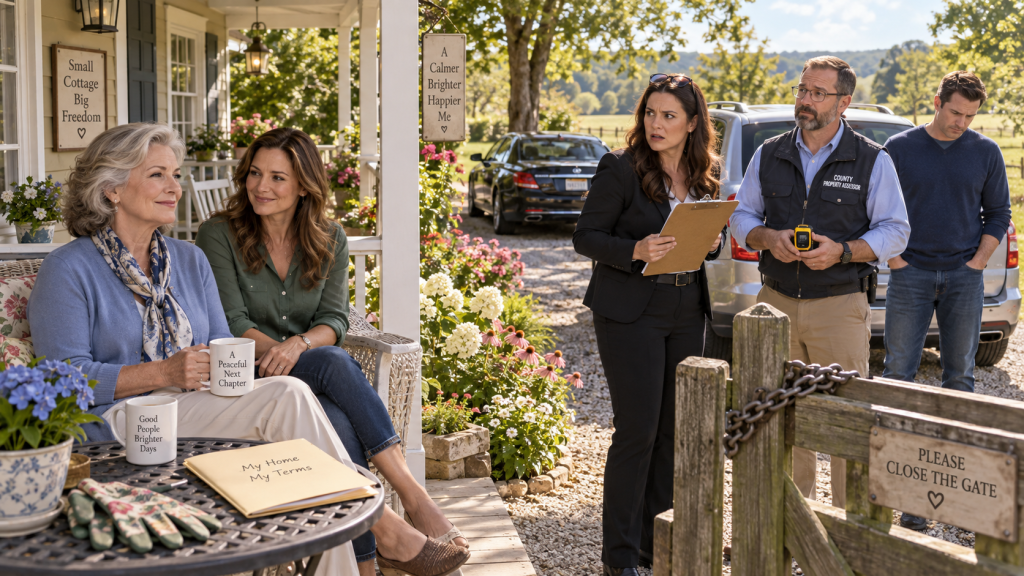
Sarah stared at me as though I had announced I had sold the moon.
“You sold our inheritance?”
Her words hung over the porch.
The assessor shifted his weight.
Emma’s expression hardened.
David looked at his wife, then at me.
For once, he did not immediately defend her.
I closed the manila folder.
“No, sweetheart,” I said. “I sold my house.”
Sarah’s mouth opened.
Nothing came out.
The assessor cleared his throat.
“I think I should go.”
Sarah spun toward him.
“No, wait.”
He raised one hand politely.
“I was retained to value a property based on the understanding that the owners were considering refinancing.”
“I told you it was family property.”
“Yes.”
“And it is.”
“No.”
He looked at the deed again.
“It belongs to Mrs. Collins.”
I almost corrected him.
Not because the name was wrong.
Because for the first time in years, hearing someone describe something as mine felt unfamiliar.
Mine.
The cottage.
The money from the city house.
The porch beneath my feet.
The flowers I had planted.
The coffee cooling beside my chair.
Mine.
Not family storage.
Not future inheritance.
Not an emergency fund with grandchildren attached.
Mine.
The assessor handed the copy back.
“I won’t be conducting an inspection.”
Sarah stared at him.
“We drove three hours.”
“I’m sorry.”
“You can at least give us an exterior estimate.”
“No.”
Her face reddened.
“Why not?”
“Because the owner has told me she did not request my services.”
He glanced toward me.
“I apologize for the misunderstanding.”
“It wasn’t yours.”
That mattered.
He had been misled too.
He nodded once, returned to his sedan, and drove away.
Gravel crackled beneath his tires.
Then the cottage became quiet.
Too quiet.
Sarah still held her clipboard.
I wondered what she had written on it.
Renovation costs?
Projected rent?
Estimated resale value?
How much of my life had been converted into numbers before she arrived?
Emma must have been wondering the same thing.
She stood.
“Okay.”
Sarah looked at her.
“Okay what?”
“Now that the stranger is gone, explain.”
David rubbed his forehead.
“Emma.”
“No.”
She looked at him.
“You showed up at Mom’s house with a property assessor she didn’t hire.”
“It wasn’t like that.”
Emma laughed once.
“Every terrible family decision begins with that sentence.”
Sarah snapped:
“Stay out of it.”
Emma looked around the porch.
“I was invited.”
Then she pointed toward the driveway.
“You weren’t.”
That one landed.
Sarah turned toward me.
“You knew we were coming.”
“I suspected.”
“That’s why the gate was unlocked.”
“Yes.”
David stared.
“You set this up?”
“No.”
I looked at the clipboard.
“You did.”
He went quiet.
Sarah crossed her arms.
“So you just sat here waiting to embarrass us.”
I thought about that.
“Partly.”
Emma almost smiled.
Sarah looked shocked.
I continued.
“Mostly, I wanted to know what you would do if I stopped warning you.”
“What does that mean?”
“I already told you the cottage was mine.”
“Yes.”
“I already told you David’s name was not going on the deed.”
Sarah’s jaw tightened.
“I was trying to protect you.”
“No.”
“I was.”
“No, you were trying to protect your expectation.”
She stared.
I stood.
“For years, I helped you because I wanted to.”
“Then why are you acting like we stole from you?”
“You didn’t steal.”
I paused.
“But you started treating my generosity like a utility.”
David’s face changed.
That one reached him.
Sarah rolled her eyes.
“Oh, come on.”
“No.”
I looked directly at her.
“Tuesday childcare.”
Silence.
“Garage storage.”
Silence.
“Groceries.”
Her face hardened.
“Those were family things.”
“Yes.”
“And family helps.”
“Yes.”
“Then why are you keeping score now?”
“I’m not.”
I stepped closer.
“That is the point.”
Sarah frowned.
“I never kept score.”
I gestured toward the cottage.
“I stopped playing.”
That silenced her.
For five years, I had functioned as the invisible support system beneath their household.
I had loved the twins.
I still did.
I had enjoyed many Tuesdays.
I had been grateful to have family nearby after my husband died.
But somewhere along the way, help had become expected.
Expected had become scheduled.
Scheduled had become owed.
And owed had become ownership.
A garage.
A day of my week.
Then, apparently, a house.
David finally spoke.
“Mom, we didn’t think we owned anything.”
I looked at him.
“Did you know she was bringing an assessor?”
He glanced at Sarah.
There.
The hesitation.
“Yes.”
My heart hurt more than I expected.
“Why?”
He looked down.
“Sarah said if we knew what the cottage was worth, we could figure out whether it made more sense to keep it as a rental later.”
“Later.”
He winced.
I hated the word.
Not because it referred to my death directly.
Because everyone knew it did.
Emma’s face went pale.
“David.”
He lifted both hands.
“We’re not sitting around waiting for Mom to die.”
Sarah muttered:
“Exactly.”
I looked at my son.
“Then why were you calculating what happens to the cottage afterward?”
He had no answer.
I felt something inside me settle.
Not anger.
Clarity.
The same kind I had felt when I dropped those cold ribs into the garbage.
Something simple.
“I am not dead.”
David closed his eyes.
“I know.”
“No.”
I shook my head.
“I don’t think either of you really understood that.”
Sarah laughed bitterly.
“That’s dramatic.”
Emma turned toward her.
“She bought a house and you brought someone to assess it for your future rental plan.”
Sarah’s face flushed.
“I was thinking ahead.”
“About someone else’s property.”
“For her son.”
“For yourself.”
“For our family.”
Emma laughed.
“There it is.”
“What?”
“The word family when you mean access.”
Sarah’s face changed.
“You don’t know anything about what we deal with.”
Emma’s expression cooled.
“What does that mean?”
“It means you live three states away and show up twice a year acting like the moral daughter while David and I are actually here.”
That was cruel.
Partly true.
Also beside the point.
Emma flinched.
I stepped in before old sibling wounds took over my porch.
“Enough.”
Both women stopped.
I looked at Sarah.
“This is not about Emma.”
Then at David.
“And it is not about who loves me more.”
Then back at Sarah.
“It is about who gets to decide what I do with my property.”
Silence.
“I do.”
She looked away.
David sat on the porch rail.
For the first time since arriving, he seemed less angry than exhausted.
“Why did you sell the city house without telling me?”
There it was.
Not accusing.
Hurt.
That mattered.
“Because I didn’t want permission.”
“You wouldn’t have needed permission.”
“No.”
I smiled sadly.
“But you would have treated the decision like a family meeting.”
He looked down.
“I might have had questions.”
“Yes.”
“I grew up there.”
“I know.”
“That house had Dad’s workshop.”
“I know.”
“My kids knew that house.”
“I know.”
His voice cracked.
“And you sold it in two days without telling me.”
That hurt.
Because this time, he was not wrong.
He had no ownership claim.
But grief and ownership are different things.
The house had been his childhood too.
I sat down.
“I should have told you before closing.”
Sarah looked surprised.
So did Emma.
I continued.
“Not because you had a vote.”
David looked at me.
“But because you loved that house.”
His eyes filled.
I saw my little boy then.
Not the man who had let his wife bring an assessor.
The ten-year-old who used to sleep in the basement during thunderstorms because he insisted he was protecting his father’s tools.
“I’m sorry for that part.”
David wiped his face quickly.
“Why didn’t you?”
I thought about it.
“Because by then I did not trust that telling you would remain information.”
His face tightened.
“It would have become pressure.”
He stared at the yard.
Maybe he knew.
Probably.
Sarah leaned against the porch post.
“So that’s it? You sell everything, lock it in a trust, and leave us nothing?”
I looked at her.
“Did you hear yourself?”
Her face went still.
Emma did not speak.
Neither did David.
I stood.
“I am sixty-eight years old.”
I had not mentioned my age before.
It suddenly mattered.
“My life is not the hallway leading to your inheritance.”
Sarah’s mouth tightened.
“I didn’t say that.”
“You asked what would happen after.”
“Everyone plans estates.”
“Yes.”
“I’m being practical.”
“No.”
I picked up the manila folder.
“Practical would be asking whether I had an estate plan.”
She looked at it.
“Do you?”
“Yes.”
That changed the room.
Sarah looked at David.
David looked at me.
Emma already knew.
Of course she did.
“What does it say?” Sarah asked.
I laughed softly.
“That is not your business.”
Her face reddened.
“David is your son.”
“Yes.”
“The twins are your grandchildren.”
“Yes.”
“So they’re in it.”
I stared.
“You keep asking the wrong question.”
“What’s the right one?”
“What do I want to do with what I own?”
She rolled her eyes.
“Fine. What do you want?”
I smiled.
“That’s the first time you’ve asked.”
Nobody spoke.
The wind moved through the maple trees.
A bird landed on the fence.
Ordinary things continued while my family rearranged itself.
“I want this cottage.”
I touched the porch rail.
“I want my retirement account left alone unless I decide otherwise.”
“I want to stop being everyone’s automatic backup plan.”
Sarah crossed her arms.
“And you want Emma to get everything.”
“No.”
That surprised her.
Even Emma looked at me.
“Then what?”
“I want to be alive long enough that there is less left than you expect.”
Emma started laughing.
David looked horrified for half a second.
Then, unexpectedly, he laughed too.
Sarah did not.
I continued.
“I want to travel.”
“I want to fix the cottage roof before it becomes an emergency.”
“I want to plant fruit trees even if I never live long enough to see them full-grown.”
“I want to pay for things that make my days better.”
“I want to help my grandchildren when I choose.”
Then I looked at David.
“And if I leave something to you, I want it to arrive as a gift.”
His eyes filled.
“Not as something you spent years waiting for.”
Sarah looked toward the driveway.
She had nothing to say.
That was rare.
Then the twins’ names came out.
“Do you even care how this affects Noah and Lucy?”
My anger returned so fast it almost surprised me.
“No.”
Sarah looked shocked.
I corrected myself.
“No. You do not use my grandchildren to make this conversation easier for you.”
Her face hardened.
“They love coming to your house.”
“They’re welcome here.”
“You stopped Tuesdays.”
“Yes.”
“They keep asking why.”
“Tell them Grandma has a life too.”
“That’ll sound great.”
“Then say it more kindly.”
David put his head in his hands.
“Can we stop?”
No one answered.
He looked at me.
“Mom, what do you want us to do right now?”
There.
The correct question.
Finally.
“Take the clipboard.”
He nodded.
“Take the measuring device you didn’t get to use.”
Sarah glared.
“Take your SUV.”
I looked at him.
“Go home.”
His face fell.
“Mom.”
“I need space.”
“How much?”
“I don’t know.”
“What about the twins?”
“They can visit when we arrange it.”
“Without us?”
“If necessary.”
Sarah laughed bitterly.
“Oh, so we’re unsafe now.”
I looked at her.
“No.”
Then I said the thing I had been afraid to say for years.
“But I don’t like who I become around you.”
She froze.
Not hate.
Not accusation.
Truth.
“I become defensive in my own home.”
Her eyes filled.
“I become careful with my words.”
“I become someone who feels guilty for having money she earned and saved.”
“I become useful instead of loved.”
That one broke David.
His shoulders dropped.
“Mom.”
I looked at him.
“I do not want to feel useful every time my phone rings.”
His face crumpled.
For five years after my husband died, I had not admitted that even to myself.
Being needed had kept loneliness away.
The twins on Tuesdays.
Sarah calling because groceries were tight.
David asking whether I could store one more thing.
Each favor proved I still belonged somewhere.
Until belonging started costing too much.
“I need to know you’ll call me even when you don’t need anything.”
David began crying quietly.
Sarah looked away.
Emma wiped one eye.
No one mocked him.
No one should have.
He was my son before he was Sarah’s husband.
I had missed that version of him.
Maybe he had too.
“We’ll go,” he said.
Sarah turned.
“What?”
“We’re leaving.”
She stared at him.
“We drove three hours.”
“I know.”
She looked furious.
“You’re seriously just going to let her—”
“Let her what?”
His voice changed.
Not loud.
Tired.
“Own her house?”
Sarah stared.
David stood.
“She’s right.”
Her face went blank.
“About what?”
“A lot.”
“David.”
He looked at me.
“We’ll go.”
I nodded.
He stepped forward.
Then stopped.
“Can I hug you?”
My throat tightened.
That question.
After so many assumptions.
“Yes.”
He hugged me.
Long.
Not like an apology.
Like grief.
I held him.
My son.
Still my son.
Even when he disappointed me.
Even when I disappointed him.
That is the cruelty and beauty of family.
Love does not always tell you what to do.
Sometimes it simply refuses to disappear while you figure it out.
When we separated, he whispered:
“I’m sorry.”
I did not say it was fine.
That word had caused enough trouble.
I said:
“I know.”
Sarah did not hug me.
She walked to the SUV without another word.
David followed.
Emma and I watched them drive away.
The chain still hung open from the gate.
After the SUV disappeared, Emma said:
“So.”
“So.”
“That went well.”
I laughed despite myself.
“You are terrible.”
“I flew three states for this.”
“No, you flew to visit me.”
“Same thing.”
I looked at her.
She smiled.
Then her expression softened.
“You okay?”
“No.”
“Good.”
I frowned.
She laughed.
“Mom, you always say you’re fine.”
I stared.
Then laughed too.
“Apparently none of my children respect me.”
“Not true.”
She linked her arm through mine.
“We’re learning.”
That evening, we sat by the wood stove.
I made soup.
Emma opened wine.
The cottage became quiet again.
Not lonely.
Quiet.
There is a difference.
I thought about Sarah.
Her question.
You sold our inheritance?
For years, I might have heard only greed.
Now I heard fear too.
David and Sarah were stretched thin financially.
I knew that.
Two children.
Mortgage.
Car payments.
Summer camps they probably could not afford.
Sarah worked part-time.
David had changed jobs twice.
My help had not simply been convenient.
It had been built into their budget.
When I withdrew it, the floor moved.
That did not make the assessor acceptable.
But context matters even when it does not excuse.
“Do you think I was too hard?”
Emma groaned.
“No.”
“I’m asking seriously.”
“So am I.”
“What if they’re struggling?”
“They are.”
I looked at her.
“You know?”
“David called me last month.”
“What?”
“He asked for a loan.”
My heart dropped.
“How much?”
“Ten thousand.”
“Did you?”
“No.”
“Why didn’t you tell me?”
“Because it wasn’t your problem.”
That answer stung.
“I’m his mother.”
“Yes.”
“He’s my son.”
“Yes.”
“Then it is partly my problem.”
Emma shook her head.
“No.”
“Emma.”
“It can matter to you without becoming yours to fix.”
I stared at her.
She had learned something I had not.
Maybe distance had taught it.
Maybe watching me had.
“Why did he need ten thousand?”
“Credit cards.”
I closed my eyes.
Of course.
“Did Sarah know he asked?”
“I don’t know.”
I looked toward the dark window.
My reflection looked older than I felt.
“What did you tell him?”
“I asked for a budget.”
I laughed.
“He hated that.”
“Very much.”
“Did he send one?”
“No.”
“Then?”
“I said no.”
I was quiet.
Emma sipped wine.
Then:
“You’re doing the face.”
“What face?”
“The rescue face.”
“I don’t have a rescue face.”
“You absolutely do.”
I sighed.
“What if I gave them money once?”
“You can.”
She leaned forward.
“But ask yourself one thing.”
“What?”
“Are you helping them solve a problem or helping them postpone changing?”
That question followed me for weeks.
David did not call for nine days.
Sarah did not call at all.
The twins sent me voice messages.
Lucy told me about a spelling test.
Noah complained about his soccer coach.
They did not mention the cottage.
Good.
Children should not be recruited into adult money.
On day ten, David called.
“Can we talk?”
“Yes.”
“Without Sarah?”
I hesitated.
“Yes.”
He drove up the following Saturday.
Alone.
No folder.
No assessor.
No equipment.
He brought coffee.
Good coffee.
A peace offering that cost less than a property valuation.
We sat on the porch.
For a while, we talked about the twins.
Then he stared at his cup.
“Emma told you.”
“Yes.”
He winced.
“I told her not to.”
“She didn’t promise.”
“No.”
“What happened?”
He rubbed both hands together.
“We got behind.”
“On what?”
“Everything.”
“That is not a number.”
He smiled weakly.
“Dad used to say that.”
“He did.”
“About twenty-six thousand on cards.”
My stomach tightened.
“Anything else?”
“Car.”
“How much?”
“Thirty-two left.”
“House?”
“Current.”
“Retirement?”
He looked away.
“David.”
“I borrowed some.”
“How much?”
“Fifteen.”
I closed my eyes.
The numbers stacked quickly.
“Why?”
“Normal life.”
“No.”
He flinched.
“Normal life doesn’t cost that much when income doesn’t support it.”
“I know.”
“You know now.”
“Yes.”
I hated how much I sounded like his father.
I also understood why my husband had spoken that way.
David stared toward the trees.
“We kept thinking my next raise would fix it.”
“Did it?”
“No.”
“Sarah’s income?”
“She cut hours when Lucy started having trouble in school.”
I nodded.
That part I knew.
“Then camps.”
“Trips.”
“Clothes.”
“Boat.”
He looked embarrassed.
I had moved that boat to storage.
“I should sell it.”
“Yes.”
He smiled faintly.
“You didn’t hesitate.”
“No.”
He looked down.
“I think Sarah believed the cottage could become a way out.”
“Mine.”
“Yes.”
“She thought you paid part of it?”
“No.”
“Then why did she tell people you did?”
He rubbed his face.
“I don’t know.”
“David.”
“I think she was embarrassed.”
“That does not explain the assessor.”
“No.”
His voice cracked.
“She kept saying if we could prove we had an interest in it, maybe later—”
“Stop.”
He did.
“I am alive.”
“I know.”
“Do not say later when you mean after I die.”
His eyes filled.
“I’m sorry.”
I believed him.
Not because he cried.
Because this time he did not explain the tears.
He let them sit.
“I should have stopped her.”
“Yes.”
“I knew bringing the assessor was wrong.”
“Yes.”
“I came anyway.”
“Yes.”
He looked at me.
“Why aren’t you angrier?”
“I am.”
“You don’t sound it.”
“I’m tired.”
That frightened him more.
Maybe it should have.
Anger still wants engagement.
Exhaustion wants distance.
He looked toward the cottage.
“I miss Dad.”
The sentence came out of nowhere.
Or maybe not.
Money and grief often live closer together than we admit.
“So do I.”
“He would have killed me.”
“No.”
“He would have yelled.”
“Absolutely.”
David laughed through tears.
“He would’ve made a spreadsheet.”
“Color-coded.”
“Red.”
“So much red.”
We both laughed.
Then David looked at me.
“I think after Dad died, I started seeing everything you had as something eventually coming to us.”
There.
Clean.
Awful.
Honest.
I waited.
“I never said it out loud.”
“You did in your head.”
“Yes.”
“Why?”
He thought for a long time.
“Because it made me feel safer.”
I understood more than I wanted to.
My husband had been the financial steady one.
After he died, David’s own life was getting more expensive.
A future inheritance became imaginary insurance.
Money that did not exist yet had already started calming him.
Until my buying the cottage threatened the fantasy.
“I’m sorry.”
I looked at him.
“Thank you.”
He looked surprised.
“That’s it?”
“What do you want?”
“I don’t know.”
“Then maybe that’s enough today.”
He nodded.
Before leaving, he handed me a piece of paper.
“What is this?”
“A budget.”
I stared at him.
“Emma?”
“Yes.”
I laughed.
“She’s ruthless.”
“You raised her.”
Fair.
The budget was ugly.
Not catastrophic.
But ugly.
We sat down again.
Not as rescuer and child.
As two adults.
I asked questions.
He answered.
No money changed hands that day.
That was deliberate.
He sold the boat the following month.
Then the second car.
Sarah increased her hours after they arranged support for Lucy at school.
They canceled a planned vacation.
Started paying down cards.
It was not glamorous.
Nobody posts debt reduction on social media with personalized banners.
But it was real.
Three months later, David called.
“Paid off one card.”
“How much?”
“Four thousand.”
“Good.”
“Say it like you mean it.”
“I’m proud of you.”
He became quiet.
“Thanks.”
Sarah still did not speak to me.
At first, I told myself that was fine.
Then I admitted it hurt.
I loved her once.
Not like a daughter exactly.
But close.
She had been in my kitchen during holidays.
I had held her hand in the hospital after the twins were born.
I had defended her when relatives criticized her parenting.
Betrayal hurts partly because affection existed first.
Five months after the assessor visit, I received a letter.
Handwritten.
Sarah.
I almost threw it away.
Instead, I opened it.
I have rewritten this four times.
That made me smile despite myself.
She continued.
I am sorry I brought the assessor. I knew you had said no to adding David to the deed. I told myself getting a value was not the same thing as taking anything. But the truth is, I was looking at your property as a solution to our problems.
My throat tightened.
I also told people the cottage was David’s investment because I was embarrassed that you could buy something in cash while we were struggling. That was ugly.
Good.
No excuse.
When you stopped helping every Tuesday, I felt abandoned. I know how ridiculous that sounds because you had helped us for years. But I had built my week around your generosity so completely that when you changed it, I experienced your boundary as betrayal.
I sat down.
That sentence mattered.
It wasn’t betrayal. It was a boundary. I understand that now.
Tears came.
I am not asking to be put on anything. I am not asking for money. I am not asking you to forget what I did. I would like the chance to apologize in person when you are ready.
At the bottom:
Also, Lucy asks every Tuesday whether Grandma Day will ever happen again. I have told her that is your choice.
I laughed through tears.
Grandma Day.
I had never called it that.
Apparently they had.
That hurt and healed simultaneously.
I called Sarah.
She answered immediately.
“Hello?”
“It’s me.”
Silence.
Then:
“Hi.”
“I got your letter.”
“Okay.”
“You spelled assessor wrong.”
She laughed once.
Then began crying.
“So did you.”
“I was nervous.”
“You should be.”
“I am.”
We both laughed weakly.
Then I said:
“Come Saturday.”
“David too?”
“No.”
Another pause.
“Okay.”
She arrived alone.
No clipboard.
No carefully prepared smile.
Jeans.
Sweater.
Hair pulled back.
She looked tired.
We sat at the kitchen table.
The manila folder was gone.
I had put it away months earlier.
I did not need evidence visible to feel secure.
Sarah looked around.
“You changed the curtains.”
“Yes.”
“They’re nicer.”
“Careful.”
She smiled.
Then looked at me.
“I’m sorry.”
I nodded.
“I know.”
“I was cruel.”
“Yes.”
“I told myself you had more than you needed.”
“Yes.”
“I thought because we were struggling, that gave us some kind of moral claim.”
My eyes filled.
“Yes.”
She began crying.
“I think I was angry that you were free.”
That surprised me.
“What?”
“You could buy this place.”
She gestured around.
“You could just decide not to babysit.”
“You could move.”
“You could say no.”
Her voice broke.
“I was drowning in bills and schedules and kids and work, and I hated you for being able to choose.”
I stared at her.
There it was.
Not greed alone.
Envy.
Exhaustion.
Shame.
None of them excused what she did.
But they made her human again.
“I should have asked for help differently,” she said.
“Yes.”
“I should have told you I was overwhelmed.”
“Yes.”
“I should never have treated your house like something already waiting for us.”
“Yes.”
She laughed through tears.
“You’re enjoying this.”
“A little.”
She nodded.
“Fair.”
“No.”
I smiled.
“My favorite word now is choice.”
She laughed.
Then became serious.
“Do you forgive me?”
I thought carefully.
“I think I’m starting to.”
Her face softened.
“Is that enough?”
“For now.”
“Yes.”
We talked for two hours.
Not about money.
Mostly.
About the twins.
Marriage.
Grief.
Her mother.
Her fear of failing.
My loneliness after my husband died.
She admitted she had interpreted my availability as proof I needed them.
I admitted sometimes I had encouraged that because being needed was easier than being alone.
Two people can participate in an unhealthy pattern without sharing equal responsibility for crossing a boundary.
That distinction helped me.
I had enabled dependence.
I had not caused the assessor.
Sarah owned that.
I owned my part.
That made repair possible.
Grandma Day came back.
Not every Tuesday.
Once a month.
Scheduled by me.
Sometimes Saturday.
Sometimes Wednesday.
Sometimes not at all.
Lucy complained.
Noah adapted.
Children survive calendars.
The first time Sarah dropped them off again, she stood at the door.
“What time should I be back?”
“Four.”
“I can do three-thirty.”
“Four.”
She smiled.
“Four.”
No assumptions.
No keys.
No “I’ll be late.”
At 3:58, her SUV pulled in.
I noticed.
Of course I did.
Respect often arrives as tiny punctualities.
Over the next year, David and Sarah paid down half their credit-card debt.
Then all of it.
The boat stayed gone.
David admitted he did not miss it.
Sarah admitted she did.
We laughed.
Their marriage survived.
Not because money problems disappeared.
Because they stopped using future money to avoid present truth.
That was what David told me, anyway.
I believed him.
Emma returned home eventually.
Not permanently.
Just for visits.
Her relationship with Sarah remained frosty.
I did not force it.
“Family harmony” had once been the excuse I used to swallow everything.
Now I allowed adults to have awkward relationships without assigning myself maintenance duty.
At Christmas, they were polite.
That was enough.
The city-house money remained in trust.
I used part to renovate the cottage.
New roof.
Insulation.
A screened porch.
Then I did something outrageous.
I bought a camper van.
Emma laughed for ten minutes.
David said:
“Dad would’ve hated that.”
“He is dead.”
“Mom!”
“What?”
I smiled.
“He cannot stop me.”
Sarah nearly fell over laughing.
I drove north one summer.
Then west.
I saw mountains.
Coastline.
Small towns.
I ate bad diner pie.
Slept badly in three states.
Got lost twice.
Loved almost all of it.
Every dollar I spent made me feel guilty at first.
Then less.
My husband and I had saved carefully.
Not so our children could watch the accounts grow forever.
So we could live without fear.
I had forgotten living was part of the plan.
At seventy-two, I took the twins to Yellowstone.
David and Sarah paid their airfare.
I paid for lodging because I wanted to.
That distinction was discussed openly.
No one called it family money.
No one talked about inheritance.
One morning, Lucy looked at me while we ate pancakes.
“Grandma?”
“Yes?”
“Are you rich?”
I nearly choked.
“Why?”
“Mom said you’re comfortable.”
I looked at Sarah.
She raised both hands.
“I said comfortable.”
I turned back to Lucy.
“I have enough.”
“For what?”
“For my life.”
She thought.
“Will you give Dad money when you die?”
Sarah closed her eyes.
David coughed.
I smiled.
“Maybe.”
Lucy frowned.
“That’s not an answer.”
“It’s the only one you’re getting.”
Noah asked:
“Can we have pancakes?”
That was the better question.
Years passed.
The cottage became home in a way the city house had stopped being before I realized it.
Not because it held fewer memories.
Because every memory there began with choice.
I chose the curtains.
The garden.
The paint.
The porch chairs.
Who had keys.
Who stayed overnight.
What belonged in the garage.
Nobody stored anything there without asking.
That became a family joke.
When David bought new camping gear, he said:
“Don’t worry. I have my own storage.”
I told him:
“Character development.”
Sarah laughed.
At seventy-five, I revised my estate plan.
Not because anyone asked.
Nobody did.
I told Emma and David together.
That mattered.
“I want you both to know what will happen.”
Sarah immediately stood.
“I’ll go.”
I looked at her.
“You can stay.”
She hesitated.
Then sat.
I explained.
The trust would first fund my care.
Everything.
Housing.
Medical needs.
Travel if I remained able.
Whatever I needed.
After my death, what remained would be divided.
A portion to Emma.
A portion to David.
Education trusts for the twins.
A charitable gift in my husband’s name.
The cottage would not automatically go to anyone.
It would be sold unless both children agreed on another plan and paid the trust fair value.
David blinked.
“Why fair value?”
“So nobody turns it into another family-property argument.”
Emma laughed.
“Smart.”
David nodded.
“Fair.”
I looked at him.
“No.”
He smiled.
“Your choice.”
“Exactly.”
Sarah said nothing.
Afterward, while David and Emma argued about dinner, she found me on the porch.
“Thank you.”
“For what?”
“For letting me sit there.”
I looked at her.
“You’re family.”
Her eyes filled.
I continued.
“That does not mean ownership.”
She laughed through tears.
“I know.”
That was enough.
At seventy-eight, my knees started complaining about the cottage steps.
Not badly.
But enough.
Sarah noticed first.
She did something that showed me how far she had come.
Nothing.
She did not mention it.
Did not recommend downsizing.
Did not send listings.
Three months later, I said:
“I’m thinking about installing a ramp.”
She nodded.
“Do you want recommendations?”
I nearly cried.
“Yes.”
That question.
Not:
You need.
Not:
We should.
Do you want.
I did.
She found a contractor.
I approved him.
Paid him.
The ramp was ugly.
I loved it.
At eighty-one, I stopped driving at night.
At eighty-three, I stopped driving entirely.
David offered rides.
Emma arranged grocery delivery when she was in town.
Sarah drove me to appointments.
Every time, she asked.
“Do you want me to come in?”
Sometimes yes.
Sometimes no.
She accepted both.
That is how trust returns.
Not through one dramatic apology.
Through dozens of ordinary moments in which the old harm could repeat and does not.
At eighty-four, I fell in the garden.
Broken wrist.
Bruised hip.
Nothing worse.
David arrived at the hospital.
Sarah ten minutes later.
Emma flew in the next day.
The doctor suggested I might consider assisted living eventually.
Everyone went silent.
I looked at Sarah.
She looked at me.
Neither said anything.
Then I started laughing.
“What?” the doctor asked.
Sarah covered her mouth.
“Nothing.”
I pointed at her.
“Years ago this woman would’ve had three brochures by morning.”
Sarah laughed so hard she cried.
David groaned.
Emma said:
“She had an assessor first.”
The doctor looked confused.
Good.
Some stories belong to the family that survived them.
I did not move then.
Two years later, I chose to.
The cottage had become too much.
Not emotionally.
Practically.
I wanted people nearby.
Meals available.
A smaller garden.
One level.
I toured places.
With all three of them.
This time, nobody spoke first.
I asked opinions.
They gave them.
I chose a community twenty minutes from David.
Thirty-five from the cottage.
Emma hated the wallpaper.
Sarah liked the courtyard.
David cared about emergency response.
I cared about the library.
My choice won.
Of course.
When it came time to sell the cottage, Sarah said:
“Do you want me to find someone?”
I looked at her.
“An assessor?”
Her face went bright red.
Everyone laughed.
Even her.
Especially her.
“Yes,” I said.
“This time you may bring one.”
She did.
With my permission.
That mattered enough to make me emotional.
The assessor was a woman named Nina.
She measured rooms.
Walked the acreage.
Asked questions.
Then sat at my kitchen table.
Sarah was there.
So was David.
Nina gave the number.
Higher than I expected.
Sarah looked at me.
“Good.”
Nothing else.
No calculation.
No suggestion.
No “family equity.”
Just good.
I realized, suddenly, that I trusted her.
Not blindly.
Trust after injury is wiser than that.
But truly.
The cottage sold to a retired teacher and her wife.
They loved the porch.
Loved the oak doors.
Promised to keep the apple tree.
I signed every document myself.
When the final key left my hand, I cried.
Sarah hugged me.
Then whispered:
“You bought yourself a life there.”
I looked at her.
“Yes.”
“I’m glad you did.”
That sentence healed something I had not known was still tender.
I moved into my apartment at the retirement community.
The trust paid for everything.
My money.
Doing its job.
Not waiting.
Not being preserved for heirs while I shrank around it.
I bought new furniture.
Expensive chair.
Terrible painting.
Emma hated both.
I told her that was why I liked them.
David brought a toolbox.
Sarah brought flowers.
The twins assembled a bookshelf badly.
Home again.
At eighty-seven, I asked Sarah to help me organize old papers.
We opened a box from the cottage.
Inside was the original property assessor’s copy of the deed.
I had kept it.
Sarah froze.
“Oh, God.”
I laughed.
“You remember.”
“I wish I didn’t.”
She sat beside me.
For a minute, we stared at the paper.
Then she said:
“I was awful.”
“Yes.”
She laughed.
“I appreciate your consistency.”
I touched her hand.
“You were also overwhelmed.”
Her eyes filled.
“That doesn’t excuse it.”
“No.”
“But it explains part.”
She nodded.
“I still hate that version of me.”
“Don’t.”
She looked at me.
“Why?”
“Because she changed.”
“That doesn’t mean I have to like her.”
“No.”
I smiled.
“But you should understand her.”
Sarah folded the paper.
“I was so scared of being poor.”
I waited.
“My mother was always behind on bills.”
She had never told me that.
“We moved four times before I was twelve.”
Her eyes filled.
“I thought marrying David meant stability.”
I looked at her.
“Then Dad died.”
“Yes.”
“And suddenly I saw your savings.”
She covered her face.
“I hate saying that.”
“Say it anyway.”
She breathed in.
“I thought your money was safety.”
“For you.”
“Yes.”
“And because you loved us, I convinced myself it would eventually become ours.”
There it was.
Same pattern.
Different childhood.
“I’m sorry.”
“I know.”
She handed me the assessor paper.
“Throw it away.”
I looked at it.
Then tore it in half.
Sarah stared.
“Really?”
“Yes.”
“Shouldn’t you keep it?”
“For what?”
“Evidence?”
“Of what?”
She laughed through tears.
“That I used to be terrible.”
“I remember.”
“Thanks.”
I tore it again.
Then put it in the recycling bin.
Not forgiveness.
That had happened long before.
Release.
At ninety, I stopped caring much about property.
Funny.
A decade earlier, ownership had felt like survival.
Now my life fit mostly inside one bedroom, one sitting room, and a closet.
Objects become lighter near the end.
Relationships become heavier.
Emma visited as often as she could.
David every Sunday.
Sarah almost as often.
The twins were adults by then.
Lucy became a teacher.
Noah went into construction management.
They both remembered Grandma Day.
Sometimes they brought pancakes.
Not very good ones.
I ate them anyway.
On my ninetieth birthday, they gave me a framed photo.
The cottage porch.
All of us sitting there.
Me in the center.
Emma.
David.
Sarah.
The twins.
Taken years after the assessor incident.
Everyone smiling.
On the back, Lucy had written:
The place Grandma chose.
That was perfect.
Not the place Grandma owned.
Chose.
I kept it beside my bed.
A year later, my health declined.
Nothing dramatic.
Then everything gradually became dramatic.
Heart problems.
Breathing.
Fatigue.
I signed updated medical instructions.
The trust documents were already clear.
Emma and David both knew.
Sarah knew too.
Nobody fought.
That was part of the inheritance, although no lawyer had written it.
Clarity.
One afternoon, David sat beside me.
He had gray hair.
My son.
Older than my husband had been when we first bought our city house.
“Mom?”
“Yes?”
“Do you remember the assessor?”
I laughed weakly.
“Unfortunately.”
“I still feel sick about it.”
“Good.”
He smiled.
Then became serious.
“I should have stopped it.”
“Yes.”
“I knew Sarah was wrong.”
“Yes.”
“I was afraid of fighting with her.”
I looked at him.
“That made me the easier person to disappoint.”
His eyes filled.
“Yes.”
There it was.
The same role I had played for years.
The easy one.
The person whose pain was considered less dangerous than conflict with someone else.
“I’m sorry.”
I took his hand.
“I know.”
“Did you forgive me?”
“Years ago.”
“Why?”
I smiled.
“Because you stopped making me pay for loving you.”
He cried.
So did I.
Later, Sarah came alone.
She sat beside the bed.
For a while, we listened to the rain.
Then she said:
“I used to think you didn’t like me.”
I looked at her.
“When?”
“Before the reunion.”
I frowned.
“Why?”
“You were so quiet around me.”
I smiled sadly.
“I was trying to be easy.”
Her face changed.
“That hurt us, didn’t it?”
“Yes.”
Not equally.
But yes.
“If I had told you earlier when I felt used…”
“You might have hated me sooner.”
I laughed.
“Maybe.”
She squeezed my hand.
“But maybe I would’ve learned sooner.”
“Maybe.”
We sat quietly.
Then she said:
“Thank you for not cutting me out forever.”
I thought.
“You’re welcome.”
“Was it hard?”
“Yes.”
“Why did you let me back?”
I looked at her.
“Because you came back different.”
She cried.
That was the entire reason.
Not blood.
Not obligation.
Change.
Emma came the next morning.
She brought peach cobbler from Miller’s Bakery.
Still open.
Helen had retired.
Her daughter ran it.
One bite took me back decades.
The first cobbler.
The reunion.
The cold ribs.
The garbage.
The beginning.
“Good?” Emma asked.
“Yes.”
She smiled.
“Do you regret buying the cottage?”
“No.”
“Even though everything blew up?”
I looked toward the photograph.
The porch.
My family.
“No.”
That cottage had been more than property.
It was the first decision I made after my husband’s death that existed entirely for me.
No twins.
No storage.
No financial emergency.
No role.
Mine.
Then later, generously shared.
That order mattered.
“You know what I regret?”
“What?”
“Waiting until I was hurt to change things.”
Emma looked at me.
“I should have built a life before resentment built one for me.”
She squeezed my hand.
“That sounds like something people should put on a wall.”
“Don’t.”
“Too late.”
I laughed.
Eventually, I entered hospice.
My choice.
There was no cottage.
No city house.
No garage.
No property assessor.
The trust paid my care.
Everything else waited.
Exactly as it should.
One evening, all of them came.
David.
Sarah.
Emma.
Noah.
Lucy.
Too many chairs.
Too many tears.
I looked at Sarah.
“Did you bring a clipboard?”
Everyone laughed.
Sarah cried so hard she could barely speak.
“Never again.”
“Good.”
Then I looked at the twins.
“You know something?”
“What?” Lucy asked.
“I never minded Tuesdays.”
Her face crumpled.
“Really?”
“No.”
I smiled.
“I minded when Tuesdays stopped being a choice.”
Noah nodded.
Maybe he understood.
Maybe later.
I looked at David.
“Same with money.”
Then Sarah.
“Same with property.”
Then Emma.
“Same with everything.”
My voice had become weak.
But they listened.
“Love feels different when choice is still inside it.”
That was the lesson.
The whole story, really.
I died six days later.
Quietly.
Emma was there.
David had gone for coffee.
Sarah had stepped into the hallway to take a call.
Life is unscripted even at the end.
The estate was handled exactly as planned.
No surprises.
No fights.
The trust paid final expenses.
Charity received its gift.
Emma and David received their shares.
The twins received education funds.
Nobody got a cottage.
Nobody got the city house.
Both had already served their purpose.
Sarah received something too.
Not money.
A letter.
I had written it years earlier.
Sarah,
If you are reading this, then I finally own nothing and you are free to bring as many assessors as you like.
I hope you laughed.
There was a time when I thought the worst thing you did was show up at my cottage believing you had a right to it.
I was wrong.
The worst part was that I had spent years teaching all of you that my time and resources were endlessly available.
You took that lesson farther than you had any right to.
But I helped write the first chapter.
Then we both changed.
I want you to remember something when your own children are grown.
Help them.
Love them.
Open your home.
Watch the grandchildren.
Give money if you choose.
But never let love become a system where one person must disappear so everyone else can function.
And if Lucy or Noah ever buys a cottage, do not ask whose name is on the deed.
I already know what you’ll do.
You’ll bring pie.
Love,
Mom
Sarah read the letter twice.
Then called Emma.
Emma later told me—through stories others repeated—that Sarah laughed and cried for half an hour.
At my memorial, she brought peach cobbler.
No cold ribs.
No scraps.
A whole cobbler.
She placed it beside my photograph.
David gave the eulogy.
He did not talk about money.
Good.
He talked about Tuesdays.
The camping equipment.
The old garage.
My bad habit of buying cheap cars even when I could afford better.
The cottage.
Then he said:
“My mother taught me too late that generosity is not the same thing as availability.”
The room became quiet.
“She loved us enough to help us for years.”
He swallowed.
“And then she loved herself enough to stop when helping became expectation.”
Sarah cried in the front row.
Emma held her hand.
David continued.
“I thought that boundary meant she was leaving us.”
He smiled through tears.
“She was actually coming back to herself.”
That was the line everyone remembered.
Not the assessor.
Not the trust.
Not the sold city house.
Coming back to herself.
Years later, Lucy bought her first house.
A little bungalow.
Too expensive.
Bad gutters.
Beautiful windows.
At closing, Sarah came with her.
No clipboard.
No suggestions.
No questions about equity.
Just a box of pastries.
Lucy signed.
Then handed her mother the keys for a photograph.
Sarah immediately handed them back.
“That’s yours.”
Lucy laughed.
“I know.”
Sarah cried.
She later told David:
“Your mother would’ve loved that.”
I hope she was right.
Noah inherited my husband’s old habit of saving too much.
Emma traveled more.
David never bought another boat.
Sarah eventually started volunteering with a local financial-literacy group for young families.
That surprised everyone.
She talked openly about lifestyle inflation, debt shame, and the danger of treating expected inheritance as financial planning.
She never told the full cottage story.
She did not need to.
Some lessons can be taught without turning private shame into public performance.
One year, at Thanksgiving, the family gathered at David and Sarah’s house.
The twins were grown.
There were new children running through rooms.
Emma flew in.
Someone mentioned storage.
Apparently Noah needed somewhere to keep camping equipment.
Sarah pointed toward David.
“Ask your father.”
David laughed.
“What about our garage?”
Sarah shook her head.
“My garage is not a warehouse.”
Everyone stopped.
Then they laughed so hard Sarah had to sit down.
Some sentences travel through generations.
The good ones should.
The bad ones too, if they can be transformed.
That became my family’s version of inheritance.
Not only money.
Language.
Boundaries.
Stories.
The knowledge that property belongs to people before it belongs to family mythology.
That help is meaningful only when no is possible.
That a person can be generous without becoming infrastructure.
And that exclusion can sometimes reveal a life you have been postponing.
If Sarah had invited me to the lake reunion, I might never have bought the cottage.
I might have watched the twins every Tuesday for another decade.
Stored more boxes.
Paid more groceries.
Smiled.
Said nothing.
Called myself lucky to be needed.
Maybe resentment would have grown quietly until love could no longer breathe around it.
Instead, I saw fifty people smiling in photographs where I should have been included.
Then Sarah handed me two cold ribs and a spoonful of potato salad as though scraps could disguise exclusion.
I threw them away.
At the time, I thought I was throwing away leftovers.
Looking back, I think I was throwing away the role.
The easy mother-in-law.
The free sitter.
The garage.
The emergency fund.
The future inheritance waiting politely in a cardigan.
I bought a cottage.
But what I really bought was room.
Room to ask:
What do I want?
Room to discover that wanting something for myself did not make me selfish.
Room for my son to grow up again.
Room for Sarah to confront the ugliest part of her fear.
Room for Emma to come home without becoming my rescuer.
Room for the twins to know their grandmother as a person instead of a service.
That cottage had two bedrooms.
Three acres.
A porch.
A wood stove.
But the most important thing it gave me had no square footage.
Choice.
That was all.
Choice.
The assessor could not measure it.
Sarah could not put it on a clipboard.
No deed could describe it completely.
Yet it was the most valuable thing I owned.
And once I learned how to keep it, I could give generously again without disappearing.
That is why the ending was not that I kept everything.
I didn’t.
I spent money.
Gave money.
Shared holidays.
Watched grandchildren.
Paid for trips.
Helped when I wanted.
I even left something behind.
The difference was that every gift came after the question.
Do I choose this?
Not:
Will they be angry if I don’t?
Not:
What will family say?
Not:
Isn’t this what mothers do?
Choose.
Yes or no.
Both allowed.
That is what turned obligation back into love.
And if I could go back to the woman sitting in her parked car outside Miller’s Bakery, looking at photographs of a reunion she had not been invited to, I would tell her one thing.
Do not beg for a seat at a table where everyone remembered your usefulness and forgot your name.
Build another table.
Put it somewhere beautiful.
Invite people who know the difference between being welcomed and being entitled.
Serve whole plates.
Keep the keys.
And when someone arrives holding a clipboard, smile.
Because by then, you will know exactly what belongs to you.
Your house.
Your time.
Your money.
Your peace.
Your choice.
Your life.
THE END STORIES! THANK YOU FOR READING GOOD LUCK !❤️
Related Posts