➡️ PART 3 ENDING PART➡️
Peter said, “We found the ring yesterday—and the letter Dad wrote to you every year but never mailed.”
For several seconds, I forgot how to breathe.
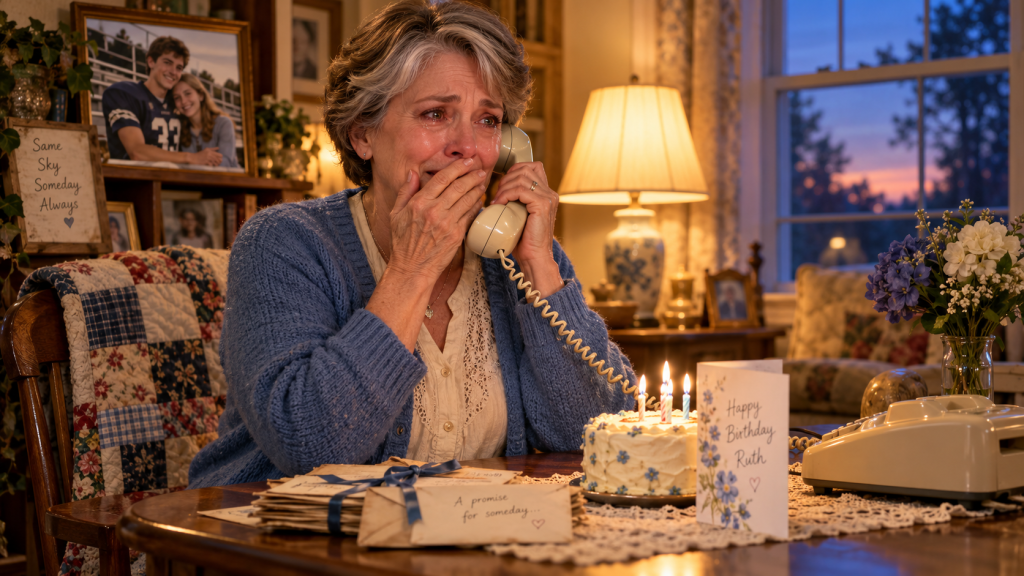
The old receiver felt heavy against my ear.
I was standing in the same kitchen where, forty-one years earlier, Jeffrey had eaten half a peach pie straight from the pan while my mother pretended not to notice.
The same yellow clock still hung above the doorway, though it had stopped keeping proper time years ago.
Outside, rain tapped softly against the windows.
Inside, a man I had loved since I was seventeen was dying somewhere I could not see.
And apparently there were forty years of words waiting between us.
“Every year?” I whispered.
Peter answered gently.
“Almost.”
Jeffrey’s voice came faintly in the background.
“Peter.”
His son ignored him.
“There are thirty-eight letters, Ruth.”
I closed my eyes.
Thirty-eight.
Birthdays I had spent pretending not to wonder whether Jeffrey remembered.
Christmases when I had looked at snow and thought about the time he shoved me into a drift behind the high school.
Years when I changed jobs.
Buried my parents.
Bought a car.
Sold it.
Turned thirty.
Forty.
Fifty.
And somewhere, without my knowing, Jeffrey had been writing.
I whispered:
“Why didn’t he send them?”
Peter went silent.
Jeffrey answered instead.
“Because I was married.”
His voice was weak, but there was something firm beneath it.
“I had already hurt you once, Ruthie.”
“I wasn’t going to make Claire live with a husband who kept one foot in another life.”
That stopped me.
In all the fantasies I had permitted myself over four decades, Claire had often been faceless.
An obstacle.
A woman whose existence represented the life I had somehow lost.
Hearing Jeffrey say her name with tenderness made me feel ashamed of every imaginary version in which she had simply vanished so he could come back to me.
I sat down.
“Did you love her?”
Peter went quiet.
Jeffrey did not hesitate.
“Yes.”
My heart hurt.
And strangely, I was glad he said it.
“I loved her very much.”
he continued.
“Not the way I loved you when I was nineteen.”
“Not the way I love you now, whatever this thing is after forty-one years.”
“But she was my wife.”
“She was good to me.”
“She gave me Peter and his sister, Anna.”
“She deserved the truth of the life we built.”
I pressed my fingers against my lips.
“Then why write to me?”
A weak laugh came through the line.
“Because human beings are inconvenient.”
Despite everything, I laughed.
It came out as a sob.
Jeffrey continued.
“I wrote when I missed you.”
“When something happened I knew you’d understand.”
“When the Red Sox broke my heart.”
“When my dad died.”
“When Peter was born.”
“When I turned forty.”
“When Claire got sick.”
“I wrote instead of calling.”
“It was the only way I knew how to put you somewhere without asking you to carry it.”
My eyes filled.
Then Peter said softly:
“Dad, tell her when you found out.”
Jeffrey was quiet.
I heard oxygen moving somewhere near him.
A soft mechanical hush.
“Jeff?”
It had been so long since I had shortened his name.
He inhaled.
“I found out about the fake letter in 1998.”
Twenty-eight years ago.
My hand tightened around the telephone cord.
“You knew for twenty-eight years?”
“I knew my mother wrote it.”
“Yes.”
Something sharp moved through me.
Not young heartbreak.
Older anger.
More precise.
“And you never called.”
“No.”
I stood because sitting suddenly felt impossible.
“You knew I hadn’t rejected you.”
“Yes.”
“You knew the letter was a lie.”
“Yes.”
“You knew I might have spent all those years believing you simply stopped loving me.”
“Yes.”
His voice broke.
“Ruthie, I know.”
“No.”
I walked into the living room, dragging the phone cord as far as it would reach.
“No, Jeffrey.”
“You don’t get to make this beautiful yet.”
Peter went completely silent.
Jeffrey did too.
I continued.
“I respected what you asked me to do.”
“You said you were getting married.”
“You asked me not to contact you.”
“So I didn’t.”
“Do you know how many times I almost did?”
“Yes.”
“No, you don’t.”
My voice cracked.
“You don’t know because I didn’t.”
“I respected your marriage.”
“I respected your choice.”
“And then you found out the choice I thought I was respecting had been built on a lie, and you still decided for me.”
Jeffrey started crying.
I heard it.
I did not stop.
Maybe forty-one years earns a person the right to finish a sentence.
“You decided I was better off not knowing.”
“Yes.”
“You decided Claire was better off.”
“Yes.”
“You decided your children were better off.”
“Yes.”
“And once again, Jeffrey, nobody asked me what I wanted.”
Silence.
Then he said:
“You’re right.”
That stopped me harder than an argument would have.
No defense.
No dying-man privilege.
Just:
“You’re right.”
He breathed shallowly.
“I was a coward.”
I closed my eyes.
“I told myself I was being honorable.”
“Some of it was honorable.”
“I was married.”
“I had children.”
“I wasn’t going to show up at your door and ask you to blow up my life.”
“But I could have written one honest letter.”
“Yes.”
“You could have told me what happened.”
“Yes.”
“You could have trusted me to understand that truth didn’t mean I was entitled to you.”
“Yes.”
His voice dissolved.
“I’m sorry.”
I sat again.
My anger remained.
But grief arrived beside it.
There is something almost unbearable about finally receiving the apology you needed from a person who no longer has enough time to demonstrate it.
I whispered:
“How sick are you?”
Peter answered.
“Dad has pancreatic cancer.”
Jeffrey muttered:
“He enjoys dramatic medical terminology.”
Peter ignored him.
“It spread before they found it.”
My eyes closed.
“How long?”
“The hospice doctor says it could be weeks.”
A pause.
“Maybe less.”
The house around me seemed to tilt.
Forty-one years.
Then weeks.
Life can be obscenely bad at arithmetic.
I asked:
“Where are you?”
Peter gave me the town.
Two hours and forty minutes away.
I knew it.
A small place north of Hartford.
I stood.
“I’m coming.”
Jeffrey said immediately:
“No.”
I almost laughed.
“Excuse me?”
“You don’t owe me that.”
“I know.”
“You don’t have to forgive me.”
“I know.”
“You don’t have to come because I’m dying.”
“I know.”
“Ruthie—”
“Jeffrey.”
My voice steadied.
“I have spent forty-one years doing what you asked.”
“Let me do what I want once.”
He went silent.
Then that old laugh.
Weak now.
Still his.
“God, I missed you.”
I closed my eyes.
“I know.”
Then:
“I missed you too.”
I left the next morning.
I barely slept.
At two, I opened the hall closet and found the old shoebox.
Everybody has one.
Mine contained theater tickets, photographs, funeral cards, dried flowers, and pieces of paper that had somehow survived more moves than some friendships.
Near the bottom were Jeffrey’s letters.
The ones from before 1986.
Creased from being read.
He always wrote in blue ink.
His handwriting leaned slightly backward, as though even the words were resisting being pushed anywhere.
I found one from October 1984.
Ruthie, college is full of idiots. Unfortunately, I may be one of them.
I laughed.
Then cried.
Another:
I saw a girl today wearing that ridiculous green scarf you have, and I almost shouted your name across campus. Good news: it wasn’t you. Bad news: for two seconds I really wanted it to be.
I sat on the floor until dawn.
At six-thirty, I packed a bag.
At seven, I stood in front of the bathroom mirror.
Sixty.
Silver threaded through my hair.
Lines around my mouth.
The faint scar beneath my chin from falling off Jeffrey’s bicycle at eighteen.
He had carried me three blocks even though I insisted I could walk.
I wondered what he looked like.
Then hated myself for wondering.
Then forgave myself.
People wonder.
I put the old letters into my bag.
Not all of them.
Three.
The ones I wanted to show him.
At seven-fifteen, I walked past the landline.
Stopped.
Touched the receiver.
For forty-one years, it had been furniture.
One ring had turned it into a doorway.
Then I left.
Peter opened the door.
I knew immediately.
Jeffrey’s eyes.
Same dark blue.
Different face.
Peter looked about forty.
Tall.
Nervous.
For one moment we simply stared at each other.
Then he said:
“Ruth?”
“Yes.”
He hugged me.
I had not expected that.
My body stiffened for half a second.
Then I hugged him back.
He whispered:
“Thank you for coming.”
I pulled away.
“You don’t need to thank me.”
He gave me a sad smile.
“That sounds like something Dad would say.”
The house was quiet.
Not hospital quiet.
Home quiet.
There were family photographs on the walls.
Jeffrey and Claire at a beach.
Peter as a boy holding a fish.
A little girl I assumed was Anna asleep against Jeffrey’s chest.
Christmas trees.
Graduations.
A wedding photograph.
I stopped.
Jeffrey looked young.
Claire stood beside him.
Beautiful.
Dark hair.
Large smile.
His hand rested at her waist.
For one ugly second, jealousy rose.
Forty-year-old jealousy wearing my sixty-year-old face.
Then Peter said quietly:
“That was 1986.”
I nodded.
“She was beautiful.”
“She was.”
He looked at the photograph.
“She died six years ago.”
“I’m sorry.”
“Thank you.”
Then:
“She knew about you.”
I turned.
“What?”
“Not everything at first.”
He pushed his hands into his pockets.
“But eventually.”
My stomach tightened.
“What did she know?”
Peter glanced toward the hallway.
“Dad should tell you.”
Then he smiled slightly.
“If he stays awake long enough.”
I followed him.
Jeffrey’s room had once been a den.
A hospital bed stood near the window.
A recliner beside it.
Books stacked on a table.
Oxygen concentrator humming.
A baseball cap hanging from a lamp.
And there he was.
For forty-one years, Jeffrey had remained nineteen somewhere in my mind.
Thick brown hair.
Long legs.
Crooked grin.
The boy under the bleachers.
The man in the bed was sixty.
Thin.
Silver-haired.
Cheekbones sharper than they should have been.
Skin pale.
But when he opened his eyes, I knew him before he smiled.
“Ruthie.”
I stopped in the doorway.
Everything I had prepared disappeared.
No speech.
No accusation.
No graceful reunion.
I covered my mouth and cried.
Jeffrey did too.
Peter quietly left.
I walked toward the bed.
Jeffrey held out his hand.
Then hesitated.
“Can I?”
That nearly broke me.
At nineteen, we had touched without asking.
Shoulders.
Hands.
Heads leaning together.
Easy intimacy before either of us knew what it meant.
At sixty, after forty-one years, he asked.
I placed my hand in his.
His fingers closed weakly around mine.
Warm.
Real.
Old.
Jeffrey looked at me for a long time.
Then said:
“You still make that face when you’re trying not to cry.”
I laughed.
“You look terrible.”
“Cancer.”
“Very rude.”
“I’ve complained.”
We laughed through tears.
Then he lifted my hand slightly.
“Turn around.”
“What?”
“I want to see if the back of your head aged.”
I stared.
He smiled.
There.
Jeffrey.
Still there.
I sat beside him.
For ten minutes we spoke about nothing important because everything important was too large.
The drive.
Traffic.
Peter.
The weather.
My house.
His medication making food taste metallic.
Then the silence arrived.
Jeffrey looked down at our hands.
“I’m sorry.”
“I know.”
“No.”
He swallowed.
“I want to say it while I can look at you.”
I waited.
He lifted his eyes.
“I’m sorry I believed the letter.”
“You were nineteen.”
“I’m sorry I wrote you not to contact me.”
“You thought I had rejected you.”
“I’m sorry that when I found out the truth, I decided silence was noble.”
My throat tightened.
He continued.
“I’m sorry I made your choices for you.”
“Yes.”
A tear slid toward his ear.
“And I’m sorry I waited until I was dying to become brave enough to call.”
“That one makes me angry.”
“I know.”
“Good.”
We sat with it.
Then Jeffrey whispered:
“I didn’t call.”
I frowned.
“Peter did.”
His weak smile appeared.
“I was still a coward.”
From the hallway Peter shouted:
“You’re welcome.”
I laughed so suddenly I startled myself.
Jeffrey grinned.
“That boy has been insubordinate since birth.”
Peter called:
“Forty years old!”
“Still.”
I wiped my eyes.
Then said:
“Tell me about the ring.”
Jeffrey’s expression changed.
Softened.
“Peter found it in my desk.”
“Where has it been?”
“Everywhere.”
“That sounds irresponsible.”
“It spent twenty years in a safe-deposit box.”
“Then I moved it home after Claire died.”
“Why?”
He looked toward the window.
“Because I thought about finding you.”
My heart tightened.
“And?”
“And I didn’t.”
“Why?”
“Fear.”
“Of me?”
“Yes.”
I almost smiled.
“You always were smarter than you looked.”
He laughed.
Then winced.
Pain.
I waited until his breathing settled.
He continued.
“I didn’t know whether you married.”
“Whether you had children.”
“Whether hearing from me would reopen something you’d spent decades closing.”
“You could have checked.”
“I did.”
My eyebrows lifted.
He looked guilty.
“Internet.”
“How scandalous.”
“You were apparently very boring online.”
“I consider that an achievement.”
“I learned your mother died.”
“Yes.”
“Your father too.”
“Yes.”
“That you were still in the same town.”
“Yes.”
“And that there was no obvious husband.”
“No husband.”
His eyes searched my face.
“Was there ever?”
I knew what he meant.
“No.”
His face broke.
Not happiness.
Pain.
That mattered.
I touched his hand.
“Don’t do that.”
“What?”
“Don’t turn my life into evidence that I spent forty years waiting for you.”
He looked ashamed.
“You’re right.”
“I had a life.”
“I loved people.”
“I had relationships.”
“Some good.”
“Some terrible.”
“I almost married once.”
His eyes widened.
“You did?”
“His name was Daniel.”
“What happened?”
“He wanted children.”
“I wasn’t sure.”
“Then his ex-wife returned.”
Jeffrey frowned.
“Idiot.”
“He married her.”
“Definitely idiot.”
I laughed.
“My point is, I didn’t sit beside this landline for forty-one years.”
“I know.”
“I thought about you.”
“A lot.”
“But you are not allowed to turn that into a shrine.”
He squeezed my hand.
“Deal.”
The word hung between us.
Deal.
Nineteen.
Bleachers.
Pinkies.
Sixty.
A promise arriving on time only in the most technical sense.
Jeffrey whispered:
“We made it.”
I shook my head.
“No.”
“What?”
“We found each other.”
“That’s different.”
He looked at me.
Then smiled.
“You always did edit me.”
“Someone had to.”
Peter brought the box after lunch.
Wooden.
Dark walnut.
Not large.
Inside were bundles of envelopes tied with string.
Each one had my name.
Ruth.
Some:
Ruthie.
Dates.
Years stacked like sediment.
And beside them, a little velvet ring box.
My hands trembled.
Jeffrey watched.
“You don’t have to read them.”
“Yes, I do.”
“No.”
He touched my wrist lightly.
“You get to choose.”
There was that word again.
Choose.
I opened the first letter.
February 12, 1987.
Not my birthday.
I looked at him.
He said:
“The first few were whenever I couldn’t stand it.”
I read.
Ruthie,
I dreamed about the bleachers last night. You were wearing that denim jacket with the broken snap, and I kept trying to tell you something, but every time I opened my mouth, the marching band started playing. This feels like a metaphor, which you would say is too obvious.
I laughed.
Jeffrey watched my face.
I continued.
Claire is kind. I want you to know that, though you’ll never read this. She didn’t steal me. I made choices. I need to remember that.
I stopped.
Looked at him.
“Twenty years old and occasionally intelligent.”
“Occasionally.”
I continued.
I think there is a version of me who never got on the bus for college and stayed beside you forever. I hope that version deserves you. I don’t know if I did.
I folded the letter.
Could not continue.
Jeffrey said:
“Enough?”
“For now.”
Peter sat in the doorway.
I had forgotten he was there.
His eyes were red.
I looked at him.
“This is strange for you.”
He gave a small laugh.
“That’s one word.”
“Your mother—”
He immediately said:
“My mom wasn’t second place.”
I nodded.
“I know.”
He studied me.
“I need you to know that.”
“I do.”
“Dad loved her.”
“I know.”
“He took care of her when she got sick.”
“What happened?”
“Ovarian cancer.”
My heart sank.
“Three years.”
Peter looked toward his father.
“She knew she was dying before he accepted it.”
Jeffrey closed his eyes.
Peter continued.
“She found the letters once.”
I looked sharply at Jeffrey.
He opened his eyes.
“1999.”
“One year after I found out what my mother had done.”
“What happened?”
Jeffrey looked ashamed.
“I came home and Claire was sitting on the floor with the box.”
My breath caught.
“She read them?”
“A few.”
“She asked who Ruth was.”
“What did you tell her?”
“The truth.”
“All of it?”
“Everything I knew.”
He looked at me.
“The promise.”
“The fake letter.”
“The ring.”
“The letters.”
I whispered:
“What did she do?”
Jeffrey smiled sadly.
“She threw a coffee mug at the wall.”
I blinked.
Peter said:
“Mom had range.”
We laughed.
Then Jeffrey continued.
“She asked if I wanted to leave.”
“I said no.”
“She asked if I still loved you.”
I held my breath.
“What did you say?”
“The truth.”
His eyes met mine.
“Yes.”
My chest hurt.
“And she stayed?”
Jeffrey nodded.
“She said something I never forgot.”
He looked toward the wedding photograph in the hallway.
“She said, ‘You can grieve a road you didn’t take, Jeffrey. But don’t make me live on the shoulder of it.’”
I closed my eyes.
I loved Claire a little in that moment.
A woman I had never met.
A woman whose marriage had carried the ghost of a nineteen-year-old promise and who still found language that generous.
Jeffrey said:
“So I stopped writing for a while.”
“How long?”
“Three years.”
I looked at the bundles.
“Then?”
“Claire asked why I was irritable every February.”
I laughed.
He smiled.
“She told me to write if it helped.”
“One condition.”
“What?”
“That I never use the letters to escape the life I had.”
Peter said quietly:
“Mom knew what love was.”
“Yes.”
I whispered.
“She did.”
Jeffrey looked at me.
“She deserved better than the secret.”
“But after she knew, there wasn’t one.”
“That was the best thing she did for me.”
“Made me stop dividing myself into rooms.”
I looked at Peter.
“I will never make your mother into the woman who kept Jeffrey from me.”
Peter’s eyes filled.
“Thank you.”
“She had a whole life with him.”
“A whole marriage.”
“Children.”
“History.”
“I lost something.”
“You had something.”
“Those are different truths.”
Peter nodded.
Then left the room because crying in front of your dying father and his almost-girlfriend from 1985 apparently has limits.
Jeffrey smiled.
“He likes you.”
“He doesn’t know me.”
“He’s efficient.”
I stayed three days.
Then four.
Then I drove home because I needed clothes, medications, and the illusion that my life still had a normal shape.
I returned the next morning.
Peter gave me the guest room.
Anna arrived that weekend.
Jeffrey’s daughter was thirty-six.
She hugged me too.
Then held me at arm’s length.
“So you’re Ruth.”
“Apparently.”
She laughed.
“Dad described your hair wrong.”
I touched it.
“He remembers 1985.”
“Fair.”
Anna had Claire’s smile.
I knew from the photographs.
That hurt beautifully.
She brought her husband and two children.
Jeffrey’s grandchildren climbed onto his bed with the casual confidence of children who have not yet learned death makes adults afraid of touching.
I watched from the doorway.
Jeffrey looked at me over his granddaughter’s head.
Not regret.
Love.
For them.
His life.
I understood something then.
I did not wish it away.
I could not.
If nineteen-year-old Jeffrey had given me the ring, Peter would not exist.
Anna would not exist.
Those children would not exist.
Maybe other children would.
Maybe another life.
But you cannot mourn one timeline without accidentally erasing the people born from another.
I refused to do that.
That night, Jeffrey and I sat alone.
He asked:
“What are you thinking?”
I told him.
He listened.
Then:
“I used to do that.”
“What?”
“Imagine going back.”
“And?”
“I stopped.”
“Why?”
“Peter was about six.”
“He fell asleep on my chest during a thunderstorm.”
“I realized every fantasy where I fixed what happened to us erased him.”
His eyes filled.
“I couldn’t wish him away.”
“No.”
“So I stopped wishing for another life.”
He looked at me.
“I only wished you knew the truth.”
I swallowed.
“I do now.”
“Yes.”
“It doesn’t give us forty years back.”
“No.”
His voice became soft.
“But we have today.”
I nodded.
“Today.”
We read one letter every morning.
Only one.
Any more felt greedy.
1989:
Ruthie, Peter took his first step today. He walked three feet and fell into a laundry basket. I laughed so hard Claire threatened divorce. You would have laughed too.
1993:
I saw your old high school English teacher at the grocery store. She asked about you. I lied and said we’d lost touch. “You two were inseparable,” she said. Funny word, inseparable. Life appears to disagree.
1998:
The year he found the truth.
The letter was twelve pages.
He did not want me to read it at first.
I did.
His anger at his mother was alive in the ink.
I found it, Ruth. God, I found it. Mom kept the envelope. I knew before she admitted it because I recognized the way she loops her capital R.
I stopped.
Jeffrey looked toward the ceiling.
“I confronted her that night.”
“What did she say?”
“That she was protecting me.”
“From me?”
“Yes.”
My stomach tightened.
“Why?”
“She thought your family was too…”
He hesitated.
“Poor?”
“Ordinary.”
I laughed bitterly.
“Your mother really knew how to insult efficiently.”
Jeffrey smiled weakly.
“My father had just arranged an internship for me through Claire’s father.”
“Mom was obsessed with the idea that I had a path.”
“She thought you represented staying home.”
“Small town.”
“Teaching.”
“Whatever she imagined.”
I looked at him.
“She didn’t know me.”
“No.”
“She knew the version of you that threatened the future she wanted for me.”
I continued reading.
She said, “You would have thrown everything away for that girl.”
My eyes burned.
I told her maybe that was mine to throw.
I stopped again.
Jeffrey’s eyes were wet.
“What happened between you and her?”
“I didn’t speak to her for eleven months.”
“Then my dad had a stroke.”
“Life complicated the anger.”
“She never really apologized properly.”
“What did she say?”
Jeffrey’s mouth twisted.
“‘I did what I thought was best.’”
Of course.
The anthem of people who prefer motive over consequence.
I continued reading.
I could call you now. I know the number. I still know it by heart. But Claire is asleep upstairs. Peter is nine. Anna is five. What would I be asking you to do with this truth? I don’t know. So tonight I’m writing instead. Maybe that is cowardice. Maybe restraint. I don’t trust myself to know the difference.
I put the letter down.
“That sentence.”
“I know.”
“You knew.”
“Yes.”
I looked at him.
“I’m still angry.”
“You should be.”
“I also understand.”
“You don’t have to.”
“I know.”
That became our strange rhythm.
No one demanded forgiveness.
So it arrived in pieces.
On the ninth day, Jeffrey asked me to take him somewhere.
Peter objected immediately.
“No.”
Jeffrey glared.
“I’m dying.”
“That is not a universal permission slip.”
I liked Peter more every day.
Jeffrey said:
“The football field.”
I froze.
Peter looked between us.
“What football field?”
“The high school.”
Peter stared.
Then:
“Oh God.”
Jeffrey smiled.
“The bleachers.”
Peter looked at me.
“You’re encouraging this?”
“I haven’t said anything.”
“That face is encouragement.”
He inherited too much.
The hospice nurse came that afternoon.
Checked Jeffrey.
Listened.
Considered.
Then said if he felt up to a short trip, with medication and wheelchair and common sense, there was no medical reason to forbid it.
Peter muttered:
“Common sense eliminates Dad.”
Jeffrey replied:
“Genetic. Be careful.”
The next morning, Peter drove us.
The high school had changed.
Of course.
New science wing.
Different sign.
Artificial turf.
The old wooden bleachers had been replaced by aluminum structures.
I felt ridiculous for being disappointed.
Jeffrey saw.
“Did you expect them to preserve our adolescent stupidity?”
“Yes.”
“Historic landmark.”
“Exactly.”
Peter parked close.
We wheeled Jeffrey toward the field.
The school was empty.
Saturday.
Cold sunlight.
Wind across the track.
Peter offered to come.
Jeffrey said:
“Give us ten minutes.”
Peter looked at me.
I nodded.
He walked away.
We stopped beside the bleachers.
Jeffrey looked up.
“Under?”
I laughed.
“You cannot crawl under bleachers.”
“Discrimination.”
“You are attached to oxygen.”
“Technicality.”
We settled near the bottom row instead.
I sat.
He stayed in the wheelchair.
For a while we watched the empty field.
Then Jeffrey said:
“I had the ring that night.”
My heart stopped.
“The night of the promise?”
“Yes.”
I turned.
“What?”
“In my jacket pocket.”
“You had a ring while making a joke about sixty?”
“It wasn’t a joke.”
My eyes filled.
“Why didn’t you give it to me?”
He smiled sadly.
“Same reason you didn’t tell me you loved me.”
“Fear.”
“Exactly.”
I shook my head.
“We were idiots.”
“Historic idiots.”
“National registry.”
He laughed.
Then coughed.
I waited.
When he recovered, he reached into his coat pocket.
My heart began pounding.
“Jeffrey.”
“Relax.”
He pulled out the velvet box.
Peter must have helped him.
I stared.
“Why did you bring that?”
“Because I want you to have it.”
“No.”
His face fell.
“Ruth—”
“No.”
I turned fully toward him.
“You bought that for a nineteen-year-old girl.”
He looked at me.
“She’s gone.”
“So is the nineteen-year-old boy.”
“Yes.”
I touched his hand.
“I don’t want the ring as payment for the years.”
“That’s not what it is.”
“What is it?”
He thought.
Then opened the box.
The ring was small.
A simple gold band with a modest round diamond.
Exactly the kind of ring a nineteen-year-old boy might have bought with summer-job money and terrifying hope.
Jeffrey whispered:
“Evidence.”
“Of what?”
“That I didn’t invent how much I loved you after I got sick.”
My throat closed.
He continued.
“I need you to know I was going to ask.”
“I believed you.”
“I know.”
He looked down.
“But I carried this so long.”
“I don’t want Peter deciding what to do with it after I’m gone.”
“Then give it to Anna.”
“No.”
“Sell it.”
“No.”
“Throw it into a lake.”
“Ruth.”
I laughed through tears.
“What?”
“Take the damn ring.”
“No.”
He glared.
Even dying, Jeffrey could glare.
Then he softened.
“Please.”
I looked at it.
Forty-one years of imagined meaning.
None of it the ring’s fault.
I held out my right hand.
“Not the left.”
Jeffrey’s eyes filled.
“Not a proposal.”
“No.”
“Not a debt.”
“No.”
“Not an apology.”
“No.”
“Then what?”
I thought.
“A witness.”
He smiled.
“A witness.”
He slid the ring onto my right ring finger.
It fit badly.
Too small.
Of course.
I laughed.
“My fingers are sixty.”
“Rude.”
He could only get it halfway.
We both laughed until he coughed again.
Finally I held it in my palm instead.
“Perfect.”
he said.
“It doesn’t fit.”
“Neither did our timing.”
I stared at him.
“That was disgustingly good.”
“I’ve had forty-one years.”
We sat beneath new bleachers on an old field and held hands.
Then Jeffrey whispered:
“Can we make another promise?”
“No promises about ninety.”
He laughed.
“No.”
“What then?”
He lifted his pinky.
Wrinkled.
Thin.
Ridiculous.
I hooked mine around it.
Jeffrey said:
“No more waiting.”
My eyes filled.
“For what?”
“Anything.”
“Say what you mean.”
“Go where you want.”
“Love whoever you want.”
“Eat dessert first.”
“That one is irresponsible.”
“Ruthie.”
I smiled.
“No more waiting.”
“Deal.”
This time, the promise was small enough to keep.
Jeffrey lived eleven more weeks.
Longer than the doctor guessed.
Not long enough.
Never long enough.
Those weeks were not one continuous romance.
That is not how dying works.
Some days he slept almost eighteen hours.
Some days he was irritable.
Once he told me to stop asking if he needed water.
I told him to stop dying so inconveniently.
Peter nearly fell off his chair laughing.
There were medication changes.
Nurses.
Visitors.
Bad nights.
Good mornings.
One afternoon, Jeffrey woke convinced it was 1985.
He looked at me and said:
“You cut your hair.”
I had not.
I went into the bathroom and cried.
The next morning he was completely lucid and complained that Peter had replaced his coffee with “brown sadness.”
Peter said:
“You’re on hospice.”
Jeffrey replied:
“Not punishment.”
We found decaf that met his standards.
Life keeps being ordinary even while ending.
That was a gift.
We also talked.
Really talked.
About the years.
I told him about Daniel.
About almost marrying.
About my work as a librarian for twenty-eight years.
About taking care of my mother during dementia.
About the little house I bought and then sold.
About returning to my childhood home after my father died because the silence there somehow felt less lonely than the silence anywhere else.
Jeffrey listened.
He never again called my life waiting.
Good.
I told him about lovers.
Not every detail.
Enough.
He looked jealous once.
I laughed.
“You had a wife.”
“I know.”
“You have no standing.”
“I know.”
“Good.”
Then he smiled.
“Was Daniel handsome?”
“Very.”
“I hate him.”
“You never met him.”
“Principle.”
We laughed.
I asked him about Claire.
He told me their first apartment had a bathroom door that did not close.
She hated mushrooms.
She could whistle so loudly people turned around on sidewalks.
She once drove six hours to bring him a forgotten folder for an interview.
When he got promoted, she cried harder than he did.
During cancer, she made lists for everyone.
Medication.
Bills.
Birthdays she was afraid he would forget after she died.
“What was the last thing she said to you?”
Jeffrey looked toward the window.
“She said, ‘Don’t make grief your second wife.’”
I closed my eyes.
Claire had apparently spent her life saying things people ought to frame.
“Did you?”
“For a while.”
He looked at me.
“Then I almost made you grief too.”
My chest tightened.
“No.”
“Yes.”
He nodded.
“I kept you in a box.”
“Letters.”
“Ring.”
“Memory.”
“Safe because memory can’t reject you.”
I stared.
That was harder to hear than I expected.
He continued.
“Calling you meant finding out who you really became.”
“Maybe you hated me.”
“Maybe you were married.”
“Maybe you had forgotten.”
“I preferred the Ruth I could keep.”
I swallowed.
“Until Peter ruined it.”
“Bless him.”
From the hallway:
“I can hear you!”
We laughed.
Peter and I became close carefully.
He loved his father.
He loved his mother.
I represented a part of Jeffrey that existed before both of them.
That could have been dangerous.
We refused to make it so.
One night, after Jeffrey was asleep, Peter and I sat at the kitchen table.
He said:
“When I found the ring, I was angry.”
“At him?”
“Yes.”
“Why?”
“I thought maybe Mom’s marriage had been fake.”
My heart hurt for him.
“What changed?”
“Dad yelled at me.”
I smiled.
“Sounds healthy.”
“He said, ‘Do not disrespect your mother by turning my regret into a verdict on our marriage.’”
I looked toward the hallway.
Good.
Peter continued.
“Then Anna and I found the letters.”
“Mom knew.”
“Some of them had notes in her handwriting.”
My eyes widened.
“What notes?”
He brought one.
A letter Jeffrey had written in 2007.
On the envelope, in different handwriting:
Too dramatic. Do not send. —C
I laughed so hard I woke Jeffrey.
He shouted weakly from the bedroom:
“What happened?”
Peter yelled:
“Mom called you dramatic.”
Jeffrey answered:
“She lacked sensitivity.”
We laughed harder.
The next envelope:
This one is actually lovely. Still don’t send it, coward. —C
I cried.
Claire had touched these letters.
Read some.
Teased him.
Accepted that part of him without letting it swallow their marriage.
I ran my thumb over her handwriting.
“I wish I had met her.”
Peter’s eyes filled.
“She probably would’ve liked you.”
Then:
“Eventually.”
Fair.
On my sixty-first day with Jeffrey—Peter counted because apparently this family had inherited numerically inconvenient sentimentality—Jeffrey had a bad night.
Pain.
Confusion.
Breathing.
The nurse came before sunrise.
Adjusted medication.
Explained things quietly.
I knew.
Peter knew.
Anna drove in.
The grandchildren were kept home at first.
Jeffrey slept most of the day.
Around four, he opened his eyes.
Saw all three of us.
Groaned.
“This looks ominous.”
Anna laughed through tears.
“You look worse.”
“Ungrateful child.”
Peter kissed his forehead.
Jeffrey looked at me.
“Ruthie.”
I moved closer.
“I’m here.”
“Letter.”
I frowned.
“What?”
“Last one.”
Peter knew.
He went to the desk.
Pulled out an envelope.
My name.
The date.
My sixtieth birthday.
The day he called.
No.
The day Peter called.
Jeffrey had written it before the phone rang.
Peter handed it to me.
Jeffrey whispered:
“Later.”
I nodded.
Then Jeffrey looked at his children.
There are things too private to retell completely.
He told Peter he was proud of the father he had become.
Told Anna to stop apologizing before asking questions.
She laughed and cried.
He asked them to tell his grandchildren he loved them “beyond reasonable measurement.”
Then he asked for ten minutes with me.
Peter and Anna left.
I sat beside him.
The room smelled faintly of lavender hand lotion and medicine.
Late sunlight came through the window.
Jeffrey looked exhausted.
“Do you regret coming?”
“No.”
“Too fast.”
“What?”
“You answered too fast.”
I smiled.
“No.”
I thought.
Then answered again.
“I regret that there was so little time.”
“I regret that we were frightened at nineteen.”
“I regret your mother did what she did.”
“I regret that you waited after you knew.”
“I regret a lot.”
He listened.
“But coming here?”
I shook my head.
“No.”
“Not for one second.”
His eyes filled.
“I love you.”
There it was.
Not nineteen.
Not a letter.
Not imagined.
Now.
I took his hand.
“I love you too.”
He cried.
Then laughed weakly.
“Took you long enough.”
I stared.
“You waited forty-one years.”
“Technicality.”
I leaned forward and kissed him.
Not dramatic.
Not young.
A soft kiss.
His hand against my cheek.
When I pulled back, Jeffrey whispered:
“Was that pity?”
“Absolutely.”
“Rude.”
“Very.”
His eyes closed.
Then:
“Ruthie?”
“Yes?”
“Don’t make me your last chapter.”
My throat closed.
“What?”
“You heard me.”
“You’re dying and still bossy.”
“Don’t wait for a dead man.”
I began crying.
“I didn’t wait for you the first forty years.”
“Good.”
“Don’t start now.”
I laughed through tears.
He squeezed my hand weakly.
“No more waiting.”
Our promise.
I pressed my pinky against his.
“No more waiting.”
“Deal.”
Jeffrey died the next morning.
Not while I was speaking beautiful words.
Not at sunset.
Not during our song.
There was no song.
He died at 6:14 a.m. while Peter dozed in the recliner, Anna sat on the floor against the wall, and I held his hand.
His breathing slowed.
Then stopped.
That was it.
One moment, Jeffrey occupied the room.
The next, every object felt too solid because he no longer was.
Peter woke.
Looked at me.
I nodded.
He covered his face.
Anna made a sound I will never forget.
I bent over Jeffrey’s hand.
Kissed his knuckles.
Then whispered:
“You remembered.”
Because he had.
Whatever else happened.
Whatever we lost.
He remembered.
The funeral was five days later.
I almost did not attend.
Not because I was ashamed.
Because I did not know where I belonged.
Widow?
No.
Old friend?
Not enough.
Lost love?
Too theatrical for an obituary.
Peter solved it.
He called.
“You sit with us.”
“Peter.”
“With us.”
“What will people think?”
He laughed sadly.
“Dad is dead.”
“His final gift can be freeing us from gossip.”
I went.
Claire’s photograph stood among the family pictures in the reception hall afterward.
I was glad.
I placed no ring beside Jeffrey’s casket.
The ring was mine because he gave it to me.
A witness.
I wore it on a thin chain around my neck because it still did not fit my finger.
At the service, Peter spoke.
Anna spoke.
A college friend.
Then Peter surprised me.
He looked toward where I sat beside Anna.
“My father believed some love stories are not measured by how long people get.”
My breath caught.
“He had a friend named Ruth when he was young.”
A few older faces turned toward me.
“He loved her.”
“He also loved my mother.”
“Those truths were never enemies, though Dad spent years fearing they were.”
Peter swallowed.
“My mother understood something before the rest of us.”
“That a heart is not a house with one room.”
“She never asked him to erase the boy he had been in order to prove the man he became belonged to her.”
I cried.
Peter continued.
“In Dad’s last months, Ruth came back into his life.”
“Or maybe he came back into hers.”
“Knowing Dad, he would argue about wording.”
Soft laughter.
“He died with his children near him and with an old friend holding his hand.”
Peter looked at me.
“I am grateful she answered the phone.”
I covered my face.
Afterward, an elderly woman approached.
Jeffrey’s cousin.
She looked at me for a long time.
“Ruth?”
“Yes.”
“Oh, honey.”
She hugged me.
Then whispered:
“His mother was an idiot.”
I laughed so unexpectedly that several people turned.
Maybe that was the best funeral gift anyone gave me.
I read Jeffrey’s final letter alone.
Not that night.
Three days later.
Back in my childhood home.
Same kitchen.
Same landline.
Rain again.
The envelope shook in my hands.
I opened it.
Ruthie,
If Peter did what I asked, you are sixty today. Happy birthday.
I smiled through tears.
I have been trying to decide whether calling you is selfish. At this point I suspect asking the question is simply another way of postponing courage.
Typical.
I have cancer. It is bad. That is not why I love you. I need to write that clearly because illness makes old men sentimental, and I refuse to let you think I invented you because I am frightened of dying.
I touched the paper.
I loved you at nineteen. I loved Claire too. Life is more complicated than the stories we tell at seventeen when everyone insists there is only one person meant for us.
Exactly.
There were years when I barely thought about you. I want to admit that because anything else would turn you into mythology. There were other years when I thought about you every week. Both are true.
I cried harder.
Honesty.
Even now.
I found out in 1998 that you did not write the letter that ended us. I should have told you then. I did not. Claire knew. She told me more than once that secrecy disguised as sacrifice was still secrecy. She was right.
Of course Claire was right.
After she died, I nearly called you several times. I would dial the first six numbers and stop. I told myself I was respecting your life. Mostly I was afraid of discovering you had no place for me in it.
I laughed through tears.
Coward.
Then I got sick. Peter found the ring yesterday while helping me organize papers. He asked who Ruth was. I told him. He looked at me as if I were the stupidest man alive. Children are cruel in middle age.
I laughed again.
He said, “Dad, she turns sixty tomorrow.”
My breath stopped.
I had forgotten the date was tomorrow because medication has turned my brain into soup. I had not forgotten the birthday itself. February 12. I have known it longer than I have known my Social Security number.
I pressed the letter against my mouth.
So here we are. Sixty.
If you are married, happy, uninterested, furious, or simply unwilling to reopen this, Peter will apologize and leave you alone. I mean that.
But if you answer—
The next line was shaky.
I would like to see your face once more.
I closed my eyes.
Then continued.
Not to ask you to forgive forty-one years.
Not to ask you to pretend Claire did not exist.
Not to turn what happened to us into proof that we were secretly meant to escape every other life.
I only want to meet the woman you became.
I sobbed then.
Because he had.
For eleven weeks.
He had met me.
Not nineteen-year-old Ruth.
Me.
There is one more thing.
When I was nineteen, I believed love meant getting the ending you wanted.
At sixty, I think love may be partly the willingness to let another person have an ending that does not center you.
If I see you, and then I die, do not turn me into another reason to wait.
My hands shook.
Keep the promise better than I did.
No more waiting.
Love,
Jeffrey
At the bottom, smaller:
P.S. I still think your green scarf was ugly.
I laughed until I cried again.
Then I folded the letter.
Placed it beside the telephone.
And for the first time since the call, I understood what the last part of loving Jeffrey required.
Not memory.
Movement.
Grief tried to make me disobey him.
For months, I wanted to turn the house into a museum.
The ring.
Letters.
Photographs Peter sent.
Jeffrey’s baseball cap, which Anna insisted I take because apparently I was the only person who had ever liked it.
I did not like it.
That became the joke.
I wore it gardening anyway.
Peter called every Sunday at first.
Then every other.
Not obligation.
Family, somehow.
Anna sent me pictures of her children.
At Thanksgiving, they invited me.
I almost said no.
Then remembered:
No more waiting.
I went.
Claire’s chair was not mine.
That mattered.
Nobody tried to make it mine.
There was no replacement role waiting for me.
Peter’s family called me Ruth.
The children eventually called me Aunt Ruth because one of them decided every older woman who brings cookies must be an aunt.
Fine.
At dinner, Peter raised a glass.
“To Mom.”
Everyone drank.
Then later:
“To Dad.”
We drank again.
No one looked nervously at me.
Love did not need to erase anyone to make room.
I wish I had understood that at nineteen.
Maybe nobody does.
I also began doing things Jeffrey never knew I wanted.
I took a pottery class.
Terrible decision.
Every bowl looked clinically depressed.
I joined a walking group.
Went to Quebec with my cousin.
Painted the upstairs bedroom blue after twenty years of beige because my mother had liked beige and I had somehow continued obeying a dead woman’s decorating preferences.
I laughed when I realized it.
Parents stay in our houses long after they leave.
Sometimes we must repaint.
I dated once.
Then twice.
The second man, Harold, talked about cryptocurrency for forty-five minutes.
Jeffrey would have haunted him if possible.
I drove home laughing.
Not because the date was good.
Because I had gone.
No more waiting.
I did not owe Jeffrey eternal romantic mourning as proof that those eleven weeks mattered.
That would have made his love another cage.
He had specifically told me not to.
So I lived.
Bad dates included.
On my sixty-first birthday, the landline rang.
7:03 p.m.
My heart stopped.
For one irrational second, I thought:
Jeffrey.
Grief is not intelligent.
I picked up.
“Hello?”
Peter.
“Happy birthday, Ruth.”
I sat down.
“Thank you.”
“Dad left instructions.”
“Of course he did.”
“He said if I didn’t call you today, he would haunt me.”
“That threat seems legally unenforceable.”
“Agreed.”
Then Peter said:
“He also told me to ask whether you’ve done anything stupid this year.”
I laughed.
“Pottery.”
“Dad would’ve hated that.”
“He had no taste.”
We talked for an hour.
Before hanging up, Peter said:
“Do you still have the old phone?”
“I’m using it.”
“You know you can replace it.”
“I know.”
“Okay.”
After the call, I looked at the receiver.
Then at the wall.
The phone had served its purpose.
For decades it had been a relic.
Then a doorway.
Now perhaps it could simply be a phone again.
I kept it.
Not because I was waiting.
Because I liked the sound.
There is a difference.
Two years later, the high school announced they were replacing the bleachers again.
Apparently our sacred monument had terrible structural integrity.
Peter called.
“You going to protest?”
“I’m sixty-two.”
“That’s a yes.”
We laughed.
I drove there alone before construction began.
Not to recreate anything.
Just to see the field.
A group of teenagers practiced soccer.
Someone shouted.
A whistle blew.
I sat on the lowest bench.
Pulled the ring from beneath my shirt.
It hung on the chain, warm from my skin.
For a moment, I saw us.
Nineteen.
Two bad dates.
Two milkshakes.
Jeffrey holding out his pinky.
If we’re both single at sixty, we stop being idiots and find each other.
Back then, I thought sixty sounded ancient.
A distant country inhabited by sensible people with no unfinished business.
I know better.
Sixty can contain a seventeen-year-old girl.
A nineteen-year-old promise.
A forty-one-year silence.
A dying man.
A son brave enough to call a stranger.
A dead wife generous enough to let an old love exist without feeling erased by it.
A ring that does not fit.
Eleven weeks.
And a future.
Yes.
A future.
That was the part Jeffrey fought hardest to give me.
I had spent decades believing our tragedy was that we lost the life we should have had.
Age changed the sentence.
There is no “should have” life.
There is only the one that happens.
The choices made.
The choices stolen.
The mistakes.
The people born because of those mistakes.
The people loved along the way.
The truths discovered too late.
The truths that still matter even then.
I would never call what Jeffrey’s mother did a blessing.
It was cruel.
She took a choice that belonged to two nineteen-year-olds and made it for them.
That mattered.
It always would.
But I would not repair that theft by wishing away Peter.
Anna.
Claire.
The grandchildren.
Jeffrey’s forty years of ordinary mornings.
His marriage.
His fatherhood.
His joys.
And I would not erase my own life either.
I had not been a woman frozen beside a telephone.
I had worked.
Traveled.
Loved.
Lost.
Laughed.
Taken care of people.
Been taken care of.
Made mistakes that had nothing to do with Jeffrey.
Become myself.
The girl under the bleachers did not disappear.
She simply stopped being the whole story.
I touched the ring.
Then laughed softly.
“Still doesn’t fit.”
Wind moved across the field.
No ghost answered.
Good.
The living should not require answers from the dead forever.
I tucked the ring beneath my shirt.
Stood.
And walked away from the bleachers before sunset.
People occasionally ask whether Jeffrey was the love of my life.
I dislike the question.
It makes love sound like a competition conducted after everyone is dead.
Jeffrey was a love of my life.
Maybe the first.
Certainly the oldest.
Claire was a love of his.
That does not diminish me.
I do not diminish her.
Daniel mattered.
Other people mattered.
Friendships mattered.
My parents.
My work.
Peter and Anna eventually.
Life is not one great romance with everything else printed in smaller type.
Jeffrey taught me that accidentally.
Then deliberately.
The promise we made at nineteen sounded romantic:
If we’re both single at sixty, we’ll find each other.
We did.
But the promise that mattered more was the second one.
The one two old people made beneath the replacement bleachers.
No more waiting.
I kept that one.
I still do.
I stopped waiting for the perfect time to travel.
Stopped waiting until I lost ten pounds to buy a dress I liked.
Stopped waiting for people to call first.
Stopped waiting to say:
I love you.
I miss you.
That hurt me.
I need help.
Come visit.
Stay for dinner.
I stopped confusing delay with safety.
Because forty-one years had taught me what waiting costs.
The ring remains on its chain.
I could have resized it.
I chose not to.
It belongs to a nineteen-year-old promise.
I like carrying it without pretending it was ever fulfilled exactly as intended.
Sometimes one of Peter’s grandchildren asks:
“What’s that?”
I say:
“An old ring.”
“Was it Uncle Jeffrey’s?”
“Your grandfather bought it.”
“For you?”
“Yes.”
“Why didn’t you marry him?”
Children prefer stories with straight roads.
I smile.
“We took too long.”
They accept that more easily than adults.
Then one asks:
“Did he love you?”
“Yes.”
“Did you love him?”
“Yes.”
Simple.
The rest belongs to grown-ups.
A few weeks before Jeffrey died, during one of his lucid evenings, he asked me a question.
I did not understand then how often I would return to it.
“If we could go back,” he said, “would you?”
I thought he meant nineteen.
The bleachers.
The ring.
Before the fake letter.
Before Claire.
Before everything.
I said:
“No.”
He looked surprised.
“Really?”
“I’d want the choice back.”
I told him.
“I would want your mother not to interfere.”
“I would want you to give me the ring if you wanted to.”
“I would want to tell you I loved you.”
“But I don’t know what choice we would have made after that.”
He listened.
“We might have married.”
“Yes.”
“We might have broken up at twenty-two.”
“Probably because you leave wet towels everywhere.”
“I improved.”
“Claire disagreed in her notes.”
He laughed.
Then I continued.
“I don’t want to go backward.”
“I want what was stolen acknowledged.”
“That’s different.”
Jeffrey’s eyes filled.
“You always were smarter than me.”
“Much.”
Then he asked:
“Are eleven weeks enough?”
I remember hating the question.
“No.”
I said.
He nodded.
“Me neither.”
Then:
“But are they real?”
I took his hand.
“Yes.”
“That has to be enough.”
He whispered.
I understand now.
Enough does not mean what you wanted.
Enough can mean what exists.
Enough can be incomplete.
Brief.
Late.
Painful.
Still real.
The old landline still rings occasionally.
Telemarketers mostly.
Once a wrong number asked for a plumbing company.
Peter calls my cell now.
Technology finally won.
But every February 12, sometime after dinner, he calls.
Sometimes Anna joins.
Sometimes the grandchildren steal the phone.
We tell Jeffrey stories.
Not only mine.
Never only mine.
The year he forgot Peter at soccer practice.
The time Claire made him sleep on the couch because he bought a motorcycle without telling her.
The awful mustache he had in 1994.
His obsession with crossword puzzles.
His letters.
The football field.
The pinky promise.
We remember a whole man.
Not the one who almost married me.
Not the one who died loving me.
A whole man.
That is the only kind worth remembering.
I turned seventy last Tuesday.
Ten years since the landline rang.
Peter came to my house.
Anna too.
Their families filled the rooms.
Someone brought a cake with seventy candles until I threatened violence.
We used seven.
Civilized.
After dinner, Peter handed me a small package.
Inside was a frame.
The photograph was taken during those eleven weeks.
I had forgotten it existed.
Peter must have taken it.
Jeffrey and I at the football field.
He was in the wheelchair.
I sat on the bottom bleacher.
Our pinkies hooked together.
Both of us laughing.
Not young.
Not pretending.
Jeffrey’s face thin.
Mine lined.
No flattering angle.
No borrowed past.
Us.
At the bottom of the frame, Peter had placed a tiny metal plaque.
Three words.
NO MORE WAITING.
I cried.
Naturally.
Peter hugged me.
“You okay?”
“No.”
“Good birthday?”
“Yes.”
He smiled.
Then:
“Dad would have made a terrible joke about seventy.”
“He made terrible jokes about everything.”
We stood.
I looked at the photograph.
Then at the room.
Jeffrey’s son.
Daughter.
Grandchildren.
My friends.
My cousin.
People I would never have known if Peter had not called.
Life after the ending.
That was what nobody tells you when you are young.
An ending is rarely where a life stops.
It becomes architecture.
A doorway.
A wall.
Sometimes a window.
You build around it.
Through it.
Beyond it.
At nineteen, Jeffrey and I thought love meant finding each other at the right time.
At sixty, we learned that sometimes the right time has already been damaged by fear, family, duty, silence, and choices you cannot undo.
But love is not made meaningless by lateness.
Neither is it made more sacred.
It is simply asked to be honest about what remains.
We had eleven weeks.
Not forty-one years.
Eleven weeks.
We used them.
We argued.
Read letters.
Talked about Claire.
Sat under bleachers.
Held hands.
Laughed at things that were not funny enough.
Kissed once like teenagers and several more times like people who had nothing left to prove.
He met the woman I became.
I met the man he became.
Then he died.
It was terrible.
It was beautiful.
It was not enough.
It was all we had.
And I refuse to call that nothing.
Sometimes I still hear his voice when the house is quiet.
Not supernatural.
Memory.
Ruthie.
One word carrying seventeen.
Nineteen.
Sixty.
Everything between.
I answer sometimes.
“Yes, Jeff.”
Then I go on with whatever I was doing.
Coffee.
Laundry.
Packing a suitcase.
Calling someone I miss.
Living.
Because that was the final promise.
And unlike the first, I refuse to spend forty-one years keeping it.
I keep it every day.
No more waiting.
No more assuming silence is kindness.
No more letting fear make decisions and calling it fate.
No more turning lost years into reasons to lose the years still here.
Jeffrey and I promised at nineteen that if we were both single at sixty, we would find each other.
We did.
Not in the way the young versions of us imagined.
There was no wedding.
No house together.
No decades on a porch.
No children with both our eyes.
Instead there was an old telephone.
A dying man.
Thirty-eight unsent letters.
A ring that no longer fit.
A son who refused to let his father die with one last secret.
And eleven weeks in which two people finally stopped being ghosts in each other’s lives.
For a long time, I thought the tragedy was that Jeffrey and I had been robbed of our future.
Now I know something gentler.
The future is not one thing.
It keeps arriving until it doesn’t.
At sixty, Jeffrey and I still had one.
Small.
Fragile.
Measured in weeks instead of decades.
But it was ours.
And when it ended, he left me another.
Mine.
So I took it.
I am still taking it.
One day at a time.
And whenever someone asks whether I wish Jeffrey had called sooner, I tell the truth.
“Yes.”
Of course I do.
I wish he had called in 1998.
I wish his mother had never written that letter.
I wish two frightened nineteen-year-olds had been brave enough to say what they felt beneath those bleachers.
I wish Claire had lived longer.
I wish Jeffrey had too.
I wish many impossible things.
But wishing is not the same as waiting.
I know that now.
The ring rests against my chest.
The photograph sits beside my old landline.
And beneath it are Peter’s three words:
NO MORE WAITING.
So when the telephone rings, I answer.
When someone invites me somewhere, I go if I want to.
When I love someone, I tell them.
When I am hurt, I speak.
When I miss Jeffrey, I let myself miss him.
Then I keep living.
Because forty-one years after our first promise, that was the last gift we gave each other:
Not another lifetime.
Permission to stop postponing the one we still had.
THE END STORIES! THANK YOU FOR READING GOOD LUCK !❤️
Related Posts