➡️ PART 3 ENDING PART➡️
“The police are standing beside it now.”
For a second, I thought I had misunderstood him.
“What?”
Mr. Lawson lowered his voice.
“I called them after you called me. I showed them the video. One officer is at my house, and another is keeping anyone from touching your trash bin.”
I leaned against the urgent-care hallway wall.
My knees suddenly felt unreliable.
“What was in the bag?”
“I don’t know.”
“You said she carried it.”
“I saw the bag. I didn’t open it.”
His voice softened.
“I figured whatever happened over there was already bad enough without me putting my hands on anything.”
He was right.
I looked through the narrow window in the exam-room door.
My daughter was asleep against my sister’s shoulder.
One eye swollen beneath fresh white gauze.
Five years old.
Her small sneakers did not touch the floor.
I looked away before the anger could take over again.
“Please save every video you have.”
“Already copied it.”
“Don’t send it around.”
“I won’t.”
“Not to neighbors. Nobody.”
“I understand.”
Then he said:
“I’m sorry.”
“For what?”
“For hearing her and not getting there faster.”
My throat tightened.
“You saved the video.”
“I heard her screaming.”
“And you saved the video.”
That mattered.
Sometimes the person who cannot stop something can still refuse to let the truth disappear afterward.
“I’ll call you later.”
I ended the call.
When I returned to the exam room, my sister looked up immediately.
“What happened?”
I glanced at my daughter.
Still asleep.
“Police are at the house.”
My sister’s face changed.
“Why?”
“The neighbor’s camera.”
“What did it show?”
I pulled out the chair and sat.
My hands had started shaking.
“It showed Rachel spraying her.”
My wife’s name sounded unfamiliar in my mouth.
Rachel.
The woman who had slept beside me for four years.
The woman who knew how I took my coffee.
The woman who kept extra hair ties in her purse because my daughter always lost hers.
The woman whose anniversary card to me was still sitting on our dresser.
Rachel.
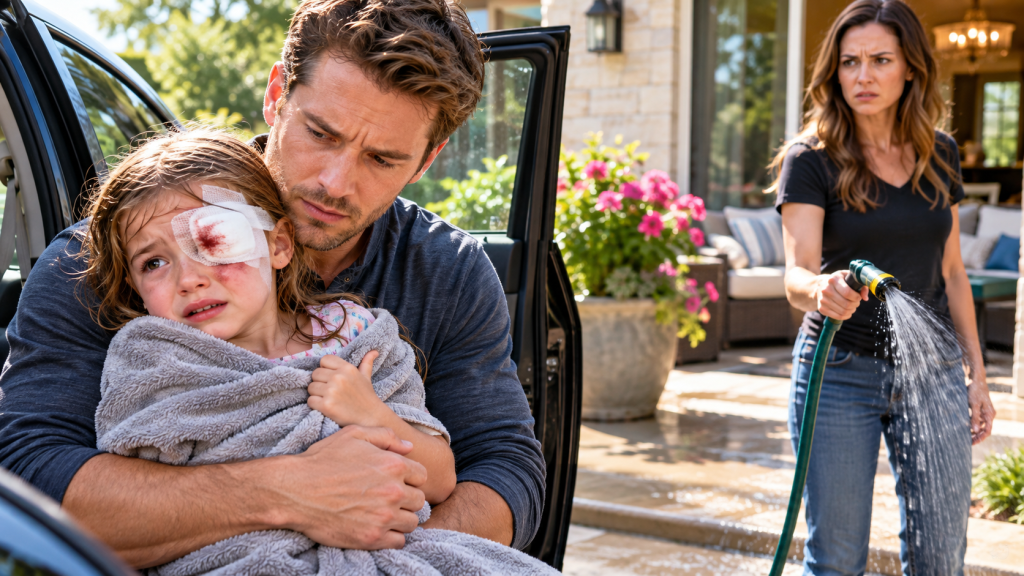
I had watched her point a garden hose at my child until my child fell.
My sister whispered:
“Oh my God.”
“There’s more.”
Of course there was.
There always seems to be more after the first thing you wish had never happened.
I told her about the black trash bag.
She stood.
“We’re not going home.”
“No.”
“Not tonight.”
“No.”
“Not ever if she’s there.”
I looked at her.
That was when I realized I had not yet allowed myself to think beyond tonight.
Urgent care.
Stitches.
Sister’s house.
Tomorrow existed, but I had no shape for it.
Marriage.
Mortgage.
Clothes.
School.
Work.
Custody.
My daughter’s stuffed rabbit still sitting on her bed.
Rachel’s toothbrush beside mine.
Everything normal had become evidence or logistics in less than two hours.
My sister leaned toward me.
“You hear me?”
“Yes.”
“Say it.”
“We’re not going home while Rachel is there.”
“Good.”
My daughter stirred.
We both stopped speaking.
Her good eye opened slowly.
“Mommy?”
“I’m here.”
“Can we go?”
“Soon.”
“Where?”
“Aunt Dana’s.”
Her shoulders lowered immediately.
“Rachel?”
“No.”
The answer came so quickly it surprised both of us.
“No Rachel.”
My daughter stared at me.
Then whispered:
“Okay.”
That tiny okay broke something in me.
Not because she wanted to stay with my sister.
Because she was relieved I understood the question underneath.
Are you taking me back to her?
No.
The doctor returned with discharge instructions and an expression that told me somebody had already briefed him.
He looked at my daughter first.
“How are we doing?”
She lifted one thumb weakly.
He smiled.
“Very official medical response.”
She almost smiled back.
Then he turned to me.
“I documented her statements as accurately as I could.”
“Thank you.”
“There may be bruising around the eye tomorrow.”
I nodded.
“Watch for vomiting, severe headache, unusual sleepiness, confusion.”
He handed me the papers.
Then, more quietly:
“I also made the mandated report.”
I knew what that meant.
Child protective services.
My stomach tightened even though I had expected it.
My sister must have seen my face.
The doctor said:
“That isn’t an accusation against you.”
“I know.”
I did know.
My body did not.
There is something terrifying about hearing that strangers are entering the paperwork of your family.
Even when you are the one who wants help.
Especially then.
“Someone may contact you tonight.”
“Okay.”
“Do not coach her.”
“I won’t.”
“Do not repeatedly question her.”
I thought about every question I had already asked in the car.
Guilt rose.
He must have seen it.
“You asked what you needed to get her here.”
He said it gently.
“Now let trained people handle the detailed interview.”
I nodded.
Then my daughter whispered:
“Can I have juice?”
The doctor smiled.
“Yes.”
Ordinary need.
Thank God.
Dana found apple juice.
My daughter drank it in tiny sips.
My phone vibrated again.
Rachel.
This time a voicemail.
I did not listen.
Then another text.
Where are you?
Then:
The police are here. What did you tell them?
Then:
You need to come home.
Then:
This is insane.
Then:
She fell. Kids fall.
Five messages in four minutes.
I screenshotted them all.
I do not know why.
Instinct.
Maybe because for the first time I understood that memory could become contested territory.
I wanted the words before someone learned to soften them.
At 7:42 that evening, a police officer came to urgent care.
Officer Lena Morales.
She wore her hair in a tight bun and spoke to my daughter only long enough to introduce herself.
No interrogation.
No repeated questions.
She asked me to step into the hallway.
Dana stayed with my daughter.
Officer Morales opened a small notebook.
“I’ve seen the neighbor’s footage.”
My heart pounded.
“Is it clear?”
“Yes.”
“How clear?”
“Clear enough to establish that the hose was being deliberately directed toward your daughter.”
I closed my eyes.
“And the fall?”
“Visible.”
“What about after?”
A pause.
“Also visible.”
I knew.
Eleven seconds.
I had counted them.
The stream continued after my daughter disappeared from the camera’s view.
Eleven seconds.
Long enough to hear a child scream.
Long enough to release a trigger.
Long enough to stop.
“What’s in the trash bag?”
I asked.
Officer Morales looked at me.
“That’s what I came to clarify.”
My stomach tightened.
“What?”
“The bag itself appears to be relevant.”
I frowned.
“Not what’s inside?”
“There are some cleaning rags and garden gloves inside, but that’s not the important part.”
“What is?”
She showed me a photograph on her department-issued phone.
A small black trash bag.
One side had a strip of black electrical tape attached.
Then another photograph.
The rear security camera on our own patio wall.
I stared.
The camera lens was uncovered now.
But adhesive residue remained around the casing.
Officer Morales said:
“Do you recognize this camera?”
“Yes.”
“We installed it after packages got stolen.”
“Does it record your patio?”
“Yes.”
“Who has access?”
“Rachel and me.”
“Cloud storage?”
“Yes.”
She nodded.
“Your neighbor’s second camera shows your wife walking from the garage with the black bag.”
My stomach turned.
“She walks toward your patio camera.”
Officer Morales continued.
“She reaches up.”
“The view from his camera is partially blocked by a tree, but the movement is clear.”
“Three minutes later, your home camera stops producing a usable image.”
I stared at her.
“What do you mean?”
“The feed doesn’t go offline.”
Her eyes stayed on mine.
“It goes black.”
I stopped breathing.
“She covered it.”
“That’s what we believe.”
The world narrowed to a buzzing fluorescent light above us.
Rachel had not merely lost her temper with a hose.
She had thought about cameras.
Before.
My daughter had said:
“She took a picture first.”
Before she fell.
Now there was a bag.
Tape.
A blinded camera.
“After the incident,” Officer Morales continued, “your neighbor’s camera shows Rachel removing something from the security camera area and walking toward the outside bin.”
“The bag.”
“Yes.”
“She threw it away.”
“Yes.”
I leaned against the wall.
My marriage ended in my mind right there.
Not legally.
Not emotionally all at once.
But the last door closed.
An accident does not need privacy from a camera before it happens.
“What did she tell you?”
I asked.
Officer Morales paused.
“That your daughter had been throwing dirt.”
“That Rachel turned on the hose to rinse her legs.”
“That your daughter ran backward despite being told to stop.”
“And that the camera had been covered earlier because Rachel was pressure-washing part of the patio and didn’t want water on the lens.”
I almost laughed.
“Pressure washing?”
“Is there a pressure washer?”
“In the garage.”
“Was it used today?”
“No idea.”
“We photographed it.”
I stared at her.
“The patio wasn’t pressure-washed.”
“How do you know?”
“Because I was there yesterday.”
Officer Morales wrote that down.
“What did Rachel say about the photograph your daughter mentioned?”
“She denied taking one.”
I looked toward the exam room.
Of course.
Three explanations in texts.
Now denial.
“Can you preserve her phone?”
I asked.
“We’re working through the proper process.”
That was all she would say.
Good.
She was doing her job.
I needed people around me who still had jobs to do instead of emotions to survive.
“What happens now?”
“We’ve contacted the child-protection investigator.”
“The prosecutor will review the evidence.”
“Depending on what is established, there may be criminal charges.”
“Tonight?”
“I can’t promise that.”
I hated that answer.
Because it was honest.
“What about the house?”
“Do you own it jointly?”
“Yes.”
“Then I strongly recommend you speak with an attorney before trying to remove anyone yourself.”
I nodded.
“My daughter and I are staying somewhere else.”
“Good.”
Then she said:
“Do not return alone tonight.”
“I won’t.”
She looked at me.
“You’re saying that now.”
I almost smiled despite everything.
“You’ve met people.”
“I’ve met frightened parents.”
Fair.
“I won’t.”
Before leaving, Officer Morales looked through the window at my daughter.
Then back at me.
“She did the right thing telling you.”
My eyes filled.
“Yes.”
“Make sure she hears that more than once.”
I did.
The first time before we left urgent care.
I crouched beside her.
“You did the right thing telling me.”
She looked away.
I said it again.
“You did the right thing.”
Her mouth trembled.
“Rachel said you’d get mad.”
“At you?”
She nodded.
“Never for telling me the truth.”
“She said you’d say I made her do it.”
My chest tightened.
“What?”
“She said if I listened, she wouldn’t have to spray me.”
I wanted to stand up and scream.
Instead I stayed on my knees.
That moment became one of the hardest disciplines of my life.
Not making my child manage my anger while telling me about somebody else’s.
“What did you do?”
I asked carefully.
She whispered:
“I picked flowers.”
That was it.
Flowers.
From the flower bed.
“Were you allowed?”
She shrugged.
“I thought so.”
“Did Rachel tell you not to?”
“She said those were for looking.”
A five-year-old had picked flowers.
Rachel had decided disobedience deserved a hose.
My hands clenched.
I opened them.
“You never deserve to be hurt because you picked flowers.”
My daughter looked at me.
“Even the pink ones?”
I almost broke.
“Even the pink ones.”
She nodded.
Then asked:
“Can we go to Aunt Dana’s?”
“Yes.”
Dana drove because I no longer trusted my concentration.
My daughter slept in the back seat.
Every time we hit a bump, I looked behind us.
At Dana’s house, she refused the guest room.
She wanted Dana’s daughter’s old room.
Smaller.
Yellow walls.
Glow-in-the-dark stars.
I tucked her in wearing borrowed pajamas.
She asked for the hallway light on.
Then the bathroom light too.
Then:
“Can you stay?”
“Yes.”
I sat on the floor beside the bed.
She fell asleep holding my fingers.
At 1:06 a.m., someone from child protective services called.
Her name was Simone Keller.
She spoke quietly.
Asked where we were.
Confirmed my daughter was not with Rachel.
Confirmed Rachel did not have access to us.
Asked whether I had any other children.
No.
Whether Rachel had ever physically disciplined my daughter before.
I said:
“Not that I know.”
Then stopped.
That phrase became haunting.
Not that I know.
Simone asked:
“Has your daughter ever shown fear of being alone with her?”
I thought.
Longer than I wanted to.
“She started asking when I’d be home.”
“When?”
“Recently.”
“How recently?”
“Maybe two months.”
“What would she ask?”
“How many sleeps until the weekend.”
“Whether I had to work late.”
“Whether Rachel was picking her up.”
My chest tightened.
I had interpreted every question as attachment.
She misses me.
Sweet.
Normal.
What if she had been measuring exposure?
“I don’t know.”
My voice broke.
“I don’t know what I missed.”
Simone said something I remembered for years.
“Tonight is not the night to build a case against yourself.”
I closed my eyes.
“We’ll work out what happened.”
“Your job right now is to keep her safe and remain available to listen.”
I nodded even though she could not see me.
Then she arranged a forensic child interview for the next morning at a child advocacy center.
I barely slept.
At six, my daughter woke and asked:
“Do we have to go home for my shoes?”
She was wearing Dana’s granddaughter’s slippers.
“No.”
“My unicorn ones are there.”
“We’ll get them later.”
“With Rachel?”
“No.”
Her shoulders relaxed.
Again.
That relief became evidence of its own.
At the advocacy center, the building looked deliberately ordinary.
No giant sign.
No police cars outside.
A waiting room with puzzles and books.
The interviewer’s name was Dr. Harper Lin.
She explained things to me first.
“I will speak with your daughter alone.”
“Okay.”
“You will not watch the interview live.”
That was harder.
“Why?”
“Because we want her to answer without reading anyone’s reaction.”
Of course.
“She may say things you didn’t know.”
I swallowed.
“I understand.”
“Afterward, I’ll tell you what I can.”
“What if she asks for me?”
“We’ll respond appropriately.”
Then she looked directly at me.
“Do not promise her any particular legal outcome.”
“I haven’t.”
“Good.”
“Do promise safety where you can actually provide it.”
That language mattered.
Promises with edges.
I waited forty-three minutes.
I know because I watched the clock.
Dana sat beside me.
She did not tell me to calm down.
Good sister.
At minute thirty-one, she put a bottle of water in my hand.
I forgot to drink it.
When my daughter came out, she carried a sticker shaped like a fox.
She climbed into my lap.
“Can we get pancakes?”
I looked at Dr. Lin.
She smiled slightly.
“Yes.”
So we got pancakes.
Only later, with my daughter coloring beside Dana in another room, did Dr. Lin tell me the outline.
There had been other punishments.
Nothing as visibly injurious as the hose incident.
Still enough.
Rachel had made her sit alone on the patio when she cried “too much.”
Once for almost an hour.
She had taken away dinner twice for not finishing chores.
Five-year-old chores.
Toys.
Shoes.
Putting clothes into a basket.
Rachel had squeezed her upper arms when angry.
Had locked the bathroom door from the outside once while my daughter was inside because she kept coming out during “quiet time.”
Not overnight.
Not for hours.
Still.
A locked door.
Five years old.
My daughter had not told me because Rachel had a sentence for everything.
Mommy works because grown-ups need money. Don’t make her worry.
If Mommy has to choose sides, you’ll make her sad.
Mommy doesn’t like tattling.
Mommy already thinks you’re dramatic.
The last one nearly made me vomit.
I had called my daughter dramatic once.
Once.
Months earlier.
She had cried because I cut her sandwich into rectangles instead of triangles.
I laughed and said:
“Somebody’s dramatic today.”
Harmless.
I thought.
Rachel had taken the sentence and turned it into a tool.
Children do not understand sarcasm the way adults hope they do.
Neither do manipulators, when sarcasm is useful.
Dr. Lin continued.
“The photograph matters to your daughter.”
“What did she say?”
“That Rachel photographed her after she picked the flowers.”
“Before the hose.”
“Yes.”
“Why?”
“Rachel told her she wanted proof of how dirty she gets when she doesn’t listen.”
My jaw tightened.
“So the photo should show her before the injury.”
“Yes.”
“And dry.”
“Most likely.”
I thought about Rachel denying the photograph existed.
“Can police recover deleted pictures?”
“That’s outside my role.”
Right.
Jobs.
Boundaries.
Good.
Then Dr. Lin said:
“Your daughter believes the spraying was punishment.”
There was no confusion.
No accidental swing.
“She said Rachel told her to stand still.”
I closed my eyes.
“And when she moved?”
“Rachel followed her with the hose.”
Neighbor video.
Exactly.
“She fell backward.”
“Yes.”
“Then what?”
Dr. Lin chose her words carefully.
“She remembers pain.”
“Water.”
“And Rachel saying, ‘Look what you made happen.’”
I stopped breathing.
Not:
Are you okay?
Not:
Oh my God.
Look what you made happen.
Blame delivered before first aid.
Then, eventually, gauze.
Then more water.
I opened my eyes.
“Why was Rachel still spraying her after she fell?”
Dr. Lin shook her head.
“We do not know exactly what Rachel intended.”
Right.
No mind reading.
Evidence.
I learned that discipline over the next year.
Stick to what can be proved.
Especially when anger wants to fill gaps.
Police obtained access to Rachel’s phone two days later.
I learned through the detective assigned to the case.
There was a photograph.
Deleted.
Recovered from cloud storage.
Timestamp:
4:11 p.m.
My daughter stood beside the flower bed.
Dry.
A little dirt on one knee.
Three pink flowers crushed in her fist.
No cut.
No blood.
No gauze.
Behind her, the patio camera appeared in the top corner of the image.
Still uncovered.
Two minutes later, our home camera feed went black.
4:14.
Neighbor video showed Rachel begin spraying.
4:15.
My daughter backed away.
4:16.
She fell.
The hose continued.
Eleven seconds.
Then Rachel disappeared from the neighbor camera’s view.
Our own camera remained black for another fourteen minutes.
When it came back, my daughter was sitting in the patio chair with gauze over her eye.
Rachel was wiping the stone.
Then the feed went black again.
I stared at the timeline the detective gave me.
“What happened the second time?”
“We don’t know.”
“Black bag?”
“Possibly.”
The bag recovered from the trash contained cleaning rags, disposable gloves, torn gauze packaging, and the strip of tape that appeared consistent with what had been used to cover the camera.
Not a weapon.
Not some secret torture kit.
In some ways, the ordinariness made it worse.
Household objects.
Tape.
Gauze.
Garden hose.
Evidence that cruelty does not require specialized tools.
Only power and permission.
Rachel’s explanations continued changing.
First:
Rinsing mud.
Then:
Accidental hose swing.
Then:
My daughter ran into the spray.
Then:
She used the hose as a “behavioral reset.”
I had never heard that phrase in our marriage.
The detective almost smiled when she quoted it.
“What is a behavioral reset?”
I asked.
“She said spraying cold water near a child can interrupt a tantrum.”
“Near?”
“That’s her description.”
I stared at the still image from Mr. Lawson’s camera.
The stream hit my daughter squarely in the chest.
“Near.”
The detective said nothing.
Good.
The criminal case began.
So did the family case.
My attorney was a woman named Priya Desai.
She specialized in family law.
The first thing she told me was:
“You are going to feel tempted to solve everything in seventy-two hours.”
“Yes.”
“You can’t.”
“I know.”
“No.”
She leaned forward.
“You understand the sentence.”
“You do not understand the reality.”
She was right.
Divorce.
Temporary protective orders.
Exclusive use of the house.
Property.
Accounts.
School pickups.
Medical access.
Emergency contacts.
Who could receive information.
Who could not.
Priya helped me file for temporary orders restricting Rachel’s contact with my daughter.
Because Rachel had not adopted her and had no independent parental rights, that part was more straightforward than I feared.
The house was not.
Jointly owned.
Rachel initially refused to leave.
I refused to return with my daughter.
So for three weeks, Dana’s house became home.
My daughter wore borrowed clothes until police escorted me to retrieve ours.
I walked through my own front door with an officer.
The patio was visible through the kitchen.
I could not look at it.
I went upstairs.
My daughter’s room.
Stuffed rabbit.
Unicorn shoes.
Pajamas.
Favorite books.
Then I noticed something.
A piece of paper taped inside her closet.
A drawing.
Three people.
Me.
My daughter.
Rachel.
Rachel drawn far away.
Between us, a red line.
Above me:
MOMMY WORK
Above Rachel:
MAD
My hands shook.
I photographed it before touching it.
The officer asked why.
“Everything feels like evidence now.”
She looked at me.
“Not everything has to be.”
I stared.
She nodded toward the stuffed rabbit.
“That can just be hers.”
That helped.
I packed the rabbit.
Left the drawing for investigators after asking what to do.
The house felt contaminated.
Not physically.
Emotionally.
Every room made me ask:
What happened here when I wasn’t here?
The kitchen.
Did Rachel take away dinner there?
The bathroom.
Which door had been locked?
The patio.
I could not step outside.
That lasted months.
Rachel moved out after temporary court orders gave me exclusive occupancy while the case proceeded.
She stayed with a friend.
Then rented an apartment.
I changed the locks legally.
Not dramatically.
No revenge.
One locksmith.
Two deadbolts.
New garage code.
Alarm reset.
I removed Rachel as emergency contact from school.
Pediatrician.
Dentist.
After-school program.
Every form.
That part hurt in an unexpected way.
For four years, I had written her name beneath mine.
Relationship: Stepmother.
Authorized pickup: Yes.
Emergency contact: Yes.
Now:
Remove.
No.
Delete.
I had loved seeing us written as a family.
Forms do not know when families stop being safe.
People have to tell them.
The criminal case moved slowly.
Rachel was charged with offenses related to child endangerment and assault.
I am deliberately not making the labels bigger than they were.
There was no attempted murder.
No monstrous legal headline.
There was documented physical harm to a child during punishment and evidence of deliberate concealment.
That was enough.
Her attorney argued context.
Discipline.
Poor judgment.
A stressful afternoon.
No prior criminal history.
Rachel had worked as a physical therapist assistant.
She had references.
Coworkers.
People who said:
“That doesn’t sound like her.”
I hated that sentence.
Of course it did not sound like her to them.
They had never been five years old in our backyard.
I also knew something uncomfortable.
It had not sounded like her to me either.
Before that afternoon.
That did not mean the evidence was wrong.
It meant people contain rooms we do not always see.
Rachel eventually entered a plea.
No trial.
Part of me hated that.
I wanted a courtroom.
Screens.
Video.
The photograph.
Every lie displayed.
Then Priya asked:
“For whom?”
I stared.
“For justice.”
“That’s not what I asked.”
I looked away.
“For me.”
There.
I wanted an official room to validate my anger.
My daughter did not need that.
She needed stability.
The plea created a record.
Probation.
Mandatory intervention and parenting-related treatment.
No contact with my daughter.
Other conditions.
Her professional employment was affected.
The exact consequences became less interesting to me with time.
At first, I tracked everything.
Every hearing.
Every filing.
Every condition.
Then one day, my daughter asked:
“Can we go get ice cream?”
I was reading an email from the prosecutor.
I looked at her.
Then closed the laptop.
“Yes.”
That became the beginning of letting Rachel’s consequences belong to Rachel.
My daughter’s healing belonged to us.
And healing was strange.
She was afraid of baths.
Not water exactly.
Directed water.
The shower terrified her.
The first night at Dana’s, she screamed when Dana turned on the handheld sprayer without warning.
I shut it off immediately.
We used a cup instead.
Pour.
Rinse.
Pour.
Rinse.
She controlled the cup.
That mattered.
At home, after we returned, I removed the detachable shower head.
Not forever.
For now.
She bathed in shallow water.
Door open.
Then door closed if she wanted.
I sat on the bathroom floor the first few times.
Months later, she told me:
“You can go.”
I went.
Stood outside anyway.
Motherhood.
Dr. Lin referred us to a child therapist named Celeste Morgan.
Play therapy.
My daughter did not sit on a couch and describe trauma like a miniature adult.
She played.
Dolls.
Blocks.
Paint.
Sand.
Water table eventually.
At first, she avoided the water table completely.
Then one day she put one plastic horse into it.
Next week, two.
Then she used a cup to pour water over a toy house.
Celeste told me only what I needed to know.
Good therapy belongs partly to the child.
Not entirely to the parent.
I had to learn not to ask:
“What did you talk about?”
Instead:
“Did you have a good session?”
Sometimes she said yes.
Sometimes:
“None of your business.”
At six.
Rude.
Wonderful.
Her appetite changed.
For weeks after the incident, she asked permission before taking snacks.
That was new.
“Can I have yogurt?”
“Yes.”
“Even if dinner is soon?”
“Yes.”
“Will you be mad?”
“No.”
It turned out Rachel had been using food as discipline more often than my daughter initially disclosed.
Not starving her.
Nothing dramatic enough to show on a growth chart.
No dessert.
No snacks.
Dinner removed after “backtalk.”
Rules disguised as structure.
I had seen some of it.
Rachel saying:
“She barely touched dinner, so no snack later.”
That had sounded like reasonable parenting.
Context matters.
So does pattern.
I felt sick when I understood the difference.
Celeste told me:
“Do not compensate by giving unlimited food.”
I frowned.
“I wasn’t going to.”
“You might.”
Fair.
“You’re going to feel tempted to reverse every rule associated with Rachel.”
She was right.
“If Rachel said bedtime at eight, you’ll want ten.”
“If Rachel said clean your room, you’ll want never.”
“If Rachel said no candy, you’ll want a candy drawer.”
I almost smiled.
“Children still need structure.”
Celeste continued.
“The goal is not a world with no limits.”
“It’s a world where limits are safe, predictable, and not humiliating.”
That became the blueprint.
Bedtime stayed.
Chores stayed.
Consequences stayed.
But they became small.
Related.
Clear.
Toys left outside?
Toy comes in.
Crayons on wall?
Help clean.
Hit someone?
Separate, calm down, repair.
No pain.
No fear.
No food.
No locked doors.
No water.
No adult saying:
Look what you made happen.
I also went to therapy.
Of course.
I fought it for two months.
My therapist was named Aaron Wells.
He was infuriatingly patient.
First session, I said:
“I should have known.”
He asked:
“How?”
“Because she was quieter.”
“When?”
“I don’t know.”
“Because she asked when I would be home.”
“Children do that.”
“Because Rachel was controlling.”
“Were you experiencing it as control then?”
“No.”
“What were you experiencing?”
“Help.”
There.
Rachel had entered our life during a difficult period.
My daughter’s other parent had been inconsistent and eventually mostly absent.
I was working full time.
Rachel was organized.
Capable.
Good with routines.
She remembered school forms.
Packed lunches.
Made pediatric appointments.
I was grateful.
Gratitude can make scrutiny feel disloyal.
When my daughter resisted Rachel, I sometimes thought:
Adjustment.
Blended family.
Testing boundaries.
When Rachel told me I was too permissive, I listened.
When she said my daughter needed consistency, I agreed.
All reasonable words.
The problem was not structure.
The problem was what Rachel did when I was not there.
Aaron told me:
“You cannot build a parenting model around never trusting anyone again.”
That made me angry.
“I trusted the wrong person.”
“Yes.”
“So why trust?”
“Because your daughter will eventually need teachers.”
“Coaches.”
“Friends’ parents.”
“Doctors.”
“Partners when she’s grown.”
He looked at me.
“The goal is not permanent suspicion.”
“It is better information.”
That took years.
I ran background checks on babysitters.
Too many.
Asked teachers extra questions.
Sometimes too many.
Dana eventually said:
“You are interviewing the soccer coach like he’s joining the CIA.”
I snapped at her.
Then apologized.
She was right.
Hypervigilance can wear the costume of excellent parenting.
It still makes a child’s world smaller if you let it.
So I worked on that too.
My daughter returned to preschool after nine days.
Her teacher knew only that there had been a family safety issue.
No details shared with other parents.
At drop-off, my daughter clung to me.
“I don’t want you to leave.”
I knelt.
“I’m coming back at three.”
“Promise?”
“Yes.”
“What if you work?”
“I already arranged it.”
“What if your phone dies?”
“School has Aunt Dana.”
“What if—”
I held up one finger.
“I will be back.”
She cried.
I left anyway.
That was one of the hardest healthy things I did.
Keeping promises does not mean removing every separation.
At 2:42, I sat in the parking lot like an idiot.
At 2:59, I stood by the door.
At three, she ran out.
“You came!”
The words stabbed me.
“Of course.”
She hugged me.
For months, every return mattered.
Home after work.
School pickup.
Grocery store.
Shower.
Bedtime.
I said:
“I came back.”
Not every time.
Enough.
Her body learned.
Slowly.
Mr. Lawson became part of our lives in a way none of us expected.
At first, my daughter was afraid of him because she knew he had the video.
Children make strange connections.
She thought video meant watching.
Watching meant danger.
I explained:
“Mr. Lawson’s camera saw something important.”
She frowned.
“Did he see me cry?”
“Yes.”
Her face crumpled.
“I don’t want him to know.”
I called him.
Explained.
He said:
“Understood.”
Then for six months, he never mentioned the incident to her.
Not once.
He waved.
Talked about his dog.
Gave her a pumpkin at Halloween.
That was it.
Eventually she asked him herself:
“Did your camera help Mommy?”
Mr. Lawson crouched.
“It helped people know what happened.”
She thought.
Then:
“Okay.”
Conversation over.
I thanked him later.
He shrugged.
“Kids shouldn’t have to comfort adults about what happened to them.”
Good man.
The flower bed remained.
I almost ripped it out.
Every pink flower made me angry.
Dana stopped me.
“What did the flowers do?”
Nothing.
Exactly.
So the flowers stayed.
My daughter avoided them for months.
Then one spring morning, almost a year later, she walked outside with me.
She stood at the edge.
“Can I pick one?”
My throat tightened.
“Yes.”
“How many?”
“As many as you want.”
She picked one.
Pink.
Of course.
Held it.
No one sprayed her.
She picked another.
Then another.
Then she stopped.
“Three is enough.”
I sat on the patio step and cried.
She looked annoyed.
“Mommy.”
“I’m fine.”
“You’re crying.”
“I can do both.”
She rolled her eyes.
Five turning six.
Good.
Then came the hose.
I had hidden it in the garage after the incident.
Not intentionally forever.
I simply could not look at it.
One summer afternoon, when she was six, we were watering the garden with a can.
She pointed toward the garage.
“Do we still have the hose?”
I stopped.
“Yes.”
“Why don’t we use it?”
I wanted to say:
Because the hose hurt you.
But objects are not people.
The hose had not decided anything.
So I said:
“I wasn’t sure you wanted to.”
She thought.
“I want to.”
My stomach tightened.
“Okay.”
I brought it out.
Same green hose.
Different nozzle.
I had thrown the old nozzle away during a furious cleaning spree months before.
Maybe that was symbolic.
Maybe I just hated it.
She stood far back.
I attached the new one.
Then handed it to her.
“You control it.”
She stared.
“Me?”
“Yes.”
“Can I spray you?”
I hesitated.
She smiled.
That little smile.
I knew exactly what she was asking.
Not violence.
Power.
Play.
“Legs only.”
She squeezed.
A thin stream hit my jeans.
I jumped theatrically.
She laughed.
Again.
I laughed.
Then she sprayed the flowers.
That sound—
Water against leaves—
had lived in my nightmares for a year.
That afternoon, my daughter turned it back into gardening.
Healing does not erase association.
It adds new ones.
At seven, she started swim lessons.
Her choice.
First lesson, she refused to put her face in the water.
Coach said:
“No problem.”
No force.
No trick.
No countdown.
Week two:
Chin.
Week three:
Mouth.
Week four:
Whole face.
She came up sputtering.
Then laughed.
I cried in the bleachers.
Of course.
By nine, she could swim the length of the pool.
By ten, she loved diving.
Water stopped belonging to Rachel.
That mattered more than I can explain.
The divorce finalized fourteen months after the incident.
I kept the house after buying out Rachel’s share through the financial settlement.
Not because I wanted to stay there forever.
Because I refused to let trauma make every decision for me.
For two more years, we lived there.
Then one evening, my daughter asked:
“Can we move?”
I stared.
“Why?”
“I don’t like the patio.”
There it was.
Not my decision.
Hers.
“Okay.”
We moved.
Not immediately.
We listed in spring.
Sold.
Bought a smaller house with a wide front porch and a tiny backyard.
No stone patio.
Grass.
Garden beds.
My daughter chose yellow for her bedroom.
At closing, I felt lighter than I expected.
Not escaping.
Choosing.
Different.
Rachel contacted me once directly after the no-contact order with my daughter had ended but before any contact was allowed.
An email.
My attorney forwarded it after filtering out legal issues.
She wrote:
I know you hate me.
I stopped there the first time.
Went back a week later.
I know you hate me. I know I hurt her. I still struggle with how that afternoon became what it did. I was angry. I thought I was disciplining her. When she fell, I panicked. Covering the camera was indefensible. Continuing the water was indefensible. Telling her it was her fault was indefensible.
I stared at that paragraph for a long time.
No:
If.
No:
Misunderstood.
No:
She made me.
Then:
I am not asking you to tell her I’m sorry. That would make her carry my apology. I am writing because I spent months telling myself I was being treated like a monster. Treatment forced me to stop asking what label I deserved and start looking at what I did.
That sentence mattered.
Not enough for reconciliation.
Enough for reality.
She continued.
I hope someday she knows that what happened was my responsibility. Not hers.
I saved the email.
Did not show it to my daughter.
Not then.
At twelve, my daughter asked:
“Did Rachel ever say sorry?”
I answered truthfully.
“To me.”
She stared.
“What did she say?”
I did not hand over the email.
I summarized.
“That she hurt you.”
“That covering the camera was wrong.”
“That spraying you was wrong.”
“That blaming you was wrong.”
My daughter was silent.
Then:
“Why didn’t she tell me?”
“Because she was told not to contact you.”
“Oh.”
“She also said you should not have to carry her apology.”
My daughter thought.
“That’s smart.”
I almost laughed.
“Maybe.”
Then she said:
“I don’t forgive her.”
“You don’t have to.”
“Do you?”
That question took longer.
“I don’t know.”
She looked at me.
“What does that mean?”
“It means I’m not angry every day anymore.”
“But I don’t want her in our lives.”
“And I don’t think forgiving someone, if it happens, has to mean giving them access.”
My daughter nodded.
“Good.”
Then:
“I still hate hoses sometimes.”
“Fair.”
She smiled.
We never made forgiveness a graduation requirement.
That mattered.
Some people turn healing into another burden.
You must forgive.
You must release.
You must stop being angry.
No.
My daughter was allowed to have whatever relationship to the past helped her live well in the present.
Over time, Rachel became less central.
That was the real healing.
Not a grand statement.
We could go whole weeks without saying her name.
Then months.
My daughter’s life filled with other things.
School projects.
Friends.
Bad haircuts.
Dance lessons she hated.
Soccer she loved.
A hamster named Gerald who lived far longer than biology suggested possible.
Middle school.
Braces.
First crush.
Normal problems.
Beautiful.
At thirteen, she told me I was “literally ruining her life” because I would not let her attend a sleepover where I had never met the parents.
I went into my room and cried laughing.
She thought I was mean.
I thought:
She trusts me enough to be furious.
Good.
We met the parents.
She went the next week.
At fifteen, she started volunteering at an animal shelter.
One afternoon, she came home soaked because a dog knocked over a bucket.
I froze when I saw her wet clothes.
She noticed.
“Mom.”
“I’m fine.”
“You have the face.”
“What face?”
“The patio face.”
I hated that she could read it.
Then she smiled.
“Dog.”
She pointed at herself.
“Bucket.”
Then:
“Not Rachel.”
I exhaled.
“Okay.”
She hugged me.
Teenagers rarely hug voluntarily.
I treasured it.
Then she whispered:
“You don’t have to check every time.”
I looked at her.
There.
The next lesson.
Trauma can make parents watch so hard that children feel permanently fragile.
I did not want that.
“I’ll work on it.”
“Good.”
“Don’t become wise. It’s annoying.”
She laughed.
At sixteen, she asked to see the neighbor video.
I said no.
Immediately.
She was furious.
“It happened to me.”
“Yes.”
“So it’s mine.”
“No.”
That answer started an argument that lasted two days.
Eventually, I brought it to Aaron, my therapist, who was still occasionally in my life by then.
He asked:
“Why no?”
“Because it’s horrible.”
“For whom?”
I stared.
He had become Priya in male form.
Annoying.
“For her.”
“Are you sure?”
“No.”
There it was.
I was protecting the five-year-old version.
My daughter was sixteen.
Different person.
We discussed it with her therapist.
Eventually, with preparation, she watched the clip.
Not alone.
Not the full unedited file repeatedly.
Once.
She cried.
I cried.
Then she said something that surprised me.
“I thought it was worse.”
I stared.
“What?”
“In my head.”
She wiped her face.
“I thought I fell farther.”
“I thought I was screaming longer.”
“I thought…”
She stopped.
“What?”
“That I was smaller.”
My chest tightened.
“You were five.”
“I know.”
“But in the video I can see myself trying to move away.”
She watched the paused frame.
“I did try.”
I took her hand.
“Yes.”
She had spent eleven years carrying some secret belief that fear meant passivity.
The video gave her something I had not known she needed.
Evidence of herself resisting.
She never watched it again.
As far as I know.
At eighteen, when she left for college, I found the old urgent-care discharge papers in a file.
Stitches.
Bruising.
Watch for concussion symptoms.
The beginning of everything.
I almost threw them away.
Then stopped.
Asked her.
“Keep or shred?”
She looked.
“Shred.”
“You sure?”
“Yes.”
We did.
Not the official legal records.
Those existed elsewhere.
Our household copy.
The paper no longer needed to live in the drawer with birth certificates and tax returns.
We fed it through the shredder.
The sound was less dramatic than movies make it.
Just paper.
Gone.
At college, she studied early childhood education.
That worried me at first.
Was she choosing a life built around what happened?
Maybe.
Maybe not.
She liked children.
She liked classrooms.
She had always been patient with younger kids.
Trauma does not own every interest that grows near it.
She became a first-grade teacher.
The first time she told me she had accepted the job, I cried.
“Mom.”
“I know.”
“You cry too much.”
“Genetics.”
At twenty-four, she called me after school.
Her voice sounded different.
“What happened?”
“A kid said something.”
My entire body went alert.
She heard it.
“Mom.”
“Sorry.”
She continued.
“One of my students asked if she could stay in the nurse’s office until her dad went to work.”
I went quiet.
“What did you do?”
“I called the counselor.”
“Documented exactly what she said.”
“Followed policy.”
Good.
Then her voice broke.
“I thought about Nurse Anita.”
The urgent-care nurse who closed the door.
“Yes.”
“I thought about Mr. Lawson.”
“Yes.”
“And you.”
I swallowed.
“What about me?”
“You listened.”
I closed my eyes.
Not perfectly.
Not soon enough for the version of motherhood I once demanded from myself.
But when it mattered most, I listened.
She continued.
“The counselor asked me if I was okay.”
“What did you say?”
“I said I will be.”
Good.
Not:
Fine.
We had all retired that word.
The child in her classroom received help.
My daughter never told me details.
Confidentiality.
Professional boundaries.
I was proud of that too.
She knew some stories do not belong to us simply because they remind us of ours.
Years later, my daughter married a kind man named Ethan.
I watched him with her carefully at first.
Of course I did.
Not because he gave me reason.
Because mothers with history sometimes mistake vigilance for intuition.
He learned quickly.
The first time he reached for the garden hose at my house, he noticed both of us go quiet.
He stopped.
Looked at my daughter.
“Do you want me to use the watering can?”
She stared at him.
Then smiled.
“No.”
She picked up the hose.
Sprayed him directly in the chest.
He shouted.
I laughed so hard I had to sit down.
That was how he learned the story’s outline.
Not from me.
From her.
In her time.
They had a daughter.
My granddaughter.
At five years old, she loved mud.
Of course.
Children enjoy testing whether life has a sense of humor.
One summer afternoon, she dug into a flower bed and covered both arms with dirt.
My daughter stood on the porch.
I was nearby.
Her little girl held up muddy hands.
“Mommy!”
My daughter stared for one second.
I saw the old memory move through her face.
Then she smiled.
“You are filthy.”
Her daughter laughed.
“Can I use the hose?”
My daughter looked at me.
I looked away.
Not my moment.
She said:
“You can use it on your feet.”
Her daughter grabbed the nozzle.
Water everywhere.
Shoes.
Grass.
Dog.
My daughter got sprayed.
She shrieked.
Then chased her child through the yard laughing.
I cried on the porch.
Quietly.
Nobody needed me to narrate the symbolism.
The water belonged to them.
That was enough.
I grew older.
The story changed shape again.
For years, I told it beginning with the patio.
Blood through gauze.
Garden hose.
My daughter shaking.
Then later, I started remembering the car more.
Locked doors.
My daughter wrapped in a towel.
“Mommy, I fell after she started spraying me.”
That sentence was the hinge.
Not because it told me everything.
Because I believed the direction of it.
She fell after.
Not:
You misunderstood.
Not:
Rachel loves you.
Not:
Why were you misbehaving?
After.
Then doctor.
Documentation.
Neighbor.
Video.
Police.
Each next adult took one piece seriously enough to keep going.
That is how safety often works.
No single hero.
My daughter spoke.
I listened.
Doctor documented.
Mr. Lawson preserved footage.
Police collected evidence.
Dr. Lin interviewed carefully.
Therapists helped.
Lawyers created boundaries.
Teachers later supported normal life.
A whole chain of people doing their part.
The opposite of the chain Rachel had tried to create.
Keep quiet.
Don’t tell.
Mommy will be mad.
Camera covered.
Photo deleted.
Explanation changed.
Truth survives sometimes because more than one person refuses to carry a lie.
I never forgot that.
I also never forgot my own mistakes.
I worked too much during that season.
Not wrong.
Necessary.
But it created space Rachel controlled.
I accepted her description of my daughter too easily.
Dramatic.
Defiant.
Testing.
I delegated more parenting authority than I understood.
Those were mine.
I faced them.
What I did not do was turn responsibility into self-punishment forever.
That would have made my daughter comfort me.
She already spent enough time learning adults’ feelings were not her job.
So when guilt rose, I took it to therapy.
Not to her.
Mostly.
I was not perfect.
One night when she was ten, I cried and said:
“I’m sorry I didn’t know.”
She looked at me.
Then said:
“Can you stop saying that?”
I froze.
“Why?”
“Because then I have to tell you it’s okay.”
There.
Five years of therapy in one sentence.
I wiped my face.
“You don’t.”
“Good.”
She went back to her book.
I stopped asking my child to absolve me.
That was one of the greatest gifts she gave me.
When she became an adult, we talked about it differently.
She told me:
“I was angry at you sometimes.”
I listened.
“For working?”
“For trusting Rachel.”
“For not noticing.”
My heart hurt.
I did not defend myself.
Then she continued:
“But I knew you didn’t know.”
Both.
Children can love us and be angry at us.
Parents survive that.
Good ones learn to.
I asked:
“What would you have wanted me to do differently?”
She thought.
“Believe weird things sooner.”
I smiled sadly.
“What does that mean?”
“When a kid changes in a way that doesn’t make sense, don’t always look for the normal answer first.”
That was wise.
Not:
Suspect everyone.
Just:
Stay curious when the explanation is too easy.
I carried that.
So did she.
Rachel died many years later.
I learned through an old mutual acquaintance.
Cancer.
Short illness.
My daughter was thirty-seven.
I called her.
“I heard something.”
She knew from my tone.
“Rachel?”
“Yes.”
“She died?”
“Yes.”
Silence.
Then:
“Oh.”
That was all.
I waited.
“What do you feel?”
She laughed once.
“Why does everybody ask that?”
Fair.
“I don’t know.”
“Okay.”
Then:
“Do I have to feel sad?”
“No.”
“Relieved?”
“No.”
“Anything?”
“No.”
She exhaled.
“Good.”
Later she told me she cried.
Not for Rachel exactly.
For the fact that part of her childhood had ended permanently without ever becoming something else.
No apology to her.
No reunion.
No confrontation.
No final scene.
Death is not always closure.
Sometimes it simply removes the possibility of one kind of future.
My daughter accepted that too.
Months later, she planted pink flowers in her yard.
Not for Rachel.
For herself.
When I asked why pink, she rolled her eyes.
“They’re flowers, Mom.”
Good.
That may have been the healthiest answer possible.
I am seventy now.
My daughter is grown.
My granddaughter thinks hoses exist primarily for attacking adults in summer.
Mr. Lawson is gone.
Dana lives in Florida.
Officer Morales retired.
Dr. Lin still sends holiday cards some years.
The patio house belongs to another family.
The flower bed is probably different.
The urgent-care clinic moved buildings.
Everything changed.
But I still remember the exact sound of the water stopping.
I had walked onto the patio.
Saw my child.
Saw the bandage.
Saw Rachel holding the hose.
I crossed the stone.
Turned the spigot.
The water shuddered through the line.
Then silence.
At the time, I thought I had only shut off a hose.
Years later, I understand that was the first boundary.
Small.
Physical.
Immediate.
Stop the water.
Then:
Car.
Lock doors.
Doctor.
No return home.
No contact.
Legal order.
Therapy.
New house.
New rules.
A child’s safety is often rebuilt that way.
One valve at a time.
One door.
One form.
One adult saying:
No more.
If someone asks me what the most important evidence was, they expect me to say the neighbor video.
It was powerful.
Or the photograph.
Or the black trash bag used to cover the camera.
Or Rachel’s changing texts.
All mattered.
But none was first.
The first evidence was my daughter’s fear.
“Don’t tell her I told you.”
That sentence did not prove a crime.
It proved something was wrong.
Before footage.
Before metadata.
Before lawyers.
A five-year-old was afraid of the consequences of telling her mother the truth.
That deserved attention all by itself.
I know that now.
Maybe that is the part I want other parents to understand.
You do not have to interrogate.
You do not have to decide guilt in a parking lot.
You do not have to become detective, prosecutor, doctor, and judge.
But when a child says something that changes the shape of the room, do not rush to flatten it back into normal because normal is more comfortable.
Listen.
Get them safe.
Let trained people ask the detailed questions.
Document what you can.
Do not make the child defend the truth against your fear of what it means.
My daughter did not need me to know everything on that patio.
She needed me to turn off the water.
Take her hand.
Leave.
Believe enough to keep going.
I did.
Not perfectly.
But enough.
Years after everything, when my daughter was thirty, she gave me a photograph for Mother’s Day.
Her.
Five years old?
No.
Six.
Almost a year after.
Standing in our backyard beside pink flowers.
Dry.
Smiling.
Holding the garden hose herself.
I stared at it.
On the back she had written:
You turned it off.
Only four words.
I cried until she threatened to take the gift back.
But those four words told me what she remembered most.
Not that I missed things.
Not that Rachel fooled me.
Not that help came from a camera.
The water was running.
I came home.
And I turned it off.
Everything after that took longer.
Years.
But sometimes a life changes because one person finally reaches for the valve.
THE END STORIES! THANK YOU FOR READING GOOD LUCK !❤️
Related Posts