➡️ PART 3 ENDING PART➡️
“Emily is alive—and tonight she’s coming home.”
I stared at my father until his face stopped looking like my father’s.
His mouth was moving.
His eyes were wet.
His hands were trembling against the kitchen table.
But all I could hear was one sentence.
Emily is alive.
My daughter had been dead for thirteen years.
I had buried a pink dress with embroidered daisies because she had loved that dress.
I had chosen white roses because she used to stop beside the white ones in my father’s garden and touch every petal.
I had watched five candles burn beside her photograph at a funeral I could barely remember surviving.
I had spent thirteen birthdays putting two cupcakes on the counter before remembering I only needed one.
I had watched Lily turn six.
Seven.
Eight.
Every year, I had looked at her face and seen the sister who should have been growing beside her.
And now my father was sitting at my kitchen table telling me none of that had been what I believed.
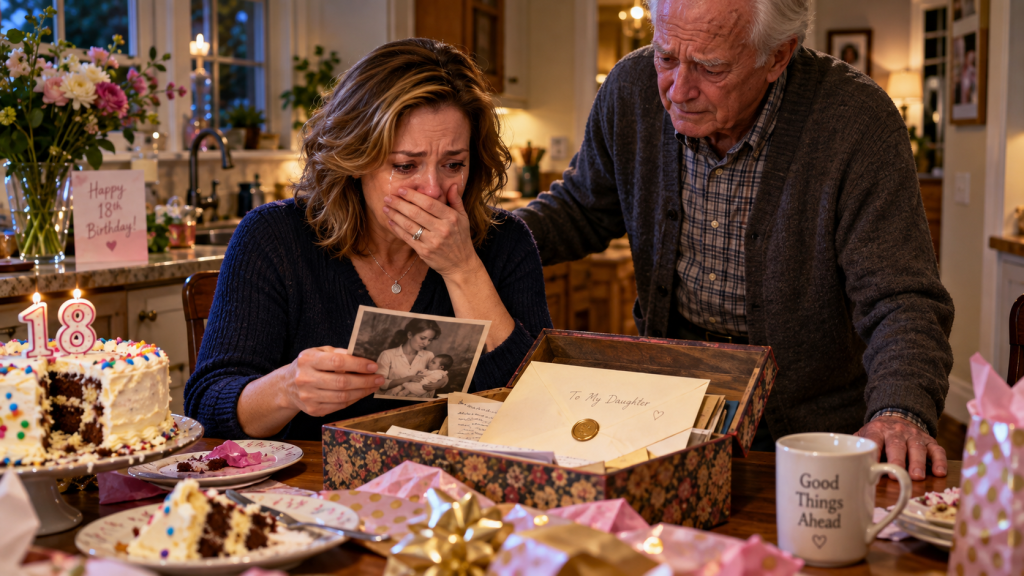
I picked up the photograph again.
Carl stood beside a girl near a lake.
She had Lily’s face.
My face.
Emily’s face.
Age twelve, according to the handwriting on the back.
Her hair was longer than Lily’s had been at twelve.
There was a small scar near her chin I didn’t remember.
She wore a blue sweatshirt and held a fishing pole.
She was smiling.
Alive.
I pressed the photograph against the table because my hands would not stop shaking.
“Say it again.”
Dad swallowed.
“Honey—”
“Say it again.”
“Emily is alive.”
“No.”
I stood so fast the chair scraped backward.
“No, you don’t get to say it softly.”
Dad looked down.
“She is alive.”
“Where?”
He hesitated.
“Where is my daughter?”
“She’s on her way here.”
“With Carl?”
Dad nodded.
I laughed.
A horrible, broken sound.
“Of course.”
Then I looked at the box.
The sealed envelope.
Carl’s handwriting.
My name.
Thirteen years.
I picked it up.
Dad reached toward me.
“Maybe sit—”
“Don’t touch me.”
His hand stopped.
I had never said those words to my father.
Not even as a teenager.
His face changed.
I did not care.
Not then.
I tore open Carl’s envelope.
Inside were eleven pages.
Eleven.
My husband had needed eleven pages to explain why he had let me bury a living child.
The first sentence blurred because I was crying too hard to read it.
I wiped my eyes.
Started again.
Sarah, if you are reading this, Lily is eighteen. Emily should be eighteen too. I have imagined this day for thirteen years, and there has never been a version of it in which I was not ashamed.
I stopped.
So did my heart, almost.
Dad whispered:
“Keep reading.”
I looked at him.
“Do not tell me what to do.”
He nodded.
I continued.
I need you to know one thing before anything else: you did not cause what happened to Emily.
My throat closed.
Why would he write that?
I kept reading.
She was not sick because of anything genetic, anything you fed her, or anything you failed to notice. Someone had been making her sick deliberately.
The words became harder to see.
I sat down.
My knees were no longer trustworthy.
Carl’s letter continued.
The toxicology work after she was admitted found a prescription medication in her system that had never been prescribed to her. The doctors initially thought it might have been an accidental exposure. Then they found earlier bloodwork that suggested it had happened before.
I covered my mouth.
Earlier bloodwork.
Emily had been sick for months before that final ambulance ride.
Little things.
Vomiting.
Weakness.
Sudden dizziness.
She would recover.
Then get sick again.
Our pediatrician thought virus.
Then food sensitivity.
Then maybe something metabolic.
I had changed cereal.
Soap.
Vitamins.
I scrubbed the kitchen.
Threw away leftovers too quickly.
I had blamed myself for every fever.
Every stomachache.
Every night she cried.
Carl’s letter:
The hospital contacted law enforcement because they believed it could be medical abuse.
I looked up.
“Who?”
Dad closed his eyes.
I looked back down before he answered.
I wanted Carl to tell me first.
Maybe because I already hated him enough.
The person they became most concerned about was Rebecca.
The letter fell from my hands.
My sister.
My older sister.
Rebecca.
I had not spoken her name in years.
Not because we fought.
Because she disappeared from my life four months after Emily’s funeral.
She told Dad she needed to “start over.”
Moved away.
Stopped calling.
For years, I had resented her for abandoning us.
I had thought grief frightened her.
Rebecca had been there for everything before Emily died.
Birthday parties.
Preschool pickup.
Sleepovers.
She was the aunt who always had stickers in her purse.
The person I trusted when I needed someone to watch the twins for an hour.
She had lost her own baby late in pregnancy three years before my girls were born.
After that, she poured herself into them.
At least that was what I believed.
“No.”
I looked at Dad.
“No.”
Tears rolled down his face.
“Sarah.”
“No.”
I grabbed the letter again.
Rebecca had access to the medication through her job. Investigators found that several of Emily’s worst episodes happened after Rebecca had been alone with the girls. They also found a message she had sent to a friend saying Emily was ‘the fragile one’ and that I didn’t understand how much she needed Rebecca.
My stomach turned.
Rebecca had worked at a rehabilitation center.
She handled medications.
Not as a doctor.
Not even as a nurse.
But enough access.
I kept reading.
They did not know whether Rebecca had also given anything to Lily. That was why everything changed so quickly.
I stopped.
Lily.
I looked toward the ceiling.
My surviving daughter was asleep upstairs.
Or I thought she was.
For the first time in thirteen years, the word surviving felt wrong.
Because Emily had survived too.
I returned to the letter.
The morning after you were told Emily had died, she was not dead. She had been stabilized and transferred under another identity.
My hands started shaking harder.
“Another identity?”
Dad whispered:
“Yes.”
I looked at him.
“How?”
“It was an emergency.”
“That is not an answer.”
“No.”
He wiped his face.
“It’s not.”
I read faster.
I know what you were told at the hospital. I know because I agreed to it. There was an emergency protective plan. The people handling it believed Rebecca might have help, and they did not know how she was getting information from the hospital. Someone had already called the floor pretending to be you and asking when Emily would be discharged.
I froze.
Pretending to be me.
A faint memory surfaced.
A nurse telling me someone had called.
I had been too shattered to understand.
They were afraid that if Rebecca believed Emily lived, she would try to reach her again. They were also afraid she might turn toward Lily.
I could barely breathe.
The first plan was supposed to last days. Then Rebecca disappeared before police could question her again. Her car was found in another state. She had withdrawn cash. The investigators believed she had learned enough to know she was being watched.
I looked at Dad.
“Rebecca ran?”
“Yes.”
“You knew?”
“Yes.”
“You let me think she just moved?”
Dad covered his face.
“Yes.”
I hated him in that moment.
I really did.
Not forever.
But completely.
Carl’s letter continued.
I made the decision I will answer for until I die. I agreed that one child would remain publicly believed dead while I disappeared with her. Lily stayed with you because nobody had reason to believe Rebecca knew where you would go after the funeral, and your father agreed to remain close and watch for anything unusual.
I looked at Dad.
He cried harder.
“You were watching us.”
“Yes.”
“For thirteen years?”
“At first for danger.”
His voice cracked.
“Later because you were my daughter.”
I laughed bitterly.
“Do not make that sound noble.”
“I’m not.”
Good.
At least that.
I kept reading.
Sarah, I know you will ask why I didn’t take both girls. I asked. The people handling the case believed moving both children at once would be harder to hide and might make Rebecca realize the death story was false. Lily also had no medical evidence of exposure. Emily was the known target.
It sounded insane.
Because it was.
I did not care how many official seals were in the box.
I did not care how frightened they had been.
My family had been divided like luggage.
One girl with Carl.
One with me.
And I had not been allowed to know the first girl was breathing.
I also know you will ask why you were excluded. The answer is uglier. Investigators could not determine whether Rebecca was getting information through someone close to you. She knew things about appointments that you had only told family. Until that leak was understood, they restricted information brutally.
Brutally.
At least he chose the right word.
Your father was told only because he had to remain near Lily and because he was already assisting investigators regarding Rebecca.
I looked at Dad.
“Assisting how?”
He whispered:
“They searched her apartment.”
I waited.
“I gave consent to boxes she had stored at my place.”
“What did they find?”
Dad closed his eyes.
“A folder.”
My stomach dropped.
“What folder?”
“Pictures.”
I could not breathe.
“Of the girls?”
“Yes.”
“Medical notes.”
“What kind?”
“Temperatures.”
“Symptoms.”
“Things she had written down.”
I looked at the letter.
Carl had written it too.
At your father’s house, investigators found a storage box Rebecca had left months earlier. Inside were copies of medical papers, photographs of both girls asleep, and handwritten notes tracking Emily’s symptoms.
I stopped reading.
My daughter.
My sister.
Notes.
Pictures.
The kitchen seemed too small for the truth.
“Why wasn’t she arrested?”
I asked.
Dad answered:
“She was gone.”
“For thirteen years?”
“No.”
There.
Another secret.
“When did they find her?”
“Seven years later.”
I stared.
“So six years ago.”
“Yes.”
I stood again.
The chair fell this time.
“You could have told me six years ago.”
Dad looked sick.
“Yes.”
“Why didn’t you?”
He did not answer.
I pointed at him.
“Do not make me read another eleven pages to find out what you did.”
He whispered:
“Emily asked us not to.”
The words stopped me.
“What?”
Dad cried.
“When Rebecca was arrested, Emily was twelve.”
The girl in the photograph.
Twelve.
Lake.
Fishing pole.
Alive.
“She knew by then that you thought she was dead.”
My chest hurt so badly I pressed my hand against it.
“She knew?”
“Yes.”
“How long had she known?”
Dad’s voice was barely audible.
“Since she was nine.”
I sat down again.
Not because I wanted to.
Because my legs gave up.
“She knew I thought she was dead.”
“Yes.”
“And she didn’t want me told?”
Dad shook his head quickly.
“Not like that.”
“Then explain it.”
“She was terrified.”
“Of me?”
“Of everything.”
He moved his hands helplessly.
“She had grown up under another name.”
“Different schools.”
“Different towns.”
“She knew Rebecca had been looking for her.”
“She knew Lily was still here.”
“She was afraid if the truth came out, reporters would find her.”
“People would ask questions.”
“She was afraid Lily would hate her.”
My eyes filled.
“Why would Lily hate her?”
“Because Emily was alive and Lily had mourned her.”
I understood.
And hated that I understood.
Dad continued.
“Carl asked if she wanted contact.”
“She said she wanted to wait until Lily was old enough to choose for herself.”
“Eighteen.”
I whispered.
Dad nodded.
“That was the promise.”
I stared at him.
“So you chose her fear over mine.”
His face crumpled.
“Yes.”
There was no excuse.
He knew it.
I looked at Carl’s letter again.
The next paragraph said the same thing.
When Rebecca was finally arrested, I believed the secret could end. Emily did not. By then, she understood enough to know what her return would do. I told her you would want her immediately. She asked me whether Lily would. I did not know how to answer.
I cried.
Quietly now.
The anger had become too big for noise.
Emily asked me to wait until Lily was eighteen. Your father agreed. I agreed. I am not asking you to believe that was the right decision. I am telling you it was hers, and after years of adults making decisions around her survival, I did not have the heart to take that one from her too.
That sentence hurt differently.
Because it made sense.
Not enough.
But some.
I left you because I could not stay and hide Emily at the same time. I also believed Rebecca was watching you. If I remained, I might lead her toward Emily or make her suspect the truth.
Then:
I let you think I abandoned Lily. I let Lily think I abandoned her. That is mine to answer for.
Good.
He would.
I did not stop loving either of you.
I almost tore the letter in half.
Love.
People love using love as if it pays retroactive rent on cruelty.
I kept reading.
I wrote Lily letters every birthday and never sent them. They are in the box. I wrote you letters too. Those are there as well.
I looked inside.
Bundles.
Thirteen envelopes.
One for each year.
Dates.
My name.
Lily’s name.
I touched none of them.
Not yet.
Emily wrote letters too once she was old enough. She chose not to send them.
Another bundle.
Purple ribbon.
My hands began shaking again.
Tonight, if she does not lose her nerve, she will walk through your door. She does not expect you to forgive me. Neither do I. She only hopes you will look at her before you decide what the last thirteen years mean.
The final line:
I am sorry I saved one daughter in a way that made you believe you had lost her.
Carl.
I put the letter down.
Dad sat silently.
I looked at the clock.
10:41 p.m.
“How long?”
I asked.
He frowned.
“Until they get here.”
“Yes.”
“Maybe twenty minutes.”
I laughed.
Twenty minutes.
Thirteen years collapsed into twenty minutes.
“Lily is upstairs.”
“I know.”
“Does she know?”
“No.”
I stared at him.
“Good.”
He flinched.
It was cruel.
I meant it.
Then I said:
“Why tonight?”
“Because Emily wanted Lily’s birthday to belong to Lily first.”
My throat tightened.
Of course she did.
A girl I had not seen since kindergarten had thought about not ruining her sister’s birthday.
“She waited until after the party?”
“Yes.”
“What if she changes her mind?”
“She might.”
“Then what?”
Dad looked at the door.
“I don’t know.”
At 10:47, the stairs creaked.
Lily appeared in the hallway wearing pajama pants and one of my old college sweatshirts.
Her hair was messy.
She looked exactly like the photograph and nothing like it.
“What’s going on?”
Neither Dad nor I spoke.
She looked at the box.
Then the photograph.
Then my face.
“Mom?”
I wiped my eyes.
“Come sit down.”
Her expression changed immediately.
“Is Grandpa sick?”
“No.”
“Are you sick?”
“No.”
“Then what?”
Dad stood.
“I should go.”
I turned on him.
“No.”
He froze.
“You stayed thirteen years.”
My voice shook.
“You can stay another twenty minutes.”
He sat.
Lily looked between us.
“Somebody tell me what’s happening.”
I picked up the photograph.
My hand trembled.
Then I held it toward her.
She took it.
For three seconds, she did not understand.
Then her face went completely still.
“Who is that?”
I could not speak.
Lily looked at Dad.
“Who?”
Dad whispered:
“Emily.”
Lily laughed.
One short sound.
“No.”
I watched the exact moment disbelief became fear.
“No.”
She pushed the photograph away.
“No, that’s not funny.”
“It isn’t.”
“Mom.”
I reached for her.
She moved back.
“What is this?”
“Lily.”
“My sister is dead.”
I started crying.
“No.”
Her whole body stiffened.
“What?”
I said it.
The sentence my father had given me less than an hour earlier.
“Emily is alive.”
Lily stared at me.
Then at Dad.
Then back.
“No.”
“She is.”
“No.”
“Honey—”
“No!”
She stood.
The chair slid backward.
“You told me she died.”
“I thought she did.”
“You took me to her grave.”
“I know.”
“You made me put flowers there.”
“I know.”
“You let me talk to her.”
I could barely breathe.
“I know.”
Her face collapsed.
“Where is she?”
“Coming here.”
Silence.
“What?”
“Tonight.”
Lily backed away.
“No.”
I stopped.
Not because I agreed.
Because she needed control too.
“I don’t want her here.”
Dad closed his eyes.
I said:
“Okay.”
He looked at me.
So did Lily.
“Okay?”
“If you don’t want to see her tonight, you do not have to.”
“But she’s coming.”
“We can ask her to stay somewhere else.”
Lily stared at the photograph.
Then whispered:
“Does she know about me?”
That broke my heart.
“Yes.”
“How long?”
“Since she was little.”
“How little?”
I hesitated.
“About nine.”
Lily laughed bitterly.
“So she knew.”
“Yes.”
“And she never called.”
“She was scared.”
“Of what?”
I opened my mouth.
Then closed it.
Not my explanation to invent.
“I think she should tell you herself if you want to hear it.”
Lily cried.
“What if I don’t?”
“Then you don’t.”
Dad whispered:
“Lily—”
She turned on him.
“You knew?”
He looked destroyed.
“Yes.”
“How long?”
“Since the beginning.”
Her face changed.
I recognized my own anger in it.
“You took me for ice cream after school.”
Dad started crying.
“Yes.”
“You came to my dance recitals.”
“Yes.”
“You helped me make that stupid volcano in sixth grade.”
“Yes.”
“And the whole time you knew she was alive?”
His chin shook.
“Yes.”
Lily stepped backward as if he had struck her.
“Get out.”
Dad closed his eyes.
“Lily.”
“Get out!”
I stood.
“Dad.”
He looked at me.
“Go sit in your car.”
“Sarah.”
“Please.”
He nodded.
At the door, he turned.
“I’m sorry.”
Lily screamed:
“Stop saying that!”
He left.
The door closed.
My daughter sank onto the kitchen floor.
I sat beside her.
Not touching.
Not yet.
She cried into both hands.
“Why?”
“I don’t know every answer.”
“Did Dad take her?”
“Carl did.”
“He’s not Dad.”
I went still.
For thirteen years, Lily had called him Carl.
Never Dad.
At five, after he disappeared, she asked when Daddy was coming home for almost a year.
Then one day, she stopped using the word.
Now:
He’s not Dad.
I understood.
“I know.”
“He left me.”
“Yes.”
“For her.”
The words were dangerous.
“No.”
She stared at me.
“He did.”
“He left with her.”
“Yes.”
“That is different from choosing that she mattered more.”
“How?”
I had no perfect answer.
“I don’t know.”
Good.
Truth.
“Maybe tonight he can explain what he thought.”
“I don’t care what he thought.”
“Okay.”
“I hate him.”
“Okay.”
“I hate Grandpa.”
I swallowed.
“Okay.”
She looked at me.
“Do you hate Emily?”
The question shocked me.
“No.”
“How can you not?”
“Because she was five.”
“She was twelve when they found Aunt Rebecca.”
“Yes.”
“She could have called.”
“Yes.”
“Why didn’t she?”
“I don’t know enough.”
Lily wiped her face angrily.
“I hate her.”
I waited.
Then:
“You’re allowed to feel that.”
She looked surprised.
I continued.
“You are allowed to love her.”
“Hate her.”
“Miss her.”
“Not want to meet her.”
“Want to meet her.”
“All in the same hour if that’s what happens.”
Lily stared at the photograph.
“She looks like me.”
“Yes.”
“No.”
She touched the picture.
“I look like her.”
My heart cracked.
Twins.
Even after thirteen years apart, she was trying to find where one ended and the other began.
Headlights moved across the front window.
Both of us froze.
A car door closed.
Then another.
Lily grabbed my hand.
The first time she had touched me since I told her.
“Is that them?”
“I think so.”
“I don’t want to.”
“We don’t have to open the door.”
A knock.
Not the doorbell.
Three soft knocks.
I stopped breathing.
Lily whispered:
“What do I do?”
“Nothing you don’t want.”
Another knock.
Then silence.
No pounding.
No calling.
No demanding entry.
Just waiting.
Lily stood.
I stood with her.
She walked halfway into the living room.
Stopped.
I did not move ahead.
She took another step.
At the front window, a shadow.
Two people.
A man.
A girl.
Woman, technically.
Eighteen.
But in my head, still five.
Lily lifted the curtain a fraction.
Then dropped it.
“Oh my God.”
She covered her mouth.
“What?”
Lily turned toward me.
“She’s me.”
I almost collapsed.
She grabbed my arm.
“Mom.”
I had not realized I was swaying.
“I’m okay.”
“You’re not.”
“Probably not.”
We laughed once through tears.
Then Lily walked to the door.
Her hand hovered over the lock.
She looked at me.
“Can I?”
“Yes.”
She unlocked it.
Opened the door three inches.
Carl stood on the porch.
Older.
So much older.
Gray at the temples.
Lines around his eyes.
For thirteen years, I had sometimes imagined seeing him again.
In every fantasy I slapped him.
Screamed.
Turned away.
Nothing prepared me for how ordinary his face looked.
Then someone stepped from behind him.
Emily.
My daughter.
Alive.
No photograph could have prepared me.
She had Lily’s eyes.
My nose.
Carl’s chin.
Her hair fell to her shoulders.
She wore jeans and a dark green sweater.
She had a scar near her chin.
The one from the lake photograph.
She was holding a small overnight bag.
Her hands shook.
My body knew her before my mind did.
Something inside me broke open.
“Emily.”
Her face crumpled.
“Mom?”
I made a sound I had never made before.
Not a word.
A mother sound.
Grief reversing too fast.
I moved toward her.
Then stopped.
Because she stepped back.
Barely.
But enough.
I saw it.
So I stopped.
My arms remained half-raised.
Thirteen years of wanting to hold my dead child.
And she was afraid of the hug.
That hurt.
It also mattered.
I lowered my arms.
“You don’t have to.”
Emily cried harder.
“I want to.”
She moved first.
Then I held her.
I cannot describe that hug properly.
I wish I could.
Her body was taller than mine.
At five, she had fit against my chest.
Now her chin reached my shoulder.
She smelled like cold air and shampoo.
Her hair touched my cheek.
I felt her breathing.
Alive.
Alive.
Alive.
I kept touching the back of her head as if my hands needed evidence.
“I’m sorry.”
She whispered it first.
That almost destroyed me.
“No.”
I pulled back.
“No, sweetheart.”
She cried.
“I’m sorry.”
“You do not apologize for being alive.”
Her face twisted.
“I knew.”
“I know.”
“I knew you thought—”
“I know.”
“I wanted to call.”
“I know.”
“I was scared.”
“I know.”
I did not know.
But I knew enough not to make her explain in the doorway.
Then Lily moved.
Emily saw her.
Everything stopped.
Twins.
They stared.
No one spoke.
Carl looked down.
I barely noticed him.
Lily touched her own face.
Emily did the same.
The motion was so identical that I almost laughed.
Then Lily’s expression hardened.
“You knew about me.”
Emily nodded.
“Yes.”
“You had pictures?”
“Yes.”
“I had a grave.”
Emily started crying again.
“I know.”
“I talked to you there.”
“I know.”
“How?”
“Grandpa told us.”
Lily recoiled.
Of course.
Another betrayal.
Emily whispered:
“I wrote you letters.”
“That’s not calling.”
“No.”
“You had thirteen birthdays.”
“Yes.”
“You knew where I was.”
“Not exactly.”
“Enough.”
Emily nodded.
“Yes.”
Lily looked at Carl.
“You.”
He lifted his eyes.
“Hi, Lily.”
She slapped him.
I did not stop her.
One slap.
Open hand.
His face turned.
Then silence.
Carl did not touch his cheek.
Did not raise his voice.
He looked at her.
“You deserved better than that.”
Lily burst into tears.
“That’s all you have?”
“No.”
His voice broke.
“I have thirteen years.”
“None of them good enough.”
“No.”
That answer mattered.
He did not argue.
Lily walked upstairs.
Fast.
Emily flinched.
“I shouldn’t have come.”
I turned.
“No.”
“She hates me.”
“She is eighteen and just learned her dead twin is alive.”
Emily stared at the staircase.
“Give her the right to be impossible tonight.”
A small, broken smile appeared.
“That sounds like Grandpa.”
I almost snapped.
Then stopped.
Of course she knew my father differently.
He had been part of her life too.
That pain would take time.
I looked at Carl.
“Not one word.”
He nodded.
“I know.”
“No.”
My voice sharpened.
“You don’t.”
I pointed toward the kitchen.
“You stand there.”
Then I took Emily upstairs.
Lily’s door was closed.
Emily stood in the hallway.
“This was our room?”
I looked at her.
She remembered.
“Before.”
Her face changed.
“We had stars on the ceiling.”
“Yes.”
“Glow ones.”
“Yes.”
“You used to turn off the light and count them.”
I cried.
She remembered.
Five-year-old memory.
Fragments.
Still ours.
Lily’s door opened.
She had heard.
Her face was wet.
Emily looked at her.
“I remember your yellow blanket.”
Lily froze.
“What?”
“You hated the blue one.”
Lily’s lower lip trembled.
“You used to steal mine.”
Emily almost smiled.
“You kicked.”
“I did not.”
“You did.”
For one second, they were not eighteen.
Something old passed between them.
Then Lily remembered.
Her face hardened again.
“You can come in.”
Emily looked at me.
I stepped back.
Their room.
Their conversation.
Not mine.
The door closed.
I stood in the hallway listening to nothing.
Downstairs, Carl waited.
I went to him.
Every fantasy I had ever had about this moment disappeared.
I did not slap him.
Lily had handled that department.
I said:
“Kitchen.”
We sat.
Same table.
The box between us.
He looked at me.
“Sarah.”
“Don’t.”
He nodded.
“How did she survive?”
He swallowed.
Then told me.
The hospital stabilized Emily after hours of treatment.
She had been critically ill, but the medication exposure was reversible once identified.
Doctors kept information tightly controlled after the suspicious toxicology finding.
The original plan had not been a thirteen-year disappearance.
Days.
Maybe weeks.
Then Rebecca vanished.
Threats were found in her apartment.
Not theatrical death threats.
Worse in some ways.
Notes.
Obsessive language.
She wrote about Emily as if Emily belonged to her.
Sarah doesn’t know what she needs.
I’m the only one who can calm her.
If they keep me away, she’ll get sick again.
My skin crawled.
Carl continued.
“I panicked.”
“You destroyed my life.”
“Yes.”
“No defense?”
“No.”
That made me angrier.
“Fight me.”
He looked exhausted.
“For what?”
“Tell me you had no choice.”
“I had choices.”
“Good.”
“I made the one I thought kept her alive.”
“And Lily?”
His face broke.
“I left her with you.”
“You left her without a father.”
“Yes.”
“You left me after our child’s funeral.”
“Yes.”
“You let me think you abandoned us because you couldn’t handle grief.”
“Yes.”
I laughed bitterly.
“Do you know what people said?”
“No.”
“That men leave when things get hard.”
He closed his eyes.
“That you blamed me.”
His eyes opened.
“Never.”
“I blamed myself.”
His face collapsed.
“No.”
“I wondered if I missed symptoms.”
“I changed doctors.”
“I changed food.”
“I thought maybe I waited too long to call the ambulance.”
“Sarah.”
“No.”
I leaned toward him.
“You do not get to interrupt this.”
He shut his mouth.
“I spent thirteen years wondering whether my daughter died because I failed her.”
Tears rolled down his face.
“That was never true.”
“Then I should have known.”
“Yes.”
“One sentence.”
“Yes.”
“You could have sent one anonymous letter.”
“Yes.”
“Anything.”
“Yes.”
“Why didn’t you?”
His answer took too long.
“Because I was afraid.”
I stared.
“Of Rebecca?”
“At first.”
“And later?”
He looked toward the ceiling.
“Of what telling you would do to Emily.”
I hated him for that.
Because again, I understood the logic without accepting the choice.
“When she was seven, we moved twice in one year.”
“When she was eight, someone sent a letter to her school asking for records under your name.”
My blood froze.
“Rebecca?”
“We never proved it.”
“When she was nine, I told Emily enough to explain why we kept moving.”
“By ten, she knew you and Lily believed she had died.”
He wiped his face.
“She had nightmares that if she contacted you, Rebecca would find Lily.”
I closed my eyes.
“She thought silence protected her sister.”
“Yes.”
“And you let her carry that.”
His face tightened.
“Yes.”
There.
His failure was not only to me.
He had made a child believe family safety depended on her disappearance.
“When Rebecca was arrested, why didn’t you call?”
“I wanted to.”
“Emily begged me not to.”
“She was twelve.”
“Yes.”
“You were the parent.”
“I know.”
“You were supposed to know when her fear should not make the decision.”
He stared at me.
“I know.”
That was the sentence that finally made him look smaller.
Not evil.
Not heroic.
A father who saved a child from one danger and then let fear become the architecture of her life.
“What happened to Rebecca?”
I asked.
“She was arrested after another child became ill.”
My stomach dropped.
“Another child?”
“A boy she was caring for.”
“Did she—”
“He survived.”
I exhaled.
“Investigators connected patterns.”
“She eventually pleaded guilty to multiple charges related to both cases.”
“Where is she?”
“Prison.”
“For how long?”
“Still there.”
I looked at him.
“And Emily knows?”
“Yes.”
“Lily?”
“No.”
“Dad?”
“Yes.”
Of course.
Everybody except me and Lily.
I laughed until I cried again.
“Who else?”
“Very few people.”
“Names.”
He told me.
A prosecutor.
Two investigators.
A lawyer.
A social worker.
Dad.
Carl.
Emily.
No secret community.
No giant conspiracy.
A small group of people who had decided secrecy equaled safety and then let the promise outlive the emergency.
I looked at the bundles of letters.
“Why write them?”
“So I didn’t forget what I owed you.”
“That’s not how debt works.”
“No.”
“Did you remarry?”
“No.”
“Relationships?”
“Not seriously.”
“Why?”
He looked at me.
“That’s not something I expect you to care about.”
Correct.
“Do you still love me?”
The question escaped before I could stop it.
Carl looked stunned.
Then devastated.
“Yes.”
I stood.
“Goodnight.”
He blinked.
“Sarah.”
“You’re not staying here.”
“Of course.”
“Where?”
“Hotel.”
“Emily?”
“She can stay if she wants.”
He nodded.
Then:
“Thank you.”
I looked at him.
“Do not thank me for letting my daughter sleep in my house.”
He flinched.
Good.
At midnight, Lily’s bedroom door opened.
Both girls came downstairs.
Their eyes were swollen.
Neither looked healed.
Good.
I would have distrusted anything that fast.
Emily stood beside Carl.
“I’m staying here.”
He nodded.
“I figured.”
Her voice shook.
“Are you okay?”
Carl almost smiled.
“No.”
“Me neither.”
They hugged.
That hurt Lily.
I saw it.
So did Carl.
He released Emily and turned toward Lily.
“I don’t expect anything from you.”
Lily said:
“Good.”
Then he left.
Dad was still in his car.
I had forgotten.
Carl stopped beside it.
They spoke for a minute.
Then Dad drove away too.
I did not invite him back inside.
Not yet.
That first night with both daughters under my roof should have felt miraculous.
It did not.
It felt impossible.
Emily slept in the guest room.
Lily stayed in her own.
At 2:17 a.m., I heard footsteps.
I opened my bedroom door.
Emily stood in the hallway.
“Sorry.”
“Don’t be.”
“I couldn’t sleep.”
“Me either.”
She looked at me.
Then:
“Can I ask you something?”
“Anything.”
“What did you do with my stuff?”
My throat tightened.
“Some of it’s in boxes.”
Her eyes filled.
“You kept it?”
“Not everything.”
“I couldn’t.”
“I kept your stuffed elephant.”
She covered her mouth.
“Ellie?”
I started crying.
“You remember?”
“Of course.”
I went to the closet.
High shelf.
A box I had moved through three homes.
I opened it.
Pink sweater.
Preschool art.
Tiny shoes.
Then Ellie.
Gray stuffed elephant.
One ear flatter than the other.
Emily took it.
Pressed it to her face.
And suddenly she was five.
Not physically.
Emotionally.
She sobbed.
I held her.
This time she did not step back.
“I missed you.”
she cried.
“Oh, baby.”
“I missed you.”
“I missed you every day.”
“I wanted to call.”
“I know.”
“Dad said I could when Rebecca got arrested.”
I froze.
“What?”
Emily pulled back.
“He said I could.”
There.
New truth.
“He left it to me.”
My anger shifted again.
“He told me you asked to wait.”
“I did.”
She wiped her face.
“But he didn’t make me.”
That mattered.
Maybe Carl had not hidden behind her fear as much as I thought.
Emily continued.
“I thought Lily would hate me.”
“She doesn’t know what she feels.”
“I don’t either.”
She sat on the floor with Ellie in her lap.
I sat beside her.
“What was your name?”
I asked.
She smiled faintly.
“Emma Carver.”
Emma.
Close enough to answer accidentally.
Far enough to hide.
“Did you like it?”
“No.”
“What did you want?”
“Emily.”
Of course.
“When did you start using it again?”
“Two years ago.”
“Legally?”
“Yes.”
“Dad helped.”
I nodded.
“What was your life like?”
Her face changed.
That was not a small question.
So she answered slowly.
Different towns.
Different schools.
Sometimes good.
Sometimes lonely.
Carl worked remote jobs when he could.
He homeschooled her for one year during the most dangerous period.
She had friends she could not tell everything.
Birthday cakes.
Fishing.
Soccer for two seasons.
Piano badly.
A dog named Pepper.
I smiled.
“Dog?”
“She’s with Dad.”
“What kind?”
“Mut.”
“Good.”
Emily smiled.
Then:
“I saw you once.”
My body went cold.
“What?”
“When I was fourteen.”
“Where?”
“Online.”
Of course.
Social media.
“Grandpa showed me your profile.”
I closed my eyes.
Dad.
Again.
“There was a picture of you and Lily at the beach.”
“What did you do?”
“Printed it.”
My heart broke.
“I kept it in my desk.”
We sat in silence.
Then she whispered:
“Do you hate me?”
“No.”
Immediate.
“You should.”
“No.”
“I let you think—”
“No.”
I took her face in my hands.
“You were a child inside a decision adults made.”
“You do not carry my thirteen years.”
Her eyes closed.
“You do not pay for them.”
“You do not fix them.”
“You do not apologize for surviving.”
She cried.
“So what do I do?”
“Live.”
The answer surprised me.
Then I realized it was right.
“Just live.”
The next morning was terrible.
Beautiful.
Terrible.
Lily walked into the kitchen and found Emily eating cereal.
The exact same cereal Lily hated.
She stopped.
“You like that?”
Emily looked down.
“Yes.”
“That stuff tastes like cardboard.”
Emily shrugged.
“I like cardboard.”
Lily laughed.
One second.
Then stopped herself.
Guilt.
I hated seeing it.
“You’re allowed to laugh.”
I said.
Both turned toward me.
“This house can hold more than one feeling.”
Lily rolled her eyes.
“Therapy language.”
“I haven’t even started therapy yet.”
“Please do.”
Emily laughed.
That one lasted longer.
Breakfast became the first ordinary thing.
Then came the hard questions.
Which side of the bed did Emily sleep on at five?
Did she remember preschool?
Did she remember Lily biting her arm?
Lily denied it.
Emily insisted.
I found the old photo.
Bite mark visible.
Evidence.
Then:
Did Emily remember the hospital?
Some.
Lights.
Vomiting.
Carl crying.
A nurse with purple glasses.
Then nothing.
Did she remember the funeral?
No.
Of course not.
Did she know there was a grave?
Yes.
Had she ever seen it?
No.
Lily asked:
“Do you want to?”
Emily said:
“I don’t know.”
Good.
No rushing.
Dad called at eleven.
I did not answer.
Carl texted once:
I’m at the Hampton Inn. Emily has my number. I will not come over unless invited.
Good.
One boundary respected.
At noon, Lily asked:
“Can I talk to Grandpa?”
I stared.
“You want to?”
“No.”
Then:
“Yes.”
Both.
I called Dad.
He came over.
He looked twenty years older than the night before.
Lily stood in the living room.
Emily stayed nearby.
Not between them.
Beside.
Dad said:
“I’m sorry.”
Lily held up a hand.
“Don’t.”
He stopped.
“I need answers.”
“Okay.”
“How many times did you see Emily?”
Dad looked at her.
“Usually once a year.”
My chest tightened.
I had not known that detail.
Lily flinched.
“Once a year.”
“Yes.”
“Where?”
“Different places.”
“Did you spend my birthday with her?”
His face changed.
“No.”
“Did you ever choose her birthday over mine?”
“No.”
“Did you ever bring her presents?”
“Yes.”
Lily cried.
“Did you bring me presents?”
“Yes.”
“That’s not better.”
“I know.”
She paced.
“Did you tell her about me?”
“Yes.”
“Everything?”
“Not everything.”
“What?”
“School.”
“Dance.”
“When you broke your wrist.”
“You told her?”
“Yes.”
Lily looked at Emily.
Emily nodded.
“I sent you a card.”
Lily’s face changed.
“What?”
“I didn’t send it.”
Of course.
A whole family built from unsent mail.
Dad continued.
“I was wrong.”
Lily turned back.
“Which part?”
“All of it?”
He swallowed.
“No.”
That answer surprised everyone.
“I do not think keeping Emily hidden while Rebecca was missing was wrong.”
He looked at me.
“I think it may have saved her life.”
I hated hearing it.
But I listened.
“I think letting Sarah believe Emily was dead was wrong.”
His voice broke.
“I think letting Lily believe Carl abandoned her without explanation was wrong.”
“I think continuing the secret after Rebecca was captured was wrong, even if Emily asked for time.”
Emily looked down.
Dad turned toward her.
“You were twelve.”
“I made you carry a decision that belonged to adults.”
Her eyes filled.
“I’m sorry.”
That apology had shape.
Lily asked:
“Why did you promise?”
Dad looked at me.
Then back.
“Because Carl told me one child needed someone close to your mother.”
“To watch.”
“To help.”
“To make sure nobody suspicious came near.”
“And because I was terrified of losing another grandchild.”
His voice shook.
“Fear can make a bad decision feel holy.”
That sentence stayed with all of us.
Fear can make a bad decision feel holy.
He had told himself secrecy was protection.
Carl too.
Maybe some of it was.
Then it became habit.
Then promise.
Then prison.
Dad continued:
“Every year, I almost told.”
I laughed bitterly.
“Almost is useless.”
“I know.”
“Did you ever write it down?”
“Yes.”
“Where?”
He looked at the box.
“There’s a letter.”
Of course.
We were drowning in letters.
Lily said:
“I don’t forgive you.”
Dad nodded.
“I understand.”
“I might later.”
His face crumpled.
“I understand.”
“Stop saying that.”
He almost laughed through tears.
“Okay.”
She walked away.
Not hug.
Not reconciliation.
Enough.
The next weeks were chaos.
Emily stayed.
Carl rented an apartment nearby.
Not because I asked.
Because Emily wanted both possibilities.
She was eighteen.
She could choose.
That became important.
Everyone kept trying to turn reunion into custody.
There was no custody.
Two adults.
Lily.
Emily.
They made choices.
Emily enrolled temporarily at a local community college after transferring credits.
She had been planning to attend school near Carl.
Then changed her mind.
Then changed it back.
Then changed again.
I learned not to interpret every decision as proof she loved me or did not.
Hard.
At first, if she slept at Carl’s apartment, I felt abandoned.
Then ashamed for feeling abandoned.
Therapy helped.
My therapist, Dr. Marina Cole, asked:
“Do you want Emily to return to you or belong to herself?”
I hated her immediately.
Then paid her for five years.
Emily belonged to herself.
So did Lily.
The twins had the hardest relationship of all.
At first, they were fascinated.
Same laugh.
Same allergy to cheap earrings.
Different music.
Lily loved old rock.
Emily loved country.
Tragic.
They both hated bananas.
Both slept with one foot outside the blanket.
Both rubbed the side of their thumb when anxious.
They hated noticing similarities as much as they loved them.
One night I heard shouting upstairs.
Lily:
“You don’t get to act like we’re twins because we look alike!”
Emily:
“I didn’t ask for this!”
Lily:
“You got Dad!”
Silence.
Then Emily screamed:
“You got Mom!”
That stopped everything.
I stood outside the door.
Did not enter.
Their pain did not need a referee yet.
Lily shouted:
“I got a grave!”
Emily shouted back:
“I got a fake name!”
Silence.
Then crying.
Both.
I walked away.
An hour later, they came downstairs together.
Eyes swollen.
Lily said:
“We need ice cream.”
I grabbed my keys.
Progress.
They went to therapy together eventually.
Not because twins require therapy to love.
Because ours needed help separating reunion from obligation.
Dr. Shah—different doctor than any from the past, just a therapist—gave them one rule I loved:
“You do not owe each other instant intimacy because you shared a womb.”
That freed them.
They stopped trying to become inseparable.
They became sisters.
Sometimes together.
Sometimes not.
That was healthier.
Carl and I had our own war.
Quiet.
Adult.
Painful.
He wanted forgiveness.
Not aggressively.
Worse.
Patiently.
He never asked outright.
He simply showed up when invited.
Answered questions.
Brought documents.
Never defended the worst choices.
It made hating him difficult.
I resented that.
One evening six months after Emily returned, we sat on my porch.
He looked older than forty-eight.
“I should have told you when Rebecca was arrested.”
“Yes.”
“I know.”
“You keep saying that.”
“What else should I say?”
“Why didn’t you?”
He looked at the yard.
“Because by then I had built my entire identity around keeping Emily hidden.”
There.
Honest.
“I did not know how to become your husband again.”
“You could have started with ‘your daughter is alive.’”
“Yes.”
He cried.
“I was ashamed.”
I stared.
“So you let me keep grieving because you were ashamed?”
“Yes.”
Good.
Not good morally.
Good truth.
He continued.
“I was afraid you’d take Emily away from me.”
That made me furious.
“She was mine too.”
“I know.”
“No.”
I stood.
“You do not get to say ‘I know’ to that.”
He stood too.
“I was the one who sat beside her through nightmares.”
“I was the one who moved.”
“Changed names.”
“Checked cars behind us.”
“And I let that turn into ownership.”
He looked sick.
“I was wrong.”
There.
Deeper.
He had started as protector.
Ended as gatekeeper.
Just like Dad.
That was the pattern.
Fear gave them authority.
Then authority became hard to surrender.
I sat again.
“Did you ever plan to come back?”
“Yes.”
“When?”
“Every year.”
“Useful.”
“No.”
He stared at his hands.
“When Emily was ten, I drove within twenty miles of here.”
My heart stopped.
“What?”
“I couldn’t do it.”
“You were twenty miles away.”
“Yes.”
“With her?”
“No.”
“Why?”
“I wanted to see you.”
“Did you?”
“No.”
I laughed.
The amount of almost in my family could have filled a second life.
“I do not know if I can ever forgive you.”
Carl nodded.
“I know.”
I looked at him.
Then, unexpectedly, we both laughed.
Because he had said it again.
That was the first time something between us softened.
Not romance.
Humanity.
Rebecca’s case became another layer.
I asked to see the records.
Some were sealed.
Some I could access as Emily’s mother and later through Emily’s permission.
I read enough.
Too much.
Her notes were chilling.
Not because they were bloody.
They were loving.
That was worse.
Emily looked pale today. Sarah didn’t notice.
She needs someone attentive.
Lily is stronger. Emily needs me.
If Sarah would stop interfering, I could keep her stable.
Rebecca had created illness, then interpreted the illness as proof Emily needed her.
A closed circle.
The more harm she caused, the more indispensable she felt.
Clinicians later described the pattern as medical abuse.
I did not need a diagnosis.
I needed distance.
Rebecca wrote me from prison.
Once.
I did not open it.
I gave it to my attorney.
Years later, Emily asked for it.
I told her:
“It’s yours if you want.”
She read it.
Then burned it.
Not ceremonially.
In a metal fire pit behind Carl’s apartment.
Lily was there.
I was not.
Good.
Some endings belonged to them.
Emily visited Rebecca once at twenty-two.
That scared me.
I wanted to forbid it.
Dr. Cole asked:
“How old is Emily?”
“Twenty-two.”
“And whose decision?”
“Hers.”
I hated therapy.
Emily went with a counselor arranged through the facility.
She returned pale.
I did not ask what was said.
She told me anyway.
Rebecca cried.
Said she loved her.
Said she had been sick herself.
Said she thought she was helping.
Emily listened.
Then asked:
“Did you put the medication in my juice?”
Rebecca eventually said yes.
That was what Emily needed.
Not apology.
Fact.
She never visited again.
Years later, she told me:
“I needed one thing in my life not to be a story somebody else told me.”
I understood.
Lily never wanted contact.
Also valid.
Dad’s relationship with us rebuilt slowly.
At first, Lily would not see him alone.
Then she did.
But she changed the rules.
No surprise visits.
No secret gifts.
No “for your own good” decisions.
At nineteen, she told him:
“If you ever keep something that big from me again, you lose me.”
Dad nodded.
“Fair.”
He meant it.
Emily had her own anger toward him.
Strange.
She had loved him during secret visits.
Fishing.
Birthdays.
Photographs.
After reunion, she understood those visits differently.
Every hug from Grandpa had existed inside a lie to us.
She needed space too.
Dad almost lost both granddaughters trying to preserve both.
Fear can do that.
But he changed.
That mattered.
He stopped using age as authority.
Started asking.
“Can I tell you something difficult?”
“Do you want advice?”
“May I visit?”
Basic questions.
Transformative.
Three years after reunion, Dad gave me his copy of the original promise Carl made him sign.
Not legal.
Personal.
One page.
I will not disclose Emily’s location or survival until the designated protection period ends or until disclosure is determined safe.
Then a handwritten addition later:
If Rebecca is apprehended before Lily turns eighteen, we will follow Emily’s wishes regarding contact, provided her therapists believe she understands the consequences.
Signed Carl.
Signed Dad.
I stared at the second sentence.
“How old was she?”
“Twelve.”
“I know.”
“I shouldn’t have signed it.”
“No.”
He nodded.
Then:
“I thought respecting her choice repaired what we had taken from her.”
I looked at him.
“And it took choice from me and Lily.”
“Yes.”
He cried.
“I finally understand that.”
That was when I forgave him.
Not because he asked.
Because he understood the shape of the harm.
Forgiveness did not mean the secret became acceptable.
It meant I stopped needing to punish him with it.
Carl took longer.
Much longer.
He and I did not remarry each other in some dramatic second wedding.
Life is not always that symmetrical.
For two years, we were simply parents of two adult daughters.
Then friends.
Careful friends.
He helped me replace a broken fence.
I helped him choose a doctor after a health scare.
We ate dinner with the girls.
Sometimes separately.
Sometimes together.
One Christmas, he stayed too late because of snow.
Slept on the couch.
Nothing happened.
Good.
Then five years after Emily came home, he asked me to dinner.
Not family dinner.
Dinner.
I stared.
“Are you asking me on a date?”
“Yes.”
“That is insane.”
“Probably.”
I said no.
Six months later, I asked him.
Why?
Because forgiveness had changed shape again.
Not forgetting.
Not erasing.
Curiosity.
Who were we now, after the lie?
We dated.
Slowly.
Lily hated it.
Emily loved it.
Of course.
Twins.
Lily said:
“He destroyed you.”
I answered:
“Yes.”
“Then why?”
“Because the person who hurt me is not automatically frozen at the worst thing he did.”
“That sounds stupid.”
“Maybe.”
“You’re going to marry him again?”
“No.”
At least not then.
Emily said:
“Dad never stopped loving you.”
I replied:
“Love does not automatically qualify someone for access.”
She smiled.
“You say that a lot.”
“Because all of you need reminding.”
Carl and I never remarried.
We chose something quieter.
Separate homes.
Shared dinners.
Travel eventually.
Companionship.
I kept my last name.
He kept his apartment.
People found it strange.
We found it honest.
He had once made an irreversible decision for me.
Our later relationship survived because neither of us demanded ownership.
Lily eventually accepted it.
Not enthusiastically.
At twenty-eight, she said:
“I still think you’re weird.”
I said:
“Thank you.”
Then she hugged Carl before leaving.
He cried in the kitchen after she left.
Did not tell her.
Good.
The grave was harder.
Emily’s grave.
An empty grave.
Technically, there had never been remains.
The funeral arrangement had used a sealed casket under circumstances I still struggle to comprehend.
The marker remained for years after reunion.
EMILY ROSE HALE
Five years old.
Beloved daughter and sister.
Emily did not want it removed immediately.
That surprised me.
“Why?”
she said:
“Because someone died.”
I stared.
“What?”
“The life I was supposed to have.”
At eighteen, she had language for grief that frightened me.
She continued.
“And the version of me you buried was real to you.”
So we left it.
For two years.
Then one spring, the twins went together.
Without me.
They placed flowers.
White roses.
Then requested the marker be changed.
Not erased.
Changed.
The new stone read:
EMILY ROSE HALE
Loved here, living elsewhere.
That was all.
No dates.
People at the cemetery probably found it odd.
Good.
Our family had earned odd.
At thirty, Emily married.
Carl walked her halfway down the aisle.
Then stopped.
She walked the rest alone.
Her choice.
Lily stood beside her.
Not as maid of honor because “twin” automatically meant role.
Because Emily asked.
Lily said yes.
At the reception, Dad danced with both girls.
He was eighty-one.
Cried through both songs.
I watched.
Thirteen years had not vanished.
They sat inside everything.
But grief had stopped being the only architecture.
Lily married later.
No twins.
One son.
Emily had two daughters.
The first time both families gathered at my house for Thanksgiving, I stood in the kitchen and watched four children run between rooms.
Noise.
Shoes.
Juice.
Chaos.
Carl beside me.
Dad asleep in a chair.
Lily arguing with Emily about gravy.
I started crying.
Lily saw.
“Oh God, Mom.”
“What?”
“Not today.”
“I’m allowed.”
“You cry at everything.”
Emily laughed.
“She does.”
They sounded alike when they laughed.
Not identical.
Never identical anymore.
That was important.
When they were five, I had often dressed them the same.
Pink dresses.
Matching bows.
After reunion, I never bought them matching anything again.
People used to ask:
“How do you tell them apart?”
Thirteen years answered that brutally.
They were always different.
We simply had not been given enough time to see how much.
Emily became a veterinarian.
Lily became an architect.
Emily loved lakes.
Lily hated boats.
Lily drank coffee black.
Emily ruined coffee with vanilla syrup.
Lily remembered childhood visually.
Emily remembered sounds.
Both remembered the yellow blanket.
Both insisted the other had bitten first.
Some mysteries remain.
Dad died at eighty-seven.
Peacefully.
Both granddaughters were there.
So was I.
Carl stood near the window.
Dad had asked for that.
Two days before he died, he motioned me closer.
His voice was weak.
“Sarah.”
“I’m here.”
“I’m sorry.”
I smiled sadly.
“We did this already.”
“I know.”
He almost laughed.
Then:
“The promise.”
I knew.
“What about it?”
“I thought keeping a promise made me honorable.”
His eyes filled.
“It doesn’t if the promise itself is hurting people.”
I squeezed his hand.
“No.”
“I should’ve broken it.”
“Maybe.”
He looked at me.
“You forgive me?”
“Yes.”
He closed his eyes.
Then:
“Good.”
That was enough.
At his funeral, Lily spoke.
Not Emily.
Emily did not want to.
Again, choice.
Lily stood in front of everyone and said:
“My grandfather once kept a secret that hurt me deeply.”
The room went silent.
I almost panicked.
Then she continued.
“He also spent the rest of his life showing me that people can take responsibility without demanding that you pretend the harm never happened.”
I cried.
Of course.
“He taught me to ride a bike.”
“Build a bookshelf.”
“File taxes.”
“And eventually, how to apologize.”
That was Dad’s legacy.
Not purified.
Whole.
Carl died before me too.
Heart failure at seventy-four.
By then, we had been companions for almost three decades.
Not husband and wife legally.
Something harder to define.
He asked me near the end:
“Do you wish I’d done it differently?”
I laughed through tears.
“Carl.”
“I know.”
“No.”
“You don’t get to ‘I know’ your way out of this one.”
He smiled.
Then I answered.
“Yes.”
“Every day.”
His eyes filled.
“Me too.”
I held his hand.
Then:
“But Emily lived.”
“Yes.”
“Lily lived.”
“Yes.”
“We found each other again.”
“Yes.”
“That does not make your choice right.”
“I know.”
There it was.
We both laughed.
His last coherent sentence to me was:
“I’m glad you opened the door.”
I knew which door.
Eighteen.
Emily on the porch.
I kissed his forehead.
“I’m glad she knocked.”
After he died, the twins went through his apartment together.
They found boxes.
Every birthday letter.
Copies of photos.
Newspaper clippings about our town.
School programs Dad had sent him.
Lily discovered Carl had attended one of her high-school track meets secretly.
That made her furious even decades later.
“He was there?”
Emily laughed.
“You’re surprised?”
“He could have said something.”
“That was sort of the family problem.”
They both laughed.
Then cried.
They kept some letters.
Shredded others.
No ceremony.
Memory does not require archiving every wound.
I am older now.
Older than Dad was when he first helped me raise Lily after the funeral.
That is strange.
Both daughters are grown.
Grandchildren nearly grown too.
People who hear the story always ask the same thing.
“How could you forgive them?”
As if forgiveness were one door.
It was not.
I forgave Dad before I forgave Carl.
I forgave Emily immediately because she had nothing to be forgiven for, though it took her years to believe that.
Lily forgave nobody on my schedule.
Good.
Carl forgave himself last.
Maybe never completely.
I never forgave Rebecca.
Not in any meaningful sense.
I stopped thinking about her.
That was enough.
People also ask:
“Would you have rather known?”
Yes.
Without hesitation.
Even if danger existed.
Even if I could not see Emily.
Even if authorities told me I had to stay away.
I would have rather lived thirteen years knowing my daughter was somewhere breathing than thirteen years visiting an empty grave.
Safety built on a mother’s false grief has a cost.
Everyone involved eventually understood that.
But I also know something uncomfortable.
I was not there in that hospital conference room.
I did not hear the threats.
I did not see investigators panic when Rebecca disappeared.
I did not hold a critically ill five-year-old while wondering whether someone would come finish what they started.
Carl did.
Fear changes the size of choices.
It does not erase responsibility.
It explains why impossible decisions sometimes look necessary from inside them.
That is the truth I can live with.
Not:
Carl was a hero.
Not:
Carl was a monster.
He was a terrified father.
He made one choice that may have helped save Emily.
Then kept making versions of that choice long after fear should have been questioned.
Dad did the same.
That distinction matters to me.
Because love can be sincere and still do damage.
Intentions do not erase consequences.
But consequences do not erase every good intention either.
Human beings are inconvenient that way.
The photograph from the box still sits in my desk.
Emily at twelve.
Carl beside the lake.
On the back:
Emily, age twelve. Safe.
For years, the word safe made me angry.
Safe?
She had a false name.
No mother.
No twin.
Fear of being found.
Was that safety?
Partly.
Maybe.
Now I think safety is more complicated.
Physical safety matters first.
Of course.
Stay alive.
Get away from the poison.
Hide if you must.
But eventually, safety has to become more than absence of danger.
It has to include truth.
Choice.
Belonging.
The right to know who loves you.
The right to say:
I am afraid.
And not have the whole world rebuilt around that fear without your consent.
Emily survived the first kind of danger at five.
It took all of us much longer to build the second kind of safety.
Lily helped.
So did anger.
Anger gets a bad reputation.
Sometimes anger is the part of love that notices a boundary was crossed.
Lily’s anger made everyone stop trying to turn reunion into a happy ending too quickly.
She said:
“No.”
“Not yet.”
“I don’t forgive you.”
“Leave me alone.”
Those sentences protected her.
Emily learned from her.
So did I.
The twins eventually became close.
Not because fate demanded it.
Because they chose each other.
That difference mattered.
They call every Sunday now.
Sometimes together.
Sometimes separately.
When they argue, they call me and try to recruit me.
I refuse.
Mostly.
Grandmothers deserve neutrality.
The first year after reunion, on their nineteenth birthday, I asked what they wanted.
Separate parties?
Together?
Nothing?
Lily said:
“Together.”
Emily looked surprised.
Then smiled.
We made one cake.
Not two.
Then Lily said:
“Actually, two.”
I panicked.
She laughed.
“One chocolate.”
“One vanilla.”
Emily rolled her eyes.
“Obviously vanilla.”
“Obviously wrong.”
Normal.
That birthday was harder than the eighteenth.
In some ways.
The eighteenth belonged to revelation.
The nineteenth belonged to reality.
Two daughters.
Both alive.
Both scarred.
Both here.
We lit nineteen candles on each cake.
Dad stood back.
Carl too.
Nobody made a speech.
Thank God.
When the girls blew out the candles, I cried.
Lily said:
“Mom.”
Emily said:
“Let her.”
They smiled at each other.
That was when I knew we might make it.
Not back.
There was no back.
Forward.
Years later, I asked Emily what she wished I had said the night she returned.
She thought.
Then answered:
“What you did.”
I frowned.
“I barely spoke.”
“You said I didn’t have to apologize for being alive.”
My throat tightened.
“I needed that.”
Then Lily, who was in the room, said:
“I needed you to tell me I was allowed to hate her.”
Emily laughed.
“Thanks.”
“You know what I mean.”
“I do.”
Different daughters.
Different needs.
Same mother.
I used to think good motherhood meant giving both children the same thing.
The twins taught me otherwise.
Fairness is not sameness.
Emily needed freedom from guilt.
Lily needed freedom to be angry.
I needed freedom to grieve what happened without turning either daughter into medicine for the other.
Carl needed consequences.
Dad needed truth.
Everyone needed something different.
That is how families repair.
Not by declaring:
We are together again.
But by asking:
What do you need from me now?
And listening when the answer is inconvenient.
My kitchen table is different now.
I replaced it years ago.
The old one had too many scratches.
Too many memories.
But sometimes, late at night, I still see that small box in front of me.
Dad’s shaking hands.
The photograph.
The envelope.
“What happened to Emily wasn’t what you thought.”
He was right.
But almost nothing afterward was what I expected either.
I thought finding out Emily was alive would erase thirteen years of grief.
It did not.
Grief does not reverse because the fact beneath it changes.
My body had still mourned.
Lily had still mourned.
Birthdays had still been missing someone.
A grave had still received flowers.
Those years remained real.
What changed was what came after.
I got to learn my daughter again.
Her laugh.
Her anger.
Her terrible vanilla coffee.
Her habit of sleeping with one foot outside the blanket.
I got to watch Lily stop talking to a grave and start arguing with her sister in the kitchen.
I got to hear Dad apologize correctly.
I got to hear Carl admit fear became control.
I got to stop asking whether love should make the past acceptable.
It shouldn’t.
Love should make the future more honest.
That is enough.
On my seventy-fifth birthday, the twins gave me a new photograph.
They recreated the lake picture.
Same lake.
They had tracked it down from Carl’s old records.
Emily stood where she had at twelve.
Lily beside her.
Both grown.
Both laughing.
On the back, Lily wrote:
Both daughters, age fifty-seven.
Emily added:
Safe enough to tell the truth.
I cried for an hour.
They complained.
Good.
Some things never change.
The old photograph and the new one now sit together.
One from the years of hiding.
One from the years after.
I keep both.
Not because secrecy deserves honor.
Because survival and truth arrived at different times.
Both are part of us.
And if there is one thing I know now, it is that a family can survive an impossible truth.
What it cannot survive forever is silence pretending to be protection.
Thirteen years after I buried my daughter, she knocked on my door.
I opened it.
She said:
“Mom?”
And all the years between us stood there too.
The lies.
The fear.
The empty grave.
The unsent letters.
The birthdays.
The promises.
None disappeared.
But she was breathing.
I could touch her.
Lily could choose whether to let her in.
I could finally know what had been taken from me.
And we could begin again without pretending beginning again meant beginning clean.
That was the real miracle.
Not that Emily had never died.
But that after everything else did—trust, marriage, certainty, the family we thought we were—we still found a way to build something honest from what remained.
And this time, nobody had to disappear to keep it safe.
THE END STORIES! THANK YOU FOR READING GOOD LUCK !❤️
Related Posts