➡️ PART 3 ENDING PART➡️
“Someone already called asking whether your accident matched the explanation you gave.”
Whitney tightened her hold on my baby.
“What?”
The nurse looked at me, not my sister.
“She identified herself as your mother.”
For a few seconds, the only sound in the room was the soft squeak of the rocking chair beneath Whitney.
I stared at the nurse.
“My mother called here?”
“Yes.”
“When?”
“About fifteen minutes ago.”
“Did you tell her anything?”
“No.”
The nurse’s expression sharpened slightly.
“You’re an adult. She isn’t authorized to receive your medical information.”
My chest loosened by half an inch.
Then tightened again.
“What exactly did she ask?”
The nurse hesitated.
“She said she wanted to know whether your injuries were consistent with falling on the apartment stairs.”
Whitney looked at me.
I looked at her.
The accident had happened just after six that evening.
I had been carrying a laundry basket down the exterior steps of my apartment building while Nora slept in her carrier beside my front door.
The wooden handrail had been loose for weeks.
I had complained twice.
My foot slipped on the second step.
I grabbed the rail.
It shifted away from the post.
My right forearm caught the jagged metal bracket beneath it, tearing the skin badly enough to require stitches, and I landed hard enough on my left wrist that I could barely grip anything afterward.
My neighbor heard me yell.
She brought Nora downstairs while I sat bleeding on the landing.
That was the story.
There was nothing mysterious about it.
Nothing complicated.
I had told Dad exactly that when I called.
Whitney’s face changed.
“She called to check whether you were lying.”
The nurse did not say anything.
She did not need to.
I stared at my discharge papers.
Mom had not called to ask if I was okay.
She had not called to ask whether I needed help.
She had called a stranger at the hospital to see whether my injuries were serious enough to justify inconveniencing her.
Whitney shifted Nora carefully against her shoulder.
“Did she ask about the baby?”
The nurse looked uncomfortable.
“No.”
Something inside Whitney broke.
I saw it.
Not dramatically.
Her mouth simply tightened, and her eyes filled.
“She called to verify the fall.”
“Yes.”
“But not the four-week-old baby sitting here.”
“No.”
Whitney stared at the wall.
Then she whispered:
“I’m sorry.”
I almost laughed.
“For what?”
“For believing them.”
I looked at her.
“What did you believe?”
She swallowed.
“That you do this.”
My chest went cold.
“Do what?”
“Make things bigger.”
The room seemed to change size.
Whitney’s voice shook.
“Mom always said emergencies follow you.”
I stared.
“What?”
“She said you panic.”
“That you call people before you know if something is actually wrong.”
“That you expect everybody to drop things.”
I looked down at the stitches running along my arm.
Eight of them.
My wrist was wrapped.
My newborn daughter slept against Whitney’s chest.
“And you believed her.”
Whitney started crying.
“Sometimes.”
That hurt.
But not as much as the next thing.
“She said you did the same thing when Nora was born.”
I looked up.
“What are you talking about?”
Whitney wiped her face with the back of her hand.
“When you went into labor.”
My heart stopped.
“What about it?”
“Mom called me.”
“She said you were upset because the hospital wouldn’t let everybody in.”
“She said you specifically asked that I not come because you wanted it to be ‘just immediate family.’”
I stared at her.
“You are immediate family.”
“I know.”
“I called you.”
“What?”
“Twice.”
Whitney’s face went blank.
“No, you didn’t.”
“Yes, I did.”
“I left two voicemails.”
She stared.
“I never got them.”
I grabbed my phone awkwardly with my good hand.
Four weeks earlier.
Labor.
Contractions.
Panic.
I had called Whitney.
No answer.
Then again.
No answer.
After Nora was born, I had told myself:
Whitney probably doesn’t want to intrude.
That hurt.
But I swallowed it.
Because swallowing things had become my specialty.
I pulled up my call history.
There.
Two calls.
I turned the screen toward her.
She looked at it.
Then took out her own phone.
Scrolled.
Nothing.
“Blocked?”
I asked.
“No.”
She shook her head.
“You’re not blocked.”
Then she froze.
“What?”
“Mom had my phone.”
My skin prickled.
“When?”
“That day.”
“Why?”
“I was at her house.”
“She said mine was dying and she’d charge it in the kitchen.”
Whitney stared at the wall.
“Mom had it for over an hour.”
Neither of us spoke.
Then she whispered:
“No.”
A childlike word.
The sound people make when they see a shape forming and want to stop it before it becomes recognizable.
I thought of birthdays.
Holidays.
Graduations.
Arguments that never quite happened.
Resentments that arrived already assembled.
“What else?”
I asked.
Whitney looked at me.
“What?”
“What else did they tell you about me?”
She shook her head.
“Claire.”
“No.”
My voice steadied.
“If tonight is what I think it is, then I need to know.”
The nurse quietly stepped toward the door.
“I’ll give you a minute.”
Before she left, she looked at Whitney.
Then me.
“If you need help carrying anything to the car, call the desk.”
That almost undid me.
A stranger offering exactly what I had called my parents for.
She closed the door.
Whitney sat across from me.
Nora made a tiny sound in her sleep.
My sister looked down at her.
Then:
“When I miscarried.”
My stomach dropped.
Three years earlier.
Whitney had been fourteen weeks pregnant.
I had found out two days after it happened.
Mom told me Whitney wanted privacy.
She specifically said:
“Do not call her. She doesn’t want sympathy.”
So I had sent flowers.
No card long enough to require a response.
No call.
No visit.
I had hated myself for not knowing how to help.
“What about it?”
Whitney started crying harder.
“Mom said you knew.”
“I did.”
“She said you were too busy to come.”
I stopped breathing.
“No.”
“She said you had work.”
“No.”
“She said you asked her to tell me you were thinking of me.”
“No.”
Whitney looked at me.
I felt something inside me tear wider than the wound on my arm.
“Mom told me you didn’t want to see anyone.”
Whitney stared.
“I wanted you.”
The words landed so softly they almost missed me.
“I wanted my sister.”
I covered my mouth.
“I would have come.”
“I know that now.”
“No.”
I leaned forward despite the pain.
“I would have driven all night.”
Whitney nodded through tears.
“I know.”
We sat there looking at each other across years we had both misunderstood.
Then she said:
“When your divorce happened.”
I went still.
My divorce had been six years earlier.
Ugly.
Not violent.
Just devastating.
My husband had left after admitting he had been seeing someone else.
I moved apartments twice.
Worked overtime.
Lost twelve pounds.
Whitney sent me a text:
Mom says you need space. I’m here if you want me.
I never answered.
At the time, I thought it sounded cold.
Formal.
Like something a coworker would send.
“What about my divorce?”
“Dad told me you didn’t want me involved.”
I stared.
“He said I always make things about myself.”
My throat tightened.
“I never said that.”
“I know.”
“Now.”
“Yes.”
She looked at Nora.
“I called Mom anyway.”
“What did she say?”
“That you were sleeping.”
“Then later she said you were angry I had called.”
“I wasn’t.”
Whitney nodded.
“I know.”
“What did they tell you about Christmas that year?”
Her eyes narrowed.
“What do you mean?”
“Mom said you didn’t want to come if I was there.”
Whitney sat perfectly still.
“No.”
My heart sank.
“She told me you said Christmas would be awkward because I was ‘too emotional.’”
“I never said that.”
“I stayed home.”
Whitney closed her eyes.
“So did I.”
“What?”
“They told me you decided not to come.”
I laughed.
A broken, exhausted sound.
Our parents had hosted Christmas without either daughter.
And both daughters had gone home alone believing the other had made it impossible.
“How did we not compare stories?”
Whitney whispered.
I knew.
Because comparing stories required closeness.
And closeness had been slowly dismantled.
Not by one enormous lie.
By hundreds of small ones.
Mom says you need space.
Dad says she’s busy.
Whitney’s sensitive right now.
Claire’s overwhelmed.
Don’t call tonight.
She’ll call you.
She doesn’t want visitors.
She said she’s fine.
We’ll handle it.
We’re just trying to keep the peace.
Whitney looked at me.
“Dad said that.”
“What?”
“Tonight.”
On the speaker phone.
“We were trying to keep the peace.”
I leaned back.
My stitches pulled.
I barely felt them.
“What peace?”
Whitney whispered.
“The peace where we never speak directly?”
Neither of us laughed.
My phone vibrated.
Mom.
Then Dad.
Then Mom again.
Whitney’s did too.
She turned hers face down.
I stared at mine.
For the first time in my life, I did not answer because I was afraid of the conversation.
I did not answer because I wanted the truth before they edited it.
“We need screenshots.”
Whitney blinked.
“What?”
“Everything.”
“Old messages.”
“Anything where Mom or Dad told you something about me.”
“That’s years.”
“I know.”
She looked at my bandaged arm.
Then at the sleeping baby.
“Not tonight.”
I opened my mouth.
She shook her head.
“No.”
“You’re hurt.”
“You just had a baby.”
“You’re exhausted.”
“We are not solving twenty years of family dysfunction in an urgent-care room.”
I stared.
Then started laughing.
She did too.
For the first time all night, the laughter did not hurt.
“Fine.”
I said.
“Tomorrow.”
“Tomorrow.”
The nurse returned with a wheelchair.
I immediately said:
“I can walk.”
Whitney gave me a look.
There it was.
My old reflex.
I can manage.
I’m fine.
I don’t need help.
The exact armor my parents had counted on.
I sat in the wheelchair.
Whitney smiled slightly.
“Growth.”
“Don’t start.”
She carried Nora.
The nurse carried my discharge folder.
An orderly carried the diaper bag.
Three people.
For one injured mother.
None of them treated helping me like an unreasonable emergency.
I cried all the way to the parking lot.
Whitney pretended not to notice.
At her house, she made up the guest room.
Then changed Nora.
Badly.
I watched from the bed.
“You put the diaper backward.”
She stared at it.
“No, I didn’t.”
“You did.”
“How can a diaper be backward?”
“Tabs go behind.”
She looked offended.
“I was an aunt for thirty-eight minutes.”
“Excuses.”
She fixed it.
Nora started crying.
Whitney panicked.
“What does she want?”
“Food.”
“Already?”
“She’s four weeks old.”
“What does that mean?”
“It means always.”
Whitney laughed.
Then handed her to me carefully.
That was when we encountered the next problem.
My arm.
I could hold Nora if someone positioned her.
But lifting her from the bassinet hurt.
So Whitney brought pillows.
Water.
Burp cloth.
Everything.
At two in the morning, she sat beside me while Nora fed.
Neither of us mentioned our parents.
Not because we were avoiding it.
Because something more important was happening.
My sister was helping me.
Directly.
No messenger.
No interpretation.
No Mom saying what Whitney meant.
No Dad explaining what I needed.
Just us.
At three-thirteen, Nora fell asleep.
Whitney carried her to the bassinet.
Then she looked back.
“Claire.”
“Yes?”
“Did you really send flowers after my miscarriage?”
My throat tightened.
“Yes.”
“What kind?”
“White lilies.”
She nodded slowly.
“I got them.”
I stared.
“There was no card.”
“There was.”
Her face changed.
“What did it say?”
“I’m sorry I don’t know how to make this hurt less. I love you. Claire.”
Whitney covered her mouth.
“There wasn’t a card.”
I stared.
“What?”
“Mom brought the flowers in.”
“She said the shop forgot the card.”
My skin went cold.
Maybe the shop had.
Maybe.
But by then, maybe had become crowded.
The next morning, we began.
Not with accusations.
With records.
Whitney pulled old text threads.
I did too.
We searched names.
Christmas.
Hospital.
Miscarriage.
Divorce.
Birthday.
Come.
Don’t come.
Mom said.
Dad said.
The pattern was worse than I expected.
Not because every event involved a lie.
That would have been easier.
Some were true.
That made the false ones harder to detect.
Sometimes Whitney really did need space.
Sometimes I really was working.
Sometimes Dad correctly passed along a message.
Sometimes Mom exaggerated.
Sometimes she omitted one sentence.
Sometimes she changed tone.
Sometimes she made a suggestion sound like a request.
Sometimes she made silence sound like rejection.
The system did not require constant lying.
It only required enough interference that we stopped trusting direct connection.
Whitney found a text from five years earlier.
From Mom:
Claire says she probably won’t make your birthday dinner. Don’t take it personally. She’s going through a lot.
Whitney remembered being hurt.
I found my message to Mom from that day:
I can be there by 7:30 if Whitney doesn’t mind waiting. Please ask her.
Mom had replied:
She already made reservations for 6. We’ll tell her you tried.
Whitney had never heard that.
Another.
Dad to me:
Whitney asked us not to bring up her promotion around you because she knows work has been hard for you.
I remembered the humiliation.
The idea that my own sister pitied me so much she needed her success hidden.
Whitney stared at the message.
“I never said that.”
“What did you say?”
“I told Mom I didn’t want to make a big announcement because you had just lost your job.”
“That’s different.”
“I know.”
One sentence.
Bent.
Enough to injure.
Another.
Mom to Whitney:
Claire doesn’t want you at the baby shower planning meeting. She thinks you take over. Let me handle it.
I stared.
“I asked why you weren’t helping.”
Whitney looked up.
“What?”
“I told Mom I thought you’d be good at games and decorations.”
Whitney’s eyes filled.
“I cried in the grocery store because I thought you didn’t want me.”
I started crying too.
“How many years?”
she whispered.
I looked at the message dates.
At least ten obvious examples.
Probably longer.
“We need to talk to them.”
Whitney nodded.
“Together.”
That word mattered.
Together.
Dad called again.
Whitney answered this time.
Speaker.
“Where are you?”
“At my house.”
“With Claire?”
“Yes.”
Pause.
Then:
“How is she?”
My entire body tightened.
Now he asked.
Whitney looked at me.
I nodded.
“She has eight stitches and a badly sprained wrist.”
Dad exhaled.
“Well, that’s not as bad as it sounded.”
Whitney closed her eyes.
There it was.
I almost laughed.
She said:
“Dad.”
“What?”
“Why did Mom call the hospital to ask whether Claire’s injuries matched her story?”
Silence.
Long.
Then:
“She was concerned.”
I shook my head.
Whitney continued.
“Concerned she was lying?”
“That’s not what I said.”
“That is what I asked.”
Dad’s voice changed.
Defensive.
“You know your sister.”
Whitney looked at me.
Then:
“Actually, I don’t think I do.”
That silenced him.
She continued.
“Because every time I tried, you and Mom told me what Claire meant before I could ask her.”
Dad sighed.
“Oh, here we go.”
My anger rose.
Whitney’s face went still.
“Here we go?”
“You two are emotional right now.”
That phrase.
Two grown women reduced to weather.
Whitney said:
“Come over at six.”
“What?”
“You and Mom.”
“No.”
Dad’s answer came too quickly.
“We’re not doing some ambush.”
I spoke for the first time.
“It isn’t an ambush if you know the time.”
Silence.
Then Dad:
“Claire.”
“Yes.”
“How are you?”
I almost laughed.
“Six o’clock.”
He sighed.
“Fine.”
Mom did not say goodbye.
She was probably beside him.
They arrived at 5:52.
Of course.
Dad believed arriving early gave him authority.
Mom carried a casserole.
I stared at it.
“What’s that?”
“Dinner.”
No apology.
No flowers.
Casserole.
As if baked pasta could cross a canyon.
Whitney said:
“Kitchen.”
Mom’s face changed slightly.
She was not used to Whitney sounding like me.
Or maybe like herself.
We sat around the table.
Nora slept in a portable bassinet beside my chair.
My injured arm rested on a pillow.
Mom kept looking at it.
Finally:
“That looks painful.”
“It is.”
She looked away.
Whitney had printed messages.
So had I.
We put them in the center.
Dad immediately stiffened.
“What is all that?”
“Examples.”
I said.
“Of what?”
Whitney answered:
“You.”
Mom’s face tightened.
“This is exactly why I didn’t want us getting into this tonight.”
I stared.
“You didn’t want us getting into this?”
“I knew emotions were high.”
“Mom.”
I leaned forward.
“You called my hospital to see if I was exaggerating my injuries.”
“I was worried.”
“You did not ask how I was.”
“I knew you were stable.”
“How?”
She hesitated.
“The hospital—”
“They didn’t tell you anything.”
Silence.
Dad stepped in.
“Your mother was trying to understand the situation.”
“Why?”
“Because you called asking us to drop everything.”
There it was.
I looked at him.
“I called because I could not safely carry my four-week-old baby.”
“And Whitney was expecting us.”
Whitney laughed once.
“No, I wasn’t.”
Dad looked at her.
“You said we could come.”
“Because Mom offered.”
Mom shifted.
Whitney continued.
“You told Claire I needed you.”
“I thought you did.”
“For what?”
Mom looked offended.
“You’ve been overwhelmed.”
“By what?”
“The house.”
“My job.”
“Everything.”
Whitney stared.
“I was watching a movie.”
Mom said nothing.
Whitney’s voice sharpened.
“I was literally on my couch watching a movie.”
Dad rubbed his forehead.
“You’re missing the point.”
“What’s the point?”
“We had already made plans.”
I stared at him.
“You made plans to visit Whitney.”
“Yes.”
“Then why didn’t you just say that?”
Dad blinked.
“What?”
“Why tell me Whitney needed you?”
Silence.
“Why not say, ‘We don’t want to leave because we already planned to visit her’?”
Dad’s jaw tightened.
“Because you would have made us feel guilty.”
My whole body went still.
There.
The truth.
Not kindness.
Not peace.
Avoiding guilt.
Whitney stared at him.
“So you blamed me.”
Dad frowned.
“We didn’t blame you.”
“You used my name.”
“To make it easier.”
Mom finally spoke.
“We were trying to avoid a fight.”
I looked at the papers.
“This.”
I touched one.
“Christmas.”
Another.
“Your miscarriage.”
Another.
“My divorce.”
Another.
“My baby shower.”
“Were all those also avoiding fights?”
Mom’s face changed.
Whitney pushed one printed text toward her.
“You told me Claire didn’t want me at the planning meeting.”
Mom barely looked at it.
“You were under a lot of stress then.”
“That is not an answer.”
“I thought it would be easier.”
“For who?”
Mom looked at both of us.
“For everyone.”
“No.”
Whitney’s voice broke.
“For you.”
That landed.
Dad said:
“Your mother has spent her entire life keeping this family together.”
I laughed.
“By keeping us apart?”
His face hardened.
“You have no idea how difficult both of you can be.”
Whitney recoiled.
I stared at him.
There it was again.
Not daughters.
Problems to manage.
Mom suddenly started crying.
“I knew this would happen.”
Whitney whispered:
“What?”
“This.”
Mom gestured between us.
“You two turning on us.”
I stared.
“We are comparing messages.”
“That’s what I mean.”
My skin went cold.
Comparing messages.
That was the threat.
Not fighting.
Not cruelty.
Verification.
I leaned back.
“Why were you afraid of us comparing stories?”
Mom wiped her face.
“I wasn’t.”
“Yes, you were.”
“No.”
Whitney pointed at the papers.
“Then explain them.”
Mom looked down.
Dad stepped in again.
“Your mother sometimes softened things.”
Whitney laughed bitterly.
“Softened?”
“Yes.”
“To protect feelings.”
I said:
“She told Whitney I didn’t come after her miscarriage because I was busy.”
Mom looked at me.
“She was devastated.”
“So?”
“You were going through your own things.”
“So you decided she couldn’t handle me?”
“I thought seeing you might make it harder.”
Whitney stared.
“How?”
Mom’s face flushed.
“You had Nora eventually.”
The room went silent.
Whitney’s miscarriage had happened before I became pregnant.
But I understood.
Mom had been comparing futures before they existed.
Whitney whispered:
“You thought Claire being there would remind me she might have children.”
“I didn’t say that.”
“You just did.”
Mom cried harder.
“I was trying to protect you.”
Whitney looked at me.
Then back.
“I needed my sister.”
Mom had no answer.
I picked up another message.
“My divorce.”
Dad sighed.
“Claire—”
“No.”
I looked at him.
“You told Whitney I didn’t want her involved.”
“I was trying to keep things calm.”
“She called.”
“Yes.”
“And?”
“You were barely sleeping.”
“So?”
“You were angry.”
“At my husband.”
“You snapped at your mother.”
“I was getting divorced.”
Dad lifted his hands.
“Exactly.”
As though pain disqualified me from deciding whom I wanted near me.
“You decided Whitney would make it worse.”
“Yes.”
He said it.
Plainly.
I stared.
“Did I ask you to decide?”
“No.”
That was the first honest answer.
Whitney leaned forward.
“Why did you tell Claire I didn’t want her at Christmas?”
Mom looked exhausted now.
“Because you had been complaining about how emotional she was.”
Whitney’s face changed.
“I said I was worried about her.”
Mom stopped.
There it was.
Worried became burdened.
Concern became avoidance.
Again.
Again.
Again.
I looked at my parents differently.
Not monsters.
That would have been easier.
They were people who had spent years editing everyone’s emotions because they could not tolerate direct conflict.
They mistook control for peace.
And because Whitney and I were different, the system worked beautifully.
I was the competent one.
The one who “lands on her feet.”
Whitney was the sensitive one.
The one who “needs support.”
To me, they said:
Whitney needs us.
To Whitney, they said:
Claire wants space.
Then both daughters behaved exactly as predicted.
I stopped asking.
Whitney stopped showing up.
Our parents remained necessary interpreters.
Dad whispered:
“We never wanted you two to hate each other.”
I looked at him.
“You didn’t have to want it.”
“You just had to keep preventing us from knowing each other.”
He looked stricken.
Mom whispered:
“That’s not fair.”
I stared.
“No.”
“It wasn’t.”
Nora began to fuss.
I tried to reach down automatically.
Pain shot through my wrist.
Whitney stood.
“I’ve got her.”
Three words.
Mom watched my sister lift the baby.
Something changed in her face.
Maybe she finally saw what the system had cost.
Mom whispered:
“Whitney doesn’t know babies.”
Whitney turned.
“Then I’ll learn.”
My eyes filled.
Mom opened her mouth.
Closed it.
Good.
I said:
“There are new rules.”
Dad immediately stiffened.
“Rules?”
“Yes.”
“I’m forty-one.”
Whitney looked at me.
“You’re forty-one?”
“I’m older than you.”
“Barely.”
Mom almost smiled.
Neither of us did.
I continued.
“No more passing messages.”
“If Whitney needs something from me, she asks me.”
“If I need something from her, I ask her.”
Mom said:
“Of course.”
“No.”
I looked at her.
“You don’t get to say ‘of course.’”
Her face changed.
“You have spent years doing the opposite.”
Silence.
“Second rule.”
“No speaking for one daughter to the other unless it is literally an emergency and one of us cannot communicate.”
Dad crossed his arms.
“You’re treating us like children.”
Whitney adjusted Nora against her shoulder.
“No.”
She said quietly.
“We’re treating you like adults who are responsible for what they say.”
Dad looked away.
“Third.”
I continued.
“If you tell me Whitney said something about me, I will ask her directly.”
“Immediately.”
Whitney nodded.
“Same.”
Mom whispered:
“So you don’t trust us.”
I thought carefully.
“Not with messages between us.”
Her eyes filled.
“That hurts.”
I nodded.
“I know.”
I did not rush to soften it.
Consequences sometimes sound cruel when people are used to avoiding them.
Dad said:
“And what about tonight?”
“What about it?”
“Are you going to keep punishing us because we couldn’t come?”
I stared.
“This is not about you not coming.”
He looked confused.
That was the problem.
“It is about telling me Whitney needed you when she did not.”
“It is about Mom calling my hospital to check whether I was exaggerating.”
“It is about making my sister think I abandoned her during one of the worst nights of her life.”
“It is about making me think she did not care when mine fell apart.”
I looked at both of them.
“It is about making distance and then blaming us for not being close.”
Mom sobbed.
Whitney looked away.
Dad said nothing.
Then I added:
“And I am changing my emergency contact.”
That got Mom.
Her head snapped up.
“What?”
“You are listed first.”
She stared.
“I’m removing you.”
Her face crumpled.
“Claire.”
“Whitney will be first.”
Whitney looked at me.
Surprised.
“Dana from work will be second.”
My mother looked as if I had disowned her.
“After everything we’ve done for you.”
There it was.
The invoice.
I almost responded angrily.
Instead:
“This is not a reward.”
“An emergency contact is the person I believe will respond appropriately in an emergency.”
Silence.
“You told me you weren’t coming.”
“You had reasons.”
“Fine.”
“But you are not my emergency contact anymore.”
Mom cried.
Dad stood.
“We should go.”
For once, I agreed.
“Yes.”
He looked surprised.
Mom stayed seated.
“Claire, please.”
I stared at her.
“I love you.”
She covered her mouth.
“But love is not the same as access.”
“That is going to change for a while.”
Dad helped her stand.
At the doorway, he turned toward Whitney.
“You’re staying?”
Whitney looked at me.
Then Nora.
“Yes.”
Dad’s face tightened.
“Of course.”
That tone.
Old.
Whitney needs them.
Except now Whitney heard it too.
She said:
“Do not do that.”
He froze.
“Do what?”
“Make my choice to help Claire into proof that I’m choosing sides.”
Silence.
“I’m helping my sister because she needs help.”
“That’s all.”
Dad looked down.
Then left.
Mom followed.
The door closed.
Whitney and I stood there.
Nora hiccupped.
Then Whitney whispered:
“That was awful.”
I laughed.
“Yes.”
“Are we okay?”
I looked at her.
“No.”
Her face fell.
Then I smiled.
“But I think we could be.”
She started crying.
So did I.
We stood in her hallway crying while my four-week-old daughter slept through the most productive family disaster of my life.
The next few weeks taught me how much of my independence had been defensive.
I stayed with Whitney for nine days.
At first, I apologized for everything.
The bottle warmer.
Laundry.
My crying baby.
Taking over the guest bathroom.
Needing help with my hair because my wrist hurt.
By day three, Whitney finally said:
“If you apologize for living in my house one more time, I’m charging you.”
“For what?”
“Emotional labor.”
I laughed.
Then apologized for laughing too loudly.
She threw a burp cloth at me.
We learned each other.
Actually learned.
Not through Mom.
Not through Dad.
Whitney drank coffee with too much cream.
I already knew that.
She hated silence while driving.
I had forgotten.
She had trouble sleeping when anxious.
I never knew.
She ordered things online and forgot she ordered them.
Every package surprised her.
I found this ridiculous.
She found it delightful.
She learned I hated people touching my kitchen knives.
That I cried when overtired.
That I had been terrified during my divorce but too embarrassed to say so.
That I secretly watched terrible baking competitions.
She judged me.
Correctly.
One night, after Nora finally fell asleep, Whitney asked:
“Why didn’t you call me when your marriage ended?”
I stared.
“I thought you didn’t want to be involved.”
“I did.”
“I know.”
“Now.”
She nodded.
Then:
“I also thought you looked down on me.”
I frowned.
“Why?”
“Mom said you thought I depended on them too much.”
My chest tightened.
“I did say something once.”
Whitney waited.
“I told Mom I worried they were doing too much for you.”
Her face changed.
There.
A real thing.
“I said it after they paid your rent for three months.”
“I know.”
“I was jealous.”
She blinked.
“Of me?”
“Yes.”
I laughed bitterly.
“I had just gone through my divorce.”
“I was paying everything alone.”
“They kept saying you needed help.”
“I wanted someone to decide I needed help.”
Whitney’s eyes filled.
“I didn’t know.”
“I never told you.”
That mattered.
Not everything was our parents’ fault.
We had both allowed assumptions to grow because direct vulnerability felt harder.
Whitney whispered:
“I did depend on them too much.”
“I know.”
“I let Mom make my appointments until I was thirty.”
I smiled.
“That is terrifying.”
“Shut up.”
Then she grew serious.
“Do you know why?”
“No.”
“Because whenever I tried doing something alone and messed it up, she’d say, ‘See? You need me.’”
I stared.
Different version.
Same system.
Mom had taught me:
You do not need help.
Mom had taught Whitney:
You cannot manage without help.
Both kept her central.
Two daughters assigned opposite roles.
The strong one.
The fragile one.
Neither role left room for actual personhood.
“I’m sorry I judged you.”
I said.
Whitney nodded.
“I’m sorry I thought you were cold.”
“I can be.”
“Not as cold as advertised.”
I laughed.
That became our joke.
Not as cold as advertised.
I healed.
Stitches removed.
Wrist improved.
I returned home with Nora.
Whitney came over the first night.
Not because Mom arranged it.
Because I asked.
That felt revolutionary.
“Can you come?”
“Yes.”
Simple.
No humiliation.
No test.
No mediator.
She brought groceries.
Then put half in the wrong cabinets.
I let it happen.
Growth.
Our parents did not contact us for nearly two weeks.
Then Dad sent a message.
Not a group text.
Separate.
I am sorry I used Whitney as the reason I wouldn’t come to the hospital. The truth is that your mother and I did not want to change our plans, and I did not want to say that because I knew it sounded selfish. So I made Whitney responsible for my choice. That was wrong.
I read it twice.
No excuse.
No “but.”
Good.
Then:
I also understand why you changed your emergency contact. I hope someday I earn that trust again.
I cried.
Did not restore him.
Important.
An apology is not an immediate reinstatement of access.
I replied:
Thank you for saying it clearly. I need time.
He wrote:
I understand.
That time, I believed him.
Mom’s apology came later.
Much later.
At first, she sent paragraphs.
Explanations.
She had been protecting us.
We were always so different.
Whitney took things personally.
I shut down.
Dad hated conflict.
She was trying to keep holidays peaceful.
Every explanation put herself back at the center.
I stopped responding.
Then three months later, a handwritten letter arrived.
One page.
Mom had apparently learned brevity.
Claire,
I have spent months wanting to explain why I did what I did. I think the explanations are partly true and mostly beside the point.
That got my attention.
I interfered in your relationship with Whitney because I believed I could manage both of your feelings better than either of you could.
My throat tightened.
I told myself I was protecting the family from conflict. In reality, I was afraid that if you two spoke directly, you might not need me to mediate. I did not know I was afraid of that until therapy made me say it out loud.
Therapy.
Mom.
I almost dropped the letter.
I made you the capable daughter and Whitney the vulnerable daughter. Then I punished both of you whenever you behaved outside those roles.
I cried.
When you needed help, I assumed you could handle it. When Whitney wanted independence, I assumed she would fail.
There.
The whole system.
I am sorry I called the hospital to see whether your injuries were serious enough to justify changing my plans. Writing that sentence makes me ashamed. It should.
I stopped.
Read it again.
I am sorry I made Whitney think you did not come after her miscarriage because you were too busy. I am sorry I made you think she did not want you there.
I am sorry for every time I translated instead of asking either of you to speak for yourselves.
Then:
I do not expect my apology to restore my old place in your life. The old place is part of the problem.
I sat at my kitchen table and cried until Nora woke.
That letter did not fix everything.
It did something better.
It named it.
Mom and Dad began therapy separately.
Then together.
Whitney joked:
“It took us forty years, but we finally got them professional supervision.”
I laughed so hard Nora startled.
Mom did not become a different person overnight.
Three weeks after her apology, she called and said:
“Whitney seems stressed.”
I went silent.
Mom stopped herself.
Then:
“Actually, never mind.”
Progress.
Another time she said:
“I think your sister wants—”
I said:
“Ask her.”
Mom sighed.
Then laughed at herself.
“Right.”
Good.
Dad had his own habits.
He still liked to say:
“Your mother thinks…”
I would answer:
“Then Mom can tell me.”
At first he looked irritated.
Later he started saying:
“Fair.”
Progress is repetitive.
Not cinematic.
The biggest repair came one year later.
Nora’s first birthday.
I planned a small party.
Family.
Cake.
Nothing elaborate.
I invited Mom and Dad.
Separately.
Directly.
Then Whitney called.
“Mom says you probably don’t want her there long.”
I stopped.
Whitney stopped too.
Then we both started laughing.
“What?”
she asked.
“She did it again.”
“Should I call her?”
“No.”
I smiled.
“I will.”
I called Mom.
“Did you tell Whitney I don’t want you staying long?”
Silence.
Then:
“I said I didn’t want to overstay.”
“That is different.”
“I know.”
“Why did you make it sound like my preference?”
Mom sighed.
“Habit.”
“Okay.”
Another silence.
Then she said:
“How long would you like us there?”
There.
Direct question.
“As long as you want.”
Her voice softened.
“Thank you.”
At the party, Nora destroyed the cake.
Completely.
Frosting in her hair.
On the floor.
On Dad’s pants.
Whitney laughed so hard she choked.
Mom brought too many gifts.
Of course.
And for the first time in years, nobody pulled me aside to explain what someone else meant.
That was peace.
Not absence of disagreement.
Absence of unnecessary translation.
Whitney and I still fought.
That surprised us.
We had spent years believing if only Mom stopped interfering, we would become perfect sisters.
No.
We are annoying.
Both of us.
Whitney cancels plans late.
I hate that.
I respond to stress by getting controlling.
She hates that.
She borrows clothes and forgets.
I keep score longer than I should.
Real relationship.
One Thanksgiving, we argued over whether Mom should host.
Whitney wanted her house.
I wanted mine.
Old us would have called Mom separately and built resentment.
New us fought directly for fifteen minutes.
Whitney said:
“You always think your plan is the adult plan.”
I said:
“You always think enthusiasm counts as logistics.”
She called me condescending.
I called her chaotic.
Then we ordered takeout and chose Mom’s house.
Problem solved.
Nobody cried.
Mostly.
Afterward Whitney said:
“That was weirdly healthy.”
“Don’t get used to it.”
She smiled.
Our parents sometimes struggled watching us disagree.
Mom’s shoulders would tighten.
Dad would start to intervene.
We developed one sentence:
“We’re allowed to work it out.”
That became a boundary for them.
And for us.
Whitney eventually told me something else.
“When we were kids, Mom did it too.”
“What?”
“Remember when I stopped sharing a room with you?”
We had been twelve and fifteen.
Whitney moved into the basement bedroom.
I thought she wanted privacy.
She thought I had asked her to leave.
Mom had told each of us a softer version.
I stared.
“How far back does this go?”
Whitney shrugged.
“Maybe forever.”
That could have destroyed me.
Instead, oddly, it helped.
Patterns begin before we understand them.
That does not mean they have to continue after we do.
At forty-two, I stopped introducing Whitney as:
“My sister—we’re very different.”
That phrase had always carried warning.
Now I just said:
“My sister.”
Enough.
Nora grew.
At two, she called Whitney “Wee-Wee.”
Whitney hated it.
I encouraged it.
At three, Aunt Whitney became her favorite person because Whitney said yes to things I did not.
Ice cream before dinner.
Stickers on furniture.
Ridiculous sunglasses.
I accused Whitney of sabotage.
She said:
“Grandparents had twenty years of favoritism. I’m catching up.”
I threw a dish towel at her.
At four, Nora asked:
“Why does Grandma ask me if Mommy is mad at her?”
I froze.
There it was.
Old instinct finding a new generation.
I called Mom.
Directly.
“Do not use Nora to check my feelings.”
Mom was quiet.
“I didn’t realize.”
“I know.”
“I’m sorry.”
Good.
No defense.
Then she called Nora later with me present.
“Grandma asked you a grown-up question she shouldn’t have.”
Nora said:
“Okay.”
“Mommy’s feelings are not your job.”
Nora was already coloring.
“Okay.”
Children often accept healthy boundaries faster than adults.
Mom learned.
By the time Nora was eight, Grandma had stopped asking children to carry adult weather reports.
That mattered.
Dad rebuilt trust differently.
He became reliable in small ways.
When he said he would pick Nora up at four, he arrived at 3:55.
When he could not help, he said:
“No.”
Not:
Whitney needs me.
Not:
Your mother made plans.
Just:
“I can’t tonight.”
I respected that more than false sacrifice.
Five years after the hospital night, I listed him as my second emergency contact again.
Not first.
Whitney remained first.
Dad noticed.
Said nothing.
A month later, he mentioned casually:
“I saw I’m back on the form.”
“Yes.”
“Thank you.”
“That’s not a prize.”
He smiled.
“I know.”
Good.
Mom never became first again.
That hurt her.
We discussed it.
She said:
“Do you think I would still not come?”
I answered honestly.
“No.”
“Then why?”
“Because Whitney has proven she can make decisions without filtering them through what she thinks people should need.”
Mom winced.
Then nodded.
“Fair.”
Trust is not a moral grade.
It is task-specific.
I trusted Mom with Nora.
I trusted her love.
I trusted her holiday cooking.
I did not trust her to be the first person making decisions in a crisis involving me.
Not for a long time.
Both could be true.
Whitney’s life changed too.
She stopped outsourcing things to Mom.
Made her own dentist appointments.
Managed her own taxes.
Bought a condo.
The first year she hosted Thanksgiving, the turkey was undercooked.
We ordered pizza.
Mom almost said:
“I told you this was too much.”
I saw the sentence reach her face.
Then she stopped.
Whitney noticed too.
We looked at each other.
Progress.
Later Mom whispered:
“I am very proud of myself.”
I laughed.
“You should be.”
When Dad turned seventy, Whitney and I planned the party together.
No parents mediating.
Terrible idea.
We fought about everything.
Venue.
Cake.
Guest list.
Budget.
Then Dad walked in and cried.
Worth it.
During his speech, he said:
“My daughters gave me one of the hardest lessons of my life.”
Whitney whispered:
“Here we go.”
I kicked her under the table.
Dad continued.
“I thought keeping peace meant preventing people from upsetting each other.”
His voice shook.
“I was wrong.”
“You cannot build closeness by managing what people are allowed to know.”
The room went quiet.
Mom took his hand.
He looked at us.
“I am grateful my daughters learned to speak to each other before I permanently taught them not to.”
I cried.
Whitney did too.
Then later she denied it.
Liar.
Years passed.
Nora became a teenager.
At thirteen, she and I had our own conflict.
Big one.
She lied about where she was after school.
I grounded her.
She screamed that I never trusted her.
Then she called Whitney.
My stomach tightened when I saw the call log.
Old fear.
Sister against mother.
Whitney called me afterward.
I answered cautiously.
She said:
“Nora called.”
“I know.”
“She’s angry.”
“I know.”
“She told me what happened.”
I waited.
Then Whitney said:
“I told her she needs to talk to you.”
I started crying.
She sighed.
“Oh God.”
“What?”
“You’re doing the thing.”
“What thing?”
“Making this symbolic.”
“It is symbolic.”
“It’s Tuesday.”
I laughed.
Then she softened.
“I am not going to become a side door around you.”
That sentence meant everything.
She could support Nora without triangulating.
Listen without carrying messages.
Family skill.
Learned late.
Passed forward.
Nora eventually apologized.
I reduced the grounding.
Not because Whitney told me to.
Because Nora and I discussed it.
Direct.
That word became sacred in our family.
Direct.
Not harsh.
Not cruel.
Simply unfiltered by unnecessary middlemen.
When Mom became ill in her seventies, our system was tested again.
Cancer.
Treatable but serious.
Old patterns returned immediately.
Mom told me:
“Don’t tell Whitney until after her trip.”
I stared.
“No.”
“She’s been looking forward to it.”
“You can ask her whether she wants to know before or after.”
Mom looked irritated.
“This is exactly what I mean.”
“No.”
I smiled.
“This is exactly what we learned.”
We called Whitney.
Mom told her directly.
Whitney canceled the trip by choice.
Mom cried.
“I didn’t want you to.”
Whitney said:
“I know.”
“But it’s my decision.”
There.
Full circle.
Mom survived.
Three years remission.
Then another health issue.
By then, both daughters were involved.
Not competing.
Roles divided by strengths.
Whitney handled appointments because she actually became excellent at medical logistics.
I handled finances because spreadsheets calm me.
Mom had spent years assigning us roles based on her assumptions.
Now we chose roles based on reality.
Much better.
Dad died first.
Heart attack.
Sudden.
Whitney called me at 5:14 in the morning.
Her voice said everything before the words.
“Claire.”
I sat up.
“What?”
“It’s Dad.”
I knew.
I drove to Mom’s house.
Whitney was already there.
No one had to tell me she needed me.
No one had to tell her I wanted space.
We simply arrived.
At the funeral, I thought about that hospital night years earlier.
Dad had refused to come because he did not want to interrupt his evening.
That man and the father I buried were the same person.
That matters.
People change without becoming innocent of who they were.
During the last decade of his life, Dad became better at saying the true sentence.
“I don’t want to.”
“I’m tired.”
“I forgot.”
“I was wrong.”
Simple honesty.
Expensive for him.
Beautiful.
After the funeral, Whitney and I sat in his garage going through tools.
She held up an old socket set.
“You want this?”
“No.”
“You sure?”
“Yes.”
“Mom says you always wanted Dad’s tools.”
I stared at her.
She froze.
Then we both started laughing so hard we cried.
Even grief could not kill the joke.
“Ask me directly.”
she said.
“I don’t want the tools.”
“Great.”
She took them.
Mom died six years later.
Older.
Quieter.
At hospice, she asked for both of us.
We sat beside her bed.
She looked at Whitney first.
“I made you think you needed me.”
Whitney cried.
“Sometimes I did.”
Mom smiled.
“Not as much as I wanted.”
Then she looked at me.
“I made you think you didn’t.”
My throat closed.
“Sometimes I did.”
“I know.”
She took my hand.
“I’m sorry I made strength feel like abandonment.”
There it was.
The sentence I had waited my whole life to hear without knowing.
Then she reached for Whitney.
“And I’m sorry I made help feel like incapability.”
Whitney sobbed.
Mom held both our hands.
“I loved you badly in some places.”
No defense.
Just truth.
“And well in others.”
I whispered.
She smiled.
“Thank you.”
That was our final honest conversation.
After she died, Whitney and I found boxes of old family papers.
Cards.
Photos.
School records.
In one box, I found the flower shop receipt from her miscarriage.
White lilies.
Card included.
I sat on the floor.
Whitney saw my face.
“What?”
I handed it to her.
The receipt showed the card message.
Exactly what I remembered.
I’m sorry I don’t know how to make this hurt less. I love you. Claire.
Whitney sat beside me.
For a while, neither of us spoke.
Then she laughed sadly.
“Mom really took the card.”
“I guess.”
“What do we do with this?”
I thought.
“Keep it?”
“Why?”
“Proof?”
Whitney looked at me.
Then shook her head.
“We don’t need proof anymore.”
She tore it in half.
Then again.
Not angrily.
Gently.
We knew.
That was enough.
I am older now.
Nora is grown.
She has a daughter of her own.
Whitney lives twenty minutes away.
We still argue.
She still cancels plans.
I still make spreadsheets nobody asked for.
She still says I organize joy out of things.
I still say she confuses chaos with personality.
Then we have lunch.
No parent translating.
No messenger.
No carefully edited version.
Us.
Years after that hospital night, Nora asked me something.
“Why is Aunt Whitney your emergency contact?”
I smiled.
“Because she came.”
Nora frowned.
“When?”
“You were four weeks old.”
I told her a simplified version.
I had been hurt.
I needed help.
I called Grandma and Grandpa.
They said no.
Whitney came.
Nora looked scandalized.
“Grandma said no?”
“Yes.”
“But she loved you.”
“Yes.”
Children always think love and failure are opposites.
They are not.
“People can love you and still fail you.”
Nora thought.
“Then why did you forgive her?”
“Because she changed.”
“Was that enough?”
“Eventually.”
Then she asked:
“Did Aunt Whitney forgive you?”
I smiled.
“For what?”
“For not calling her.”
That stopped me.
Children find the hidden symmetry.
“I had to.”
I said.
“Because I believed things about her that I never checked.”
Nora nodded as though this were obvious.
“So everybody should just ask everybody?”
I laughed.
“That would have saved us about twenty years.”
She shrugged.
“Adults are weird.”
Correct.
The hospital night did not destroy my family.
The family system had been hurting us long before that.
The hospital simply made it impossible to keep pretending the pain was random.
I had eight stitches.
A sprained wrist.
A four-week-old baby.
And parents who did not want to change their evening.
That hurt.
But the sentence that changed my life was not:
“We’re not coming.”
It was Whitney’s.
Do you need me to come?
And mine:
Yes.
One honest question.
One honest answer.
No interpreter.
No pride.
No story about who needed whom more.
Just need meeting willingness.
That became the model for everything afterward.
Do you need me?
Yes.
No.
Maybe.
Ask me.
I’ll tell you.
Do not ask Mom what I mean.
Do not ask Dad whether I’m upset.
Do not tell my daughter what her aunt wants.
Do not tell my sister what I can handle.
Ask.
Then listen.
People imagine family healing as dramatic reconciliation.
Hugs.
Tears.
Apologies.
We had those.
But the strongest repair happened in ordinary sentences.
“I can’t come tonight.”
Truth.
“I want you there.”
Truth.
“That hurt me.”
Truth.
“I disagree.”
Truth.
“I need help.”
The hardest one for me.
“I need help.”
For years, I thought strength meant needing less.
That night taught me something better.
Strength is being able to say what you need without turning another person’s answer into a verdict on your worth.
My parents said no.
It hurt.
My sister said yes.
I let her.
That mattered.
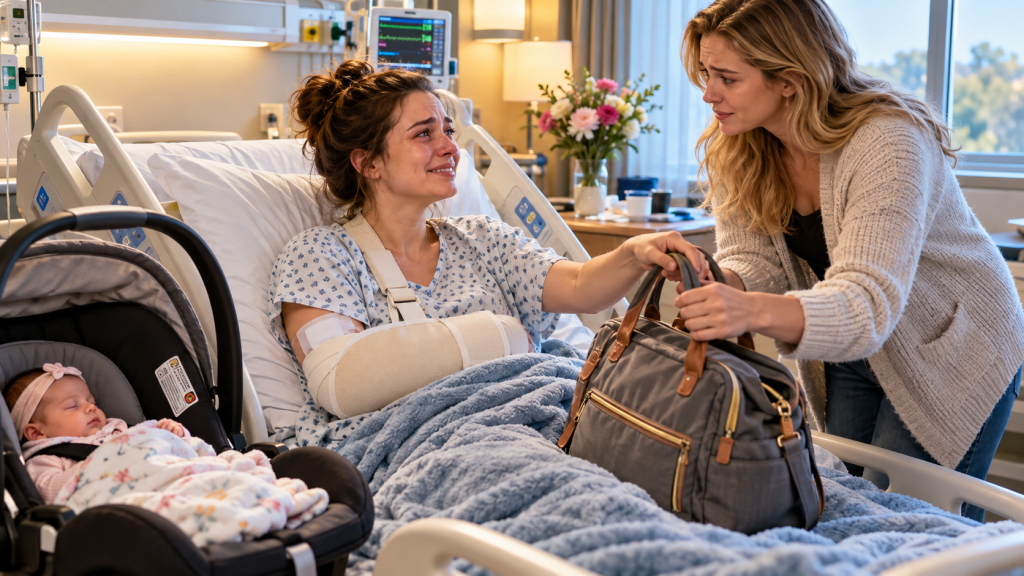
If I close my eyes, I can still see Whitney walking into that hospital room in jeans and a sweatshirt.
Hair messy.
Worried.
No speech.
No accusation.
She looked at my stitches.
Then at Nora.
Then at the diaper bag in my one usable hand.
And she simply reached down.
Took the bag.
The gesture was so small.
But sometimes family begins again with one person finally carrying what the other cannot.
Not forever.
Not because one sister is weak and the other strong.
Just for that moment.
Because that is what help is supposed to be.
Years later, when Mom was dying, Whitney and I stood on opposite sides of her hospital bed.
Same sisters.
Different hospital.
Mom’s hands between ours.
She looked at us.
Then whispered:
“I should have let you two have each other.”
Whitney cried.
I squeezed Mom’s hand.
“You did eventually.”
She smiled.
“No.”
Her eyes moved from one daughter to the other.
“You took each other back.”
That was true.
We did.
And it started the night my parents refused to come for my baby.
At the time, I thought that was the abandonment.
I did not understand it was also the night the door between two sisters finally opened.
Whitney walked through it carrying my diaper bag.
And neither of us ever let anyone close it again.
THE END STORIES! THANK YOU FOR READING GOOD LUCK !❤️
Related Posts