➡️ PART 3 ENDING PART➡️
“Rachel… Mom told me something before they took her for scans. Something about you—and I think you need to hear it.”
For a moment, I said nothing.
Across the table, my mother had stopped eating.
Helen still moved carefully a year after those ninety days in the hospital. She had regained most of the weight she lost, her hair had grown back thick and silver at the temples, and the deep scar across her abdomen had faded from angry red to pale pink.
But there were things illness had changed permanently.
She tired sooner.
She hated the smell of antiseptic.
She kept an overnight bag packed in the hall closet.
And whenever my phone rang after nine at night, she looked at me with the same old fear.
Now she watched my face.
“What did Diane say?” I asked.
Grant breathed unevenly into the phone.
“They’re taking her for a CT scan.”
“That isn’t what I asked.”
There was a pause.
Then:
“She asked whether you were coming.”
I almost laughed.
“You ordered me to come.”
“I know.”
“What did she say about me?”
Grant exhaled.
“She told me not to call you like that.”
I frowned.
“What?”
“She said if I contacted you, I was supposed to ask. Not tell.”
My mother lowered her fork.
Grant continued.
“She said I had no right to expect you to do for her what I wouldn’t do for Helen.”
The room went completely quiet.
I looked at my mother.
Helen’s eyes filled immediately.
I turned away.
“Your mother said that?”
“Yes.”
“When?”
“Before they took her back.”
I pressed my fingers against my forehead.
“And now you think I need to hear it because?”
“Rachel.”
“No. Finish the thought.”
“I’m scared.”
There it was.
Not noble.
Not complicated.
Scared.
A year ago, I had been scared too.
For ninety days.
I had learned the different sounds hospital elevators make at two in the morning.
I had learned which vending machine accepted crumpled dollars.
I had learned how to sleep with my head against a wall while sitting upright.
I had learned that surgeons sometimes speak more softly when the news is worse.
And Grant had learned how to complain that the laundry basket was full.
“I was scared too.”
“I know.”
“No.”
My voice changed.
“You knew I was worried.”
“That is not the same as understanding what it felt like.”
Grant went quiet.
I continued.
“When Mom’s blood pressure dropped on Christmas Eve, I thought she might die.”
“I know.”
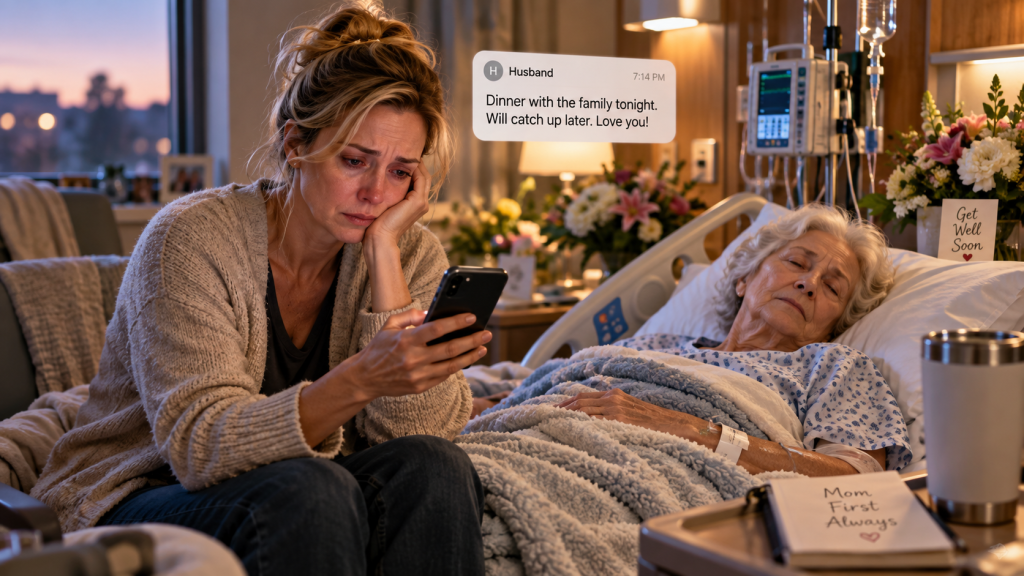
“You sent me a picture of dinner.”
His breathing stopped for a second.
“I shouldn’t have done that.”
“No.”
I looked at Helen.
She stared at her plate.
“You shouldn’t have.”
Then Grant whispered:
“Mom also said something else.”
Of course.
“What?”
“She said she told me to go to the hospital last Christmas.”
My whole body went still.
“What?”
Grant did not answer quickly enough.
“What did you just say?”
He sounded sick.
“Mom told me to go be with you.”
I stood.
The chair scraped backward.
My mother said:
“Rachel.”
I held up one hand.
Not now.
“When?”
“Christmas Eve.”
“At dinner?”
“Yes.”
My heart began pounding.
Grant continued.
“She asked where you were.”
“What did you tell her?”
Silence.
I already knew it would hurt.
“What did you tell her, Grant?”
“That you decided to stay at the hospital.”
“That part was true.”
“Yes.”
“And?”
He exhaled.
“I said you told me to go without you.”
My stomach turned.
“I told you to go without me?”
“Yes.”
I laughed once.
“After I begged you to come inside.”
“I know.”
“After you sat in the car.”
“Yes.”
“While I carried Mom’s suitcase.”
“Yes.”
“And then you went to your mother’s house and told everybody I wanted you there.”
His voice broke.
“Yes.”
I closed my eyes.
I remembered Diane in the photograph.
Red dress.
Hands resting on the back of a chair.
Grant beside her.
Paige smiling.
Wine glasses.
Candles.
Wish you were here.
I had looked at that picture and thought his family simply had different priorities.
Now I saw something else.
They had been given a different story.
“Why?”
I asked.
Grant did not answer.
My mother whispered:
“Rachel.”
I opened my eyes.
“No.”
This time I was not stopping her.
I was stopping myself.
Because I knew exactly what I wanted to say.
Cruel things.
True things.
The worst combination.
So I asked one question.
“Why?”
Grant spoke quietly.
“Because Mom would have made me leave.”
There it was.
No misunderstanding.
No hospital phobia.
No innocent emotional difference.
He had lied because the truth might have cost him dinner.
I sat back down.
My legs felt suddenly weak.
“You knew she would tell you to come to me.”
“Yes.”
“So you made me the reason you stayed.”
“I was tired of fighting about it.”
I almost could not believe the sentence.
“You were tired?”
“Rachel—”
“My mother had tubes coming out of her body.”
“I know.”
“I had slept four hours in two days.”
“I know.”
“I had asked my husband for one evening.”
“I know.”
“And you were tired of fighting.”
He started crying.
I could hear it.
That did not move me the way it once would have.
There was a time when Grant crying would have made me soften automatically.
Move toward him.
Relieve him.
Make his feelings easier.
A year of distance inside a marriage had changed that reflex.
“What else did you tell them?”
“Nothing.”
I said nothing.
He corrected himself.
“Not nothing.”
“Go on.”
“When Mom asked why I wasn’t visiting Helen…”
My stomach sank again.
“What did you say?”
“That you wanted time alone with her.”
I covered my mouth.
Across the table, my mother closed her eyes.
“You told Diane I didn’t want you there.”
“Yes.”
“You told your family I was keeping you away.”
“I didn’t say it like that.”
“How did you say it?”
“That you were overwhelmed and wanted the hospital to be your space.”
“My space.”
My voice came out hollow.
“Yes.”
A hospital room became my personal retreat in his version.
The chair where I slept.
The bathroom where I cried.
The corridor where I called insurance.
My space.
I laughed.
Then cried.
Both at once.
Grant whispered:
“I was selfish.”
“No.”
I wiped my face.
“You were deliberate.”
Silence.
“That is harder.”
He said nothing.
I looked at Helen.
She was crying now too.
“I’m sorry.”
I told her.
She frowned.
“For what?”
“For lying to you about the flowers.”
She stared.
“The flowers?”
“Grant didn’t send them.”
Her expression changed.
“I did.”
I swallowed.
“I ordered them.”
“I wrote the card.”
“I used our account because I wanted you to think he cared enough to do something.”
My mother stared at me for a long time.
Then she reached across the table.
Took my hand.
“Honey.”
“I was embarrassed.”
“Of what?”
“That my husband had not come.”
My voice broke.
“So I gave him credit for flowers he didn’t choose.”
Helen squeezed my fingers.
“You were trying to protect me.”
“I was protecting him.”
That realization hurt.
Not Mom.
Grant.
I had been laundering his indifference into kindness.
Translating him into a better husband.
Writing cards in his voice.
Making excuses.
He hates hospitals.
He has work.
He’s tired.
He doesn’t know what to do.
He cares differently.
Seven years.
I had been ghostwriting our marriage.
Grant said my name through the phone.
“Rachel.”
I looked at the screen.
Then back at Mom.
“What does Diane need?”
He hesitated.
“What?”
“Medically.”
“Oh.”
His breathing changed.
“She fell near the bottom of the stairs.”
“She hit her hip and shoulder.”
“She may have fractured her hip.”
“She’s conscious.”
“Paige is here.”
Of course.
His sister.
“So she isn’t alone.”
“No.”
“Good.”
“Rachel, please.”
“What?”
“I need you.”
A year ago, those three words would have destroyed me.
Because they were exactly what I had said.
I need my husband.
He had answered:
You’re stronger than you think.
I stared at the wall.
Then said the words slowly.
“You’re stronger than you think.”
Grant went silent.
I hated how satisfying it felt.
Not because I wanted him to suffer.
Because for once, the sentence returned to its owner.
“Rachel.”
“No.”
“You do not get to call me cruel for repeating your own words.”
“I’m not.”
“You were right about one thing last year.”
“What?”
“Sitting in a hospital chair would not have changed my mother’s surgery.”
He cried quietly.
“And me sitting there tonight will not change your mother’s scan.”
“That isn’t why I’m asking.”
“I know.”
That was the point.
He finally knew.
Presence is not medicine.
It is not surgery.
It does not reduce a fracture.
It does not cure cancer.
It tells the person beside you:
You do not have to be frightened alone.
I had tried to explain that a year earlier.
He had needed his own fear before he understood the language.
“I’m not coming for you.”
I said.
He was quiet.
Then:
“Okay.”
“But I may come for Diane.”
He exhaled.
“Thank you.”
“Do not thank me yet.”
I ended the call.
For several seconds, I simply stood there.
Mom looked at me.
“You’re going.”
It was not a question.
“I don’t know.”
“Yes, you do.”
I sat across from her again.
“Why should I?”
Mom smiled sadly.
“Because you’re not Grant.”
That sentence hit me.
“But I don’t want to reward him.”
“Then don’t.”
“How?”
“Go for Diane.”
She took another bite of dinner.
Almost comically calm.
“Sit with her.”
“Help her.”
“Be kind to her.”
“Then come home and decide what to do about your husband.”
I stared.
“You make it sound simple.”
“It isn’t.”
Mom shrugged.
“Simple and easy are different.”
I looked down.
“Will you be okay?”
She smiled.
“I survived stomach cancer.”
“I can manage leftovers.”
I laughed through tears.
Then I stood.
“Come with me.”
Her eyes widened.
“To the hospital?”
“If you want.”
She thought.
Then shook her head.
“No.”
“Why?”
“Because Diane needs family, not an audience.”
Fair.
I kissed her forehead.
At the door, Mom said:
“Rachel.”
I turned.
“Do not confuse kindness with surrender.”
I carried that sentence all the way to St. Joseph’s.
By the time I arrived, Diane had been moved from imaging to a treatment room.
Paige met me in the hallway.
Grant’s younger sister looked exhausted.
Her hair was in a messy bun, her coat still zipped.
The moment she saw me, she hugged me.
I stiffened.
Then hugged back.
“I’m so glad you came.”
She pulled away.
“Mom was asking for you.”
That surprised me.
“For me?”
“Yes.”
Then Paige’s face changed.
“Grant told me.”
I knew.
“What part?”
“The lies.”
I looked toward the waiting area.
Grant sat alone.
Hands clasped.
Head bowed.
He saw me.
Stood.
I looked away.
Not yet.
“Can I see Diane?”
Paige nodded.
“She’s awake.”
“Possible hip fracture.”
“Confirmed?”
“Small fracture near the top.”
“Surgery?”
“They’re discussing it.”
I took a breath.
Then entered.
Diane looked smaller in the hospital bed.
That always happens.
People who fill homes, kitchens, holidays, suddenly become a body beneath a white blanket.
She had a bruise forming near her temple.
Her arm rested carefully across her chest.
When she saw me, tears filled her eyes.
“Rachel.”
I walked closer.
“You scared everybody.”
She gave a weak smile.
“I’ve always been dramatic.”
“Apparently.”
Then her smile disappeared.
“I’m sorry.”
I pulled the chair beside the bed.
“For falling?”
“For last year.”
I stared.
“You didn’t know.”
“Not enough.”
“What does that mean?”
Diane looked toward the closed door.
“I knew Grant had not been visiting your mother.”
My stomach tightened.
“He told me you preferred to be alone with Helen.”
“I believed him at first.”
“Then?”
“Paige asked why you weren’t at Christmas dinner.”
“I said you were at the hospital.”
“She said Grant had dropped you there.”
Diane’s eyes filled.
“That bothered me.”
“I asked him why he didn’t stay with you.”
“He said you wanted him to come to dinner.”
I closed my eyes.
“And you believed him.”
“For maybe ten minutes.”
I looked at her.
“What changed?”
“Because you never do that.”
I frowned.
Diane smiled sadly.
“You don’t send people away when you’re scared.”
“You pull everyone closer.”
She knew me better than I had realized.
“So I told him to go back.”
My chest hurt.
“What did he say?”
“That you’d be angry if he came.”
I laughed bitterly.
“Of course.”
Diane started crying.
“I should have called you.”
“Yes.”
I said it gently.
Not cruelly.
Simply true.
She nodded.
“I know.”
“I almost did.”
“Then Grant told me your mother’s blood pressure had stabilized.”
“That you were resting.”
“That you didn’t want more people coming.”
I stared at the blanket.
He had managed us all.
Not because he wanted to protect anyone.
Because our separate ignorance made his choices easier.
Diane whispered:
“I’m ashamed.”
I looked up.
“For his choices?”
“For letting him speak for you.”
That mattered.
She continued.
“I should have asked you.”
“Yes.”
“I’m sorry.”
I nodded.
“Thank you.”
No dramatic forgiveness.
Just truth.
Then Diane said something unexpected.
“I told him tonight that if he ordered you here, I’d ask security to send him home.”
I almost laughed.
“You said that?”
“Yes.”
“Why?”
“Because I’m hurt, not helpless.”
There she was.
Diane.
Still Diane.
She shifted and winced.
I stood automatically.
“Do you need the nurse?”
“No.”
“Are you sure?”
“Yes.”
Then:
“Sit.”
I sat.
Her eyes filled again.
“I would like you here.”
I swallowed.
“Okay.”
“But because I asked.”
“Yes.”
“Not because Grant did.”
“Yes.”
That distinction changed everything.
I stayed.
Not all night.
Three hours.
I helped Diane call her insurance.
Held her water.
Texted Paige when the surgeon came.
Asked questions because hospital language still came too easily to me.
Grant stayed mostly outside.
Once he entered.
Diane looked at him.
“You lied to me.”
He lowered his head.
“I know.”
“I defended you to Rachel.”
“I know.”
“You let me think she was pushing you away.”
“Yes.”
Diane’s voice sharpened.
“Why?”
Grant looked at me.
I said nothing.
He had to answer her.
“I didn’t want to go to the hospital.”
Diane stared.
“That’s it?”
He swallowed.
“I hate hospitals.”
“So does everybody.”
“I felt useless.”
“You were not being asked to perform surgery.”
“I know.”
“You were being asked to sit beside your wife.”
Grant cried.
“I know.”
Diane shook her head.
“No.”
“You know tonight.”
“That is not the same.”
I stared at her.
My mother had said almost exactly that.
Maybe women who have spent enough time surviving other people eventually begin speaking the same language.
Diane continued.
“You were afraid saying ‘I don’t want to’ would make you look selfish.”
“Yes.”
“So you made Rachel look demanding.”
He lowered his eyes.
“Yes.”
“And on Christmas, you made her look like she sent you away.”
“Yes.”
Diane closed her eyes.
“I raised you better than that.”
Grant’s face tightened.
“Mom.”
“Do not make me responsible for your adulthood.”
Silence.
Good.
She turned toward me.
“Rachel, go home.”
I blinked.
“What?”
“You look exhausted.”
“I’m fine.”
Her eyes narrowed.
“Do not say that in a hospital.”
I laughed.
So did Paige from the doorway.
Even Grant almost smiled.
Diane said:
“Paige is staying.”
“I’m staying.”
Grant spoke quickly.
Diane looked at him.
“You can.”
Then back to me.
“You do not owe me a night.”
That sentence released something in me.
I kissed her cheek.
“I’ll come tomorrow.”
“Because you want to?”
“Yes.”
“Good.”
I left.
Grant followed me into the parking garage.
I heard him call my name.
“Rachel.”
I kept walking.
“Please.”
I stopped beside my car.
Turned.
He looked terrible.
Not because of me.
Because his mother had fallen.
Because his marriage was finally visible to him.
Because the tools he used to avoid discomfort had failed.
“What?”
“I’m sorry.”
I looked at him.
“For what?”
His eyes filled.
“For not coming.”
“Not enough.”
He nodded.
“For lying about why.”
“Keep going.”
He swallowed.
“For telling my mother you didn’t want me there.”
“For making you cover for me.”
I frowned.
“I covered for you by choice.”
“Yes.”
“But I benefited.”
Good.
“For acting as though your mother’s illness belonged to you and didn’t affect me.”
His voice cracked.
“For complaining about laundry.”
“For asking about milk.”
“For that stupid Christmas picture.”
Tears ran down his face.
“I thought because I could not fix anything, there was no point being there.”
I waited.
“And that was wrong.”
“Yes.”
He looked at me.
“I understand now.”
I shook my head.
“No.”
His face fell.
“You understand a piece.”
“What’s the difference?”
“The difference is that your mother fell today.”
“You were scared for three hours.”
“I was scared for three months.”
He closed his eyes.
“I know.”
“No.”
I almost laughed.
“We have got to stop using that phrase.”
He wiped his face.
“Okay.”
Then:
“I want to fix this.”
I stared at the man I had loved for seven years.
There had been good years.
Real ones.
He made me laugh.
He remembered how I liked my eggs.
He rubbed my feet when I had migraines.
He once drove four hours to rescue me when my car broke down.
People become harder to leave when their failures are not their only truth.
“I don’t know if it can be fixed.”
His face crumpled.
“Please don’t say that.”
“Why?”
“Because I love you.”
I felt tired.
“Grant.”
“I’m serious.”
“I know.”
“Then?”
“Love is not the disputed fact.”
That silenced him.
“The issue is what you did when loving me required inconvenience.”
He stared.
There it was.
Our marriage in one sentence.
Love when convenient.
Care when symbolic.
Flowers someone else arranged.
A photograph from dinner.
Thinking of you.
Never the chair beside me.
“I’m going home.”
He whispered:
“Will you be there?”
I looked at him.
“No.”
His eyes widened.
“I’m staying with Mom tonight.”
“Rachel.”
“I need space.”
“Please.”
I shook my head.
“You taught me something last year.”
His face tightened.
“What?”
“A hospital being staffed does not mean the person beside the patient has support.”
I opened my car door.
“And a marriage existing does not mean the person inside it has a partner.”
I left.
I stayed with Mom for three weeks.
Grant did not come after me.
That surprised me.
Then impressed me slightly.
He texted once a day.
No pressure.
Diane’s surgery went well.
She walked ten steps today.
I fed the cat.
I scheduled therapy.
That last one caught me.
I did not reply.
Not because I did not care.
Because therapy was not a gift to me.
It was work he needed whether I returned or not.
Diane recovered well.
The fracture required surgery, but no major complication.
I visited because I wanted to.
Sometimes Grant was there.
He was different in that hospital.
Not magically transformed.
Awkward.
Uncomfortable.
He did not know where to stand.
He asked too many questions.
Then not enough.
But he stayed.
One afternoon, Diane fell asleep while Grant and I sat on opposite sides of the room.
He whispered:
“I finally understand what you meant.”
I looked at him.
“What?”
“That doing nothing with someone is still doing something.”
I stared at my sleeping mother-in-law.
“Sometimes it’s everything.”
He nodded.
There were moments like that.
Moments that made me wonder if we could rebuild.
Then there were others.
Grant would say:
“I wish you had told me how bad it was.”
And I would become furious.
“I did.”
Then he would stop.
Correct himself.
“You’re right.”
The old marriage was full of explanations.
The possible new one required corrections.
That became our test.
Could he hear truth without immediately defending the version of himself he preferred?
Sometimes.
Then more often.
We began couples counseling.
Not because I promised to stay.
I made that clear.
Our therapist, Dr. Elaine Foster, asked us the first session:
“What are you trying to save?”
Grant said:
“Our marriage.”
I said:
“Myself.”
He looked at me.
Dr. Foster nodded.
“Good.”
Grant looked confused.
“How is that good?”
“Because Rachel cannot honestly work on the marriage if she thinks the price is losing herself.”
I loved Dr. Foster immediately.
Grant needed time.
He had grown up in a family where Diane did everything.
Meals.
Appointments.
Birthday cards.
Emotional maintenance.
His father had been physically present and emotionally distant.
Grant learned that being a good man meant working, not cheating, paying bills, coming home.
He had done those things.
He did not understand partnership as labor beyond provision.
That explained him.
It did not excuse him.
We learned to distinguish those.
Dr. Foster asked:
“When Rachel says, ‘I need you,’ what do you hear?”
Grant thought.
“Demand.”
I stared at him.
He looked embarrassed.
“Expectation.”
“Loss of control.”
There it was.
“What do you hear when Grant says no?”
she asked me.
“Abandonment.”
Not disagreement.
Abandonment.
There was my work.
Because Grant had failed me badly.
But I also needed to learn that every no was not the hospital.
Boundaries had to belong to both of us.
We rebuilt strange things first.
Laundry.
He did his own.
Not because I refused forever.
Because he needed to learn that clean shirts did not emerge from marriage itself.
Groceries.
Shared list.
Milk stopped being my responsibility by default.
His mother’s appointments.
He arranged them.
I helped if asked.
My mother’s appointments.
I did the same.
No assumption.
No gendered invisible assignment disguised as love.
Then came emotional things.
If I had a hard day, Grant stopped asking:
“What do you want me to do?”
as if care required technical instructions.
Sometimes he simply sat.
If he was overwhelmed, he stopped becoming irritated until I guessed why.
He said:
“I’m scared.”
“I’m tired.”
“I don’t know what to do.”
Simple sentences.
Hard-earned.
But the marriage still did not heal quickly.
There were nights I looked at him and saw Christmas Eve.
Car running.
Suitcase in my hands.
There were mornings I woke angry for something that happened fifteen months earlier.
Trauma is not only what happens in catastrophic events.
Sometimes trust breaks in ordinary moments and the body remembers the exact temperature of the parking lot.
Grant wanted a timeline.
He was smart enough not to ask directly, but I could feel it.
How long until we were normal?
We were never going back to normal.
That was the point.
One evening after therapy, he said:
“I miss us.”
I looked at him.
“Which us?”
He frowned.
“Before.”
“Before Mom got sick?”
“Yes.”
I thought.
Then said:
“I don’t.”
That hurt him.
“I miss parts.”
I continued.
“But the old marriage required me to translate your absence into love.”
His eyes filled.
“I don’t want that marriage back.”
Neither did he, eventually.
Nine months after Diane’s fall, I moved home.
Not because everything was fixed.
Because there was enough evidence of change to try.
Grant had visited my mother twelve times during that period.
Not performatively.
No flowers photographed.
No social media.
Sometimes he brought soup.
Sometimes fixed her porch light.
Sometimes sat while she watched old crime shows.
Mom did not make it easy.
She was polite.
Cool.
He accepted that.
Once she said:
“Grant, you know I remember you did not visit me.”
He nodded.
“Yes.”
“I’m not going to pretend otherwise because you’re being helpful now.”
“I don’t expect you to.”
Good.
Mom later told me:
“He may be learning.”
Then:
“Do not stay because I said that.”
Of course.
Diane apologized to Helen too.
That meeting was something.
Two mothers at my kitchen table.
Helen with her scar.
Diane with a cane.
Diane said:
“I should have called you last Christmas.”
Helen looked at her.
“Yes.”
“I believed my son.”
“Most mothers do.”
Diane smiled sadly.
“We should probably do it less automatically.”
Mom laughed.
Then Diane said:
“I am sorry your daughter sat alone because my son lied in my house.”
Helen’s eyes filled.
“You didn’t do that.”
“No.”
“But I benefited from not asking enough.”
That was enough for Mom.
They became friends.
Not best friends.
Lunch occasionally.
Complained about us.
Dangerous.
A year after Diane’s fall, Christmas Eve returned.
I dreaded it.
Same date.
Same family dinner.
Grant noticed.
“What do you want to do?”
I stared.
He was asking.
Not informing.
“I want to spend the afternoon with Mom.”
“Okay.”
“And dinner with your family.”
“Okay.”
“And if Mom needs me, I leave.”
Grant nodded.
“I’ll come with you.”
I looked at him.
“You don’t have to.”
“I know.”
Different sentence.
Not obligation.
Choice.
Christmas Eve afternoon, Mom was fine.
Annoyingly fine.
She practically pushed us out.
“Go.”
“We can stay.”
“No.”
“I have a movie.”
“Soup.”
“And peace.”
Grant laughed.
At Diane’s house, the same dining room looked different.
Maybe because I did.
Diane wore red again.
Not the same dress.
Paige poured wine.
Grant sat beside me.
At 9:40, exactly around the time he had once sent the photograph, he pulled out his phone.
My body tightened automatically.
He noticed.
Then handed it to me.
Screen open.
Camera.
“Picture?”
I stared.
Then laughed.
“Sure.”
We took one.
Not Wish you were here.
Mom was exactly where she wanted to be.
So was I.
I sent the photo to Helen myself.
She replied:
You both look tired. Leave before they start dessert.
Normal.
That night, Grant and I drove home together.
He turned off the car in the garage.
Did not immediately get out.
“Rachel.”
“Yes?”
“I’m sorry.”
I looked at him.
“For?”
“Last Christmas.”
Not this one.
The old one.
“I know you’ve apologized.”
he continued.
“I just realized tonight how easy it would have been.”
“What?”
“To leave dinner.”
His eyes filled.
“I made it sound impossible.”
“I said schedules, traffic, family waiting.”
“I acted like your need was a giant demand.”
He wiped his face.
“It would have taken forty-five minutes.”
I said nothing.
“I could have eaten later.”
“Yes.”
“I could have sat with you.”
“Yes.”
“I could have brought food.”
“Yes.”
“I could have done anything.”
“Yes.”
He looked at me.
“And I chose nothing.”
That was the apology that finally reached the deepest part.
Not because he felt bad.
Because he understood proportion.
I had not asked for everything.
I had asked for presence.
He had inflated the request until refusal felt reasonable.
“I forgive you.”
The words surprised me.
Grant cried.
I did too.
Then I added:
“That does not mean I forget.”
“I know.”
“And if you ever use my mother’s illness against me during an argument—”
“I won’t.”
I looked at him.
“Good.”
We stayed married.
That may disappoint people who prefer cleaner endings.
I understand.
There were days I wanted the satisfaction of leaving.
The apartment.
The signed papers.
The final text.
Sometimes leaving is the brave thing.
Sometimes staying is cowardice.
And sometimes staying after a real change is neither.
It is simply a choice.
Mine.
That mattered most.
I stayed because Grant changed his behavior before he knew whether it would win me back.
He went to therapy when I was living with Mom.
He cared for Diane without handing the job to me.
He apologized to Helen without asking her to reassure him.
He told his family the truth about Christmas.
That one mattered.
At Diane’s next birthday dinner, Grant stood after dessert.
Nobody asked him to.
He said:
“I need to correct something I told all of you last year.”
I stared.
Paige stared.
Diane looked unsurprised.
Grant continued.
“I told you Rachel wanted me at Christmas dinner while Helen was in the hospital.”
“She didn’t.”
“I said that because I did not want to admit I had refused to stay with my wife.”
The table went quiet.
“I made Rachel look distant so I could look reasonable.”
His face was red.
“I’m sorry.”
He sat down.
No applause.
Thank God.
Just truth.
Later, Paige hugged me.
“I thought you hated us.”
My throat tightened.
“Why?”
“Because you never came around.”
“I was at the hospital.”
“I know.”
“Now.”
Another story corrected.
Grant and I never had children.
Not because of what happened.
Life simply went that way.
But we had our mothers for many more years.
Helen remained cancer-free.
Every anniversary of her surgery, she bought herself something ridiculous.
Year one:
Red boots.
Year two:
A trip to Savannah.
Year three:
A very expensive blender she barely used.
“It’s symbolic.”
she said.
“Of what?”
“Smoothies.”
Impossible woman.
Diane recovered from the hip fracture but walked with a cane permanently.
She decorated it with seasonal ribbons.
At Christmas:
Red.
Fourth of July:
Blue.
Halloween:
Tiny plastic spiders.
Grant pretended to hate it.
He secretly bought the decorations.
That was how he loved differently later.
Not grand declarations.
Maintenance.
Presence.
When Helen eventually became ill again, years later, the cancer had not returned.
It was her heart.
She was eighty-one.
This time, when the ambulance took her, Grant arrived at the emergency room before I did.
Traffic.
I was twenty minutes behind.
When I ran into the waiting area, breathless, he stood.
“I’m here.”
Three words.
That was all.
I looked at him.
Then hugged him.
Not because his presence changed Mom’s heart.
Because I did not have to enter the fear alone.
He stayed all night.
No meeting excuse.
No laundry.
No:
What would I do there?
He bought terrible coffee.
Held my coat.
Asked the cardiologist useful questions.
Then at four in the morning, when Mom stabilized, he said:
“Go sleep for an hour.”
I looked at him suspiciously.
He smiled.
“I’m not sending you away.”
“I’m offering.”
Different.
I slept.
Mom recovered.
When she was discharged, she told Grant:
“You finally figured hospitals out.”
He laughed.
“What?”
“Chairs.”
“What about them?”
“You sit in them.”
That was Mom.
She died peacefully three years later.
At home.
Not a hospital.
Grant sat beside me on the floor after everyone left.
No advice.
No speech.
Just sat.
For hours.
That was all I had ever wanted.
Diane died four years after Mom.
By then, Grant understood grief from both directions.
He did not order me to take care of her.
He asked:
“Can you come?”
I said:
“Yes.”
I helped because Diane had become mine too.
Not duty.
Relationship.
That distinction saved something in me.
During her final week, Diane asked to speak to me alone.
Grant left the room.
She looked toward the door.
Then at me.
“You stayed with him.”
“Yes.”
“Why?”
I smiled.
“You’re asking that now?”
“I’m dying.”
“I get to be nosy.”
Fair.
I thought.
“Because he became someone I could stay with.”
Diane nodded.
“Good answer.”
Then:
“If he hadn’t?”
“I would have left.”
She smiled.
“Better answer.”
I laughed.
She squeezed my hand.
“I’m glad you didn’t become his mother.”
“What?”
She looked toward the door.
“I did too much for him.”
“When he was young.”
“Then when he was grown.”
“I taught him care was something women produced in the background.”
My eyes filled.
“You also taught him to change.”
She smiled.
“No.”
“You did.”
I shook my head.
“He did.”
That mattered.
We cannot take responsibility for another adult’s growth any more than we should take responsibility for their refusal.
Grant changed because he chose to.
I stayed because I chose to.
Two separate acts.
Diane died the next morning.
Grant grieved hard.
I sat beside him.
No scorekeeping.
No:
Now you know how I felt.
That lesson had already been learned.
Revenge is sometimes useful as a doorway.
Not a home.
The text I sent him—
She’s at a hospital, Grant. She has nurses. Hire someone if you need a break.
—I do not regret it.
He needed to hear his own coldness spoken back.
So did I.
I needed to understand how brutal those words sounded when the fear belonged to someone you loved.
But I am glad I did not build the rest of my life around returning pain in equal amounts.
That would have made Grant the measure of me.
I wanted something else.
Kindness with boundaries.
Compassion without obedience.
Love without self-erasure.
Years later, Grant found the screenshot of that text while cleaning old cloud backups.
He showed me.
“Wow.”
I laughed.
“I was savage.”
“You were accurate.”
He stared at the screen.
Then:
“I deserved it.”
I looked at him.
“No.”
He frowned.
“I thought you’d agree.”
“I think you needed to hear it.”
“That is different.”
He smiled.
“You sound like therapy.”
“Expensive wisdom.”
Then he deleted the screenshot.
Good.
We no longer needed evidence.
The lesson had become behavior.
That is how I measure apologies now.
Not by tears.
Not by words.
Not even by how ashamed someone looks when they finally understand what they did.
Behavior.
Does the person show up differently when the next hard moment arrives?
Grant did.
Again.
Again.
Again.
For years.
That was enough.
And I changed too.
I stopped covering for people.
If Grant forgot a birthday gift, I did not buy one and put both names on it.
If he did not call someone, I did not invent the reason.
If he was uncomfortable, I let him be uncomfortable.
If I needed help, I said it plainly.
Sometimes he said no.
And because his no was honest, I could survive it.
That may sound strange.
But an honest no is kinder than a false excuse that teaches you your need was unreasonable.
One evening, long after both our mothers were gone, Grant and I sat at the kitchen table looking through photographs.
We found the Christmas Eve picture.
Diane in red.
Paige with wine.
Grant smiling.
Empty chair where I might have sat.
On the back, years earlier, someone had written:
Christmas Eve — everyone together.
I stared at it.
Then laughed sadly.
“Not everyone.”
Grant looked at me.
“No.”
We kept the photo.
Not as punishment.
As record.
Families tell better stories when they stop editing the uncomfortable people out of the frame.
My mother spent ninety days in a hospital.
Grant never visited.
That will always be true.
His mother fell down the stairs a year later.
He called me expecting immediate care.
That will always be true too.
I gave him back his own words.
Also true.
But none of those sentences is the whole ending.
The ending took years.
It looked like therapy appointments.
Laundry.
Apologies.
Hospital chairs.
Christmas dinners.
Two mothers becoming friends.
A husband learning that presence has value even when it cannot fix the problem.
A wife learning that strength does not require swallowing disappointment until resentment becomes identity.
And one sentence from my mother that I carried longer than any revenge line:
Do not confuse kindness with surrender.
I did not.
I went to Diane because she asked me.
I did not go because Grant commanded me.
I helped.
Then came home.
I chose compassion without returning to obedience.
That night, when I walked into the ER, Grant thought he had won for perhaps half a second.
He thought I had come because he called.
Then Diane reached for my hand and said:
“You came.”
And I answered:
“You asked.”
Grant heard the difference.
So did I.
That was the beginning of everything that came after.
Not revenge.
Not forgiveness.
Choice.
My own.
Finally.
THE END STORIES! THANK YOU FOR READING GOOD LUCK !❤️
Related Posts