➡️ PART 3 ENDING PART➡️
Mara looked at the brass key lying between us on the kitchen table.
Then she looked at the address written at the bottom of Paul’s letter.
Neither of us spoke.
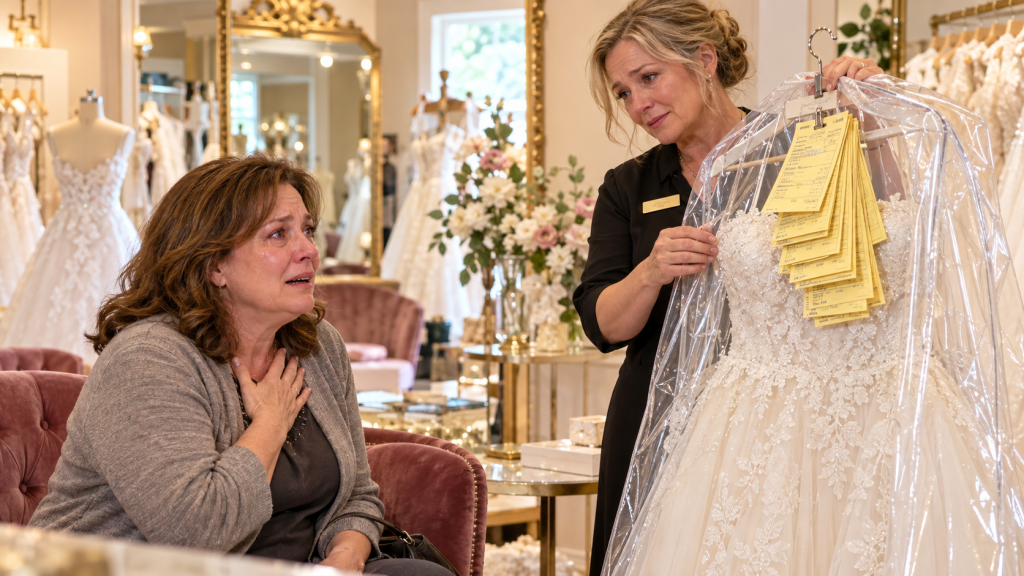
The dress was draped over the back of a dining chair, still inside its clear plastic bag, the seventeen yellow payment slips fluttering whenever the heat came on.
I hated looking at it.
That surprised me.
Six months earlier, I had imagined crying the first time I saw my daughter in a wedding dress.
I had pictured myself pretending not to cry, Mara laughing at me, Paul standing somewhere nearby looking terrified and happy.
Instead, the dress had entered our house like another mourner.
Beautiful.
Silent.
Uninvited.
Mara touched the key.
“What do you think it opens?”
“I don’t know.”
“Mom.”
“I really don’t.”
She looked at the letter again.
Paul had written only:
Before I got sick, I bought us something I never told you about.
Then the address.
Nothing else.
Of course.
Paul had always believed explanations could be postponed until the most inconvenient possible moment.
When he proposed to Mara, he had hidden the ring inside a box of hardware because he knew she would never suspect romance inside anything labeled WALL ANCHORS.
He had once taken her forty miles in the wrong direction because he refused to admit the GPS knew more than he did.
And apparently, while dying, he had decided a brass key and an address were enough information to leave behind.
Mara stared at me.
“Do you want to go?”
I asked.
“Now?”
“No.”
The answer came immediately.
Then she looked toward the dress.
“Yes.”
I waited.
She laughed once, without humor.
“I don’t know.”
That had become her most honest answer since Paul died.
Not yes.
Not no.
I don’t know.
I had spent the first months trying to rescue her from those words.
“Do you want dinner?”
“I don’t know.”
“Do you want company?”
“I don’t know.”
“Do you want me to stay?”
“I don’t know.”
I used to answer for her.
I stopped after I realized grief was taking enough decisions away.
So I reached across the table and turned the key once between my fingers.
“We can go tomorrow.”
Mara nodded.
Then shook her head.
“No.”
I waited.
“If I wait until tomorrow, I won’t sleep.”
“You don’t sleep anyway.”
“Exactly.”
She stood.
“Let’s go.”
The address was twenty-seven minutes outside town.
I knew because Mara watched the map the entire way.
The sun had already dropped low enough to turn every windshield orange.
The wedding dress lay across the backseat.
I had suggested leaving it at home.
Mara insisted we bring it.
“Why?”
I asked.
“I don’t know.”
There it was again.
Good enough.
The address led us away from the main road and onto a narrow street lined with maples and small older houses.
Nothing expensive.
Nothing dramatic.
No hidden mansion.
No secret estate.
Just an ordinary neighborhood where people left bicycles beside garages and pumpkins on porches because October had arrived.
Mara leaned forward.
“There.”
I slowed.
The house was small.
One story.
White siding.
Dark green shutters.
A porch that needed paint.
One maple tree in the front yard.
The grass had grown too tall.
A red toolbox sat beneath the porch roof.
Mara stopped breathing.
“That’s his.”
I parked.
“What?”
“The toolbox.”
She was out of the car before I turned off the engine.
I followed.
She walked across the yard slowly.
Then faster.
Her hand touched the dented red box.
I recognized it too.
Paul used to bring that toolbox to our house whenever something stopped working.
Arthur—my late husband—had owned five tools and trusted none of them.
Paul once replaced three outlets in my kitchen while Arthur stood behind him saying things like:
“Are you sure the electricity is off?”
Paul finally handed him the voltage tester.
“Mr. Warren, if I get electrocuted, you can say I told you so at my funeral.”
We had laughed then.
Before there was any reason to imagine his funeral.
Mara crouched beside the toolbox.
His name was written on the side.
PAUL R.
Black marker.
Her fingers traced the letters.
“Why is this here?”
I looked at the house.
“Let’s find out.”
The brass key fit the front door.
Mara turned it.
The lock clicked.
She froze.
I stood behind her without touching her.
Finally, she pushed the door open.
Dust.
Wood.
Drywall.
The faint metallic smell of electrical work.
The living room was half finished.
One wall had been painted cream.
The other still showed primer.
A stack of baseboards lay on the floor.
Outlet covers were missing.
Blue painter’s tape marked spots along the wall.
Paul’s handwriting was on every strip.
TV HERE? ASK MARA BEFORE DRILLING ANYTHING.
Another:
SHE WILL WANT TOO MANY LAMPS. ACCEPT FATE.
Mara made a sound.
Then laughed.
It broke into a sob halfway through.
She pressed her fist against her mouth.
I touched her back.
She walked deeper into the house.
The kitchen had new cabinets but no hardware.
A sink.
No faucet.
The refrigerator space stood empty.
On the wall beside the pantry, Paul had drawn a crooked arrow in pencil.
COFFEE STATION. NONNEGOTIABLE.
Mara cried harder.
“He bought a house.”
I looked around.
“Yes.”
“He bought us a house.”
Her voice sounded almost angry.
“Yes.”
“How?”
“I don’t know.”
“When?”
“I don’t know.”
She turned toward me.
“Why didn’t he tell me?”
There was no answer that would help.
So I gave her none.
She went down the hall.
First bedroom.
Empty.
Second bedroom.
Paint cans.
Third room.
A folding table covered with papers.
And an envelope.
Of course.
Paul had apparently believed in weaponizing stationery.
Mara stopped in the doorway.
Her name was written across the front.
Beside it was another envelope.
Mine.
MRS. WARREN
I stared.
Even from the grave, the boy refused to call me by my first name.
Mara looked at me.
“You got one too.”
“I see that.”
“You want to open yours?”
“No.”
“Why?”
“Because I’m afraid he’s going to ask me to fix something.”
For one second she smiled.
A real smile.
Then it disappeared.
She picked up her envelope.
Her fingers shook.
“Do you want me here?”
I asked.
She thought.
“Yes.”
Then she opened it.
The letter was longer than the one from the dress.
Mara unfolded three pages.
Paul’s handwriting changed halfway through.
The beginning was strong.
By the last page, the letters leaned against each other as if they were tired too.
Mara began reading silently.
Then stopped.
“Can I read it out loud?”
“Of course.”
She swallowed.
“Okay.”
Then:
Mara,
If you found this place, I’m sorry about the porch. I meant to sand it before you ever saw it. Cancer turned out to be a terrible renovation schedule. One star. Would not recommend.
Mara laughed through her tears.
I looked away.
She continued.
I bought the house eleven months before I got sick. I found it through Kenny’s cousin after the previous owner decided he was done being a landlord. It was cheap because everything in here was ugly and half the wiring was older than your mother’s casserole dishes. Do not tell her I wrote that.
I stared at Mara.
She laughed.
“He’s dead.”
she said.
“He should still be frightened.”
She continued.
I used the money Grandpa left me for the down payment and most of my savings for the rest. There was still a small loan. By the time you read this, the insurance money I arranged through work should have paid it off or gotten close enough that the attorney can explain what’s left. If something went wrong, sell the place. I mean that. Do not turn yourself broke because I decided to play HGTV without telling you.
Mara stopped.
Her face had gone pale.
“He bought this before the diagnosis.”
“Yes.”
“So he wasn’t…”
She could not finish.
Planning to die.
I knew what she meant.
“No.”
Mara looked around the unfinished room.
For six months, everything Paul had done near the end had been interpreted through death.
The will.
The hospice forms.
The donation conversation.
The canceled wedding.
The dress payments.
Now we were standing inside evidence that Paul had once made plans assuming time would obey him.
That hurt differently.
Mara continued.
This was supposed to be your wedding surprise. I know surprises involving major real estate purchases are probably a relationship crime. I was going to tell you before we actually got married because I enjoy living and didn’t think hiding a mortgage until after the ceremony would help.
I laughed.
Mara did too.
Then she kept reading.
You once told me you hated paying rent because every time you hung a picture, you felt like you were apologizing to someone else’s wall. I remembered.
Mara stopped.
Her shoulders collapsed.
“I said that once.”
“When?”
“Years ago.”
She looked around.
“He remembered.”
I touched her arm.
“Yes.”
She read on.
I wanted to fix this place myself. Not because I’m cheap, though I am. Because I wanted there to be something in our life I had built with my hands before we started filling it with things.
Then I got sick.
The room went silent.
No joke after that line.
Just those four words.
Mara’s voice became smaller.
For a while, I thought I could still finish it. I kept coming here when I had enough energy. Kenny helped. Sometimes I sat on the floor for twenty minutes and pretended I was deciding where outlets should go when really I was trying not to throw up.
Mara covered her mouth.
I stared at the painted wall.
Paul had been there.
Sick.
Weak.
Still trying to finish a house for a wedding he must have gradually understood he would never see.
Anger rose in me again.
Not rational.
Not fair.
How dare he.
How dare he spend strength he did not have on drywall and switches.
How dare he turn every unfinished room into something Mara would have to survive.
Mara read:
When Dr. Shah finally told me what I already knew, I stopped pretending this house was our future.
She paused.
Then:
That sentence almost killed me worse than the cancer.
My eyes filled.
But listen carefully: the house is not a command.
Mara’s eyes moved more slowly now.
I am not leaving you a life you are required to finish.
If you hate this place, sell it.
If you love it, live here.
If you want to rent it to a guy who paints every wall orange and keeps snakes in the bathtub, that will be terrible, but technically your decision.
Mara laughed.
I smiled.
Do not preserve my plans because I died. Dead people become very persuasive because nobody can argue with us. That seems unfair.
I closed my eyes.
Smart boy.
Too smart.
Too late.
The house is yours if you want it. The money is yours if you sell it. The unfinished work is not a promise you owe me.
Then:
The same goes for the dress.
Mara stopped.
Her eyes lifted toward the hallway as if the dress were standing there listening.
She continued.
I know you thought it cost too much. You kept showing me that picture and saying, “It’s just fabric.” It was never just fabric. You loved it and were ashamed of wanting something expensive for one day. That made me crazy.
I looked at Mara.
She was crying openly now.
So I started paying.
When I got sick, I almost stopped.
Then I thought about what would happen if I died before the wedding. I knew the shop would call. I knew somebody would eventually find out. I also knew you would probably think paying for the dress was cruel because there would be nowhere to wear it.
Mara whispered:
“He knew.”
Of course he knew.
Maybe it was cruel. If so, I’m sorry.
But I kept paying because I needed one thing from before the diagnosis to reach the end exactly the way I intended.
My throat tightened.
Not the wedding.
The gift.
Mara lowered the page for a second.
Then continued.
The dress was never payment toward a wedding. It was something beautiful you wanted and refused to let yourself have. I wanted you to own it. That’s all.
Wear it. Sell it. Donate it. Cut it into curtains. Your mother will faint if you do that, which is an argument in favor.
“I hate him.”
I whispered.
Mara laughed through tears.
“Me too.”
Then she read the next line.
Please don’t turn the dress into my coffin with buttons.
The laughter stopped.
Mara sat down on the folding chair.
So did I.
The sentence was ugly.
Perfect.
Necessary.
She continued.
I have one more thing to ask.
I braced myself.
Don’t make me the best man who ever lived just because I died young.
My breath caught.
Mara looked up.
I left socks beside the bed. I forgot your birthday dinner reservation that one year. I once told you the lasagna was good when it tasted like wet cardboard because your mother was sitting beside me and I wanted to live.
I gasped.
Mara started laughing so hard she could not read.
“I knew he hated it!”
“That coward.”
She wiped her eyes.
Then continued.
Remember me accurately.
That sentence quieted the room.
Love me accurately.
If you make me perfect, every living man you meet will lose to someone who no longer has to wash dishes, apologize, get tired, or say the wrong thing.
Mara’s face changed.
She stared at the page.
I did too.
Do not marry a memory.
The words from his voicemail.
Here again.
And don’t stay single for me either. That would be even weirder.
Mara laughed softly.
You do not owe me another wedding.
You owe me nothing.
I loved you.
That was my choice.
What you do with the life after me is yours.
Mara stopped.
The final lines waited at the bottom.
Her voice broke when she read them.
I’m sorry I didn’t get ordinary with you.
I wanted grocery lists. Mortgage arguments. Bad vacations. You complaining that I loaded the dishwasher wrong when there is objectively only one way to load a dishwasher and yours is incorrect.
Mara smiled through tears.
I wanted to become boring with you.
I’m sorry I couldn’t.
Love,
Paul
Mara folded forward.
The pages fell into her lap.
I moved beside her.
Held her.
She sobbed against my shoulder.
Not the contained crying she had done for six months.
Not tears she could wipe before work.
This was the sound of someone finally grieving the future.
Not only the man.
The grocery lists.
Mortgage arguments.
Bad vacations.
The ordinary life they had been denied.
I held her until my arm went numb.
Then longer.
Eventually, Mara looked toward my envelope.
“You should read yours.”
“No.”
“Mom.”
“I am emotionally unavailable.”
She almost smiled.
“Read it.”
So I did.
The front said:
MRS. WARREN
Inside:
Mrs. Warren,
If you are reading this, I assume you have already blamed yourself for at least six things you could not control. Please stop.
I stared at the page.
Mara smiled sadly.
“He knew you too.”
I kept reading.
You treated me like family before I had any official right to be one. You fed me. Let me use your tools even though they were terrible. Called me when Mara was being stubborn because you knew I could occasionally translate Warren into human.
I snorted.
Thank you.
Simple.
That hurt more than paragraphs.
I need you to do something for me.
I closed my eyes.
“There it is.”
Mara waited.
Do not make grief another job for her.
I stopped.
Read it again.
Do not make grief another job for her.
My eyes filled immediately.
Mara is very good at performing competence. I think she learned that from you. If she gets up, works, pays bills, and answers texts, people will decide she is doing better. Don’t let them confuse functioning with healing.
I could barely see.
But also don’t turn her into a patient. She will hate that.
Mara nodded vigorously.
“I would.”
“Quiet.”
I continued.
Let her be angry at me.
Let her be relieved sometimes.
I stopped.
Relieved?
Mara’s eyes dropped.
I read:
I know that sounds horrible. It isn’t. Cancer made our lives small. She spent months waiting for my phone to ring. Waiting for test results. Waiting for me to get worse. If one day she realizes she can make plans without checking whether I’m strong enough to go, she may feel relief. Please do not let her mistake that for disloyalty.
I started crying.
Because I had already done exactly that.
Not aloud.
But inside.
The first time Mara accepted an invitation after Paul died, I had watched her laugh with coworkers and thought:
How can she?
Then hated myself for thinking it.
Paul had seen that trap before either of us reached it.
I kept reading.
And Mrs. Warren, I know you lost your husband too.
My chest tightened.
Please do not spend all your grief helping Mara with hers.
I stared at the page for a long time.
Mara reached for my hand.
For months, I had been so focused on my daughter that I had barely spoken Arthur’s name.
He had died four years before Paul.
A different grief.
Older.
Still present.
Paul remembered.
I know you will want to save her.
You can’t.
Cruel.
True.
Sit with her instead.
Then, at the bottom:
P.S. Your lasagna is excellent. The wet-cardboard comment above was a legal strategy to preserve my dignity.
I laughed so loudly it echoed through the unfinished house.
Mara laughed too.
Then we cried again.
We did not explore the rest of the house that night.
There was too much Paul in every room.
A pencil behind one ear would have seemed less present.
We locked the door.
Put the letters in Mara’s bag.
Took the dress home.
The next morning, Mara called the number written at the bottom of the paperwork on the folding table.
It belonged to an attorney.
Paul’s attorney.
Mr. Levin.
He knew exactly who Mara was.
“I’ve been expecting you.”
Apparently everyone had been expecting Mara except Mara.
He explained the house.
Paul had purchased it before his diagnosis.
Small down payment from an inheritance.
Savings.
A manageable mortgage.
Once his illness progressed, he updated his estate plan.
A life insurance policy through his union paid the remaining mortgage after his death.
The transfer paperwork had already been completed.
The house was Mara’s.
Not a mansion.
Not a fortune.
A modest little house with unfinished paint and a porch that still needed sanding.
A real gift.
Which made it harder.
Mr. Levin also explained the voicemail.
Paul had recorded several audio files during hospice.
Not dozens.
Not a lifetime of scheduled interruptions.
Three.
One tied to the bridal shop account.
One for the house.
One for me and Mara together.
Paul’s number remained active temporarily through a family account managed by his sister. With her help and the hospice social worker, the messages had been scheduled through a legacy-messaging service so they would appear from his old number.
I did not understand the technology.
I did not want to.
All I knew was that Mara had received one phone call from the dead and there would be two more opportunities for my heart to stop.
“When?”
she asked.
Mr. Levin answered:
“The house message is triggered by opening the secure file attached to the transfer documents.”
Mara looked at me.
“And the third?”
“A date Paul selected.”
“What date?”
Mr. Levin paused.
“August seventeenth.”
Their wedding date.
Mara went completely still.
I hated Paul again.
A little.
Maybe more than a little.
Mara did not open the house message.
Not that day.
Not that week.
The file sat on her laptop.
VIDEO — HOUSE
She avoided it.
Good.
Paul himself had written that dead people were too persuasive.
There was no rule that said grief had to consume every message immediately just because the sender could no longer create another.
Meanwhile, the bridal shop called again on the first Friday.
I answered.
“Magnolia Bridal.”
A young voice.
Before she could continue, I said:
“Please put Patty on.”
Patty came quickly.
I asked:
“Why are you still calling?”
She sounded horrified.
“We shouldn’t be.”
“But you did.”
“I am so sorry.”
She explained what had happened.
Paul had completed the dress payments before he died.
The final yellow receipt was indeed the final dress payment.
But because the gown had never been picked up or formally canceled, the account remained open in the store’s old layaway system.
The automated first-Friday task list kept generating a contact reminder.
The staff saw “active account” and assumed balance.
Nobody had opened the deeper payment history until I walked into the shop.
“So there is no balance?”
“None.”
“Storage?”
“No.”
“Alterations?”
“No.”
“The dress is Mara’s.”
“Yes.”
I closed my eyes.
“Then close the account.”
“I already did.”
“Good.”
Patty paused.
“Mrs. Warren?”
“Yes?”
“I am sorry.”
This time the apology felt simple enough to accept.
“Thank you.”
Then she said:
“Paul came here four days before he died.”
My chest tightened.
“I thought he mailed the last payment.”
“He had mailed most.”
“The last one he brought.”
I sat down.
Patty continued.
“He was in a wheelchair.”
“His sister drove him.”
“He insisted on coming inside.”
“Why?”
“I asked.”
“What did he say?”
Patty’s voice broke.
“He said he wanted to see the dress one more time.”
I covered my mouth.
“He didn’t touch it.”
“He just stood—or sat, really—by the mirror and looked at it.”
“Then he said, ‘She would’ve looked ridiculous crying in this thing.’”
I laughed through tears.
Patty continued.
“Then he asked me to put the envelope in the bodice.”
“After that, he paid the final eighty-four dollars and fifty cents.”
My eyes closed.
“That’s why you said he paid again from hospice.”
“Yes.”
“He used his hospice debit card.”
“I remembered the logo when I processed it.”
I hated the image.
Paul weak enough for hospice.
Still insisting on finishing eighty-four dollars and fifty cents.
Then Patty said:
“He wasn’t trying to finish a wedding.”
I went quiet.
“He told me that.”
“What exactly?”
“He said, ‘The wedding is gone. The promise to buy her the dress isn’t.’”
I cried.
Again.
There seemed to be no bottom.
Mara returned to work.
She continued feeding the dog.
Paying bills.
Not wearing mascara.
But she changed in small ways after finding the house.
She stopped avoiding Paul’s name.
That surprised me.
Before, if someone said:
“Paul would have loved this,”
her face shut down.
Now sometimes she answered:
“He would have hated it.”
Or:
“Paul was allergic to anything that required reservations.”
Accuracy.
Just as he asked.
She also started getting angry.
Real anger.
Not only sadness dressed as exhaustion.
One evening she slammed a cabinet.
“He lied to me.”
I was washing dishes.
“About what?”
“The house.”
“Technically—”
“Mom.”
“Sorry.”
“He hid a whole house.”
“Yes.”
“He knew he was sick and still didn’t tell me.”
“Yes.”
“I could have helped him.”
“Yes.”
“I could have gone there with him.”
“Yes.”
Her face crumpled.
“He robbed me of that.”
I dried my hands.
“Maybe.”
She stared.
I continued.
“He probably thought he was protecting the surprise.”
“Then later protecting you.”
“That doesn’t mean he chose correctly.”
Mara sat.
For months, people had treated Paul’s final decisions as sacred.
Dying people become difficult to criticize.
That was exactly the problem he had predicted.
I sat opposite her.
“You’re allowed to be angry.”
She whispered:
“What kind of person gets angry at a dead man who bought her a house?”
“The kind who loved him enough to want a say.”
She cried.
Then:
“I wish I could yell at him.”
“I know.”
“I wish he could say sorry.”
“I know.”
“I wish he could get defensive.”
I laughed softly.
“That would be very Paul.”
“He would say, ‘Technically, I planned to tell you.’”
“Exactly.”
We laughed.
Then cried.
Accurate love.
Messy.
Human.
Two months after finding the house, Mara decided to finish the electrical work.
Not the whole house.
Just enough to make it safe.
Paul’s friend Kenny helped.
He had worked beside Paul for nine years.
Big man.
Tattooed arms.
Cried every time Paul’s name came up.
Pretended allergies.
Kenny entered the house, looked at the open walls, and swore.
“He did half this wrong.”
Mara gasped.
“You’re lying.”
“No.”
Kenny pointed.
“He was rushing.”
Mara stared.
Then laughed.
That laugh mattered.
Because Paul could be wrong again.
Not perfect.
Not sainted.
A man who left one junction box in an inconvenient place because he was sick and stubborn.
Kenny corrected it.
Without ceremony.
No one preserved Paul’s mistake just because he died.
That became a rule for the house.
If Paul’s work was good, keep it.
If it was bad, fix it.
If Mara hated it, change it.
The kitchen became green.
Paul had left a note on one paint sample:
ABSOLUTELY NOT THIS COLOR. LOOKS LIKE A PICKLE.
Mara chose it.
I stared at the wall.
“You did this because he hated it.”
“Maybe.”
“Healthy.”
“He said it was my house.”
“Fair.”
The color looked good.
Paul had been wrong.
Again.
Wonderful.
In January, Mara finally opened the house video.
She asked me to come.
We sat on the living-room floor of the now-safe, still-unfinished house.
Laptop between us.
Green kitchen behind.
She clicked.
Paul appeared.
My breath stopped.
Alive.
Moving.
Not hospital-bed Paul.
Still ill.
Thin.
Knit cap.
But upright.
He sat in the unfinished living room.
For several seconds, he looked into the camera without speaking.
Then:
“Okay.”
He sighed.
“This is terrible.”
Mara laughed immediately.
Paul on the screen continued.
“I had a speech.”
He looked off camera.
“Kenny, stop laughing.”
From somewhere behind the camera, Kenny said:
“You’re doing great.”
“Shut up.”
Mara covered her mouth.
I cried.
Paul looked back into the lens.
“Mara.”
Then his expression changed.
Everything playful disappeared.
“If you found the house, I’m guessing your mother got involved because you would have ignored the bridal shop until 2047.”
Mara whispered:
“Accurate.”
Paul smiled faintly on the screen.
“I need to say something I couldn’t get right in the letter.”
He took a breath.
“I’m sorry.”
Mara went still.
“I’m sorry I didn’t tell you about the house when I got sick.”
Her face collapsed.
There it was.
The apology she said she wanted.
Too late.
Still powerful.
Paul continued.
“At first, I thought I would get better.”
“Then I thought I would have more time.”
“Then telling you felt like handing you another thing you’d lose.”
“I told myself secrecy was kindness.”
“It probably wasn’t.”
Mara sobbed.
I put my hand over hers.
Paul looked tired.
“I should have let you choose whether you wanted to come here while I was still here.”
Mara whispered:
“Yes.”
As though he could hear.
“Yes, you should have.”
Paul nodded on the screen at nothing.
Almost as if he knew.
“I’m sorry.”
Silence.
Then he continued.
“But since I can’t repair that, I need you to hear the next part.”
He looked around the unfinished room.
“Please do not live here because I bought it.”
Mara cried harder.
“Seriously.”
“If every wall feels like me, sell it.”
“If you wake up one morning and hate the front porch, sell it.”
“If you meet somebody one day and he says, ‘This house feels like your dead fiancé is supervising me from the outlets,’ that is fair.”
I laughed through tears.
Paul smiled.
“I do not want to haunt anybody through electrical infrastructure.”
Mara laughed.
Then he became serious.
“A gift that traps you is not a gift anymore.”
There.
The entire house reduced to one sentence.
“A gift that traps you is not a gift anymore.”
Paul continued.
“I bought the place because I imagined a life.”
“That life isn’t happening.”
He swallowed.
“I hate saying that.”
His eyes filled.
Mara reached toward the screen.
Did not touch it.
Paul said:
“But your life is.”
“Please don’t make yours smaller to keep mine recognizable.”
Then he smiled.
“Also the bedroom closet is too small.”
“I realized that after framing.”
“My mistake.”
“Fix it.”
The video ended.
No music.
No dramatic goodbye.
Just Paul reaching toward the camera.
Then black.
Mara sat on the floor for a long time.
Finally she whispered:
“I’m going to sell the house.”
I looked at her.
“You decided just now?”
“No.”
“I decided weeks ago.”
“I was afraid watching this would make me change my mind.”
“Did it?”
She looked around.
“No.”
Then she cried.
Because knowing the right decision does not make it painless.
We finished enough of the house to sell responsibly.
Nothing fancy.
Safe wiring.
Functional kitchen.
Finished bathroom.
Fresh paint.
Kenny refused payment for his labor.
Mara forced him to accept reimbursement for materials.
He complained.
She threatened him with legal paperwork.
Paul would have been proud.
The house sold in May.
A young couple bought it.
No tragic backstory.
No cosmic reason.
They simply liked the maple tree and the green kitchen.
The woman was pregnant.
Mara learned that at closing and immediately started crying in the parking lot.
“I’m sorry.”
I said.
“Why are you apologizing?”
“I don’t know.”
She laughed through tears.
“They’re going to have a baby there.”
“Yes.”
“Paul wanted…”
“I know.”
She stopped me.
“No.”
Her hand tightened around mine.
“Don’t finish that sentence.”
I nodded.
She took a breath.
“Paul wanted a life there.”
“They’re going to have one.”
Then she smiled sadly.
“That can be enough.”
We walked to the car.
She never went back.
The proceeds were not enormous.
Enough to matter.
Mara put most into savings.
Paid off a small student loan.
Donated a portion to the hospice that cared for Paul.
Not because he asked.
He never did.
Her choice.
She also bought something completely unnecessary.
A ridiculously expensive mattress.
I stared at the price.
“Paul would object.”
“That’s why I’m buying it.”
“Grief is becoming expensive.”
“Therapy costs more.”
Fair.
She slept better.
Worth every dollar.
Then came August seventeenth.
The wedding date.
For weeks, Mara pretended it was not coming.
I did not mention it.
Paul’s third scheduled message would arrive that day.
We knew.
That made the waiting worse.
At 8:14 in the morning, nothing.
At noon, nothing.
At three, Mara called me.
“Did Mr. Levin get the date wrong?”
“I don’t know.”
At five-thirty, her old phone rang.
Paul’s number.
She stared.
Then answered.
No voice.
Just a text link.
ONE LAST THING. THEN I PROMISE TO STOP INTERRUPTING.
Mara laughed and sobbed at the same time.
She came to my house.
We sat on the porch.
She opened it.
Audio only.
Paul’s voice.
More tired than the house video.
Hospice Paul.
“Hey.”
A pause.
“If it’s August seventeenth, then today was supposed to be our wedding.”
Mara closed her eyes.
“I’m sorry.”
He breathed slowly.
“You’re probably having a horrible day.”
“Or maybe you forgot until noon.”
“If that happened, good.”
Mara’s face tightened.
Paul continued.
“I thought about recording messages for birthdays.”
“Christmas.”
“Anniversaries.”
“Your first day at some new job.”
“Maybe if you got married someday.”
Mara opened her eyes.
“I almost did.”
My heart sank.
Then Paul said:
“I decided not to.”
I breathed.
“Because that would be selfish.”
He coughed.
Waited.
“I don’t want to keep arriving.”
Mara started crying.
“I don’t want a phone number from a dead man appearing every time your life tries to move.”
I covered my mouth.
“So this is the last scheduled message.”
“After today, if you hear my voice, it will be because you chose to play something old.”
“That matters.”
Mara whispered:
“Thank you.”
Paul continued.
“If you still have the dress, okay.”
“If you sold it, good.”
“If your mother turned it into curtains, call the police.”
I laughed.
Mara did too.
Then:
“If you still have the house, okay.”
“If you sold it, good.”
“If there are orange walls and bathtub snakes, I warned you.”
Mara cried harder.
Then Paul went quiet.
When he spoke again, his voice was softer.
“Mara.”
“I wanted today.”
The laughter disappeared.
“I wanted the church.”
“I wanted to see you walk toward me.”
“I wanted your mom to cry too loudly.”
I wiped my face.
“I wanted to step on your dress during the first dance because we both know I would have.”
Mara pressed both hands against her mouth.
“I wanted forty more August seventeenths where we forgot to make reservations and ordered takeout.”
He took a long breath.
“I wanted it.”
“Please don’t make my acceptance sound like I didn’t.”
Mara sobbed.
That line mattered.
The dying are often praised for acceptance until we forget acceptance can contain rage.
Paul continued.
“But wanting something does not make the world owe it.”
“I hate that too.”
Another pause.
“So today, grieve what we didn’t get.”
“Be furious.”
“Eat something bad for you.”
“Then tomorrow, please let August eighteenth happen.”
Mara lowered her head.
The final words came quietly.
“I loved you when I had a future with you.”
“I love you now when I don’t.”
“But if love means anything useful, it has to leave you free.”
“Goodbye, Mara.”
Then:
“Not forever, if heaven works the way your mother thinks.”
I stared.
Mara laughed through tears.
Then his voice:
“But for now.”
A breath.
“Goodbye.”
The recording ended.
No more calls ever came from Paul’s number.
Mara kept it saved in her phone for another year.
Then the number was disconnected.
One ordinary day, she moved the recordings to a hard drive.
Not because she wanted them gone.
Because she was tired of seeing his name in her recent calls.
That was one of the bravest things I watched her do.
The dress remained.
That became the last object.
After the house was sold, invitations recycled, decorations donated, Paul’s clothes sorted, the ivory gown still hung in Mara’s spare-room closet.
The wedding closet.
Same place.
Untouched.
Months passed.
Then another year.
One Saturday, Mara called.
“Come over.”
I went.
The closet door was open.
Dress on the bed.
“What happened?”
“I’m taking it back to Magnolia.”
My stomach tightened.
“Returning it?”
“No.”
“Patty says they can consign it.”
I looked at the dress.
Perfect.
Never altered.
Never worn.
“Are you sure?”
Mara’s eyes filled.
“No.”
Good answer.
She touched one sleeve.
“I thought about keeping it.”
“For what?”
“I don’t know.”
“Proof.”
“Of what?”
“That he loved me.”
I looked at her.
“Do you need fabric for that?”
She smiled sadly.
“No.”
Then:
“I also thought about wearing it somewhere.”
“Where?”
“The grocery store.”
I laughed.
“Very elegant.”
“Then I realized that would be me turning grief into performance.”
She looked at the dress.
“I just want it to become a dress again.”
That sentence hit me.
Not Paul’s final gift.
Not the gown from the wedding that never happened.
A dress.
Something another woman could wear without knowing anything about cancer or hospice or seventeen yellow receipts.
We carried it to Magnolia Bridal.
Patty cried when she saw us.
Of course.
She took the gown out of the bag.
Steamed the skirt.
Checked every button.
Mara watched.
Then Patty asked:
“Do you want to know who buys it?”
Mara thought.
“No.”
“Are you sure?”
“Yes.”
She smiled.
“I hope whoever gets it spills champagne on it.”
Patty laughed.
“So do I.”
Mara signed the consignment paperwork.
We walked out.
The bell jingled behind us.
For the first time, the bridal shop did not feel like a place where someone had died.
Three weeks later, Patty called.
“The dress sold.”
Mara was at my house.
I watched her face.
“To who?”
I raised an eyebrow.
Mara covered the phone.
“I know.”
Then to Patty:
“Never mind.”
Patty laughed.
“She loved it.”
That was all.
Mara closed her eyes.
“Good.”
When the consignment check arrived, Mara donated half to hospice.
Used the rest to take a trip.
Alone.
Three days by the ocean.
Her first solo trip.
She sent me a photograph from the beach.
No caption.
Just her feet in the sand and a paperback beside them.
I stared at it for a long time.
Then did not call.
That was my growth.
Grief became less visible after two years.
People assumed that meant it was nearly done.
People are ridiculous.
Mara still dreamed about Paul.
Sometimes woke angry.
Sometimes happy.
Sometimes forgot the sound of his laugh and panicked.
Then found a recording.
Sometimes she did not play it.
That mattered.
She kept one of his old work shirts.
The broken watch he always promised to fix.
A grocery list.
MILK
EGGS
COFFEE
DOG FOOD
LIGHT BULBS
His handwriting still looked like a crime scene.
She framed that grocery list.
Not the engagement photograph.
Not a hospital picture.
Groceries.
Ordinary.
Exactly what they had lost.
Three years after Paul died, Mara called me after work.
Her voice sounded strange.
“Can I tell you something without you reacting?”
“No.”
“Mom.”
“I can attempt restraint.”
“That’s all I’m asking.”
I sat.
“What?”
“I had dinner with someone.”
My heart jumped.
I controlled my face even though she could not see it.
“Okay.”
“Like a date.”
“I understood.”
“Are you crying?”
“No.”
I absolutely was.
“Mom.”
“Keep talking.”
His name was Adam.
They worked in different departments at the same company.
Divorced.
No children.
Liked old movies.
Hated camping.
Paul had loved camping.
Good.
He was not Paul.
Good.
Terrifying.
Mara said:
“I almost canceled.”
“Why?”
“I felt like I was cheating.”
My throat tightened.
“On someone who’s been dead three years?”
“Yes.”
“Feelings are rarely logical.”
“I know.”
“How was dinner?”
“Good.”
“That seems inconvenient.”
She laughed.
Then became quiet.
“Mom?”
“Yes?”
“Paul told me not to marry a memory.”
“I know.”
“What if I’m using that as permission because I want permission?”
I thought carefully.
“Then take it.”
She went silent.
“You don’t need the dead to authorize the living.”
I said.
“That includes Paul.”
Mara cried.
So did I.
Accurate love.
Again.
Adam did not become a replacement.
Thank God.
He became himself.
That took work.
The first time Mara told him about Paul, she gave the simplified version.
Fiancé.
Cancer.
Canceled wedding.
Death.
Adam listened.
Then said:
“I’m sorry.”
No competition.
No grand promise.
Months later, Mara showed him the grocery list.
He laughed.
“His handwriting was terrible.”
She gasped.
“I know.”
That was when I began liking him.
Anyone willing to criticize a dead fiancé’s handwriting had courage.
There were difficult moments.
Of course.
On the anniversary of Paul’s death, Mara became quiet.
Adam once asked:
“Do you want me to leave?”
She said:
“No.”
Then:
“Yes.”
Then:
“I don’t know.”
He went home.
Brought breakfast the next morning.
No resentment.
Another year, he joined her at the cemetery.
Another year, she went alone.
No one turned grief into a loyalty test.
Paul would have approved.
Or maybe not.
Dead people do not get votes.
We had learned.
Four and a half years after Paul died, Adam proposed.
Not dramatically.
In their kitchen.
While Mara was making coffee.
He apparently had a ring in his pocket for three weeks because every planned proposal started feeling like theatre.
He finally said:
“I love you. I’d like to keep being boring with you.”
Mara dropped the spoon.
Later, when she told me those words, I had to sit down.
He did not know.
Paul’s letter.
I wanted to become boring with you.
Mara had never shown Adam that part.
At first she thought it was a sign.
Then she corrected herself.
“It’s not a sign.”
“No.”
“It’s just…”
“Two men who loved the same woman understanding ordinary life is valuable.”
She cried.
“Yes.”
That was enough.
The engagement lasted a year.
No rushing.
No ghosts scheduling anything.
When Mara decided to shop for a dress, she asked me.
“Will you come?”
I looked at her.
“Where?”
She smiled.
“Magnolia.”
My heart stopped.
“You’re joking.”
“No.”
“Why?”
“Because I like Patty.”
“That shop traumatized me.”
“That seems personal.”
I stared.
Then laughed.
“Fine.”
The bell jingled exactly the same.
Fake flowers still in the window.
Vanilla candles.
Steamed fabric.
Patty stood behind the counter.
When she saw Mara, her hand flew to her mouth.
“Oh.”
Mara smiled.
“Hi.”
Patty looked at the ring.
Then at me.
Then immediately started crying.
“This is unprofessional.”
she said.
“Extremely.”
I agreed.
Mara hugged her.
Then:
“I need a dress.”
Patty wiped her eyes.
“Okay.”
No mention of Paul.
Not then.
No:
He would be happy.
No:
How beautiful that you found love again.
Just:
“What do you like?”
Mara thought.
Then laughed.
“Apparently expensive things I pretend I don’t want.”
Patty smiled.
“We can work with that.”
The first dress looked terrible.
The second looked worse.
The third made Mara look like a cake.
We laughed.
Then Patty brought out a simple silk gown.
No buttons.
No lace.
Nothing like Paul’s dress.
Mara stepped onto the little platform.
Looked into the mirror.
I waited for grief.
It came.
I saw it in her face.
Then it moved.
Not gone.
Moved enough to make room for something else.
Mara turned toward me.
“Well?”
I cried.
Loudly.
Exactly as Paul predicted I would have at the first wedding.
Mara laughed.
“Mom.”
“I can’t help it.”
Then she cried too.
Patty cried.
Useless bridal shop.
No professionalism anywhere.
Mara looked at herself again.
Then whispered:
“I like this one.”
I stood.
Walked over.
“Then have it.”
She met my eyes in the mirror.
No shame.
No:
It costs too much.
No:
It’s only one day.
She looked at the price.
Winced.
Then laughed.
“I can afford it.”
“Yes.”
She nodded.
“I want it.”
That sentence made me cry harder than anything.
I want it.
Simple.
Unapologetic.
Paul had paid seventeen installments trying to teach her something she finally knew how to say herself.
She bought the dress.
In full.
That day.
Before Mara’s wedding to Adam, she visited Paul’s grave.
Alone.
I know because she told me afterward.
She did not ask permission.
Did not apologize.
She sat beside the stone and said:
“I’m getting married Saturday.”
Then waited.
Nothing.
Of course.
She told him about Adam.
The dog.
The green kitchen in the house she had sold.
The dress that went to another bride.
She told him she still had the broken watch.
Then she said:
“I love you.”
And:
“I’m not staying.”
Both.
That was the whole lesson.
Love did not require residence.
She stood.
Went home.
Married Adam three days later.
The wedding was small.
Different church.
Different season.
Different flowers.
No bubbles.
Mara refused bubbles.
“Too many associations.”
Fair.
I sat in the front row.
Adam stood at the altar.
Alive.
Nervous.
Imperfect.
He looked at Mara as she walked toward him.
For one second, I thought of Paul.
Of course.
I imagined the wedding that never happened.
That image hurt.
Then Mara reached Adam.
He whispered something.
She laughed.
And I stayed in the room I was actually in.
That was important.
During the vows, Mara said:
“I promise not to ask you to compete with anyone I have loved before you.”
My breath caught.
Adam’s eyes filled.
Then:
“And I promise not to use the past as a reason to be less honest in the future.”
She squeezed his hands.
“I choose you as the person standing here.”
Not destiny.
Not replacement.
Choice.
I cried into my handkerchief.
Too loudly.
Paul would have complained.
After dinner, Mara found me outside.
“You okay?”
“Yes.”
“You made a face during the vows.”
She knew my faces too well.
“I thought about him.”
“So did I.”
We stood quietly.
Then Mara said:
“I used to think moving on meant there would be a day I stopped loving Paul.”
I nodded.
“There wasn’t.”
“No.”
“Good.”
She looked toward the reception hall where Adam was dancing badly with his sister.
“Love changed jobs.”
I smiled.
“What does that mean?”
“Paul isn’t part of my decisions anymore.”
“He’s part of my history.”
That was beautifully said.
I hugged her.
Then:
“Do you think he would like Adam?”
Mara pulled back.
“Mom.”
“What?”
“Dead people don’t get votes.”
I laughed.
“Right.”
She kissed my cheek.
“Finally trained you.”
Years passed.
Mara and Adam became boring.
Beautifully.
Grocery lists.
Mortgage arguments.
Bad vacations.
One spectacular fight about dishwasher loading that made me leave their house because I was laughing too hard.
The first time Mara called to complain about Adam leaving socks beside the bed, I almost said:
Paul did that.
I stopped.
Not everything needed comparison.
Accuracy applied to the present too.
They did not have children immediately.
Then they did.
A girl.
Lucy.
When Mara called from the hospital, I cried before she spoke.
“Mom, she’s fine.”
“I know.”
“You don’t know anything yet.”
“Fine.”
When I held Lucy, I thought of Paul for one second.
Not because this child could have been his.
That path never happened.
I thought of his letter.
Please let August eighteenth happen.
So many August eighteenths had happened.
Enough to build an entirely new life.
That did not erase August seventeenth.
It just prevented one date from swallowing the calendar.
One afternoon, when Lucy was four, she found Paul’s framed grocery list.
Children can identify emotional objects without understanding them.
“What’s this?”
“An old list.”
“Who wrote it?”
Mara went quiet.
“A man named Paul.”
“Who’s Paul?”
I looked at my daughter.
She looked at me.
Then at Lucy.
“He was someone I loved before Daddy.”
Lucy accepted that in the effortless way children sometimes accept truths adults spend years complicating.
“His writing is bad.”
I nearly choked.
Mara laughed.
“Yes.”
“It is.”
Then Lucy ran away to find crayons.
No haunting.
No crisis.
Paul became a name inside the family story.
Not a secret.
Not competition.
A person who existed.
That felt right.
I eventually asked Mara what happened to the seventeen yellow receipts.
She had kept them.
In an envelope.
Not framed.
Not displayed.
One winter afternoon, she took them out.
Seventeen slips.
$84.50.
Again.
Again.
Again.
The final payment four days before he died.
She touched the last one.
“I used to think this was the saddest thing he did.”
“What do you think now?”
She thought.
“I think it was stubborn.”
I smiled.
“Yes.”
“And maybe a little selfish.”
“Probably.”
“And loving.”
“Yes.”
She looked at me.
“All at once.”
“Most important things are.”
She put the receipts back.
Then placed the envelope in a memory box with Paul’s grocery list copies, the house letter, and one photograph.
Not the whole wedding life.
Not the whole cancer.
Enough.
Patty retired from Magnolia Bridal.
Before closing the shop, she called Mara.
“I found something.”
Of course.
Old bridal shops apparently survive entirely on mysterious objects.
We went.
Patty handed Mara a photocopy of Paul’s original layaway agreement.
At the bottom, under special instructions, Paul had written:
DO NOT LET HER CANCEL BECAUSE SHE GETS GUILTY ABOUT THE PRICE.
Mara laughed.
Then underneath:
If circumstances change, ownership remains hers after paid. No wedding required.
Patty said:
“He insisted I write that into the file.”
Mara stared.
“He knew?”
“Not that he would die.”
“This was before his diagnosis.”
Mara’s face changed.
“Then why?”
Patty smiled.
“He said you had a habit of returning things you loved if you decided someone else had spent too much on you.”
I looked at Mara.
She looked guilty.
True.
Paul had understood the dress before cancer.
That mattered.
The gift was not a death ritual.
It had begun as a living man trying to teach the woman he loved how to receive.
Everything cancer did afterward had distorted the meaning.
But the beginning remained.
Mara asked:
“Do you know who bought the dress?”
Patty smiled.
“I do.”
Mara hesitated.
Then shook her head.
“No.”
Patty nodded.
“Good.”
That question no longer needed an answer.
I am older now.
Old enough that people sometimes ask what I learned from watching my daughter lose one future and build another.
I dislike lessons that make suffering sound useful.
Cancer did not need to happen to teach us anything.
Paul did not need to die for Mara to become stronger.
Grief is not tuition.
Sometimes terrible things are simply terrible.
Paul wrote that too, in a different letter.
Bad things are not always messages.
But once something happens, you still have to decide what you carry from it.
I carried this:
Love is not preserved by freezing the person who remains.
That was the danger.
The dress.
The house.
The voicemail.
All beautiful.
All dangerous if misunderstood.
Anything can become a shrine if grief is frightened enough.
Even generosity.
Paul seemed to know that.
He kept leaving instructions that said:
Use this.
Sell this.
Change this.
Do not obey me.
Remember me accurately.
Go live.
It took us years to realize the final request was the hardest.
Mara still visits his grave sometimes.
Adam knows.
Does not ask for a report.
Sometimes he goes.
Sometimes he does not.
On the tenth anniversary of Paul’s death, Mara asked me to go with her.
We brought no flowers.
Paul never cared about flowers.
We brought coffee.
Sat on the grass.
Mara said:
“I’m older than he ever got to be.”
She was forty-four.
Paul died at thirty-four.
“I know.”
“It feels wrong.”
“I know.”
She looked at the stone.
“Lucy thinks thirty-four is ancient.”
I laughed.
“Children are cruel.”
Mara smiled.
Then:
“I can’t remember exactly what his voice sounded like without the recordings.”
My heart tightened.
“That scares me.”
“Yes.”
“Do you want to play one?”
She thought.
“No.”
That answer was beautiful.
Not because she had forgotten.
Because she trusted memory enough to let it be imperfect.
When we left, Mara touched the top of his headstone.
Not dramatically.
Just once.
Then:
“Bye, Paul.”
No forever.
No apology.
We walked to the car.
Mara drove.
I looked through the window at the cemetery disappearing behind us.
For years, I had believed love required looking backward respectfully.
Now I understood love could also mean turning your body toward where you were going.
On the way home, Mara stopped at a grocery store.
We needed milk.
Eggs.
Coffee.
Dog food.
And light bulbs.
I stared at the basket.
Mara noticed.
“What?”
I started laughing.
Then crying.
She looked down.
Saw it.
Paul’s list.
Exactly.
Milk.
Eggs.
Coffee.
Dog food.
Light bulbs.
Life repeating itself without meaning to.
Mara smiled.
For one second, her eyes filled.
Then she picked up the milk.
“No signs.”
she said.
“Agreed.”
“Just groceries.”
“Yes.”
We checked out.
Went home.
That was all.
And somehow it was everything.
The bridal shop called every first Friday because a computer thought an account was unfinished.
For months, those calls felt cruel.
Like the world had failed to understand that Paul was dead.
But the truth was stranger.
The account was finished.
The computer simply did not know.
Maybe grief is like that.
Something can be over and still keep generating reminders.
A date.
A song.
A phone number.
A dress.
A house.
A grocery list.
The work is not making the reminders disappear.
It is learning that they do not mean you have to return.
Years after that first phone call from Paul’s old number, Mara once asked me:
“Do you think I would have married him if he lived?”
The question shocked me.
“Yes.”
I said.
Then stopped.
That was too easy.
“I think you planned to.”
“That isn’t the same.”
She nodded.
“No.”
People like to turn the dead into certainty.
Perfect marriage.
Perfect future.
Forty guaranteed anniversaries.
But Paul himself had asked not to be made perfect.
So I corrected myself.
“You loved him.”
“You were engaged.”
“You had plans.”
“Maybe you would have been married fifty years.”
“Maybe you would have divorced over dishwasher loading.”
Mara laughed.
“Paul would never load it correctly.”
“See?”
She smiled.
Then:
“I like that answer better.”
“So do I.”
Accurate love.
Again.
When Mara turned fifty, Adam threw her a surprise party.
I told him she hated surprises.
He did it anyway.
Poor man.
She forgave him eventually.
During the party, someone played an old song from Mara and Paul’s college years.
I noticed her pause.
Adam noticed too.
He did not rush over.
Did not ask whether she was okay.
Mara listened.
Then kept talking to the woman beside her.
Later, while cutting cake, she looked at me.
“You heard it?”
“Yes.”
“I’m okay.”
“I know.”
That was growth for me too.
Not every memory required intervention.
At the end of that night, Lucy—now a teenager—helped clean.
She found the framed grocery list again.
“Mom, why do you keep this?”
Mara thought.
Then answered:
“Because someone I loved wanted an ordinary life with me.”
Lucy looked confused.
“But it’s just groceries.”
“Exactly.”
I watched my daughter.
She did not cry.
Neither did I.
Almost.
The last object from the wedding was the Target bag of invitations.
Can you believe that?
For years, it stayed at the back of Mara’s closet.
After the dress left.
After the house sold.
After she married Adam.
After Lucy was born.
The invitations remained.
Not because Mara was clinging to them.
Because she forgot.
One afternoon, she found the bag while cleaning.
She called me.
“Guess what I found.”
I went over.
There they were.
Cream paper.
August seventeenth.
Mara Warren and Paul Reynolds.
The wedding that never happened.
Mara held one.
“You want it?”
she asked.
I stared.
Years earlier, I would have taken it.
Preserved it.
Framed it.
Turned paper into a relic.
Now I shook my head.
“No.”
“Me neither.”
She kept one.
Only one.
Put it in Paul’s memory box.
The rest went into recycling.
Not burned.
No ceremony.
Paper becoming paper again.
I loved that.
When I drove home, I passed Magnolia Bridal.
The shop had a different name now.
Different owner.
The fake flowers were gone.
I almost stopped.
Then didn’t.
Some places belong to their moment.
You do not have to keep visiting.
I still remember Patty touching that last yellow receipt and telling me:
“He paid again from hospice.”
At the time, I thought I was looking at the saddest evidence of love I would ever see.
Maybe I was.
But sadness was not the whole meaning.
Paul paid because he was stubborn.
Because he had promised himself he would.
Because Mara loved the dress.
Because completing one ordinary plan mattered to him when his body had taken away nearly every other plan.
He could not reach the wedding.
He could finish the gift.
That was human.
Not saintly.
Not logical.
Human.
And when he left Mara the house, he did something similar.
He could not build their future.
He could give her the choice of what to do with its materials.
At first, both gifts felt like burdens.
Eventually, they became what gifts should be.
Things she was free to keep or release.
That freedom was Paul’s real final present.
Not the dress.
Not the house.
Not the money from selling it.
Not the recorded voice.
Freedom from believing grief was a contract.
He never asked Mara to stay faithful to a future that died with him.
He never asked her to keep the house.
Wear the dress.
Visit his grave.
Stay unmarried.
Cry on schedule.
Remember him perfectly.
He asked her to live inaccurately sometimes.
To forget details.
Change plans.
Correct his wiring.
Paint the kitchen a color he hated.
Marry someone else if she wanted.
Let August eighteenth happen.
And eventually,
she did.
Again.
And again.
And again.
If Paul could see Mara now, I have no idea what he would think.
That is not a sad sentence anymore.
It is honest.
Maybe he would like Adam.
Maybe not.
Maybe he would complain about the kitchen in Mara’s current house.
Probably.
Maybe he would think Lucy is hilarious.
Definitely.
Maybe he would still insist there is only one correct way to load a dishwasher.
He would still be wrong.
But those are stories we invent.
They can comfort us.
They cannot become rules.
Paul’s life ended.
Mara’s did not.
That was the line we finally learned to respect.
The last time I asked Mara whether she still had his voicemail, she said:
“Somewhere.”
“Do you listen?”
“Not much.”
“Why?”
She looked at me.
“Because I remember what he said.”
Then she smiled.
“And because he told me to stop letting him interrupt.”
I laughed.
“Bossy even dead.”
“Yes.”
Then:
“But he was right about one thing.”
“What?”
Mara looked toward the kitchen where Adam and Lucy were arguing over dinner.
Ordinary noise.
A cabinet closing.
Water running.
Someone laughing.
She smiled.
“He wanted me to become boring.”
I listened.
“Looks like you succeeded.”
She laughed.
“Finally.”
On the wall near her kitchen, there is no wedding photograph of Paul.
No framed dress receipt.
No picture of the house.
Only the grocery list.
Milk.
Eggs.
Coffee.
Dog food.
Light bulbs.
And beneath it, years later, Mara added a small handwritten line of her own.
Not for guests.
Not for Paul.
For herself.
It says:
Ordinary was never guaranteed. That is why it matters.
I read it every time I visit.
And every time, I think of a thirty-four-year-old electrician with terrible handwriting, sitting in hospice, insisting on making one final eighty-four-dollar-and-fifty-cent payment toward a dress he would never see his bride wear.
I used to think that was the tragedy.
Now I understand the tragedy was simply that he died.
The payment was something else.
A stubborn little act from the living man he still was.
A man who loved my daughter.
A man who wanted more time.
A man who did not get it.
A man wise enough, before he left, to tell the woman he loved that she did.
So Mara used it.
Not perfectly.
Not quickly.
Not without guilt.
But she used it.
And one ordinary day, long after the calls stopped, long after the dress belonged to another woman and the house belonged to another family, my daughter stood in her kitchen laughing at something Adam had said while Lucy complained that nobody had bought milk.
I watched her reach for a pen.
She wrote MILK on a grocery list.
Her handwriting was neat.
Nothing like Paul’s.
And for once, none of us needed it to be.
THE END STORIES! THANK YOU FOR READING GOOD LUCK !❤️
Related Posts