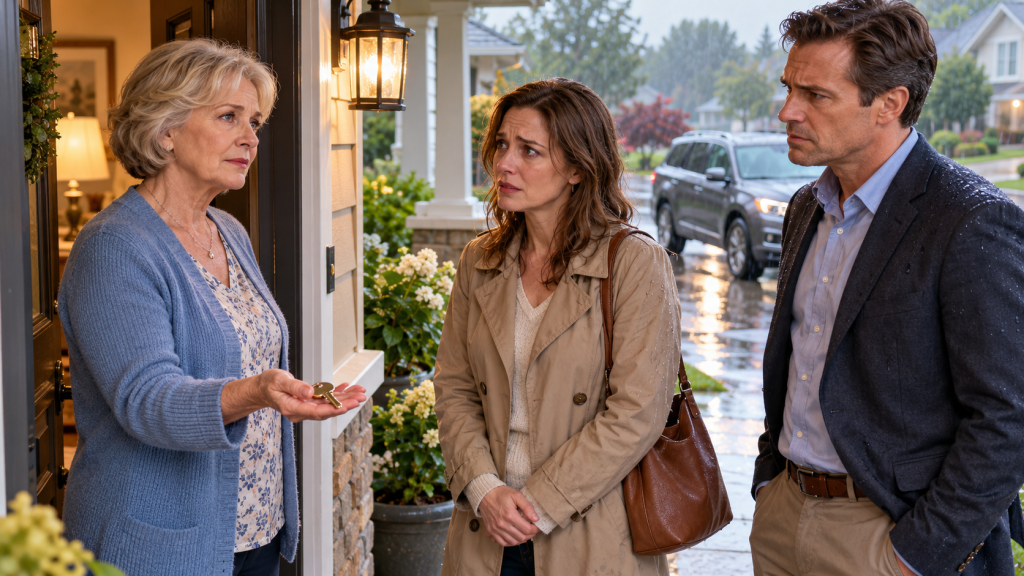
➡️ PART 3 ENDING PART➡️
“Mom… there’s something about the house you don’t know.”
I stopped turning Michael’s letter over in my hands.
For a few seconds, the only sound in the garage was the low hum of the old refrigerator we kept beside the workbench.
Sarah was still on the phone.
Crying.
Not loudly.
The quiet kind.
The kind I had learned to distrust because it usually meant my daughter was deciding how much truth she could afford to give me.
I sat on Michael’s old wooden stool beside the red tool chest.
“What about the house?”
Sarah inhaled.
“David refinanced things.”
“What does that mean?”
“It wasn’t exactly a refinance.”
“Sarah.”
“We took out a home-equity line.”
My fingers tightened around the paper.
“When?”
“Eighteen months ago.”
I closed my eyes.
Eighteen months.
I had been sending twelve hundred dollars every month toward their mortgage for four years.
Eighteen months earlier, Sarah had sat at my kitchen table eating chicken soup and told me how relieved she was that my help was “finally letting them get ahead.”
I remembered the exact words because I had gone to bed that night feeling useful.
Useful.
What a dangerous word.
“How much?”
I asked.
Silence.
“Sarah.”
“Seventy-eight thousand.”
I stood up so quickly the stool scraped backward.
“Seventy-eight thousand dollars?”
“I know.”
“No.”
“You obviously do not know because I had to drag that number out of you.”
“Mom—”
“What was it for?”
Sarah cried harder.
“David’s business.”
“All of it?”
“No.”
“How much?”
“About forty-two.”
My stomach tightened.
“The rest?”
“Credit cards.”
“How much?”
“Almost nineteen.”
I pressed my fingers against my forehead.
“That’s sixty-one.”
“I know.”
“What happened to the other seventeen?”
Another silence.
Then:
“The basement.”
I looked toward the ceiling of my garage as if the answer might be written there.
“The home theater.”
“It wasn’t supposed to be a home theater at first.”
I laughed.
There was nothing funny in it.
“What was it supposed to be?”
“A client space.”
“For David’s company.”
“He wanted a place to bring potential investors and customers.”
“In your basement?”
“It was cheaper than leasing an office.”
“And the television Martha saw?”
Sarah did not answer.
“How much was it?”
“Mom.”
“How much?”
“Thirty-eight hundred.”
I closed my eyes.
“And yesterday you stood on my porch and told me you didn’t have twelve hundred dollars for the mortgage.”
“It’s financed.”
That sentence almost impressed me.
People can make anything sound affordable if they break the cost into enough pieces.
“So you don’t have thirty-eight hundred dollars.”
“No.”
“You have another thirty-eight hundred dollars of debt.”
Sarah began crying again.
I sat back down.
Michael’s letter rested in my lap.
Love is not the same as financing every consequence away.
My dead husband had apparently been waiting six years to become relevant.
I asked:
“Are you behind on the mortgage?”
“Not yet.”
“What does that mean?”
“The first mortgage is current.”
“Because my transfer covered part of it.”
“Yes.”
“And the equity line?”
Silence.
“Sarah.”
“We missed last month.”
I stared at the red tool chest.
“How much is the payment?”
“It changes.”
“How much was the last one?”
“Eight hundred and sixty.”
My stomach turned.
“So you have the mortgage.”
“The home-equity payment.”
“The SUV.”
“The phones.”
“Storage.”
“Credit cards.”
“And whatever debt David’s business has.”
She whispered:
“Yes.”
“And when you texted me telling me to stay out of your life, you expected me to continue paying twelve hundred on the house and four-fifty on the car?”
“I didn’t think about it like that.”
“How did you think about it?”
“I don’t know.”
“No.”
I said quietly.
“You do.”
“That is exactly why you called me back.”
She breathed.
Then:
“I thought the money was separate.”
There it was.
The sentence that changed everything.
“What?”
“I thought…”
She struggled.
“You’ve been helping for years.”
“I thought even if we needed space, you wouldn’t want Leo affected.”
My throat tightened.
“So you thought access to me was optional, but access to my pension was permanent.”
“No.”
“It sounds like that.”
“Mom, please.”
I closed my eyes.
I loved her.
That was the problem.
Not because love made me weak.
Because love made me want to translate every ugly sentence into something kinder before it could hurt her.
I had done that for years.
Sarah is overwhelmed.
David is stressed.
Young families have expenses.
Leo deserves stability.
A mother helps.
Michael’s letter crackled beneath my hand.
I asked:
“Did you sign the home-equity paperwork?”
“Yes.”
“Did David forge anything?”
“No.”
“Did he lie to you about what you were signing?”
“No.”
That mattered.
I did not want Sarah turning her husband into a villain simply because the consequences had become frightening.
“So you agreed.”
“Yes.”
“Why didn’t you tell me?”
She started crying harder.
“Because I knew what you’d say.”
“What?”
“That we couldn’t afford it.”
“Could you?”
“No.”
There.
The truth.
I leaned against the workbench.
“Come over.”
“What?”
“You heard me.”
“David—”
“Not David.”
Silence.
“I want you to come here alone.”
“Why?”
“Because I want to understand what is happening.”
“And because if your husband is standing beside you, I don’t know whether I’m hearing what you think or what you two have agreed to say.”
“That’s unfair.”
“Maybe.”
I looked at Michael’s letter.
“But you asked me for distance.”
“I am allowed to be careful about how I reenter.”
She went quiet.
Then:
“I’ll come.”
“Bring every statement.”
“What?”
“Mortgage.”
“Home-equity line.”
“Credit cards.”
“Vehicle loan.”
“Business loans if you have access.”
“Phone bill.”
“Storage contract.”
“Everything.”
“Mom, I’m not asking you to pay—”
“Good.”
I said.
“Because I’m not.”
Silence.
Then:
“What are we supposed to do?”
I looked at my husband’s handwriting.
Love is not the same as financing every consequence away.
“You are going to figure out what your life actually costs.”
Then I hung up.
Sarah arrived forty-five minutes later.
No designer handbag.
No makeup.
No David.
She carried a grocery bag full of papers.
Of course.
My daughter had inherited my filing system.
Which was to say she did not have one.
She stood on the porch looking younger than thirty-eight.
For a moment, I saw her at seven.
Missing front tooth.
Knees always bruised.
Running into my kitchen whenever life hurt because I knew where the Band-Aids were.
The old instinct rose.
Bring her inside.
Feed her.
Tell her everything will be all right.
I did bring her inside.
I made coffee.
I did not promise the rest.
We sat at the dining table.
The same table where I had stared at her message the morning before.
Please don’t contact us anymore.
Sarah glanced toward my phone.
Then at me.
“I’m sorry.”
I waited.
“For what?”
Her face tightened.
“The message.”
“What part?”
“Mom.”
“No.”
I said gently.
“I’m learning something.”
“What?”
“That ‘I’m sorry’ can become another way of rushing past details.”
Her eyes filled.
“I want the details.”
She looked down.
Then began.
“I’m sorry I sent you a message telling you to stay out of my life instead of having an adult conversation.”
I nodded.
“I’m sorry I called your questions negativity.”
My throat tightened.
“What questions?”
She knew exactly.
“When you asked why we were taking another vacation.”
“When you asked whether we really needed the SUV.”
“When you said David’s business should be paying for itself by now.”
“When you asked why Leo’s school account was overdue if we had just redone the basement.”
There it was.
I had not imagined it.
For months, every time I noticed the arithmetic did not make sense, Sarah accused me of judging them.
I had eventually stopped asking.
She continued.
“I was embarrassed.”
“About what?”
“That you were right.”
My anger softened slightly.
Not gone.
She looked at her hands.
“David said every conversation with you made him feel like he was being audited.”
I almost smiled.
“Perhaps because the numbers were bad.”
“He said you didn’t respect him.”
“Did you think I didn’t?”
She hesitated.
“Yes.”
“Why?”
“Because you kept questioning the business.”
I leaned forward.
“I questioned whether a business that required me to subsidize your housing and car for four years was actually supporting your family.”
“That is not the same thing as disrespecting him.”
“I know that now.”
I waited.
She continued.
“Last week, after you asked whether we had considered selling the SUV, David got angry.”
“I remember.”
“He said we needed boundaries.”
“Your message used that word.”
“Yes.”
“Did he write it?”
Sarah looked at me.
“No.”
That answer mattered.
“I wrote it.”
“Did he tell you to?”
“He said we should take space.”
“But I wrote it.”
“Sent it.”
“My choice.”
Good.
Painful.
Honest.
I nodded.
“Thank you for not blaming him for your part.”
She cried.
“I thought you would keep paying.”
There it was.
Again.
No prettier version.
“Why?”
Sarah wiped her face.
“Because Dad always said family money wasn’t conditional.”
My breath stopped.
Michael.
Of course.
“What exactly did your father say?”
“That when you help your children, you don’t keep score.”
I looked toward the garage.
My husband’s letter.
The canceled checks.
The records.
The irony was almost cruel.
“When did he say that?”
“Years ago.”
“What was happening?”
She frowned.
“I don’t remember.”
“I do.”
She looked up.
“You were twenty-six.”
“You had a medical bill after your emergency surgery.”
“Your insurance denied part of it.”
“Your father and I paid the difference.”
“That was not the same as paying your mortgage because you chose a lifestyle you cannot afford.”
Sarah looked away.
“I know.”
“Do you?”
“I’m trying.”
Good.
I opened the grocery bag.
“Then let’s start.”
The numbers were worse than I expected.
Not catastrophic.
Not impossible.
Worse.
Their first mortgage payment was $2,140.
My $1,200 transfer had covered more than half.
They paid the rest.
The home-equity line now required just under nine hundred dollars a month.
The SUV loan was $712.
My $450 transfer had hidden most of that burden too.
Their phones cost $284 because they upgraded frequently and carried device payments.
I had been paying the base family plan.
They carried eleven thousand dollars on two credit cards even after using the equity line to pay off previous balances.
David’s business had business debt too, but Sarah did not know the full amount.
That alarmed me more than anything.
“How do you not know?”
“He keeps business separate.”
“That is normal.”
I said.
“But your house equity went into that business.”
“Your household income covers his shortfalls.”
“You need to know the exposure.”
She looked ashamed.
“I know.”
Then I found the store financing statement.
Television.
Sound system.
Reclining chairs.
Projector equipment.
Six thousand four hundred dollars.
Not thirty-eight hundred.
I slid it toward her.
“You told me the television was thirty-eight.”
“The television was.”
“The rest…”
She looked at the paper.
“I didn’t know all of this was on the same account.”
My stomach tightened.
“Sarah.”
“I’m serious.”
“David ordered some of it.”
“After we talked.”
“When?”
She read the dates.
Three weeks earlier.
I sat back.
So much for a client space built eighteen months ago.
They were still adding to it.
While I postponed replacing a window seal because twelve hundred dollars had to leave my account on schedule.
For the first time that day, anger became simple.
Not complicated by motherhood.
Not softened by excuses.
I was angry.
I said:
“Do you know how much money I’ve given you in four years?”
Sarah went pale.
“No.”
“Neither did I.”
“I started adding last night.”
I opened my folder.
“Mortgage help alone: fifty-seven thousand six hundred.”
She stared.
“Car transfers: twenty-one thousand six hundred.”
Her mouth opened.
I continued.
“Storage: seven thousand two hundred.”
“Phone plan and device help: just under six thousand.”
“Repairs.”
“Leo’s camp.”
“Dental bill.”
“Two emergency insurance deductibles.”
“Your water heater.”
“Your refrigerator.”
I looked at the total.
“A little over one hundred five thousand dollars.”
Sarah started crying.
I did not stop.
“More than one hundred five thousand.”
“I didn’t…”
She covered her face.
“I never added it.”
“Neither did I.”
“That was my mistake.”
I looked around my dining room.
“My coat lining is stitched twice.”
“The guest-room window leaks cold air.”
“I haven’t replaced the bathroom faucet because every month I told myself you needed the money more.”
Sarah lowered her hands.
“Mom.”
“I am not saying that because I expect repayment.”
“I gave it.”
“That matters.”
“I chose.”
“But I need you to understand what your message did.”
Tears filled my eyes now.
“You told me my involvement was too much after I had spent four years making myself smaller financially so your family could live larger.”
Sarah sobbed.
“That is the part I am going to have to forgive.”
Not the money.
The blindness.
Sarah stayed for five hours.
We did not solve her life.
That was important.
We made three lists.
Must pay.
Can cut.
Need more information.
The first list contained the mortgage.
Utilities.
Food.
Insurance.
Minimum debt payments until they had a proper plan.
The second list was longer.
Storage.
Subscriptions.
Gym memberships neither used.
Meal delivery.
Premium cable.
The home theater additions.
The SUV, possibly.
Vacations.
Device upgrades.
The third list was mostly David’s business.
That list frightened Sarah.
Good.
Not because fear is healthy.
Because ignorance had been expensive.
At one point she looked at me.
“What would you do?”
Old Amber almost answered.
Immediately.
Sell the SUV.
Close the business.
Sell the house.
Leave David.
Move closer.
Work full-time.
My mouth even opened.
Then I remembered Michael’s letter.
Financing every consequence away was not the only way I had over-functioned.
I also solved.
Decided.
Directed.
Then wondered why everyone treated me like management.
I said:
“I would make different choices than you.”
“That doesn’t mean my choices are yours.”
She looked frustrated.
“I need help.”
“I am helping.”
“No.”
“I mean tell me what to do.”
I leaned back.
“No.”
Her face fell.
“Why?”
“Because if I decide everything, then six months from now you can blame me for the parts you hate.”
“That’s not fair.”
“It’s not a punishment.”
“I will sit with you.”
“I will help you read statements.”
“I will help you find a certified financial counselor.”
“I will watch Leo while you meet with one.”
“I will even pay for one session with an attorney if you need to understand your legal obligations.”
Her eyes lifted.
“But I am not paying your debts.”
“And I am not choosing your marriage.”
She was quiet.
Then:
“That’s what Dad’s letter said?”
I froze.
I had not told her about it.
She saw my face.
“What letter?”
I looked toward the garage.
For several seconds, I considered lying.
Then smiled sadly.
“Apparently your father had better timing dead than alive.”
I brought Michael’s letter inside.
Sarah recognized the handwriting before I sat down.
Her face broke.
“Where did you find that?”
“In his tool chest.”
She touched the envelope.
“Can I read it?”
I hesitated.
It was addressed to me.
Then:
“Yes.”
She unfolded it.
Read.
The first page listed payments we had made for her during Michael’s final years.
A rent deposit.
Car repair.
Medical bill.
One month of childcare.
Nothing outrageous.
But enough for him to notice a pattern.
Then the line:
Amber, if Sarah ever starts treating your help like something she is owed, please stop before you disappear inside her life.
Sarah cried immediately.
I wanted to take the letter back.
Protect her.
Then remembered that protection and avoidance are not always the same.
She continued.
I love our daughter, but love is not the same as financing every consequence away.
Sarah stopped.
“He wrote that?”
“Yes.”
“When?”
“The date is four months before he died.”
Her lips trembled.
“Why didn’t he tell me?”
“Maybe because he was talking to me.”
“Maybe because he thought I needed the warning more.”
That was painful to admit.
She read the rest.
Michael had written:
We taught Sarah we would catch her. That was not always wrong. She is our child. But if we catch her every time before she learns what caused the fall, then eventually she may confuse rescue with gravity.
Sarah laughed through tears.
“That sounds like Dad.”
“Yes.”
Then:
Don’t make help a secret contract where you expect gratitude forever. If you give, give cleanly. If you cannot give without resentment, say no. Both are more honest than martyrdom.
That line was for me.
Not Sarah.
I felt it again.
For years I had congratulated myself for being generous while quietly resenting them for accepting what I kept offering.
That was not entirely fair either.
Sarah looked at me.
“You were angry at us before the message.”
“Yes.”
“Why didn’t you say anything?”
I looked down.
“Because I wanted to be needed.”
The words surprised me.
Even though they were true.
Sarah stared.
I continued.
“After your father died, this house became so quiet.”
“You had David.”
“Leo.”
“A whole life.”
“And every time you called saying you needed something…”
I swallowed.
“It made me feel useful.”
“Connected.”
“I told myself I was only helping you.”
“But part of me was buying a role.”
Sarah’s face crumpled.
“Mom, no.”
“Yes.”
“I did not buy your love.”
“I know that.”
“But I used money to make saying no unnecessary.”
“That has consequences too.”
We sat with that.
Two women.
Mother and daughter.
Both discovering that generosity can become unhealthy without either person planning it.
Sarah whispered:
“I’m sorry I took it for granted.”
I nodded.
“I’m sorry I made overgiving look normal and then expected you to notice I was hurting.”
She reached across the table.
I took her hand.
Not fixed.
Honest.
Better.
David arrived at seven.
Uninvited.
Of course.
Sarah had texted him that she was still at my house.
He stood on the porch.
I opened the door but did not step aside.
Déjà vu.
“Is Sarah here?”
“Yes.”
“I need to talk to my wife.”
“You should.”
He looked at me.
“Can I come in?”
I thought.
Then:
“If Sarah wants you to.”
I called her.
Her choice.
She came to the doorway.
David looked tired.
Angry too.
“Can we talk?”
Sarah nodded.
“Here?”
“No.”
She looked at me.
“I’m going home.”
I wanted to say:
Don’t.
I didn’t.
Instead:
“Okay.”
David’s eyes moved toward the table where papers were spread everywhere.
His face tightened.
“You showed your mother our finances?”
Sarah answered before I could.
“Yes.”
“Why?”
“Because I didn’t understand them.”
“You understand them.”
“No.”
she said.
“I understand what you told me.”
“That’s different.”
His jaw tightened.
“Sarah, we talked about boundaries.”
I almost laughed.
That word again.
Sarah’s face changed.
“So did Mom.”
He looked at me.
I said nothing.
Sarah continued.
“We took seventy-eight thousand dollars against our house.”
“You put forty-two into the business.”
“We’re carrying new credit-card debt.”
“We spent more than six thousand on the basement electronics.”
“I didn’t know the total.”
“You signed.”
“Yes.”
“I did.”
She nodded.
“That’s on me.”
“But I’m not signing anything else until I know everything.”
David’s face reddened.
“Your mother is getting inside your head.”
There.
The old script.
I almost answered.
Sarah beat me to it.
“No.”
David stared.
“I called her.”
“I brought the paperwork.”
“I asked.”
“This is my head.”
I felt something inside me loosen.
My daughter.
Finally sounding like an adult instead of someone translating between husband and mother.
David looked at me.
“You’re enjoying this.”
I stared.
“No.”
He almost laughed.
“Come on.”
“You’ve never liked me.”
“That is not true.”
“You’ve questioned my business since day one.”
“No.”
“I questioned it once it had been operating for three years while my pension was helping cover your house.”
His face hardened.
“You offered.”
“Yes.”
I said.
“I did.”
“That was my mistake to manage.”
“And I have.”
“I stopped.”
His eyes narrowed.
“You can’t just pull money because you’re angry.”
“I can stop gifts.”
“That’s not what they were.”
“What were they?”
“Family support.”
I nodded.
“Then your family can support itself for a while.”
He looked at Sarah.
“See?”
She shook her head.
“No.”
“Don’t do that.”
“What?”
“Make everything between you and Mom into something I have to referee.”
David went quiet.
Sarah took her purse.
“We’re going home.”
I wanted to stop her.
Again.
Didn’t.
At the door she hugged me.
Whispered:
“Don’t restart the transfers.”
I closed my eyes.
“I won’t.”
That was the first boundary she helped me keep.
The television went back two days later.
Not because I demanded it.
Sarah told me.
The chairs too.
The sound system.
Restocking fees hurt.
Consequences usually do.
The storage unit became their problem at the end of the month.
They moved everything into their garage and basement.
Three kayaks.
Baby furniture.
Exercise equipment.
Boxes.
For two weeks, apparently they could barely park.
Good.
Not punishment.
Physics.
Objects occupy space even when your mother stops subsidizing the square footage.
Sarah transferred the phone lines.
She and David downgraded devices.
Canceled streaming subscriptions.
Sold one kayak.
Then another.
The SUV became the hardest.
Because my name was tied to the loan, I could not simply pretend it had nothing to do with me.
The lender explained my responsibility clearly.
If they stopped paying, my credit would suffer too.
I hated that.
It was the perfect symbol of our family.
I had signed something to help.
Now independence required cooperation.
I told Sarah and David:
“You have sixty days to refinance it in your own names or sell it.”
David said his credit would not qualify alone.
Sarah’s might not either.
I said:
“Then sell it.”
He looked at me like I had suggested they sell Leo.
“We need a reliable car.”
“Yes.”
“Reliable does not require this one.”
Three weeks later, they sold the SUV.
After paying the loan, there was enough left for a down payment on a used minivan.
David hated the minivan.
Leo loved it.
Life continued.
I fixed the guest-room window.
That sounds insignificant.
It wasn’t.
The contractor came on a Thursday morning.
He removed the cracked seal and damaged trim.
Replaced what needed replacing.
When he handed me the invoice, I stared at the total.
Less than one month of the mortgage assistance I had sent Sarah.
For two winters I had stuffed a rolled towel against that window because I thought repairs could wait.
I paid the bill.
Then I stood in the room with my hand against the frame.
No draft.
I cried.
The contractor looked alarmed.
“Ma’am?”
“I’m fine.”
He backed away carefully.
I laughed.
Then bought a new winter coat.
Not designer.
Warm.
Dark green.
I did not wait for a sale.
Reckless.
Martha admired it over the fence.
“Who died?”
“My financial martyrdom.”
She raised a glass of iced tea.
“About time.”
The first month without those transfers felt strange.
My account balance remained higher.
That sounds obvious.
Emotionally, it wasn’t.
On the first of the month, I woke at six and checked my banking app automatically.
No $1,200 gone.
No $450.
The numbers sat there.
Mine.
I felt guilty.
Then angry that I felt guilty.
Then guilty about the anger.
Retirement is apparently very exciting.
I opened a separate savings account.
Named it:
AMBER’S LIFE
Corny.
I didn’t care.
Every month, I transferred part of what I had previously given Sarah into it.
Not all.
Some went to house repairs.
Some to increased grocery spending because I stopped pretending canned soup was a personality.
Some to charity.
Cleanly.
No resentment.
Michael would have approved.
Probably.
Sarah and David’s finances got worse before they got better.
That was predictable.
Without my subsidies, the actual structure of their life became visible.
David’s business was not “finally making money.”
It had one profitable quarter.
Then two weak months.
The business debt was larger than Sarah knew.
Twenty-nine thousand dollars across a line of credit and business cards.
Not catastrophic.
But their house had become the emotional collateral for every risk David wanted to take.
Sarah called me after meeting with a financial counselor.
Her voice shook.
“We may have to sell.”
I sat on my porch.
The old Amber said:
I can help.
The new Amber asked:
“How do you feel about that?”
“Horrible.”
“I love that house.”
“I know.”
“Leo loves his room.”
“I know.”
“I feel like we failed.”
I looked at the tomato plants.
“Did selling your SUV mean you failed at transportation?”
“That’s not the same.”
“No.”
“But sometimes expensive things stop fitting.”
She cried.
“What would Dad say?”
I smiled sadly.
“He would probably ask what the numbers say.”
“He loved numbers.”
“Yes.”
Then:
“He would also remind you a house is not your character.”
Sarah was quiet.
“We’re not deciding yet.”
“Good.”
“Take time.”
Then she asked:
“You really won’t help with the equity line?”
My chest tightened.
There it was.
Not manipulative.
Hopeful.
Still hard.
“No.”
Silence.
Then:
“Okay.”
No screaming.
No accusation.
Progress.
I added:
“I will help you move if you sell.”
She laughed through tears.
“Free labor?”
“One weekend.”
“After that, hourly rate.”
She laughed harder.
We hung up.
I cried afterward.
Boundaries can be right and still hurt.
That is something nobody tells you.
The no-contact message stayed between us.
We did not pretend it had never happened.
For almost two months, Sarah and I spoke cautiously.
No daily calls.
No automatic Sunday dinner.
She came when invited.
I did not appear at her house unannounced.
I realized, uncomfortably, that I had sometimes done that.
Not constantly.
Enough.
“I was nearby.”
“I brought something for Leo.”
“I only need a minute.”
My intentions were loving.
Still, a door is a door.
Distance had revealed things on both sides.
One afternoon I asked Sarah:
“Before that message, did I overstep in ways that had nothing to do with money?”
She looked terrified.
“Are you sure you want an answer?”
“No.”
“Give it anyway.”
She thought.
“You sometimes commented on how we parent Leo.”
My mouth opened.
Closed.
Fair.
“You’d say things like, ‘When you were his age, bedtime was eight.’”
“That sounds harmless.”
“It didn’t always feel harmless.”
I nodded slowly.
“Anything else?”
“You rearranged my pantry once.”
I stared.
“It was chaos.”
“Mom.”
“Sorry.”
She smiled despite herself.
“You’d also answer questions for me when David asked.”
“That is not possible.”
She gave me a look.
Apparently possible.
I breathed.
“Okay.”
Then:
“Why didn’t you tell me?”
“We did.”
I frowned.
“When?”
“You thought we were teasing.”
That hurt.
Because I remembered.
David saying:
“Amber, one day we’re going to put a velvet rope around the kitchen.”
Me laughing.
Sarah saying:
“Mom, seriously, stop reorganizing.”
Me saying:
“You’ll thank me tomorrow.”
Oh.
I looked down.
“I’m sorry.”
Sarah touched my hand.
“Thank you.”
I swallowed.
“That doesn’t make the financial part okay.”
“I know.”
“Good.”
We were learning to hold more than one truth without using one to cancel the other.
I saw Leo regularly again.
Not because money returned.
Because he was my grandson.
Sarah called one Saturday.
“He wants to see you.”
My eyes filled.
“What did you tell him?”
“That Grandma and Mom had a grown-up disagreement and were working it out.”
Good.
No villain.
No weaponizing a child.
When Leo came through my front door, he ran into me so hard my back complained for two days.
“Grandma!”
I held him.
He smelled like grass and crayons.
“I missed you.”
“I missed you too.”
“Mom said you needed space.”
I almost laughed.
Apparently “space” had become the family word of the year.
“I did.”
“Are you done?”
“Mostly.”
He accepted that.
Then saw Michael’s red tool chest in the garage.
“What’s that?”
“Grandpa’s.”
“Can we open it?”
“Yes.”
We spent two hours sorting screwdrivers.
Leo asked what each thing did.
I only knew about half.
Michael had known all of them.
At one point Leo held up a wrench.
“Grandpa used this?”
“Probably.”
“Can I have it?”
I looked at him.
Not yet.
The words almost came.
Then I smiled.
“You can use it here.”
He nodded.
That felt right.
Inheritance should not begin with possession either.
Sometimes it begins with being shown how something works.
David and I barely spoke for three months.
That was fine.
Then one afternoon he called.
I considered not answering.
Did anyway.
“Amber.”
“Yes.”
“I owe you an apology.”
I sat.
“Go ahead.”
No cushioning.
He breathed out.
“I treated your money like revenue.”
The sentence surprised me.
“What?”
“I had it in our household spreadsheet.”
“Your mortgage transfer.”
“Car money.”
“Everything.”
“As recurring income.”
My stomach tightened.
Technically, of course he had.
Practically.
Still ugly.
He continued.
“When you canceled it, I felt like you had cut our salary.”
“That’s how entitled I had become.”
I said nothing.
“I also pushed Sarah to take distance from you because I was tired of feeling judged.”
“Did you feel judged because I asked about the business?”
“Yes.”
“Were the questions unfair?”
He paused.
“No.”
Good.
He continued.
“I wanted the benefits of having you involved without the discomfort of you noticing how dependent we were.”
There it was.
Clean.
Accurate.
“I’m sorry.”
I looked through my kitchen window.
Rain.
Same kind of rain as the Tuesday night Sarah texted me.
“Thank you.”
He sounded almost disappointed.
That was all.
No forgiveness speech.
No hug through the phone.
Just thank you.
Then he said:
“I’m selling the business.”
That surprised me.
“Why?”
“It’s not working.”
“Are you sure?”
“No.”
“I hate it.”
“But I hate what it did to us more.”
That was his decision.
I did not praise him.
Did not criticize.
I said:
“I hope whatever comes next is steadier.”
“So do I.”
He took a salaried job three months later.
Less glamorous.
Benefits.
Predictable paycheck.
He seemed embarrassed at first.
Then calmer.
Sometimes stability is not failure.
It is simply less photogenic.
Sarah and David sold the house the following spring.
Not because I forced them.
Because after the counselor showed them the five-year projection, keeping it would have required every good month to continue forever.
Good months rarely sign contracts.
They sold before they were desperate.
After paying the mortgage, home-equity line, fees, and moving costs, they had far less equity than Sarah once believed.
But they walked away without foreclosure.
Without asking me to write a check.
That mattered.
They rented a three-bedroom townhouse.
Smaller.
No finished basement.
No home theater.
Leo loved the community pool.
Children are irritatingly adaptable when adults are busy mourning countertops.
The first time I visited, Sarah looked embarrassed.
“Sorry it’s small.”
I stared.
“You have three bathrooms.”
“Two and a half.”
“Your father and I raised you with one.”
She laughed.
Then:
“I thought you’d judge it.”
My chest tightened.
“That’s something I need to work on too.”
I looked around.
The place was warm.
Lived in.
Affordable.
“Does it fit?”
Sarah smiled.
“Yes.”
“Then it’s good.”
That became enough.
The designer handbag disappeared.
I noticed.
Did not ask.
Sarah later admitted she sold several expensive things online during the downsizing.
Not because I demanded proof of suffering.
Because she finally understood that possessions could become cash without becoming tragedy.
The storage unit ended too.
They kept what mattered.
Sold.
Donated.
Threw away.
Michael’s tools remained with me.
Good.
One year after the text message, Sarah asked me to lunch.
Same rainy week.
She handed me a card.
Inside:
Mom,
One year ago I told you I wanted distance. I thought distance meant I could remove the parts of our relationship that made me uncomfortable while keeping the parts that made my life easier.
I swallowed.
I was wrong.
You were also right that I had stopped seeing your help as a gift. I saw it as infrastructure.
That word.
Infrastructure.
Perfect.
I am ashamed of that.
But I also want you to know something. When the money stopped, I was terrified. Later, I was angry. Eventually, I became grateful. Not because losing the help was pleasant, but because I finally learned what my life cost.
My eyes filled.
David and I had built a lifestyle around money we did not earn. Your transfers hid that. We helped create the situation, but your rescue made it easier to avoid looking at it.
Then:
I don’t want money between us like that again.
I looked up.
Sarah was crying.
“I mean it.”
I took her hand.
“I believe you.”
She continued.
“If Leo needs surgery someday and I’m desperate, I’m still calling you.”
I laughed.
“Please.”
“But not for a bigger car.”
“Good.”
“Or mortgage assistance because we want a nicer neighborhood.”
“Excellent.”
She smiled.
Then:
“I miss when we were close.”
My heart tightened.
“So do I.”
“Can we be again?”
I thought.
Then:
“Yes.”
“But different.”
She nodded.
“Different.”
That was the beginning of a relationship neither of us had experienced before.
Mother and adult daughter.
Not banker and beneficiary.
Not manager and dependent.
Not emergency dispatcher and caller.
Just family.
Harder.
Cleaner.
I started doing things with my money that would once have felt irresponsible.
I replaced the bathroom faucet.
Then the countertops.
Not necessary.
Wanted.
I took a six-day train trip through the Rockies with Martha.
She snored.
Denied it.
I bought a decent camera.
Took terrible photographs.
I started a woodworking class at the community center because Michael had always promised to teach me how to use half the tools in that red chest.
My first project was a small bench.
It wobbled.
Martha sat on it and said:
“This thing is a lawsuit.”
I fixed it.
Eventually.
I liked touching Michael’s tools without sadness being the only thing they carried.
He had left me a warning inside that chest.
But he had also left screwdrivers.
A level.
A measuring tape with his initials.
A life contains more than its final lesson.
I tried to remember that.
On Michael’s birthday, I took his letter to the cemetery.
Not because I thought he could read it.
Because I needed to talk.
“You were right.”
I said.
Wind moved through the grass.
“Don’t enjoy it.”
Nothing.
“Also, you were wrong about one thing.”
I unfolded the page.
“You wrote that Sarah might confuse rescue with gravity.”
I smiled.
“I confused rescuing her with motherhood.”
That part was mine.
“I liked being the person everyone needed.”
“I just didn’t like what it cost.”
My eyes filled.
“I should have said no sooner.”
Then:
“I wish you were here.”
That sentence remained true no matter how much I grew.
I sat beside his grave.
Told him about Sarah’s smaller townhouse.
David’s salaried job.
Leo’s obsession with tools.
My train trip.
The green coat.
Then I laughed.
“You would hate the coat.”
Michael had believed all winter coats should be navy or black.
Some dead husbands deserve to be ignored.
Two years after everything changed, David came to my house with a check.
I stared at it.
Nine hundred dollars.
“What is this?”
“The last amount you covered for the SUV before everything stopped.”
I looked at him.
“That was not a loan.”
“I know.”
“Then why?”
He shifted.
“I need to pay something back.”
I almost refused.
Then stopped.
Maybe this was not about me needing the money.
Maybe it was about him needing to practice accountability.
I took the check.
“Thank you.”
He looked relieved.
Then:
“I can’t repay everything.”
“I’m not asking you to.”
“I know.”
“Amber?”
“Yes?”
“I used to think you reminded me of how much I was failing.”
I waited.
He continued.
“Now I think I was angry because you made it harder to lie to myself.”
That was probably the kindest thing he ever said to me.
I smiled.
“That sounds exhausting.”
He laughed.
“It was.”
We never became close.
We became respectful.
That was enough.
Sarah went back to full-time work when Leo started middle school.
Her choice.
Not because I stopped paying.
Not because David demanded it.
She had enjoyed part-time work while Leo was small.
That mattered.
She also liked earning more.
Both could be true.
One afternoon she called.
“Guess what?”
“What?”
“I got a raise.”
“That’s wonderful.”
She sounded proud.
I waited for the old reflex:
Do you need anything?
Instead I said:
“How are you going to celebrate?”
Silence.
Then she laughed.
“Mom.”
“What?”
“You almost asked if I needed money.”
“I did not.”
“You thought it loudly.”
“Rude.”
She used part of the raise to increase retirement contributions.
That made me absurdly happy.
I kept it to myself.
Mostly.
Leo became a teenager.
Then taller than all of us.
The little boy who once climbed into my lap now ate everything in my refrigerator.
One afternoon he found Michael’s letter.
Not the whole thing.
Just the envelope with Grandpa’s handwriting.
“Can I read it?”
I thought.
Then:
“Not yet.”
“Why?”
“Because it was written to me.”
He nodded.
No argument.
Boundaries.
Look at that.
Then he said:
“Mom says Grandpa was really smart.”
“He was sometimes.”
“Was Dad bad with money?”
I stared.
Teenagers.
No warm-up.
“Why are you asking?”
“I heard them talking about the old house.”
I thought carefully.
“Your parents made some choices that cost more than they expected.”
“Did you save them?”
I smiled.
“At first.”
“And then?”
“I stopped.”
He frowned.
“Why?”
“Because sometimes helping somebody avoid every consequence can keep them from learning what needs to change.”
Leo absorbed that.
Then:
“So if I get a speeding ticket someday, you won’t pay it?”
“Absolutely not.”
“What if I cry?”
“I’ll take a picture.”
He laughed.
Good.
Years later, Sarah told me something I had not known.
The day she sent the no-contact message, she had sat in her parked car for twenty minutes before pressing send.
“Why?”
I asked.
“Because part of me knew it was too harsh.”
“Why send it?”
She looked ashamed.
“Because I wanted to feel powerful.”
That surprised me.
“Against me?”
“Against everything.”
She explained.
The debt.
David’s unstable business.
The house.
Leo.
Her embarrassment.
My questions.
“She said every time you asked if we were okay, I heard: You are failing.”
My throat tightened.
“That was not what I meant.”
“I know.”
“Now.”
She continued.
“I couldn’t control the business.”
“Or the debt.”
“Or the home-equity rate.”
“But I could control whether my mother was allowed to call.”
I sat quietly.
That was human.
Ugly.
Human.
Then she smiled sadly.
“I thought setting one dramatic boundary would make me feel less trapped.”
“And?”
“It made the person paying half my mortgage stop paying half my mortgage.”
We both laughed.
Time had softened the edge enough.
Then Sarah said:
“That was when I found out boundaries have to belong to reality.”
“What does that mean?”
“You can’t ask someone to disappear emotionally and remain financially present because that version is convenient for you.”
I smiled.
“Correct.”
She looked at me.
“You also can’t show up unannounced and call it love.”
I sighed.
“Must we bring that up?”
“Yes.”
Fair.
Our relationship became funnier once it became clearer.
Sarah started asking:
“Are you available to babysit, or am I emotionally blackmailing you?”
I would answer:
“Both. What time?”
Sometimes I said no.
She found another sitter.
Nobody died.
Sometimes she said no to me.
I learned to survive that too.
If I invited them to dinner and they had plans, I stopped answering:
“Fine.”
in the tone all mothers know is not fine.
Growth is humiliating.
The automatic transfers never restarted.
That became sacred.
Not because I never helped financially again.
I did.
Once, Leo needed orthodontic work insurance barely covered.
Sarah and David could pay.
I offered to cover a portion as a gift for his birthday.
We discussed it clearly.
Amount.
Purpose.
One time.
No automatic transfer.
No implied control.
They accepted.
I gave it cleanly.
Michael’s rule.
If you give, give cleanly.
When Sarah thanked me, I said:
“You’re welcome.”
Not:
After everything I’ve done.
Not:
Remember who helped.
Just you’re welcome.
That felt new.
Martha died when I was seventy-five.
I hated that.
No beautiful lesson.
She got pneumonia after a long illness and never fully recovered.
Before she died, she made me promise to take the train trip again.
I told her no.
She said:
“Then go somewhere else.”
Bossy woman.
After the funeral, I found myself standing by our fence.
No one leaned over it.
Silence.
Loss keeps reinventing itself.
Six months later, I used money from AMBER’S LIFE and went to Nova Scotia.
Alone.
For twelve days.
Sarah panicked more than I did.
“Are you sure?”
“Yes.”
“Do you have travel insurance?”
“Yes.”
“Share your itinerary.”
“I’ll send the hotels.”
“Location?”
“No.”
“Mom.”
“Boundaries.”
She groaned.
I laughed.
Look at us.
On my seventy-eighth birthday, Sarah gave me a new winter coat.
I stared.
Dark green.
Nearly identical to the one I had bought years earlier.
“What happened to mine?”
“It’s worn out.”
“It has life left.”
“Mom.”
I laughed.
Then checked the lining.
Beautiful.
Warm.
No repairs.
Inside the pocket was a note.
For once, let somebody else replace something before it falls apart.
I cried.
Sarah cried.
Leo, now in college, complained that women in our family made clothing too emotional.
He was correct.
David’s business failure became something he talked about openly eventually.
Not with pride.
Without shame.
He said:
“I kept calling it a business because admitting it was an expensive experiment felt worse.”
I understood.
We all have names that protect us from facts.
Support.
Boundaries.
Commitment.
Investment.
Family help.
Sometimes the right word changes everything.
He eventually became operations manager for a regional company.
Good at it.
Stable.
He and Sarah never became wealthy.
They became solvent.
There is dignity in that.
Sarah and David stayed married.
I know some people expected them not to.
I did not decide.
Neither should anyone else.
They went to counseling.
Had terrible months.
Good ones.
Learned.
Fought.
Stayed.
Not because leaving would have meant failure.
Because after the money stopped hiding the problems, they chose to address them.
That choice belonged to them.
Their marriage was never mine to fix.
Another lesson learned late.
One evening, almost ten years after the message, Sarah and I sat at my kitchen table drinking tea.
Chamomile.
The same tea I had been steeping the night she told me not to contact her.
She smiled.
“Do you remember that text?”
“Yes.”
“I wish you didn’t.”
“I am sixty-seven in that memory forever.”
“That is unfair.”
“Life is cruel.”
She laughed.
Then:
“What would you do if I sent it now?”
I thought.
“Respect it.”
Her smile faded slightly.
“Really?”
“Yes.”
“Even now?”
“Especially now.”
I took her hand.
“Love does not mean I get to override a boundary because I dislike it.”
She nodded.
Then I smiled.
“But I would still stop any recurring payments.”
She laughed so hard she nearly spilled the tea.
“Fair.”
I kept Michael’s letter.
Of course.
It lives in the red tool chest now.
Bottom drawer.
Same place I found it.
But I added my own note.
For Sarah eventually.
Not yet.
It says:
Sarah,
Your father warned me not to disappear inside your life. He was right.
But there is something he did not get to see.
You learned. So did I.
I once thought motherhood meant preventing pain whenever I could. Now I think it means loving someone enough to let them become capable.
If I helped too much, forgive me.
If I withdrew too sharply, forgive that too.
Please remember this: asking for help is not weakness. Expecting help without gratitude or limits is something else.
Give cleanly. Receive gratefully. Say no before resentment turns love into bookkeeping.
And replace your own windows before financing anyone else’s home theater.
Love, Mom
Michael would appreciate the last line.
Probably.
My house looks different now.
New window.
New faucet.
New coat hooks by the door.
The red tool chest in the garage.
One of Leo’s crooked shelves on the wall because he built it when he was fourteen and insisted it was level.
It is not.
I keep it anyway.
Not every mistake needs correcting.
Only the ones that make the structure unsafe.
That may be true of families too.
I no longer pay for storage.
No family phone plan.
No one else’s mortgage.
No one else’s car.
The first of the month arrives quietly.
My pension comes in.
My bills go out.
A transfer moves automatically into AMBER’S LIFE.
I kept the name.
At eighty, I have earned corniness.
Sometimes I use that money for travel.
Sometimes house repairs.
Sometimes nothing.
Money sitting there no longer makes me feel guilty.
It feels like a promise I finally learned to keep to myself.
The strangest thing about the whole story is that when Sarah sent:
Please don’t contact us anymore,
I thought I was losing my daughter.
In a way, I was.
I lost the version of her who believed my money would always arrive whether or not the relationship did.
She lost the version of me who believed usefulness guaranteed closeness.
Good.
Those two women loved each other.
They were also exhausting each other.
What came after was better.
Not easier.
Better.
There is a sentence people use about boundaries.
They say boundaries show you who respects you.
Maybe.
I think boundaries also show you where your own habits have become confused.
Sarah drew hers badly.
Cruelly.
I responded literally.
Then both of us discovered what had been tangled underneath.
Money.
Grief.
Need.
Control.
Fear.
Love.
None of it fit into one text message.
Most families don’t.
If I could go back to that rainy Tuesday at 9:45, I would still cancel the payments.
Immediately.
I would still take back my key.
I would still remove my belongings from the storage unit.
I would still refuse to subsidize the home theater, the oversized SUV, or a house they could not afford.
But I would understand one thing sooner.
Stopping money was not revenge.
It was information.
For them.
For me.
It told Sarah and David what their life actually cost.
It told me how much of my identity had become wrapped around solving problems nobody had asked me to keep solving forever.
The truth was expensive.
Still cheaper than another decade of pretending.
And the phone calls?
Yes.
They came.
That morning.
Again that afternoon.
For weeks.
At first, they were about money.
Then logistics.
Then anger.
Then apologies.
Eventually they became ordinary again.
Sarah calling to say:
“Mom, Leo made the team.”
“Mom, do you remember Aunt Joan’s pie recipe?”
“Mom, I got the promotion.”
“Mom, are you free for lunch?”
Those were the calls I had wanted all along.
Not because someone needed a mortgage transfer.
Because my daughter wanted me.
There is a difference.
It took us losing the first kind of dependence to rediscover the second kind of closeness.
Last Christmas, the whole family came to my house.
Sarah.
David.
Leo.
His girlfriend.
Too much food.
Too many coats by the door.
David brought wine.
Sarah brought dessert.
Leo fixed the loose handle on my garage cabinet using one of Michael’s screwdrivers.
After dinner, Sarah stood at the sink.
“Need help?”
I asked.
She smiled.
“No.”
Then:
“Actually, yes.”
Progress.
We washed dishes together.
No silent scorekeeping.
No one proving anything.
At one point she nudged me.
“What?”
I asked.
“You know what’s funny?”
“Probably not.”
“If I had never sent that text, you might still be paying our mortgage.”
I looked at her.
“Possibly.”
“That’s horrifying.”
“Yes.”
She laughed.
“So technically I saved you a fortune.”
I stared.
Then splashed dishwater at her.
She shrieked.
David shouted from the other room:
“Healthy boundaries!”
We all laughed.
Even me.
Especially me.
After everyone left, I sat alone at the kitchen table.
Chamomile tea.
Rain against the windows.
Just like that first night.
But the guest-room window no longer leaked.
The house felt warm.
My phone sat beside the sugar bowl.
Quiet.
I did not need it to ring.
That mattered.
On the counter lay Michael’s old measuring tape.
Leo had forgotten to return it to the tool chest.
I picked it up.
Ran my thumb over his scratched initials.
M.M.
Michael Mitchell.
My husband.
Gone for years.
Still occasionally right in irritating ways.
I smiled.
“You told me.”
I whispered.
“You told me to stop.”
The house answered with silence.
That was okay.
I finally knew what to do without being told.
My daughter once asked me to disappear from her life.
I respected the words.
Then discovered she had never imagined my money disappearing too.
For a while, that hurt enough to make me wonder whether she had loved me or merely depended on me.
The answer turned out to be less dramatic.
She loved me.
And depended on me.
And took me for granted.
And resented me.
And needed me.
And later learned to need me differently.
Human beings are rarely one thing.
Neither was I.
I was generous.
And controlling sometimes.
Self-sacrificing.
And quietly resentful.
Loving.
And afraid of being unnecessary.
The healing came when we stopped needing one of us to be completely wrong.
Sarah had crossed a line.
So had I in smaller ways over many years.
Her message forced the truth into daylight.
Then we had to live with it.
That was the hard part.
That was also the useful part.
I do not believe parents should punish adult children by turning money into obedience.
That is not what I wanted.
If Sarah had said:
“Mom, I need space, but can we talk about how we unwind the financial help you’ve been giving us?”
I would have respected that conversation.
Maybe helped them transition for a month.
Maybe not.
We would have discussed it.
But she told me to stop contacting her while assuming my account would continue contacting hers automatically.
That was not a boundary.
That was entitlement with better vocabulary.
I needed to stop participating.
So I did.
And once I stopped, all of us became responsible for what was actually ours.
Sarah’s mortgage.
David’s business.
Their car.
Their storage.
Their marriage.
My home.
My money.
My loneliness.
My choices.
My life.
Responsibility sounds less romantic than love.
I think healthy love needs a lot of it.
Michael’s letter said:
If you cannot give without resentment, say no.
I wish I had learned that at forty.
Fifty.
Even sixty.
I learned it at sixty-seven.
Late is still a time.
So now, when someone asks for help, I pause.
Not dramatically.
Just long enough to ask myself:
Do I want to?
Can I afford to?
Will I resent this later?
Am I helping with a problem, or helping someone avoid looking at the problem?
Sometimes the answer is yes.
Sometimes no.
Both can be loving.
That may be the most expensive lesson I ever learned.
Fortunately, I finally stopped paying tuition.
THE ENDTHE END STORIES! THANK YOU FOR READING GOOD LUCK !❤️
Related Posts