➡️ PART 3 ENDING PART➡️
Dad hadn’t just violated Grandma Ruth’s condition.
He had secretly borrowed against the house.
For a long moment, I stared at the scanned document on my phone while Emma sat beside me beneath the Christmas blanket.
The tree lights blinked softly in the living room.
Red.
Gold.
Green.
Outside, a thin layer of snow had begun settling over the sidewalk.
Everything looked painfully peaceful.
I zoomed in on the final paragraph again.
The language was legal and dense, but the meaning was simple enough.
When Grandma Ruth transferred the property to my parents twenty-three years earlier, she had not handed it over without conditions.
She had retained certain rights.
The property was intended to remain a family residence.
It was not supposed to be sold, transferred, or significantly encumbered without written consent while she was alive.
And if certain conditions were violated, her attorney could petition to enforce the reversion provisions written into the original agreement.
I looked at the next attachment.
A mortgage document.
My father’s signature.
My mother’s signature.
Loan amount:
$312,000.
Date:
Fourteen months earlier.
My stomach tightened.
I opened the third attachment.
An authorization form.
At the bottom was Grandma Ruth’s name.
A signature beside it.
I stopped breathing.
Emma noticed.
“Mom?”
I enlarged the page.
The signature looked like Grandma’s.
Almost.
But I had seen her handwriting my whole life.
Grandma Ruth wrote her capital R with a long first stroke that curved backward.
This one didn’t.
I called her immediately.
She answered on the first ring.
“What did you find?”
I did not want Emma hearing the details until I understood them, so I stood and walked into the laundry room.
I shut the door.
“Grandma.”
“Yes?”
“There’s a consent form attached to the loan.”
Silence.
“It has your signature.”
Longer silence.
Then:
“I never signed a consent form.”
My heart began pounding.
“Are you sure?”
Grandma’s voice became sharp.
“Kate.”
“I know what I sign.”
I closed my eyes.
“Okay.”
“Send it.”
I did.
Thirty seconds later, she called again.
“That is not my signature.”
No hesitation.
No confusion.
Nothing.
“It looks close.”
“That is because whoever copied it had access to my handwriting.”
My stomach turned.
“Grandma…”
“Do not accuse anyone.”
“I wasn’t going to.”
“Yes, you were.”
Fair.
Her voice softened slightly.
“We let the attorney handle facts.”
“Not anger.”
That woman had been waiting ninety years to become terrifying in the calmest possible way.
“What happens now?”
“I don’t know yet.”
“But I know this.”
Her voice tightened.
“Your father borrowed against a house he knew carried restrictions.”
“And somebody supplied a document bearing my name.”
“That gets answered.”
I looked through the small laundry-room window.
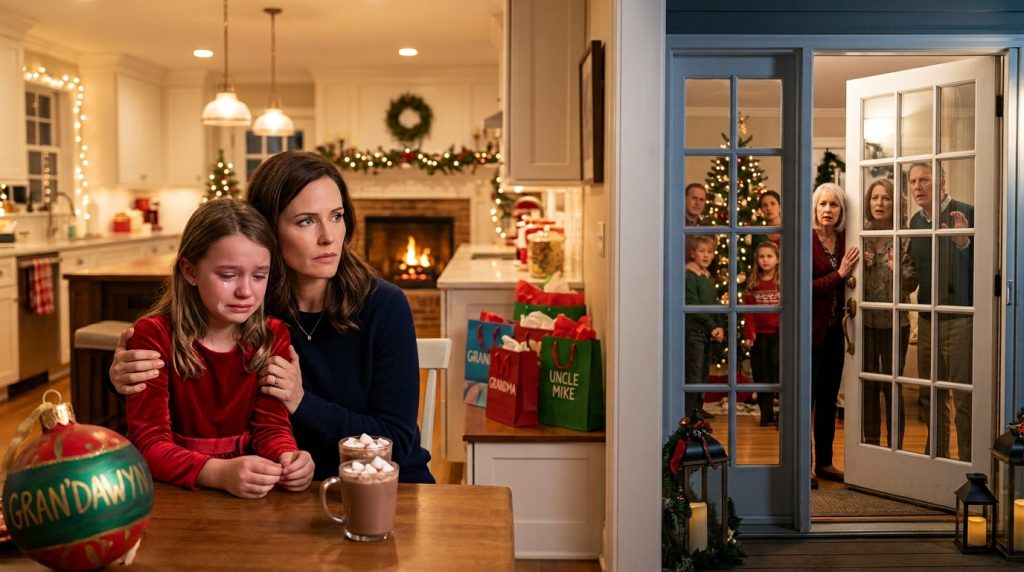
Emma sat at the kitchen table holding the handmade ornament my mother had refused to take.
Gold letters:
GRANDMA
My anger returned so quickly it made me dizzy.
“Five hours ago they told an eleven-year-old to walk home alone.”
“I know.”
“And now we’re talking about a forged signature.”
“I know.”
“Grandma, what happened to this family?”
Her answer came quietly.
“Too many people were protected from small consequences.”
I said nothing.
She continued.
“Then one day they became comfortable with bigger things.”
Dad called again at 9:26.
Then 9:28.
Then 9:31.
I let the phone ring.
At 9:35, Mom texted.
Kate, this has gone far enough. Your grandmother doesn’t understand the legal situation. Call us before you make this worse.
I nearly laughed.
They had turned away my child.
Borrowed against Grandma’s house.
Possibly submitted a document she said she had never signed.
And somehow I was still the person making things worse.
Old habits are remarkable.
Emma looked at the message over my shoulder.
“Grandma says Great-Grandma is confused?”
“Apparently.”
“Is she?”
“No.”
Emma nodded.
Then:
“Should I be scared?”
That question erased every fantasy I had about marching to my parents’ house and watching them panic.
My daughter did not need spectacle.
She needed safety.
I put the phone facedown.
“Not tonight.”
“What about their house?”
“That is adult paperwork.”
“What about Christmas?”
I sat beside her.
“What about it?”
“Is everyone mad at me?”
“No.”
“Grandpa sounded mad in his text.”
“He is scared.”
“Because of me?”
“No.”
I took her hand.
“Emma, I need you to hear this until it becomes boring.”
She watched me.
“Adults make choices.”
“Adults handle the consequences of those choices.”
“You walking to their house did not create the deed.”
“You wearing a red dress did not create the loan.”
“You bringing presents did not create whatever happened with Great-Grandma’s signature.”
“And telling the truth did not cause any of it.”
Her eyes filled.
“But if I hadn’t told Great-Grandma…”
“Then the paperwork still would have existed.”
“Only we might not have known.”
She thought about that.
Then:
“So telling is different from causing.”
My throat tightened.
“Yes.”
“Exactly.”
I would repeat that sentence to her for years.
Grandma’s attorney, Mr. Bernard Hale, called at ten.
He sounded tired.
Professional.
Not dramatic.
Good.
He explained the situation more carefully than Grandma had.
“The deed structure is unusual but enforceable enough that the lender should have required clear documentation of Mrs. Ruth Warren’s consent before accepting the property as collateral.”
“Should?”
I asked.
“There are title questions.”
“How did the loan close?”
“We are determining that.”
“Can Grandma just take the house back?”
“No.”
That answer surprised me.
Part of me was relieved.
Another part disappointed.
Mr. Hale continued.
“Real estate disputes do not resolve themselves because someone behaved badly at Christmas.”
Fair.
“The reversion language gives your grandmother significant rights.”
“But enforcement may require notices, title review, lender involvement, and possibly court action.”
“What happens to my parents tomorrow?”
“Tomorrow?”
“Likely nothing visible.”
I looked toward Emma.
“What about the loan?”
“The lender has been notified that consent is disputed.”
“They will review their file.”
“If the authorization was defective, they have a serious problem.”
“And if it was forged?”
“That is a separate issue.”
“Criminal?”
“Potentially.”
He paused.
“But we are not there yet.”
Good.
Facts.
Not revenge.
“Your grandmother does not want anyone removed from the property tonight.”
“I didn’t think she did.”
“She is angry.”
“I noticed.”
“She is also careful.”
Then:
“Kate, do not go over there tonight.”
I almost smiled.
“Grandma already tell you I might?”
“She knows you.”
“I wasn’t going to.”
Good lie.
He continued.
“Keep your daughter home.”
“Save every message about what happened.”
“Write down what Emma told you while it is fresh.”
“Do not coach her.”
“Do not post anything publicly.”
“And let tomorrow be tomorrow.”
I looked at my daughter.
Tomorrow.
That was enough.
At 10:42, someone knocked.
Not rang.
Knocked.
Hard.
I stood.
Emma froze.
My stomach dropped.
I checked the doorbell camera.
Dad.
Of course.
Coat open.
Snow on his shoulders.
No Mom.
I almost ignored him.
Then he knocked again.
“Kate.”
His voice came through the door.
“We need to talk.”
Emma whispered:
“Is he mad?”
I looked at her.
“He doesn’t get to come in if you don’t want him to.”
Her eyes widened.
My father had never needed permission to enter my house.
Not really.
He had a key until two years earlier.
He was Grandpa.
Family.
Automatic access.
That night, I waited for my daughter.
She thought.
Then shook her head.
“No.”
That was all I needed.
I stepped onto the porch and closed the door behind me.
Dad stared.
“You locked me out?”
“No.”
“I came outside.”
“Same difference.”
Snow drifted between us.
“You need to call off your grandmother.”
“I can’t.”
“Don’t play games.”
“I am not controlling Grandma Ruth.”
“She’s ninety.”
“She is eighty-eight.”
Dad looked irritated.
“She’s upset.”
“Yes.”
“Because Emma gave her some distorted version—”
I stepped closer.
“No.”
My voice stayed quiet.
“Do not finish that sentence.”
He stared.
“What?”
“You can be angry at me.”
“You can be angry at Grandma.”
“You do not blame my eleven-year-old for telling what happened to her.”
Dad exhaled.
“Nobody is blaming Emma.”
“You just said distorted version.”
“Because children don’t always understand context.”
I almost laughed.
“What context explains refusing to let her use a phone?”
Dad went silent.
“What context explains telling her to walk home alone after dark?”
“It was still light.”
I stared at him.
That was his defense.
Not:
I didn’t say that.
Not:
I thought someone was coming.
It was still light.
My father heard himself too late.
I said:
“You told an eleven-year-old to walk home carrying presents because you couldn’t find a chair.”
“We had twenty-three people.”
“You own folding chairs.”
“It wasn’t about a chair.”
Finally.
I went still.
“What was it about?”
Dad looked toward the driveway.
Then:
“Dana was upset.”
There it was.
Aunt Dana.
“What did Dana have to do with Emma?”
“She and you have been tense.”
“Dana and I have barely spoken in six months.”
“Exactly.”
“What?”
Dad rubbed his forehead.
“She thought it would be uncomfortable.”
“For who?”
“Everyone.”
I stared.
“Emma is eleven.”
“I know.”
“Did Dana ask you to turn her away?”
“No.”
“Did Mom?”
Dad did not answer.
My heart sank.
“Dad.”
“Your mother thought it would be easier.”
That word.
Easier.
The word adults use when they want to make cruelty sound logistical.
“Easier than what?”
He sighed.
“Logan and Emma have been having problems.”
I laughed bitterly.
“Logan mocks her every time they’re together.”
“Kids tease.”
“He is fifteen.”
“She is eleven.”
“He laughed at her dress tonight.”
Dad looked away.
“You knew?”
“I heard afterward.”
“Did anyone stop him?”
Silence.
I had my answer.
“So instead of correcting the fifteen-year-old who bullies your granddaughter, you removed the eleven-year-old because she was easier to remove.”
“That’s not what happened.”
“It is exactly what happened.”
Dad’s jaw tightened.
“This is why your mother says conversations with you become impossible.”
“Good.”
He blinked.
“I am done making cruelty easy to explain.”
Snow landed in his hair.
For one second, he looked old.
Then he said:
“Your grandmother is threatening our home.”
“No.”
“Your paperwork is threatening your home.”
His face changed.
I continued.
“Why did you borrow three hundred twelve thousand dollars?”
He froze.
There it was.
“You saw the documents.”
“Yes.”
Dad looked toward the street.
“That is none of your business.”
“You made it my business when Emma’s Christmas exposed the deed.”
His face flushed.
“It was a private loan.”
“Against Grandma’s house.”
“She gave us the property.”
“With restrictions.”
“Those restrictions were outdated.”
“Then why did the lender need her signature?”
Silence.
I stepped closer.
“Did she sign it?”
Dad’s eyes met mine.
Then moved away.
I felt sick.
“Dad.”
“I was told the consent was handled.”
“By whom?”
“Kate.”
“By whom?”
He said nothing.
My stomach turned.
“Mom?”
Still silence.
I whispered:
“Oh God.”
Dad snapped:
“No one forged anything.”
“I didn’t say forged.”
His face changed.
Too late.
I stared at him.
He stared back.
There are moments when families change because someone finally says the thing everyone has been protecting from language.
I said:
“Go home.”
“Kate.”
“Go.”
“We need to fix this.”
“Yes.”
“You do.”
“Not tonight.”
“Not through Emma.”
“And not by standing on my porch trying to make me responsible for keeping Grandma quiet.”
His voice dropped.
“If we lose that house—”
I cut him off.
“Then it will be because of choices adults made.”
The exact words I had told Emma.
Dad heard them.
He looked toward the front door.
Then back at me.
Something in his face broke.
Maybe shame.
Maybe fear.
He left without another word.
Emma was waiting at the kitchen table when I came inside.
“Is Grandpa okay?”
That was my child.
Turned away by him.
Still worried.
“He’s upset.”
“Is he going to lose the house?”
“I don’t know.”
She looked down.
Then:
“Did he say sorry?”
My chest tightened.
“No.”
Emma nodded slowly.
“Okay.”
That hurt more than tears.
Expectation lowering in real time.
I sat beside her.
“He should have.”
“I know.”
Then she picked up the handmade ornament.
“Can I take Grandma’s name off?”
I looked at it.
Tiny gold letters.
Her careful painting.
“You can do whatever you want with it.”
She thought.
Then:
“I don’t want to smash it.”
“Good.”
“That would feel mean.”
“Okay.”
“Can we paint over it?”
“Yes.”
“With what?”
I smiled.
“What do you want it to say?”
She looked toward our small tree.
Then at me.
“HOME.”
I cried.
Of course I did.
We found white paint.
She covered GRANDMA slowly.
Then wrote:
HOME
in gold.
We hung it on our tree.
That was our Christmas.
Not ruined.
Changed.
The next morning was quieter than I expected.
No police cars.
No eviction notice.
No dramatic lockout.
Real consequences rarely arrive wearing music.
They arrive as email attachments.
Certified letters.
Phone calls.
People saying:
“We need to review the file.”
By ten, the lender had formally opened an internal review of the consent document.
The title company did too.
Grandma’s attorney sent notice preserving her rights under the original deed agreement.
My parents were advised not to sell, refinance, or further encumber the property while the dispute was being examined.
Then Grandma Ruth called me.
“I want to see Emma.”
I looked at my daughter.
She nodded.
“Come here.”
Grandma said:
“No.”
“I’m going to your parents’ house.”
My stomach dropped.
“Grandma.”
“I am not hiding from my own deed.”
“You are eighty-eight.”
“And?”
“And Dad is upset.”
“So am I.”
I closed my eyes.
“Please don’t go alone.”
“I have Bernard.”
Of course she had the attorney.
“And Raymond.”
“Who is Raymond?”
“My neighbor.”
“Why?”
“He is nosy and large.”
I laughed despite myself.
That was Grandma.
She continued.
“You and Emma are not coming.”
“What?”
“This is not her meeting to carry.”
I looked at Emma.
Grandma was right.
“When will you call?”
“When I’m finished.”
“Grandma—”
“Kate.”
“Yes?”
“Take your daughter somewhere nice.”
“Do not make her spend the day waiting for adults to behave.”
Then she hung up.
So I took Emma ice skating.
She was terrible.
I was worse.
We fell three times.
A teenager laughed at me.
I told him age was coming for him too.
Emma laughed until she had tears in her eyes.
We drank hot chocolate afterward.
No family group chat.
No legal updates.
For two hours, the crisis existed without owning us.
That mattered.
Then my phone rang.
Grandma.
I answered.
“How bad?”
She sighed.
“Complicated.”
Not catastrophic.
Complicated.
“Mom and Dad?”
“Alive.”
“Good start.”
“Your mother admitted she signed my name.”
I stopped breathing.
Emma was choosing marshmallows at the counter.
I turned away.
“She admitted it?”
“Yes.”
“Why?”
Grandma’s voice hardened.
“Because your father was turned down for the loan without my consent.”
My stomach tightened.
“And they needed the money?”
“Apparently.”
“What for?”
Silence.
“Grandma.”
“Dana.”
Of course.
“What about her?”
“Your sister—”
“She’s my aunt.”
Grandma sighed.
“I am old.”
“Yes.”
“Dana needed money.”
“How much?”
“One hundred eighty thousand initially.”
My hand tightened around the phone.
“For what?”
“Her business.”
Aunt Dana owned a high-end home décor store that always seemed busy and never seemed profitable.
Then another memory arrived.
Her renovated kitchen.
The Caribbean trip.
Logan’s private-school tuition.
I asked:
“And the rest of the loan?”
“Some debts your parents had.”
“What debts?”
“Credit cards.”
“Property taxes.”
“Money they had already given Dana.”
My eyes closed.
There it was.
The house built to make space for family had become collateral for financing one branch of it.
“What did Mom say about the signature?”
“That she believed I would agree if asked.”
I laughed bitterly.
“So she skipped the asking.”
“Yes.”
Grandma was quiet.
Then:
“She cried.”
“Good.”
“Kate.”
“I know.”
I rubbed my forehead.
“What happens?”
“Bernard is working with the lender.”
“Your parents have choices.”
“What kind?”
“Refinance elsewhere if they can.”
“Repay enough to restructure.”
“Sell another asset.”
“Possibly sell the house under an agreed process if the deed issues are resolved.”
“Or litigate.”
“Do you want the house back?”
Grandma went silent.
Then:
“No.”
That surprised me.
“Then why invoke the clause?”
“Because if a boundary exists and everyone learns you will never enforce it, eventually it becomes decoration.”
My throat tightened.
She continued.
“I gave them the house because they had children.”
“Because Christmas at my little bungalow had become impossible.”
“I wanted a place where everyone could come.”
“I was sentimental.”
“Maybe foolish.”
“You weren’t foolish.”
“Perhaps not.”
“But I will not pretend the agreement means nothing after they signed my name.”
Then:
“I do not want your parents homeless.”
“I do want them accountable.”
Those are different goals.
I would remember that.
Aunt Dana called me that afternoon.
Her voice was ice.
“Are you happy?”
I almost laughed.
“No.”
“This is destroying Mom and Dad.”
“No.”
“You are letting Grandma destroy them.”
“Dana—”
“All because Emma wasn’t invited to one dinner?”
I stood.
“Stop.”
“No.”
“You stop pretending this is some moral crusade.”
I closed my eyes.
There it was.
The family’s great talent.
Turn a pattern into one isolated event.
One dinner.
One chair.
One child.
One loan.
One signature.
Nothing ever connected.
Except it did.
I said:
“Did you know about the loan?”
Silence.
My answer.
“How much did Mom and Dad give you?”
“That is none of your business.”
“Did you know the money came from the house?”
She hung up.
Good.
Sometimes silence is an admission wearing lipstick.
Three days later, Aunt Dana’s store closed “temporarily.”
The sign said inventory review.
The truth was that her largest supplier had not been paid.
My parents’ loan had been plugging holes in her business for over a year.
The house money was not a one-time rescue.
It was keeping a failing business alive.
Grandma’s attorney discovered another transfer.
$40,000.
Then $25,000.
Then $18,000.
Every time Dana’s store reached the edge, my parents sent something.
And every time my parents needed cash, they used the house.
Grandma Ruth listened to the numbers without blinking.
Then said:
“Your grandfather would haunt everyone involved.”
Grandpa had been an accountant.
I believed her.
My father finally called Emma six days after Christmas.
He asked me first.
That mattered.
“She wants to hear from you?”
I asked Emma.
She thought.
Then nodded.
“But speaker.”
“Okay.”
Dad’s voice sounded older.
“Emma?”
“Hi.”
Long silence.
Then:
“I owe you an apology.”
She looked at me.
I nodded once.
Dad continued.
“You came to our house because you had been invited.”
“You brought gifts.”
“You behaved kindly.”
“And I told you to leave.”
Emma’s eyes filled.
Dad’s voice broke.
“I was wrong.”
She said nothing.
“I also told you to walk home.”
“That was not safe.”
“I should have called your mother.”
“I should have driven you myself.”
“I should have made room.”
Emma whispered:
“Why didn’t you?”
There it was.
The question no adult speech could avoid.
Dad breathed.
“Because I was trying to keep other people from being uncomfortable.”
Emma frowned.
“Why was I uncomfortable for them?”
Dad stopped.
I closed my eyes.
Children ask the cleanest questions.
He said:
“You weren’t.”
Emma looked confused.
“Then why?”
Dad started crying.
I had never heard my father cry on the phone.
“Because I made a bad choice.”
“I thought it was easier to disappoint you than argue with adults.”
Emma stared at the table.
Then:
“So you knew I’d be sad.”
“Yes.”
“And you did it anyway.”
“Yes.”
His voice barely worked.
“I’m sorry.”
Emma wiped her face.
“Okay.”
Dad inhaled sharply, probably relieved.
Then Emma added:
“I’m still mad.”
I almost smiled.
Dad was quiet.
“You’re allowed to be.”
Good.
That mattered.
Then Emma said:
“I don’t want to come over yet.”
Another silence.
Dad answered:
“Okay.”
Better.
No guilt.
No:
But we’re family.
Just okay.
When the call ended, Emma looked at me.
“Did I forgive him?”
I thought.
“You accepted an apology.”
“Is that different?”
“Yes.”
“How?”
“You can believe someone is sorry without being ready to trust them again.”
She nodded.
“That’s good.”
I smiled.
“Why?”
“Because I don’t trust him yet.”
Fair.
Mom took longer.
Much longer.
Her first message to Emma said:
I’m sorry Christmas became such a misunderstanding.
I did not let Emma answer.
Not because I controlled her.
Because she asked:
“What does she mean by misunderstanding?”
I said:
“I don’t know.”
She said:
“I don’t want to talk to her.”
So we didn’t.
Mom sent gifts.
We returned them.
Not angrily.
Just unopened.
Then she sent a letter.
I read it first because Emma asked me to.
It said:
Emma, I am sorry I made you feel unwelcome.
I stopped.
Wrong.
Made you feel.
Not:
I turned you away.
I kept reading.
There was tension between adults, and I handled it poorly.
Still hiding.
I hope one day you understand families make mistakes.
I folded the letter.
Emma asked:
“Is it good?”
I looked at her.
“It is not ready.”
She nodded.
“Okay.”
I put it away.
No reply.
Consequences do not need speeches every time.
Meanwhile, the house problem became ugly.
The lender did not simply erase $312,000 because Grandma disputed the consent.
Money had been borrowed.
Spent.
The bank had its own rights.
My parents had obligations.
Grandma had rights under the deed.
The title insurer had questions.
The notarization on the consent form became a major issue.
The notary was someone who worked part-time for Dana’s business.
That was when things stopped being merely sad.
Grandma had never appeared before that notary.
Yet the document stated she had.
The notary eventually admitted she had signed the acknowledgment after Mom assured her Grandma had already approved everything.
I remember putting my head on my kitchen table when I heard.
One lie had required another.
Then another.
No mastermind.
No grand criminal plot.
Just people who kept deciding the next shortcut would fix the previous one.
That frightened me more.
No one went to prison.
Real life disappointed everyone who wanted fireworks.
The lender, attorneys, title insurer, and parties eventually negotiated.
The fraudulent notarization was reported to the appropriate authorities.
The notary lost her commission and faced penalties.
My mother had to give a formal statement.
My father too.
Their attorney told them exactly how serious submitting an unauthorized consent document could have become.
For the first time in my life, Mom stopped saying:
“But I meant…”
Intent was no longer the only thing in the room.
The financial solution hurt.
My parents had to sell their lake cabin.
Dad loved that cabin.
He had spent summers there since I was thirteen.
Selling it covered a large piece of the loan.
Dana sold inventory and closed her store permanently.
She repaid part of what Mom and Dad had given her.
Not enough.
My parents liquidated investments.
Cut expenses.
Dad delayed retirement plans.
The remaining loan was refinanced under terms that no longer pretended Grandma had consented.
The family-home deed restrictions stayed in place until Grandma chose otherwise.
She did not take the house.
She could have pursued a more aggressive remedy.
She didn’t.
When I asked why, she said:
“I want accountability.”
“Not homelessness.”
Then:
“And frankly, moving your mother into my bungalow would punish me too.”
I laughed so hard I nearly fell off the chair.
Grandma Ruth remained Grandma Ruth.
Aunt Dana blamed me for nearly a year.
At Easter, she did not speak to me.
At Grandma’s birthday, she left when Emma arrived.
Fine.
Logan once muttered something about “Drama Queen Emma.”
I heard.
So did Grandma Ruth.
That was unfortunate for him.
She turned her wheelchair toward him.
Yes, by then she used one for long outings.
“What did you say?”
Logan froze.
“Nothing.”
“My hearing is excellent.”
He looked at his mother.
Dana said:
“Mom, let it go.”
Grandma stared.
“No.”
One word.
That entire side of the table quieted.
“Logan.”
He looked at her.
“You are sixteen now.”
“Fifteen at Christmas.”
“Old enough in both cases to know that humiliating a younger child is not wit.”
His face reddened.
“I was joking.”
“Jokes are supposed to be funny to more than the boy saying them.”
I bit the inside of my cheek.
Grandma continued.
“You laughed at her dress.”
He stared at the table.
“Yes.”
“Apologize.”
Dana said:
“Mother.”
Grandma held up a hand.
“Dana, if you protect him from embarrassment every time he causes somebody else pain, you are not helping him.”
Silence.
That sentence seemed larger than Logan.
Larger than Christmas.
Larger than the house.
Protection from consequences.
Again.
Logan turned toward Emma.
“Sorry.”
Emma looked at him.
“For what?”
I nearly applauded.
He sighed.
“For laughing at your dress.”
“And?”
He looked miserable.
“For making you feel weird at Christmas.”
Emma waited.
Then:
“Okay.”
No hug.
No instant cousins again.
Just okay.
Enough.
Mom finally apologized properly nine months after Christmas.
September.
Emma had started sixth grade.
She was taller.
Less interested in red dresses.
More interested in volleyball.
Mom asked if she could come by.
Emma said:
“For twenty minutes.”
I did not know where she learned negotiation.
Maybe Grandma Ruth.
Mom arrived carrying nothing.
Good.
No gifts to soften the room.
She sat on my sofa.
Emma beside me.
Mom’s hands shook.
“I wrote three letters.”
she said.
Emma nodded.
“I didn’t like them.”
Mom almost smiled.
“I know.”
Then she looked at my daughter.
“I’m going to try without a letter.”
Good.
She took a breath.
“I invited you to Christmas.”
“Yes.”
“You arrived.”
“Yes.”
“I opened the door.”
Emma’s face tightened.
Mom continued.
“And I told you there wasn’t room.”
Tears filled her eyes.
“That was a lie.”
Emma went still.
Mom cried.
“There was room.”
“Of course there was.”
“We could have brought in a chair.”
“We could have moved people.”
“We could have made room because that is what family does.”
Emma stared.
“Then why didn’t you?”
Mom wiped her face.
“Because Dana was angry with your mother.”
“Logan had been complaining about you.”
“And instead of telling adults and older children to behave, I chose the person I thought would make the least trouble.”
Emma looked at me.
Then back at Mom.
“You chose me because I was a kid.”
“Yes.”
Mom’s voice broke.
“I chose you because I thought you would go quietly.”
My heart cracked.
That was the truth.
Ugly.
Clean.
Emma’s eyes filled.
“I did.”
“I know.”
“You walked away quietly.”
Mom sobbed.
“I watched you.”
I stared.
“What?”
Mom looked at me.
“I watched from the window.”
My stomach turned.
“You watched her walk home?”
“I thought your father had told her to call you.”
Dad had not.
Emma whispered:
“You saw me?”
Mom covered her mouth.
“Yes.”
“Why didn’t you come get me?”
Mom could barely speak.
“Because I had already made the wrong decision.”
“And instead of admitting it, I kept making it.”
There.
That sentence.
That was the whole family story.
One wrong decision protected by the next.
Emma cried.
Mom said:
“I am sorry.”
“Not for making you feel unwelcome.”
“I made you unwelcome.”
“I turned away my granddaughter on Christmas.”
“I refused you a phone.”
“I let you walk home.”
“I was wrong.”
No excuses.
Finally.
Emma took a long breath.
Then:
“I don’t want to sleep at your house yet.”
Mom nodded.
“Okay.”
“I don’t want Logan there when I visit.”
Mom hesitated.
Only half a second.
Then:
“Okay.”
“And I want you to take the ornament.”
I looked at Emma.
She stood.
Went to the tree-storage box in the hall closet.
The ornament was inside.
Not the original version.
The painted-over one.
HOME
Mom took it carefully.
Her face crumpled when she saw the word.
Emma said:
“I don’t want you to change it back.”
Mom shook her head.
“I won’t.”
“Keep it.”
Mom held it against her chest.
“I will.”
That was the beginning.
Trust returned slowly.
As it should.
Mom came to Emma’s volleyball games.
She asked before sitting beside us.
Dad picked Emma up from school once when I had a work emergency.
He called me three times to confirm the plan.
Probably excessive.
I appreciated it.
At Thanksgiving, Emma agreed to spend two hours at their house.
She brought no gifts.
Nobody expected any.
Logan was not there.
Dana did not come.
The dinner was smaller.
Grandma Ruth sat at the head of the table.
Of course.
At one point she looked around and said:
“Funny.”
“What?”
Dad asked.
“We have all these empty chairs.”
Nobody laughed at first.
Then Emma did.
That gave everyone permission.
The tension broke.
A little.
The house never felt quite the same again.
Maybe because once you know a building can be used as a symbol, you stop confusing it with the family itself.
Grandma Ruth had given them walls.
What happened inside had always been their responsibility.
That was the lesson.
Not:
Grandma can take your house if you are mean.
Emma never learned that.
I made sure of it.
She learned:
Promises written down matter.
Permission matters.
Adults can lose privileges when they abuse them.
Apologies do not erase consequences.
And no building is more important than the person standing outside its door.
Grandma Ruth died two years later.
Ninety.
In her own bed.
Surrounded by people she had bossed for nearly a century.
Emma held her hand that afternoon.
So did I.
Mom sat on the other side.
Near the end, Grandma opened her eyes and looked at Emma.
“Did they make room?”
Emma knew exactly what she meant.
She smiled.
“Yes.”
Grandma nodded.
“Good.”
Then she looked at me.
“Kate.”
“Yes?”
“Paperwork.”
Even dying.
I laughed through tears.
“What about it?”
“Read it.”
Mom started laughing too.
Grandma smiled.
“Finally somebody learns.”
She died that night.
Her will surprised everyone.
Not because of money.
There wasn’t much.
Grandma had already given away most of what she intended to give.
The family-house deed was addressed separately.
After the loan situation was stabilized, Grandma had amended the long-term arrangement.
My parents retained the right to live there during their lifetimes under clear conditions.
But afterward, the house would not automatically pass to Dana.
Or me.
Or any single branch of the family.
Grandma created a small family trust governing the property.
The trust could keep the house for family use or sell it according to rules designed to prevent exactly what had happened before.
No secret loans.
No unilateral transfers.
No one person deciding family property was private collateral.
And one sentence in the accompanying letter made all of us cry.
A house does not make a family. If keeping this one ever makes you cruel to one another, sell it.
That was Grandma.
Practical even in sentiment.
My parents stayed in the house.
They changed.
Not perfectly.
Dad finally retired.
Mom volunteered at a community center twice a week.
Dana rebuilt her life after the store closed.
She took a salaried job for the first time in twenty years.
She hated it for six months.
Then admitted she liked leaving work at work.
Our relationship remained distant.
Not hostile.
Some relationships do not need to return to what they were.
Sometimes peace is enough.
Logan grew up.
That surprised all of us.
At nineteen, he called Emma on her birthday.
No joke.
No insult.
He said:
“I was awful to you when we were younger.”
She said:
“You were.”
He laughed.
Then:
“I’m sorry.”
She accepted.
They did not become best friends.
They became cousins who could share a table without somebody bleeding emotionally.
Progress.
Emma never forgot that Christmas.
Neither did I.
For years, December made her restless.
The week before Christmas, she would check her phone battery twice before leaving home.
That detail broke me the first time I noticed.
Trauma can hide inside small habits.
So we changed Christmas.
Not to erase the old one.
To build something new.
Our house became open on Christmas afternoon.
Not a grand event.
Soup.
Bread.
Desserts.
Anyone we loved who had nowhere comfortable to go could come.
No formal invitations required.
No perfect table.
We owned twelve folding chairs.
On purpose.
The first year, six people came.
The second, eleven.
By the time Emma was seventeen, twenty-seven people passed through between noon and evening.
Neighbors.
Friends.
One classmate whose parents were divorcing.
Martha from three houses down.
Dad.
Mom.
Sometimes Dana.
Sometimes not.
Grandma Ruth’s old recipe for apple cake sat on the counter.
And above the kitchen doorway hung Emma’s ornament.
HOME
Every year.
When Emma was sixteen, she asked me something while we were hanging lights.
“Mom?”
“Yes?”
“Do you think Grandma and Grandpa would have changed if Great-Grandma hadn’t threatened the house?”
I stopped.
Hard question.
“I don’t know.”
She untangled a wire.
“Do people only change when something hurts?”
“Sometimes.”
“That’s sad.”
“Yes.”
Then I thought.
“But not always.”
She looked at me.
“Sometimes consequences just make it impossible to keep pretending.”
She considered that.
“So the house didn’t change them.”
“No.”
“It made them look.”
“Exactly.”
She smiled.
“I like that better.”
So did I.
Dad sold the lake cabin and never bought another one.
For years, I thought he resented Grandma for that.
Eventually, he told me:
“I miss the cabin.”
“I know.”
“But I’m glad we sold it.”
That surprised me.
“Why?”
He looked toward Emma, who was helping Mom carry food into the kitchen.
“Because every time I think about it, I remember there was a moment when I was more upset about losing property than I was about sending my granddaughter out the door.”
His eyes filled.
“That scares me.”
I said nothing.
He continued.
“I needed something to cost me.”
I looked at him.
“Not because I deserved punishment.”
“Because if nothing changed, I might have convinced myself it wasn’t that serious.”
That was honest.
I hugged him.
The first time after Christmas.
It had been almost three years.
He cried into my shoulder.
So did I.
Forgiveness can be slow enough to become real.
Mom kept the HOME ornament until she died.
Many years later.
By then Emma was grown.
Married.
With a daughter of her own.
When we cleaned Mom’s things, we found the ornament wrapped separately in tissue paper.
Beside it was a note.
Mom had written:
For Emma. I once told her there was no room. She taught me that room is something people make.
Emma sat on the floor and cried.
Then laughed.
“Grandma got dramatic.”
“Age does that.”
She looked at me.
“Should I keep it?”
“That’s your choice.”
She did.
Emma became a teacher.
Third grade.
Of course.
Maybe because she understood what it meant to be the smallest person in a room full of adults.
Maybe not.
I stopped turning every choice into a response to Christmas.
She was allowed a life unrelated to one terrible evening.
When she bought her first house, it was tiny.
Two bedrooms.
One bathroom.
At the housewarming, Dad—older now, slower—looked around.
“This is cozy.”
Emma smiled.
“Not much space.”
Everyone froze.
Then she laughed.
“So we’ll make some.”
Dad closed his eyes.
He deserved that.
Then he smiled.
“Yes.”
“We will.”
At Emma’s wedding, my parents sat in the second row.
Not because of punishment.
Because the front row was for me and the groom’s parents.
Dad did not complain.
Mom was already gone by then.
Dana came.
Logan came with his wife.
Family had changed shape.
During the reception, Emma gave a speech.
She thanked people.
Made jokes.
Then she looked at me.
“When I was eleven, my mother taught me something I didn’t understand until I got older.”
I immediately started crying.
She smiled.
“She taught me that being rejected from one room does not mean you are unwanted in the world.”
My hands covered my face.
Emma continued.
“She also taught me you should always charge your phone before family events.”
Everyone laughed.
Even Dad.
Then she lifted her glass.
“To the people who make room.”
We drank to that.
Years after Grandma Ruth died, the old family house was finally sold.
My parents had lived there until Dad moved into a smaller place near me.
The trust no longer needed to keep a huge house for a family scattered across three states.
We voted.
Yes, voted.
Grandma had built rules for everything.
Sell.
Unanimous.
The buyer was a family with four children.
On closing day, Dad asked if he could walk through one last time.
Emma and I went with him.
The dining room was empty.
No Christmas table.
No music.
No Dana.
No Logan.
No rejected child on the porch.
Just sunlight.
Dad stood near the front door.
“This is where she was.”
he whispered.
Emma knew.
She was twenty-eight then.
“Yeah.”
Dad touched the doorframe.
“I have replayed it a thousand times.”
Emma looked at him.
“Me too.”
“I always open the door in the replay.”
Her face softened.
“But you didn’t.”
“No.”
Silence.
Then Emma said:
“Grandpa.”
“Yes?”
“You can’t fix that Christmas.”
His eyes filled.
“I know.”
“But you fixed a lot after.”
Dad cried.
That was enough.
We left the keys on the kitchen counter.
Walked out.
The house became someone else’s.
Family survived.
Proof.
The proceeds from the sale were divided according to Grandma’s trust.
Some to my parents’ remaining needs.
Some to family beneficiaries.
A portion to charity.
Emma received a modest amount.
When she saw the check, she laughed.
“What?”
I asked.
“This whole story started because they said there wasn’t space.”
“And?”
“Now the house is money.”
I smiled.
“Buildings are temporary.”
She nodded.
Then donated part of her share to a local organization that provided emergency housing for families with children.
I cried.
She rolled her eyes.
“Mom.”
“What?”
“You cry at tax-deductible donations now?”
“Apparently.”
She kept the rest.
Good.
No one needed sainthood.
People sometimes hear what happened and focus on Grandma Ruth “taking back the house.”
That is not what happened.
She never stormed in with movers.
She never threw my parents onto the lawn.
She never used property to humiliate them.
She used the paperwork to stop pretending choices had no cost.
The house did not disappear five hours after Christmas dinner.
Their certainty did.
That was what unraveled first.
The certainty that Grandma’s gift had no conditions.
The certainty that Mom could sign what she wanted.
The certainty that Dad could borrow quietly.
The certainty that Dana would always be rescued.
The certainty that Emma would go away without anyone having to look too closely at why.
That was the collapse.
Not brick.
Entitlement.
I am grateful Grandma did not turn the house into revenge.
At first, I wanted her to.
I imagined Mom and Dad standing on the sidewalk with suitcases.
Ugly thought.
Honest thought.
Then I looked at Emma.
What would that have taught her?
That power makes cruelty acceptable if you use it for the right side?
No.
Grandma taught something better.
Enforce the boundary.
Tell the truth.
Let adults repair what they damaged.
Do not become them while holding them accountable.
That lesson took longer.
It was worth more.
For months after Christmas, I worried Emma would believe family love was conditional.
One bad dinner can become a child’s whole theory of belonging if nobody helps them rewrite it.
So I became deliberate.
When plans changed, I told her why.
When adults were upset, I reminded her adult feelings were not her job.
When she made mistakes, I corrected the behavior without threatening the relationship.
When she said no to relatives, I did not call her rude simply because she was younger.
And when she asked:
“Are you mad at me?”
I learned to answer honestly.
“About this thing, yes.”
“But I still love you.”
Children should not have to guess whether anger means exile.
Years later, Emma told me the worst part had not been the walk.
Not Logan laughing.
Not even Grandma refusing the ornament.
It had been standing on the porch and hearing everyone inside.
Laughter.
Plates.
Music.
People she knew.
A whole room continuing without her.
“I thought if nobody came outside,” she said, “maybe that meant everybody agreed.”
My heart broke all over again.
“Some didn’t know.”
“I know now.”
“But Aunt Dana knew.”
“Yes.”
“Grandpa knew.”
“Yes.”
“Grandma knew.”
“Yes.”
She looked at me.
“And nobody came.”
I could not repair that.
So I said:
“I’m sorry.”
She nodded.
Then:
“But you came home.”
My eyes filled.
“Yes.”
“That mattered.”
Sometimes parenthood is arriving after the hurt and refusing to leave a child alone with its meaning.
I could not change the porch.
I could change what she learned from it.
Every Christmas Eve after that, before bed, Emma and I had one ridiculous tradition.
We counted chairs.
Not because we expected dozens of guests.
Because the joke became ours.
“Kitchen?”
“Six.”
“Dining room?”
“Eight.”
“Folding chairs?”
“Twelve.”
“Emergency stools?”
“Three.”
Then Emma would say:
“So?”
And I would answer:
“There is always room.”
As she got older, she rolled her eyes more.
Still asked.
Even after moving out, she texted:
Chair count?
I replied:
Enough. Always.
The year she had her first baby, Christmas happened at my house again.
Her daughter, Sophie, was four months old.
Mom was gone.
Dad used a cane.
Grandma Ruth had been gone for years.
Time had done what it always does.
Removed people.
Added others.
We had twenty-one guests.
At four in the afternoon, the doorbell rang.
A teenage boy stood outside.
I recognized him as the son of one of Emma’s neighbors.
He looked embarrassed.
“Mrs. Kate?”
“Yes?”
“My mom said Emma told us…”
He stopped.
Emma appeared behind me.
“Tyler.”
His shoulders relaxed.
His parents had had a terrible fight.
Police were at the house.
He did not want to be there.
Emma stepped aside.
“Come in.”
He looked at the crowded living room.
“Is there space?”
My heart stopped.
Emma looked at me.
I looked at her.
Years disappeared.
Red dress.
Gift bags.
Cold street.
Locked-out child.
Then Emma smiled.
“We’ll make some.”
We did.
Dad heard.
He turned his face away and cried.
I saw him.
Said nothing.
Some moments do not need narration while they are happening.
Later that night, after everyone left, Emma stood beside our tree holding Sophie.
The old ornament hung near the top.
HOME
She touched it.
“Funny.”
“What?”
“This thing used to say Grandma.”
“I remember.”
She smiled.
“I think home was better.”
“So do I.”
Then she looked down at her baby.
“What if I mess her up?”
I laughed softly.
“You will.”
“Mom.”
“We all do.”
“That is not comforting.”
I touched Sophie’s tiny foot.
“You will make mistakes.”
“The goal is not never hurting your child.”
“That is impossible.”
“The goal is to notice.”
“To listen.”
“To apologize without making them comfort you.”
“To change.”
Emma looked at the ornament.
“Like Grandma eventually did.”
“Yes.”
“And Grandpa.”
“Yes.”
She nodded.
“Okay.”
Then:
“But if I ever turn Sophie away on Christmas, you can haunt me.”
“Gladly.”
Dad died at eighty-one.
Emma was beside him.
So was I.
Near the end, he was confused sometimes.
One evening he kept asking:
“Did she get home?”
I did not understand.
“Who?”
“The red dress.”
My throat closed.
Emma was sitting by the window.
She heard.
She came closer.
“Grandpa.”
He looked at her.
For one second, completely clear.
“You got home?”
Emma took his hand.
“Yes.”
He cried.
“I’m sorry.”
She bent and kissed his forehead.
“I know.”
Then:
“I got home.”
His eyes closed.
He died two days later.
I do not believe one sentence erased anything.
But I am grateful he heard her answer.
After the funeral, Emma and I went through his desk.
We found a small envelope.
Her name.
Inside was a photograph.
The old family house.
Christmas lights around the doorway.
No date.
On the back Dad had written:
A door is only useful if you open it.
Underneath:
I learned too late that being the head of a family does not mean deciding who deserves a place inside it.
Emma read it twice.
Then handed it to me.
“You keep it.”
“Why?”
“I don’t need it.”
That was not rejection.
It was healing.
She no longer needed evidence that he had regretted what he did.
She already knew.
I kept the photograph.
Still have it.
I am older now.
Old enough that Christmas mornings come faster.
Old enough that Emma worries about me carrying heavy dishes.
Old enough that Sophie is almost the age Emma was that night.
That terrifies me a little.
Sometimes Sophie wears red.
The first time she did at Christmas, I had to leave the room for a minute.
Memory is strange.
It can turn fabric into weather.
But I came back.
Always.
That is the point.
Sophie knows the story in pieces.
Not the legal drama.
Not yet.
She knows her mother once had a bad Christmas.
She knows Great-Great-Grandma Ruth was “scary in a good way.”
Accurate.
She knows the ornament used to say something else.
One year she asked:
“What?”
Emma looked at me.
Then said:
“It used to have someone’s name.”
“Whose?”
“Doesn’t matter.”
Sophie frowned.
“Why paint over it?”
Emma smiled.
“Because sometimes objects need new meanings.”
Sophie accepted that.
Children often do.
Adults are the ones who keep arguing with symbolism.
The original handmade gift bags Emma carried home that Christmas are gone.
Paper tears.
Ribbon frays.
Food spoils.
The ornament remains.
Grandma’s legal papers are archived.
The loan was repaid years ago.
The store closed.
The lake cabin belongs to another family.
The old house belongs to strangers.
Almost everything that felt enormous that Christmas became temporary.
Except what we learned.
That stayed.
We learned that “family” is not a word that makes harmful choices harmless.
We learned that age does not make a child less deserving of respect.
We learned that adults sometimes call something “easier” when they mean easier for themselves.
We learned that generosity without boundaries can become permission people were never actually given.
We learned a signature matters.
A promise matters.
A door matters.
And sometimes the most important person in the family is the one standing outside it.
People have asked whether I regret calling Grandma Ruth that Christmas night.
Never.
I regret that Emma had a reason to make the call.
I regret leaving her at my parents’ house assuming invitation meant safety.
I regret not seeing sooner how often Logan’s teasing was dismissed because confronting Dana was inconvenient.
I regret every moment I taught Emma to tolerate something because “that’s just how family is.”
But telling the truth?
No.
I will never regret that.
Silence protects the person who benefits from the arrangement.
Truth gives everyone else a chance to choose differently.
Five hours after my parents turned my daughter away, their lives did begin to unravel.
But not because I screamed.
Not because Grandma magically took a house.
Not because we launched some perfect revenge.
What unraveled was the network of excuses holding everything together.
The secret loan.
Dana’s dependence.
Mom’s forged consent.
Dad’s silence.
Logan’s bullying.
My habit of keeping peace.
Emma’s belief that being polite meant accepting rejection.
Once one thread came loose, we saw how many knots had been hidden beneath it.
Some relationships survived.
Some changed.
Some never returned to what they were.
That was not destruction.
That was reality becoming visible.
The last Christmas Dad spent with us, he arrived early.
Very early.
I opened the door at ten in the morning.
He stood there holding two folding chairs.
I stared.
“What are those?”
He smiled.
“Insurance.”
I started crying.
“Dad.”
“What?”
“We have enough chairs.”
“I know.”
He carried them in anyway.
Emma saw him.
She stopped.
Then laughed.
“Grandpa.”
“What?”
“You’re ridiculous.”
“Yes.”
He set the chairs beside the wall.
“No one gets sent home.”
Emma’s smile softened.
“No.”
“Nobody does.”
That was the closest our family ever came to a perfect Christmas.
Not because the past disappeared.
Because everyone remembered it and behaved differently.
And if there is one image I keep above all the others, it is not my parents’ faces when they realized Grandma could challenge the house.
Not Aunt Dana’s store closing.
Not the legal papers.
Not the lake cabin sale.
Not even Dad bringing those two folding chairs.
It is my daughter at eleven.
Sitting at my kitchen table.
Red dress wrinkled.
Hair messy.
Hot chocolate cooling between her hands.
Every present she had lovingly wrapped still sitting by the door.
She thought she had ruined Christmas.
She thought being turned away meant she had done something wrong.
And I remember kneeling beside her and saying:
“You never apologize for being mistreated.”
At the time, I thought I was teaching Emma.
Years later, I realized I was teaching myself too.
I had spent decades apologizing for other people’s discomfort.
Smoothing.
Explaining.
Forgiving before apologies arrived.
Calling silence peace.
Emma’s Christmas ended that.
Not with revenge.
With clarity.
A child had stood at a family door and been told there was no space for her.
Everything that happened afterward came down to one simple truth:
There had always been space.
What had been missing was courage.
Courage to move a chair.
Courage to correct a bully.
Courage to tell an angry sister no.
Courage to ask before borrowing.
Courage to admit a signature was wrong.
Courage to apologize without excuses.
Courage to let consequences happen.
And eventually,
courage to open the door again.
That is why the ornament still hangs on our tree.
The gold letters are uneven now.
Emma was eleven when she painted them.
The white paint beneath has cracked enough that, in certain light, you can almost see the old name underneath.
We never repaint it.
We do not need to erase where it came from.
We only need the word that came after.
HOME.
And every Christmas, before anyone arrives, I count the chairs.
Not because I am afraid we will run out.
Because I remember the girl who was told there wasn’t one for her.
Then the doorbell rings.
I open the door.
And whoever is standing there hears the same thing:
“Come in.”
THE END STORIES! THANK YOU FOR READING GOOD LUCK !❤️
Related Posts