➡️ PART 3 ENDING PART➡️
“And so do you.”
Mom looked at me when she said it.
Not at the hostess.
Not at Antonio.
At me.
Her eyes were wet, but there was something steady beneath the tears.
Something almost mischievous.
As if my seventy-eight-year-old mother had spent half a century carrying a story in her pocket and had finally decided the pocket was too heavy.
The young hostess stood frozen behind the reservation stand.
The color had drained from her face.
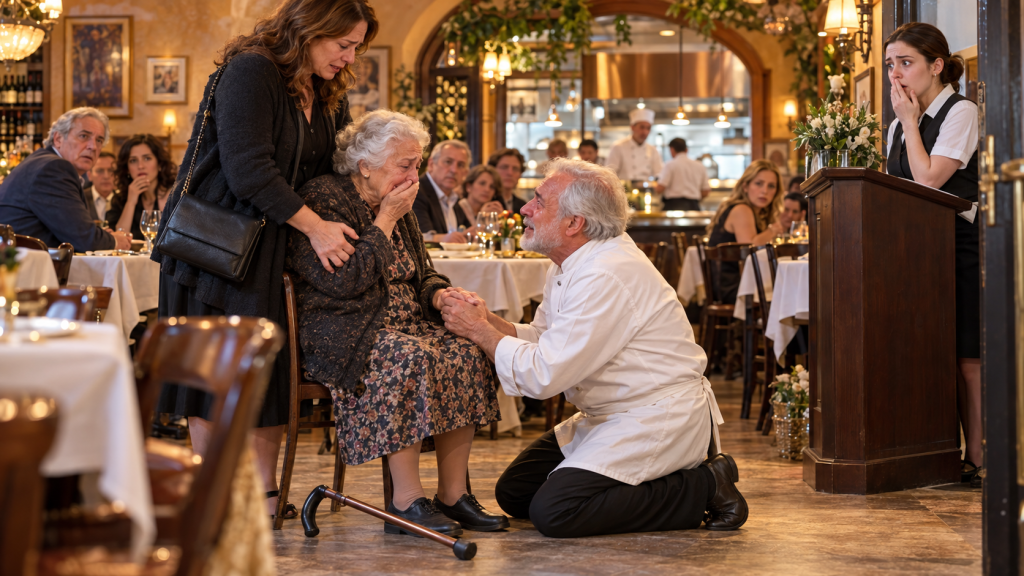
Antonio was still holding Mom’s hand.
Then the girl whispered:
“Grandpa?”
That one word changed the room again.
I stared at her.
Then at Antonio.
Grandpa?
The young woman who had looked at my mother’s orthopedic shoes and called her cheap was the restaurant owner’s granddaughter.
Antonio slowly rose from his knees.
He did not let go of Mom’s hand.
“Yes, Gianna.”
His voice was quiet.
The kind of quiet that frightened more than shouting.
Gianna looked as though she wanted the floor to open beneath her.
“I didn’t know who she was.”
Mom’s expression changed.
Not anger.
Sadness.
“Oh, sweetheart.”
She said it so gently that somehow it sounded harsher than if she had screamed.
“That is exactly the problem.”
Gianna’s lips parted.
Nothing came out.
Mom bent carefully, picked up her cane, and straightened.
Antonio tried to help her.
She waved him away.
“I am old, Antonio.”
She said.
“Not porcelain.”
For the first time, the old man laughed.
It came out broken by tears.
“That hasn’t changed.”
“Neither has your dramatic entrance.”
“You made me drop a plate.”
“I did nothing.”
“You walked into my restaurant after fifty-eight years.”
Mom shrugged.
“I was hungry.”
A few diners laughed softly.
The tension loosened for one breath.
Then Antonio looked at Gianna.
It returned.
“Did you tell them we were fully booked?”
Gianna swallowed.
“Yes.”
“Are we?”
“No.”
“Is there a minimum spend tonight?”
She hesitated.
Antonio’s face changed.
“Gianna.”
“No.”
The word was barely audible.
A murmur moved across the dining room.
My anger, which had been simmering beneath shock, flared again.
“You made it up?”
Gianna looked down.
“I was trying to—”
“To what?”
I demanded.
She looked at me, then away.
Antonio’s voice remained controlled.
“Answer her.”
Gianna’s cheeks burned.
“To keep the room…”
She stopped.
Mom waited.
“To keep the room what?”
Gianna whispered:
“Upscale.”
I actually laughed.
Not because it was funny.
Because sometimes cruelty sounds so ridiculous when someone is forced to say it plainly.
Mom looked around the restaurant.
White tablecloths.
Candles.
Wineglasses.
Old black-and-white photographs of Italian villages on the walls.
A vase of fresh rosemary on every table.
Then she looked back at Gianna.
“And you thought an old woman with a cane would damage the scenery?”
Gianna’s eyes filled with tears.
“I’m sorry.”
Mom nodded.
“I believe you are sorry right now.”
Gianna looked almost relieved.
Then Mom continued.
“But right now everybody is looking.”
The relief disappeared.
“I am more interested in who you are when nobody important is watching.”
Antonio closed his eyes briefly.
That sentence reached him too.
Then Mom touched his sleeve.
“Don’t fire her yet.”
He looked at her.
“Lucia—”
“Yet.”
She emphasized it.
“She should hear the story first.”
Antonio stared at Mom.
Then at Gianna.
Finally, he nodded.
Mom looked at me.
“And you should hear it too.”
I suddenly felt like a child.
Not a grown woman standing beside her elderly mother.
A child about to learn that parents have entire lives hidden behind the years in which we knew them.
“Mom…”
She touched my hand.
“You always asked why I never wore gold.”
I blinked.
“What?”
She smiled faintly.
“There was a reason.”
Antonio closed the dining room for ten minutes.
Not the restaurant.
Just paused seating.
He told the waitstaff to take care of the customers already eating.
Then he led us to a large round table near the back.
The best table in the room.
Gianna remained standing until Antonio pointed toward a chair.
“Sit.”
She did.
I sat beside Mom.
Antonio sat across from her.
For several seconds, they simply looked at each other.
Fifty-eight years is a long time.
Long enough for black hair to turn white.
Long enough for hands to knot with arthritis.
Long enough for children to have children.
Long enough to believe somebody you once loved as family had disappeared completely from the earth.
Antonio whispered:
“I really thought you died.”
Mom gave a small, incredulous laugh.
“I noticed.”
“I wrote.”
“So did I.”
“For years.”
“So did I.”
Antonio stared.
“Then why did nothing—”
“Because we were poor and stupid and half the addresses in our village changed every time somebody sneezed.”
Antonio laughed.
Mom did too.
Then both of them cried again.
I looked between them.
“Would somebody please explain?”
Mom wiped beneath her eyes.
“All right.”
She looked at Gianna first.
“You want to know what your grandfather looked like when I met him?”
Gianna nodded.
Mom smiled.
“He was twelve years old.”
Antonio groaned.
“Lucia.”
“Skinny.”
“I was athletic.”
“You were starving.”
“I was lean.”
“You had one pair of trousers.”
“Very efficient.”
Mom laughed.
It was the laugh I remembered from childhood.
The laugh she used before life became heavier.
Then she looked at Gianna.
“We grew up two streets apart in a village outside Naples.”
“Our houses were small.”
“Everybody’s houses were small.”
“We did not know we were poor because nearly everyone around us was poor too.”
Antonio nodded.
“My father repaired farm equipment.”
Mom continued.
“My father laid stone.”
“My mother cooked for people whenever they could pay.”
“She could make six people believe half a chicken was a feast.”
Antonio smiled.
“She could.”
Mom looked at me.
“That tomato-and-bread soup I used to make when money was tight?”
I nodded.
I remembered it immediately.
Thick tomatoes.
Stale bread.
Garlic.
Basil.
A little olive oil when we had it.
I had loved that soup as a child.
It was only years later that I realized meals built around yesterday’s bread were often born from necessity.
“That was Nonna’s recipe.”
Mom said.
Antonio raised a finger.
“With fennel.”
Mom looked delighted.
“You remember.”
“I built a restaurant around remembering.”
Something in his voice made me look around again.
I had smelled that soup when we walked in.
I had not noticed consciously.
Mom probably had.
Maybe that was why she said she wanted to feel at home again.
Antonio continued.
“Lucia’s mother taught half the village to cook.”
Mom shook her head.
“She taught half the village to stretch food.”
“Same skill.”
“No.”
Antonio smiled.
“In a restaurant it is.”
Gianna listened silently.
Antonio looked at her.
“When my father died, I was fifteen.”
His voice changed.
“My mother had four children and almost nothing.”
“I left school.”
“Worked wherever I could.”
“Lucia’s mother let me wash pots in exchange for supper.”
Mom interrupted.
“She fed you whether you washed pots or not.”
“Your mother told me that.”
“I know.”
Antonio laughed.
Then:
“I wanted to go to America.”
Gianna looked surprised.
“You never told me that.”
Antonio’s eyes moved toward her.
“I told you I came to America.”
“You never asked how.”
The girl flinched.
He immediately softened.
“That is my fault too.”
Interesting.
He did not let her carry everything.
Mom leaned back.
“At seventeen, Antonio heard about an uncle’s friend in New York who could help him find kitchen work.”
“He had somebody willing to receive him.”
“He had paperwork.”
“He had hope.”
“What he didn’t have was enough money for the journey.”
Antonio looked down.
Gianna whispered:
“So what happened?”
Mom held out her left hand.
Bare except for a simple silver ring.
“Your great-grandmother gave me a necklace when I turned sixteen.”
I knew the photograph.
Suddenly.
A faded black-and-white image in Mom’s old album.
Mom at sixteen.
Dark hair tied back.
A tiny gold medallion at her throat.
I had asked about it once as a child.
She told me she lost it.
My mouth went dry.
“The Madonna necklace?”
Mom looked at me.
“Yes.”
“You said you lost it.”
“I lied.”
“Why?”
“Because your grandmother would have crossed the Atlantic just to haunt me if she knew.”
Antonio laughed into his hand.
Mom smiled.
Then:
“I sold it.”
I stared at her.
“For Antonio?”
“Yes.”
Antonio’s eyes filled.
“I didn’t know.”
Mom turned toward him.
“What?”
“You told me your aunt lent you money.”
“She would have if she had any.”
Antonio covered his mouth.
“Lucia…”
“You were leaving.”
“What was I supposed to do?”
“Keep your mother’s necklace.”
“And let you spend your life unloading trucks because you were twenty dollars short?”
“It was more than twenty.”
“Everything was more than twenty to us.”
He laughed and cried simultaneously.
Mom’s voice softened.
“I sold it to a jeweler in Naples.”
“I remember holding the money in my shoe because I was terrified somebody would steal it.”
“I gave it to Antonio the next morning.”
“And told him it came from my aunt because otherwise he would have refused it.”
Antonio whispered:
“I would have.”
“I know.”
Gianna was crying now.
Quietly.
Mom looked at her.
“Your grandfather left Italy with one suitcase, two shirts, and shoes with cardboard inside one sole because there was a hole.”
Gianna looked at Antonio.
“Is that true?”
He nodded.
“Yes.”
Mom continued.
“If you had been standing at a restaurant door that day, you would have looked at him once and decided he could not afford dinner.”
No one spoke.
Mom leaned forward.
“And you would have been correct.”
Gianna’s face collapsed.
“But you would have been wrong about his worth.”
There.
The whole evening in one sentence.
Antonio bowed his head.
Mom continued.
“Poverty and dignity can live in the same pair of shoes.”
“So can money and ugliness.”
“That is why judging somebody by what they wear is such a lazy way to understand a human being.”
Gianna wiped her face.
“I’m sorry.”
Mom nodded.
“I know.”
Then:
“But let me finish.”
Antonio arrived in New York at eighteen.
He washed dishes.
Then peeled vegetables.
Then cooked breakfast in a diner.
Then worked nights in an Italian restaurant in Queens.
He sent money home to his mother.
Never enough.
Always something.
Mom received postcards.
At first.
He mailed them to the village.
Pictures of New York.
Times Square.
A subway entrance.
Once, a postcard showing the Statue of Liberty with one line:
It is enormous and the coffee here is terrible.
Mom laughed when she told us.
“I kept that card for years.”
“Where is it?”
I asked.
“Probably in a box you’ve tried to make me throw away.”
Fair.
Antonio told his side.
“I sent letters too.”
“I asked whether she wanted to come.”
Mom looked at me.
That was the part meant for me.
“You know the story about how your father and I came to America?”
“Yes.”
My father, Paolo, had been a mechanic.
Work was scarce.
Mom was pregnant with me.
They decided to leave Italy.
A cousin in New York knew someone in a factory in upstate New York.
At least that was the version I knew.
Mom smiled sadly.
“Not quite.”
I stared.
“Antonio sent the first job contact.”
My head turned toward him.
He nodded.
“I had met a man at the restaurant whose brother managed a machine shop upstate.”
“I sent Lucia the address.”
Mom continued.
“Paolo wrote.”
“They offered him a position.”
“Not glamorous.”
“Enough.”
“So we came.”
I looked at Antonio.
“You helped my parents immigrate?”
He shrugged.
“Your mother helped me first.”
Mom immediately said:
“That is not why you did it.”
“No.”
he admitted.
“It isn’t.”
“Then don’t turn kindness into accounting.”
They looked at each other.
Old friends correcting each other after almost sixty years.
I felt something inside me shift.
All my childhood, I believed my mother had crossed the ocean carrying me toward a future my father had found.
Now another invisible hand appeared in the story.
Antonio.
A teenage boy who had once needed her necklace.
Then, years later, sent back an address.
A contact.
A possibility.
Mom looked at me.
“That is what you needed to hear.”
“Why didn’t you tell us?”
She shrugged.
“Because it was not a family legend.”
“It was help.”
“People help each other.”
“You say thank you.”
“You live.”
“You help somebody else when you can.”
“You do not spend fifty years making your children feel like they owe a stranger.”
Antonio stared at her.
“You never owed me.”
“I know.”
“That’s what I mean.”
I asked how they lost touch.
That answer was less poetic.
Addresses changed.
Mom and Dad moved three times in six years.
Antonio changed restaurants.
Letters came back.
A relative in the village confused Lucia with a cousin who had died after childbirth.
Antonio heard that “Lucia Moretti had died in America.”
He believed it.
Mom assumed Antonio had married, opened a life, and forgotten to write.
Neither had enough money to travel casually.
Then children came.
Work.
Years.
Mom’s Paolo died in an industrial accident when my youngest brother was five.
After that, survival swallowed nostalgia.
She cleaned offices before dawn.
Worked in a school cafeteria.
Took sewing home at night.
Raised three children.
No internet.
No easy search.
No social media.
No reunion.
Just life moving forward until people who had once known everything about each other became memories.
Antonio eventually opened his first small restaurant.
Twelve tables.
Then a larger one.
Then the bistro where we sat.
He married a woman named Maria.
They had two daughters.
One daughter had Gianna.
Maria died five years earlier.
He had retired from most day-to-day operations but still cooked several nights a week because, in his words, “retirement is a conspiracy invented by people who hate garlic.”
Mom approved.
Antonio suddenly stood.
“Wait.”
He disappeared into the kitchen.
Gianna looked at Mom.
“I really didn’t know.”
Mom sighed.
“Gianna, stop saying that as if knowing who I was would have changed what you did.”
The girl lowered her eyes.
“You are still trying to find the version where your mistake was insulting an important person.”
Gianna looked up.
Mom tapped the table gently.
“The mistake was believing only important people deserve kindness.”
I watched Gianna absorb that.
No dramatic transformation.
No speech.
Just discomfort.
Good.
Sometimes discomfort is the first honest teacher a person gets.
Antonio returned carrying a shallow white bowl.
He placed it in front of Mom.
Steam rose.
Tomato.
Garlic.
Bread.
A little fennel.
Mom froze.
“No.”
Antonio smiled.
“Yes.”
She lifted the spoon.
Tasted.
Her eyes closed.
When they opened, she was crying.
“My mother’s soup.”
Antonio nodded.
“With one change.”
“What?”
“I use better olive oil.”
Mom slapped his arm.
The entire table laughed.
Even Gianna.
Then Mom tasted again.
Slowly.
The way people eat when food is not food but a door.
I watched her face become seventeen.
For just a second.
That was worth more than any expensive birthday dinner.
Antonio insisted we stay.
Mom agreed under one condition.
“We pay.”
“No.”
“Antonio.”
“Lucia.”
“You own a restaurant, not a dictatorship.”
“You sold your necklace.”
“Fifty-eight years ago.”
“Interest.”
Mom glared.
He grinned.
Eventually they compromised.
Antonio would buy Mom’s birthday dinner.
I would leave the tip.
Mom called the arrangement corrupt.
Then ordered gnocchi.
The dining room reopened.
The story spread only as far as stories do when people are sitting twelve feet away.
Some diners pretended not to have heard.
Others smiled at Mom.
One older couple raised their wineglasses toward her.
She looked mortified.
“Why are they staring?”
“Because Antonio dropped to his knees in the middle of the restaurant.”
“I told him he was dramatic.”
Gianna no longer stood at the hostess station.
Antonio asked another employee to take over.
Gianna remained in the back office until the end of our meal.
Before we left, she came to the table.
Her makeup had been washed off.
Her eyes were swollen.
“I’m sorry, Mrs. Russo.”
Mom had married under the name Russo.
Hearing Gianna use it felt strange after spending the evening learning Lucia Moretti again.
Mom looked at her.
“For what?”
Gianna hesitated.
“For assuming you couldn’t afford to eat here.”
“Anything else?”
Gianna swallowed.
“For lying about the reservations.”
Mom waited.
“For embarrassing you.”
Mom kept waiting.
Gianna’s voice dropped.
“For thinking there was a kind of customer who deserved to be here more than you did.”
There.
Mom nodded.
“Better.”
Gianna took a breath.
“I was cruel.”
“Yes.”
I almost looked at Mom in surprise.
No softening.
Not yet.
Gianna’s eyes filled.
“I’m sorry.”
Mom said:
“I believe that you wish you had not done it.”
Gianna frowned slightly.
“That isn’t the same thing as knowing why you did it.”
Gianna went still.
Mom continued.
“You should figure that part out before you ask me to forgive you.”
Gianna nodded.
Then turned toward me.
“I’m sorry to you too.”
I wanted to say something sharp.
I had spent two hours imagining several excellent lines.
Then I looked at the young woman.
Twenty-one maybe.
Ashamed.
Not ruined.
Not irredeemable.
I said:
“I hope the next elderly woman who walks in here doesn’t need to know your grandfather to be treated well.”
Gianna started crying again.
“That’s fair.”
“Yes.”
It was.
Outside the restaurant, Mom stood beneath the awning.
The city lights reflected off wet pavement.
I helped her into her coat.
“Mom.”
“Yes?”
“You really sold Nonna’s necklace?”
She sighed.
“Are we going to make this into a federal investigation?”
“I asked you about that necklace my entire childhood.”
“You asked twice.”
“I was traumatized by your secrecy.”
“You survived.”
I laughed.
Then hugged her.
Hard.
She made an irritated sound.
“My cane.”
“Sorry.”
We pulled apart.
I looked at her.
“Why did you want to come here?”
She glanced toward the restaurant.
“My church friends said the soup tasted like the food back home.”
“You had no idea Antonio owned it?”
“None.”
“You never saw the name?”
“The restaurant is called Casa Bellini.”
“So?”
“His name is Antonio Bellini.”
Mom waved a hand.
“Do you know how many Bellinis there are in Italy?”
Fair.
Then she smiled.
“I thought maybe whoever owned it came from somewhere near us.”
She looked through the window.
Antonio was standing inside watching.
Mom waved.
He waved back.
Her eyes filled.
“I wanted one meal that tasted like before.”
“Before what?”
She thought.
“Before everything.”
That answer stayed with me.
The next morning, Antonio called Mom at 7:15.
Of course he had somehow obtained her number before we left.
Old people are terrifyingly efficient when motivated.
I was at Mom’s house bringing coffee.
Her phone rang.
She looked at the screen.
“Who is this?”
She answered.
“Hello?”
I heard Antonio’s voice immediately.
“Did I wake you?”
“No.”
Mom lied.
She had been asleep in her recliner.
He asked if he could come by.
Mom looked at me.
I shrugged.
Twenty minutes later, Antonio stood on her porch holding a paper bag of pastries.
“Bribery.”
Mom said.
“Breakfast.”
“Same thing.”
He came inside.
They sat at her kitchen table.
I started to leave.
Mom pointed.
“Stay.”
So I did.
Antonio looked more serious than the night before.
“Lucia, I need to tell you something.”
“Oh, good.”
She sighed.
“I was worried we had exhausted surprises.”
He looked at me.
Then:
“Gianna has done this before.”
The warmth left the room.
Mom’s expression changed.
“What?”
Antonio placed several printed pages on the table.
“After you left, I checked recent complaints.”
My anger returned instantly.
“What kind of complaints?”
“Customers saying they were told there were no tables.”
“Customers who later saw empty tables.”
“One complaint from a couple who said Gianna asked whether they knew the tasting-menu prices before seating them.”
Mom’s mouth tightened.
Antonio continued.
“I spoke to staff.”
“A server said Gianna sometimes delayed seating people she thought would order too little.”
“Another said she was very concerned with how the room looked for social media.”
I stared.
“So she was curating customers.”
Antonio’s face hardened.
“Yes.”
Mom was quiet.
Then:
“What did you do?”
“I suspended her.”
“Good.”
“I was going to fire her.”
Mom nodded.
“Maybe you should.”
Antonio looked surprised.
“You told me not to.”
“I said not yet.”
She lifted her coffee.
“I wanted her to hear the story first.”
“I did not promise her a job.”
Antonio laughed despite himself.
“That sounds like you.”
Mom continued.
“Is she a good worker?”
He thought.
“Usually.”
“Smart?”
“Yes.”
“Entitled?”
Antonio looked pained.
“Yes.”
Mom nodded.
“Whose fault is that?”
Antonio blinked.
“Excuse me?”
“Children learn what families teach.”
“She is twenty-one.”
“She is responsible for being cruel.”
“But if she grew up believing your restaurant is proof your family became better than the people you used to be, maybe all of you should examine that.”
Antonio sat back.
That one hurt.
Mom did not stop.
“Did she know about the cardboard in your shoe?”
“No.”
“Did she know you washed dishes?”
“Not really.”
“Did she know you slept six men to an apartment?”
Antonio looked at me.
I raised my hands.
“I’m staying out of this.”
Mom continued.
“Did she know that for your first winter in New York you owned one coat?”
“No.”
“Then what story did she grow up with?”
Antonio stared at his hands.
“The restaurant.”
“Success.”
“Her mother told her I built everything from nothing.”
Mom gave him a look.
“No one builds from nothing.”
He closed his eyes.
There it was.
Maybe Gianna was not the only person being taught.
Antonio decided not to fire her immediately.
He gave her a choice.
She could leave.
No argument.
No family pressure.
No future promises.
Or she could remain employed under conditions.
Not as hostess.
Not near the front door.
Not in management training.
She would work where Antonio had started.
The kitchen.
Dishes.
Prep.
Stock.
Then, if she stayed long enough and the staff believed she had changed, she could work tables.
I thought Mom would approve.
She surprised me.
“Do not make washing dishes sound like punishment.”
Antonio stared.
Mom continued.
“There are people in that kitchen who wash dishes for a living.”
“Do not tell your granddaughter their honest work is where bad people go to learn humility.”
Antonio nodded slowly.
“You’re right.”
So they changed it.
Gianna would work through each part of the restaurant because she claimed to want a career in hospitality and clearly did not understand what hospitality meant.
Dish station.
Prep.
Host support.
Serving.
Cleaning.
Bookkeeping.
Reservations.
And before returning to a front-facing role, she would undergo proper training and personally respond, where appropriate, to the guests whose complaints had been documented.
Not to beg for absolution.
To acknowledge what happened.
She accepted.
Maybe because Antonio was her grandfather.
Maybe because she wanted to repair something.
Probably both.
Motives do not need to begin pure to become better.
Three weeks later, Gianna came to Mom’s house.
I happened to be there.
She carried no flowers.
No expensive gift.
Good start.
“Can I come in?”
Mom looked at me.
Then at Gianna.
“Yes.”
We sat.
Gianna’s hands shook.
“I figured out why.”
Mom tilted her head.
“Why what?”
“Why I did it.”
Mom waited.
Gianna breathed.
“I liked being the person who decided who belonged.”
That was honest enough to make the room uncomfortable.
She continued.
“I’m studying hospitality management.”
“I follow all these restaurant accounts.”
“Design.”
“Luxury branding.”
“Guest experience.”
“I started thinking the room itself was a product.”
“That the people inside it had to match.”
I asked:
“Match what?”
She looked ashamed.
“Money.”
“Appearance.”
“The kind of customers who take photos and make the place look expensive.”
Mom shook her head slowly.
Gianna continued.
“At first I thought I was helping the restaurant.”
“Then I think…”
She stopped.
“What?”
Mom asked.
“I think I liked the power.”
There.
No excuse.
Gianna looked at Mom.
“I’m not asking you to tell me I’m actually a good person.”
Mom smiled faintly.
“Good.”
“I don’t know you well enough to make such a reckless statement.”
Gianna almost laughed.
Then tears filled her eyes.
“My grandfather told me he came here with almost nothing.”
“He told me about your necklace.”
“He told me he never paid you back.”
Mom’s expression sharpened.
“He did not owe me repayment.”
“I know.”
“He said you’d say that.”
“Then why repeat his foolishness?”
Gianna smiled weakly.
Then:
“I keep thinking about what I said about my grandmother.”
Mom’s face softened slightly.
My grandma isn’t some beggar.
Those words had hung over everything.
Gianna continued.
“My grandmother Maria grew up in the Bronx.”
“Her father drove a delivery truck.”
“Her mother cleaned offices.”
“She wore her sister’s old coats.”
“I knew that.”
“I just never pictured it.”
Mom nodded.
“That is different.”
“I think poor people were a category in my head.”
“Not actual people in my family.”
Silence.
Then Mom said:
“Do you know what a beggar is?”
Gianna frowned.
“Someone who asks for money?”
“Sometimes.”
Mom tapped her cane lightly against the floor.
“But the word you used did not mean someone asking for help.”
“You used it to mean someone whose dignity you thought was smaller than yours.”
Gianna cried.
“Yes.”
Mom nodded.
“Fix that.”
“How?”
Mom shrugged.
“That is your work.”
“I am old.”
“I have enough of my own.”
I almost smiled.
Gianna looked disappointed.
She had wanted instructions.
A task.
A clear route to forgiveness.
Mom refused to make kindness easy.
Then, after a moment, she added:
“Start by serving people before deciding what they can give you.”
Gianna nodded.
“I can do that.”
Mom looked directly at her.
“No.”
“You can try.”
That was more honest.
Antonio and Mom began seeing each other every Sunday.
Not romantically.
Everyone asked.
Everyone was wrong.
At seventy-eight and eighty, apparently two widowed people cannot eat soup without becoming a scandal.
Mom laughed when I asked.
“Antonio?”
She said.
“I remember when he had lice.”
“Romance is impossible after that.”
Antonio was equally horrified.
“Lucia bossed me around before I had chest hair.”
Fair.
Their relationship was stranger and better.
Two pieces of a vanished world recognizing each other.
He brought old Italian records to her house.
She corrected his memory of village gossip.
He insisted a bakery had been on Via Roma.
She insisted it was one street over.
Neither could prove it.
They argued anyway.
Sometimes I sat listening.
They spoke Italian faster than I could follow.
My mother’s voice changed in Italian.
Younger.
Sharper.
More musical.
I had always known her as Mom.
Antonio remembered Lucia.
There is a gift in meeting someone who knew your parent before parenthood turned them into a role.
I learned she had once climbed onto the church roof on a dare.
She denied it.
Antonio produced a witness by telephone.
I learned she hated anchovies even as a teenager.
I learned she had wanted to become a nurse but could not afford the schooling.
That one hurt.
“Why didn’t you ever tell me?”
I asked.
She shrugged.
“What would telling you change?”
“I could have known.”
She looked at me.
“Yes.”
That answer taught me something.
We often assume our parents’ unlived lives disappeared because they chose us.
Sometimes they simply learned to carry them quietly.
Antonio learned things too.
He learned Mom had raised three children alone after Paolo’s death.
That she cleaned offices at night.
That she once sewed alterations until two in the morning for six months to pay for my brother’s dental work.
He listened with tears in his eyes.
Mom hated when he became sentimental.
“Stop looking at me like I survived a war.”
“You did.”
“I raised teenagers.”
“Exactly.”
She laughed.
The restaurant changed.
Not overnight.
Antonio hired an outside hospitality consultant.
Not one who spoke about “upscale positioning.”
One who focused on accessibility, equitable service, conflict resolution, and consistent reservation policies.
There had never been a general minimum spend.
That lie disappeared immediately.
Special event menus had minimums.
Ordinary dinner did not.
The restaurant website clarified seating and reservation rules.
Anonymous guest feedback was reviewed.
Employees received explicit authority to question discriminatory decisions without fearing retaliation.
Antonio held a staff meeting.
Gianna later told me what he said.
“This restaurant was built by people who would not have passed the test my granddaughter invented at the door.”
Dishwashers.
Immigrants.
Busboys.
Single mothers.
Students.
People with accents.
People with patched shoes.
People who counted tips before deciding whether they could take a taxi home.
“That is our history.”
he told them.
“If we become ashamed of those people, then we become ashamed of the hands that built the kitchen.”
No plaque.
No publicity.
No press release.
Just policy.
That mattered to me more.
Gianna stayed.
At first, I assumed she would quit after a month.
She did not.
She washed dishes without pretending it was spiritual transformation.
Good.
She burned her hand once.
Complained.
The dishwasher beside her told her to wear the gloves properly.
She did.
She learned prep.
Learned how much food a restaurant wastes when somebody miscounts inventory.
Learned that the quiet man named Mateo who hauled crates every morning spoke three languages and was finishing an accounting degree at night.
Learned that the server she once treated as “just a waitress” had two children and was studying nursing.
Learned that Antonio’s fancy dining room depended on people customers rarely looked at.
Then she worked lunch service.
That was harder.
People can hide arrogance in a kitchen.
A dining room reflects it back.
She had to greet everybody.
Not selectively.
Everybody.
One afternoon, six months after Mom’s birthday, I stopped in without telling anyone.
I wanted takeout.
I also wanted to see.
Gianna was at the host stand.
Again.
That surprised me.
Apparently the staff had agreed she was ready for limited shifts.
An elderly man entered ahead of me.
Old work jacket.
Paint on one sleeve.
His wife wore a knitted hat even though it was warm.
Gianna smiled.
“Good afternoon.”
The man looked around nervously.
“Do we need a reservation?”
“No, sir.”
“We have a table available.”
He whispered something to his wife.
Then asked:
“This place expensive?”
The old Gianna might have heard insult.
Or inconvenience.
This Gianna answered:
“We have dishes at a range of prices.”
Then she took a menu from the stand.
“If you’d like, I can show you before you decide.”
No condescension.
No whispered warning.
Just information.
The man studied the menu.
His wife pointed.
“We can do that.”
Gianna smiled.
“Then we’d be happy to have you.”
She seated them.
Only then did she see me.
Her face went red.
“How long were you standing there?”
“Long enough.”
She looked nervous.
“I wasn’t performing.”
“I know.”
“How?”
“Because you didn’t know I was here.”
Her eyes filled.
That was the first time I believed Mom might eventually forgive her.
Not because Gianna said sorry.
Because nobody important was watching.
Mom’s real seventy-eighth birthday dinner happened six months late.
Antonio insisted.
“No drama this time.”
Mom said.
“I can’t control other people.”
“You control your restaurant.”
“Barely.”
He reserved the same table.
This time Gianna greeted us.
She looked at Mom’s orthopedic shoes.
Then her cane.
Then her face.
“Good evening, Mrs. Russo.”
Mom narrowed her eyes.
“Are you checking whether I upgraded my wardrobe?”
Gianna panicked.
Then saw the smile.
“Absolutely.”
she said.
“Your shoes remain unacceptable.”
Mom laughed.
A real laugh.
Then hugged her.
Briefly.
Gianna froze.
Mom released her.
“That is not forgiveness forever.”
she warned.
“I know.”
“It is one hug.”
“I’ll take it.”
Good.
Antonio served the tomato-and-bread soup.
Mom tasted it.
Still complained about the olive oil.
Tradition.
Then he brought out another dish.
Small baked pasta with eggplant and cheese.
Mom stared.
“No.”
“Yes.”
“My mother made this only at Easter.”
“I remember.”
“You stole all our recipes.”
“I prefer preserved.”
“You are a thief.”
“An immigrant entrepreneur.”
We laughed.
At the end of dinner, Gianna brought a cake.
No sparklers.
Mom hated sparklers.
One candle.
“Why one?”
Mom asked.
Gianna answered:
“Grandpa said seventy-eight candles would violate the fire code.”
Antonio shouted from the kitchen:
“Correct!”
Mom rolled her eyes.
Everyone sang.
She blew out the candle.
Then Antonio asked:
“What did you wish for?”
Mom looked around the table.
At me.
At Gianna.
At Antonio.
Then:
“Nothing.”
I frowned.
“Nothing?”
She smiled.
“I already found what I came for.”
Home.
I understood.
Over the next years, Casa Bellini became part of our family routine.
Not because we received free meals.
Mom refused.
Aggressively.
Antonio eventually stopped arguing and quietly charged her 1970s prices.
She did not realize for months.
When she did, she threatened legal action.
He told her to call a lawyer.
She said she knew several.
Old people flirt strangely even when they are not flirting.
Gianna graduated from college.
Hospitality management.
At her graduation dinner, she asked Mom to come.
Mom said:
“Why?”
Gianna looked wounded.
“Because you matter to me.”
Mom blinked.
There are moments when elderly parents reveal they remain vulnerable to being needed.
This was one.
She came.
Gianna gave a small speech.
I expected her to talk about Antonio.
She did.
Then she looked at Mom.
“When I was twenty-one, I thought hospitality meant protecting a beautiful room from the wrong people.”
She paused.
“Lucia taught me that hospitality means making sure the room does not make people feel wrong for entering.”
Mom whispered to me:
“She rehearsed that.”
“Obviously.”
“Too polished.”
I laughed.
But Mom’s eyes were wet.
Gianna continued.
“I once judged a woman by her shoes.”
“That woman had once sold the most valuable thing she owned so my grandfather could cross an ocean.”
“I am grateful she did not let my worst night become the only thing she believed about me.”
Mom stopped smiling.
Her face softened.
That line reached her.
After dinner, she hugged Gianna longer.
No warning about one hug.
Progress.
Antonio eventually stepped away from the kitchen.
Not because he wanted to.
His cardiologist threatened him.
Mom approved.
“Listen to your doctor.”
“You smoked for twenty years.”
“I stopped.”
“Because your doctor told you.”
“No.”
“Because cigarettes became expensive.”
She looked at me.
“Both.”
Antonio gave more day-to-day responsibility to his daughter and senior staff.
Not automatically to Gianna.
That was important.
Gianna had to work for each promotion.
She eventually became guest-experience manager.
Years later, general manager.
By then, the title meant something different to her.
She once told me:
“I used to think the hostess decided who got in.”
“What do you think now?”
“The hostess is the first person responsible for making sure nobody feels small before dinner even begins.”
Simple.
Earned.
Mom turned eighty.
Then eighty-one.
Then eighty-two.
Her knees worsened.
Her opinions did not.
At eighty-three, she finally agreed to stop driving.
That argument lasted longer than some marriages.
I drove her to Casa Bellini every other Sunday.
Antonio used a walker by then.
The two of them sat at their usual table insulting each other’s medical equipment.
“Nice wheels.”
Mom told him.
“Nice cane.”
he replied.
“Mine has style.”
“Mine has brakes.”
We laughed.
One Sunday, an elderly woman entered the restaurant alone.
She wore a worn winter coat despite spring weather.
Her hair was pinned back.
She stood near the host stand looking uncertain.
Gianna approached.
“Good afternoon.”
The woman spoke with a heavy accent.
Eastern European, maybe.
She held a small envelope in her hand.
“I have reservation?”
Gianna asked her name.
Found it.
Then:
“Of course.”
The woman looked at the dining room.
“This is… maybe too fancy.”
Gianna smiled.
“No.”
“It is exactly fancy enough.”
The woman laughed nervously.
“I wait for daughter.”
“We can seat you now.”
The woman touched her coat.
“I come from work.”
Gianna did not look down.
Not once.
“Then you must be hungry.”
She led her to a window table.
Mom watched the entire thing.
Then looked at me.
“She learned.”
“Yes.”
Mom nodded.
“Good.”
That one word contained forgiveness.
Not forgetting.
Not pretending the insult never happened.
Something better.
Evidence that the hurt had produced responsibility instead of only shame.
Afterward, I asked Mom:
“Do you forgive her?”
She pretended not to understand.
“Who?”
“Gianna.”
Mom sighed.
“Why do Americans need everything turned into a courtroom verdict?”
“You are an American.”
“I object.”
“You’ve lived here sixty years.”
“Temporary.”
I laughed.
Then:
“Seriously.”
Mom thought.
“I stopped wanting her to feel bad.”
“That’s probably close.”
“Why?”
“Because once somebody is changing, shame becomes useless after a certain point.”
I stared.
“When did you become a philosopher?”
“When my knees stopped letting me leave conversations.”
Fair.
Antonio died first.
He was eighty-six.
Peacefully.
His daughter called Mom before she called half the extended family.
I answered because Mom was sleeping.
When I told her, she did not cry immediately.
She sat in her chair.
Hands resting on her cane.
Then whispered:
“He spent his whole life being late.”
“What?”
“The boy missed school.”
“Missed trains.”
“Missed church.”
“Fifty-eight years late finding me.”
Her mouth trembled.
“And now he leaves first.”
Then she cried.
I sat beside her.
Held her hand.
There was no romance to mourn.
Something older.
A witness.
One of the last people alive who remembered Lucia before she became Mother, Widow, Grandmother, Immigrant.
Antonio had taken part of that world with him.
At the funeral, Gianna asked Mom to sit with the family.
Mom refused at first.
“I am not blood.”
Gianna took her hand.
“Neither was the necklace.”
Mom cried.
Then sat in the first row.
Antonio left no dramatic fortune to Mom.
Thank God.
That would have ruined the story.
He left her one thing.
A small wooden box.
Inside were every letter she had ever mailed him from Italy.
He had kept them.
Even the ones with water stains.
Even one written when she was sixteen complaining that her father would not let her attend a dance.
Mom sat at her kitchen table reading them.
I asked:
“Can I see?”
“No.”
“Mom.”
“They are private.”
“He’s dead.”
“I’m not.”
Fair.
A week later, she gave me one.
The first.
Lucia at seventeen.
The handwriting slanted.
The English nonexistent.
At the bottom, in Italian:
When you arrive, do not become ashamed of where you came from. Hunger is not shame. Having nothing is not shame. Forgetting people when you have something—that is shame.
I read it twice.
“You wrote this?”
Mom shrugged.
“I was dramatic.”
“You were right.”
“That too.”
I framed a copy.
She complained.
Then secretly liked it.
Gianna placed another copy in the restaurant office.
Not in the dining room.
Mom insisted.
“I am not becoming wall décor.”
It hung where staff could see it.
Not customers.
That felt right.
A reminder to the people responsible for the door.
Casa Bellini remained successful.
But Antonio’s death changed its identity.
Gianna could have made it more exclusive.
Investors suggested it.
Higher prices.
Fewer tables.
Private club feel.
She declined the club idea.
Not because nice things are wrong.
Mom taught us that too.
Beauty is not arrogance.
Good food does not become immoral because it is expensive.
The problem begins when price is confused with human value.
Gianna kept the restaurant elegant.
Reservations mattered.
Some dishes were expensive.
Special events had minimums when clearly disclosed.
But no employee was permitted to invent social rules based on clothes, age, accent, disability, or what they guessed someone might spend.
The room stayed beautiful.
The door became kinder.
That was the point.
Mom eventually needed a wheelchair for longer outings.
The first time I wheeled her into Casa Bellini, she looked annoyed.
“I hate this thing.”
“I know.”
“I look ancient.”
“You are eighty-five.”
She glared.
“Traitor.”
Gianna came running from the host stand.
For one tiny second, I remembered the first night.
Orthopedic shoes.
Cane.
The slow inspection.
You look so cheap.
Now Gianna did not hesitate.
“Lucia!”
She bent and kissed Mom’s cheek.
Then:
“Your table is ready.”
Mom looked around.
“Half the restaurant is empty.”
Gianna grinned.
“We’re fully booked.”
Mom stared.
Gianna immediately added:
“I’m joking.”
Mom whacked her lightly with the cane she still carried mostly for intimidation.
Everyone laughed.
Mom lived to eighty-seven.
Her last birthday was at home.
Small.
She was too tired for the restaurant.
Gianna brought dinner.
Not a catered spectacle.
Soup.
Bread.
Gnocchi.
The same tomato-and-bread soup.
Mom took one spoonful.
Closed her eyes.
“Too much fennel.”
Gianna started crying.
“You always say that.”
“Because nobody listens.”
She ate the entire bowl.
A month later, Mom entered hospice.
No dramatic illness.
Her heart was tired.
Her lungs were tired.
Her body had carried her across an ocean, through widowhood, three children, jobs, grief, arthritis, and nearly nine decades.
Eventually even stubbornness has biology.
On one of her last clear afternoons, I sat beside the bed.
She asked:
“Did you keep the letters?”
“Yes.”
“Not all.”
“No.”
“The ones I gave you.”
“Yes.”
“Good.”
Silence.
Then:
“Do you remember the girl?”
“What girl?”
She gave me a look.
“Restaurant.”
“Gianna?”
“Yes.”
“Of course.”
Mom smiled.
“She became good.”
“I think she was always capable of good.”
Mom nodded.
“That is different.”
It was.
She stared toward the window.
Then whispered:
“People are very quick to decide who someone is.”
“The rich girl decided I was a beggar.”
“Antonio decided I was dead.”
“You children decided I was only your mother.”
I laughed through tears.
“That one seems unfair.”
“It is true.”
Then she squeezed my hand.
“Do not freeze people in one moment.”
“Not the good ones either.”
“What does that mean?”
She looked at me.
“Antonio was generous.”
“He was also vain.”
I laughed.
“Very.”
“Gianna was cruel.”
“She changed.”
“Your father was loving.”
“He could also be impossible.”
Her eyes filled.
“And I was not a saint.”
I kissed her hand.
“I know.”
She glared.
“Too fast.”
I laughed so hard I cried.
So did she.
That was one of our last good conversations.
Mom died quietly on a Tuesday morning.
I was holding her hand.
My brothers were there.
The room was full.
Not with money.
Not status.
Not impressive clothes.
People.
That was what she had accumulated.
At the funeral, Gianna sat beside me.
She wore simple black.
No hostess smile.
No polished speech.
Afterward she handed me a small paper bag.
“What’s this?”
“Open it later.”
Inside was a gold necklace.
Small Madonna medallion.
I stared at it.
Then immediately called her.
“No.”
“I knew you’d say that.”
“This is too much.”
“It isn’t the original.”
“I know.”
“I had one made from the photograph.”
My eyes filled.
“Why?”
“Because Lucia gave away hers to open a door for Grandpa.”
“I wanted something to come back to her family.”
I cried.
Then said:
“You know she would have told you this was sentimental nonsense.”
“Yes.”
Gianna laughed through tears.
“She would also have kept it.”
Also true.
I wear it sometimes.
Not always.
Mom hated making objects too sacred.
Years have passed since that first night at Casa Bellini.
I still eat there.
Not every week.
Enough.
Gianna runs the restaurant now.
She has gray beginning at her temples.
That feels impossible.
Ty—no, wrong story. Let’s not mix.
Her children sometimes work summer shifts.
She makes them begin in the kitchen.
Not as punishment.
Education.
They learn names.
Prep.
Cleaning.
Inventory.
Serving.
Hosting.
All of it.
Before they stand at the front door, Gianna tells them the story.
Not about the “important woman” their mother insulted.
About an old woman in orthopedic shoes.
That detail matters.
She tells them:
“You will never know what somebody has carried before reaching this door.”
Good.
Antonio would approve.
Mom would correct the grammar.
One evening, years later, I arrived early.
I sat at Mom’s old table.
A young hostess I had never met stood near the entrance.
A family walked in.
Grandmother.
Mother.
Two children.
The grandmother wore a faded coat.
She spoke hesitant English.
The little boy immediately touched one of the fancy place settings and his mother pulled his hand away in embarrassment.
For one second, something old tightened inside me.
Then the hostess smiled.
“Welcome.”
Not exaggerated.
Not charitable.
Normal.
The most beautiful kind of kindness.
Normal.
She asked whether they had a reservation.
They did not.
She checked.
“We can seat you.”
The mother looked at the menu posted near the door.
She whispered something to the grandmother.
The grandmother began to turn away.
The hostess said:
“If you’d like, we have an early dinner menu as well.”
Then she showed them.
Information.
Choice.
No judgment.
The family stayed.
A few minutes later, the little boy was eating bread too quickly.
His grandmother laughed.
I looked at the empty chair across from me.
For one impossible second, I could hear Mom.
See?
Not because the restaurant had become perfect.
Because somebody had learned.
Then taught someone else.
That is how change survives.
Gianna joined me with two bowls of tomato-and-bread soup.
She sat.
I tasted mine.
“Too much fennel.”
Her eyes filled instantly.
“You’re becoming her.”
“God help us.”
We laughed.
Then Gianna said:
“I think about that night every time somebody walks in.”
“Still?”
“Yes.”
“Doesn’t that get exhausting?”
“No.”
She thought.
“Not in the way you mean.”
“I don’t punish myself with it anymore.”
Good.
“What do you do?”
“I remember that I was certain.”
“About what?”
“That I knew who your mother was from looking at her.”
She shook her head.
“I was so certain.”
“That scares me more than being cruel.”
I understood.
Certainty can make cruelty feel righteous.
Gianna continued.
“She saved my grandfather before I existed.”
“He helped her family before my mother existed.”
“They lost each other.”
“Found each other.”
“And I almost made her leave before any of us knew.”
Her eyes filled.
“What if you had walked out ten seconds earlier?”
I had asked myself that too.
Then I remembered Mom.
“Don’t build your life around the ten seconds that didn’t happen.”
Gianna smiled.
“She’d say that.”
“With worse grammar.”
We laughed.
For years, people told the story as though Antonio recognizing Mom was the miracle.
The owner comes rushing out.
Drops to his knees.
The rude hostess turns pale.
Perfect justice.
But that was never the real miracle.
Recognition is easy when someone important enters the room.
The difficult part is learning to recognize dignity before you know a person’s story.
Before you know they once saved the owner.
Before you know they raised three children.
Before you know what they sacrificed.
Before you know whether they have money.
Before there is a reason to be impressed.
That is what Gianna had to learn.
Maybe what all of us have to learn.
My mother did not deserve respect because Antonio loved her.
She did not deserve a table because she had once sold a necklace.
She did not deserve kindness because she carried an extraordinary history beneath an ordinary coat.
She deserved those things when she first walked through the door simply because she was a human being asking to eat dinner with her daughter.
Everything that came after only made the lesson impossible to ignore.
I still have Mom’s old orthopedic shoes.
Do not ask why.
They should have been thrown away.
The soles are worn.
One strap is cracked.
They sit in a box beside the Madonna necklace and copies of Antonio’s letters.
My daughter once asked:
“Why keep ugly shoes?”
I answered:
“Because somebody once looked at them and thought they told the whole story.”
She frowned.
“And?”
“They didn’t.”
That was enough.
My mother crossed an ocean pregnant with me.
She buried a husband too young.
Raised three children.
Cleaned offices.
Served cafeteria lunches.
Sewed hems under a kitchen light.
Sent us to school in clean clothes.
Made stale bread taste like comfort.
Helped a hungry boy reach America before she knew whether she would ever get there herself.
Then, at seventy-eight, she walked into a beautiful restaurant and was nearly turned away because her shoes did not look expensive enough.
If there is anything funny about life, it is this:
The people most obsessed with looking important are often the ones least capable of recognizing importance when it arrives quietly.
Mom arrived with a cane.
Antonio recognized a girl.
Gianna saw a price tag that wasn’t there.
And I?
I thought I was taking my mother to dinner.
Instead, I met Lucia.
The girl before the widow.
The teenager who sold gold for a friend.
The immigrant carrying me toward a country she barely knew.
The woman whose courage had existed decades before I was old enough to notice it.
That was the gift of that terrible night.
Not revenge.
Not a hostess being shamed.
A door opened.
For all of us.
The last thing Mom ever told Gianna was by phone.
Two weeks before she died.
Gianna had called to ask whether she wanted soup delivered.
Mom said:
“Yes.”
Then:
“And Gianna?”
“Yes, Lucia?”
“Do not make it too salty.”
“I won’t.”
A pause.
Then Mom said:
“You turned out all right.”
Gianna later told me she had to sit on the kitchen floor after the call.
Because from Lucia Russo, that was practically sainthood.
Casa Bellini has a small line printed at the bottom of every menu now.
Gianna added it after Mom died.
Not Mom’s name.
She would have hated that.
Just a sentence.
Everyone who enters is already worthy of the table.
The first time I saw it, I cried.
Then immediately heard Mom in my head.
Too sentimental.
Probably.
I like it anyway.
Because the truth is simple.
You cannot tell who built a life by the shoes they wear at seventy-eight.
You cannot tell who once went hungry by the restaurant they own at eighty.
You cannot tell who is capable of changing by the worst sentence they said at twenty-one.
And you cannot measure a person’s worth by whether they can afford the most expensive thing on the menu.
My mother knew that before any of us.
She had learned it in kitchens where bread was stretched, coats were patched, and people survived because somebody shared what little they had.
Antonio learned it there too.
Gianna had to learn it later.
And because she did, the lesson did not die with either of them.
It remained at the door.
In the greeting.
In the empty chair offered without suspicion.
In the menu handed over without judgment.
In the simple words:
“Welcome. We have a table for you.”
Which, in the end, was all my mother had asked for in the first place.
THE END STORIES! THANK YOU FOR READING GOOD LUCK !❤️
Related Posts