➡️ PART 3 ENDING PART➡️
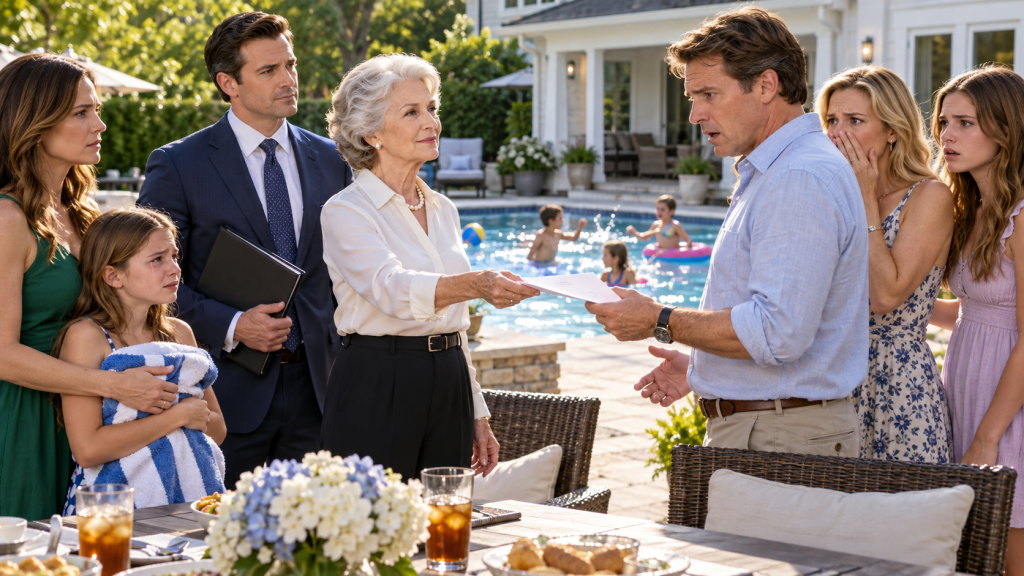
Dad stared at Andrew.
“What do you mean?”
Grandma’s eyes sharpened.
“The buyer knew exactly what he was getting.”
For one strange second, the pool behind us seemed offensively loud.
Water rushed through the new filtration system.
Rachel’s children splashed near the shallow end.
Someone had left music playing beside the grill.
A moment earlier, it had been a family party.
Now every sound felt inappropriate.
Dad looked down at the page again.
Then at Andrew.
“What exactly are you accusing me of?”
Andrew remained calm.
“I’m not accusing you of anything.”
He tapped the folder.
“I’m explaining what the records show.”
Mom stepped closer.
“Then explain.”
Grandma turned toward me.
“Take Lucy inside for a minute.”
Lucy tightened her hand around mine.
“No.”
Everyone looked at her.
My daughter’s voice was small.
But steady.
“I want to hear.”
My heart broke a little.
She was eleven.
She should have been worried about whether there was enough frosting left on a cupcake.
Instead, she was standing beside a swimming pool purchased with her stolen cello, asking adults to let her hear the truth about what they had done to her.
Grandma looked at her.
For several seconds, neither spoke.
Then Grandma nodded.
“All right.”
She pointed toward the patio table.
“Everyone sits.”
Rachel’s face tightened.
“Grandma, people are watching.”
Grandma glanced around at the relatives and neighbors pretending very badly not to listen.
“Then perhaps people should go home.”
Mom looked horrified.
“You are not throwing people out of my house.”
Grandma raised one eyebrow.
“No.”
“I am giving you the chance to keep this from becoming entertainment.”
That silenced her.
Dad finally found his voice.
“Everyone, thank you for coming.”
Nobody moved.
He tried again.
“There’s a family matter we need to handle.”
That worked.
Slowly.
Awkwardly.
Neighbors collected children.
Relatives picked up bags.
One cousin hugged Mom as if somebody had died.
Rachel’s kids complained about leaving the pool.
Rachel snapped at them.
Then looked ashamed.
Within fifteen minutes, the backyard was nearly empty.
Only the people who belonged to the problem remained.
Grandma.
Andrew.
My parents.
Rachel.
Me.
Lucy.
And Rachel’s husband, Kevin, who had apparently spent the entire confrontation believing that standing beside the grill made him invisible.
Grandma looked at him.
“Did you know where the pool money came from?”
Kevin swallowed.
“Rachel said her parents were helping.”
Grandma turned toward Rachel.
“Is that what you told him?”
Rachel crossed her arms.
“Basically.”
“Basically is a dangerous word.”
Rachel looked away.
Grandma sat carefully at the patio table.
Andrew placed the folder in front of her.
Then he looked at Lucy.
“The cello has a history.”
Lucy nodded.
“I know Great-Grandma played it.”
“That’s part of the history.”
He pulled out a photograph.
Old.
Black-and-white.
Grandma at perhaps sixteen years old.
Dark hair braided over one shoulder.
A cello between her knees.
The same cello.
Lucy stepped closer.
“That’s you?”
Grandma smiled.
“Yes.”
“You look like Mom.”
I protested.
“I do not.”
Grandma and Lucy answered together.
“You do.”
For one tiny moment, the tension broke.
Then Andrew continued.
“The instrument came into Margaret’s family in 1958.”
Grandma nodded.
“My father bought it from my teacher.”
Dad frowned.
“You always said Grandpa couldn’t afford anything back then.”
“He couldn’t.”
Grandma smiled sadly.
“That was why he worked nights for almost two years paying it off.”
Lucy stared at her.
“Why?”
“Because I was good.”
Grandma said it without embarrassment.
Without false modesty.
Just fact.
“I was very good.”
Something bright appeared in Lucy’s eyes.
Grandma continued.
“I had a teacher who believed I might someday play professionally.”
“My father believed her.”
“So he did something financially ridiculous.”
Andrew smiled faintly.
“Apparently family tradition.”
Dad did not.
Grandma looked at Lucy.
“The cello was already old when I received it.”
“It had been made in northern Italy in the eighteenth century.”
“Not by one of the household names people put in newspaper headlines.”
“But by a respected workshop.”
“Over the years, repairs were documented.”
“Owners were documented.”
“Performances were documented.”
“That matters with old instruments.”
Lucy listened with complete concentration.
Grandma continued.
“I played it through college.”
“In a chamber group after I married.”
“At weddings.”
“Churches.”
“Community orchestras.”
“Your grandfather hated classical music but attended every performance anyway.”
A softness moved across her face.
“I stopped performing seriously after your mother and Rachel were born.”
Mom looked toward her.
Grandma did not.
“But I never stopped playing.”
Lucy whispered:
“I know.”
Every Christmas, even after Grandma’s hands became stiff with age, she played one hymn.
Slowly.
Beautifully.
Then five years ago, when Lucy was six, Grandma heard her play a child-sized cello at a school recital.
Lucy had missed three notes.
Maybe four.
Afterward Grandma cried in the parking lot.
I thought she was being sentimental.
I understood now.
Andrew removed another document.
“The trust itself was created twelve years ago.”
Dad interrupted.
“Before Lucy was even born.”
“Yes.”
Andrew said.
“It originally held several family heirlooms and allowed Margaret to designate individual beneficiaries later.”
He turned a page.
“Five years ago, she amended it.”
“Lucy was named sole beneficiary of the cello.”
Mom shook her head.
“You never told us that.”
Grandma looked at her.
“I told you the cello belonged to Lucy.”
“That is not the same as saying there was a trust.”
“It should not have needed to be.”
Mom’s mouth tightened.
Andrew continued.
“The trust retained legal title while Lucy was a minor.”
“Margaret remained trust protector.”
“A professional fiduciary was named as trustee.”
“Your parents had physical possession because the instrument was stored in Margaret’s old music room after she moved.”
Dad stared at him.
“I thought it was family property.”
Grandma leaned forward.
“It was.”
“Lucy is family.”
No one answered.
Then Andrew opened a different section of the folder.
“The larger problem concerns the sale.”
Dad’s shoulders stiffened.
“What larger problem?”
“The buyer.”
Grandma said.
Andrew nodded.
“The buyer’s name is Victor Halpern.”
Rachel frowned.
“So?”
Grandma looked at Dad.
“Tell them how you found him.”
Dad did not answer.
“Dad?”
I asked.
His face had gone gray.
Andrew answered instead.
“Your father contacted three dealers.”
“One declined without documentation showing ownership.”
“One asked for an appraisal and provenance file.”
“The third put him in contact with Mr. Halpern.”
Dad rubbed his forehead.
“I didn’t know there was a trust.”
Andrew nodded.
“That may be relevant.”
“Then why are you making this sound like I committed some crime?”
“Because Mr. Halpern asked whether Margaret had authorized the sale.”
Silence.
Mom looked at Dad.
“What?”
Dad stared at the table.
Andrew removed a printed email.
The first line was enlarged.
Please confirm the current owner has authorized you to negotiate and sell the instrument on her behalf.
My stomach turned.
Andrew placed another email beside it.
Dad’s reply.
Yes. The instrument belongs to the family, and I am handling the sale with full authority.
Mom looked at him.
“You told him Margaret authorized you?”
Dad snapped:
“I said I had authority.”
“You didn’t.”
“I thought I did.”
Grandma’s voice was calm.
“No.”
“You hoped nobody would ask closely enough for the difference to matter.”
Dad looked at her.
Something like shame moved across his face.
Andrew continued.
“Mr. Halpern then requested photographs.”
“Interior markings.”
“Repair labels.”
“Measurements.”
“Your father sent them.”
“And?”
I asked.
Andrew looked at Lucy.
Then at Grandma.
“Mr. Halpern recognized the instrument.”
Dad closed his eyes.
There.
That was the part he knew was coming.
Grandma said:
“He had seen it before.”
“When?”
Lucy asked.
“Years ago.”
Grandma said.
“I loaned it for an exhibition and recital series through a regional conservatory.”
“Victor Halpern was one of the donors.”
“He collects instruments.”
“He remembered mine.”
Rachel stared.
“So he knew it was worth more.”
Grandma nodded.
“Much more.”
“How much?”
Dad whispered.
Andrew answered.
“The last formal insurance appraisal was four hundred and sixty thousand dollars.”
Nobody moved.
Even the pool seemed quieter.
Rachel’s mouth fell open.
Mom’s hand flew to the back of a chair.
Dad looked as though somebody had struck him.
Lucy simply stared at Andrew.
I could not breathe properly.
“Four hundred and sixty…”
I stopped.
Grandma touched my arm.
“The number is not the important part.”
I looked at her.
“It is a little important.”
She smiled sadly.
“Yes.”
“A little.”
Rachel finally spoke.
“You’re saying Dad sold a nearly half-million-dollar cello for eighty-seven thousand dollars?”
Andrew corrected her.
“We are saying the last insurance appraisal was four hundred and sixty thousand.”
“Market value can vary considerably.”
“Old instruments do not have simple price tags.”
“But yes.”
“Eighty-seven thousand was substantially below every documented professional valuation we have located.”
Mom sank into a chair.
“Oh my God.”
Dad looked furious.
Not at Grandma.
At himself.
Then at Andrew.
“So this Halpern cheated us.”
Grandma’s eyes flashed.
“Do not say us.”
Dad looked up.
“You were not cheated out of anything you owned.”
Silence.
That sentence landed hard.
Andrew continued.
“Mr. Halpern knew he was buying well below prior appraisal.”
“But he also requested confirmation of authority.”
“He received a representation from your father.”
Dad pushed back.
“That makes him innocent?”
“I did not say that.”
Andrew said.
“He is represented by counsel.”
“They have been cooperative since receiving notice from the trust.”
“What does cooperative mean?”
I asked.
“It means Mr. Halpern has agreed not to sell, alter, export, loan, or otherwise transfer the cello while title is resolved.”
My heart jumped.
“He still has it?”
“Yes.”
Lucy’s fingers closed around mine.
“Is it safe?”
Andrew looked at her.
“Yes.”
The word changed her entire face.
Not joy.
Not yet.
But oxygen.
“He didn’t sell it again?”
“No.”
“Did he hurt it?”
“No evidence of that.”
“Can I get it back?”
Andrew paused.
Then smiled slightly.
“That is exactly what we are working on.”
Lucy started crying.
Quietly.
I pulled her against me.
She buried her face in my shoulder.
For six weeks she had practiced on a borrowed instrument and told herself maybe Great-Grandma had changed her mind.
For six weeks she had made herself small enough to spare adults embarrassment.
Now she finally let herself cry.
Grandma reached across and put one wrinkled hand on Lucy’s back.
“You were never supposed to lose it.”
she whispered.
“You hear me?”
Lucy nodded against my shoulder.
“It was yours.”
“You did nothing wrong.”
That sentence mattered more than four hundred and sixty thousand dollars.
Dad stood and walked toward the edge of the pool.
He stared into the blue water.
Nobody followed.
After a while he said:
“I thought it was worth maybe a hundred.”
Grandma answered:
“You could have asked me.”
He looked over his shoulder.
“You would have said no.”
“Yes.”
“Exactly.”
Grandma’s expression hardened.
“That is not an explanation in your favor.”
Dad turned.
“You weren’t using it.”
“Lucy was.”
“She is eleven.”
“And?”
“She might quit next year.”
Lucy flinched.
I felt it.
Grandma did too.
Her voice changed.
“Come here.”
Dad frowned.
“What?”
“Come back to the table.”
He did.
Not because she was physically intimidating.
Because some part of a grown son remains twelve years old when his mother uses that tone.
Grandma pointed toward Lucy.
“You apologize.”
Dad stared.
“For what?”
My blood boiled.
Grandma did not raise her voice.
“For saying her commitment matters less because she is young.”
“For deciding her property was disposable because you wanted something else.”
“For allowing her to spend six weeks believing I might have taken back a gift.”
Dad looked uncomfortable.
“Mom—”
“No.”
Grandma said.
“You spent eighty-seven thousand dollars that was not yours.”
“You can survive one honest sentence.”
Dad turned toward Lucy.
My daughter’s face was wet.
He looked at her.
Really looked.
Maybe for the first time since this began.
“I’m sorry.”
Lucy did not answer.
Dad swallowed.
“I should not have sold the cello.”
Still silence.
He continued.
“I thought…”
Then stopped.
Grandma waited.
Dad started again.
“I told myself it was sitting in the house.”
“That you were young.”
“That you could use another instrument.”
“That the pool would be used by several children.”
His eyes filled.
“I made your loss sound reasonable because I wanted the money.”
There.
Finally.
Lucy looked at him.
“Did you know Great-Grandma gave it to me?”
Dad’s eyes dropped.
“Yes.”
“Then why did you say she wasn’t using it?”
He had no answer.
Children ask simple questions adults spend years avoiding.
After a long silence, Dad whispered:
“Because it was easier.”
Lucy wiped her face.
“Oh.”
Just that.
Oh.
I hated how much disappointment one syllable could hold.
Rachel suddenly stood.
“Okay.”
Everyone looked at her.
“This is awful.”
“Yes.”
I said.
“But nobody told me the cello was worth half a million dollars.”
I stared.
“You knew it belonged to Lucy.”
“That is not the same thing.”
“That is exactly the same thing that matters.”
Rachel’s face reddened.
“I thought Mom and Dad were selling an old instrument Grandma didn’t need.”
“You heard Lucy play it.”
“That doesn’t mean—”
“What?”
I snapped.
“That doesn’t mean it was hers?”
Rachel crossed her arms.
“I thought family things belonged to the family.”
Grandma sighed.
“There is that sentence again.”
Rachel looked at her.
“You gave me jewelry.”
“Yes.”
“Mom has things from you.”
“Yes.”
“So why is Lucy special?”
My daughter shrank slightly.
I stepped forward.
Grandma beat me to it.
“Lucy is not special because the cello is expensive.”
Rachel opened her mouth.
Grandma raised a hand.
“She is special to me because every grandchild is special to me in a different way.”
“I gave you my mother’s pearl earrings because you loved them from the time you were fifteen.”
Rachel’s face changed.
“I helped your brother with his first home because that was what he needed.”
“I gave Emily my handwritten recipes because she was the one who cooked beside me every Christmas.”
Then she looked at Lucy.
“I gave Lucy the cello because she loves music.”
“It was never a contest.”
Rachel looked away.
Grandma continued.
“You turned gifts into a scoreboard.”
“I did not.”
“You are standing beside a pool bought with somebody else’s gift asking why she was special.”
Rachel started crying.
“That is exactly what you are doing.”
Kevin spoke from behind her.
“Rachel.”
She snapped:
“Not now.”
He shook his head.
“No.”
“Now.”
She turned.
His face was pale.
“You told me your parents sold some old family instrument they owned.”
Rachel stared.
“I thought they did.”
“You knew Lucy played it.”
“I knew she used it.”
Kevin’s jaw tightened.
“That is not what you said.”
Rachel looked around.
Suddenly there was nowhere comfortable to put the blame.
She sat.
Hard.
Grandma’s expression softened slightly.
“Tell the truth.”
Rachel covered her face.
“I wanted the pool.”
There.
Grandma waited.
Rachel cried.
“I wanted it.”
“The kids kept asking.”
“Everyone in the neighborhood has one.”
“Kevin said we should wait another year.”
“I complained to Mom.”
“She said there might be a way.”
Mom looked at her.
“Rachel.”
“No.”
Rachel shook her head.
“We’re doing truth now, right?”
Mom went silent.
Rachel continued.
“Mom mentioned the cello.”
“I said Lucy hardly played at family gatherings anymore.”
My chest tightened.
Lucy looked at her aunt.
Rachel started sobbing.
“I said she would probably grow out of it.”
My daughter’s face changed.
That hurt more than the sale.
Because this was someone she loved using her possible future change as permission to erase what she loved now.
Rachel whispered:
“I’m sorry.”
Lucy said nothing.
Rachel looked at me.
“I didn’t know they’d get eighty-seven thousand.”
“Would forty have been okay?”
I asked.
She flinched.
“No.”
“Ten?”
Silence.
“One thousand?”
Rachel closed her eyes.
“No.”
“Then stop hiding behind the number.”
She nodded.
That was all I needed from her then.
Andrew let the emotions settle before speaking again.
Then he turned toward my parents.
“We need to discuss restitution.”
Mom’s face went pale.
Dad sat.
“The money is gone.”
Andrew nodded toward the pool.
“Obviously.”
Kevin rubbed his face.
“We put some of our money in too.”
“How much?”
I asked.
Rachel whispered:
“About twenty-eight thousand.”
I stared.
The pool had cost more than a hundred thousand dollars.
My parents had contributed the bulk.
Using Lucy’s cello.
Kevin looked sick.
“I thought the money was theirs.”
I believed him.
Mostly because anger at him would have required energy I did not have.
Andrew opened another document.
“The trust has several options.”
Dad immediately said:
“We don’t have eighty-seven thousand in cash.”
Grandma looked at him.
“You have assets.”
Mom stared.
“You wouldn’t.”
Grandma’s face went very still.
“Wouldn’t what?”
“Make us sell our house.”
“No.”
Grandma said.
“I would not make you do anything.”
“Then what is he talking about?”
Andrew stepped in.
“The trust is entitled to pursue the proceeds of an unauthorized sale.”
“We are attempting to resolve this without litigation.”
Dad laughed bitterly.
“By threatening our house.”
“No.”
“By asking you to repay money you received for property you did not own.”
The simplicity was devastating.
Mom looked at Grandma.
“We’re your children.”
Grandma’s eyes filled.
“Yes.”
That answer came softly.
“You are.”
For a second, I thought she might collapse into old habits.
Then she continued.
“And Lucy is my great-grandchild.”
Mom looked away.
Grandma whispered:
“Family does not mean the oldest person in the room gets sacrificed to protect the adult children from consequences.”
I glanced at her.
That line had history inside it.
Maybe more than I knew.
Andrew continued.
“Mr. Halpern has agreed in principle to rescind the purchase and return the instrument to the trust.”
Lucy’s head snapped up.
“When?”
“We need the legal documents completed.”
“But he wants his purchase price returned.”
Dad laughed without humor.
“Of course he does.”
Andrew nodded.
“He may also have claims based on representations made during the sale.”
Dad’s face tightened.
“We are trying to prevent this from becoming more expensive.”
Mom whispered:
“What do you want from us?”
Grandma answered.
“Not want.”
“Require.”
Then she looked at Andrew.
He explained.
My parents would repay the $87,000 to the trust over a structured period.
A portion could come from savings.
The rest from refinancing or another lawful source they chose.
The trust would use the repayment arrangement to complete the rescission and cover related costs.
My parents would also be responsible for reasonable legal and restoration expenses caused by the sale.
No criminal threats.
No public humiliation.
No “give me your house.”
Just repayment.
Dad stared at the papers.
“How long?”
“That depends on the financing you arrange.”
Andrew said.
Mom whispered:
“We’re retired.”
Grandma looked at her.
“So am I.”
Silence.
“You thought Lucy’s future could absorb the cost of your decision.”
Grandma continued.
“Now yours will absorb it.”
Harsh.
But fair.
Rachel stood again.
“We’ll contribute.”
Kevin looked at her.
She turned.
“We benefited.”
His face tightened.
“How?”
“The pool.”
“We didn’t know—”
“I knew enough.”
That surprised me.
Rachel looked at my parents.
“I’m not letting you carry all of it.”
Mom began crying.
“No, sweetheart.”
Rachel gave a broken laugh.
“There it is.”
“What?”
“The thing we always do.”
Mom stared.
Rachel wiped her face.
“Someone makes a mess, then somebody else says sweetheart and absorbs it.”
She looked at Grandma.
“Maybe that’s why we’re all like this.”
Grandma’s expression changed.
Pain.
Recognition.
Families inherit more than jewelry and instruments.
They inherit habits.
Who gets protected.
Who gets asked to understand.
Who pays.
Who stays quiet to keep dinner pleasant.
Rachel looked at Kevin.
“We’ll repay part.”
He nodded reluctantly.
Then more firmly.
“Yes.”
The pool behind them glittered in the afternoon sun.
It looked less like luxury now.
More like a receipt.
Lucy finally spoke.
“Do they have to fill it in?”
Everyone looked at her.
“What?”
Rachel asked.
“The pool.”
Lucy pointed.
“Do you have to destroy it?”
Rachel’s face crumpled.
“No.”
Andrew said gently.
“Probably not.”
Lucy looked relieved.
That surprised me.
“Why do you care?”
I whispered.
She shrugged.
“Emma and Josh didn’t sell my cello.”
Rachel covered her mouth.
Those were her cousins.
Of course.
An eleven-year-old had managed in one sentence what the adults had spent six weeks failing to do:
Put responsibility where it belonged.
Not on the children swimming in the pool.
Not on the pool itself.
On the adults who made the decision.
Grandma’s eyes filled.
“Exactly.”
she said.
Rachel cried harder.
The party ended without cake.
Nobody wanted cake.
Andrew left with signed acknowledgments that a formal settlement would be negotiated through counsel.
My parents went inside.
Rachel took her children home.
Kevin stayed long enough to drain the inflatable toys from the pool.
I stood with Lucy near the gate.
Grandma came beside us.
“You okay?”
she asked.
Lucy shrugged.
That meant no.
Then she looked up.
“Is the cello really worth that much?”
Grandma sighed.
“I was hoping you would not focus on that.”
“It’s weird.”
“Yes.”
“Can I still play it?”
Grandma smiled.
“Of course.”
“What if I scratch it?”
My heart tightened.
There it was.
Money turning music into fear.
Grandma bent slowly until she was closer to Lucy’s height.
“Listen to me.”
“A cello is not valuable because nobody touches it.”
“It is valuable because it makes music.”
“Old instruments survive because generations of people play them.”
“They get repaired.”
“They get worn.”
“They get loved.”
Lucy swallowed.
“What if I’m not good enough?”
Grandma’s eyes softened.
“That question has nothing to do with the price.”
“I gave it to you before anyone told you what it was worth.”
“Do you remember why?”
“Because I like cello.”
“No.”
Grandma smiled.
“Because you love it.”
“There is a difference.”
Lucy thought.
Then nodded.
Grandma touched her cheek.
“Promise me something.”
“What?”
“Never play for the price tag.”
“Play because the sound means something to you.”
Lucy nodded.
“I promise.”
The cello came home seventeen days later.
I remember the exact number.
Lucy counted.
Every morning before school:
“Sixteen days.”
“Fifteen.”
“Fourteen.”
She tried not to ask Andrew for updates.
Failed.
He was patient.
Then, on a Friday afternoon, a dark vehicle pulled into my driveway.
Andrew got out.
Beside him was a conservator named Dr. Elias Benton.
And in the back was a hard black cello case.
Lucy saw it through the front window.
She stopped breathing.
Then ran.
I caught her before she opened the door too hard.
“Slow.”
“I am slow.”
“You are vibrating.”
“I know.”
Andrew smiled when we stepped outside.
“Would you like to see something?”
Lucy burst into tears.
Just from the case.
He carried it inside.
Placed it in our living room.
Dr. Benton knelt and opened the latches.
One.
Two.
Three.
The lid lifted.
There it was.
Dark amber varnish.
Curved wood.
A small familiar patch near the lower bout where the finish had worn differently.
Lucy’s cello.
She covered her mouth.
Grandma had come over earlier.
She stood behind us holding her cane.
When the instrument appeared, her eyes closed.
She whispered something in Italian.
I did not understand.
Maybe a prayer.
Lucy approached.
Then stopped.
“Can I touch it?”
Dr. Benton smiled.
“It belongs with you.”
She looked at Grandma.
Grandma nodded.
Lucy reached out.
Her fingertips touched the neck.
Then the scroll.
She began crying harder.
“I thought I’d never see it again.”
I turned away.
Sometimes a mother needs two seconds to break where her child cannot see.
Grandma did not.
She cried openly.
Good for her.
Lucy carefully lifted the cello.
Held it against herself.
And for the first time since the sale, her shoulders lowered.
Home.
Not the instrument.
Her.
Dr. Benton had inspected it before delivery.
No significant damage.
The buyer had stored it professionally.
A seam needed minor attention.
The bridge had shifted slightly.
Routine.
Then he surprised us.
“I’d like Lucy to bring it to the workshop next week.”
Lucy panicked.
“Why?”
“Because an instrument this old should be adjusted for the player.”
He smiled.
“Not the other way around.”
That sentence became important.
For six weeks, adults had expected Lucy to adjust herself to their choices.
Student cello.
Be reasonable.
You’re eleven.
You’ll be fine.
Now somebody was saying:
The object should meet the child where she is.
Grandma smiled.
“I like him.”
Dr. Benton laughed.
“I’ll send an invoice.”
Grandma immediately stopped liking him.
The first note Lucy played was terrible.
Truly.
Her hands were shaking.
The bow skittered across the string with a scratch that made everybody flinch.
Lucy froze.
Then started laughing.
The sound surprised us.
She tried again.
A long G.
Warm.
Dark.
The room changed.
I had forgotten what that cello sounded like in our house.
Not louder than the student instrument.
Fuller.
Like the note continued somewhere after the sound stopped.
Lucy played a scale.
Then the little Bach piece Grandma had been helping her learn.
She missed an entrance.
Restarted.
Halfway through, Grandma sat.
Her eyes filled.
Lucy noticed.
“Are you okay?”
Grandma nodded.
“Keep playing.”
So she did.
And while she played, I thought about my father staring at a pool.
My mother saying Lucy would be fine.
Rachel saying she was eleven.
All those adult sentences trying to shrink what mattered to a child because something else was more convenient.
Then music filled the room.
No argument.
No legal folder.
Just proof that something taken had returned.
Not unchanged.
Neither was Lucy.
The money took longer.
Of course.
Objects can come home faster than trust.
My parents refinanced their house.
They hated it.
Dad complained that the rate was terrible.
I said nothing.
Mom told relatives Grandma had “forced” them into debt.
Grandma heard.
Called her.
I happened to be there.
“I did not put you into debt.”
Grandma said.
“You spent money that belonged to someone else.”
Mom cried.
“You don’t have to be so cold.”
Grandma’s face broke slightly.
“I am being colder than I want to be because every time I soften, you hear permission.”
Silence.
That line stayed with me.
Sometimes boundaries must be repeated until people stop mistaking pain for negotiation.
Eventually, my parents repaid most of the sale proceeds through the refinance.
Rachel and Kevin contributed the rest over time.
The pool stayed.
But it stopped feeling free.
Maybe that was appropriate.
The buyer, Victor Halpern, sent Lucy a letter.
I almost threw it away.
Then asked Andrew.
He read it first.
“No manipulation.”
he said.
“Your choice.”
I gave it to Lucy.
The letter was short.
Victor apologized for participating in a purchase he should have examined more carefully.
He explained that he recognized the cello from the conservatory exhibition and knew the $87,000 price was unusually low.
He told himself the family needed liquidity and that the seller had authority.
Then he admitted something rarer:
He had wanted the bargain enough not to ask harder questions.
That sentence impressed me.
Not because it absolved him.
Because people rarely confess the exact place greed made them incurious.
He wrote:
An instrument with this history should remain where its music matters, not merely where its market value is admired. I am glad it is back with you.
Lucy read the letter twice.
Then asked:
“Do I have to forgive him?”
“No.”
I said.
Grandma answered at the same time:
“No.”
Lucy smiled.
Then:
“I think I kind of do.”
Grandma shook her head.
“You do not forgive because somebody writes well.”
Lucy laughed.
“I know.”
“What are you going to do?”
“Nothing.”
Good.
Forgiveness did not require correspondence.
My parents did not speak to me for almost two months.
That was easier than I expected.
And harder.
Mom sent one birthday card to Lucy.
No money.
Just:
I’m sorry. Love, Grandma.
Lucy put it on her shelf.
She did not reply.
I did not force her.
Dad drove past our house once.
Did not stop.
I saw him.
He saw me.
Kept going.
Families can create entire conversations through brake lights.
Rachel called first.
“I miss you.”
I nearly laughed.
“That’s direct.”
“I’m trying something new.”
I sat on my porch.
“What do you want?”
She went quiet.
“Ouch.”
“Sorry.”
“No.”
she said.
“That’s fair.”
Then:
“I don’t want anything.”
Suspicious.
We both laughed.
The first real laugh between us in months.
Rachel continued.
“I started therapy.”
That surprised me.
“For the cello?”
“For everything.”
She sighed.
“The cello was just the part nobody could pretend was normal.”
I understood.
“What does that mean?”
“Mom and Dad have always done this.”
“Done what?”
“Decide whose needs are most important based on who is loudest.”
I thought.
Rachel had often been loud.
I had often been quiet.
She continued.
“And I learned that if I wanted something badly enough, somebody would make it happen.”
“That sounds like blaming them.”
“Partly.”
she said.
“But I was forty when I suggested selling Lucy’s cello.”
“There is an age where childhood stops being a full defense.”
Good.
She was learning.
Rachel whispered:
“I’m sorry.”
I believed her more this time.
Not because her apology was more dramatic.
Because she did not ask what it earned.
We met for coffee.
Rachel brought no children.
No parents.
No Kevin.
Just us.
She looked tired.
“I keep thinking about Lucy asking if we had to fill in the pool.”
I nodded.
“She was worried about my kids.”
“Yes.”
“And I wasn’t worried about her.”
I did not rescue her from that sentence.
She cried.
“I told myself she had another cello.”
“A loaner.”
“I know.”
She shook her head.
“I think I needed her to be fine.”
“Why?”
“Because if she wasn’t fine, then I had to admit the pool came from hurting her.”
There.
That was the emotional center.
People often do not deny harm because they cannot see it.
They deny it because admitting it would ruin the thing they got from causing it.
Rachel continued.
“We’re keeping the pool.”
“I know.”
“The kids love it.”
“I know.”
“Sometimes I hate looking at it.”
I studied her.
“Then make it mean something different.”
She frowned.
“How?”
“That’s your problem.”
She laughed through tears.
“Very helpful.”
“Therapy has made me mysterious.”
“I can tell.”
The following summer, Rachel did something I did not expect.
She opened the pool to a local adaptive swim program twice a month.
Not as public penance.
No social-media post.
No plaque about Lucy’s cello.
She paid instructors.
Bought safety equipment.
Adjusted part of the deck for accessibility.
When I heard, I called.
“Why?”
Rachel hesitated.
“Because you said make it mean something different.”
“I said that?”
“Yes.”
“Smart.”
“Don’t get excited.”
She laughed.
Then:
“It doesn’t erase anything.”
“No.”
“I know.”
Good.
She was no longer trying to turn restitution into erasure.
The pool remained complicated.
Maybe that was honest.
My parents took longer.
Dad was the first.
He came to one of Lucy’s recitals almost a year after the sale.
He did not tell us.
I saw him in the back row.
Lucy was twelve now.
Taller.
More confident.
She played a movement from a Saint-Saëns piece arranged for students.
The antique cello sat against her shoulder.
Dad cried through almost the entire performance.
Afterward, he waited near the lobby door.
I approached him.
“Why didn’t you tell us?”
He looked embarrassed.
“I thought Lucy might not want me here.”
“That was probably her decision.”
“I know.”
Progress.
He held a small bouquet.
Nothing expensive.
He looked toward Lucy.
“Can I give these to her?”
I asked her.
Not because I wanted to punish him.
Because her choice mattered.
Lucy thought.
Then nodded.
Dad walked over.
Held out the flowers.
“You were beautiful.”
Lucy said:
“The cello sounded beautiful.”
Dad shook his head.
“You did.”
Her face softened slightly.
Then Dad whispered:
“I’m sorry I treated something you loved like inventory.”
My chest tightened.
That was specific.
Real.
Lucy looked at him.
“Why did you?”
Dad inhaled slowly.
“Because I had started believing anything valuable in the family was ours to manage.”
“That sounds dumb.”
He laughed.
“It was.”
Then:
“And because I wanted your aunt to be happy.”
Lucy frowned.
“Why was making Aunt Rachel happy more important than making me sad?”
Dad closed his eyes.
No easy answer.
Finally:
“Because Rachel was asking loudly.”
“You weren’t.”
My daughter looked at him.
“That doesn’t make sense.”
“No.”
Dad said.
“It doesn’t.”
That was enough for that night.
He did not ask for a hug.
Lucy gave him one anyway.
Short.
Her choice.
Mom took almost two years.
Pride is an astonishingly durable material.
She continued telling herself Grandma had “made everything legal.”
As though ownership existed only because Andrew printed it.
Then Grandma became ill.
Nothing dramatic.
Age.
Heart problems.
Fatigue.
She was eighty-nine.
One afternoon Mom called me.
“Grandma wants Lucy.”
We drove to assisted living.
Grandma was in bed.
Smaller than before.
Lucy sat beside her with the cello case near the wall.
Grandma smiled.
“Play.”
Lucy laughed.
“You don’t even say hello anymore.”
“I’m ninety.”
“Efficiency.”
Lucy took out the cello.
Played.
A Bach sarabande.
Slow.
Tender.
Not technically perfect.
Something better.
Personal.
Grandma closed her eyes.
When the last note ended, nobody spoke.
Then Mom whispered from the doorway:
“I’m sorry.”
Grandma opened her eyes.
Mom walked into the room.
For once, she looked less like my mother and more like somebody’s daughter.
“I was wrong.”
Grandma waited.
Mom cried.
“I thought because you were old, the things you had would become ours anyway.”
There it was.
“I thought the cello was going to the family.”
Grandma’s voice was weak.
“It was.”
Mom nodded.
“I know.”
“Now.”
She sat beside the bed.
“I didn’t see Lucy as someone who could own something that important.”
Grandma looked at her.
“Why?”
Mom swallowed.
“Because she was a child.”
Grandma smiled sadly.
“So was I when my father bought it for me.”
Mom started crying harder.
“I’m sorry.”
Grandma reached for her hand.
Not absolution.
Contact.
“Do better.”
she whispered.
Mom nodded.
“I will.”
Then Grandma looked at Lucy.
“Again.”
Lucy laughed through tears.
“You’re bossy.”
“Family tradition.”
She played again.
Grandma died three months later.
Peacefully.
Her funeral was full of music.
Lucy asked to play.
I told her she did not have to.
She said:
“I want to.”
She performed the same sarabande.
Halfway through, her bow trembled.
She stopped for one beat.
Breathed.
Continued.
That pause broke everyone.
Dad cried openly.
Mom held Rachel’s hand.
I stared at the cello.
The instrument had outlived makers.
Owners.
Wars.
Moves.
Deaths.
Arguments.
Lawyers.
A swimming pool.
It had been called property.
Asset.
Inheritance.
Evidence.
But in Lucy’s hands, it returned to being what it had always been.
A voice.
Grandma’s will contained no dramatic revenge.
That surprised everyone.
My parents were still included.
Rachel was included.
I was included.
Grandchildren and great-grandchildren had specific trusts.
The cello remained in Lucy’s trust until she reached the age Grandma specified.
Then full title would transfer to her.
Andrew read a letter Grandma had written.
Not to one person.
All of us.
My family,
If you are listening to Andrew read this, then I am finally beyond having to correct all of you in person. Enjoy the temporary freedom.
We laughed through tears.
Then:
You have spent too much time confusing inheritance with love.
The room went silent.
What I leave behind is not a ranking.
A larger gift does not mean a larger love.
A smaller gift does not mean punishment.
Objects should go where they can continue living.
Money should go where it can create stability, education, care, or possibility.
And some things should leave the family entirely if keeping them would turn you against one another.
Andrew paused.
Then continued.
The cello belongs with Lucy because she makes music with it.
If she becomes a doctor at twenty-five and never touches it again, that does not mean I chose wrongly when she was six.
Lucy started crying.
Children deserve to be loved for who they are now, not only for the adult we hope they become.
I closed my eyes.
That sentence.
Grandma always knew where to place the knife.
And to my children: you did not become bad people because you made a selfish decision.
Mom sobbed.
Dad looked down.
But do not insult the people you hurt by pretending the decision was anything less than selfish.
Repair what you can.
Apologize without bargaining.
Then live better long enough that the apology becomes believable.
Rachel reached for my hand.
I took it.
The letter ended:
If you want to honor me, stop asking who deserves more.
Ask what you can do with what you have.
Love,
Margaret
Andrew folded the paper.
No one spoke for a long time.
Lucy changed after Grandma died.
Not worse.
Older.
She practiced more.
Then less for a few months.
I panicked.
Of course.
“What if she quits?”
I asked her teacher.
He looked at me as if I had missed every lesson of the last three years.
“Then she quits.”
I stared.
“What?”
“She is twelve.”
“Music has to remain hers.”
I thought of Grandma.
Never play for the price tag.
So I stopped asking whether she had practiced.
Mostly.
I am still a mother.
There are limits to personal transformation.
Lucy returned to it on her own.
By fourteen, she was serious again.
At fifteen, she joined a youth chamber ensemble.
At sixteen, she played her first solo with a small regional orchestra.
Was she a prodigy?
No.
That mattered to me.
She was good.
Very good.
But her worth was not justified retroactively by becoming extraordinary.
Even if she had quit at twelve, the cello still would have been hers when my parents sold it.
Property rights do not depend on whether the child later proves the gift was a smart investment.
Neither does dignity.
At sixteen, Lucy asked me a question I had dreaded.
“Can I sell the cello someday?”
I nearly drove off the road.
“What?”
We were on the way home from rehearsal.
She laughed.
“Not now.”
“Good.”
“I mean someday.”
I gripped the steering wheel.
“Why?”
“I don’t know.”
“What if I want a different instrument?”
“What if I don’t become a musician?”
“What if…”
She glanced at me.
“Grandma gave it to me.”
“When it’s legally mine, doesn’t that mean I decide?”
I almost heard my parents’ arguments echoing.
Family heirloom.
Too valuable.
You’re young.
Then I realized the irony.
If I told Lucy she could never decide because the family story mattered more than her ownership, I would be building a prettier version of the same cage.
I breathed.
“When it becomes yours outright, yes.”
Her eyes widened.
“Really?”
“Yes.”
“I may need medication.”
“But yes.”
She laughed.
Then:
“I don’t think I’d sell it.”
“Excellent.”
“But I wanted to know.”
I nodded.
“That matters.”
My parents eventually repaid every dollar.
It took six years.
The final payment was strangely anticlimactic.
Andrew’s office sent confirmation.
I called Dad.
“It’s done.”
He exhaled.
“Six years.”
“Yes.”
“Worst pool I ever bought.”
I laughed.
Then:
“How are you?”
He thought.
“Relieved.”
A pause.
“Embarrassed.”
“That too.”
Then:
“Emily.”
“Yes?”
“Thank you for not keeping Lucy away from us forever.”
I sat quietly.
“That was Lucy’s decision.”
“I know.”
Good.
He knew.
Dad continued.
“I used to think being the parent meant the family things were mine to decide.”
“I know.”
“Funny.”
“What?”
“I’m eighty-two and still learning ownership.”
I smiled.
“Expensive class.”
“Very.”
We both laughed.
Peace sometimes arrives without a grand speech.
Just two people able to joke about the wound after enough repair has been done.
Mom changed differently.
She became almost obsessive about asking permission.
Too much.
She would visit my house and say:
“Can I use the bathroom?”
I stared.
“Mom.”
“What?”
“You do not need written authorization.”
“Just checking.”
Lucy found it hilarious.
Once Mom brought over an old ring.
“Your grandmother gave me this.”
She said.
“I want Lucy to have it.”
Lucy looked terrified.
“No.”
Everyone laughed.
Mom did too.
Then she said:
“Fair.”
She gave it to Rachel instead.
Rachel asked:
“Are there legal documents?”
Mom threw a napkin at her.
Healing can become comedy if a family lives long enough.
The pool remained.
Rachel’s children grew up swimming in it.
Eventually the adaptive program became more organized.
Then a summer fundraiser.
Then a small partnership with a local nonprofit.
Rachel never named it after Grandma.
Or Lucy.
Good.
She simply used what she had.
Years later, when the pool needed an expensive repair, Rachel called me.
“I have the funniest problem.”
“What?”
“The pool is costing me money.”
I laughed so hard I had to sit down.
“Tragic.”
“Grandma is laughing somewhere.”
“Definitely.”
Rachel sighed.
“Should I fill it in?”
“Your decision.”
“You’re no fun.”
“Growth.”
She kept it.
Lucy was eighteen when the trust transferred full ownership of the cello to her.
Andrew invited us to his office.
He was grayer.
Still carried slim folders like weapons.
He slid one document across the desk.
Lucy signed.
Then stared at me.
“That’s it?”
“That’s it.”
She looked at Andrew.
“So it’s legally mine now?”
“Yes.”
“Completely?”
“Yes.”
Andrew smiled.
“Please do not sell it for eighty-seven thousand dollars.”
Lucy burst out laughing.
Even I did.
Then she signed one more document acknowledging transfer.
We walked outside.
The cello case was in the car.
Lucy stopped beside it.
“You know what’s weird?”
“What?”
“I thought I’d feel different.”
“How?”
“Powerful.”
I smiled.
“Do you?”
“No.”
She looked through the car window.
“I just feel responsible.”
Grandma would have loved that answer.
Lucy did not go to conservatory.
That surprised everyone.
She studied architecture.
Music remained serious.
But not profession.
At first, Dad looked nervous when she announced it.
He had learned enough not to speak.
Later he asked me:
“Does she still deserve the cello?”
I stared.
He immediately raised his hands.
“Bad wording.”
“Very.”
He laughed.
“I mean…”
He thought.
“Grandma always imagined music.”
“No.”
I corrected.
“Grandma imagined Lucy.”
Dad nodded slowly.
“Right.”
That was the lesson.
Lucy joined a university chamber group.
Played recitals.
Sometimes went months without performing.
The cello lived with her.
Not as investment.
Not museum piece.
Companion.
At twenty-three, she had a small repair done after a seam opened.
The bill nearly caused her to faint.
She called me.
“Mom.”
“Yes?”
“Old instruments are terrible.”
“Sell it.”
“Never.”
I laughed.
Grandma was still with us in conversations like that.
Years after the pool party, Victor Halpern died.
His attorney contacted Lucy.
That surprised us.
Victor had left a small fund to support restoration costs for several instruments he had once collected or helped place.
Lucy’s cello was included.
She sat with the letter.
“What do I do?”
“What do you want to do?”
She sighed.
“You always answer with that now.”
“Therapy.”
She smiled.
Then:
“I don’t want his money.”
“Why?”
“Because of what happened.”
I waited.
Then she reconsidered.
“But maybe saying no because I’m still angry gives the whole thing too much power.”
Smart.
She eventually accepted a portion for a major conservation treatment.
Then donated an equal amount over time to a youth music-access program.
Not because morality required balancing the ledger.
Because she liked the idea.
Choice.
Again.
When Lucy was twenty-seven, she performed Grandma’s favorite Bach piece at my parents’ fiftieth anniversary celebration.
Yes.
My parents stayed married.
Families are strange.
Dad sat in the front row.
Mom beside him.
Rachel and I near the aisle.
The pool story had become old enough that some younger cousins barely knew it.
Good.
Not everything needs to become family mythology.
Lucy finished.
Dad stood first.
Not because of the cello.
Because of her.
Afterward, he hugged her.
“Great-Grandma would be proud.”
Lucy smiled.
“Because I played well?”
Dad shook his head.
“Because you kept it yours.”
My eyes filled.
That sentence told me he had finally learned.
The cello is worth more now.
Probably.
I try not to know.
Once the number caused enough damage, I stopped treating appraisal like gossip.
Lucy insures it.
Maintains documentation.
Stores it correctly.
Does the responsible things.
But in our family, we rarely discuss its price.
We discuss sound.
The worn patch in the varnish where Grandma’s hand rested.
The photograph of sixteen-year-old Margaret.
The tiny repair label from 1892.
The time Lucy played an entire recital with one black shoe and one navy shoe because she dressed in the dark.
That story is more valuable.
Do not tell an appraiser I said that.
There is one detail I did not understand until years later.
The afternoon Grandma walked into the pool party with Andrew, she already knew the cello was likely coming back.
Andrew had been negotiating with Victor’s lawyer for weeks.
The trust claim was strong.
The buyer was cooperative.
Grandma could have told us immediately.
She did not.
I once asked why.
We were sitting beside her bed months before she died.
“You scared everyone half to death.”
She smiled.
“I know.”
“Why didn’t you just say Victor agreed to return it?”
“Because your parents were listening only for whether they would get away with what they did.”
I frowned.
She continued.
“If I had started with ‘the cello is safe,’ they would have relaxed.”
“They needed to understand the harm before they learned the rescue.”
I thought.
“That sounds manipulative.”
“It was.”
At least she was honest.
Then:
“But sometimes adults only listen once relief stops being available.”
I laughed.
“You’re impossible.”
“Genetic.”
Probably.
I also asked why she smiled when I first told her.
That calm smile that frightened me.
She looked almost embarrassed.
“I smiled because I knew something your parents didn’t.”
“The trust?”
“Yes.”
“And the appraisal.”
“Yes.”
“And Victor?”
“Not yet.”
Then she looked at me.
“I also smiled because for one ugly second, I enjoyed knowing they were in trouble.”
I stared.
Grandma shrugged.
“I was eighty-eight, not holy.”
That made me laugh.
Then she became serious.
“Anger is useful at the beginning.”
“It tells you a line was crossed.”
“Just don’t build your house there.”
I wrote that down later.
Lucy has a daughter now.
Her name is Margaret.
We call her Maggie.
Of course.
Maggie is six.
She does not play cello.
She plays drums.
Terribly.
Loudly.
Grandma Margaret would have pretended to hate it and secretly bought her better sticks.
The antique cello sits in Lucy’s music room.
One afternoon, little Maggie asked:
“Is that mine someday?”
Lucy nearly choked.
I laughed from the hallway.
“What did you say?”
Lucy gave me a murderous look.
Then crouched beside her daughter.
“Maybe.”
Maggie frowned.
“What does maybe mean?”
“It means I’m still alive.”
I laughed harder.
Lucy glared.
Then said:
“And while I’m alive, it belongs to me.”
Maggie shrugged.
“Okay.”
Then ran off to hit something with a drumstick.
Simple.
Children can understand ownership when adults do not complicate it.
Later, Lucy looked at me.
“Was that too harsh?”
“No.”
“She’s six.”
“Yes.”
“She asked.”
“Yes.”
Lucy smiled.
“Great-Grandma would approve.”
“Great-Grandma would have put it in another trust.”
Lucy groaned.
“Please don’t give her ideas from beyond the grave.”
Too late.
The story people tell about the cello still bothers me sometimes.
“My parents sold a child’s half-million-dollar cello for eighty-seven thousand dollars to build a swimming pool.”
It sounds impossible.
Sensational.
Almost funny in its absurdity.
But the money was never the strangest part.
The strangest part was how reasonable everyone made it sound beforehand.
It was sitting there.
Lucy was young.
She could use another cello.
Rachel’s children would use the pool.
Grandma was old.
The family would benefit.
Every selfish decision arrives dressed in sentences.
Good ones.
Practical ones.
The kind adults use when they need morality to become a budgeting exercise.
The danger was not that my parents woke up one morning wanting to hurt Lucy.
They did not.
The danger was that they wanted something else badly enough to make her hurt seem small.
That is how people who love you can still do something cruel.
Not always through hatred.
Sometimes through convenience.
Grandma taught me one final thing I did not understand until much later:
The opposite of favoritism is not treating everybody identically.
It is seeing each person clearly.
She gave Rachel pearls because Rachel loved them.
Recipes to me because I cooked with her.
Help to my brother because he needed a home.
The cello to Lucy because music had become a language between them.
Equal love does not always produce equal objects.
And trying to force every gift into an equal division can destroy the meaning that made it a gift.
My parents looked at the cello and saw $87,000.
The appraiser saw far more.
Victor saw a bargain.
The trust saw protected property.
Andrew saw a legal mess.
Rachel saw a swimming pool.
I saw my daughter’s heartbreak.
Grandma saw a child making music.
In the end, that was the only valuation that saved us.
Years after Grandma died, Lucy played at a small family dinner.
No recital.
No formal clothes.
Just Sunday.
She finished a piece and little Maggie clapped wildly.
Then Maggie asked:
“Mommy, why is that cello so old?”
Lucy smiled.
“Because people took care of it.”
“Who?”
“Lots of people.”
“Great-Great-Grandma Margaret.”
“Her dad.”
“People before them.”
“People who repaired it.”
“People who played it.”
Maggie thought.
“Is it expensive?”
Lucy looked at me.
I held my breath.
Then she answered:
“Yes.”
Maggie’s eyes widened.
“How expensive?”
Lucy smiled.
“Enough that we take care of it.”
Perfect.
Not a number.
A responsibility.
Maggie nodded.
“Can I touch it?”
Lucy said:
“Yes.”
Then showed her how.
No fear.
No glass case.
No turning music into money.
Just a child’s hand on old wood.
A living thing continuing.
The pool is still there too.
Older.
Replastered twice.
Surrounded by trees that were small when it was installed.
Rachel’s grandchildren swim in it now.
Sometimes Lucy brings Maggie.
Yes.
She does.
The first time, I asked whether it felt strange.
Lucy looked at the water.
Then at her cousins’ children laughing.
“It isn’t their fault.”
Same answer she gave at eleven.
Some people arrive wise.
The rest of us spend decades trying to catch up.
Rachel overheard.
She hugged Lucy.
No apology speech.
Those had already been made.
Then she handed Maggie a pool noodle.
Life continued.
That may be the least dramatic and most important thing.
The pool did not need to be destroyed for Lucy to heal.
The family did not need to be destroyed either.
What needed to be destroyed was the belief that love excused taking.
That family meant permission.
That children could be overruled because adults considered their losses more survivable.
Once those ideas were gone, the rest could remain.
Even the pool.
If Grandma were here, she would hate how long I have made this story.
She would say:
“Emily, get to the point.”
So here it is.
My parents sold my eleven-year-old daughter’s cello.
They told themselves it was practical.
They told themselves she was young.
They told themselves another child’s happiness could justify her loss.
They were wrong.
Grandma protected the cello legally because she knew family affection is not a substitute for clear ownership.
She got it back.
My parents repaid the money.
Rachel accepted her part.
Lucy learned that adults can betray you without your value becoming smaller.
And all of us learned something about inheritance that no appraisal could measure.
An heirloom is not valuable because it survives inside a family.
It is valuable because the family proves worthy of carrying it.
For a while, we were not.
Lucy was.
That was enough to keep the music alive.
And in the end, the cello did not belong to the loudest adult.
Or the oldest.
Or the person who wanted the money most.
It belonged to the eleven-year-old girl who had once stood beside an empty music stand and whispered:
“Did I do something wrong?”
No, sweetheart.
You never did.
The adults did.
And because one old woman refused to let us rename theft as practicality, we finally learned how to make it right.
Years later, whenever Lucy draws her bow across those strings, I still think about the pool.
Not with anger.
Not anymore.
I think about value.
How badly adults can misunderstand it.
How easily money can make a beautiful thing look like a number.
Then the cello speaks.
Warm.
Deep.
Older than all of us.
And every note seems to carry the answer Grandma gave our family before she left:
What matters most should never be measured only by what someone else is willing to pay for it.
Some things are worth protecting because of who becomes more fully themselves when they are allowed to keep them.
Lucy kept the cello.
But more importantly, we stopped asking her to become smaller so the adults around her could have more.
That was Grandma’s real gift.
Not the antique instrument.
The lesson.
And unlike the cello, it belonged to all of us.
THE END STORIES! THANK YOU FOR READING GOOD LUCK !❤️
Related Posts