The bride’s question fell into the ballroom like broken glass. “Tell her whose body was actually in that coffin.” No one moved. Not Adrian. Not Colleen. Not the gray-haired man who had stood up from the front row. Not even me.
For one strange second, all I could hear was the soft instrumental music still playing through the speakers, cheerful and delicate, completely unaware that the groom had been buried three months earlier.
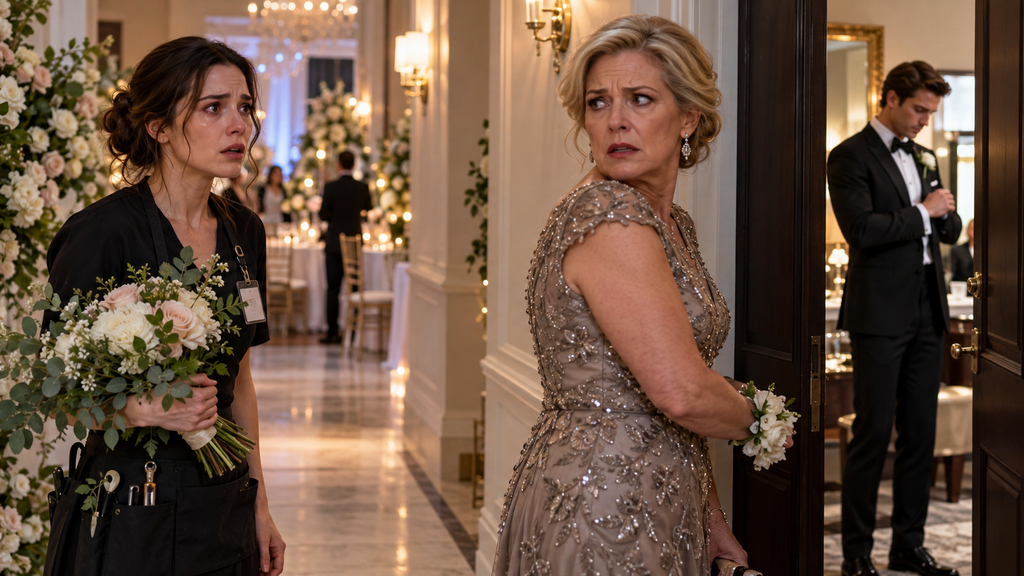
The bride slowly removed her veil.
Her hands were shaking.
“Adrian.”
He looked at her.
“Vivian, please.”
So that was her name.
Vivian.
The woman who had spent that morning preparing to marry my dead fiancé.
She stepped away from him.
“No.”
Her voice was quiet.
“You told me Meredith died.”
I felt something inside me turn cold.
Adrian closed his eyes.
Vivian looked at me.
“You’re Meredith?”
“Yes.”
She swallowed.
Then she looked back at him.
“You said your fiancée was killed in the crash.”
The room seemed to tilt.
I laughed once.
Not because it was funny.
Because there are moments when the truth becomes so grotesque your body mistakes horror for absurdity.
“He told you I died?”
Vivian nodded.
Her face was white.
“He said he was driving.”
“He said you were in the passenger seat.”
“He said he survived and you didn’t.”
Adrian whispered:
“Vivian.”
She turned on him.
“Don’t say my name like you have the right.”
Colleen stepped forward.
“This is not the place.”
I looked at her.
“You buried your son.”
Her face crumpled.
“No.”
I stepped closer.
“You stood beside me at a grave.”
“I held your hand.”
“You watched me kiss a closed coffin.”
Tears streamed down her face.
“Meredith—”
“And you knew he was alive.”
She looked away.
There are some silences that are confessions.
I turned toward the gray-haired man.
He was Adrian’s grandfather, Walter Parker.
I remembered him from the funeral.
He had barely spoken that day.
He had touched the coffin once before leaving.
Now he looked older than he had three months earlier.
I asked:
“Whose body did I bury?”
Walter looked at Colleen.
Colleen shook her head.
“Dad.”
Walter ignored her.
His voice came out rough.
“His name was Thomas Bell.”
I stared.
I had never heard the name.
“Who was Thomas Bell?”
Adrian finally spoke.
“My cousin.”
Vivian’s mouth fell open.
I looked at Adrian.
“You buried your cousin under your name?”
“No.”
“It wasn’t supposed to happen like that.”
I almost screamed.
But I had already spent three months screaming where nobody could hear me.
In my shower.
In my car.
Into the pillow I still slept beside because I could not make myself move Adrian’s things.
I had nothing left to perform.
So I asked quietly:
“What was supposed to happen?”
Adrian looked around the ballroom.
There were perhaps eighty guests.
All of them staring.
His wedding had become an autopsy.
He whispered:
“Not here.”
I smiled.
Three months ago, he had apparently decided a funeral was an acceptable place to lie to me.
Today, the wedding could survive some honesty.
“Here is fine.”
Colleen stepped toward me.
“Meredith, please.”
I looked at her.
“Did Thomas have a mother?”
She froze.
That was answer enough.
“Did he?”
Walter said:
“Yes.”
“Was she at the funeral?”
“No.”
“Why?”
Walter closed his eyes.
“She was told the body had not been recovered.”
I stared.
So somewhere, another mother had been mourning an empty absence while I mourned the wrong body.
The cruelty of it was almost impossible to hold.
Vivian lowered herself into one of the front-row chairs.
Her bouquet slid from her lap.
The flowers I had arranged scattered across the floor.
White roses.
Lisianthus.
Tiny blue delphinium.
I had made beauty for this.
That nearly broke me.
Adrian said:
“The accident was real.”
I looked at him.
He continued.
“Thomas was driving.”
“Why?”
“We were coming back from my grandfather’s lake property.”
“There was rain.”
“The car went off the road.”
My stomach tightened.
“You were in the car.”
“Yes.”
“Were you injured?”
“Yes.”
He touched the side of his ribs instinctively.
I remembered the report saying the crash had been so severe identification relied heavily on documents and family confirmation.
At the time, I had not questioned it.
Why would I?
Grief makes some facts too painful to inspect.
Adrian continued.
“I got out.”
“Thomas didn’t.”
His voice cracked.
For the first time, something resembling genuine grief moved across his face.
Then Walter spoke.
“Thomas and Adrian were wearing similar jackets.”
Colleen snapped:
“Dad.”
Walter looked at her.
“I’m done.”
His voice carried through the ballroom.
“I have been done since the cemetery.”
He turned toward me.
“The identification became confused.”
I stared at him.
“Confused.”
“At first.”
he said.
“Only at first.”
There it was.
The line between accident and choice.
I felt it.
Vivian did too.
She whispered:
“What happened after?”
Walter looked at Adrian.
Adrian’s shoulders dropped.
“The hospital called Mom.”
Colleen covered her mouth.
Adrian continued.
“I was admitted under Thomas’s name.”
My head spun.
“Why?”
“I didn’t have my wallet.”
Vivian said:
“And they thought you were him.”
“Yes.”
“At first.”
I said.
Adrian looked at me.
“Yes.”
“Then your mother arrived.”
Silence.
“She saw you.”
“Yes.”
“And she knew you were Adrian.”
“Yes.”
“And instead of correcting the mistake…”
My voice broke.
“…she let me bury Thomas as you.”
Colleen began crying.
“You don’t understand what was happening.”
I turned toward her.
“What would make that understandable?”
She sobbed.
“Adrian was in trouble.”
There it was.
Not grief.
Not confusion.
Trouble.
I looked at him.
“What trouble?”
He said nothing.
Walter answered.
“Money.”
Adrian closed his eyes.
Vivian laughed bitterly.
“Of course.”
I looked at Walter.
“What money?”
He sat.
Very slowly.
Like he had carried the answer too long.
“My company.”
I remembered Parker Development.
Walter had built it.
Adrian had worked there.
Project management.
Contracts.
Real estate.
He had always described the work as boring.
Apparently not boring enough.
Walter continued.
“Six months before the accident, I discovered irregular transfers.”
Adrian’s face hardened.
“They weren’t stolen.”
Walter looked at him.
“They were unauthorized.”
“That is not the same thing.”
“It was my company.”
“You were going to approve the project.”
“I never did.”
My pulse pounded.
I looked at Adrian.
“How much?”
No answer.
Walter said:
“Four hundred and eighty thousand dollars.”
Someone in the room gasped.
Vivian stood.
“You told me your grandfather cheated you out of your partnership.”
Adrian looked at her.
“He did.”
Walter slammed his cane against the floor.
“I did not.”
For the first time, the old man looked furious.
“I refused to let you use company money to finance speculation in a resort development because you had no approved contracts, no due diligence, and no authority.”
Adrian shouted:
“You promised me a future in the business.”
Walter shouted back:
“I promised you work.”
“Not immunity.”
The room fell silent.
I stared at the man I had been days away from marrying.
For two years, Adrian had told me Walter was controlling.
Old-fashioned.
Unwilling to let younger people take risks.
I had defended Adrian.
Of course I had.
I had even told him:
“You don’t need his permission to build your own future.”
I had not realized he interpreted that financially.
I whispered:
“You took almost half a million dollars?”
Adrian turned toward me.
“It was an investment.”
“That is not what I asked.”
His jaw clenched.
“Yes.”
The word was almost inaudible.
Vivian whispered:
“Oh my God.”
Walter continued.
“When the crash happened, the company had already contacted counsel.”
“An internal review was underway.”
“Adrian believed he was going to be prosecuted.”
Adrian snapped:
“I believed you were going to destroy me.”
Walter stared at him.
“No.”
“You destroyed yourself.”
That sentence landed harder than anything else.
Colleen rushed toward Adrian.
“He panicked.”
I stared at her.
“And you helped.”
She cried.
“He was my son.”
I laughed.
“Thomas was someone’s son too.”
Colleen froze.
Walter lowered his head.
Vivian whispered:
“And Meredith?”
Colleen looked at me.
“What about Meredith?”
Vivian’s voice sharpened.
“She was going to marry him.”
“She buried him.”
“She spent three months thinking he was dead.”
Colleen’s face collapsed.
“I thought…”
She stopped.
I waited.
“What?”
“I thought it would be kinder.”
The sentence nearly took me apart.
“Kinder.”
“He wanted to leave.”
Colleen said.
“You two had been fighting.”
I stared at Adrian.
“We argued about your work hours.”
He looked away.
“That is not the same as wanting to end our engagement.”
Colleen continued desperately.
“I thought if you believed he had died, you could eventually move on.”
I laughed so hard tears came.
“You thought grief would be kinder than rejection.”
Colleen sobbed.
“I was wrong.”
“Yes.”
I said.
“You were.”
No cruelty.
No raised voice.
Just truth.
Sometimes truth sounds cruel when people have been protected from it.
Vivian looked at Adrian.
“When did you meet me?”
I already knew the answer would matter.
Adrian looked toward the floor.
Vivian stepped closer.
“When?”
“Two weeks after the accident.”
She recoiled.
I did too.
Two weeks.
I had still been sleeping beside his funeral clothes because I could not bring myself to move them from the chair.
Two weeks after I watched a coffin go into the ground, Adrian met the woman he now planned to marry.
“How?”
Vivian demanded.
“Online.”
“Under what name?”
He hesitated.
“Adam.”
Vivian laughed.
Of course.
The dead man had needed a new name.
“You told me your name was Adam Parker.”
“Yes.”
“Was anything real?”
He looked at her.
“My feelings.”
She slapped him.
The sound cracked across the room.
Nobody moved.
Adrian touched his cheek.
Vivian was shaking.
“Don’t say that.”
He stared.
She continued.
“You told me your fiancée died.”
“You told me you survived the crash.”
“You cried in my apartment.”
My stomach twisted.
He had used my grief as his grief.
He had taken my place in the story.
Vivian turned toward me.
“I am so sorry.”
I did not know what to say.
She had been prepared to marry my fiancé.
But she too had been fed a corpse.
Mine.
“I believe you.”
I said.
Her face crumpled.
That was all I had.
Then Walter said the sentence that widened everything again.
“The insurance claim was not about Adrian’s life insurance.”
I turned.
“What?”
Adrian went still.
Colleen whispered:
“Dad, enough.”
Walter looked at me.
“There was a key-person policy through Parker Development.”
My stomach tightened.
“On Adrian?”
“Yes.”
“How much?”
Walter hesitated.
“One point two million.”
The room went silent.
Vivian whispered:
“No.”
Walter nodded.
“The company was beneficiary.”
I frowned.
“Then why would Adrian want to be declared dead if the company received the money?”
Walter looked at Colleen.
Colleen closed her eyes.
Then I understood.
“No.”
Walter said:
“Before the accident, Adrian had been trying to buy into a development through a separate entity.”
“He needed capital.”
“The policy payout went to Parker Development.”
“But Colleen convinced me…”
He stopped.
Adrian snapped:
“She convinced you of nothing.”
Walter ignored him.
“She convinced me that if I reported Adrian’s misuse of company funds immediately, the insurer might delay payment while everything was investigated.”
My heart pounded.
“So you stayed quiet.”
Walter nodded.
“I told myself the company needed to survive.”
“And after the money came in?”
“I used it to stabilize the business.”
“That part was legitimate.”
he said.
“Then Adrian contacted Colleen.”
I turned.
“When?”
Colleen whispered:
“Five days after the funeral.”
Five days.
I had still been receiving casseroles.
Five days after I buried him, he called his mother.
Not me.
Colleen continued.
“He said he needed money.”
Of course.
“How much?”
She looked at Walter.
Walter closed his eyes.
“Two hundred thousand dollars.”
Vivian stared at Adrian.
“You said your grandfather gave you seed money for a new company.”
Adrian looked away.
I laughed bitterly.
Every lie had a tiny bone of truth inside it.
That was why they held together.
Walter continued.
“I did not approve the transfer.”
I looked at Colleen.
“You did it.”
Her face broke.
“I had access.”
There.
The insurance claim paid the company.
The mother moved money to the supposedly dead son.
Not because she thought he deserved happiness.
Because she wanted to save him from consequences.
I whispered:
“You stole from your father’s company.”
Colleen shook her head.
“I intended to repay it.”
Walter laughed without humor.
“That sentence has buried enough people.”
The bride’s father stood from the second row.
I had barely noticed him before.
A broad man with silver hair.
He looked at Vivian.
“We’re leaving.”
She did not move.
“Dad.”
“No.”
She looked at him.
“I need to hear this.”
He stared at Adrian with open disgust.
Then sat back down.
Fine.
Apparently the wedding had become mandatory testimony.
I looked at Adrian.
“What were you going to do after today?”
He hesitated.
“What do you mean?”
“You were planning a wedding.”
“You were alive.”
“Did you think no one would ever recognize you?”
He looked toward Vivian.
“We were moving.”
“Where?”
“Portugal.”
I stared.
Vivian whispered:
“You told me Spain.”
Adrian closed his eyes.
Even the escape country had variants.
I almost laughed.
“Why Portugal?”
No answer.
Walter said:
“Because Parker Development had no operations there.”
Adrian glared.
Walter continued.
“He intended to leave the country.”
Vivian looked at Adrian.
“Were we actually getting married legally today?”
Silence.
Her face went white.
“Adrian.”
The officiant—who had been standing awkwardly near the arch—finally spoke.
“The license was never delivered.”
Vivian turned.
“What?”
The officiant looked apologetic.
“I was told there was an administrative delay and that today would be ceremonial.”
Vivian stared at Adrian.
“You weren’t going to legally marry me.”
He stepped toward her.
“Not yet.”
She backed away.
“Because legally you’re dead.”
Silence.
Of course.
He could not marry under his real identity without unraveling the lie.
The wedding was a performance.
Again.
My funeral had been a performance.
This wedding was a performance.
Adrian apparently lived between ceremonies nobody could legally trust.
I looked at Colleen.
“You knew?”
She whispered:
“Yes.”
“And you were going to let Vivian believe today made her his wife.”
Colleen started crying again.
“I told him this had gone too far.”
“When?”
“Last week.”
I stared.
Three months of lies.
And last week was when too far arrived.
“Did you know he told Vivian I was dead?”
No answer.
“Colleen.”
“Yes.”
I felt something in me go quiet.
I had loved this woman.
I had helped her decorate her Christmas tree.
I drove her to a doctor’s appointment after cataract surgery.
She once called me the daughter she never had.
Then she stood in a room while her son told another woman I was a corpse.
I asked:
“Why didn’t you tell me?”
Her answer came barely above a whisper.
“Because once you knew, everything would collapse.”
That was the real answer.
Not kindness.
Not grief.
Structure.
I was the brick they needed left in place.
My ignorance held up the lie.
That realization freed something in me.
They had not believed I was weak.
They had believed I was useful.
I took out my phone.
Adrian saw.
“What are you doing?”
“Calling the police.”
Colleen gasped.
“Meredith.”
I looked at her.
“You buried the wrong man.”
“You submitted false information.”
“You moved insurance-related money.”
“My fiancé has been legally dead for three months and is standing in a wedding suit.”
I shook my head.
“I am officially out of family solutions.”
Adrian moved toward me.
“Wait.”
Vivian stepped between us.
“No.”
He stared at her.
She looked at him.
“You stay away from her.”
For the first time that day, I felt the strange possibility that Vivian and I were not rivals.
We were witnesses.
Different lies.
Same man.
The police arrived.
Then more people.
Venue staff.
Detectives.
Questions.
The wedding ended without vows.
The flowers remained perfect.
That offended me.
By late afternoon, Adrian was gone from the ballroom.
Not dramatically dragged away.
Just escorted into a process bigger than his explanations.
Colleen went too.
Walter voluntarily followed to speak with investigators.
Vivian sat beside me on a bench behind the venue.
Still wearing her wedding dress.
I still wore my florist apron.
For several minutes, neither of us spoke.
Then she looked at me.
“I hate this dress.”
I glanced at it.
“It’s beautiful.”
“That’s the problem.”
I understood.
She turned toward me.
“Did you love him?”
“Yes.”
“So did I.”
I nodded.
We sat with that.
Two women.
Same man.
Two different funerals for futures that never existed.
Vivian whispered:
“I feel stupid.”
My chest tightened.
“No.”
She looked at me.
“I was going to marry a dead man who told me his dead fiancée was you.”
“Yes.”
“That sounds stupid.”
“It sounds like you trusted someone who constructed a lie around information you had no reason to question.”
She looked at me.
“Is that what you tell yourself?”
I thought.
“Not yet.”
She gave a broken smile.
“Maybe we should.”
I nodded.
Maybe.
The investigation lasted months.
Not movie months.
Real months.
Slow.
Administrative.
Infuriating.
The kind where you learn that the truth can be obvious emotionally and still require twelve certified documents.
Thomas Bell’s identity was corrected.
That mattered most to me at first.
His mother, Irene, was found.
She had spent three months believing her son’s body had never been recovered from the crash site.
Instead, he had been buried under Adrian’s name.
I could not sleep the night I learned investigators had told her.
I kept imagining the moment.
The knock.
The explanation.
The grave.
I wanted to call her.
I did not.
What could I possibly say?
I’m sorry I cried over your son’s coffin because I thought he was mine.
There are sentences nobody deserves to have to speak.
Weeks later, Irene contacted me.
Her voice was older than I expected.
“Meredith?”
“Yes.”
“This is Irene Bell.”
My hand shook.
“I’m so sorry.”
She interrupted.
“No.”
I closed my eyes.
“You didn’t know.”
Neither did she.
We both cried.
Then she said:
“I want my son’s name back.”
That sentence broke me.
Not money.
Not revenge.
His name.
I helped however I could.
Statements.
Funeral records.
Photographs.
Eventually, Thomas was reinterred under his own name.
I attended.
Not beside the family.
In the back.
Irene saw me.
Came over.
Took my hand.
Exactly as I had taken Colleen’s three months earlier.
Life can be cruel with symmetry.
She whispered:
“You loved him without knowing him.”
I shook my head.
“I loved Adrian.”
She looked toward Thomas’s casket.
“But you mourned this body.”
“Yes.”
She squeezed my hand.
“Then part of your grief belongs here too.”
I cried harder than I had expected.
Sometimes healing comes from strangers granting you permission the people you loved refused to give.
Adrian faced serious consequences.
So did Colleen.
Walter cooperated fully.
His company survived, though not unchanged.
The insurance claim became part of a long legal dispute.
Funds were recovered where they could be.
Records were corrected.
The details were complicated.
What mattered to me was simpler.
Adrian could no longer be dead when convenient and alive when romantic.
Reality had finally become nonnegotiable.
I learned more about him than I wanted.
There had been another account.
Another failed investment.
Messages with men I had never met.
Plans to leave before the accident.
Not only leave the company.
Leave me.
That hurt in a quieter way.
Apparently the accident did not create the betrayal.
It only offered him a door.
He had already been looking for one.
Michael—my attorney, who later became the person responsible for explaining legal words while I stared at walls—once said:
“People think a dramatic event changes someone.”
“Usually it reveals what they were already willing to do.”
I hated that sentence.
Because it was true.
Colleen wrote me six letters.
I opened the first two.
The first was apology mixed with justification.
She had panicked.
She had been terrified Adrian would go to prison.
She had thought grief would eventually free me.
She had lost her husband young and believed people survive anything.
That last part angered me most.
Survival is not permission to wound someone.
The second letter was better.
Shorter.
I watched you grieve my son while knowing he was alive. There is no explanation that makes that less cruel. I am sorry.
I kept that one.
I stopped opening the rest.
Apologies can be real without requiring continued access.
Walter visited my flower shop eight months after the wedding.
He looked older.
Walked with a cane now.
He brought no flowers.
Smart man.
He stood among buckets of roses and eucalyptus.
“I wanted to see you.”
“Why?”
“To apologize.”
“You already did through your lawyer.”
“That was an affidavit.”
“Very heartfelt.”
He almost smiled.
Then became serious.
“I knew earlier than I admitted.”
My chest tightened.
“How early?”
“The day after the crash.”
I stared.
So even his courtroom cooperation had contained an edited truth.
He continued.
“I knew Colleen intended to let the mistaken identification stand.”
“And you did nothing.”
“Yes.”
“Why?”
He looked ashamed.
“The company.”
“Always the company.”
“Yes.”
He stared at the floor.
“I built it from nothing.”
“Four hundred employees.”
“Contracts.”
“Families dependent on payroll.”
“I convinced myself if the truth came out before the insurance claim resolved, everything could collapse.”
“So you let me collapse instead.”
He closed his eyes.
“Yes.”
There it was.
Not noble.
Not strategic.
A transfer of suffering.
He whispered:
“I am sorry.”
I looked at him.
“Did Thomas matter?”
Walter began crying.
“He worked for us occasionally.”
“That is not what I asked.”
He nodded.
“Yes.”
“Not enough.”
“No.”
I respected the answer.
Not enough.
Sometimes wrongdoing is not the absence of care.
It is care arranged in a hierarchy where someone else always lands at the bottom.
Vivian and I stayed in contact.
Not best friends.
Life is not obligated to become poetic.
But we understood each other in a strange way.
Once a month at first.
Then every few months.
She returned the wedding dress.
Could not get the deposit back.
We laughed about that eventually.
Darkly.
She asked whether I wanted the veil.
I nearly threw my coffee.
“Why would I want your veil?”
“I don’t know.”
“You’re the florist.”
“That is not how flowers work.”
We laughed until we cried.
She went to therapy.
So did I.
Highly recommend professionals when your fiancé has staged his death.
Friends are wonderful.
But eventually they run out of facial expressions.
My own wedding dress stayed in a garment bag for nearly a year.
I could not sell it.
Could not donate it.
Could not look at it.
One rainy Saturday, I finally unzipped the bag.
Ivory silk.
Simple sleeves.
Pearl buttons.
I had imagined walking toward Adrian in it.
For months, that made the dress feel contaminated.
Then I realized something.
The dress had never lied to me.
It was fabric.
My dream had been honest even if the man inside it was not.
So I donated it.
Not dramatically.
No bonfire.
No scissors.
A local nonprofit collected formalwear for women who could not afford wedding dresses.
The volunteer asked:
“Any story behind it?”
I looked at the dress.
Then smiled.
“Too much.”
She laughed.
I let it go.
The flower shop changed too.
For months after everything, wedding work felt impossible.
Every groom’s boutonniere made me uneasy.
Every mother adjusting a tie reminded me of Colleen.
Every white aisle arrangement brought the chapel back.
I considered quitting.
Then Irene came in one afternoon.
Thomas’s mother.
She ordered flowers for his birthday.
Not funeral flowers.
His birthday.
Yellow tulips.
“He hated roses.”
she said.
I smiled.
“Good.”
She looked at me.
“Why good?”
“I’ve had enough roses.”
She laughed.
Then she said:
“Don’t let them take flowers from you too.”
I stared.
That sentence stayed.
The next wedding I designed, I cried while making the bouquet.
Then finished it anyway.
The bride never knew.
She should not have.
Her joy did not owe me an apology for resembling what I lost.
Slowly, weddings became weddings again.
Not evidence.
Not warnings.
Just people promising things.
Sometimes keeping them.
Sometimes not.
The flowers were still beautiful.
A year after the fake wedding, Adrian asked to see me.
Through attorneys first.
Then a letter.
I ignored it.
Another came.
I almost threw it away.
Then curiosity won.
Not love.
Not hope.
Curiosity.
The letter said:
I know I have no right to ask you to hear me.
Good start.
I have spent a year trying to understand when I became someone capable of watching you bury me.
I stopped.
Then continued.
I keep wanting to blame the crash. Fear. Money. My mother. Granddad. But the truth is that when the mistake happened, I saw an exit and chose it.
My eyes filled.
There.
No romance.
No “I was protecting you.”
Just choice.
I told myself you would heal from death more easily than from knowing I abandoned you. That was vanity disguised as mercy.
I had to put the letter down.
Hours later, I finished.
Vivian deserved the truth. Thomas deserved his name. His mother deserved his body. You deserved not to be made into a widow without a marriage or a death.
That sentence broke something open.
A widow without a marriage or a death.
Yes.
That was exactly what I had been.
I am sorry.
No request to meet.
No demand for forgiveness.
I kept the letter.
For three weeks.
Then I agreed to one conversation.
We met in a supervised conference room connected to the legal process.
Nothing romantic.
Metal table.
Fluorescent lights.
No flowers.
Adrian looked older.
Not dramatically.
Just stripped of the polish I remembered.
He sat across from me.
For several seconds, neither of us spoke.
Then:
“You look good.”
I almost laughed.
“Don’t.”
He nodded.
“Right.”
Silence.
I asked:
“Did you ever love me?”
He closed his eyes.
“Yes.”
“That makes it worse.”
“I know.”
“No.”
I shook my head.
“I need you to understand.”
He looked at me.
“If you had never loved me, then maybe all of this would fit into something simple.”
“You were a liar.”
“I was fooled.”
“End.”
My voice broke.
“But you knew how I take my coffee.”
“You knew I hate thunderstorms.”
“You held me when my father died.”
“You wrote vows.”
“You cried when I found the venue.”
I stared at him.
“You loved me and still let me bury you.”
Adrian began crying.
“Yes.”
“That is the part I will never understand.”
He covered his face.
“I don’t understand it either.”
I believed him.
Oddly.
Human beings can know love and still commit acts that contradict everything love should require.
That truth frightened me for a long time.
Then it freed me.
Love is not a guarantee of character.
I asked:
“Why Vivian?”
He took a breath.
“She didn’t know me.”
Of course.
“She knew Adam.”
“Yes.”
“Not Adrian.”
“No.”
“And Adam had no debt.”
“No grandfather.”
“No Meredith.”
“No funeral.”
“No history.”
He nodded.
“I wanted to be a man without consequences.”
That was perhaps the most honest sentence he ever gave me.
I whispered:
“And you built him out of other people’s pain.”
“Yes.”
He cried.
“I’m sorry.”
I looked at him.
“I believe you.”
Hope flickered across his face.
I continued.
“That does not mean I forgive you today.”
Hope faded.
Good.
“I may someday.”
“Or I may stop caring enough to decide.”
He nodded.
“I understand.”
“Do you?”
“Yes.”
We sat in silence.
Then I stood.
He said:
“Meredith.”
I turned.
“I did love you.”
I nodded.
“I know.”
Then:
“That’s why I have to leave with more than one lesson.”
He looked confused.
I continued.
“Being loved by someone does not automatically make them safe.”
I walked out.
That was the last time I saw him.
Three years passed.
Then five.
Life did what it always does.
Continued without asking whether the previous chapter felt resolved.
I expanded the shop.
Hired two full-time assistants.
Taught floral workshops.
Bought a tiny house with a greenhouse.
I adopted an elderly dog named Walter.
Not after Adrian’s grandfather.
The shelter named him.
I considered changing it.
Then decided one Walter had already caused enough paperwork.
The dog stayed Walter.
He snored.
Loved cucumbers.
Hated men in hats.
Good judge of character.
Vivian eventually married.
A real wedding.
Legally licensed.
I did not design the flowers.
Too weird.
But she invited me.
I almost said no.
Then she wrote:
You don’t have to come. But I wanted the invitation to be honest this time.
That did it.
I went.
I wore blue.
Sat in the back.
Her husband was named Eric.
He knew the story.
Apparently first-date disclosures had become aggressive after Adrian.
When Vivian walked down the aisle, she looked at me.
Just once.
No sadness.
No apology.
Something quieter.
Recognition.
She married him.
The officiant said:
“By the authority vested in me…”
Vivian started laughing.
Everyone looked confused.
I laughed too.
Eric knew why.
He whispered something to her.
She composed herself.
Barely.
Afterward, she hugged me.
“This one counted.”
I whispered:
“I checked the license.”
She laughed.
Healing sometimes has a terrible sense of humor.
Irene came too.
Thomas’s mother.
She and Vivian had met through me.
Strange constellation.
Three women connected by one dead man, one living man who pretended to be dead, and a bureaucracy none of us had asked to understand.
At the reception, Irene held my hand.
“Thomas would have hated this music.”
I laughed.
“You say that at every wedding.”
“He had taste.”
We drank champagne.
Life became bigger than the worst reason we met.
That felt miraculous.
Colleen eventually wrote one final letter.
By then, I had no anger left hot enough to protect me.
Only distance.
I opened it.
Meredith,
I used to tell myself mothers would understand what I did because mothers protect their children.
I kept reading.
I was wrong.
Protecting Adrian from consequences required sacrificing Thomas, Irene, Vivian, you, my father, and eventually Adrian himself. That was not protection. It was fear wearing love’s clothes.
I sat very still.
I am sorry I held your hand at that grave.
Tears came.
You were comforting me while I was helping destroy you.
Yes.
There is nothing I can say that makes that better.
No.
There wasn’t.
Then:
I hope one day you remember me from before that cemetery. But if you cannot, I understand.
I did remember.
Christmas cookies.
Doctor appointment.
Laughing in my kitchen.
Helping me choose table linens.
That was the hardest part.
People who betray you are rarely monsters in every memory.
Sometimes they were kind on Tuesday and cruel enough to change your life on Thursday.
The mind wants consistency.
Humans refuse.
I folded the letter.
Placed it with Adrian’s.
Years later, I threw both away.
Not angrily.
I simply no longer needed evidence that they knew.
Walter died first.
I read his obituary.
Did not attend the funeral.
Sent no flowers.
That surprised people.
A florist not sending flowers.
But grief does not require professional courtesy.
I wished him peace.
From my kitchen.
That was enough.
Irene died years later.
I did attend.
Yellow tulips.
Of course.
Her family hugged me.
Someone introduced me as:
“The woman who helped bring Thomas home.”
I almost corrected them.
I had not brought him home.
Truth had.
Persistence had.
Investigators had.
His mother’s love had.
But I let the sentence stand.
Sometimes people need a simple line for a complicated story.
At forty-three, I met Daniel.
Not Adrian’s brother.
Different Daniel.
Terrible luck with names.
He was a landscape architect who came into the shop because one of his clients needed arrangements for a charity dinner.
He was divorced.
Had a daughter.
Liked early mornings.
Hated olives.
For four months, I waited for something to be wrong.
A second family.
A hidden identity.
Possibly a staged death.
Daniel was patient.
One night, I finally told him everything.
Not the short version.
Everything.
He listened.
Then asked:
“What do you need from me when you get scared?”
That question changed me.
Not:
Don’t you trust me?
Not:
I’m not him.
Not:
You have to move on.
What do you need?
I thought.
“Consistency.”
He nodded.
“I can do that.”
He did.
Not perfectly.
Humanly.
We dated four years before he proposed.
I nearly said no.
Not because I did not love him.
Because the word fiancé had become haunted.
He proposed in my greenhouse.
No restaurant.
No crowd.
No ring hidden in food.
Thank God.
He said:
“Meredith, I would like to build a boring life with you.”
I started crying.
He panicked.
“Wrong phrase?”
“No.”
I laughed.
“Perfect phrase.”
Boring.
Groceries.
Doctor appointments.
Laundry.
Actual tax returns.
A man who remained legally alive.
Luxury.
I said yes.
Planning the wedding felt strange.
I had spent years creating weddings for strangers.
Now every choice brushed against a ghost.
Cake.
Venue.
Dress.
My first wedding had never happened, but it had left fingerprints.
Daniel never acted jealous of that.
Once, while looking at venues, I said:
“Adrian and I almost chose this place.”
Then froze.
Daniel shrugged.
“Did you like it?”
“No.”
“Great.”
We kept driving.
That simplicity healed something.
The past did not need to disappear for the future to exist.
I invited Vivian.
She accepted immediately.
When she arrived, her husband Eric came with her.
They gave us a toaster.
“Very romantic.”
I said.
Vivian smiled.
“It has a warranty.”
“Even better.”
Irene was gone by then.
I placed one yellow tulip in a small vase near the entrance.
Not a memorial guests understood.
I did.
For Thomas.
The man whose body had once carried someone else’s name.
The man whose mother taught me grief does not need legal ownership to be real.
Colleen was not invited.
I struggled with that.
For weeks.
Then Daniel said:
“Forgiveness and invitation are different verbs.”
I stared.
“Did you read that somewhere?”
“No.”
“Sounds suspiciously wise.”
“I’m forty-seven.”
“Sometimes it happens.”
I laughed.
Colleen remained outside that chapter.
Not punishment.
Boundary.
On my wedding morning, I stood in front of the mirror.
Different dress.
Different woman.
My hands shook.
My assistant, Lena, adjusted my veil.
“You okay?”
“Yes.”
Lie.
“No.”
Better.
She smiled.
“Cold feet?”
“No.”
“Old ghosts.”
She squeezed my shoulder.
“Make them sit in the back.”
I laughed.
Good advice.
When I walked down the aisle toward Daniel, I did not think about Adrian at first.
Then, halfway there, I did.
Of course.
I saw the first venue we booked.
The cake samples.
The engagement ring.
The closed casket.
The cemetery.
The chapel.
Vivian in white.
Adrian’s face when he saw me alive.
All of it passed through me.
Then Daniel smiled.
He did not rescue me from the memory.
He simply waited at the end of the aisle while I carried it.
That was love too.
Not erasure.
Room.
Our officiant asked:
“Who gives this woman—”
I interrupted.
“No one.”
The guests laughed softly.
I smiled.
“I came willingly.”
Daniel grinned.
The officiant recovered.
“Excellent correction.”
Vivian laughed loudest.
Of course.
We married legally.
I checked.
Twice.
Maybe three times.
Daniel found this hilarious.
I did not care.
Years later, someone asked me whether I regretted following Adrian into that chapel.
It was an assistant at the flower shop.
She knew the broad story.
Not all details.
She said:
“If you hadn’t followed him, maybe you would’ve never known.”
I thought about that.
“No.”
“What?”
“I would have known eventually.”
“How?”
“Lies that large don’t stay elegant forever.”
She nodded.
Then:
“But do you regret seeing it?”
That was harder.
For a long time, yes.
I wished someone had sat me down gently.
Handed me documents.
Let me discover Adrian was alive without seeing him in the suit he bought for our wedding.
Without seeing Colleen adjust his tie.
Without hearing her laugh.
Then I realized pain does not become kinder because it arrives in an envelope.
I said:
“No.”
“Why?”
“Because after the chapel, nobody could convince me I imagined it.”
That mattered.
For years, my greatest fear had been that I was stupid.
Stupid for missing the affair.
Stupid for not questioning the closed casket.
Stupid for comforting Colleen.
Stupid for keeping Adrian’s toothbrush.
Stupid for speaking to his photograph.
Stupid for grieving someone who was alive.
Therapy took that apart slowly.
I had not been stupid.
I had been operating inside a set of facts given to me by people I trusted.
When people deliberately corrupt the information you receive, the failure belongs to them.
Not the person making reasonable decisions with false data.
That lesson went deeper than Adrian.
It changed how I understood shame.
I kept one photograph from my first engagement.
Not of Adrian.
Of me.
Standing in my shop after he proposed.
Holding up my hand.
Laughing.
I almost threw it away.
Then didn’t.
Because the woman in that photograph was not foolish.
She was happy.
Her happiness had been real even if the future she imagined was not.
I refused to punish her for not predicting betrayal.
That may have been the last stage of healing.
Not forgiving Adrian.
Forgiving myself for believing him.
The flower shop eventually expanded into three locations.
Lena became a partner.
We stopped doing enormous wedding installations ourselves because our knees collectively filed a complaint.
I taught younger florists.
Whenever someone panicked because something went wrong—a missing boutonniere, a broken vase, a late cake—I would say:
“Is the groom alive?”
They usually stared.
“Yes.”
“Great.”
“Manageable.”
Lena would yell from the back:
“Meredith, stop traumatizing the interns.”
I laughed.
Dark humor.
Useful fertilizer.
One spring, twenty years after Adrian’s funeral, a young bride came into the shop.
Her fiancé had disappeared three weeks before the wedding.
Not staged death.
Just vanished.
Stopped answering.
Cowardly.
She cried at my consultation table.
“I feel stupid.”
The old word.
I sat beside her.
“No.”
She wiped her face.
“How did I not know?”
I asked:
“Did he tell you?”
“No.”
“Did he act like he was leaving?”
“No.”
“Then why are you responsible for predicting information he worked to conceal?”
She stared.
I heard my therapist in my own voice.
Time does that.
We canceled the wedding flowers.
Instead, she bought herself one bouquet.
Sunflowers.
She left holding them.
I watched through the window.
Maybe that was why I had stayed in the wedding business.
Flowers do not promise permanence.
They bloom.
They die.
That does not make the blooming false.
Adrian died for real many years later.
I learned through Vivian.
A heart condition.
No staged crash.
No mistaken body.
No second wedding.
Just death.
Real this time.
Vivian asked:
“Do you want to know about the funeral?”
I sat quietly.
Then said:
“No.”
She nodded.
“I didn’t think so.”
I expected to feel something dramatic.
Relief.
Anger.
Vindication.
Instead, I felt sad.
Not because I wanted him back.
Because once, long ago, a younger Meredith had planned an entire life with that man.
His final death closed something she once believed would last forever.
I cried that night.
Daniel held me.
He did not ask why.
The next morning, I was okay.
Grief can revisit without reclaiming the house.
A week later, I drove to the cemetery.
Not Adrian’s new grave.
The old one.
The place where Thomas had once been buried under Adrian’s name.
The original marker was gone.
Thomas had his own grave elsewhere.
The plot had been corrected long ago.
It was empty.
I stood there.
An empty grave.
How appropriate.
So much of my pain had been built around absence wearing the shape of certainty.
I placed one flower on the grass.
Not rose.
Not tulip.
A single white daisy.
Then said:
“I’m done.”
No one answered.
Good.
I did not need one.
I went home to Daniel.
Walter the dog had been gone for years.
We had another dog now.
Mabel.
She had eaten half a cushion.
Daniel stood in the kitchen holding the evidence.
“She did it.”
Mabel wagged.
I laughed.
Normal life.
Boring life.
Beautiful life.
Sometimes people want stories like mine to end with revenge.
They ask:
“Did Adrian lose everything?”
“What happened to Colleen?”
“Did Vivian slap him again?”
“Did you sue?”
Some consequences happened.
Some did not.
Some money came back.
Some never did.
Legal outcomes mattered.
But none of them became the ending I cared about.
Because revenge still places the person who hurt you at the center.
My ending was quieter.
I went back to flowers.
I kept working.
I learned to trust again without pretending trust was certainty.
I stopped confusing grief with loyalty.
I married a man who never needed me to be ignorant so he could feel free.
I became older than the age Adrian had been when he decided disappearing was easier than telling me the truth.
And eventually, I could remember him without my body becoming the chapel again.
That was enough.
More than enough.
The worst day of my life was not Adrian’s funeral.
I used to think it was.
Then I thought it was the wedding.
Eventually, I stopped ranking them.
Pain is not a competition.
The funeral taught me what it felt like to lose someone.
The wedding taught me something stranger.
You can lose someone who is still standing in front of you.
Sometimes that is worse.
Sometimes it is the beginning of freedom.
When I saw Colleen that day, she tried to hide.
For years, I thought that was because she was ashamed.
Later, I understood it was more complicated.
She was afraid.
Not of me.
Of reality.
I was the one person who could walk into that ballroom and make every story collide.
Dead Adrian.
Living Adrian.
Dead Meredith.
Living Meredith.
Thomas.
The insurance claim.
The wedding.
The lie.
I was not dangerous because I knew everything.
I was dangerous because my existence contradicted what they needed everyone else to believe.
That is why she hid.
And that is why, after I finally saw the truth, I never hid from it again.
I used to think closure meant understanding why.
Why Adrian left.
Why Colleen helped.
Why Walter stayed silent.
Why Vivian believed him.
Why Thomas’s body became a secret.
I got many answers.
None were enough.
Fear.
Money.
Shame.
Cowardice.
Love distorted into protection.
Ambition.
Opportunity.
All true.
Still not enough.
Then I realized closure was not the final explanation.
It was the day I stopped needing one more answer before allowing myself to live.
I had spent three months mourning a man who was alive.
Years later, I understood the strangest part.
The version of Adrian I loved really had died before the funeral.
Not in the crash.
Earlier.
Somewhere between the first hidden transfer and the first serious lie.
I simply had not known.
The funeral was false.
The grief was not.
My love was not.
My future was.
That distinction saved me from turning my whole past into a fraud.
There had been real laughter.
Real tenderness.
Real mornings.
Real dreams.
Then real betrayal.
Human lives are untidy enough to hold all of that at once.
And if I could stand beside the younger version of myself outside that groom’s room, watching Adrian step into view, I would not tell her to stop crying.
I would not tell her revenge was coming.
I would not promise she would meet someone better.
I would put my hand on her shoulder and say:
“You are not losing your entire life in this hallway.”
“You are losing the future you thought you had.”
“That will hurt terribly.”
“But there are other futures.”
“You cannot see them because grief is standing too close.”
“Walk away from the door.”
“Breathe.”
“Make the call.”
“Let the truth become ugly.”
“And then keep going.”
Because she did.
I did.
The bouquet from Vivian’s wedding never made it down the aisle.
Venue staff found the flowers scattered near the first row.
They asked what to do with them.
I said:
“Throw them away.”
Years later, I regretted that.
Not because I wanted to keep them.
Because flowers deserve better than becoming symbols for people’s lies.
Now, when weddings are canceled at my shop, I donate the flowers whenever possible.
Hospitals.
Nursing homes.
Shelters.
One broken promise can still become something beautiful in another room.
That may be the closest thing I have to a philosophy.
Adrian once told me he did not want anything going wrong on his wedding day.
Everything did.
Thank God.
Because the ceremony stopped.
The lies stopped growing.
Thomas got his name back.
Irene got her son back, at least in the only way death allows.
Vivian got the truth before she tied her future to a man who had not even legally existed under the name she loved.
And I got something I did not know I still needed.
Proof.
Not that Adrian was cruel.
Not that Colleen was guilty.
Proof that I had not lost my mind.
The man I buried was standing there.
The mother who comforted me had known.
The facts were impossible.
And still they were facts.
Once I stopped arguing with reality, reality finally became the ground beneath my feet again.
So yes.
My fiancé died six weeks before our wedding.
That is what everyone believed.
Three months later, I saw him alive at another wedding.
That is where the story became unbelievable.
But the unbelievable part was never that he survived.
People survive crashes.
The unbelievable part was how many people convinced themselves that my grief was an acceptable price for keeping their own lives intact.
For a while, that knowledge almost destroyed me.
Then it taught me the thing I now trust most.
No love worth having requires your ignorance.
No protection worth accepting depends on somebody else being sacrificed.
And no future is truly lost simply because the person you planned it with turned out to be someone you could not safely follow there.
I thought I had buried my future with Adrian.
I hadn’t.
I had only buried the one that required him.
And after everything—
the coffin,
the chapel,
the insurance forms,
the false names,
the ruined wedding,
the letters,
the graves,
the years—
I finally built a life no one had to fake a death to escape.
A real one.
Mine.
THE END STORIES! THANK YOU FOR READING GOOD LUCK !❤️
Related Posts