“Go before five. Ask for safe-deposit box 317.” I read the sentence twice. Then a third time. Warren was already looking at the kitchen clock. 4:17 p.m. “What bank?” I turned the final page over.
Mom had written an address beneath the sentence. First Federal. The downtown branch. Twenty-three minutes away if traffic cooperated. Warren reached for the letter. “Let me see.” I pulled it back. “Why?” His face tightened.
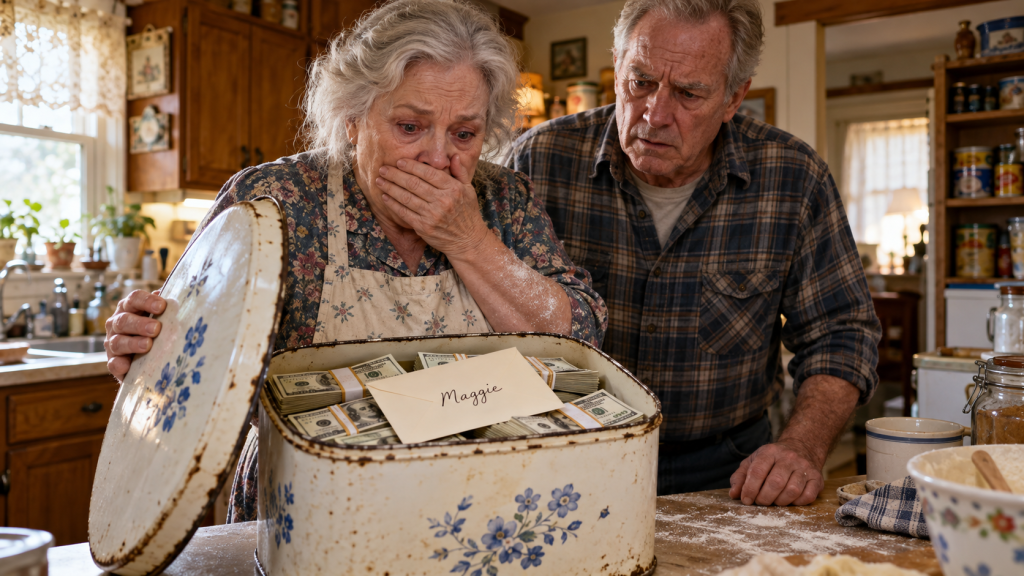
“Because she was my mother too.” “That didn’t bother you when the envelope had my name on it.” “ Maggie.” There was something in his voice. Not anger. Panic. I stared at him. “You knew something was in that tin.” “No.” “You looked frightened before I opened the letter.”
“I was surprised.”
“That wasn’t surprise.”
His jaw tightened.
“We’re going to miss the bank.”
He grabbed his keys.
I did not move.
“Maggie.”
“What did you know?”
His shoulders fell slightly.
“Not enough.”
“What does that mean?”
He glanced toward the pantry.
Toward the shelf where the flour tin had sat for more than sixty years.
Then he looked at me.
“When I was thirteen, Arthur took me to First Federal.”
My stomach tightened.
“For what?”
“I didn’t know.”
“What happened?”
“He told me Mom needed me to sign something.”
The room seemed to shrink.
“The withdrawal slip.”
Warren nodded.
“I remembered the bank when I saw the passbook.”
“Why didn’t you tell me?”
“I was thirteen.”
“You’re seventy-five now.”
His face changed.
That landed.
“I know.”
“Then why didn’t you tell me sometime in the last sixty-two years?”
He looked down.
“Because every year I waited made it harder to explain the year before.”
That answer was so painfully human that for a second I had no response.
Then anger returned.
“You knew Arthur took money from me.”
“I knew he took money.”
“From me.”
“I didn’t understand how much.”
“You never asked?”
“I did later.”
“When?”
Warren rubbed his face.
“When I was seventeen.”
My chest tightened.
“What did he say?”
“He told me it had been used for the family.”
“What family?”
“Ours.”
I laughed once.
Not because anything was funny.
“Of course.”
Warren continued quickly.
“He said the business was failing.”
“He said if he hadn’t taken it, we might have lost the house.”
“He said Mom knew.”
“Did she?”
“I don’t know.”
I held up her letter.
“She says she allowed it.”
Warren looked sick.
“I think she signed something.”
“Then why lie to me about college?”
His eyes filled.
“I don’t know.”
I did.
Fear.
Shame.
Survival.
But knowing the names did not make the choices hurt less.
I looked at the clock.
4:22.
“Get your coat.”
Warren blinked.
“We’re going?”
“Yes.”
He reached for the flour tin.
I stopped him.
“What?”
“The money stays.”
“Maggie, that’s almost nineteen thousand dollars.”
“I know.”
“You can’t leave it sitting here.”
I stared at him.
“I’m seventy-eight.”
“You’re seventy-five.”
“If one of us plans to sprint off with it, this would be an excellent time to admit it.”
He almost smiled.
Almost.
“Put it in your purse.”
“That purse would surrender structurally.”
“Fine.”
He found one of Mom’s old canvas shopping bags.
We placed the bundles inside.
The three pages went into my handbag.
The smaller envelope came too.
When I lifted it, something hard slid against the paper.
I frowned.
“There’s something else.”
Warren turned.
I reached inside.
A small brass key dropped into my palm.
A faded paper tag was wired to it.
317.
Neither of us spoke.
At 4:26, we left the house.
I drove.
Warren followed in his truck.
I noticed him in the mirror the entire way.
That irritated me.
Not because he was following.
Because part of me wondered whether he would turn off.
Disappear.
Avoid whatever waited in that bank.
He didn’t.
At 4:51 p.m., I pulled into First Federal.
Warren parked beside me.
The lobby doors were still unlocked.
A young employee near the entrance glanced at the clock as we hurried in.
“We close at five.”
“I know.”
I probably sounded rude.
I did not care.
“I need access to safe-deposit box 317.”
She smiled politely.
“Do you have identification?”
“Yes.”
“And the key?”
I held it up.
That changed her expression slightly.
“Let me get our branch manager.”
Warren whispered:
“Maybe this is nothing.”
I looked at him.
“You have spent seventy-five years in this family.”
“You should know better than to say that.”
He sighed.
A woman in her sixties emerged from an office.
Silver glasses.
Navy suit.
A nameplate that said Susan Bell.
“Mrs. Hayes?”
“Maggie Hayes.”
She looked at Warren.
“And you are?”
“Warren Hayes.”
Susan’s expression shifted.
Not recognition exactly.
Something close.
“Please come with me.”
I stopped.
“You know our names?”
She looked toward the lobby doors.
The employee locked them.
Then Susan said:
“I knew your mother.”
My heart tightened.
“How?”
“She was a customer here for almost forty years.”
Warren stared.
“We never came here with her.”
“She came alone.”
Of course she did.
Susan looked at the brass key.
“Box 317 has special instructions.”
My pulse quickened.
“What instructions?”
“They were updated nine years ago.”
“By Mom?”
“Yes.”
“What do they say?”
Susan looked at me.
“That access is granted to Margaret Hayes upon Dorothy Vance’s death, provided Margaret presents identification and the original box key.”
Margaret.
Nobody had called me that in years.
My mother’s handwriting on the envelope suddenly felt heavier.
Susan continued.
“There is also a secondary instruction involving Warren Hayes.”
Warren stiffened.
“What kind?”
“You’ll understand once we open the box.”
He looked at me.
I looked at him.
Neither of us liked mysteries anymore.
Susan took us downstairs.
First Federal’s safe-deposit room smelled faintly of metal, carpet cleaner, and old paper.
The walls were lined with narrow steel doors.
317 was near the floor.
Susan used the bank’s guard key.
I inserted Mom’s brass key.
For one second, it would not turn.
My hands were shaking.
Warren reached toward me.
“Want me to—”
“No.”
He pulled his hand back.
I tried again.
The lock clicked.
Susan slid out a long gray box and placed it in a private viewing room.
Then she said:
“I’ll give you privacy.”
I touched her arm.
“Did my mother ever tell you what was inside?”
“No.”
“But she came often?”
“Usually twice a year.”
“For decades?”
“Yes.”
That somehow hurt.
There had been an entire version of my mother’s life conducted in bank lobbies.
Susan left.
Warren and I stared at the box.
He whispered:
“You open it.”
I lifted the lid.
No cash.
At first.
Just envelopes.
Documents.
A red ledger.
A bundle of old savings bonds.
Three bank books.
A photograph.
And two letters.
One marked:
MAGGIE — READ FIRST
The other:
WARREN — YOURS
My brother made a sound.
Almost a laugh.
Almost a sob.
“She knew.”
“Yes.”
Mom had anticipated us standing here together.
Of course she had.
For sixty years, she had anticipated everything except telling us the truth while she was alive.
I opened my letter.
Maggie,
If you are reading this, then I am gone, and that may be the only reason I finally found enough courage to put the whole truth in your hands.
I stopped.
Warren looked at me.
“Read it aloud.”
“You have your own.”
“I know.”
I looked down again.
The $12,600 Arthur took from your account in 1964 did not disappear into groceries, rent, or ordinary family expenses.
My chest tightened.
He used $9,000 of it to buy his share in Vance Tool & Die.
I stopped breathing.
Warren whispered:
“Oh God.”
Arthur’s business.
The company that had employed him for thirty-seven years.
The company that paid for our Christmas bicycles.
Our first color television.
The family trips to Wisconsin.
The second car.
The furnace.
The roof.
My mother’s later comfort.
His retirement.
Everything.
I kept reading.
The remaining $3,600 went toward debts he had hidden from me.
When I learned what he had done, the business purchase had already been made.
I demanded he return your money.
He said he would.
He did not.
My fingers tightened around the page.
Instead, Arthur told me something that I spent the rest of my life being ashamed I believed.
I swallowed.
He said if I exposed him, he would leave us with nothing, contest every account, and make sure you and Warren knew that I had signed the transfer paperwork too.
Warren looked at me sharply.
I read on.
That part was true.
I signed.
My eyes blurred.
There it was.
Mom’s handwriting.
No excuse.
No evasive language.
I did not sign because I thought it was right.
I signed because Arthur frightened me, because I had two children, because I had no job at the time, and because I believed a terrible promise: that he would replace every dollar before you needed it.
When you were offered the scholarship, the money was gone.
My breath broke.
I remembered that day.
A white envelope.
The university seal.
My mother sitting at the kitchen table.
Me saying:
“If I can cover tuition, maybe I can go.”
Mom crying.
Then saying:
“We can’t afford the rest, Mags.”
I had turned it down.
At sixteen, I thought poverty had made the decision.
At seventy-eight, I learned fear had.
I lowered the letter.
“I had a place.”
Warren’s eyes filled.
“I know.”
“I could have gone.”
“Yes.”
“I could have gone.”
He nodded.
“I’m sorry.”
I looked at him sharply.
“Did you know then?”
“No.”
“Warren.”
“I swear.”
He pulled his letter closer but did not open it.
“I knew Arthur took money.”
“I didn’t know it was your whole college fund.”
I looked back at Mom’s letter.
I watched you turn down that scholarship.
That is the memory I carried longest.
You told me it was fine.
You said maybe college was not meant for you.
You went to work at Bell Telephone six weeks later.
My throat tightened.
Forty-one years.
I had worked forty-one years.
Started as a switchboard assistant.
Finished as a billing supervisor.
Built a decent life.
Married once.
Widowed.
No children.
Friends.
Travel.
A small pension.
I had not been miserable.
That almost made the theft more complicated.
My life had not been ruined.
It had simply been redirected without my consent.
That mattered.
Mom continued.
You made a good life.
Do not let anyone use that as proof that what we did to you was harmless.
I covered my mouth.
Mom had known.
Even from beyond death, she had anticipated the argument.
You turned out fine.
What difference did it make?
Apparently enough difference that she had spent sixty years filling a flour tin.
I kept reading.
Arthur’s business became successful.
Every time it did, I asked again.
Every time he said the money was “inside the family now.”
My stomach turned.
That phrase.
Inside the family.
The magic sentence people use when they want individual ownership to disappear.
After twenty years, he began saying that because the business had supported all of us, you had already received your money back indirectly.
I laughed.
Bitterly.
Of course he did.
Warren whispered:
“That sounds exactly like him.”
I did not accept that.
But I also did not tell you.
This is the part you may never forgive me for.
I stopped.
Warren looked at me.
I read on.
Arthur stole the money.
I stole the truth.
I closed my eyes.
For one moment, I could not continue.
Warren turned away.
His shoulders shook.
My mother had spent decades calling herself a coward in private while making casseroles, balancing checkbooks, clipping coupons, and telling us never to lend money we could not afford to lose.
Suddenly, that rule made sense.
Not wisdom.
A scar.
I returned to the page.
When Vance Tool & Die was sold in 1998, Arthur received $184,000 after taxes and obligations.
My eyebrows rose.
I remembered the sale.
Arthur came home with champagne.
He bought Mom a new Buick.
He gave Warren five thousand dollars toward a roof.
He gave me a porcelain angel.
I had hated that angel.
I suddenly hated it more.
I asked for $12,600 plus what I considered fair interest for you.
Arthur refused.
He said too much time had passed.
Warren swore softly.
That night, I opened an account at First Federal in my own name and began putting money into it.
There it was.
The rest.
At first it was small.
Twenty dollars.
Fifty.
Then part of my pension.
Then gifts Arthur gave me that I did not need.
Then money from the sale of my Buick after he could no longer drive.
I bought savings bonds.
I renewed certificates of deposit.
I kept records.
I looked at the red ledger.
Mom had kept records.
Of course she had.
Arthur discovered the account in 2008.
We had the worst argument of our marriage.
For the first time, I told him I would tell you everything if he interfered.
He did not.
I almost smiled.
Mom had finally found courage.
Late.
But not never.
In 2014, Arthur signed the confession in the blue envelope.
My eyes moved through the box.
Blue envelope.
There.
Warren stared at it too.
I kept reading.
He did not become a different man.
Do not make that mistake.
But he became an old man capable of admitting one terrible thing.
He agreed that a portion of the business-sale money should have belonged to you.
He gave me $41,000 from an account he had kept separately and told me to add it to what I had saved.
I stared at the number.
Forty-one thousand.
Not enough to erase sixty years.
Enough to prove even Arthur had eventually understood the debt was real.
When he died, I added another $27,000 from the portion of his estate that came to me.
Warren whispered:
“So that’s why her account was smaller than we expected.”
I looked at him.
“What?”
He looked embarrassed.
“When we were doing funeral paperwork, I saw one old statement.”
“I thought she’d spent more than I realized.”
Neither of us had known she had been spending on the past.
I continued.
The account at First Federal is payable to you on my death.
My hands stopped.
As of my last statement, the balance was $126,400.
Warren let out a breath.
I stared at the page.
One hundred twenty-six thousand four hundred dollars.
Plus the flour tin.
$18,940.
Mom had spent decades rebuilding a future I could no longer use in the same way.
I whispered:
“One hundred twenty-six thousand.”
Warren nodded.
My brain could not fit the number beside the old white flour tin.
Mom clipping coupons.
Mom refusing name-brand cereal.
Mom keeping the thermostat at sixty-seven.
Mom telling me the restaurant coffee was too expensive.
All while a six-figure account sat quietly across town.
I kept reading.
The cash in the flour tin is not part of that account.
It is money I saved at home over the years because I needed to see something physical growing where the theft had once been.
That sentence broke me.
I pictured her opening the tin.
Adding a twenty.
A fifty.
A hundred.
Then putting it back on the shelf.
Year after year.
A private ritual of guilt.
Do not mistake the cash for thrift.
It was penance.
I cried.
Not delicately.
Not the dignified crying old women are expected to do.
I bent over the metal table in a bank basement and cried like I had at twelve when Mom slapped my hand away from the flour tin.
Warren moved toward me.
Stopped.
Waited.
“Can I?”
he asked.
That hurt too.
He was asking before touching me.
“Yes.”
He put one arm around my shoulders.
I leaned into him.
For several minutes, we were not seventy-eight and seventy-five.
We were children again.
A girl who wanted flour.
A boy taken to a bank and told to sign.
Two children inside a family secret built by adults.
When I could breathe again, I finished.
I know money cannot return choice.
It cannot make you sixteen again.
It cannot give you the college years you might have had.
I am not leaving it to you because I believe dollars repair time.
I am leaving it because the money was yours before any of us decided what your life should be.
My vision blurred.
Use it selfishly.
I laughed through tears.
Warren did too.
That sounded like Mom.
Only she would need death to give me permission to be selfish.
Travel.
Buy something foolish.
Give it away.
Take a class.
Leave it untouched.
I do not care.
I have spent sixty years deciding what you should know.
I refuse to decide what you should do with the truth.
Then the last lines:
I am sorry, Mags.
Not because your life turned out badly.
It didn’t.
I am sorry because it was yours, and I let someone else choose part of it.
Mom.
I sat in silence.
Warren cried beside me.
Eventually, I looked at his unopened letter.
“You should read yours.”
He shook his head.
“Later.”
“No.”
“Maggie.”
“Read it.”
He hesitated.
Then opened it.
His hands shook worse than mine had.
He read silently at first.
Then stopped.
“What?”
He looked at me.
“She knew I remembered.”
“Read it.”
His voice cracked.
My dear Warren,
He stopped.
Swallowed.
Started again.
You were thirteen years old when Arthur put a withdrawal slip in front of you and told you to sign as a witness.
Warren closed his eyes.
You did not steal Maggie’s money.
He covered his mouth.
I felt something inside me shift.
He kept reading.
You did not help him because you understood what he was doing.
You were a boy trying to please the man who controlled our house.
Warren began crying.
Not quietly.
I had never seen my brother cry like that.
Not at our biological father’s funeral.
Not when his first marriage ended.
Not when Mom died.
Now.
In a bank basement.
At seventy-five.
Because our mother had finally told him he was thirteen.
I made another mistake afterward.
Warren’s voice broke.
I asked you not to tell Maggie what you remembered.
I looked at him.
He stared at the page.
“So she did.”
“Did what?”
“She asked me.”
His eyes filled.
“After I turned seventeen.”
I waited.
He read on.
You came to me after Arthur told you the money had been used for the family.
You said Maggie deserved to know.
My chest tightened.
Warren whispered:
“I tried.”
I believed him.
He continued.
I told you telling her would destroy the family.
I told you Arthur might leave.
I told you your sister had already built a life and knowing would only hurt her.
That was wrong.
Warren stopped reading.
His face was wet.
“She said you’d be better off not knowing.”
I looked at him.
“And you believed her.”
“I wanted to.”
That was honest.
He continued.
I gave a child responsibility for keeping an adult secret.
That was unfair.
You carried it longer than I had any right to ask.
Warren sat down.
His knees seemed to give out.
I took the letter from his hand.
He let me.
I read the rest aloud.
The money I leave Maggie is not an unequal inheritance.
It is repayment of an old debt.
There it was.
Mom knew us.
Knew death could turn love into arithmetic.
Knew one child receiving more money could become proof of favoritism if the reason remained hidden.
Your share of my estate remains exactly what my will says.
Half to you.
Half to Maggie.
The First Federal account and the flour-tin money are separate because they were never mine in the way the rest was mine.
I looked at Warren.
He nodded.
Tears kept falling.
Do not ask Maggie to divide it.
Warren laughed.
I did too.
Mom really knew us.
And Maggie, if you are reading over his shoulder, do not give him half because you feel guilty.
I laughed harder.
Warren covered his face.
“That woman.”
I continued.
You two have spent your lives taking turns rescuing each other from discomfort.
Stop it.
Warren said:
“She gets bossier after death.”
“Yes.”
The final paragraph was for him.
Warren, I am sorry I made silence look like loyalty.
If Maggie is angry with you, let her be angry.
Do not defend yourself with your age then or your age now.
Just tell the truth.
Love, Mom.
We sat there.
The red ledger between us.
Two letters.
Sixty years.
Finally, Warren said:
“I’m sorry.”
I looked at him.
He continued.
“I should have told you.”
“Yes.”
“I was thirteen when it happened.”
“Yes.”
“I was seventeen when Mom asked me not to.”
“Yes.”
“I was twenty-five when I could have decided she was wrong.”
That one mattered.
“Yes.”
“I was thirty-five.”
“Yes.”
“Forty-five.”
“Yes.”
His voice broke.
“I kept waiting for a good time.”
I looked at him.
“There wasn’t one.”
“I know.”
I let the silence stand.
He deserved some of it.
Then I said:
“I’m angry with you.”
He nodded.
“I know.”
“I don’t know how angry yet.”
“Okay.”
“I may get angrier later.”
“Okay.”
“I may call you names.”
“That seems likely.”
I almost smiled.
“But I believe you were a child when it began.”
His face crumpled.
“Thank you.”
“That doesn’t erase the adult years.”
“I know.”
Good.
No shortcut.
No instant absolution.
Just truth with room around it.
We opened the blue envelope.
Arthur’s confession.
Typed.
Not handwritten except for the signature.
Dated October 18, 2014.
Notarized.
I read it twice.
I, Arthur James Vance, acknowledge that in 1964 I caused funds belonging to Margaret Hayes to be withdrawn from an account established for her education.
No excuses yet.
Then:
I used $9,000 of those funds toward the purchase of my ownership interest in Vance Tool & Die and approximately $3,600 for debts and household obligations.
He admitted it.
Plainly.
Dorothy objected. I pressured her to sign paperwork and promised the money would be returned before Margaret reached college age. I did not keep that promise.
My hands shook.
When the business became successful, I convinced myself its support of the family counted as repayment. It did not.
That sentence surprised me.
Arthur.
The man who could turn mowing the lawn into proof everyone owed him gratitude.
The man who insisted we call him Dad in public.
The man who kept every receipt.
He had eventually written:
It did not.
Warren was a minor when I involved him in one withdrawal and should not be blamed.
I looked at my brother.
He cried again.
Margaret was never told the truth by me. She deserved to be.
Then the last line:
If this statement reaches her after my death, that delay is one more wrong I cannot correct.
Arthur signed.
No apology.
Strangely, I respected that.
Maybe he knew “sorry” would look too small beneath what he had done.
Or maybe he still could not say it.
Either way, the facts were there.
We opened the red ledger next.
Mom’s handwriting.
Dates.
Deposits.
Twenty dollars.
Fifty.
Thirty-five.
A hundred.
Sometimes nothing for months.
Then more.
Each entry had notes.
March 1981 — skipped new curtains, $60 to Maggie fund.
I laughed through my tears.
December 1983 — Arthur bonus gift, kept $100. He thinks I bought coat.
“Mom.”
Warren whispered.
I turned the page.
July 1990 — CD renewed.
April 1998 — business sold. Arthur still refuses. Opened separate First Federal account.
October 2008 — Arthur found statement. Told him if he touched account, I tell children everything. First time he believed me.
I smiled.
There she was.
Not coward forever.
Then:
October 2014 — Arthur signed confession. Added $41,000.
January 2020 — Arthur’s estate settled. Added $27,000.
May 2023 — total replacement account exceeds $120,000. I know this is not time. Stop pretending it is.
That note was to herself.
Not us.
At the back was a calculation.
Original amount.
Inflation estimates from different years.
Interest estimates.
Not exact.
Not obsessive.
A woman trying to answer an impossible question:
What is sixty years of stolen choice worth?
At the bottom, Mom had written:
There is no correct number.
I closed the ledger.
Warren whispered:
“She knew.”
“Yes.”
“She knew money wasn’t the same.”
“Yes.”
A knock came at the viewing-room door.
Susan.
“Everything okay?”
No.
But I said:
“Yes.”
Then:
“Actually, no.”
She opened the door.
“I need to understand the account.”
She sat with us.
The First Federal account had been converted over the years.
Savings.
CDs.
Then a payable-on-death money-market account.
Mom remained sole owner during life.
I was named beneficiary.
Warren had no claim to it through probate.
Neither did the estate.
Neither did Arthur’s heirs.
Susan explained carefully:
“Once we receive the certified death certificate and beneficiary documentation, the funds can be released according to the account terms.”
I stared at her.
“How much exactly?”
She checked the system.
“As of this morning, $127,083.41.”
More than Mom’s last letter.
Interest.
Time continuing even after she stopped writing.
Warren let out a slow breath.
Susan looked at him.
“There is another account under Dorothy’s name that belongs to the estate.”
“Her ordinary savings?”
“Yes.”
“That will be handled through probate according to her will.”
Equal.
As Mom intended.
I looked at the paper savings bonds.
“What about these?”
Susan examined them.
“Some may have matured long ago.”
“Some are registered in Dorothy’s name.”
“One appears to be co-registered with Margaret.”
“We’ll need to verify through Treasury.”
More paperwork.
Fine.
For once, I was in no hurry.
At seventy-eight, I had waited sixty-two years without knowing I was waiting.
I could survive another month.
We left the bank at 6:14.
The lobby had closed long ago.
Susan walked us out personally.
The sun was lower.
Warm light across the parking lot.
Warren stood beside his truck.
“What now?”
I looked at him.
“I’m going home.”
“Mom’s house?”
“No.”
“My house.”
He nodded.
“Right.”
He looked uncertain.
“Should I follow you?”
“No.”
That hurt him.
I could see it.
But Mom’s letter had told me something I needed to practice immediately.
Do not rescue each other from discomfort.
“I need tonight alone.”
“Okay.”
“Warren.”
He looked at me.
“I’m not cutting you out.”
His shoulders loosened.
“I just need one night where nobody tells me what this means.”
He nodded.
“Okay.”
I got into my car.
He did not follow.
Good.
That night, I put Mom’s letters on my dining-room table.
The $18,940 remained locked in my trunk until morning because I was too exhausted to deal with it.
Do not imitate me.
At three in the morning, I woke thinking about the scholarship.
Not Arthur.
Not Mom.
Not Warren.
The scholarship.
I had forgotten the exact name of the school.
Then it came back.
St. Catherine College.
Two hours away.
I had wanted to study history.
Not because I planned to become a historian.
Because I loved stories.
Old newspapers.
Letters.
Maps.
The way one decision decades earlier could reshape an entire family.
The irony was almost offensive.
I laughed in the dark.
At sixteen, I thought studying history was impractical.
At seventy-eight, history had just handed me a bill.
The next morning, Warren called.
I let it ring.
He did not call again.
At noon, he sent:
I’m here when you want.
Nothing else.
Good.
I spent three days reading.
Every letter.
Every ledger page.
Every bank document.
Every withdrawal slip.
One slip contained Warren’s thirteen-year-old signature.
Awkward.
Large.
He had written his whole middle name.
Warren Michael Hayes.
The sight of it broke something open in me.
That was not an accomplice’s signature.
That was a boy’s.
I called him.
He answered immediately.
“Maggie?”
“Come over.”
“I’ll be there in thirty.”
“Bring coffee.”
“From where?”
“The expensive place.”
He laughed.
“Mom would haunt us.”
“Let her.”
Forty minutes later, he arrived with two large coffees and pastries.
We sat on my porch.
I showed him the slip.
“That’s your handwriting.”
He looked at it.
“Yes.”
“What do you remember?”
He closed his eyes.
“Arthur picked me up from school.”
“Why?”
“He said we had to help Mom.”
“Did Mom come?”
“No.”
“The first time, no.”
“First time?”
He winced.
“There were two trips.”
Part 2 had mentioned one withdrawal in his name.
Now two.
My stomach tightened.
“What happened?”
“The first time, Arthur had paperwork already filled out.”
“He told me to sign as witness.”
“Did the teller ask anything?”
“I remember him joking that I had a serious signature.”
“What about the second?”
“Mom came.”
That matched her letter.
Warren continued.
“She cried in the car afterward.”
“Did you ask why?”
“Yes.”
“She said grown-up money problems were boring.”
I stared toward the street.
Mom.
Always turning fear into something children could ignore.
“Then what?”
“A few months later, I heard them fighting.”
“Arthur said the business would make us rich.”
“Mom said the money was yours.”
“That’s when I understood.”
“You were thirteen.”
“Yes.”
“Why didn’t you tell me then?”
“I thought Mom would.”
“She didn’t.”
“No.”
“When you were seventeen?”
“I told her I remembered.”
“She made me promise not to tell.”
“Why did you keep that promise once you were grown?”
Warren looked at his coffee.
“Because Arthur paid for my first year at Georgia Tech.”
I stared.
“What?”
“I didn’t finish.”
“I know.”
He looked ashamed.
“I always wondered if some of that money was yours too.”
The thought had haunted him.
“I don’t know.”
“Neither do I.”
“Did Arthur ever say?”
“No.”
Warren’s eyes filled.
“I thought if I told you, you’d think everything I got came from what he took from you.”
I sat very still.
“Did you?”
“Think that?”
“Yes.”
“Sometimes.”
Honest.
Painful.
Human.
He continued.
“Then I’d tell myself the business made money afterward.”
“That it wasn’t literally your dollars anymore.”
“That we were all supported.”
“Same argument Arthur used.”
“Yes.”
He looked at me.
“I hate that.”
I nodded.
“You should.”
He accepted that too.
Then I said:
“You were not required to ruin your life because he stole from mine.”
Warren stared.
“What?”
“You went to school.”
“You got a bicycle.”
“You had camp.”
“You ate dinner.”
“You lived in the house.”
“I am not going to make you apologize for being a child in the same family.”
He began crying again.
“But.”
I raised one finger.
“You do owe me for the adult silence.”
He nodded.
“Yes.”
“I don’t know what that looks like yet.”
“Okay.”
“And no, you are not getting half the money.”
He laughed through tears.
“Mom anticipated that.”
“She did.”
“I wasn’t going to ask.”
“I know.”
“Actually…”
He smiled.
“I thought about it for maybe seven seconds in the kitchen.”
I stared.
“Seven?”
“Eight.”
I laughed so hard coffee came out my nose.
That was the first time the story became ours instead of Arthur’s.
A joke.
Small.
Stupid.
Necessary.
Probate took months.
Mom’s ordinary estate was divided equally.
House proceeds after expenses.
Checking.
Savings.
Her Buick, which was old enough to qualify as a historical argument.
Furniture.
Warren wanted the television.
I let him have it.
He insisted I take Mom’s china.
I did not want it.
We compromised by giving the china to his daughter, Elise.
The $18,940 from the flour tin presented a legal question because cash does not become magically separate from an estate simply because a letter says so.
I told the probate attorney exactly where it came from.
No secrets.
The letter.
The tin.
The intent.
The attorney reviewed Mom’s estate plan and supporting documents.
Ultimately, the cash was treated consistently with Mom’s documented transfer intention after the estate’s legal obligations were addressed.
It took paperwork.
Affidavits.
Patience.
No movie scene.
Good.
Reality is rarely improved by skipping paperwork.
The First Federal account transferred separately to me as beneficiary.
$127,083.41.
I stared at the deposit confirmation for a long time.
Then did absolutely nothing with it.
For six months.
That surprised everyone.
Especially Warren.
“You haven’t spent any?”
“No.”
“Not even dinner?”
“I have pension money for dinner.”
“What are you waiting for?”
“I don’t know.”
He nodded.
That was the right response.
Not advice.
Not plans.
Not what Mom would have wanted.
Just:
Okay.
The first thing I bought with the money was not glamorous.
A hearing aid.
A very good one.
My insurance covered part.
I used the account for the rest.
Warren laughed when I told him.
“Sixty years of family guilt and you bought better hearing?”
“Yes.”
“Mom would’ve expected Europe.”
“She spoke too softly.”
We laughed.
The second thing I did surprised me.
I called St. Catherine College.
The school still existed.
Bigger now.
Different buildings.
Different name attached to one department.
I asked whether they allowed senior auditors in history courses.
The woman on the phone said:
“Absolutely.”
I started crying.
She panicked.
“Ma’am?”
“I’m fine.”
“Are you sure?”
“No.”
“But continue.”
That fall, at seventy-nine, I sat in a classroom with thirty-two students.
Most were younger than my grandchildren would have been if I had them.
I took a course called American Memory and Public History.
The professor was thirty-six.
She used slides.
Everything was online.
I hated the learning platform.
I loved the class.
On the first day, we were asked why we enrolled.
A boy in a baseball cap said he needed the credit.
A young woman said she wanted to work in museums.
Then it was my turn.
I said:
“I’m late.”
The professor smiled.
“You’re here.”
I cried.
Again.
Apparently seventy-nine was my crying era.
I did not earn a degree.
I did not need to.
I took one course.
Then another.
Local history.
Women’s history.
Archival methods.
Warren teased me.
“Are you planning a career?”
“Yes.”
“At eighty?”
“I’m ambitious.”
Good.
I also traveled.
Mom’s letter said use it selfishly.
I took that seriously.
At eighty, I went to New Mexico.
Not because of any childhood dream.
Because I saw a photograph of Santa Fe and thought:
That looks nice.
Sometimes freedom is not dramatic.
Sometimes it is choosing a place for no deeper reason than desire.
Warren came on part of the trip.
I invited him.
Important distinction.
He paid his own way.
Also important.
We fought once about directions.
Normal sibling fight.
It felt wonderful.
No stolen money.
No Arthur.
No Mom.
Just two old people arguing about whether the GPS had said left or right.
At dinner, Warren raised his glass.
“To Mom.”
I hesitated.
Then raised mine.
“To complicated women.”
He smiled.
“She’d hate that.”
“She was one.”
We drank.
My anger toward Mom changed over time.
It did not disappear.
People like endings where a dead parent’s letter explains everything and love rushes in to cover the cracks.
That was not my experience.
Some mornings, I missed her so badly I could smell her lemon cabinet oil.
Other mornings, I wanted to drive to the cemetery and shout:
“You had sixty years!”
Both were love.
Both were grief.
I eventually went.
Alone.
Mom and Arthur were buried side by side.
Of course.
Their names carved into one stone.
Dorothy Vance
Arthur Vance
Beloved.
That word annoyed me.
Not because they were not beloved.
Because stone makes people simple.
Lives are not.
I stood in front of Arthur’s name first.
“I read your confession.”
Wind through the trees.
Nothing else.
“You stole from me.”
Saying it aloud felt strange.
Too small.
Too direct.
“You also taught me to drive.”
I laughed bitterly.
“You came to my husband’s funeral.”
“You fixed my furnace three times.”
“You also stole my college money.”
All true.
“I don’t know what to do with you.”
That was the most honest thing I could say.
Then I moved to Mom.
“I’m angry.”
My throat tightened.
“I love you.”
Both.
“You should have told me.”
Tears came.
“I understand why you were afraid.”
More tears.
“You still should have told me.”
Then:
“I’m taking history classes.”
I laughed.
“You were right about one thing.”
“What?”
A voice behind me.
I nearly jumped out of my shoes.
Warren.
Standing twenty feet away holding flowers.
“You followed me?”
“No.”
“I come Thursdays.”
“It’s Tuesday.”
He looked at his watch.
“Oh.”
I laughed so hard I had to sit on the cemetery bench.
He joined me.
“What was she right about?”
he asked.
I wiped my face.
“Some things weren’t ready to be opened.”
Warren looked toward Mom’s grave.
“Were they ready now?”
“No.”
I smiled sadly.
“But she ran out of time.”
We sat together.
Then he placed the flowers between both names.
Not just Mom.
Arthur too.
I noticed.
Said nothing.
Forgiveness belongs to each person separately.
At eighty-one, I decided to create a scholarship.
Not huge.
Not a foundation with marble letters.
A local community-college fund.
For students over fifty returning to education.
Warren asked:
“Why fifty?”
“Because everybody thinks starting over belongs to the young.”
“Fair.”
I funded it with $25,000.
Named it:
The Dorothy Hayes Second Start Scholarship.
Not Arthur.
Mom.
Warren stared when he saw the paperwork.
“You named it after her?”
“Yes.”
“Why?”
“Because guilt made her save the money.”
“But choice should decide what it becomes.”
He nodded.
Then asked:
“Why Hayes?”
I smiled.
“Because that was her name before Arthur.”
Warren’s eyes filled.
The first recipient was a fifty-eight-year-old woman named Carla who wanted to become a respiratory therapist after raising four children.
When the college asked whether I wanted to meet her, I almost said no.
Then yes.
Carla shook my hand.
“I thought I was too old.”
I said:
“So did I.”
She laughed.
“I’m fifty-eight.”
“I’m eighty-one.”
She stared.
“You win.”
“I usually do.”
Warren rolled his eyes.
The scholarship grew.
Not because I put all the money into it.
I didn’t.
Mom said selfishly.
I believed her.
I kept enough to travel.
To take classes.
To fix my roof.
To buy ridiculous theater tickets.
At eighty-two, I bought a bright red coat that cost far too much.
Warren said:
“Mom would faint.”
I said:
“Then she shouldn’t have told me to be selfish.”
At eighty-three, I finally opened the last sealed envelope from safe-deposit box 317.
I had forgotten it.
Or maybe avoided it.
No name.
Just:
WHEN YOU’RE READY
Mom could still annoy me from beyond death.
Inside was one sheet.
Not a confession.
Not money.
A recipe.
Biscuits.
I stared.
Flour.
Baking powder.
Salt.
Butter.
Milk.
At the bottom:
You wanted to make these when you were twelve.
I started crying before I finished reading.
I slapped your hand because the tin already held $240 I had secretly saved by then.
Two hundred forty dollars.
That was why she panicked.
Not flour.
Evidence.
You thought I was angry because you disobeyed.
I was terrified you would find the beginning of the truth.
My hands shook.
I am sorry for that too.
Then:
Make the biscuits. Use a different tin.
I laughed.
Then called Warren.
“Come over.”
“What happened?”
“We’re making biscuits.”
Silence.
“Maggie, are you dying?”
“Not tonight.”
He came.
We used store-bought flour from an ordinary paper bag.
No sacred container.
No hidden cash.
No envelopes.
The first batch burned.
The second spread strangely.
The third was almost right.
Warren ate four.
“You know Mom’s were better.”
“Leave.”
He ate another.
We saved one for her.
Not literally.
I am not that sentimental.
We ate it too.
At eighty-four, Warren had a minor stroke.
He recovered well.
But for the first time, I understood that the years left between us were not abstract.
I sat beside his hospital bed.
He looked at me.
“You’re not putting money in a flour tin, are you?”
I laughed.
“No.”
“Good.”
He became serious.
“Maggie.”
“What?”
“If I die first…”
“No.”
“Listen.”
I sighed.
“Fine.”
“If I die first, there’s something in my desk.”
I stared.
“Absolutely not.”
He laughed.
“What?”
“No hidden letters.”
“It’s not hidden.”
“You just told me it’s in your desk.”
“Fair.”
“What is it?”
“A copy of my letter from Mom.”
“Why?”
“I want Elise to know.”
His daughter.
“What part?”
“That thirteen-year-olds shouldn’t be made responsible for adult secrets.”
My throat tightened.
“I think she knows you were a child.”
“I need her to know I know.”
That mattered.
Warren survived.
He later gave Elise the letter himself.
Good.
No posthumous surprises.
We had enough.
At eighty-five, I sold Mom’s flour tin.
Not for money.
To an antiques dealer?
No.
That felt wrong.
Instead, I donated it to the local historical society along with a short anonymous description for an exhibit about household saving practices.
They wanted the whole story.
I refused.
Not every family secret needs to become public history.
I allowed them to label it:
Enamel flour tin, mid-20th century. Used for household cash savings over several decades.
That was true.
Incomplete.
Enough.
Before handing it over, I touched the chipped blue flowers.
For more than sixty years, that tin had held fear.
Then money.
Then evidence.
Then nothing.
Objects survive the meanings we assign them.
That can be a mercy.
The red ledger stayed with me.
So did Mom’s letters.
Arthur’s confession went into a file with the bank documents.
Not framed.
Not worshiped.
Records.
That is all.
At eighty-seven, the Second Start Scholarship funded its twenty-fifth student.
The college invited me to speak.
I refused.
Then Carla, the first recipient, called.
“You have to come.”
“No.”
“I’m asking.”
“I’m declining.”
“You taught me to start at fifty-eight.”
“I did no such thing.”
“You funded it.”
“That’s different.”
“Maggie.”
I sighed.
“Fine.”
At the ceremony, I stood at a podium.
The microphone was too high.
A young man lowered it.
I said:
“Do not call me inspirational.”
The audience laughed.
Good.
“I mean it.”
More laughter.
“I’m not here because I spent my life heroically pursuing education.”
“I’m here because I didn’t.”
The room quieted.
“I wanted something at sixteen.”
“Life went another direction.”
“Some of that was circumstance.”
“Some was somebody else’s choice.”
“Some was mine.”
I looked at the recipients.
“The dangerous thing about missing one beginning is believing beginnings are rationed.”
My voice shook.
“They aren’t.”
A woman in the front row cried.
So did I.
Of course.
I continued.
“You may not get the original version.”
“That matters.”
“Do not let anyone tell you it doesn’t.”
“But a different version is still a life.”
That became the line people remembered.
I did not mention Arthur.
Or Mom.
Or $12,600.
Or flour.
The story belonged to me.
I chose how much to give away.
At eighty-eight, Warren and I sat on my porch one summer night.
He had stopped driving after dark.
I had stopped pretending my knees were fine.
We drank iced tea.
He said:
“Do you ever wonder who you would’ve been?”
“If I went to college?”
“Yes.”
“All the time.”
“Does it bother you?”
“Yes.”
He looked surprised.
I smiled.
“Why do people think healing means you stop wondering?”
“I don’t know.”
“I might have become a teacher.”
“A historian.”
“I might have hated college.”
“I might have married somebody different.”
“I might have stayed single.”
“I might have moved away.”
“I don’t know.”
Warren stared toward the yard.
“I’m sorry.”
“I know.”
“I know you know.”
“Then why say it?”
“Because it doesn’t expire.”
I looked at him.
That was good.
“Okay.”
Then I asked:
“Do you wonder who you’d be if you had told me?”
He nodded.
“All the time.”
“Does it bother you?”
“Yes.”
“Good.”
He laughed.
“You’re terrible.”
“Older sister.”
“By three years.”
“Authority is authority.”
We sat quietly.
Then Warren said:
“I’m glad she wrote the letters.”
“So am I.”
“You’re still angry.”
“Yes.”
“At Mom?”
“Yes.”
“At Arthur?”
“Yes.”
“At me?”
“Occasionally.”
He nodded.
“Fair.”
Then:
“Are you happy?”
I looked at him.
Strange question at eighty-eight.
Maybe the right one.
“Yes.”
I thought again.
“Mostly.”
“Good.”
“You?”
“Mostly.”
Good enough.
Warren died at eighty-six.
Two years after that porch conversation.
Peacefully.
His daughter called me before sunrise.
I sat beside him at the hospital.
Held his hand.
No final confession.
No secret.
No sudden revelation.
Thank God.
He opened his eyes once.
“Maggie?”
“I’m here.”
“Biscuits.”
I laughed.
“What?”
“Yours were terrible.”
Then he died.
That was Warren.
I cried until my chest hurt.
At his funeral, Elise gave me an envelope.
I almost shouted at her.
She laughed through tears.
“It’s not a secret.”
“What is it?”
“Dad’s copy of Grandma’s letter.”
I took it.
On the outside, Warren had written:
Maggie already knows everything. Do not make this dramatic.
I laughed during a funeral.
Perfect.
Inside was one additional note.
Mags,
You were right to be angry.
Thank you for not making anger the only thing we had left.
Warren.
I kept that one.
At ninety, I stopped taking college courses.
Not because I was too old.
Because online registration became more annoying than death.
I told the registrar that.
She laughed.
I spent more time with the scholarship program.
Read applications.
Sometimes students wrote:
I know it may be too late.
I crossed out that sentence every time.
Not too late.
Different.
That was what I had learned.
At ninety-one, a student named Marcus asked me:
“What made you create this?”
I smiled.
“An old flour tin.”
He stared.
“What?”
“Long story.”
“Tell me.”
“No.”
He laughed.
“Why not?”
“Because curiosity does not create entitlement.”
He blinked.
Then smiled.
“That sounds like something you learned the hard way.”
“Yes.”
Good boy.
At ninety-two, I reread Mom’s original letter.
The first line still hurt.
I am sorry.
Then:
Fear made a coward of me.
For years, I had thought the sentence was about one act.
It wasn’t.
Cowardice can become a habit.
So can courage.
Mom practiced one for years.
Then slowly practiced the other.
Saving twenty dollars.
Opening an account.
Threatening Arthur with the truth.
Demanding a confession.
Writing letters.
Setting up the beneficiary.
Not enough to make the past right.
Enough to make the ending more honest.
I finally understood why she could not tell me while alive.
I still believed she should have.
Both truths fit.
That may have been the greatest lesson age gave me.
You do not have to choose between understanding someone and holding them responsible.
You can do both.
At ninety-three, I returned to First Federal.
The branch had been renovated.
Safe-deposit boxes were being phased out.
Susan Bell had retired.
A young manager showed me the new lobby.
I asked:
“Do you still have box 317?”
He checked.
“No, ma’am. That section was removed several years ago.”
I smiled.
Good.
Gone.
Not every container needs to become a shrine.
Outside, I sat in my car for a while.
The same parking lot.
Different cars.
Different body.
Same sky.
I thought about arriving at 4:51 with flour on my sleeves and Warren following behind me.
At the time, I thought we were racing a bank clock.
We were really racing sixty years of silence.
The bank could have been closed.
We would have returned Monday.
Nothing magical depended on 5 p.m.
But emotionally?
I’m glad we made it.
I’m glad the day the flour tin opened did not end with another delay.
I had enough delays.
Years later, people who knew pieces of the story would say:
“At least your mother made it right.”
I always corrected them.
“No.”
She didn’t.
You cannot make time right.
You can make records right.
Money right.
Ownership right.
You can apologize.
You can repay.
You can tell the truth.
But sixteen does not return because an account balance reaches six figures.
That does not mean repair is meaningless.
It means repair should not pretend to be resurrection.
Mom gave me $18,940 in a flour tin.
Then $127,083.41 at the bank.
Savings bonds.
Letters.
Arthur’s confession.
A ledger full of guilt.
Those things mattered.
But the most important thing she gave me was one sentence:
I refuse to decide what you should do with the truth.
That was the first time in the entire story someone returned the choice to me.
So I used it.
I took classes.
Traveled.
Bought the red coat.
Funded strangers’ second beginnings.
Forgave my brother.
Stayed angry with my mother for exactly as long as I needed.
Understood Arthur without absolving him.
Ate terrible biscuits.
Lived.
That was the repayment no bank could calculate.
I was twelve the first time Mom stopped me from opening the flour tin.
I was seventy-eight when I finally did.
For sixty-six years, I thought the rule had been about flour.
It wasn’t.
It was about a family that confused silence with protection.
Money with repayment.
Survival with harmlessness.
And love with the right to decide what somebody else could bear to know.
Mom was wrong about that.
So was Arthur.
So, for too many years, was Warren.
But in the end, the truth did what hidden things sometimes do when finally brought into light.
It did not destroy us.
It changed the shape of what could survive.
THE END STORIES! THANK YOU FOR READING GOOD LUCK! ❤️
Related Posts