Marcus’s last sentence stayed suspended above the kitchen table. “Your father knew before your eighteenth birthday that he probably wouldn’t live another five years.” I stared at him. Then at the letter in my hand. Then back at him.
“No.” Marcus didn’t move. “No,” I said again. “Dad didn’t know.” “He did.” “He would’ve told me.” Marcus looked away. That hurt more than if he had argued. I stood so quickly Dad’s chair scraped across the floor. “You’re telling me he found out he was dying and his response was to charge his eighteen-year-old son rent?”
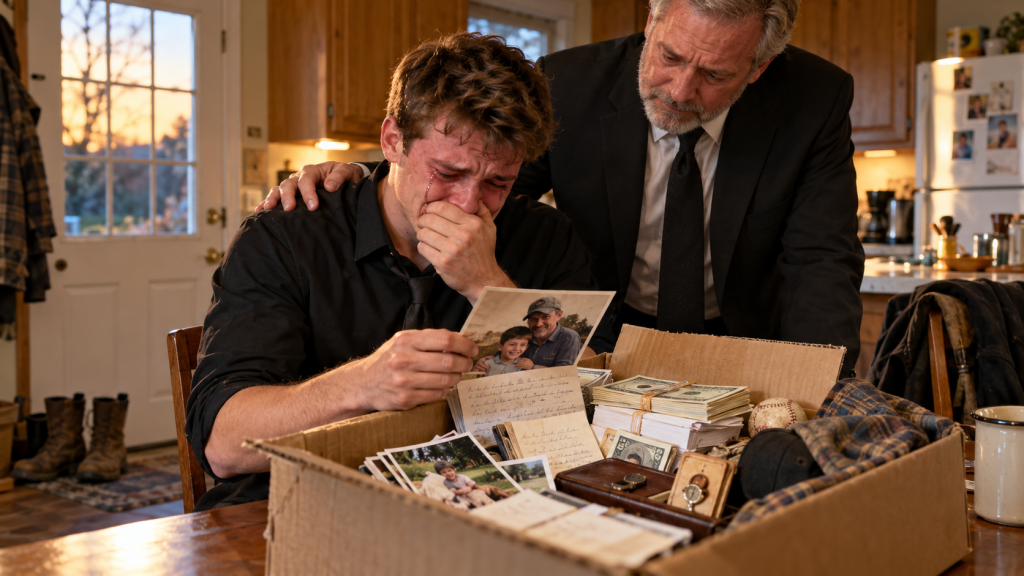
“It wasn’t that simple.” I laughed. It came out ugly. “It actually sounds extremely simple.” “Ryan—” “No.” I held up the letter. “For five years, I thought he cared more about fishing rods than whether I had shoes without holes.” My throat tightened. “I thought he looked at me every month and decided two hundred fifty dollars mattered more than whether I could ever move out.”
Marcus’s eyes filled.
“He handled it badly.”
“Badly?”
I shook my head.
“You don’t get to put five years inside that word.”
He accepted that without defending Dad.
Good.
That was the first thing anyone did right that evening.
I looked down at the letter again.
Dad’s handwriting was blocky and impatient, the way it had always been.
Ryan,
If Marcus is giving you this, then I didn’t get the chance to explain any of it myself.
I swallowed.
That sentence already irritated me.
He had had five years to explain.
I kept reading.
You will probably be angry. You should be.
Do not let Marcus turn me into a better father after I’m dead than I was while I was alive.
I stopped.
Marcus gave a weak smile.
“He made me promise.”
“Promise what?”
“That if you were angry, I wouldn’t defend him.”
I looked back at the page.
Dad continued.
When you were seventeen, I was diagnosed with hypertrophic cardiomyopathy.
I knew the words only vaguely.
Heart.
Something with the heart.
My stomach tightened.
Mine was complicated by an arrhythmia the cardiologist could not reliably control.
They told me I might live another twenty years.
They also told me I could collapse tomorrow.
I stared at the sentence.
“That isn’t the same as knowing he had five years.”
Marcus shook his head.
“No.”
“What?”
“He didn’t know exactly.”
“You just told me he probably wouldn’t live five years.”
Marcus sighed.
“The doctors told him his risk was high.”
“He interpreted it that way.”
“Especially after your mom.”
My anger stalled.
“What does Mom have to do with it?”
Marcus looked toward the dark window.
“Your father became terrified of death after she died.”
I almost laughed.
“Could’ve fooled me.”
“He wasn’t afraid of dying.”
Marcus looked at me.
“He was afraid of leaving you helpless.”
I said nothing.
He continued.
“Your mother handled almost everything involving you.”
“School.”
“Doctors.”
“Birthdays.”
“Clothes.”
“Talking.”
“Your father worked.”
“That was the arrangement they fell into.”
“When she died, he realized he didn’t know how to do the rest.”
My jaw tightened.
“So he chose not to learn.”
“Yes.”
The answer surprised me.
Marcus leaned forward.
“That’s the part people are going to want to romanticize.”
“They’ll say he was grieving.”
“He was scared.”
“He loved you in his own way.”
“All of that is true.”
“But he also had nine years after your mother died to ask how your day was.”
“He didn’t.”
I looked at Marcus.
Tears burned behind my eyes.
He continued.
“Love can explain a failure.”
“It does not erase the failure.”
I looked back at Dad’s letter.
The first thing I thought after the doctor told me was not about myself.
I thought: Ryan doesn’t know how much electricity costs.
Despite everything, I laughed.
A broken little sound.
Of course that was Dad.
Not:
My son will miss me.
Electricity.
I read on.
Then I thought about rent.
Insurance.
Taxes.
Car repairs.
Groceries.
I realized I had spent years doing those things around you instead of teaching you how to do them.
That scared me.
I sat down slowly.
So I made a plan.
My jaw tightened again.
There it was.
Dad always had a plan.
Usually without asking the person affected by it.
The $250 was part of that plan.
I wanted you to learn that housing comes before entertainment.
That money leaves on the first whether you feel ready or not.
That jobs disappear.
That cars break.
That life charges you even when you are angry about it.
Then:
I also knew that if I simply told you I was saving money for you, you would depend on it.
I stopped reading.
“That is insulting.”
Marcus nodded.
“Yes.”
“He thought I would depend on money I knew existed?”
“Yes.”
“I worked constantly.”
“I know.”
“He knew.”
“I know.”
I looked down.
I was wrong about some things.
That caught me.
I thought making life harder would make you stronger.
Sometimes it did.
Sometimes it just made life harder.
My throat tightened.
The shoes were one of those times.
I covered my eyes.
The shoes.
God.
I remembered standing in the kitchen in wet socks.
Dad opening the refrigerator.
Me asking for forty dollars.
Forty.
He had looked at the soles.
Then said:
“Put on another pair of socks.”
For years, I had turned that sentence into proof.
Proof that I had not mattered enough.
The letter continued.
You asked me for shoes, and I said no because I had decided I should stop solving your problems.
Then I watched you leave for work in them.
I knew before the door closed that I had confused teaching with withholding.
I wiped my face.
I bought a pair the next day.
I froze.
I looked at Marcus.
“What?”
Marcus said nothing.
I returned to the letter.
I put them in my truck.
I planned to give them to you after work.
Then I imagined you knowing I had changed my mind and thinking every boundary I gave you could be broken if you looked miserable enough.
I stared.
“That is insane.”
Marcus nodded.
“Your dad could make a simple emotion into a construction project.”
Despite myself, I laughed.
Then cried harder.
So the shoes stayed in my truck for three weeks.
By the time I decided I had been an idiot, you had bought your own.
I returned mine.
I kept the receipt because apparently shame makes you save stupid things.
I dug beneath the photographs.
There it was.
A faded receipt.
Men’s work boots.
$68.49.
Purchased one day after I asked.
Returned twenty-two days later.
I pressed the receipt flat against the table.
For some reason, that tiny piece of paper hurt more than the bank statement.
Because it showed me something money could not fix.
Dad had cared.
He had still chosen silence.
He had loved.
He had still failed me.
Both were true.
I kept reading.
The account started with your rent.
I matched every payment.
When I worked overtime, I added more.
When you repaired your own car instead of asking me, I added what I would have spent.
When you picked up extra shifts, I added fifty dollars sometimes.
You never knew.
That was the point.
Then came another line.
I thought I was building you a runway.
I did not notice soon enough that you thought I was charging you admission to be my son.
My vision blurred.
I put the letter down.
For several minutes, neither Marcus nor I spoke.
Finally I whispered:
“When did he realize?”
Marcus looked at me.
“About how you saw it?”
“Yes.”
“Two years ago.”
I stared.
“Two years?”
“He heard you talking to somebody.”
“Who?”
“Your friend Caleb.”
I remembered.
Caleb and I had been sitting on the back porch after work.
Beer between us.
I had said:
“My dad charges me to live in the house he inherited from Mom.”
I had laughed afterward.
Then:
“I’m basically a tenant he occasionally remembers is family.”
I had not known Dad was in the garage.
Marcus said:
“He called me that night.”
“What did he say?”
Marcus looked down.
“He said, ‘I think I taught him the wrong lesson.’”
My throat tightened.
“What did you tell him?”
“That he should talk to you.”
“And?”
“He said he would.”
I laughed bitterly.
“Of course.”
Marcus nodded.
“He didn’t.”
“Why?”
“Because the next morning you told him you were saving for your own place.”
I stared.
“He decided telling you about the account would ruin that motivation.”
I slammed my palm against the table.
“There!”
Marcus flinched.
“That.”
“That is exactly what he always did.”
“He decided what I needed to know.”
“He decided what would make me stronger.”
“He decided what hurt was useful.”
“He decided and decided and decided.”
My voice broke.
“And he never once asked me.”
Marcus nodded.
“No.”
I sat down.
All the anger drained out of me at once.
It left exhaustion behind.
I looked toward Dad’s work boots by the door.
“How did he die?”
Marcus frowned.
“You know.”
“Heart attack.”
“No.”
I shook my head.
“I know what the hospital said.”
“I mean what actually happened.”
Marcus went very still.
I noticed.
“What?”
He looked toward the box.
“There’s more.”
Of course there was.
I almost laughed.
“Dad died and still managed to turn one conversation into seventeen separate envelopes.”
Marcus reached into the bottom of the box.
He removed a small spiral notebook.
Dad’s.
Oil-stained cover.
Bent corner.
I recognized it.
He carried one just like it to work.
“He kept a symptom log.”
Marcus said.
“He didn’t want you finding it.”
I opened the first page.
Dates.
Blood pressure.
Heart rate.
Chest pain.
Dizziness.
Medication.
Then entries became more frequent.
April 12 — chest tightness at mill, 5 min.
May 3 — dizzy after stairs. Didn’t tell Ryan.
May 19 — woke with racing heart.
June 1 — Dr. Patel wants procedure. Cost high. Think.
I looked up.
“Procedure?”
Marcus’s face tightened.
“He was supposed to have an ICD placed.”
“A what?”
“Implantable defibrillator.”
My stomach dropped.
“Could that have saved him?”
Marcus answered carefully.
“It could have reduced the risk of sudden cardiac death.”
I stared.
“Why didn’t he do it?”
Marcus said nothing.
I looked back at the notebook.
Two pages later:
Insurance deductible 8,600.
Then:
Ryan account: 16,440. Do not touch.
I stopped breathing.
“No.”
Marcus lowered his eyes.
“No.”
I stood.
“He refused heart treatment to keep money in that account?”
“Not exactly.”
“It says it right there.”
“He delayed it.”
“For how long?”
“Months.”
My whole body went cold.
“Why?”
“Money was one reason.”
“One?”
Marcus swallowed.
“He was afraid.”
I laughed.
“Dad?”
“Yes.”
“He hated hospitals after your mom.”
“So he delayed.”
“Yes.”
“For an account I never knew existed.”
“Partly.”
I stared at the notebook.
“Then this money killed him.”
Marcus stood.
“No.”
“It did.”
“No, Ryan.”
“If he had spent it—”
“You don’t know that he would have lived.”
“But he might have.”
“Yes.”
The word hit me.
Marcus came closer.
“Do not turn the account into the reason your father died.”
“He made multiple choices.”
“He had insurance.”
“He could have financed the procedure.”
“I offered to loan him money.”
“His employer had assistance.”
“He had options.”
“He delayed because he was scared.”
“And because he was stubborn.”
“And because he had convinced himself leaving you money was safer than admitting he was sick.”
I stared at him.
“That doesn’t make me feel better.”
“It isn’t supposed to.”
I sat again.
I hated everything in that box now.
The rent receipts.
The photographs.
The account.
The letter.
Proof of love.
Proof of stupidity.
Proof that Dad had spent five years preparing me to survive his death while refusing to let me know his death might be coming.
I whispered:
“He did it again.”
“What?”
“He made the choice for me.”
Marcus nodded.
“Yes.”
“I would’ve given him every dollar.”
“I know.”
“I would’ve slept in my car.”
“I know.”
“I would’ve paid the deductible.”
“I know.”
“He didn’t ask.”
“No.”
Tears fell.
“I was right there.”
Marcus’s voice softened.
“Yes.”
I pressed both hands over my face.
For years, I thought Dad did not need me.
Now I learned he had needed me badly.
He had simply decided needing his son was something a father should never admit.
That did not feel better.
It felt worse.
I finished the letter after midnight.
Marcus had gone home.
He left me alone with the box.
Dad’s final pages were not poetic.
That would have been suspicious.
He wrote like Dad.
Short.
Clumsy.
Occasionally crossed out.
I don’t know how to say this part without making it sound like I did everything for you.
I didn’t.
I paused.
Some of what I called teaching you was me being tired.
Some was grief.
Some was fear.
Some was me not knowing what to say when you looked too much like your mother.
My breath caught.
I had never known that.
Especially when you smiled crooked.
My hand went to my mouth.
Mom had smiled like me.
I barely remembered.
Sometimes you would walk into the kitchen and I would see her face for half a second.
Then I would get angry.
Not at you.
At what I lost.
You probably could not tell the difference.
I started crying.
No.
I could not.
Children rarely can.
They only know the room changed when they entered.
I should have learned how to tell you.
I didn’t.
That is mine.
Then:
The money in the account is yours.
Use it for a home, school, a business, or nothing yet.
Do not use it to prove anything to me.
I am dead.
I laughed through tears.
Dad.
Even his own death could not stop him from sounding practical.
And do not forgive me because of the money.
I read that line twice.
Money is easy compared with saying, “I’m sorry I made you feel unwanted.”
My chest broke open.
I am sorry I made you feel unwanted.
I could not keep reading.
I stood and walked into the hallway.
Dad’s bedroom door was open.
I had not entered since the funeral.
I stood there for several minutes.
Then went inside.
The room smelled faintly of aftershave, dust, and laundry detergent.
On the dresser was a photograph of Mom.
Next to it—
Me.
Age twelve.
Baseball uniform.
I had never seen that photograph in Dad’s room.
I picked it up.
On the back:
Ryan — first hit of the season. Pretended not to look at me after. Looked twice.
I sat on the bed.
Dad had noticed.
That was the most painful discovery of all.
He noticed everything.
He simply did not know how to turn noticing into closeness.
I stayed there until morning.
The funeral paperwork took weeks.
Dad’s estate was small.
The house still had a mortgage.
His truck was worth less than I thought.
His fishing gear was not the secret fortune I once joked it was.
The savings account contained $18,940.23.
Exactly what the statement showed.
But there was another surprise.
Not a giant inheritance.
Something more Dad-like.
Marcus took me to a credit union.
There, a loan officer named Mrs. Alvarez pulled out a file.
“Your father had a small life insurance policy through work.”
My heart tightened.
“How much?”
“Fifty thousand dollars.”
I stared.
That sounded enormous to me then.
She continued.
“After final expenses and his remaining debts, you should receive approximately thirty-seven thousand.”
I looked at Marcus.
“You knew?”
“Yes.”
“Anything else?”
He thought.
“Your dad has a toolbox.”
“I know about the toolbox.”
“Then no.”
I almost laughed.
“Good.”
I was becoming afraid of cardboard boxes.
Mrs. Alvarez handed me another document.
“Your father also made extra principal payments on the house.”
I frowned.
“He did?”
“Yes.”
“How much is left?”
She told me.
Far less than I expected.
The house was not free.
But it was within reach.
For the first time, I understood what Dad had been doing with those fishing-gear purchases I resented.
Some had been real.
He loved fishing.
But most of his money had not disappeared.
He had been paying down debt.
Saving for me.
Preparing.
Quietly.
Always quietly.
Too quietly.
Three weeks after the funeral, I called Dad’s cardiologist.
Dr. Patel could not discuss everything without documentation.
Once the estate paperwork was sorted and proper permissions were verified, he agreed to speak generally about Dad’s medical history.
I sat in an office with a plant dying in the corner.
Appropriate.
Dr. Patel was younger than I expected.
He looked at Dad’s chart.
“Your father was difficult.”
I almost smiled.
“Yes.”
“He came regularly at first.”
“He took medication.”
“Stopped smoking years ago.”
“That helped.”
“Then his arrhythmias worsened.”
“He needed additional intervention.”
I asked the question I had rehearsed.
“If he’d had the defibrillator, would he be alive?”
Dr. Patel looked at me.
“I cannot answer that.”
“Would it have helped?”
“It could have.”
“That isn’t enough.”
“It is the honest answer.”
I hated honest answers that refused to become certainty.
He continued.
“Your father died from a cardiac event the device was designed to treat.”
My eyes filled.
“But no procedure guarantees survival.”
“He also had structural heart disease.”
“We cannot rewrite the outcome.”
I looked away.
“He didn’t do it because of money.”
“Money was one issue he raised.”
“One?”
“Fear.”
There it was again.
“Your father witnessed your mother die in a hospital after a prolonged illness.”
I stared.
Mom had died of complications from leukemia.
I remembered fluorescent corridors.
Dad sleeping in chairs.
“He associated hospitals with helplessness.”
Dr. Patel continued.
“He also expressed concern that if a procedure went badly, you would have no financial cushion.”
I laughed bitterly.
“So his solution was to risk dying without telling me.”
Dr. Patel did not defend him.
“No.”
“He made a poor decision.”
The simplicity helped.
Not heroic sacrifice.
Poor decision.
I needed that.
Then Dr. Patel said:
“He also told me something once.”
“What?”
“He said, ‘My son thinks I don’t care what happens to him.’”
I froze.
“When?”
“About a year ago.”
My eyes filled.
“What did you say?”
“I said, ‘Then tell him differently.’”
I almost laughed.
“And?”
“He said, ‘I wouldn’t know how.’”
I wiped my face.
Dr. Patel closed the chart.
“Some people believe caring is an internal state.”
“They forget it also needs to become behavior.”
I carried that sentence home.
I did not forgive Dad that week.
Or the week after.
People kept expecting the box to transform everything.
Marcus’s wife said:
“Your father loved you so much.”
At the memorial dinner.
I almost screamed.
Instead I said:
“Yes.”
Then:
“He also hurt me.”
She looked uncomfortable.
I let her.
I became protective of complexity.
Everyone wanted a beautiful story.
Strict father secretly saves every rent payment.
Son discovers father’s hidden love after death.
Cue music.
But that was not the whole story.
Dad had saved my money.
He had also charged me while I struggled.
He had matched every dollar.
He had also watched me wear broken shoes.
He had prepared me for life without him.
He had also denied me the chance to prepare emotionally for losing him.
He loved me.
He failed me.
Neither fact canceled the other.
That became important.
I used part of the money to fix my shoulder.
Not all at once.
Physical therapy.
An MRI.
A specialist.
The injury was not as catastrophic as I had feared.
Surgery was not immediately necessary.
That alone changed everything.
Pain had made me feel older than twenty-three.
Treatment gave pieces of myself back.
I also paid off the worst medical bill.
Then I did something Dad probably would have considered irresponsible.
I bought shoes.
Not fancy ones.
Good work boots.
Waterproof.
$189.
I stood in the store holding them and cried like an idiot.
The salesman looked terrified.
“Sir, are they uncomfortable?”
I laughed through tears.
“No.”
“They’re perfect.”
I bought them.
Then I went home and put the old pair in Dad’s box.
I did not know why.
Maybe evidence.
Maybe burial.
Maybe both.
The savings account did not become a house down payment immediately.
I kept most of it.
For six months.
Then a letter arrived from the community college.
Not to me.
To Dad.
They were responding to an information request he had made before he died.
Industrial Maintenance Certification Program
I stared at it.
Dad had circled:
Electrical systems.
PLC basics.
Mechanical troubleshooting.
The exact skills that could move me beyond warehouse and stocking jobs.
In the margin he wrote:
Ryan would be good at this. He already fixes everything.
My throat tightened.
Then anger came.
“Why didn’t you tell me?”
I said it aloud in the empty kitchen.
Dad did not answer.
Typical.
I enrolled anyway.
Not because Dad wanted it.
Because after looking at the program, I wanted it too.
That distinction mattered.
I worked part-time.
Used some of the account for tuition.
No heroic refusal.
No proving I could suffer independently.
I had done enough of that.
Marcus helped me fix my car one Saturday.
While we were under the hood, he said:
“Your dad would be happy.”
I stopped.
“Don’t.”
Marcus immediately nodded.
“Sorry.”
I wiped my hands.
“I need this to be mine.”
“School?”
“Yes.”
“I can’t spend the rest of my life doing things and wondering whether he approves from the grave.”
Marcus leaned against the truck.
“That makes sense.”
Then:
“He’d probably complain about the tuition.”
I laughed.
“There.”
“That sounds like him.”
We both laughed.
Grief became easier when Dad was allowed to remain himself.
Not saint.
Not villain.
Just Dad.
The biggest twist arrived nine months after his death.
Not in an envelope.
Through a woman named Laura.
She came to the house on a Sunday afternoon.
Early forties.
Dark hair.
Nervous.
She stood on the porch holding a little girl’s hand.
The girl looked about eleven.
I opened the door.
“Yes?”
“Ryan?”
“That depends.”
She smiled faintly.
“Good.”
I frowned.
“Who are you?”
Her expression became serious.
“My name is Laura Bennett.”
“I knew your father.”
Every muscle in my body tightened.
Of course.
Another secret.
“What kind of knew?”
She understood immediately.
“No.”
She shook her head.
“Not like that.”
I did not relax.
She looked at the girl.
“This is Mia.”
Mia waved awkwardly.
I waved back.
Laura continued.
“Can we come in?”
I almost said no.
Then remembered Dad’s box.
Apparently my life had become a series of people arriving with information.
“Fine.”
We sat at the kitchen table.
Dad’s table.
Laura kept looking around.
“I haven’t been here in years.”
“How did you know Dad?”
“He supervised me at the plant.”
That surprised me.
Dad rarely talked about coworkers beyond complaining about management.
Laura took a breath.
“Your father helped me leave my husband.”
I stared.
“What?”
Mia looked down.
Laura continued.
“My ex was violent.”
“Not every day.”
“Not the version people imagine.”
“He controlled money.”
“Keys.”
“Where I worked.”
“Who I spoke to.”
“When I finally decided to leave, I had nowhere to go.”
“Your father found out.”
I could not reconcile this with the man who once told me to put on another pair of socks.
“What did he do?”
“He helped.”
“How?”
“Found me an apartment.”
“Paid the first deposit.”
“Helped move furniture.”
“Changed the locks.”
“He even went with me to court once because I was scared.”
I stared.
Dad?
My Dad?
Laura’s eyes filled.
“He never told you?”
“No.”
“He never told anyone.”
“Why are you telling me?”
She looked at Mia.
Then back at me.
“Because he asked me not to while he was alive.”
I laughed bitterly.
“Of course he did.”
Laura winced.
“He said you already thought he cared more about other people than you.”
I froze.
“What?”
“He knew?”
“Yes.”
The room went cold.
“What exactly did he say?”
Laura thought.
“He said, ‘My boy thinks I have patience for everybody except him.’”
I looked away.
That had been exactly how I felt.
Dad could help neighbors repair fences.
Drive Marcus to surgery.
Volunteer at the union picnic.
But ask him about my day?
Two syllables.
Fine?
Done.
Laura continued.
“He said helping strangers was easier.”
“Why?”
“Because they didn’t know him well enough to disappoint.”
I laughed.
“That sounds like him.”
“He said with you, every conversation felt like there was too much at stake.”
I stared.
Laura added:
“That’s not an excuse.”
“Good.”
“No.”
She shook her head.
“He said that too.”
Then Mia pulled something from her backpack.
A small wooden box.
She placed it in front of me.
“Mr. Miller made this.”
Dad had built things sometimes.
Shelves.
Fishing lures.
Simple furniture.
I opened it.
Inside was a stack of index cards.
My name appeared on top.
I looked at Laura.
“What is this?”
“She found them in his locker after he died.”
Mia answered before her mother could.
“Mom didn’t want to read them.”
I picked up the first card.
Ask Ryan how shoulder is.
The next:
Ryan works Tues-Sat this week. Don’t wake him early Sunday.
Next:
He likes that hot sauce with green lid.
I stopped.
Next:
Car making knocking noise. Offer to listen but don’t take over.
Next:
Birthday — maybe fishing? He probably won’t want to go. Ask anyway.
Tears blurred the words.
He had written reminders.
About me.
Because apparently being a father came so unnaturally to him that he needed notes.
I did not know whether to laugh or break something.
Laura watched me.
“He was trying.”
I swallowed.
“Yes.”
Then:
“He was terrible at it.”
She smiled sadly.
“Yes.”
Both.
Again.
Always both.
The final card said:
Tell Ryan about heart.
Nothing else.
No check mark.
No crossed-out line.
Just the thing he never managed to do.
I held the card for a long time.
Then Mia said quietly:
“Your dad taught me to fish.”
I looked at her.
“How old were you?”
“Eight.”
“Did you catch anything?”
“No.”
“He probably blamed your bait.”
She smiled.
“He did.”
I laughed.
For one second, Dad was in the room.
Not as a mystery.
Just a man complaining about worms.
That was healing too.
I graduated from the certification program at twenty-five.
Marcus came.
Laura and Mia came.
I left Dad’s seat empty.
Not because I believed he was spiritually occupying it.
Because I wanted one empty chair to mean:
He should have been here.
That was enough.
After the ceremony, Marcus handed me an envelope.
I glared.
“No.”
He laughed.
“It’s just a card.”
“If another secret comes out of this, I’m throwing you into traffic.”
He opened both hands.
“Fair.”
Inside:
Proud of you. — Marcus
No Dad message.
No hidden recording.
No map to buried treasure.
I hugged him.
Sometimes ordinary is the greatest relief.
I kept the house.
Not forever.
For three more years.
At first, selling felt like betrayal.
Then one winter night the furnace died.
I sat in the kitchen wearing three layers while waiting for a repairman.
And suddenly I realized:
I did not even like the house.
I liked what it proved.
That Dad had left me something.
That I had survived.
That our family had existed there.
But a building should not have to carry grief forever.
I sold it.
After the remaining mortgage and fees, I walked away with enough for a small down payment elsewhere.
I bought a two-bedroom townhouse.
Nothing impressive.
Dry.
Warm.
Mine.
The first night, I sat on the floor eating pizza.
No memories in the walls.
No footsteps I expected to hear.
No work boots by the door.
I cried.
Then I slept better than I had in years.
At twenty-eight, I met Natalie.
She worked in payroll at the manufacturing facility where I eventually became maintenance supervisor.
Our first argument was about money.
Of course.
She wanted us to split groceries proportionally after we moved in together.
I insisted fifty-fifty.
She made more than I did then.
I said:
“I’m not living off you.”
She stared at me.
“That is not what I said.”
“I can pay my half.”
“I know.”
“Then what’s the problem?”
“The problem is you turn every offer of cooperation into a threat to your independence.”
That sentence made me furious.
Because it was accurate.
I slept on the couch.
The next morning she asked:
“Did your dad make you pay rent?”
I stared.
“How do you know?”
“You talk about money like it’s a character test.”
That shook me.
I told her everything.
The $250.
The box.
The account.
The heart condition.
The shoes.
The letters.
By the end, Natalie was crying.
Then she said:
“Your dad loved you.”
“Yes.”
“And he messed you up.”
I laughed.
“Yes.”
“Both?”
“Both.”
“Good.”
“What?”
“You don’t have to choose.”
I married her two years later.
No inheritance drama.
No secret parent.
No box at midnight.
Just us.
Marcus gave a toast.
He said:
“Ryan’s father taught him many lessons.”
I stiffened.
Marcus saw.
Then smiled.
“Some intentionally.”
The room laughed.
So did I.
He continued.
“Ryan learned the rest by deciding what kind of man he wanted to become afterward.”
That one stayed with me.
When our son, Eli, turned seventeen, I began thinking about rent.
The thought scared me.
Not because charging an adult child rent is inherently wrong.
But because I knew how easily I could make parenting into a test.
I talked to Natalie first.
She said:
“What do you want him to learn?”
I answered too quickly.
“Responsibility.”
She smiled.
“That is not specific enough.”
I hated that she was right.
We sat down with Eli before his eighteenth birthday.
Not after.
Before.
I said:
“When you turn eighteen, if you’re working full-time and not in school, we’re going to ask you to contribute.”
He looked nervous.
“How much?”
“Two hundred dollars.”
His eyebrows rose.
“That’s robbery.”
Natalie laughed.
“Wait until you see rent outside this house.”
Then I said:
“But we’re going to show you where it goes.”
He frowned.
“What?”
“Half helps with actual household costs.”
“Half goes into savings for you.”
He stared.
“You’re telling me?”
“Yes.”
“Doesn’t that ruin the lesson?”
I froze.
Dad’s voice almost came out of my mouth.
If you know it’s there, you’ll depend on it.
Instead I said:
“No.”
“The lesson is not that adults should hide financial plans from you.”
“The lesson is that money has jobs.”
Eli nodded slowly.
“Can I see the account?”
“Yes.”
“Can I choose what it’s invested in?”
“Within reason.”
His face lit up.
“Crypto?”
“No.”
“Then this is oppression.”
Natalie laughed so hard she had to leave the room.
I sat there staring at my son.
Eighteen.
Safe enough to joke with me about money.
That was when I understood something Dad never learned.
Teaching does not require mystery.
Boundaries do not require humiliation.
Preparation does not require fear.
And transparency does not make children weak.
Sometimes knowing why a rule exists teaches more than the rule itself.
Eli still made mistakes.
Of course.
At nineteen, he overdrafted his checking account because he bought concert tickets before his car insurance drafted.
He called me.
“Dad?”
“Yes.”
“I messed up.”
“How much?”
He told me.
Old instinct:
Fix it.
New instinct:
Ask.
“What do you think you should do?”
“I can pick up an extra shift.”
“Good.”
“I might need until Friday to pay you rent.”
“That’s fine.”
He hesitated.
“You’re not mad?”
“No.”
“I thought adult life charges you whether you’re ready or not.”
I froze.
Dad’s words.
My words.
Generations echo even when you try to change them.
I answered:
“It does.”
“But family isn’t supposed to imitate every cruel part of adult life just to prove it exists.”
Silence.
Then Eli said:
“That was weirdly deep.”
“Pay me Friday.”
“Love you.”
“Love you too.”
The call ended.
I sat at the kitchen table.
Then cried.
Not because I had done everything right.
Because I had said the words out loud.
Love you too.
No note card required.
At thirty-six, I found Dad’s work boots in a storage bin.
I had forgotten I kept them.
The leather was cracked.
Soles worn.
I placed them beside my own boots.
Mine were newer.
Better.
Waterproof.
I looked at both pairs.
Then realized something I had never considered.
Dad’s boots had holes too.
Small ones.
Near the heel.
He had patched them with adhesive.
For years, I had remembered his fishing gear and beer and assumed every dollar he denied me became pleasure for him.
Some did.
He was not a monk.
But there were signs I had not seen.
He had also been cheap with himself.
Sometimes poverty or fear makes people weirdly selective.
Spend thirty dollars on something unnecessary.
Refuse sixty-eight dollars for something essential.
Human beings are not spreadsheets.
I sat on the garage floor holding one of his boots.
Natalie found me.
“Everything okay?”
I showed her.
“He had holes too.”
She sat beside me.
“Does that change anything?”
I thought.
“No.”
Then:
“Maybe the story I told myself.”
“What story?”
“That I was the only person he denied.”
She nodded.
I looked at the old boot.
“He wasn’t specifically cruel to me about money.”
“He was terrified of spending.”
“After Mom got sick, medical bills crushed them.”
“I knew that.”
“But I never connected it.”
Natalie touched my shoulder.
“Understanding is not the same as excusing.”
“I know.”
I smiled.
“I think I finally know.”
Marcus died when I was forty-one.
Cancer.
Quick.
Before he died, he asked me to visit.
I sat beside his hospital bed.
He looked terrible.
He would have appreciated that description.
He said:
“I need to tell you something.”
I groaned.
“If there is another box—”
He laughed until he coughed.
“No box.”
“Good.”
“I lied once.”
My stomach tightened.
“About Dad?”
“Yes.”
I sat straighter.
“When?”
“The night I gave you the box.”
“What lie?”
“I said your dad knew he probably wouldn’t live another five years.”
I stared.
“He didn’t?”
“Not exactly.”
“You already corrected that.”
“No.”
Marcus took a breath.
“I made it sound more certain because I thought it would make the rent make sense.”
I went silent.
He continued.
“I wanted you to see his intention before you judged the method.”
I stared at him.
“That was not your choice.”
“I know.”
Anger came fast.
“You promised him you wouldn’t defend him.”
“I failed.”
“Yes.”
“I know.”
Marcus looked at me.
“I’m sorry.”
I stood and walked toward the window.
For years, I had built part of Dad’s story around that sentence.
He knew he was dying.
So he made me pay rent.
But the real truth was less dramatic.
Dad knew he had a dangerous heart condition.
He feared death.
He overreacted.
He designed a financial lesson around that fear.
Then trapped himself inside the plan.
No prophecy.
No countdown.
Just a scared father making choices.
I turned back.
“Why tell me now?”
Marcus smiled weakly.
“Because I’m dying.”
“That seems to make people suddenly value accuracy.”
Despite myself, I laughed.
He continued.
“And because your dad’s biggest mistake was deciding what truth you could handle.”
“I don’t want my last act to be doing the same.”
My anger softened.
Not vanished.
Softened.
I sat beside him.
“Thank you.”
“For lying?”
“For correcting it.”
He nodded.
Then:
“Your dad would be proud of you.”
I groaned.
“Marcus.”
“Sorry.”
He smiled.
“Habit.”
A week later, he died.
I missed him terribly.
He had been the bridge between Dad and me.
Then I realized I did not need a bridge anymore.
Dad had been dead almost twenty years.
Whatever relationship remained existed inside memory.
And memory was allowed to mature.
At forty-five, I reread Dad’s letter for the first time in nearly a decade.
The paper had yellowed slightly.
The line that once destroyed me now felt different.
Do not forgive me because of the money.
I understood why.
Money makes people want clean equations.
He charged $250.
He saved $250.
Therefore no harm.
Wrong.
The money returned the dollars.
Not the years.
Not the wet shoes.
Not the cold conversations.
Not the birthdays where Dad gave me cash in an envelope instead of asking what I wanted.
But the harm did not erase the love either.
That mattered just as much.
I finished the letter.
The final paragraph had become my favorite.
Not because it was beautiful.
Because Dad finally stopped instructing me.
I don’t know what kind of man you became.
I hope decent.
I hope less afraid than me.
I hope when somebody you love needs something, you don’t make them guess whether they can ask.
Then:
If you have kids, tell them things.
Even the bad things.
Especially the things that make you look stupid.
I smiled.
Dad had managed one excellent parenting lesson.
He delivered it after dying.
Terrible timing.
Still useful.
When Eli turned twenty-three—the same age I had been when Dad died—he came home one Sunday.
He brought his girlfriend.
After dinner, he stayed behind.
“Dad?”
“Yes?”
“I want to move to Seattle.”
My stomach tightened.
Far.
Expensive.
Risky.
He had a job offer.
Not enough savings.
Part of me immediately began calculating.
Rent.
Moving truck.
Emergency fund.
Security deposit.
Then Dad’s voice appeared.
Life charges you whether you are ready.
Another voice followed.
Mine.
Family does not need to imitate every cruel part of life.
I asked:
“What do you need from me?”
Eli seemed surprised.
“Advice.”
That almost made me laugh.
“Not money?”
“I might ask for that too.”
“Good.”
“What?”
“Nothing.”
We talked.
For two hours.
About salary.
Rent.
His girlfriend.
Career growth.
Fear.
I told him:
“I think you should go.”
He looked shocked.
“You do?”
“Yes.”
“What if I fail?”
“You might.”
“That’s comforting.”
“You asked.”
He smiled.
Then:
“Can I borrow three thousand for moving costs?”
“Yes.”
He blinked.
“That easy?”
“No.”
I grinned.
“We’re writing it down.”
“Of course.”
“With repayment terms.”
“You are Grandpa.”
I stared.
He froze.
“Sorry.”
I laughed.
“No.”
“You’re right.”
Then:
“But we’re talking about it.”
He nodded.
“Difference.”
“Yes.”
Difference.
That word became the measure of everything.
Not perfection.
Difference.
Years later, after Natalie and I became grandparents, Eli brought his daughter over.
Her name was June.
Six years old.
She found Dad’s old cardboard box in my office closet.
Because apparently every important family story eventually becomes a six-year-old touching something they were not supposed to touch.
“Grandpa?”
“Yes?”
“What’s this?”
My heart tightened.
The box.
Still there.
Rent receipts.
Photographs.
Letter.
Old boots receipt.
Index cards.
History.
I sat beside her.
“That belonged to my dad.”
“Your dad is dead.”
Children.
Direct.
“Yes.”
“Was he nice?”
I thought.
A lifetime of answers moved through me.
Finally:
“Sometimes.”
She frowned.
“That’s weird.”
“People are.”
She pulled out one envelope.
“Can I open it?”
“No.”
“Why?”
“Because it’s mine.”
She accepted that easier than most adults would.
Then:
“Did he love you?”
I smiled.
“Yes.”
“How do you know?”
That question.
God.
How do you know?
I could have pointed to $18,940.
The matched rent.
Life insurance.
Community-college brochures.
Photographs.
Index cards.
The account.
But I did not.
I said:
“He left evidence.”
June frowned.
“Evidence?”
“Yes.”
“Like detectives?”
“Sort of.”
Then I added:
“And eventually I learned there had been evidence while he was alive too.”
“What?”
“He worked.”
“He came to my baseball games.”
“He kept my mom’s picture.”
“He worried about my car.”
“He remembered things without saying them.”
I paused.
“But he should have said them.”
June thought.
Then asked:
“Do you tell Daddy?”
“What?”
“That you love him.”
“Yes.”
“All the time?”
“Probably too much.”
She smiled.
“Daddy says you text him weather warnings.”
“That is love.”
“That is annoying.”
“Also love.”
She laughed.
I closed the box.
That night, I decided I no longer wanted it hidden in the closet.
I did not throw it away.
I moved it to a shelf.
Not sacred.
Not secret.
Just part of the family.
I am sixty-eight now.
Older than Dad ever got to be.
That fact still feels impossible.
Sometimes I look in the mirror and see him around my eyes.
I used to resent that.
Now I find it comforting.
A few months ago, I found the original bank statement again.
$18,940.23.
At the time, it felt like a fortune.
Today, compared with a lifetime, it looks almost small.
But the amount was never the point.
The real inheritance was messier.
Dad taught me responsibility.
Some intentionally.
Some accidentally.
He taught me that preparation without tenderness can feel like rejection.
That saving money for someone is not the same as telling them they matter.
That independence is useful until it becomes a refusal to need anyone.
That fear disguised as discipline is still fear.
That parents can love deeply and parent poorly.
That adult children are allowed to acknowledge both.
And maybe most importantly—
He taught me that explanation is not erasure.
I understand why Dad charged me rent.
I understand why he hid the account.
I understand why he avoided treatment.
I understand why he never told me about his heart.
I understand why grief turned him quiet.
I understand why looking at me sometimes hurt.
I understand almost everything now.
And some of it was still wrong.
That used to feel like a contradiction.
It doesn’t anymore.
Love is strong enough to survive accurate memory.
Dad does not need me to lie about him to keep loving him.
I wish he had learned that while he was alive.
Last year, I visited his grave.
I brought nothing.
No flowers.
No fishing lure.
No letter.
I sat on the grass.
For a while, I talked about Eli.
About June.
About Natalie.
About work.
Then I said:
“You were right about one thing.”
Wind moved through the trees.
“Life does charge you every month whether you’re ready or not.”
I smiled.
“But you were wrong about another.”
I looked at his name carved into stone.
“You don’t make somebody strong by making sure they never need you.”
My eyes filled.
“You make them strong by teaching them they can survive—and still letting them know the door is open.”
I wiped my face.
“I wish your door had been open more.”
Then:
“I wish I had knocked harder.”
That one surprised me.
For years, I put all responsibility on Dad.
He had been the parent.
Rightly.
But adulthood gave me enough perspective to admit something else without blaming my younger self.
Sometimes I had stopped trying too.
After enough rejection, I protected myself.
I became sarcastic.
Distant.
I stopped asking.
That was understandable.
Still sad.
I touched the grass.
“I forgive you.”
The words came quietly.
Not fireworks.
Not absolution.
Not:
Everything you did was okay.
Just:
I no longer needed anger to prove the hurt happened.
That was what forgiveness eventually meant to me.
The facts stayed.
The pain stayed part of the story.
But I could put it down.
Then I laughed.
“You know what’s funny?”
Nothing answered.
“After all that rent, I became the kind of dad who made spreadsheets with his kid.”
“You would hate that.”
I imagined his voice.
Too much talking.
I smiled.
“Yeah.”
“Probably.”
I stood.
Before leaving, I said:
“And those shoes were a terrible decision.”
That one I hoped he heard.
The cardboard box is still in my house.
The first envelope still holds a $250 deposit slip.
Dad’s handwriting still looks impatient.
The photograph of my ruined shoes is still there.
On the back:
I should have bought these. I told him socks instead. Coward.
I used to cry whenever I saw that word.
Coward.
Now I see something else.
He had known.
Not enough to change in time.
But enough to tell the truth after he was gone.
I wish courage had arrived earlier.
Of course I do.
But late truth is still different from no truth.
And that box did not teach me that my father had secretly been perfect.
It taught me something more useful.
He had been human.
Scared.
Stubborn.
Loving.
Withholding.
Generous.
Proud.
Grieving.
Wrong.
Trying.
All at once.
When I was eighteen, Dad slid a scrap of paper across the kitchen table and told me:
“Two hundred fifty dollars.”
For years, I heard only the money.
Five years later, after his funeral, I opened a box and discovered what he had been trying—and failing—to say underneath it.
I am afraid I will leave you.
I don’t know how to prepare you.
I don’t know how to tell you I love you.
So I’m trying to build you something instead.
I wish he had simply used the words.
That is why I do.
Every time Eli leaves my house:
“Love you.”
Every time June hangs up the phone:
“Love you.”
Every time Natalie goes to sleep before me:
“Love you.”
Sometimes they roll their eyes.
Good.
Let love become so ordinary that nobody in my family ever has to search through a dead man’s cardboard box to prove it was there.
That is the inheritance I kept.
Not the $18,940.
Not the house.
Not the insurance money.
The lesson hidden inside all the things my father never managed to say:
If you love someone, do not make them solve the mystery.
Tell them while you are still here.
THE END STORIES! THANK YOU FOR READING GOOD LUCK !❤️
Related Posts