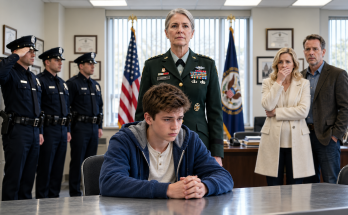
Raymond’s smile vanished. For the first time that morning, nobody in my family had anything to say. Not Victoria. Not my mother. Not my father. Not even Raymond, who normally had an answer before anyone finished asking the question.
The two-star general standing beside me did not raise his voice. He did not need to. “Mr. Cole,” he said, “you have not been arrested. You are not being detained by the Army. Federal investigators have requested that you remain available for contact.”
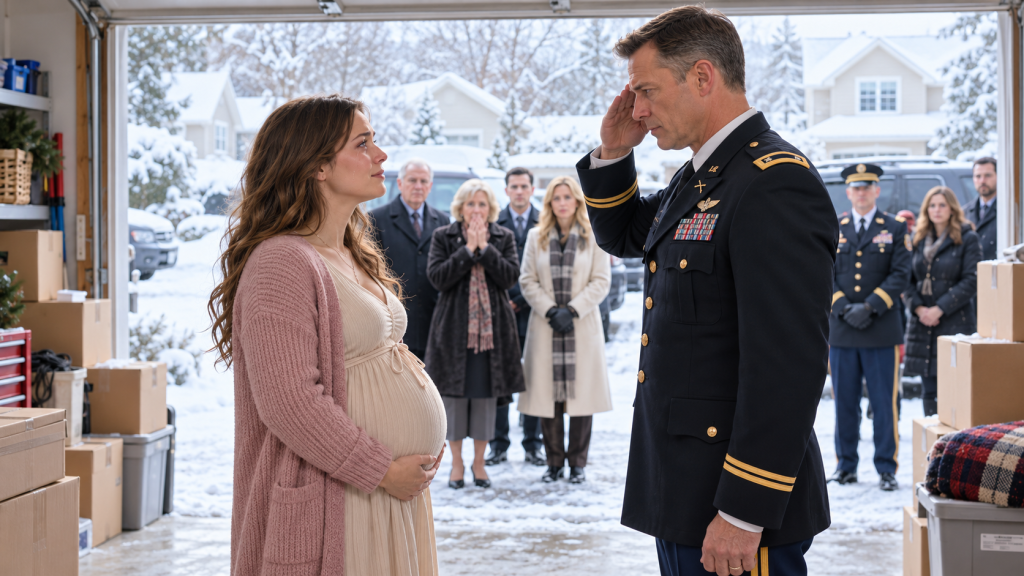
Raymond swallowed. “Federal investigators?” The general looked at him. “You heard me.” Victoria stepped between them. “My husband hasn’t done anything.” The general’s expression barely changed. “I did not say he had.” “Then why is his company in that file?” “Because that question belongs to investigators.”
My father finally found his voice.
“This is absurd.”
He came off the porch still holding the newspaper.
“This family buried a man yesterday. My daughter is pregnant. And now you people arrive with military vehicles and start threatening us?”
The general looked at me first.
Not him.
That mattered.
“Colonel Mercer, do you wish to remain here while transportation is arranged?”
I looked around the driveway.
The house.
Marcus’s house.
No.
Mine, according to the deed inside the folder.
The home where my husband had replaced a kitchen floor at midnight because he refused to admit he had measured the first boards wrong.
The home where we had once painted the nursery three different shades of green before agreeing they all looked identical.
The home where my father had just told me my grief was ruining Thanksgiving.
The home where my pregnant body had been assigned to a freezing garage because Raymond wanted an office.
I looked at the cardboard box sitting on the concrete.
Then at my family.
“No, sir.”
My mother’s face changed.
I think that was the exact moment she understood I was actually leaving.
Not sulking.
Not retreating upstairs.
Leaving.
“Grace,” she said quickly.
That was my name.
Grace Mercer.
Though nobody in my family had spoken it gently that morning.
“Grace, don’t be dramatic.”
I almost laughed.
The convoy.
The general.
The federal investigation folder.
The pregnant widow standing barefoot in a freezing garage.
And I was being dramatic.
I bent and reached for the cardboard box.
The sergeant beside me moved immediately.
“I’ve got it, ma’am.”
“No.”
I held the box myself.
It was light.
Two sweaters.
A photograph.
My prenatal vitamins.
Marcus’s folded T-shirt.
Almost nothing from the life I had lived in that house.
The sergeant hesitated.
Then nodded.
“Yes, ma’am.”
My father stepped closer.
“You’re not actually going anywhere.”
I looked at him.
“I am.”
“This is your family home.”
“No.”
I held up the deed.
“It is my home.”
The words landed harder than shouting would have.
Victoria stared at me.
“What does that mean?”
“It means Marcus transferred the house to me before his final mission.”
Brenda—no, my mother was Eleanor—looked toward the garage as if the walls themselves might confirm it.
Raymond finally spoke.
“So what?”
Everyone turned.
He tried to recover some of his old confidence.
“So the house is in her name.”
He shrugged.
“She’s married. She’s family. It doesn’t mean everybody has to leave because she’s upset.”
The general said nothing.
I answered.
“You’re right.”
Raymond looked relieved.
“For once.”
Then I continued.
“You don’t have to leave because I’m upset.”
I looked at my mother.
My father.
Victoria.
Then Raymond.
“You have to leave because I’m asking you to leave my property.”
Silence.
My father’s face darkened.
“You would put your own parents out on Thanksgiving?”
I looked toward the garage.
“You were going to put your pregnant daughter there on Thanksgiving.”
His mouth opened.
Then closed.
I turned toward the general.
“Sir, I need ten minutes.”
He nodded.
“We’ll wait outside.”
The soldiers withdrew with him.
Not as guards.
Not as an audience.
That small act of respect nearly broke me.
For the first time all morning, I was alone with my family.
My mother crossed the room toward me.
“Grace.”
I stepped back.
She froze.
I had never stepped away from her touch before.
She looked wounded.
I hated that part.
People who hurt you are not always emotionless when consequences arrive.
Sometimes they are genuinely hurt that you no longer trust their hands.
That does not make the boundary wrong.
Eleanor whispered:
“We didn’t understand.”
“What?”
“Who you were.”
I stared at her.
That sentence hurt more than everything else.
“Who I was?”
“I mean your position.”
“My rank.”
“Yes.”
I looked at her.
“So if I were really just an administrative worker, the garage would have been fine?”
Her face collapsed.
“That’s not what I meant.”
“It’s exactly what you meant.”
Victoria jumped in.
“Grace, everyone is emotional.”
I turned to her.
“You called me at five in the morning to tell me my room belonged to Raymond.”
“I said temporary.”
“You told me to sleep in an unheated garage.”
“There’s a space heater.”
I laughed.
“There is one outlet out there and Raymond uses it for his battery tender.”
Raymond looked away.
Victoria’s voice sharpened.
“You always do this.”
“Do what?”
“Make everything bigger than it is.”
I stared at her.
“My husband was buried yesterday.”
“I am five months pregnant.”
“You wanted my room for your husband’s investment calls.”
Victoria’s eyes filled.
“That’s not fair.”
Maybe.
But it was true.
My father threw the newspaper onto the counter.
“Enough.”
Old command.
Old reflex.
He had used that voice since we were children.
It worked on Victoria.
It worked on my mother.
For years, it worked on me.
Not anymore.
“You’re right.”
He looked almost relieved.
I continued.
“Enough.”
His expression changed.
I set the cardboard box on the table.
“You all have until tomorrow afternoon to arrange somewhere else to stay.”
My mother gasped.
“Tomorrow?”
“Yes.”
“That’s impossible.”
“No.”
“It’s inconvenient.”
“There’s a difference.”
Raymond scoffed.
“You can’t legally throw people out overnight.”
He was right.
Annoyingly.
I looked at him.
“I know.”
That surprised him.
“My lawyer will handle whatever notice is required.”
The Army had taught me many things.
One of them was that authority did not improve when you pretended laws did not apply.
I was not going to become my family just because I finally had leverage.
“I’m leaving today.”
“I will not be returning while you are here.”
“The property lawyer will contact everyone about occupancy.”
My father sneered.
“Property lawyer.”
“Yes.”
“You’ve become somebody.”
I looked at him.
“No.”
“I’ve always been somebody.”
His face went still.
I picked up the box again.
My mother whispered:
“What about Thanksgiving?”
I turned toward her.
And for some reason, that almost made me cry.
Not the garage.
Not the rank.
Thanksgiving.
As though turkey were still the emergency.
“I hope you enjoy it.”
Then I walked outside.
The cold hit my face.
The baby moved inside me.
A strong little roll beneath my ribs.
I rested one hand there.
“I know.”
I whispered.
“I’m going.”
The sergeant opened the rear door of the second vehicle.
Before I climbed in, General Avery—Major General Nathan Avery, my temporary receiving commander—held out the sealed folder.
“There is more inside.”
I looked at him.
“From Marcus?”
His expression softened.
“Yes.”
My lungs stopped working.
Not literally.
But almost.
I stared at the folder.
“Sir…”
“You don’t have to read it now.”
“Is it operational?”
“Some pages are.”
“Then I’ll wait.”
He nodded.
“That would be wise.”
It was such a normal military answer that I nearly laughed.
Even grief had classification markings.
I climbed into the vehicle.
Through the window, I saw my family standing together in the driveway.
Four people.
No longer looking annoyed.
Now looking afraid.
Not of me.
Of the consequences they had not imagined when they believed I had none.
As the convoy pulled away, I looked back once.
Only once.
Then I turned forward.
The first relocation site was not some secret underground facility.
It was a secure military guest residence near Fort Belvoir.
Comfortable.
Plain.
Protected.
Exactly what I needed.
The “protective status” was not because assassins were following me.
The truth was less cinematic and more unsettling.
Marcus’s final mission had involved oversight of a procurement network tied to overseas logistics contracts.
After his death, investigators discovered irregularities connecting several subcontractors to shell entities that moved money through domestic investment firms.
One of those investment firms had done business with Raymond’s company.
That did not mean Raymond had killed Marcus.
It did not even mean Raymond knew everything flowing through his accounts.
The Army did not tell me that.
The FBI did not tell me that.
And I refused to invent it.
But because my identity had been kept unusually quiet and because family relationships overlapped with an active financial investigation, command decided I should be moved until investigators understood the risk.
Risk.
Not certainty.
That distinction became important over the next year.
At the guest residence, a medic checked my blood pressure.
Too high.
Not dangerous.
Higher than normal.
“Stress,” she said.
I almost laughed.
“Really?”
She looked at me.
“Colonel, you buried your husband yesterday.”
Right.
Sometimes rank makes people forget that obvious things still count.
I showered.
Changed.
Ate half a sandwich.
Then sat on the edge of the bed with Marcus’s folder in front of me.
My hands trembled.
I opened it.
The first documents were exactly what General Avery had said.
Property deed.
Estate instructions.
Survivor benefits.
Trust papers.
The $4.7 million survivor-benefit trust was more complicated than the single page my family had seen.
It was not simply money Marcus had somehow accumulated in secret.
Part came from life-insurance proceeds.
Part from investments.
Part from a family trust established by his grandparents.
Part from assets transferred before deployment.
The unborn baby was the primary beneficiary.
I was trustee until the child reached certain ages, with independent oversight.
Marcus had planned carefully.
Painfully carefully.
Then I reached the final envelope.
My name.
His handwriting.
GRACE
I stopped.
The world blurred.
For seven months I had imagined Marcus’s last moment.
Had he been afraid?
Had he thought of me?
The baby?
Had he known?
No official report could answer those questions.
Now his handwriting was sitting on my knees.
I opened it.
The first line destroyed me.
If you’re reading this, then somebody finally made you sit down long enough to open paperwork.
I laughed.
Then sobbed.
That was Marcus.
No grand poetry before a joke.
I read on.
First, I love you.
Second, I’m sorry.
Third, if anyone from command uses the phrase “your husband died a hero,” you are allowed to ask them to bring food instead.
I wiped my face.
You are going to want details. Some you may get. Some you may never get. Please do not spend the next forty years trying to solve the parts of my death that were never yours to carry.
That line took time.
I read it twice.
Then again.
The house is yours. I transferred it before this rotation because if something happened to me, I did not want you negotiating housing while pregnant or grieving.
He knew.
He did not know my family would try to take my room.
But he knew vulnerability attracts people who mistake exhaustion for permission.
The trust is for the baby. Use it responsibly. Do not turn our child into a museum for me.
My throat closed.
If it’s a boy, please do not name him Marcus. One Marcus is enough trouble for one family.
I laughed.
Then cried harder.
We had not known the sex.
We had chosen to wait.
I continued.
If it’s a girl, you still cannot name her Marcus.
I pressed the paper against my mouth.
Then came the part that changed the story.
There is one thing you need to know about Raymond.
My body went cold.
I do not know whether he is involved in anything illegal. Read that sentence twice.
So I did.
I do know his company appeared in a financial-routing review connected to contractor accounts under investigation. I reported the relationship to counterintelligence and legal because he is family. I did not confront him. You should not either.
My hands tightened.
Marcus had known.
Not guilt.
Connection.
Enough to report.
Nothing more.
If I die before the review closes, there is a chance someone will overreact because of the family link. Don’t let grief turn suspicion into certainty.
Of course he wrote that.
Marcus hated lazy conclusions.
Then:
And don’t protect Raymond because he is family either. Let investigators do their jobs.
I nodded despite myself.
“Okay.”
I whispered.
As though he could hear.
The last page was for me.
Not Colonel Mercer.
Not widow.
Me.
Grace, your family has always underestimated how much you carry because you rarely complain while carrying it. Do not help them do that anymore.
I stopped breathing.
He knew that too.
Strength is not an agreement to accept bad treatment.
I closed my eyes.
The garage.
My father’s newspaper.
Victoria’s voice.
My mother stirring coffee.
Please build a life where our child learns the difference between being generous and being available for exploitation.
Then:
And if your father ever tells you grief is making you dramatic, remind him I outranked him in every branch of government that matters.
I laughed so loudly the soldier outside the door probably heard.
Then I cried until I fell asleep with the letter on my chest.
The investigation into Raymond lasted fourteen months.
That is important.
Not fourteen hours.
No federal agents dragged him away on Thanksgiving.
No helicopter appeared.
No handcuffs in my driveway.
He was interviewed.
His records were subpoenaed.
Several accounts were frozen temporarily while investigators traced transactions.
His company’s reputation suffered immediately once partners learned federal scrutiny was involved.
Some clients left.
Others waited.
Victoria blamed me.
Of course.
Her first message arrived three days after Thanksgiving.
I hope you’re happy. Raymond’s business is collapsing because of your military friends.
I stared at it.
Then deleted it.
She sent another.
You always hated that he was successful.
That one actually made me laugh.
I forwarded everything to my attorney and stopped reading.
Raymond eventually retained experienced counsel.
And then the truth became more complicated.
His firm had indeed moved money for entities linked to suspicious contractor networks.
But much of the money entered through a client he believed was a legitimate infrastructure fund.
His compliance systems were terrible.
His due diligence was worse.
He had ignored several warnings because the returns were excellent.
But investigators did not find evidence that he knew the funds were connected to illicit procurement activity when he first accepted them.
Later was different.
There were emails.
Questions raised internally.
A compliance officer told him one client’s documentation did not make sense.
Raymond responded:
As long as the wires clear, stop trying to invent problems.
That sentence cost him.
Not because it proved he understood the entire scheme.
It proved he chose not to understand.
Willful blindness has consequences.
The government ultimately charged several people connected to the network.
Raymond faced regulatory and criminal exposure for specific financial-reporting and compliance-related conduct.
He was not accused of Marcus’s death.
Not sabotage.
Not murder.
Not espionage.
People online later invented those theories.
They were wrong.
I learned to despise dramatic lies even when they made my side look more heroic.
The proven truth was enough.
Raymond had prioritized profit over questions.
That choice allowed dirty money to pass through his company.
He eventually entered a plea related to financial reporting failures and obstruction involving records created after scrutiny began.
He received a custodial sentence measured in a few years, followed by supervision and financial penalties.
His company was dissolved.
Investors sued.
He lost the Audi.
I did not care about the Audi.
Victoria did.
For about six months, apparently.
Then she filed for divorce.
When I heard, I felt nothing satisfying.
Just tired.
Her marriage had been real even if her husband had been arrogant.
Loss is not funny simply because someone once hurt you.
The house dispute ended faster.
My family initially refused to leave.
My father told my attorney:
“This is our daughter’s home. We’re guests.”
Rachel—different Rachel from my sister? No, my lawyer was Rachel Cooper in a different story, but here I needed a new lawyer. My attorney was Mara Ellison, a military-family estate attorney Marcus and I had used for years.
Mara replied:
“Guests leave when the host revokes permission.”
My father said:
“You can’t throw parents into the street.”
Mara said:
“No one is throwing anyone into the street.”
“You have income.”
“You have another residence.”
“You also received formal notice.”
That was true.
My parents had sold their own large home six months earlier and moved into Marcus’s house “temporarily” while deciding where to retire.
Temporary stretched.
Then Victoria and Raymond began staying more often.
Then their belongings multiplied.
Then somehow I became the person being moved.
Mara handled it correctly.
Written notice.
Property access arrangements.
No threats.
No military personnel at the door.
No misuse of my rank.
My family moved out twelve days later.
My mother left me a voicemail.
She cried through most of it.
Not apology.
Not yet.
Mostly disbelief.
I cannot believe you would do this before Christmas.
I listened once.
Then archived it.
Dates do not turn cruelty into kindness.
Thanksgiving had not protected me.
Christmas did not obligate me.
The house stayed empty for nearly two months.
I remained near Fort Belvoir while command completed security reviews and prepared my next assignment.
Not deployment.
Not yet.
Pregnancy changed what duties were appropriate.
The Army did not send a five-month-pregnant widow from a funeral straight into some combat zone because an extraction convoy looked dramatic in the driveway.
My orders were reassignment and secure transport.
Administrative.
Command-level.
Still meaningful.
But grounded in the fact that I was pregnant and grieving.
That mattered.
For years I had been excellent at allowing people to imagine military competence meant immunity to ordinary human limits.
Marcus’s letter cured some of that.
Strength is not an agreement to accept bad treatment.
I used the sentence often.
Mostly on myself.
At twenty-seven weeks, I returned to the house.
Alone.
A security officer drove me.
He waited outside.
I walked through the front door.
Silence.
The first thing I saw was the kitchen table.
My father’s newspaper no longer there.
My mother’s sugar bowl gone.
Victoria’s coffee mug gone.
Raymond’s laptop charger gone.
Their absence should have felt triumphant.
It did not.
The house felt like Marcus had died again.
His boots near the mudroom.
His half-finished list on the refrigerator.
Fix nursery closet.
Order furnace filters.
Tell Grace to stop buying terrible decaf.
I sat on the kitchen floor and cried.
Maybe for an hour.
Maybe ten minutes.
Grief destroys clocks.
Then the baby kicked.
Hard.
I put my hand over my stomach.
“You’re opinionated.”
Another kick.
“Like your father.”
Nothing.
I smiled.
That was the beginning of returning home.
Not reclaiming it from my family.
Reclaiming it from the moment they had turned it into a place of humiliation.
I moved into the downstairs guest room.
The room they had refused me.
Not because I needed revenge.
Because stairs had become annoying.
The garage stayed a garage.
Raymond never parked there again.
I installed a better heater anyway.
Not because anybody was sleeping there.
Because Ohio? No, Harrisburg, Pennsylvania winters were cold, and I wanted the pipes protected.
Practicality.
Marcus would have approved.
My daughter was born in February.
A girl.
Maeve Elise Mercer.
Not Marcus.
He had explicitly forbidden it.
Maeve because Marcus once told me the name sounded like someone who would grow up and frighten senators.
Elise for my grandmother.
Labor lasted thirteen hours.
My sister did not come.
My parents did not come.
Mara came for thirty minutes because lawyers apparently enjoy hospitals when there is no litigation involved.
General Avery sent flowers.
The card said:
No salutes required.
I laughed.
My mother called after Maeve was born.
I almost did not answer.
Then I did.
“Hello?”
She was crying.
“Is she okay?”
“Yes.”
“And you?”
“Yes.”
“What’s her name?”
“Maeve.”
Silence.
Then:
“That’s beautiful.”
I said nothing.
Eleanor whispered:
“Can I see her?”
I looked at Maeve sleeping in the hospital bassinet.
My instinct said no.
My guilt said yes.
Neither was enough.
“I’m not ready.”
My mother cried harder.
“Grace…”
“I said I’m not ready.”
This time she heard the boundary.
“Okay.”
The word surprised me.
No argument.
No guilt.
“Okay.”
That was the first small change.
My father was slower.
He did not call.
Not after Maeve was born.
Not for six weeks.
Then a letter arrived.
Actual paper.
Harrison hated handwriting.
I opened it while Maeve slept on my chest.
Grace,
I owe you an apology.
I nearly stopped.
My father had said sorry exactly twice in my childhood.
Once for forgetting a school recital.
Once for backing over my bicycle.
He continued.
I told myself I was frustrated because I did not know how to help you grieve.
That is not what happened Thanksgiving morning.
Good.
Specific.
I was uncomfortable with your grief, so I demanded you make it smaller for me.
My throat tightened.
I treated Marcus’s house as family property because he was gone and you looked vulnerable.
There.
The truth.
I used the fact that you rarely fight with us as evidence that you would accept whatever we decided.
I read that line twice.
Then I learned your rank and felt embarrassed because strangers suddenly treated you with respect I had failed to show you.
My eyes filled.
That embarrassment taught me something ugly about myself.
I should not have needed stars on a general’s shoulders to understand my daughter deserved a warm room.
I cried.
Not because it fixed everything.
Because he finally understood the right part.
The letter ended:
I do not expect to meet Maeve until you decide I can.
Dad
I did not call immediately.
I waited three weeks.
Then invited my parents separately.
Not together.
My mother came first.
She stood in the entryway holding a tiny knitted blanket.
Her eyes went to the garage door.
Then away.
“Can I come in?”
Not:
This is family.
Not:
I’m your mother.
Can I come in?
“Yes.”
She met Maeve.
Cried.
Held her for exactly twelve minutes.
When Maeve started fussing, my mother immediately handed her back.
No advice.
No claiming.
Before leaving, she looked toward the kitchen.
“I was cruel.”
I nodded.
“Yes.”
She winced.
I did not rescue her from the word.
“I am sorry.”
“Thank you.”
She looked surprised.
“Is that all?”
“For today.”
Eleanor nodded.
“Okay.”
Again.
She was learning.
My father came later.
He brought no gift.
He stood in the doorway with his hands in his coat pockets.
“I didn’t know what to bring.”
“Nothing is fine.”
He looked at Maeve.
His face broke.
“She looks like Marcus.”
She did not.
Not yet.
She looked like a potato with beautiful eyelashes.
But grief makes people see what they need.
He held her awkwardly.
Maeve sneezed.
My father jumped.
I almost laughed.
Then he whispered:
“I’m sorry I called your tears a problem.”
That was the moment I believed his letter.
Not because he apologized twice.
Because he named the behavior without adding:
But I was stressed.
No defense.
He continued:
“I miss him too.”
I looked at my father.
That had never occurred to me.
Marcus and Harrison had argued constantly.
Politics.
Lawn equipment.
How steaks should be cooked.
Everything.
But they had also spent hours fixing the deck together.
My father lost someone too.
Not the way I did.
Still loss.
“I know.”
I said.
For the first time, we grieved Marcus in the same room.
Victoria was different.
She waited ten months.
Her marriage was collapsing.
Raymond’s legal trouble had become public.
She called me furious.
“You knew.”
I was feeding Maeve mashed banana.
“Knew what?”
“About Raymond.”
“No.”
“The military knew.”
“The military was investigating accounts connected to his company.”
“Same thing.”
“No.”
“It isn’t.”
“You let me stay married to him.”
I put the spoon down.
“Victoria.”
“You could have warned me.”
“I learned there was an investigation the same morning you did.”
“You had Marcus’s letter.”
“Afterward.”
She went quiet.
Then:
“You could have told me what it said.”
“It said he did not know whether Raymond had committed a crime.”
Silence.
“That’s it?”
“That was the important part.”
Victoria began crying.
“I lost everything.”
I looked around my kitchen.
At Maeve.
At Marcus’s photograph.
At my life.
“No.”
She snapped:
“Don’t.”
“You lost your marriage.”
“You lost money.”
“Raymond lost his company.”
“That is not everything.”
“You don’t know what it feels like.”
I almost laughed.
Then stopped.
Pain does not need competition.
“I know what it feels like to have a life collapse.”
She cried harder.
For once, I did not solve it.
Did not invite her to move in.
Did not send money.
Did not make my strength pay for her crisis.
I said:
“I’m sorry you’re hurting.”
That was all.
She hated it.
Maybe because it was exactly what she could have given me on Thanksgiving and did not.
Eventually, Victoria apologized too.
Not dramatically.
Two years later.
Maeve was walking by then.
Victoria came for lunch.
She had divorced Raymond.
Taken a job at a nonprofit arts foundation.
Smaller salary.
No Audi.
She seemed more relaxed than I remembered.
At one point, Maeve threw yogurt at her.
Victoria stared at the white streak on her blouse.
I said:
“Welcome to motherhood-adjacent life.”
She laughed.
Then became serious.
“I was horrible to you.”
I nodded.
“Yes.”
“You don’t have to agree that fast.”
“I’ve had two years to prepare.”
She looked down.
“I resented you.”
“Why?”
“You were always the competent one.”
That surprised me.
“You thought I was helpless.”
“That morning, yes.”
“But before?”
Victoria stirred her coffee.
“Dad trusted you.”
“Marcus adored you.”
“You had a career nobody understood but everybody respected in vague ways.”
“Then you got pregnant.”
“I had been trying for years.”
I went still.
I had not known.
“You never told me.”
“I didn’t want pity.”
There it was.
Family habit.
Silence wearing pride.
Victoria continued.
“When Marcus died, part of me felt terrible for you.”
“And part of me…”
She stopped.
“Say it.”
“Part of me was jealous that even your tragedy made people care about you.”
That was ugly.
She knew it.
I appreciated the honesty anyway.
“So when Mom said Raymond needed your room…”
“You enjoyed it.”
She nodded.
“I think I did.”
I sat back.
That hurt.
But it was cleaner than pretending.
Victoria whispered:
“I’m sorry.”
I looked at her.
“Explanation is not excuse.”
“I know.”
“But thank you for telling the truth.”
That became the beginning of our adult relationship.
Not restoration to what we had.
Something new.
Less automatic.
More honest.
Raymond never apologized to me directly.
He sent one letter from prison.
I gave it to my attorney unopened.
Mara asked:
“Do you want me to summarize?”
“No.”
I was done being the audience for every man’s late insight.
Years later, after his release, he sent another.
I read that one.
He wrote:
I thought money moving through my firm was proof of success.
When people raised questions, I heard them as threats to what I built.
Then:
The reason I remember Thanksgiving is not the investigation.
It is the garage.
I paused.
I watched your family send a pregnant widow into the cold because I wanted a private room for phone calls.
I did not object.
I thanked them.
My throat tightened.
That had always bothered me.
Not because Raymond caused the decision.
Because he accepted it like tribute.
He continued:
I spent years believing status proved value.
Your rank embarrassed me because it exposed how quickly I had treated you as insignificant when I thought you had none.
Good.
Accurate.
He ended:
I am sorry. I do not expect an answer.
I did not send one.
That was enough.
The $4.7 million trust became something my family never touched.
Not because they asked.
After everything, no one dared.
I managed it with a professional trustee.
Conservative investments.
Education provisions.
Healthcare.
Future distributions.
Maeve would learn about it gradually.
Not as a birthday surprise.
Not as proof she was special.
Money can become identity if adults are careless.
Marcus had not built the trust so our daughter could become a monument to wealth.
He built it so she would have choices.
I tried to honor that.
I returned to full duty after maternity leave.
Not immediately.
Not heroically.
I used every day available.
The old Grace would have rushed back because absence felt like weakness.
The new Grace listened to Marcus’s letter.
I stayed home.
Fed Maeve at 2 a.m.
Walked circles through the kitchen.
Learned that an Army colonel can be defeated by diaper tabs.
My soldiers survived without me.
Imagine that.
When I returned, I led differently.
A captain once requested emergency leave because his father was dying.
He apologized three times.
“Stop.”
I told him.
“Ma’am?”
“You do not need to apologize because someone you love is dying.”
He looked stunned.
I thought of Thanksgiving.
My family treating grief like an inconvenience.
“Go.”
“We’ll handle the work.”
He did.
And we did.
That became one of Marcus’s quieter legacies.
Not medals.
Not classified missions.
The fact that after losing him, I stopped making competence a requirement for compassion.
I retired from the Army eleven years later.
Maeve was ten.
At the ceremony, General Avery—retired himself by then—sat in the second row.
My parents came.
Victoria too.
Marcus’s photograph rested near the podium.
Not enormous.
Not dramatic.
Just there.
During my remarks, I said:
“Leadership taught me to make decisions with incomplete information.”
Then:
“Grief taught me something harder.”
“To stop making decisions about what other people are allowed to feel.”
My father lowered his head.
I continued.
“There is a difference between expecting resilience and exploiting it.”
That was the real lesson.
After retirement, I sold the house.
People were shocked.
Especially my mother.
“But Marcus gave it to you.”
“Yes.”
“It was his home.”
“And mine.”
“Then why?”
Because every wall held him.
Beautifully.
Painfully.
And Maeve was entering middle school.
I wanted a place she could remember as ours, not her father’s absence.
I did not need to preserve the house to prove I loved him.
That realization took years.
I sold to a young military family.
Not discounted dramatically.
I was not creating a fairy tale.
Fair price.
Clean transaction.
They had two children.
A third on the way.
When the buyer walked through the garage, he said:
“This is freezing.”
I laughed so suddenly he looked confused.
“Yes.”
“It is.”
I paid to insulate it before closing.
Mara asked:
“Why?”
I looked at her.
“Because nobody should sleep out there.”
She understood.
In the new house, I framed Marcus’s letter.
Not the whole thing.
One sentence.
Strength is not an agreement to accept bad treatment.
It hung beside the front door.
Maeve asked about it when she was twelve.
“Did Dad write that?”
“Yes.”
“Why?”
I looked at her.
“Because sometimes people think strong people need less kindness.”
“That’s stupid.”
“Yes.”
“He knew Grandma and Grandpa did that?”
“Not exactly.”
“He knew I had trouble setting boundaries.”
Maeve considered.
“You?”
I laughed.
“Believe it or not.”
She did not.
Children only know the version of us that raised them.
At fourteen, she asked how Marcus died.
I had always given her age-appropriate answers.
He served overseas.
He died during a classified operation.
He loved her before she was born.
This time she wanted more.
“What happened?”
I told her what had been declassified.
Not operational details still protected.
Not dramatic embellishment.
Marcus was part of an oversight mission supporting a logistics investigation.
There was an attack on a convoy.
He was killed.
Others were injured.
That was enough.
Maeve cried.
Then asked:
“Was Uncle Raymond involved?”
There it was.
Internet rumors.
Family gossip.
“No.”
“People online say…”
“They’re wrong.”
“How do you know?”
“Because investigators found financial misconduct.”
“Not evidence he caused your father’s death.”
Maeve frowned.
“But his company handled bad money.”
“Yes.”
“That doesn’t mean he killed Dad.”
“No.”
“Why do people say it?”
“Because simple villains make stories easier.”
Maeve thought.
“Was he a bad person?”
I sighed.
“You’re going to hate my answer.”
“What?”
“People are usually more complicated than one adjective.”
She rolled her eyes.
“You always say things like that.”
“Occupational hazard.”
Then I told her about the garage.
Not because I wanted her to hate her grandparents.
Because she had a right to know a family story she would otherwise hear from somebody else.
Her face changed.
“They did what?”
“I was fine.”
“Mom.”
“Eventually.”
“Grandpa made you sleep in a garage?”
“He tried.”
“And Aunt Victoria?”
“Agreed.”
“And Grandma?”
“Yes.”
Maeve was furious.
More furious than I had ever been.
“They don’t deserve you.”
I looked at her.
“That isn’t how love works.”
She stared.
“They hurt me.”
“They apologized.”
“They changed.”
“I chose what relationships I wanted afterward.”
“You do not need to punish them on my behalf.”
Maeve frowned.
“I can still be mad.”
“Absolutely.”
Good.
No inherited fake forgiveness either.
When she confronted my father, she did it herself.
He told me later.
Apparently she walked into his study, crossed her arms, and said:
“Did you really try to make Mom sleep in a freezing garage while she was pregnant with me?”
My father said:
“Yes.”
Maeve asked:
“What was wrong with you?”
He said:
“A lot, that morning.”
I nearly laughed.
Then he told her:
“I thought because your mother could survive almost anything, she should have to survive whatever was convenient for us.”
Maeve cried.
My father cried.
They hugged.
That conversation belonged to them.
I did not manage it.
That was growth too.
Maeve eventually attended West Point.
Her choice.
Not mine.
I tried very hard not to look proud when she told me.
Failed completely.
On her first day, she said:
“Do not cry.”
“I’m not.”
“You are.”
“Wind.”
“Inside?”
“Military wind.”
She hugged me.
Then whispered:
“Dad would be proud.”
I almost broke.
“Yes.”
“He would.”
She never met him.
And yet he had shaped her life.
Not through a saintly myth.
Through letters.
Choices.
The trust.
Stories.
And the boundaries he reminded me to teach her.
She did not become Marcus.
She became Maeve.
That was what he wanted.
My father died when Maeve was twenty-three.
Quietly.
Heart failure.
I was there.
So was my mother.
Victoria arrived an hour before the end.
My father drifted in and out.
At one point, he opened his eyes and looked at me.
“Grace.”
“I’m here.”
He whispered:
“Garage.”
I laughed through tears.
“Dad.”
“I was an idiot.”
“Yes.”
My mother whispered:
“Harrison.”
He smiled faintly.
“I’m dying.”
“I get to be accurate.”
That was my father.
He squeezed my hand.
“Thank you for letting me know you after.”
That sentence still stays with me.
Not forgive me.
Not thank you for taking me back.
Letting me know you after.
Because boundaries had changed us.
He had known a daughter who absorbed.
After Thanksgiving, he had to meet the woman who chose.
Those were not the same relationship.
Both were real.
After he died, my mother gave me his old newspaper from that Thanksgiving.
I stared at her.
“You kept this?”
“He did.”
“Why?”
“He wrote something on it.”
In the margin, beside an article about holiday travel, my father had written:
The morning I learned rank should not be required for respect.
I cried.
Kept it.
Not because the newspaper mattered.
Because accountability had lasted longer than embarrassment.
Victoria remarried eventually.
A high-school principal named Samuel.
No luxury car obsession.
No investment firm.
He liked gardening.
The first Thanksgiving after they married, Victoria called me.
“We have the guest room ready.”
I laughed.
“Are you offering me a room or making a historical apology?”
“Both.”
I went.
Maeve came.
My mother made too much food.
Samuel burned the rolls.
Nobody mentioned garages.
Nobody assigned bedrooms by income.
A small miracle.
Raymond never returned to family holidays.
That was his choice partly.
Ours partly.
He and Victoria remained divorced.
He rebuilt a smaller career after prison, working in compliance consulting under restrictions and supervision that people found ironic.
Maybe it was.
Maybe it was exactly the work he needed to understand.
I heard once that he gave a lecture about willful blindness in financial systems.
Life has a sense of humor.
I never attended.
At sixty-seven, I visited Arlington.
Marcus was buried elsewhere, near his parents, because that was what he had asked.
But I went to Arlington sometimes to think about soldiers I had lost.
That day, a young woman sat on a bench nearby crying.
Uniform.
Captain.
I did not recognize her.
I almost walked past.
Then stopped.
“You okay?”
She wiped her face.
“Yes, ma’am.”
Lie.
I knew it.
I sat at the far end of the bench.
No questions.
After a while, she said:
“My husband died last month.”
My chest tightened.
I looked straight ahead.
“I’m sorry.”
“Everybody keeps telling me I’m strong.”
I closed my eyes.
There it was.
The dangerous compliment.
She continued:
“I think they mean they don’t want me to make them uncomfortable.”
I turned toward her.
“Sometimes they do.”
She looked at me.
“What am I supposed to say?”
I thought of Marcus.
My father.
The garage.
Maeve.
Then:
“Say what you need.”
“What if they don’t like it?”
“That’s information.”
She laughed through tears.
Then asked:
“Did you lose someone?”
“Yes.”
“How long ago?”
“Long enough that people think the answer should be easy.”
She smiled.
We talked for twenty minutes.
I never told her my rank.
Did not need to.
That mattered too.
I am seventy-four now.
Maeve has children.
Three.
All loud.
Marcus would have been delighted and exhausted.
The $4.7 million trust became much larger over decades because it was invested responsibly and because Maeve did not treat inheritance like free air.
She used some for education.
Some for a home.
Left much invested.
Created a scholarship for children of service members killed overseas.
Her idea.
Not mine.
She named it the Marcus Mercer Futures Fund.
I objected.
“He specifically said not to turn you into a museum for him.”
Maeve said:
“It’s a scholarship, Mom.”
“He’d still complain.”
“Good.”
She smiled.
“Then it sounds like him.”
Fair.
The original house has been sold twice since I left.
The insulated garage apparently became a home gym.
That makes me laugh.
Sometimes strangers who hear a simplified version of my story say:
“You showed them.”
Meaning my family.
Meaning the convoy.
The salute.
The deed.
The $4.7 million.
Raymond’s investigation.
As though the point of the story is that people mistreated a powerful woman and regretted it.
I do not like that version.
Because it implies mistreating me would have been acceptable if I had actually been what they thought.
A low-level employee.
A dependent widow.
A woman with no classified orders.
No colonel’s rank.
No trust.
No general arriving in the driveway.
But the garage was wrong before anyone saluted me.
That is the part I want remembered.
I deserved warmth when they thought I had nothing.
I deserved respect before they knew my title.
A pregnant widow should not need a two-star general to prove she is worth a bedroom.
A grieving person should not need secret importance to make tears acceptable.
That is what my father eventually understood.
My mother too.
Victoria, in her own slower way.
Even Raymond.
The salute did not make me valuable.
It only exposed how conditional their respect had become.
That distinction changed my life.
For years after Marcus died, I kept his old Army T-shirt.
The one I wore that Thanksgiving morning.
Soft.
Faded.
Eventually too fragile to wear.
Maeve found it when she was thirty.
“This was Dad’s?”
“Yes.”
“You wore it that day?”
“Yes.”
She held it carefully.
“Can I keep it?”
My first instinct was no.
Mine.
My grief.
My object.
Then I remembered Marcus’s letter.
Do not turn our child into a museum for me.
But this was different.
Maeve was choosing.
I handed it to her.
“Yes.”
She folded it against her chest.
Not sacred.
Not magic.
Just cloth that had once smelled like someone we both loved in different ways.
A year later, Maeve gave me a framed photograph.
Thanksgiving morning.
Not the convoy.
I did not even know someone had taken it.
Apparently one of the soldiers did after arrival for documentation.
In the photograph, I am standing at the garage entrance.
Pregnant.
Barefoot.
Holding one cardboard box.
The sergeant is saluting.
My family is blurred in the background.
At first glance, the picture looks triumphant.
A hidden colonel revealed.
A family shocked.
A dramatic reversal.
But that is not what I see.
I see the box.
Two sweaters.
Prenatal vitamins.
Marcus’s shirt.
Everything I thought I needed to carry alone.
And I see my own face.
Not victorious.
Tired.
Sad.
Still standing.
Maeve had written something beneath the frame.
One line from Marcus.
Strength is not an agreement to accept bad treatment.
I hung it beside my front door.
Not because I want everyone to know I was a colonel.
Most visitors already know.
I hang it there because some lessons need to meet you on the way out into the world.
You can be strong and still ask for warmth.
You can love family and still make them leave your house.
You can forgive without restoring every privilege.
You can grieve and still lead.
You can accept help without becoming weak.
You can discover that someone you love acted terribly without rewriting every good memory into a lie.
And you can survive a day when people treat you like you are nothing without spending the rest of your life proving that you are something.
I stopped proving.
That was freedom.
Marcus knew before I did.
Maybe that is why he wrote the letter.
Maybe he had spent twelve years watching me carry things quietly and knew grief would tempt everyone around me to pile on one more box.
He could not come home to stop them.
So he left me a deed.
A trust.
A warning.
And one sentence.
Not a weapon.
A boundary.
Years later, Maeve once asked me:
“If Dad had lived, do you think Thanksgiving still would’ve happened?”
I smiled.
“No.”
“Because Grandpa wouldn’t have dared?”
“Probably.”
She laughed.
Then I became serious.
“But that wouldn’t have fixed the real problem.”
“What problem?”
“That they respected Marcus’s strength more than my vulnerability.”
Maeve thought.
Then:
“Would Dad have put Raymond in the garage?”
I laughed so hard I had tears in my eyes.
“He would have considered it.”
“Seriously?”
“Your father had many virtues.”
“Restraint was seasonal.”
She smiled.
For a moment, he was there.
Not as a fallen officer.
Not as a classified mission.
Just Marcus.
The man who bought terrible decaf.
The man who rebuilt cabinets twice because the first measurement was wrong.
The man who prepared for death because he loved life enough to plan for people surviving him.
That is the Marcus I keep.
Not the hero from the funeral program.
My husband.
Maeve’s father.
The man whose last gift was not money.
It was permission.
Permission to stop confusing endurance with duty.
So if you ask me what happened on that freezing Thanksgiving morning, I will tell you this:
My family sent a pregnant widow toward a garage because they believed she was too dependent to object.
A soldier saluted her.
A general arrived.
A secret rank became visible.
A financial investigation frightened the man who thought he owned the room.
Those things happened.
But they are not the ending.
The ending came years later.
A family learned that apologies must name the harm.
A daughter learned she could love grandparents without inheriting their mistakes.
A widow learned grief did not require surrender.
And a house once filled with cold became only a house again.
That is enough.
Because the real reversal was never that my family discovered I was powerful.
It was that I finally stopped needing them to know I was powerful before I believed I deserved kindness.
THE END STORIES! THANK YOU FOR READING GOOD LUCK !❤️
Related Posts