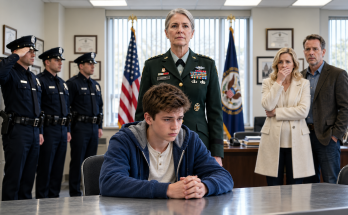
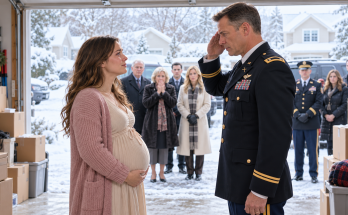
For several seconds, nobody moved. Marcus remained on the grass. One cheek pressed into the damp lawn. His right arm folded carefully behind him, not injured, not twisted beyond what I knew he could tolerate, simply controlled. That distinction mattered.
I could have hurt him. He had wanted me to. In some strange way, I think he needed violence from me. If I struck him hard enough, he could become the victim. If I lost control, he could point at me and say: See? I told you what she really is. So I did the one thing his pride could not understand.
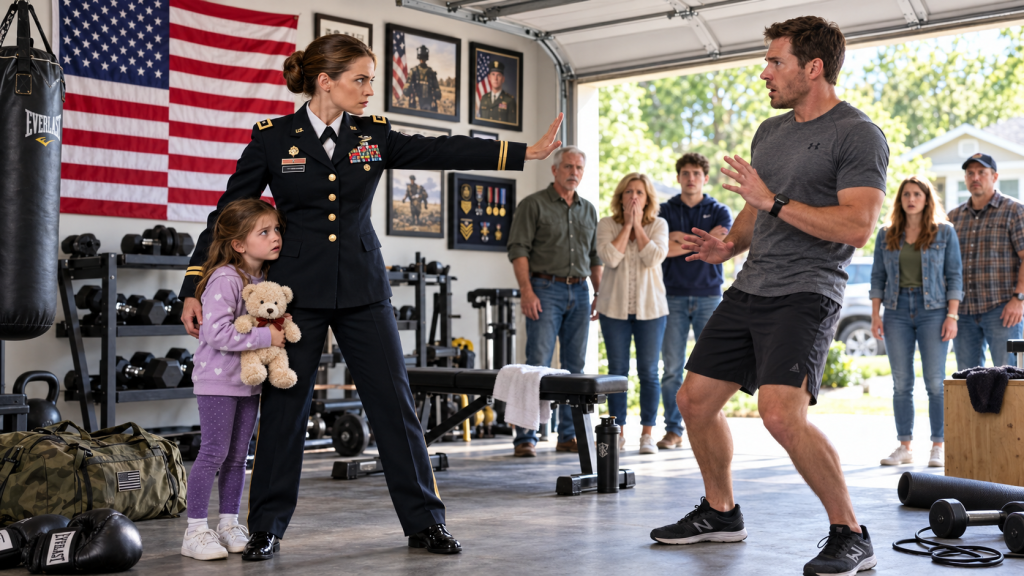
I stopped the moment he stopped being a threat. I released his arm. Stepped back. And let him decide whether to become dangerous again. He did not. Not while the lieutenant colonel stood there. Not while three soldiers watched. Not while forty neighbors had gone completely silent.
Marcus pushed himself slowly onto one elbow.
His face had changed.
The confidence was gone.
Not because I had put him on the ground.
Because the word Major was still hanging in the air.
Rachel stared at me.
“Major?”
Her voice sounded almost childlike.
I looked at her.
“Yes.”
Warren stepped closer.
“You’re telling me she’s a major?”
The lieutenant colonel turned toward him.
“I’m telling you nothing, sir.”
Then he looked back at me.
“Ma’am, transport is ready.”
I nodded.
“Give me a minute.”
“Yes, ma’am.”
Lily still had both arms wrapped around me.
Her cheek pressed against my side.
I felt her shaking.
That erased every satisfying feeling I might have had.
I crouched in front of her.
“Look at me.”
She did.
Tears filled her eyes.
“Are you hurt?”
“No.”
“Did Uncle Marcus hurt you?”
“No.”
“Is he going to?”
“No.”
I said it firmly.
Not because I could predict Marcus forever.
Because right then, with me there, he was not getting near her.
Lily whispered:
“He said he’d break your arm.”
“I know.”
“I thought…”
Her voice disappeared.
I touched her face.
“You thought I couldn’t stop him.”
She nodded.
“I’m sorry you had to see that.”
She looked toward Marcus.
Then back at me.
“Why didn’t you hit him?”
That question stayed with me longer than anything Marcus said.
Because my daughter had expected power to look like retaliation.
I answered quietly.
“Because stopping someone is not the same as punishing them.”
She frowned.
I continued.
“He was no longer a danger.”
“So I stopped.”
Lily looked at me for a long moment.
Then nodded.
Behind us, Warren said:
“This is ridiculous.”
I stood.
He pointed at Marcus.
“He was joking.”
Marcus looked at him.
For the first time, even he seemed uncomfortable with that version.
I said:
“Was he?”
Warren waved one hand.
“It was trash talk.”
“He threatened to break my arm.”
“In front of my daughter.”
“He threw fighting gloves at me.”
“He rushed me twice.”
Warren scoffed.
“You humiliated him.”
I almost smiled.
“No.”
“He did that himself.”
The crowd shifted.
A neighbor named Denise Park stepped forward.
She lived three houses down.
Former school counselor.
Kind eyes.
Usually avoided conflict.
Not that day.
“I recorded it.”
Warren turned.
“What?”
Denise held up her phone.
“From the first threat.”
The lawn went even quieter.
Marcus stood now.
Slowly.
His face tightened.
“You recorded me?”
Denise said:
“Yes.”
“Why?”
“Because Lily looked scared.”
That answer hit harder than any insult.
One of Marcus’s gym friends looked down.
Another crossed his arms and backed away.
The lieutenant colonel glanced toward me.
“Ma’am?”
I understood the question.
Did I want military involvement?
No.
This was not a military matter just because I wore a uniform.
“I’ll handle it.”
He nodded.
I looked at Denise.
“Please keep the original recording.”
“I will.”
Marcus laughed once.
A brittle sound.
“So what now?”
He looked at me.
“You call the cops?”
I said nothing.
He took another step.
“Come on, Major.”
The word came out like poison.
“You going to ruin my life over a family argument?”
Lily flinched.
That made the decision easy.
I took out my phone.
“Yes.”
Marcus stared.
I called the non-emergency line.
No dramatic arrest.
No sirens racing onto the lawn.
An officer arrived about twenty minutes later.
By then, command had allowed me to delay transport.
The soldiers waited near the vehicles.
Professional.
Separate.
The officer spoke to me.
Then Marcus.
Then witnesses.
He watched Denise’s video.
Took notes.
Asked whether I wanted to make a formal complaint.
I said yes.
Marcus looked betrayed.
That fascinated me.
People who ignore your boundaries often feel shocked when consequences finally have paperwork.
Rachel came toward me.
“Don’t do this.”
I turned.
“Why?”
“He’s my husband.”
“He threatened me.”
“He didn’t mean it.”
“He ran at me.”
“He was showing off.”
“In front of Lily.”
Rachel’s face tightened.
“You always make everything about her.”
I stared at my sister.
“Yes.”
“She’s my daughter.”
Rachel folded her arms.
“So Marcus said something stupid.”
“You embarrassed him in front of everyone.”
There it was.
Not:
He scared Lily.
Not:
He threatened you.
Not:
Is anyone okay?
Embarrassment.
The thing she cared about most.
I looked at her.
“You stood there smiling.”
Rachel’s expression changed.
“What?”
“When he threatened me.”
“You smiled.”
“I didn’t.”
“You did.”
“I watched you.”
She looked away.
That hurt worse than Marcus.
Marcus was arrogant.
I understood arrogant men.
Rachel was my sister.
She knew exactly how much Lily had already seen in her life.
She knew why I hated intimidation in front of children.
And still she had been entertained.
I said:
“I need space from you.”
Her head snapped toward me.
“Are you serious?”
“Yes.”
“For how long?”
“I don’t know.”
“Because of this?”
“No.”
“Because of what this showed me.”
That finally silenced her.
The officer eventually told Marcus that the incident would be documented and reviewed under applicable state law.
There was probable cause for further action based on the threat, his conduct, witness accounts, and video.
The exact legal process would take time.
I did not demand handcuffs.
I did not ask for special treatment.
I did not mention my rank.
I gave my statement.
Provided contact information.
Then I left.
The black vehicles took us to a secure federal facility outside the city.
Lily sat beside me in the rear seat.
She had stopped crying.
That did not mean she was okay.
Children often become quiet after fear because adults mistake silence for recovery.
I knew better.
She stared out the window.
“Mom?”
“Yes?”
“Are you famous?”
I almost laughed.
“No.”
“The general is waiting.”
“That doesn’t make me famous.”
“You have an award.”
“A lot of people have awards.”
“Uncle Marcus looked like he was going to throw up.”
“That part had less to do with the award.”
Lily looked at me.
“What kind of major are you?”
I exhaled.
That question had been coming for years.
“Army.”
“I know.”
“What do you do?”
I looked toward the driver.
Then back at her.
“Some things I still can’t explain.”
“That’s annoying.”
“Yes.”
“But I can tell you more than I have.”
She nodded.
I thought carefully.
“I’ve worked in Special Operations support and operational commands.”
“I’ve led teams.”
“I’ve deployed.”
“I’ve done work in places where mistakes could get people hurt.”
Lily’s eyes widened.
“Like combat?”
“Yes.”
“Have you…”
She stopped.
I knew the question.
“No details.”
She nodded.
“Do you kill people?”
Children do not ask politely when they need truth.
I answered as honestly as I could.
“I’ve served in places where people were trying to kill us.”
“I have defended myself and other people.”
Her face went serious.
“Is that why Uncle Marcus couldn’t beat you?”
I looked at her.
“Partly.”
Then:
“But mostly because he was angry and careless.”
“Training helps you stay calm.”
“That was the difference.”
Lily thought.
“So you’re better than him.”
“No.”
She frowned.
“At fighting.”
“Maybe.”
“But that wasn’t the important part.”
“What was?”
“That I didn’t need to prove it.”
She looked out the window again.
I hoped she remembered that longer than she remembered the lawn.
The ceremony happened that afternoon.
Not some giant televised spectacle.
A secure auditorium.
Maybe eighty people.
Command staff.
Families.
A few retired officers.
The general who had been waiting was Lieutenant General Thomas Keene.
He shook my hand before the ceremony.
Then looked at Lily.
“You must be the real boss.”
Lily stared.
Then looked at me.
“See?”
I sighed.
“Do not encourage her, sir.”
He laughed.
The valor award related to an operation eighteen months earlier.
The details had only recently been cleared for broader internal recognition.
I had led a small team supporting the extraction of allied personnel and civilians from a deteriorating security situation overseas.
Things had gone wrong.
Vehicles disabled.
Communications interrupted.
Two members of the team wounded.
We stayed longer than planned.
Not because I was fearless.
Because people were still outside the perimeter.
Courage is often described incorrectly.
People imagine no fear.
I was terrified.
I simply had responsibilities larger than the fear.
The citation used phrases like:
extraordinary leadership
and
personal courage under hostile conditions
and
decisive action.
Those words sounded larger than the moments felt.
I remembered blood on my glove.
A radio that would not stop crackling.
A young sergeant asking:
“Ma’am, are we leaving?”
And me answering:
“Not yet.”
That was all.
Lily sat in the front row.
When the general pinned the decoration, I looked at her.
She was crying.
Not frightened this time.
Proud.
That almost broke me more than the citation.
Afterward, she ran toward me.
“You’re actually cool.”
I stared.
“Actually?”
She hugged me.
“I thought you just did emails.”
“That was the plan.”
She pulled back.
“Why did you hide it?”
“Because secrecy protected the work.”
“And because I wanted you to have a normal life.”
Lily raised one eyebrow.
“Normal?”
“Fair criticism.”
The first twist came three days later.
Not from the police.
Not from command.
From my sister.
Rachel called at 11:42 p.m.
I almost ignored it.
Then answered.
Silence.
“Rachel?”
Her breathing was uneven.
“Can I come over?”
“No.”
I had not even thought.
The answer came automatically.
She began crying.
“Please.”
I sat up in bed.
Lily was asleep down the hall.
“What happened?”
More silence.
Then:
“Marcus punched a hole in the pantry door.”
I closed my eyes.
“Are you safe?”
“Yes.”
“Is he there?”
“No.”
“Where is he?”
“At Warren’s.”
“Did he touch you?”
“No.”
“Did he threaten you?”
Long pause.
“Not exactly.”
“Rachel.”
“He said I embarrassed him by not defending him enough.”
I felt something cold move through me.
“What does ‘not exactly’ mean?”
“He grabbed my wrist.”
I got out of bed.
“Any injury?”
“No.”
“Are you alone?”
“Yes.”
“Lock the doors.”
“Call the police if he comes back.”
“I’m coming over.”
She began crying harder.
“Thank you.”
I drove there.
Not in uniform.
No convoy.
No soldiers.
Just my old SUV.
The same one Marcus had mocked for years.
Rachel opened the door wearing pajamas.
Her mascara had run down her face.
She looked small.
Younger somehow.
The pantry door had a hole near the handle.
I stared at it.
Then at her wrist.
Red marks.
My anger became very quiet.
“Has he done this before?”
“No.”
I waited.
Rachel looked away.
That answer changed.
“Rachel.”
“He’s never hit me.”
“That wasn’t what I asked.”
She sat at the kitchen table.
I sat across from her.
For a long time, she said nothing.
Then:
“He controls money.”
“How?”
“He gives me a household budget.”
“I don’t have access to the investment accounts.”
“He says I spend too much.”
“What else?”
“He checks my phone sometimes.”
“Why?”
“He says because marriage should be transparent.”
My jaw tightened.
“What else?”
Rachel cried.
“He hates when I go out without telling him first.”
“What else?”
Silence.
Then:
“He’s broken things.”
“How often?”
“I don’t know.”
“You know.”
She whispered:
“Six times.”
I closed my eyes.
Six.
The lawn made more sense.
Warren’s laughter made more sense.
The gym friends standing behind Marcus made more sense.
Not because every aggressive man becomes abusive.
But because intimidation had been rehearsed somewhere.
Rachel looked at me.
“I thought it was different.”
“What?”
“With you.”
“He was joking.”
I stared.
“You needed him to be joking.”
Her face crumpled.
“Yes.”
That hurt.
But it was honest.
She whispered:
“If what he did to you counted…”
“Then what he did to you counted too.”
Rachel covered her face.
I reached across the table.
Not to fix it.
Just touch her hand.
She whispered:
“I smiled because if I acted like it was funny, then maybe it was.”
There.
The smile on the lawn.
The thing I had taken as cruelty.
It had still hurt.
But now it had another layer.
Fear can look like amusement when someone has been trained to protect the person causing it.
That did not erase what Rachel did.
Explanation was not absolution.
But it changed what came next.
I helped her contact an attorney.
Not mine.
Independent.
She documented the damaged door and marks.
She opened an account in her own name.
Changed passwords.
Gathered identity documents.
We did not make Lily part of the process.
No dramatic child witness.
No secret recording missions.
Adults handled adult problems.
Rachel filed for a protective order after Marcus sent a message threatening to “teach her loyalty.”
That wording mattered.
The police report from the lawn mattered too.
So did Denise’s video.
Patterns become clearer when one incident is no longer isolated.
Marcus blamed me.
Naturally.
His first message arrived through a new number.
You poisoned my wife against me.
I blocked it.
Then another email.
You think your rank makes you untouchable.
Forwarded to my lawyer.
Blocked.
Then:
You destroyed my family.
No.
I learned something in Special Operations that applied surprisingly well to family:
Do not accept responsibility for damage created by someone else’s decisions just because they hand you the report.
Marcus had built that instability himself.
I merely stopped helping everyone pretend the structure was sound.
The legal cases moved slowly.
The lawn incident did not send Marcus to prison for years.
That would have been fantasy.
He faced charges tied to threats and assaultive conduct based on evidence and local law.
His later conduct toward Rachel created separate proceedings.
He received restrictions on contact.
Lost access to firearms temporarily under court conditions associated with the protective process.
Had to complete court-ordered programs.
Faced probation and legal fees.
The gym suspended him.
Then terminated his membership after learning he had repeatedly bragged about “testing” people outside sanctioned training.
Several clients left.
That mattered to him more than it should have.
Warren insisted everything was exaggerated.
He called me.
I answered once.
“I hope you’re proud.”
“I’m not.”
“You ruined my son.”
“No.”
“You embarrassed him in front of everyone.”
“No.”
“He threatened a woman in front of her child.”
“He charged at me twice.”
“He later grabbed his wife.”
“He sent threatening messages.”
“Those were his choices.”
Warren’s breathing grew heavy.
“You always thought you were better than us.”
I almost laughed.
“You thought I filed paperwork.”
Silence.
“That didn’t stop you from treating me badly.”
“You changed when those soldiers showed up.”
“No.”
I looked out my kitchen window.
“I stopped pretending your behavior was normal.”
He hung up.
That was the last direct conversation we had for years.
Then came the second twist.
It started with one of Marcus’s gym friends.
His name was Trevor Bell.
He asked to meet me.
I declined.
Then he contacted my attorney.
Said he had information related to harassment.
So I agreed.
Public place.
Attorney present.
Trevor looked miserable.
“I should’ve stopped it.”
I said nothing.
He continued.
“On the lawn.”
“I knew Marcus was planning something.”
My lawyer leaned forward.
“What do you mean?”
Trevor swallowed.
“He’d been talking for weeks about putting you in your place.”
My stomach tightened.
“Why?”
“He thought you embarrassed Warren at the HOA meeting.”
I stared.
“What HOA meeting?”
Then I remembered.
Three months earlier.
A dispute over a neighborhood security contract.
Warren chaired the homeowners association.
He wanted residents to approve a company owned by one of his friends.
The bid was almost double the other proposal.
I had asked for competitive quotes.
That was it.
I did not yell.
Did not accuse anyone.
I simply asked why the higher bid had been selected.
Warren became irritated.
Marcus apparently never forgot.
Trevor continued.
“He said women like you only act tough because nobody challenges them physically.”
My lawyer’s pen stopped.
Trevor looked ashamed.
“He wanted everyone there.”
“The barbecue.”
“The gym guys.”
“The neighbors.”
“It was staged?”
Trevor nodded.
My anger turned cold.
Not spontaneous.
Not drunken.
Planned humiliation.
Marcus had wanted Lily there too.
That was the part that broke something.
“He knew my daughter would be present?”
“Yes.”
“He said that was the point.”
I stared at Trevor.
“What point?”
Trevor swallowed.
“He said if she watched you back down, you’d stop acting superior.”
My vision narrowed.
I thought of Lily twisting her shirt.
Marcus threatening to break my arm.
Warren laughing.
Rachel smiling through fear.
This was never about MMA.
It was theater.
A man trying to teach a child that her mother could be put in her place.
My attorney asked:
“Do you have proof?”
Trevor took out his phone.
“Group chat.”
Marcus had written:
Bring the gloves Saturday. I’m making desk-major mommy tap in front of everybody.
Interesting wording.
Desk-major.
He did not know my rank officially.
But apparently he had guessed I held some military position above what the family believed.
Another message:
Her kid will be there. Even better.
I had to look away.
My lawyer asked Trevor why he was bringing this forward.
He stared at the table.
“Because my daughter asked me why I laughed.”
That was all.
He had brought his fifteen-year-old.
She had been near the back of the crowd.
“She said it scared her.”
Trevor rubbed both hands over his face.
“I told her Marcus was just being Marcus.”
“She said, ‘Then why do you hang out with him?’”
He looked at me.
“I didn’t have an answer.”
Children again.
Seeing what adults normalize.
Trevor turned over the messages.
They strengthened the case.
More importantly, they changed the story for me.
I had been giving Marcus too much credit.
I thought his arrogance exploded in the moment.
No.
He had rehearsed cruelty.
Planned the crowd.
Chosen the audience.
That meant I needed stronger boundaries.
Not fear.
Clarity.
My command also reviewed the public nature of the incident.
Not because I had done anything wrong.
Because I was a field-grade officer with sensitive duties and the event had circulated online.
Of course it had.
Someone posted part of Denise’s video.
Then another person uploaded the salute.
Within forty-eight hours, strangers were calling me:
THE SPECIAL OPS MOM WHO DROPPED AN MMA BULLY.
I hated it.
The clip removed context.
People celebrated violence that had barely happened.
They slowed down the moment Marcus fell.
Added music.
Called it “revenge.”
One video had six million views.
Lily saw it at school.
She came home furious.
“They made memes.”
“I know.”
“One says ‘Karen unlocked final boss.’”
I covered my face.
“I hate the internet.”
She looked at me.
“You looked cool.”
“Not helping.”
Command requested I make no public comment beyond an approved statement.
Fine.
I did not want fame.
A stranger messaged me:
YOU SHOULD HAVE BROKEN HIS ARM.
I deleted it.
Another:
Women like you are dangerous.
Deleted.
Another:
Thank you for showing my daughter women can defend themselves.
That one I kept.
But even that needed context.
I did not want girls believing empowerment meant secretly being capable of hurting men.
I wanted them to know something harder.
Training matters.
Boundaries matter.
Evidence matters.
Leaving matters.
Calling police matters.
Restraint matters.
And nobody needs a secret military career before threats deserve to be taken seriously.
I eventually agreed to one internal military family-safety panel.
Closed audience.
No press.
I said:
“The viral version of my story is wrong.”
People looked surprised.
I continued.
“The important part is not that I was secretly more capable than the man threatening me.”
“The important part is that he should not have threatened me even if I had never thrown a punch in my life.”
Silence.
“That is what people keep missing.”
I looked around the room.
“A woman does not earn the right to safety by being dangerous enough to retaliate.”
That sentence traveled farther than the fight clip.
I was glad.
Lily started therapy.
Not because she was broken.
Because watching adults threaten each other changes the way children understand safety.
Dr. Maya Foster specialized in children from military families.
After several sessions, Maya asked me to join.
Lily sat on the couch with a pillow in her lap.
She looked annoyed.
That was normal.
Maya asked:
“What do you remember most about that day?”
I expected:
The gloves.
Marcus falling.
The soldiers.
Instead Lily said:
“Aunt Rachel smiling.”
My heart dropped.
Lily continued.
“I thought if she thought it was funny, maybe I was stupid for being scared.”
Rachel.
Again.
The smile.
I looked at Lily.
“You were not stupid.”
“I know now.”
Maya asked:
“What did you think your mom was feeling?”
Lily shrugged.
“Nothing.”
I stared.
“Nothing?”
“You didn’t look scared.”
Maya glanced at me.
There it was.
The danger of control.
My daughter had mistaken regulation for absence.
I said:
“I was scared.”
Lily looked shocked.
“You were?”
“Yes.”
“Of Uncle Marcus?”
“Of what he might do.”
“Of what you might see.”
“Of whether I could end it without someone getting hurt.”
Her eyes widened.
“You looked normal.”
“That was training.”
“Not lack of fear.”
Lily thought.
Then:
“So brave people are scared?”
“All the time.”
That session changed how I parented.
I stopped hiding every difficult emotion in the name of protecting her.
I did not dump adult burdens onto her.
But I allowed her to see sadness.
Uncertainty.
Grief.
Frustration.
Children do not need invincible parents.
They need honest, regulated ones.
Rachel’s divorce took nearly two years.
Messy.
Expensive.
No children between them, which simplified custody but not finances.
Marcus controlled several investment accounts.
Rachel had access to less information than she believed.
There were debts.
Loans.
One failed business venture.
Warren had guaranteed part of it.
That explained some of the family pressure too.
Not the violence.
Never the violence.
But the system around Marcus made more sense.
Warren had spent decades teaching him that dominance was competence.
That embarrassment was injury.
That winning arguments mattered more than repairing relationships.
Marcus had absorbed those lessons enthusiastically.
Rachel had adapted around them.
The lawn was not the beginning.
It was exposure.
Marcus eventually entered a plea related to the public incident and later violations of communication restrictions.
He avoided a long prison sentence.
There were short custodial consequences for one violation, probation, mandated intervention, and strict no-contact provisions.
The point was not dramatic punishment.
The point was a record.
Boundaries backed by enforcement.
He lost several professional opportunities.
His social circle changed.
Some people stayed with him.
That used to bother me.
Then I realized I did not need universal agreement to be safe.
Warren refused accountability for years.
Rachel cut contact.
I did too.
Then Warren had a stroke.
Minor.
Enough to scare him.
He sent a letter.
Not through family.
Through my lawyer.
I almost threw it away.
Then read it.
Major Caldwell,
He could not even start with my first name.
I almost laughed.
Then:
I spent most of my life believing respect had to be enforced.
That surprised me.
I taught Marcus that if someone embarrassed him, the correct response was to embarrass them harder.
I kept reading.
I laughed on the lawn because I thought humiliation was harmless when the person deserved it.
Then:
Lily did not deserve to see that.
My throat tightened.
He continued.
Neither did you.
No excuse.
Good.
When Marcus’s legal problems began, I blamed you because blaming you allowed me to avoid asking who taught him that control equals strength.
I put the letter down.
Came back an hour later.
The last paragraph said:
I do not ask for a relationship.
I only wanted to state clearly that I helped create the attitudes that led to that day.
I am sorry.
I believed he meant it.
That did not create access.
Remorse and relationship are different currencies.
I sent no reply.
Rachel did.
Eventually.
Short.
She told him she had read it.
Nothing more.
That was her choice.
Years passed.
Lily grew.
At fourteen, she started martial arts.
I nearly said no.
Not because martial arts were bad.
Because the gloves still lived in my memory.
She noticed.
“Mom.”
“I’m thinking.”
“You’re overthinking.”
“That too.”
“Coach Nina is a woman.”
“I know.”
“She teaches self-defense.”
“I know.”
“She says the first goal is getting away.”
That got my attention.
We visited.
The gym was nothing like Marcus’s crowd.
No swagger.
No humiliation.
Coach Nina told students:
“You do not train so you can win fights.”
“You train so your body has options when your brain is scared.”
I signed Lily up.
She loved it.
Not because she wanted to become dangerous.
Because she liked learning what her body could do.
At sixteen, she competed.
Not MMA.
Judo.
Controlled.
Rules.
Referees.
Sportsmanship.
After one match, she lost by ippon.
She came off the mat angry.
“I had her.”
“No.”
“She had you.”
Lily glared.
“Whose side are you on?”
“The truth.”
She laughed despite herself.
Then:
“Uncle Marcus would’ve hated losing.”
“Yes.”
“I hate losing.”
“Different thing.”
“How?”
“You don’t need to scare anyone because you lost.”
She went quiet.
Then nodded.
That was the whole lesson.
Rachel rebuilt her life too.
Slowly.
She worked in event planning before Marcus.
Had stopped because he said her schedule was “chaotic.”
After the divorce, she returned.
Started small.
Weddings.
Fundraisers.
Then corporate events.
She was good.
Really good.
One afternoon, five years after the lawn, she called.
“I booked the convention center.”
“For what?”
“My company.”
I smiled.
“Your company?”
Silence.
Then:
“I registered it yesterday.”
I could hear pride and fear mixing.
“What’s it called?”
“Second Light Events.”
I laughed.
“That sounds aggressively inspirational.”
“Shut up.”
I was proud of her.
We became close again.
Not because the lawn disappeared.
Because she never asked me to pretend it had.
One Thanksgiving, years later, we sat at my table.
Lily home from college.
Rachel bringing pie.
No Marcus.
No Warren.
No gloves.
Rachel looked at me.
“Do you ever think about that barbecue?”
“Less than I used to.”
“I do.”
“Why?”
She stared at her coffee.
“Because I remember smiling.”
I said nothing.
She continued.
“I know why I did it.”
“Fear.”
“Habit.”
“Trying to make him happy.”
“But I still did it.”
“Yes.”
Tears filled her eyes.
“I’m sorry Lily saw me.”
Lily was in the kitchen.
She heard.
She came in holding whipped cream.
“I know.”
Rachel looked at her.
“What?”
“I know why you smiled.”
Rachel cried.
Lily sat down.
“You still scared me.”
“I know.”
“But you left him.”
Rachel covered her face.
Lily continued:
“You don’t have to keep apologizing forever.”
Rachel looked at me.
I shrugged.
“She’s bossy.”
Lily said:
“Genetic.”
We laughed.
That is what repair looked like.
Not forgetting.
Not endless punishment.
Truth returning without destroying the room.
I retired from active duty years later as a lieutenant colonel.
Not general.
Not some mythical warrior promotion.
A normal career ending after difficult work, good teams, mistakes, accomplishments, and one very strange viral lawn incident.
At my retirement ceremony, Lily stood beside me.
Rachel attended.
So did Denise Park, the neighbor who recorded the video.
Trevor came too.
That surprised me.
He had left Marcus’s gym years earlier.
Started coaching youth wrestling at a community center.
I learned he had a rule posted on the wall:
Strength without control is insecurity wearing muscles.
I liked that.
During my remarks, I mentioned none of the classified work.
None of the viral stuff.
I talked about restraint.
I said:
“The public usually hears about military courage when something dramatic happens.”
“But most professional courage is quieter.”
“It is telling the truth when your team made a mistake.”
“It is stopping an operation because the risk changed.”
“It is asking for help before pride becomes danger.”
“And sometimes it is having the ability to escalate and choosing not to.”
Lily smiled from the front row.
She knew exactly what I meant.
After retirement, I taught leadership at a federal training program.
Nothing secret.
No black vehicles.
Mostly classrooms.
I liked it.
Young officers always asked about the lawn eventually.
Someone always found the video.
One student said:
“Ma’am, weren’t you tempted to really teach him a lesson?”
I answered:
“I did.”
The room went quiet.
“The lesson was that I controlled what happened next.”
“That is more important than controlling another person.”
He wrote that down.
Good.
Marcus resurfaced indirectly when Lily was twenty-four.
She called me.
“Mom.”
I knew that tone.
“What?”
“Uncle Marcus emailed me.”
Everything in me tightened.
“What did he say?”
“He apologized.”
“Did you answer?”
“No.”
Good.
Then:
“Do you want to read it?”
“No.”
She sounded surprised.
“Really?”
“It was sent to you.”
“You decide.”
Lily was quiet.
“What if I want to answer?”
“Then answer.”
“Would that hurt you?”
I closed my eyes.
There are moments as a parent when every instinct wants to make your child’s emotional choices safer by making them yours.
That is control too.
“I might have feelings.”
“But they are mine to manage.”
“You decide what relationship, if any, you want.”
Lily whispered:
“Okay.”
She did answer.
One message.
She told him:
You scared me when I was eleven.
I watched you threaten my mother because you thought embarrassing her would make you powerful.
I do not want a relationship.
But I accept that you are sorry.
Marcus replied:
I understand.
And stopped.
That was the most respectful thing he ever did for her.
Years later, he wrote me too.
I read it because enough time had passed that the choice felt mine.
His letter was not dramatic.
He did not blame Warren.
Rachel.
The gym.
Me.
He wrote:
I thought being strong meant nobody could make me feel small.
Then:
You made me feel small without trying, because I sensed there was more to you than I understood.
Interesting.
Instead of being curious, I decided I needed to dominate you.
Accurate.
I planned the lawn because I wanted witnesses.
That line still hurt.
When you did not injure me, I hated you more for a while because I could not turn you into the monster I needed.
I sat with that.
He continued:
Court, divorce, and years of mandated counseling did not change me quickly.
Losing people did.
Time did.
Watching younger men copy the way I used to speak did.
Then:
I am sorry I threatened you in front of Lily.
I am more sorry I wanted her to see you afraid.
My eyes filled.
Because that was the deepest wound.
He had finally named it.
The letter ended:
You do not owe me forgiveness.
I hope I never again confuse restraint with weakness.
I folded it.
Put it away.
I did not respond.
Not every accurate apology requires a bridge.
Sometimes it only closes a file.
Warren died first.
Marcus attended the funeral.
Rachel did not.
I did not.
Lily sent flowers.
Her choice.
The card said:
Rest peacefully.
Nothing more.
Marcus died years later from a heart condition.
Not violence.
Not some ironic fight.
Ordinary mortality.
By then, Lily had children.
I was a grandmother.
Rachel called.
“Did you hear?”
“Yes.”
“How do you feel?”
I thought.
“Sad.”
She was quiet.
“For him?”
“For everything.”
That was the truth.
I was sad for the man Marcus had been.
For the man he might have become sooner.
For Rachel’s lost years.
For Warren’s influence.
For the frightened eleven-year-old girl on the lawn.
For how much damage adults create when they treat humiliation like entertainment.
I did not attend the funeral.
Lily did.
That surprised me.
She explained later.
“I wanted to see the ending.”
I understood.
She said the gym friends were there.
Older.
Quiet.
Trevor too.
At one point, Trevor came to her.
“He said your mom changed my life.”
Lily laughed.
“What did you say?”
“That sounded expensive.”
I laughed so hard I cried.
That was my daughter.
I am seventy-nine now.
Lily is forty-eight.
Rachel is seventy-four.
We still spend Thanksgiving together most years.
No Warren.
No Marcus.
No black gloves.
The old video still exists online.
Every few years somebody rediscovers it.
New captions.
New music.
New strangers arguing about whether it was staged.
It was not.
Some say:
THE MOM WAS SECRETLY SPECIAL FORCES.
Close enough for the internet.
Others say:
HE MESSED WITH THE WRONG WOMAN.
That phrase bothers me.
He did not mess with the wrong woman.
He did the wrong thing.
There is a difference.
If I had actually been a records clerk with no combat training, his threat would still have been wrong.
If I had frozen.
Cried.
Backed away.
Called police.
Run inside.
Any of those responses would have been valid.
My competence did not create my right to dignity.
My rank did not create my right to safety.
My ability to put Marcus on the grass did not make his threat serious.
His threat made it serious.
That is what I wish people understood.
Sometimes women hear stories like mine and say:
“I wish I could have done what you did.”
I tell them:
“You do not need to.”
The goal is not to become dangerous enough that bad people regret choosing you.
The goal is to live in a world where intimidation is taken seriously before anyone has to prove what they can do.
I still have the gloves.
Not because I treasure them.
Denise returned them months after the case ended.
Evidence no longer needed.
I almost threw them away.
Then Lily asked to keep them.
“For what?”
“I don’t know.”
I let her.
Years later, she gave them back.
Inside a shadow box.
Beneath them was a small brass plate.
I expected some dramatic quote.
Instead, it said:
THE DAY MOM CHOSE CONTROL.
I cried.
Because she understood.
Not:
The day Mom beat Uncle Marcus.
Not:
The day everyone learned Mom was Special Operations.
The day I chose control.
Over my body.
My response.
My fear.
My next step.
That was the victory.
The lawn had taught Lily something I never intended.
Power does not need to shout.
Strength does not need an audience.
Training is most valuable when it helps you remain yourself under pressure.
And restraint is not passivity when it is chosen by someone fully capable of escalation.
One evening, when Lily was forty-two, she brought my oldest granddaughter over.
Ten years old.
Nearly the age Lily had been.
The girl noticed the shadow box.
“Grandma, why do you have boxing gloves on the wall?”
“Long story.”
Lily looked at me.
“Tell her.”
So I did.
Not every detail.
Age appropriate.
I said:
“A man tried to scare me.”
“What did you do?”
“I made sure he couldn’t hurt me.”
“Did you punch him?”
“No.”
She looked disappointed.
Children.
“Why not?”
“Because I didn’t need to.”
She considered this.
“Were you scared?”
“Yes.”
Her eyes widened.
“Really?”
“Yes.”
“Then how did you win?”
I smiled.
“I didn’t need to win.”
“I needed everyone safe.”
She stared at me.
Then at the gloves.
“That’s boring.”
Lily laughed so hard she nearly fell off the couch.
I did too.
Maybe that is the perfect ending.
Children want exciting stories.
Adults who have survived enough learn to value boring endings.
No ambulance.
No broken arm.
No spectacular revenge.
A police report.
A lawyer.
Therapy.
Boundaries.
Divorce.
Time.
Apologies.
Distance.
A child growing into a woman who knows fear does not make her weak.
A sister learning that smiling through abuse does not make it harmless.
A man eventually naming what he did without demanding forgiveness.
A family learning that strength is not domination.
Boring.
Beautiful.
Real.
The last time I visited the old neighborhood, Denise still lived there.
We sat on her porch drinking iced tea.
The lawn looked smaller than I remembered.
That happens with places where big memories live.
I pointed toward the patch where the gloves had landed.
“There?”
Denise nodded.
“About there.”
I smiled.
“Funny.”
“What?”
“I remembered it farther from the porch.”
“Memory adds distance.”
We sat quietly.
Then Denise said:
“I almost didn’t record.”
I looked at her.
“Why?”
“I thought it wasn’t my business.”
I nodded.
“What changed your mind?”
She looked toward the sidewalk.
“Lily.”
“She looked terrified.”
Then:
“I decided fear in a child makes it somebody’s business.”
I swallowed.
“Thank you.”
She waved it away.
“No.”
“I mean it.”
“If you hadn’t recorded…”
“You still would’ve been believed.”
“Maybe.”
“Maybe not by everyone.”
Denise nodded.
“That’s true.”
We sat together.
Two older women.
A lawn.
No crowd.
No soldiers.
No threat.
Just afternoon light.
I realized then that my story had never really been about combat training.
It was about witnesses.
Marcus wanted witnesses because humiliation required an audience.
Denise became a different kind of witness.
She preserved truth.
Lily became the witness who mattered most.
Her fear forced me to see what I would no longer tolerate.
Rachel became a witness to her own marriage once she stopped laughing.
Trevor became a witness against a culture he had helped enable.
And eventually even Marcus became a witness to himself.
That is what accountability is.
Not always punishment.
Sometimes the moment a person can no longer claim they did not see what they were doing.
Marcus threw gloves at my feet because he wanted me to become small in public.
Instead, everything hidden around him became visible.
My rank.
His planning.
Rachel’s fear.
Warren’s influence.
The neighbors’ silence.
The cost of treating intimidation like entertainment.
People still think the secret twist was that I was a Special Operations major.
It wasn’t.
That was only the surprise.
The real twist was simpler.
I had spent years hiding what I could do.
Marcus had spent years hiding who he was when people stopped obeying him.
That afternoon, both things came into the light.
Only one of us benefited from the truth.
And if I could go back to that lawn now, knowing everything that followed, I would do exactly one thing differently.
Before I picked up the gloves, I would kneel beside Lily and tell her:
“You do not have to watch.”
Because protecting a child sometimes means showing strength.
And sometimes it means refusing to make them carry proof of it.
Everything else?
The silence.
The restraint.
The call to police.
The boundaries.
The years of repair.
I would keep.
Especially the moment Marcus finally understood that the quiet woman in front of him had never been defenseless.
She had simply been disciplined enough not to make violence her identity.
THE END STORIES! THANK YOU FOR READING GOOD LUCK !❤️
Related Posts