The hallway video played again. At 1:38 a.m., Lydia appeared carrying the brass candlestick. Noah backed away. She swung. He raised one arm. The candlestick caught him just above the eyebrow. He stumbled into the wall.
Then Lydia rushed forward again. Noah moved. Her shoulder struck the banister. She caught herself before falling. For three seconds, she stood perfectly upright. Then she looked toward the camera. Sat down deliberately on the third stair.
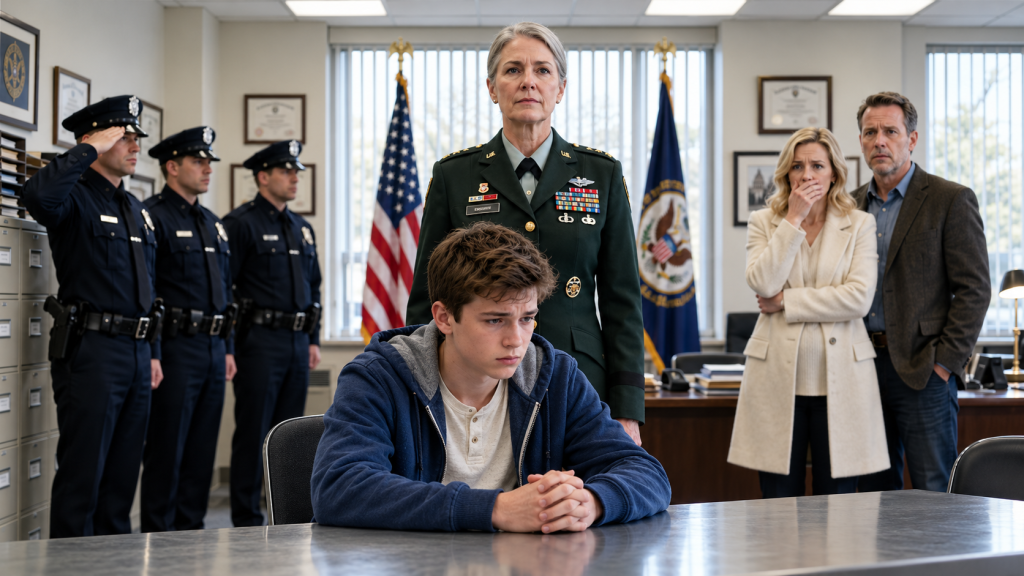
And whispered: “Now let’s see who your father believes.” No one in the interview room moved. Mark stared at the laptop as if the screen had opened beneath his feet. Lydia’s face had lost all color. The detective paused the recording.
“Mrs. Grant,” he said carefully, “you told responding officers your stepson shoved you from the top landing.”
Lydia swallowed.
“He did.”
The detective glanced at the frozen frame.
“No.”
“He didn’t.”
“You’re seeing one angle.”
Eleanor said nothing.
Thirty-two years in Major Crimes had taught her that silence was often more useful than accusation.
People rushed to fill silence.
Lydia did.
“He threatened me before that.”
The detective asked:
“What did he say?”
“I don’t remember the exact words.”
“You reported that he said, ‘I’m going to kill you.’”
Lydia blinked.
“Yes.”
“That.”
The detective turned toward Noah.
“Did you say that?”
Before Noah could answer, Eleanor touched his wrist.
“Counsel first.”
The detective nodded.
“Fair.”
Mark finally spoke.
His voice sounded hollow.
“Lydia.”
She turned toward him.
“Mark, please.”
He pointed at the screen.
“You had a candlestick.”
“He was coming toward me.”
“No.”
His voice cracked.
“He was backing away.”
Lydia stood.
“This is unbelievable.”
The detective immediately said:
“Sit down.”
“I’m not under arrest.”
“I said sit down while we clarify what happened.”
Lydia stared at him.
Then at Eleanor.
The smugness returned for half a second.
“You think because your grandmother used to run this place, everyone is going to take your side?”
Eleanor’s eyes lifted slowly.
The young officer at the desk had called her Commander Grant.
That title had made Lydia nervous.
But Eleanor had no intention of using an old badge like a weapon.
She was retired.
She had no authority over the detectives in that building.
No right to command anyone.
Tonight, that was almost a relief.
She could be what Noah needed.
Not Commander Grant.
Grandma.
Eleanor looked at Lydia.
“No.”
“They’re going to take the evidence seriously.”
The detective closed the laptop.
“Mrs. Grant, don’t leave.”
Lydia’s expression changed.
“You said I wasn’t under arrest.”
“I said don’t leave.”
Mark stepped backward.
He looked at Noah.
The bandage above his son’s eyebrow had a faint red spot beginning to seep through.
Mark whispered:
“Noah…”
Noah looked away.
That hurt Eleanor more than the video.
Not anger.
Not shouting.
A child who no longer expected his father’s voice to mean safety.
A second detective entered a few minutes later.
Then a juvenile advocate.
Then an attorney Eleanor trusted, Maya Rosen, who had represented families and minors for years.
Eleanor had called her from the car.
Maya arrived wearing jeans beneath a wool coat and carrying a legal pad.
She looked at Noah first.
Not Eleanor.
Not Mark.
“Are you Noah?”
“Yes.”
“I’m Maya.”
“Your grandmother asked me to come.”
“I don’t work for her.”
“I’m here for you.”
Noah nodded.
That sentence seemed to settle him.
Maya asked everyone else to step out while she spoke privately with him.
Eleanor left without complaint.
Mark tried to stay.
Maya blocked the doorway with one hand.
“Not yet.”
“I’m his father.”
“Yes.”
“And right now I need to speak with him without you.”
Mark looked offended.
Then ashamed.
He stepped out.
The corridor smelled like burnt coffee and old carpet.
Eleanor had spent thousands of hours in hallways like this.
Witnesses waiting.
Families crying.
Suspects bargaining with themselves before anyone asked another question.
But she had never stood there as a grandmother while her grandson decided whether his father belonged inside the room.
It was different when the child behind the door was yours.
Mark sat two chairs away.
For several minutes, he stared at his shoes.
Then he whispered:
“I didn’t know.”
Eleanor looked at him.
Mark’s eyes filled.
“I didn’t know she would do something like that.”
Eleanor’s voice remained quiet.
“No.”
“You didn’t.”
He looked relieved for half a heartbeat.
Then she continued.
“But you knew Noah had been telling you something was wrong.”
The relief disappeared.
“Mom…”
“He told you she blamed him for things.”
“She said he was acting out.”
“He told you she went through his room.”
“He was fifteen.”
“He told you she called him a liar.”
“She said he lied.”
“He told you he wanted to stay with me.”
Mark’s jaw tightened.
“You know why I didn’t allow that.”
“Tell me.”
“You were undermining us.”
Eleanor stared at him.
“By letting him sleep in my guest room?”
“By always believing him.”
There it was.
Eleanor felt something inside her go still.
“You say that like believing your child was my mistake.”
Mark looked away.
“He was difficult.”
“How?”
“He stopped eating dinner with us.”
“Stayed in his room.”
“Skipped family activities.”
“Wouldn’t talk to Lydia.”
Eleanor nodded.
“Those are also things frightened children do.”
“He wasn’t frightened.”
“How do you know?”
Mark did not answer.
Eleanor leaned back.
“He called me at 2:47 in the morning from a police station because you were standing beside the woman who hit him.”
Mark closed his eyes.
“Do not ask me to make you feel better before he is safe.”
That ended the conversation.
Twenty minutes later, Maya opened the door.
“Eleanor?”
She stood.
Maya looked toward Mark.
Then back at Eleanor.
“Noah wants to leave with you when the police are finished.”
Mark rose immediately.
“I’m his father.”
Maya’s expression stayed neutral.
“And Noah is sixteen.”
“You retain parental rights.”
“But given the allegations and tonight’s circumstances, the immediate safety plan needs to be discussed with investigators and child welfare.”
Mark went pale.
“Child welfare?”
“You brought your injured son to a station and supported an accusation that video appears to contradict.”
“I didn’t know.”
Maya nodded.
“That matters.”
“It does not erase tonight.”
Mark sat back down.
For the first time, Eleanor saw something she recognized in him.
Fear.
Not for Lydia.
For himself.
For what kind of father the record might show him to be.
The detectives separated everyone.
Photographs were taken of Noah’s injury.
Medical records from the urgent-care examination were preserved.
The candlestick had been collected from the house.
The hallway-camera video was downloaded from the cloud service directly.
Not from Mark’s phone.
Not from Eleanor’s.
Directly.
Chain of custody mattered.
The detective asked Mark whether the camera system automatically retained deleted clips.
Mark frowned.
“I think thirty days.”
Lydia, sitting across the room with another officer, suddenly looked up.
Eleanor noticed.
So did the detective.
“Interesting,” Eleanor thought.
But she kept her mouth shut.
Retirement had not removed her instincts.
Only her authority.
The detective asked:
“Who has administrator access to the camera account?”
Mark answered:
“Me and Lydia.”
“When was the last time either password changed?”
“I don’t know.”
“Does the system keep account logs?”
“I think so.”
Lydia stood.
“This has gone far enough.”
The detective turned.
“Sit down.”
“I want a lawyer.”
“Then we’ll stop asking substantive questions.”
“I’m leaving.”
“No.”
This time the detective’s voice changed.
“You are being detained while we determine the appropriate next step.”
Lydia looked toward Mark.
“Do something.”
Mark did nothing.
Not because he had suddenly become brave.
Because the video was still playing in his head.
The woman he had trusted had stared into a camera and announced her intention to make him believe a lie.
That is a hard thing to unsee.
By 5:36 a.m., Lydia was taken into custody pending further review of assault-related conduct and the false report.
The exact charging decision would belong to prosecutors.
Not Eleanor.
Not Mark.
Not Noah.
That distinction mattered.
Noah was released into Eleanor’s care under an emergency arrangement Mark agreed to after speaking with his own attorney.
Child welfare would follow up.
Family court could address longer-term placement if necessary.
Nothing became permanent at sunrise.
Real systems move slower than frightened families want.
Outside the station, snow had started falling.
Noah pulled his hood up.
Eleanor unlocked the car.
Before he got in, he looked back at the building.
“Grandma?”
“Yes?”
“Is she going to jail?”
“I don’t know.”
“But she lied.”
“Yes.”
“She hit me.”
“Yes.”
“Then why don’t you know?”
Eleanor opened the passenger door.
“Because what happened and what can be proven in court are related, but they are not always the same question.”
Noah frowned.
“You sound like a cop.”
“Occupational damage.”
That made him smile.
Small.
But real.
They drove home in silence.
At 6:11 a.m., Noah fell asleep against the window.
Eleanor looked at him whenever the traffic lights turned red.
Sixteen years old.
Too tall for the seat.
Still somehow the seven-year-old who once slept with a hallway light burning because darkness made him think his mother might disappear again.
His mother, Emily, had died from complications of leukemia when Noah was six.
Eleanor had loved Emily.
Everyone had.
Emily had been calm where Mark was impatient.
Funny where Eleanor was serious.
Before she died, she had done what responsible parents do when death stops being theoretical.
She made a will.
Updated insurance.
Created a trust.
Eleanor remembered that trust because Emily had asked her to serve as co-trust protector with an independent bank trustee.
At the time, Mark had been offended.
“Why do we need outsiders in our finances?”
Emily answered:
“Because grief makes people strange, and Noah shouldn’t pay for anybody’s bad year.”
Emily had been right about more than she knew.
The trust had grown over time.
Roughly $680,000 now.
Education.
Medical care.
Support.
Then staged distributions when Noah reached adulthood.
Mark could request qualified expenses while Noah was a minor.
He could not simply empty it.
Lydia had complained about that structure more than once.
Eleanor remembered.
At the time, she thought Lydia was merely resentful.
Now she wondered.
Not accused.
Wondered.
There is a difference investigators learn or fail.
At home, Eleanor made tea.
Noah woke around noon.
He came into the kitchen wearing one of her old Chicago Police sweatshirts.
It hung off his shoulders.
“Hungry?”
“No.”
“Eat anyway.”
He groaned.
“Grandma.”
“Toast.”
“I’m not six.”
“Then make your own toast.”
He did.
That was progress.
Halfway through the second piece, Eleanor asked:
“How long?”
Noah froze.
He knew what she meant.
He looked down.
“Since before Dad married her.”
Eleanor’s heart sank.
“What happened?”
“She was nice at first.”
“That doesn’t answer me.”
Noah picked at the crust.
“She’d say things.”
“What things?”
“That Dad was tired because of me.”
“That he needed a real marriage.”
“That I made everything harder.”
Eleanor said nothing.
Noah continued.
“She’d tell him I slammed doors when I didn’t.”
“That I cursed at her.”
“That I broke stuff.”
“Did you?”
“Sometimes I slammed doors.”
“Okay.”
“And I cursed once.”
“What did you say?”
Noah looked embarrassed.
“I said she was a lying psycho.”
Eleanor lifted an eyebrow.
“Not ideal.”
“She was lying.”
“Still not ideal.”
He almost smiled.
Then his face changed.
“She planted Grandma Emily’s necklace in my backpack.”
Eleanor went still.
“What?”
“Two years ago.”
“The gold one Dad said went missing.”
Noah nodded.
“Lydia found it in my school bag.”
“Dad grounded me for a month.”
“I told him she put it there.”
“He said I always blamed her.”
Eleanor remembered.
Mark had called her then.
Angry.
Ashamed.
“My son is stealing from his dead mother.”
Eleanor had argued that Noah had no reason to steal something that would one day belong to him.
Mark said:
“You always take his side.”
Now Eleanor felt sick.
“What else?”
Noah swallowed.
“The money from Dad’s desk.”
“How much?”
“Eight hundred dollars.”
“You were blamed.”
“Yes.”
“Did you take it?”
“No.”
“Anything else?”
“Lydia scratched her own car.”
Eleanor stared.
“What?”
“She said I keyed it because she took my phone.”
“How do you know she did it?”
“I saw her through my bedroom window.”
“Did you tell your father?”
“Yes.”
“What did he say?”
“That I was escalating.”
Noah laughed once.
No humor.
“She likes that word.”
Eleanor reached across the table.
“Noah.”
He pulled back.
Not from her.
From the question he knew was coming.
“Why didn’t you tell me?”
“I did.”
Eleanor stopped.
“What?”
“I tried.”
“When?”
“A lot.”
He looked at her.
“You’d ask to talk to Dad.”
“Then he’d say I was exaggerating.”
“Then Lydia would know I told you.”
“And after that everything got worse.”
The kitchen became painfully quiet.
Eleanor had thought she was watching carefully.
Thought retirement, experience, and love made her difficult to fool.
But Lydia had not needed to fool Eleanor completely.
Only isolate Noah enough that every warning arrived wrapped in teenage conflict.
Eleanor whispered:
“I’m sorry.”
Noah looked uncomfortable.
“You didn’t do it.”
“No.”
“But I did not understand fast enough.”
That distinction mattered too.
She did not tell him it was not her fault.
Some guilt was useful.
Not crushing guilt.
Accountability.
Adults who love children still miss things.
Pretending otherwise helps no one.
The first real break in the larger case came from the camera company.
Police preserved the account logs.
There were administrator actions associated with Lydia’s login.
At 1:51 a.m., thirteen minutes after the incident, someone using Lydia’s account attempted to delete the hallway clip.
The deletion did not permanently remove the cloud backup.
At 1:54 a.m., the system password was changed.
At 2:03, remote access from Lydia’s phone downloaded the clip.
At 2:09, the clip was deleted from the local recorder.
Then Lydia told police the camera had been broken.
That sequence mattered.
Not because it proved everything about the previous two years.
Because it showed consciousness of the evidence in this incident.
The prosecutor’s office took the case seriously.
Eleanor did not call anyone.
She did not walk into the DA’s office waving an old badge.
She let Maya handle communication.
That discipline irritated Mark.
Three days after the incident, he came to Eleanor’s home.
Alone.
She opened the door but did not invite him in.
“I want to see Noah.”
“No.”
Mark stared.
“I’m his father.”
“He said no.”
“You can’t keep him from me forever.”
“I’m not.”
“You asked to see him today.”
“He said no today.”
Mark’s eyes filled.
“Mom.”
Eleanor remained still.
“I made a mistake.”
“No.”
His face changed.
She continued.
“You made a series of choices.”
“Don’t do that.”
“Do what?”
“Talk to me like a suspect.”
Eleanor almost laughed.
“I’m talking to you like my son.”
“Then act like my mother.”
“I am.”
“I’m refusing to lie to you because you’re hurting.”
Mark looked away.
“She manipulated me.”
“Yes.”
“She lied.”
“Yes.”
“She made him look dangerous.”
“Yes.”
“I believed my wife.”
Eleanor’s voice sharpened.
“You disbelieved your child.”
Mark flinched.
“That is the other half of that sentence.”
Silence.
Snowmelt dripped from the roof.
Mark whispered:
“I thought loyalty to my marriage mattered.”
“It does.”
“So does fatherhood.”
“She kept showing me proof.”
“No.”
“She showed you evidence that fit what you already decided to believe.”
Mark’s eyes filled.
“You really think I wanted this?”
“No.”
“I think you wanted peace in your house more than you wanted uncertainty.”
“And Noah paid for that peace.”
Mark started crying.
Eleanor did not comfort him.
Not because she did not love him.
Because grief sometimes needs to sit where it belongs.
After several minutes, Mark said:
“Tell him I’m sorry.”
Eleanor shook her head.
“No.”
“Why?”
“Tell him yourself when he wants to hear it.”
That boundary mattered.
The second major discovery came two weeks later.
Police had obtained warrants for Lydia’s phone and laptop related to the assault and suspected evidence tampering.
The forensic review found messages.
Hundreds.
Most ordinary.
Groceries.
Work.
Family gossip.
Then one conversation with Lydia’s longtime friend Marissa Cole.
The messages went back eighteen months.
Marissa:
How much is Noah’s trust actually worth?
Lydia:
Almost 700k now. Emily’s family made sure Mark can’t touch principal without the bank.
Marissa:
Annoying.
Lydia:
Very.
That message made Eleanor’s stomach turn.
Another:
If Noah keeps getting worse, Mark can make a case he can’t manage money later.
Marissa:
At 18?
Lydia:
Lawyer said adulthood changes things, but if there’s a documented incapacity issue, there are options.
There were the beginnings of a plan.
Not a legally sound one.
But a plan.
Lydia appeared to believe that if Noah developed a documented history of violence, psychiatric instability, and inability to manage himself, Mark might someday petition for some form of continued guardianship or financial control after Noah became an adult.
Whether a court would ever grant that was another question.
The bar was high.
The trust had independent oversight.
But motive does not need a plan to be intelligent.
Only believed by the person carrying it out.
More messages followed.
Lydia:
He’ll never agree to treatment if we ask.
Marissa:
Then make Mark scared enough.
Lydia:
Working on it.
Eleanor had to stop reading.
Maya had warned her.
“Only read what you can handle.”
Eleanor said:
“I handled murder scenes for thirty-two years.”
Maya answered:
“This is your grandson.”
Different.
Always different when it is yours.
Then came a name.
North River Behavioral Academy.
A private residential program in Wisconsin.
Tuition and treatment packages could exceed $90,000 a year.
Lydia had obtained brochures.
Requested consultations.
Asked whether trust funds could pay.
That alone was not criminal.
Parents seek treatment.
But another message made the motive darker.
Marissa’s brother, Paul, worked as an independent referral consultant receiving commissions from certain placements.
North River was one.
Marissa:
If he enrolls, Paul gets 8%.
Lydia:
And if trust pays, Mark won’t feel it.
Eleanor stared.
Eight percent of $90,000.
Seven thousand two hundred dollars.
Not enough to explain years of cruelty by itself.
But it showed how far Lydia had started converting Noah’s suffering into household strategy.
Then:
Lydia:
Once he’s out of the house, Mark and I can breathe.
There it was.
Probably the deepest motive.
Not money.
Removal.
The trust and referral money were tools.
She wanted Noah gone.
She wanted Mark without the grief, history, and child who reminded him there had been a marriage before hers.
The prosecutor later told Maya:
“Do not reduce this to a trust scheme.”
They were right.
The evidence supported assault.
False reporting.
Evidence tampering.
Possibly other offenses depending on proof.
The trust-related messages showed motive and planning.
They did not magically convert every cruel act into fraud.
Reality was uglier because it was less neat.
Lydia seemed to have two motives that fed each other.
She wanted control of her home.
And she believed Noah’s money could finance removing him from it.
The third twist hurt Mark most.
Investigators recovered deleted home-camera clips.
Not all.
Some overwritten.
Some unavailable.
But enough.
Six months earlier, the hallway camera showed Lydia entering Noah’s room carrying something small in her right hand.
Nine minutes later, she emerged empty-handed.
Twenty minutes after that, she called Mark upstairs.
That was the day she “found” Emily’s necklace inside Noah’s backpack.
Mark watched the recovered video in his lawyer’s office.
According to Maya, he vomited afterward.
Eleanor took no satisfaction in that.
Another clip showed Lydia standing near her own car at 11:14 p.m.
Arm moving along the passenger door.
The next morning, she claimed Noah had scratched it.
The image quality could not prove exactly what object was in her hand.
But the timing and movement mattered.
A third clip showed Lydia carrying an envelope from Mark’s study into the laundry room on the same day $800 supposedly disappeared.
Again, not enough by itself.
Together, the pattern changed everything.
Noah had been telling the truth for years.
Not perfectly.
Not about every teenage argument.
He had lied about homework.
Snuck out once.
Hidden a failing chemistry grade.
He was sixteen.
Truth did not require him to be an angel.
That became important to Eleanor.
Victims do not need perfection before harm counts.
One afternoon, Noah sat at Eleanor’s kitchen table doing algebra.
He suddenly looked up.
“If I did bad stuff too, does that make her right?”
Eleanor put down her coffee.
“What bad stuff?”
“I screamed at her.”
“I told her I hated her.”
“I punched my bedroom door once.”
“Okay.”
“I took Dad’s car without permission.”
“You did what?”
Noah winced.
“That was last year.”
“We’ll return to that.”
He almost smiled.
Then:
“What if I was difficult?”
Eleanor leaned forward.
“Difficult children still cannot be hit with candlesticks.”
Noah looked down.
“Difficult teenagers still deserve adults who tell the truth about them.”
“You can be responsible for your bad choices.”
“And Lydia can be responsible for hers.”
“One does not cancel the other.”
Noah nodded slowly.
That became one of the most important conversations they had.
Because Lydia’s manipulation had taught him a dangerous idea:
If he had ever done anything wrong, then he had no right to complain when someone wronged him.
Eleanor spent years helping him unlearn it.
The family court entered a temporary order allowing Noah to remain with Eleanor while the criminal case and safety concerns were addressed.
Mark received structured contact.
At first, Noah refused.
The court did not force immediate emotional reconciliation.
He had counsel.
A therapist.
A guardian ad litem appointed to assess his interests.
The process felt invasive.
Necessary.
Noah hated strangers asking questions.
He hated repeating the story.
Eleanor hated watching him repeat it.
But she also knew why documentation mattered.
Memory changes.
Evidence disappears.
Children grow up and wonder whether they imagined things.
Records can become anchors.
Lydia’s criminal case took nearly a year.
Her attorneys challenged the video context.
Argued Noah had been verbally aggressive before the recording began.
Pointed to his disciplinary history.
Raised questions about Mark’s household conflict.
All legitimate defense work.
None changed the clearest facts.
Lydia carried the candlestick toward Noah.
Swung first.
He retreated.
She staged the fall.
Then attempted to delete the video.
Eventually, Lydia entered a negotiated plea to charges tied to the assault, false reporting, and evidence interference.
Other allegations were dismissed.
She did not receive thirty years.
There was no television judge announcing a life sentence.
She received a combination of custodial time, probation, mandatory counseling, and restrictions on contact with Noah.
The trust-related conduct became relevant in family proceedings and civil matters more than the core criminal conviction.
Marissa and Paul were investigated separately over referral practices.
The evidence did not show some giant kidnapping conspiracy.
Paul’s business practices drew regulatory scrutiny.
He lost referral contracts.
Some payments were repaid.
That was all.
The truth did not need to grow beyond what the evidence supported.
Mark filed for divorce.
Lydia fought it.
Then settled.
Their marriage had lasted seven years.
The same years Noah had slowly learned to stop trusting his father.
That fact tormented Mark.
For a while, Eleanor worried it would destroy him.
Instead, if painfully, it changed him.
Mark started therapy.
Not family therapy at first.
His own.
The first time he told Eleanor that, she asked:
“Why?”
He looked offended.
“Why?”
“Yes.”
“What are you trying to change?”
Mark thought.
Then said:
“I don’t know how I became a father who needed his son to be wrong.”
Eleanor felt her throat tighten.
“That sounds like a place to start.”
Months passed before Noah agreed to see him.
The meeting took place in a therapist’s office.
Eleanor waited downstairs.
This was not her conversation.
When Noah came out, his face was red.
Mark followed ten minutes later.
Neither spoke.
In the car, Eleanor asked:
“Want food?”
Noah nodded.
They went for burgers.
Halfway through his fries, he said:
“He apologized.”
Eleanor waited.
“He said Lydia manipulated him.”
Eleanor’s jaw tightened.
Then Noah continued:
“But he said that wasn’t enough.”
Good.
“He said he liked believing her because it meant he didn’t have to admit the house was messed up.”
Better.
“He said every time I told him something was wrong, he heard it as me attacking his marriage.”
Noah pushed one fry around the plate.
“He said he chose being a husband over being my dad.”
Eleanor felt tears behind her eyes.
“What did you say?”
“I said I hated him.”
Eleanor nodded.
“What did he say?”
“He said he understood.”
Noah started crying.
Quietly.
Eleanor reached across the table.
“He hugged you?”
“No.”
“He asked.”
“I said no.”
“And?”
“He said okay.”
That word.
Okay.
Maybe the first real thing Mark had done right in years.
Respecting no.
Repair began there.
Not with forgiveness.
Permission.
Mark kept showing up.
Therapy.
Scheduled visits.
School meetings when Noah allowed.
No gifts designed to buy closeness.
No speeches.
At Noah’s seventeenth birthday, Mark mailed a card through Eleanor.
Inside:
You do not have to answer. I love you. I am working on becoming safer to love back.
Noah put it in a drawer.
Did not reply.
Six months later, he texted Mark:
Want coffee Saturday?
Mark called Eleanor crying.
She said:
“Do not ruin this by making it huge.”
“I know.”
“No speeches.”
“I know.”
“No gifts.”
“I know.”
“And do not tell him I coached you.”
Mark laughed through tears.
“Mom.”
“Goodbye.”
They had coffee.
Then again.
At eighteen, Noah moved into a dorm at Northwestern.
Not far.
Far enough.
He studied computer science for one semester.
Hated it.
Changed to journalism.
Eleanor pretended not to panic.
“You’re leaving a practical degree.”
“I like journalism.”
“Journalists are underpaid.”
“You were a cop.”
“Exactly.”
He laughed.
The trust paid qualified education expenses through the independent trustee.
Noah did not receive $680,000 in a birthday balloon.
Emily had structured distributions.
A portion at twenty-five.
Another later.
The trustee retained safeguards.
Noah learned about investing before accessing much.
That made Eleanor proud.
What made her prouder was something smaller.
At nineteen, Noah called because his roommate borrowed his laptop without permission.
Old Noah would have swallowed the anger until it exploded.
This Noah said:
“I told him not to do it again.”
Eleanor asked:
“And?”
“He said I was overreacting.”
“What did you say?”
“I said he can think that and still not touch my stuff.”
Eleanor smiled.
“Good.”
“Grandma?”
“Yes?”
“Was that a Commander Grant answer?”
“No.”
“That was a Noah answer.”
He went quiet.
“Cool.”
Mark remarried eventually.
Years later.
Not quickly.
Her name was Julia Mercer, a pediatric physical therapist.
Before their relationship became serious, Mark told her the entire story.
Not his flattering version.
He showed her the court records.
Therapy summaries he was permitted to share.
His own letters to Noah.
Julia asked to meet Noah only when Noah was ready.
He waited nine months.
At dinner, Julia said:
“I’m not here to replace anyone.”
Noah answered:
“Good, because I’m twenty-three.”
She laughed.
That helped.
Eleanor watched Mark closely.
He did not interrupt Noah.
Did not explain him.
Did not correct small details.
Growth can look painfully ordinary.
It is still growth.
Lydia disappeared from their daily lives after completing her sentence and supervision.
She obeyed the no-contact order.
For years, Noah heard nothing.
Then at twenty-six, a letter arrived through his attorney.
Lydia requested permission to send it.
Noah asked Eleanor:
“Should I read it?”
Eleanor answered:
“That is not my decision.”
“I know.”
“But what would you do?”
“I would decide whether reading it serves me.”
Noah rolled his eyes.
“Cop-grandma philosophy.”
“Free of charge.”
He read it.
Then brought it to Eleanor.
“Do you want to see?”
“No.”
He looked surprised.
“Why?”
“It was written to you.”
Noah sat down.
“She admitted it.”
“What?”
“Everything.”
Eleanor felt something tighten.
“The necklace.”
“The money.”
“The car.”
“She said sometimes she staged things because once Dad started believing I was bad, it became easy.”
Eleanor closed her eyes.
Noah continued.
“She said she hated how much of Dad’s life belonged to my mother even though she was dead.”
There.
The emotional core.
“She said every photo of Mom made her feel like a guest.”
“She hated that Dad still went to Mom’s grave.”
“She hated the trust because it meant Mom still had influence.”
Noah’s voice shook.
“She said she started wanting me gone before she ever thought about the money.”
Eleanor opened her eyes.
Noah was crying.
“She said after she talked to Marissa about North River, it became practical.”
“Like if she could make me look unstable, Dad would agree to send me away.”
Eleanor took his hand.
Noah whispered:
“She said the night with the candlestick was because I told Dad I was moving out when I turned eighteen.”
“She panicked.”
Eleanor waited.
“Does she ask you to forgive her?”
“No.”
That surprised Eleanor.
“She said forgiveness would be for her, and she doesn’t get to ask me to make her feel better.”
Noah sat back.
“Do you think she changed?”
Eleanor thought carefully.
“I think the letter shows more insight than she had before.”
“That is not the same as knowing who she is now.”
Noah nodded.
“I’m not writing back.”
“Okay.”
“But I don’t hate her every day anymore.”
Eleanor squeezed his hand.
“That sounds expensive.”
Noah laughed.
“What?”
“I spent years thinking hate was free.”
“It isn’t.”
He nodded.
They burned nothing.
No dramatic ceremony.
No fireplace confession.
No symbolic ashes.
Noah put the letter in a folder with the court documents.
History.
Not home.
Eleanor aged.
Retirement had once terrified her.
After thirty-two years in Major Crimes, silence felt suspicious.
Then Noah moved into her guest room and silence disappeared.
Even after he left, life stayed full.
He graduated.
Became an investigative reporter.
Of course.
Mark blamed Eleanor.
“You trained him.”
“I tried to get him into accounting.”
“You did not.”
“No.”
At twenty-nine, Noah won a regional journalism award for a series exposing financial exploitation in residential youth programs.
Eleanor sat in the audience beside Mark.
When Noah’s name was called, Mark stood first.
Clapped until his hands hurt.
Eleanor stayed seated for three seconds longer.
Not because she was less proud.
Because she had suddenly understood why Noah chose that story.
North River.
The program Lydia once wanted him sent to.
Noah had spent eighteen months investigating a broader industry.
Not Lydia’s case.
Not himself.
Families.
Children.
Referral commissions.
Poor oversight.
Facilities that did good work.
Facilities that did harm.
Complexity.
Exactly the way Eleanor taught him evidence should be handled.
After the ceremony, she hugged him.
“You did good work.”
Noah smiled.
“That is the nicest thing you’ve ever said.”
“That cannot possibly be true.”
“You once told me my birthday cake had evidentiary value.”
“It did.”
“The bakery put the wrong age.”
“Chain of custody matters.”
Mark groaned.
Somehow, after everything, they could laugh together.
That did not mean the past disappeared.
At thirty-one, Noah became a father.
A daughter.
Emily Eleanor Grant.
Eleanor objected immediately.
“Absolutely not.”
Noah laughed.
“You’re too late.”
“You named a baby after me?”
“Middle name.”
“Still reckless.”
He handed Eleanor the newborn.
She looked down.
Tiny.
Warm.
Furious about being alive.
Eleanor started crying.
Noah smiled.
“Commander?”
“Shut up.”
Mark stood nearby.
Also crying.
Three generations in one hospital room.
A family damaged.
Not destroyed.
Years later, when Emily was nine, she found Eleanor’s old badge in a drawer.
“Were you a police boss?”
Eleanor laughed.
“Something like that.”
“Did you catch bad guys?”
“Sometimes.”
“Did you shoot people?”
Children.
Always straight to the dramatic part.
“No stories today.”
Emily frowned.
Then:
“Dad says you saved him.”
Eleanor went quiet.
“What did he tell you?”
“That when he was a kid, someone lied about him and you believed him.”
Eleanor’s throat tightened.
“That is not the same as saving him.”
Emily considered.
“What did you do?”
“I listened.”
“That’s it?”
“And I got help.”
Emily looked disappointed.
“That’s boring.”
Eleanor smiled.
“Most useful things are.”
At eighty-one, Eleanor could no longer drive at night.
Her knee had finally won.
Noah took her to appointments.
Mark fixed the loose railing on her porch.
Julia brought soup nobody asked for.
Life became smaller.
Not worse.
One winter afternoon, Noah arrived carrying a box.
“What’s that?”
“Old case files.”
Eleanor stared.
“You stole police files?”
“No.”
“Relax.”
“They’re mine.”
He set the box down.
Inside were copies from his own juvenile case.
Lawfully obtained years earlier.
The hallway-camera still.
The medical report.
Maya’s notes he was allowed to keep.
The letter from Lydia.
The card from Mark.
At the bottom, an old photograph of Noah at seven sleeping on Eleanor’s couch under a police blanket.
Eleanor touched the picture.
“Where did you get this?”
“Dad.”
Mark must have taken it.
Noah sat beside her.
“I used to think the video saved me.”
Eleanor looked at him.
“It helped.”
“A lot.”
“Yeah.”
“But that’s not what I mean.”
He picked up the still image of Lydia holding the candlestick.
“I thought if the camera hadn’t caught it, Dad would’ve chosen her forever.”
Eleanor said nothing.
Noah continued.
“Maybe he would have.”
“That still scares me.”
Eleanor nodded.
“It scares me too.”
“But…”
He looked at her.
“You believed me before you saw the video.”
Eleanor felt tears rise.
“Yes.”
Noah smiled.
“That mattered more.”
For decades, Eleanor had built cases around physical proof.
Prints.
Blood.
Statements.
Timelines.
Video.
Money.
Evidence was sacred because memory was imperfect and power could bend stories.
But there was another kind of truth she had learned from Noah.
Sometimes a frightened child needs an adult to say:
I believe you enough to protect you while we find out what happened.
Not blind certainty.
Not assumptions.
Protection.
Space.
A lawyer.
A doctor.
A safe bed.
Time for evidence to speak.
That was different from deciding guilt before facts.
It was refusing to make safety conditional on perfect proof.
Eleanor had learned that too late for some people in her career.
Not too late for Noah.
Mark died before Eleanor.
Cancer.
Fast.
Cruel.
He was sixty-nine.
By then, he and Noah had spent decades rebuilding something neither called complete.
Mark was not redeemed by one apology.
He became trustworthy again through thousands of smaller choices.
Showing up.
Listening.
Respecting boundaries.
Telling the truth about Lydia when people asked.
Never calling himself a victim.
At the hospital, near the end, Noah sat beside him.
Eleanor waited outside.
Later, Noah told her what they said.
Mark whispered:
“I should have believed you.”
Noah answered:
“Yes.”
Not:
It’s okay.
Not:
You did your best.
Yes.
Mark cried.
Then said:
“I’m sorry.”
Noah held his hand.
“I know.”
That was enough.
Mark died two hours later.
At the funeral, Noah gave the eulogy.
He did not turn his father into a saint.
He said:
“My father made a failure when I was young that changed both our lives.”
The room went still.
“He believed the person who made his home easiest instead of the child who made the truth harder.”
Eleanor closed her eyes.
Noah continued.
“But the man who failed me at sixteen spent the rest of his life learning how to stop asking other people to pay for his comfort.”
Then:
“He became my father again slowly.”
“That matters.”
Noah did not say everything happens for a reason.
Eleanor hated that sentence.
Some things happen because people choose badly.
Meaning comes later, if it comes at all.
Eleanor died at eighty-seven.
At home.
Not dramatically.
No case.
No midnight phone call.
No station.
She had breakfast.
Complained that coffee tasted weak.
Watched half a baseball game.
Took a nap.
Did not wake.
Noah found her in the chair by the window.
Her reading glasses rested in her lap.
Beside her was an old leather wallet.
The badge still inside.
He cried for a long time.
At her funeral, the Chicago Police Department sent an honor detail.
Young officers who knew her mostly through stories stood beside retired detectives who had once feared her case reviews.
Maya came.
Denise? No, different story.
The young desk officer from that night, now a lieutenant, came too.
He introduced himself to Noah.
“I was there.”
Noah smiled sadly.
“I remember.”
The lieutenant said:
“Your grandmother terrified me.”
Noah laughed through tears.
“She did that.”
Then the lieutenant’s expression softened.
“That night she didn’t tell anyone what to do.”
“She could have.”
“She just sat beside you.”
Noah looked toward Eleanor’s photograph.
“That was the point.”
During the eulogy, Noah told the story.
Not all of it.
Enough.
“At 2:47 in the morning, I called my grandmother because I thought my father had stopped believing anything I said.”
“She answered before the second ring.”
A small laugh moved through the room.
“She told me three things.”
“Don’t answer more questions.”
“Don’t sign anything.”
“Stay where there are cameras and witnesses.”
Another laugh.
“Very Grandma.”
Then Noah became serious.
“But before she hung up, she told me the thing I actually needed.”
You are not alone.
His voice broke.
“That sentence saved more of me than the video did.”
The room blurred.
Noah continued.
“My grandmother spent her career looking for evidence.”
“But she taught me that evidence and compassion do not compete.”
“You can protect someone before you know every fact.”
“You can listen without promising an outcome.”
“You can believe that fear deserves attention without deciding every accusation in advance.”
“And you can love your family without helping them hide what they did.”
He paused.
“She taught my father that.”
“She taught me that.”
“And now I am trying to teach my daughter.”
At the end of the service, Noah placed Eleanor’s old reading glasses beside the photograph.
Not the badge.
The badge went to a small display at the police museum with several awards and a short biography.
Noah chose the glasses.
Because that was how he remembered her.
At the kitchen table.
Reading reports.
Correcting his grammar.
Pretending crossword puzzles were “cognitive conditioning.”
Years later, Emily asked him:
“What was Great-Grandma really like?”
Noah smiled.
“Terrifying.”
“Dad.”
“Fine.”
“She was very good at knowing when people were avoiding a question.”
“Was she nice?”
“Yes.”
“She just hid it behind sarcasm.”
Emily laughed.
Then:
“Did she really save you from jail?”
Noah thought.
“No.”
“Then what happened?”
He looked at his daughter.
“She made sure nobody rushed to decide who I was before the truth had a chance to speak.”
Emily frowned.
“That sounds like journalist stuff.”
“Family business.”
She rolled her eyes.
Noah smiled.
Then told her about the call.
2:47 a.m.
The bandage.
The station.
The hallway camera.
The lie.
The father who believed the wrong person.
The grandmother who arrived twenty minutes later.
Emily asked:
“Were you scared?”
“Yes.”
“Did Great-Grandma look scared?”
“No.”
“Was she?”
Noah smiled.
“I think she was terrified.”
That answer surprised Emily.
“How do you know?”
“Because courage isn’t when you don’t feel fear.”
“It’s when fear doesn’t get to make all your decisions.”
Emily thought about that.
Then:
“Did you forgive Lydia?”
Noah took longer.
“I stopped needing to hate her.”
“That isn’t the same.”
“No.”
“Did you forgive Grandpa?”
“Yes.”
“Why him?”
“Because he changed.”
“Did Lydia not change?”
“Maybe she did.”
“But forgiveness and relationship are different things.”
Emily sighed.
“You sound old.”
“Genetic.”
He looked at Eleanor’s photograph on the shelf.
And for a second, she was there again.
Commander Grant.
Grandma.
The woman who spent thirty-two years solving crimes and learned, near the end, that the hardest case of her life had never been about proving Lydia was lying.
The proof came quickly.
The harder work was everything after.
Teaching Noah that being falsely accused did not make him permanently fragile.
Teaching Mark that being manipulated did not erase his responsibility.
Allowing Lydia’s motives to become understandable without becoming acceptable.
Protecting a trust without turning money into the center of the story.
Letting consequences come through courts instead of revenge.
Letting apologies exist without forcing reconciliation.
Letting a family become something different instead of pretending it could return to what it was.
That was the real investigation.
It lasted decades.
And in the end, Eleanor’s greatest achievement was not the cases she closed.
Not the badge.
Not the title that made a young officer freeze at a desk.
It was one frightened sixteen-year-old who learned that somebody would come when he called.
At 2:47 in the morning, Noah thought his life was over because the wrong person had told the more convincing story.
Twenty minutes later, the woman who loved him walked through the station doors.
Lydia thought Eleanor’s title would be the thing that destroyed her lie.
It wasn’t.
The title only made people recognize Eleanor.
Evidence destroyed the lie.
Patience exposed the pattern.
Accountability separated explanation from excuse.
And love gave Noah enough time to become more than the worst thing somebody falsely said about him.
That was the ending Eleanor would have preferred.
Not a dramatic arrest.
Not revenge.
Not Lydia suffering forever.
A boy grows up.
A father learns too late, then spends years learning properly.
A grandmother refuses to confuse authority with power.
And a family discovers that the truth is not always the loudest voice in the room.
Sometimes it is the frightened one whispering at 2:47 a.m.
All it needs is someone willing to answer.
THE END STORIES! THANK YOU FOR READING GOOD LUCK !❤️
Related Posts