The inspector looked from the documents in his hands to the enormous gray house overlooking my father’s garden. Then he said something that made every person standing beside the fence fall silent. “Mr. Lindqvist, I don’t think your neighbor understands what he purchased.” Brent lowered his coffee mug.
“What is that supposed to mean?” The inspector didn’t answer immediately. He turned another page. Then another. His expression changed from confusion to genuine astonishment. I stepped closer. “What does my father’s garden have to do with Brent’s house?” The young teacher who had brought the envelope swallowed.
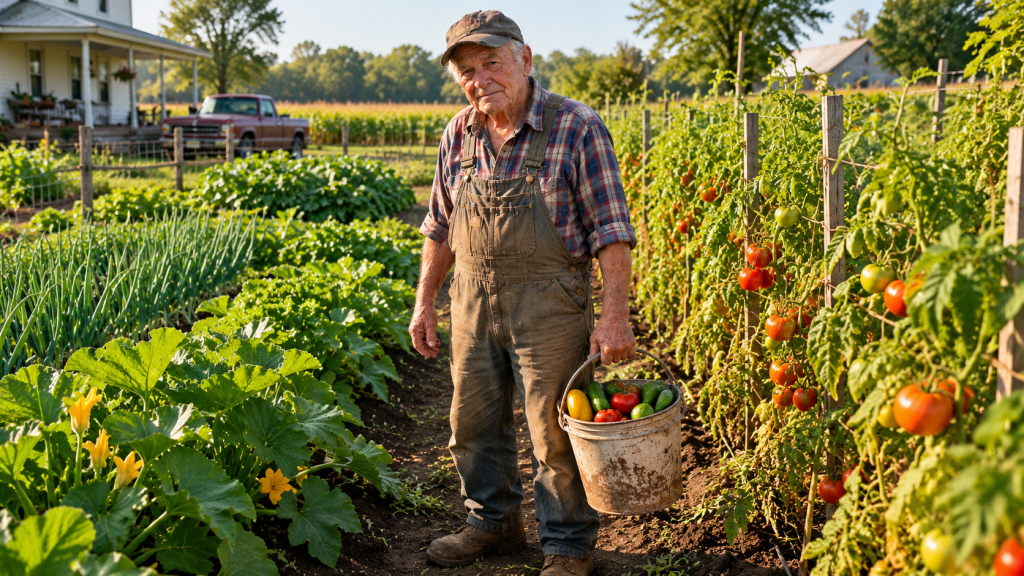
“Everything.” My father stood in the middle of his vegetable rows, holding the empty handle of his old bucket. He looked smaller than I’d ever seen him. Seventy-nine years old. Silver hair beneath a faded green cap. Shoulders permanently bent from decades of working the land. Hands rough enough to split open a walnut but gentle enough to hold a newborn bird.
And suddenly, everyone was looking at him.
Dad frowned.
“Would somebody please tell me what’s going on?”
The teacher’s eyes filled with tears.
“Mr. Lindqvist, your wife left instructions.”
Dad went completely still.
“My Martha?”
The teacher nodded.
“Yes, sir.”
A breeze moved through the tomato plants.
Somewhere behind us, a car door slammed.
But my father didn’t seem to hear anything.
He looked at the envelope as if it might disappear.
“Martha’s been gone nine years.”
“I know.”
“She never told me about any agreement.”
The teacher’s voice trembled.
“Apparently, she wanted it that way.”
Dad removed his cap.
Then whispered the words that broke my heart.
“That woman is still keeping secrets from me.”
For a brief moment, a few people smiled.
But the inspector wasn’t smiling.
He was studying the paperwork with the focused expression of someone who had discovered that a routine complaint had become something much more complicated.
Then Brent came storming down from his deck.
And everything changed.
“Let me see that!”
Brent marched toward the fence in expensive slippers and a dark blue robe.
His coffee sloshed over the rim of his mug.
“Whatever you’re holding, it doesn’t change the zoning ordinance.”
The inspector looked up.
“Sir, please remain on your property.”
Brent laughed.
“I’m standing on my property.”
“Then that’s where I’d like you to stay while I review these documents.”
Brent’s face reddened.
“Do you know how much I pay in property taxes?”
Nobody answered.
He pointed toward Dad.
“That man has turned this neighborhood into a farm.”
I felt my jaw tighten.
Dad’s garden had been there for forty-three years.
Long before Brent purchased the Swenson property.
Long before his gray mansion.
Long before the enormous deck where he stood every morning pretending the vegetables offended him personally.
But Brent continued.
“I bought a beautiful residential lot. I didn’t pay nearly a million dollars to overlook a bunch of people digging in the dirt!”
One of the women carrying a box of tomatoes stopped walking.
The veteran beside the beans lowered his bucket.
Sarah pulled her children closer.
And for the first time, I noticed something about the gathering crowd.
Most of these people were not angry.
They were hurt.
Brent had called the garden an eyesore.
But to them, it was something else entirely.
It was groceries.
It was dinner.
It was one less night of telling a hungry child that there wasn’t enough.
Dad slowly put his cap back on.
Then looked at Brent.
“Son, nobody asked you to buy the place.”
A few people chuckled.
Brent’s face darkened.
“Don’t call me son.”
Dad nodded.
“All right.”
Then he bent to pick up his bucket.
That was my father.
He had never been interested in winning arguments.
He believed the garden needed tending whether people behaved kindly or not.
But Brent wasn’t finished.
“I expect this inspector to do his job.”
The young man straightened.
“I intend to.”
“Then enforce the violation!”
The inspector raised the document.
“Mr. Brent, according to these records, there may be a recorded agreement affecting land associated with both properties.”
Brent blinked.
“What agreement?”
“An agricultural preservation and access agreement.”
Silence.
Then Brent laughed.
“That’s impossible.”
The teacher stepped forward.
“It’s not.”
Brent turned toward her.
“Who are you?”
“My name is Emily Carter. I’m a teacher at Lincoln Elementary.”
“And what does that have to do with anything?”
Emily looked toward Dad.
“Quite a lot.”
Then she reached into her bag.
And removed another envelope.
This one was yellowed with age.
Across the front, in handwriting I recognized immediately, were the words:
FOR THE DAY SOMEONE TRIES TO TAKE THE GARDEN AWAY.
My throat closed.
Mom.
That was Mom’s handwriting.
I would have recognized those letters anywhere.
The rounded M.
The narrow T.
The way she always drew the final line beneath important words.
My hands began trembling.
“Where did you get that?”
Emily looked at me.
“Your mother gave it to my grandmother.”
I stared at her.
“Your grandmother?”
She nodded.
“Mrs. Eleanor Swenson.”
The name struck me like lightning.
The Swensons.
The family who had owned Brent’s property before he bought it.
I turned toward the enormous gray house.
Then back toward Emily.
“What does your grandmother have to do with this?”
Emily swallowed.
“Your mother and my grandmother made a promise forty years ago.”
Dad lifted his head.
And the expression on his face changed.
Because suddenly, I could tell he remembered something.
Something he had never told me.
My parents bought their house in 1978.
I was six years old.
The property wasn’t much to look at.
An old farmhouse.
A leaning garage.
A patch of grass that turned brown every summer.
And half an acre of land behind the house that nobody seemed to want.
Dad was thirty-one then.
He worked at the local mill.
Mom worked part-time at a pharmacy.
Money was always tight.
But Dad loved the soil.
He would come home from a ten-hour shift, change into his old boots, and spend the evening digging.
At first, he planted only tomatoes.
Then beans.
Then potatoes.
By the third year, the garden had grown so large that Mom began laughing whenever he brought home another packet of seeds.
“Harold,” she’d say, “are you planning to feed the county?”
Dad would grin.
“Not the whole county.”
“Just half?”
“Maybe the eastern half.”
They were happy.
Not wealthy.
Not famous.
Just happy.
And when the mill closed in 1984, that garden became the reason we never went hungry.
I remembered those years vividly.
The way Mom stretched a chicken into three meals.
The way Dad repaired his boots instead of buying new ones.
The way they pretended everything was fine whenever I asked why we couldn’t go on vacation like the other children.
But there was always food.
Fresh beans.
Tomatoes.
Potatoes.
Squash.
And somehow, no matter how little we had, Mom always sent me next door with a basket for Mrs. Swenson.
“She lives alone,” Mom would say.
“Take these over.”
I never questioned it.
Mrs. Swenson was an elderly widow with a crooked smile and a house full of clocks.
She always gave me peppermint candy.
I remembered sitting at her kitchen table while she told stories about her late husband.
But I had never known she and Mom had signed a legal agreement.
Until that morning.
Dad looked at Emily.
“Eleanor never mentioned the papers.”
Emily smiled sadly.
“Grandma said your wife didn’t want to make a fuss.”
Dad let out a broken laugh.
“That sounds like Martha.”
Then he wiped his eyes.
And asked, “What exactly did they do?”
Emily handed the old envelope to the inspector.
He removed several documents.
Among them were a signed agreement, a survey drawing, and a letter.
Caroline wasn’t there to explain it.
There was no courtroom.
No dramatic judge.
Just a county inspector standing beside a row of tomato plants, trying to understand a forty-year-old arrangement.
He examined the survey carefully.
Then said, “We need the recorder’s office to verify the recorded version and determine what remains enforceable.”
Brent threw his hands into the air.
“Exactly! Meaning none of this proves anything.”
The inspector looked at him.
“It means I cannot responsibly make a final determination based only on the original complaint.”
Brent’s expression changed.
“And the removal notice?”
“I can request that enforcement be held pending review.”
My heart pounded.
Dad remained quiet.
The inspector continued.
“The documents appear to concern the strip of land along your western boundary, Mr. Brent.”
Brent frowned.
“What strip?”
Emily pointed toward the back of his property.
“The area where the old Swenson shed used to stand.”
Brent looked confused.
Then irritated.
“That’s my backyard.”
Emily took a breath.
“My grandmother allowed the Lindqvists to use that area for garden access and irrigation.”
Brent laughed.
“Allowed? That was decades ago.”
“Yes,” Emily answered.
“And she wanted the arrangement to continue.”
He shook his head.
“That’s not how property ownership works.”
Emily’s voice remained calm.
“That’s why she had an attorney prepare an agreement and record it.”
The inspector nodded.
“If valid and applicable, a recorded easement or restrictive agreement can affect subsequent owners.”
Brent stared at him.
For the first time, his confidence faltered.
Then he pointed toward the vegetable rows.
“Fine. But the vegetables are still an eyesore.”
Dad finally looked up.
“Have you ever eaten a tomato picked warm from the vine?”
Brent blinked.
“What?”
Dad smiled faintly.
“Just wondering.”
Several people laughed.
Brent didn’t.
Dad bent down.
Picked a ripe tomato.
Turned it gently in his palm.
Then placed it into Sarah’s box.
“Let’s finish the harvest,” he said.
And the people went back to work.
As though the argument had been no more important than a passing cloud.
I stayed beside the inspector.
“My father isn’t running a business,” I explained.
“He doesn’t sell the vegetables.”
The inspector looked toward the people filling boxes.
“I can see that.”
“He gives them away.”
He nodded.
“That’s relevant, but it doesn’t automatically settle the land-use issue. I need to check the ordinance and the property’s legal status.”
I appreciated his honesty.
I didn’t want special treatment.
I wanted a fair decision.
The inspector looked toward Dad.
“How long has he been doing this?”
I swallowed.
“As long as I can remember.”
He studied the garden.
Then quietly asked, “Who organizes all these people?”
I looked around.
The answer surprised even me.
Nobody seemed to be organizing them.
They knew where to go.
Older men carried baskets.
Teenagers filled crates.
Parents worked beside their children.
A woman in hospital scrubs collected squash.
Two firefighters loaded boxes into the back of a truck.
A young man wearing a delivery uniform carried potatoes toward a minivan.
It wasn’t chaos.
It was a community.
One I had somehow never seen.
“I don’t know,” I admitted.
The inspector smiled faintly.
“Neither do I.”
Then he said, “I’d like to speak with your father.”
Dad was kneeling beside the green beans when we approached.
He had a handful of pods resting in his palm.
“Morning again,” he said.
The inspector crouched beside him.
“Mr. Lindqvist, may I ask you something?”
Dad nodded.
“Go ahead.”
“Why do you grow so much food?”
Dad looked at the beans.
Then toward the people moving between the rows.
“Because the ground gives more than I need.”
The inspector waited.
Dad shrugged.
“Seems wrong to let it go to waste.”
I felt tears rise.
“That simple?”
Dad smiled.
“Most good things are.”
The inspector looked toward a young mother placing tomatoes into a cardboard box.
“How do people know when to come?”
Dad pulled another bean from the vine.
“Word gets around.”
“Do you charge anything?”
“No.”
“Accept donations?”
Dad shook his head.
“Some folks bring seeds. Some bring compost. Some help mend the fence.”
He smiled.
“But nobody has to pay to eat.”
I covered my mouth.
The inspector’s eyes softened.
“How many families come here?”
Dad considered.
“Depends on the week.”
“Approximately?”
“Maybe forty.”
My heart stopped.
Forty?
Dad shrugged.
“Some weeks more.”
I stared at him.
“Dad…”
He looked at me.
“What?”
“Forty families?”
He seemed almost embarrassed.
“Well, not all at once.”
I looked around the garden.
Then toward the road lined with vehicles.
Forty families.
My seventy-nine-year-old father had been quietly feeding forty families every week.
And I had been worried he was growing too many beans.
Sarah approached us.
She was still holding the old photograph.
“Mr. Lindqvist?”
Dad looked up.
“Morning, sweetheart.”
Her voice trembled.
“Can I tell them?”
Dad frowned.
“Tell them what?”
She smiled through tears.
“About last Christmas.”
Dad looked uncomfortable.
“Sarah, that’s not necessary.”
But she turned toward the inspector.
“Last winter, my husband died.”
The garden seemed to grow quieter.
“He had cancer.”
She swallowed.
“We spent everything we had on medical bills and keeping the house.”
My eyes filled.
“By December, I had six children and less than thirty dollars in the bank.”
Dad looked down.
Sarah continued.
“I didn’t tell anyone.”
Her voice broke.
“I was ashamed.”
The inspector listened.
“One Friday morning, I heard a truck outside.”
She smiled through tears.
“It was Mr. Lindqvist.”
Dad shook his head.
“Sarah…”
“He brought potatoes. Carrots. Squash. Frozen vegetables he’d saved from the summer.”
She began crying.
“And a turkey.”
I covered my mouth.
“He told me he’d accidentally bought one too many.”
A few people laughed softly.
Sarah wiped her cheeks.
“Then he gave me an envelope.”
She looked at Dad.
“There was money inside.”
My father stared at the ground.
Sarah continued.
“Enough to cover the electricity bill.”
I began sobbing.
“He said somebody had left it in his mailbox and asked him to pass it along.”
She smiled sadly.
“But the envelope had his handwriting.”
The inspector looked toward Dad.
Dad adjusted his cap.
“Well, the electricity shouldn’t go off when there are children in the house.”
Sarah began crying harder.
Then she took his hand.
“Mr. Lindqvist, my children had Christmas because of you.”
Dad’s eyes filled.
He patted her hand.
“Your children had Christmas because their mama kept going when things got hard.”
And then Sarah hugged him.
My father.
The quiet old man who ate dinner alone.
Who repaired everything instead of replacing it.
Who wore the same work jacket for twenty years.
He stood in the middle of his garden while a mother of six held him as though he were the last safe place in the world.
I had never been prouder of him.
Another man stepped forward.
His name was Walter Jennings.
He was a retired firefighter with a cane.
He had lost part of his mobility after an accident.
Walter looked at the inspector.
“Can I say something?”
The young man nodded.
“Of course.”
Walter pointed toward Dad.
“That man brought vegetables to my house every Friday after my wife died.”
My eyes filled.
“I didn’t ask him.”
Walter swallowed.
“I didn’t even know him well.”
Dad smiled faintly.
Walter continued.
“Some days, he left the food on the porch because I wouldn’t answer the door.”
His voice broke.
“I was in a bad place.”
The crowd grew still.
Walter looked at Dad.
“But he kept coming.”
A tear slid down his face.
“Every Friday.”
He paused.
“Then one morning, he knocked and asked whether I could help repair his tractor.”
Dad chuckled.
“It was broken.”
Walter smiled.
“It wasn’t.”
A ripple of laughter moved through the garden.
Dad looked offended.
“Now, Walter…”
Walter shook his head.
“You’d loosened a perfectly good belt.”
People laughed harder.
Walter wiped his eyes.
“You knew I needed a reason to get out of bed.”
Dad said nothing.
Walter continued.
“You gave me one.”
The inspector slowly lowered his clipboard.
I looked at my father.
And suddenly understood why he always seemed tired on Friday evenings.
He wasn’t driving aimlessly.
He was delivering food.
Checking on lonely people.
Finding reasons for grieving neighbors to keep living.
And he had done it quietly enough that even his own daughter didn’t know.
Then the young teacher spoke.
“There’s something else.”
Emily stepped into the space between the rows.
Several people turned toward her.
She looked at Dad.
“Mr. Lindqvist, do you remember when Lincoln Elementary started its breakfast program?”
Dad nodded.
“Of course.”
“Do you remember why?”
He shrugged.
“Kids were hungry.”
Emily smiled through tears.
“Yes.”
She looked toward the inspector.
“Eighteen years ago, our school discovered that several children were arriving without breakfast.”
Her voice trembled.
“Some were falling asleep in class.”
Others were taking food home in their pockets.
Some told teachers they weren’t hungry.
But the teachers knew better.
Emily swallowed.
“My grandmother told Mrs. Lindqvist about it.”
I felt a chill.
Mom.
Of course Mom.
Emily continued.
“The Lindqvists began supplying produce for a summer nutrition project.”
She looked at Dad.
“They never wanted publicity.”
He shook his head.
“Wasn’t anything worth talking about.”
Emily’s voice broke.
“Mr. Lindqvist, hundreds of children have eaten food from this garden.”
I stared at my father.
Hundreds.
The number felt impossible.
Dad looked genuinely confused.
“Well, children grow. They need vegetables.”
A soft laugh spread through the crowd.
Emily smiled through tears.
“That’s exactly what your wife used to say.”
Dad’s eyes filled.
Then he looked down.
And for the first time that morning, I saw him truly struggle to remain composed.
Because every story about the garden was also a story about Mom.
And he missed her.
He missed her more than any of us understood.
Brent had retreated to his deck.
But he was still watching.
His coffee mug sat on the railing.
His arms were folded.
His expression was difficult to read.
Angry.
Embarrassed.
Perhaps confused.
I wanted to walk over there.
I wanted to tell him what the garden meant.
I wanted to ask what kind of man looked at rows of vegetables feeding hungry families and saw only something ugly.
But Dad caught my eye.
He shook his head once.
A small movement.
Almost invisible.
I knew what it meant.
Don’t.
I took a breath.
And stayed where I was.
Because Dad had spent seventy-nine years teaching me that anger was a tool best used carefully.
It could help you protect something.
But if you let it take over, you might end up damaging the very thing you loved.
By eight o’clock, nearly seventy people had come through the garden.
Some stayed to work.
Others collected food and left.
A church van arrived.
A nurse picked up vegetables for elderly patients.
Two college students carried crates toward a food pantry.
And still Dad moved between the rows.
Slowly.
Patiently.
Checking tomatoes.
Showing a little boy how to tell whether a squash was ripe.
Helping an elderly woman lift a box into her car.
The inspector watched everything.
Then approached me.
“Your father is remarkable.”
I smiled through tears.
“He’s stubborn.”
The inspector laughed softly.
“I noticed.”
I looked toward Dad.
“Are you going to make him remove it?”
The young man’s expression grew serious.
“I can’t make that decision based on sympathy.”
I nodded.
“I understand.”
“But I also can’t ignore the history, records, and nature of the use.”
He looked toward the survey.
“This deserves a thorough review.”
I swallowed.
“So the thirty days?”
“I’ll recommend pausing enforcement while the county verifies the recorded documents and examines whether the notice was properly issued.”
My eyes filled.
“Thank you.”
He shook his head.
“Don’t thank me yet. We still have work to do.”
Then he smiled.
“But I think your father was right to ask me to come this morning.”
At ten thirty, the last boxes were loaded.
The fog had disappeared.
Sunshine warmed the rows.
Dad stood beside his truck, wiping his hands on a rag.
I walked toward him.
He looked up.
“You hungry?”
I stared.
“Dad.”
“What?”
“You’ve just spent four hours feeding half the county, and you’re asking whether I’m hungry?”
He smiled.
“It’s nearly lunch.”
I laughed.
Then began crying.
He frowned.
“What’s wrong?”
I shook my head.
“Nothing.”
He looked unconvinced.
I stepped forward.
And hugged him.
He stiffened.
Dad had never been particularly comfortable with emotional displays.
He believed hugs were best reserved for weddings, funerals, and serious illnesses.
But after a moment, his arms came around me.
“What’s all this?”
I held him tighter.
“Why didn’t you tell me?”
He was quiet.
“Tell you what?”
“About the families.”
He sighed.
“Didn’t seem important.”
I pulled back.
“Dad, you’ve been feeding people for years.”
He shrugged.
“Somebody has to grow the beans.”
I laughed through tears.
Then looked at him.
“Mom would be proud.”
His expression changed.
The smile faded.
For a moment, he looked very old.
Then he whispered, “I hope so.”
I took his hand.
“She would.”
He looked toward the garden.
And tears filled his eyes.
“I still plant her favorite tomatoes.”
My throat tightened.
“Which ones?”
He smiled sadly.
“The yellow ones near the fence.”
I looked.
A whole row.
Golden tomatoes glowing in the sun.
I had walked past them hundreds of times without knowing.
Dad swallowed.
“She used to say they looked like little pieces of sunshine.”
A tear slid down his cheek.
I squeezed his hand.
“Dad…”
He looked away.
“Some mornings, I still expect her to come out the back door and tell me I’m planting too much.”
My heart broke.
I pulled him close.
And this time, he didn’t resist.
The county hearing was scheduled three weeks later.
At first, Dad refused to attend.
“Nothing to talk about,” he said.
I stared at him.
“Dad, they’re deciding whether you can keep the garden.”
He shrugged.
“They can talk without me.”
“No.”
He looked up.
I took a breath.
“You’ve spent your whole life showing up for other people.”
He frowned.
“So?”
“Now it’s our turn to show up for you.”
He looked uncomfortable.
“I don’t need a big fuss.”
I smiled.
“Too bad.”
He sighed.
“You sound just like your mother.”
I laughed.
“Good.”
I contacted an attorney named Laura Bennett.
She specialized in property law and local government matters.
When I explained the situation, she agreed to review the records.
Her first question surprised me.
“Was the garden in existence before the current zoning ordinance?”
I nodded.
“Yes.”
“How long?”
“Over forty years.”
She became thoughtful.
“And did the county ever previously object?”
“Not that I know of.”
“Do you have photographs or records showing the historical use?”
I thought about Mom’s old albums.
Birthday pictures.
Summer photographs.
Dad beside tomato plants.
Me holding an enormous zucchini when I was seven.
A photograph of our first family dog sleeping beneath the bean poles.
“Yes,” I said.
“Plenty.”
Laura smiled.
“Good.”
Then she examined the agreement involving the Swenson property.
Her expression grew more serious.
“This could be important.”
My heart raced.
“Does it protect the garden?”
“It may protect certain access and irrigation rights. We’ll need to confirm the recorded instrument and its scope.”
I nodded.
“And what about the zoning complaint?”
“That’s a separate question.”
She looked directly at me.
“Your father deserves a decision based on the actual ordinance, the property’s established use, and the applicable legal protections.”
I swallowed.
“Not Brent’s opinion.”
Laura smiled faintly.
“Exactly.”
The following week, I visited the county archives.
A clerk helped me locate aerial photographs dating back decades.
There was Dad’s garden.
In 1981.
In 1994.
In 2006.
In 2017.
And in the most recent survey.
The same half acre.
The same rows.
The same irrigation line.
The same patch of land that had fed people for generations.
I stared at the photographs.
The county’s complaint described the garden as an unmaintained agricultural use.
But the historical evidence showed something very different.
A carefully cultivated family garden.
A long-established community food source.
A piece of local history.
I requested certified copies.
Then went home and opened Mom’s old photo albums.
It was there that I found the next surprise.
The photograph was tucked between two pages in an album labeled SUMMER 1986.
Dad stood beside Mrs. Swenson.
Mom was between them.
All three held shovels.
Behind them was the old shed.
The one that had stood on the Swenson property.
On the back, Mom had written:
FIRST DAY OF THE COMMUNITY GARDEN AGREEMENT.
I sat very still.
Community garden.
Not simply Dad’s vegetable patch.
I turned the page.
Another photograph.
Children carrying baskets.
A handwritten sign reading:
TAKE WHAT YOU NEED. LEAVE SOME FOR THE NEXT FAMILY.
My throat tightened.
Then another.
Mom standing beside a woman holding a baby.
Another.
Dad repairing an irrigation pipe.
Another.
Mrs. Swenson handing potatoes to a young man in military uniform.
And suddenly, everything I believed about the garden changed.
It hadn’t begun as a hobby.
It hadn’t even begun as charity.
It had begun as a promise between neighbors.
I reached the final page of the album.
Inside was a letter.
Mom’s handwriting.
Addressed to me.
MY DEAR GIRL,
I covered my mouth.
I hadn’t known it was there.
I unfolded it carefully.
The paper was thin.
The ink slightly faded.
But the words were clear.
One day, you’ll inherit many things from your father and me.
Some will be useful.
Some will be sentimental.
Some won’t seem worth much at all.
But I hope the most important thing you inherit is the understanding that a full table means little if the people next door are hungry.
My eyes filled.
Your father believes growing food is the easiest thing in the world.
It isn’t.
It takes patience.
Water.
Faith.
And the willingness to plant something today that you may not enjoy for months.
I smiled through tears.
People are like that too.
Sometimes kindness takes time to grow.
Sometimes you help someone and never learn what happened afterward.
Sometimes the only reward is knowing they went to bed with a full stomach.
I began crying.
Then came the paragraph that stayed with me.
If anyone ever asks why we grow so much, tell them the garden is not about vegetables.
It’s about making sure nobody in our little corner of the world has to feel forgotten.
I pressed the letter against my chest.
And whispered, “Oh, Mom.”
The hearing room was nearly full when we arrived.
Dad stopped in the doorway.
Then looked at me.
“What did you do?”
I glanced inside.
People were sitting in rows.
Sarah and her children.
Walter Jennings.
Emily Carter.
The firefighter.
The nurse.
The young parents.
The elderly neighbors.
The school volunteers.
Even several people I didn’t recognize.
I smiled.
“Nothing.”
Dad raised an eyebrow.
“That’s a lot of nothing.”
I laughed.
He shook his head.
“Lord help me.”
Then we walked inside.
Brent sat near the front.
He wore a dark suit and a silver watch.
His attorney sat beside him.
He looked irritated.
But when he glanced back and saw the crowded room, his expression changed.
For a moment, he seemed genuinely surprised.
I wondered whether he’d believed Dad was simply a lonely old man with too many tomato plants.
Perhaps he had never imagined how many people depended on that garden.
Then Dad sat down.
Placed his old green cap on his knees.
And waited.
The hearing began with a county staff member summarizing the complaint.
A neighboring homeowner had reported vegetation and alleged agricultural activity inconsistent with residential zoning requirements.
An inspection had resulted in a notice directing removal of the garden.
The county had subsequently paused the deadline pending review of additional records.
Laura stood.
She presented the historical aerial photographs.
The family albums.
The recorded agreement.
The garden’s long-established use.
And statements from people familiar with the property.
She explained that the garden was not a commercial agricultural operation.
There were no sales.
No farmstand.
No admission fees.
The vegetables were grown and distributed without charge.
Then she addressed the ordinance.
The relevant zoning language distinguished certain commercial agricultural activities from ordinary residential gardening.
It also contained provisions concerning established uses and circumstances requiring additional factual review.
The county staff member acknowledged that the original notice had been issued before the full history was known.
That mattered.
The inspector had done his job by investigating a complaint.
But now the county had more information.
And more information required a better decision.
Brent’s attorney stood next.
He argued that the volume of activity created traffic, noise, and visual concerns.
He pointed toward photographs of vehicles parked along the road.
He described people arriving early on Saturdays.
He complained about the appearance of the rows.
I sat beside Dad.
My hands tightened.
But Laura remained calm.
When given the opportunity, she addressed the concerns one by one.
Parking could be managed.
Distribution hours could be scheduled.
Access points could be maintained.
Safety measures could be improved.
None of those concerns automatically required destroying a forty-year-old garden.
Then the attorney mentioned Brent’s view from his deck.
I almost laughed.
The view.
This entire fight had begun because a wealthy man disliked looking at vegetables.
But Laura did not mock him.
She simply said, “A preference for a different landscape is not, by itself, proof that a lawful established use must end.”
I squeezed Dad’s hand.
He leaned toward me.
“She’s pretty good.”
I smiled.
“Very.”
Then the county board invited public comment.
Sarah stood first.
Her hands trembled as she approached the microphone.
She spoke about her husband.
Her children.
The winter when money ran out.
The vegetables Dad brought.
She did not exaggerate.
She did not beg.
She simply told the truth.
When she finished, the room was quiet.
Then Walter stood.
He walked slowly with his cane.
He described the Fridays when Dad left food on his porch.
And the morning Dad asked him to repair a tractor that wasn’t really broken.
Soft laughter filled the room.
Walter smiled.
Then his voice broke.
“That garden helped keep me connected to the world when I didn’t particularly want to be here anymore.”
My eyes filled.
He looked toward Dad.
“Harold never treated me like a problem.”
Walter paused.
“He treated me like a neighbor.”
Then he returned to his seat.
Emily spoke next.
She brought records from the school program.
Photographs of volunteers.
Letters from former students.
One letter was written by a young woman attending nursing school.
She described growing up in a home where her mother worked two jobs.
She remembered receiving bags of fresh vegetables every summer.
She remembered Dad showing her how to plant beans.
She wrote that watching the garden made her believe she could build a better future.
Emily read the final line aloud.
Mr. Lindqvist gave my family food, but he also gave me something I didn’t know I needed: the feeling that somebody cared whether we were okay.
I began crying.
Dad looked down at his cap.
His hands trembled.
He had spent years pretending the garden was nothing special.
Now the people he’d helped were telling him exactly what it meant.
Then something unexpected happened.
A woman stood near the back of the room.
She was perhaps fifty.
Dark hair.
A cream-colored coat.
A leather handbag.
She looked nervous.
The board chair invited her to speak.
She approached the microphone.
“My name is Rebecca Swenson.”
Emily turned sharply.
“Aunt Rebecca?”
My heart tightened.
Rebecca Swenson.
The daughter of Eleanor Swenson.
The woman who had inherited the property before selling it to Brent.
She took a breath.
“I sold the neighboring property two years ago.”
Brent sat straighter.
His attorney looked toward her.
Rebecca continued.
“I need to clarify something about the sale.”
The room grew quiet.
She looked toward Brent.
“Before closing, the title documents included a recorded agreement concerning garden access and irrigation.”
Brent’s face changed.
His attorney lowered his pen.
Rebecca swallowed.
“I also gave the buyer information about the Lindqvist garden.”
She looked toward Dad.
“My mother wanted that arrangement respected.”
Brent suddenly stood.
“That’s not what happened!”
The board chair raised a hand.
“Mr. Brent, you’ll have an opportunity to respond.”
Rebecca looked frightened.
But she continued.
“I told Mr. Brent that the garden had been there for decades.”
Her voice trembled.
“He said he understood.”
My heart began pounding.
She looked directly toward Brent.
“And I specifically remember him saying he liked the idea of living beside a community garden.”
Silence.
Then Brent’s attorney leaned toward him.
And whispered something urgently.
I stared at Brent.
He had known.
He had known about the garden before buying the property.
He had known it was important to the community.
He had even been told about the agreement.
Yet he’d filed a complaint and called the garden an eyesore.
Why?
Why would someone knowingly buy a property beside a garden and then spend months trying to make it disappear?
I looked toward the enormous gray house visible through the hearing-room window.
Then remembered something.
The day Brent moved in, a survey crew had been working near the back fence.
I thought they were marking the boundary.
Later, construction equipment appeared.
Workers removed the old Swenson shed.
Then they poured concrete for Brent’s enormous deck.
I had never questioned it.
But suddenly, the old agreement seemed more important.
I leaned toward Laura.
“Can I show you something?”
She looked at me.
“What?”
I pulled out my phone.
Searched through photographs from the previous spring.
I found one I’d taken while visiting Dad.
A picture of his first tomato seedlings.
In the background, barely visible, were Brent’s construction workers.
And the old irrigation line.
I enlarged the image.
Then showed Laura.
Her expression changed.
“Where was this taken?”
“Dad’s backyard.”
“When?”
“Last April.”
She studied it.
Then whispered, “This may be relevant to the survey issue.”
My stomach tightened.
“What issue?”
She looked at the document.
“Whether the new improvements interfere with the recorded easement.”
I stared at her.
Then toward Brent.
And for the first time, I wondered whether the complaint had never been about the vegetables at all.
Laura requested permission to submit the photograph for further review.
The board accepted it into the record subject to verification.
She explained that the photograph might show the location of an irrigation feature associated with the recorded agreement before Brent’s construction.
The county’s land-use officer looked interested.
Brent’s attorney looked uncomfortable.
The board chair asked whether the placement of the deck had been inspected in relation to the recorded easement.
Nobody could answer immediately.
The issue had not been part of the original complaint.
So the chair directed staff to review the relevant permits and survey records separately.
Brent sat rigidly.
His face was dark red.
Dad leaned toward me.
“What’s happening?”
I whispered, “I think Brent may have built something where he wasn’t supposed to.”
Dad frowned.
“The shed area?”
I nodded.
He looked toward the ceiling.
Then whispered, “Oh, for heaven’s sake.”
I almost laughed.
That was Dad.
He wasn’t pleased.
He wasn’t excited.
He was simply annoyed that another problem had appeared where people should have been planting vegetables.
The board recessed for twenty minutes.
People gathered in the hallway.
Sarah hugged me.
Walter shook Dad’s hand.
Emily wiped her eyes.
Dad looked overwhelmed.
He kept asking whether anyone wanted a bottle of water.
I pulled him aside.
“Dad.”
“What?”
“Are you all right?”
He nodded.
“Fine.”
I studied him.
His cheeks were pale.
His hands looked tired.
“Are you sure?”
He smiled faintly.
“Never had so many people talk about my beans before.”
I laughed.
Then hugged him.
He held me for a moment.
Then whispered, “I wish your mother were here.”
My throat tightened.
“Me too.”
He looked toward the hearing-room doors.
“She would know what to say.”
I smiled through tears.
“Dad, she already did.”
He frowned.
I reached into my bag.
And pulled out her letter.
The one from the photo album.
I handed it to him.
His hands trembled as he unfolded it.
He read slowly.
His lips moved over the words.
When he reached the final paragraph, tears began sliding down his cheeks.
He pressed the paper against his chest.
Then whispered, “Oh, Martha.”
For a long time, I stood beside him.
Neither of us spoke.
Sometimes grief needs no explanation.
Sometimes it simply needs someone willing to stay.
When the hearing resumed, the county board announced that the original removal notice would be withdrawn.
For a moment, I thought I’d misheard.
Then the chair continued.
The available evidence did not support treating the entire long-established garden as the prohibited activity described in the notice.
The county would separately address appropriate operational concerns, including parking and traffic management, through ordinary procedures.
The recorded property agreement would be reviewed by the relevant offices, and any dispute regarding the neighboring improvements would be handled through the proper permitting or property-law process.
But Dad would not be required to remove his garden under the original thirty-day notice.
I felt the air leave my lungs.
Beside me, Dad sat motionless.
Then Sarah began crying.
Walter closed his eyes.
Emily covered her mouth.
And suddenly the room filled with applause.
The board chair tapped the microphone.
“Please, everyone.”
But even she was smiling slightly.
I turned toward Dad.
“Dad.”
He looked at me.
His eyes were wet.
“You can keep it.”
He blinked.
“What?”
“The garden.”
My voice broke.
“You can keep the garden.”
For several seconds, he didn’t move.
Then he looked down at Mom’s letter.
And whispered, “Good.”
Just one word.
No cheering.
No fist in the air.
No victory speech.
Just good.
Then he carefully folded the letter.
Placed it in his shirt pocket.
And stood.
“Come on,” he said.
I stared.
“Where?”
He looked at me as though the answer were obvious.
“Home.”
I laughed through tears.
“Why?”
He smiled.
“Tomatoes won’t pick themselves.”
The decision spread through town before we reached the driveway.
By the time Dad parked his old pickup, three neighbors were waiting beside the fence.
One held flowers.
Another carried a pie.
The third had a handmade sign.
THE GARDEN STAYS.
Dad stared at it.
Then looked at me.
“Did you arrange this?”
I laughed.
“No.”
He shook his head.
“People are making too much fuss.”
But his eyes filled.
A little boy ran toward him.
“Mr. Harold!”
Dad smiled.
“Morning, Tommy.”
The boy held out a drawing.
It showed Dad standing in a huge garden beneath a yellow sun.
Around him were people carrying baskets.
At the top, in uneven letters, were the words:
THANK YOU FOR HELPING EVERYBODY.
Dad stared at the drawing.
Then knelt slowly.
He put one hand on the boy’s shoulder.
“Did you make this?”
Tommy nodded proudly.
“Yep.”
Dad smiled.
“Well, it’s mighty fine.”
The boy grinned.
“Mom says you’re the reason we got vegetables when Dad was sick.”
Dad looked at him.
“Your mama’s a hard worker.”
Tommy nodded.
Then threw his arms around Dad.
And my seventy-nine-year-old father began crying in the driveway.
For the next few weeks, the garden became the center of town.
Not because Dad wanted attention.
He hated attention.
But people wanted to help.
The high school agricultural club offered volunteers.
A local hardware store donated tools.
A plumber volunteered to inspect the irrigation system.
A church group organized a safer pickup schedule.
The food pantry offered to coordinate distributions so cars wouldn’t crowd the road.
And an accounting volunteer helped establish a small nonprofit organization to support the garden’s charitable work.
Dad resisted all of it.
“I’ve been doing fine with a bucket and a shovel.”
I laughed.
“Dad, you’re seventy-nine.”
“So?”
“You shouldn’t be lifting fifty-pound sacks of potatoes by yourself.”
He frowned.
“Been lifting them for years.”
“Exactly.”
He looked toward Walter.
“She’s bossy.”
Walter grinned.
“Gets it from Martha.”
Dad sighed.
“Everybody says that.”
I smiled.
“Because it’s true.”
But Brent’s story wasn’t finished.
The county’s review of his construction permits uncovered questions about the deck’s placement.
A survey showed that part of the improvement might interfere with the area covered by the recorded irrigation easement.
The matter required additional professional review.
And Brent did not take the news well.
One afternoon, he came to Dad’s fence carrying a thick folder.
His face was flushed.
“Mr. Lindqvist!”
Dad was watering squash.
He looked up.
“Morning.”
“It’s afternoon.”
Dad glanced toward the sun.
“So it is.”
Brent didn’t smile.
“I want to talk about this ridiculous easement.”
Dad shut off the hose.
“All right.”
Brent waved the folder.
“My attorney says the language is ambiguous.”
Dad nodded.
“Could be.”
“And I shouldn’t have to tear up my deck because of some ancient agreement.”
Dad leaned against the fence.
“I never asked you to tear anything up.”
Brent blinked.
“What?”
“I said I never asked you to.”
Brent stared.
Dad continued.
“I asked the inspector to see the garden before making a decision.”
He looked toward the vegetable rows.
“That’s all.”
Brent seemed momentarily confused.
Then he said, “Your people are making me look like a monster.”
Dad frowned.
“My people?”
“The volunteers. The neighbors. Everyone.”
Dad studied him.
Then asked quietly, “Have they been threatening you?”
Brent hesitated.
“No.”
“Damaging your property?”
“No.”
“Harassing your family?”
Brent looked away.
“Not exactly.”
Dad nodded.
“Then maybe they’re just disappointed.”
Brent’s jaw tightened.
He opened his mouth.
Then closed it.
Dad continued.
“You called their food an eyesore.”
For a moment, there was no sound but the sprinkler ticking beside the potatoes.
Then Brent looked toward the garden.
And said something I never expected.
“I didn’t know.”
Dad tilted his head.
“Didn’t know what?”
Brent swallowed.
“About the families.”
Dad was quiet.
Brent continued.
“I thought you were running some kind of illegal produce business.”
Dad almost laughed.
“Son, I’m not sure I’ve ever made a dollar from a tomato.”
Brent looked uncomfortable.
Dad studied him for a moment.
Then said, “You could’ve asked.”
Brent looked down.
And for the first time, he had no answer.
A week later, Brent returned.
This time, without a folder.
Without a lawyer.
Without his expensive coffee mug.
He stood beside the fence wearing jeans and work boots.
Dad was kneeling beside the potatoes.
“Mr. Lindqvist?”
Dad looked up.
“Morning.”
Brent swallowed.
“Could I speak with you?”
Dad slowly stood.
“Sure.”
Brent looked toward the garden.
Then toward the road.
He seemed nervous.
“I wanted to apologize.”
Dad didn’t react immediately.
Brent continued.
“I made assumptions.”
He looked down.
“I complained before understanding what you were doing.”
Dad listened.
Brent swallowed.
“And I said some things I shouldn’t have.”
My father nodded.
“Yes, you did.”
Brent blinked.
Perhaps he expected immediate forgiveness.
Dad wasn’t unkind.
But he wasn’t dishonest either.
Brent took a breath.
“I’m sorry.”
Dad studied him.
Then looked toward a row of tomato plants.
“Ever grow vegetables?”
Brent frowned.
“What?”
“Tomatoes. Beans. Anything?”
Brent shook his head.
“No.”
Dad nodded.
“Want to learn?”
I almost laughed.
Brent stared.
“Are you serious?”
Dad smiled faintly.
“Wouldn’t have asked otherwise.”
Brent looked toward the plants.
Then back at Dad.
“I guess.”
Dad reached for a spare pair of gloves.
“Good.”
He handed them across the fence.
“Start with the weeds.”
Brent stared at the gloves.
And I realized my father had just given him something far more difficult than forgiveness.
An opportunity to become useful.
I watched from the kitchen window as Brent awkwardly knelt between the bean rows.
Dad stood beside him, explaining which plants to pull.
At first, Brent looked uncomfortable.
Then embarrassed.
Then genuinely interested.
He asked questions.
Dad answered.
When Brent accidentally pulled a young bean plant, Dad shook his head.
“That’s lunch you just murdered.”
Brent stared at him.
Then laughed.
A real laugh.
Dad smiled.
And I felt something soften inside me.
Not because Brent’s complaint had been harmless.
It hadn’t.
He had frightened my father.
Threatened a resource people depended on.
And forced the community to spend time and money defending something that should have been examined fairly from the beginning.
But I had also watched Dad spend a lifetime believing that people were more complicated than their worst moments.
He never excused cruelty.
He simply didn’t believe humiliation was the best way to teach someone kindness.
The deck dispute was eventually resolved through an agreed modification to the irrigation arrangement and corrective work approved by the relevant parties.
Brent paid for the work affecting his property.
Dad didn’t have to lose garden access.
And the irrigation line continued serving the vegetable rows.
It wasn’t a dramatic victory.
It was paperwork.
Surveyors.
Engineers.
Lawyers.
A lot of phone calls.
And a practical solution.
Dad was delighted.
Not because he had won.
But because everyone finally stopped interrupting his planting schedule.
By the following spring, the garden had more volunteers than ever.
Dad still woke before sunrise.
Still wore his green cap.
Still used the same old bucket.
But he no longer did everything alone.
Students prepared seedlings.
Retirees helped with watering.
Parents organized harvest days.
A local mechanic repaired Dad’s pickup.
And the food pantry coordinated deliveries for families who couldn’t travel.
We named the organization Martha and Harold’s Community Harvest.
Dad protested immediately.
“Don’t put my name on anything.”
I smiled.
“Too late.”
He frowned.
“Then take it off.”
Emily laughed.
“We’ve already printed the sign.”
Dad sighed.
“Waste of perfectly good paint.”
Walter grinned.
“You’re not getting out of this one, Harold.”
Dad shook his head.
But the next morning, I found him standing in front of the sign.
Reading it.
Over and over.
His hand rested against Martha’s name.
And tears slipped down his cheeks.
I didn’t interrupt.
Some moments belong only to the people we miss.
That summer, something happened that reminded me how fragile happiness can be.
Dad collapsed beside the tomato plants.
It was a Thursday.
The hottest day of the season.
I had been at work when Emily called.
Her voice was shaking.
“Your father’s been taken to the hospital.”
The world stopped.
“What?”
“He got dizzy. Walter found him sitting on the ground.”
My stomach tightened.
“Is he conscious?”
“Yes.”
“Is he breathing?”
“Yes.”
“Where are they taking him?”
She told me.
I grabbed my keys.
And drove faster than I should have.
All the way to the hospital, I thought about the mornings Dad spent alone.
The years he worked himself to exhaustion.
The way he always said he was fine.
The way Mom died so suddenly.
The terrible possibility that I might lose him too.
I gripped the steering wheel.
“Please,” I whispered.
“Not yet.”
Dad was sitting upright when I reached the emergency department.
He looked annoyed.
That was the first good sign.
A nurse was checking his blood pressure.
Dad looked at me.
“What are you doing here?”
I almost screamed.
“What am I doing here?”
He shrugged.
“Thought you were working.”
I stared at him.
“Dad, you collapsed.”
He frowned.
“I sat down.”
“On the ground!”
“It’s where the ground was.”
The nurse tried not to smile.
I covered my face.
“Dad…”
He sighed.
“It’s hot outside.”
I looked at the nurse.
She explained that dehydration and heat exposure appeared to have contributed to his symptoms, and the medical team was evaluating him for other possible causes.
I nodded.
Then looked back at Dad.
“You are not going back to work in that garden during the hottest part of the day.”
He opened his mouth.
I raised a finger.
“Don’t.”
He closed it.
The nurse laughed softly.
Then said, “I think your daughter has a point.”
Dad sighed.
“Everybody’s against me.”
I sat beside his bed.
Took his hand.
And began crying.
His expression softened.
“Hey.”
I shook my head.
He squeezed my fingers.
“I’m all right.”
“You scared me.”
“I know.”
My voice broke.
“Dad, I can’t lose you.”
He became very quiet.
Then reached toward me.
I leaned into his arms.
And for a moment, I was six years old again.
A little girl frightened of the dark.
Safe because her father was holding her.
Dad stayed in the hospital overnight.
The doctors recommended rest, hydration, follow-up care, and avoiding strenuous work in extreme heat.
He complained about the food.
Complained about the television.
Complained that nobody knew how to make decent coffee.
But when I told him the garden volunteers were taking care of everything, he became quiet.
“Who’s watering the beans?”
“Walter.”
Dad frowned.
“Walter always uses too much.”
“Emily’s helping.”
He sighed.
“She waters the leaves.”
“Dad.”
“What?”
I took his hand.
“The garden will survive one day without you.”
He looked toward the window.
Then whispered, “That’s what worries me.”
My heart tightened.
“What?”
He swallowed.
“That it won’t.”
I stared at him.
For the first time, I understood.
Dad wasn’t simply afraid of missing a day of gardening.
He was afraid of what would happen when he was no longer there.
To the families.
To the children.
To the people who counted on Friday deliveries.
He had carried that responsibility alone for so long that even illness felt like betrayal.
I squeezed his hand.
“Dad.”
He looked at me.
“That’s why we built the organization.”
He frowned.
“What?”
“So you don’t have to carry everything anymore.”
His eyes filled.
“The garden belongs to the community now.”
He shook his head.
“Your mother started it.”
I smiled through tears.
“And you kept it alive.”
I took a breath.
“Now let us help you keep it growing.”
Dad looked down.
For a long time, he didn’t speak.
Then he whispered, “I suppose Martha would like that.”
I nodded.
“She would.”
The next Friday, Dad insisted on visiting the garden.
Not working.
Just visiting.
I made that distinction very clear.
He sat beneath a canopy beside the shed.
A bottle of water rested in his hand.
A wide-brimmed hat shaded his face.
Walter stood nearby making sure he didn’t attempt anything more strenuous than giving advice.
And people came.
Dozens of them.
Children.
Parents.
Volunteers.
Families carrying boxes.
Everyone stopped to greet Dad.
One little girl brought him a drawing.
Another handed him a sunflower.
A teenager gave him a thank-you card.
A woman who had received food from the garden for years brought homemade bread.
Dad looked overwhelmed.
He kept saying, “You didn’t have to.”
And every time, someone answered, “We wanted to.”
I watched him slowly understand something.
He had spent decades being the person who gave.
Now he was learning how to receive.
And that, for my stubborn father, may have been the hardest lesson of all.
A month later, the community held a celebration.
It wasn’t Dad’s idea.
Of course it wasn’t.
He would have preferred everyone stay home and leave the tomatoes alone.
But Emily insisted.
The county had completed its review.
The garden’s operations were now organized under clear procedures.
The irrigation issue was resolved.
And the new nonprofit had secured donations for long-term maintenance.
We wanted to celebrate.
So we gathered beside the garden on a warm Saturday evening.
String lights hung from the fence.
Long tables were covered with homemade food.
Children ran through the grass.
Someone brought a guitar.
Walter made terrible jokes.
Sarah’s children hung paper flowers around the new garden sign.
And Brent arrived carrying a huge bowl of potato salad.
I nearly dropped my plate.
Brent.
Potato salad.
For a moment, I wondered whether the world had turned upside down.
He caught me staring.
Then smiled awkwardly.
“My wife made it.”
I laughed.
“Of course she did.”
He grinned.
“I’m not trusted near the stove.”
Behind him stood his wife, Amanda.
I had met her only briefly before.
She was warm.
Quiet.
And looked genuinely happy to be there.
She took my hand.
“I wanted to thank you.”
I frowned.
“For what?”
“For giving Brent a chance to understand.”
I looked toward the garden.
Dad was sitting beside Walter.
Brent’s two children were helping Sarah’s youngest son carry cups.
Amanda smiled.
“He grew up believing success meant having more than other people.”
My chest tightened.
She looked toward her husband.
“I think this garden is teaching him something different.”
I smiled.
“Dad has a way of doing that.”
After dinner, Emily stood beneath the string lights holding a microphone.
Dad immediately looked suspicious.
“What is she doing?”
I smiled.
“Nothing.”
He raised an eyebrow.
“You’re a terrible liar.”
Emily laughed into the microphone.
“Mr. Lindqvist, we promise this won’t take long.”
Dad sighed.
“That’s what everybody says before it takes forever.”
The crowd laughed.
Emily smiled.
“Tonight, we wanted to celebrate a garden.”
She looked around.
“But more importantly, we wanted to celebrate the people who kept it alive.”
Applause rose.
Dad stared at his shoes.
Emily continued.
“More than forty years ago, Martha Lindqvist and Eleanor Swenson made an agreement.”
She held up a copy of the old photograph.
“They wanted this land to remain a place where neighbors helped neighbors.”
My eyes filled.
“For decades, Martha and Harold grew vegetables, shared food, and supported families without asking for recognition.”
She paused.
“After Martha died, Harold continued.”
The crowd grew quiet.
“He never made speeches.”
A few people smiled.
“He rarely accepted help.”
More laughter.
“And he certainly didn’t expect us to be standing here tonight.”
Dad muttered, “That’s the truth.”
Emily smiled through tears.
“But because of him, children have eaten fresh food.”
“Older neighbors have received visits.”
“Families have made it through difficult seasons.”
“And people who once felt forgotten have discovered they matter.”
My throat tightened.
Emily took a breath.
“So tonight, we have one more surprise.”
Dad turned toward me.
“No.”
I laughed.
“Yes.”
He shook his head.
“Whatever it is, no.”
But then a young man stepped forward carrying a framed certificate.
He wore a suit.
Had a small scar near his eyebrow.
And looked nervous.
He introduced himself.
“My name is Daniel Foster.”
Dad frowned.
The young man smiled.
“You probably don’t remember me.”
Dad studied him.
Daniel continued.
“When I was nine years old, my mother and I lived in the apartment building near the old mill.”
Dad’s expression changed.
The young man swallowed.
“We didn’t have much.”
He looked toward the audience.
“Some weeks, we depended on the food Mr. Lindqvist brought.”
My eyes filled.
Daniel continued.
“One Friday, he found me sitting outside the building.”
He smiled sadly.
“I was crying because I wanted to quit school.”
Dad stared at him.
The young man swallowed.
“He sat beside me.”
My heart tightened.
“And he told me something I’ve never forgotten.”
Daniel looked directly at Dad.
“He said, ‘Son, being poor is a circumstance. It is not your name.’”
The entire crowd fell silent.
Daniel’s voice broke.
“He told me I wasn’t less valuable because my family needed help.”
Tears streamed down my cheeks.
“And then he gave me a bag of tomatoes and told me to carry them upstairs before my mother started worrying.”
Soft laughter moved through the crowd.
Daniel smiled through tears.
“I finished school.”
Dad’s mouth trembled.
“I went to college.”
The young man paused.
“And today, I’m a physician.”
A gasp moved through the audience.
Dad covered his mouth.
Daniel continued.
“I work with families who face the same struggles mine did.”
His eyes filled.
“And whenever someone tells me they’re ashamed to need help, I remember Mr. Lindqvist.”
He took a breath.
“I remember that kindness doesn’t ask people to prove they deserve it.”
The crowd began crying.
Daniel held up the certificate.
“Our hospital foundation is establishing a community nutrition grant in Martha and Harold Lindqvist’s honor.”
Dad stared.
“What?”
Emily smiled through tears.
“The funding will help support the garden for years to come.”
The crowd erupted in applause.
But my father didn’t stand.
He sat quietly.
His hands trembling.
His eyes fixed on the young doctor.
Then he whispered, “Your mama used to make the best cornbread.”
Daniel began sobbing.
“Yes, sir.”
Dad smiled through tears.
“I remember you.”
And the young man crossed the space between them.
Dropped to his knees.
And hugged my father.
I will never forget that moment.
The string lights.
The warm evening air.
The smell of tomatoes and fresh bread.
The sound of people crying.
My father sitting in an old wooden chair with a grown man kneeling beside him.
A man who had once been a hungry little boy.
A man who now helped others survive.
Dad had never known what happened to that child.
He had simply given him food.
And a few words.
Then gone home.
But kindness had continued growing long after the vegetables were eaten.
It had become education.
Confidence.
A career.
A life spent helping other people.
And suddenly, I understood Mom’s letter.
Sometimes you help someone and never learn what happened afterward.
That night, my father learned.
After the celebration, I drove Dad home.
He sat quietly in the passenger seat.
The framed certificate rested on his lap.
For several minutes, neither of us spoke.
Then he said, “Your mother would’ve loved that young man.”
I smiled.
“She would.”
Dad looked out the window.
“Think she knows?”
My throat tightened.
I considered my answer.
Then reached for his hand.
“I don’t know, Dad.”
He nodded slowly.
I continued.
“But I know she would’ve been proud.”
Dad smiled.
“Yes.”
A tear slipped down his cheek.
“She would.”
The following morning, I arrived at Dad’s house carrying breakfast.
He was sitting at the kitchen table.
The certificate stood beside the window.
Mom’s photograph rested next to it.
Dad had placed a small yellow tomato on the windowsill.
I stared at it.
“What’s that?”
He smiled.
“First one from Martha’s row.”
My throat tightened.
I sat across from him.
He poured coffee.
For a while, we simply listened to the birds outside.
Then Dad looked at me.
“Can I ask you something?”
“Of course.”
He hesitated.
“When I’m gone…”
My heart stopped.
“Dad.”
He raised a hand.
“Let me finish.”
I swallowed.
He looked toward the garden.
“When I’m gone, don’t let them turn it into some fancy place where nobody feels welcome.”
My eyes filled.
“Dad…”
“No locked gate just because someone’s shoes are muddy.”
I nodded.
“No making people fill out forms to prove they’re hungry.”
Tears slipped down my cheeks.
“And no treating anyone like charity.”
His voice broke.
“Your mother hated that word.”
I laughed through tears.
“She did.”
Dad smiled sadly.
“She said we’re all one bad year away from needing somebody.”
I covered my mouth.
He continued.
“So keep it simple.”
“Grow the food.”
“Share it.”
“Help people.”
“And don’t make a fuss.”
I nodded through tears.
“I promise.”
He reached across the table.
Took my hand.
And squeezed it.
“Good girl.”
For a moment, I was a child again.
Sitting at the same table.
Listening to my father tell me how the world ought to work.
And I realized something.
The most important inheritance he would leave me wasn’t the house.
Or the land.
Or the old pickup.
It was the belief that a person could make the world kinder without ever becoming famous.
Dad lived three more years.
Three beautiful, stubborn, imperfect years.
He still woke early.
Still wore the green cap.
Still complained that volunteers planted the beans too close together.
Still insisted nobody needed a computer to grow potatoes.
But he gradually learned to rest.
To sit beneath the canopy.
To tell stories.
To let younger people carry the heavy buckets.
And every Friday, he still rode along when the volunteers made deliveries.
Sometimes he carried a small bag himself.
Sometimes he just waved from the passenger seat.
But he always went.
Because to Dad, Friday wasn’t a chore.
It was a promise.
The last spring of his life, he planted one more row of yellow tomatoes.
I watched him kneel slowly.
His hands trembled.
He had become thinner.
More tired.
But his eyes still brightened whenever he touched the soil.
“Dad, let me do that.”
He shook his head.
“I’m nearly finished.”
I crouched beside him.
“Then I’ll help.”
He smiled.
We planted together.
Small seedlings.
Soft soil.
Warm sunlight.
For a while, neither spoke.
Then Dad looked at me.
“Your mother used to sing when she planted.”
I smiled.
“I remember.”
He nodded.
“She couldn’t carry a tune.”
I laughed.
“She was terrible.”
Dad laughed too.
Then his expression softened.
“But I loved hearing her.”
My throat tightened.
I looked toward the yellow tomato seedlings.
Then began singing.
One of Mom’s old songs.
Quietly.
Badly.
Dad stared at me.
Then laughed.
“Oh, sweetheart.”
I smiled through tears.
“What?”
“You sound exactly like her.”
And for one brief, perfect moment, we were together again.
Mom.
Dad.
Me.
Not in the same room.
Not in the same time.
But in the same love.
Dad died the following winter.
Peacefully.
In his own bed.
With me holding his hand.
The house was quiet.
Snow rested along the windowsills.
His old green cap hung beside the door.
And on the bedside table stood a photograph of Mom.
He had been tired for weeks.
The doctors had prepared us.
I knew the time was coming.
But knowing never makes goodbye easy.
That morning, he looked toward the window.
Then at me.
“Are the beans planted?”
I smiled through tears.
“Not yet, Dad. It’s winter.”
He frowned faintly.
“Oh.”
I squeezed his hand.
“But everything’s ready for spring.”
He nodded.
“Good.”
His eyes moved toward Mom’s photograph.
Then back to me.
“Take care of the garden.”
My throat closed.
“I will.”
He smiled.
“And yourself.”
I began crying.
“I promise.”
He squeezed my hand once.
Then whispered, “Your mother would be proud of you.”
A tear slipped down my cheek.
I leaned forward.
Kissed his forehead.
And whispered, “I’m proud of you too, Dad.”
He smiled.
A small, peaceful smile.
Then closed his eyes.
And a little while later, he was gone.
The funeral was held on a cold Saturday morning.
I expected a modest gathering.
Dad had never enjoyed crowds.
He wasn’t a businessman.
A politician.
A celebrity.
He was a retired mill worker who grew vegetables.
But when I arrived at the church, I couldn’t believe what I saw.
Cars lined the road.
People stood outside.
Families filled the pews.
The church hall was overflowing.
Sarah arrived with her children.
Walter came using his cane.
Emily brought several former students.
Dr. Daniel Foster traveled from another city.
The firefighters came.
The nurses.
The volunteers.
The food pantry workers.
Brent and Amanda stood near the back with their children.
And dozens of people I had never met walked through the doors carrying photographs.
Letters.
Drawings.
Small baskets of vegetables from their own gardens.
My father had spent a lifetime giving food away.
Now the people he’d fed had come to honor him.
I stood beside his coffin.
His old green cap rested on a table nearby.
And I began crying.
Not only because I had lost him.
But because I was finally seeing the full size of his life.
He had lived quietly.
But his love had reached farther than any of us knew.
During the service, Emily read Mom’s letter.
The one about the garden.
The one that said a full table means little if the people next door are hungry.
Her voice trembled.
People cried.
Then Walter spoke.
He described Dad’s kindness.
The broken tractor.
The Friday deliveries.
The way Dad always pretended helping someone was no trouble at all.
Finally, Dr. Foster approached the microphone.
He looked toward the coffin.
Then toward the crowd.
“My mother used to say that some people change the world without realizing it.”
His voice broke.
“Mr. Lindqvist was one of those people.”
He paused.
“He didn’t build hospitals.”
“He didn’t write laws.”
“He didn’t become famous.”
The church was silent.
“He grew beans.”
A few people laughed through tears.
“And tomatoes.”
More laughter.
“And enough potatoes to feed an army.”
I smiled through tears.
Then Daniel’s voice softened.
“But those vegetables were never just food.”
He looked toward me.
“They were proof that somebody remembered us.”
My face crumpled.
He continued.
“When you grow up poor, sometimes the hardest part isn’t being hungry.”
His voice broke.
“It’s believing nobody cares.”
A tear slipped down his cheek.
“Mr. Lindqvist cared.”
He looked around the room.
“And because he cared, some of us found the strength to keep going.”
For a long moment, he couldn’t speak.
Then he whispered, “Thank you, Harold.”
And returned to his seat.
After the funeral, we gathered at the garden.
Snow covered the rows.
The greenhouse stood quiet.
The new sign was dusted with frost.
MARTHA AND HAROLD’S COMMUNITY HARVEST.
I stood beside it.
The wind was cold.
My hands were trembling.
Then Brent approached.
He carried a small wooden box.
“Can I give you something?”
I looked at him.
“Of course.”
He handed me the box.
Inside were seeds.
Yellow tomato seeds.
I stared.
Brent smiled sadly.
“Your father gave these to me last fall.”
My eyes filled.
“He said they were Martha’s favorites.”
I nodded.
Brent swallowed.
“He told me to save them.”
My throat tightened.
“He said when spring came, I should plant them where the children could see.”
Tears streamed down my face.
Brent looked toward the garden.
“I wasn’t a good neighbor when I moved here.”
I shook my head gently.
He continued.
“I thought success meant building the biggest house.”
His voice broke.
“Having the nicest lawn.”
“The best view.”
He stared toward the rows.
“Your father taught me that a view is worth more when you can see people helping each other.”
I began crying harder.
Brent took a breath.
“He never made me feel like I couldn’t become better.”
I looked at him.
Then smiled through tears.
“That sounds like Dad.”
He nodded.
And together, we stood beside the garden he had once tried to destroy.
Holding seeds.
Waiting for spring.
The first harvest after Dad’s death was the hardest.
I arrived before sunrise.
Just as he used to.
The air was cool.
Fog rested above the fields.
I parked beside the shed.
Then sat in my car.
For a long time, I couldn’t move.
I could almost see him.
His green cap.
The old bucket.
The way he bent to inspect the plants.
The way he whistled when he thought nobody was listening.
I looked toward the garden.
The rows were ready.
Beans.
Tomatoes.
Potatoes.
Squash.
Onions.
Beets.
More vegetables than any one family could ever need.
I began crying.
“Dad,” I whispered.
“I don’t know if I can do this.”
Then headlights appeared through the fog.
One pickup.
Then another.
Then a car.
Then four more.
Exactly as they had on the morning of the county inspection.
Vehicles lined the road.
Doors opened.
People stepped out carrying boxes.
Baskets.
Buckets.
Nobody needed directions.
They already knew where to go.
Sarah was first.
She approached my car.
Opened the passenger door.
And smiled through tears.
“Morning.”
I wiped my face.
“Morning.”
She looked toward the garden.
“Ready?”
I shook my head.
“No.”
Sarah reached for my hand.
“That’s okay.”
Her voice softened.
“We are.”
I began crying harder.
Then Walter appeared.
Emily.
Daniel Foster.
Brent.
Amanda.
The children.
The volunteers.
The people my father had spent his life feeding.
They stood beside my car.
Waiting.
Not impatiently.
Not expecting me to be strong.
Simply waiting.
And I realized something.
Dad hadn’t left me a burden.
He had left me a community.
I stepped out of the car.
Sarah hugged me.
Walter put a hand on my shoulder.
Emily smiled.
And together, we walked into the garden.
That morning, we harvested the first yellow tomatoes.
Brent’s children carried baskets.
Sarah organized the deliveries.
Walter supervised the potatoes.
Emily worked with the students.
And I stood beside the row Dad had planted with me the previous spring.
The one where we’d sung Mom’s old song.
I knelt.
Touched the soil.
Then picked a ripe yellow tomato.
It was warm from the sun.
Smooth.
Beautiful.
A little piece of sunshine.
I held it in my palm.
And began crying.
Then a little boy approached.
He couldn’t have been older than six.
He carried an empty cardboard box.
“Miss?”
I looked up.
“Yes, sweetheart?”
He pointed at the tomato.
“Is that one for somebody?”
I stared at him.
Then smiled through tears.
“Yes.”
“Who?”
I looked around.
At the people working.
At the families waiting.
At the rows stretching toward the fence.
And I heard Dad’s voice.
People.
Just people.
I placed the tomato in the boy’s box.
“Whoever needs it.”
He grinned.
“Okay!”
Then ran toward the other volunteers.
I watched him go.
And for the first time since Dad died, I smiled without feeling guilty.
Years passed.
The garden grew.
Not bigger in acreage.
But bigger in purpose.
The organization partnered with schools.
Families learned to plant vegetables.
Older residents taught children how to preserve food.
Volunteers delivered fresh produce to people who couldn’t leave their homes.
A small greenhouse extended the growing season.
A scholarship helped students interested in agriculture, nutrition, and community service.
Every spring, we held a planting day.
Every autumn, a harvest celebration.
And every Friday, volunteers delivered food.
Just as Dad had.
Sometimes I rode along.
Sometimes I drove.
Sometimes I simply packed boxes beside the shed.
But I never forgot his rule.
No one had to prove they deserved to eat.
One summer afternoon, I noticed a young girl standing beside the garden gate.
She was maybe eleven.
Thin.
Quiet.
Holding a plastic grocery bag.
She looked uncertain.
I approached gently.
“Hello.”
She stared at me.
“Hi.”
“Can I help you?”
She hesitated.
“My mom said we could get vegetables here.”
I smiled.
“Of course.”
She looked down.
“We don’t have money.”
My heart tightened.
I crouched so we were at eye level.
“Sweetheart, you don’t need money.”
She looked surprised.
“Really?”
“Really.”
She glanced toward the rows.
“Can I take tomatoes?”
“As many as your family can use.”
Her eyes filled.
Then she whispered, “My mom’s embarrassed.”
I felt tears rise.
I remembered Sarah.
Walter.
Daniel Foster.
The children Mom had fed.
The people Dad helped.
And I knew exactly what to say.
“Tell your mom there’s nothing embarrassing about needing food.”
The girl looked at me.
I smiled.
“This garden exists because everybody needs help sometimes.”
She nodded slowly.
Then smiled.
“Okay.”
I handed her a basket.
“Come on.”
We walked toward the tomatoes.
And I showed her how to find the ripe ones.
The same way Dad had shown me.
The same way Mom had shown him.
The same way kindness travels from one generation to another.
That evening, after the volunteers left, I sat beneath the old maple tree.
The garden was quiet.
The sunset painted the sky orange and pink.
I held Mom’s letter.
It had grown fragile with time.
The folds were soft.
The ink faded.
But the words remained.
The garden is not about vegetables.
I smiled through tears.
I looked toward the rows.
Then toward Brent’s house.
His children were playing in the yard.
Amanda waved from the deck.
Brent stood near the fence, watering the yellow tomatoes he’d planted beside the irrigation line.
I waved back.
And suddenly, the memory of that first terrible notice returned.
The county complaint.
The thirty-day deadline.
Brent standing on his deck with his coffee.
Dad quietly reading the paper.
The inspector holding his clipboard.
The old man’s request.
Come back Saturday morning at six.
At the time, I thought Dad had some clever argument prepared.
Some document.
Some legal trick.
Some way to embarrass Brent.
But that was never Dad’s plan.
He didn’t want to humiliate anyone.
He didn’t want revenge.
He didn’t even want to prove he was right.
He simply wanted the inspector to see.
To see the people.
The families.
The children.
The boxes.
The empty buckets arriving.
The full buckets leaving.
The truth that couldn’t fit inside a complaint form.
And it worked.
Not because kindness magically erased zoning laws.
Not because a good cause made every regulation irrelevant.
But because the county finally examined the whole picture.
The history.
The legal records.
The actual use.
And the community that had grown around the garden.
Dad knew something I had spent years learning.
Sometimes the best way to change someone’s mind is not to argue louder.
It’s to let them see what matters.
On what would have been Dad’s eighty-fifth birthday, we held a small gathering beside the garden.
The weather was beautiful.
Warm sunshine.
A gentle breeze.
The smell of fresh soil.
Children painted signs.
Volunteers planted seedlings.
Sarah brought a chocolate cake.
Walter insisted he was too old to help, then spent three hours directing everyone from a lawn chair.
Brent brought lemonade.
Emily read a short passage from Mom’s letter.
And I stood beside the garden sign, holding Dad’s old green cap.
For a moment, I couldn’t speak.
Then I looked around.
At the faces.
The children.
The families.
The rows.
And finally, the enormous gray house beyond the fence.
I smiled.
Then began.
“My father was not an extraordinary man in the way people usually mean.”
A few people smiled.
“He didn’t have much money.”
“He didn’t own a big business.”
“He didn’t travel the world.”
My voice trembled.
“He owned an old pickup, a collection of terrible hats, and more vegetable seeds than any reasonable human being needed.”
Laughter moved through the crowd.
I smiled through tears.
“He was stubborn.”
More laughter.
“Terribly stubborn.”
Walter shouted, “Amen!”
Everyone laughed.
I looked down at the cap.
“But he believed one thing with his whole heart.”
The garden became quiet.
“That no person should feel forgotten if there was something he could do about it.”
My throat tightened.
“He couldn’t solve every problem.”
“He couldn’t pay everyone’s bills.”
“He couldn’t take away grief.”
“He couldn’t make illness disappear.”
I wiped my eyes.
“But he could grow beans.”
A few people laughed through tears.
“He could carry potatoes.”
“He could knock on a door.”
“He could ask someone to help repair a tractor.”
“And sometimes, those simple things were enough to remind a person that life was still worth living.”
Silence settled over the crowd.
I looked toward Brent.
His eyes were wet.
Then toward Sarah.
Her children stood beside her.
Walter rested both hands on his cane.
Emily held a tissue.
I continued.
“When someone complained about this garden, Dad didn’t yell.”
“He didn’t threaten.”
“He didn’t call anyone names.”
“He simply asked the inspector to come back on Saturday morning.”
I smiled.
“At six.”
Soft laughter.
“And when the inspector arrived, Dad didn’t show him a speech.”
My voice broke.
“He showed him the truth.”
I looked across the garden.
“All of you.”
Tears streamed down my cheeks.
“Because every person standing here was part of what this place meant.”
I lifted Dad’s cap.
“And as long as we keep helping one another, my father’s work isn’t finished.”
Applause rose through the garden.
But I barely heard it.
Because for a moment, I could almost see Dad standing beside the beans.
Smiling.
Shaking his head.
Muttering that people were making far too much fuss.
After the gathering, Brent approached me.
He stood beside the yellow tomato row.
“Can I ask you something?”
I smiled.
“Of course.”
He looked toward the garden.
“Do you ever think about how close we came to losing this?”
I nodded.
“Yes.”
He swallowed.
“I still regret filing that complaint.”
I studied him.
He continued.
“I thought I was protecting my property value.”
He laughed sadly.
“I didn’t realize I was trying to destroy something worth far more.”
My eyes filled.
Brent looked toward the old irrigation line.
Then smiled.
“Your father taught me that.”
I nodded.
“He had a way of doing that.”
Brent became quiet.
Then said, “I wish I’d known him longer.”
My throat tightened.
I smiled.
“You knew him long enough to learn.”
Brent nodded slowly.
Then looked toward the rows.
“I hope so.”
He picked up a watering can.
And returned to work.
Years later, a reporter from the local newspaper asked me to tell the story.
She wanted to write about the garden’s history.
The zoning complaint.
The community response.
The agreement between Martha and Eleanor Swenson.
The people helped.
And the way the garden had survived.
We sat beneath the maple tree.
The reporter opened her notebook.
“Can I ask you one last question?”
I smiled.
“Of course.”
She looked toward the vegetables.
“What do you think your father would want people to remember about him?”
I considered that.
The old bucket.
The green cap.
The Saturday mornings.
The Friday deliveries.
The hospital room.
The yellow tomatoes.
Then I smiled.
“He wouldn’t want people to remember him.”
The reporter looked surprised.
“What?”
I nodded.
“He’d be embarrassed by all the attention.”
She laughed.
“Then what would he want?”
I looked toward a little girl carrying a basket of squash.
Then toward an elderly man resting beneath the canopy.
Then toward a young volunteer helping Sarah load boxes.
I smiled.
“He’d want people to remember each other.”
The reporter lowered her pen.
I continued.
“He’d want someone to notice when a neighbor stopped coming outside.”
“He’d want people to ask whether a family had enough food.”
“He’d want children to learn how to grow something.”
“He’d want us to understand that having more than we need means we have something worth sharing.”
My voice softened.
“And he’d probably want us to stop talking and get back to work.”
The reporter laughed.
I laughed too.
Then I looked toward the garden.
And whispered, “Mostly that.”
Today, the garden still stands.
Half an acre.
Nine rows of green beans.
Hundreds of tomato plants.
Potatoes.
Squash.
Onions.
Beets.
And one special row of yellow tomatoes near the fence.
The old wooden shed has been repaired.
The irrigation system works.
The new sign is weathered but sturdy.
And every Saturday morning, just before six, headlights begin appearing through the mist.
One pickup.
Then another.
Then a car.
Then several more.
People arrive with empty boxes.
Buckets.
Baskets.
They walk through the gate.
Some head toward the beans.
Others toward the tomatoes.
Children laugh.
Older volunteers give instructions.
Someone puts on coffee.
Someone carries bread to the table.
And the garden wakes.
Every time I watch it happen, I remember Dad.
Standing beside the inspector.
His old bucket in his hand.
His cap pulled low.
Asking one simple favor.
Come back Saturday morning at six.
He knew the truth wouldn’t need much explaining once people saw it.
Because a garden can look like a mess to someone who sees only rows of dirt.
But to a hungry family, it can look like dinner.
To a grieving widow, it can look like someone remembered.
To a lonely veteran, it can look like a reason to open the door.
To a child, it can look like hope.
And to an old man who misses his wife, it can become the place where her love keeps growing.
Sometimes, when the morning is quiet and the sunlight falls across the yellow tomatoes, I stand beside Mom’s favorite row.
I touch the leaves.
Feel the warm soil beneath my fingers.
And imagine my parents there.
Dad bending over the beans.
Mom standing beside him with a basket.
She would be telling him he had planted too much.
He would be laughing.
She would shake her head.
He would promise to plant less next year.
And of course, he wouldn’t.
I smile every time I imagine it.
Then I kneel.
Pull a weed.
Check the tomatoes.
And get back to work.
Because that is what they taught me.
Love isn’t always a grand gesture.
Sometimes it is a sack of potatoes left on a porch.
A basket of tomatoes for a struggling family.
A call to someone who lives alone.
An hour spent listening.
A row of beans planted for people whose names you may never know.
And sometimes the greatest monument a person can leave behind isn’t made of marble.
It grows from the earth.
Feeds the hungry.
Brings neighbors together.
And returns every spring.
I still have the county’s original thirty-day removal notice.
It’s framed in the garden office.
Not as a trophy.
Not to humiliate Brent.
But as a reminder.
Beneath it hangs a photograph taken that foggy Saturday morning.
My father standing beside his bucket.
The young inspector holding his clipboard.
Vehicles lined along the road.
Families carrying empty boxes toward the garden.
And behind them, the enormous gray house.
On the bottom of the frame, I placed one sentence from Mom’s letter.
A full table means little if the people next door are hungry.
Sometimes visitors ask why we display the notice.
I smile.
Then tell them.
“Because that paper almost ended this garden.”
They look surprised.
Then I point toward the photograph.
“And those people saved it.”
But deep down, I know the truth is even more beautiful.
The people didn’t simply save the garden.
For decades, the garden had been saving them.
And when the moment came, they returned the kindness.
Not with money.
Not with power.
Not with threats.
But by showing up.
Just as Dad always had.
One morning, many years after the complaint, a little boy approached me carrying a tomato.
He looked toward the photograph of Dad hanging inside the shed.
“Miss?”
I smiled.
“Yes?”
“Who’s that man?”
I looked at the picture.
Dad.
Seventy-nine years old.
Green cap.
Weathered face.
Kind eyes.
Standing beside rows of vegetables.
My throat tightened.
“That was my father.”
The boy studied the photograph.
“Was he famous?”
I smiled through tears.
“No, sweetheart.”
He frowned.
“Then why is his picture here?”
I crouched beside him.
“Because he helped a lot of people.”
The boy looked thoughtful.
“How?”
I pointed toward the garden.
“He grew food for anyone who needed it.”
The boy glanced at his tomato.
Then toward the families filling baskets.
“All this?”
I nodded.
“All this.”
He looked impressed.
Then asked a question that brought tears to my eyes.
“Can I help too?”
I smiled.
“Of course.”
He grinned.
“What do I do?”
I looked toward the tomato in his hand.
Then repeated the words Dad had lived by.
“Take what you need.”
I paused.
“And leave some for the next family.”
The boy nodded seriously.
Then carefully placed his tomato into a basket.
He ran toward the other children.
And I stood there watching him.
A little boy.
A simple act.
A lesson passed forward.
My eyes filled.
Because my father was gone.
My mother was gone.
But their kindness was still here.
Growing.
Feeding.
Teaching.
Making room for people who needed somewhere to belong.
And I finally understood the most important thing about the garden.
It had never belonged to one old man.
It belonged to every person whose life had been touched by his generosity.
As the sun rose higher, I heard the familiar sound of a pickup pulling onto the gravel road.
Then another.
Then another.
I turned toward the entrance.
New families were arriving.
Some looked shy.
Some looked tired.
Some carried small children.
Some held empty baskets with both hands.
And I knew exactly what my father would have done.
He would have smiled.
Tipped his old cap.
And welcomed them.
So I did.
I stood beside the gate.
Smiled at a young mother holding a little girl’s hand.
And said, “Good morning.”
She looked nervous.
“Is this where we can get vegetables?”
I nodded.
“Yes.”
She glanced toward the garden.
“Do we have to sign up?”
“No.”
“Do we need to pay?”
I smiled.
“No.”
Her eyes filled.
She looked down at her daughter.
Then whispered, “Thank you.”
I felt tears rise.
I reached for an empty basket.
Placed it in her hands.
And said the words Dad would have said.
“There’s plenty.”
She began crying.
Her little girl smiled.
And together, they walked toward the tomatoes.
I watched them disappear between the rows.
Then looked up at the morning sky.
The sun was bright.
The breeze was gentle.
And the garden was alive.
I touched the old green cap hanging beside the gate.
“Morning, Dad,” I whispered.
Then smiled.
“We’re still growing.”
That is the story of how one neighbor’s complaint nearly destroyed a seventy-nine-year-old man’s vegetable garden.
But it is also the story of what happened when an entire community remembered who had been feeding them all along.
The inspector came expecting to find a zoning violation.
Instead, he found decades of history that required careful review.
Families who depended on fresh food.
A recorded agreement nobody had thought to explain.
An old promise between two women.
And a quiet man who believed that if the earth gave him more than he needed, the extra belonged to someone who needed it more.
Brent came expecting to protect his view.
Instead, he learned to see something he’d overlooked.
A garden isn’t ugly because it grows food instead of flowers.
A neighbor isn’t a nuisance because people come to ask for help.
And a property’s value cannot always be measured by what someone can sell it for.
Sometimes its greatest value is what it gives away.
My father never asked anyone to call him a hero.
He would have hated the word.
He simply planted.
Watered.
Harvested.
Delivered.
And repeated those ordinary acts for decades.
Yet those little acts changed lives.
And when the day came that someone tried to take the garden away, the lives he’d touched became the strongest testimony anyone could offer.
I think about that whenever I see the first seedlings breaking through the soil.
How small they are.
How fragile.
How easily someone could step on them without noticing.
And yet, given patience and care, they grow into something that feeds people.
Kindness is much the same.
It begins small.
A basket.
A visit.
A helping hand.
A few encouraging words.
Then one day, you look around and discover that those small beginnings have become something enormous.
A community.
A legacy.
A reason for people to keep showing up.
And when I think about the kind of life I want to live, I no longer dream of doing something spectacular.
I want to live the way Dad did.
Quietly.
Generously.
With enough courage to help when help is needed.
And enough humility to understand that I may never know how far one act of kindness travels.
Because the most important things we grow are not always the things we plant in the ground.
Sometimes they are the hope we plant in someone else’s heart.
Sometimes they are the dignity we restore.
Sometimes they are the simple reminders that nobody has to face a difficult season entirely alone.
And sometimes they become a garden that continues blooming long after the people who planted it are gone.
I used to think my father grew too many vegetables.
Now I know the truth.
He was growing more than food.
He was growing belonging.
He was growing hope.
He was growing the kind of love that asks for nothing and leaves the world a little kinder than it found it.
And every Saturday, at six in the morning, that love still arrives through the fog.
In pickup trucks.
In old cars.
In minivans filled with children.
In empty buckets waiting to be filled.
In volunteers who know where to go without being told.
And in the quiet certainty that whoever walks through the gate will be welcomed.
I look at the rows of beans.
The potatoes.
The squash.
The yellow tomatoes glowing like little pieces of sunshine.
Then I look at the photograph of my father.
And I smile.
Because the inspector gave him thirty days to remove his garden.
But Dad gave an entire community something that would outlive him.
A place where nobody had to feel forgotten.
And that was worth more than any perfect lawn, expensive house, or beautiful view could ever be.
THE END STORIES! THANK YOU FOR READING GOOD LUCK !❤️
Related Posts