For twenty-seven years, I had watched my grandmother touch the little silver wings on her purse whenever she missed Grandpa. She touched them on his birthday. On their wedding anniversary. On Christmas mornings when the chair beside her remained empty. And whenever somebody mentioned airplanes.
But until that moment, thirty-five thousand feet above the earth, I had never understood why. Captain Daniel Reyes stood beside Row 34, holding an envelope my grandfather had written before he died. Grandma Eleanor Walsh stared at it as though the paper might disappear if she reached for it.
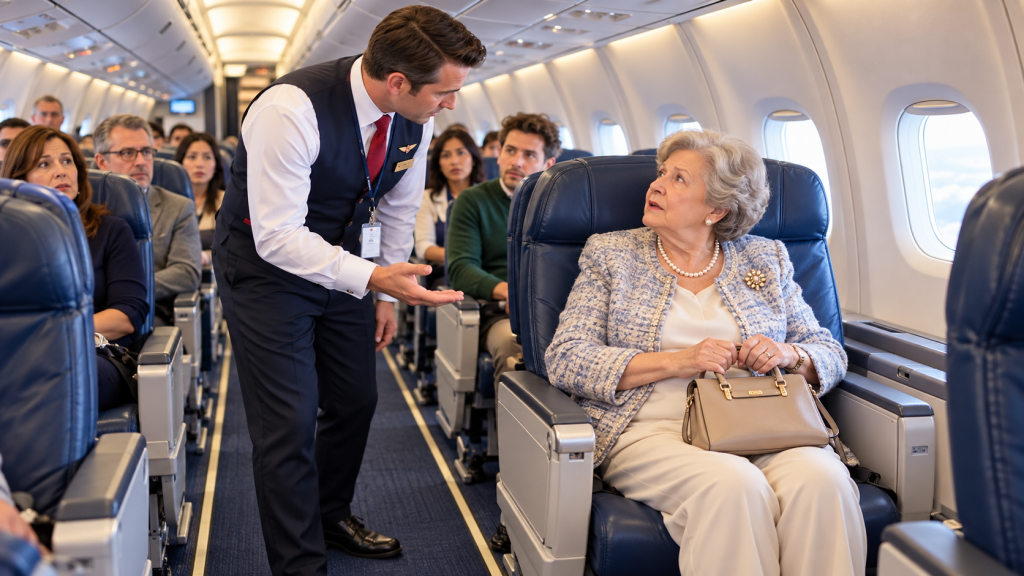
Her hands were trembling. “Mrs. Walsh,” the captain said gently, “I believe this belongs to you.” I stood in the aisle, unable to speak. Around us, passengers had begun noticing the unusual scene. A woman across the aisle lowered her book. A young man removed his headphones.
The flight attendant, whose name was Melissa, stood a few steps away, giving Grandma space.
Captain Reyes glanced toward the front of the aircraft.
“We have another pilot at the controls,” he explained quietly. “I can stay for a few minutes if you’d like.”
Grandma looked up.
“Your mother kept this all those years?”
His expression softened.
“Yes, ma’am.”
“Why?”
Daniel swallowed.
“Because she promised your husband she would find you.”
A tear slid down Grandma’s cheek.
Then she reached for the envelope.
Her fingers brushed the handwriting.
Mrs. Eleanor Walsh.
Below her name, in Grandpa’s unmistakable slanting letters, were four words.
For the next sunrise.
Grandma made a sound I had never heard before.
Not quite a sob.
Not quite a laugh.
Something that seemed to come from a place deeper than either.
“Oh, Tommy,” she whispered.
She pressed the envelope against her chest.
And suddenly, the expensive first-class seat I’d purchased seemed like the least important thing in the world.
I knelt beside her.
“Grandma?”
She turned toward me.
Her blue eyes were shining.
“Claire, sweetheart, could you sit with me?”
I looked toward the empty middle seat beside her.
The passenger assigned there, a kind woman traveling to visit her daughter, immediately stood.
“Please,” she said. “Take my place for a while.”
I thanked her.
Then I sat beside Grandma.
Captain Reyes remained nearby.
Grandma looked at the envelope again.
“Would you mind if I opened it now?”
Daniel shook his head.
“Not at all.”
She carefully slipped one finger beneath the old flap.
The adhesive had grown brittle with age.
Inside were two folded sheets of paper.
One held a letter.
The other was a photograph.
Grandma looked at the photograph first.
I leaned closer.
It showed Grandpa standing beside a small airplane, wearing a leather jacket and a smile that seemed almost too big for his face.
His dark hair was blowing across his forehead.
Beside him stood a teenage boy.
Seventeen years old, perhaps.
Thin, nervous-looking, with a flight manual tucked beneath one arm.
Grandma’s fingers trembled.
“Daniel?”
The captain nodded.
“That was me.”
I stared at the picture.
The boy looked nothing like the confident captain standing beside us.
And yet the same eyes were there.
The same serious expression.
Grandma smiled through tears.
“Tommy never told me you were so young.”
Daniel laughed softly.
“I was younger than I thought I was.”
Then his expression grew thoughtful.
“Your husband gave me my first real flying lesson. He was the one who convinced me I could become a pilot.”
Grandma looked up.
“And your mother?”
“She worked as a flight attendant. She was assigned to Flight 608 that day.”
Grandma closed her eyes.
For a moment, I thought she was remembering the flight.
Then she whispered, “Isabel.”
Daniel nodded.
“Isabel Reyes.”
Grandma pressed her hand against her mouth.
“Oh, I remember her.”
She looked toward me.
“Claire, your grandfather told me she was the kindest woman on that airplane.”
Daniel’s eyes filled.
“She said the same thing about him.”
For a few seconds, all three of us sat quietly.
Then Grandma unfolded the letter.
And began to read.
My darling Ellie,
If you’re holding this letter, then somebody has finally managed to deliver what I was too frightened to say while looking into your beautiful eyes.
Grandma stopped.
Her mouth trembled.
I reached for her hand.
She squeezed it.
Then continued reading silently, while Daniel respectfully stepped back.
Her eyes moved slowly across the page.
After a moment, she looked at me.
“Claire, I don’t think I can read this by myself.”
“Would you like me to?”
She nodded.
I took the paper carefully.
It smelled faintly of old stationery and the leather purse she’d carried for decades.
I began.
“I know you’ve noticed how tired I’ve become. I know you see me resting after walking upstairs and holding on to the kitchen counter when I think you’re not looking.”
My throat tightened.
Grandpa had died of cancer.
I’d been six when he passed away.
I remembered his warm hands, his deep laugh, and the peppermint candies he always kept in his coat pockets.
But I hadn’t known how sick he’d been before the final weeks.
“The doctors have told me things I don’t know how to tell you yet. I keep thinking that if I find the right words, I can somehow make the news less frightening.”
Grandma closed her eyes.
I continued.
“But there are no gentle words for a future I may not get to share with you.”
A tear fell onto the paper.
I wiped it away quickly.
“Ellie, I have spent forty-three years loving you. I have watched you become a mother, a grandmother, and the strongest person I’ve ever known. Yet I still remember you as the girl who refused to dance with me at the county fair because you said my shoes were ugly.”
Grandma let out a broken laugh.
“They were,” she whispered.
Daniel smiled.
I looked down again.
“I know you are afraid of flying. I know you pretend otherwise because you don’t want me to worry. That’s why I asked you to sit beside the window in 34A.”
Grandma touched the seat beneath her.
“I wanted you to see the sunrise over the clouds. I wanted you to understand that there is beauty waiting beyond the things that frighten us.”
The cabin seemed to grow quieter.
“If I am no longer beside you someday, I don’t want you to spend the rest of your life sitting inside our house, keeping the curtains closed because you think loving me means refusing to enjoy the world without me.”
Grandma began crying.
I paused.
She shook her head.
“Keep going.”
I swallowed.
“Travel. Visit California again. See the ocean. Eat food you’ve never tasted. Laugh at terrible jokes. Spend money on something wonderfully unnecessary. Let our grandchildren take you places.”
I looked at her.
She was holding the armrest tightly.
“And if you ever find yourself on an airplane again, choose a window seat. Look out at the clouds. Let the sunrise remind you that the world is still beautiful, even when someone you love is no longer there to see it with you.”
My voice broke.
At the bottom, Grandpa had written:
“When you reach the clouds, Ellie, don’t look for me behind you. Look at the beautiful life still waiting ahead.”
I stopped reading.
Grandma covered her face.
For a long time, she cried quietly.
I put my arm around her.
And there, in an economy seat she’d chosen over the expensive first-class experience I thought she deserved, I finally began to understand.
Grandma hadn’t wanted luxury.
She’d wanted to return to a moment when Grandpa was still alive.
A moment when they had sat together above the clouds, believing there would be many more sunrises.
But the letter wasn’t the only surprise waiting inside the envelope.
On the second sheet, Grandpa had written something about Daniel Reyes.
Something that would change how I understood my grandfather’s final months.
Grandma wiped her eyes as I unfolded the second page.
The handwriting was less steady.
Some of the letters leaned into one another, and there were places where Grandpa had stopped writing and begun again.
I wondered whether his hands had been trembling.
Whether he’d been frightened.
Whether he’d known that these might be among the last words Grandma would ever receive from him.
I took a breath.
“Ellie, there’s something I never told you about the young man sitting near us on Flight 608.”
Daniel looked up.
“You remember Daniel Reyes. Seventeen years old, carrying a flight manual like a Bible and trying so hard not to look frightened.”
The captain laughed through tears.
“I was terrified.”
Grandma smiled faintly.
I continued.
“I told you he reminded me of myself when I first learned to fly. That was true. But there was something else.”
The paper trembled between my fingers.
“A few days before we boarded that airplane, I received the news that my illness was much more serious than I’d hoped. For the first time in my life, I felt useless. I had spent decades teaching people how to fly, and suddenly I could barely imagine getting through another month.”
Grandma closed her eyes.
“Then Daniel called me. He was worried about his scholarship interview. He said he wasn’t sure he was good enough to become a pilot.”
I glanced toward the captain.
His expression had changed.
He was no longer smiling.
“I told him to meet me at the airfield. We spent the afternoon going through procedures, looking at weather charts, and talking about his future.”
I swallowed.
“When he left, he thanked me for believing in him. He couldn’t have known that he’d given me something I desperately needed: a reason to look forward instead of counting the days I might have left.”
Daniel covered his mouth.
“Ellie, I helped that boy because I believed in his dream. But the truth is, he helped me too.”
My voice cracked.
“He reminded me that the worth of a life isn’t measured only by how long it lasts. Sometimes it is measured by what we leave growing in other people.”
Grandma reached for the paper.
I gave it to her.
She read the final paragraph herself, her voice barely audible.
“If Daniel becomes a pilot, tell him I am proud of him. And if he ever wonders whether teaching one frightened boy to believe in himself was worth the trouble, tell him it was one of the finest things I did during my final year.”
She stopped.
Then whispered the last sentence.
“The world is too wide, Ellie, for either of us to spend what time we have left being afraid to live.”
Grandma lowered the page.
Captain Reyes stood motionless.
For a moment, his uniform seemed to belong to someone else.
He wasn’t a respected airline captain.
He was the nervous seventeen-year-old in the photograph, discovering that the man who encouraged him had been fighting a private battle.
“I never knew,” he whispered.
Grandma reached for his hand.
“Neither did I.”
His eyes filled.
“He never told me he was that sick.”
“He didn’t want people to worry,” she answered.
Then she gave a sad little smile.
“Tommy was stubborn that way.”
Daniel laughed through tears.
“So was my mother.”
For a moment, Grandma held his hand.
Then she said something I would remember for the rest of my life.
“Daniel, my husband thought he was helping you become a pilot.”
She looked at the silver wings on her purse.
“But maybe you were helping him remain himself.”
The captain lowered his head.
And I realized that the letter had not simply traveled twenty-seven years to reach Grandma.
It had also been waiting twenty-seven years to tell Daniel something he never knew.
When the captain returned toward the cockpit, Melissa stayed beside us.
She offered Grandma a glass of water and a tissue.
Then she asked whether we would prefer some privacy.
Grandma shook her head.
“I’m quite all right, dear.”
I looked at her.
She wasn’t all right.
Not in the ordinary sense.
Her cheeks were wet.
Her fingers were trembling.
And she had just received a message from a husband she’d buried almost three decades earlier.
But something in her expression had changed.
The worry I’d noticed when she boarded the plane was fading.
In its place was a kind of wonder.
I sat beside her.
“Grandma, why didn’t you tell me about Seat 34A?”
She looked at the window.
For a long moment, she didn’t answer.
Then she smiled.
“Because you would’ve tried to fix it.”
I frowned.
“Fix what?”
“My sadness.”
The words struck me.
Grandma turned toward me.
“Claire, you’ve been trying to make this birthday perfect since January.”
I looked down.
“I just wanted you to be comfortable.”
“I know, sweetheart.”
She touched my cheek.
“And I loved you for it.”
Then she glanced toward the front of the aircraft.
“But you thought comfort meant the biggest seat, the nicest meal, and someone bringing me warm towels.”
I felt embarrassed.
“Was that wrong?”
“No.”
She smiled.
“It was generous.”
Then her expression softened.
“But sometimes comfort is being exactly where your heart needs to be.”
I looked at the old boarding pass.
Seat 34A.
The same number, printed on paper twenty-seven years old.
Grandma continued.
“Your grandfather asked me to sit beside the window on that last flight because I was terrified of airplanes.”
I nodded.
“I remember you telling me you didn’t like flying.”
She laughed softly.
“That’s putting it kindly.”
Then she looked toward the clouds.
“I’d always been frightened of heights. When we boarded Flight 608, I wanted to turn around and go home.”
“What did Grandpa say?”
Her eyes filled.
“He took my hand and said, ‘Ellie, I can’t promise the sky will never frighten you. But I can promise you won’t have to be frightened alone.'”
I swallowed.
Grandma touched the armrest.
“Then he sat beside me.”
She paused.
“During the electrical problem, some of the cabin lights went out. The crew explained that the pilots were managing the situation and preparing to divert.”
Her voice grew quieter.
“People were frightened. A child started crying. Someone across the aisle began praying.”
I stared at her.
“Grandpa stayed calm?”
She smiled.
“Not because he wasn’t concerned. He knew enough about airplanes to take the situation seriously.”
She looked toward the photograph.
“But he also knew people were watching him. He explained what he could, encouraged everyone to follow the crew’s instructions, and kept telling me to breathe.”
A tear slipped down her cheek.
“Even while he was sick, he was thinking about how to help.”
I reached for her hand.
“What happened after the plane landed?”
“We were checked over, waited at the airport, and continued our trip on another flight. Your grandfather spent most of the delay speaking with Daniel.”
She smiled.
“He said the boy needed encouragement more than the passengers needed someone to discuss the mechanical problem.”
I glanced toward the cockpit.
Then back at Grandma.
“Did you know Grandpa had written this letter?”
She shook her head.
“Not then.”
“Did he tell you about his diagnosis?”
“Eventually.”
Her expression grew sad.
“Only after we returned home. By then, he couldn’t hide how much he was struggling.”
I swallowed.
“Why didn’t he tell you sooner?”
Grandma was quiet.
Then she answered honestly.
“Because he was frightened.”
She looked at me.
“And because sometimes people think keeping pain to themselves is the same thing as protecting the people they love.”
I nodded.
“Was it?”
“No.”
Her answer was immediate.
I stared.
Grandma continued.
“I would’ve wanted to know. I would’ve wanted every day we had left, even the difficult ones.”
She touched the letter.
“But I also understand that Tommy was a frightened man trying to find the courage to say goodbye.”
I leaned against her shoulder.
She kissed my hair.
“Love isn’t always perfect, Claire. Even beautiful love can contain mistakes.”
For a moment, neither of us spoke.
Then Grandma smiled sadly.
“But what matters is what we choose to do with the truth once we have it.”
About an hour before landing, Daniel returned to our row during a quiet period in the flight.
He had arranged for the other pilot to remain at the controls.
This time, he carried a small notebook.
“Mrs. Walsh,” he said, “would you mind if I told you something about my mother?”
Grandma looked up.
“Of course.”
Daniel sat briefly in the available aisle seat.
“My mother kept your husband’s envelope in a wooden box.”
He smiled faintly.
“The box was full of things she considered important. Photographs, letters, an old watch that belonged to my grandfather, and the wings she received when she completed her flight attendant training.”
Grandma nodded.
“She must have been very proud of those.”
“She was.”
Daniel’s eyes filled.
“She worked in aviation for thirty-eight years. She retired only when her health made the traveling difficult.”
He looked at the envelope in Grandma’s lap.
“When she died last month, I found the letter among her belongings.”
I swallowed.
“Why didn’t she send it before?”
Daniel took a breath.
“She tried.”
He opened the notebook.
“She wrote down the address she had for you from the old flight records. The letter was returned. Later, she contacted the airline’s former customer service office, but the records were incomplete.”
Grandma nodded slowly.
“We moved after Tommy died.”
“That’s what she suspected.”
Daniel continued.
“She also asked a few former colleagues whether they knew how to reach you. But she didn’t have enough information to find the right Eleanor Walsh.”
I looked at Grandma.
She’d moved from the house where she and Grandpa raised their family into a smaller home after he died.
I hadn’t realized how that ordinary decision could have closed the trail of someone trying to reach her.
Daniel turned another page.
“There’s something else.”
Grandma looked up.
“My mother kept a photograph of your husband on her bedside table during her final illness.”
I stared.
“Why?”
Daniel smiled sadly.
“Because when I became a pilot, she said she wanted to remember the people who helped make it possible.”
Grandma covered her mouth.
He continued.
“I was supposed to be on the other side of the country today.”
I frowned.
“What?”
“My original roster had me flying a different route. I exchanged assignments with another captain two weeks ago because I needed to attend to some family matters in California.”
He looked toward the window.
“And this morning, before boarding, Melissa mentioned that an elderly passenger had moved herself into Seat 34A.”
I sat straighter.
“Why would that make you curious?”
Daniel smiled faintly.
“Because she said the passenger was celebrating her eightieth birthday, had asked specifically for the window seat, and was carrying an old pair of silver pilot wings.”
Grandma touched her purse.
“She noticed them?”
“She did.”
Daniel nodded toward Melissa, who was helping a passenger farther down the aisle.
“She asked whether they belonged to a pilot in your family. You told her they had belonged to your late husband.”
Grandma remembered.
“Oh, yes.”
Daniel continued.
“Melissa mentioned your name while asking whether I knew of any aviation history connected with it.”
I stared.
“Weren’t you surprised?”
“Very.”
He smiled sadly.
“Walsh isn’t an unusual surname. But an Eleanor Walsh with old pilot wings, requesting Seat 34A, on the very route where I was carrying a letter addressed to Eleanor Walsh…”
His voice broke.
“I couldn’t ignore it.”
I looked at the envelope.
“You had it with you?”
Daniel nodded.
“I’d brought it because I planned to speak with someone in California who’d helped my mother search for you. I wanted to follow up on the old records.”
He gave a small, disbelieving laugh.
“Instead, you came aboard my airplane.”
Grandma began crying again.
Daniel reached for her hand.
“I’ve spent my career believing that good flying depends on preparation, attention, and never relying on luck.”
He smiled.
“But I don’t have a better explanation for this coincidence.”
Grandma looked at him.
Then whispered, “Maybe some promises take a very long time to find their way home.”
Daniel nodded.
And for a moment, the cabin seemed to hold something larger than three people and an old letter.
It held a promise made by a dying man.
A promise guarded by a faithful friend.
And a woman who had finally returned to the place where she’d last watched the sunrise beside her husband.
When we landed in California, I expected Grandma to be exhausted.
She had spent much of the flight crying.
She’d read Grandpa’s letter so many times that I worried the old paper might tear along its folds.
But as the airplane taxied toward the terminal, she pressed her hand against the window and smiled.
“Look, Claire.”
I leaned closer.
Outside, the California sky was turning a soft shade of gold.
“What is it, Grandma?”
“The mountains.”
I followed her gaze.
Far beyond the runway, distant peaks rose against the horizon.
She stared at them like someone seeing an old friend.
“Your grandfather loved that view.”
I smiled.
“You remember?”
She laughed gently.
“Sweetheart, there are things I can’t remember from last Thursday. But I can tell you exactly what your grandfather said the first time he saw those mountains.”
“What did he say?”
She turned toward me.
“He said, ‘Ellie, would you look at that? Somebody forgot to tell the world it was supposed to be ordinary.'”
I laughed.
It sounded exactly like Grandpa.
When the aircraft reached the gate, Daniel made a final announcement, thanking the passengers for flying.
Then, after the seat-belt sign went off, he returned briefly to the cabin.
He approached Grandma.
“Mrs. Walsh, would you mind waiting a moment before leaving?”
She looked startled.
“Have I done something wrong?”
He laughed.
“Not at all.”
He glanced toward me.
“I’ve got something I’d like to show you.”
We gathered our belongings and waited until most of the passengers had disembarked.
Then Daniel led us toward the front of the aircraft, where Melissa stood with a small paper bag.
Inside was a photograph.
It showed Daniel in uniform, standing beside an airplane on the day he completed his first commercial flight as a captain.
He was smiling proudly.
Pinned to his shirt were silver wings.
On the back of the photograph, he’d written:
For Thomas Walsh, who taught me that the sky belongs to those brave enough to reach for it.
Grandma stared.
“When did you take this?”
“Sixteen years ago.”
She looked up.
“Why did you write that?”
Daniel’s voice softened.
“Because I wanted to send it to your husband before I knew he’d passed away. My mother suggested I keep it until we found you.”
Grandma pressed her hand against her mouth.
He continued.
“I’ve kept a copy in my study ever since.”
I looked at him.
“Captain Reyes, how many people have you helped become pilots?”
He seemed surprised.
“I couldn’t tell you exactly.”
“Try.”
He laughed softly.
“Well, I started volunteering with an aviation mentoring program about fifteen years ago. I’ve worked with quite a few students.”
Grandma looked up.
“Why?”
Daniel glanced toward the faded photograph of his seventeen-year-old self.
Then he answered.
“Because someone once believed in me before I believed in myself.”
My eyes filled.
He continued.
“Your grandfather never asked me to repay him. But he made me understand that helping someone reach a dream can change more than one life.”
Grandma took a breath.
Then she reached for the little silver wings on her purse.
She unclipped them carefully.
I stared.
“Grandma?”
She held them toward Daniel.
For a moment, he didn’t move.
“Mrs. Walsh, I couldn’t possibly—”
She shook her head.
“These belonged to Tommy. He wore them for years.”
Daniel looked at the wings.
“They should stay with your family.”
Grandma smiled.
“They are staying with my family.”
He stared at her.
She continued.
“Not because we’re related by blood, Daniel. But because my husband loved teaching you, and you’ve kept sharing what he taught.”
Tears filled the captain’s eyes.
He hesitated.
Then gently closed her fingers around the pin.
“May I make a suggestion?”
Grandma nodded.
“Keep them for now. And if you’re willing, I’d love to help you arrange for them to be displayed at the aviation training center where I mentor students.”
She looked surprised.
“Would they really want them?”
Daniel smiled.
“With the story behind them? Absolutely.”
Grandma touched the wings.
Then nodded.
“I think Tommy would like that.”
We spent our first evening in California at a little hotel overlooking the ocean.
I had chosen it because the rooms had balconies and Grandma loved the sound of waves.
After dinner, she asked whether we could sit outside for a while.
I brought two blankets.
We settled into wooden chairs facing the darkening water.
For several minutes, neither of us spoke.
Then Grandma opened her purse.
I smiled.
“More secrets?”
She laughed.
“Perhaps one.”
She reached inside and removed a small envelope tied with a faded blue ribbon.
It was much thicker than Grandpa’s letter.
I watched as she placed it on her lap.
“What’s that?”
She smiled sadly.
“Letters.”
I frowned.
“From Grandpa?”
She shook her head.
“To him.”
I stared.
Grandma untied the ribbon.
Inside were dozens of folded pages.
Some were written on stationery.
Others on notebook paper.
One was scribbled on the back of a grocery receipt.
She touched them gently.
“I started writing to Tommy after he died.”
My throat tightened.
“How often?”
“Whenever something happened that I wanted to tell him.”
She smiled.
“At first, nearly every day.”
I looked at the stack.
“All these years?”
She nodded.
I reached toward one page.
“May I?”
She handed it to me.
The date was from twenty-three years earlier.
I recognized the subject immediately.
It was the year I started kindergarten.
Grandma had written:
Tommy, Claire went to school today wearing her little red shoes. She insisted on carrying her backpack herself. You would’ve laughed to see how important she looked.
I began crying.
Another letter described the day I learned to ride a bicycle.
One mentioned my high school graduation.
Another was written after my first serious heartbreak.
I stared at Grandma.
“You told him about me?”
She smiled.
“Of course.”
“All this time?”
She nodded.
“Sweetheart, your grandfather adored you.”
I pressed a letter against my chest.
For years, I’d thought of Grandpa as a kind man whose face was slowly fading from my memory.
Now I discovered that Grandma had been carrying him through every milestone of my life.
Not as a ghost she couldn’t release.
But as someone whose love still shaped the way she saw the world.
I looked at the envelopes.
“Why didn’t you tell me?”
She thought for a moment.
“Because they were conversations I needed to have.”
I nodded.
Then she added something that surprised me.
“But lately, I’ve been writing less.”
I frowned.
“Why?”
She looked toward the ocean.
“At first, I was afraid that meant I was forgetting him.”
Her voice softened.
“Then I realized I was simply learning how to live again.”
I reached for her hand.
Grandma smiled through tears.
“And today, sitting in 34A, I think I finally understood what Tommy wanted.”
I looked at the letter on her lap.
“What?”
She gazed toward the distant lights moving along the shoreline.
“He never wanted to become the place where my life stopped.”
For a moment, the only sound was the ocean.
Then Grandma took Grandpa’s letter and placed it beside her own.
“Tomorrow,” she said, “I want to do something.”
I smiled.
“Anything.”
She turned toward me.
“I want to go to the beach where Tommy and I walked on our last trip.”
I nodded.
“Of course.”
She hesitated.
“And Claire?”
“Yes?”
“I want us to take a photograph.”
I smiled.
“Of the two of us?”
She nodded.
“Right where he stood.”
Her eyes filled.
“But this time, I don’t want to spend the whole day crying about who isn’t there.”
She squeezed my hand.
“I want to remember who still is.”
The next morning, Grandma woke me before sunrise.
I opened my eyes to find her standing beside the bed, already dressed.
She wore a pale blue blouse, comfortable trousers, and a white cardigan.
Her silver hair was neatly brushed.
And the little wings were pinned to her purse again.
“Grandma,” I groaned, “it’s barely five.”
She smiled.
“Your grandfather always said the best things happen before everybody else wakes up.”
I sat up.
“You hated when he said that.”
She laughed.
“I still do.”
Then she pulled back the curtains.
Beyond the balcony, the ocean was dark and endless.
A thin line of orange light was beginning to appear along the horizon.
I got dressed.
And together, we drove to the beach.
The shoreline was almost empty.
A few people walked dogs along the sand.
An elderly couple sat on a bench holding hands.
Seabirds moved across the water.
Grandma asked me to help her down the steps.
She walked slowly, leaning on my arm.
When we reached the sand, she stopped.
For a moment, she seemed unable to move.
“Grandma?”
She looked toward the ocean.
“This is it.”
I glanced around.
“The same beach?”
She nodded.
“Your grandfather and I came here the morning after Flight 608.”
Her eyes filled.
“He was already tired. I thought it was from the journey.”
She smiled sadly.
“He insisted we come before breakfast because he wanted to watch the sun touch the water.”
I took her hand.
“What happened?”
She looked down.
“We sat right over there.”
She pointed toward a weathered wooden bench near the dunes.
“And he told me he wanted to spend the next ten years traveling with me.”
My throat tightened.
Grandma continued.
“He said we’d visit all the places we’d postponed while raising our family.”
She swallowed.
“France. Italy. The Grand Canyon. Little towns where nobody knew our names.”
I nodded.
Then Grandma whispered, “He died six weeks later.”
The wind moved through her hair.
For a long time, neither of us spoke.
Then she turned toward me.
“I was angry with him, Claire.”
I looked up.
“Grandpa?”
She nodded.
“I was angry that he’d made promises he couldn’t keep. Angry that he hadn’t told me how sick he was. Angry that he left me with a whole future I didn’t know how to live.”
Tears slipped down her cheeks.
“And then I felt guilty for being angry.”
I put my arms around her.
She leaned against me.
“People think grief is only sadness,” she whispered. “Sometimes it’s anger. Sometimes it’s fear. Sometimes it’s feeling guilty because you’ve had a beautiful day without the person you miss.”
I nodded.
She took a breath.
“For twenty-seven years, I thought getting on another airplane would mean leaving Tommy behind.”
She touched the silver wings.
“But he was telling me the opposite all along.”
I smiled through tears.
“He wanted you to keep going.”
She nodded.
Then looked toward the sunrise.
“Yes.”
A moment later, she surprised me.
“Claire, would you take my picture?”
I laughed softly.
“Right here?”
She nodded.
“With the ocean behind me.”
I took out my phone.
Grandma straightened her cardigan.
Held her little leather purse.
And smiled.
Not the polite smile she wore for family pictures.
A real one.
The kind that reached her eyes.
I took the photograph.
Then she gestured for me to stand beside her.
“Now both of us.”
I asked a passing woman to take our picture.
Grandma wrapped one arm around my waist.
I leaned against her.
And together, we smiled into the morning light.
Later, when I looked at the photograph, I noticed something I’d missed.
Grandma was holding Grandpa’s old boarding pass in one hand.
Not tightly.
Not as though she was afraid of losing it.
Simply holding it.
A memory she could carry without allowing it to stop her from moving forward.
Before we returned home, Captain Reyes invited us to visit the aviation training center where he volunteered.
Grandma agreed.
A week later, we entered a building filled with photographs of airplanes, maps, training equipment, and young people studying flight procedures.
Daniel welcomed us at the door.
He introduced Grandma to several students.
One young woman told us she’d grown up in a family that couldn’t afford flying lessons.
Another said she was the first person in her family to attend college.
A young man explained that he’d nearly abandoned his dream until a mentor helped him understand the application process for a scholarship.
Grandma listened carefully.
Then Daniel showed us a small display he’d prepared with the center’s permission.
It contained a copy of the photograph from his teenage years.
A short account of Grandpa’s work as a flight instructor.
And a space for the original silver wings, should Grandma choose to lend them to the center.
Beneath the photograph was a sentence.
THOMAS WALSH — HE BELIEVED IN TOMORROW, EVEN WHEN HIS OWN TOMORROWS WERE FEW.
Grandma began crying.
Daniel stood beside her.
“I wanted the students to know what he did for me.”
She looked at the display.
Then at him.
“Tommy would’ve been embarrassed by all this attention.”
Daniel laughed.
“I know.”
She smiled through tears.
“But he would’ve loved knowing you’re helping these young people.”
Daniel nodded.
“That’s what matters.”
Grandma carefully unclipped the wings from her purse.
This time, she placed them in Daniel’s hand.
“Then let them inspire somebody else.”
He accepted them gently.
“I’ll make sure they’re cared for.”
She squeezed his fingers.
“And Daniel?”
“Yes, ma’am?”
“When one of these students becomes a captain, tell them to help someone else.”
He smiled through tears.
“I will.”
And there, surrounded by young people looking toward futures they could barely imagine, I finally understood what Grandpa’s life had meant.
He hadn’t left behind a fortune.
He hadn’t built a famous company.
He hadn’t become a household name.
But he’d helped a frightened seventeen-year-old believe he could fly.
That boy had grown into a man who taught others.
And now Grandpa’s kindness was reaching people he’d never had the chance to meet.
When Grandma and I returned home, she made one change that surprised the entire family.
She renewed her passport.
Then she asked me to help her plan another trip.
“Where do you want to go?” I asked.
She thought for a moment.
“Somewhere I’ve never been.”
I laughed.
“Grandma, that covers quite a few places.”
She grinned.
“Then we’d better get started.”
We began with a short trip the following spring.
Nothing extravagant.
Just a few days in a city she’d always wanted to visit.
She took photographs.
Tried unfamiliar food.
Bought a bright red scarf she said Grandpa would’ve called ridiculous.
And laughed more than I’d heard her laugh in years.
Sometimes she still cried when she spoke about him.
Sometimes she sat quietly beside a window, looking at the clouds.
But I no longer rushed to distract her.
I had learned that grief didn’t always need fixing.
Sometimes it simply needed someone willing to sit beside it.
And sometimes, after enough quiet moments, it made room for joy.
On Grandma’s eighty-first birthday, I gave her a small photo album.
The first page showed Grandpa standing beside his airplane.
The second showed Grandma sitting in Seat 34A, holding his old letter.
The third showed us standing together on the California beach at sunrise.
And the final page showed a group of young aviation students smiling beneath the display honoring Thomas Walsh.
Grandma turned the pages slowly.
Then she looked at me.
“Claire, do you remember being upset when I gave up that first-class seat?”
I laughed.
“Very upset.”
She smiled.
“You wanted everything to be perfect.”
“I did.”
She closed the album.
Then took my hand.
“Sweetheart, it was perfect.”
I looked at her.
“Even in economy?”
She laughed.
“Especially in economy.”
Then her expression softened.
“You gave me more than a birthday trip.”
My eyes filled.
“You gave me the courage to get on that airplane.”
She touched the photograph of Seat 34A.
“And once I was there, I found something I didn’t even know I was still waiting for.”
I smiled.
“Grandpa’s letter?”
She nodded.
“Yes.”
Then she looked toward the window.
“But also permission to stop being afraid of living without him.”
For a moment, neither of us spoke.
Then Grandma leaned closer.
“Do you know what Tommy would’ve said if he’d seen us crying over that old letter?”
I shook my head.
She grinned.
“He would’ve told us to dry our eyes, look out the window, and stop wasting a perfectly good sunrise.”
I burst out laughing.
So did she.
And for a moment, I could almost hear Grandpa laughing with us.
I still think about that flight.
About how irritated I felt when Grandma handed me the economy boarding pass.
I’d believed the first-class seat was a gift of comfort.
A way of thanking her for eighty years of love, sacrifice, and strength.
But Grandma had understood something I hadn’t.
The most precious places in our lives aren’t always the most expensive ones.
Sometimes they’re ordinary places made extraordinary by the people who shared them with us.
An old kitchen chair.
A garden bench.
A seat beside a hospital bed.
Or a window seat near the back of an airplane.
For twenty-seven years, Seat 34A had lived in Grandma’s memory as the place where she last watched the sky beside the man she loved.
Then, on her eightieth birthday, it became something more.
The place where she received his final words.
The place where she discovered that the kindness he had given a frightened young student was still changing lives.
And the place where she finally understood that continuing to live wasn’t the same as leaving him behind.
Because love isn’t measured by how long we remain trapped in sorrow after someone dies. It is measured by how beautifully we carry what they taught us into the days they couldn’t share.
Grandma never regretted giving up her first-class seat.
And I never again asked why she’d chosen economy.
Because I finally understood.
She hadn’t gone back to Seat 34A to find the husband she’d lost. She went there to find the part of herself that had stopped living when he died.
And when she looked out at the clouds, she discovered that the world was still waiting for her.
Just as Grandpa had promised.
THE END STORIES! THANK YOU FOR READING GOOD LUCK !❤️
Related Posts