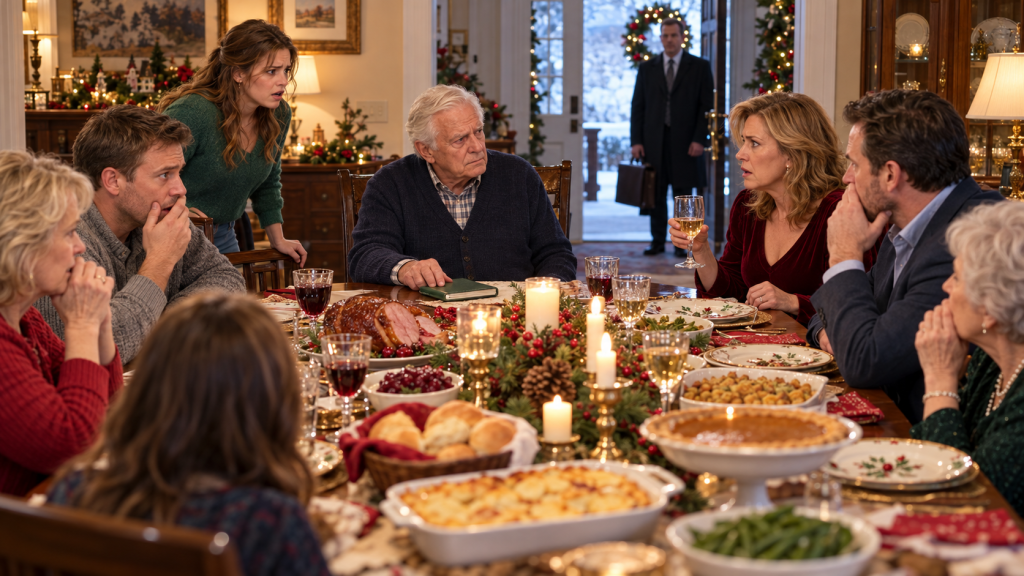
Aunt Linda reached across the Christmas table as though she could physically stop the words from leaving Mr. Dawson’s mouth. “Please,” she whispered. “You don’t understand what that letter will do.” Grandpa didn’t move. His name was Walter Bennett, and for seventy-eight years, he’d lived by a simple rule: if a person had something important to say, you let them finish.
He looked at his oldest daughter, then at the attorney standing beside Grandma’s empty chair. “Read it, Henry.” Mr. Dawson unfolded the letter. The paper was pale blue, the kind Grandma Evelyn used for birthday notes and handwritten recipes. I recognized her handwriting before he spoke.
Those slightly slanted letters. The long loops on her capital E. The careful way she dotted every i, even when her hands began trembling during her final months. My throat tightened. Eight months had passed since we’d buried her beneath the oak tree at Willow Creek Cemetery.
And suddenly, her words were about to fill the farmhouse again.
Mr. Dawson began.
“My dear Walter, if this letter is being read at our family table, then something I feared has finally happened.”
Aunt Linda covered her mouth.
“I have spent fifty-four years loving this family. I have baked birthday cakes, mended school uniforms, held frightened grandchildren, and prayed beside hospital beds. I have loved each of you in ways you may never fully understand.”
My eyes blurred.
I could almost hear Grandma’s voice.
“But love has taught me something painful. There are people who become so accustomed to receiving that they forget the person giving has a heart.”
Grandpa lowered his eyes.
“Last February, Linda came to the house with documents concerning the south parcel of our farm. She told me Walter was becoming incapable of managing his affairs and that selling the land would protect him from future expenses.”
Linda shook her head.
“Mom misunderstood.”
Grandpa raised one finger.
She fell silent.
Mr. Dawson continued.
“I asked whether Walter had agreed. Linda said he would once we helped him understand what was best.”
A terrible stillness settled over the table.
“I told her that losing some of his hearing did not mean losing his judgment. I refused to support the sale.”
Across from me, Uncle Gary stared at his plate.
Brett’s wineglass remained untouched.
“Three weeks later, I found a draft statement among the papers Linda had left behind. It described Walter as confused, forgetful, and incapable of making financial decisions. My name had been typed beneath an endorsement I had never agreed to give.”
Aunt Linda began crying.
“Dad, please.”
Grandpa’s face didn’t change.
Mr. Dawson read on.
“I fear that after I am gone, the people Walter loves most may try to turn his age into a reason to take away his choices.”
My tears slipped onto my napkin.
“If that happens, I ask only that you remember something: Walter Bennett is not a farm waiting to be inherited. He is a living man who built a life, raised children, buried friends, survived hardship, and still deserves to decide what happens tomorrow.”
The silence was unbearable.
Then Mr. Dawson reached the final paragraph.
“And Katie, my precious granddaughter, if you are sitting beside him when this letter is opened, I want you to know that your grandfather and I have noticed the kindness you give when nobody is watching. We are not leaving you the burden of fixing everyone. We are leaving you something harder: permission to tell the truth, even when the people you love do not want to hear it.”
I pressed both hands against my face.
Grandpa reached for me.
His fingers were warm.
Steady.
Still strong from a lifetime of work.
Mr. Dawson lowered the letter.
Nobody spoke.
Twenty-two people sat around a table decorated with candles, pine branches, and Grandma’s red Christmas napkins.
Some looked ashamed.
Some looked confused.
And some seemed to be calculating how much trouble they were in.
Finally, Aunt Linda stood.
“I was trying to protect Dad.”
Grandpa looked up.
“From what, Linda?”
She swallowed.
“From making a mistake.”
He nodded slowly.
“Which mistake?”
She glanced at Gary.
Then back at Grandpa.
“Keeping land you don’t need anymore.”
Grandpa stared at her.
For a long moment, I thought he might shout.
Instead, he asked a question so quietly that everyone leaned forward.
“Linda, when did you decide I no longer needed my own life?”
Her face crumpled.
“Daddy, that’s not fair.”
He shook his head.
“No. What wasn’t fair was sitting beside my wife’s bed while she was dying and hearing you discuss how quickly the south field could be sold after her funeral.”
Linda lowered her head.
My stomach twisted.
Grandpa continued.
“Your mother could barely lift a glass of water. Yet you came into her room talking about property values.”
“I was worried about expenses!”
Grandpa nodded toward Mr. Dawson.
“Henry has our financial records. You know I can afford my care.”
Gary finally spoke.
“Dad, nobody said you couldn’t.”
Grandpa turned toward him.
“Then why did you tell Linda I wouldn’t last the winter?”
Gary’s mouth opened.
Closed.
Grandpa looked around the table.
“I didn’t invite Henry here to humiliate anyone.”
He paused.
“I invited him because some of you have mistaken my silence for permission.”
Then he placed his hand on the green notebook.
“And that ends tonight.”
The first person to leave the table was not Linda.
It was my fourteen-year-old cousin, Emily.
She stood so quickly her chair scraped against the floor.
Her mother, Aunt Carol, reached for her.
“Emily?”
But Emily wasn’t looking at her mother.
She was staring at Brett.
“Did you really call Grandpa a vegetable?”
Brett gave an uncomfortable laugh.
“Em, come on. Adults say stupid things.”
Emily’s eyes filled.
“That isn’t a stupid thing. That’s cruel.”
Brett looked away.
Grandpa watched her silently.
Then Emily walked around the table and stood beside him.
“Grandpa, I’m sorry.”
He frowned gently.
“For what, sweetheart?”
“For laughing when people made jokes about you.”
She began crying.
“I didn’t know you could hear. But I still shouldn’t have laughed.”
Grandpa opened his arms.
Emily leaned down and hugged him.
And something changed in that room.
Not everyone suddenly became good.
Not every apology was sincere.
But Emily had done what the adults had refused to do.
She had stopped defending herself long enough to acknowledge that she’d hurt someone.
Grandpa kissed her forehead.
“Thank you, honey.”
Then he looked toward Brett.
“That’s what an apology sounds like.”
Brett’s face flushed.
He pushed back his chair.
“Well, excuse me for not knowing you were secretly listening to everybody.”
Grandpa’s expression hardened.
“Secretly listening?”
Brett shrugged.
“You let us think you were deaf.”
Grandpa nodded.
“I did.”
He paused.
“But Brett, I didn’t make you say those things.”
Brett looked down.
Grandpa continued.
“You said them because you thought I couldn’t hear you.”
No one answered.
Then my grandmother’s old wall clock began chiming seven.
The same clock Grandpa had repaired every winter for as long as I could remember.
Seven clear notes rang through the farmhouse.
For six years, I’d sat at family dinners watching people speak about Grandpa as though his life had already ended.
Now I was watching them discover that the man they had dismissed was the only person in the room who remembered every word.
Mr. Dawson waited until everyone had settled before opening his briefcase again.
“There are two matters Mr. Bennett has asked me to explain,” he said. “The first concerns the petition filed to have someone appointed to manage his affairs.”
Linda wiped her cheeks.
“That was only a precaution.”
The attorney looked at her.
“The petition alleges that your father cannot understand financial information, make decisions about his property, or manage his personal welfare.”
Grandpa leaned back.
“And yet I was the one who hired Henry.”
A few people shifted uncomfortably.
Mr. Dawson continued.
“The court has not made a finding of incapacity. Mr. Bennett has undergone an independent medical evaluation, and the documentation we have obtained supports his ability to understand and make the decisions at issue. The petition will be addressed through the proper court process.”
Gary frowned.
“So what’s your point?”
“My point,” Mr. Dawson said, “is that hearing loss is not evidence that a person has lost the ability to manage his life.”
Grandpa reached behind his ear and carefully removed one of his tiny hearing aids.
He held it between two fingers.
“This helps me hear.”
Then he touched his forehead.
“This still works.”
Emily smiled through her tears.
Grandpa put the hearing aid back in place.
“Now, the second matter.”
Mr. Dawson produced a document with a blue cover.
Gary sat straighter.
Linda stopped crying.
Brett’s eyes moved immediately toward the title.
WALTER BENNETT — ESTATE AND FARM SUCCESSION PLAN.
Grandpa saw their expressions.
He gave a small, sad smile.
“Funny how quickly everybody starts paying attention when the word estate appears.”
Linda looked wounded.
“Daddy—”
“No, Linda. You can listen for a change.”
Mr. Dawson explained that Grandpa had updated his estate documents after Grandma’s death. He had considered how to protect his care, preserve the farm’s operations, and provide a clear process for whatever happened to the property after his lifetime.
No one would receive immediate control simply because they expected an inheritance.
No one had been promised the right to sell the land.
And Grandpa had not appointed Linda, Gary, or Brett to make those decisions for him.
Gary leaned forward.
“Then who’s getting the farm?”
Grandpa looked at him.
“I’m still using it.”
“Dad, I mean eventually.”
“I know what you mean.”
Grandpa folded his hands.
“That’s the trouble.”
Mr. Dawson continued.
“Mr. Bennett has directed us to explore a long-term stewardship arrangement for the working farm. The plan will provide for his needs first and establish conditions for future ownership and management that reflect his wishes.”
Brett scoffed.
“So you’re giving it to Katie?”
Twenty-one pairs of eyes turned toward me.
My stomach tightened.
Grandpa looked at his grandson.
“Why would you assume that?”
“Because she’s the favorite.”
The words stung.
Not because they were true.
Because Brett had spent years turning my visits into something suspicious.
When I brought Grandpa groceries, I was trying to earn an inheritance.
When I drove him to an appointment, I was trying to impress him.
When I stayed overnight after Grandma died, I was apparently positioning myself to take the farm.
In Brett’s mind, nobody could love Grandpa without expecting payment.
I opened my mouth.
But Grandpa spoke first.
“Katie isn’t getting the farm tonight.”
Brett blinked.
Grandpa looked toward me.
“And she isn’t going to spend the rest of her life managing everyone else’s expectations just because she was kind to her grandparents.”
My eyes filled.
Then he added, “I haven’t asked her to make any promise about the land. I won’t make that decision for her.”
For the first time all evening, I felt something loosen in my chest.
I loved that farm.
I loved the fields and barns, the old farmhouse and the porch swing Grandma had painted every spring.
But love didn’t mean I wanted to be trapped there by twenty other people’s resentment.
Grandpa understood that.
He had always understood more than most people realized.
The next discovery came from a folder Mr. Dawson placed beside the green notebook.
“Mr. Bennett also asked that we review several transactions and proposed transactions involving his property.”
Gary’s expression changed.
“Transactions?”
Grandpa looked at him.
“Yes, Gary. Transactions.”
Mr. Dawson removed a printed advertisement.
Across the top was a photograph of Grandpa’s combine.
Beneath it was an asking price.
$185,000.
I stared.
Gary had joked about selling the combine dozens of times.
I’d always assumed he was simply being cruel.
But this was an actual advertisement.
A prospective buyer had contacted Grandpa’s farm manager, Caleb Ortiz, asking when the equipment could be inspected.
Caleb had immediately notified Grandpa.
Mr. Dawson looked toward Gary.
“The listing identified you as the seller.”
Gary’s face reddened.
“It was only a listing. I didn’t sell anything.”
Grandpa nodded.
“That’s true.”
Gary looked relieved.
Then Grandpa continued.
“But you tried to sell something you didn’t own.”
Gary stared at the table.
“How much of that money were you planning to give me?”
Silence.
Grandpa waited.
Gary finally muttered, “I would’ve worked something out.”
Grandpa’s eyes filled.
“I worked forty-eight years to pay for and maintain the machinery on that farm.”
He took a slow breath.
“Every spring, I’d check the equipment before planting. Every autumn, I’d make sure it was stored properly.”
His voice trembled.
“You know why?”
Gary didn’t answer.
“Because the land doesn’t care whether you’re tired. When the crop is ready, your tools need to be ready too.”
He looked toward the photograph.
“And you saw my combine as a quick way to pay for your boat.”
Gary looked away.
Nobody defended him.
Then Brett muttered, “It’s not like Grandpa uses it himself anymore.”
Caleb Ortiz, who had been invited to dinner with his wife and two children, finally spoke from the far end of the table.
“Mr. Bennett may not drive the combine now, Brett. But the farm still uses it. I operated it this harvest.”
Brett looked startled.
Caleb continued.
“Your grandfather reviews the crop reports every month. He knows what we’ve planted, what we’ve harvested, and what every repair costs.”
Grandpa gave him a grateful nod.
Caleb leaned forward.
“You might not see him in the driver’s seat anymore. That doesn’t mean he stopped running his business.”
I looked at the people seated around the table.
Some seemed embarrassed.
Others angry.
But the people who understood the farm best were not the ones calculating its sale price.
They were Grandpa, Caleb, and the workers who still showed up before sunrise.
By eight o’clock, the Christmas dinner was over.
Not officially.
There was still pie in the kitchen.
The coffee remained warm.
Someone had left a plate of cookies beside Grandma’s empty chair.
But the evening had become something no one could pretend was an ordinary family celebration.
Linda and Gary left before dessert.
Brett followed them.
Several relatives departed quietly, unsure what to say.
Others stayed to clear dishes and help.
Emily washed plates beside Caleb’s wife, Rosa.
My aunt Carol folded napkins without speaking.
And I found Grandpa alone in the living room, looking at the photograph of Grandma above the mantel.
He was holding his green notebook.
I sat beside him.
“Grandpa?”
He turned.
“Yes, Katie?”
“Are you all right?”
He stared toward the photograph.
“No.”
The answer startled me.
For six years, he’d seemed unshakable.
He’d listened to insults without reacting.
Watched people discuss his death.
Let his own family forget that he was still a person.
Now his eyes were wet.
“I didn’t think it would hurt this much,” he whispered.
I reached for his hand.
“Grandpa, they were cruel.”
He nodded.
“But they’re mine.”
His voice broke.
“Linda was the first baby I ever held. Gary used to follow me through the fields carrying a little wooden shovel. Brett rode on my shoulders when he was small.”
He looked down.
“I remember every good thing too.”
Tears slipped down my cheeks.
Then he looked at me.
“And Katie, I’m sorry.”
I frowned.
“For what?”
“For asking you to keep my secret.”
My throat tightened.
He continued.
“I thought I was learning who people really were. But I made you sit through six years of ugliness while I did it.”
I shook my head.
“You told me not to say anything.”
“I know.”
He squeezed my hand.
“And I was wrong to put you in that position.”
For the first time, I allowed myself to admit how badly it had hurt.
“I hated listening to them.”
His eyes filled.
“I know, sweetheart.”
“Sometimes I wanted to scream.”
He nodded.
“Me too.”
I laughed through tears.
Grandpa opened his arms.
I leaned against him.
And in the quiet living room, surrounded by Grandma’s photographs and the smell of Christmas pine, we finally allowed ourselves to grieve.
Not only for Grandma.
But for the family we’d believed we had.
The trouble didn’t end when everyone drove away.
It began again the next morning.
At 7:14, my phone started vibrating.
The family group chat had become a battlefield.
Linda accused me of manipulating Grandpa.
Gary claimed Mr. Dawson was trying to take over the estate.
Brett wrote that I had convinced an old man to pretend he could hear so I could inherit everything.
I read three messages before my hands started shaking.
Then Grandpa walked into the kitchen.
He was wearing his old plaid robe, carrying a mug of coffee.
“What’s wrong?”
I tried to hide the phone.
“Nothing.”
He raised an eyebrow.
“Katie.”
I sighed and showed him.
He read the messages slowly.
Then he handed the phone back.
“Don’t answer.”
I stared.
“But they’re telling everybody I did this.”
Grandpa sat at the table.
“I know.”
“People might believe them.”
He nodded.
“Some will.”
I felt tears gathering.
“How can you be so calm?”
He looked toward the window.
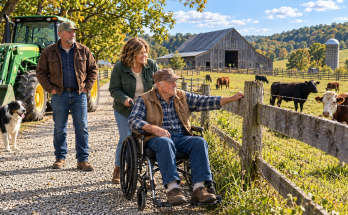
Outside, snow covered the barn roof and the fence posts along the driveway.
“Because I spent six years learning what happens when people don’t speak honestly.”
He turned back.
“I’m not going to ask you to spend another six years defending the truth to people determined not to hear it.”
I looked down.
“What should I do?”
“Let Henry handle the legal matters. Tell the truth when someone asks you directly. And don’t turn your whole life into an argument about my property.”
He smiled.
“You have a life of your own, sweetheart.”
I swallowed.
Sometimes, after so many years of helping Grandpa, I forgot that.
I’d driven him to appointments.
Picked up medication.
Handled repairs.
Visited after Grandma died when the farmhouse felt unbearably quiet.
I didn’t regret any of it.
But Grandpa was right.
I’d begun to measure every week by what he needed.
And somewhere along the way, I’d stopped making plans for myself.
He reached across the table.
“Your grandmother noticed.”
I looked up.
“What?”
“She noticed you stopped talking about going back to school.”
My cheeks warmed.
Three years earlier, I’d applied to a graduate program in agricultural education.
I’d wanted to help small rural communities develop programs that taught young people how to grow food, manage land, and build careers outside the cities.
Then Grandma became ill.
I deferred enrollment.
After her death, I never rescheduled it.
Grandpa watched me.
“She wanted you to go.”
I looked down.
“She needed help.”
“Yes,” he said gently. “And you helped.”
His eyes filled.
“But don’t confuse being needed with being required to put your whole future away.”
I couldn’t answer.
Then Grandpa smiled.
“That was one of the things she wanted Henry to tell you.”
My throat tightened.
“The harder gift?”
He nodded.
“Freedom, Katie.”
I stared.
“Freedom to love us without making your own life smaller.”
Three days after Christmas, Mr. Dawson called with news.
The real estate agent who had discussed the south parcel with Linda had provided copies of their communications.
They confirmed that she had approached the agent about a potential sale.
They also showed that she’d been seeking a buyer willing to move quickly if she gained authority to act for Grandpa.
One email said the family anticipated a guardianship appointment early in the new year.
Another proposed that prospective buyers begin preliminary site inspections before a court decided anything.
No completed land sale had occurred.
No valid contract signed by Grandpa had been found.
But the messages explained why Linda was in such a hurry.
She had already been discussing the money she expected to receive.
I sat beside Grandpa while Henry summarized the records.
Grandpa listened carefully.
Then asked, “Did she tell the agent I was dying?”
Henry looked at him.
“She described your condition as rapidly declining.”
Grandpa closed his eyes.
For a long moment, nobody spoke.
Then he gave a small, bitter laugh.
“Well, that’s news to me.”
Henry didn’t smile.
“There’s another issue. The petition includes a statement that your late wife supposedly agreed you could no longer make financial decisions.”
I looked up sharply.
“Grandma refused to sign anything like that.”
Henry nodded.
“Her letter contradicts the claim, and I have notes from my conversations with her. We’ll submit the relevant evidence through the appropriate process.”
Grandpa looked toward the window.
“She tried to warn me.”
I frowned.
“Grandma?”
He nodded.
“That final winter, Evelyn said Linda wasn’t visiting because she missed us.”
His eyes filled.
“She told me Linda looked at the farm the way a stranger looks at a house with a ‘For Sale’ sign.”
I swallowed.
“Did you believe her?”
He looked down.
“Not completely.”
The admission hurt.
He continued.
“I knew Linda had debts. I knew Gary wanted money for his boat. But I kept telling myself they’d never actually try to take control.”
He looked at the old photograph on the desk.
“I wanted to believe my children would remember how much their mother and I had loved them.”
I reached for his hand.
He squeezed it.
“Turns out loving somebody doesn’t guarantee they’ll make good choices.”
The court hearing took place in January.
Grandpa wore his brown suit.
The same suit he’d worn to my high school graduation.
He insisted on walking into the courthouse with his cane instead of using the wheelchair we’d brought in case he became tired.
I walked beside him.
Henry carried the documents.
Linda sat across the courtroom with her attorney.
Gary and Brett were behind her.
I tried not to look at them.
The judge reviewed the petition, medical evaluations, financial information, and the evidence concerning Grandpa’s decision-making.
Grandpa answered questions about his care, his income, his property, and his wishes.
He explained his hearing loss.
He described how his hearing aids worked.
And he demonstrated that he understood the consequences of both keeping and selling his land.
When he was asked why he’d allowed relatives to believe he couldn’t hear them, he was honest.
“At first, Your Honor, I wanted to know what people said when they thought I wasn’t listening.”
The judge looked at him.
“And later?”
Grandpa took a breath.
“Later, I was afraid of what would happen when they found out.”
I looked down.
He continued.
“I suppose that wasn’t my wisest decision.”
The judge considered him for a moment.
Then asked, “Do you understand that your relatives may disagree with your financial choices?”
Grandpa nodded.
“Of course.”
“And that disagreement alone does not mean anyone has authority to override those choices?”
“Yes.”
Grandpa straightened.
“I understand my children may wish I would sell the farm. But wishing doesn’t make it their farm.”
Several people shifted in their seats.
After reviewing the evidence, the court declined to grant the requested guardianship.
The judge found that the petition had not established the legal basis for taking away Grandpa’s decision-making authority.
Linda looked stunned.
Grandpa simply nodded.
He didn’t smile triumphantly.
He didn’t look toward his daughter.
When we left the courtroom, he stopped on the courthouse steps.
He breathed in the cold January air.
Then whispered, “I wish Evelyn were here.”
I took his arm.
“She would’ve been proud of you.”
He nodded.
A tear slipped down his cheek.
“She always was.”
Two weeks later, Caleb came to the farmhouse with an unexpected visitor.
Her name was Hannah Ruiz.
She was twenty-seven, recently returned from agricultural college, and the daughter of a man who had worked for Grandpa during my childhood.
Her father, Luis, had died several years earlier.
Grandpa remembered him immediately.
“Luis could repair a tractor with a pocketknife and a bad attitude,” he said.
Hannah laughed.
“That sounds like Dad.”
She had come to discuss working with Caleb on a new crop-management plan.
She also wanted to know whether Grandpa would consider leasing a smaller section of the farm for a training program involving young agricultural workers.
I watched Grandpa’s face change as she explained.
For months, the family had discussed the farm only in terms of its sale price.
Now someone was talking about soil health.
Seed costs.
Equipment maintenance.
The future of farming.
Hannah spread maps across the kitchen table.
“We want to help young people learn how to operate a farm responsibly,” she explained.
Grandpa leaned forward.
“What would they learn first?”
“Probably equipment safety and soil management.”
He smiled.
“Good. Too many people start with the machines and forget the ground underneath them.”
I laughed.
Hannah turned toward me.
“Caleb says you studied agricultural education.”
I nodded.
“A little.”
“Would you be interested in helping develop the curriculum?”
I stared.
Grandpa looked at me.
He didn’t speak.
He simply waited.
For the first time in years, nobody was telling me what family loyalty required.
Nobody was asking me to abandon my own plans.
A young woman was offering me an opportunity.
And my grandfather was giving me room to choose.
I looked at Hannah.
Then smiled.
“I’d love to talk about it.”
Grandpa reached for his coffee.
And I could have sworn I saw Grandma’s smile in the way his eyes brightened.
By March, the house felt different.
Not because everything had been repaired.
But because Grandpa had stopped pretending.
When someone telephoned, he answered without exaggerating his hearing loss.
When a visitor spoke too quietly, he asked them to repeat themselves without apology.
He wore his hearing aids openly.
Sometimes he even joked about them.
“Best investment I ever made,” he told Caleb one morning. “Though I could’ve done without some of the things they let me hear.”
Caleb laughed.
But I noticed that Grandpa had also stopped carrying the green notebook everywhere.
For six years, it had been his silent companion.
A record of insults.
Dates.
Conversations.
Cruel remarks spoken by people who assumed he couldn’t hear.
Now it sat in a drawer beside Grandma’s photograph.
One afternoon, I found him looking at it.
“Grandpa?”
He looked up.
“Yes?”
“Are you going to keep writing in it?”
He turned the notebook over in his hands.
Then shook his head.
“I don’t think so.”
I sat beside him.
“Why?”
He opened it to the final written page.
There were only three lines.
December 25. Linda asked when I would die.
Gary agreed.
Brett toasted the south parcel.
Grandpa stared at the words.
“I thought keeping a record would help me understand my family.”
I waited.
He continued.
“Eventually, I started expecting to hear something ugly every time someone opened their mouth.”
His eyes filled.
“That’s no way to spend what’s left of your life.”
I reached for his hand.
He closed the notebook.
“I’ll keep it because the records may still matter. But I’m finished collecting insults.”
I nodded.
Then he smiled.
“Besides, I’ve got better things to write down.”
He reached into a drawer and produced a new notebook.
A blue one.
On its first page, he’d written:
THINGS STILL WORTH LIVING FOR.
Beneath that were four entries.
Katie getting back to school.
Emily’s spring concert.
The first calves of the season.
Another Christmas with Evelyn’s pie.
I covered my mouth.
“Grandpa.”
He smiled.
“What?”
I leaned forward and hugged him.
He held me for a moment.
Then whispered, “Your grandma would tell me I’ve finally started paying attention to the right things.”
Aunt Linda came back to the farmhouse in April.
She called first.
That was new.
For years, she’d arrived whenever she pleased, helped herself to coffee, and asked questions about the property as though her name were already on the deed.
This time, she stood on the porch holding a small paper bag.
Grandpa invited her inside.
I was in the kitchen preparing lunch, but I offered to leave them alone.
Grandpa shook his head.
“Stay if you’d like, Katie. Linda and I don’t need any more secrets.”
My aunt looked uncomfortable.
Then she sat down.
For a long time, nobody spoke.
Finally, she placed the bag on the table.
Inside was a tin of Grandma’s favorite shortbread cookies.
“I made them from Mom’s recipe.”
Grandpa opened the tin.
He took one.
Broke it in half.
Tasted it.
Then smiled sadly.
“Needs a little more butter.”
Linda began crying.
Grandpa set the cookie down.
“What did you come to say, honey?”
She wiped her eyes.
“I’m sorry.”
He waited.
She continued.
“Not because the court ruled against me. Not because everybody found out what I said.”
Her voice shook.
“I’m sorry because I treated you like an obstacle.”
Grandpa’s eyes filled.
Linda stared at the table.
“I kept thinking about what the farm could do for me. How much it was worth. How much easier my life would be if it were sold.”
She swallowed.
“And I stopped thinking about the fact that it was your home.”
Grandpa didn’t answer.
She continued.
“I’ve started working with a financial counselor. I’m restructuring the mortgage and selling some things I can’t afford.”
I looked at her.
She gave me an embarrassed smile.
“Turns out I can’t solve my financial problems with somebody else’s property.”
Grandpa nodded slowly.
“That’s an important lesson.”
Linda looked at him.
“Can you forgive me?”
He took a breath.
“I love you, Linda.”
Her face crumpled.
“But I don’t trust you with my affairs.”
She nodded through tears.
“I understand.”
“And I won’t change the legal arrangements because you’re sorry.”
“I know.”
Grandpa looked at her for a long moment.
“Forgiveness isn’t a shortcut around responsibility.”
Linda lowered her eyes.
Then whispered, “I know that now.”
For the first time, I believed she might mean it.
Not because she was crying.
She’d cried before.
But because she had come without asking for anything.
No signature.
No check.
No promise about inheritance.
Just a difficult conversation with the father she’d hurt.
It wasn’t enough to erase six years.
But perhaps it was enough to begin something different.
Gary took longer.
He didn’t call in April.
Or May.
When Grandpa had a birthday in June, Gary sent a card.
Inside, he’d written only:
Hope you’re doing well, Dad.
Grandpa read it.
Then placed it beside the others.
I watched his face.
“Are you disappointed?”
He thought about it.
“Some.”
I sat beside him.
Then he added, “But I spent six years listening to him talk about what I’d leave behind. I suppose I can give him a little time to figure out what he wants to say while I’m still here.”
In July, Gary finally came to visit.
He brought no gifts.
He looked nervous.
He stood in the doorway holding his car keys.
“Dad, can we talk?”
Grandpa nodded.
They sat on the porch for nearly two hours.
I didn’t listen to their conversation.
Some things belonged between a father and his son.
Later, Gary came inside with red eyes.
He approached me.
“Katie.”
I looked up.
He swallowed.
“I owe you an apology.”
I waited.
He continued.
“I told people you were trying to take the farm.”
“Yes, you did.”
He nodded.
“And I knew you were the one taking Dad to his appointments.”
I looked at him.
“Then why did you say it?”
His face reddened.
“Because it made me feel better about not doing it myself.”
For a moment, I couldn’t speak.
Then he looked down.
“I was ashamed.”
I took a breath.
“Gary, you could’ve just come over.”
He nodded.
“I know.”
I wasn’t ready to hug him.
And I didn’t.
But I thanked him for telling the truth.
Sometimes that was all a person could offer at the beginning.
By late summer, Grandpa’s estate plan had been updated and reviewed with independent advisers.
He retained control of his farm and his decisions during his lifetime.
A professional successor trustee would manage the relevant assets if the trust’s terms required it later, rather than allowing one relative to seize control through assumption or pressure.
The working acreage would be maintained through a long-term management and leasing plan, with provisions designed to protect its agricultural purpose.
Grandpa also began discussing a conservation arrangement for part of the property, with the details dependent on careful legal, financial, and agricultural review.
Nobody could simply arrive with a real estate agent and sell the south parcel because they wanted a new boat.
And nobody, including me, would automatically become responsible for running two hundred acres without agreement, training, or support.
Caleb remained farm manager.
Hannah began developing the education program.
And I returned to school part-time.
The first time I walked into a classroom again, I felt twenty years younger and fifty years more frightened.
I almost turned around.
Then I remembered Grandpa’s words.
Don’t confuse being needed with being required to put your whole future away.
So I stayed.
I took notes.
Asked questions.
Made friends.
And slowly began remembering the person I’d been before my relatives’ expectations became the center of my life.
When I told Grandpa I’d passed my first course, he insisted on baking a cake.
It was dreadful.
He confused baking powder with baking soda and accidentally doubled the salt.
We ate one bite each.
Then burst out laughing.
Grandpa wiped tears from his eyes.
“Your grandmother would’ve divorced me over that cake.”
I laughed so hard I nearly fell off my chair.
And for the first time since Grandma died, the farmhouse sounded like a home again.
The following Christmas, we gathered at the farmhouse again.
There weren’t twenty-two people.
Not everyone was ready to return.
Some relatives still resented Grandpa’s decisions.
Some found it easier to call him stubborn than acknowledge how they’d treated him.
Brett sent a short apology but chose not to attend. Grandpa replied that he appreciated the words and would be happy to speak when Brett was ready to have an honest conversation.
The empty places still hurt.
But this time, nobody pretended they didn’t.
Linda arrived early and helped prepare dinner.
Gary carried firewood onto the porch.
Emily brought handmade decorations for the tree.
Caleb and Rosa joined us with their children.
And Hannah arrived carrying a framed photograph of the first group of students who’d completed our agricultural training program.
Grandpa studied the picture for a long time.
“Look at that,” he whispered.
I smiled.
“Twenty-three students.”
His eyes filled.
“Twenty-three people learning to take care of land.”
He looked toward the window.
“Your grandmother would’ve loved that.”
I nodded.
“She would have.”
Later, while we prepared dessert, I found a small note tucked inside Grandma’s old recipe book.
It was written in her familiar handwriting.
Katie, if you’re making my Christmas pie, don’t worry if it isn’t perfect. And don’t worry if the table isn’t full. A family isn’t measured by the number of chairs occupied, but by the love and honesty of the people sitting in them.
I read it twice.
Then carried it into the dining room.
Grandpa looked up.
“What’s that?”
I handed him the note.
He studied it.
His expression softened.
Then he laughed quietly.
“That woman always knew how to get the last word.”
Everyone smiled.
We sat down to dinner.
Grandpa took his place at the head of the table.
He wore the same good cardigan he’d worn the previous Christmas.
But this year, there was no green notebook beside his plate.
No whispered speculation about his death.
No discussion of how much money anyone might receive.
Linda asked him about the crops.
Gary asked how the tractor repairs were going.
Emily told him about her school concert.
And Grandpa listened.
Really listened.
Not to discover who might betray him.
But because the conversation was finally worth hearing.
Halfway through dinner, Linda turned toward him.
“Dad?”
He looked up.
“Yes, honey?”
She hesitated.
Then smiled.
“I’m glad you’re here.”
Grandpa’s eyes filled.
For a moment, he couldn’t speak.
Then he reached across the table and squeezed her hand.
“Me too, Linda.”
I looked toward Grandma’s empty chair.
We’d left a small candle beside her photograph.
Its flame moved gently whenever someone passed.
I missed her.
I missed her voice, her laughter, and the way she always insisted everyone take leftovers home.
But I no longer felt that losing her meant losing everything she’d taught us.
Her kindness remained.
Her courage remained.
And the truth she’d insisted we face had given us a chance to build something better.
After dinner, Grandpa called me onto the porch.
Snow was falling softly across the fields.
He stood beside me, leaning on his cane.
“Beautiful night,” he said.
I nodded.
“Yes.”
He looked toward the southern pasture.
“Remember what Linda said last Christmas?”
I swallowed.
“Of course.”
He nodded.
“She said the farm would pay off her mortgage when I died.”
I looked at him.
Then he smiled faintly.
“Funny thing, Katie. I spent so long worrying about what everybody planned to do after I was gone that I nearly forgot to enjoy being here.”
My eyes filled.
He continued.
“I can’t make them love me the way I wish they would. I can’t undo what they said.”
He reached for my hand.
“But I can decide what to do with the days I still have.”
I leaned against his shoulder.
“Grandpa, are you happy?”
He considered the question.
Then nodded.
“Not every minute.”
I smiled.
He continued.
“But I’ve got good people in my life. Work that matters. A granddaughter building her future.”
He looked toward the glowing farmhouse windows.
“And a few more Christmas dinners, if the good Lord allows.”
Tears slipped down my cheeks.
He squeezed my hand.
“That’s enough to be grateful for.”
We stood together as snow settled over the fences and the old barn.
Behind us, laughter drifted through the kitchen windows.
For six years, my family had spoken about Grandpa as though he were already gone.
But he had been there all along.
Listening.
Remembering.
Waiting.
And when he finally spoke, the most important thing he revealed wasn’t that he could hear.
It was that he was still a man with a heart, a future, and the right to decide how he wanted to live.
Because growing old doesn’t make a person less worthy of respect. And an inheritance is never more valuable than the living person who might one day leave it behind.
That Christmas, Grandpa didn’t need another notebook to remember what people said.
He had something better.
A table where people spoke to him instead of about him.
And a family beginning to understand that the greatest gift he could leave us was not his farm.
It was the chance to love him while he was still here.
THE END STORIES! THANK YOU FOR READING GOOD LUCK !❤️
Related Posts